As Pandemic Spending Rises, Pentagon Spending Needs Cuts

If there was any lingering hope of President Donald Trump making good on his promise to “quickly” balance the federal budget, COVID-19 has obliterated it once and for all. Pandemic relief spending has pushed 2020’s federal budget deficit north of $3.5 trillion while the economy is forecast to shrink by around 6 percent this year. As borrowing increases and economic growth is erased, publicly held debt is projected to exceed GDP for the first time since World War II.

These numbers are daunting, but the magnitude of the debt we’re taking on to grapple with the pandemic’s economic effects cannot be an excuse for excess. To all the talk of responsibilities COVID-19 has occasioned, add one more: Not leaving future generations with a balance higher than must be. As federal revenues decline, no expenditure should escape scrutiny, least of all the single biggest slice of the discretionary pie: Pentagon spending.

With a foreign policy pivot toward restraint and diplomacy, we can spend less—far less—on the military while strengthening U.S. security and peace. Here are five ways to start.

Reassess priorities. Effective foreign policy reform requires Washington to recognize its resources are limited and their use must be better prioritized. The purpose of U.S. defense spending is U.S. defense, not policing the world, meddling in other nations’ internal politics, or attempting to manage the balance of power in regions on the other side of the planet. The interventionist, military-first approach of the last two decades was always dangerous, expensive, and inhumane. It is clearer now than ever it is a mistake we cannot afford. Trump reportedly realizes this concerning Afghanistan, but the lesson must be applied more broadly.

End wars. The single most important way to reduce Pentagon spending and bolster U.S. security is to stop fighting a litany of counterproductive wars with no plausible path to anything like victory and an unacceptably high cost in blood and treasure. Get out of Iraq, Afghanistan, Syria, Yemen, Libya, Somalia, and smaller conflicts around the Middle East and North Africa. Don’t start a new war with Iran. Indeed, stop using military intervention as the primary option in U.S. foreign policy and rebuild American foreign affairs around patient, pragmatic diplomacy instead.

Share burdens. Trump has made a point of complaining about NATO allies free-riding on U.S. security, and the pandemic’s downward pressure on defense spending is an opportunity to put words into action. We should wind down U.S. influence and activity in NATO; bring U.S. troops home from permanent bases in Europe; and end U.S. involvement in Eastern European conflicts with Russia, which present an enormous risk of escalation into great power conflict.

Reduce footprint. In addition to reducing U.S. military presence in Europe, Washington should dramatically scale down our foreign military bases elsewhere around the world. This includes conducting a new round of Base Realignment and Closure (BRAC), which shutters unused facilities and others the Pentagon has already determined it does not need. But it should also include a bigger strategic move away from the assumption that it benefits the United States to have around 800 overseas bases in 70 nations. This global military sprawl is abnormal and unnecessary. It exposes us to needless risk and hikes the Pentagon’s annual baseline far too high.

Cut waste. To call for cutting Pentagon waste is a fiscal hawk cliche because the Department of Defense has a history of unreliable accounting and indefensible expenditures, perhaps no worse than average in Washington, but certainly on a larger scale. Better oversight will lower spending, and less spending will make good oversight more feasible. This is less important than strategic reform and cannot be its substitute, but it is probably also less controversial.

Writing at Foreign Affairs this month, Massachusetts Institute of Technology’s Barry R. Posen mulls the possibility of a “pax epidemica,” that widespread illness might curtail global military conflict. Whether that theory proves correct, the coronavirus pandemic should certainly occasion more prudence at the Pentagon in strategy and spending alike.

from Latest – Reason.com https://ift.tt/3f9Ruu9
via IFTTT
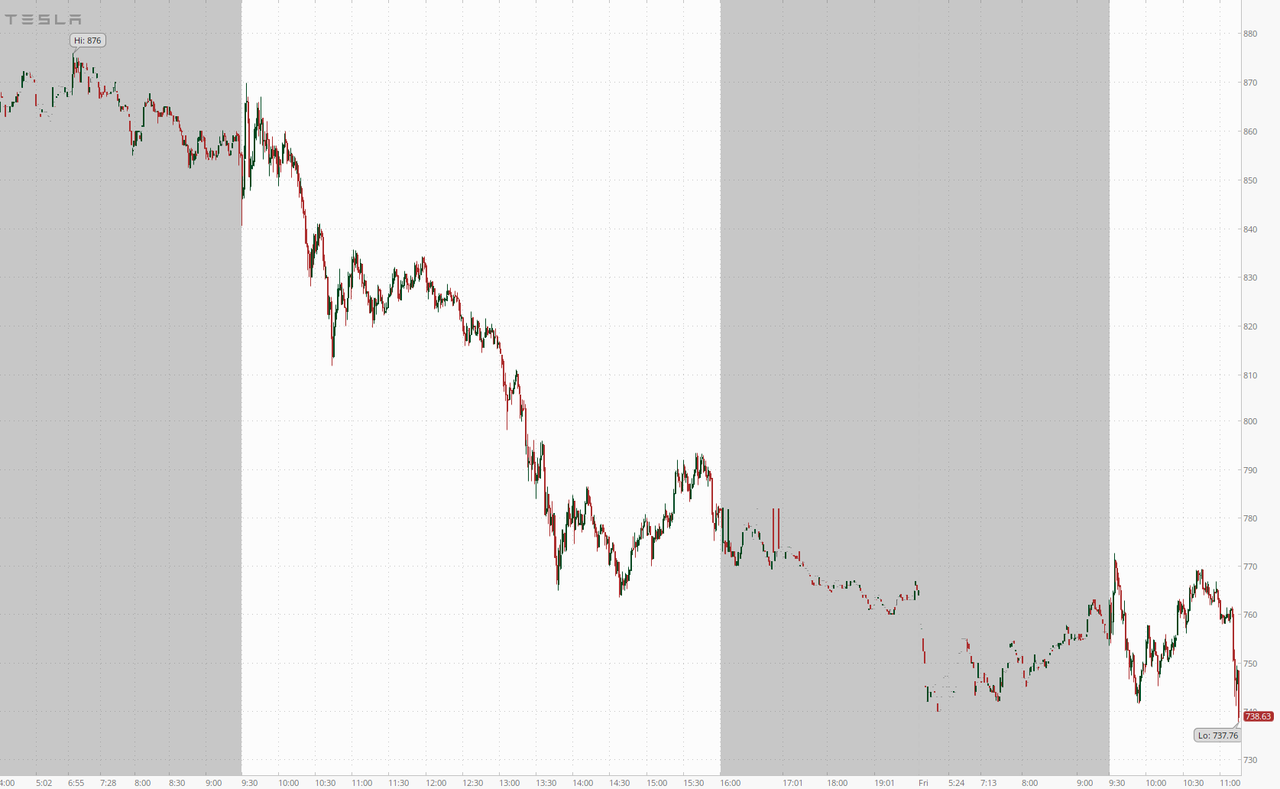
Hacked? Tesla Tumbles After Musk Twitter Account Says “Stock Price Too High”

Hacked? Tesla Tumbles After Musk Twitter Account Says “Stock Price Too High”

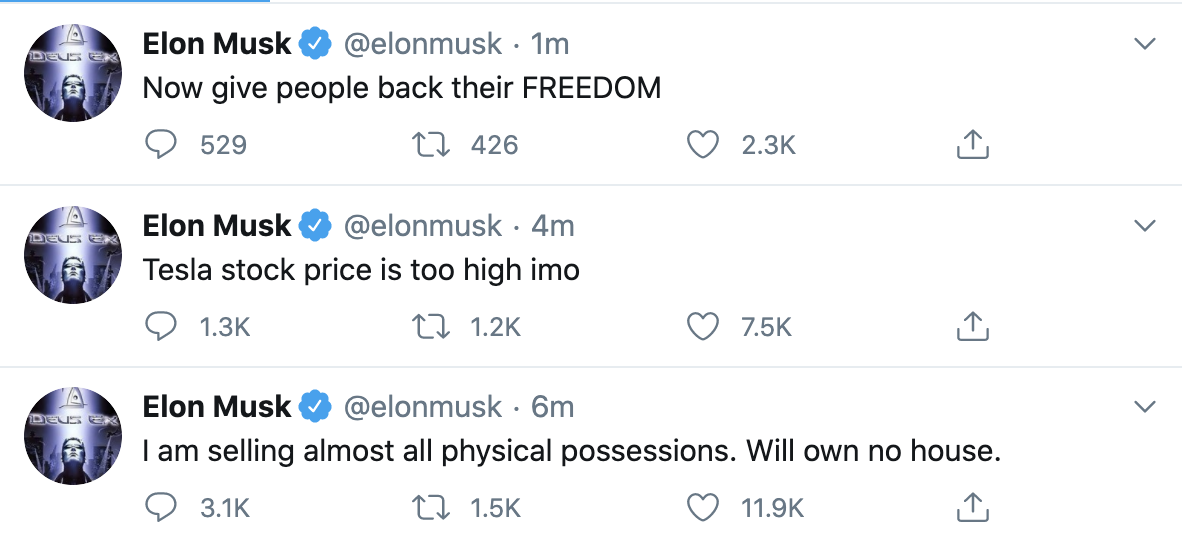
Elon Musk just tweeted that he’s planning on selling all his possessions and “will own no house”, before tweeting that Tesla’s share price is “too high” – basically a wet dream for Tesla bears.

Which raises suspicions about whether Musk’s account was hacked.

Here’s a screenshot of the three tweets (which included a “FREEDOM” tweet referencing his earnings call rant about California’s “fascist” lockdown).

Musk’s twitter bio has also been changed.

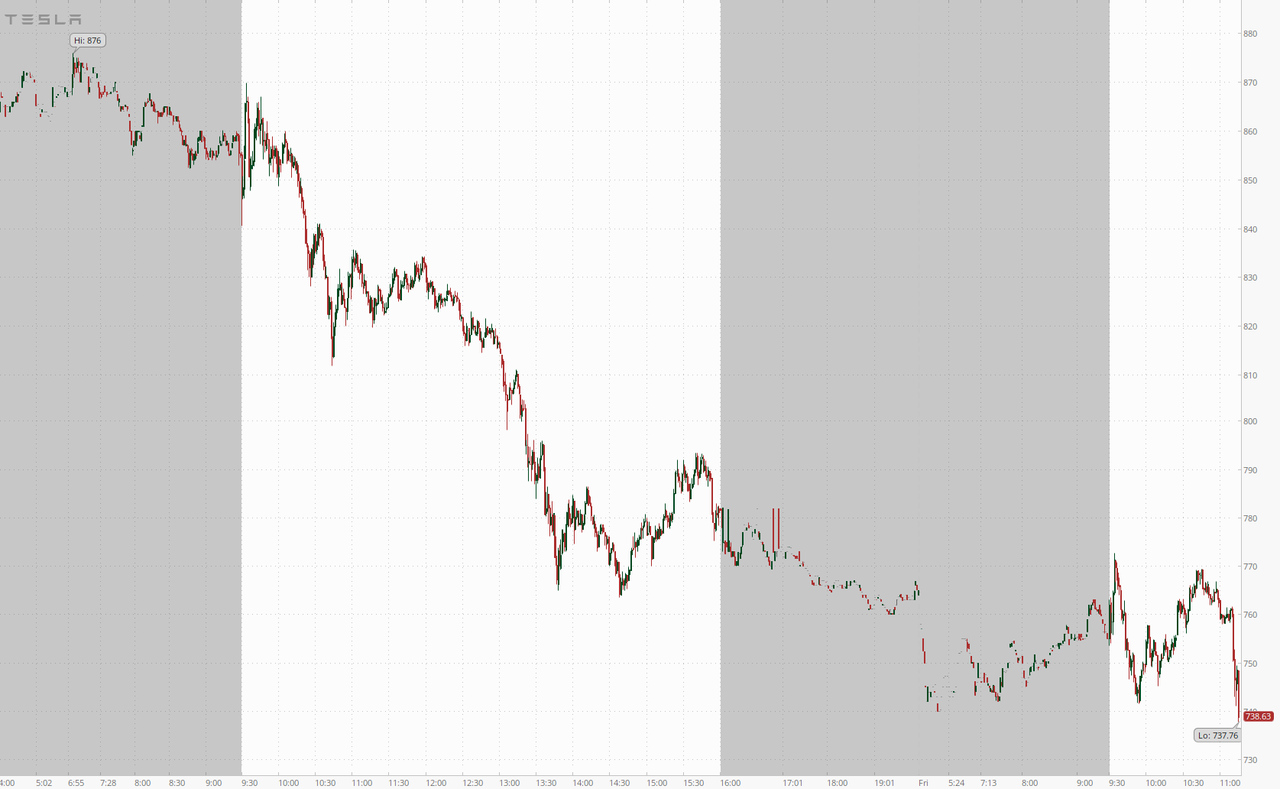
Whatever happened, it’s impacting Tesla’s shares, which are sliding on the “share price too high” comment.

No word yet form the company as the world wonders whether Musk has been hacked…or is perhaps in the middle of another meltdown.


Tyler Durden

Fri, 05/01/2020 – 11:17

via ZeroHedge News https://ift.tt/3bXXjce Tyler Durden

Mark Cuban Calls Out Elon Musk After CEO’s Bizarre Conference Call Tirade

Mark Cuban Calls Out Elon Musk After CEO’s Bizarre Conference Call Tirade

It was just two days ago when Elon Musk lashed out at California officials for extending the state (and, most importantly, Tesla’s) lockdown orders. As we noted, the notoriously volatile CEO went off on a bizarre expletive-laden tirade, calling government officials “fascists” and at one point simply asking “what the f*ck?”.

While it’s been clear to us for years that Musk appears to be completely unstable, Elon’s pattern of bizarre behavior culminating in this most recent conference call, where he weighed in on something that is life or death for so many people, may have turned some other innocent bystanders into critics.

For example, social media was littered with people using the #BoycottTesla hashtag, calling Elon out on his bluff:

And another one of these new outspoken critics is billionaire Mark Cuban.

Cuban was asked about the conference call while on Fox News on Wednesday, where he summed it up perfectly:

“Anything that negatively impacts Tesla, Elon hates, period, end of story. You know, I don’t think he has other people’s interests at heart.”

He continued: 

“My attitude is you’ve got to be smart. We don’t have to rush back into things. We get to learn.”

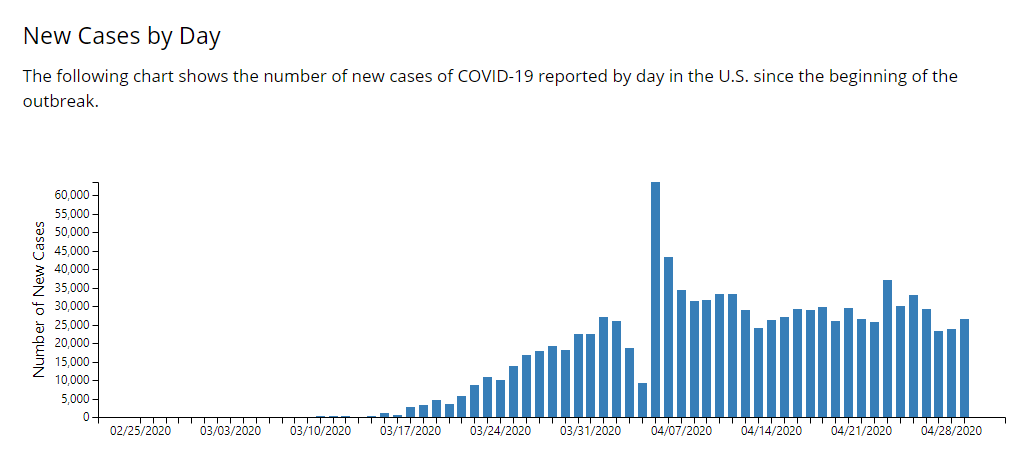
Meanwhile, Musk is doubling down on obviously false predictions he had made about the coronavirus months ago, including where where he predicted the U.S. would have close to zero new cases by now. There were over 26,000 cases reported on April 29, the day of Tesla’s conference call.

Recall, toward the end of Tesla’s conference call, Musk unleashed a 5-minute rant doubling down on his stance against the shelter-in-place orders that have gripped the United States economy in recent weeks, warning that the factory shutdowns are a “serious risk” to the electric automaker’s business.

“It will cause great harm, not just to Tesla, but to many companies,” Musk said on the call.

“And while Tesla will weather the storm, there are many companies that will not. Everything people have worked for their whole life is being destroyed in real time.”

“It’s breaking people’s freedoms in ways that are horrible and wrong and not why they came to America or built this country. What the fuck. Excuse me. Outrage. Outrage.”

“Frankly, I would call it forcible imprisoning of people in their homes against all of, their constitutional rights, in my opinion” he said, and then slammed the government imposed shutdown of all non-essential businesses as undemocratic and downright “fascist.”

“If somebody wants to stay in their house, that’s great and they should be able to,” he said. “But to say that they cannot leave their house and they will be arrested if they do, this is fascist.  This is not democratic, this is not freedom, give people back their goddamn freedom.”

The full rant can be heard in the clip below. It begins about 35 minutes into the clip and lasts about 8 minutes:


Tyler Durden

Fri, 05/01/2020 – 11:15

via ZeroHedge News https://ift.tt/2xq9NKt Tyler Durden

That Was Fast: CTAs Hammered After Turning “+100% Long” As Gamma Craters

That Was Fast: CTAs Hammered After Turning “+100% Long” As Gamma Craters

When yesterday we discussed the recent bizarro ramp in stocks that sent the S&P just shy of 3000 on the day the latest GDP print confirmed the US had entered a recession if not a depression, we explained that – in a world now totally disconnected from fundamental and economic reality – the move higher was entirely due to machines chasing momentum as CTA had flipped form net short to max 100% long…

… coupled with the sticky dealer “gamma” gravity at SPX 3,000 which served as a “strange attractor” for the market, pushing it just shy of this particular bogey.

Well, a lot can change in 24 hours, because as we closed out the best month for stocks since 1974, the rabid buying reversed violently after Trump warned he would seek retribution against China on their COVID19 response, which as Nomura’s Charlie McElligott writes created the dreaded “macro shock-down” catalyst to trigger an “accelerant (sell) flows” in the other direction.

What this means is that just as the technicals – i.e., dealer gamma and CTA momentum 0 conspired to send stocks soaring on the day the US entered a depression recession, so we are now facing the mirror image and as McElligott writes:

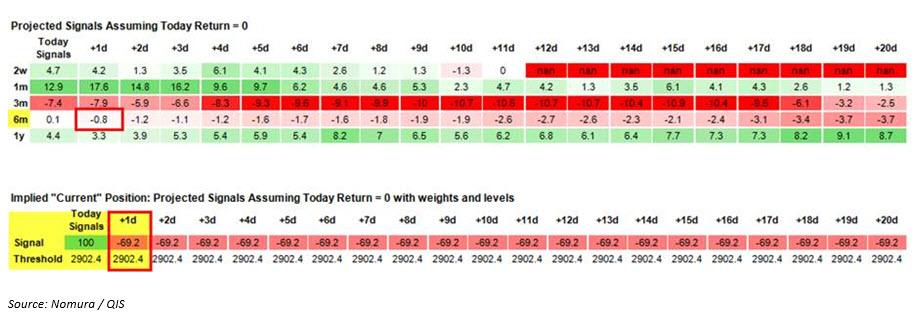
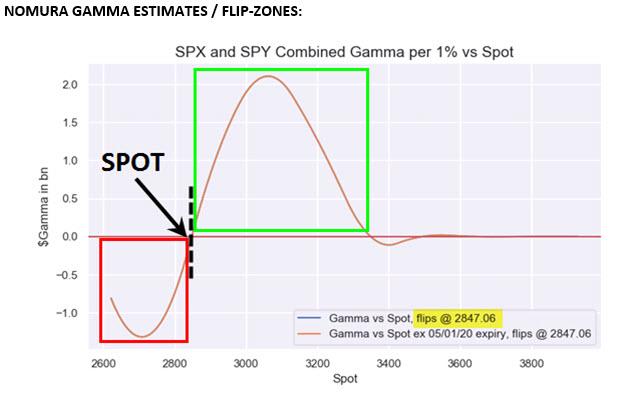
  • The gap-down tripped the just-established CTA “+100% Long” signal back into “-69% Short” territory (ref 2845 last in spot, well-below the 2926 trigger on-close required for the “flip short” and actually now proximate to the 2805 “-100% Short” signal trigger level)

  • The gap also shocked the also just-established Dealer “Long Gamma” position (when ref was ~2940 yday morning) now all the way back down to the exact “Neutral Gamma” level (2847, basically right where spot is now)—while any push lower from here then risking a move deeper into outright “Short Gamma” territory which would elicit heavier-handed Dealer hedging flows that likely dicate “selling-into lows”

In other words, the trapdoor opened just a day after CTAs flipped from legacy “short” back into a “+100% Long” stance in its S&P futures position with the S&P bounced safely around the significant Gamma levels between 2900 and 2950 strikes, when the avalanche of anti-China stories sent the ES trading off 135 handles from yesterday’s overnight highs to this morning’s lows.

As Nomura concludes, the extent/velocity of the selloff in Spooz matters because:

  1. it has sent the S&P back below the trigger level where CTAs would again pivot back -“short” as the 84.6% loading in the 6m window would “flip” (a close below 2926 has signal to -69% short, while below 2805 goes back -100% short—albeit all on smaller gross $ exposure)’
  2. this current spot ref ~2840 level is actually back (lower) to the “Gamma Neutral” level from yesterday’s typically insulating “Long Gamma” position for Dealers…but certainly now capable of slipping into outright “Short Gamma” on another surge lower

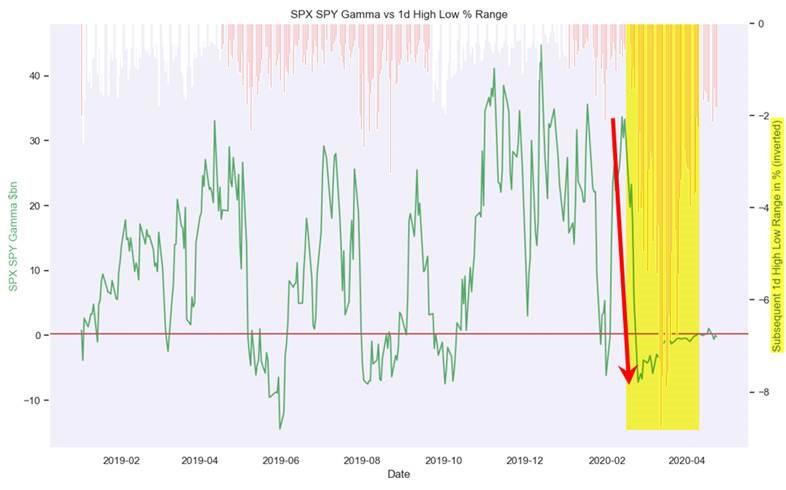
To the second point above, McElligott adds that impulse shifts lower in the Dealer “long gamma” position think of its a third derivative of prices tend to corroborate with larger trading ranges, especially as we get deeper into “short gamma” territory and Dealer hedging behavior is altered, having to “sell into the hole.”

In other words – thanks to this broken market – the more we drop, the lower the liquidity, the greater the bid/ask range, the higher the resulting vol, the greater the likelihood to drop more, and so on, which makes perfect sense in a bizarro market that hasn’t responded to any actual fundamentals in years, but is merely one giant reflexive feedback loop where past price action dictates future price action.

So, as McElligott concludes, the levels to watch today:

a bleed deeper into “Short Gamma” territory now that we are slightly below the “Gamma Neutral” level at 2847 (with $1.1B $Gamma at the 2850 strike)…things get especially frisky into an approach of 2805 (CTA’s going deeper short from “-69% Short”- to “-100% Short”- signal) and the “Short Gamma” more aggressive options Dealer hedging flows (selling into lows), all of which could conspire and accelerate this market reversal–particularly in light of weaker holiday volumes.


Tyler Durden

Fri, 05/01/2020 – 10:56

via ZeroHedge News https://ift.tt/3f7ZL1C Tyler Durden

Texas Is Allowing Restaurants To Reopen Starting Today. Many Restaurant Owners Fear It Won’t Go Well.

Starting today, many of Texas’s restaurants, movie theaters, malls, and retail locations will be partially open for business, operating at 25 percent capacity, per orders that Gov. Greg Abbott released last Monday. Establishments in counties that have had less than five coronavirus cases as of April 30 may jump straight to operating at 50 percent capacity.

If Texas does not see a vast spike in new COVID-19 cases by May 18, Abbott says, phase two of the reopening can commence. That will involve bumping allowed capacity up to 50 percent in all counties, plus allowing barbershops, hair salons, gyms, and bars to open as well.

The aim is to balance the interests of businesses and workers who have been hit hard by government-mandated lockdowns, who have lost weeks of revenue through no fault of their own, with the public health concerns that led the authorities to shut down much of the economy. Texas has had a less severe outbreak so far than many other states—28,000 infections, with just under 800 deaths. The state’s hospitals, even in such cities as Austin and Houston, haven’t had to deal with overflowing ICUs like the ones in New Orleans and New York.

But many restaurant owners in Austin, where I live, say that operating at 25 percent isn’t feasible for their business models, doesn’t seem prudent at this time, and would hardly provide much economic relief anyway.

“From a business perspective, it’s negligible at 25 percent. But even at 75 percent, I just don’t know how I would manage safe social distancing for everyone and keep my customers and employees safe,” says Jay Lee, owner of a pan-Asian restaurant called Koriente. “You can’t exactly eat with a mask on, and I have a small space where people would be in close proximity to each other.” Lee will keep Koriente closed for now.

“Opening at 25 percent is not viable for our 40-seat restaurant, as we would be adding back the costs we have cut and not serving nearly as many people as we are with to-go service,” says Sarah Heard, owner of Foreign and Domestic. The restaurant, which sources from local farms as much as possible, shifted to offering takeout service and groceries (which they intend to maintain for now), plus outdoor seating where you can eat on the premises if you abide by contactless payment and counter pickup. Phase one doesn’t change much for them.

For larger restaurants, reopening at this capacity is possible. Mighty Fine and Rudy’s Bar-B-Q both have foldable chairs and tables in their locations, notes brand director Allyson Young, so it plans to reconfigure its indoor dining space to accommodate social distancing. It has maintained a full staff during the Texas shutdown, having shifted to takeout service—indeed, it’s even been hiring.

Salt Lick BBQ owner Scott Roberts says the restaurant, located in the nearby town of Dripping Springs, will do a modified version of phase one, keeping its dining room closed but shifting toward outdoor seating. His plan: “Get the barbecue, find a shade tree, and enjoy.” The restaurant will reassess its options when phase two starts.

Smaller restaurant owners are less optimistic. Paola Guerrero-Smith, co-owner of Buenos Aires Café, says: “Last week we re-organized our floor layout [at the East 6th St. location] just to see what it would look like to have a less crowded seating arrangement per other cities protocols. And it was an eye opener for sure. The restaurant as we once knew it is no longer a reasonable business model anymore. At least not for a while.”

“Nothing changed since March 17,” adds Guerrero-Smith. “The cases have not dropped and we are still at risk. Our restaurant is already small, and to operate at 25 percent capacity means 20 guests at any given time. Twenty-five percent or less labor is 7 of the 30 employees, 25 percent or less of the food and beverage offerings we can offer. But it doesn’t mean 25 percent less of our financial responsibilities. Payments are being deferred but not forgiven. And when our staff loses unemployment because now we have to [be] ‘open for business’ then we are going to have even further serious problems.”

Guerrero-Smith’s concerns about unemployment benefits are reasonable. Day cares have been instructed to only take the children of “essential” workers, but any workers who choose not to return once their employers reopen will no longer be eligible for unemployment benefits. The Texas Tribune reports that the Texas Workforce Commission said earlier this week that it is “considering case-by-case waivers” that would alter the rules, but nothing has been finalized.

Not only are many smaller restaurant owners unable or unwilling to open at 25 percent, but there are a host of other problems that come with the state’s confusing, contradictory patchwork of rules, some of which have not been suspended in advance.

And of course, demand might not bounce back in phase one, or even phase two. People have lost a lot of disposable income and gained a lot of caution. Will the joy of going out to dinner—the busy hum of a full restaurant, the knowledge you won’t have to do any dishes later, the comfort of being taken care of by an especially attentive waiter, the ability to revel in dishes you’d struggle to make in your own kitchen—be easily summoned again?

Abbott’s critics argue that he made a rash decision to reopen while Texas’s testing capacity remains low. Texas Monthly argues that the governor has cherry-picked data and time frames to convey that Texas’s cases are dwindling. But that matters less if business owners are willing to pick up the slack, making independent decisions while considering their own risk tolerance and financial realities. 

The issue is the actual on-the-ground circumstances of those who are affected by this pandemic and the subsequent closures. Smaller restaurants will be hit hardest by this, and reopening at such reduced capacities unfortunately delivers far less economic relief to them than anticipated.

from Latest – Reason.com https://ift.tt/2Yq1Obh
via IFTTT

Justin Amash: People Want a President ‘Who Is Normal, Honest, Practical, Capable.’

Five-term Michigan Congressman Justin Amash has announced that he’s running for the Libertarian Party’s presidential nomination, which will be decided in late May. The 40-year-old son of Middle Eastern immigrants took office in 2011 as a Republican but left the party last July, saying he didn’t want to be part of a partisan death spiral. He has consistently voted against corporate bailouts, increases in debt-financed government spending, overseas military interventions, and the prosecution of the federal drug war.

During the coronavirus pandemic, Amash has castigated federal agencies such as the Centers for Disease Control and the Food and Drug Administration, first for botching containment efforts and then for asserting monopoly control over testing. He was one of a mere handful of no votes on the $2.2 trillion CARES Act, arguing that all relief payments should go directly to individuals and households rather than corporations, nonprofits, or government agencies.

Republican and Democratic loyalists are lashing out at Amash as a quixotic potential spoiler with no chance of being elected and calling for him to step aside. 

Nick Gillespie talked with Amash over Skype about why he thinks Donald Trump is too erratic to be given a second term, why Joe Biden is too old for a first term, and why he believes his vision of a freer country will take him to victory in November.

Read a transcript of the interview.

Edited by John Osterhoudt. Amash graphics by Lex Villena.

Photo credit: Gage Skidmore from Peoria, AZ, United States of America / CC BY-SA (https://ift.tt/UbRXBT); Bill Clark/CQ Roll Call/Newscom; Jeff Malet Photography/Newscom; Keiko Hiromi/AFLO/Newscom; Michael Reynolds/ZUMA Press/Newscom; Graeme Sloan/Sipa USA/Newscom; Mateusz Wlodarczyk / Forum/ZUMA Press/Newscom; Pool/TNS/Newscom; Michael Brochstein/ZUMA Press/Newscom; JOHN ANGELILLO/UPI/Newscom

from Latest – Reason.com https://ift.tt/3bQhfxs
via IFTTT

Criticize the Michigan Protesters for Crowding Into a Building Without Masks On, Not for Peacefully Carrying Weapons

Michigan legislators passed a bill yesterday afternoon that said they can sue Gov. Gretchen Whitmer if she extends shutdown orders beyond May 15. Last night, the Democratic governor did in fact issue an executive order extending the shutdown to May 28and promised to veto any attempt to limit her authority to do so.

“The governor will not sign any bills that constrain her ability to protect the people of Michigan from this deadly virus in a timely manner,” said Whitmer’s office in a Thursday evening statement. “The governor intends to veto this bill when presented to her.”

This follows a raucous day at the Michigan state capitol.

Michigan residents rallying there yesterdaythe latest in a series of cross-country protests against restrictive lockdown policies—once again saw the most outrageous or worst elements get highlighted as representative of the whole lot.

It’s not entirely the media’s fault. These folks mean to attract attention. They’re eager to talk to reporters. And they’re often initially shared in social media photos not by professional reporters but by others attending (or counterprotesting) the rally. Pictures of normie-looking people quietly exercising their rights don’t tend to go viral. And while many local news accounts of protests have been thorough, balanced, and nuanced, it’s always the wildest quote or character from these accounts that capture public attention even before cable news programs and the culture war’s digital aggregators get their hands on them.

Still, the latest spectacle in Michigan has proven a particularly ripe target for sensationalized press. You see, some protesters were armed. Visibly armed. (Concealed carry is banned on the capitol grounds, so visibly armed is the only way there to be legally armed.) No guns were discharged, and there were no reports of people carrying illegal weapons. Yet the firearms seem to have garnered more visceral horror and public condemnation than the legitimate public health problem posed by maskless protesters crowding into buildings and shouting up close in each other’s and staff’s faces.

The “American Patriot Rally” started outside, reported Craig Mauger of The Detroit News, who was there throughout the day. But protesters were let into the capitol lobby, where they began chanting “let us in” after they were denied entry to the closed legislative chamber.

Armed “gunmen” did not “storm” the capital in a threatening manner, a claim that was making the rounds online for a bit yesterday, nor were police required to protect Whitmer from them. Only one person was arrested yesterday, police told Mauger—and that was for ripping a flag out of someone else’s hands.

Whitmer spokesperson Tiffany Brown in a statement said yesterday that “it’s disappointing to see people congregating without masks, and without practicing social distancing. This kind of activity will put more people at risk, and it could mean that more people will die.”

She’s right. Regardless of whether Michigan’s shutdown orders go too far, protesters will lose some public sympathy and some moral high ground when they move unnecessarily put others at risk in those ways.

But the state shares a good deal of blame here, even putting aside larger shutdown-oriented battles. They could, after all, have offered to let the protesters enter the building in an orderly and public-health-friendly fashion. They could have let protesters who were taking the proper precautions go further into the building and make themselves heard before their elected officials.

At the very least, they could have issued state police and capital staff better protective gear.

Inside the closed legislature, Michigan state lawmakers were debating whether to extend a state-of-emergency declaration. The state of emergency declaration is separate from Whitmer’s shelter-in-place order, which is ostensibly what people were rallying against.

In addition, a resolution was introduced “authorizing the Speaker of the House to commence legal action on behalf of the House of Representatives challenging the Governor’s authority and actions during the COVID-19 pandemic.” It was adopted by a voice vote, as was a similar resolution in the state Senate.

The resolutions (Senate Resolution 114 and House Resolution 250) would have to be approved by Gov. Whitmer, who said she would veto “any bills that constrain her ability to protect the people of Michigan from this deadly virus.”

Michigan Advance notes that “Whitmer’s office maintains she holds legal authority to continue her emergency orders without the Legislature’s approval under the Constitution and the Emergency Powers of Governor Act.”

Outside the legislature yesterday, some of those carrying guns talked to local reporters and sounded far from the crazed maniacs they’ve been portrayed as:

As to why some protesters were carrying guns Thursday, John Parkinson, 47, of Macomb Township, said his weapon is like a piece of clothing to him, and he carries it for personal protection.

“It is our constitutional right,” he said. “It is not that we are trying to say, ‘Look at me. Look at me.’ This is what we do. This is how we do things. This is our way of life. I openly carry my handgun daily.”

Unfortunately, freakouts over people peacefully exercising their rights—and the antics of an irresponsible segment among the protesters—distract from the reasonable and real issues being addressed by many ralliers and stay-at-home supporters of lifting lockdown orders to at least some degree.

It’s not a choice between total lockdown and utter inaction, as Reason‘s Shika Dalmia writes at The Week. “We need more targeted approaches to contain high-risk activities and protect high-risk populations while giving ordinary Americans more—not less—freedom to figure out when and how they want to return to work and some semblance of normal life.”


QUICK HITS

  • In a Friday morning appearance on Morning Joe, Democratic presidential candidate Joe Biden addressed Tara Reade’s sexual assault allegation against him. “No. It is not true. I’m saying unequivocally it never happened,” said Biden.
  • Nick Gillespie interviews Rep. Justin Amash (L-Mich.) about a range of things, including the sexual assault allegations against both President Donald Trump and former Vice President Joe Biden. “When asked if he could state that he has never assaulted or behaved improperly toward anyone, Amash said, ‘Yes, I can say that definitively.'”

from Latest – Reason.com https://ift.tt/2YnPzME
via IFTTT

Texas Is Allowing Restaurants To Reopen Starting Today. Many Restaurant Owners Fear It Won’t Go Well.

Starting today, many of Texas’s restaurants, movie theaters, malls, and retail locations will be partially open for business, operating at 25 percent capacity, per orders that Gov. Greg Abbott released last Monday. Establishments in counties that have had less than five coronavirus cases as of April 30 may jump straight to operating at 50 percent capacity.

If Texas does not see a vast spike in new COVID-19 cases by May 18, Abbott says, phase two of the reopening can commence. That will involve bumping allowed capacity up to 50 percent in all counties, plus allowing barbershops, hair salons, gyms, and bars to open as well.

The aim is to balance the interests of businesses and workers who have been hit hard by government-mandated lockdowns, who have lost weeks of revenue through no fault of their own, with the public health concerns that led the authorities to shut down much of the economy. Texas has had a less severe outbreak so far than many other states—28,000 infections, with just under 800 deaths. The state’s hospitals, even in such cities as Austin and Houston, haven’t had to deal with overflowing ICUs like the ones in New Orleans and New York.

But many restaurant owners in Austin, where I live, say that operating at 25 percent isn’t feasible for their business models, doesn’t seem prudent at this time, and would hardly provide much economic relief anyway.

“From a business perspective, it’s negligible at 25 percent. But even at 75 percent, I just don’t know how I would manage safe social distancing for everyone and keep my customers and employees safe,” says Jay Lee, owner of a pan-Asian restaurant called Koriente. “You can’t exactly eat with a mask on, and I have a small space where people would be in close proximity to each other.” Lee will keep Koriente closed for now.

“Opening at 25 percent is not viable for our 40-seat restaurant, as we would be adding back the costs we have cut and not serving nearly as many people as we are with to-go service,” says Sarah Heard, owner of Foreign and Domestic. The restaurant, which sources from local farms as much as possible, shifted to offering takeout service and groceries (which they intend to maintain for now), plus outdoor seating where you can eat on the premises if you abide by contactless payment and counter pickup. Phase one doesn’t change much for them.

For larger restaurants, reopening at this capacity is possible. Mighty Fine and Rudy’s Bar-B-Q both have foldable chairs and tables in their locations, notes brand director Allyson Young, so it plans to reconfigure its indoor dining space to accommodate social distancing. It has maintained a full staff during the Texas shutdown, having shifted to takeout service—indeed, it’s even been hiring.

Salt Lick BBQ owner Scott Roberts says the restaurant, located in the nearby town of Dripping Springs, will do a modified version of phase one, keeping its dining room closed but shifting toward outdoor seating. His plan: “Get the barbecue, find a shade tree, and enjoy.” The restaurant will reassess its options when phase two starts.

Smaller restaurant owners are less optimistic. Paola Guerrero-Smith, co-owner of Buenos Aires Café, says: “Last week we re-organized our floor layout [at the East 6th St. location] just to see what it would look like to have a less crowded seating arrangement per other cities protocols. And it was an eye opener for sure. The restaurant as we once knew it is no longer a reasonable business model anymore. At least not for a while.”

“Nothing changed since March 17,” adds Guerrero-Smith. “The cases have not dropped and we are still at risk. Our restaurant is already small, and to operate at 25 percent capacity means 20 guests at any given time. Twenty-five percent or less labor is 7 of the 30 employees, 25 percent or less of the food and beverage offerings we can offer. But it doesn’t mean 25 percent less of our financial responsibilities. Payments are being deferred but not forgiven. And when our staff loses unemployment because now we have to [be] ‘open for business’ then we are going to have even further serious problems.”

Guerrero-Smith’s concerns about unemployment benefits are reasonable. Day cares have been instructed to only take the children of “essential” workers, but any workers who choose not to return once their employers reopen will no longer be eligible for unemployment benefits. The Texas Tribune reports that the Texas Workforce Commission said earlier this week that it is “considering case-by-case waivers” that would alter the rules, but nothing has been finalized.

Not only are many smaller restaurant owners unable or unwilling to open at 25 percent, but there are a host of other problems that come with the state’s confusing, contradictory patchwork of rules, some of which have not been suspended in advance.

And of course, demand might not bounce back in phase one, or even phase two. People have lost a lot of disposable income and gained a lot of caution. Will the joy of going out to dinner—the busy hum of a full restaurant, the knowledge you won’t have to do any dishes later, the comfort of being taken care of by an especially attentive waiter, the ability to revel in dishes you’d struggle to make in your own kitchen—be easily summoned again?

Abbott’s critics argue that he made a rash decision to reopen while Texas’s testing capacity remains low. Texas Monthly argues that the governor has cherry-picked data and time frames to convey that Texas’s cases are dwindling. But that matters less if business owners are willing to pick up the slack, making independent decisions while considering their own risk tolerance and financial realities. 

The issue is the actual on-the-ground circumstances of those who are affected by this pandemic and the subsequent closures. Smaller restaurants will be hit hardest by this, and reopening at such reduced capacities unfortunately delivers far less economic relief to them than anticipated.

from Latest – Reason.com https://ift.tt/2SsprfA
via IFTTT

Justin Amash: People Want a President ‘Who Is Normal, Honest, Practical, Capable.’

Five-term Michigan Congressman Justin Amash has announced that he’s running for the Libertarian Party’s presidential nomination, which will be decided in late May. The 40-year-old son of Middle Eastern immigrants took office in 2011 as a Republican but left the party last July, saying he didn’t want to be part of a partisan death spiral. He has consistently voted against corporate bailouts, increases in debt-financed government spending, overseas military interventions, and the prosecution of the federal drug war.

During the coronavirus pandemic, Amash has castigated federal agencies such as the Centers for Disease Control and the Food and Drug Administration, first for botching containment efforts and then for asserting monopoly control over testing. He was one of a mere handful of no votes on the $2.2 trillion CARES Act, arguing that all relief payments should go directly to individuals and households rather than corporations, nonprofits, or government agencies.

Republican and Democratic loyalists are lashing out at Amash as a quixotic potential spoiler with no chance of being elected and calling for him to step aside. 

Nick Gillespie talked with Amash over Skype about why he thinks Donald Trump is too erratic to be given a second term, why Joe Biden is too old for a first term, and why he believes his vision of a freer country will take him to victory in November.

Read a transcript of the interview.

Edited by John Osterhoudt. Amash graphics by Lex Villena.

Photo credit: Gage Skidmore from Peoria, AZ, United States of America / CC BY-SA (https://ift.tt/UbRXBT); Bill Clark/CQ Roll Call/Newscom; Jeff Malet Photography/Newscom; Keiko Hiromi/AFLO/Newscom; Michael Reynolds/ZUMA Press/Newscom; Graeme Sloan/Sipa USA/Newscom; Mateusz Wlodarczyk / Forum/ZUMA Press/Newscom; Pool/TNS/Newscom; Michael Brochstein/ZUMA Press/Newscom; JOHN ANGELILLO/UPI/Newscom

from Latest – Reason.com https://ift.tt/3bQhfxs
via IFTTT

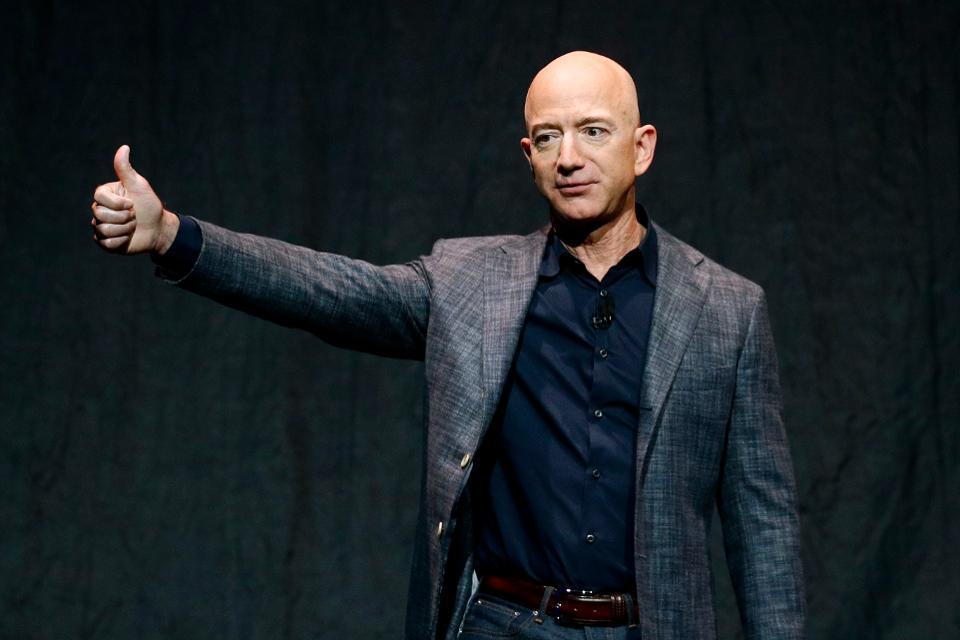
Jeff Bezos Called To Testify Before Congress As House Judiciary Launches Amazon Perjury Probe

Jeff Bezos Called To Testify Before Congress As House Judiciary Launches Amazon Perjury Probe

After a report in the Wall Street Journal appeared to show that Amazon used data gleaned from third-party transactions and used it to for the company’s own competitive advantage on its platform, the House Judiciary Committee on Friday announced that it was launching an investigation into the company over whether it committed perjury during a Congressional hearing.

The probe will require Amazon CEO Jeff Bezos to testify before Congress, something he has previously resisted.

Bezos is the only CEO of the American Tech “big four” (Amazon, Apple, Google and Facebook) who has never before testified in front of Congress.

Last night, Bezos told Amazon investors to “take a seat”, and insisted that the company would continue to invest in its vast expansion plans despite posting disappointing results.

Of course, Amazon is still responsible for a huge percentage of the broader market rebound last month, even if investors didn’t exactly take to the earnings.

But the fact that Democrats are opening this investigation suggests that the bipartisan antipathy toward Amazon is gathering pace more quickly than the public – and perhaps even Mr. Bezos himself – truly understands.


Tyler Durden

Fri, 05/01/2020 – 10:42

via ZeroHedge News https://ift.tt/3d6PWiJ Tyler Durden