Judge Rules Vegan ‘Butter’ Can Be Labeled as ‘Vegan Butter’

veganbutter

Last week, U.S. District Court Judge Richard Seeborg of California’s Northern District Court ruled Miyoko’s Creamery, maker of a vegan butter, may use the word “butter” to describe its, well, vegan butter.

As the ruling details, Miyoko’s received a warning letter from California agricultural regulators in December that claimed the company’s vegan butter products and website “ran afoul of state and federal law.” In that letter, California dairy regulators informed Miyoko’s that its vegan butter “‘is not butter’ and may not imply it is ‘a dairy food.'”

Miyoko’s, which is sold at thousands of U.S. and Canadian retail outlets, including Safeway, Whole Foods, and Costco, sued in February, arguing the state’s misguided threats could cost the company millions of dollars while violating the company’s First Amendment rights.

Last week’s ruling enjoins California from enforcing any ban on Miyoko’s use of the term “butter” while the lawsuit proceeds.

“This victory is the latest in a growing trend of common-sense labeling decisions made in courts across the United States,” said Michele Simon, executive director of the Plant-Based Foods Association, which represents plant-based food producers.

The warning that California regulators sent Miyoko’s alleged the company’s butters violated state and federal “standards of identity” for butter. As I write in my book, Biting the Hands that Feed Us: How Fewer, Smarter Laws Would Make Our Food System More Sustainable, standards of identity “establish specific rules for what foods may be labeled under a given name,” including ingredients that may, must, or may not be present in the food, sometimes even specifying acceptable percentages of such ingredients. For example, as I note in the book, the USDA’s standard of identity for hot dogs (“hotdogs”) declares they must contain “raw skeletal muscle meat… may (but need not) contain ‘poultry skin’ and pig lips [and] may not contain more than 30 percent fat.”

“In the State’s central thesis, Miyoko’s product does not meet the federal standard for ‘butter’ (which it cannot be called without dairy and an 80% fat content), barely evades being ‘margarine’ (which it would have to be called if it was slightly fattier), and ought to be sold as a ‘spread’ (non-enforcement around peanut-and-fruit-based “butter” notwithstanding),” Judge Seeborg’s ruling explains.

Dictionary definitions of “butter” make clear that use of the term a) is not limited to products made from animal-based ingredients, and b) may include vegetable-based ingredients. For example, Dictionary.com, which uses definitions pulled chiefly from Random House’s popular unabridged dictionary, defines butter to include “any of various other soft spreads for bread: apple butter; peanut butter” or “any of various substances of butterlike consistency… and certain vegetable oils solid at ordinary temperatures.”

I was extremely pleased to learn Judge Seeborg’s ruling cited Ocheesee Creamery v. Putnam—a 2017 federal court case in Florida in which I served as an expert—as support for Miyoko’s position. In Ocheesee, Florida regulators attempted to force a small, all-natural creamery to stop using the term “skim milk” to describe its 100% skim milk because the state’s standard of identity for “skim milk” required the frivolous addition of vitamin E to all skim milk—something Ocheesee refused to do.

In my book and elsewhere, I’ve argued all standards of identity are absurd and may be unconstitutional. While Judge Seeborg doesn’t go that far in his ruling, he makes a point that I made in my expert Ocheesee testimony and report: a government body may not redefine a word to the exclusion of its traditional and usual dictionary definition.

“[J]ustifying governmental speech regulation using the government-issued dictionary is troublingly self-fulfilling,” Judge Seeborg writes.

Just as happened in the Ocheesee case, one the chief claims of California regulators in the vegan butter case is that the product in question was somehow misleading consumers. Miyoko’s countered that no reasonable consumer has been, is, or could be fooled into thinking its products are derived from animal milk rather than from plants. The company’s packaging and messaging prove that fact. For example, the front of the company’s European Style Cultured Vegan Butter packaging alone uses the word “vegan” twice, notes the “cashew & coconut oil spread” is “100% crafted from plants,” is “lactose free,” states that it “contains nuts,” and boasts a photo of a dozen or so cashews.

“I don’t think there’s a single confused consumer out there,” owner Miyoko Schinner told Bay Area news station KPIX in February. “No more than a consumer is confused when they order almond milk. They know it’s not dairy milk. In fact, they’re ordering almond milk because they don’t want dairy milk!”

Judge Seeborg agreed, noting that California had failed to identify even one consumer who claimed they’d been misled by Miyoko’s. He referred to the state’s position as “underwhelming” and “unanchored by precedent, empirical research, or any other form of independently authoritative ballast.”

As in the vegan butter case, makers of many other foods produced using cow’s milk often claim exclusive domain over words that, both historically and presently, do not even imply such ownership. As I’ve detailed many times—including in Biting the Hands that Feed Us and here—”the dairy industry has been making a living out of seeking government protection against its competitors since, perhaps, the dawn of time. And the federal government (along with state governments) has a long and sordid history of obliging the industry.”

That’s protectionism, plain and simple. And that is in fact exactly—wholly and only—what the Miyoko’s case is all about. The state really must hate that everyone knows it, too.

Miyoko believes this is simply a government agency trying to protect an industry that feels threatened by change,” the KPIX report notes.

“California’s move against Miy[o]ko’s comes amid a nation-wide battle by dairy and meat producers to quash the growth of plant-based alternatives,” the San Jose Mercury News reported in February, after Miyoko’s sued the state.

“The dairy lobby’s efforts to use the California government as a tool was thankfully overruled by a judge who upheld the First Amendment, not to mention common sense,” Simon, of the Plant-Based Foods Association, told me by email this week.

This month’s ruling is a win for free speech and food freedom and a blow to protectionism. That’s like butter.

from Latest – Reason.com https://ift.tt/34FVLTj
via IFTTT

Ambazonia, Remedies, and the First Amendment

I had never heard of Ambazonia before Friday, but I now see that it is a breakaway part of Cameroon, in an area also known as the South Cameroons, though it’s actually northwest of much of Cameroon. Here’s the opinion that enlightened me on the subject, decided Feb. 6, but just added to Westlaw; it’s by Judge Percy Anderson (C.D. Cal.), Cameroon Ass’n of Victims of Ambazonia Terrorism Inc. v. Ambazonia Foundation Inc.:

According to the Complaint, defendants Ambazonia Foundation Inc. (“AFI”), Ambazonia Interim Government (“AIG”), Ambazonia Governing Council (“AGC”), Ambazonia Defense Forces (“ADF”), Tapang Ivo Tanku (“Tanku”), and Christopher Anu Fobeneh (“Fobeneh”) (collectively “Defendants”), are associated with and control an armed militia group seeking to overthrow the government in the Northwest and Southwest (“NOSO”) region of Cameroon. [Some of the defendants allegedly live in the U.S. or are organized here. -EV] The Complaint alleges that Defendants announced on January 7, 2020, that there will be a “total lockdown of NOSO during the periods of February 6, 2020 through February 12, 2020” and instructed fighters associated with the militia “that anyone who steps out of their homes during that lockdown, or operates any business, will be abducted, or killed.” These allegations are similar to allegations contained in the prior actions filed by Plaintiff’s counsel, in which the plaintiffs in those prior action alleged that the militia’s leaders announced lockdowns for other periods of time. CAVAT asserts that the lockdown threats, as well as abductions and killings in Cameroon, harm CAVAT’s efforts to provide humanitarian services in the region.

Plaintiff’s Complaint alleges claims against Defendants for: (1) conspiracy to kill, kidnap, maim, or injure persons or damage property in a foreign county in violation of 18 U.S.C. § 956; (2) providing material support to terrorists in violation of 18 U.S.C. § 2339A; (3) expedition against a friendly country in violation of the Neutrality Act, 18 U.S.C. § 960; and (4) financing of terrorism in violation of 18 U.S.C. § 2339C. The Ex Parte TRO seeks to temporarily restrain Defendants from:

“1. Engaging in conduct or actions, or conspire to engage in such conducts or actions, including actions such as abductions, arson, arrests, killings, kidnappings, human rights violations, war crimes, assault, battery, harass, intimidate, molest, attack, strike, stalk, threaten, hit, abuse, or disturb the peace of plaintiff, its members, its victims, or those similarly situated.

“2. Providing any assistance like money, logistics, expert advise or assistance, personnel, weapons, bullets, to the armed non-state groups in Cameroon.

“3. Providing or preparing for, or furnishing the money for, any military expedition or enterprise to be carried out against the Republic of Cameroon.

“4. Collecting funds, directly or indirectly, with the intention that such funds be used, or knowledge that the funds will be used, to cause death or serious bodily injury to a civilian, or to any other person not taking an active part in the hostilities in a situation of armed conflict, when the purpose of such an act is to intimidate a population, or to compel a government or an international organization to do or to abstain from doing any act.

“5. Ordered to declare, by spokesman and de facto leader, Ivo Tanku Tapang for AGC defendants, and Communications Secretary Christoperh Anu Fobeneh a.k.a. Chris Anu for AIG defendants, and post on their social media forums on Facebook and YouTube that: ‘Any civilians who do not obey their ‘total lockdown’ orders on February 6, 2020 through February 12, 2020, will not be harmed and they will not agree or provide funding to the armed groups to commit any acts of killings, abductions, destruction of property, torture, maiming of anyone.'”

Trying to stop an alleged civil war / revolution / reprisal against civilians in Cameroon via a civil lawsuit in U.S. District Court seems like a tall order, and Judge Anderson doesn’t go for it. He rejects the demand on procedural grounds (such as failure to adequately explain why notice wasn’t given to the defendants), but adds:

The Court additionally concludes that CAVAT has not satisfied its burden to satisfy the requirements for injunctive relief or to establish that the injunction it seeks would prevent the irreparable harm it claims it will suffer as a result of the most recent lockdown threats.

Unfortunately, it is not clear that any injunction the Court could issue would provide Plaintiff with the relief it seeks. The criminal statutes on which CAVAT bases its civil claims already prohibit the activities CAVAT seeks to prevent Defendants from conducting, and at least two of those statutes do not appear to create a private right of action…. “It would be doubly difficult to find a private damage action within the Neutrality Act, since this would have the practical effect of eliminating prosecutorial discretion in an area where the normal desirability of such discretion is vastly augmented by the broad leeway traditionally accorded the Executive in matters of foreign affairs.” .. .

Additionally, although the Antiterrorism Act (“ATA”) authorizes a civil remedy for nationals of the United States to sue for injuries they have suffered “by reason of an act of international terrorism” and recover treble damages, the statute does not expressly provide for injunctive relief. Plaintiff cites to no authority applying the ATA in which a court has granted injunctive relief like that sought here. Instead, the injunctive relief Plaintiff seeks appears to be designed more to trigger future contempt proceedings than to prevent Plaintiff’s irreparable harm.

The Court additionally notes that by seeking an order requiring Defendants to make certain statements disavowing a lockdown, CAVAT asks this Court to compel Defendants to make certain statements. That type of relief raises significant First Amendment considerations. See Riley v. Nat’l Fed’n of Blind, Inc. (1988). The First Amendment protects not only “the right to speak freely,” but also “the right to refrain from speaking at all.” Wooley v. Maynard (1977); see also Hurley v. Irish-American Gay, Lesbian & Bisexual Group of Boston (1995) (“[O]ne important manifestation of the principle of free speech is that one who chooses to speak may also decide what not to say.”)….

from Latest – Reason.com https://ift.tt/2GcJ4Fv
via IFTTT

Judge Rules Vegan ‘Butter’ Can Be Labeled as ‘Vegan Butter’

veganbutter

Last week, U.S. District Court Judge Richard Seeborg of California’s Northern District Court ruled Miyoko’s Creamery, maker of a vegan butter, may use the word “butter” to describe its, well, vegan butter.

As the ruling details, Miyoko’s received a warning letter from California agricultural regulators in December that claimed the company’s vegan butter products and website “ran afoul of state and federal law.” In that letter, California dairy regulators informed Miyoko’s that its vegan butter “‘is not butter’ and may not imply it is ‘a dairy food.'”

Miyoko’s, which is sold at thousands of U.S. and Canadian retail outlets, including Safeway, Whole Foods, and Costco, sued in February, arguing the state’s misguided threats could cost the company millions of dollars while violating the company’s First Amendment rights.

Last week’s ruling enjoins California from enforcing any ban on Miyoko’s use of the term “butter” while the lawsuit proceeds.

“This victory is the latest in a growing trend of common-sense labeling decisions made in courts across the United States,” said Michele Simon, executive director of the Plant-Based Foods Association, which represents plant-based food producers.

The warning that California regulators sent Miyoko’s alleged the company’s butters violated state and federal “standards of identity” for butter. As I write in my book, Biting the Hands that Feed Us: How Fewer, Smarter Laws Would Make Our Food System More Sustainable, standards of identity “establish specific rules for what foods may be labeled under a given name,” including ingredients that may, must, or may not be present in the food, sometimes even specifying acceptable percentages of such ingredients. For example, as I note in the book, the USDA’s standard of identity for hot dogs (“hotdogs”) declares they must contain “raw skeletal muscle meat… may (but need not) contain ‘poultry skin’ and pig lips [and] may not contain more than 30 percent fat.”

“In the State’s central thesis, Miyoko’s product does not meet the federal standard for ‘butter’ (which it cannot be called without dairy and an 80% fat content), barely evades being ‘margarine’ (which it would have to be called if it was slightly fattier), and ought to be sold as a ‘spread’ (non-enforcement around peanut-and-fruit-based “butter” notwithstanding),” Judge Seeborg’s ruling explains.

Dictionary definitions of “butter” make clear that use of the term a) is not limited to products made from animal-based ingredients, and b) may include vegetable-based ingredients. For example, Dictionary.com, which uses definitions pulled chiefly from Random House’s popular unabridged dictionary, defines butter to include “any of various other soft spreads for bread: apple butter; peanut butter” or “any of various substances of butterlike consistency… and certain vegetable oils solid at ordinary temperatures.”

I was extremely pleased to learn Judge Seeborg’s ruling cited Ocheesee Creamery v. Putnam—a 2017 federal court case in Florida in which I served as an expert—as support for Miyoko’s position. In Ocheesee, Florida regulators attempted to force a small, all-natural creamery to stop using the term “skim milk” to describe its 100% skim milk because the state’s standard of identity for “skim milk” required the frivolous addition of vitamin E to all skim milk—something Ocheesee refused to do.

In my book and elsewhere, I’ve argued all standards of identity are absurd and may be unconstitutional. While Judge Seeborg doesn’t go that far in his ruling, he makes a point that I made in my expert Ocheesee testimony and report: a government body may not redefine a word to the exclusion of its traditional and usual dictionary definition.

“[J]ustifying governmental speech regulation using the government-issued dictionary is troublingly self-fulfilling,” Judge Seeborg writes.

Just as happened in the Ocheesee case, one the chief claims of California regulators in the vegan butter case is that the product in question was somehow misleading consumers. Miyoko’s countered that no reasonable consumer has been, is, or could be fooled into thinking its products are derived from animal milk rather than from plants. The company’s packaging and messaging prove that fact. For example, the front of the company’s European Style Cultured Vegan Butter packaging alone uses the word “vegan” twice, notes the “cashew & coconut oil spread” is “100% crafted from plants,” is “lactose free,” states that it “contains nuts,” and boasts a photo of a dozen or so cashews.

“I don’t think there’s a single confused consumer out there,” owner Miyoko Schinner told Bay Area news station KPIX in February. “No more than a consumer is confused when they order almond milk. They know it’s not dairy milk. In fact, they’re ordering almond milk because they don’t want dairy milk!”

Judge Seeborg agreed, noting that California had failed to identify even one consumer who claimed they’d been misled by Miyoko’s. He referred to the state’s position as “underwhelming” and “unanchored by precedent, empirical research, or any other form of independently authoritative ballast.”

As in the vegan butter case, makers of many other foods produced using cow’s milk often claim exclusive domain over words that, both historically and presently, do not even imply such ownership. As I’ve detailed many times—including in Biting the Hands that Feed Us and here—”the dairy industry has been making a living out of seeking government protection against its competitors since, perhaps, the dawn of time. And the federal government (along with state governments) has a long and sordid history of obliging the industry.”

That’s protectionism, plain and simple. And that is in fact exactly—wholly and only—what the Miyoko’s case is all about. The state really must hate that everyone knows it, too.

Miyoko believes this is simply a government agency trying to protect an industry that feels threatened by change,” the KPIX report notes.

“California’s move against Miy[o]ko’s comes amid a nation-wide battle by dairy and meat producers to quash the growth of plant-based alternatives,” the San Jose Mercury News reported in February, after Miyoko’s sued the state.

“The dairy lobby’s efforts to use the California government as a tool was thankfully overruled by a judge who upheld the First Amendment, not to mention common sense,” Simon, of the Plant-Based Foods Association, told me by email this week.

This month’s ruling is a win for free speech and food freedom and a blow to protectionism. That’s like butter.

from Latest – Reason.com https://ift.tt/34FVLTj
via IFTTT
Ambazonia, Remedies, and the First Amendment

I had never heard of Ambazonia before Friday, but I now see that it is a breakaway part of Cameroon, in an area also known as the South Cameroons, though it’s actually northwest of much of Cameroon. Here’s the opinion that enlightened me on the subject, decided Feb. 6, but just added to Westlaw; it’s by Judge Percy Anderson (C.D. Cal.), Cameroon Ass’n of Victims of Ambazonia Terrorism Inc. v. Ambazonia Foundation Inc.:

According to the Complaint, defendants Ambazonia Foundation Inc. (“AFI”), Ambazonia Interim Government (“AIG”), Ambazonia Governing Council (“AGC”), Ambazonia Defense Forces (“ADF”), Tapang Ivo Tanku (“Tanku”), and Christopher Anu Fobeneh (“Fobeneh”) (collectively “Defendants”), are associated with and control an armed militia group seeking to overthrow the government in the Northwest and Southwest (“NOSO”) region of Cameroon. [Some of the defendants allegedly live in the U.S. or are organized here. -EV] The Complaint alleges that Defendants announced on January 7, 2020, that there will be a “total lockdown of NOSO during the periods of February 6, 2020 through February 12, 2020” and instructed fighters associated with the militia “that anyone who steps out of their homes during that lockdown, or operates any business, will be abducted, or killed.” These allegations are similar to allegations contained in the prior actions filed by Plaintiff’s counsel, in which the plaintiffs in those prior action alleged that the militia’s leaders announced lockdowns for other periods of time. CAVAT asserts that the lockdown threats, as well as abductions and killings in Cameroon, harm CAVAT’s efforts to provide humanitarian services in the region.

Plaintiff’s Complaint alleges claims against Defendants for: (1) conspiracy to kill, kidnap, maim, or injure persons or damage property in a foreign county in violation of 18 U.S.C. § 956; (2) providing material support to terrorists in violation of 18 U.S.C. § 2339A; (3) expedition against a friendly country in violation of the Neutrality Act, 18 U.S.C. § 960; and (4) financing of terrorism in violation of 18 U.S.C. § 2339C. The Ex Parte TRO seeks to temporarily restrain Defendants from:

“1. Engaging in conduct or actions, or conspire to engage in such conducts or actions, including actions such as abductions, arson, arrests, killings, kidnappings, human rights violations, war crimes, assault, battery, harass, intimidate, molest, attack, strike, stalk, threaten, hit, abuse, or disturb the peace of plaintiff, its members, its victims, or those similarly situated.

“2. Providing any assistance like money, logistics, expert advise or assistance, personnel, weapons, bullets, to the armed non-state groups in Cameroon.

“3. Providing or preparing for, or furnishing the money for, any military expedition or enterprise to be carried out against the Republic of Cameroon.

“4. Collecting funds, directly or indirectly, with the intention that such funds be used, or knowledge that the funds will be used, to cause death or serious bodily injury to a civilian, or to any other person not taking an active part in the hostilities in a situation of armed conflict, when the purpose of such an act is to intimidate a population, or to compel a government or an international organization to do or to abstain from doing any act.

“5. Ordered to declare, by spokesman and de facto leader, Ivo Tanku Tapang for AGC defendants, and Communications Secretary Christoperh Anu Fobeneh a.k.a. Chris Anu for AIG defendants, and post on their social media forums on Facebook and YouTube that: ‘Any civilians who do not obey their ‘total lockdown’ orders on February 6, 2020 through February 12, 2020, will not be harmed and they will not agree or provide funding to the armed groups to commit any acts of killings, abductions, destruction of property, torture, maiming of anyone.'”

Trying to stop an alleged civil war / revolution / reprisal against civilians in Cameroon via a civil lawsuit in U.S. District Court seems like a tall order, and Judge Anderson doesn’t go for it. He rejects the demand on procedural grounds (such as failure to adequately explain why notice wasn’t given to the defendants), but adds:

The Court additionally concludes that CAVAT has not satisfied its burden to satisfy the requirements for injunctive relief or to establish that the injunction it seeks would prevent the irreparable harm it claims it will suffer as a result of the most recent lockdown threats.

Unfortunately, it is not clear that any injunction the Court could issue would provide Plaintiff with the relief it seeks. The criminal statutes on which CAVAT bases its civil claims already prohibit the activities CAVAT seeks to prevent Defendants from conducting, and at least two of those statutes do not appear to create a private right of action…. “It would be doubly difficult to find a private damage action within the Neutrality Act, since this would have the practical effect of eliminating prosecutorial discretion in an area where the normal desirability of such discretion is vastly augmented by the broad leeway traditionally accorded the Executive in matters of foreign affairs.” .. .

Additionally, although the Antiterrorism Act (“ATA”) authorizes a civil remedy for nationals of the United States to sue for injuries they have suffered “by reason of an act of international terrorism” and recover treble damages, the statute does not expressly provide for injunctive relief. Plaintiff cites to no authority applying the ATA in which a court has granted injunctive relief like that sought here. Instead, the injunctive relief Plaintiff seeks appears to be designed more to trigger future contempt proceedings than to prevent Plaintiff’s irreparable harm.

The Court additionally notes that by seeking an order requiring Defendants to make certain statements disavowing a lockdown, CAVAT asks this Court to compel Defendants to make certain statements. That type of relief raises significant First Amendment considerations. See Riley v. Nat’l Fed’n of Blind, Inc. (1988). The First Amendment protects not only “the right to speak freely,” but also “the right to refrain from speaking at all.” Wooley v. Maynard (1977); see also Hurley v. Irish-American Gay, Lesbian & Bisexual Group of Boston (1995) (“[O]ne important manifestation of the principle of free speech is that one who chooses to speak may also decide what not to say.”)….

from Latest – Reason.com https://ift.tt/2GcJ4Fv
via IFTTT

UK’s Johnson Reprises Skripal Saga For Navalny “Poisoning”

UK’s Johnson Reprises Skripal Saga For Navalny “Poisoning”

Tyler Durden

Sat, 08/29/2020 – 08:10

Authored by Finian Cunningham via The Strategic Culture Foundation,

Britain’s Prime Minister Boris Johnson is the latest Western leader to wildly jump on the bandwagon claiming that Russian opposition figure Alexei Navalny was poisoned, and by implication insinuating the Kremlin had a sinister hand in it.

“The poisoning of Alexei Navalny shocked the world,” asserted Johnson on Twitter, who went on to call for a “transparent investigation” to find the perpetrators. The British premier didn’t explicitly finger the Russian authorities, but that was what he implied.

It’s amazing how Boris Johnson, wracked by the political disaster of his sheer incompetent mishandling of the coronavirus pandemic in Britain, somehow has the time and “authority” to poke into Russian affairs.

Johnson’s rush to judgement replicates other Western leaders who have concluded without any evidence that Navalny was poisoned in a malicious way. U.S. Secretary of State Mike Pompeo has said he backs the European Union’s call for a comprehensive investigation. Germany Chancellor Angela Merkel not only referred to Navalny’s condition as “poisoning” but also a “crime”.

Boris Johnson’s intervention is reminiscent of how he accused the Kremlin of poisoning former MI6 spy Sergei Skripal in March 2018 within days of that incident. Johnson was then the UK’s foreign minister. What actually happened to Skripal and his daughter Yulia in the English city of Salisbury remains a mystery since the pair have not been seen or heard of since. Presumably, they are in the custody of the British authorities, who have denied all international norms by not allowing Russia consular access to at least one of its citizens.

As with the Skripal case, the reflexive response among Western governments and media is to accuse Russian authorities of malign involvement in the case of Navalny. Demanding an investigation by the Russian government indicates a high-handed presumption to interfere in Russian internal affairs. It also indicates a Western prejudice to criminalize Moscow over any incident.

As soon as Navalny was hospitalized after apparently being taken ill during a flight last week from the Siberian city of Tomsk to Moscow, Western media headlines immediately inferred it was the result of sinister play. “Putin critic” was ubiquitous in headlines, as were unfounded claims of “poisoning” from drinking tea. (Russian trope alert.)

The Russian doctors who treated Navalny said there was no evidence of poisonous substance found in his body. They said his seizure may have been caused by a fatal drop in blood sugar levels. He is reportedly diabetic. So, from what we can tell, the Russian doctors appear to have saved Navalny’s life by their rapid response, but they were unable to make a precise diagnosis. What then merits Western demands for an investigation by the Russian authorities?

Here is the strange twist in the story.

Two days after being treated in Russia, Navalny is airlifted on Saturday, August 22, by a private jet to a hospital in Germany, where he continues to reside, reportedly in a coma, which is not life-threatening. The doctors in the Charité hospital in Berlin release a vague statement claiming that it is “likely” he has been “poisoned”. They cite the presence of “cholinesterase inhibitors” in his body as evidence of “poisoning”.

The Russian medics were also aware of “cholinesterase inhibitors” being present and were treating Navalny with atropine, a known antidote. But as the Russians point out, cholinesterase inhibitors are widely found in a variety of clinical pharmaceuticals as well as more sinister substances, such as nerve agents. By merely detecting the presence of cholinesterase inhibitors and while not detecting any specific chemical that then does not permit a conclusion of “poisoning”, which the Russian doctors refrained from.

Therefore, what we have is a hasty assessment by the German doctors who make a dramatic conclusion, which the Russian counterparts do not, even though both teams were working on the same clinical sample information. Surely, that is unprofessional and unethical on the part of the German medics.

It would appear that the doctors at the Berlin hospital share the same mental condition as Boris Johnson, Angela Merkel and Mike Pompeo. That is, a condition of condemning Russia before any evidence is in. Then let the media pile on the propaganda tropes and “history” of “assassinations” by “Kremlin poisoning”

The curious question is: why did the Russia authorities permit the private transport of a Russian citizen out of the country at a time when he was in a serious medical condition? Was the Russian government unnerved by the media accusations of foul play against a dissident figure who has been lionized by the West as some kind of political hero? Did they feel the need to be excessively “open”?

Alexei Navalny, despite his high-profile among Western media, is a minor figure in Russian politics. His so-called anti-corruption campaigns have negligible interest for most ordinary Russian citizens, and minimal political impact for the Russian government. In short, Navalny is a professional gadfly whose importance is blown out of all proportion to its reality by Western media. There is nothing to gain for the Russian authorities in causing injury to this person, assuming that such a malicious event might even be considered.

That may well explain why Russian officials assented to Navalny being airlifted to Berlin, knowing full well that his medical condition was not caused by anything pertaining to deliberate, sinister action. Still, that decision by the Russians seems an odd concession over a matter of sovereignty. It’s doubtful that the Americans, British, Germans or others would have followed a similar course for one of their citizens being take abroad, especially one who could be exploited for propaganda value.

Surely, Moscow did not underestimate the mentality of Russophobia which Western politicians suffer from? The cardinal rule is never give hostages to fortune when dealing with buffoons like Britain’s Boris Johnson. It looks like Navalny is now one such hostage to anti-Russian fortune.

via ZeroHedge News https://ift.tt/2QO3iaF Tyler Durden

$5.7 Million In Cocaine Found Smuggled In Boxes Of Yams At Gatwick Airport Near London

$5.7 Million In Cocaine Found Smuggled In Boxes Of Yams At Gatwick Airport Near London

Tyler Durden

Sat, 08/29/2020 – 07:35

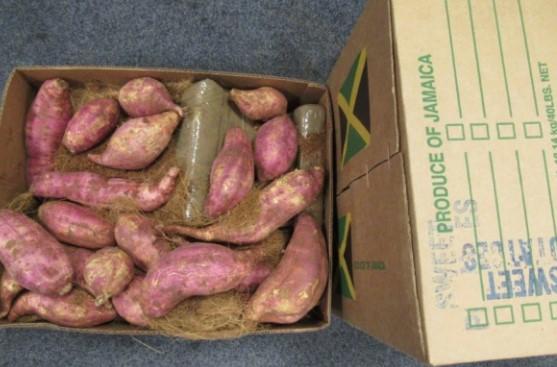
Almost $6 million in cocaine was discovered by British authorities at Gatwick Airport, near London, this month. According to the UK’s National Crime Agency, three separate seizures were made, with the first occurring on August 11.

The incoming flights were all from Jamaica. On the first flight, about 22 kilos of the drug were found “in a consignment of vegetables that had come off a flight from Kingston,” according to the agency. 

A second seizure was made from the same flight one week later on August 18, this time carrying 30 kilos of cocaine.

Finally, a third seizure was made on August 25, again on a flight from Kingston. The cocaine on the third flight amounted to about 3 kilos and was “suspended in a liquid solution”. 

NCA Branch Commander Mark McCormack commented: “Working with our colleagues at Border Force we are determined to do all we can to stop class A drugs reaching the streets of the UK, where they can cause so much damage. These seizures are an example of that in action, and our investigations are ongoing.

Tim Kingsberry, regional director for Border Force South, said: “Through the diligence and hard work of Border Force officers, we have prevented millions of pounds of cocaine from reaching Britain’s streets. I hope this detection sends a clear message to anyone who thinks they can smuggle dangerous drugs into the UK. We will find and confiscate these items and we will bring you to justice.”


via ZeroHedge News https://ift.tt/2QA2G8f Tyler Durden

NATO In Crisis

NATO In Crisis

Tyler Durden

Sat, 08/29/2020 – 07:00

Authored by Jonas Dringelis via The Baltic Word,

NATO’s Secretary General Jens Stoltenberg met German Chancellor Angela Merkel in Berlin Thursday against a backdrop of challenges for the transatlantic military alliance, rising tensions in Europe and a political crisis in Belarus.

Addressing the situation in Belarus, Jens Stoltenberg denied accusations that NATO troops were gathering at the country’s border with Poland and Lithuania.

“NATO has no military build-up in the region so any excuse to use that as an excuse to crack down on peaceful protesters is absolutely unjustified,” Stoltenberg said.

It is worth noting that there is skepticism over what role NATO should play in de-escalating international disputes, as divisions remain within the organization.

Chief strategy officer at Rasmussen Global Fabrice Pothier told Thursday that NATO was riven with divisions between its members.

The spat between Greece and Turkey has caused a rift in NATO, and within Europe, with the U.S. reportedly conducting naval exercises with Turkey, while France has conducted drills with Greece.

“The real squeeze for NATO is from the inside. Yes, there are crises on the outside in Belarus, in the Eastern Mediterranean crisis, but fundamentally it is squeezed from the inside because some of the big members, the U.S., Turkey, France, are not seeing eye to eye. I think on the inside (of NATO) there is a real political crisis simmering,” Pothier told.

Today such a crisis may arise in Latvia, Lithuania, Estonia and Poland.

Because both the soldiers and residents of these countries do not like the fact that U.S. and NATO multinational EFP battlegroup soldiers are allowed everything.

The governments of Latvia, Lithuania and Estonia regularly declare their loyalty to NATO’s course of confrontation with Russia and the readiness of citizens to participate in the militarization of NATO’s Eastern flank.

However, opinion polls show otherwise.

Thus, the IBRIS Market and Social Research Institute (Poland) and the portal Defense24.pl conducted a survey. It was about the determination of the population of Poland and its NATO partners (Germany, Slovakia, Czech Republic, Latvia, Lithuania, Estonia) to take up arms if necessary.

As a result, a low level of readiness of Lithuanians, Latvians and Estonians to fight with Russia was revealed.

The Baltic countries showed the following results: only 17% of the inhabitants of Lithuania would fight, 16% – in Latvia and 24% – in Estonia.

U.S. and NATO, deploying a contingent in the Baltic States and Poland, are concentrating certain troops there and expose the population of these countries to a threat, because in fact it can lead to direct confrontation with Russia and Belarus.

via ZeroHedge News https://ift.tt/3gGoo4W Tyler Durden

From the Archives: August/September 2020

archives

15 Years Ago

August/September 2005

“Statins are not the only class of safe drugs still under lock and key. Medical information is available to more people than ever before, and Americans are buying more drugs and making more-sophisticated choices about their health. Yet access to everything from insulin to Viagra still requires a day off from work and a trip to the doctor’s office. For Americans growing more knowledgeable about the specifics of self-care, the prescription regime presents a significant and sometimes insurmountable barrier.”
Kerry Howley
“Locking Up Life-Saving Drugs”

“From a civil libertarian perspective, it’s clear enough why the unequal treatment of gay parents is objectionable: The human desire for family isn’t exclusive to heterosexuals, and attempts to prevent gays from raising families both stigmatize them and threaten to deprive them of an important component of a full life. But these barriers to adoption should also offend anyone concerned about family values—about ensuring that all children, especially those who have suffered in the past, find loving homes.”
Julian Sanchez
“All Happy Families”

25 Years Ago

August/September 1995

“The law was the Americans with Disabilities Act, and it gives the feds veto rights over such issues as: whether a prospective employer can ask a would-be truck driver if he has epilepsy; how far grab bars must be from the back walls of toilet stalls; what surfaces are permitted for subway platforms; how restaurant seating must be arranged; and dozens of other aspects of running businesses and city governments. The law has created an entire industry around interpreting it and, as the old cliché goes, provided plenty of work for lawyers, if not for the handicapped.”
Brian Doherty
“Unreasonable Accommodation”

“As government deadlines for zero-emission vehicles draw closer, the scientific research community is telling politicians to pull the plug on the only vaguely plausible form of such a contraption: the electric car. Recent studies…all conclude that given the state of battery technology, the limitations and expected costs of the vehicles, and the anticipated environmental benefits, electric cars have a long way to go before they’re up to speed.”
Nick Gillespie
“Electric Blues”

30 Years Ago

August/September 1990

“Americans like to think of themselves as the world’s leading democrats, but, by the usual measures, we’re none too pleased with our own democracy. Voter turnout is low and getting lower; around 40 percent is standard for a statewide primary. People intensely distrust the politicos who represent them. Given the chance—as on the California primary ballot—voters will support just about any ‘ethics’ initiative that promises to control the people’s supposed representatives.”
Virginia I. Postrel
“Democracy Blues”

“Today’s intellectuals and reformers have little respect for the automobile—or for automobile culture. The car’s very convenience seems an indulgence, a waste of resources and money. ‘The Soviet Union’s greatest contribution to world peace was the fact that it did not put a car in every Soviet citizen’s garage,’ says Ralph Nader.”
Fred Smith
“Autonomy”

 45 Years Ago

August/September 1975

“For most people, daily newspapers or television news programs are lifelong textbooks. In their own fashion, journalists are the world’s teachers who present ‘lessons’ in the form of news stories. The picture that emerges from these lessons is not unlike what emerges from most high schools and colleges: disjointed stories with no apparent connections. What daily journalism offers is not, strictly speaking, news (important changes in the status quo that can be verified), but gossip. The changes that are reported are not really changes, or they are not really important, or they are too-soon shown to be unimportant. In short, the daily journalism textbook is a random sample of incomplete information. It lacks completeness because it is all flat surfaces, and no foreground, my word for the unknown, still-to-occur events that would shed some light on the real changes and true importance of today’s events. It is this failing that helps to strangle the chance for a science of journalism.”
Dennis Chase
“Foregrounding the News”

from Latest – Reason.com https://ift.tt/2YL2w2g
via IFTTT