Politics, Not Science, Is Keeping Schools Closed

Politics, Not Science, Is Keeping Schools Closed

Tyler Durden

Sat, 08/01/2020 – 09:20

Authored by Yinon Weiss via RealClearPolitics.com,

Politicians speak about following the science to set COVID-19 policy, but their decisions are more about political objectives than they are about medical efficacy.

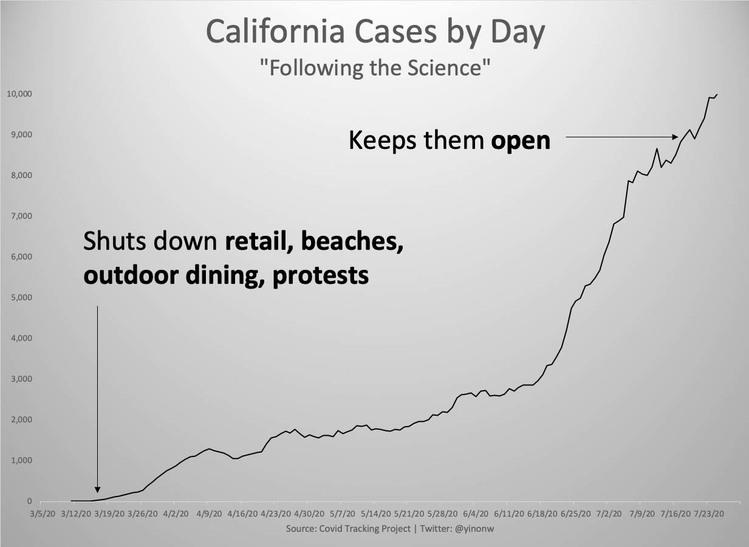
Why else did California Gov. Gavin Newsom shut down retail businesses in March when the state had under 300 cases per day but allow them to be open in July when the state clocked in at over 10,000 cases per day?
Why else would Kentucky Gov. Andy Beshear allow liquor stores to stay open but close down churches? Why did Michigan Gov. Gretchen Whitmer insist that buying lottery tickets remain legal but made it illegal to buy garden supplies? And how did New York Gov. Andrew Cuomo use “science” to prohibit outdoor funerals but allow outdoor protests?

But as badly as our lockdowns have damaged local businesses, a potentially even bigger problem is created by the physical closure of schools. One of the most important functions of a civil society is to protect and educate its children, and the cancellation of in-person education stands to become one of the most detrimental acts of collateral damage during this pandemic.

California currently expects its 5-year-olds to complete kindergarten exclusively through online distance learning. For this dubious undertaking, the politicians are given passionate political cover. The Los Angeles Teachers Union maintains that “the only people guaranteed to benefit from the premature reopening of schools amidst a rapidly accelerating pandemic are billionaires and the politicians they’ve purchased” — as if billionaires typically send their kids to L.A. public schools. The wealthy will send their children to in-person private schools or hire additional tutors, while most American families will suffer from a widening education gap that could set their kids back years. Worst of all, none of this is medically substantiated. 

Children Are Safe

There is a great deal of fear generated in the media about risk to children, but the truth is that children are incredibly resistant to coronavirus. So much so that children are far more likely to die from the flu, or even just from driving to school, than from COVID-19.
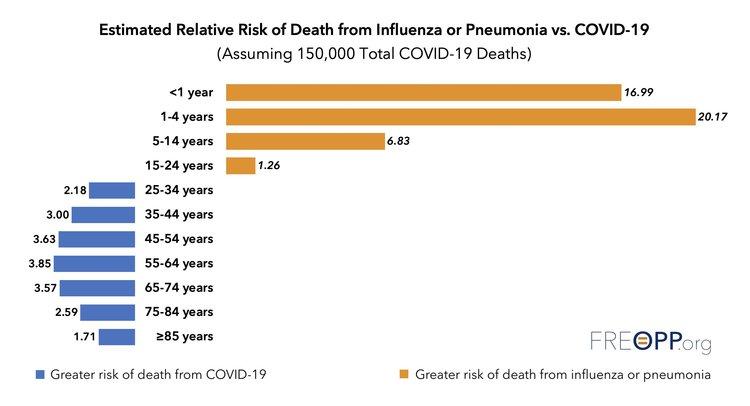
The CDC has recorded a total of 20 COVID-19 deaths in children ages 5-14 compared to almost 2,000 deaths from non-COVID causes in the same time period for the same age group.  It means children have been 100 times  more likely to die from non-COVID causes during the pandemic than from COVID. This puts the risk of COVID death for children 5 to 14 in the same ballpark as deaths by lightning

Claims of long-term damage or mystery illnesses have not been backed by any definitive evidence and they therefore serve more as a scare and intimidation tactic than as a medical guide. The truth is that children so far have had around a 1 in 20,000 rate of COVID-19 hospitalizations, according to the CDC. While controversial to some, Sweden’s policy of keeping primary schools open even at the height of the pandemic serves as an excellent counterpoint. With over 1 million children, Sweden did not have a single death of a school-aged child despite full attendance and no masks.

Sweden is not alone in sending kids to school. Denmark opened its schools back up in April. Finland kept normal class sizes when it reopened. Parts of Montana opened schools back in May, as did parts of Canada and Germany. The Netherlands announced that Dutch students didn’t even need to socially distance anymore as they experienced very low transmission rates. Schools all across Europe have reopened successfully, both with and without masks. The risk to the children themselves therefore cannot be used as a justification for the massive damage created by ceasing in-person education. But what about the teachers?

Transmission From Children to Adults Is Rare

Science magazine, a preeminent journal that dates to 1880, recently published a comprehensive analysis studying school reopenings around the world and concluded that “younger children rarely spread the virus to one another or bring it home.

A study in Switzerland, including a review of World Health Organization contact tracing, failed to find evidence of a single case of a child passing coronavirus to an adult. A comprehensive study in Iceland isolated SARS-CoV-2 samples from every positive case, sequenced the virus genome, and tracked the mutation patterns. This analysis, along with contact tracing, allowed researchers to identify definitively who passed the virus to whom. The study concluded “[E]ven if children do get infected, they are less likely to transmit the disease to others than adults. We have not found a single instance of a child infecting parents.” A study of schools in Ireland found “no evidence of secondary transmission of COVID-19 from children attending school.

New Zealand conducted a study across 15 schools in which 18 individuals with COVID-19 were in close contact with 735 other students and 128 staff members, yet no teacher or staff member contacted COVID-19 from any of the initial 18 cases and only two students out of the 735 would later test positive. The New Zealand study concluded: “Our investigation found no evidence of children infecting teachers.”
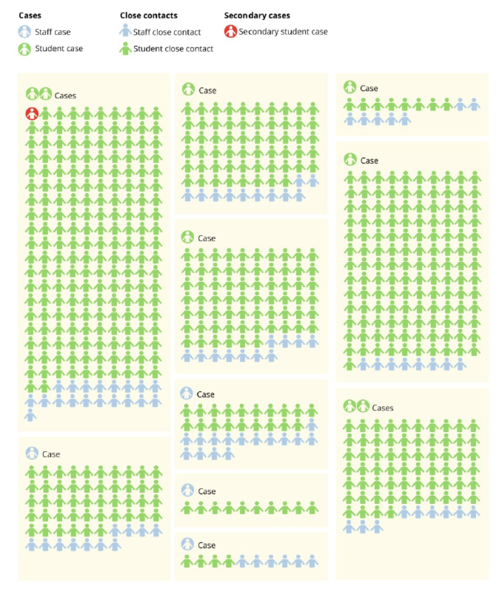
Cases and close contacts among teachers and students in 10 New Zealand high schools showing one secondary case in a student. Source: “COVID-19 in Schools – the Experience in NSW”

Denmark, The Netherlands, Finland, Belgium, and Austria all opened schools and “found no evidence of increased spread of the novel coronavirus after schools reopened.The same was found in scientific studies in FranceSweden, and Germany. A leading British epidemiologist goes even further to claim there is not a single known case of a teacher being infected of coronavirus from a student anywhere in the world.

Since there could still be a rare school outbreak, such as experienced in Israel, students with high-risk household members should be given a distance education option, and teachers who believe themselves or their households to be at high risk should be allowed to teach remotely, balancing the risk for all parties. This way healthy students can be be educated by healthy teachers. With science overwhelmingly pointing to reopening schools, why do so many schools intend to remain closed?

The Politics of Teaching

If children are at minimal risk, transmission to adults is rare, and both can be accommodated with optional distance learning, why are some schools suspending all in-person education? It’s certainly not because of the parents, who would be the last people to send their children into a dangerous situation. The vast majority of parents support reopening schools with modifications, perhaps because they best understand the cost-benefit of depriving their children of a full education.

The reason many schools won’t open, just like why so many places originally locked down, comes back to fear and politics. The Los Angeles’ teachers union, for example, recently came out with a list of demands before returning to teach in person. These included defunding the police, ending charter schools, “Medicare for All,” and a new wealth tax. It was not until the union came out with these demands that Newsom announced closure of nearly all schools in California — overriding individual school districts that had planned to open.

In a brazen announcement, the union put in bold words the conclusion of their argument: “Normal wasn’t working for us before. We can’t go back” – openly conveying that this negotiation was more about changing what they didn’t like about American education and society before the pandemic, and certainly not about what is best for children. Despite overwhelming scientific evidence pointing to the safety of school reopenings, union President Cecily Myart-Cruz labeled doing so “anti-science.” Yet, it’s also no wonder that so many teachers have concern for their safety now, as media outlets like CNN continue to run sensationalized stories building up school reopenings as dangerous while downplaying the actual science and evidence.

Day Care at School Gives the Game Away

Cities left with little choice due to their political environment are trying to mitigate the situation for parents. New York City will offer day care for 100,000 students attending schools that are only partially reopening, though this largely defeats the point of keeping children from being at school in the first place. If school closing advocates are correct, this would only expose children to a broader cohort of peers and would make teachers, children, and their caretakers less safe.

Some districts in California are offering day care right on school campus for half and full day programs, at a cost. So parents can pay to send their kids to school to be watched but not to be taught. Ironically, a student might be physically at a school under the watch of paid day care while simultaneously “attending” the very same school online.

It is clear that science is not the driving principle behind any of these policies, which helps explain why both the CDC and American Academy of Pediatrics have advocated for opening on-campus education.

Teachers Are Essential Workers

There are few functions in society more essential than educating our children. “Education of our children is an essential Texas value,” Texas Attorney General Ken Paxton recently wrote in a letter directing that health officials cannot completely close schools, and they certainly cannot preemptively close schools with no evidence of local school spread.

The CDC recently concluded that “in-person schooling is in the best interest of students, particularly in the context of appropriate mitigation measures similar to those implemented at essential workplaces.”

The education of our children is too essential to be used as a political bargaining chip.

If nurses can come to work every day and treat the sick and infected, then certainly teachers can be expected to come to work and teach the young and healthy.

via ZeroHedge News https://ift.tt/3fki3vF Tyler Durden
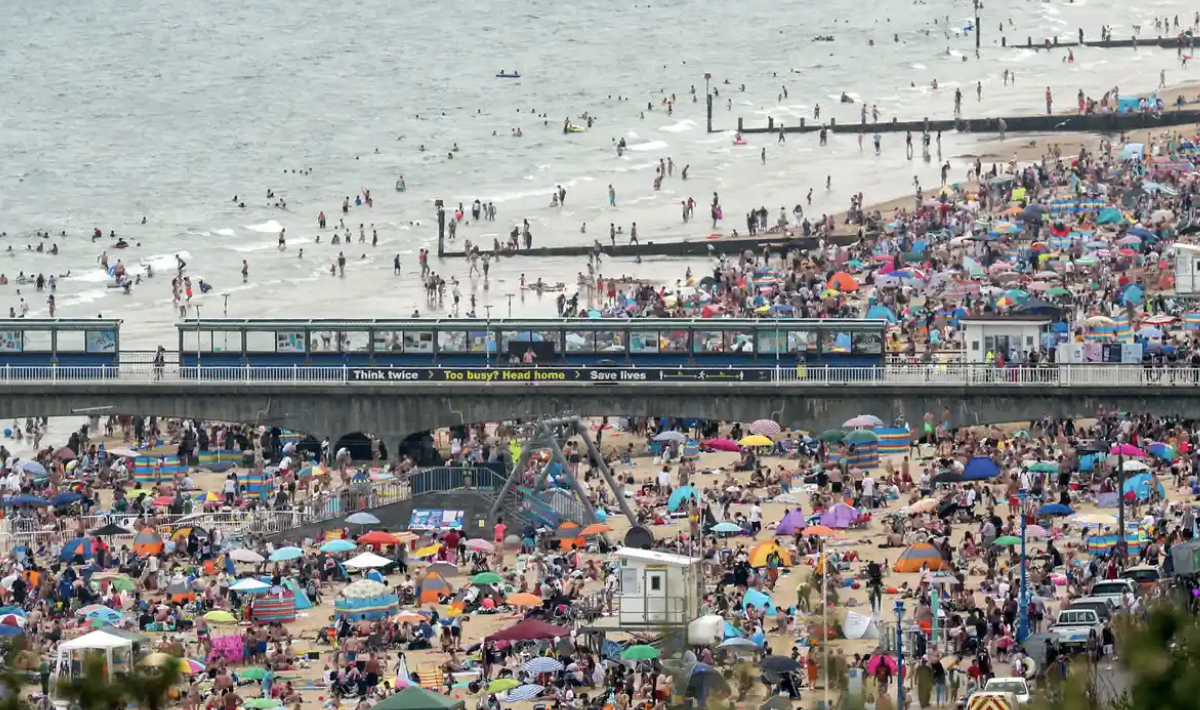
English Ignore Social Distancing Pleas And Pack Beaches On Hottest Day Of Summer

English Ignore Social Distancing Pleas And Pack Beaches On Hottest Day Of Summer

Tyler Durden

Sat, 08/01/2020 – 08:45

Millions of Britons across northern England have been placed under partial lockdown as a handful of hotspots have emerged in Manchester and other areas. But despite a pervasive sense of trepidation as outbreaks in Catalonia, Poland and elsewhere revive fears about a second wave hammering Europe, many in the UK are crowding on to beaches as temperatures reach record summer highs.

Footage going viral on social media shows packed beaches along the south coast of England as temperatures notched the hottest day of the year.

At Bournemouth, a resort town in southwestern England not far from Southampton, a major incident was declared last month because the beach became so packed, social distancing became impossible.

That’s happening again, it appears.

Here’s more from the Guardian, which documented groups of as many as 50 people, mostly consisting of teenagers and people in their early 20s.

Despite the warnings, groups of up to 50 teenagers, and men and women in their early 20s gathered. Security guards removed some men who were drinking under the pier but no attempts were made to close the beaches or to to ask people to leave.

One sun-seeker, 18-year-old Lizzie Jones from Portsmouth, who was on the beach with a dozen friends, said she felt perfectly safe and didn’t feel she was putting anyone at risk. “We’re out here in the fresh air. People are a bit close but I don’t think there’s much of a danger,” she said.

Some car parks were full, prompting scores of people to abandon their vehicles illegally.

A digital sign informed people that the beach was “too busy.” A new app produced by the local authority, Bournemouth, Christchurch and Poole council, urged people to avoid long stretches of the beaches with the message: “Avoid, safe social distancing not possible.”

Further east, the city council of Brighton and Hove expressed alarm over the number of people crowding its beaches.

Officials also warned visitors to some of the most popular beaches in Kent to find a less-crowded spot, or consider returning at “a quieter time”.

Another anonymous young man who spoke to the Guardian said he and his friends had taken public transit to the beach at Bournemouth: “It feels safe to me. I don’t know anyone who has had coronavirus. Until I do I don’t think it will feel real to me.”

via ZeroHedge News https://ift.tt/3flqczV Tyler Durden

Here Are The Top Highlights From Ghislaine Maxwell’s Unsealed Court Records

Here Are The Top Highlights From Ghislaine Maxwell’s Unsealed Court Records

Tyler Durden

Sat, 08/01/2020 – 06:10

Dozens of exhibits related to Ghislaine Maxwell and Jeffrey Epstein were unsealed Thursday evening, providing insight into allegations against the financier and his purported ‘madam,’ as well as other high-profile individuals, including Bill Clinton, Alan Dershowitz and several other people whose names one can only guess (and the internet has).

The documents, related to a 2015 civil defamation lawsuit against Maxwell by Epstein accuser Virginia Giuffre, were ordered to be released on July 23 by US District Judge Loretta Preska – which also included flight logs from Epstein’s private jets, as well as police reports from the multiple locations where Epstein maintained residences.

Among the findings:

Bill Clinton was allegedly on pedo island with ‘2 young girls’

Sordid details from alleged sexual encounters

Virginia Giuffre asked Comey’s FBI for evidence in their possession, and was ignored.

Of course:

Maxwell was in communication with Epstein in January of 2015 – contradicting her claim that she hadn’t been in touch with him in more than a decade.

Alan Dershowitz is mentioned several times (and has gone to great lengths to defend himself – suggesting on multiple occasions that this very document release would in exonerate him).

Dersh defends:

Epstein accuser(s) allegedly had to have sex with this guy

And former New Mexico Governor Bill Richardson (D)

Other speculative mentions (redacted): Prince Andrew, Jean Luc Brunel, and more.

Trump is in the clear (which we’ve known for some time):

And some food for thought…

Check back for more…

via ZeroHedge News https://ift.tt/3151kXP Tyler Durden

Congress Considers Dueling Meat Bills To Meet Demand and Foster Food Resiliency

Cows

America’s meat supply has been hammered by the COVID-19 outbreaks occurring at many of the nation’s largest meat-processing plants. Pressure on the meat supply means consumer prices have spiked. The nation’s small and mid-sized farmers and ranchers can help address shortages, but they first need better access both to small-scale slaughter and processing facilities and to local and regional markets. To address the crisis, while making the food system more resilient to shocks such as COVID-19, Congress must amend the Federal Meat Inspection Act, which needlessly restricts both interstate and intrastate meat sales. 

There are three different bills before Congress right now that could impact America’s meat supply immediately and for years (and decades) to come: the PRIME Act, the New Markets for State-Inspected Meat and Poultry Act (“New Markets Act”), and the RAMP-UP Act. One of those bills is great. Another is good. And one—the RAMP-UP Act—appears to be a big-business stalking horse.

Just what does each bill propose to do?

The New Markets Act—the good bill—would create and strengthen regional food systems by lifting a senseless ban on the interstate sale of state-inspected meat. Under current federal law, meat produced and inspected by state authorities in 20 U.S. states cannot be sold across state lines solely because those states use their own meat inspectors—rather than USDA employees—to enforce food-safety regulations. For example, that means meat from a rancher in Arizona that’s inspected by Arizona state officials may be sold only in Arizona, even though the Arizona inspectors are enforcing rules that are equivalent to those enforced by USDA inspectors. That approach makes such little sense that even the USDA has said it embraces the aims of the New Markets Act.

What the New Markets Act doesn’t address, though, is the overall capacity or supply shortfalls that have caused the present meat crisis. That’s where the PRIME Act shines. PRIME is the great bill because it would create and strengthen local food systems by allowing the intrastate sale of uninspected meat and meat products. (The PRIME Act would also allow states to adapt or adopt their own inspection requirements for custom facilities.) For example, under the current law, cuts of meat from a rancher in Florida that’s processed in what’s known as a “custom” facility, which is subject to a host of federal and state regulations but does not have an on-site government inspector, cannot be sold to the public at all—not even at a local farmers’ market. The PRIME Act would allow the rancher to sell that meat within the state of Florida directly to consumers and through local outlets, opening up new markets for small ranchers. And by allowing the local sale of meat from these operations, the PRIME Act would encourage the proliferation of small-scale processors, adding diversity, resilience, and badly needed additional capacity to our national processing system.

“Passage of this law would improve the fabric of America’s meat landscape dramatically,” I write of the PRIME Act in my book, Biting the Hands that Feed Us: How Fewer, Smarter Laws Would Make Our Food System More Sustainable.

The RAMP-UP Act—the likely stalking horse for Big Agriculture—would authorize the USDA to provide six-figure grants to existing small and mid-sized processing facilities that their owners could use in pursuing USDA facility inspection. The process for obtaining that grant of USDA inspection—which can take years and is deeply flawed—would remain otherwise unchanged under the bill.

It gets worse. That’s because, if the RAMP-UP Act were to succeed in its stated goal—to bring still more facilities under USDA inspection—it would require the agency to hire many more Food Safety and Inspection Service (FSIS) inspectors. But FSIS has long suffered from inspector staffing shortages. So the USDA already can’t hire enough inspectors to staff the nation’s existing meat-processing plants, but the RAMP-UP Act says we should create an expensive new program that requires the agency to hire hundreds (or more) new FSIS inspectors! What could go wrong? And what exactly is the food-safety argument that supports this approach?

While the legislative sponsors of the bill may be well-intentioned, it’s instructive to note that supporters of the RAMP-UP Act include a veritable who’s who of the nation’s biggest livestock producers and processors, including the American Farm Bureau Federation, lobbyists for pork producers, and others. 

Many of these same groups, including the same large processors that have had thousands of workers sickened with COVID-19, are also steadfast opponents of the PRIME Act. They’ve raised concerns about allowing uninspected meat on the intrastate market. But that’s nothing more than fearmongering. Consider that a decades-old USDA exemption already allows many poultry farmers to slaughter thousands of their own chickens on their farms without continuous federal or state inspection and to sell those chickens to grocers and others. No cases of foodborne illness have been tied to this uninspected poultry. Zero. That’s in sharp contrast to the nation’s largest processors, a dozen of which each process over 1 million cows per year and which together account for more than half of all beef processed in USDA-inspected facilities. Despite continuous USDA inspection, there have been numerous recalls and foodborne illness cases tied to these massive operations. That’s one reason the very premise of the RAMP-UP Act—to bring more state-inspected and custom processing facilities under the USDA’s inspection regime, as if that’s some sort of food-safety panacea—is deeply, fundamentally, and inherently flawed.

I’ve long supported the PRIME Act. The New Markets for State-Inspected Meat and Poultry Act is an eminently sensible bill. But the RAMP-UP Act won’t change the rules of the game for farmers and ranchers and would have little or no immediate impact on the meat supply. That’s why I fear the RAMP-UP Act, as I noted, is a stalking horse for large special interests that is intended to suppress competition, distract from the PRIME Act, and supplant actual reform.

“The RAMP-Up Act would do what Congress does best: spending money to help solve a problem that Congress created in the first place,” says Daren Bakst, an agricultural policy fellow with the Heritage Foundation, in an email to me this week. “Legislators shouldn’t be fooled by the RAMP-UP Act. It doesn’t solve the underlying regulatory problems, and it doesn’t even attempt to address the sale of custom slaughtered meat.”

“Funding small slaughterhouses to try to help them meet regulations that are badly designed for their type of operation is like paying someone to help them roll a boulder up a mountain, instead of asking if they should be climbing that mountain in the first place,” says Judith McGeary, a Texas rancher and attorney who leads the Farm & Ranch Freedom Alliance (and also serves with me on the board of the Farm-to-Consumer Legal Defense Fund). “The PRIME Act provides for scale-sensitive regulation of those slaughterhouses, which in turn helps both farmers who depend on them, and the consumers who want to buy locally raised meat from people they trust.”

Dr. Michael Fisher, a retired FSIS staff officer, has been critical of what he sees as the agency’s lack of strategic planning and leadership. Fisher tells me the RAMP-UP Act is a “nice idea,” but says the bill would “not help custom and state inspected plants become USDA inspected because it does not remove the primary obstacle to obtaining a grant of inspection, which is the FSIS application process. You can give a custom and state inspected plant baskets full of money. They could build palatial palaces on the prairie. But if the FSIS District Manager does not want to issue a grant of inspection because doing so creates a human resources problem for the District Manager, FSIS can create administrative obstacles to the application process that results in the custom and state inspected plant giving up on the process and never obtaining a grant of inspection.”

Rep. Chellie Pingree (D–Maine), an organic farmer, champion of many small farmers, and longtime sponsor of the PRIME Act who also co-sponsored the RAMP-UP Act, told me this week that the PRIME Act is an essential component of any necessary reform.

“I am committed to supporting small facilities and expanding processing options for our local producers,” Pingree says. “These two bills provide different strategies to support that underlying goal and should be complementary, not mutually exclusive.”

The COVID-19 pandemic has proven that our food system needs significant reforms to ensure the nation’s meat supply is safe, affordable, diversified, and available. The PRIME Act is a once-in-a-lifetime opportunity to rebuild and strengthen our local food systems. It would benefit consumers, small farmers and ranchers, processors, grocers, restaurants, and others in all 50 states. Whatever else Congress does, it must pass this bill right now.

from Latest – Reason.com https://ift.tt/3k0deLf
via IFTTT

Congress Considers Dueling Meat Bills To Meet Demand and Foster Food Resiliency

Cows

America’s meat supply has been hammered by the COVID-19 outbreaks occurring at many of the nation’s largest meat-processing plants. Pressure on the meat supply means consumer prices have spiked. The nation’s small and mid-sized farmers and ranchers can help address shortages, but they first need better access both to small-scale slaughter and processing facilities and to local and regional markets. To address the crisis, while making the food system more resilient to shocks such as COVID-19, Congress must amend the Federal Meat Inspection Act, which needlessly restricts both interstate and intrastate meat sales. 

There are three different bills before Congress right now that could impact America’s meat supply immediately and for years (and decades) to come: the PRIME Act, the New Markets for State-Inspected Meat and Poultry Act (“New Markets Act”), and the RAMP-UP Act. One of those bills is great. Another is good. And one—the RAMP-UP Act—appears to be a big-business stalking horse.

Just what does each bill propose to do?

The New Markets Act—the good bill—would create and strengthen regional food systems by lifting a senseless ban on the interstate sale of state-inspected meat. Under current federal law, meat produced and inspected by state authorities in 20 U.S. states cannot be sold across state lines solely because those states use their own meat inspectors—rather than USDA employees—to enforce food-safety regulations. For example, that means meat from a rancher in Arizona that’s inspected by Arizona state officials may be sold only in Arizona, even though the Arizona inspectors are enforcing rules that are equivalent to those enforced by USDA inspectors. That approach makes such little sense that even the USDA has said it embraces the aims of the New Markets Act.

What the New Markets Act doesn’t address, though, is the overall capacity or supply shortfalls that have caused the present meat crisis. That’s where the PRIME Act shines. PRIME is the great bill because it would create and strengthen local food systems by allowing the intrastate sale of uninspected meat and meat products. (The PRIME Act would also allow states to adapt or adopt their own inspection requirements for custom facilities.) For example, under the current law, cuts of meat from a rancher in Florida that’s processed in what’s known as a “custom” facility, which is subject to a host of federal and state regulations but does not have an on-site government inspector, cannot be sold to the public at all—not even at a local farmers’ market. The PRIME Act would allow the rancher to sell that meat within the state of Florida directly to consumers and through local outlets, opening up new markets for small ranchers. And by allowing the local sale of meat from these operations, the PRIME Act would encourage the proliferation of small-scale processors, adding diversity, resilience, and badly needed additional capacity to our national processing system.

“Passage of this law would improve the fabric of America’s meat landscape dramatically,” I write of the PRIME Act in my book, Biting the Hands that Feed Us: How Fewer, Smarter Laws Would Make Our Food System More Sustainable.

The RAMP-UP Act—the likely stalking horse for Big Agriculture—would authorize the USDA to provide six-figure grants to existing small and mid-sized processing facilities that their owners could use in pursuing USDA facility inspection. The process for obtaining that grant of USDA inspection—which can take years and is deeply flawed—would remain otherwise unchanged under the bill.

It gets worse. That’s because, if the RAMP-UP Act were to succeed in its stated goal—to bring still more facilities under USDA inspection—it would require the agency to hire many more Food Safety and Inspection Service (FSIS) inspectors. But FSIS has long suffered from inspector staffing shortages. So the USDA already can’t hire enough inspectors to staff the nation’s existing meat-processing plants, but the RAMP-UP Act says we should create an expensive new program that requires the agency to hire hundreds (or more) new FSIS inspectors! What could go wrong? And what exactly is the food-safety argument that supports this approach?

While the legislative sponsors of the bill may be well-intentioned, it’s instructive to note that supporters of the RAMP-UP Act include a veritable who’s who of the nation’s biggest livestock producers and processors, including the American Farm Bureau Federation, lobbyists for pork producers, and others. 

Many of these same groups, including the same large processors that have had thousands of workers sickened with COVID-19, are also steadfast opponents of the PRIME Act. They’ve raised concerns about allowing uninspected meat on the intrastate market. But that’s nothing more than fearmongering. Consider that a decades-old USDA exemption already allows many poultry farmers to slaughter thousands of their own chickens on their farms without continuous federal or state inspection and to sell those chickens to grocers and others. No cases of foodborne illness have been tied to this uninspected poultry. Zero. That’s in sharp contrast to the nation’s largest processors, a dozen of which each process over 1 million cows per year and which together account for more than half of all beef processed in USDA-inspected facilities. Despite continuous USDA inspection, there have been numerous recalls and foodborne illness cases tied to these massive operations. That’s one reason the very premise of the RAMP-UP Act—to bring more state-inspected and custom processing facilities under the USDA’s inspection regime, as if that’s some sort of food-safety panacea—is deeply, fundamentally, and inherently flawed.

I’ve long supported the PRIME Act. The New Markets for State-Inspected Meat and Poultry Act is an eminently sensible bill. But the RAMP-UP Act won’t change the rules of the game for farmers and ranchers and would have little or no immediate impact on the meat supply. That’s why I fear the RAMP-UP Act, as I noted, is a stalking horse for large special interests that is intended to suppress competition, distract from the PRIME Act, and supplant actual reform.

“The RAMP-Up Act would do what Congress does best: spending money to help solve a problem that Congress created in the first place,” says Daren Bakst, an agricultural policy fellow with the Heritage Foundation, in an email to me this week. “Legislators shouldn’t be fooled by the RAMP-UP Act. It doesn’t solve the underlying regulatory problems, and it doesn’t even attempt to address the sale of custom slaughtered meat.”

“Funding small slaughterhouses to try to help them meet regulations that are badly designed for their type of operation is like paying someone to help them roll a boulder up a mountain, instead of asking if they should be climbing that mountain in the first place,” says Judith McGeary, a Texas rancher and attorney who leads the Farm & Ranch Freedom Alliance (and also serves with me on the board of the Farm-to-Consumer Legal Defense Fund). “The PRIME Act provides for scale-sensitive regulation of those slaughterhouses, which in turn helps both farmers who depend on them, and the consumers who want to buy locally raised meat from people they trust.”

Dr. Michael Fisher, a retired FSIS staff officer, has been critical of what he sees as the agency’s lack of strategic planning and leadership. Fisher tells me the RAMP-UP Act is a “nice idea,” but says the bill would “not help custom and state inspected plants become USDA inspected because it does not remove the primary obstacle to obtaining a grant of inspection, which is the FSIS application process. You can give a custom and state inspected plant baskets full of money. They could build palatial palaces on the prairie. But if the FSIS District Manager does not want to issue a grant of inspection because doing so creates a human resources problem for the District Manager, FSIS can create administrative obstacles to the application process that results in the custom and state inspected plant giving up on the process and never obtaining a grant of inspection.”

Rep. Chellie Pingree (D–Maine), an organic farmer, champion of many small farmers, and longtime sponsor of the PRIME Act who also co-sponsored the RAMP-UP Act, told me this week that the PRIME Act is an essential component of any necessary reform.

“I am committed to supporting small facilities and expanding processing options for our local producers,” Pingree says. “These two bills provide different strategies to support that underlying goal and should be complementary, not mutually exclusive.”

The COVID-19 pandemic has proven that our food system needs significant reforms to ensure the nation’s meat supply is safe, affordable, diversified, and available. The PRIME Act is a once-in-a-lifetime opportunity to rebuild and strengthen our local food systems. It would benefit consumers, small farmers and ranchers, processors, grocers, restaurants, and others in all 50 states. Whatever else Congress does, it must pass this bill right now.

from Latest – Reason.com https://ift.tt/3k0deLf
via IFTTT

The Eurozone’s Financial Disintegration

The Eurozone’s Financial Disintegration

Tyler Durden

Sat, 08/01/2020 – 08:10

Authored by Alasdair Macleod via GoldMoney.com,

Introduction

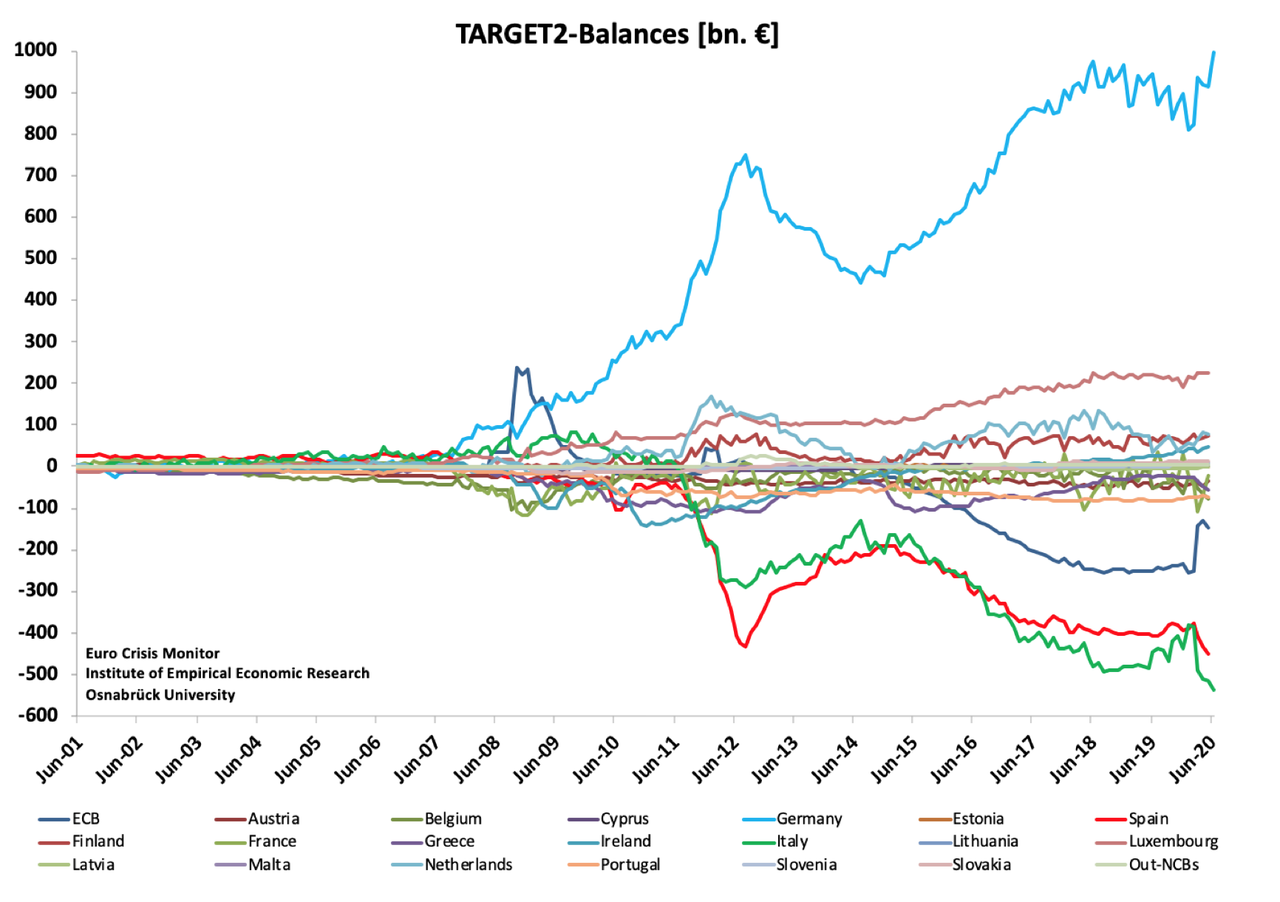
The Euro Crisis Monitor (below) shows the increasing imbalances in the TARGET2 settlement system between all its members: the ECB (itself with a €145bn deficit) and the national central banks in the Eurozone.

Other than minor differences reflecting net cross-border trade not matched by investment flows going the other way, these imbalances should not exist. But following the Lehman crisis and as the Eurozone developed its own series of crises, imbalances arose. Commentators have grown used to them, so have more or less given up pointing them out. But in the last few months, the apparent flight into the Bundesbank (€995,083m surplus) has gathered pace, as have the deficits for Italy (€536,722m) and Spain (€451,798m). It is time to take these rising imbalances seriously again.

Target2 — the ECB’s flexible friend

Target2 is the settlement system for transfers between the national central banks. The way it works, in theory, is as follows. A German manufacturer sells goods to an Italian business. The Italian business pays by bank transfer drawn on its Italian bank via the Italian central bank through the Target2 system, crediting the German manufacturer’s German bank through Germany’s central bank.

But since the Lehman crisis, and more noticeably the last eurozone crisis, capital flows appear to have gravitated from Portugal, Italy, Greece and Spain (the PIGS — remember them?) to principally Germany, Luxembourg, Netherlands and Finland in that order. Before 2008, the balance was maintained by trade deficits in Greece, for example, being offset by capital inflows as residents elsewhere in the eurozone bought Greek bonds, other investments in Greece and the tourist trade collected net cash revenues.

In this sense, it would be wrong to suggest that trade imbalances have led to Target2 imbalances. But part of the problem must be put down to the failure of private sector investment flows to recycle.

Then there is the question of “capital flight”, which is not capital flight as such.

The problem is not that residents in Italy and Spain are opening bank accounts in Germany and transferring their deposits from domestic banks, but more an example of the tragedy of the commons. The origin of this phrase applied to common grazing rights, where everyone in the parish can graze their livestock on common ground, but no one has the incentive to ensure it is properly managed, not overgrazed, and maintained free of gorse and bracken. Consequently, the ground becomes less productive over time. Similarly, the national central banks that are heavily exposed to potentially bad loans know that their losses, if materialised in a general banking crisis, will end up being shared throughout the central bank system, according to their capital keys.

The capital key relates to the national central banks’ equity ownership in the ECB, which for Germany, for example, is 26.4% of the total. If Target2 collapsed for any reason, the Bundesbank, to the extent the bad debts in the Eurosystem are shared, could lose a significant part of the trillion euros owed to it by the other national central banks. But it would be a step too far to say that some national central banks, such as those of Spain and Italy, are gaming the system. It appears to be a problem that simply arises as an unintended consequence of Target2.

If one national central bank runs a Target2 deficit with the other central banks, it is almost certainly because it has loaned money on a net basis to its commercial banks to cover payment transfers, instead of them progressing through the settlement system. Those loans appear as an asset on the national central bank’s balance sheet, which is offset by a liability to the ECB’s Eurosystem through Target2. But under the rules, if something goes wrong either with its own lending or another NCB’s lending, the costs are shared out by the ECB on the pre-set capital key formula. In theory, it is therefore in the interest of a national central bank to run a greater deficit in relation to its capital key by supporting its own banks. It is not necessarily a deliberate act of the Bank d’Italia or the Banco de España to make dodgy loans to their commercial banks; it is just how the system works, and the consequence of national pressures.

To understand how and why the problem arises, we must go back to the earlier crises following Lehman, which have informed national regulatory practices. If the national banking regulator deemed loans to be non-performing, the losses would become a national problem. Alternatively, if the regulator deems them to be performing, they are eligible for the national central bank’s refinancing operations. A commercial bank can then use the questionable loans as collateral, borrowing from the national central bank, which spreads the loan risk with all the other national central banks in accordance with their capital keys. Insolvent loans are thereby removed from the Italian and Spanish banking systems and dumped on the Eurosystem.

In Italy’s case, the very high level of non-performing loans peaked at 17.1% in September 2015 but has now been reduced to 6.9%. As PWC Italia wryly put it,

“Italian banks in response to market and regulatory pressure have halved the total stock of non-performing loans to €135bn in 2019 (vs €341bn in 2015) and at the same time they have set up their NPL platform and organisational controls that will allow to manage non-performing loans more quickly and efficiently and thus to face the incoming economic crisis in a more resilient way.”

Given the incentives for the regulator to deflect the non-performing loan problem from the domestic economy into the Eurosystem, it would be a miracle if much of the reduction in NPLs is genuine.

In the member states with negative Target2 balances such as Italy there has been a trend to liquidity problems for legacy industries, rendering them insolvent. With the banking regulator incentivised to remove the problem from the domestic economy, loans to these insolvent companies have been continually rolled over and increased. The consequence is that new businesses have been starved of bank credit, because bank credit in the member nation’s banks is increasingly tied up supporting businesses that should have gone to the wall long ago.

Officially, there is no problem, because the ECB and all the national central bank Target2 positions net out to zero, and the mutual sharing of liabilities between the national central banks keeps it that way. To its architects, a systemic failure of Target2 is inconceivable. But, because some national central banks end up using Target2 as a source of funding for their own balance sheets, which in turn funds their own dodgy commercial banks, some national central banks have mounting potential liabilities not of their own making, but rather the making of national bank regulators.

The Eurosystem member with the greatest problem is Germany’s Bundesbank, now owed close to a trillion euros through Target2. And the risk of losses is now accelerating both in their quantity, and given the economic consequences of Covid-19, the quality of the underlying loan-assets is rapidly deteriorating as well. The main culprits, the national central banks of Italy and Spain, at the same time are seeing their deficits increase rapidly. The Bundesbank should be very concerned. Its directors will be aware of the problem, particularly since it is now in the public domain.

One may ask how this “mythical surplus” fits in with the Bundesbank’s own balance sheet. As an asset, the surplus was about half of the Bundesbank’s total assets at 31 December 2019, and it finances, among other things, current accounts and deposit facilities of €560bn for its own risk-averse commercial banks. The Bundesbank’s silence in this matter is increasingly untenable.

Commercial banks are in deep trouble

The position for commercial banks in the eurozone, to say the least, is extremely fragile. For years, they have operated in the strait jacket of negative interest rates imposed by the ECB, which operate as a tax on the commercial banks’ liquidity. They can only offset it by buying government and other bonds with less of a negative yield, or with a positive yield. Alternatively, they can lend revolving capital to business customers and consumers for positive margin. And lastly, they can deploy balance sheets for purely financial purposes, which given underlying fundamentals is becoming a likely source of credit contraction.

One would have thought lending bank credit into the real economy would be the most urgent objective of monetary policy, but as we have seen, the increasing support for zombie corporations to prevent national write-offs precludes other lending for economic benefit. And the ECB’s policy objectives are divorced from this problem, which is the responsibility of the national central banks.

The ECB operates on a higher plain. The real consideration that sets the ECB’s interest rate policy is different: it needs to nurse the finances of insolvent member state governments. It does this through various asset purchase programmes, which allow the ECB to set and supress the cost of funding national deficits. Under its charter the ECB is not allowed to fund member states directly, but it can buy bonds in the secondary market. By buying government bonds, almost entirely from commercial banks, balance sheet space is created for the banks to buy further new issues of government bonds, thus resolving the funding problem.

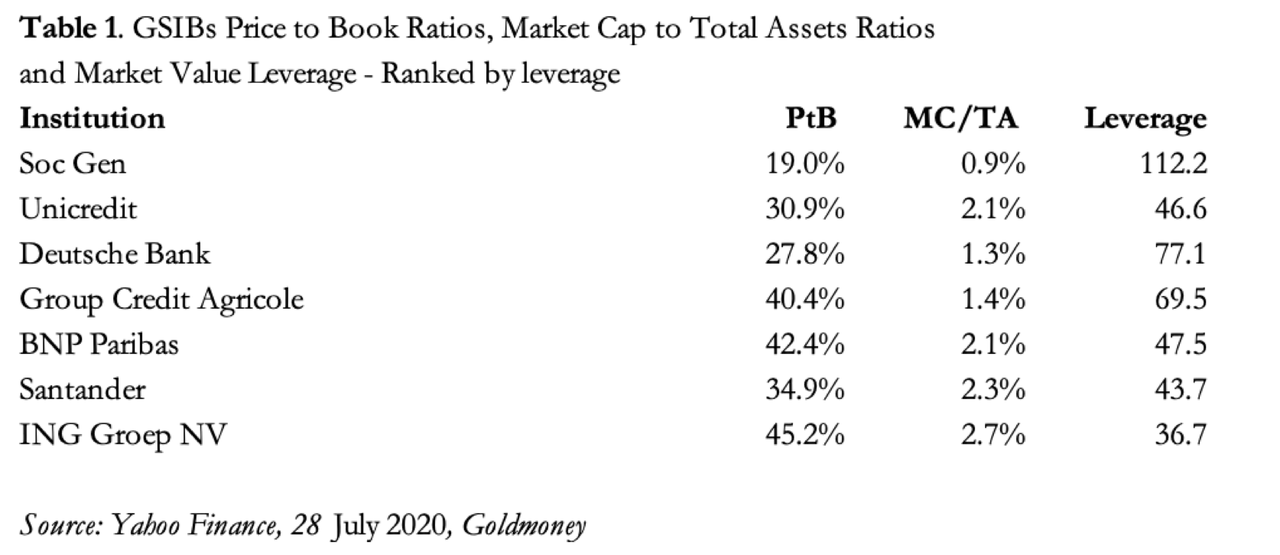
On the face of it, this is a win-win for the governments which are now being paid to borrow, and also for the banks. The yield on national government debt is always set to ensure that a positive return is obtained for the banks by subscribing for new bonds and selling them to the ECB at what amounts to a guaranteed price. But this zero-risk business comes with wafer-thin margins, which encourages excessive balance sheet expansion to compensate. Deutsche Bank, for example, has a ratio of total 2019 assets to equity of 21.4 times, Credit Agricole 28.1 times, BNP Paribas 20.1 times, and Société Generale 21.4 times. These high rates of leverage can only be borne by banks who can demonstrate very low rates of non-performing loans, a situation that will have changed fatally for all Eurozone banks as a consequence of COVID-19 lockdowns.

Other banks, such as UniCredit in Italy, have lower asset to equity ratios (14.4) and Santander in Spain (15.2), reflecting higher lending risks on their balance sheets as well as problems with non-performing loans. But these ratios are still far too high in the context of a contracting European and global economy. Even though the flood of money unleashed by the ECB and other central banks in response to the coronavirus has broadly remained in the financial economy and therefore is puffing up share prices everywhere, the market’s rating of the equity value of eurozone banks is very low. Table 1 shows how this affects balance sheet gearing from a shareholder’s point of view in the global systemically important banks in the eurozone — the GSIBs.

Even though they permit them to be outrageously high, the regulators focus on total asset to equity ratios becomes positively frightening when the true value of balance sheet equity judged by the market is taken into account. For the eurozone’s banking regulators to ignore the market ratings for these banks is a negation of their primary responsibility, to protect the public from bad banking practice.

The whole regulatory thing is a giant banking sham. As far as the ECB is concerned, the role of the commercial banks is to act as agents in its funding of member states’ budget deficits. But that problem has escalated suddenly in recent months putting additional strains on the whole Eurosystem. Yet the ECB continues to drive the commercial banks into the ground by forcing them towards yet higher ratios on the slimmest of margins in its quest to fund member government deficits.

To summarise the problems now faced through the creation of the Eurosystem:

  • The national central banks in the PIIGS are now using the Target2 settlement system as a means of their own balance sheet funding in excess of their capital key, which has the effect of burdening the central banks of Germany, Luxembourg, Finland and the Netherlands with excess liabilities in the event of a partial or complete systemic failure.

  • Instead of non-performing loans being dealt with at a national level, banks are encouraged to continually finance them and carry them on their balance sheet as being solvent. These loans are then used as collateral for funding from the Italian and Spanish central banks as well as those of Portugal and Greece, which are in turn financed through Target2 imbalances.

  • This situation surely should not be tolerated by the Bundesbank in particular, being exposed to close to a trillion euros in a settlement system that is being progressively corrupted by its users.

  • Funding government deficits, being the ECB’s primary and now exclusive objective, has led to extreme levels of operational gearing for the eurozone’s commercial banks, which can only result in an eventual collapse of the whole system. Share prices for the region’s GSIBs are in effect trying to discount this outcome.

  • The Eurosystem is unsuited to deal with a systemic shock on the scale it now faces and, on its realisation, can be expected to collapse.

National solvency issues

The underlying problem for the eurozone and the ECB is government spending deficits will continue to grow, and no attempt is being made to address this problem. In the process, events have corrupted the banking and settlement systems, setting national central banks against each other as debtors and creditors, and encouraging commercial banks into unsound practices by not writing off bad debts. We should be in no doubt the financial system of the eurozone is heading towards an eventual crisis which will destroy it.

Before COVID-19, the ECB might have been expected by its critics to continue on its path towards financial oblivion for a few more years yet. After all, top-down control systems can persist for decades despite everything, as long as the control is strong enough. But we should be in no doubt that lockdowns have had an undermining impact that calls the survivability of the Eurosystem into more immediate question.

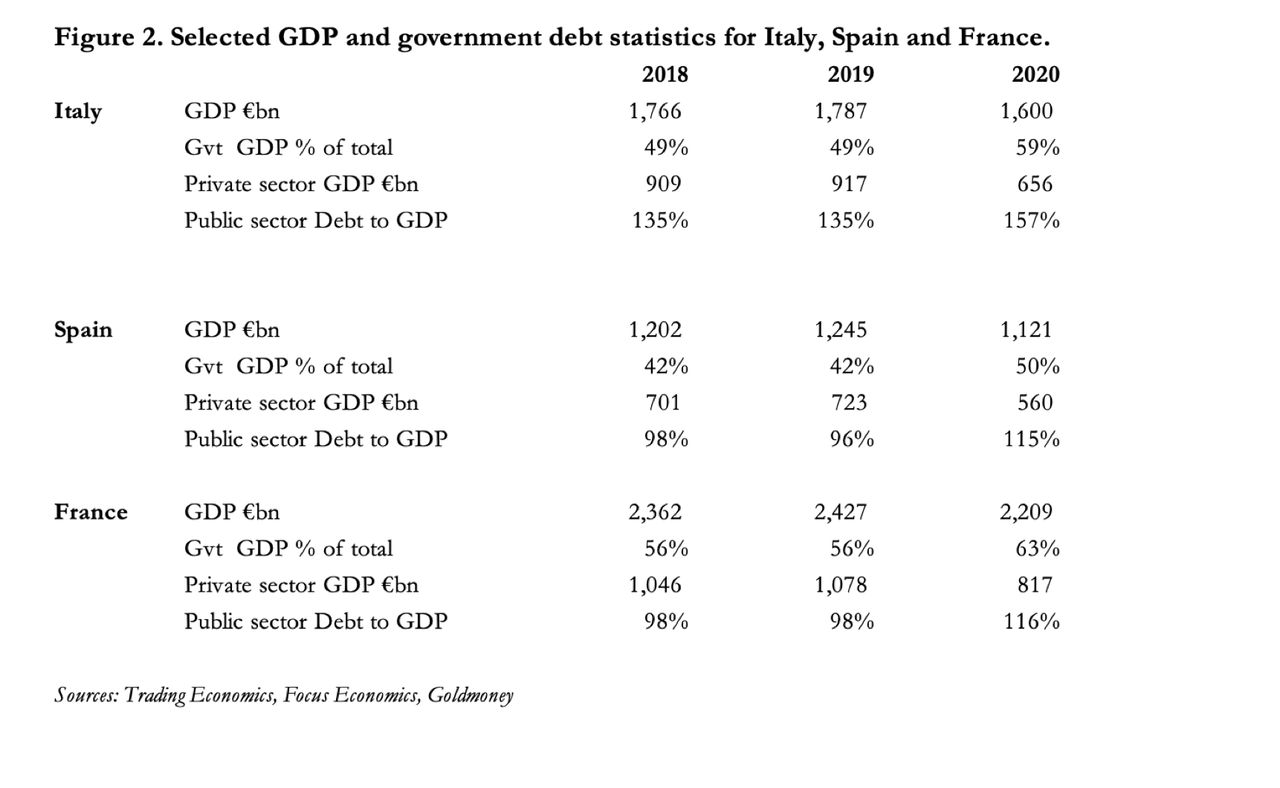
Table 2, which is of the relevant national statistics for Italy and Spain with the addition of highly indebted France, illustrates the problem emanating from lockdowns.

Forecasts for GDP in 2020 are consensus from Focus Economics. Debt to GDP statistics and their forecasts are from Trading Economics. From these, we can derive the economic effect on national private sectors. It is not widely appreciated that headline GDP numbers are bolstered by extra government spending, which when stripped out leaves the private sector exposed to significant falls in GDP on seemingly Panglossian forecasts. Thus, a 10.5% fall in consensus GDP expectations for Italy this year, after increased public spending in connection with the virus, translates into a fall of 28% in private sector GDP.

The effect on the Italian economy will simply lead to a new round of bankruptcies for all levels of Italian business, accumulating on the balance sheets of Italian banks. Similarly, we see Spain’s private sector contracting by 22.5%, and France’s by 24%. In all three cases, consensus forecasts for 2021 are for significant recoveries, conforming to a V-shape. With a second round of lockdowns increasingly likely, those forecasts are vulnerable to reality.

Forecasters are almost all Keynesian in that they expect government spending to stimulate economic recovery. But in reality, all that extra government spending can be expected to achieve is a statistical appearance of recovery through the creation of more bank credit to bolster government spending. But with the banking system commandeered to provide inflationary finance for governments and already having over-leveraged balance sheets (Table 1), prospects for economic recovery are remote.

As soon as it becomes clear that the recovery is going to take longer than anticipated we can expect the fragile confidence, that the ECB can continue to keep the show on the road, to evaporate. That is if, and not before, one or more of those highly leveraged eurozone banks does not face bankruptcy itself.

The consequences of financial dislocation

The developing situation embodied in the Target2 settlement system has concealed the rotten core of the Eurosystem. The consequences of imbalances, always dismissed by the authorities, are poorly understood and therefore ignored by financial commentators. But as we have seen, the Eurosystem and its Target2 settlement structure have fostered the concealment of bad debts at the national level, transferring them into the national central bank network.

The principal losers are Germany, Luxembourg, the Netherlands and Finland. Excepting Luxembourg, which can be expected to just go with the flow, the others could be determined enough to form the nucleus of a new currency area; but they are unlikely to do so before the Eurosystem implodes. To do so would actively destroy it, and the balance sheets of their own central banks as well.

The collapse of the Eurosystem would bankrupt the PIGS, and possibly other member states, cutting off all monetary financing. One would doubt, that even in such a crisis, there would emerge the political leadership with the strength, skill and determination to take these nations out of the crisis. As a centralising force, Brussels is utterly useless and will have lost all credibility. Furthermore, the collapse of the Eurosystem would mean the end of the euro as circulating money, so currency replacements, presumably on national lines, would have to emerge.

The ending of the euro will not be mourned. Those which it disciplined through its strength regretted the loss of a money they could print for themselves. And those who end up paying for its failure will have sacrificed all their peoples’ hard-won savings.

For the moment, the euro is strong against the world’s reserve currency. This strength comes partly from its moderate international trade surplus compared with the enormous US trade deficit, and the fact that the dollar is over-owned by foreigners while the euro is not. But in terms of purchasing power both currencies are on their different trajectories to purchasing power destruction.

The Fed’s policy of tying in the dollar to the fortunes of financial asset values is one form of currency destruction, but the euro will be destroyed if, and when, the flawed Eurosystem falls apart.

via ZeroHedge News https://ift.tt/3fl3vLY Tyler Durden

Hurricane Isaias Barrels Towards Virus-Infected South Florida 

Hurricane Isaias Barrels Towards Virus-Infected South Florida 

Tyler Durden

Sat, 08/01/2020 – 07:37

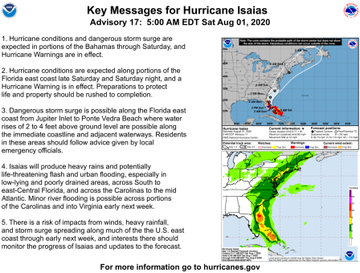
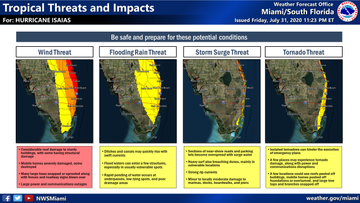
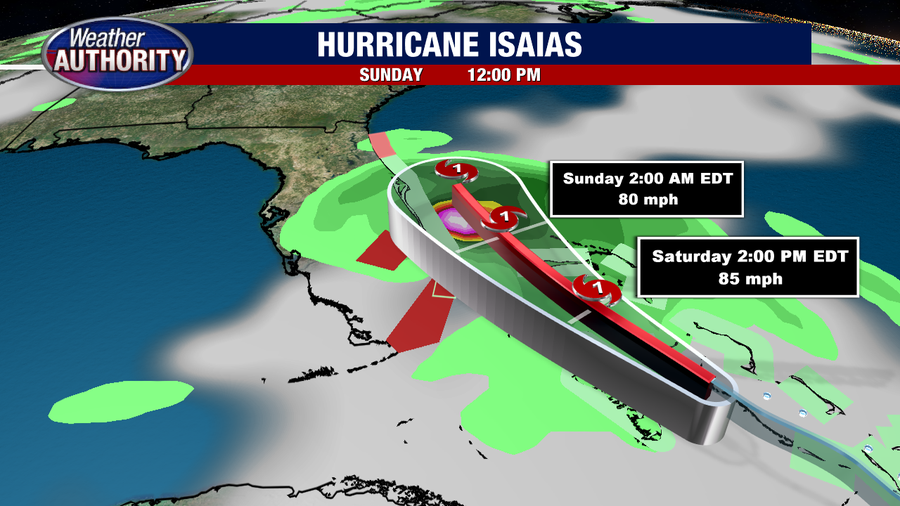
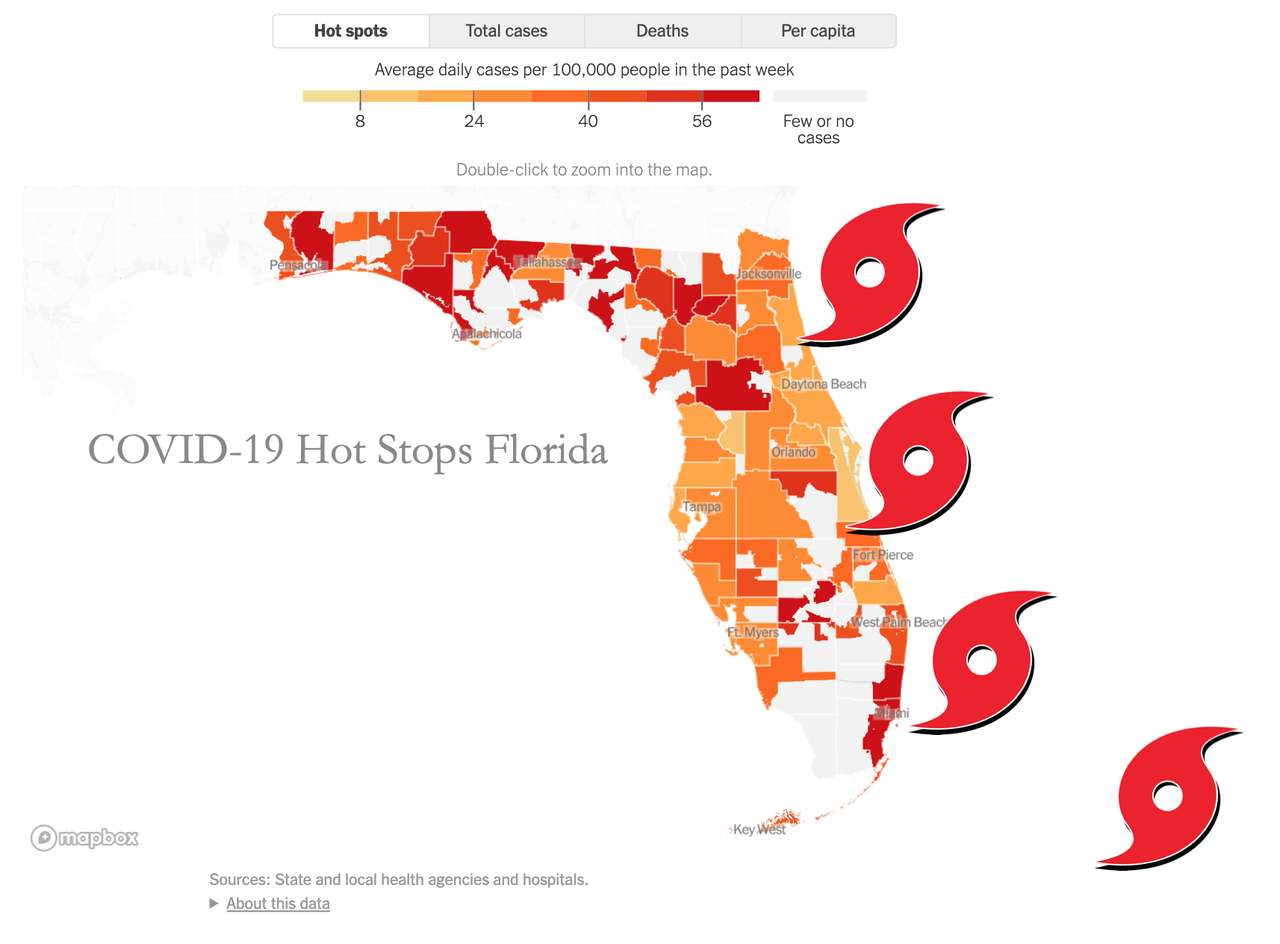
Hurricane Isaias has maximum sustained winds of around 85 mph Saturday morning, and strengthening is possible through the day as the storm barrels towards South Florida. The storm is slated to move up the East Coast later this weekend into next week, potentially unleashing torrential rain, high winds, and dangerous flooding in virus-infected states.

The Hurricane Center (NHC) latest Isaias update:

Hurricane warnings were posted for Boca Raton to the Volusia-Brevard county line. Miami Mayor Carlos Giménez told residents Friday that more than a dozen evacuation centers were ready to serve the community with social distancing measures. 

“We still don’t think there is a need to open shelters for this storm, but they are ready,” Giménez said.

NHC expects 2 to 4 feet storm surge from Jupiter Inlet to Ponte Vedra Beach, with 1 to 3 feet just north Miami Beach

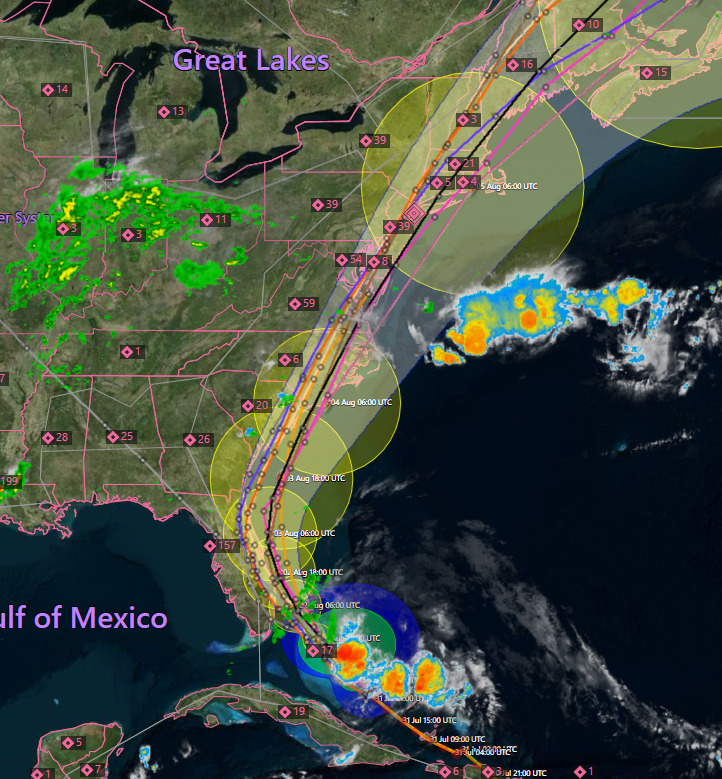
Here’s the current track of the storm. 

Daily Mail tweets the hurricane may prevent NASA astronauts from returning to Earth on Sunday. 

Florida has emerged as the epicenter of the COVID-19 outbreak, and the state registered a record 253 coronavirus deaths Friday with the hurricane fast approaching.

Florida Governor Ron DeSantis announced a state of emergency for counties along the Atlantic coast. He said the state is “fully prepared for this and any future storm during this hurricane season.” 

Spaghetti models show Isaias’ potential track is to ride the Florida coastline late Saturday through early Monday. The storm is expected to follow the East Coast, arriving in North Caroline early Tuesday, and New York City by Wednesday. 

Elsewhere in the Atlantic, NHC is “issuing advisories” for more potential storms to develop next week. 

via ZeroHedge News https://ift.tt/2DoWuwE Tyler Durden

Crossing The Rubicon: The UK Slips Into A Repressive State

Crossing The Rubicon: The UK Slips Into A Repressive State

Tyler Durden

Sat, 08/01/2020 – 07:00

Authored by Mark Chapman via Off-Guardian.org,

Julius Caesar’s crossing the Rubicon River in 49 BC in defiance of Roman law placed him and his army on a direct collision course with Rome, leading to the Civil War which established him as Roman dictator. It is a well-established metaphor for a point at which there is no going back and at which things will never be the same.

I predicted a few weeks ago that the UK Government would in the near future try to force everyone to wear facemasks in public.

Leave aside the plethora of information that makes it clear face masks are of practically zero benefit in everyday circumstances, and may in fact be dangerous, the forced wearing of facemasks is a transgression so fundamental and of such significance that it is difficult to adequately express.

It implicitly hands your body over to state control, and renders one of your most basic existential freedoms subject to state interference. For the first time, the right to exercise a choice of whether you should inhibit your respiratory faculties and hide your face in public is taken out of your hands. If you doubt the significance of this, try to remember the public outcry that followed a debate regarding banning the wearing of burkhas and hijabs in the face of Islamic terrorism, and the connotations this had for civil liberties at the time.

Facemask wearing is the visible hallmark of Asian states perceived in the West as repressive and authoritarian. It is a badge of serfdom, akin to the yellow star that Jews were forced to wear in Nazi Germany. There is no greater invasion of your person possible short of tattooing you with a number.

This astonishing about-turn in policy has not happened overnight or without preparation. It has been preceded by a cleverly-orchestrated media campaign which seeks to bizarrely turn established professional and scientific research on its head, making virologists, infection-control bodies and academics who have published papers for the medical profession into liars and charlatans.

This campaign has included editorials and blogs which talk in disapproving and accusatory tones of “mask-shirkers” and “mask-deniers” allegedly “refusing” to wear face masks. Leave aside the obvious fact that refusal cannot take place without a demand: in other words someone has to give you an instruction to which you reply, “No, thanks.”

Absent such a demand, you are not refusing anything, merely making a choice. And until now there has been no such demand. But those making this choice are now psychopaths and enemies of humanity without a shred of integrity, respect or regard for their fellow human beings.

When I returned from Asia early this year the advice was clear: face masks do not protect you from infection and it is not advised that you wear them.

What is more, face mask wearing was actively discouraged because of limited supplies required for hospital environments, where infection control is king and every precaution makes sense. Above all the only situation in which it is appropriate to wear a facemask in public is if you are unwell and have a cough, in which case why not stay at home?

But this piece of simple logic has been covered by the mask-advocates whose logic runs like this:

“You may have coronavirus without knowing it, and may infect others with your breath even at unlimited distances so you need to wear a mask.”

This covers all bases despite the evidence for this being at best negligible and at worst manipulated and dishonest.

It is part of the greater logic that renders every societal value worthless unless it contributes to the impossible task of making sure that not one single individual anywhere, ever, is infected with Covid-19. None of this means I think we should do nothing about this pandemic. But there is now a growing awareness that the cure proposed is not indefinitely sustainable and may in fact be worse than the disease.

The virtue-signalling of face-mask advocates is easily refuted. Facemasks have been available for decades for use in industry and ideas generally considered good are taken up by the public. Nobody needed the government to tell them to go out and buy a car or a television set.

So if you’re so convinced face masks are a good idea why has it taken the State to tell you before you came to this Eureka moment?

And for how many years or decades have you been going around disrespectfully infecting your fellow human beings by going out without a mask when you had a cold or the flu?

However, apparently all the established research is now wrong and face mask wearing is essential. It is a vast game of “Simon Says,” in which we only do anything when Simon says. And it won’t stop there. Expect newspapers like the Guardian to run sanctimonious editorials demanding that face-mask wearing be extended to pubs and restaurants, and eventually to every departure from your home.

Following this such a move will become policy: indeed, the British public will do what they are already doing, gleefully embracing this perverse doctrine, boasting of buying colourful face masks for their children, and showering anyone who has a different point of view with disapproval.

I’m forced now to doubt that we, the British people value our freedom as much as we profess to. We take to the streets in droves to embrace new forms of repression, such as an anarchistic movement that seeks to rewrite history and dismantle our police forces, or an anti-human death cult that seeks to suppress all human activity by frightening us all into believing we are destroying the Earth by existing.

But in the face of mounting attacks on our liberty and our freedom, we are silent. We have had our liberty taken away from us. Our movements are monitored. Our discussions are censored via social media. We are no longer free even to make fundamental choices about our bodies. A public that will silently accept these things has learned nothing from history, will accept anything and deserves its fate if that is a dystopian world-state.

We are no longer entitled to lecture other nations about being repressive states. Their representatives, quite rightly in my view would laugh in our faces. There is a growing fear in the minds of many of us that Western lockdowns may be permanent. The spectres of identity cards, martial law and forced vaccination now hover over us.

Dismissing this as “conspiracy theory” and accusing those who feel this way of an inhuman disregard for life is the rhetoric of fascism, a force that always thrives in the face of a perceived threat. I believe forced face-mask wearing in British streets is a brutal act that crosses the Rubicon, and finally signifies our descent into a de facto repressive state.

via ZeroHedge News https://ift.tt/2D0W5Rj Tyler Durden