The Politics of Guns Are Changing. Politicians Need To Catch Up.

splrfphotos143715

Amidst lots of the empty, emotive posturing you get at political conventions, last week’s Democratic gathering featured triumphalist cheerleading for gun restrictions. Sensing ballot-box victory within their grasp, the party’s officials pulled out the stops on threadbare proposals to dismiss self-defense rights and disarm civilians. It was as if the convention had beamed in from 2019, skipping over months of pandemic-driven uncertainty, growing skepticism toward the competency and decency of police, and social unrest that has driven millions of Americans to purchase firearms.

Oblivious to a changing world, political figures are pushing policies for which the moment has passed.

Far from the seats of political power, guns are very popular right now. FBI records of background checks, an indicator of gun sales from licensed dealers, hit an all-time high of 3.9 million in June, up from 2.3 million a year earlier and 1.9 million in June of 2018. The numbers remained high in July, at 3.6 million background checks.

More importantly, industry surveys say that many of those background checks and subsequent purchases involve new gun owners, not just established firearms fanciers adding to personal collections.

“Retailers reported an increased number of first-time gun buyers, estimating that 40 percent of their sales were to this group,” the National Shooting Sports Foundation (NSSF) announced in early June.  “This is an increase of 67 percent over the annual average of 24-percent first-time gun buyers that retailers have reported in the past.”

“All this equates to more than 2.5 million new gun owners in a very short period of time,” the NSSF adds.

There’s no mystery about the reasons for the surge in sales.

The year opened with widespread fears that the country’s divisive politics would lead to violence in an election year. “Nearly six in ten Americans agree that there will be protests or rioting in the United States over the next year in response to how the country is being run,” Ipsos reported in January. “Research suggests that many Americans are particularly concerned about the 2020 election cycle.”

That was before the COVID-19 pandemic struck the U.S, resulting in panic-buying that stripped store shelves and lockdown orders that crippled the economy. The Ipsos poll also predated high-profile police violence against civilians—especially the killing of George Floyd and, more recently, the shooting of Jacob Blake—that brought Black Lives Matter protesters and then rioters into the streets in many cities.

Along the way, many Americans lost faith in the government’s ability to make intelligent judgments and keep the peace, and the fairness and decency of law enforcement officers.

As a result, Americans are purchasing firearms in record numbers. And many of those buyers are from outside the ranks of traditional firearms fans.

In recent years, gun ownership has come to have a distinct partisan and demographic flavor. Republicans are more than twice as likely as Democrats to say that they own a gun. “White men are especially likely to be gun owners: About half (48%) say they own a gun, compared with about a quarter of white women and nonwhite men (24% each) and 16% of nonwhite women,” notes Pew Research.

That has made restrictions on the means for self-defense an easy sell for Democratic officeholders. Gun laws have been convenient weapons for targeting political enemies without offending supporters.

But the world is changing. According to the NSSF, “40 percent of first-time gun buyers in the first four months of 2020 were female. The main purchase driver among the group was personal protection, followed by target shooting and hunting.”

African-Americans, who are often unfairly targeted by law-enforcement and have vocally protested such treatment, are stocking on up on tools to defend themselves, too.

“The highest overall firearm sales increase comes from Black men and women who show a 58.2 percent increase in purchases during the first six months of 2020 versus the same period last year,” the NSSF noted in July.

Black Americans have armed themselves to push back against police, to put racists on notice, and to protect their homes and businesses.

“The arrival of militia members and armed private citizens is to be expected in cities where there is intense fallout from fatal use-of-force incidents,” Reason‘s Zuri Davis wrote in May. “Black activists, some inspired by the likes of Malcolm X and the Black Panthers, are using their guns to remind the public that they, too, have a voice.”

To this growing constituency for owning firearms, gun-controllers have a clunky, tone-deaf message: Vote for us and we’ll pass laws that make it harder for you to protect your families! Even better, those laws will give the cops you’re protesting more excuses to hassle you!

Obsessed with winning control over the federal government and punishing their hated political opponents, mostly Democratic gun control advocates failed to notice that the policies they favor were crafted for a world in which much of the population generally trusts government and its enforcers. That world was always largely imaginary; trust in government has sunk for years, and large majorities of African-Americans have long harbored doubts about law enforcement. But whatever was real about that image of the world has been swept away by recent events.

The world of 2020 is one in which gun ownership is losing its status as a partisan marker and becoming an expression of reliance in self and community across the population. Politicians still peddling schemes for restricting firearms ownership are asking the public to put their lives in the hands of a government they don’t trust, with those laws to be enforced by police in whom there’s record low confidence. If implemented, those laws won’t hurt just political enemies; they’ll also harm growing ranks of new gun owners among groups that were once assumed to be reliable supporters of restrictions.

The politics of guns are changing in a year that has demolished old arguments for gun control. Politicians need to catch up with the new reality.

from Latest – Reason.com https://ift.tt/2CZPer1
via IFTTT

Florida Will Pay Out $4.6 Million to Female Inmate Paralyzed After Guard Beating

weimar

The state of Florida will pay out $4.65 million to settle a civil rights lawsuit filed by Cheryl Weimar, a state prison inmate who was paralyzed from the neck down after a brutal beating by guards last September.

The Miami Herald reports that the payout could be the largest settlement ever by the state in a prison abuse case. (In 2018, the state paid $4.5 million to the family of Darren Rainey, a mentally ill Florida inmate who was boiled to death in a rigged shower by two guards).

The settlement agreement closes the book, at least on the civil side, on a case that put a gruesome spotlight on Florida’s troubled prison system, and specifically ongoing allegations of brutality and abuse at Lowell Correctional Institution, the state’s largest women’s prison.

According to Weimar’s lawsuit, she complained to a guard on Aug. 21 of last year, saying she couldn’t clean toilets because of pain from a pre-existing hip condition. This led to a confrontation with two Lowell correctional officers. Weimar, who has a history of mental illness, tried to declare a psychological emergency. Under department policy, the guards should have called for medical personnel.

Instead, her lawsuit alleged, the guards slammed her to the ground and began beating her. At least one guard elbowed the back of her neck, the suit said. Guards then dragged Weimar “like a rag doll” to an area not covered by surveillance cameras and continued beating her nearly to death.

For the past year, she has been confined to a hospital bed, paralyzed from the neck down, and dependent on feeding tubes.

Internal Florida Department of Corrections (FDOC) incident reports showed that Keith Turner, one of the guards allegedly involved in the beating, had a long history of complaints against him alleging excessive force, verbal and physical abuse, and trading contraband cigarettes for oral sex. Turner was later arrested on charges of molesting two minors and fired from the FDOC. The other correctional officer named in the lawsuit was reassigned and remains employed at the department.

The Florida Department of Law Enforcement (FLDE) and the FDOC Office of the Inspector General both launched investigations into Weimar’s beating. The FDLE investigation is still ongoing, according to a department spokesperson.

In 2018, the Justice Department launched a civil rights investigation into pervasive misconduct and sexual assaults by correctional staff at Lowell. A 2015 Miami Herald investigation found numerous accusations of assaults, retaliation, filthy conditions, inadequate healthcare, and suspicious deaths at the prison, as well as “an inadequate number of cameras,” which allows guards to hide brutality.

from Latest – Reason.com https://ift.tt/3hCMijq
via IFTTT

Stellar, Record Big 5Y Treasury Auction Shows “No Fear” Of Inflation For Years To Come

Stellar, Record Big 5Y Treasury Auction Shows “No Fear” Of Inflation For Years To Come

Tyler Durden

Wed, 08/26/2020 – 13:16

Following yesterday’s stellar 2Y auction, moments ago the Treasury sold another record batch of paper, this time $51 billion in 5Y notes, up from $49 billion in July.

Following aggressive selling across the curve, there was a solid concession heading into the 1pm deadline, and sure enough just like yesterday, the high yield of 0.298% stopped through the When Issued 0.307% by 0.9bps, indicating that just like yesterday, virtually nobody is worried about inflation over the next 5 years.

And just like yesterday’s 2Y auction, the bid to cover surged to 2.71, from 2.32 last month (and 2.49 for the six-auction average), which was the highest BTC since April’s 2.74 and well above the 2.48 six auction average.

Finally, and also just like yesterday, the internals were impressive with Indirects taking down 66.2% of the auction, the highest take down by foreigners since August 2018. And with Directs taking down 15.9%, Dealers were left with just 17.8% of the auction which they can then flip back to the Fed, this was the second lowest Dealer takedown on record with just the 17.5% in August 2017 lower.

Overall, another stellar auction and one wonders if Powell’s speech vowing he won’t hike rates until 2060 has already leaked…

via ZeroHedge News https://ift.tt/34AzxCc Tyler Durden

Rand Paul Delivers Blistering Foreign Policy Attack: “Biden Will Choose War Again”

Rand Paul Delivers Blistering Foreign Policy Attack: “Biden Will Choose War Again”

Tyler Durden

Wed, 08/26/2020 – 13:10

Among the most notable highlights at last night’s Republican National Convention, Senator Rand Paul delivered a blistering take down of Democratic presidential nominee Joe Biden’s foreign policy, which Paul linked to multiple wars under Democrat administrations spanning decades (going back to Clinton’s bombing of Serbia). 

“I fear Biden will choose war again,” Paul asserted“He supported war in Serbia, Syria, Libya. Joe Biden will continue to spill our blood and treasure. President Trump will bring our heroes home.”

“If you hate war like I hate war, if you want us to quit sending $50 billion every year to Afghanistan to build their roads and bridges instead of building them here at home, you need to support President Trump for another term,” said Paul, who has long been a fierce critic of former President Obama’s foreign policy, including overt intervention in Libya, and covert action toward destabilizing Syria.

He slammed Biden as a hawk who has “consistently called for more war” and with no signs anything would be different.

Interestingly, Sen. Paul has also in the recent past led foreign policy push back against President Trump – especially over the two times Trump has bombed Syria following alleged Assad chemical attacks, which Paul along with other anti-interventionists across the aisle like Tulsi Gabbard questioned to begin with.

But it appears Paul is firmly supportive of Trump’s newly released 50-point agenda for his second term outlining the Commander-in-Chief will “stop endless war” and ultimately bring US troops “home.” The plan still emphasized, however, the administration will “maintain” US military strength abroad while ‘wiping’ out global terrorism.

“President Trump is the first president in a generation to seek to end war rather than start one. He intends to end the war in Afghanistan. He is bringing our men and women home. Compare President Trump with the disastrous record of Joe Biden, who has consistently called for more war,” Paul said further. 

Back during the primaries in 2016, Paul and Trump sparred intensely over national security questions:

He also highlighted Biden’s unrepentant yes vote to go to war in Iraq.

“I’m supporting President Trump because he believes as I do that a strong America cannot fight endless wars. We must not continue to leave our blood and treasure in Middle East quagmires,” Paul concluded.

Elsewhere in the approximately four-minute speech, Paul said Trump will fight “socialists poisoning our schools and burning our cities.”

via ZeroHedge News https://ift.tt/2D4xWsY Tyler Durden

Watch Out Hoodlums… Victims May Start Fighting Back Much More!

Watch Out Hoodlums… Victims May Start Fighting Back Much More!

Tyler Durden

Wed, 08/26/2020 – 12:50

Authored by Adam Dick via The Ron Paul Institute for Peace & Prosperity,

There are hoodlums across America looting and burning down businesses, banging on people’s vehicles while ordering drivers rudely where to drive, bearing down on people to intimidate them into expressing support for this or that cause, and committing other crimes of violence and property destruction.

Many of these hoodlums say things about black lives mattering, white supremacy or systemic racism being bad, reparations for slavery being needed, or some other message related to politics or race. Other hoodlums do not say such things but take their actions while in a group of people, many of whom are saying such.

All that talk concerning politics and race is beside the point. The people taking these actions are hoodlums.

The hoodlums have tended to have the upper hand so far.

Victims have been surprised and unprepared to be victims. Victims have figured the acts of violence and property destruction will soon fade away. Victims have thought police would protect them.

Well, the fade away is not happening, and police have often failed to protect victims from harm.

More and more, potential future victims are preparing for confrontation by the hoodlums.

Some of these hoodlums, and the people with them, like to complain about police brutality. They may soon be on the receiving end of brutality, but not from cops.

When victims fight back, they will sometimes do so disproportionately, and they will sometimes react against people who see themselves as nonviolent protesters or onlookers but are near the hoodlums and appear to be associates of the hoodlums.

The danger of being a hoodlum or hanging around with hoodlums will rise.

Hoodlums should expect their violent and property destructive ways to place them in increasing danger. Giving up on those activities can help them protect themselves from danger.

Meanwhile, protesters and other individuals who find themselves in apparent association with hoodlums can also expect that such activity will involve increasing danger. They can practice greater care regarding with whom they associate and where they choose to be. Their safety may depend on it.

via ZeroHedge News https://ift.tt/34zn7dN Tyler Durden

Half Of NABE Respondents Believe Return To 2019 Growth Levels Could Take Years

Half Of NABE Respondents Believe Return To 2019 Growth Levels Could Take Years

Tyler Durden

Wed, 08/26/2020 – 12:36

The most important question in all of finance is when the recession will end. The appearance of the strongest market recovery rally in 87 years, would suggest sunny days are ahead for the real economy. Though, the forward-looking market, is too forward-looking, ignoring today’s deep economic scarring and pricing in an economic recovery that could be years away. 

A majority of economists believe the US economy could emerge from the virus-induced recession sometime later this year or at some point in 2021, according to Bloomberg, citing a new National Association for Business Economics (NABE) survey.

About half of the respondents surveyed expect the economy to return to 4Q19 GDP activity level sometime in 2022.   

Sixty-six percent of respondents said the economy remains in a contraction that started in February, while 80% indicate a 25% probability of a double-dip recession

In terms of a recession – a ‘V-shaped’ recovery in the real economy this year is becoming a distant dream. It sounds more like government propaganda, one that is routinely pumped by the Trump administration, because, hey, it’s an election year… 

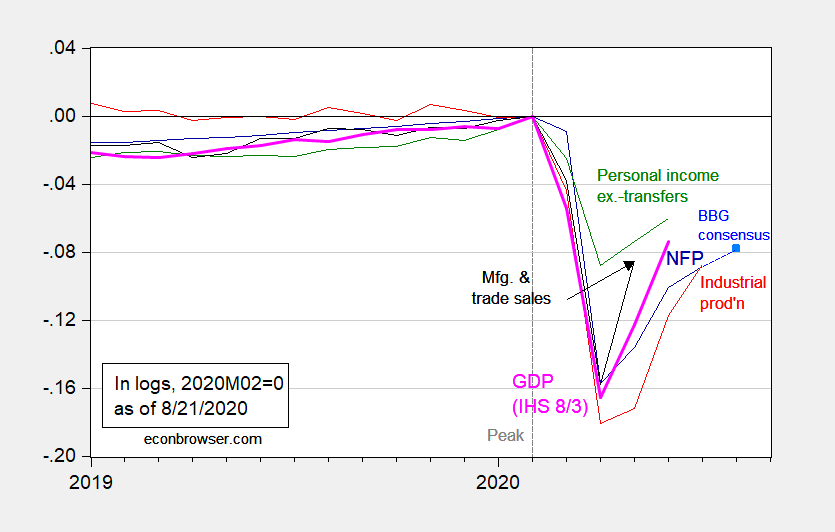
There’s an abundance of economic data out there suggesting the economic recovery is transforming from a ‘V’ to a ‘Nike Swoosh,’ shown below:

h/t Menzie Chinn, Professor of Public Affairs and Economics, University of Wisconsin, and Blogger at Econbrowser

The NABE survey also showed many of the respondents believe Congress should pass another round of fiscal stimulus, with 22% indicating the size of the stimulus should be around $1.5 to $2 trillion. 

About 40% of respondents grade Congress’ fiscal response as “insufficient,” 37% believe it’s “adequate – while 75% said the Federal Reserve monetary policy response is “about right.” 

And maybe fears of a double-dip recession, or at least the belief a ‘V-shaped’ recovery is not in the cards this year as it would take trillions of more dollars of monetary and fiscal stimulus to supercharge the economy once again. 

We’ve highlighted the surge in money supply, following the virus-induced lockdowns, unleashed a massive spike in positive economic surprises as tracked by the Citi econ surprise index – though with waning stimulus, positive economic beats appearing to be stalling, suggesting the recovery could reverse. 

Even though President Trump signed an executive order to redirect disaster-relief funds to extend supplemental unemployment insurance, implementation has been slow. 

Hopes for a ‘V-shaped’ economic rebound continue to diminish. 

via ZeroHedge News https://ift.tt/32vHrKr Tyler Durden

US-China Relations & Believing That ‘Pigs Can Fly’

US-China Relations & Believing That ‘Pigs Can Fly’

Tyler Durden

Wed, 08/26/2020 – 12:20

Authored by Michael Every via Rabobank,

“It’s Still Good! It’s Still Good!”

Many years ago there was an episode of The Simpsons where Homer decides to roast an entire suckling pig, apple in mouth and all. He even invites over the neighbours to enjoy his culinary triumph, the “Pig de resistance”.

A toast to the host who can boast the most roast!” says Ned Flanders. This all infuriates his vegetarian daughter, Lisa, who takes the lawnmower and pushes the entire pig, which is on trolley, out of the garden, up a steep hill,…and then let’s gravity go to work. The pig rolls down the hill and crashes at speed through a hedge.

It’s a little dirty. It’s still good! It’s still good! cries Homer, running after it. Then the pig goes off a bridge and into the river.

It’s just a little slimy. It’s still good! It’s still good! cries Homer from the bridge. Then the pig gets sucked into a drainage hole in a dam, pressure builds up behind it, and it goes flying through the air like a missile on the other side.

It’s just a little airborne. It’s still good! It’s still good!bewails Homer.

It’s gone,” says Bart.

I know,” concedes Homer.

In the top-floor office of the Springfield nuclear power plant, Mr Burns looks out at the vista and says: “You know Smithers, I think I will donate one million dollars to the local orphanage….when pigs fly.” Both cackle. Then the suckling pig flies past the two stunned men.

Will you be donating that million dollars now, Sir?” asks Smithers.

No, I’d still rather not,” replies Burns.

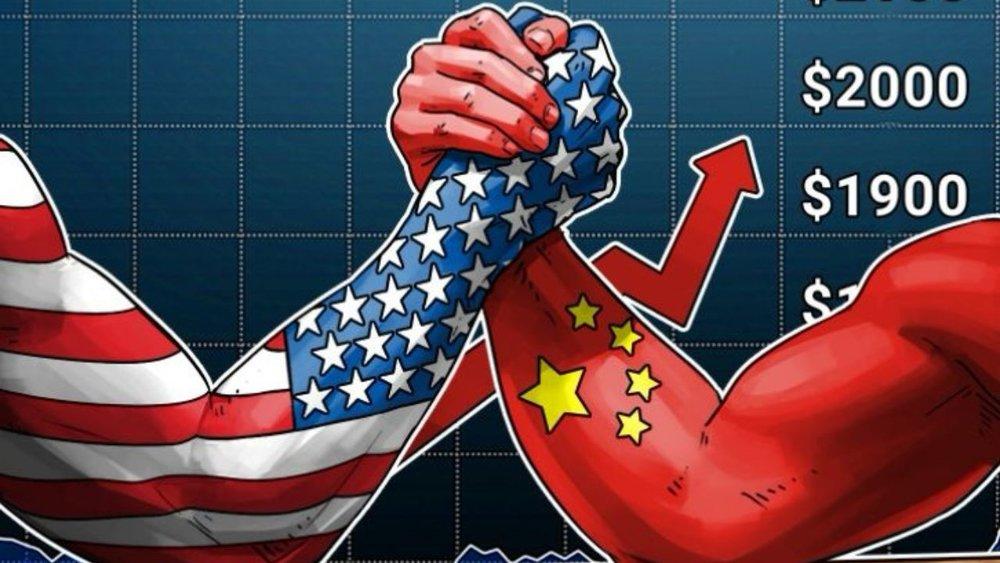
Frankly, the above is as good a description of the US-China phase one trade deal as I can think of (as well as of the general attitudes of the very wealthy). The deal was, on paper, a feast for the US – lots and lots more NET exports to China, promises on other areas of contention, and a monitoring mechanism.

However, even if Covid-19 hadn’t pushed it down the hill, the underlying US-China dynamic would have anyway. The US and China and the market commentariat may be echoing Homer –“It’s still good! It’s still good!”– but this particular trade deal is already in the hole in the dam with water pressure building up behind it. It just hasn’t been violently ejected the thing into the air…yet.

Of course, this is not a new view here. Yet it was further underlined by everything written about China written in the 50-point Trump agenda yesterday, which involves bringing jobs home using tariffs and taxes; it is underlined by the continued US crackdown on Huawei, for example – unless we presume other Chinese firms are going to be lining up to buy semiconductors from the US instead(?); and it is very much underlined by Politico reporting that the White House is considering officially designating China’s treatments of its Uighur minority as genocide, which is about as inflammatory an accusation as one can make – and a Biden campaign spokesperson has already used exactly that term.

Meanwhile, from the Chinese side, The Asia Times’ perpetual Belt-‘n-Roader Pepe Escobar gives a selective reading of the political tea leaves that highlights the following (my comments added):

  • Beijing won’t shut US businesses operating in China, but new companies wanting to enter the market in finance, IT, healthcare and education services will not be approved (i.e., decoupling).

  • Beijing won’t dump its US Treasuries (which would be impossible anyway) but is going to sell as much as USD200bn in 2020 (which means nothing at all for Treasuries as someone else will be happily buying them, but makes one wonder what China will be buying…and selling; not to the US and earning USD, presumably?)

  • CNY internationalization (which is not happening) will be accelerated, including clearing USD through the CIPS system to mitigate any ban on using SWIFT. (Except the US controls the USD and can tell everyone if they use CIPS then they can’t use USD in SWIFT.)

  • The PLA has been put into Stage 3 alert: all leave has cancelled for the rest of 2020; defence spending will rise to 4% of GDP; and more nuclear weapons will be produced. (Which will raise US-China tensions, is hideously expensive, and will push the fiscal deficit deeper into the red, while dragging the current account in the same direction.)

  • Chinese is stressing self-reliance and “dual circulation” to focus on its internal market. (Which means they need higher wages for higher spending, which means a loss of export competitiveness and a current account deficit and no self-reliance; unless China decouples from the world.)

  • The consolidation of the Eurasian integration project in parallel to a global CNY (e.g., economic powers like Belarus?)

In short, China appears determined to go its own way at its own pace, and even if the strategy it publicly suggests it will use to do so is not adequate given the potential pressure points the US can use against it, then it appears Beijing is more likely to adapt than concede. Such adaptation is very unlikely to meet the terms of the US-China phase one trade deal.

Read all the above and then ask yourself: “Is it still good? Is it still good?

Right now, the answer is yes. However, the water (read: political) pressure is building, and when the time is right for either side… POP!!

The only way to see that isn’t the case is to believe that pigs can fly. Which, oddly enough, seems to be prevalent among many of Mr Burns’ friends in Wall Street, and those buying CNY at 6.90.

via ZeroHedge News https://ift.tt/32yRdeW Tyler Durden

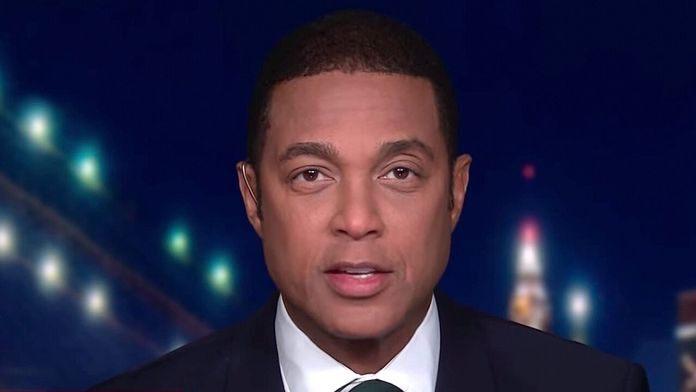
“It’s Showing Up In The Polling”: CNN’s Lemon Says Biden Needs To Stop Ignoring Riots Because They’re Helping Trump

“It’s Showing Up In The Polling”: CNN’s Lemon Says Biden Needs To Stop Ignoring Riots Because They’re Helping Trump

Tyler Durden

Wed, 08/26/2020 – 12:00

CNN‘s Don Lemon wants Joe Biden to stop ignoring violent race riots gripping the country – but not because of the crime, or the death, or the deep divide in America that’s caused the price of ammunition to skyrocket as mobs of unhinged leftists harass innocent people.

Nope, it’s because the riots are “showing up in the polling” and helping President Trump.

The following exchange took place between Lemon and CNN’s Chris Cuomo on Tuesday:

Cuomo: “You have COVID and Kenosha, Don, and what’s happening in Wisconsin, it’s a Rorschach test for where this country is, and I think it probably represents the biggest threat to the Democratic cause.

Lemon: “You took the words right out of my mouth.”

Cuomo: “That’s because we’re reading from the same teleprompter.”

Lemon: “That’s all you. This is where I come in. We’ll get to that. But when you said it’s too little too late, I don’t know about that. I mean, we still have a lot of time left until election day. I do think that this —what you said was happening in Kenosha is a Rorschach test for the entire country. I think this is a blind spot for Democrats. I think Democrats are hoping this will go away, and it’s not going to go away.”

I think maybe Joe Biden may be afraid to do it. I’m not sure. Maybe he won’t, maybe he is. He’s got to address it. He’s got to come out and talk about it. He’s got to do a speech like Barack Obama did about race. He’s got to come out and tell people that he’s going to deal with the issue of police reform in this country, and that’s what’s happening now is happening under Donald Trump’s watch. When he is the president, Kamala Harris is the vice president. Then they will take care of this problem. But guess what? The rioting has to stop. Chris, as you know, and I know it’s showing up in the polling, it’s showing up in focus groups. It is the only thing right now that is sticking.” (Transcript via Breitbart)

Watch:

And as Rusty Weiss of The Mental Recession notes violent crime is now a major issue among voters heading into the 2020 election.

A recent poll from the Pew Research Center indicates violent crime is a major issue amongst voters heading into the 2020 presidential election.

A sizable 59 percent of voters in the survey indicate that violent crime, which President Trump has framed as happening in Democrat-controlled cities, is a “very important” factor in casting their ballots.

When broken down by party affiliation, the party of law and order becomes clear: 46 percent of Joe Biden supporters view violent crime as an important factor, while 74 percent of President Trump’s backers feel the same.

Imagine what Lemon would say if the riots were helping Biden.

via ZeroHedge News https://ift.tt/3lkpmHN Tyler Durden

The Fed Faces A “Complete Nightmare”: Convincing The Public That Higher Inflation Is Good For Them

The Fed Faces A “Complete Nightmare”: Convincing The Public That Higher Inflation Is Good For Them

Tyler Durden

Wed, 08/26/2020 – 11:55

Yesterday we explained why Bank of America, a contrarian voice among Wall Street banks, believes that hopes for an explicit announcement of Average Inflation Targeting (AIT) by Jerome Powell in his highly-anticipated speech titled “Monetary Policy Framework Review” to be delivered at 910am on Thursday which wraps up an examination of inflation which started in early 2019 among both among central bank officials and the public, will be a disappointment.

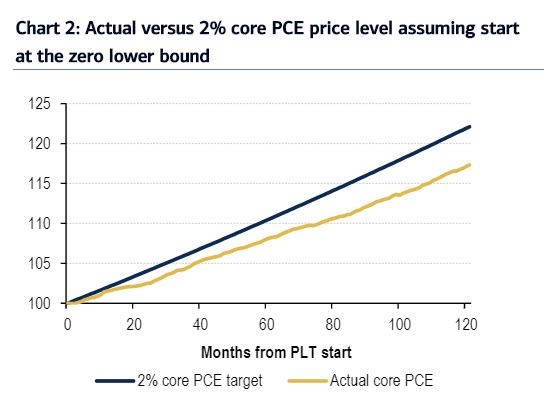
The first reason that an explicit policy would entail picking a specific time period over which PCE inflation is required to average 2% before beginning a policy normalization (hiking) process. This is a problem, because in simulations conducted by the BofA rates team, it found this could in require the Fed to remain on hold for 42 years!

Furthermore, explicit AIT could also cripple the Fed’s already waning credibility, not least of all because “it would also bring up difficult issues around the appropriate time period to calculate averages and the maximum realized inflation rates the Fed would tolerate while the average climbs higher.” Ultimately, BofA concludes that an explicit policy of AIT could greatly complicate both Fed communication and logistics. This would risk a reduction in the Fed’s credibility, which is already vulnerable given:

  • the market’s pricing of inflation expectations well below 2% for the next 30 years, and
  • its decade-long miss in achieving its inflation mandate

Explicit policies aside, there is the question of just what mere “forward guidance” and jawboning can do when the Fed is already at the limit of its firepower, and according to some has even crossed into illegal territory by purchasing corporate bonds. In other words, “the market is overhyping the Fed’s ability to change the course of inflation in the future, under any policy.” Here’s why:

To begin with, interest rates are already close to 0 across the entire Treasury curve. The principle of monetary easing is to increase aggregate demand by lowering the cost of funding, theoretically increasing borrowing for spending and investment. But at the current low rates, even if the Fed were to set all Treasury rates to 0bp, how many new borrowers and spenders would emerge? This is the problem of the zero lower bound that has worried the Fed and other central banks for years. The incremental ability to ease, without adopting deeply negative rates, is limited.

Yet one look at the market and front page headlines today, suggest that Bank of America is in the minority when it comes to what Powell will announce tomorrow, when under the smokescreen of “Average Inflation Targeting”, the Fed will essentially assure markets that rates will be at zero for years to come (42 if BofA is right).

So assuming that Powell does everything he can not to disappoint markets, the Fed chair then faces a far tougher task: convincing the public not only that the central bank can and will deliver in the wake of a pandemic that has eroded trust in institutions and put a huge chunk of the labor force on the unemployment rolls, but more importantly, convince Americans that higher inflation will be good for them in the long run – even as analysts, such as BofA , have already begun second-guessing whether a new Fed “framework” will fare any better than the current one in an environment where monetary policy is at the limit of what it can do to help the economy.

“The situation is really perilous right now and there is little that monetary policymakers at this point have left in their arsenal,” David Wilcox, former head of the Fed’s research division and now a senior fellow at the Peterson Institute told Reuters, adding that the Fed’s new framework, expected to be unveiled soon, will seem abstract unless it is coupled with new steps to enforce it, such as massive new bond-buying or the setting of explicit unemployment goals.

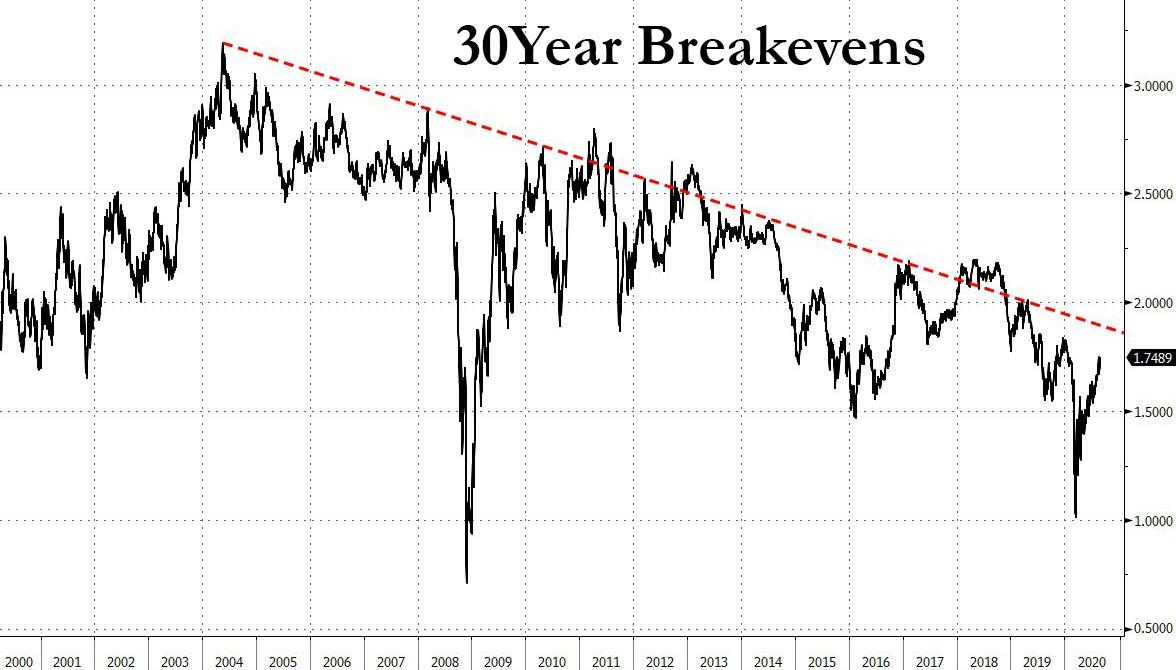
Which begs the question: if buying $3 trillion in bonds over just 3 months, a never been seen pace of debt monetization, failed to convince the market that inflation will rise over the long term as 30 Year breakevens at just 1.75% show…

… what will: buying $30 trillion? $300 trillion?

Or perhaps the Fed will punt, afraid of sparking an even more massive asset bubble, and instead of making an explicit AIT goal, merely acknowledges that a period of inflation overshoot is necessary to produce an average inflation rate of 2% over a cycle. This, according to BofA’s Ralph Axel “could take the form of officially changing the 2% inflation target to a range of 1.5-2.5%, or codifying that it will officially seek periods of inflation overshoots on the order of, say, 50-100bp to achieve its 2% goal on average through the cycles.”

Indeed, the minutes from the Fed’s last policy meeting indicated that may be the case, giving the central bank time to see how the economy behaves at this stage of the coronavirus pandemic. After all, it has already chopped interest rates to zero, started some bond-buying, and approved massive lending programs, however the market was disappointed when the Fed renounced Yield Curve Control for now – arguably a key market component of any inflation targeting regime.

One thing is certain: the Fed must do something if for no other reason than to give the impression it is fighting to reduce the surge in US unemployment as a result of the coronavirus shutdowns. And yet it begs the question: does the Fed really have any control over unemployment rate via the inflation channel?

It is not that long ago that the Phillips curve – which represents the theoretical linkage between the inflation rate and the unemployment rate in an economy – was declared dead. Indeed, until the March shutdowns, unemployment had collapsed to historically low levels without inflation even hitting the Fed’s 2% target. Expectations about inflation, considered key to the future pace of price hikes, also lagged, prompting even Yellen in one of her last speeches as Fed chair, to say that our understanding of inflation may be flawed by models that are misspecified and our inability to predict trends in sectors such as health care and housing which are large components of the price index.

In short, as BofA noted, the complete breakdown of the Phillips curve, inversely relating unemployment rates to wages, has long mystified the Fed and has caused them to rethink long-held concepts such as NAIRU (the non-accelerating inflation rate of unemployment).

And yet, despite a decade of failure, the hope now is that the reverse will work: that by sparking “asymmetric” as it is called in polite economic circles, or runaway – in the proper vernacular – inflation, will spark a flood of hiring. But why? In a world where it has become abundantly clear the US economy can operate just as efficiently on a “work from home” basis, why would corporations rush to rehire the same people they paid steadily rising wages instead of outsourcing to Vietnam or Eastern Europe?

As Reuters notes, the disconnect between employment and inflation has become a chronic problem not only for the Fed but for central bankers around the world. Without some inflation, interest rates remain lower than normal which while great for asset prices (this headline literally just hit on Bloomberg: *MSCI ALL-COUNTRY WORLD INDEX REACHES RECORD HIGH), it affords little room to help the economy by reducing them when recessions hit, as happened this year. Central banks are then faced with cutting rates quickly to zero and using politically more difficult tools like buying of government bonds and – for the first time ever – corporate bonds.

The Fed first put the inflation target in place in 2012, and has missed it most of the time since. As shown above, markets indicate the expected U.S. inflation rate 30 years out is just 1.75%, a level reflecting little worry about the risk of a jump in inflation and little faith in the Fed’s sway over the one economic variable a central bank is thought to control.

Which brings us full circle, with the thinking going as follows: if what the Fed has done so far hasn’t worked, then it’s time for the Fed to do even more of it.

“There is a growing realization that a 2% inflation target as originally put in place in the U.S. and around the world is not quite enough,” St. Louis Fed President James Bullard said in a recent interview with Reuters. Changing the framework could help “shore up the target and get expectations to stay at 2%,” he said. Actually, no, it would crush America’s already suffering middle class by sending prices higher even as wages continue to shrink.

It’s also why after Powell’s speech tomorrow laying the groundwork for AIT, at its policy meeting next month, the Fed is expected to change how it characterizes its inflation goal and instead of looking to achieve 2% inflation on an annual basis, it is expected to aim to achieve that level as an average over a longer time, and explicitly allow perhaps years of faster price increases to make up for years when prices rose too slowly.

And here again we go back to BofA’s math: it will take 42 years of 2.0% inflation to get back to normal; it would also take a decade of 2.5% inflation to offset the target shortfalls since 2012. It would also mean stocks at all time highs, while the average American standard of living will hit an all time low.

What about unemployment?

Well, the existing strategy treats super-low unemployment as a risk to inflation that the central bank needs to “mitigate” rather than as a bonus for workers as long as prices are tame. Ironically, record low unemployment in 2019 and early 2020 did nothing to spark higher inflation expectations; just the opposite.

And yet – the thinking goes – as the Fed supercharges inflation and greenlights faster price increases, implicit in an average inflation goal, which these days means simply higher stock prices with little impact on the broader economy or that biggest variable of all – higher wages – also known as “good inflation”…

… it ought to allow for lower unemployment since the Fed would leave financial conditions looser even as prices picked up.

Which basically boils down to the following argument: Americans will need to suffer through years, if not decades, of declining purchasing power and higher prices just so unemployment declines… which of course is bizarre in a time when increasingly more are hoping that Universal Basic Income from the government will replace traditional work for a growing chunk of the population.

Good luck selling the American people on that, especially at a time when the fastest price increases have been for essentials like food and appliances.

“What if we are unlucky and we get high unemployment and inflation over 2%?”, Columbia Threadneedle analyst Ed Al-Hussainy told Reuters. Those were the very conditions that led the Fed in the 1970s – a period of devastating stagflation – to wage a two-decade battle to set its credibility as an inflation fighter.

“Messaging the algebra to Congress and the public is a complete nightmare.”

via ZeroHedge News https://ift.tt/3jbVco4 Tyler Durden

It’s time to have an honest, rational conversation with your family

When the captain came on the announcement system yesterday morning to introduce himself to passengers, the first thing he said was,

“Ladies and gentlemen, a lot of us have been cooped up and under tremendous stress for the past several months. So the most important thing we can do right now is be kind, patient, and understanding with one another.”

It was an interesting way to start off a flight.

And I remember thinking to myself, “He probably wouldn’t bother saying something like that unless they’ve had some bad experiences recently with passengers fighting with one another.”

Sure enough, it didn’t take long before I heard an altercation between two passengers; ostensibly one of them had let her mandatory face covering slip ever-so-slightly below her nose. And a nearby passenger would have none of that.

It was even more interesting to me to witness the sense of entitlement that some people feel in barking orders to other human beings. They’re like Army Drill Sergeant shouting “Put your mask over your nose!”

This example, of course, barely scratches the surface of conflict these days. I’ve written before in these pages about people being pepper sprayed, or assaulted, for not wearing a mask.

I’m not even talking here about whether it’s right or wrong to wear I mask; I’m talking about the inability to people to engage in civil discourse.

There’s so much bottled up RAGE in the world… and it takes nothing anymore for that rage to explode and turn violent.

Masks are only one example. Social justice is another—rage quickly turns to violence and chaos.

Earlier this week an angry mob (of mostly white young people) swarmed restaurant customers whose only crime was dining outside in the wrong place at the wrong time.

The mob ran up to the restaurant tables and commanded the diners raise to raise their fists in solidarity, screaming “White silence is violence.”

You can’t even have lunch anymore without having to worry about being attacked by a violent mob.

And just last night in Wisconsin, rioters violently clashed with armed citizens in a literal gun battle that took place in the streets in America.

The mob had already torched private property, including, inexplicably, a car dealership. And several concerned citizens took it upon themselves to defend other property from the mob since the local government doesn’t seem willing or capable to do so.

And that’s when things became violent. At least two people are dead, and several shot.

Even something as simple as politics—which has long been a source of passionate and vocal disagreement—easily descends into violence and chaos.

These days, people are literally being beaten and battered for quietly expressing their political views. Countless others have been fired from their jobs.

It’s nearly impossible to have a rational discussion anymore, and this all constitutes a complete breakdown in the social fabric.

I figure many of us probably stare at our screens and watch these videos and news reports in utter disbelief. We can’t bring ourselves to acknowledge what has happened over these past few months.

But make no mistake– this is happening. This is not a figment of our imaginations. And it’s not going away.

Don’t be fooled into thinking it’s going to blow over. Or some politician is going to ride in on a white horse and make everything better.

In fact, in many cases, state and local governments are in on it… they’re fanning the flames of chaos, cheering on riots and dismissing the violence as “peaceful protests.”

I’ve been writing about this for years: you cannot depend on your government, and you cannot depend on the good nature of your fellow citizens. You really have yourself to rely on, first and foremost.

That’s why I’ve long encouraged our readers to have a Plan B.

A Plan B isn’t about doom and gloom. On the contrary—it’s about ensuring that you’re in a position of strength regardless of what happens, or doesn’t happen, next.

A Plan B is an acknowledgement that obvious risks exist… and a sensible approach to protect yourself from those risks.

Well, we’re not talking about ‘risks’ anymore, i.e. potential threats that -might- occur. We’re talking about terrible trends that HAVE happened… ARE happening… right in front of our very eyes.

Our brains work in a funny way in this regard; human beings often suffer what psychologists call “normalcy bias,” i.e. even when we see radical events taking place, we assume that everything will quickly go back to normal.

Seriously—does anyone honestly believe that these angry mobs will put down their torches and pitchforks and settle down? Does anyone honestly believe that after the election it will be all rainbows and buttercups?

Don’t fall into this trap. Don’t shrug off what’s happening and assume it will all go away. Remember the words of Medal of Honor recipient Admiral Jim Stockdale, who survived 7+ years in a Vietnamese prison camp:

You must never confuse faith that you will prevail in the end—which you can never afford to lose– with the discipline to confront the most brutal facts of your current reality, whatever they might be.”

It’s really time to have an honest, rational conversation with yourself and your family about obvious threats… and sensible solutions.

Source

from Sovereign Man https://ift.tt/3b0hw1q
via IFTTT