The Pandemic Is Accelerating Trends That Are Disrupting The Foundations Of The Economy

The Pandemic Is Accelerating Trends That Are Disrupting The Foundations Of The Economy

Tyler Durden

Wed, 08/26/2020 – 09:50

Authored by Charles Hugh Smith via OfTwoMinds blog,

The problem is the economy that’s left has no means of creating tens of millions of jobs to replace those lost as the 1959 economic model collapses.

Fundamentally, the economy of 2019 was not very different from the economy of 1959: people went shopping at retail stores, were educated at sprawling college campuses, went to work downtown, drove to the doctor’s office or hospital, caught a flight at the airport, and so on.

The daily routine of the vast majority of the workforce was no different from 1959. In 2019, the commutes were longer, white-collar workers stared at screens rather than typewriters, factory workers tended robots and so on, but the fundamentals of everyday life and the nature of work were pretty much the same.

Beneath the surface, the fundamental change in the economy was financialization, the commodification of everything into a financial asset or income stream that could then be leveraged, bundled and sold globally at an immense profit by Wall Street financiers.

This layer of speculative asset-income mining had no relation to the actual work being done; it existed in its own derealized realm.

For decades, these two realmsthe structure of everyday life (to borrow Braudel’s apt term) and the abstract, derealized but oh so profitable realm of financialization–co-existed in an uneasy state of loosely bound systems.

If you squinted hard enough and repeated the mantras often enough, you could persuade yourself there was still some connection between the everyday-life economy and the realm of financialization.

The two realms have now disconnected, and the real-world economy has been ripped from its moorings, as patterns of work and every-day life that stretch back 70 years to the emergence of the postwar era unravel and dissolve.

The trends that are currently fatally disrupting retail, education, office work and healthcare have been in place for years. When I wrote my 2013 book about the digitized future of higher education in a low-cost union of high-touch and low-touch learning, The Nearly Free University, all these trends were already clearly visible to those willing to look beyond the models embedded in the economy for decades or even centuries.

Visionaries like Peter Drucker foresaw the complete disruption of the education and healthcare sectors as far back as 1994. Post-Capitalist Society.

The problem with this disruption is it eliminates tens of millions of jobs–not just the low-paying jobs in retail and dining-out, but high-paying jobs in university administration, healthcare, and other core service sectors.

The last real-world connection between everyday life and financialization was the over-supply of everything that could be financialized: the way to reap the big profits was expand whatever could be leveraged and sold. So retail and commercial space ballooned, colleges proliferated, cafes sprang up on every corner, etc.

Meanwhile, financialization’s unquenchable thirst for higher profits stripped everything of the redundancy and buffers required to stabilize the system in times of crisis. So hospitals no longer kept inventory because by the logic of financialization, all that mattered was maximizing the return on capital–nothing else could possibly matter in the derealized realm of speculative profiteering.

Now healthcare finds itself trapped between the pincers of financialization’s stripmining and the collapse of retail in-person demand–the financial foundation of the entire system. Under the relentless pressure of financialization’s stripmining and profteering, healthcare only survives if it can bill somebody somewhere a staggering amount for everything from office visits to procedures to hospital stays to medications.

Once that avalanche of billing dries up, the entire sector implodes: a sector that accounts for almost 20% of the U.S. economy.

Higher education is also imploding, and for the same reason: its output no longer justified its enormous cost structure. The same can be said of overbuilt retail and commercial space: the financial justification for sky-high rents have imploded and will never come back. The over-supply is so monumental and the collapse of demand so permanent, the gigantic pyramid of debt and speculative excess piled on all these excesses is collapsing.

A bailout by the Federal Reserve won’t change the fundamentals of the collapse of financialization; all the Fed can do is reserve scarce lifeboat seats for its billionaire banker-financier pals. (Warren, you know Bill, have you met Jamie, Jeff, Tim and the rest of the Zillionaire Rat-Pack?)

Despite the record highs in the stock market–the ultimate expression of financialization disconnected from the real-world economy–financialization is also imploding. Financialization still claimed a connection to the real world of income streams and the value of the collateral underlying all the speculative profiteering: the high rents paid by the restaurants on the ground floor and the businesses for office space above justified the high value of the collateral, the commercial building.

Foundational swaths of the real-world economy have been swept away, and so the collateral is largely worthless. Lots of people want their employer to start paying for business-class airline seats again so they can jet around the country on somebody else’s dime, staying in pricey hotels and attending conferences, but these activities no longer have any financial justification.

The economy of 1959 is finally expiring. The enormous time and money sinks of transporting humans hither and yon no longer have any financial justification.

The problem is the economy that’s left has no means of creating tens of millions of jobs to replace those lost as the 1959 economic model collapses. We all know that automation is replacing human labor, but the real change is the collapse of the financial justification for the enormously costly systems we now depend on to generate jobs: healthcare, retail, tourism, dining out, education, working downtown, and all the professions dependent on managing all this complexity.

While the elimination of low-skill jobs–a longstanding trend–is attracting attention, the implosion of the 1959 economic model and financialization will soon sweep away millions of high-paying professional jobs that no longer have any financial justification.

As the 1959 economy implodes, so does the tax system based on payroll taxes and property taxes. This article sketches out the perverse incentives for employers to invest in automation rather than hire workers: Covid-19 Is Dividing the American Worker (WSJ.com)

There are alternatives, but they require accepting the implosion of both the 1959 economic model and its evil offspring, financialization.

I sketched out an alternative way of organizing work, everyday life and finance in my book A Radically Beneficial World. There are alternative ways of organizing civilization other than the insanely wasteful and exploitative system we now inhabit.

*  *  *

My recent books:

Will You Be Richer or Poorer?: Profit, Power, and AI in a Traumatized World ($13)
(Kindle $6.95, print $11.95) Read the first section for free (PDF).

Pathfinding our Destiny: Preventing the Final Fall of Our Democratic Republic ($6.95 (Kindle), $12 (print), $13.08 ( audiobook): Read the first section for free (PDF).

The Adventures of the Consulting Philosopher: The Disappearance of Drake $1.29 (Kindle), $8.95 (print); read the first chapters for free (PDF)

Money and Work Unchained $6.95 (Kindle), $15 (print) Read the first section for free (PDF).

*  *  *

If you found value in this content, please join me in seeking solutions by becoming a $1/month patron of my work via patreon.com.

via ZeroHedge News https://ift.tt/2EzpsdF Tyler Durden

New in Chicago Law Review Online: “October Term 2019 in Review: Blue June”

The University of Chicago Law Review Online has published my new essay, October Term 2019 in Review: Blue June. This Essay was inspired by Dave Barry’s satirical year-in-review columns. I hope to make it an annual tradition.

Here is the abstract:

Over the past 225 years, the Supreme Court witnessed two presidential impeachment trials and two pathogenic shutdowns. This past winter, Chief Justice John Roberts presided over both in the span of two months—and those weren’t even the biggest headlines of the year! This term had it all: guns, abortion, DACA, Little Sisters, LGBT discrimination, Trump’s tax returns, and more. Plus, don’t forget Court packing, Chief Justice Kagan, and Blue Monday. Welcome to the October Term 2019.

And yesterday, I delivered a standup version of the essay to the Nashville Federalist Society Chapter. Enjoy!

I was trying to emulate Dennis Miller on Weekend Update. It is hard to know how jokes are received on Zoom–you can’t hear the laughter. But I saw plenty of smiles on the grid.

from Latest – Reason.com https://ift.tt/34BNyQa
via IFTTT

Palantir CEO Slams Silicon Valley’s “Engineering Elites” Social Justice Warriors

Palantir CEO Slams Silicon Valley’s “Engineering Elites” Social Justice Warriors

Tyler Durden

Wed, 08/26/2020 – 09:30

Somehow, we missed this little easter egg buried in Palantir’s S-1, which was released Tuesday afternoon.

In what was titled a “Letter from Palantir’s Chief Executive Officer”, Palantir’s CEO Alex Karp lambasted Silicon Valley’s monolithic progressive culture ensconced within companies like Google-owner Alphabet, where employees have rebelled against the company’s work for the DoJ. In the letter, Karp defended Palantir’s government work, and challenged the Silicon Valley “elite” to try thinking for themselves for once, instead of kowtowing to every progressive whim.

“Our company was founded in Silicon Valley. But we seem to share fewer and fewer of the technology sector’s values and commitments,” Karp wrote.

Palantir’s decision on who to hire are among the most deliberative decisions made at the company, and Karp insisted that its hiring is geared around one principle: “the creation of effective software,” a prerogative upon which “our welfare and security depend”. Karp shared Palantir’s strategy of “flexible” leadership, and insisted it has helped the company tamp down on preening managers and egotistical “producers” who actually contribute little to the final product.

Karp directly takes American tech behemoths to task for their sanctimonious moralizing after they deliberately misled the American people about the true nature of their business models.

Our company was founded in Silicon Valley. But we seem to share fewer and fewer of the technology sector’s values and commitments.

From the start, we have repeatedly turned down opportunities to sell, collect, or mine data. Other technology companies, including some of the largest in the world, have built their entire businesses on doing just that.

Software projects with our nation’s defense and intelligence agencies, whose missions are to keep us safe, have become controversial, while companies built on advertising dollars are commonplace.

Finally, the letter directly addressed the company’s reputation as being on the innovative cutting edge of surveillance and spyware.

In a triumph of form and function, the most impactful part of the letter arrives at the conclusion, where Karp sets forth a new principle that clarifies the relationship between “the public” and its new technology overlords in Silicon Valley.

The world’s largest consumer internet companies have never had greater access to the most intimate aspects of our lives. And the advance of their technologies has outpaced the development of the forms of political control that are capable of governing their use.

The bargain between the public and the technology sector has for the most part been consensual, in that the value of the products and services available seemed to outweigh the invasions of privacy that enabled their rise.

Americans will remain tolerant of the idiosyncrasies and excesses of the Valley only to the extent that technology companies are building something substantial that serves the public interest. The corporate form itself — that is, the privilege to engage in private enterprise — is a product of the state and would not exist without it.

Our software is used to target terrorists and to keep soldiers safe. If we are going to ask someone to put themselves in harm’s way, we believe that we have a duty to give them what they need to do their job.

We have chosen sides, and we know that our partners value our commitment. We stand by them when it is convenient, and when it is not.

Karp doesn’t make himself widely available to the press or the public, which is one reason this letter is so important. Read the entire letter below:

* * *

Our welfare and security depend on effective software.

In times of stability, the right software helps our most critical institutions serve their markets and the public. In times of crisis, effective software can be essential to an organization’s survival.

Our software platforms are used by the United States and its allies around the world. Many of the world’s most vital institutions, from defense and intelligence agencies to companies in the healthcare, energy, and manufacturing sectors, rely on the software platforms that we have built.

The challenges that we face, and the crises that we have and will continue to confront, expose the systemic weaknesses of the institutions on which we depend. Our industrial infrastructure and manufacturing supply chains were conceived of and constructed in a different century. Government agencies have faltered in fulfilling their mandates and serving the public. Some institutions will struggle to survive.

Others will collapse.

Our customers come to us because their technological infrastructure has failed them. The enterprise software industry’s focus on custom software tools and applications is misplaced. Those approaches often only work briefly, if at all. The problems and needs of an organization often change before the software can even be deployed.

Our partners require something more. They need generalizable platforms for modeling the world and making decisions. And that is what we have built.

II.

Our company is a creative enterprise, filled with strong personalities who are immensely talented and care deeply about their work.

The culture of our company is more than a mere byproduct of the people we choose to hire. Our culture and means of organizing ourselves are preconditions for the creation of effective software.

We identify what needs to be done and organize ourselves around the outcomes that we hope to achieve. This requires that we stay flexible about who should be leading what and when.

At many organizations, employees spend their days, even their careers, posturing for others, concerned with claiming credit for success and avoiding blame for failure.

Entire companies can subsist for years on a business model that may have made sense at some point in the past. In the short term, there are often profits to be extracted from the enterprise, and from customers.

We have rejected this way of working. The alignment of interests between our employees and our company, and between our company and our customers, is one of the principal reasons we have come as far as we have.

III.

Our work and the use of our software present difficult questions.

The construction of software platforms that enable more effective surveillance by the state of its adversaries or that assist soldiers in executing attacks raises countless issues, involving the points of tension and tradeoffs between our collective security and individual privacy, the power of machines, and the types of lives we both want to and should lead. The ethical challenges that arise are constant and unrelenting.

We embrace the complexity that comes from working in areas where the stakes are often very high and the choices may be imperfect.

The more fundamental issue is where authority to resolve such questions — to decide how technology may be used and by whom — should reside.

Our society has effectively outsourced the building of software that makes our world possible to a small group of engineers in an isolated corner of the country. The question is whether we also want to outsource the adjudication of some of the most consequential moral and philosophical questions of our time.

The engineering elite of Silicon Valley may know more than most about building software. But they do not know more about how society should be organized or what justice requires.

IV.

Our company was founded in Silicon Valley. But we seem to share fewer and fewer of the technology sector’s values and commitments.

From the start, we have repeatedly turned down opportunities to sell, collect, or mine data. Other technology companies, including some of the largest in the world, have built their entire businesses on doing just that.

Software projects with our nation’s defense and intelligence agencies, whose missions are to keep us safe, have become controversial, while companies built on advertising dollars are commonplace. For many consumer internet companies, our thoughts and inclinations, behaviors and browsing habits, are the product for sale. The slogans and marketing of many of the Valley’s largest technology firms attempt to obscure this simple fact.

The world’s largest consumer internet companies have never had greater access to the most intimate aspects of our lives. And the advance of their technologies has outpaced the development of the forms of political control that are capable of governing their use.

The bargain between the public and the technology sector has for the most part been consensual, in that the value of the products and services available seemed to outweigh the invasions of privacy that enabled their rise.

Americans will remain tolerant of the idiosyncrasies and excesses of the Valley only to the extent that technology companies are building something substantial that serves the public interest. The corporate form itself — that is, the privilege to engage in private enterprise — is a product of the state and would not exist without it.

Our software is used to target terrorists and to keep soldiers safe. If we are going to ask someone to put themselves in harm’s way, we believe that we have a duty to give them what they need to do their job.

We have chosen sides, and we know that our partners value our commitment. We stand by them when it is convenient, and when it is not.

V.

The ability of our most vital institutions to protect and provide for the public requires the right technology.

And we believe that as a result, over the long term, the strength and survival of democratic forms of government do as well.

Alexander C. Karp

Chief Executive Officer & Co-Founder

Palantir Technologies Inc.

* * *

Source: Palantir S-1

via ZeroHedge News https://ift.tt/3hvrBFL Tyler Durden

Wedbush Sets Apple Bull Case Price Target At ‘Street High’ $700

Wedbush Sets Apple Bull Case Price Target At ‘Street High’ $700

Tyler Durden

Wed, 08/26/2020 – 09:16

Never to be outdone by its sell side competitors, the deep thinkers over at Wedbush (who just anointed Tesla with a $3,500 price target hours ago) have now slapped a ‘street high’ $700 bull case price target on Apple shares this morning.

The target comes after the NASDAQ has rallied to new all time highs nearly every day this month. Apple has similarly been on a tear, rising from about $370 to the $500 level over the course of barely a month. Apple is also up more than 120% off of its March lows.

Apple, like Tesla, has seen its shares helped along upward by retail investors buying them on news of a forthcoming split which, of course, adds no actual value to either company’s equity. 

But this run-up hasn’t stopped Wedbush from putting out the “most bullish view” on the stock out of any shop. Analyst Daniel Ives wrote that “a further re-rating of Apple’s stock is on the horizon as Cupertino heads into this transformational iPhone product cycle.”

He called Apple’s opportunity with the 5G iPhone a “once in a decade” opportunity – noting that the launch of the new phone comes at a time when “a significant percentage of worldwide iPhones are in the window of an upgrade opportunity”. Ives thinks that about 350M of the 950M iPhones globally are due for an upgrade. 

He has also said the company has seen “eye popping” growth in both wearables and its services business. 

Ives gave Apple’s services business a $950B valuation “given the increasingly importance of this key revenue stream that is getting new appreciation by investors.” He predicts AirPod unit sales of 90M this year versus 65M in 2019.

Apple’s stock split is set for August 31.

With the way shares have been moving, it’ll be time for another split as soon as this one has consummated…

via ZeroHedge News https://ift.tt/2FWp21D Tyler Durden

Debunking The Establishment’s Desperate Plans To Discredit Gold

Debunking The Establishment’s Desperate Plans To Discredit Gold

Tyler Durden

Wed, 08/26/2020 – 09:00

Authored by James Rickards via DailyReckoning.com,

Central Banks Are Driving Gold

Gold as an asset class is confusing to most investors. Even sophisticated investors are accustomed to hearing gold ridiculed as a “shiny rock” and hearing serious gold analysts mocked as “gold bugs,” “gold nuts” or worse.

As a gold analyst, I grew used to this a long time ago. But, it’s still disconcerting when one realizes the extent to which gold is simply not taken seriously or is treated as a mere commodity no different than soybeans or wheat.

The reasons for this disparaging approach to gold are not difficult to discern. Economic elites and academic economists control the central banks. The central banks control what we now consider “money” (dollars, euros, yen and other major currencies).

Those who control the money supply can indirectly control economies and the destiny of nations simply by deciding when and how much to ease or tighten credit conditions, and when to favor (or disfavor) certain types of lending.

When you ease credit conditions in a difficult environment, you help favored institutions (mainly banks) to survive. If you tighten credit conditions in a difficult environment, you can more or less guarantee that certain companies, banks or even nations will fail.

This power is based on money and the money is controlled by central banks, primarily the Federal Reserve System. However, the money-based power depends on a monopoly on money creation.

As long as investors and institutions are forced into a dollar-based system, then control of the dollar equates to control of those institutions. The minute another form of money competes with the dollar (or euro, etc.) as a store of value and medium of exchange, then the control of the power elites is broken.

This is why the elites disparage and marginalize gold. It’s easy to show why gold is a better form of money, why it’s more reliable than central bank money for preserving wealth, and why it’s a threat to the money-monopoly that the elites depend upon to maintain power.

Not only is gold a superior form of money, it’s also not under the control of any central bank or group of individuals. Yes, miners control new output, but annual output is only about 1.8% of all the above-ground gold in the world.

The value of gold is determined not by new output, but by the above-ground supply, which is 190,000 metric tonnes. Most of that above-ground supply is either owned by central banks and finance ministries (about 34,000 metric tonnes) or is held privately either as jewelry (“wearable wealth”) or bullion (coins and bars).

The floating supply available for day-to-day trading and investment is only a small fraction of the total supply. Gold is valuable and is a powerful form of money, but it’s not under the control of any single institution or group of institutions.

Clearly gold is a threat to the central bank money monopoly. Gold cannot be made to disappear (it’s too valuable), and it would be almost impossible to confiscate (despite persistent rumors to that effect).

If gold is a threat to central bank money and cannot be made to disappear, then it must be discredited. So it becomes important for central bankers and academic economists to construct a narrative that’s easily absorbed by everyday investors that says gold is not money.

The narrative goes like this:

There’s not enough gold in the world to support trade and commerce. (That’s false: there’s always enough gold, it’s just a question of price. The same amount of gold supports a larger amount of transactions when the price is raised).

Gold supply cannot expand fast enough to keep up with economic growth. (That’s false: It confuses the official supply with the total supply. Central banks can always expand the official supply by printing money and buying gold from private hands. That expands the money supply and supports economic expansion).

Gold causes financial panics and crashes. (That’s false: There were panics and crashes during the gold standard and panics and crashes since the gold standard ended. Panics and crashes are not caused or cured by gold. They are caused by a loss of confidence in banks, paper money or the economy. There is no correlation between gold and financial panic).

Gold caused and prolonged the Great Depression. (That’s false: Even Milton Friedman and Ben Bernanke have written that the Great Depression was caused by the Fed. During the Great Depression, base money supply could be 250% of the market value of official gold. Actual money supply never exceeded 100% of the gold value. In other words, the Fed could have more than doubled the money supply even with a gold standard. It failed to do so. That’s a Fed failure not a gold failure).

You get the point. There’s a clever narrative about why gold is not money. But, the narrative is false. It’s simply the case that everyday citizens believe what the economists say (usually a bad idea) or don’t know enough economic history to refute the economists (and how could you know the history if they stopped teaching it fifty years ago).

The bottom line is that economists know that gold could be a perfectly usable form of money. The reason they don’t want it is because it dilutes their monopoly power over printed money and therefore reduces their political power over people and nations.

To marginalize gold, they created a phony narrative about why gold doesn’t work as money. Most people were too easily impressed by the narrative or simply didn’t know enough to challenge it. Therefore the narrative wins even if it is false.

In fact, central banks went from being net sellers to net buyers of gold in 2010, and that net buying position has persisted ever since. The largest buyers are Russia and China, but significant purchases have also been made by Iran, Turkey, Kazakhstan, Mexico and Vietnam.

Here’s the bottom line:

Central banks have a monopoly on central bank money. Gold is the competitor to central bank money and most central banks would prefer to ignore gold. Yet, central banks in the aggregate are net buyers of gold.

In effect, central banks are signaling through their actions that they are losing confidence in their own money and their money monopoly. They’re getting ready for the day when confidence in central bank money will collapse across the board. In that world, gold will be the only form of money anyone wants.

As confidence in the dollar is eroded due to Fed money printing and congressional super-deficits, investors will gradually look for alternative stores of wealth, including gold.

These trends begin slowly and then gather momentum. As the dollar price of gold really begins to soar, investors will take notice. Even more people will invest in gold, driving the price still higher.

Investors like to say that the price of gold is going up. But what is really happening is that the value of the dollar is going down (it takes more dollars to buy the same amount of gold).

This is the real inflation and the real dollar collapse most investors miss at the early stages.

Eventually, confidence in the dollar will be lost completely, central bankers will need to restore confidence, and they’ll turn to some type of gold standard to do so.

We’re a long way from that point right now.

But if central banks are voting with their printing presses in favor of gold, if the super-rich and their advisers are all jumping on the gold bandwagon, what are you waiting for?

Here’s a once in a lifetime opportunity to front run central banks and acquire your own gold at attractive prices before the curtain drops on paper money.

via ZeroHedge News https://ift.tt/34AJ3Fe Tyler Durden

France Imposes New COVID-19 Restrictions In Marseilles; Delhi Outbreak Intensifies: Live Updates

France Imposes New COVID-19 Restrictions In Marseilles; Delhi Outbreak Intensifies: Live Updates

Tyler Durden

Wed, 08/26/2020 – 08:45

As the coronavirus outbreak continued to slow in the Sun Belt, and across the US (even the northeast is seeing new lows in hospitalizations related to the virus), our attention drifted back to India and the Middle East on Wednesday, and Europe as well.

Iran’s death increased by 119 on Wednesday to 21,020,  surpassing 21,000, according to health ministry spokeswoman Sima Sadat Lari, who told state TV the total number of identified cases had risen to 365,606, after 2,243 new cases were counted in the past day, up from 2,213 a day earlier.

Lari added that 2,243 new cases were identified in the past day in Iran, rising from 2,213 a day earlier.

“Unfortunately we have been facing a surge in coronavirus infections in recent weeks. I urge everyone to avoid unnecessary trips,” Lari said.

We imagine Iran’s neighbors would prefer Iranians to stay home, too.

It’s not Oxford/AstraZeneca, but the University of Cambridge, which is running its own vaccine project, has some news on Wednesday: it’s due to start vaccine trials in the coming months after securing government funding for the project. Speaking of the British Government, PM Boris Johnson reiterated his stance on children returning to school on Wednesday by saying that staying home would do them “more harm” than returning to school and risking  a spike in coronavirus infections.

UK Education Secretary Gavin Williamson defended the Johnson government’s overnight U-turn on mandatory face masks in secondary schools, after declaring last night that headmasters would have the leeway to decide whether to require pupils to wear them.

“What we’ve always said…this would be something that we’d keep under constant review,” Gavin Williamson told Sky News. “Then when we issued the further guidance for the full return of schools in early July, again we emphasis the importance of keeping this area under review.”

As if Myanmar’s long-suffering Rohingya Muslim minority hasn’t suffered enough, Myanmar health authorities reported the country’s largest recorded spike in new COVID-19 cases on Wednesday. Most of the cases were recorded in Rakhine State, where much of the persecuted Rohingya population lives in densely populated camps.

In India, Delhi continues to struggle from a new rise in coronavirus cases despite surveillance data showing that 30% of the city’s residents may have already been infected with the virus.

However, this latest outbreak comes weeks after what appeared to be a successful effort to slow the spread.

Delhi reported 1,544 new cases on Tuesday, taking the city’s tally to 164,071. The city currently has 11,998 active cases.

Over the past day, 1,155 people have recovered, bringing the total to 147,743 patients who have recovered in the city so far. Delhi reported 17 new deaths bringing its death toll to 4,330.

After issuing new travel advisories targeting fellow EU members, Germany on Wednesday said it would scrap mandatory free coronavirus tests for returning travelers, a measure introduced earlier this month. Citing capacity constraints at its laboratories, Germany said the policy had been enacted hastily as a spike in new cases stoked fears of a comeback that has yet to emerge, though daily case totals remain elevated. Rules about mandatory quarantines for travelers, however, will remain in place.

Elsewhere on the Continent, bars and restaurants in and around Marseille will be forced to close at 11 pm local time starting Wednesday night and the obligatory wearing of masks will be extended to the entire city in France’s latest attempt to quell a recent upswing in new cases that has focused on the country’s two biggest cities, Paris and Marseille.

More than 23.9 million people around the world have been diagnosed with the coronavirus, and 15.5 million have recovered. More than 819,000 have died, according to data from Johns Hopkins University.

via ZeroHedge News https://ift.tt/3ja6Obg Tyler Durden

US Durable Goods Orders Smash Expectations In July Thanks To ‘War’

US Durable Goods Orders Smash Expectations In July Thanks To ‘War’

Tyler Durden

Wed, 08/26/2020 – 08:38

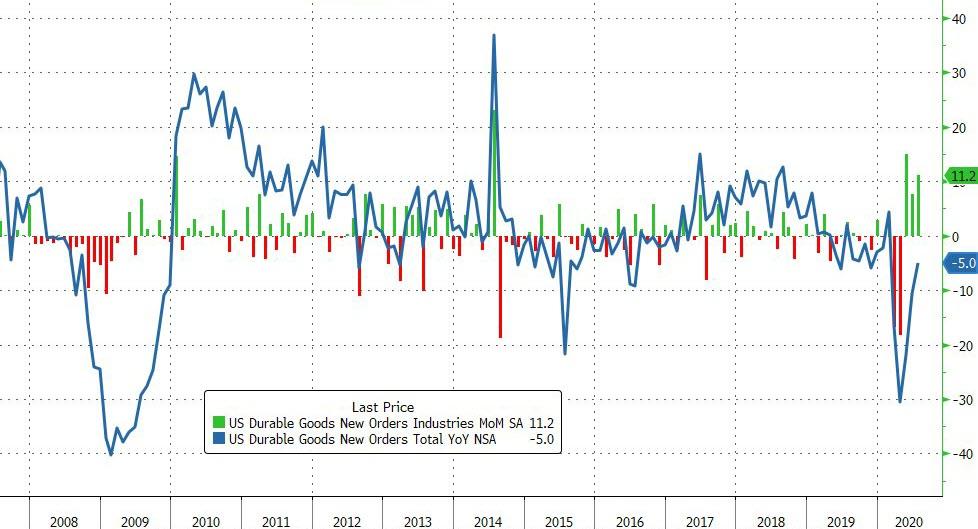
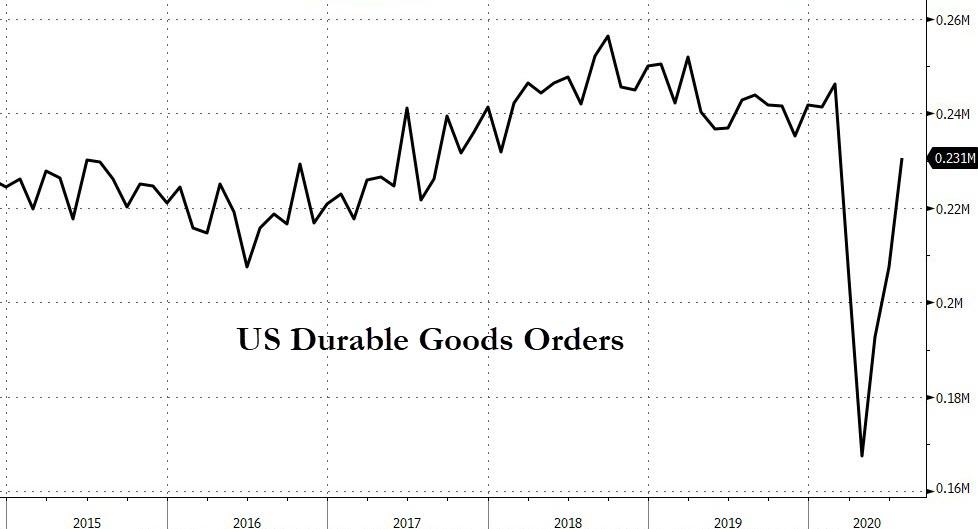
After its initial spike back in May, Durable Goods Orders rebound has slowed and that deceleration of the ‘V’ was expected to continue in today’s preliminary July data, but instead saw a resurgence… rising 11.2% MoM (against expectations of a 4.7% rise).

Source: Bloomberg

Year-over-year, durable goods orders remain down 5.0%, but the “V” is filling in fast…

Source: Bloomberg

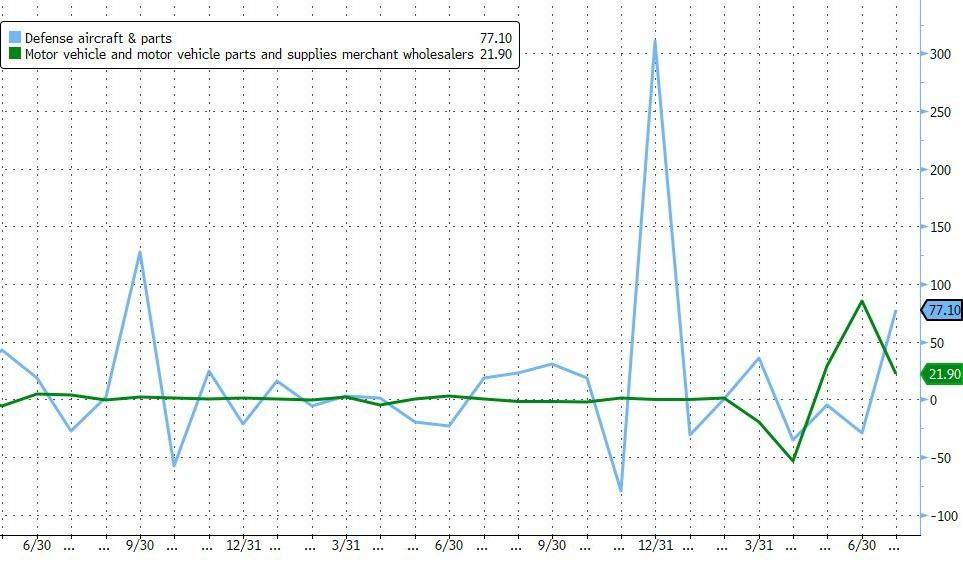
The headline beat was driven by a surge in defense orders and continued rebound in auto demand…

Additionally, core capital goods orders, a category that excludes aircraft and military hardware and is seen as a barometer of business investment, rose 1.9%, slightly more than forecast.

via ZeroHedge News https://ift.tt/3lh3ixI Tyler Durden

Kamala Harris on the Second Amendment

In 2008, Kamala Harris signed on to a District Attorneys’ friend-of-the-court brief in D.C. v. Heller, the Supreme Court’s leading Second Amendment case. Of course, she may have changed her views on the Second Amendment since then (perhaps in light of precedents such as Heller); and she may have different personal views than the ones she expressed as a D.A. (though note that she signed on to the brief as a signatory, and not just as a lawyer for the signatories). But this brief likely tells us something about her views on the Second Amendment.

[1.] To begin with, the brief urged the Court to reverse the decision below, and thus to reinstate D.C.’s handgun ban. Thus, Harris’s view in that case was that the Second Amendment doesn’t preclude total bans on handgun possession.

[2.] The brief also came at a time when the great majority of federal courts (including the Ninth Circuit, which covered Harris’s jurisdiction, San Francisco) viewed the Second Amendment as not securing any meaningful individual right of members of the public to personally keep and bear arms. Rather, those courts viewed the Second Amendment as endorsing (to quote the then-existing Ninth Circuit precedent, which the brief itself later cited),

the “collective rights” model, [which] asserts that the Second Amendment right to “bear arms” guarantees the right of the people to maintain effective state militias, but does not provide any type of individual right to own or possess weapons.

Under this theory of the amendment, the federal and state governments have the full authority to enact prohibitions and restrictions on the use and possession of firearms, subject only to generally applicable constitutional constraints, such as due process, equal protection, and the like.

And the brief supported that majority view among federal courts: Affirming the D.C. Circuit decision, which rejected the collective rights model and recognized an individual right to own guns,

could inadvertently call into question the well settled Second Amendment principles under which countless state and local criminal firearms laws have been upheld by courts nationwide.

Thus, Harris’s view in that case was thus that the “collective rights” view of the Second Amendment was correct, since that was the “settled Second Amendment principle[]” in lower federal courts at the time.

[3.] Now the brief also said that “The District Attorneys do not focus on the reasons for the reversal [that it was urging], however, leaving these arguments to Petitioners and other amici.” Nonetheless, it argued that,

For nearly seventy years, courts have consistently sustained criminal firearms laws against Second Amendment challenges by holding that, [among other things], (i) the Second Amendment provides only a militia-related right to bear arms, (ii) the Second Amendment does not apply to legislation passed by state or local governments, and (iii) the restrictions bear a reasonable relationship to protecting public safety and thus do not violate a personal constitutional right. The lower court’s decision, however, creates a broad private right to possess any firearm that is a “lineal descendant” of a founding era weapon and that is in “common use” with a “military application” today….

The federal and state courts have upheld state and local firearms laws, as well as criminal convictions thereunder, against Second Amendment challenges on three primary grounds. In holding the D.C. laws at issue to be unconstitutional, the decision below undermines each of these grounds, which also could be cast into doubt by an affirmance in this case.

First, courts nationwide have upheld criminal gun laws on the basis that the Second Amendment provides only a militia-related right to bear arms. See, e.g., Scott v. Goethals, No. 3-04-CV-0855, 2004 WL 1857156, at *2 (N.D. Tex. Aug. 18, 2004) (affirming conviction under Texas Penal Code § 46.02 for unlawfully carrying a handgun because Second Amendment does not provide a private right to keep and bear arms); Silveira v. Lockyer, 312 F.3d 1052,1087 (9th Cir. 2003) (holding that California residents challenging constitutionality of California’s Assault Weapons Control Act lacked standing because Second Amendment provides militia-related right to keep and bear arms); State v. Brecunier, 564 N.W.2d 365, 370 (Iowa 1997) (upholding firearm sentence enhancement because defendant “had no constitutional right to be armed while interfering with lawful police activity”)….

The lower court’s sweeping reasoning undermines each of the principal reasons invoked by those courts that have upheld criminal firearms laws under the Second Amendment time and again. First, under the lower court’s analysis, the Constitution protects a broad “individual” constitutional right, one that is not militia-related, to possess firearms….

This certainly seems to me like approval of the principle listed as (i) in the brief, which is the view that “the Second Amendment provides only a militia-related right to bear arms.”

Now perhaps this passage could be read as simply describing what courts were doing, or as suggesting that the Supreme Court could either adopt principle (i) or perhaps some of the other principles instead. But it certainly sounds to me like an endorsement of the “only a militia-related right to bear arms” view, especially since that’s the lower federal courts’ “well settled Second Amendment principle[]” to which the brief had earlier alluded (see item 2 above).

Plus principle (ii) is an endorsement of the view (rejected by the Court two years later in McDonald v. City of Chicago) that states and localities can institute whatever gun bans they want (even total gun bans) without violating the Second Amendment. And even if we focus on principle (iii), under which gun laws are constitutional if they “bear a reasonable relationship to protecting public safety,” the brief was supporting a total handgun ban—if that is permissible on the theory that it “bear[s] a reasonable relationship to protecting public safety,” then I would think a total ban on all guns would be, too.

The brief closed with a suggestion that “the Court exercise judicial restraint and explicitly limit its decision to the three discrete provisions of the D.C. Code on which it granted certiorari” (the handgun ban, a licensing requirement, and the requirement that guns be stored disassembled or bound with a trigger lock), because “This would avoid needless confusion and uncertainty about the continued viability and stare decisis effect of this Court’s—and other courts’—prior Second Amendment jurisprudence.”

This passage doesn’t expressly urge the Court to adopt a particular line of reasoning. But, again, the first principle that the brief mentioned, and the one most clearly consistent with lower federal courts’ “prior Second Amendment jurisprudence,” was that the Second Amendment didn’t secure an individual right that ordinary citizens could exercise in their daily lives. It sounds like that is at least one approach that the brief is endorsing.

So, to summarize:

  1. Kamala Harris, as D.A., definitely endorsed the view that a total handgun ban didn’t violate the Second Amendment.
  2. She also seemed to endorse the view that the Second Amendment secures only a “collective” or “militia-related” right, and not the individual right that the Court ultimately recognized in D.C. v. Heller.

An article by Cam Edwards (Bearing Arms) on Aug. 11 made a similar argument in concluding that”Kamala Harris Doesn’t Think You Have the Right To Own a Gun” (to quote its original title), but an Agence-France Press “Fact Check” on Aug. 18 labeled that claim “false.” I find the “Fact Check” quite unpersuasive, at least as to the specific question of Harris’s views on the right to own a gun.

AFP writes, “Rather than outright opposition to gun ownership, Harris has supported legislation aimed at increasing safety.” It may well be that Harris wouldn’t promote a statute banning guns outright. But her brief states that she thinks governments have the constitutional power to ban at least all handguns, and likely guns more generally.

AFP writes, “Nor has she called for the destruction of the Second Amendment, which says: ‘A well regulated militia, being necessary to the security of a free state, the right of the people to keep and bear arms, shall not be infringed.'” But she has endorsed, as I read it, the view that the Second Amendment doesn’t protect a normal individual right to own guns, rather protecting only a “collective right” under which states can limit gun ownership to members of a state-designated “militia.”

AFP goes on to say, “Legal scholars, however, say that although Harris supported the amicus brief, it is false to conclude from it that she believes—as the article claims—’you don’t have the right to own a gun'”:

“The brief in question is not about whether there is an individual right under the Second Amendment. It is about the crime-related consequences of invalidating the DC handgun law at issue in Heller,” Aziz Huq, of the University of Chicago Law School, told AFP by email. Huq studies how constitutional design interacts with individual rights and liberties.

Adam Winkler, a specialist in gun policy at the UCLA School of Law, made a similar argument.

“This statement is false,” he said of the article’s claim.

“The brief she supported argued that DC’s gun laws should be upheld but not because there was no right to own a gun,” Winkler said in an email to AFP.

“Rather, the brief argued that the laws should be upheld because there is a tradition of gun restrictions, and DC’s were reasonable regulations,” said Winkler, the author of “Gunfight: The Battle Over the Right to Bear Arms in America.”

Again, for the reasons I gave above, I think Profs. Huq and Winkler are mistaken. The brief does seem to endorse the collective rights view of the Second Amendment, under which there really is no right to own a gun. And, again, at the very least the brief endorses the view that all handguns could be banned, consistently with the Second Amendment.

Finally, the brief turns to another scholar:

The amicus brief which Harris joined argued “that at least as far as the Second Amendment is concerned, it doesn’t relate to private rights,” said [Jake] Charles, of the Duke Center for Firearms Law.

But he added: “I’m not sure it’s fair to claim that as her current position given that the Supreme Court decided in Heller that people do have that right, and I haven’t seen her questioning the Heller decision.”

Here, I agree that (1) the amicus brief does take that the Second Amendment doesn’t protect any “private rights,” and (2) we can’t be certain that this remains her view today. But it is at least plausible that her views about the subject haven’t changed, and that if she could participate in reshaping the Supreme Court, she would reshape it in favor of reversing the Heller decision, and moving the law back to a view under which “the Second Amendment … doesn’t relate to private rights.”


from Latest – Reason.com https://ift.tt/2FSrCpm
via IFTTT

Kamala Harris on the Second Amendment

In 2008, Kamala Harris signed on to a District Attorneys’ friend-of-the-court brief in D.C. v. Heller, the Supreme Court’s leading Second Amendment case. Of course, she may have changed her views on the Second Amendment since then (perhaps in light of precedents such as Heller); and she may have different personal views than the ones she expressed as a D.A. (though note that she signed on to the brief as a signatory, and not just as a lawyer for the signatories). But this brief likely tells us something about her views on the Second Amendment.

[1.] To begin with, the brief urged the Court to reverse the decision below, and thus to reinstate D.C.’s handgun ban. Thus, Harris’s view in that case was that the Second Amendment doesn’t preclude total bans on handgun possession.

[2.] The brief also came at a time when the great majority of federal courts (including the Ninth Circuit, which covered Harris’s jurisdiction, San Francisco) viewed the Second Amendment as not securing any meaningful individual right of members of the public to personally keep and bear arms. Rather, those courts viewed the Second Amendment as endorsing (to quote the then-existing Ninth Circuit precedent, which the brief itself later cited),

the “collective rights” model, [which] asserts that the Second Amendment right to “bear arms” guarantees the right of the people to maintain effective state militias, but does not provide any type of individual right to own or possess weapons.

Under this theory of the amendment, the federal and state governments have the full authority to enact prohibitions and restrictions on the use and possession of firearms, subject only to generally applicable constitutional constraints, such as due process, equal protection, and the like.

And the brief supported that majority view among federal courts: Affirming the D.C. Circuit decision, which rejected the collective rights model and recognized an individual right to own guns,

could inadvertently call into question the well settled Second Amendment principles under which countless state and local criminal firearms laws have been upheld by courts nationwide.

Thus, Harris’s view in that case was thus that the “collective rights” view of the Second Amendment was correct, since that was the “settled Second Amendment principle[]” in lower federal courts at the time.

[3.] Now the brief also said that “The District Attorneys do not focus on the reasons for the reversal [that it was urging], however, leaving these arguments to Petitioners and other amici.” Nonetheless, it argued that,

For nearly seventy years, courts have consistently sustained criminal firearms laws against Second Amendment challenges by holding that, [among other things], (i) the Second Amendment provides only a militia-related right to bear arms, (ii) the Second Amendment does not apply to legislation passed by state or local governments, and (iii) the restrictions bear a reasonable relationship to protecting public safety and thus do not violate a personal constitutional right. The lower court’s decision, however, creates a broad private right to possess any firearm that is a “lineal descendant” of a founding era weapon and that is in “common use” with a “military application” today….

The federal and state courts have upheld state and local firearms laws, as well as criminal convictions thereunder, against Second Amendment challenges on three primary grounds. In holding the D.C. laws at issue to be unconstitutional, the decision below undermines each of these grounds, which also could be cast into doubt by an affirmance in this case.

First, courts nationwide have upheld criminal gun laws on the basis that the Second Amendment provides only a militia-related right to bear arms. See, e.g., Scott v. Goethals, No. 3-04-CV-0855, 2004 WL 1857156, at *2 (N.D. Tex. Aug. 18, 2004) (affirming conviction under Texas Penal Code § 46.02 for unlawfully carrying a handgun because Second Amendment does not provide a private right to keep and bear arms); Silveira v. Lockyer, 312 F.3d 1052,1087 (9th Cir. 2003) (holding that California residents challenging constitutionality of California’s Assault Weapons Control Act lacked standing because Second Amendment provides militia-related right to keep and bear arms); State v. Brecunier, 564 N.W.2d 365, 370 (Iowa 1997) (upholding firearm sentence enhancement because defendant “had no constitutional right to be armed while interfering with lawful police activity”)….

The lower court’s sweeping reasoning undermines each of the principal reasons invoked by those courts that have upheld criminal firearms laws under the Second Amendment time and again. First, under the lower court’s analysis, the Constitution protects a broad “individual” constitutional right, one that is not militia-related, to possess firearms….

This certainly seems to me like approval of the principle listed as (i) in the brief, which is the view that “the Second Amendment provides only a militia-related right to bear arms.”

Now perhaps this passage could be read as simply describing what courts were doing, or as suggesting that the Supreme Court could either adopt principle (i) or perhaps some of the other principles instead. But it certainly sounds to me like an endorsement of the “only a militia-related right to bear arms” view, especially since that’s the lower federal courts’ “well settled Second Amendment principle[]” to which the brief had earlier alluded (see item 2 above).

Plus principle (ii) is an endorsement of the view (rejected by the Court two years later in McDonald v. City of Chicago) that states and localities can institute whatever gun bans they want (even total gun bans) without violating the Second Amendment. And even if we focus on principle (iii), under which gun laws are constitutional if they “bear a reasonable relationship to protecting public safety,” the brief was supporting a total handgun ban—if that is permissible on the theory that it “bear[s] a reasonable relationship to protecting public safety,” then I would think a total ban on all guns would be, too.

The brief closed with a suggestion that “the Court exercise judicial restraint and explicitly limit its decision to the three discrete provisions of the D.C. Code on which it granted certiorari” (the handgun ban, a licensing requirement, and the requirement that guns be stored disassembled or bound with a trigger lock), because “This would avoid needless confusion and uncertainty about the continued viability and stare decisis effect of this Court’s—and other courts’—prior Second Amendment jurisprudence.”

This passage doesn’t expressly urge the Court to adopt a particular line of reasoning. But, again, the first principle that the brief mentioned, and the one most clearly consistent with lower federal courts’ “prior Second Amendment jurisprudence,” was that the Second Amendment didn’t secure an individual right that ordinary citizens could exercise in their daily lives. It sounds like that is at least one approach that the brief is endorsing.

So, to summarize:

  1. Kamala Harris, as D.A., definitely endorsed the view that a total handgun ban didn’t violate the Second Amendment.
  2. She also seemed to endorse the view that the Second Amendment secures only a “collective” or “militia-related” right, and not the individual right that the Court ultimately recognized in D.C. v. Heller.

An article by Cam Edwards (Bearing Arms) on Aug. 11 made a similar argument in concluding that”Kamala Harris Doesn’t Think You Have the Right To Own a Gun” (to quote its original title), but an Agence-France Press “Fact Check” on Aug. 18 labeled that claim “false.” I find the “Fact Check” quite unpersuasive, at least as to the specific question of Harris’s views on the right to own a gun.

AFP writes, “Rather than outright opposition to gun ownership, Harris has supported legislation aimed at increasing safety.” It may well be that Harris wouldn’t promote a statute banning guns outright. But her brief states that she thinks governments have the constitutional power to ban at least all handguns, and likely guns more generally.

AFP writes, “Nor has she called for the destruction of the Second Amendment, which says: ‘A well regulated militia, being necessary to the security of a free state, the right of the people to keep and bear arms, shall not be infringed.'” But she has endorsed, as I read it, the view that the Second Amendment doesn’t protect a normal individual right to own guns, rather protecting only a “collective right” under which states can limit gun ownership to members of a state-designated “militia.”

AFP goes on to say, “Legal scholars, however, say that although Harris supported the amicus brief, it is false to conclude from it that she believes—as the article claims—’you don’t have the right to own a gun'”:

“The brief in question is not about whether there is an individual right under the Second Amendment. It is about the crime-related consequences of invalidating the DC handgun law at issue in Heller,” Aziz Huq, of the University of Chicago Law School, told AFP by email. Huq studies how constitutional design interacts with individual rights and liberties.

Adam Winkler, a specialist in gun policy at the UCLA School of Law, made a similar argument.

“This statement is false,” he said of the article’s claim.

“The brief she supported argued that DC’s gun laws should be upheld but not because there was no right to own a gun,” Winkler said in an email to AFP.

“Rather, the brief argued that the laws should be upheld because there is a tradition of gun restrictions, and DC’s were reasonable regulations,” said Winkler, the author of “Gunfight: The Battle Over the Right to Bear Arms in America.”

Again, for the reasons I gave above, I think Profs. Huq and Winkler are mistaken. The brief does seem to endorse the collective rights view of the Second Amendment, under which there really is no right to own a gun. And, again, at the very least the brief endorses the view that all handguns could be banned, consistently with the Second Amendment.

Finally, the brief turns to another scholar:

The amicus brief which Harris joined argued “that at least as far as the Second Amendment is concerned, it doesn’t relate to private rights,” said [Jake] Charles, of the Duke Center for Firearms Law.

But he added: “I’m not sure it’s fair to claim that as her current position given that the Supreme Court decided in Heller that people do have that right, and I haven’t seen her questioning the Heller decision.”

Here, I agree that (1) the amicus brief does take that the Second Amendment doesn’t protect any “private rights,” and (2) we can’t be certain that this remains her view today. But it is at least plausible that her views about the subject haven’t changed, and that if she could participate in reshaping the Supreme Court, she would reshape it in favor of reversing the Heller decision, and moving the law back to a view under which “the Second Amendment … doesn’t relate to private rights.”


from Latest – Reason.com https://ift.tt/2FSrCpm
via IFTTT

The First Trillion Is Always The Hardest – Analyzing Apple-Mania

The First Trillion Is Always The Hardest – Analyzing Apple-Mania

Tyler Durden

Wed, 08/26/2020 – 08:20

Authored by Michael Lebowitz via RealInvestmentAdvice.com,

Fundamentals might be good for the first third or first 50 or 60 percent of a move, but the last third of a great bull market is typically a blow-off, where the mania runs wild and prices go parabolic.

– Paul Tudor Jones

From 1976 when Apple (AAPL) began in Steve Jobs’s garage to 2019, its worth rose to $1 trillion. Subsequently, from March 20, 2020, the trough of the COVID market crash, to today, the value increased by another $1 trillion. Over 44 years to hit the first trillion, and less than half a year for the second. Apple is up 240% from the March lows.

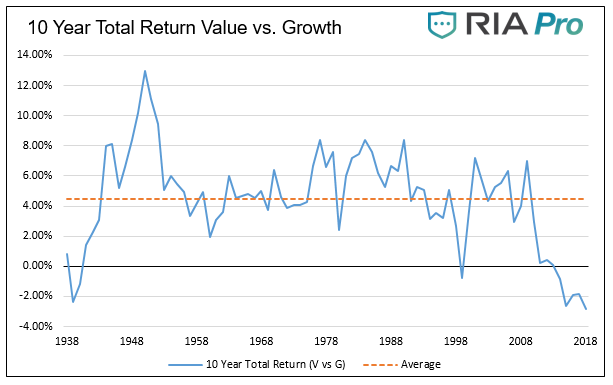
We consider ourselves value investors. That means we prefer to invest in companies that are “underpriced.” Over time, this strategy typically translates into better than market returns and a margin of safety. In our view, it offers a better risk/return profile. The graph below shows the value of this strategy over the last 80 years.

We own Apple, yet fully admit it is anything but a value investment. This article provides the opportunity to discuss Apple’s valuation and current market conditions that lead value investors, like ourselves, to own a very expensive company like Apple.

Apple Mania Running Wild

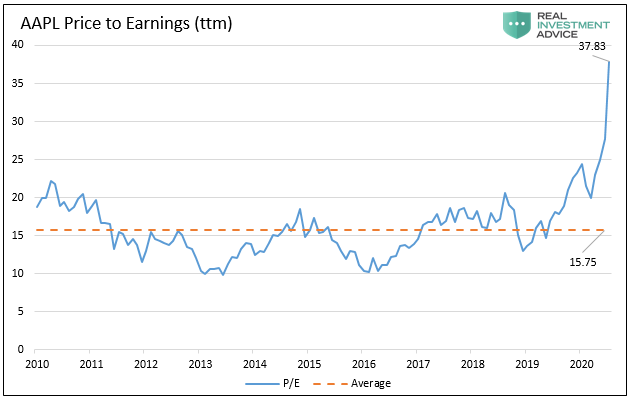
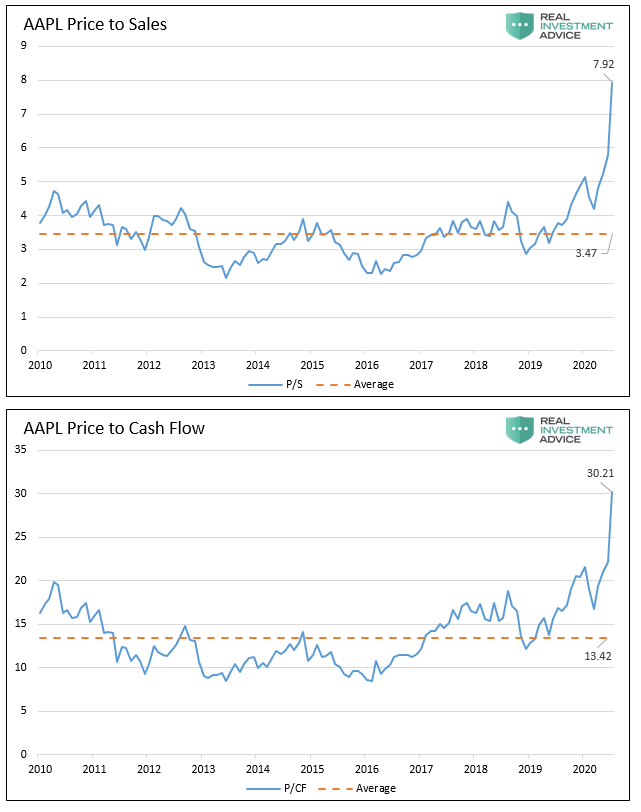
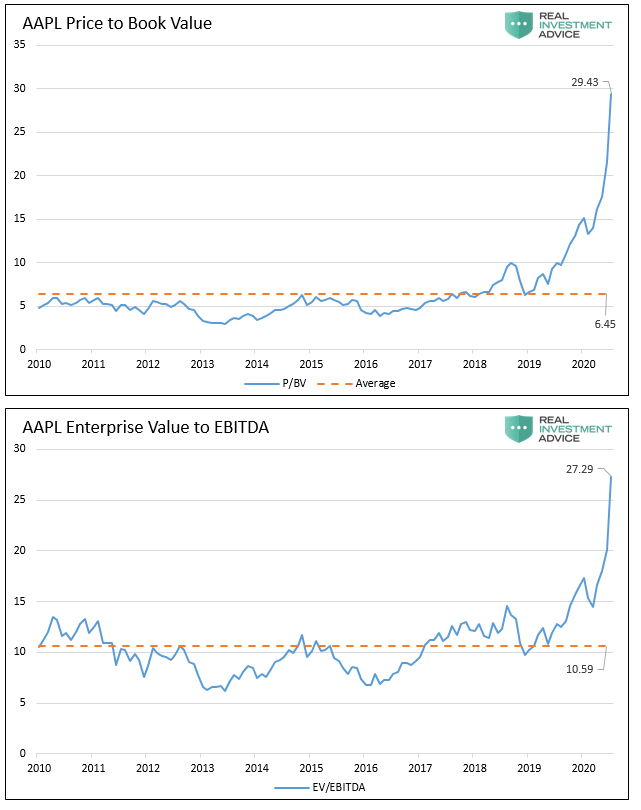
Is Apple worth $1 trillion, let alone the recently added second trillion? To answer this question, we share some well-followed valuation ratios and financial trends. The orange dotted line in each graph is its respective ten-year average.

As shown, valuation ratios are more than double their ten-year averages. Without any doubt, Apple is expensive using these historically reliable techniques.

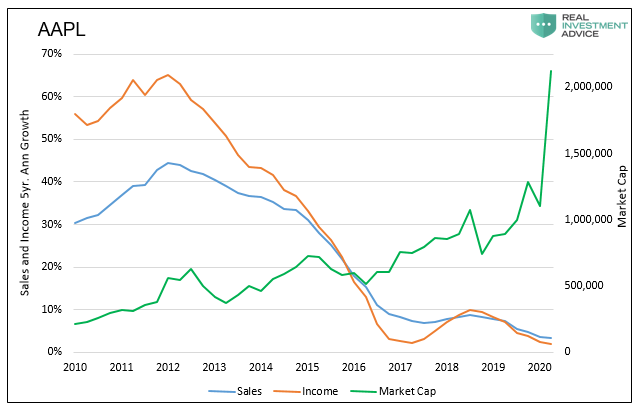
The disconnect between fundamentals and market cap, shown below, explains why valuation ratios are soaring.

Over the last ten years, sales and income growth have slowed considerably. Sales over the previous five years have grown by 3.22% per year, while income by 1.82%. Despite the troubling trends, the stock has nearly quintupled since 2015.

What’s Apple Worth?

We employ two internally built cash flow models to help us assess Apple’s value.

Model #1 – Our first model uses the present value of 30 years of projected earnings for comparison to the current market cap. We assume a forward 5% income growth rate, which is faster than the 3% rate of the last five years.

Model #1, using a generous income assumption, values Apple’s current stock price at a 58% premium to its future cash flows. This model tends to agree with the ratios shown above.

Model #2 – Our second model uses forecasted cash flows instead of net earnings and similar assumptions as our first model. Model #2 is more friendly but still puts the current stock price at a nearly 15% premium to its valuation.

Why A Value Investor Owns Apple

So, why do we own such an expensive company?

Weak growth trends, expensive valuations, and our models are all meaningless if one thinks Apple can grow earnings at much faster rates. For instance, in our first model, Apple is fairly valued if it can grow net income at 9%.

That is not the reason we own Apple.

Here is a hint:  “The equity market has traded soft under the surface of the headline indices, which are now being driven by just one stock—Apple.” Morgan Stanley

The passive nature of the market compels us to own it. To better understand the effect that passive investing is having on all types of investors, we suggest reading our article, Passive Fingerprints Are All Over This Crazy Market.

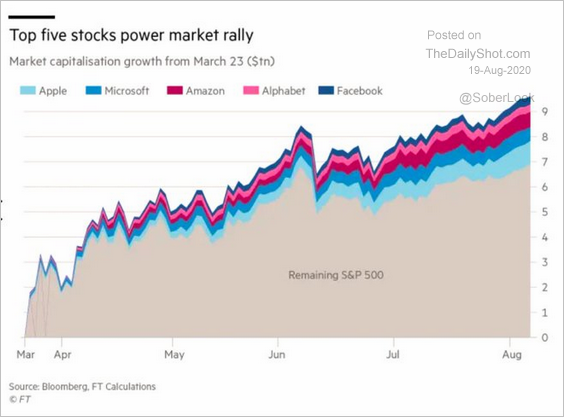
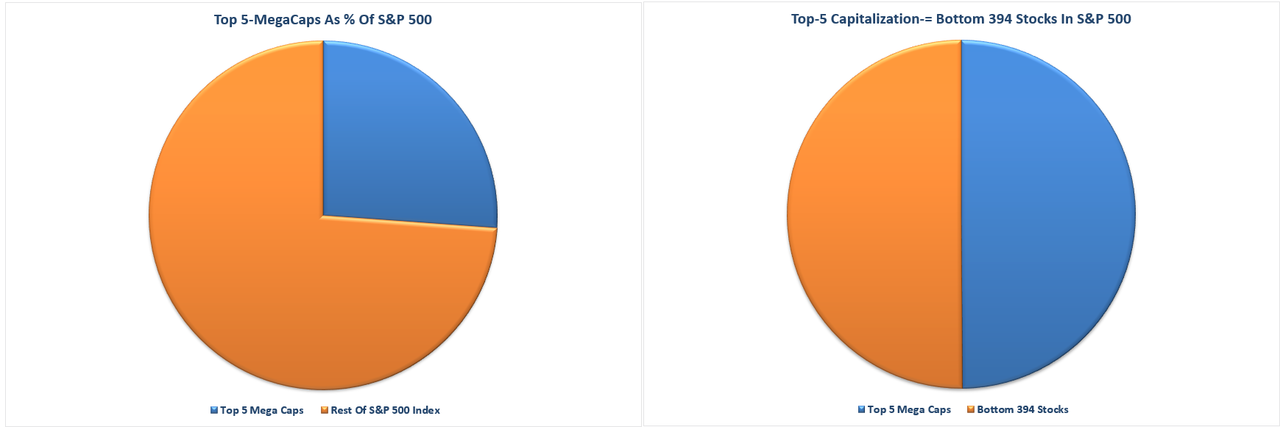
The market is putting a proverbial gun to our head and other investors.  It whispers in our ears; if you want to keep up with your benchmark, you must own the “Big 5.” (Apple, Microsoft, Amazon, Google, and Facebook)  Failing to hold some or all of them guarantees you will underperform. Those five companies account for 26% of the S&P 500.

As we wrote in Bulls Chant Into A Megaphone:

“What investors are missing is that the top-5 stocks are distorting the movements in the overall index.

For each $1 put into each of those top-5 stocks, the impact on the index is the same as putting $1 into each of the bottom 394 stocks. Such is clearly not a true representation of either the market or the economy.”

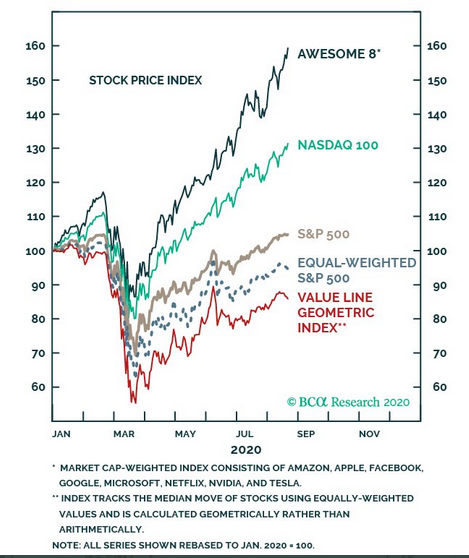
The graph below tells another version of the same story, the “Awesome 8.” This slightly expanded list of companies has also grossly outpaced the “market.”

We own Apple and some of the others listed above.  We have done very well in them allowing us to keep pace with the market. However, we fully understand the gains are not commensurate with underlying fundamentals.

Managing Risk

We do not take Apple’s high price and precarious valuations for granted. There is little doubt that over time they regress to the norm, barring substantial growth. At some point, Apple investors will get burnt.

To properly manage risk and sleep well at night, we establish tight stop limits. Further, we frequently take profits and reduce exposure when Apple becomes technically overextended.

For example, we are currently holding only half our original position as the price is extended by three standard deviations. Typically such an aberration results in a pullback or at least a consolidation.

Summary

There is little doubt that we are in the mania stage of the bull market. In this phase, value is grossly underperforming growth. To keep up, we are accepting of the risks embedded in expensive stocks such as Apple. We do this, however, with full knowledge of the risks and employ tactical risk management strategies.

We look forward to a day when we can own a portfolio of value stocks. When we can buy and sell securities based on economic and fundamental reasoning. When the irrationality of mania does not impinge upon our strategies.

We believe there will be a day when we can scoop up Apple shares for fractions of the current cost and possibly when it is once again a value. Admittedly though, the price of Apple as a value play is well below where it is today.

We leave you with an age-old question – is this time different?

via ZeroHedge News https://ift.tt/3gsS6KD Tyler Durden