The contours of China’s long-term strategy for the new Cold War are quickly coming into view…
Let’s start with the story of an incredibly disappearing summit.
Every August, the leadership of the Chinese Communist Party (CCP) converges to the town of Beidaihe, a seaside resort some two hours away from Beijing, to discuss serious policies that then coalesce into key planning strategies to be approved at the CCP Central Committee plenary session in October.
The Beidaihe ritual was established by none other than Great Helmsman Mao, who loved the town where, not by accident, Emperor Qin, the unifier of China in the 3rd century B.C., kept a palace.
2020 being, so far, a notorious Year of Living Dangerously, it’s no surprise that in the end Beidaihe was nowhere to be seen. Yet Beidaihe’s invisibility does not mean it did not happen.
Exhibit 1 was the fact that Premier Li Keqiang simply disappeared from public view for nearly two weeks – after President Xi chaired a crucial Politburo gathering in late July where what was laid out was no less than China’s whole development strategy for the next 15 years.
Li Keqiang resurfaced by chairing a special session of the all-powerful State Council, just as the CCP’s top ideologue, Wang Huning – who happens to be number 5 in the Politburo – showed up as the special guest at a meeting of the All China Youth Federation.
What’s even more intriguing is that side by side with Wang, one would find Ding Xuexiang, none other than President Xi’s chief of staff, as well as three other Politburo members.
In this “now you see them, now you don’t” variation, the fact that they all showed up in unison after an absence of nearly two weeks led sharp Chinese observers to conclude that Beidaihe in fact had taken place. Even if no visible signs of political action by the seaside had been detected. The semi-official spin is that no get-together happened at Beidaihe because of Covid-19.
Yet it’s Exhibit 2 that may clinch the deal for good. The by now famous end of July Politburo meeting chaired by Xi in fact sealed the Central Committee plenary session in October.
Translation:
the contours of the strategic road map ahead had already been approved by consensus. There was no need to retreat to Beidaihe for further discussions.
Trial balloons or official policy?
The plot thickens when one takes into consideration a series of trial balloons that started to float a few days ago in select Chinese media. Here are some of the key points.
1. On the trade war front, Beijing won’t shut down US businesses already operating in China. But companies which want to enter the market in finance, information technology, healthcare and education services will not be approved.
2. Beijing won’t dump all its overwhelming mass of US Treasuries in one go, but – as it already happens – divestment will accelerate. Last year, that amounted to $100 billion. Up to the end of 2020, that could reach $300 billion.
3. The internationalization of the yuan, also predictably, will be accelerated. That will include configuring the final parameters for clearing US dollars through the CHIPS Chinese system – foreseeing the incandescent possibility Beijing might be cut off from SWIFT by the Trump administration or whoever will be in power at the White House after January 2021.
4. On what is largely interpreted across China as the “full spectrum war” front, mostly Hybrid War, the PLA has been put into Stage 3 alert – and all leaves are canceled for the rest of 2020. There will be a concerted drive to increase all-round defense spending to 4% of GDP and accelerate the development of nuclear weapons. Details are bound to emerge during the Central Committee meeting in October.
5. The overall emphasis is on a very Chinese spirit of self-reliance, and building what can be defined as a national economic “dual circulation” system: the consolidation of the Eurasian integration project running in parallel to a global yuan settlement mechanism.
Inbuilt in this drive is what has been described as “to firmly abandon all illusions about the United States and conduct war mobilization with our people. We shall vigorously promote the war to resist US aggression (…) We will use a war mindset to steer the national economy (…) Prepare for the complete interruption of relations with the US.”
It’s unclear as it stands if these are only trial balloons disseminated across Chinese public opinion or decisions reached at the “invisible” Beidaihe. So all eyes will be on what kind of language this alarming configuration will be packaged when the Central Committee presents its strategic planning in October. Significantly, that will happen only a few weeks before the US election.
It’s all about continuity
All of the above somewhat mirrors a recent debate in Amsterdam on what constitutes the Chinese “threat” to the West. Here are the key points.
1. China constantly reinforces its hybrid economic model – which is an absolute rarity, globally: neither totally publicly owned nor a market economy.
2. The level of patriotism is staggering: once the Chinese face a foreign enemy, 1.4 billion people act as one.
3. National mechanisms have tremendous force: absolutely nothing blocks the full use of China’s financial, material and manpower resources once a policy is set.
4. China has set up the most comprehensive, back to back industrial system on the planet, without foreign interference if need be (well, there’s always the matter of semiconductors to Huawei to be solved).
China plans not only in years, but in decades. Five year plans are complemented by ten year plans and as the meeting chaired by Xi showed, 15 year plans. The Belt and Road Initiative (BRI) is in fact a nearly 40-year plan, designed in 2013 to be completed in 2049.
And continuity is the name of the game – when one thinks that the Five Principles of Peaceful Coexistence, first developed in 1949 and then expanded by Zhou Enlai at the Bandung conference in 1955 are set in stone as China’s foreign policy guidelines.
The Qiao collective, an independent group that advances the role of qiao (“bridge”) by the strategically important huaqiao (“overseas Chinese”) is on point when they note that Beijing never proclaimed a Chinese model as a solution to global problems. What they extol is Chinese solutions to specific Chinese conditions.
A forceful point is also made that historical materialism is incompatible with capitalist liberal democracy forcing austerity and regime change on national systems, shaping them towards preconceived models.
That always comes back to the core of the CCP foreign policy: each nation must chart a course fit for its national conditions.
And that reveals the full contours of what can be reasonably described as a Centralized Meritocracy with Confucian, Socialist Characteristics: a different civilization paradigm that the “indispensable nation” still refuses to accept, and certainly won’t abolish by practicing Hybrid War.
via ZeroHedge News https://ift.tt/3b1bnll Tyler Durden
Photos Emerge Of ‘Secret’ Stealth Drone Made By Boeing Tyler Durden
Tue, 08/25/2020 – 23:45
For the last couple of years, we’ve kept readers abreast of new developments concerning the Boeing Airpower Teaming System (ATS), a combat stealth drone also known as “loyal wingman” for fourth and fifth-generation aircraft.
Boeing Australia announced in early 2019 that ATS would be manufactured at the Boeing Phantom Works in Brisbane. Since then, not much has been revealed about the ‘top secret’ stealth drone project until now:
Spotted on the tarmac at an undisclosed location, possibly at the RAAF Base Amberley, ATS was conducting taxi trials ahead of its first test flight, reported Australian Defence Magazine (ADM).
“The first ATS aircraft is currently undergoing ground testing, which will be followed by taxi and a first flight later this year,” a Boeing spokesperson told ADM and declined to provide a location and exact trial details.
ATS is a stealth unmanned aerial vehicle that can autonomously fly with RAAF aircraft, such as the F-35, F/A-18E/F, and E-7A Wedgetail, to provide defense and surveillance support while on combat missions. It will be the first aircraft designed and developed in Australia in over five decades.
Boeing ATS program director Shane Arnott told ADM that ATS’ payload would be dependent on the needs of the mission of the customer. He revealed the drone is powered by a commercial turbofan engine but wouldn’t disclose any other information.
Last week, DARPAtv held a live-streamed event that featured an AI-controlled virtual fighter jet beating a human pilot in a series of simulated dogfights.
The rise of Skynet continues…
via ZeroHedge News https://ift.tt/31u6A8R Tyler Durden
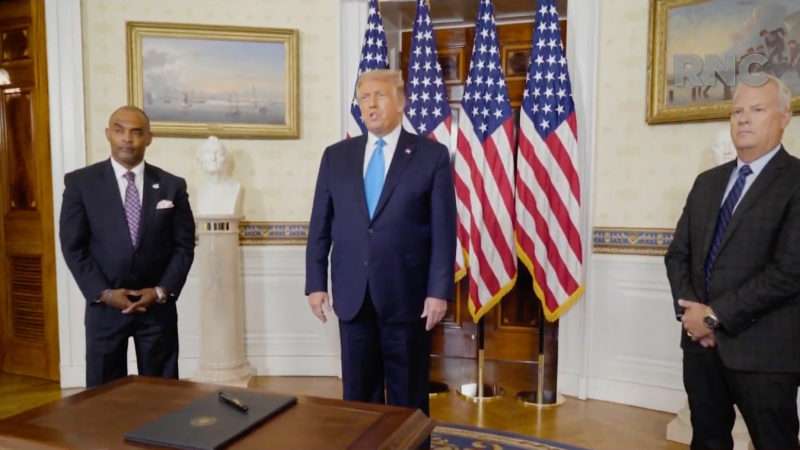
President Donald Trump pardoned Jon Ponder, a formerly incarcerated man who now runs a nonprofit to help others coming out of prison, in a video recorded Tuesday.
The video played at the Republican National Convention (RNC) Tuesday night during a program that focused on Trump’s record on criminal justice reform.
“I will continue to give all Americans, including former inmates, the best chance to build a new life and achieve their own American dream,” Trump said.
On the National Day of Prayer, Hope for Prisoners founder Jon Ponder came to the White House to share his story with the American people.
Ponder is the founder of Hope for Prisoners, a Nevada nonprofit that offers support services and training to formerly incarcerated people. Trump met with Ponder at the 2018 National Day of Prayer at the White House, and the president was a guest speaker at a Hope for Prisoners graduation ceremony in February.
Trump’s pardon wipes away a federal bank robbery conviction from Ponder’s record.
“Today, praise God, I am filled with hope,” Ponder said. “A proud American citizen who has been given a second chance. My transformation began in a prison cell, while I found myself a three-time convicted felon facing yet another sentence. I gave my life to Jesus.”
The pardon was the latest in a string of high-profile commutations and pardons by Trump. Alice Johnson, a former federal inmate who was serving life in prison before Trump commuted her sentence in 2018, is also expected to speak at the RNC.
But while criminal justice advocates have applauded pardons and commutations issued in deserving cases like those, there have been criticisms that the Justice Department’s Office of the Pardon Attorney, the regular office that handles clemency applications, has been sidelined. The Washington Postfound the vast majority of the pardons and commutations under Trump have gone to cases that caught his attention on TV or were brought to him personally by advocates or celebrities.
At a July 13 White House press briefing, White House Press Secretary Kayleigh McEnany was asked specifically about Ponder’s possible pardon and the neglect of regular clemency applications.
“It’s absolutely not the case that only those who are politically connected get a pardon. This president is the president of criminal justice reform,” McEnany responded. “This president did the FIRST STEP Act. This president has fought for those who are given unduly harsh sentences more than any Democrat who like to talk about it but never actually did it.”
Trump’s tendency to pardon his cronies has led to some calls to restrict the executive’s pardon powers, but that would be a terrible mistake. There are thousands more Jon Ponders and Alice Johnsons in the federal prison system, many of them passed over by the Obama administration’s clemency initiative. Precious few of them have the sort of connections to get their case to the president’s ears. If Trump wants to show he will fight for their second chances—and isn’t just putting on a show or helping his pals—he can and should prove it.
from Latest – Reason.com https://ift.tt/3gxE2zA
via IFTTT
Birds have been a problem for wind power. Wind turbines, whatever their other merits, have the tendency to kill birds, and possibly bats. This has been a longstanding problem, particularly because those areas best for wind power are often important for birds, particularly those species that tend to ride on wind currents.
The bird problem has meant that environmental organizations have been inconsistent advocates of wind power, endorsing the such carbon-free power in the abstract, but often opposing particular wind power development proposals. I wrote about this problem over twenty years ago in The Weekly Standard, and it has not gone away.
New research suggests that one solution to the bird problem is rather simple: Painting one blade black dramatically reduces bird kills by wind turbines–70 percent in one location under study. This is an important development because the effect appears quite large, and it’s a relatively inexpensive fix. Assuming this research pans out, there is a cheap way to address the biggest environmental drawback of wind power, and that’s a big deal.
from Latest – Reason.com https://ift.tt/2FYZqBl
via IFTTT
Today, in Thompson v. Marietta Education Association, the U.S. Court of Appeals for the Sixth Circuit rejected a constitutional challenge to a law requiring government employees to accept exclusive representation by a public sector union. This requirement would seem to be in conflict with the principles underlying Janus v. AFSCME, but an older as-yet-not-overturned Supreme Court precedent upheld such arrangements, so the Sixth Circuit panel’s hands were tied.
Judge Thapar wrote for the court. His brief opinion for the court begins:
By signing on the dotted line, public employees accept the government as their employer. In Ohio, the law requires them to also accept a union as their exclusive bargaining representative. It’s a take-it-or-leave-it system—either agree to exclusive representation, which is codified in state law, or find a different job. This take-it-or-leave-it system is in direct conflict with the principles enunciated in Janus v. AFSCME, 138 S. Ct. 2448 (2018). But when the Supreme Court decided Janus, it left on the books Minnesota State Board for Community Colleges v. Knight, 465 U.S. 271 (1984). And because Knight directly controls the outcome of this case, we affirm the district court’s decision upholding the challenged Ohio law.
Later in the opinion, Judge Thapar writes:
Thompson’s first claim is that Ohio law impermissibly allows the Marietta Education Association to speak on her behalf during collective-bargaining sessions, and that this amounts to compelled speech and association in violation of the First Amendment. See Ohio Rev. Code §§ 4117.05(A), 4117.11(B)(6).
The First Amendment protects “both the right to speak freely and the right to refrain from speaking at all.” Wooley v. Maynard, 430 U.S. 705, 714 (1977). Likewise, “[f]reedom of association . . . plainly presupposes a freedom not to associate.” Roberts v. U.S. Jaycees, 468 U.S. 609, 623 (1984). These rights capture the more basic truth that “[f]orcing free and independent individuals to endorse”—either implicitly or explicitly—”ideas they find objectionable is always demeaning.” Janus, 138 S. Ct. at 2464. The Supreme Court has thus explained that “designating a union as the exclusive representative of nonmembers substantially restricts the nonmembers’ rights.” Id. at 2469. And the Court has deemed exclusive public sector bargaining “a significant impingement on associational freedoms that would not be tolerated in other contexts.” Id. at 2478.
Given the Supreme Court’s language, one might think that Thompson should prevail. Yet Supreme Court precedent says otherwise. And lower courts must follow Supreme Court precedent. SeeAgostini v. Felton, 521 U.S. 203, 237 (1997).
The primary precedent blocking Thompson’s way is Knight. There, a group of non-union community college instructors challenged Minnesota’s collective-bargaining statute. They objected to the State’s recognition of an exclusive representative to speak for all employees at “meet and confer” sessions. These sessions concerned subjects outside the scope of mandatory collective bargaining. See 465 U.S. at 274–78. But the Supreme Court rejected the challenge. It held that Minnesota had “in no way restrained [the instructors’] freedom to speak . . . or their freedom to associate or not to associate with whom they please.” Id. at 288. To the contrary, the Court held that the instructors’ First Amendment rights were not unduly infringed because they remained “free to form whatever advocacy groups they like” and were “not required to become members of [the union].” Id. at 289.
Knight controls here. If allowing exclusive representatives to speak for all employees at “meet and confer” sessions does not violate the First Amendment, we see no basis for concluding that the result should be different where the union engages in more traditional collective bargaining activities. It appears that every other circuit to address the issue has agreed. . . .
To be sure, Knight‘s reasoning conflicts with the reasoning in Janus. But the Supreme Court did not overrule Knight in Janus. And when an earlier Supreme Court decision “has direct application in a case, yet appears to rest on reasons rejected in some other line of decisions, the Court of Appeals should follow the case which directly controls, leaving to [the Supreme] Court the prerogative of overruling its own decisions.” Rodriguez de Quijas v. Shearson/Am. Exp., Inc., 490 U.S. 477, 484 (1989). We do so here.
This strikes me as the proper way for a lower court to handle controlling Supreme Court precedent. There may well be conflict within the Court’s own precedents, as Judge Thapar observes in his opinion, but resolving this conflict is the work of the Supreme Court, not lower courts.
from Latest – Reason.com https://ift.tt/3lhHp1e
via IFTTT
Birds have been a problem for wind power. Wind turbines, whatever their other merits, have the tendency to kill birds, and possibly bats. This has been a longstanding problem, particularly because those areas best for wind power are often important for birds, particularly those species that tend to ride on wind currents.
The bird problem has meant that environmental organizations have been inconsistent advocates of wind power, endorsing the such carbon-free power in the abstract, but often opposing particular wind power development proposals. I wrote about this problem over twenty years ago in The Weekly Standard, and it has not gone away.
New research suggests that one solution to the bird problem is rather simple: Painting one blade black dramatically reduces bird kills by wind turbines–70 percent in one location under study. This is an important development because the effect appears quite large, and it’s a relatively inexpensive fix. Assuming this research pans out, there is a cheap way to address the biggest environmental drawback of wind power, and that’s a big deal.
from Latest – Reason.com https://ift.tt/2FYZqBl
via IFTTT
Today, in Thompson v. Marietta Education Association, the U.S. Court of Appeals for the Sixth Circuit rejected a constitutional challenge to a law requiring government employees to accept exclusive representation by a public sector union. This requirement would seem to be in conflict with the principles underlying Janus v. AFSCME, but an older as-yet-not-overturned Supreme Court precedent upheld such arrangements, so the Sixth Circuit panel’s hands were tied.
Judge Thapar wrote for the court. His brief opinion for the court begins:
By signing on the dotted line, public employees accept the government as their employer. In Ohio, the law requires them to also accept a union as their exclusive bargaining representative. It’s a take-it-or-leave-it system—either agree to exclusive representation, which is codified in state law, or find a different job. This take-it-or-leave-it system is in direct conflict with the principles enunciated in Janus v. AFSCME, 138 S. Ct. 2448 (2018). But when the Supreme Court decided Janus, it left on the books Minnesota State Board for Community Colleges v. Knight, 465 U.S. 271 (1984). And because Knight directly controls the outcome of this case, we affirm the district court’s decision upholding the challenged Ohio law.
Later in the opinion, Judge Thapar writes:
Thompson’s first claim is that Ohio law impermissibly allows the Marietta Education Association to speak on her behalf during collective-bargaining sessions, and that this amounts to compelled speech and association in violation of the First Amendment. See Ohio Rev. Code §§ 4117.05(A), 4117.11(B)(6).
The First Amendment protects “both the right to speak freely and the right to refrain from speaking at all.” Wooley v. Maynard, 430 U.S. 705, 714 (1977). Likewise, “[f]reedom of association . . . plainly presupposes a freedom not to associate.” Roberts v. U.S. Jaycees, 468 U.S. 609, 623 (1984). These rights capture the more basic truth that “[f]orcing free and independent individuals to endorse”—either implicitly or explicitly—”ideas they find objectionable is always demeaning.” Janus, 138 S. Ct. at 2464. The Supreme Court has thus explained that “designating a union as the exclusive representative of nonmembers substantially restricts the nonmembers’ rights.” Id. at 2469. And the Court has deemed exclusive public sector bargaining “a significant impingement on associational freedoms that would not be tolerated in other contexts.” Id. at 2478.
Given the Supreme Court’s language, one might think that Thompson should prevail. Yet Supreme Court precedent says otherwise. And lower courts must follow Supreme Court precedent. SeeAgostini v. Felton, 521 U.S. 203, 237 (1997).
The primary precedent blocking Thompson’s way is Knight. There, a group of non-union community college instructors challenged Minnesota’s collective-bargaining statute. They objected to the State’s recognition of an exclusive representative to speak for all employees at “meet and confer” sessions. These sessions concerned subjects outside the scope of mandatory collective bargaining. See 465 U.S. at 274–78. But the Supreme Court rejected the challenge. It held that Minnesota had “in no way restrained [the instructors’] freedom to speak . . . or their freedom to associate or not to associate with whom they please.” Id. at 288. To the contrary, the Court held that the instructors’ First Amendment rights were not unduly infringed because they remained “free to form whatever advocacy groups they like” and were “not required to become members of [the union].” Id. at 289.
Knight controls here. If allowing exclusive representatives to speak for all employees at “meet and confer” sessions does not violate the First Amendment, we see no basis for concluding that the result should be different where the union engages in more traditional collective bargaining activities. It appears that every other circuit to address the issue has agreed. . . .
To be sure, Knight‘s reasoning conflicts with the reasoning in Janus. But the Supreme Court did not overrule Knight in Janus. And when an earlier Supreme Court decision “has direct application in a case, yet appears to rest on reasons rejected in some other line of decisions, the Court of Appeals should follow the case which directly controls, leaving to [the Supreme] Court the prerogative of overruling its own decisions.” Rodriguez de Quijas v. Shearson/Am. Exp., Inc., 490 U.S. 477, 484 (1989). We do so here.
This strikes me as the proper way for a lower court to handle controlling Supreme Court precedent. There may well be conflict within the Court’s own precedents, as Judge Thapar observes in his opinion, but resolving this conflict is the work of the Supreme Court, not lower courts.
from Latest – Reason.com https://ift.tt/3lhHp1e
via IFTTT
On the first night of the Republican National Convention, Donald Trump surrounded himself with a handful of regular Americans who have been involved in pandemic response, including a trucker who hauled steel utilized for hospital beds.
“Oh wow, that’s fantastic. Well, congratulations. I love the truckers. They’re on my side,” Trump ad-libbed. The conversation was recorded and edited, so what Americans saw was what the GOP wanted them to see. “I think all of them, frankly. I think pretty much all of them.”
It was the kind of impolitic throwaway line than in 2015 or 2016 would have led to minor gasps, some involuntary laughter, and not a small amount of audience thrill—wait, could you imagine an actual president saying this? It’s the stuff of Hollywood pictures for nearly a century: A guy who talks and teases like a regular Joe instead of speechifying and oozing like a polished pol upends Washington through his Everyman straight talk.
But that fantasy works best as fantasy, as something tantalizing to contemplate, whether in two-hour fictions or two-week flings at the top of primary polls, rather than day after day in a position of power during a time of national crisis. We’re happy (well, happy might be too strong a word) to imagine Warren Beatty rapping the unvarnished truth about corporate America cock-blocking socialized medicine, but lines such as “If you don’t put down the malt liquor and chicken wings and get behind somebody other than a running back who stabs his wife, you’re NEVER gonna get rid of somebody like me,” would probably begin to wear thin around Year Four.
The Republican National Convention is providing constant reminders that this uniquely needy and frequently funny American character is no longer the brick ready to be thrown through the White House window, no longer the Elephant Man being drafted to disrupt the alleged beauty pageant of politics, but rather the chief executive sitting atop a mammoth executive branch of the world’s most powerful country. As Mojo Nixon could testify, ribald satire plays much better on the outside looking in.
It was silly to think a 70-year-old man who’d courted public attention for four decades would somehow change his spots once in office, and so he hasn’t. If you built a drinking game out of RNC speakers ladling out hyperbolic, coke-shooting-from-your-nose praise on the president, you’d be dead before midnight each day.
“Just imagine what 2020 would have looked like fighting for your life without Donald Trump fighting for it too,” volunteered Trump health care advisory board member Natalie Harp Monday. “In January, there would have been no China travel ban. Millions would have died.”
That claim, based on a much-criticized March study that assumed a worst-case, never-remotely-possible scenario of “no intervention” against the virus, belonged nowhere near the White House communications department five months ago, let alone near the top of a much-watched televised event in late August. But it surely pleased the boss, is so often—and so embarrassingly—the point.
“He ended once and for all the policy of incarceration of black people,” claimed George state Rep. Vernon Jones Monday. Big, if true. (It’s not.)
“Our president,” asserted Cuban immigrant Maximo Alvarez, “is just another family man,” which is arguably the most elastic definition of family values since Big Love.
“He has,” heralded Afghanistan War vet Sean Parnell, “fiercely defended the besieged First and Second Amendment.” The latter of which is debatable and the former of which is the inverse of the truth.
Hyperbole and hero-worship are baked into politics. And the hubris can go sky high when the protagonists at the center begin to smoke their own supply.
“I am absolutely certain,” Barack Obama (in)famously said in his nomination acceptance speech at the 2008 Democratic National Convention, “that generations from now, we will be able to look back and tell our children that this was the moment when we began to provide care for the sick and good jobs to the jobless; this was the moment when the rise of the oceans began to slow and our planet began to heal; this was the moment when we ended a war and secured our nation and restored our image as the last, best hope on Earth. This was the moment—this was the time—when we came together to remake this great nation.” Yuck.
But the messianism becomes a managerial malady when you build the expectation among staff underling, visiting VIP, and even little kids that the ticket to Oval Office access is a convincing testimonial, preferably on live TV, to the greatness of the Great Man.
“So Jordan, if President Trump was standing right there, what would you say to him today about Right to Try?” Vice President Mike Pence asked 10-year-old Jordan McLinn, who suffers from Duchenne Muscular Dystrophy. McLinn hesitated a bit, but remembered his line. “Thank you for being a hero to everybody in the country.” We are coaching sick kids to make the president feel appreciated.
In nearly every chronicled breakdown of a Trump administration breakdown, from the January 2017 travel ban to the 2020 pandemic response, there has featured a dysfunctional trifecta of premature presidential braggadocio, advisers massaging information in ways to please their mercurial boss, and overmatched managers picked for reasons of politics and loyalty instead of competence and independence.
“I like this stuff. I really get it,” the president said March 6, a week before all coronavirus hell broke loose. “People are surprised that I understand it….Every one of these doctors said, ‘How do you know so much about this?’ Maybe I have a natural ability. Maybe I should have done that instead of running for president.” He also added, with almost cruel disregard for the truth, “Anybody who wants a test gets a test.” If that were true, six months later we would not be looking at more than 178,000 deaths.
All of this makes Trump’s unabashed and unprecedented nepotism inevitable. Eric Trump, who closed his speech Tuesday with a section addressed directly to his dad, said that sticking up for the Silent Majority “is a fight that only my father can win.” Echoed Tiffany Trump earlier, “My father is the only person to challenge the establishment, the entrenched bureaucracy, Big Pharma and media monopolies, to ensure that Americans’ constitutional freedoms are upheld and that justice and truth prevail.”
Monday night’s two most disturbing presenters were a power couple—Donald Trump Jr., and former Fox News co-host and legal analyst Kimberly Guilfoyle. Chewing up scenery in front of what appeared to be an audience of one, a red-eyed, pumped-up Trump Jr., gave a cult-like recommendation for how Americans can win the future: By “embracing the man who represents a bright and beautiful future for all.”
Guilfoyle, resembling a send-up of Evita Peron, doubled down on the AYFKM oversell of her current boss and possible future father-in-law: “He built the greatest economy the world has ever known,” she said, at a time of double-digit unemployment. “America, it’s all on the line,” she added. “President Trump believes in you, he emancipates and lifts you up to live your American dream.”
Such is the rhetoric of recently transformed autocracies, not mature republics.
I am never the target audience for this stuff, and it wouldn’t be the first time I have misjudged the public appetite for Trump’s shtick. But populism has a long history of making promises rarely deliverable by good ideas, let alone cronyist, l’etat c’est moi, big-government protectionism.
Donald Trump is campaigning against an American carnage he vowed four years ago to reverse. He’s running against socialism after jacking up federal spending in three years as much Barack Obama did in eight. And he’s telling the same jokes as king that he killed with as jester. Good management requires more than cracking wise, promoting sycophancy, and seeking scapegoats. And Americans have a little bit more on their plate right now than resentment toward coastal cancel culture and “cosmopolitan elites.” As a fellow eccentric ideologically promiscuous entertainer once sang, that joke isn’t funny anymore.
from Latest – Reason.com https://ift.tt/2Es4dL1
via IFTTT
“They came again this morning at about 8:00 o’clock. A large cargo-type helicopter flew low over the cabin, shaking it on its very foundations. It shook all of us inside, too. I feel frightened … I see how helpless and tormented I am becoming with disgust and disillusionment with the government which has turned this beautiful country into a police state … I feel like I am in the middle of a war zone.”
– Journal entry from a California resident describing the government’s aerial searches for marijuana plants
Backyard gardeners, beware: tomato plants have become collateral damage in the government’s war on drugs, especially marijuana.
In fact, merely growing a vegetable garden on your own property, or in a greenhouse on your property, or shopping at a gardening store for gardening supplies—incredibly enough—could set you up for a drug raid sanctioned by the courts.
It’s happened before.
After shopping for hydroponic tomatoes at their local gardening store, a Kansas family found themselves subjected to a SWAT team raid as part of a multi-state, annual campaign dubbed “Operation Constant Gardener,” in which police collected the license plates of hundreds of customers at the gardening store and then investigated them for possible marijuana possession.
By “investigated,” I mean that police searched through the family’s trash. (You can thank the Supreme Court and their 1978 ruling in California v. Greenwood for allowing police to invade your trash can.) Finding “wet glob vegetation” in the garbage, the cops somehow managed to convince themselves—and a judge—that it was marijuana.
In fact, it was loose-leaf tea, but those pesky details don’t usually bother the cops when they’re conducting field tests.
There’s a long list of innocent ingredients that could be mistaken for drugs and get you subjected to a raid, because that’s all it takes—just the barest whiff of a suspicion by police that you might be engaged in criminal activity—to start the ball rolling.
From there, these so-called “investigations” follow the usual script: judge issues a warrant for a SWAT raid based on botched data, cops raid the home and terrorize the family at gunpoint, cops find no drugs, family sues over a violation of their Fourth Amendment rights, and then the courts protect the cops and their botched raid on the basis of qualified immunity.
Surely, you might think, the government has enough on its hands right now—policing a novel coronavirus pandemic, instituting nationwide lockdowns, quelling civil unrests over police brutality—that it doesn’t need to waste time and resources ferreting out pot farmers.
You’d be wrong.
This is a government that excels at make-work projects in which it assigns at-times unnecessary jobs to government agents to keep them busy or employed.
Back in 2013, an aerial surveillance mission spotted what police thought might be marijuana plants. Two days later, dozens of city officials, SWAT team, police officers and code compliance employees, and numerous official vehicles including dozens of police cars and several specialized vehicular equipment, including helicopters and unmanned flying drones, descended on The Garden of Eden, a 3.5-acre farm in Arlington, Texas, for a 10-hour raid in search of marijuana that turned up nothing more than tomato, blackberry and okra plants.
These aerial and ground sweeps have become regular occurrences across the country, part of the government’s multi-million dollar Domestic Cannabis Eradication Program. Local cops refer to the annual military maneuvers as “Eradication Day.”
Writing for The Washington Post, Radley Balko describes how these raids started off, with the National Guard, spy planes and helicopters:
The project was called the Campaign Against Marijuana Production, or CAMP… In all, thirteen California counties were invaded by choppers, some of them blaring Wagner’s “Ride of the Valkyries” as they dropped Guardsmen and law enforcement officers armed with automatic weapons, sandviks, and machetes into the fields of California … In CAMP’s first year, the program conducted 524 raids, arrested 128 people, and seized about 65,000 marijuana plants. Operating costs ran at a little over $1.5 million. The next year, 24 more sheriffs signed up for the program, for a total of 37. CAMP conducted 398 raids, seized nearly 160,000 plants, and made 218 arrests at a cost to taxpayers of $2.3 million.
The area’s larger growers had been put out of business (or, probably more accurately, had set up shop somewhere else), so by the start of the second campaign in 1984, CAMP officials were already targeting increasingly smaller growers. By the end of that 1984 campaign, the helicopters had to fly at lower and lower altitudes to spot smaller batches of plants. The noise, wind, and vibration from the choppers could knock out windows, kick up dust clouds, and scare livestock. The officials running the operation made no bones about the paramilitary tactics they were using. They considered the areas they were raiding to be war zones. In the interest of “officer safety,” they gave themselves permission to search any structures relatively close to a marijuana supply, without a warrant. Anyone coming anywhere near a raid operation was subject to detainment, usually at gunpoint.
But how do you go from a “war on drugs” to SWAT-style raids on vegetable gardens?
Connect the dots, starting with the government’s war on marijuana, the emergence of SWAT teams, the militarization of local police forces through the federal 1033 Program, which allows the Pentagon to transfer “vast amounts of military equipment—machine guns and ammunition, helicopters, night-vision gear, armored cars—to local police departments,” and the transformation of American communities into battlefields: as always, it comes back to the make work principle, which starts with local police finding ways to justify the use of military equipment and federal funding.
Mark my words: the use of police drones will make these kinds of aerial missions even more common.
For the most part, aerial surveillance is legal. As Arthur Holland Michel writes for The Atlantic: “When it comes to law enforcement, police are likewise free to use aerial surveillance without a warrant or special permission. Under current privacy law, these operations are just as legal as policing practices whereby an officer spots unlawful activity while walking or driving through a neighborhood.”
In Philip Cobbs’ case, helicopter spotters claimed to have seen two lone marijuana plants growing in the wreckage of a fallen oak tree on the Virginia native’s 39-acre family farm.
What the cops were really after was an excuse to search Cobbs’ little greenhouse, which he had used that spring to start tomato plants, cantaloupes, and watermelons, as well as asters and hollyhocks, which he planned to sell at a roadside stand near his home. The search of the greenhouse turned up nothing more than used tomato seedling containers.
Nevertheless, police charged Cobbs with misdemeanor possession of marijuana for the two plants they claimed to have found. Eventually, the charges were dismissed but not before The Rutherford Institute took up Cobbs’ case, which revealed that police hadn’t even bothered to secure a warrant before embarking on their raid of Cobbs’ property—a raid that had to cost taxpayers upwards of $25,000, at the very least—part of their routine sweep of the countryside in search of pot-growing operations.
Two plants or two hundred or no plants at all: it doesn’t matter.
A SWAT team targeted one South Carolina man for selling $50 worth of pot on two different occasions. The Washington Postreports: The SWAT team “broke down Betton’s door with a battering ram, then fired at least 57 bullets at him, hitting him nine times. He lost portions of his gallbladder, colon, bowel and rectum, and is paralyzed from the waist down. He also suffered damage to his liver, lung, small intestine and pancreas. Two of his vertebrae were damaged, and another was partially destroyed. Another bullet shattered his leg.” After security footage showed that most of what police said about the raid was a lie, the cops settled the case for $2.75 million.
Monetary awards like that are the exception, however.
Most of the time, the cops get away with murder and mayhem. Literally.
Bottom line: no amount of marijuana is too insignificant if it allows police to qualify for federal grants and equipment and lay claim to seized assets (there’s the profit motive) under the guise of fighting the War on Drugs.
Although growing numbers of states continue to decriminalize marijuana use and 9 out of 10 Americans favor the legalization of either medical or recreational/adult-use marijuana, the government’s profit-driven “War on Drugs”—waged with state and local police officers dressed in SWAT gear, armed to the hilt, and trained to act like soldiers on a battlefield, all thanks to funding provided by the U.S. government, particularly the Pentagon and Department of Homeland Security (DHS)—has not abated.
Since the formation of the DHS post-9/11, hundreds of billions of dollars in grants have flowed to local police departments for SWAT teams, giving rise to a “police industrial complex” that routinely devastates communities, terrorizes families, and destroys innocent lives.
No longer reserved exclusively for deadly situations, SWAT teams are now increasingly being deployed for relatively routine police matters, with some SWAT teams being sent out as much as five times a day. Nationwide, SWAT teams have been employed to address an astonishingly trivial array of criminal activity or mere community nuisances: angry dogs, domestic disputes, improper paperwork filed by an orchid farmer, and misdemeanor marijuana possession, to give a brief sampling.
Unfortunately, general incompetence, collateral damage (fatalities, property damage, etc.) and botched raids tend to go hand in hand with an overuse of paramilitary forces.
In some cases, officers misread the address on the warrant. In others, they simply barge into the wrong house or even the wrong building. In another subset of cases, police conduct a search of a building where the suspect no longer resides.
SWAT teams have even on occasion conducted multiple, sequential raids on wrong addresses or executed search warrants despite the fact that the suspect is already in police custody. Police have also raided homes on the basis of mistaking the presence or scent of legal substances for drugs. Incredibly, these substances have included tomatoes, sunflowers, fish, elderberry bushes, kenaf plants, hibiscus, and ragweed.
All too often, the shock-and-awe tactics utilized by many SWAT teams only increases the likelihood that someone will get hurt with little consequences for law enforcement, even when the raids are botched.
Botched SWAT team raids have resulted in the loss of countless lives, including children and the elderly. Usually, however, the first to be shot are the family dogs.
SWAT raids are usually carried out late at night or shortly before dawn. Unfortunately, to the unsuspecting homeowner—especially in cases involving mistaken identities or wrong addresses—a raid can appear to be nothing less than a violent home invasion, with armed intruders crashing through their door.
That’s exactly what happened to Jose Guerena, the young ex-Marine who was killed after a SWAT team kicked open the door of his Arizona home during a drug raid and opened fire. According to news reports, Guerena, 26 years old and the father of two young children, grabbed a gun in response to the forced invasion but never fired. In fact, the safety was still on his gun when he was killed. Police officers were not as restrained. The young Iraqi war veteran was allegedly fired upon 71 times. Guerena had no prior criminal record, and the police found nothing illegal in his home.
The problems inherent in these situations are further compounded by the fact that SWAT teams are granted “no-knock” warrants at high rates such that the warrants themselves are rendered practically meaningless.
This sorry state of affairs is made even worse by U.S. Supreme Court rulings that have essentially done away with the need for a “no-knock” warrant altogether, giving the police authority to disregard the protections afforded American citizens by the Fourth Amendment.
When the war on drugs—a.k.a. the war on the American people—becomes little more than a thinly veiled attempt to keep SWAT teams employed and special interests appeased, it’s time to revisit our drug policies and laws.
“You take the Constitution, the Bill of Rights, all the rights you expect to have—when they come in like that, the only right you have is not to get shot if you cooperate. They open that door, your life is on the line,” concluded Bob Harte, whose home was raided by a SWAT team simply because the family was seen shopping at a garden store, cops found loose tea in the family’s trash and mistook it for marijuana.
“Our family will never be the same,” said Addie Harte, recalling the two-hour raid that had police invading their suburban home with a battering ram and AR-15 rifles. As The Washington Post reports:
Bob found himself flat on floor, hands behind his head, his eyes locked on the boots of the officer standing over him with an AR-15 assault rifle. “Are there kids?” the officers were yelling. “Where are the kids?” “And I’m laying there staring at this guy’s boots fearing for my kids’ lives, trying to tell them where my children are,” Harte recalled later in a deposition on July 9, 2015. “They are sending these guys with their guns drawn running upstairs to bust into my children’s house, bedroom, wake them out of bed.”
It didn’t matter that no drugs were found—nothing but a hydroponic tomato garden and loose tea leaves. The search and SWAT raid were reasonable, according to the courts.
Portland Businesses Leave Due To ‘Lawlessness Endorsed By Mayor’ Tyler Durden
Tue, 08/25/2020 – 23:05
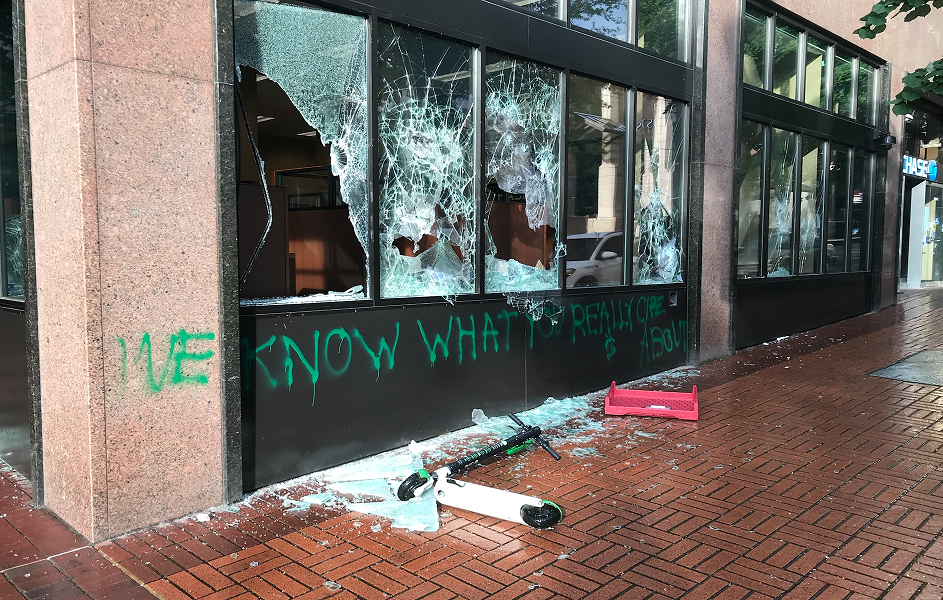
All it took was nearly three months of often-riotous protests in Portland for business owners to pull out of the city or relocate outside its central district, according to local station KOIN (via Fox Business).
In a letter to Mayor Ted Wheeler and the Portland City Council, the Downtown Development Group said that the exodus of companies wasn’t related to the Black Lives Matter movement – “but does have most everything to do with the lawlessness you are endorsing downtown.”
“The number is like nothing I have seen in 42 years of doing business in downtown,” wrote DDG co-founder Greg Goodman.
Goodman said companies include Daimler Trucks North America, Airbnb, Banana Republic, Microsoft, Saucebox, and Google, which he claimed: “leased 90,000 square feet in the Macy’s building [and] has stopped construction of their improvements.”
“The list goes on and on. If you know a retail or office broker, give them a call and ask them how many clients they have are trying to leave,” he continued.
Goodman encouraged city leaders to “walk around downtown Portland in the morning,” adding that he would personally give them a tour. –Fox Business
“You aren’t sweeping the streets, needles are all over the place, garbage cans are broken and left open, glass from car windows that have been broken out is all over the streets, parks are strewn with litter,” the letter continues. “You are willfully neglecting your duties as elected officials to keep our city safe and clean.”
On Saturday, Portland PD said that just 30 officers were available to manage a crowd of several hundred people, while authorities say that the department “had to be judicious with our limited resources” due to many officers having already worked the previous night’s demonstrations, according to The Oregonian.
Meanwhile, Mayor Wheeler issued a statement regarding a Saturday skirmish between right-wing Proud Boys activists and Black Lives Matter demonstrators – completely taking the side of BLM and calling the Proud Boys ‘White nationalists.’
“I vehemently oppose what the Proud Boys and those associated with them stand for, and I will not tolerate hate speech and the damage it does in our city. White nationalists, particularly those coming to our city armed, threaten the safety of Portlanders, and are not welcome here,” said Wheeler. “We are at a critical place where police officers are needed to intervene in protests where police officers themselves are the flashpoint.”
via ZeroHedge News https://ift.tt/2ECbveU Tyler Durden