The Dissolution Of Liberal Universalism

The Dissolution Of Liberal Universalism

Tyler Durden

Wed, 09/02/2020 – 03:10

By Alastair Crooke of the Strategic Culture Foundation

For a long time, the towns and cities of Europe (and the rest of the world) grew organically around the social, economic and political needs of the people. The result was the well-known, and much-loved, forms of ancient city, town and village, built from wood, brick or stone. This pattern remained unchanged for centuries. Then came two ‘World Wars’.

In their wake arose the initial, liberal-globalist push, and concomitantly, the bland, de-cultured “internationalist style” of architecture (the forerunner to today’s identity-and-gender-blurring politics). The two impulses were connected: They both arose out from the (understandable) ‘Never Again (war)’ popular sentiment.

Liberals from the 19th century onwards had thought that once the great European imperial regimes; once nationalism; once cultural ‘belonging’ were all erased, we would live peacefully together, and realise our destiny in a productive and utopian manner.

West European liberalism had become, as it were, both the world’s rhetorical – and literal – ‘currency’ (i.e. the dollar), and internationalist architecture assumed a sort of appropriate, universalist blandness and homogeneity that seemed to underwrite liberalism’s claims to human convergence and cosmopolitanism. It was, however, explicitly conceived as a tool to expunge culture – as a set of customs, a way of being, that is of value solely because it is its own – from the world.

Airports, the world over, looked the same. Hotels and city-centres became so ‘universal’ – that it was hard to recall in which city one was situated. Everywhere accepted the dollar. These were the ‘goods’ which a global currency and global ‘narrative’ brought with it. It gave a sense that the Enlightenment ‘ethos’ contained the germ of something truly universal.

Well, it was illusory – all that being globally anywhere, rather than somewhere, gave a false signal. It was not universalism at all – as it has turned out – but a momentary flaring of eurocentrism.

Today, with America’s soft power collapsed, and American society racked by internal fissures, not even the illusion of universalism can be sustained. Liberalism’s grimy ‘secret’ is exposed: Its core tenets were able to be projected as a universal project, only so long as it was underpinned by power. In J.S. Mill’s day, the civilisational claim served Europe’s need for colonial validation. And Mill tacitly acknowledged this when he validated the clearing of the indigenous American populations – as a category of non-productive populace.

Now, with liberalism widely understood as The God that Failed, other states are coming forward, offering themselves as separate, equally compelling ‘civilisational’ states. They reject the western nation-state model. And as civilization-states, they are organized around culture rather than politics. Linked to a civilization, the state has the paramount task of protecting a specific cultural tradition. Its reach encompasses all the regions where that culture is dominant.

What is the point here? Many things which had seemed solid, and separate, were in fact, all interlinked through universalism (held together through the great illusion): the Dollar, the ‘Davos’ Great Reset, the monetary system – and yes – even our ghastly contemporary architecture and interior design – all exhibits of a de-cultured world.

The salient point is that western liberalism now is non-fungible (appropriate only to certain states in America and to some European circles). A powerful centrifugal dynamic is at work. And liberalism’s loss of its pillar of power (U.S. power), and consequently its fungibility, leaves Europe naked.

Digital currencies simply will accelerate the centrifugal force – splitting apart our familiar currencies and monetary systems. The Fed is examining a digital currency; China has a Central Bank digital currency (CBDC), and Russia, Iran, the UK and Italy are amongst those planning their own CBDCs. ‘Davos’, of course, too wants digital for their explicitly illiberal technocracy project.

At a gathering of France’s ambassadors last year, President Macron mused that China, Russia and India were not merely economic rivals but “genuine civilisation states … which have not just disrupted our international order; and assumed a key role in the economic order, but they also have very forcefully reshaped the political order, and the political thinking that goes with it, with a great deal more inspiration than we have”.

Warning his audience that, “We know that civilisations are disappearing; countries as well. Europe will disappear”, Macron lauded the civilisational projects of Russia and Hungary, which “have a cultural, civilisational vitality that is inspiring”, and declared that France’s mission – its historic destiny – was to guide Europe into a civilisational renewal, forging a “collective narrative and a collective imagination. That is why I believe very deeply that this is our project, and must be undertaken as a project of European civilisation”.

The ‘old liberal illusion’ cannot be extended – not just because U.S. power is eroding, but rather, because its core values are being radicalised, stood on their head, and turned into the swords with which to impale classic American and European liberals (and U.S. Christian Conservatives). It is now the younger generation of American woke liberals who are asserting vociferously not merely that the old liberal paradigm is illusory, but that it was never more than ‘a cover’ hiding oppression – whether domestic, or colonial, racist or imperial; a moral stain that only redemption can cleanse.

In a way, these woke generations are paraphrasing Samuel Huntington, who writing in his Clash of Civilizations, asserted that “the concept of a universal civilization helps justify Western cultural dominance of other societies and the need for those societies to ape Western practices and institutions.” Universalism is the ideology of the West for confronting other cultures. Naturally, everyone outside the West, Huntington argued, should see the idea of one world as a threat.

With the ‘great illusion exploded’, and nothing substantive to put in its place, a new European Order cannot coherently be formulated. Macron however, is trying to rally Europe for the coming ‘age of empires’. Yet, it is not viable now for Europe any longer to trade off America’s post-war construct: America’s post-war imperium was under-girded by military and financial power. But Europe deliberately eschewed hard power, seeking instead a ‘new liberal imperialism’ (in Robert Cooper’s analysis).

The European project once may have sheltered under the wing of U.S. hard-power as an adjunct to America’s civilization mission, but that too is over: Trump has called Europe an enemy of America, on a par with China. The U.S. is no more Europe’s benevolent ‘uncle’ to deploy its hard power whenever Europe gets in a tangle.

And simply to speak of a European claim to universal values (tolerance, freedom of lifestyle, human rights, etc.,) essentially is to stand for the negation of the civilization-state, as Huntington argued. These values affirm rather, the freedom to experiment with different ways of life that will surely run counter to the grain of old tapestries of moral narratives and cultural practice that underwrites the course of human life experienced within a living community.

For example, the Chinese expressly prioritise Confucian values, and an emphasis on stability and social harmony over western ‘liberty’ and individual autonomy.

These ‘Euro-values’ as such offer no definition for the ‘good’ of the community, which almost every civilisational-state does do. They may be seen loosely to serve as an operating system, but liberalism in its (admittedly distorted contemporary form) does not amount to a civilisational system. At most, it has become a menu of lifestyle options to be juxtaposed against non-western lifestyles and choices.

Macron tells Europeans to root their belonging in the Enlightenment – yet as Portugal’s former foreign minister Bruno Macaes observed in a recent essay, it is precisely the global aspirations of liberalism that have severed the West, and Europe particularly, from its own cultural roots.

Unlike other European states (such as Russia), Macron inserts a glass ceiling to its prospective cultural ‘reach-back’: Why should it be limited to the Enlightenment? Why expunge the early Renaissance? Why does Europe extol so much the Frankish Charlemagne, and decline to reach back further? There were European values well before the Franks mounted their ‘cultural war’ to systematically expunge Europe’s old values. To limit the search to the Enlightenment is no reach-back at all.

No, the European leadership is so severed from Europe’s earlier cultural traditions that these are almost certainly irrecoverable. Political leaders do not appear to have answers to the dilemma posed by Macron of the rise of the civilisational-states (other than rallying to a European imperium stripped down to some soft-totalitarian technocracy à la Davos). Indeed, they do not even seem to realise – even now – the wider ramifications to universal liberalism’s implosion down to a few scattered ‘islands’ of adherents amidst a sovereigntist background.

Does Europe exist now as a coherent, bounded entity? Neither the Greeks nor sixteenth-century Europeans regarded themselves as ‘western’, a term which dates back only to the late eighteenth century. There was no such ‘thing’ as humankind in the ancient world: There were Assyrians, Greeks, Egyptians, Persians and so on, but no ‘humanity’ until – guess when – the Enlightenment, of course.

“Western societies have sacrificed their specific cultures for the sake of a universal project”, Macaes notes. “One can no longer find the old tapestry of traditions and customs or a vision of the good life in these societies”. Our naive faith that liberalism, derived from the political and cultural traditions of Northern Europe, would conquer the world has now been shattered for good. Instead, it is the defiantly non-liberal civilisation-states of Eurasia that threaten to swallow us whole.

Where then does that leave Europe, and what are we to do with liberalism? “Now that we have sacrificed our own cultural traditions to create a universal framework for the whole planet,” Macaes asks, “are we now supposed to be the only ones to adopt it?”.

via ZeroHedge News https://ift.tt/31NXJ20 Tyler Durden
Lancet Study Finds US Has, By Far, The World’s Most Overpriced Medical Care

Lancet Study Finds US Has, By Far, The World’s Most Overpriced Medical Care

Tyler Durden

Wed, 09/02/2020 – 02:20

Submitted by Eric Zuesse, originally posted at Strategic Culture

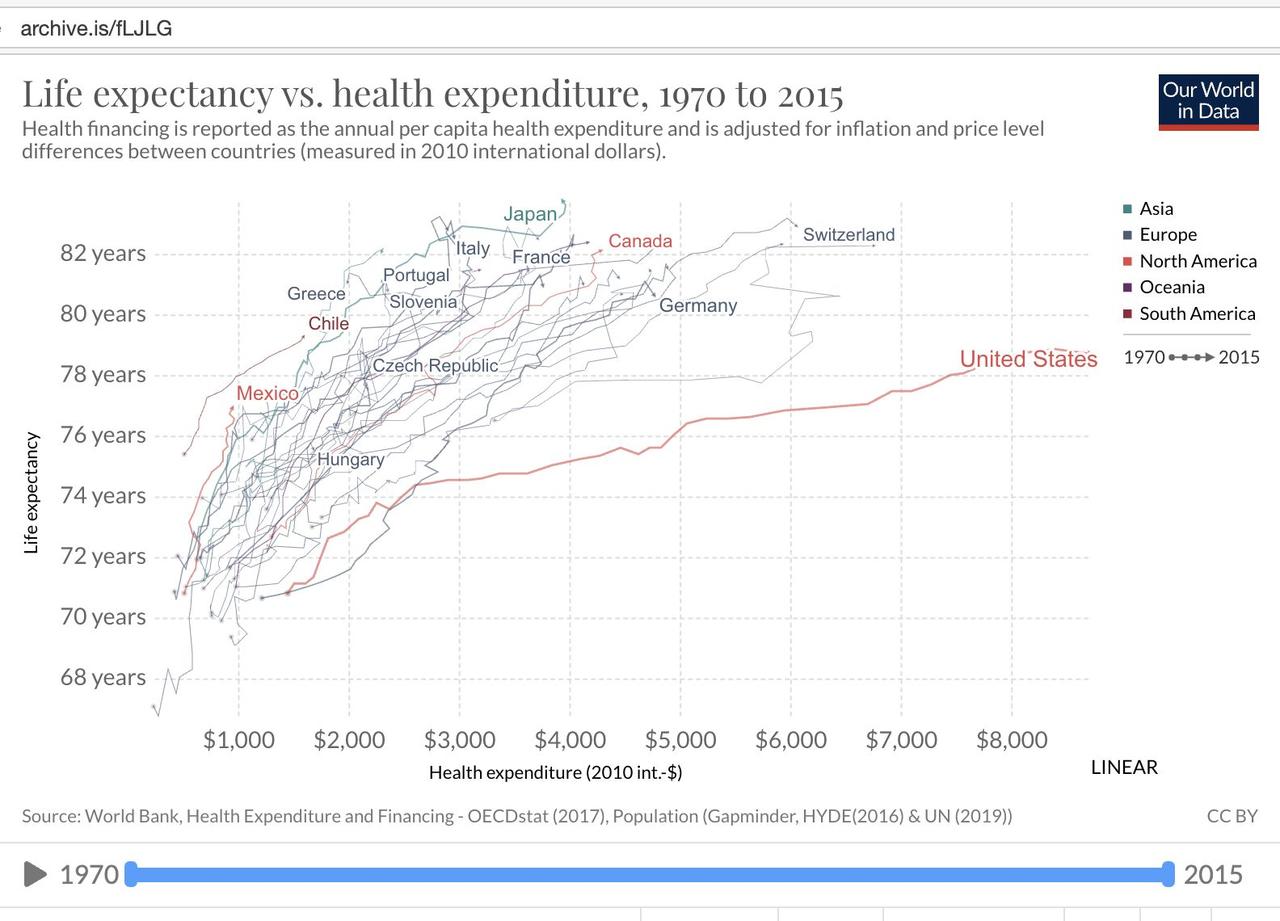
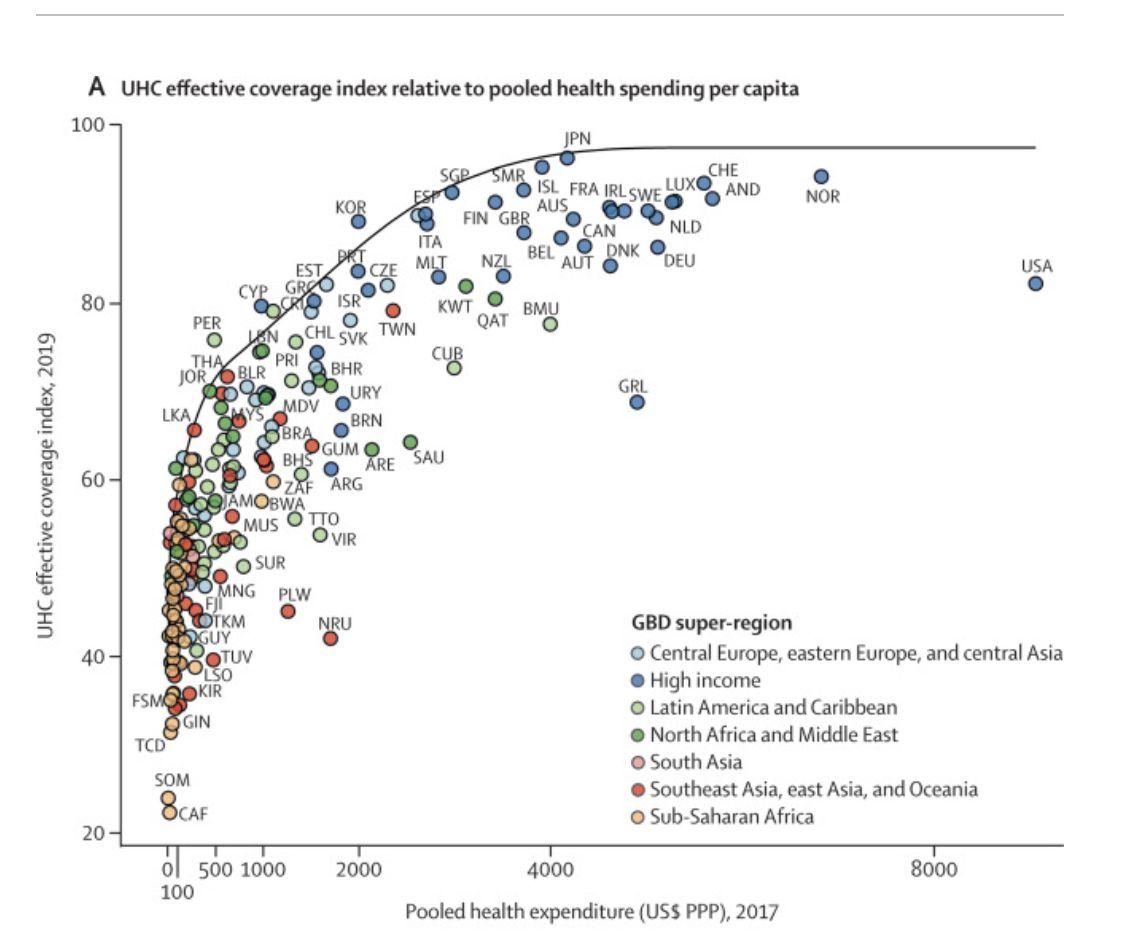
The medical journal, The Lancet, is one of the world’s Big Three scientific journals of medicine; that’s the triumvirate of authorities for physicians worldwide, and the other two are the Journal of the American Medical Association, and the New England Journal of Medicine. On August 27th The Lancet published “Measuring universal health coverage based on an index of effective coverage of health services in 204 countries and territories”. Here is the visual that’s in it, which shows the United States as having, by far, the world’s costliest medical care, at around $9,000 per person per year, and yet as having lower quality of health care than virtually all other industrialized nations do:

Here is another such study, showing the same thing, and calculating it more simply:

What explains this?

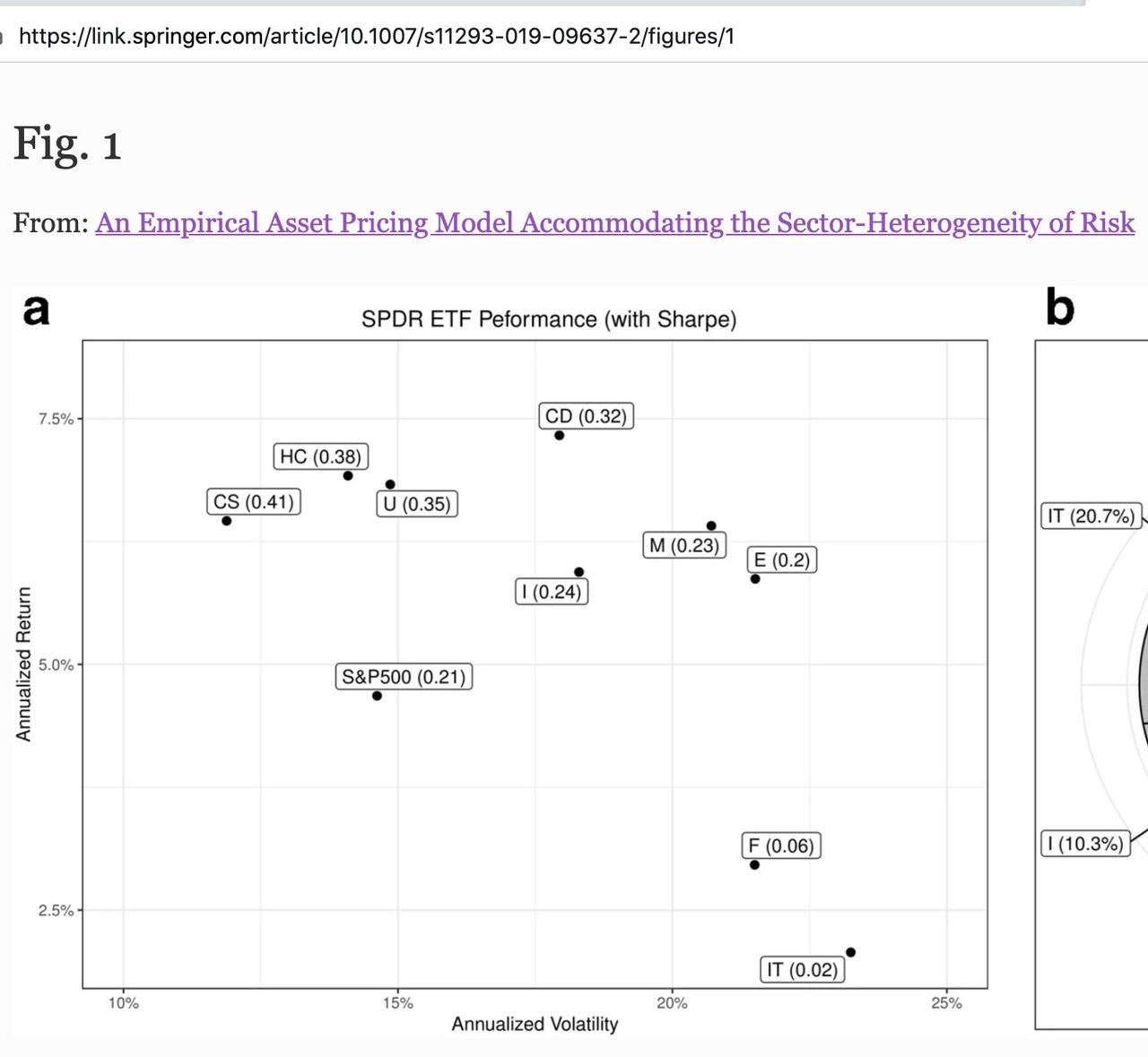
Quite simply, the United States is the world’s most corrupt nation, and medical care is such an extreme necessity when a citizen needs it, so that they’ll pay whatever the system charges them for it — and investing in healthcare products and services is therefore enormously profitable in the United States. Actually, the only other market-sector that competes with it for providing simultaneously high returns and low risk (the combination that offers the best of both worlds to investors) is consumer staples, such as foods, which likewise are necessities of life. When people are desperate, they’ll pay, whatever the cost, because these are things they don’t just want — they need. Here, from Maksim Papenkov’s award-winning 6 February 2020 paper, “An Empirical Asset Pricing Model Accommodating the Sector-Heterogeneity of Risk”, is his sector-specific calculation of stock-market profitability during 2000-2018, showing that “HC” Health Care, and “CS” Consumer Staples, were the best at combining low risk with high returns, during that 19-year period:

(“CD” there is Consumer Discretionary and includes Automobiles and Hotels. It’s the only sector that has higher returns than Health Care, but those returns are twice as risky. The S&P500 have lower returns than Health Care and slightly higher riskiness. At the opposite end, “IT” Information Technology is both the riskiest and the least profitable; and “F” Financials are the second-worst sector for investors. The most-profitable sectors are the necessities, the sectors that take the most from the most-desperate.)

In May 2017, Axene Health Partners published their actuary, Chris Slaybaugh’s, study, “International Healthcare Systems: The US Versus the World”, which stated:

The United States is the only industrialized country in the world that does not have Universal Health Coverage for all citizens. … Rather than one system, United States citizens and residents are insured under a variety of sometimes overlapping systems. The United States is also the only developed country where a significant number of citizens are permitted to be uninsured and where a person’s employment can determine whether they have insurance and what insurance they have. … The extent to which medical bills contribute to bankruptcy is hard to tease out from other factors, but even those who are skeptical of the claim that medical costs cause the majority of bankruptcies concede that they are a significant contributor.13

In the rest of the developed world, by contrast, medical costs are rarely or never cited as a driver behind personal bankruptcy.

In fact, CNBC headlined on 11 February 2019, “This is the real reason most Americans file for bankruptcy” and reported that,

Two-thirds of people who file for bankruptcy cite medical issues as a key contributor to their financial downfall.

While the high cost of health care has historically been a trigger for bankruptcy filings, the research shows that the implementation of the Affordable Care Act [“Obamacare”] has not improved things.

What most people do not realize, according to one researcher, is that their health insurance may not be enough to protect them.

While Barack Obama was running for President in 2008, he was promising to provide Americans with a “public option” in order to reduce profits for health insurance companies and thus lower costs, but he dropped that proposal immediately when he won the 2008 election, and he never pushed for it (not even to use as a bargaining chip with the Republicans in shaping his Obamacare). (In fact, Obama chose the conservative head of the Senate Finance Committee, Democratic Senator Max Baucus, to draft his Obamacare, because Baucus was against there being a public option, and because the progressive Democratic Senator Ted Kennedy’s Health, Education & Labor Committee had just drafted an Obamacare with a public option — Obama refused to have Kennedy draft his healthcare legislation. Obama was actually against there being a public option; only his public rhetoric was for it. Joe Biden is apparently now following the same tactic, of lying promises to the public, and true promises to his billionaire backers, to win the White House.) Obama promised the public “universal coverage”, which means 100% of the population covered, like in all other advanced economies, and his Obamacare increased the percentage insured from 84.5% when he came into office in 2009, to 87.7% two years after Obamacare started in 2013 — around 3%, by 2015 (which was after two years). That was still far short of the promised 100%. He was lying through his teeth in order to win election, and the ‘news’-media still hide (instead of expose) the fact that he did, and that he was actually an agent of the billionaires. He’s now the big hero among Democrats, because maybe Trump is even worse. Trump is up-front about his fascism. And Trump’s opponent now is another hypocrite (after Obama), Obama’s V.P., Joe Biden, who was the U.S. Senate’s leading Democratic Party segregationist and won his nomination by claiming to have been instead a civil-rights champion. Everything in U.S. politics is bait-and-switch. That’s the reality in America’s ‘democracy’: a bait-and-switch ‘democracy’, which serves actually only the wealthiest few. The politicians who are elected serve only the wealthy and well-connected.

America is the most libertarian, or “neo-liberal,” of the advanced industrial nations, and this is why it has the world’s most overpriced medical care. It provides the most liberty for the billionaires.

One of the few extremely bold Americans who rose high in the U.S. healthcare system and tried to tell the public how intensely corrupt it is, has been Marcia Angell, M.D, who held numerous prestigious posts in the U.S. medical system, and she was for a while the Editor-in-Chief of the New England Journal of Medicine. On 15 January 2009, Dr. Angell headlined “Drug Companies & Doctors: A Story of Corruption”, and wrote:

Conflicts of interest pervade medicine. … It is simply no longer possible to believe much of the clinical research that is published, or to rely on the judgment of trusted physicians or authoritative medical guidelines. I take no pleasure in this conclusion, which I reached slowly and reluctantly over my two decades as an editor of The New England Journal of Medicine. … So many reforms would be necessary to restore integrity to clinical research and medical practice that they cannot be summarized briefly. Many would involve congressional legislation and changes in the FDA, including its drug approval process. But there is clearly also a need for the medical profession to wean itself from industry money almost entirely. … Breaking the dependence of the medical profession on the pharmaceutical industry will take more than appointing committees and other gestures. It will take a sharp break from an extremely lucrative pattern of behavior. But if the medical profession does not put an end to this corruption voluntarily, it will lose the confidence of the public. …

She had said, nine years earlier:

If we had set out to design the worst system that we could imagine, we couldn’t have imagined one as bad as we have. … Our health care system is based on the premise that health care is a commodity like VCRs or computers and that it should be distributed according to the ability to pay. … That market ideology is what has made the health care system so dreadful, so bad at what it does. … That is a fundamental mistake in the way this country, and only this country, looks at health care. … The only way to both reduce cost and increase access and quality is to change the system, to scrap it and start over. … I would pay for health care in a single payer system, and what goes into that pot can vary. In Germany, employers have to contribute to that pot. I don’t think that’s a good idea. I would rather see it come straight out of tax revenues.

Experts who are that public-spirited and knowledgeable about the system should be appointed by U.S. Presidents to lead the FDA and the Department of Health and Human Services, but the billionaires prevent that (of course).

On June 27th, NPR headlined “After Pushing Lies, Former Cigna Executive Praises Canada’s Health Care System”, and interviewed a retired PR executive for America’s health insurance companies, who said that maybe the work that he had done smearing Canada’s socialized health insurance — “to spread misinformation about Canada or use cherry-picked data and anecdotes” so as to deceive Americans to accept America’s existing medical system — was partly to blame for America’s having performed significantly worse than Canada had done on the coronavirus crisis. (As of 29 August 2020, Canada had 3,378 cases per million and was the 76th worst out of 215 countries, whereas U.S. had 18,522 cases per million and was the 9th-worst. On deaths, Canada was the 27th-worst at 241, whereas U.S. was the 11th-worst at 564.)

America’s billionaires derive the vast majority of their net worth from stocks (capital gains and dividends), and from interest that’s paid to them; and, since nothing does this for them better than healthcare investments, the current for-profit system in health care is terrific for them; and these few hundred people, billionaires, extract this wealth from the hundreds of millions of Americans, the general public, and want to continue doing so, and they consequently finance politicians such as Joe Biden and Donald Trump (and their predecessors, such as Bush and Clinton), and they also set up ‘charitable’ foundations, and donate to medical schools, so as to inculcate this libertarian belief, not just into the public, but especially into the students and professors, who receive that trickle-down from them, as employees and future employees. While many in academe are against it, they’re not the ones who get advanced to the prestigious and high-paid positions. “He that pays the piper calls the tune.” It’s top-down (aristocracy), and it only pretends to be bottom-up (democracy). And, so, the corruption continues, and Americans die younger, and poorer, because of this aristocratically controlled system. It’s the American way. It’s the American system. Of corruption. Americans call it “capitalism.”

Of course, another area in which the U.S. Government is extraordinarily corrupt is its Military-Industrial Complex; and, on August 28th, a former top official of the NSA, Bill Binney, provided, online, an in-depth description of what he personally knows about that. His personal knowledge is enormous concerning within the Government itself, but not outside it — i.e., not regarding the corporations and billionaires who control the economic rewards system that the top public officials, who typically are agents of the “Deep State” (the billionaires), are serving. However, what he says there is informative and highly reliable regarding the way that the Government’s bureaucracy itself functions, and he is extraordinarily honest about the intense corruption within the official Government. He makes clear that the U.S. Constitution is being systematically and routinely violated by top U.S. officials; so, the U.S. Government routinely violates the U.S. Constitution, in this ‘democracy’, where the system functions like clockwork, for the billionaires.

via ZeroHedge News https://ift.tt/2QIW8Ex Tyler Durden

You Have Libertarian Alternatives to Biden and Trump This November

Jorgensen_1161x653

The media obsess about Trump/Biden, but another candidate will be on every state ballot: Libertarian Party nominee Jo Jorgensen.

Dr. Jorgensen, a psychology lecturer at Clemson University, is very different from Donald Trump and Joe Biden. Instead of promising government solutions, she tells people, “You can spend your money better than the politicians.”

I like that. So, she’s the subject of my video this week.

I start with COVID-19. Libertarians are skeptical of government action, but a pandemic may be the rare situation when government should act. People need protection from contagious people. No one wants medical facilities overwhelmed.

When politicians issued lockdown orders, their actions were praised by most media. “There are no libertarians in a pandemic,” smug people said to me.

Jorgensen says that’s nonsense, that COVID-19 became one more excuse for authoritarian politicians to boss people around.

“Is it right for the government to take away tens of millions of jobs? I say no. Young people could be out there and have no more risks than having the flu.”

If government stepped back, she says, the private sector would lead the way. She points out that Walmart required masks be worn in all their stores. “It shows that, yes, we can be adults without government telling us we need to be adults.”

I tell Jorgensen that my former Fox Business colleague Lou Dobbs calls libertarianism “an absurd philosophy.”

“What I think is crazy,” she replies, “is spending a lot more than you take in… having troops in the Middle East, which makes us more at risk, just like we saw with 9/11… crazy is actually having taxpayers pay for the defense of Germany and France.”

Good points. Why does America need to be the whole world’s policeman?

Vice President Biden helped get America into many of its endless wars. President Trump said he’d like to bring our soldiers home, but he hasn’t done much of it.

“Instead of fighting wars and having military bases all over the world,” Jorgensen says, she’d “make America one giant Switzerland, armed and neutral.”

Biden says he would “end gun violence” and that “the Second Amendment is limited.” Jorgensen replies, “we limit gun violence by allowing peaceful citizens to arm themselves.”

Trump taxed imports, claiming America “loses” when we have a trade deficit.

Jorgensen calls that laughably ignorant. “I have a trade deficit with my gas station because I buy gas from them and they buy nothing from me,” says Jorgensen. “It doesn’t matter what one country does.”

Biden says increasing the minimum wage to $15 is “just a start.” Jorgensen quips: “Yeah. A start to minorities not being able to get a rung on the ladder to successful employment.”

Jorgensen opposes Trump’s immigration restrictions.

I push back: “There are billions of poor people all over the world. Some want to come here to freeload.”

Jorgensen replies that welfare programs have rules to prevent freeloading, “Many… have a five-year waiting list.” Also, “if you look at people who have the initiative to come here, they typically have the initiative to work.”

Biden would spend $2 trillion to try to delay climate change. Jorgensen says the free market is the better way. “Wherever there’s big government, there’s more pollution.”

Neither Trump nor Biden wants to stop the war on drugs. Jorgensen believes that (for adults) all drugs should be legal.

I agree with Jorgensen about most things. But people say a vote for a Libertarian candidate is wasted.

In addition, Jorgensen will be accused of taking votes from Trump at a time when “only Trump might stop big government Democrats.” She’ll be accused of taking votes from Biden, when “we need to get this clown (Trump) out of office.”

“We need to get both clowns away from the presidency,” Jorgensen replies.

Jorgensen won’t win, but I hope her campaign inspires some Americans to think about the proper role of government.

Jorgensen is absolutely correct when, at the end of our interview, she says: “We’ve got Washington in everything we do. It’s just causing more problems.”

COPYRIGHT 2020 BY JFS PRODUCTIONS INC.

DISTRIBUTED BY CREATORS.COM

from Latest – Reason.com https://ift.tt/3jCIleU
via IFTTT

Millions Of Americans Had Their Emergency Savings Wiped Out By Downturn

Millions Of Americans Had Their Emergency Savings Wiped Out By Downturn

Tyler Durden

Wed, 09/02/2020 – 01:30

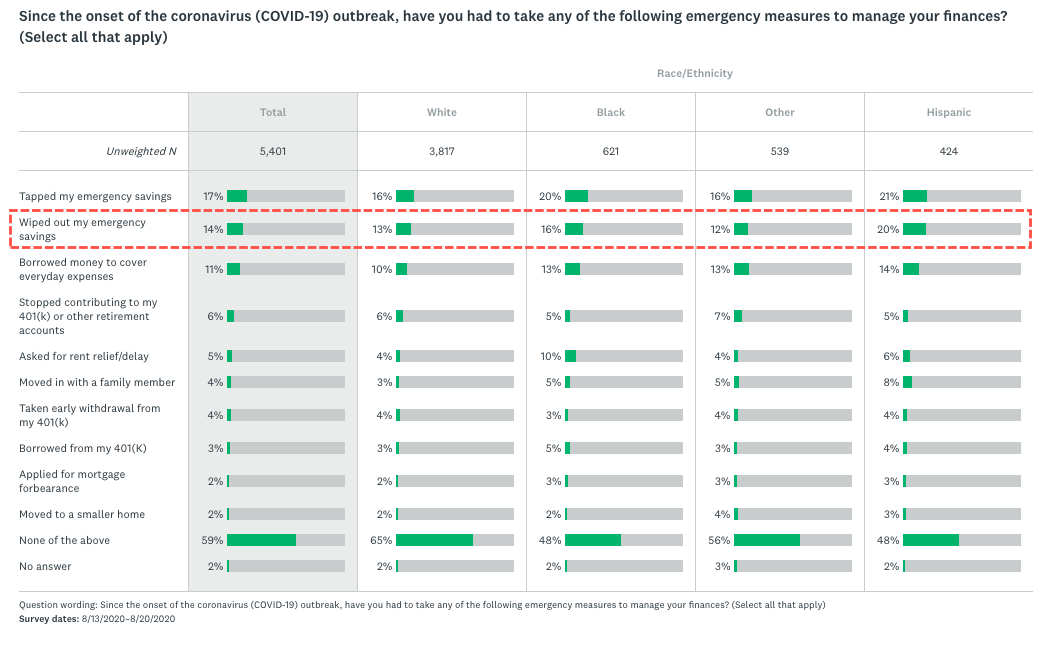
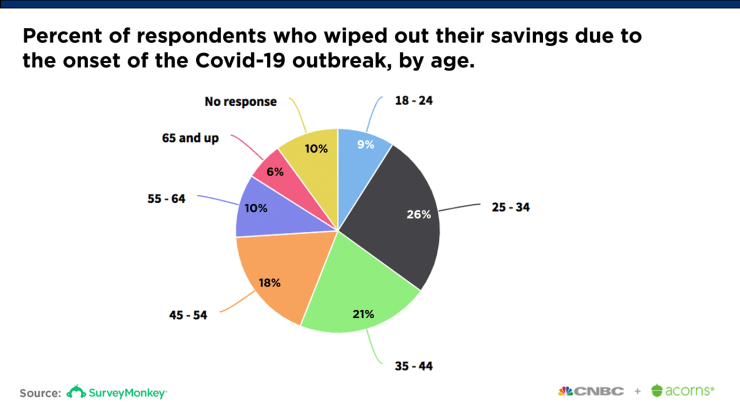
A new survey via CNBC and Acorns Invest commissioned by SurveyMonkey, found that the virus-induced recession wiped out 14% or about 46 million American’s emergency savings. 

About 17% had to tap into emergency savings to cover living expenses, 11% had to borrow money to cover everyday expenses, 6% stopped contributing to 401(k) or other retirement accounts, and 5% asked for rent relief. 

The survey of more than 5,400 adults in August found that older millennials depleted their emergency savings the most. About 26% of those aged 25 to 34 said their savings had been drained as they struggled to survive the downturn. Only 6% of boomers drained savings; they’ve been through multiple boom/bust cycles and understand the importance of saving for a rainy day. Unlike millennials who have only been through one recession. 

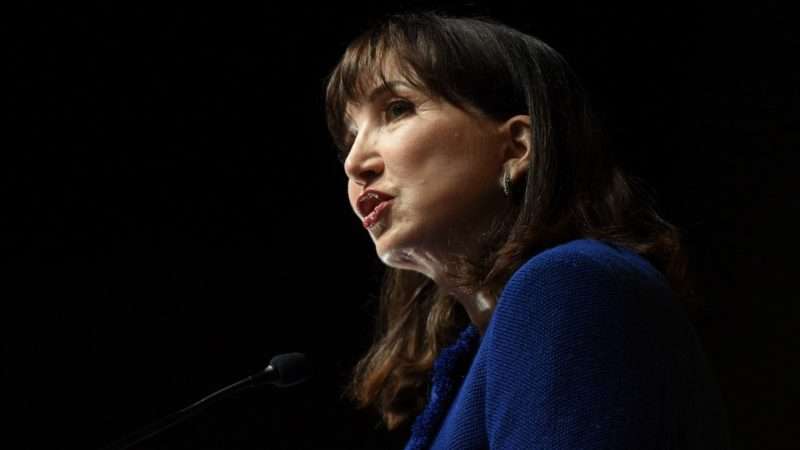
The survey’s findings outline a similar message from former Federal Reserve Chair Janet Yellen last week, where she warned in an op-ed, published in The New York Times, that millions of Americans are suffering. She said monetary policy by itself could not save the economy from the downturn, and the solution will require additional rounds of fiscal stimulus to thwart a deepening fiscal cliff. 

The virus-induced recession has caused unprecedented economic damage, while more than 30 million American’s are collecting unemployment benefits. The labor market recovery has stalled as the Fed’s new policy to raise the inflation target above 2% will result in a higher cost of living for tens of millions broke, jobless Americans. 

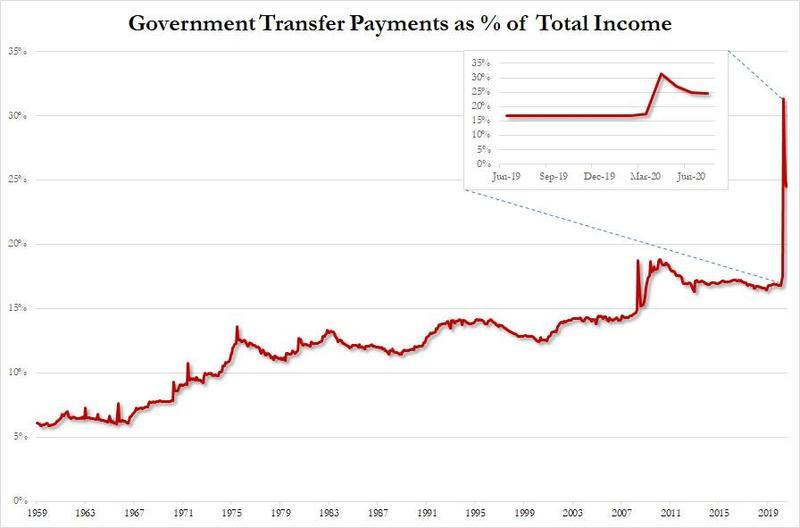
What’s even more stunning is that a quarter of all personal income is derived from the government.

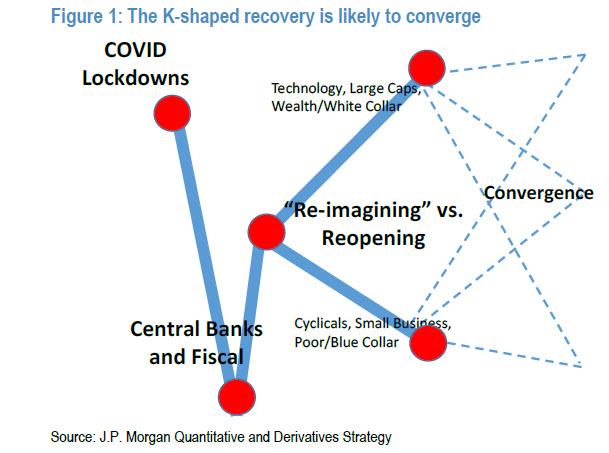
This merely underscores the uneven, or K-shaped nature of the the recovery: where the political elites and ultra-wealthy were bailed out by the Fed, while millions of serfs, i.e., low-income folks, have (almost) completely run out of savings, depleted stimulus funds, and some can no longer afford food as the fiscal cliff  hits the 31 day mark on Tuesday.

Congress and the Fed better beware: stress low-income households enough, they will eventually assemble and revolt, striking at the one building that has so far avoided the protesters’ focus: the Marriner Eccles building.

via ZeroHedge News https://ift.tt/31MQRlB Tyler Durden

Trump’s Vague Commitment to Criminal Justice Reform

Alice-Johnson-RNC-8-27-20-C-SPAN

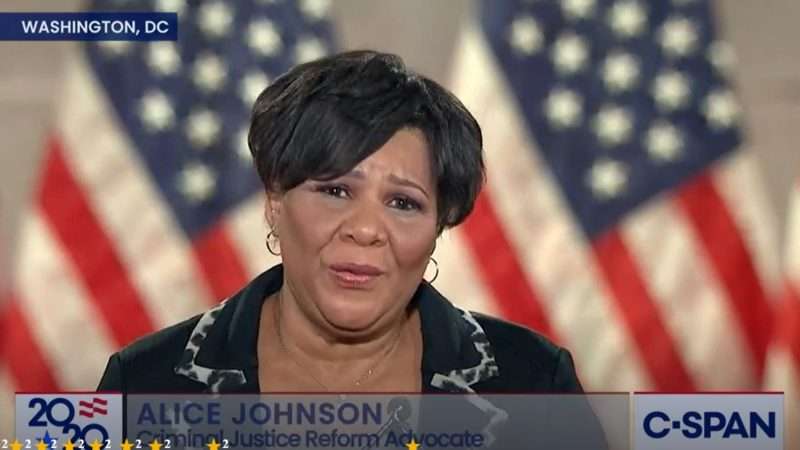
Alice Johnson’s appearance at the Republican National Convention last week was a rebuke to Democratic presidential nominee Joe Biden, who for decades promoted the draconian policies that sent her to prison for life as a first-time, nonviolent drug offender. Johnson’s case was also meant to show that President Donald Trump, who commuted her sentence in 2018 and pardoned her the day after her speech, offers a more enlightened alternative.

The truth is a little more complicated. While Biden’s record in office on criminal justice issues is long and awful, Trump’s is short and pretty good. But when it comes to promises for the future, a repentant Biden supports several ambitious reforms, while Trump sounds like the Biden of the 1980s and ’90s.

Johnson, who received a life sentence in 1997 for participating in a Memphis-based cocaine trafficking operation, was introduced during the president’s State of the Union address last year, and she was featured in a Trump campaign Super Bowl ad last February. Her case exemplifies the unjust penalties that Biden—whom the Trump campaign describes, with only a little hyperbole, as “the chief architect of mass incarceration and the War on Drugs”—supported as a senator.

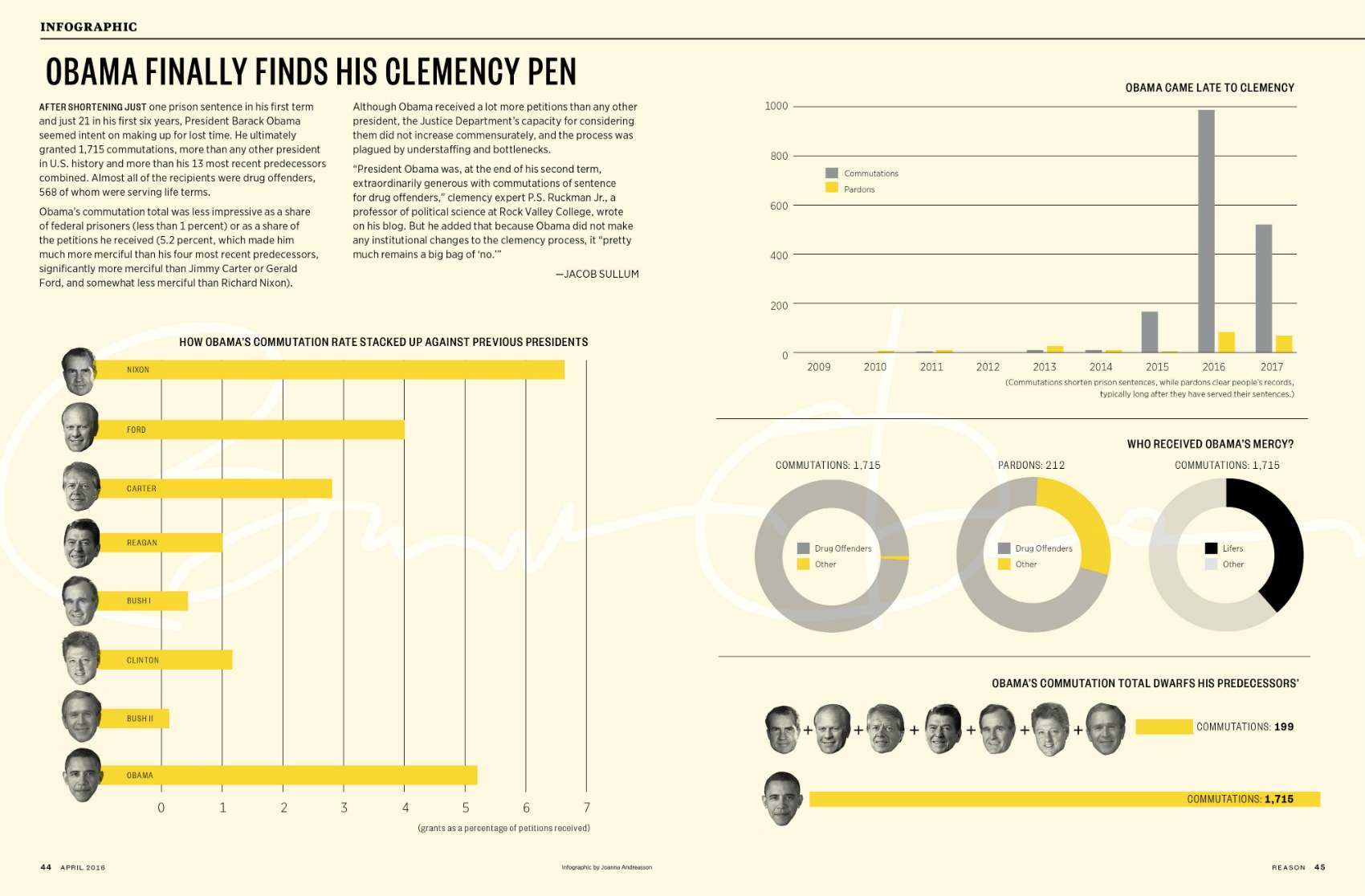
Trump seems to have been genuinely moved by Johnson’s story, and so far he has commuted 10 sentences in addition to hers. By comparison, Barack Obama, who eventually commuted a record 1,715 sentences, approved just one petition during his first term.

The convention also highlighted Trump’s support for the FIRST STEP Act, a 2018 law that included some modest but significant sentencing reforms. One of those provisions dealt with the irrational disparity between the smoked and snorted forms of cocaine, which was created by a 1986 law that Biden wrote.

More than two decades later, in the midst of his unsuccessful bid for the 2008 Democratic presidential nomination, Biden introduced a bill aimed at eliminating that distinction, which had led to strikingly unequal treatment of black defendants. While the bill went nowhere, Biden as vice president continued to advocate correction of what he last year described as “a big mistake” that had “trapped an entire generation.”

The Fair Sentencing Act, which Obama signed in 2010, shrank but did not eliminate the gap between crack and cocaine powder, and it did not apply retroactively, meaning that thousands of prisoners continued to serve sentences that nearly everyone agreed were excessive. The FIRST STEP Act, which passed the House and the Senate with overwhelming support, addressed the latter problem; it also reduced sentences for repeat drug offenders, expanded “good time” credits, prevented the stacking of multiple firearm charges in a single drug case, and widened the “safety valve” that allows low-level, nonviolent offenders to avoid mandatory minimums.

Trump deserves credit for supporting that law, which has freed thousands of federal prisoners, and for using his clemency powers not only to help his cronies but to ameliorate some genuine injustices. Yet his campaign has nothing to say about further reforms, and his second-term agenda echoes the “tough on crime” Biden, calling for more police on the streets, opposing bail reform, and advocating harsher punishment without explaining why current penalties are inadequate.

Biden, meanwhile, claims to have seen the error of his ways. In addition to equalizing the sentences for crack and cocaine powder, he supports abolishing the myriad mandatory minimums and death penalties he once championed and decriminalizing pot possession, although he still resists repealing the federal ban on marijuana.

“Against all odds,” the president’s daughter said at the convention, Trump “brought together Republicans and Democrats, and passed the most significant criminal justice reform of our generation. And we’re just getting started.” That last part requires some explanation.

“My father did not campaign on this issue,” Ivanka Trump added. “He tackled this injustice because he has a deep compassion for those who have been treated unfairly.” While I am inclined to believe her, Trump needs to clarify the future implications of that impulse.

© Copyright 2020 by Creators Syndicate Inc.

from Latest – Reason.com https://ift.tt/2EECYNH
via IFTTT

The Statutory Authority for the Nationwide Eviction Moratorium

Today, the Center for Disease Control and Prevention filed a notice in the Federal Register. The order purports “to temporarily halt residential evictions to prevent the further spread of COVID-19.” No, not just in federal housing. Nationwide.

Under this Order, a landlord, owner of a residential property, or other person3 with a legal right to pursue eviction or possessory action, shall not evict any covered person from any residential property in any jurisdiction to which this Order applies during the effective period of the Order.

CDC argues that keeping people in their homes will prevent the spread of COVID-19:

In the context of a pandemic, eviction moratoria—like quarantine, isolation, and social distancing—can be an effective public health measure utilized to prevent the spread of communicable disease. Eviction moratoria facilitate self-isolation by people who become ill or who are at risk for severe illness from COVID-19 due to an underlying medical condition. They also allow State and local authorities to more easily implement stay-at-home and social distancing directives to mitigate the community spread of COVID-19.

Landlords who evict tenants to qualify for this program face fines of up to $100,000 and a year in prison.

What is the authority for this sweeping order? The thirty-seven page notice cites a single regulation:  42 CFR § 70.2. It provides:

Whenever the Director of the Centers for Disease Control and Prevention determines that the measures taken by health authorities of any State or possession (including political subdivisions thereof) are insufficient to prevent the spread of any of the communicable diseases from such State or possession to any other State or possession, he/she may take such measures to prevent such spread of the diseases as he/she deems reasonably necessary, including inspection, fumigation, disinfection, sanitation, pest extermination, and destruction of animals or articles believed to be sources of infection.

To be sure, this regulation allows the Director to “take such measures to prevent such spread of the diseases as he/she deems reasonably necessary.” But there are limits of this delegation. The regulation provides examples of such measure:  “inspection, fumigation, disinfection, sanitation, pest extermination, and destruction of animals or articles believed to be sources of infection.” All of these measures are localized, and limited to prevent the spread of an infection in a single building or location. None of these examples are even remotely close to a nationwide moratorium on evictions. This action is far beyond the scope of delegated authority.

Moreover, the Director cannot order state courts to not process summary evictions. A landlord could rely on these processes, but then face a federal prosecution for doing so. Would any landlord risk it?

This eviction moratorium lacks even a patina of statutory authorization. Landlords can, and should challenge this executive action.

In August, I blogged about the President’s executive actions for disaster relief and payroll tax deferral. Both actions were well within the scope of the President’s statutory authority. For days, critics argued these actions were unconstitutional. No one ever backed this argument up. These positions were pure political posturing. Now, about a month later, all objections have subsided. Yet, I have seen nary an objection to this eviction moratorium.

One final, pragmatic point. This order only delays evictions. It does not excuse back rent. In theory, once January rolls around, people would be required to pay five months of back rent. But that will never happen. Whoever is President in December will sign into law a bill that funds all of this back rent. All of it. In effect, President Trump gave millions of Americans a five month reprieve from paying rent. Any litigation will likely be mooted come January, as a bill will make the landlords whole.

from Latest – Reason.com https://ift.tt/2QLi7un
via IFTTT

You Have Libertarian Alternatives to Biden and Trump This November

Jorgensen_1161x653

The media obsess about Trump/Biden, but another candidate will be on every state ballot: Libertarian Party nominee Jo Jorgensen.

Dr. Jorgensen, a psychology lecturer at Clemson University, is very different from Donald Trump and Joe Biden. Instead of promising government solutions, she tells people, “You can spend your money better than the politicians.”

I like that. So, she’s the subject of my video this week.

I start with COVID-19. Libertarians are skeptical of government action, but a pandemic may be the rare situation when government should act. People need protection from contagious people. No one wants medical facilities overwhelmed.

When politicians issued lockdown orders, their actions were praised by most media. “There are no libertarians in a pandemic,” smug people said to me.

Jorgensen says that’s nonsense, that COVID-19 became one more excuse for authoritarian politicians to boss people around.

“Is it right for the government to take away tens of millions of jobs? I say no. Young people could be out there and have no more risks than having the flu.”

If government stepped back, she says, the private sector would lead the way. She points out that Walmart required masks be worn in all their stores. “It shows that, yes, we can be adults without government telling us we need to be adults.”

I tell Jorgensen that my former Fox Business colleague Lou Dobbs calls libertarianism “an absurd philosophy.”

“What I think is crazy,” she replies, “is spending a lot more than you take in… having troops in the Middle East, which makes us more at risk, just like we saw with 9/11… crazy is actually having taxpayers pay for the defense of Germany and France.”

Good points. Why does America need to be the whole world’s policeman?

Vice President Biden helped get America into many of its endless wars. President Trump said he’d like to bring our soldiers home, but he hasn’t done much of it.

“Instead of fighting wars and having military bases all over the world,” Jorgensen says, she’d “make America one giant Switzerland, armed and neutral.”

Biden says he would “end gun violence” and that “the Second Amendment is limited.” Jorgensen replies, “we limit gun violence by allowing peaceful citizens to arm themselves.”

Trump taxed imports, claiming America “loses” when we have a trade deficit.

Jorgensen calls that laughably ignorant. “I have a trade deficit with my gas station because I buy gas from them and they buy nothing from me,” says Jorgensen. “It doesn’t matter what one country does.”

Biden says increasing the minimum wage to $15 is “just a start.” Jorgensen quips: “Yeah. A start to minorities not being able to get a rung on the ladder to successful employment.”

Jorgensen opposes Trump’s immigration restrictions.

I push back: “There are billions of poor people all over the world. Some want to come here to freeload.”

Jorgensen replies that welfare programs have rules to prevent freeloading, “Many… have a five-year waiting list.” Also, “if you look at people who have the initiative to come here, they typically have the initiative to work.”

Biden would spend $2 trillion to try to delay climate change. Jorgensen says the free market is the better way. “Wherever there’s big government, there’s more pollution.”

Neither Trump nor Biden wants to stop the war on drugs. Jorgensen believes that (for adults) all drugs should be legal.

I agree with Jorgensen about most things. But people say a vote for a Libertarian candidate is wasted.

In addition, Jorgensen will be accused of taking votes from Trump at a time when “only Trump might stop big government Democrats.” She’ll be accused of taking votes from Biden, when “we need to get this clown (Trump) out of office.”

“We need to get both clowns away from the presidency,” Jorgensen replies.

Jorgensen won’t win, but I hope her campaign inspires some Americans to think about the proper role of government.

Jorgensen is absolutely correct when, at the end of our interview, she says: “We’ve got Washington in everything we do. It’s just causing more problems.”

COPYRIGHT 2020 BY JFS PRODUCTIONS INC.

DISTRIBUTED BY CREATORS.COM

from Latest – Reason.com https://ift.tt/3jCIleU
via IFTTT

Trump’s Vague Commitment to Criminal Justice Reform

Alice-Johnson-RNC-8-27-20-C-SPAN

Alice Johnson’s appearance at the Republican National Convention last week was a rebuke to Democratic presidential nominee Joe Biden, who for decades promoted the draconian policies that sent her to prison for life as a first-time, nonviolent drug offender. Johnson’s case was also meant to show that President Donald Trump, who commuted her sentence in 2018 and pardoned her the day after her speech, offers a more enlightened alternative.

The truth is a little more complicated. While Biden’s record in office on criminal justice issues is long and awful, Trump’s is short and pretty good. But when it comes to promises for the future, a repentant Biden supports several ambitious reforms, while Trump sounds like the Biden of the 1980s and ’90s.

Johnson, who received a life sentence in 1997 for participating in a Memphis-based cocaine trafficking operation, was introduced during the president’s State of the Union address last year, and she was featured in a Trump campaign Super Bowl ad last February. Her case exemplifies the unjust penalties that Biden—whom the Trump campaign describes, with only a little hyperbole, as “the chief architect of mass incarceration and the War on Drugs”—supported as a senator.

Trump seems to have been genuinely moved by Johnson’s story, and so far he has commuted 10 sentences in addition to hers. By comparison, Barack Obama, who eventually commuted a record 1,715 sentences, approved just one petition during his first term.

The convention also highlighted Trump’s support for the FIRST STEP Act, a 2018 law that included some modest but significant sentencing reforms. One of those provisions dealt with the irrational disparity between the smoked and snorted forms of cocaine, which was created by a 1986 law that Biden wrote.

More than two decades later, in the midst of his unsuccessful bid for the 2008 Democratic presidential nomination, Biden introduced a bill aimed at eliminating that distinction, which had led to strikingly unequal treatment of black defendants. While the bill went nowhere, Biden as vice president continued to advocate correction of what he last year described as “a big mistake” that had “trapped an entire generation.”

The Fair Sentencing Act, which Obama signed in 2010, shrank but did not eliminate the gap between crack and cocaine powder, and it did not apply retroactively, meaning that thousands of prisoners continued to serve sentences that nearly everyone agreed were excessive. The FIRST STEP Act, which passed the House and the Senate with overwhelming support, addressed the latter problem; it also reduced sentences for repeat drug offenders, expanded “good time” credits, prevented the stacking of multiple firearm charges in a single drug case, and widened the “safety valve” that allows low-level, nonviolent offenders to avoid mandatory minimums.

Trump deserves credit for supporting that law, which has freed thousands of federal prisoners, and for using his clemency powers not only to help his cronies but to ameliorate some genuine injustices. Yet his campaign has nothing to say about further reforms, and his second-term agenda echoes the “tough on crime” Biden, calling for more police on the streets, opposing bail reform, and advocating harsher punishment without explaining why current penalties are inadequate.

Biden, meanwhile, claims to have seen the error of his ways. In addition to equalizing the sentences for crack and cocaine powder, he supports abolishing the myriad mandatory minimums and death penalties he once championed and decriminalizing pot possession, although he still resists repealing the federal ban on marijuana.

“Against all odds,” the president’s daughter said at the convention, Trump “brought together Republicans and Democrats, and passed the most significant criminal justice reform of our generation. And we’re just getting started.” That last part requires some explanation.

“My father did not campaign on this issue,” Ivanka Trump added. “He tackled this injustice because he has a deep compassion for those who have been treated unfairly.” While I am inclined to believe her, Trump needs to clarify the future implications of that impulse.

© Copyright 2020 by Creators Syndicate Inc.

from Latest – Reason.com https://ift.tt/2EECYNH
via IFTTT

The Statutory Authority for the Nationwide Eviction Moratorium

Today, the Center for Disease Control and Prevention filed a notice in the Federal Register. The order purports “to temporarily halt residential evictions to prevent the further spread of COVID-19.” No, not just in federal housing. Nationwide.

Under this Order, a landlord, owner of a residential property, or other person3 with a legal right to pursue eviction or possessory action, shall not evict any covered person from any residential property in any jurisdiction to which this Order applies during the effective period of the Order.

CDC argues that keeping people in their homes will prevent the spread of COVID-19:

In the context of a pandemic, eviction moratoria—like quarantine, isolation, and social distancing—can be an effective public health measure utilized to prevent the spread of communicable disease. Eviction moratoria facilitate self-isolation by people who become ill or who are at risk for severe illness from COVID-19 due to an underlying medical condition. They also allow State and local authorities to more easily implement stay-at-home and social distancing directives to mitigate the community spread of COVID-19.

Landlords who evict tenants to qualify for this program face fines of up to $100,000 and a year in prison.

What is the authority for this sweeping order? The thirty-seven page notice cites a single regulation:  42 CFR § 70.2. It provides:

Whenever the Director of the Centers for Disease Control and Prevention determines that the measures taken by health authorities of any State or possession (including political subdivisions thereof) are insufficient to prevent the spread of any of the communicable diseases from such State or possession to any other State or possession, he/she may take such measures to prevent such spread of the diseases as he/she deems reasonably necessary, including inspection, fumigation, disinfection, sanitation, pest extermination, and destruction of animals or articles believed to be sources of infection.

To be sure, this regulation allows the Director to “take such measures to prevent such spread of the diseases as he/she deems reasonably necessary.” But there are limits of this delegation. The regulation provides examples of such measure:  “inspection, fumigation, disinfection, sanitation, pest extermination, and destruction of animals or articles believed to be sources of infection.” All of these measures are localized, and limited to prevent the spread of an infection in a single building or location. None of these examples are even remotely close to a nationwide moratorium on evictions. This action is far beyond the scope of delegated authority.

Moreover, the Director cannot order state courts to not process summary evictions. A landlord could rely on these processes, but then face a federal prosecution for doing so. Would any landlord risk it?

This eviction moratorium lacks even a patina of statutory authorization. Landlords can, and should challenge this executive action.

In August, I blogged about the President’s executive actions for disaster relief and payroll tax deferral. Both actions were well within the scope of the President’s statutory authority. For days, critics argued these actions were unconstitutional. No one ever backed this argument up. These positions were pure political posturing. Now, about a month later, all objections have subsided. Yet, I have seen nary an objection to this eviction moratorium.

One final, pragmatic point. This order only delays evictions. It does not excuse back rent. In theory, once January rolls around, people would be required to pay five months of back rent. But that will never happen. Whoever is President in December will sign into law a bill that funds all of this back rent. All of it. In effect, President Trump gave millions of Americans a five month reprieve from paying rent. Any litigation will likely be mooted come January, as a bill will make the landlords whole.

from Latest – Reason.com https://ift.tt/2QLi7un
via IFTTT

New York Launches Unsecured Online ‘Portal’ For Requesting Absentee Ballots

New York Launches Unsecured Online ‘Portal’ For Requesting Absentee Ballots

Tyler Durden

Tue, 09/01/2020 – 23:50

As New York, which successfully managed to hold most of its primary votes mostly by mail, has opened an online portal allowing residents to request an absentee ballot.

Gov Andrew Cuomo acted unilaterally to allow any person concerned about COVID-19 risk to request an absentee ballot, even as some southern states rule that COVID-19 fears aren’t a valid reason to vote absentee. ;

NYers have until Oct. 27 to mail in their ballots.

The absentee ballot portal went live Tuesday, and Cuomo heralded the launch as a move toward ensuring free and fair elections.

“As the November election approaches, we know that many voters feel vulnerable in the midst of this pandemic,” he said. “In line with the sweeping reforms we have implemented to make it easier for New Yorkers to exercise their right to vote, today we launch the online portal through which every registered voter concerned about COVID-19 can obtain an absentee ballot.”

USPS has advised Americans to request ballots no later than 15 days before the Nov. 3 vote.

To request a ballot, users must enter their birth date, county and ZIP code to confirm that you are already registered to vote. You are then taken to a page where you decide how you want the absentee ballot delivered.

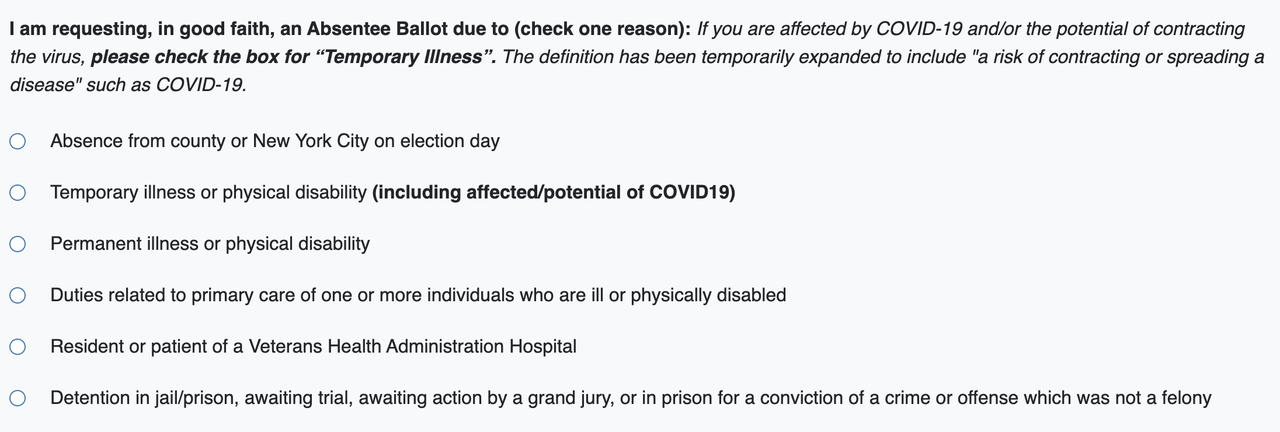
Interestingly, when we tested the portal, we found that it didn’t include any requests for sensitive private information like an individual’s social security number. An individual could request an absentee ballot simply by entering in another individual’s birthday, address and zip code – all information that’s easily attainable.

The screen shots below are from the website for NYC’s board of elections. City-dwellers are directed there to finish the application, but virtually all of the same questions, and the complete lack of security, are the same.

We sincerely hope this doesn’t create a massive crush of fraudulent requests, as any motivated individual could use social media to fraudulently apply for absentee ballots, if only to prove a point.

And NY isn’t alone.

via ZeroHedge News https://ift.tt/3bjsZck Tyler Durden