Huge Block Of Gulf Of Mexico Auctioned For Oil Drilling, Infuriating Biden’s Climate Activists

Huge Block Of Gulf Of Mexico Auctioned For Oil Drilling, Infuriating Biden’s Climate Activists

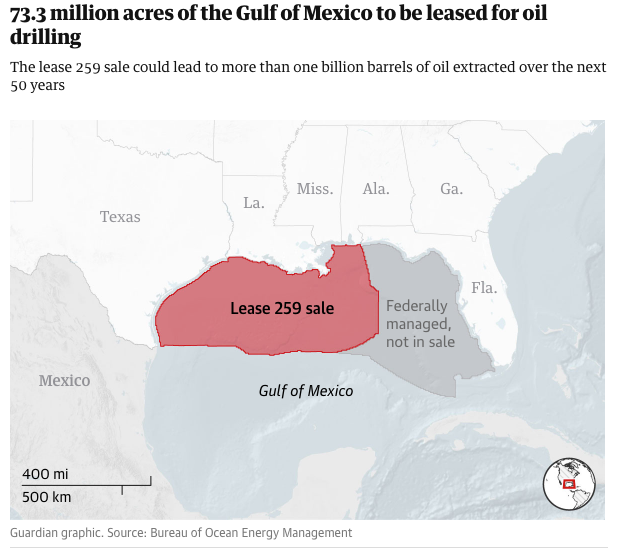
As required by the Inflation Reduction Act (IRA) of 2022, the Bureau of Ocean Energy Management (BOEM) auctioned oil and gas drilling rights across 73.4 million acres in the Gulf of Mexico despite the Biden administration’s pledge to end new leasing as part of climate change initiatives. 

According to BOEM, 32 companies participated in the Gulf of Mexico Lease Sale 259, submitting $309,798,397 in total bids. Reuters pointed out that Chevron Corp, ExxonMobil Corp, and BP Plc were among the top bidders. 

The Guardian said the size of Lease 259 is comparable in size to Italy. 

Source: The Guardian 

The auction was a requirement in President Biden’s IRA, which safeguards federal oil and gas leasing and mandates lease sales in the Gulf of Mexico by the end of March. 

Revenues received from offshore oil and gas leases will be paid to US Treasury, Gulf Coast states (Texas, Louisiana, Mississippi, and Alabama) and local governments, the Land and Water Conservation Fund, and the Historic Preservation Fund. 

The auction comes weeks after Biden authorized a large ConocoPhillips oil project in northwest Alaska.

A little awkward, considering he has pledged during the election campaign: “I guarantee you we’re going to end fossil fuels.”

New oil and gas developments in the Gulf of Mexico and Alaska have infuriated climate activists:

“For the first half of his presidency, Joe Biden led on climate with transformative vision but in the second half he seems to be signaling a disastrous climate U-turn,” Ben Jealous, executive director of the Sierra Club and a prominent progressive, said.

For instance, Alaska’s $8 billion Willow oil field development project has a 30-year lifespan. The projects in the Gulf also have years, if not more than a decade, lifespan. The notion that Biden wants to ban oil and gas is ‘malarkey,’ and his staunchest climate supporters are getting wind the president is failing on his word. 

“If he’s making a political calculation, he’s making a wrong one. He’s breaking a major promise on drilling and by going back on his word he will inspire many young people to stay at home rather than voting in 2024. His decisions appear to be rooted in the political and economic calculus of the last century, not this one,” Jealous added. 

Tyler Durden
Thu, 03/30/2023 – 18:00

via ZeroHedge News https://ift.tt/XA18Om7 Tyler Durden

Belief In Traditional American Values Plummeting: WSJ Poll

Belief In Traditional American Values Plummeting: WSJ Poll

Authored by Eric Utter via American Thinker (emphasis ours),

According to a depressing new poll from The Wall Street Journal, belief in the importance of traditional American values has plummeted in the United States in recent decades.

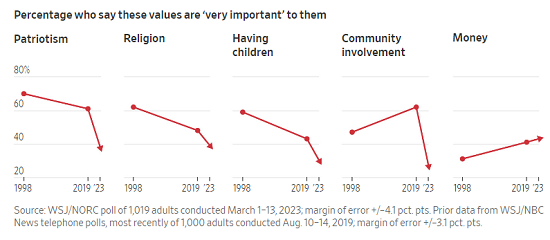
The poll queried U.S. respondents about the importance of patriotism, religious faith, having children and other traditionally American values in their lives. Only 39% of Americans surveyed said their religious faith is very important to them, and just 38% said patriotism is very important.

The Journal compared those numbers to the results from the first time it ran the poll in 1998… when 62% of Americans said religion was very important to them, and 70% said patriotism was. And that was during the Clinton administration!

So, apparently, a majority of Americans no longer believe either religion or patriotism is important.

If that is the case, Democrats will never be out of power again. They never tire of dissing the country, its founders…and the concept of objective truth, morality…and God. (“Male and female He made them? Screw that, I decide if I am male or female…or any other gender, including ones I make up out of whole cloth!”)

Remarkably, the survey also purported to find that a plurality of Americans believe the U.S. has not gone far enough in promoting equality between men and women, accepting people who are gay, lesbian or bisexual, or in promoting racial and ethnic diversity in business and universities. If we go any further down that road, no one but members of the BIPOC LGBTQ Community will ever again be allowed to head a company or attend college.

The results of this poll, if they are reasonably accurate depictions of Americans’ values, or lack thereof, are disheartening to say the least. If, essentially, 23% of Americans lost their belief in a higher power, and 32% lost their belief in the goodness of their country in just the past 25 years…it is time to turn out the lights, as the party is unquestionably over.

The founders knew this was a distinct possibility at some point. John Adams famously observed, “Our Constitution was made only for a moral and religious People. It is wholly inadequate to the government of any other.” This is one reason “progressives” disdain them so. They disdain the very concepts of morality and religion, as they tend to put boundaries on people’s behavior. A God would be competition for them, and that they cannot countenance.

Conservatives, on the other hand, wish to conserve the best of the past, and pass on the accrued wisdom and best practices of millennia past. (We are not reflexively against change, such as voting Democrats out of office, potentially eliminating the National Endowment for the Arts, defunding National Public Radio, proposing school choice and voucher initiatives, or re-funding the police.)

It is no coincidence that testosterone and sperm levels have fallen during this same period. Or that IQs have declined, too. It all ties together. As Andrew Breitbart averred, it is true that politics is downstream from culture. And the current cultural cesspool feeds the stream that flows through—and poisons—our political class.

Objectively, this leads to one inescapable conclusion: sickeningly, the incessant lies that “progressive” Democrats—and their sycophantic lapdogs in the mainstream media—have told the American people…have been effective. Bullshit is viable.

Indoctrination works.

Tyler Durden
Thu, 03/30/2023 – 17:40

via ZeroHedge News https://ift.tt/P51t8A4 Tyler Durden

Trump Indicted By Manhattan Grand Jury Over Porn Star Hush Payment

Trump Indicted By Manhattan Grand Jury Over Porn Star Hush Payment

Former President Trump has been indicted by a Manhattan Grand Jury over hush money paid to former porn star Stormy Daniels, according to the NY Times, citing four people familiar with the matter.

The still-sealed felony indictment, which comes as 2024 campaign season comes into focus, makes Trump the first former president in US history to face criminal charges.

The exact charges are not yet known, however the Times expects them to be announced in the coming days by the Manhattan district attorney’s office. Prosecutors working for DA Alvin L. Bragg will ask Trump to surrender and face arraignment on said unknown charges.

[U]nlike the investigations that arose from his time in the White House, this case is built around a tawdry episode that predates Mr. Trump’s presidency. The reality star turned presidential candidate who shocked the political establishment by winning the White House now faces a reckoning for a hush money payment that buried a sex scandal in the final days of the 2016 campaign.

Mr. Trump has consistently denied all wrongdoing and attacked Mr. Bragg, a Democrat, accusing him of leading a politically motivated prosecution. He has also denied any affair with the porn star, Stormy Daniels, who had been looking to sell her story of a tryst with Mr. Trump during the campaign. -NY Times

The move also comes just before the grand jury takes a one-month break until late April.

Interestingly, as The Epoch Times’ Jack Phillips reported, this month-long delay came after an attorney in former President Donald Trump’s orbit who testified in front of a Manhattan grand jury earlier this month believes that there has been a shift in Manhattan District Attorney Alvin Bragg’s case against the 45th president.

Well, I think I got through to them, because [Monday] I understand they called back another witness by the name of David Pecker, who used to run the National Enquirer,” Costello, a former Michael Cohen attorney, told Newsmax on Tuesday.

“Basically, what they’re doing is really gerrymandering this,” he said of Bragg’s probe into Trump.

Costello said he had represented Cohen, himself a former Trump lawyer, and told reporters last week that he does not believe Cohen is a credible witness against Trump.

Sounds like that wasn’t the case.

The prosecution’s star witness in the case is former Trump attorney Michael Cohen, who paid Stormy Daniels $130,000 to keep quiet about sleeping with Trump. Cohen said that Trump directed him to buy her silence (contrary to a 2018 letter from his lawyer claiming the opposite), and says that the Trump organization helped cover it up.

Meanwhile, this didn’t age well…

Tyler Durden
Thu, 03/30/2023 – 17:28

via ZeroHedge News https://ift.tt/FuogpK7 Tyler Durden

Watch: Austrian Lawmakers Stage Mass Walkout During Zelensky Speech

Watch: Austrian Lawmakers Stage Mass Walkout During Zelensky Speech

As we and others have observed recently, Western populations have grown weary of “sacrificing” their hard-earned money and tax dollars for Ukraine. Volodymyr Zelensky himself has this week acknowledged that ‘Ukraine fatigue’ is setting in, and waning enthusiasm and support for the war effort against Russia, which is clearly evident even to him, apparently.

This was also on display during Zelensky’s latest speech. He addressed the lower house of Austria’s parliament via video-link on Thursday. Not far into the speech, a large group of Austrian lawmakers from the conservative Freedom Party (FPO), often dubbed in mainstream media as “far right”, staged a group protest and walked out all together. They left placards on their desks with the words “space for neutrality” and “space for peace”. They are not happy at the current European and US stance which has blocked negotiations.

“It is sad that the FPO is the only party in parliament that takes our ever-lasting neutrality seriously, thereby also standing up for peace,” FPO leader Herbert Kickl said just ahead of the Zelensky speech.

A similar movement is happening in Bulgaria too, which alongside Austria and Hungary has pledged not to send any lethal aid to Ukraine. These countries, led by Hungary’s example, have expressed they want to “prevent further escalation” with Russia. Watch the Austrian politicians walk out on Zelensky’s speech below…

Tyler Durden
Thu, 03/30/2023 – 17:20

via ZeroHedge News https://ift.tt/9gSTGw7 Tyler Durden

Unique Quarter-End Situation Emerging

Unique Quarter-End Situation Emerging

By Scott Skyrm of Curvature

The stars might be aligned on Friday to create a unique situation in the Repo market.

Friday is quarter-end and Japanese year-end, which has the most market distortions for a quarter-end next to year-end. At the same time, there’s still some crisis in the market, so we expect this Friday to be more volatile and have more bank window dressing than normal.

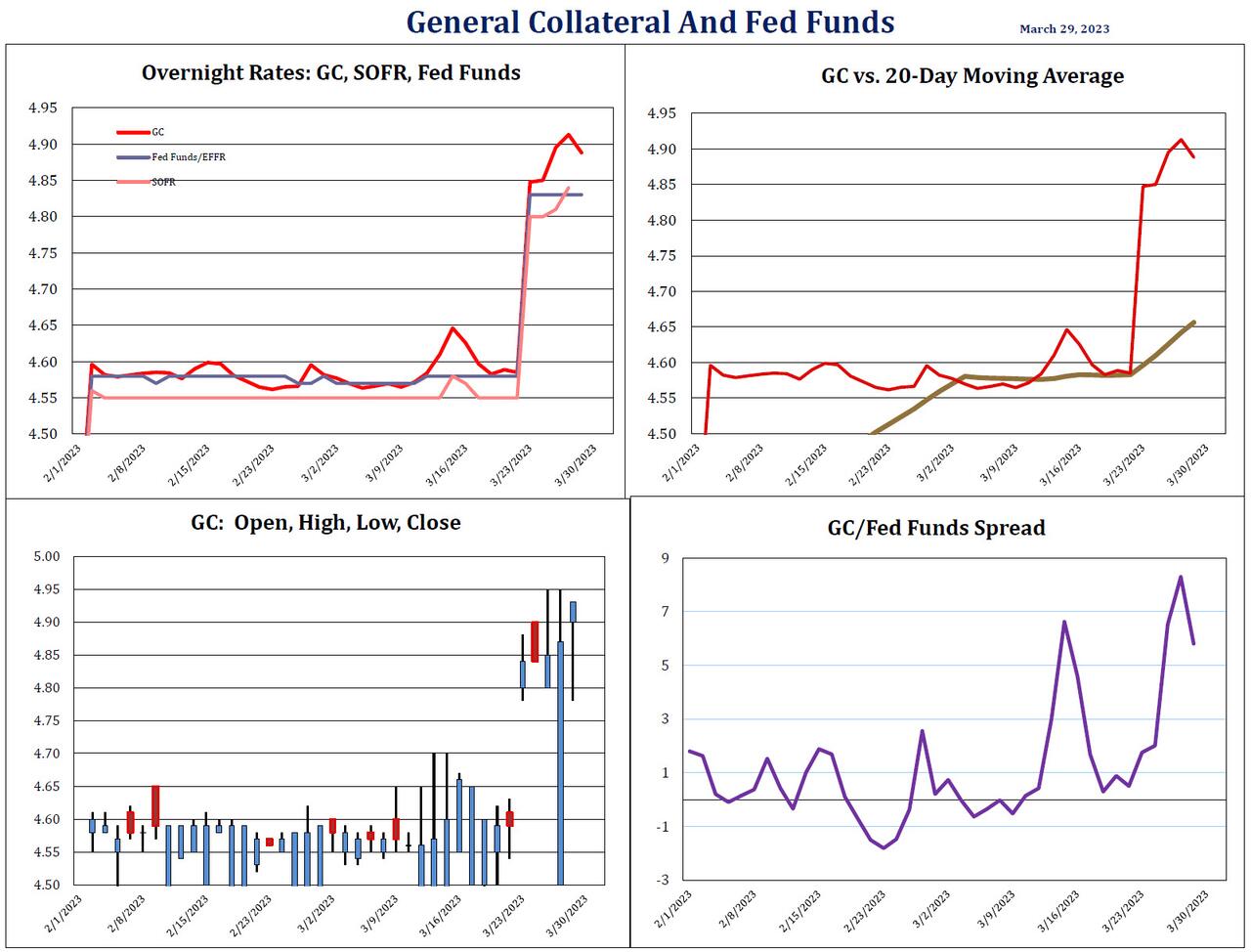
As of now, Repo GC (General Collateral) traded between 4.88% and 5.00% for Friday and the market is now at 4.98%/4.95%. GC is effectively trading near the top of the fed funds target range for the first time in three years. And that presents an interesting possibility!

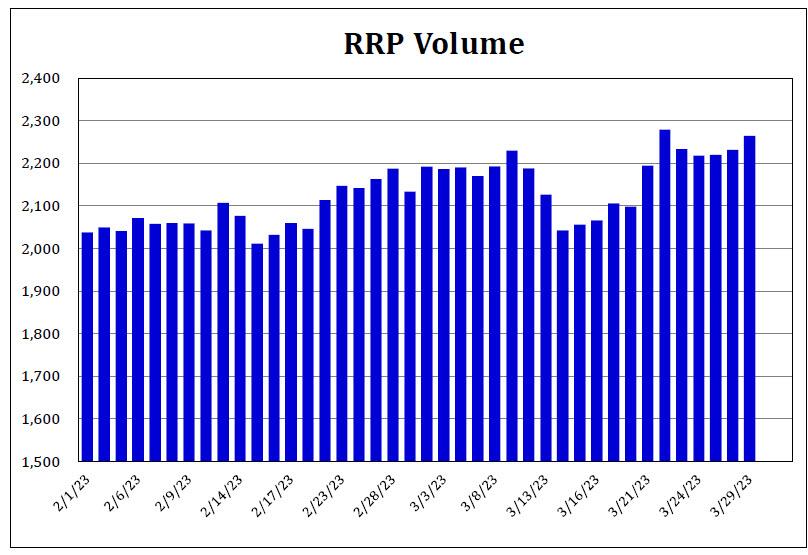
There is still $2.2 trillion in the Fed’s RRP earning just 4.80%. Those investors are giving up 5 to 7 basis points each day going to the Fed instead of the market. In fact, on Friday, GC rates could be above 5.00%, so at some point RRP investors will be giving up 15 to 20 basis points. There’s supposed to be a natural market mechanism that pulls cash out of the RRP and into the general market when Repo rates are higher than the RRP rate.

However, due to the market crisis and quarter-end, we expect RRP volume to actually increase on Friday.

At the other end of the target range, the Standing Repo Facility (SRF) has not yet been used by the market because Repo rates have been at the bottom of the fed funds target range since the program was initiated.

This crates the unique situation. If overnight rates are above 5.00%, Primary Dealers might go to the SRF and borrow cash from the Fed at 5.00% at the same time Money Market Funds are giving cash to the Fed at 4.80%. Both programs could be used on the same day!

Tyler Durden
Thu, 03/30/2023 – 17:00

via ZeroHedge News https://ift.tt/rl1nox0 Tyler Durden

Fed Balance Sheet Dips As Deposit-Run Eases While Bankers Blast Biden’s Premature Re-Regulation

Fed Balance Sheet Dips As Deposit-Run Eases While Bankers Blast Biden’s Premature Re-Regulation

President Biden is calling on regulators to tighten the rules for mid-sized banks, making the political point to ‘roll back Trump era rules’, ensuring everyone knows – despite the fact that it is not true – that this bank failure is trump’s fault (rather than the woke regulators’ dismal follow-ups to red-flags)… and remember The Fed didn’t stress-test for higher interest rates.

The changes include reinstating rules for banks with assets between $100 billion and $250 billion – the bucket in which SVB would have fallen – including liquidity requirements, enhanced stress testing and so-called “living wills” that show how banks that size could be wound down.

The White House also called for:

  • annual stress tests for banks in that range, instead of every two years
  • shortening the time to apply stress tests once banks reach $100 billion in assets
  • strengthening supervisory tools to ensure banks can withstand rising interest rates.

Additionally, as Bloomberg reports, The White House called on the Federal Deposit Insurance Corp. to replenish the fund without relying on community banks.

The Bank Policy Institute made it clear how they falt about this clearly political move to avoid accountability by the regulators:

It would be unfortunate if the response to bad management and delinquent supervision at SVB were additional regulation on all banks that would impose meaningful costs on the U.S. economy going forward.

The Fed has barely begun its promised review.

This has a strong feeling of ready, fire, aim.

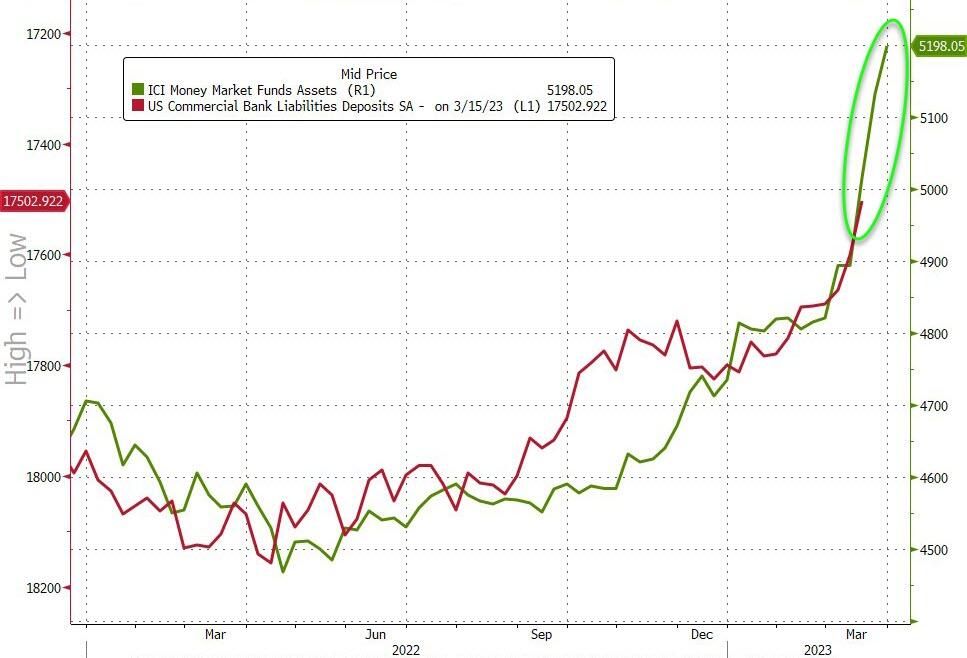
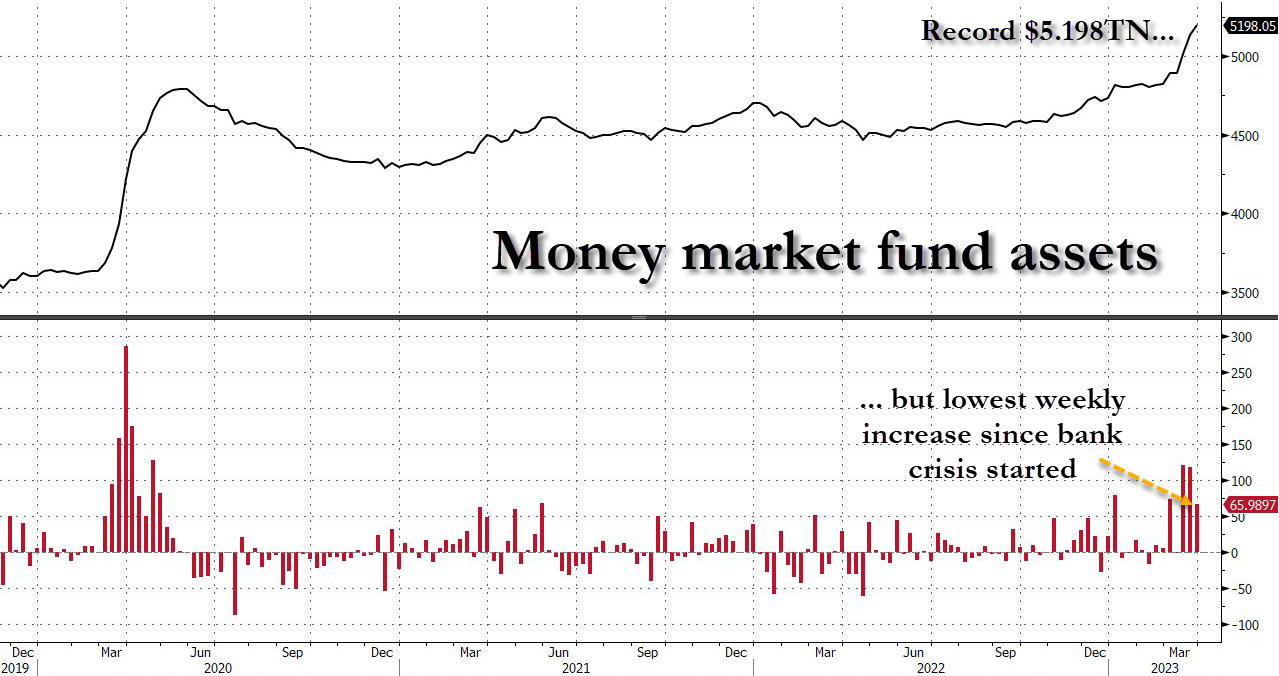
This call for tougher regulations comes as outflows from bank deposits into money markets (which hit a new fresh record highs of $5.2 trillion today – with 54.5bn of inflows last week) continue to accelerate (thanks to The Fed)

Source: Bloomberg

The last 3 weeks (including SVB’s exodus) has seen $304 billion of inflows, a record surge outside of the COVID lockdown crisis.  As TD Securities strategist Gennadiy Goldberg said regarding last week’s data:

“This is consistent with ongoing deposit flight from the banking system as depositors indirectly invest their cash into government securities via money funds and shun bank credit,” adding that,

“This answers the question of ‘where is the money going once it leaves the banking system?”

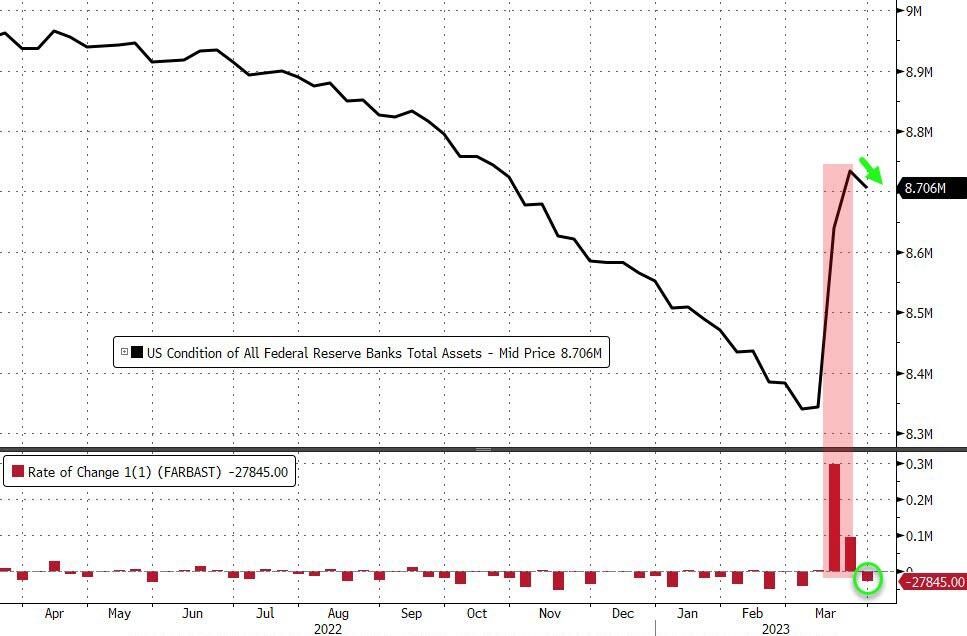
Meanwhile, the most anticipated financial update of the week, the  infamous H.4.1, or the Fed’s weekly balance sheet update, showed that the world’s most important balance sheet actually shrank modestly last week by $27.8 billion (helped by a drop in TSY and MBS of $10bn as part of the ongoing QT)…

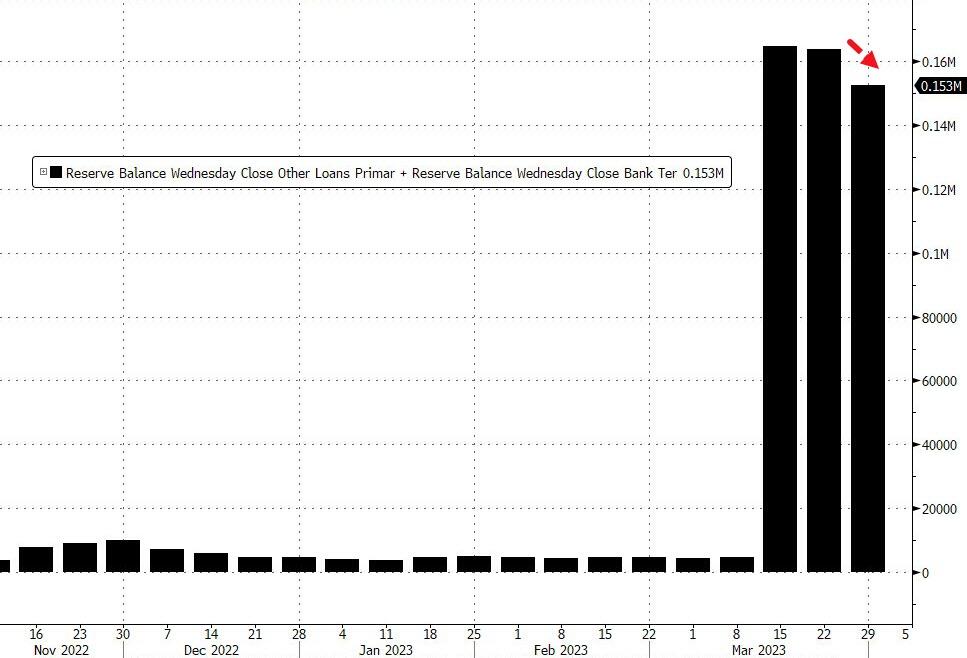
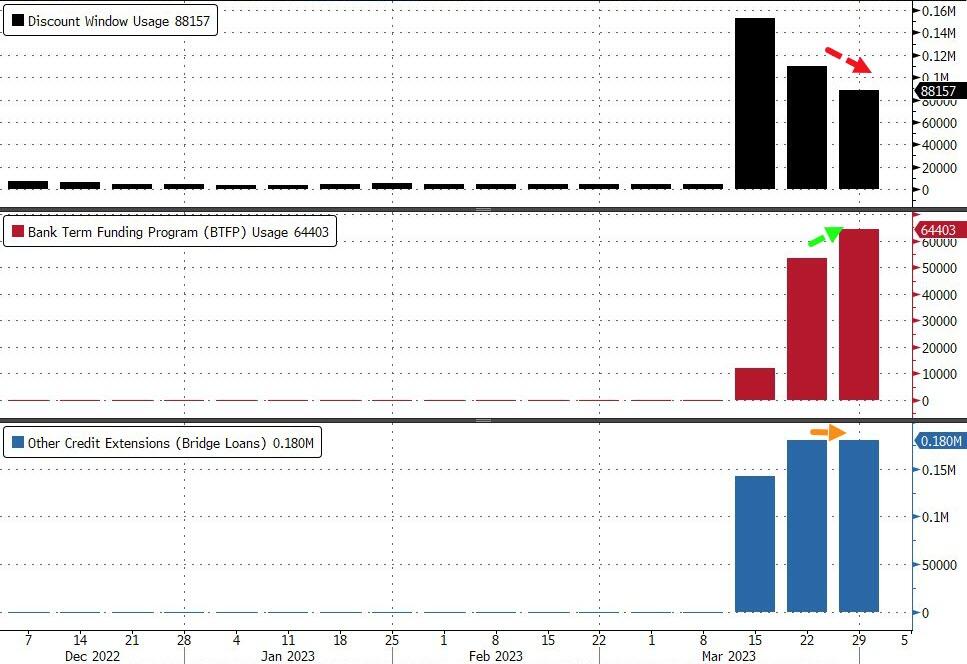
Looking at the actual reserve components that were provided by the Fed, we find that Fed backstopped facility borrowings fell modestly from $164 billion to $153 billion (still massively higher than the $4.5 billion pre-SVB)…

Source: Bloomberg

…but the composition shifted, as usage of the Discount Window dropped by $22 billion to $88 billion (upper pane below) which however was offset in part by a $10.7 billion increase in usage of the Fed’s brand new Bank Term Funding Program, or BTFP, to $64.4 billion (middle pane) from $53.7BN last week. Meanwhile, other credit extensions – consisting of Fed loans to bridge banks established by the FDIC to resolve SVB and Signature Bank  – were basically flat at $180.1BN (lower pane)…

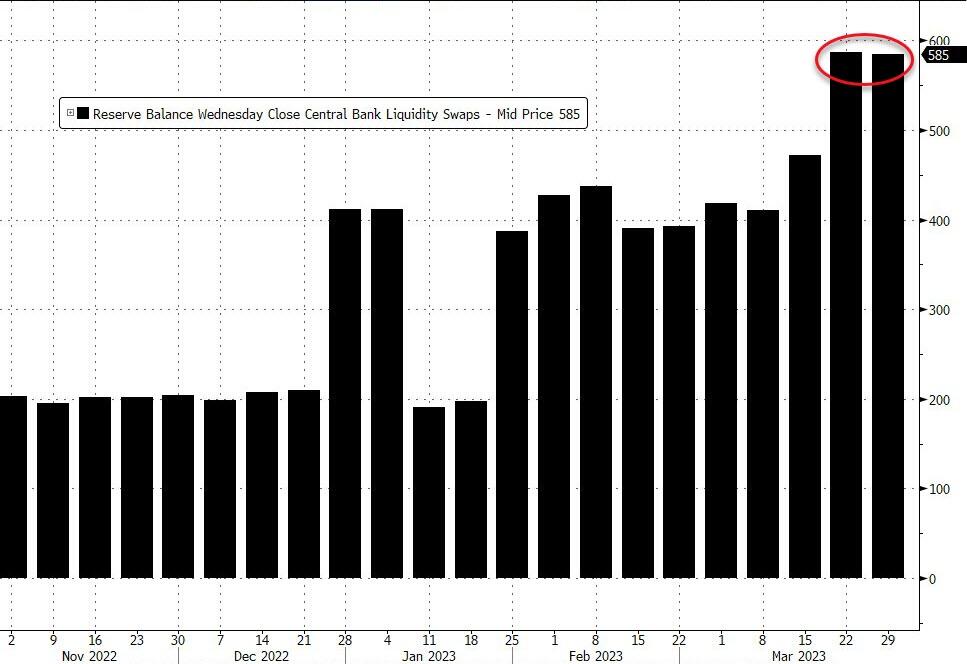
The Fed’s USD liquidity swaps only remained at a paltry $585 million in the past week ($100mm to the SNB and $487.5 to ECB)…

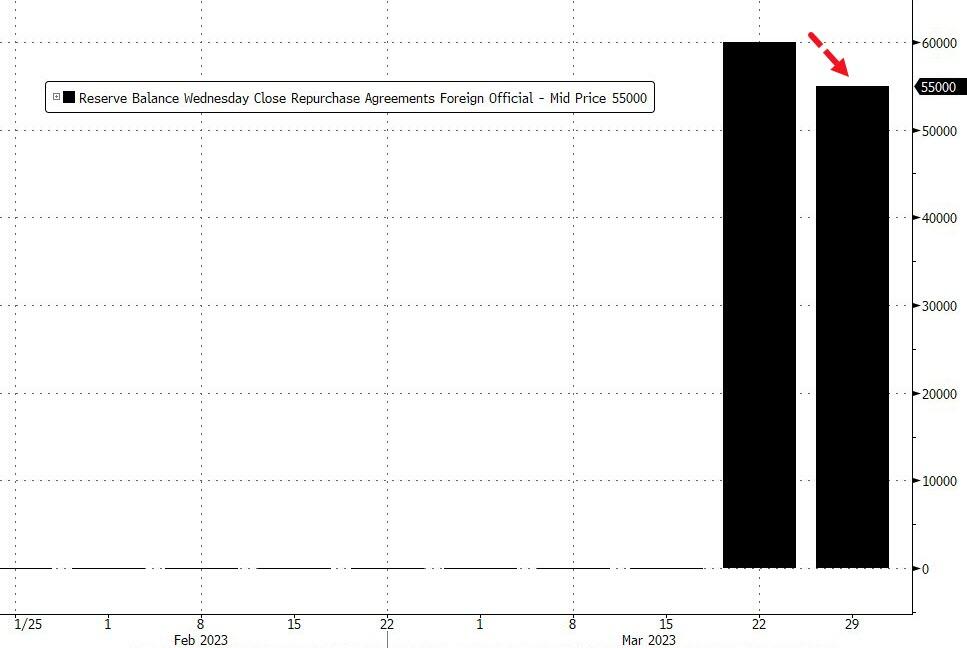
But just like last week, this is meaningless since at least one bank parked a whopping $55BN in the Fed’s foreign repo facility. The bad news: the dollar shortage continues; the good news: at least it’s less than last week’s record $60BN.

And finally, bear in mind what we detailed earlier, that according to Barclays, a second, slower-burning but even more powerful, bank run wave has now begun as “price sensitive” depositors are no longer dormant, but are not actively looking for the best place to park their money. Which is also why contrary to the narrative that the banking crisis is now over, because the S&P is back above pre-SVB levels, banks continue to plumb lows.

Still, there was some some good news: While we noted above that money market funds rose to a new record high, the weekly increase was down almost 50% from $117.4BN last week to “only” $66BN and the slowest since the bank crisis started.

Bottom line: for now at least, the deposit run is slowing.

Tyler Durden
Thu, 03/30/2023 – 16:46

via ZeroHedge News https://ift.tt/UWLypVY Tyler Durden

While We’re Obsessing About The Economy & The Fed, Society Is Unraveling

While We’re Obsessing About The Economy & The Fed, Society Is Unraveling

Authored by Charles Hugh Smith via OfTwoMinds blog,

The market and the government will continue to promote and support a neofeudal status quo until they are forced by society to restore the common good and opportunity.

Of the three primary dynamics of human endeavor–the market, government and society–we focus almost exclusively on the first two. Society is rarely considered as a force of its own. It is implicitly viewed as reactive to the market economy and government, the churning wake left as the market and government chart the course.

In other words, society is secondary to the economy and governance, the venue of fashions, trends, entertainment, culture wars, etc., fodder for media and social media, a reflection of what’s happening in the market and government.

As I explain in my book Global Crisis, National Renewal, this is a misunderstanding of society’s role as a force that changes the economy and governance in profound ways.

We give social transformation short shrift because it’s not easy to study or understand. Social change is amorphous and doesn’t lend itself to quantification like the market or the legal structures of government policy. We end up relying on snapshots such as opinion polls that are inherently limited in scope and accuracy. Respondents tend to give answers they they believe are expected or reflect their views of the moment. Other data is collected from groups that are self-selecting.

Despite these limitations, it’s clear that American society is unraveling and undergoing profound changes that will eventually upend markets and governance. We will come to realize society is transforming markets and governance, not the other way around.

Charts of the stock market and economy in the 1960s do not reflect the social changes in values that made the 1960s so tumultuous and consequential. Three social movements–civil rights, the environment and women’s rights–all changed the economy and governance in the 1970s, unleashing forces that continue to shape our economy and government to this day.

The market and government didn’t lead these changes, social forces changed the market and government. The market and government were perfectly happy to maintain the status quo of rampant industrial pollution and systemic restrictions of civil rights. Society forced economic and political change: the government was forced to enact environmental regulations limiting pollution and industrial waste, and enact legislation removing barriers that enforced an oppressive, unjust, two-tier society and economy.

In the 1970s, these environmental, women’s rights and civil rights advances forced on the market and government transformed the economy for the better. Women entered the workforce en masse and women and minorities gained access to institutions that that had previously excluded them. Environmental and efficiency regulations transformed the American economy and landscape from an industrial dumping ground to a much cleaner, more sustainable, more efficient and productive industrial base.

I discussed this recently in The Forgotten History of the 1970s and The 1970s: From Rotting Carcasses Floating in the River to Kayak Races.

Much work remains to be done, of course, but much has been accomplished by the citizenry concluding the status quo is no longer acceptable.

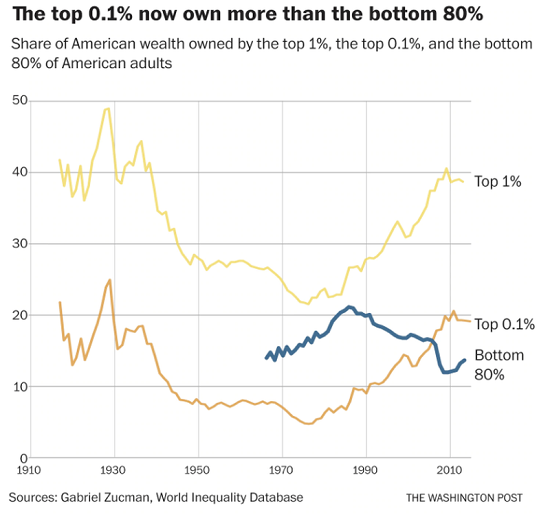
In my analysis, the nation’s social fabric is unraveling due to the breakdown of civic virtue, social cohesion and the social contract. The dominance of finance (hyper-financialization) and corporate self-interest (hyper-globalization) has fatally undermined civic virtue, social cohesion and the social contract. Rather than the market serving society, society now serves the market and finance in a painfully obvious two-tiered neofeudal structure in which the few garner the vast majority of the wealth and political power.

Locking in vast private wealth is now the Prime Directive of the elite, an elite which in previous generations understood that every elite ultimately serves at the behest of those they rule (i.e. consent of the governed), and so the elite must apply some of their wealth and power to pursue the common good rather than their own self-interest.

Soaring wealth-income inequality leads to vast concentration of political power. “The people” rule in name only. Any attempt to end the two-tiered neofeudal structure of our economy at the ballot box is futile.

As for the social contract of equal opportunity for all, in the real world, the rungs in the ladder of social mobility have been broken. Those who bought homes and assets a generation or two ago have acquired wealth in a credit-asset bubble economy, while those who borrowed a fortune for a college degree find the value is uncertain or marginal in all but the top-tier of credentials–and connections still matter.

The net result is people are dropping out, opting out or burning out. This is the result of what I call social defeat: the odds are now stacked against all but the super-achievers and the well-connected. Given the instability and inequality of the financialized, globalized “market economy” (heh), a family and home are out of reach financially for many, so they give up. Others see their hard-won gains wiped out by medical expenses (the leading cause of household bankruptcies) or a collapse in the speculative bubble-du-jour. We see the same trends in stagnant economies elsewhere (Japan, for instance): the decline of marriage, family and having children and the abandonment of social / community ties.

As this Wall Street Journal poll reveals, the traditional forces of social cohesion are collapsing before our eyes. As Peter Turchin has explained, social cycles of integration and disintegration occur every 50 years or so. In integrative phases, people find reasons to cooperate. In disintegrative phases, people find reasons to disagree and fragment into divisive, polarized camps. Clearly, we’re well into a disintegrative phase, and what could bring us together is not even visible.

America Pulls Back From Values That Once Defined It, WSJ-NORC Poll Finds (WSJ.com)

The rising emphasis on money reflects the insecurity and instability that characterize the economy. If history teaches us anything, it’s that piling up private stashes of wealth can’t buy social cohesion, restore the social contract or rebuild social ties. Speculative gain is the ultimate false god. The belief that if we all barricade our own private wealth, everything will be fine is the acme of social dissolution.

We have a great opportunity for national renewal, but there is precious little in the market or governance that offers common ground. The common ground must be found in social changes in what we value and what is no longer acceptable. The market and the government will continue to promote and support a neofeudal status quo until they are forced by society to restore the common good and opportunity.

*  *  *

My new book is now available at a 10% discount ($8.95 ebook, $18 print): Self-Reliance in the 21st CenturyRead the first chapter for free (PDF)

Become a $1/month patron of my work via patreon.com.

Tyler Durden
Thu, 03/30/2023 – 16:20

via ZeroHedge News https://ift.tt/caPt2Dn Tyler Durden

Don Blankenship Loses Libel Lawsuit Against Donald Trump, Jr., Who Called Blankenship a “Felon”

From Blankenship v. Trump, decided today by Judge John Copenhaver (S.D. W. Va.):

Following an explosion at Upper Big Branch, a West Virginia coal mine, on April 5, 2010, which resulted in the death of twenty-nine miners, the United States government initiated an investigation into the cause of the explosion. While the plaintiff was not charged with the death of the miners or with causing the explosion, the government charged the plaintiff with three felonies, including conspiracy to defraud the federal Mine Safety and Health Administration, and one misdemeanor for conspiracy to violate federal mine safety laws. On December 3, 2015, a federal jury found the plaintiff not guilty of the felony charges but convicted him of the misdemeanor offense. The plaintiff was sentenced to one year in prison, which the plaintiff served and from which he was released in the spring of 2017.

In January 2018, the plaintiff announced his campaign to run as a Republican for a United States Senate seat in West Virginia…. The plaintiff alleges that political and news media figures conspired to defeat his candidacy by referring to the plaintiff as a “felon” or a “convicted felon,” despite the fact that the plaintiff was cleared of the felony charges and was only convicted of the misdemeanor offense. One of these figures was Trump, Jr. On May 3, 2018, after allegedly attending a meeting with members of the National Republican Senatorial Committee (“NRSC”), Trump, Jr. published a series of tweets about the plaintiff from his Twitter handle @DonaldTrumpJr.

The first tweet on May 3, 2018, states:

I hate to lose. So I’m gonna go out on a limb here and ask the people of West Virginia to make a wise decision and reject Blankenship! No more fumbles like Alabama. We need to win in November. #wv #wvpol

In response, the plaintiff issued a press release that afternoon in which he promoted his candidacy. Later on May 3, 2018, Trump, Jr. posted a second tweet (“quote tweet”), in response to a tweet from CNN reporter Dan Merica’s Twitter handle @merica. Merica’s tweet reads:

Trump’s son urges West Virginia Republicans to reject Blankenship, who responds by labeling @DonaldJTrumpJr part of the “establishment.”

Mr. Merica’s tweet includes a link to his CNN news article about Trump, Jr.’s earlier tweet urging West Virginia Republicans to “reject Blankenship.” The first part of the article reads:

President Donald Trump’s son Donald Trump Jr. urged West Virginia Republicans on Thursday to reject Don Blankenship in next week’s primary, comparing the coal baron to failed Alabama Senate candidate Roy Moore.

“I hate to lose. So I’m gonna go out on a limb here and ask the people of West Virginia to make a wise decision and reject Blankenship! No more fumbles like Alabama,” he wrote on Twitter. “We need to win in November.”

The comment from the President’s son is the clearest signal yet that national Republicans are worried that Blankenship’s upstart campaign could upend plans to run either Republican Rep. Evan Jenkins or Attorney General Patrick Morrisey against vulnerable Democratic Sen. Joe Manchin in November. National Republicans were worried when Blankenship jumped into the race, given that the former CEO of Massey Energy had just recently finished serving a yearlong sentence following a misdemeanor conviction for his involvement in the deadliest US mine explosion in four decades …..

Trump, Jr.’s quote tweet includes his own comments, the tweet from Dan Merica, and the link to the CNN news article. Trump, Jr.’s quote tweet comment includes:

Ha, now I’m establishment? No, I’m realistic & I know the first thing Manchin will do is run ads featuring the families of those 29 miners killed due to actions that sent you to prison. Can’t win the general… you should know that & if others in the GOP won’t say it, I will.

Another Twitter user replied to Trump, Jr.’s tweet: “Don’t think Manchin will do that. His ads are usually ab[ou]t him.” Trump, Jr. replied to this tweet on May 3, 2018, with a third tweet (“reply tweet”), which reads:

He’s probably never run against a felon.

The plaintiff argues that Trump, Jr.’s reply tweet refers to him as a felon and is materially false because he has never been convicted of a felony. The plaintiff also alleges that Trump, Jr.’s reply tweet was made in conjunction with reference to the mine explosion from his quote tweet, which had the additional effect of falsely attributing to the plaintiff responsibility for murder….

[P]laintiff asserts Trump, Jr. acted with actual malice, because his reply tweet, in which he called the plaintiff a felon, occurred after he had quote tweeted Mr. Merica’s article which stated the plaintiff was convicted of only a misdemeanor. The plaintiff continues by claiming “[a] jury would inevitably draw multiple legitimate inferences in Plaintiff’s favor from this affirmative evidence.” First, the plaintiff claims a jury would “logically deduce” that Trump Jr. read the article he quote tweeted before posting his reply tweet. Next, he asserts a jury “would obviously conclude” that Trump, Jr. had not forgotten that the plaintiff was convicted of a misdemeanor when he posted his reply tweet. Finally, the plaintiff alleges “a jury would likely extrapolate” that Trump, Jr. knew the exact number of coal miners who died in the mine disaster (as referenced in his quote tweet), only by having read an article hyperlinked (“hyperlinked article”) in Mr. Merica’s article.

The court finds the evidence presented by the plaintiff is wholly insufficient to show Trump, Jr. knew what he tweeted was false or that he had a high degree of awareness of its probable falsity. [Note that public official/public figure plaintiffs have to show this knowledge or recklessness by clear and convincing evidence. -EV] First, Mr. Merica’s article makes no reference to the number of coal miners who died in the mine disaster. Instead, the plaintiff’s claim is that Trump, Jr. must have clicked on a hyperlink that plaintiff says was embedded within Mr. Merica’s article, which then took Trump, Jr. to another CNN article that simply reported a proposed investigation of the death of the twenty-nine miners. There is no record evidence before this court that shows that the “hyperlinked article” was in fact embedded as a hyperlink within Mr. Merica’s article.

Next, there is no evidence before the court which shows Trump, Jr. read Mr. Merica’s article or the supposed hyperlinked article, before he posted his reply tweet. This is despite the plaintiff having had the opportunity to serve written discovery on Trump, Jr., and having taken his deposition. Instead, the plaintiff makes tenuous inferences, that simply do not provide clear and convincing evidence that Trump, Jr. acted with actual malice. While the court is required to view all reasonable inferences in favor of the nonmovant, the Fourth Circuit Court of Appeals has long reasoned “permissible inferences must still be within the range of probability.” The inferences the plaintiff asks this court to accept are speculative and in no way go to show the subjective intent of Trump, Jr.

Indeed, the record evidence in this matter fails to show that Trump, Jr. had knowledge of the falsity of his tweets or that he had a subjective belief that there was a high probability his statements were false. During his deposition on December 6, 2021, Trump, Jr. testified that, at the time of his May 3, 2018, tweets, he was unaware that the plaintiff was convicted of only a misdemeanor. He testified to the following concerning how he concluded the plaintiff was a felon:

Q. Where did you have—what other sources did you see that called Mr. Blankenship a felon?

A. Well, I saw Senators talking about it on television. I saw TV pundits talking about it. I read newspaper articles about it. And so that’s how I came to that conclusion.

Q. I’m sorry. So you said you had other sources. What other sources are you talking about?

A. I just remember numerous. I don’t know which specifically at this point. But it was pretty widespread all over the media that that was the case.

Furthermore, Trump, Jr. remembered “most” of “[t]he big political” broadcast networks had referred to the plaintiff as a felon, including Fox, MSNBC, and CNN, and he had seen the plaintiff be called a felon “pretty much everywhere.” Trump, Jr.’s testimony that there was widespread usage of the term “felon” to describe the plaintiff is supported by the allegations found in the plaintiff’s first amended complaint (the operative complaint) filed in his case against Fox News and 107 other defendants…. [T]he plaintiff in his first amended complaint against Fox News and 107 other defendants claimed in paragraphs 149 to 171 that on at least eleven occasions prior to May 3, 2018, widespread media publication, including multiple publications on each Fox News, CNN, MSNBC, and other media outlets, occurred which referred to the plaintiff as a “felon,” “ex-felon,” or that he was imprisoned for manslaughter. That practice, according to plaintiff in that same complaint, continued unabated down to election day on May 8, 2018, and beyond. In view of this phenomenon, it is not surprising to learn that Trump, Jr. stated that at the time he called the plaintiff a felon—just five days before the primary election—he believed he was accurate.

The plaintiff has failed to rebut any of this evidence, and has provided little evidence, aside from the tenuous inferences the plaintiff asks this court to draw from Trump, Jr.’s quote tweet and Mr. Merica’s article….

Because the plaintiff has failed to produce clear and convincing evidence showing Trump, Jr. acted with actual malice, the court finds Trump, Jr. is entitled to summary judgment on the plaintiff’s defamation claim.

In 2021, the same judge denied Trump, Jr.’s motion to dismiss, concluding that erroneously calling a misdemeanant a felon was potentially defamatory, and concluding that Blankenship had sufficiently alleged that Trump, Jr. knew that the felony allegation was false (or was reckless about it). But here, after discovery, the judge granted Trump, Jr.’s motion for summary judgment, concluding that Blankenship hadn’t supplied sufficient evidence of such knowledge or recklessness.
The post Don Blankenship Loses Libel Lawsuit Against Donald Trump, Jr., Who Called Blankenship a "Felon" appeared first on Reason.com.

from Latest https://ift.tt/cgdJ9uE
via IFTTT

DeSantis Signs Bill Banning Rent Control, Preempting Local Zoning Restrictions


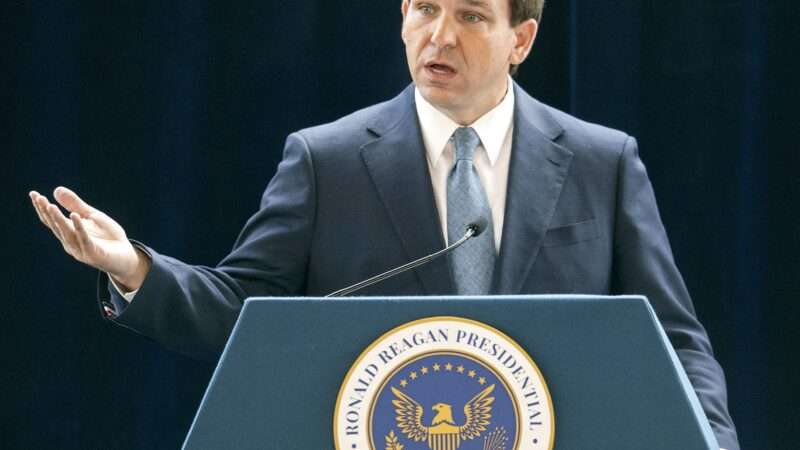
Ron DeSantis speaks behind a podium against a dark background

Florida Gov. Ron DeSantis, a Republican, has signed into law a new housing package that bans local governments from adopting rent control and cracks down on their ability to shoot down housing projects that contain affordable units.

The main provisions of the Live Local Act include funding increases and tax credits worth $711 million for a variety of the state’s affordable housing programs. This includes sales tax relief on purchases of building materials; downpayment assistance for cops, teachers, military personnel, and other “hometown heroes” buying their first home; and more funding for affordable housing construction.

“This legislation provides record support for Florida’s workforce and their families to help them live where they work, while also providing historic support for our military communities and the families living near military bases,” said DeSantis.

In addition to new funding, the new law also includes some deregulatory policies.

It would require local governments to approve multifamily developments on commercial and mixed-use zoned properties without forcing builders to go through discretionary rezoning amendments.

In addition to these expedited approvals, these projects would also get relief from local height and density restrictions. They can be either three stories high or as tall as the tallest allowable commercial or residential development within one mile of the project site.

This regulatory relief would be available to projects where 40 percent of the units are offered at below-market rates to people making 120 percent of the area median income (AMI). Those affordable units could be offered at market rates after 30 years.

These kinds of inclusionary zoning policies typically act as a tax on new development, raising prices for market-rate units and reducing the construction of affected projects.

It’s tough to say how strict Florida’s policy will be.

Requiring that 40 percent of units be below-market-rate units is quite high. But a 120 percent AMI income threshold allows for much higher rents than most inclusionary zoning policies, which typically require housing be affordable for those making 80 percent or less of the AMI.

Also, developers would have to opt into these affordability requirements. A market-rate developer could still take their chances getting a property rezoned under the existing system. The worst these affordability requirements would do is make the expedited approvals and zoning relief ineffective.

That makes it less burdensome than “mandatory” inclusionary zoning policies that impose affordability requirements regardless of any benefits a developer has opted to receive.

Builders have praised the zoning reform measures.

“This legislation will increase and improve availability of affordable housing,” said Brian Bullock, president of Tampa Bay Builders Association, in an email. “This new law changes zoning laws and allows the home building and development communities to assist in growing desperately needed affordable housing stock.”

The law also fully prohibits local governments from adopting rent control.

Florida law already makes it really difficult for localities to regulate rents. They can only do so upon a finding that there’s a “housing emergency which is so grave as to constitute a serious menace to the general public.”  That’s a pretty high standard. The emergency caps can’t last longer than a year. They also have to be passed by both the local county or city commission and voters via referendum.

Nevertheless, both officials and voters in Orange County, Florida, approved a rent control initiative in 2022. Litigation from trade associations representing property owners stopped it from going into effect. Now, the option is completely off the table.

DeSantis’ signing of the bill is notable given his administration’s past opposition to local zoning reforms.

The state’s Department of Economic Opportunity (DEO) sued to stop a 2022 Gainesville ordinance allowing four-unit homes on residential land from going into effect. The reform itself was locally unpopular and the first act of a new Gainesville City Commission in January 2023 was to repeal the previous commission’s upzoning.

The DEO lawsuit argued that Gainesville was being overly reliant on the “invisible hand” of the market to provide affordable housing, something only inclusionary zoning can do.

One provision of the bill DeSantis signed does make it more difficult to build affordable housing. The new law partially undoes a 2019 reform that allowed localities to expedite approvals of projects including affordable units on residential, commercial, or industrial land, even if the project isn’t consistent with a local comprehensive plan or other state or local laws. Now, those expedited approvals are only available to projects on commercial or industrial land.

The post DeSantis Signs Bill Banning Rent Control, Preempting Local Zoning Restrictions appeared first on Reason.com.

from Latest https://ift.tt/olL4On7
via IFTTT

My New Article “Abortion and Foot Voting in Post-Dobbs America: Prospects for Change”


Abortion Protests
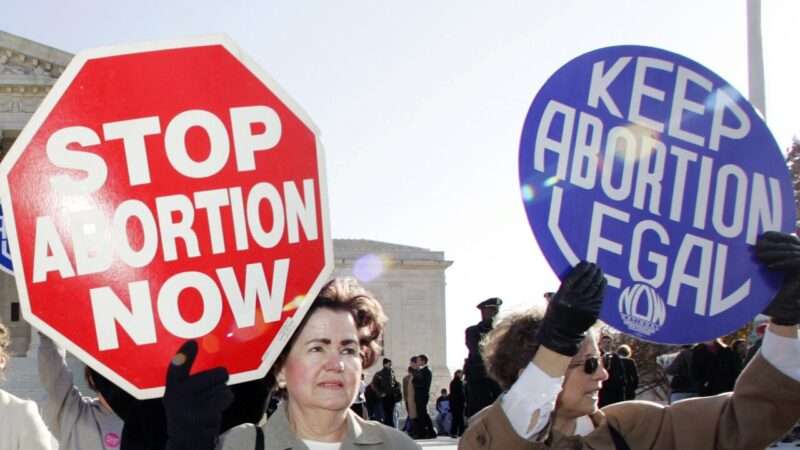
In this Nov. 30, 2005 file photo, an anti-abortion supporter stands next to a pro-choice demonstrator outside the U.S. Supreme Court in Washington. (AP Photo/Manuel Balce Ceneta)


Australian Outlook, (a publication of the Australian Institute for International Affairs), has published my article “Abortion and Foot Voting in Post-Dobbs America: Prospects for Change.” This piece is the second in a two-part series. The first part, published last week, explained why post-Dobbs interstate variations in abortion policy may be unlikely to generate much in the way of foot voting by people seeking to avoid abortion restrictions—at least not the kind of foot voting that involves actually moving to another state. This one considers potential developments that might change that. Here’s an excerpt:

As described in Part I of my series on abortion and foot voting in the wake of Dobbs, the broader response to the Supreme Court’s 2022 decision holding there is no constitutional right to abortion is likely to lead to only modest abortion-driven foot voting. The combination of contraception, mail-order abortion pills, and traveling out of state to get an abortion provide relatively low-cost substitutes for in-state abortion access for most women. In addition, exclusionary zoning, high taxes, and job-killing regulations reduce the attractiveness of many pro-choice “blue” states to potential foot voters.

But a number of factors might change that. Most obviously, policy changes could potentially reduce or eliminate low-cost alternatives to in-state abortion access. For their part, blue states have been taking steps to make themselves more attractive to would-be movers….

The most obvious shift that could change foot voter calculations is that conservative states might try to ban contraception. But contraception is overwhelmingly popular in the United States and doesn’t generate the same kinds of deep-seated, left-right divisions as abortion…

A conservative group has filed a lawsuit claiming that the federal Food and Drug Administration (FDA) illegally approved Mifepristone, a drug used in most medication abortions. The plaintiffs’ legal arguments are dubious. But they could potentially get a favorable ruling, at least at the initial trial court stage. If the plaintiffs ultimately prevail, it would make mail-order abortion much more difficult…

As with mail-order pills, red states could also try to ban interstate travel to get an abortion. The Missouri state legislature has already considered doing just that, and Idaho is considering a more limited ban, focusing on travel by minors. But such restrictions probably would not stand up in court, as there are multiple strong constitutional arguments against them. In a concurring opinion in the Dobbs case, Justice Brett Kavanaugh – a key member of the conservative majority on the Supreme Court – emphasised his view that such restrictions would indeed be unconstitutional….

I also consider the possibility that the federal government might enact nationwide legislation on abortion, either of the pro-life or pro-choice variety.

The post My New Article "Abortion and Foot Voting in Post-Dobbs America: Prospects for Change" appeared first on Reason.com.

from Latest https://ift.tt/tJU79i8
via IFTTT