Gold Gains As Banks Buckle Again, Dollar Dumped

Gold Gains As Banks Buckle Again, Dollar Dumped

For the third day in a row (ahead of tomorrow’s month- and quarter-end and the big PCE print), bonds ‘rested’ while stocks went wild (this time up… and then back down). Gold rallied as the dollar and bitcoin sold off.

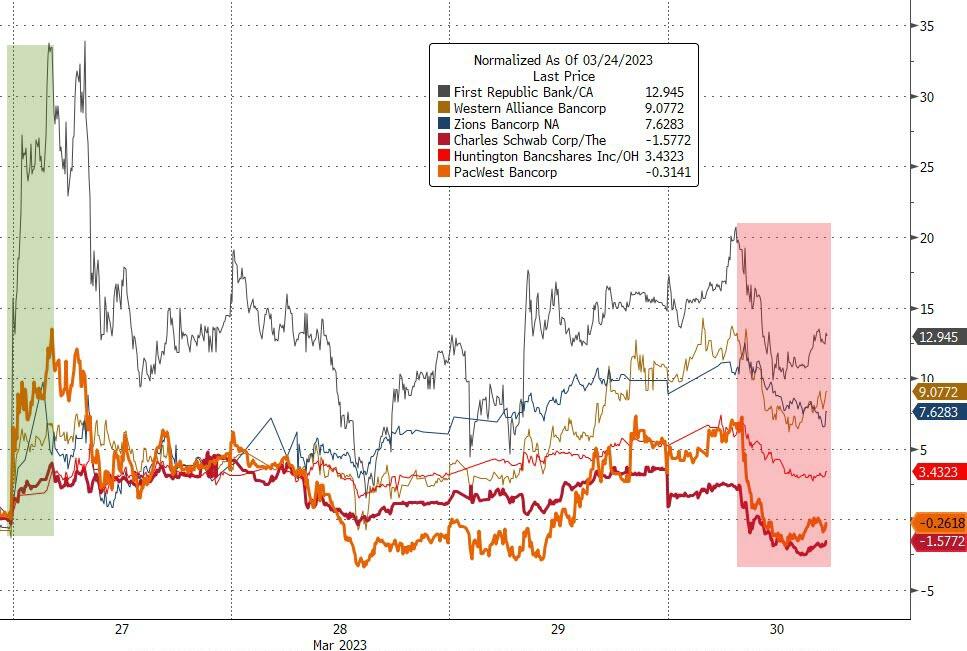
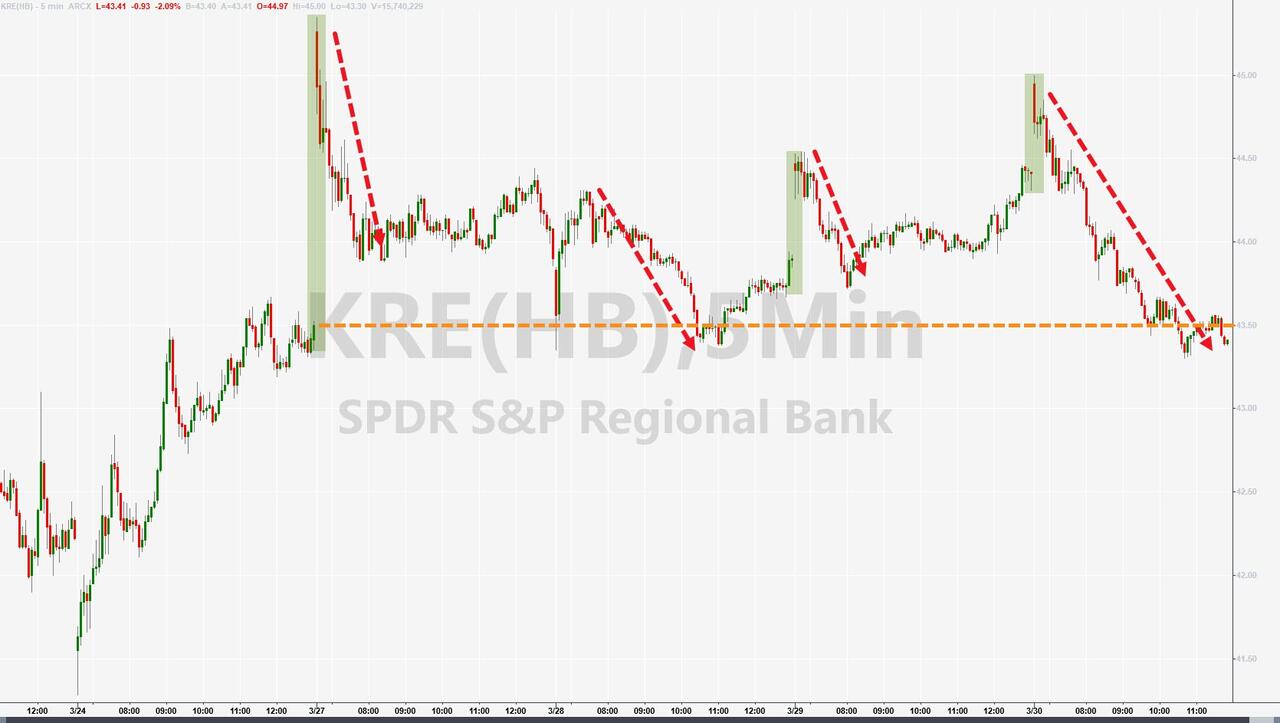
Regional bank stocks slipped back towards the post-SVB lows again, back into the red for the week (not helped by Biden pushing for tighter regs for this cohort) ahead of tonight’s Fed bailout data…

FRC was weak today and SCHW fell on an analyst downgrade joining PACW in the red for the week…

Source: Bloomberg

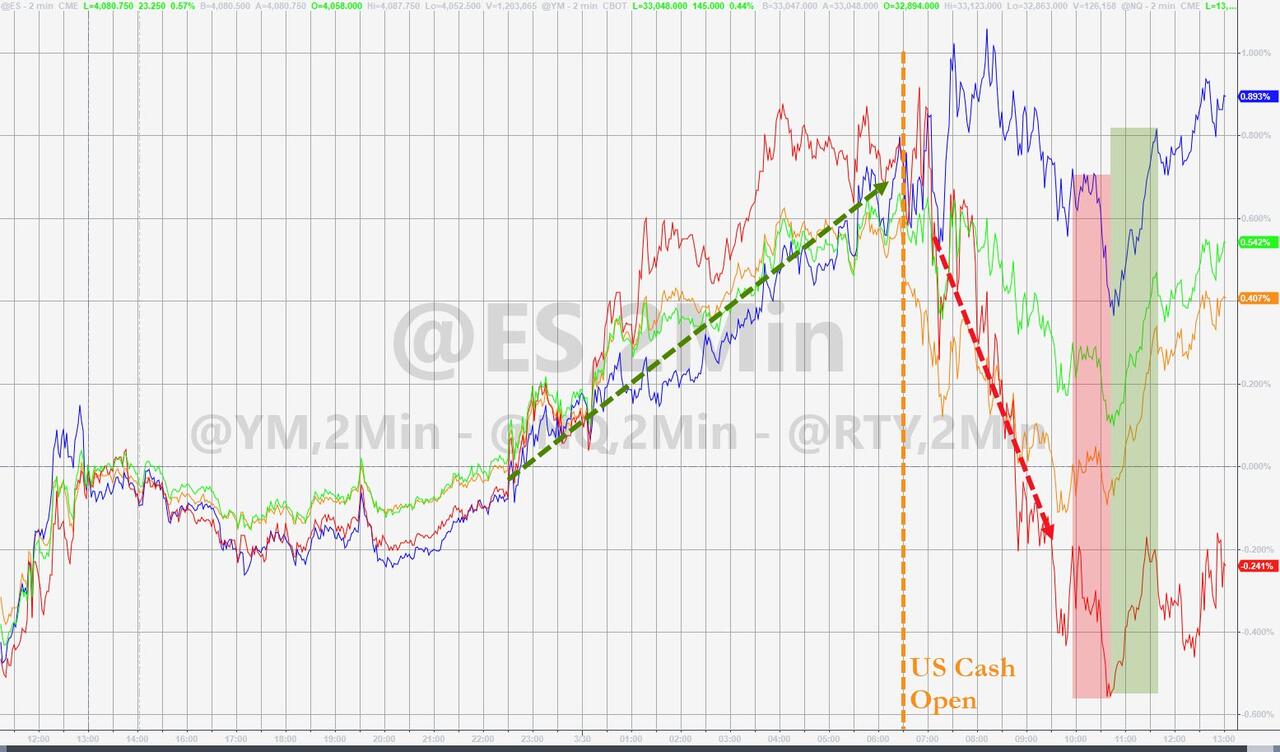
Minnesota Fed’s Kashkari opened his mouth around 1330ET and hawkish tones gushed forth, pushing stocks lower.

Richmond Fed’s Barkin was more dovish at around 1400ET, hinting at credit tightening (which may reduce needs for hikes) and that policy has lags (hinting at a pause).

Nasdaq outperformed… again… with Small Caps lagging (actually closing in the red on the day). The Dow and S&P rebounded (after Barkin) back into the green on the day…

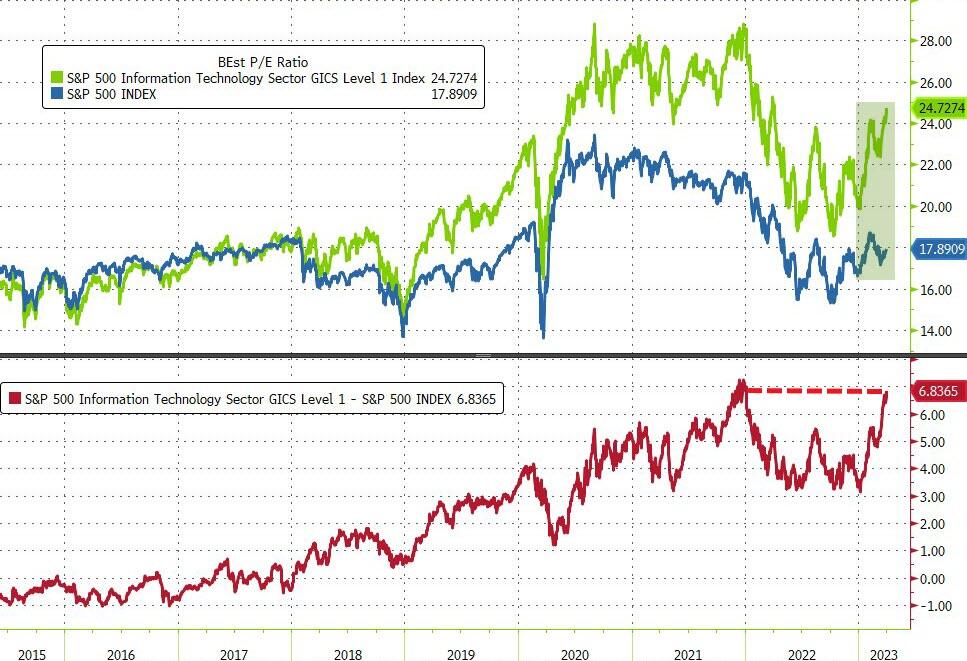
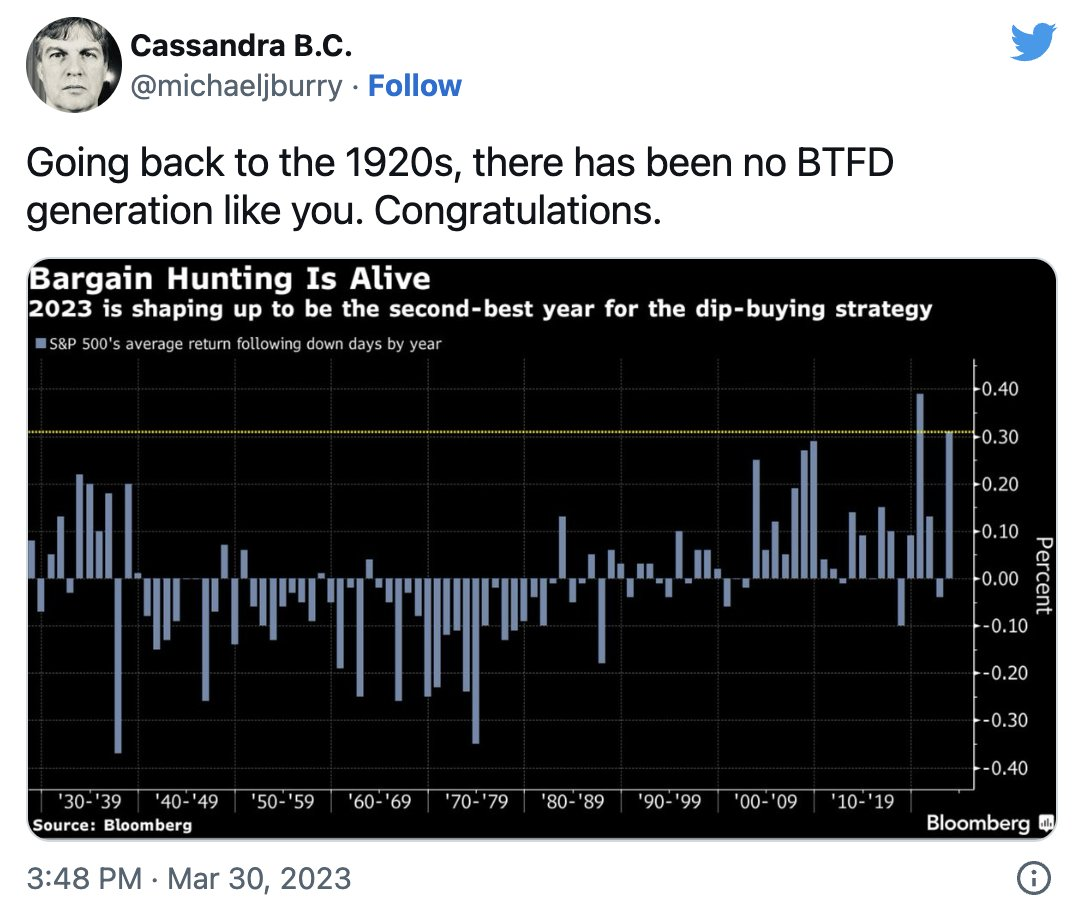
And as the quarter-end nears, it’s clear what’s driving the exuberance in long-duration stocks…

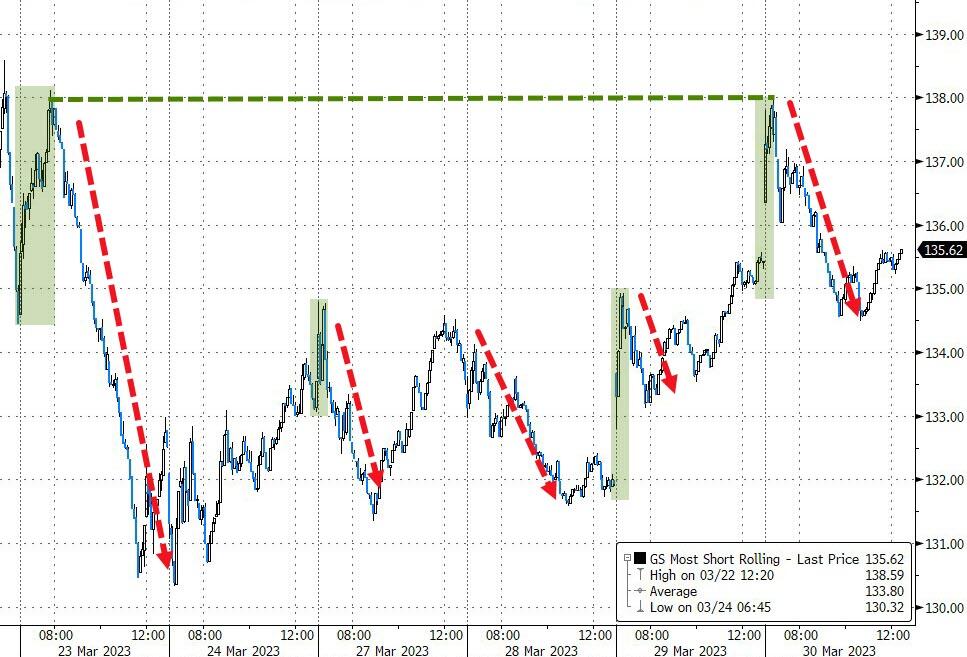
‘Most Shorted’ Stocks squeezed higher at the open once again (to key resistance) but were sold back to unch from there…

Source: Bloomberg

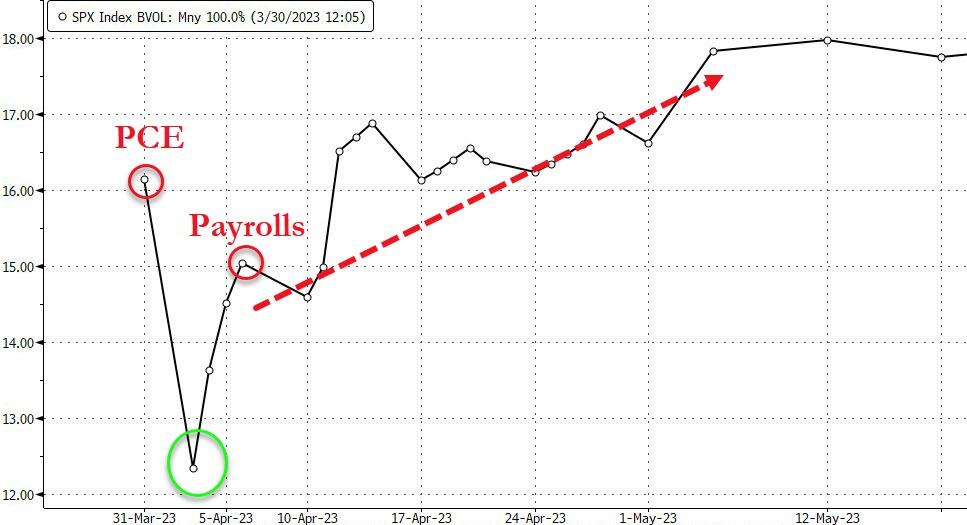
Options traders have priced in a lot of (relative) uncertainty for tomorrow (PCE), but then a jolt lower before rising again into next week’s payrolls…

Source: Bloomberg

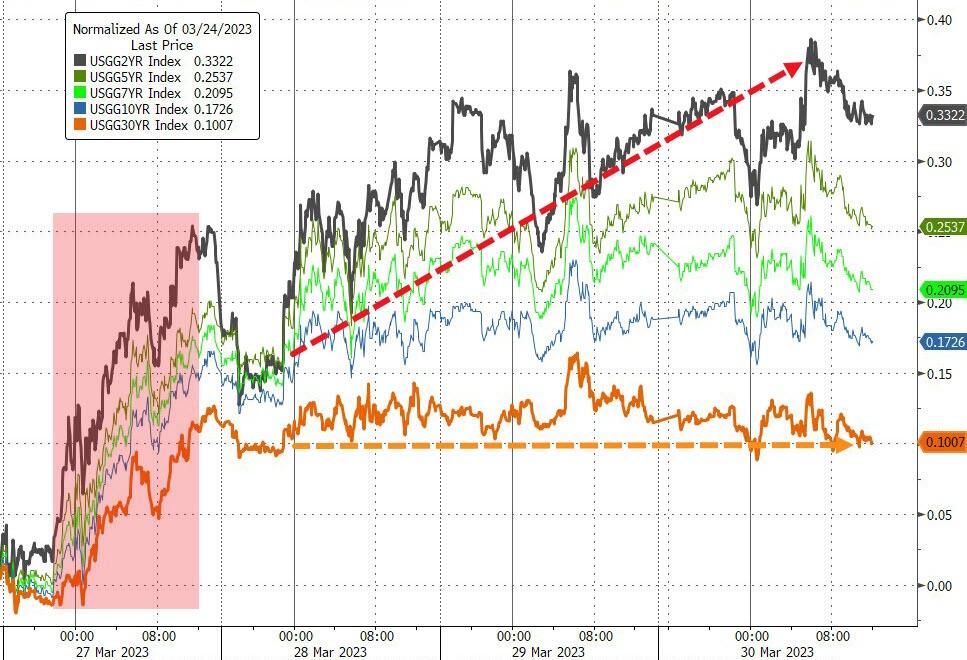
Treasury yields were modestly lower on the day with the belly outperforming (5Y -3bps) but all yields are still up notably on the week…

Source: Bloomberg

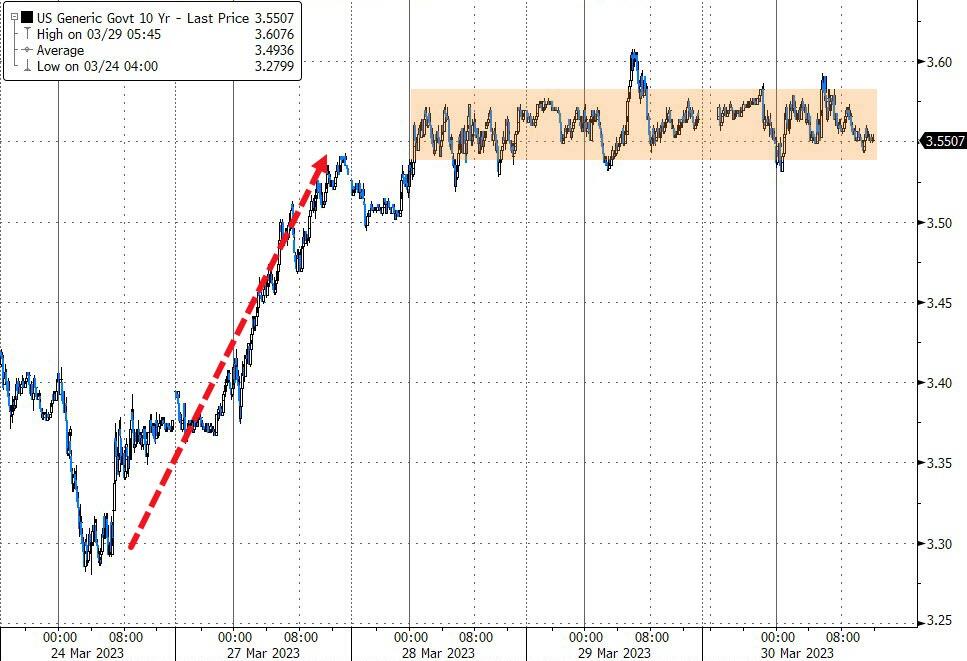
The 10Y yield continued to sleep after its explosion higher Friday thru Monday on the back of a suddenly heavy calendar of issuance…

Source: Bloomberg

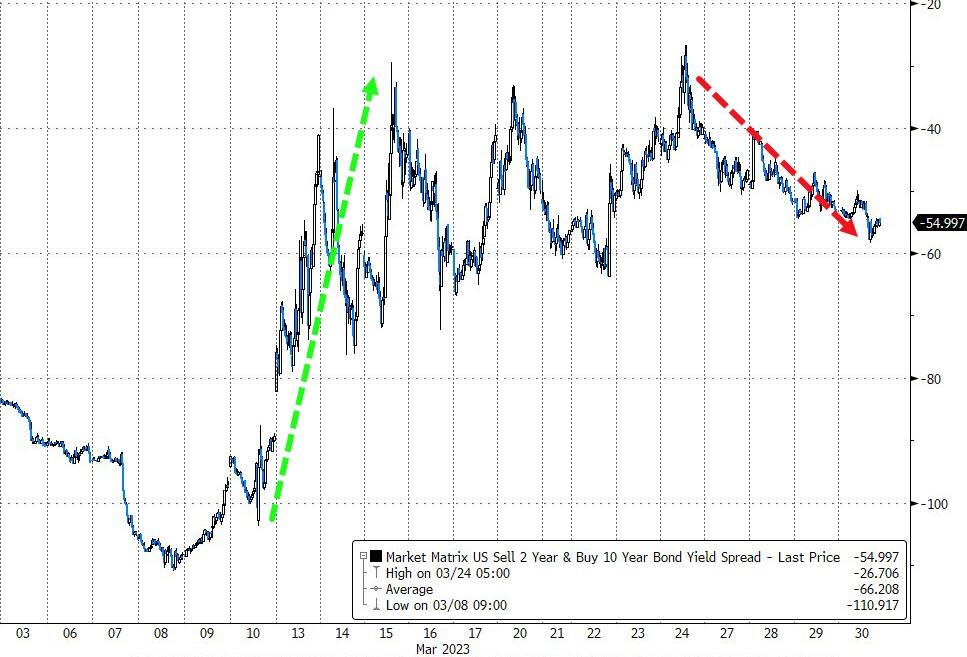
The yield curve (2s10s) flattened for the 4th straight day…

Source: Bloomberg

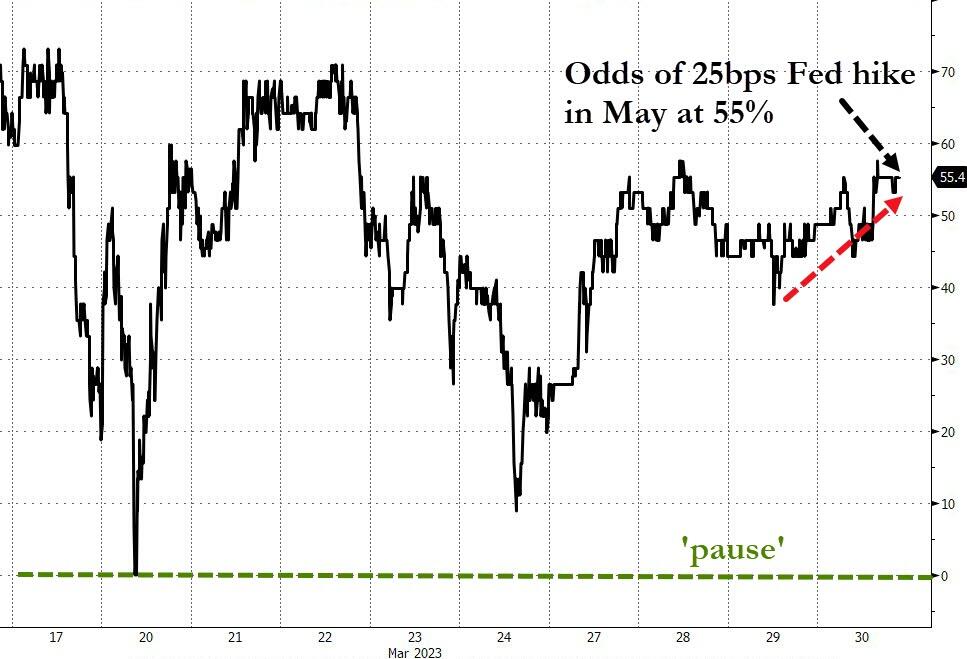
Rate-hike odds picked up hawkishly again today, with May now at 55% odds of 25bps hike…

Source: Bloomberg

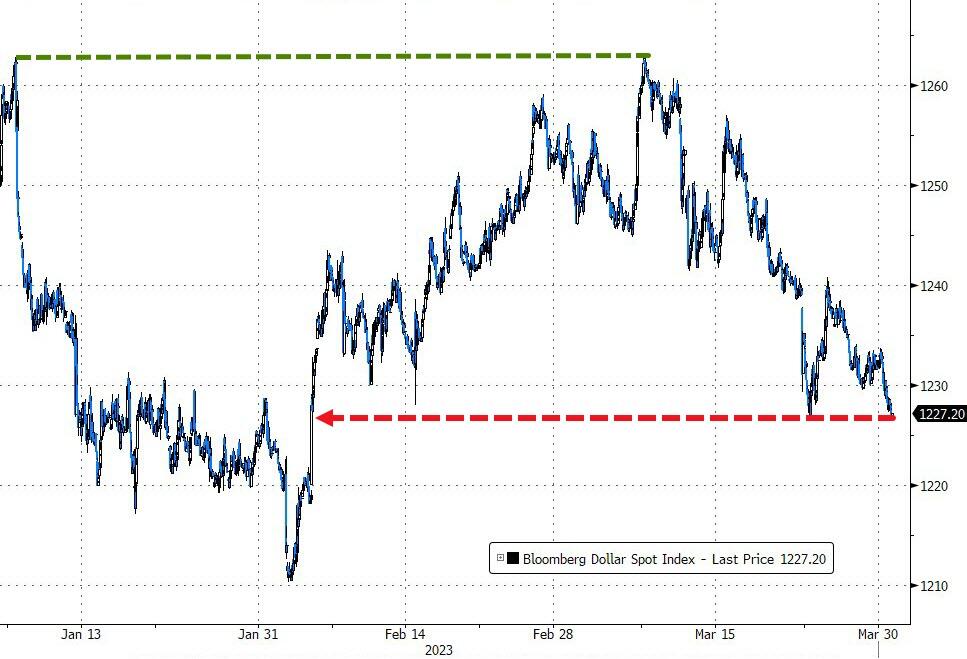
The dollar dumped again to its lowest close since Feb 3rd…

Source: Bloomberg

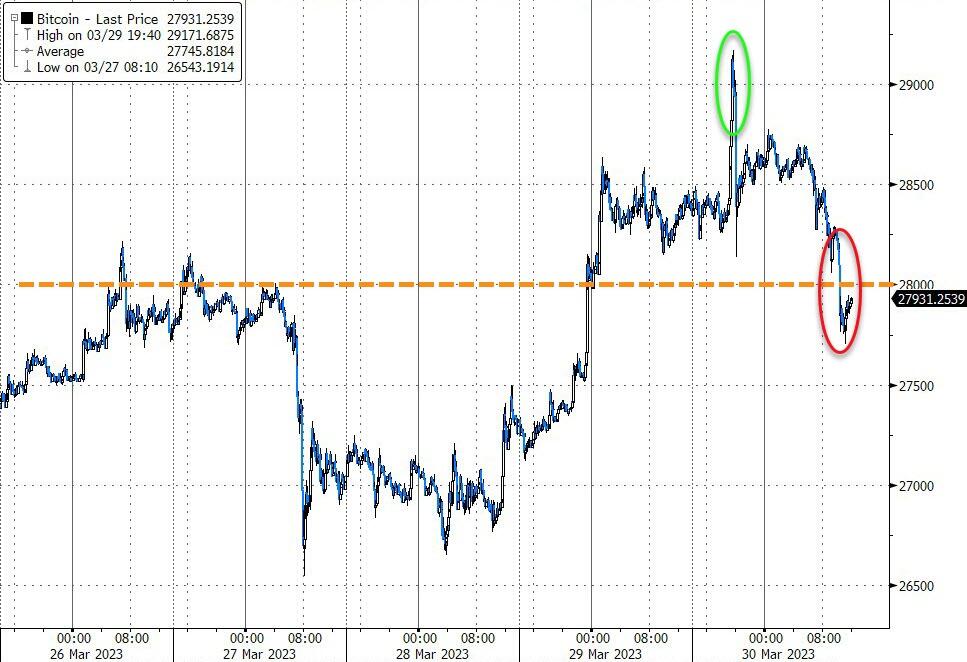
Bitcoin slipped back below $28,000 today (after spiking above $29 k overnight)..

Source: Bloomberg

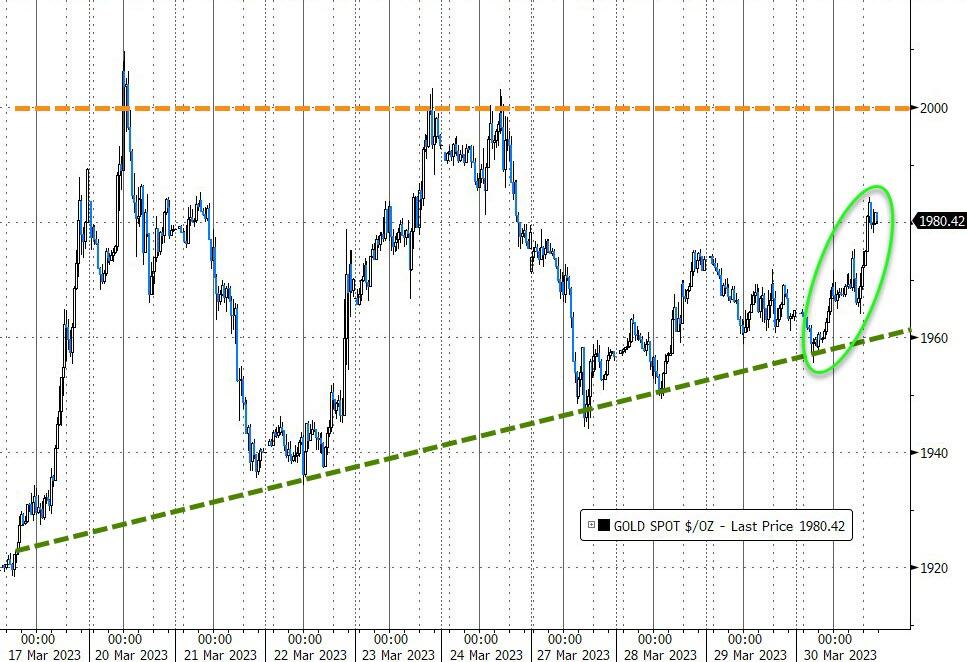
Gold (June futures) topped $2000 once again, as spot jumped back above $1980…

Source: Bloomberg

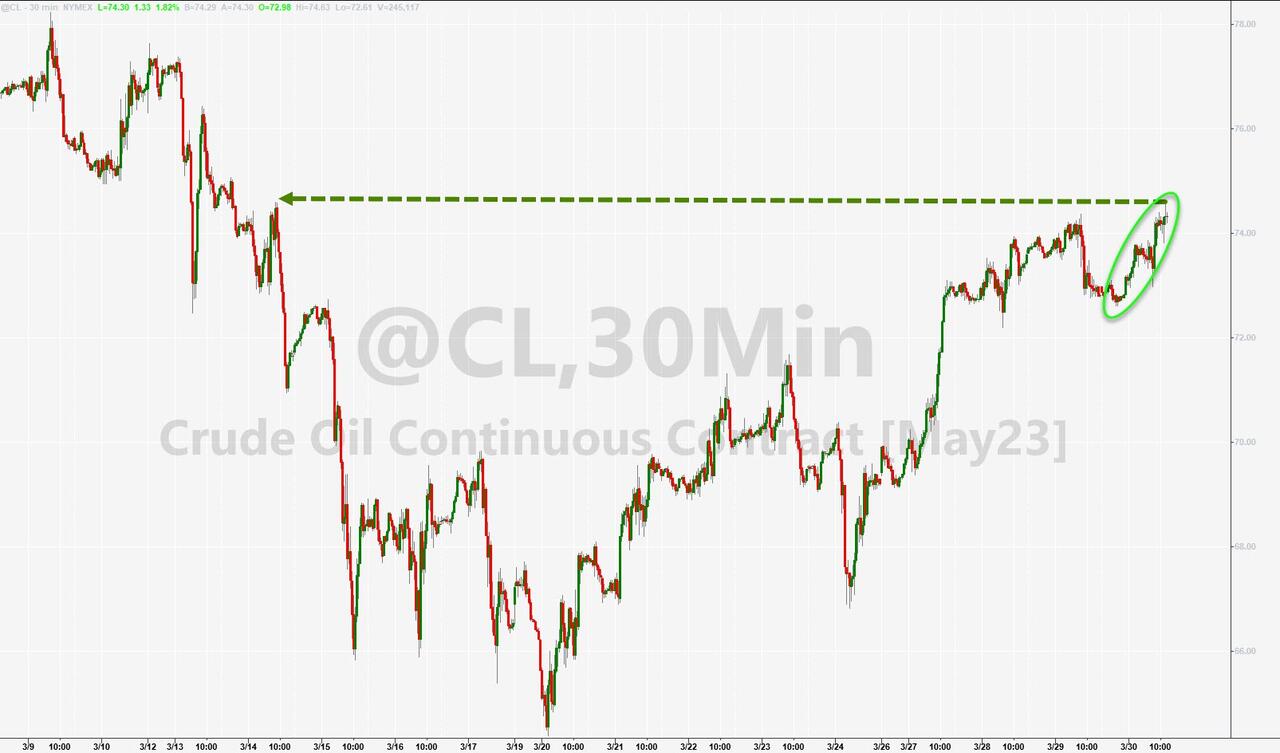
Oil prices extended their gains with WTI (May is front-month) back above $74 at two-week highs…

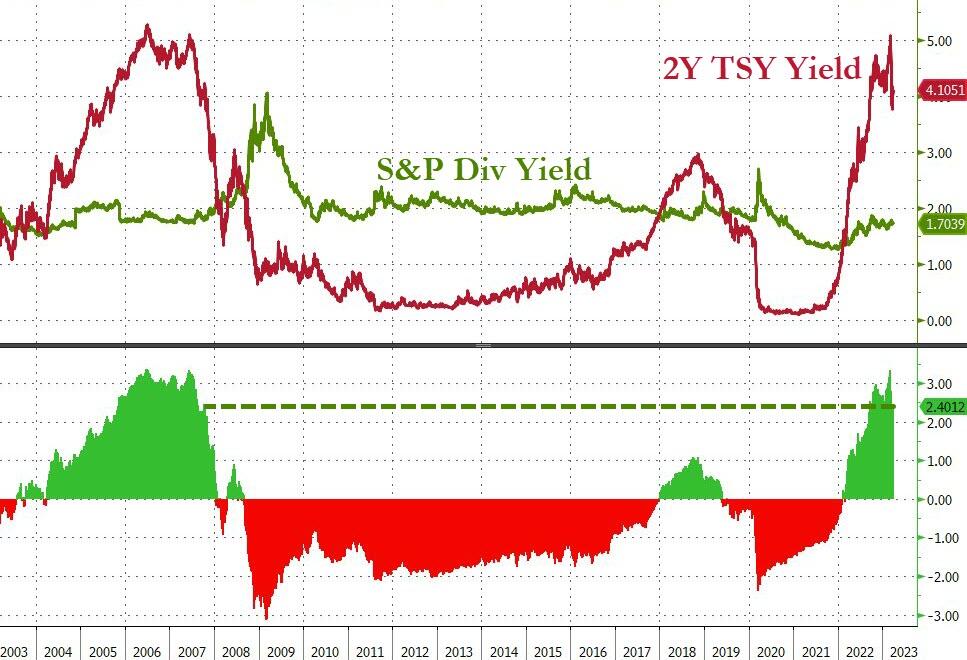
And finally, we note that US equities still screen as expensive vs. the alternatives despite the recent decline in Treasury yields…

Source: Bloomberg

And the S&P 500 NTM P/E of 18x ranks in the 82nd percentile since 1980

Source: Bloomberg

Do you feel lucky punk?

Given that, maybe you should!

Tyler Durden
Thu, 03/30/2023 – 16:01

via ZeroHedge News https://ift.tt/A5tQoJw Tyler Durden

$800 Billion & Counting… California Reparations Board Confronted To Make Good On Years Of Reparation Rhetoric

$800 Billion & Counting… California Reparations Board Confronted To Make Good On Years Of Reparation Rhetoric

Authored by Jonathan Turley,

I recently wrote a column on how Democrats in California are being challenged to put their money where their mouth has been on reparations.

For years, Democrats have insisted that reparations are a moral imperative.

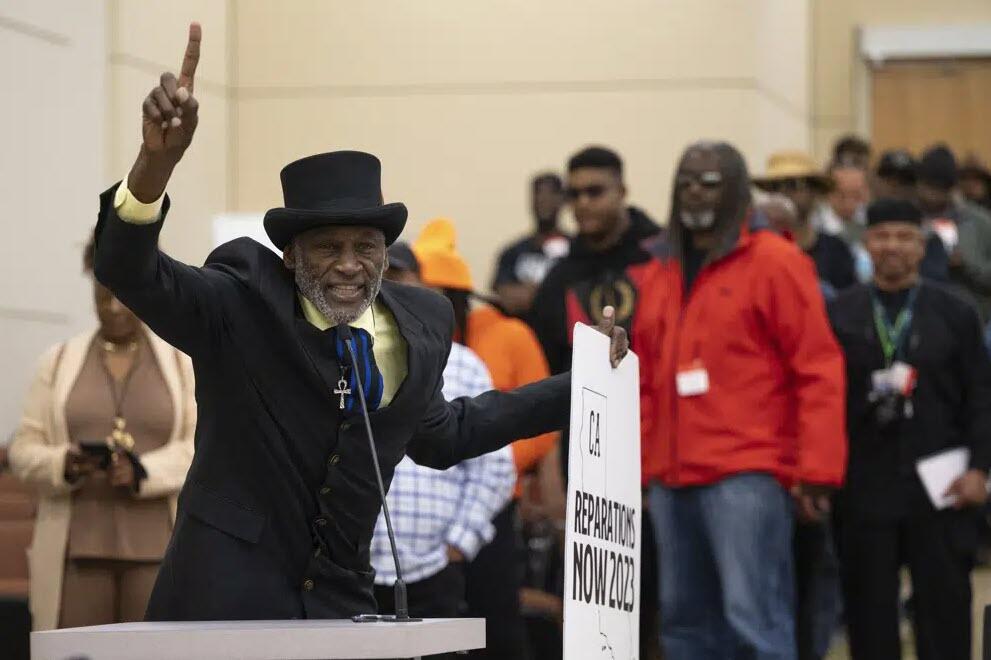
Now, however, the bill has come due and advocates in a Wednesday hearing confronted members of the California Reparations Task Force in asking “where’s the money?” Some are now demanding more than $5 million per resident as Reparations Board member Lisa Holder of the Equal Justice Society promised that the committee’s “recommendations will be breathtaking.”

California Gov. Gavin Newsom (D) created the Reparations Task Force, which just reached its own recommendations for $223,000 per person. Others have insisted the figure should be $350,000 for individuals and another $250,000 for Black-owned businesses. One California politician insisted the figure needs to be $800,000 per person, reflecting the average cost of a home in the state. In the meantime, a similar board has recommended $5 million payments to eligible residents of San Fransisco.

Notably, California’s law expressly states that this money should not be treated as compensation for federal reparations.

That raises the question of whether a resident could receive $5 million from San Francisco, $223,000 from the state, and additional payments from the federal government.

[ZH: As Eric Lundrum writes at AMGreatness, after economists estimated that California’s reparations plan could spend as much as $800 billion, the leader of the state’s “reparations task force” has refused to commit to such a staggering amount.

According to ABC News, the $800 billion figure would be paid to all black residents in the state in return for past historical circumstances such as slavery and segregation, as well as alleged “racism” in policing, incarceration rates, and housing.

“All forms of discrimination should be considered in reparations,” said Thomas Craemer, a public policy professor at the University of Connecticut, in testimony before the panel.

“The task force should feel free to go beyond our loss estimates, and determine what the right amount would be.”

But on Wednesday, the task force’s chair, Kamilah Moore, said the final decision on the exact amount will be left up to the California state legislature and Governor Gavin Newsom (D-Calif.).

“The task force is pretty much done regarding the compensation component,” Moore said in an email.

“Our task was to create a methodology for calculation for various forms of compensation that correspond with our findings.”]

Some congressional Democrats have pushed for similar federal reparations and passed a bill out of the House Judiciary Committee in 2021 that failed to receive a floor vote. BET founder Robert Johnson has called for $14 trillion in federal reparations.

In the hearing on Wednesday, the growing expectation and impatience was evident among witnesses. Yet, some reparations advocates in cities with even smaller reparation programs admit that they do not know how cities will fund the payouts.

One witness described the payments of $5 million per person as “nothing” and “too little.” The correct figure was suggested as more like $7.6 million.

Reverend Tony Pierce asked “Where’s the money? Where’s the cash? Where’s the check?” “$5 million, San Francisco’s already made a move. $5 million is nothing.” Pierce mocked the notion of $5 million if it is “spread over 50 years would only amount to $100,000 year, and then with taxes, you’ll be lucky if you end up with $40,000 a year.”  He also rejected the notion of $223,000 for housing as woefully inadequate.

For her part, Holder is pledging breathtaking” reparation payments, including “monetary compensation to Black people who are descendants of enslaved and persecuted Black Americans.”

Those continued assurances are fueling demands for the money without further delay. After years of being told that the payments are moral imperatives, many are losing patience. In a prior hearing, one well-known California activist declared in a prior hearing that “It’s a debt that’s owed, we worked for free. We’re not asking; we’re telling you.”

Despite Gov. Newsom’s underestimating the state debt figures by billions, this bill has now come due and many critics are challenging the left to show that the prior pledges were not mere political opportunism or virtue signaling.

California is set to face the true costs of these pledges and many are in no mood to haggle over price.

In other words, California Democrats may have finally reached the “show me the money” moment.

Tyler Durden
Thu, 03/30/2023 – 15:40

via ZeroHedge News https://ift.tt/6KAu8j1 Tyler Durden

Rare Rebuke Of Israel By White House Riles Republicans

Rare Rebuke Of Israel By White House Riles Republicans

The political fallout continues after President Biden’s controversial and rare criticisms of Israel, which included on Tuesday his urging Prime Minister Benjamin Netanyahu to abandon his governing coalition’s judicial overhaul policy which critics say will destroy any semblance of checks and balances and thus is a threat to Israeli democracy itself. The plan is now on “pause” as deep divisions in Israel simmer.

Biden had said he hoped Netanyahu “walks away from” the plan which has brought hundreds of thousands of Israeli protesters into the streets over the last couple weeks. But he really riled Israel-supporters by emphasizing that he has no intention of welcoming Netanyahu to the White House “in the near term.” Typically newly elected Israeli prime ministers can expect to meet with the US president fairly quickly after entering office.

“Like many strong supporters of Israel, I’m very concerned, and I’m concerned that they get this straight. They cannot continue down this road,” Biden had told reporters after a speech in North Carolina. “Hopefully the prime minister will act in a way that he can try to work out some genuine compromise. But that remains to be seen.”

Again such a rebuke from an American president directed at close ally Israel, which receives over $3 billion a year in foreign and defense aid from Washington, is so rare as to be almost unheard of. But some argue that the funding and steady weapons pipeline to Tel Aviv is precisely why Washington must reign in Israel from time to time.

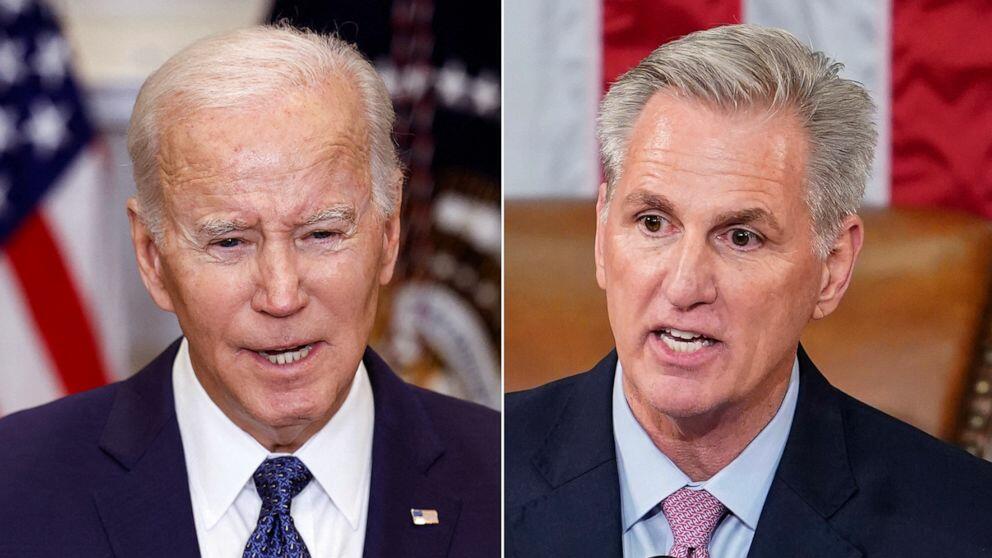
But pro-Israel hawks have historically treated the Jewish state like it cannot possibly do any wrong. Congressional Republicans were especially angry by Biden’s criticisms, with House Speaker Kevin McCarthy on Thursday speaking up, issuing words of support for Netanyahu

“Prime Minister Netanyahu is an Israeli patriot, statesman, and most importantly, a great friend of the United States of America,” McCarthy said in a statement.

“Free societies have vigorous and open debate. Israel is no exception. I support Prime Minister Netanyahu, and America’s support for Israel’s strong, vibrant democracy is unwavering. Now is an important time for Americans to stand together in support of our long, mutually respectful, and important friendship with Israel.”

Interestingly, some Republicans agree that the judicial overhaul plan shouldn’t be pursued, but have expressed that Biden shouldn’t criticize Israel so out in the open.

For example, Rep. Chris Smith of New Jersey said Biden’s words should have been conveyed through quiet back-channels: “The administration if they’re going to convey a message, it ought to be doing it through secure channels and not being so public about it,” he said to The Hill on Wednesday.

“An ally like Israel that absolutely needs a friend like the United States as part of its deterrence, we want to, in no way convey, any, no matter who’s prime minister, diminution of support. Talk it out on a secure phone or in a meeting, don’t do it through the press,” Smith added.

Tyler Durden
Thu, 03/30/2023 – 15:20

via ZeroHedge News https://ift.tt/QUNfZeA Tyler Durden

Damascus Rocked By Israeli Attack On Heels Of Saudi-Iran Rapprochement

Damascus Rocked By Israeli Attack On Heels Of Saudi-Iran Rapprochement

More Israeli airstrikes rocked Damascus early Thursday morning, wounding two Syrian soldiers, according to national SANA news agency and international reports.

State sources say Syrian air defenses were “confronting hostile targets” over the capital at around 1:20am, during the aerial attack which came from the direction of the Golan Heights. This marks the fourth major Israeli attack on Syria this month, which included two prior air assaults which temporarily shut down Aleppo International Airport.

Illustrative: AP image of 2018 missile attack & anti-air defenses over Damascus.

“At around 01:20 am (10:20 GMT), the Israeli enemy carried out an aerial aggression from the direction of the occupied Golan Heights targeting several positions in the vicinity of Damascus,” Syria’s defense ministry said later, also noting material damage.

After a short lull following a pattern of several years that included hundreds of Israeli attacks on Syria, there’s been an uptick and return to more frequent attacks so far this year.

“A group monitoring the Syrian civil war said the Israeli missile strikes last week destroyed a suspected arms depot used by Iran-backed fighters at Aleppo airport,” Al Jazeera observes. “On March 7, three people were killed in the Israeli air strike on the airport that also halted flights for three days.”

Israeli officials have long claimed to be targeting Iranian military assets such as weapons shipments, but civilians and city infrastructure have long been targeted. “Along with airports, Israeli warplanes have also aimed at other critical infrastructure, including Syrian seaports,” AJ notes further.

One likely explanation for Israel’s ramped up aggression in Syria is the Saudi-Iran deal to reestablish and normalize diplomatic ties announced this month. Israel has long relied on robust US-Gulf (and GCC) efforts to counter Iran. Couple with this is that Syria’s Bashar al-Assad is being welcomed in Gulf capitals such as the UAE and Oman.

US state-backed VOA has observed the post-earthquake diplomacy is part of “renewed efforts to bring Damascus back into the Arab fold.” This scares Israel, which wants to see Syria perpetually isolated amid fears in Tel Aviv of deepened Iranian entrenchment in the region.

Tyler Durden
Thu, 03/30/2023 – 15:00

via ZeroHedge News https://ift.tt/wCRuETc Tyler Durden

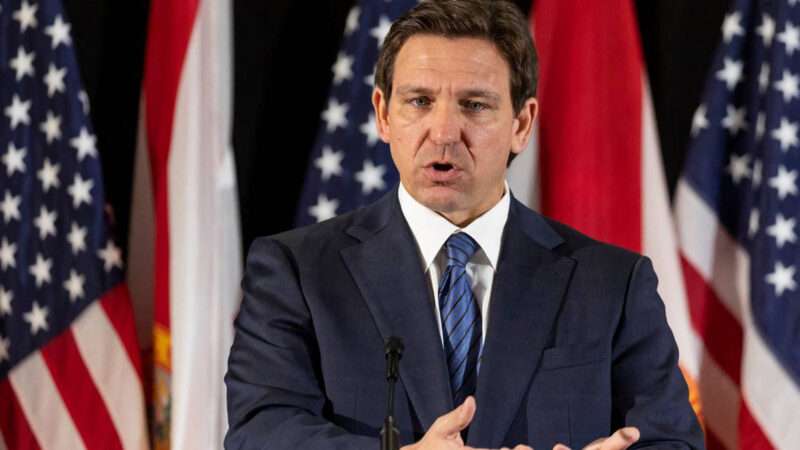
Ron DeSantis Reportedly Plans To Portray Trump As Soft on Crime


Ron DeSantis speaks in front of a row of American and state of Florida flags

During his 2020 presidential campaign, Donald Trump attacked Joe Biden from the left on criminal justice, highlighting the Democrat’s long history of supporting draconian drug penalties that disproportionately hurt African Americans. Now Florida Gov. Ron DeSantis reportedly is planning to attack Trump from the right on criminal justice, highlighting the former president’s support for the FIRST STEP Act, a package of modest reforms that Trump signed in 2018.

The New York Times, citing unnamed sources close to DeSantis, reports that his expected campaign for the 2024 Republican presidential nomination will portray Trump as soft on crime. That prospect does not bode well for the future of debates about crime and punishment within the Republican Party, which seems to be reverting to the mindlessly punitive mentality that the FIRST STEP Act challenged.

Trump’s pose as a criminal justice reformer always seemed more tactical than sincere. In 2016, he ran on a Nixonian “law and order” platform that paid no attention to proportionality or to the distinction between inherently criminal conduct and offenses that exist only by legislative decree. Trump admires brutal drug warriors like Rodrigo Duterte, the former president of the Philippines, and has repeatedly floated the idea of copying them by executing drug dealers.

Under the influence of his son-in-law Jared Kushner, however, Trump embraced sentencing reform in the hope of appealing to moderates, making inroads among black voters, and dampening support for Biden. Kushner persuaded Trump to back the FIRST STEP Act, which reduced some mandatory minimum sentences, authorized the resentencing of crack offenders in line with current penalties, expanded the “safety valve” that allows some drug defendants to avoid mandatory minimums, increased “good time” credit for federal prisoners, and facilitated “compassionate release.”

Trump bragged about that accomplishment during his 2019 State of the Union address, which was attended by two federal drug offenders whose sentences he had commuted. One of those clemency recipients was Alice Johnson, an African-American woman who had received a life sentence for participating in a Memphis-based cocaine trafficking operation. Johnson was featured in a Trump campaign ad that aired during the 2020 Super Bowl.

“Alice Johnson was sentenced to serve life in prison for a nonviolent drug offense,” the TV spot’s opening caption said. “Thanks to President Trump, people like Alice are getting a second chance.” That was followed by footage of Johnson reuniting with her family and tearfully thanking Trump for setting her free. “Politicians talk about criminal justice reform,” another caption said. “President Trump got it done. Thousands of families are being reunited.”

Trump’s campaign castigated Biden for championing policies that imposed unconscionable sentences on people like Johnson. “In addition to wrecking countless lives with the 1994 crime bill, during his time in the Senate, Biden’s ‘priority’ was legislation that policy experts agree made the opioid epidemic far more deadly,” it said. “Biden pioneered legislation that decreases the likelihood of people to call 911 if they witness a drug overdose and has even led to prosecutors filing homicide charges against drug overdose victims’ loved ones.”

Johnson made another appearance at the 2020 Republican National Convention. “I was once told that the only way I would ever be reunited with my family would be as a corpse,” she said. “But by the grace of God and the compassion of President Donald John Trump, I stand before you tonight.”

Trump’s daughter Ivanka drove home the point that her father had acted decisively to ameliorate the damage done by unjust drug laws. “Against all odds,” she said at the convention, “he brought together Republicans and Democrats, and passed the most significant criminal justice reform of our generation….He tackled this injustice because he has a deep compassion for those who have been treated unfairly.”

Trump was bitterly disappointed that he received no apparent political payoff from these overtures to critics of Biden’s legislative legacy. “Did it for African Americans,” he wrote last year in response to a reporter’s question. “Nobody else could have gotten it done. Got zero credit.”

Trump won’t be making that mistake again. The same man who in 2020 was touting his compassion for nonviolent drug offenders is back to advocating their execution.

DeSantis, meanwhile, reportedly thinks Trump’s flirtation with criminal justice reform is a promising point of attack. “Mr. DeSantis and his backers see the signature criminal-justice law enacted by Mr. Trump in 2018 as an area of weakness with his base,” the Times says, “and Mr. DeSantis has indicated that he would highlight it when the two men tussle for the Republican nomination.”

That tactic is a bit problematic for DeSantis, who supported an early version of the FIRST STEP Act as a congressman. But the version of the bill that DeSantis voted for in May 2018, which passed the House with support from 226 Republicans, did not include the sentencing reforms that were later added to the bill. DeSantis had left Congress to run for governor by the time the final version passed. That bill—the one that Trump signed—attracted support from 182 Republicans in the House and 38 Republicans in the Senate.

Given the broad bipartisan support for those sentencing reforms, it may be hard to portray them as the work of soft-on-crime progressives. But according to the Times, that is what DeSantis plans to do.

The FIRST STEP Act resulted in reduced prison terms for more than 7,000 people. As DeSantis sees it (or will claim to see it), any crimes subsequently committed by any of those people are on Trump.

The Times cites a recent tweet from Pedro L. Gonzalez, “a conservative with a large online following who often attacks Mr. Trump from the right and defends Mr. DeSantis,” as a preview of what we can expect from the DeSantis campaign. “The man who brutally attacked one of Rand Paul’s staffers in broad daylight over the weekend was released from prison thanks to Trump’s First Step Act,” Gonzalez wrote yesterday. He said Glynn Neal, the man arrested for stabbing a member of the Kentucky senator’s staff, benefited from the law’s expansion of good time credit, which would be true of any federal prisoner who stayed out of trouble while serving his sentence.

Gonzalez did not mention that Paul himself was among the three dozen Republican senators who voted for the FIRST STEP Act. According to Gonzalez’s logic, Paul recklessly endangered his own staff by supporting sentencing reform. After DeSantis officially launches his presidential campaign, the Times says, we are apt to see more attacks along these lines.

Last year, DeSantis bragged about signing a bill that increased Florida’s penalties for fentanyl offenses. That law “increases the mandatory minimum sentence for trafficking fentanyl from 3 years to 7 years for 4-14 grams, and from 15 to 20 years for 14-28 grams.” Seven years for four grams of fentanyl is even more severe than the five-year mandatory minimum for five grams of crack that Biden once cited as proof of his anti-drug zeal.

The sentences that DeSantis proudly signed into law are exactly the sort of rigid and disproportionate penalties that Trump criticized Biden for promoting. But there is actually little daylight between Trump and DeSantis on this issue. During the same State of the Union speech in which Trump highlighted his compassion for Alice Johnson, he urged Congress to “strengthen criminal penalties for dealing and trafficking in fentanyl and other opioids.” And if Trump had his druthers, those penalties would include death.

Despite that glaring inconsistency, Trump not only decried “very unfair” drug sentences; he actually did something about them. Judging from his complaint that he got “zero credit” for that, he already wishes he had never endorsed the proposition that there is such a thing as an excessively severe drug penalty. DeSantis seems determined to compound Trump’s regret.

The post Ron DeSantis Reportedly Plans To Portray Trump As Soft on Crime appeared first on Reason.com.

from Latest https://ift.tt/aq4b7Lk
via IFTTT
A Police Officer Killed a Man for Firing ‘Celebratory’ Shots Into the Air. Now, He Faces a Federal Lawsuit.


Photo of James Williams and his family on the left with a photo of police under red filter on the right

Around midnight on New Year’s Day 2022, an Ohio man was shot and killed by a police officer for firing “celebratory” shots into the air. Now, his widow has filed a federal lawsuit against the officer and local police department, claiming that police violated her husband’s constitutional rights by using unnecessary, excessive force.

“For decades, United States Supreme Court has interpreted the Fourth Amendment to the United States Constitution to prohibit a police officer’s use of excessive force during the arrest of a citizen,” the lawsuit states, adding that police deprived “Plaintiff of his well-established right to be free from excessive force, per the authority cited herein.”

Near midnight on December 31, 2021, 46-year-old James Williams fired shots into the air from the porch of his Canton, Ohio, home. According to the lawsuit, this is a common occurrence on New Year’s Eve within the town. In fact, the complaint notes that earlier in the evening, before Williams fired any shots, Canton police received a radio broadcast alerting them of another man that was firing shots into the air as “celebratory fire for New Years.”

When Williams “join[ed] in that activity,” a nearby police officer—Robert Huber—heard gunfire and drove to the front of William’s home, which had a 6-foot fence surrounding the porch. According to the lawsuit, Huber then walked up the steps of the porch and looked through a window, where he saw Williams walking through the house while holding a rifle. The complaint states that Huber then backed off the porch and onto the street, where he activated his body camera and radioed for backup.

According to the lawsuit, Huber heard gunfire shortly after and approached the fence around the porch with his gun drawn. Without any verbal warning to Williams, Huber fired at the fence, striking Williams in the chest. The complaint states that Huber then shouted, “Shots fired, shots fired,” and, “Police! Get down now! Police! Get down now!”

The complaint states that Williams then staggered into his living room, in view of his children, where he died shortly thereafter. The suit states that Huber did not attempt to provide medical care to Williams at any point.

“Defendant Huber intentionally fired his service weapon at Decedent and killed him with gunfire while Decedent posed no threat of death or serious bodily harm to Defendant Huber,” the lawsuit states. “Huber fired at Decedent through a wooden fence which blocked Defendant Huber’s view of the scene in front of him, putting at risk the lives of Decedent, Plaintiff, and their children.”

Huber has not been disciplined or charged in connection with the shooting. Last September, a grand jury declined to charge Huber, sparking protests in Canton. “While the Stark County Prosecutor has failed in obtaining justice for James, we will not stop until we do,” read a statement from the family’s legal team.

While Huber seems unlikely to face criminal charges, this latest lawsuit is the final legal avenue for William’s family to hold police accountable for his death. (A previous lawsuit was dismissed for Williams’ widow’s failure to obtain legal counsel.) However, it’s unclear whether they will succeed in obtaining a settlement, as wide-ranging qualified immunity protections guard police from civil lawsuits. For now, accountability for Huber, or the police department that failed to discipline him, seems far-off.

“I really feel that there was no justice for James Williams and his family,” said Canton City Councilwoman Chris Smith after the grand jury’s decision. “There was no justice. I am disappointed in this system.”

The post A Police Officer Killed a Man for Firing 'Celebratory' Shots Into the Air. Now, He Faces a Federal Lawsuit. appeared first on Reason.com.

from Latest https://ift.tt/YeHqMAm
via IFTTT

How Biden’s Private Sponsorship Parole Policy Reduced Illegal Migration by Making the Legal Kind Easier


Venezuelans Fleeing Socialism 2
Venezuelans fleeing the socialist regime of Nicolas Maduro.


In early January, the Biden Administration extended the model used by the successful Uniting for Ukraine private migrant sponsorship program to include  up to 30,000 migrants per month from four Latin American countries: Cuba, Venezuela, Nicaragua, and Haiti. Under the program, migrants from these countries can quickly gain legal entry into the United States and the right to live and work here for up to two years, if they pass a background check and have a private sponsor in the US who commits to supporting them.

As in the case of Uniting for Ukraine, the main justification for this program is to grant refuge to people fleeing horrific violence, poverty, and oppression. Three of the four nations covered by the program are ruled by repressive socialist dictatorships, and the fourth (Haiti) suffers from horrific escalating violence and extreme poverty.

In a recent substack post, Cato Institute immigration analyst Alex Nowrasteh (one of the nation’s leading immigration policy experts) describes how the program has a notable additional benefit. It greatly reduces illegal border crossings:

Encounters of migrants crossing the southwest (SW) border with Mexico are down 39 percent from December 2022 to February 2023. President Biden’s immigration and border plan that expanded legal migration to the United States through humanitarian parole should take credit for this decline. Under Biden’s plan, up to 30,000 migrants from Venezuela, Cuba, Nicaragua, and Haiti (VCNH migrants) are allowed to enter the United States legally each month through humanitarian parole. As a result, more of them are waiting to come legally rather than attempting to cross illegally.

In February 2023, the number of VCNH migrants encountered, found inadmissible by Customs and Border Protection (CBP), or apprehended by Border Patrol decreased by 84 percent compared to December 2022. The number of VCNH migrants showing up at the border fell from 91,344 in December to 22,084 in January and then further down to 14,381 in February….

This trend supports Cato’s theory that legal migration discourages illegal immigration and border crossings. Non-VCNH migrants who do not have the option of humanitarian parole fell by only 12.5 percent from 160,651 in December 2022 to 134,192 in January and rose again to 140,617 in February. Almost 80 percent of the total decline in encounters along the border from December to February comes from a reduction in VCNH migrants….

Biden’s border plan reduced chaos along the Southwest land border in a short period. That’s good for its own sake, helps clear the air for a serious immigration debate, and is politically astute for Biden, which means that the incentives for good policy are politically aligned and sustainable. Second, the Biden plan increases legal immigration when U.S. labor demand is still high. Third, it defunds criminal networks and cartels by channeling many migrants into the legal system and away from the black market.

For reasons Alex explains, the reduction in illegal crossing by VCNH country migrants cannot be explained by other factors. It is powerful evidence for the proposition that the easiest way to reduce illegal migration is to make the legal kind easier. This also, of course, has the effect of reducing disorder at the border, and curbing opportunities for organized crime.

In addition to the policy advantages noted in Alex’s post, the reduction in illegal border crossings undercuts the rationale for the lawsuit challenging the program filed by twenty red states. As I explain here, the statute authorizing the president to use the “parole” power to let in migrants indicates that he may do so “on a case-by-case basis for urgent humanitarian reasons or significant public benefit.” Reducing illegal migration and disorder at the border qualifies as such a “significant public benefit.” Or at least it does if you believe the leaders of the plaintiff states, who have long been loudly complaining about illegal border crossings, and claiming they constitute a major crisis.

For reasons laid out in my earlier post, it is also pretty obvious that there are compelling “humanitarian reasons” for paroling migrants from these four nations. On this point, too, you don’t need to take my word. You can instead take that of the governors of some of the plaintiff states in the lawsuit:

Three of the four nations included in the program are ruled by oppressive socialist dictators, whose policies have created horrific conditions. Few have put it better than Florida Governor Ron DeSantis, whose state is one of the participants in lawsuit. As he said last year, Venezuela’s socialist president Nicolas Maduro is a “murderous tyrant” who “is responsible for countless atrocities and has driven Venezuela into the ground.” DeSantis went on to say that “people [in Venezuela] are “really hurting,”due to the government’s policies. It is indeed true that Venezuelan socialism has resulted in widespread oppression, poverty, and hyperinflation, leading to the biggest refugee crisis in the history of the Western hemisphere, with some 6 million people fleeing. Texas Governor Greg Abbott, whose state is spearheading the lawsuit, has also noted the severe economic crisis in Venezuela, which he (rightly) blames on socialism.

In 2021, DeSantis  signed a law requiring Florida public schools to provide 45 minutes of instruction each year on the evils of Communist regimes, including that of Cuba, which DeSantis correctly described as responsible for “poverty, starvation, migration, systemic lethal violence, and suppression of speech.” Cuba, likewise, inflicts severe poverty and oppression on its people, including recent brutal suppression of protests in July 2021….

Nicaragua under the increasingly authoritarian socialist rule of Daniel Ortega is a similar story. Ortega’s repression has deepened already severe poverty, and created what even the left-leaning BBC describes as an “atmosphere of terror….”

Abbott, DeSantis, and other GOP governors have repeatedly denounced both the evils of socialism generally, and those of the Cuban, Venezuelan, and Nicaraguan governments specifically.

But perhaps they have somehow forgotten these things. If so, DeSantis should invite his fellow GOP governors to sit in on one of the 45-minute classes on the evils of communism, established under the law he signed last year.


The post How Biden's Private Sponsorship Parole Policy Reduced Illegal Migration by Making the Legal Kind Easier appeared first on Reason.com.

from Latest https://ift.tt/NeoFgrf
via IFTTT

An Era of Broad Remedies Makes Standing Even More Important

“Few exercises of the judicial power are more likely to undermine public confidence in the neutrality and integrity of the Judiciary than one which casts the Court in the role of a Council of Revision, conferring on itself the power to invalidate laws at the behest of anyone who disagrees with them. In an era of frequent litigation, class actions, sweeping injunctions with prospective effect, and continuing jurisdiction to enforce judicial remedies, courts must be more careful to insist on the formal rules of standing, not less so.”

Arizona Christian Sch. Tuition Org. v. Winn, 563 U.S. 125, 145–46 (2011).

The post An Era of Broad Remedies Makes Standing Even More Important appeared first on Reason.com.

from Latest https://ift.tt/na3YK2d
via IFTTT

How Bidenflation Was Made

How Bidenflation Was Made

Via Political Calculations blog,

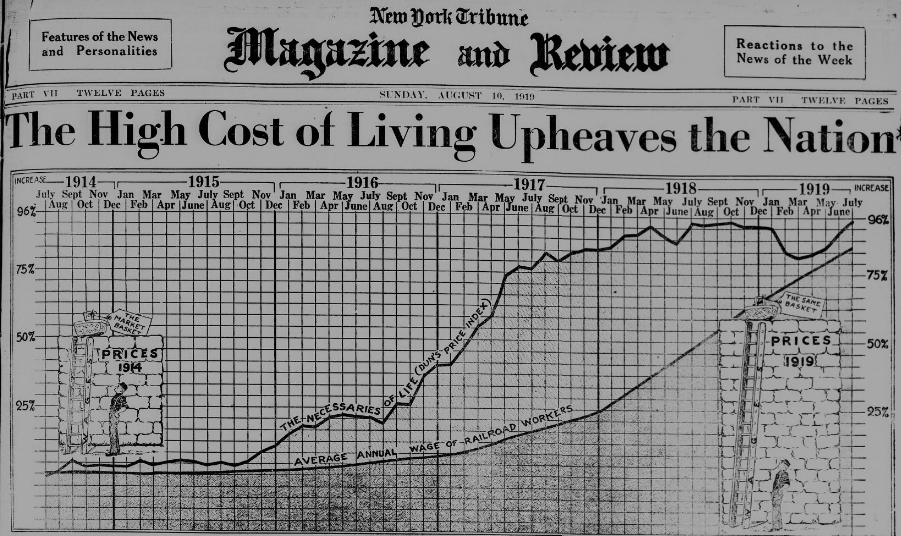
In late 2020, the policy makers of the Biden administration and its partisan supporters started crafting a new COVID stimulus package. What they wrought set off a chain of events that ultimately led to the cost of living and banking system crisis we face today.

It didn’t have to be that way. When they started their discussions, the participants had modest goals for what an additional stimulus would look like. Considering the federal government had just enacted its fourth Covid relief package on 27 December 2020, totaling $900 billion, no one at the time was advising the Biden administration to pursue for another stimulus of similar size, much less one that was $1 trillion larger.

That changed quickly after 5 January 2021, when President Biden’s political party gained control of the U.S. Senate after runoff elections in Georgia came out in their favor.

With control of the U.S. Congress in hand, the most rabidly partisan among President Biden’s supporters quickly switched gears to exercise their new political power. Instead of linking the magnitude of any new stimulus package to the actual scale of the problem the U.S. economy was facing at the time, they decided they would “go big”, putting their fringe political agenda ahead of sound fiscal policy.

But in ditching sound fiscal policy, they opened a rift among those who had been crafting the new stimulus measure. That rift took the form of an academic controversy that erupted while they were developing what would ultimately become the American Rescue Plan Act, which the Biden administration rammed through Congress and signed into law on 11 March 2021.

The controversy involved an economic concept known as potential output, or potential GDP. Here’s a quick primer:

Potential output is an estimate of what an economy could feasibly produce when it fully employs its available economic resources. The Congressional Budget Office (CBO) estimates potential output by estimating potential GDP, which it describes as “the economy’s maximum sustainable output.” The word “sustainable” is important — it doesn’t mean that the entire working-­age population is working 18 hours per day or that factories are operating 24/7. Rather, it means that economic resources are fully employed — at normal levels. Potential output (estimated as real potential GDP) serves as an important benchmark level against which actual output (measured as real GDP) can be compared with at any given time.

The difference between the economy’s potential output and its actual output is called the output gap, which economic policy makers must consider when shaping major fiscal policies. If they adopt policies that undershoot the gap, they will fail to obtain the full positive results they seek at the cost of greatly adding to the nation’s debt. If they overshoot the gap, they risk creating adverse economic conditions, like inflation, that can fully undermine whatever positive results they hoped to achieve.

These scenarios were known risks at the time the Biden administration was pushing the American Rescue Plan Act forward. In fact, because the stimulus package they were considering had swelled to $1.9 trillion, the risk of creating inflation became a primary concern among the more fiscally responsible members of Biden’s policy making team. But they lost the internal argument when President Biden sided with the most extreme elements among his supporters.

That victory didn’t make the likelihood the enormous new stimulus package would almost certainly overshoot the output gap and create persistent inflation go away. By Inauguration Day, the progressive activists who hijacked the stimulus development still needed to dispell that risk to ensure they could get the massive stimulus through a still closely-divided Congress. Their chosen path to achieve their political agenda would hinge on an assumption cooked up by the Biden administration’s most rabidly partisan supporters: that the nation’s potential GDP and output gap were much larger than the CBO estimated and thus, would not create inflation. That assumption would become the focal point of the controversy for how the stimulus bill could negatively impact the economy.

On 3 February 2021, the Committee for a Responsible Federal Budget discussed how the assumptions of the size of potential GDP and the output gap being put forward affected the forecasts of how much the stimulus could overshoot the output gap:

The output gap could differ from CBO’s projections. Many forecasts and experts suggest the economy will grow faster this year than CBO estimates. A one percentage point increase in Gross Domestic Product (GDP) growth would reduce the output gap to less than $200 billion, in which case the American Rescue Plan would be large enough to close eight to ten times the output gap based on the Edelberg and Sheiner numbers. On the other hand, many have argued that CBO is underestimating full employment and potential GDP. If potential GDP were 1 percent larger than CBO’s estimate, the output gap would total $1.3 trillion through 2023 and the America Rescue Plan would close 115 to 145 percent of the output gap.

The “Edelberg and Sheiner numbers” refer to a 28 January 2021 analysis of the Biden administration’s proposed stimulus produced by the nonpartisan Brookings Institute’s Wendy Edelberg and Louise Sheiner. Just a few weeks later, Sheiner would join with Brookings’ Tyler Powell and David Wessel to report on the controversy related to potential GDP that had erupted among those who were giving input to the Biden Administration’s first major economic policy initiative:

As President Biden and Congress negotiate the next fiscal stimulus package to aid the COVID-19 economic recovery, they will implicitly be making assumptions about the output gap. Analysis by one of us (Louise Sheiner) and our Brookings colleague Wendy Edelberg suggests that Biden’s $1.9 trillion package would result in GDP reaching its pre-pandemic path by the end of 2021 and exceeding it in 2022. In other words, some of the economic activity lost during the pandemic would be made up after the virus subsides.

Based on the CBO’s recent estimate of potential GDP, though, this would leave a large positive output gap—peaking at 2.6 percent in the first quarter of 2022. Some critics — including former Treasury Secretary Lawrence Summers — argue that pushing output this far above potential could drive up inflation.

Others, including Nobel Laureate Paul Krugman, warn against putting too much emphasis on a projected output gap in determining the riskiness of a large fiscal stimulus. They note the significant uncertainty that surrounds any estimate of potential GDP. Indeed, by CBO’s estimates, the U.S. economy was operating above potential in 2019, yet inflation remained subdued and below the Fed’s 2 percent target. Moreover, there is little historical precedent to predict how the pandemic will affect potential output or consumer and business demand once the virus recedes.

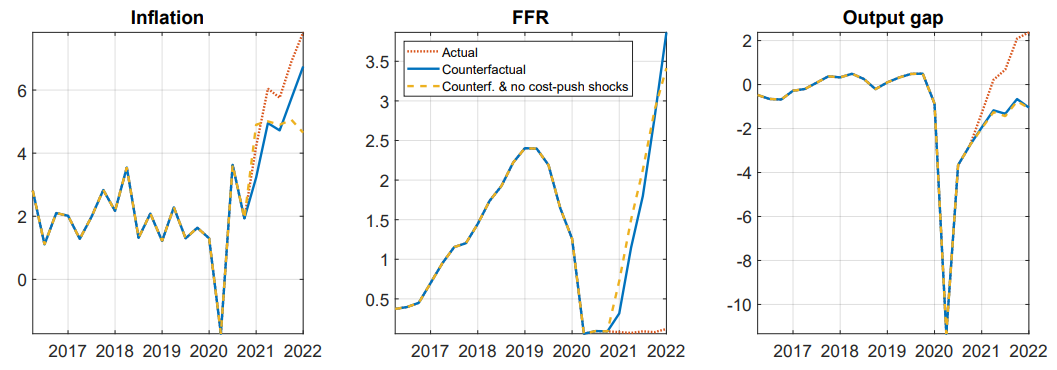
With hindsight being 20/20, we know that Larry Summers’ view was correct. President Biden’s COVID stimulus overshot the output gap and created significant inflation, which quickly became evident after its enactment. Mainstream economists using different methodologies indicate the American Recovery Plan Act played a “sizable role” in causing inflation, adding anywhere from 2.6% to 3.5% on top of the inflation rate that would have been recorded without President Biden’s $1.9 trillion stimulus.

That inflation was allowed to fester for a full year because of a commitment the Federal Reserve made to hold rates near zero percent for as long as possible. It took Americans seeing prices inflate faster than their incomes to finally force the Fed to address the inflation they allowed to gain traction with a series of interest rate hikes beginning in March 2022. Flashing forward one year later, the actions to fix the inflation unleashed by the stimulus measure has had negative impacts on large sectors of the U.S. economy, such as the housing market, and directly contributed to the bank failures that became front page news during the last few weeks.

The Biden administration cannot say they were not warned. Here’s the prescient commentary from Larry Summers’ 4 February 2021 op-ed in the Washington Post:

… while there are enormous uncertainties, there is a chance that macroeconomic stimulus on a scale closer to World War II levels than normal recession levels will set off inflationary pressures of a kind we have not seen in a generation, with consequences for the value of the dollar and financial stability. This will be manageable if monetary and fiscal policy can be rapidly adjusted to address the problem. But given the commitments the Fed has made, administration officials’ dismissal of even the possibility of inflation, and the difficulties in mobilizing congressional support for tax increases or spending cuts, there is the risk of inflation expectations rising sharply. Stimulus measures of the magnitude contemplated are steps into the unknown.

In another op-ed just two months later, Summers provided the epitaph for the inflationary failure of the Biden administration’s first major economic initiative with just a simple, understated clause:

Excessive stimulus driven by political considerations was a consequential policy error…

The Biden administration and its extremist political supporters chose to purposefully overshoot the output gap and pretend it would not create the adverse economic conditions that are undermining whatever positive results they hoped to achieve with their $1.9 trillion stimulus. Today, they’re expending much effort trying to avoid accountability for their roles in causing the catastrophic consequences of what is becoming the biggest policy error in generations.

Then again, if they weren’t honest about it from the beginning, why would they start being honest and take responsibility for their failings now?

References

Martin Wolf. Interview with Larry Summers: ‘I’m concerned that what is being done is substantially excessive’. Financial Times. [Online Article]. 11 April 2021. Here’s a video of the full interview:

François de Soyres, Ana Maria Santacreu, and Henry Young. Demand-Supply Imbalance during the COVID-19 Pandemic: The Role of Fiscal Policy. Federal Reserve Bank of St. Louis Review. First Quarter 2023, 105(1), pp. 21-50. [PDF Document]. DOI: 10.20955/r.105.21-50. 20 January 2023.

Francesco Bianchi and Leonardo Melosi. Inflation as a Fiscal Limit. Federal Reserve Bank of Chicago Working Paper No. 2022-37. [Online Article]. DOI: 10.2139/ssrn.4205158. 21 September 2022.

Doreen Fagan. Understanding Potential GDP and the Output Gap. Federal Reserve Bank of St. Louis Open Vault Blog. [Online Article]. 4 August 2021.

Committee for a Responsible Federal Budget. How Much Would the American Rescue Plan Act Overshoot the Output Gap. [Online Article]. 3 February 2021.

Wendy Edelberg and Louise Sheiner. The macroeconomic implications of Biden’s $1.9 trillion fiscal package. Brookings Institute Up Front. [Online Article]. 28 January 2021.

Tyler Powell, Louise Sheiner, and David Wessel. What is potential GDP, and why is it so controversial right now? Brookings Institute Up Front. [Online Article]. 22 February 2021.

Tyler Durden
Thu, 03/30/2023 – 14:40

via ZeroHedge News https://ift.tt/Fg4tzrS Tyler Durden

Block Shares Rebound After Company Issues Response Addressing Short Seller Claims

Block Shares Rebound After Company Issues Response Addressing Short Seller Claims

Shares of payment company Square are edging back toward territory it traded in prior to Hindenburg Research’s March 23 report on the company. Today, shares are higher by about 3% after the company issued a more detailed response to the report. 

The company said in a response publicized on Thursday that its “compliance and risk teams placed just 2.4% of Cash App accounts on a watch list last year”, according to Bloomberg on Thursday. 

As part of the response, the company also admitted that it had 39 million unique users by social security number, differing from the 51 million user number they have highlighted. 

The company also said “that transacting actives have conducted at least one financial transaction through the app during the specified period, unlike other companies that count any account that opens their mobile app or loads a webpage as an active account,” Seeking Alpha reported

Addressing allegations of fraud, Block wrote:

“While it’s challenging to arrive at definitive estimates of the amount of fraud and illicit activity, we measure the number of accounts that we “denylist” (a control that prevents, among other things, sending and receiving funds, using a Cash App Card, buying stocks or bitcoin, or taking a loan).”

 “We have additional controls to help prevent known bad actors from returning to the platform,” it added. 

Recall on March 23, Hindenburg Research published a report called “Block: How Inflated User Metrics and “Frictionless” Fraud Facilitation Enabled Insiders To Cash Out Over $1 Billion”. 

“Most analysts are excited about the post-pandemic surge of Block’s Cash App platform, with expectations that its 51 million monthly transacting active users and low customer acquisition costs will drive high margin growth and serve as a future platform to offer new products,” the short seller wrote.

The report alleged: “Our research indicates, however, that Block has wildly overstated its genuine user counts and has understated its customer acquisition costs. Former employees estimated that 40%-75% of accounts they reviewed were fake, involved in fraud, or were additional accounts tied to a single individual.”

“Even when users were caught engaging in fraud or other prohibited activity, Block blacklisted the account without banning the user,” Hindenburg writes. “Block obfuscates how many individuals are on the Cash App platform by reporting misleading “transacting active” metrics filled with fake and duplicate accounts. Block can and should clarify to investors an estimate on how many unique people actually use Cash App.”

Tyler Durden
Thu, 03/30/2023 – 13:39

via ZeroHedge News https://ift.tt/WEV1r9T Tyler Durden