They Just Keep “Doubling, Tripling Down On Narratives That Are Manifestly Untrue” – Jim Kunstler Crushes The ‘Lying Legacy Media’

They Just Keep “Doubling, Tripling Down On Narratives That Are Manifestly Untrue” – Jim Kunstler Crushes The ‘Lying Legacy Media’

Via Greg Hunter’s USAWatchdog.com,

Renowned author and journalist James Howard Kunstler (JHK) has been complaining and pointing out that the American public is told one lie after another by the Lying Legacy Media (LLM), the government and the medical community. 

This kind of lying, according to JHK, is pure treason by all parties, from the 600 million CV19 bioweapon/vax injections, to the crumbling banking system, to the war in Ukraine.  Let’s start with the genocide of the CV19vax.  JHK says,

“They are pretending that they didn’t cause any damage, and they are ignoring their own assembled statistics, and they don’t want to paint a realistic picture for the American public to see what the consequences were for their vaccination program…

I don’t think they can suppress the reality of it that much longer.  There are just too many people who know too many people who have been injured or killed by the vaccines.  The basic problem is dishonesty puts you in a place of weakness, and the truth puts you in a position of strength.  Eventually, if you are not being honest with yourself and the other people around you, you are going to be found out…

They have to keep doubling and tripling down on narratives that are manifestly untrue, and pretty soon I think people are going to be super pissed off about how all this went down.”

With the banking crisis, JHK says the lie that everything is under control is going to be exposed too.  JHK says,

“When you are compelled to liquidate like Silicon Valley Bank, they are liquidating their assets below their supposed value and they become insolvent.  I would imagine there is a great deal of damage waiting to express itself out there, and we haven’t seen much action in the derivatives racket so far, and that’s going to be a big deal when that happens because of the completely reckless contracts that are made…

It’s really a bad bet, and the people taking the bet can’t pay off the bet, and the whole thing is really a disaster waiting to happen.”

JHK says the so-called reset is going to happen, but not the way Klause Schwab wants it to happen. 

All will go extremely local, and JHK says, “Social discourse will make it all much worse.”

The lies about Ukraine and the losing war started by NATO are summed up by JHK,

“In retrospect, we could see why Donald Trump would want to have a phone call with Zelensky over the Biden family activities in Ukraine…

The whole Ukraine portfolio is just a big bag of crap. . . . Because of those activities, there is a war against the people, and that includes a war against Donald Trump.  They are trying every way possible to shove him off the playing field…

I think it is safe to say the U.S. government is not your friend.”

In closing, JHK says,

“This is an extremely socially and politically perverse period of history…

.I grew up in the hippie period… It was quite based compared to the baseless nuttery and lunacy that this country is involved in now.  The fact that there has to be any debate about drag queen story hour for children is amazing… That’s okay?  Deliberately, demonstrable male imitation of a female.  That’s supposed to be good for kids and not scare them?

…There is a uniform craziness across the culture, and people are being asked to swallow increasingly absurd propositions.  That’s where we are now.  We are being asked to swallow absurd ideas one after another.”

There is much more in the 52-minute interview.

Join Greg Hunter as he goes One-on-One with author and journalist James Howard Kunstler.

To Donate to USAWatchdog.com Click Here

James Howard Kunstler (JHK) is a prolific writer, and you can enjoy his work and analysis for free at Kunstler.com. If you want to buy one of the 23 books JHK has written, click here to shop.

Tyler Durden
Thu, 03/30/2023 – 13:20

via ZeroHedge News https://ift.tt/1fUV2t4 Tyler Durden

Bolsonaro Returns To Brazil From Florida, Faces Down Multiple Criminal Investigations

Bolsonaro Returns To Brazil From Florida, Faces Down Multiple Criminal Investigations

Former Brazilian President Jair Bolsonaro has returned to Brazil on Thursday for the first time since far-left rival Luiz Inácio Lula da Silva returned to the presidency, and at a moment no less than five Supreme Court investigations linger over his head, any one of which could send him to prison.

As AFP outlines, this includes “four for alleged crimes during his term (2019-2022), and one over accusations he incited a riot by supporters who invaded the presidential palace, Congress and the Supreme Court on January 8, protesting his election loss.”

Via AP: Brazil’s former President Jair Bolsonaro greets supporters outside the Liberal Party’s headquarters in Brasilia on Thursday.

He spent three months in Florida, quiet and keeping a low profile, as politicians in both Brazil and the US (Democrats) called for him to be booted from the US amid questions over his visa status. He had flown to Florida days prior to Lula’s Jan.1st inauguration, residing in a posh resort community residence outside Orlando provided by a friend, on an A-1 visa which is only issued to diplomats and heads of state.

Democrats as well as pro-Lula officials accused Bolsonaro of inciting riots and political violence from afar, and the White House had even multiple times been asked about extradition. 

The State Department’s Ned Price denied to extradition was on the table, and explained in early January: “If an A visa holder is no longer engaged in official business on behalf of their government, it is incumbent on that visa holder to depart the US or to request a change to another immigration status within 30 days.”

Additionally, group of 41 Democratic members of Congress had sent a letter to the Biden White House demanding action against the former Brazilian president. “We must not allow Mr Bolsonaro or any other former Brazilian officials to take refuge in the United States to escape justice for any crimes they may have committed when in office,” the lawmakers wrote.

Bolsonaro had submitted an application for a for a six-month visitor visa, so while it at first appeared he would extend his stay in the US through legal means, that could have been called off due to the mounting political pressure both within and outside the US.

The former president was greeted by a large crowd upon return:

He never actually formally conceded defeat to Lula, and is expected to help bolster the political opposition in Brazil, but says he doesn’t plan to lead it. CNN describes of his return:

Instead, Bolsonaro said he planned to help his party “as an experienced person,” collaborating with “whatever they wish,” CNN Brasil quoted the former president as saying. He added that he will tour the country in preparation for next year’s municipal elections.

“We have turned a page, and now we will prepare for next year’s election,”  he recently said to CNN Brasil. “You don’t have to oppose this government. This government is an opposition in itself.”

Tyler Durden
Thu, 03/30/2023 – 13:00

via ZeroHedge News https://ift.tt/nX6HIZt Tyler Durden

Elon Musk, Andrew Yang, and Steve Wozniak Propose an A.I. ‘Pause.’ It’s a Bad Idea and Won’t Work Anyway.


An open letter's proposed six-month "pause" on A.I. research is a bad idea. It wouldn't work anyway.

“AI systems with human-competitive intelligence can pose profound risks to society and humanity,” asserts an open letter signed by Twitter’s Elon Musk, universal basic income advocate Andrew Yang, Apple co-founder Steve Wozniak, DeepMind researcher Victoria Krakovna, Machine Intelligence Research Institute co-founder Brian Atkins, and hundreds of other tech luminaries. The letter calls “on all AI labs to immediately pause for at least 6 months the training of AI systems more powerful than GPT-4.” If “all key actors” will not voluntarily go along with a “public and verifiable” pause, the letter’s signatories argue that “governments should step in and institute a moratorium.”

The signatories further demand that “powerful AI systems should be developed only once we are confident that their effects will be positive and their risks will be manageable.” This amounts to a requirement for nearly perfect foresight before allowing the development of artificial intelligence (A.I.) systems to go forward.

Human beings are really, really terrible at foresight—especially apocalyptic foresight. Hundreds of millions of people did not die from famine in the 1970s; 75 percent of all living animal species did not go extinct before the year 2000; and “war, starvation, economic recession, possibly even the extinction of homo sapiens” did not happen since global petroleum production failed to peak in 2006.

Nonapocalyptic technological predictions do not fare much better. Moon colonies were not established during the 1970s. Nuclear power, unfortunately, does not generate most of the world’s electricity. The advent of microelectronics did not result in rising unemployment. Some 10 million driverless cars are not now on our roads. As OpenAI (the company that developed GPT-4) CEO Sam Altman argues, “The optimal decisions [about how to proceed] will depend on the path the technology takes, and like any new field, most expert predictions have been wrong so far.”

Still, some of the signatories are serious people and the outputs of generative A.I. and large language models like ChatGPT and GPT-4 can be amazing—e.g., doing better on the bar exam than 90 percent of current human test takers. They can also be confounding.

Some segments of the transhumanist community have been greatly worried for a while about an artificial super-intelligence getting out of our control. However, as capable (and quirky) as it is, GPT-4 is not that. And yet, a team of researchers at Microsoft (which invested $10 billion in OpenAI) tested GPT-4 and in a pre-print reported, “The central claim of our work is that GPT-4 attains a form of general intelligence, indeed showing sparks of artificial general intelligence.”

As it happens, OpenAI is also concerned about the dangers of A.I. development—however, the company wants to proceed cautiously rather than pause. “We want to successfully navigate massive risks. In confronting these risks, we acknowledge that what seems right in theory often plays out more strangely than expected in practice,” wrote Altman in an OpenAI statement about planning for the advent of artificial general intelligence. “We believe we have to continuously learn and adapt by deploying less powerful versions of the technology in order to minimize ‘one shot to get it right’ scenarios.”

In other words, OpenAI is properly pursuing the usual human path for gaining new knowledge and developing new technologies—that is, learning from trial and error, not “one shot to get it right” through the exercise of preternatural foresight. Altman is right when he points out that “democratized access will also lead to more and better research, decentralized power, more benefits, and a broader set of people contributing new ideas.”

A moratorium imposed by U.S. and European governments, as called for in the open letter, would certainly delay access to the possibly quite substantial benefits of new A.I. systems while doubtfully increasing A.I. safety. In addition, it seems unlikely that the Chinese government and A.I. developers in that country would agree to the proposed moratorium anyway. Surely, the safe development of powerful A.I. systems is more likely to occur in American and European laboratories than those overseen by authoritarian regimes.

The post Elon Musk, Andrew Yang, and Steve Wozniak Propose an A.I. 'Pause.' It's a Bad Idea and Won't Work Anyway. appeared first on Reason.com.

from Latest https://ift.tt/QJVHSZn
via IFTTT

SEC’s Gensler Seeks $2.4 Billion In Funding To Chase Down Crypto ‘Misconduct’

SEC’s Gensler Seeks $2.4 Billion In Funding To Chase Down Crypto ‘Misconduct’

Authored by Luke Huigsloot via CoinTelegraph.com,

United States Securities and Exchange Commission Chair Gary Gensler says the regulator is spread thin and needs additional funding to keep up with the “increased complexity in the capital markets.”

United States Securities and Exchange Commission Chair Gary Gensler has thrown his support behind U.S. President Joe Biden’s request to allocate a record $2.4 billion in funding for the regulator, highlighting the ongoing need to crack down on “misconduct” in the cryptocurrency industry.

In prepared testimony for the March 29 budget hearing with the House Appropriations Committee, Gensler said the additional funding was needed to keep up the pace of innovation, adding:

“Rapid technological innovation in the financial markets has led to misconduct in emerging and new areas, not least in the crypto space. Addressing this requires new tools, expertise, and resources.”

The additional funding would allow the SEC to hire 170 additional staff, most of whom would work within its enforcement and examination divisions, said Gensler.

The SEC chair said that the prior year’s budget increase allowed it to bring staffing levels above what it was in 2016 for the first time, but said the regulatory agency was still stretched thin, adding:

As the cop on the beat, we must be able to meet the match of bad actors. Thus, it makes sense for the SEC to grow along with the expansion and increased complexity in the capital markets.”

Gensler again described crypto as the wild west, suggesting the nascent industry is “rife with noncompliance,” and that crypto investors were putting their “hard-earned assets at risk in a highly speculative asset class.”

According to Gensler, the regulator “received more than 35,000 separate tips, complaints, and referrals from whistleblowers and others in FY 2022,” which helped it bring more than 750 enforcement actions and “resulted in orders for $6.4 billion in penalties and disgorgement.”

Thirty of these actions were related to the crypto industry, which resulted in $242 million in monetary penalties and represents a 36% increase over the 22 actions announced in 2021.

Tyler Durden
Thu, 03/30/2023 – 12:40

via ZeroHedge News https://ift.tt/L0mZ3S7 Tyler Durden

China Blasts Taiwan President’s US Trip, Warns Against McCarthy Meeting

China Blasts Taiwan President’s US Trip, Warns Against McCarthy Meeting

China is warning of a severe response if Taiwanese President Tsai Ing-wen meets with House Speaker Kevin McCarthy (R-CA) while she tours the United States as well as Central America over the next week. Tsai’s plane touched down in New York City late Wednesday, and after a brief tour of the city on Thursday she’s expected to head to Guatemala and Belize.

But the Associated Press confirms of the schedule, “She is expected to stop in Los Angeles on her way back to Taiwan on April 5, when a meeting with McCarthy is tentatively scheduled.” Predictably, this has outraged China, with the AP continuing: “The spokesperson for China’s Taiwan Affairs Office, Zhu Fenglian, denounced Tsai’s stopovers and demanded that no U.S. officials meet with her.”

President Tsai Ing-wen’s arrival, via Reuters

The spokesperson warned that if Tsai “has contact with US House Speaker McCarthy, it will be another provocation that seriously violates the one-China principle, harms China’s sovereignty and territorial integrity, and destroys peace and stability in the Taiwan Strait.”

White House National Security Council spokesman John Kirby defended the trip, saying that “It is Taiwan’s decision to make these transits based on their own travel, transits are not visits, they are private, and they are unofficial.”

But China’s embassy in Washington fired back, saying a Tsai-McCarthy meeting is likely to trigger confrontation, and that the US “should not use past mistakes as excuses for repeating them today,” according to the words of Xu Xueyuan, chargé d’affaires of the embassy.

“[Whether] it is Taiwan leaders coming to the United States or the US leaders visiting Taiwan, it could lead to another serious, serious, serious, I repeat, confrontation in the China-US relationship,” Xu added.

It must be recalled that China’s PLA military had launched its largest-ever ‘encircling’ live-fire exercises around Taiwan when then House Speaker Nancy Pelosi visited the island in August. Likely ahead of April 5, when Tsai is expected to meet the Republican House Speaker, China will ratchet its muscle-flexing around the self-ruled island once again.

Tyler Durden
Thu, 03/30/2023 – 12:00

via ZeroHedge News https://ift.tt/rmIMWbK Tyler Durden

“WTF Is Wrong With You”: Columbia Center & Law Students Protest Meeting With Justice Kavanaugh

“WTF Is Wrong With You”: Columbia Center & Law Students Protest Meeting With Justice Kavanaugh

Authored by Jonathan Turley,

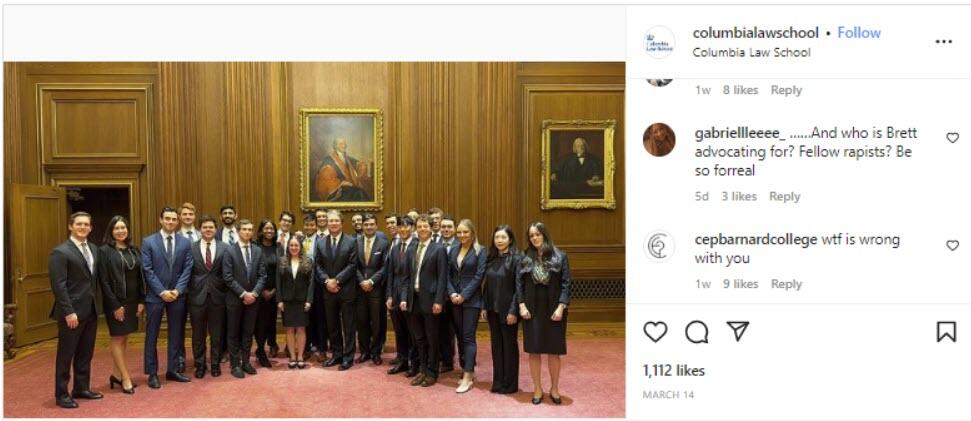
Columbia University law students and alums are in an uproar over an Instagram post that showed students in the Federalist Society meeting with Supreme Court Justice Brett Kavanaugh at the Court.

It would ordinarily be a singular experience for law students to spend time with one of the nine justices.

That is not how it went over at Columbia where some are outraged by the meeting and Columbia’s posting the picture on its social media account.

The Empowering Women of Color group announced it was “withdrawing our participation from Columbia Law School recruiting events.”

Columbia’s own Center for Engaged Pedagogy, simply declared “WTF is wrong with you.”

With the posting, Columbia offered the following description:

“On February 23, members of the Columbia Federalist Society (@clsfedsoc) visited the Supreme Court of the United States to engage in conversation with Justice Brett M. Kavanaugh. During the visit, they learned about the human side of being a justice, the Court’s deliberation process, and how to be an effective advocate. Justice Kavanaugh also answered questions about a few of his most famous opinions.”

That would seem precisely the type of opportunity that a premier law school seeks to make available to its students. However, Kavanaugh remains persona non grata due to his conservative jurisprudence and allegations from his confirmation hearings. It does not matter that Kavanaugh (who was later the subject of an assassination attempt) was never charged with any crime and vehemently denies the allegations of Christine Blasey Ford.

Those opposing any engagement with Kavanaugh raised both his legal viewpoints and the assault allegations.

The Black Law Students Association wrote on behalf of a large number of groups to oppose the posting and to “put the administration on notice” that it is unacceptable for law students to meet with the justice — or for the law school to support it.

“We believe that our school’s choice to platform Justice Kavanaugh is symbolic of a pattern of behavior that our organization does not and will not support and will not be affiliated with. We thank LALSA, NALSA, EWOC, OutLaws, QTPOC, IfWhenHow, APALSA, SALSA, and others, for joining us in this advocacy and struggle. We look forward to continued collaboration. By joining us in this effort, you have all helped put the administration on notice that we have a strong and growing collective.”

The objection to “platforming” Kavanaugh is telling. Deplatforming is a major tool used by the anti-free speech movement.

As discussed earlier, former Dartmouth Professor Mark Bray is the author of a book entitled “Antifa: The Anti-Fascist Handbook” and one of the chief enablers of these protesters. Bray describes Antifa as “a pan-left radical politics uniting communists, socialists, anarchists and various different radical leftists together for the shared purpose of combating the far right.” However, the broader anti-free speech movement shares the same underlying opposition to “platforming” of those with opposing views.

Bray speaks positively of the effort to supplant traditional views of free speech: “At the heart of the anti-fascist outlook is a rejection of the classical liberal phrase… that says I disapprove of what you say but I will defend to the death your right to say it.” He defines anti-fascists as “illiberal” who reject the notion that far right views deserve to “coexist” with opposing views.

Bray says that the protesters do not “see fascism or white supremacy as a view with which they disagree as a difference of opinion.” Their goal is not co-existence but “to end their politics.” Bray and other academics are liberating students from the confines of what they deem the false “allegiance to liberal democracy.” Once freed of the values of free speech and democratic values, violence becomes merely politics by other means. When pushed, Bray stressed that Antifa is only a threat to one side and one party:

“There is a certain political lens that — agree or disagree with the lens — there is an element of continuity in terms of the types of groups targeted. I don’t know of any Democratic Party events that have been ‘no platformed,’ or shut down by anti-fascists. So there is a political lens, people will quibble about what the lens is, who designs the lens, but I don’t think the slippery slope is actually, in practice, nearly as much of a concern as people imagine it would be.”

The Empowering Women of Color group rejected the position of Columbia that it should maintain a neutral and tolerant position on such events or speakers:

We cannot condone complicity with a man who is credibly accused of sexual assault. The insinuation from the Communications Office that the post was neutral and just the Law School’s way of highlighting activities students are participating in is laughable and untrue. A post of this kind, with its caption, is a terrifying stamp of approval.”

In other words, there is no neutrality. Columbia is expected to refuse to participate or recognize any event with the justice, who has never been charged, let alone convicted, of any crime.

However, it is the posting of the Center, as an official office of Columbia University, that is most alarming. The Center account was used to object:  “WTF is wrong with you. Ah yes. Every day I wake up wondering what is the day in the life of someone who strips people’s rights away.”  The Center helps design curriculum and methods of teaching for Columbia and states a mission of instilling “abolitionist” values:

“The CEP invites faculty, students, and staff to participate in a spring discussion group and incubation space focused on using abolitionist thinking to challenge our existing pedagogical practices and the way we live our lives. Participants will use abolitionist values to create personal and pedagogical praxes, come up with actionable plans toward a meaningful material transformation of the world.”

Those “plans” apparently do not involve principles of diversity of thought, due process, or free speech. Unless this is an unapproved posting, the Center is suggesting that law students should not meet with Kavanaugh and that the law school should not support any events with the justice.

I have no problem with the protesting of these groups, though I strongly disagree with their position.

However, the involvement of an office or department of the university is deeply concerning. If this was an unapproved posting, Columbia should make that clear. If it was a statement on behalf of Columbia’s Center, the university should explain how this is consistent with its commitment to free speech and tolerance for opposing views of its students and faculty.

Tyler Durden
Thu, 03/30/2023 – 11:40

via ZeroHedge News https://ift.tt/noLFNY7 Tyler Durden

New York Lawmakers Could Pass the Nation’s Strictest State-Level Rent Control Law by the End of the Week


New York's controversial "good cause" eviction bill could force landlords to go to housing court to defend even the smallest rent increases.

New York might adopt the nation’s strictest state-level rent control law by the end of the week in the name of preventing unfair evictions.

State lawmakers are currently scrambling to assemble and pass a budget bill before an April 1 deadline. The must-pass piece of legislation is often used as a vehicle for enacting controversial pieces of legislation, like bail reform and congestion pricing.

This year, there’s a chance it will include a much-debated “good cause” eviction bill.

A perennial priority for the New York Legislature’s contingent of socialist and progressive lawmakers, good cause eviction would require landlords to renew leases with their current tenants. It would also prevent them from evicting tenants for something other than “good cause”—like engaging in criminal behavior on the property, creating nuisances, violating substantive provisions of their lease, or damaging their unit.

Tenants could also still be evicted for nonpayment of rent, but, crucially, only if their nonpayment isn’t the result of an “unreasonable” rent increase.

“We hear, each one of us who is a legislator, we hear every single day from constituents, saying, ‘I’m facing a rent increase of hundreds of dollars per month.’ That is an eviction,” said Democratic Socialists of America member and New York state Sen. Julia Salazar (D–Brooklyn), the sponsor of the 2023 good cause eviction bill, when an identical measure was being considered last year.

What’s an unreasonable rent increase? According to the current bill text, any rent increase above 3 percent per year or 150 percent of the annual change in the consumer price index would be presumptively considered unreasonable.

Landlords would have to go to housing court to argue a rent increase above that threshold was reasonable. Tenants, meanwhile, could also drag them into housing court by challenging rent increases below that threshold for being unreasonable.

For “small property owners especially, if you’re going into housing court, you’re already losing money,” says Michael Johnson, communications director for the landlord trade association Community Housing Improvement Program (CHIP). “All this becomes a mess. Essentially the judge is determining the rent.”

This separates New York’s proposed good cause eviction bill from other states that have paired rent control with good cause eviction policies. California and Oregon’s rent control laws establish annual allowable rent increases of 5 and 7 percent plus inflation, respectively. (California has a maximum 10 percent rent cap.)

That’s both more generous and more clear than what’s envisioned in New York’s bill.

New York’s good cause eviction supporters will often point to New Jersey as a model. The Garden State also forbids evictions that result from “unconscionable” rent increases, without establishing in statute what exactly counts as unconscionable.

Judges have generally held that rent increases in the 8–10 percent range are in fact conscionable, reported Slate‘s Harry Grabar last year. Johnson says there’s also case law allowing 50 percent increases provided that the hike was merely bringing rents from below-market to market rates.

So in practice, that means New Jersey’s eviction policies give landlords a lot more flexibility to raise rents than what’s being envisioned in New York.

The prospect of having to go to court for a routine rent increase all by itself has some landlords worried, given how long it can take for housing courts to process cases.

“I know people that have open housing court cases that predate COVID,” says Ann Korchak, board president of the group Small Property Owners of New York, and landlord who owns 20 units in New York City.

She also complains there’s a frustrating lack of detail in the four-page bill. “My problems start right there. How monumental this shift would be and how little language is used to address it,” she tells Reason.

That brevity creates a lot of unanswered questions, like whether a tenant with guaranteed lease renewal would be able to sublet his unit at uncontrolled market rates in perpetuity and whether landlords would have the freedom to raise rents by an uncontrolled amount after a vacancy.

If the answer to that last question is no, the result could be good cause eviction keeping a lot of older units off the market because owners wouldn’t be able to pay for needed repairs with rent increases.

A 2019 law tightening New York’s longstanding rent stabilization law—which was co-sponsored by Salazar—limits the ability of landlords to pass on the costs of unit improvements or remove units from rent stabilization entirely.

Korchak says the change has meant she can only raise the rent on one of her rent-stabilized units by about $90 a month. Meanwhile, the unit’s last occupant—who Korchak says was a hoarder who occupied the unit for 50 years—left the apartment in need of as much as $300,000 in repairs and renovations.

With the rent increase limits making financing the repairs difficult, the apartment has sat vacant for 15 months, she says.

The construction of new units could also be imperiled by the bill.

New York’s good cause eviction bill also doesn’t exempt recent construction from its rent controls. (It does exclude smaller, owner-occupied multifamily buildings.)

That’s in contrast to Oregon and California’s rent control laws, which both exempt buildings under 15 years old from rent caps.

When St. Paul, Minnesota, voters passed a rent control ordinance with a 3 percent rent increase cap and no exemption for new housing, developers fled town and construction activity collapsed.

New York City isn’t a market that developers will give up on so easily. But it’s not as if they’re receiving a positive incentive to build more units either.

Unlike New Jersey, New York’s good cause eviction bill doesn’t establish procedures for how a landlord could reclaim a building in order to redevelop it either.

New York’s main real estate lobby REBNY is dead set against the good cause eviction bill. The state’s main pro-development “yes in my backyard” (YIMBY) group, Open New York, has (somewhat controversially) come out in support of it.

“We need to combat discrimination, and we need to come up with ways to actually have the government step in and better provide housing stability,” Annemarie Gray, Open New York’s executive director, told Curbed last month about the group’s support of good cause eviction legislation.

New York Times writer Mara Gay editorialized in favor of good cause eviction last week, in an article that otherwise endorsed new housing supply as a solution to New York’s high housing costs.

“Tenant protections alone will not solve the root problem of the crisis, which is the dire lack of housing supply,” wrote Gay. Yet those expecting New York to fix its dire lack of housing supply while simultaneously passing the toughest rent control law in the country might end up being disappointed.

Johnson says the question of whether the good cause eviction bill is included in the must-pass budget is “the $1 million question.” There’s a chance it will be included alongside housing supply reforms. It could also be excluded and potentially passed as part of some major housing bill later in the session.

The post New York Lawmakers Could Pass the Nation's Strictest State-Level Rent Control Law by the End of the Week appeared first on Reason.com.

from Latest https://ift.tt/NY1MuTt
via IFTTT

Disney Pulled Fast One On DeSantis, Used ‘Royal Lives’ Clause To Preserve Power

Disney Pulled Fast One On DeSantis, Used ‘Royal Lives’ Clause To Preserve Power

Weeks before Florida Governor Ron DeSantis (R) announced a new hand-picked board to take over Disney’s long-held special taxing district in Orlando, the company enacted a new rule which stipulates that any changes to the district must be made to benefit Walt Disney World.

The agreement gives Disney development rights throughout the district, and “not just on Disney’s property,” and gives the company veto authority over any public project in the district.

On Wednesday, the board said it’s considering legal action over the agreement, which was reached between the entertainment giant and the outgoing board days before DeSantis signed February legislation to end Disney’s self-governing status and establish a state-controlled district controlled by a five-member board appointed by the governor.

The Feb. 8 document, first reported by the Orlando Sentinel, grants Disney “prior review and comment” over any changes made to properties in the district, formerly known as the Reedy Creek Improvement District and now known as the Central Florida Tourism Oversight District.

That document also states that the declaration shall be enforceable “in perpetuity” or, if that is deemed unenforceable, “until 21 years after the death of the last surviving descendants of King Charles III, King of England.” –NBC News

According to the BBC, the “royal lives” clause used in the agreement date back to the 17th century but are rarely used.

“I can’t think of a more naked attempt to circumvent the will of the voters and the will of the Florida Legislature,” said newly appointed board member Brian Aungst Jr. “That is offensive to me.”

“This essentially makes Disney the government,” said borad member Ron Peri during Wednesday’s meeting.

According to the chairman of the new board, Martin Garcia, challenging the document would likely result in “protracted litigation,” which could go all the way to the US Supreme Court. The board has hired two outside law firms to explore legal options.

A DeSantis rep said that his office was aware of Disney’s “last-ditch efforts” to give itself “new rights and authorities” in advance of the changes in the special district.

An initial review suggests these agreements may have significant legal infirmities that would render the contracts void as a matter of law,” said DeSantis comms director Taryn Fenske. “We are pleased the new Governor-appointed board retained multiple financial and legal firms to conduct audits and investigate Disney’s past behavior.”

And according to a Wednesday night statement from the district’s acting counsel and newly obtained legal counsel, “The lack of consideration, the delegation of legislative authority to a private corporation, restriction of the Board’s ability to make legislative decisions, and giving away public rights without compensation for a private purpose, among other issues, warrant the new Board’s actions and direction to evaluate these overreaching documents and determine how best the new Board can protect the public’s interest in compliance with Florida Law.”

Disney, meanwhile, tells CNN that it stands by its actions.

All agreements signed between Disney and the District were appropriate, and were discussed and approved in open, noticed public forums in compliance with Florida’s Government in the Sunshine law,” the company said.

Florida’s spat with Disney began after the company opposed a Florida law which prohibits the instruction of sexual orientation and gender identity until the third grade, and allows for “age appropriate” instruction in older grades. In response, DeSantis and Florida GOP lawmakers eliminated the Reedy Creek Improvement District, the special taxing authority which gave Disney control of the land surrounding its Orlando-area properties. Republican lawmakers in control of the state legislature voted to fire the board overseeing the district and gave DeSantis power to name all five replacements. The move also renamed the district as the Central Florida Tourism Oversight District, and reduced its powers.

Except it looks like Disney has gotten the last laugh, for now.

Tyler Durden
Thu, 03/30/2023 – 11:20

via ZeroHedge News https://ift.tt/RhfjCQB Tyler Durden

America’s LNG Problems Hit Banking Crisis Snags

America’s LNG Problems Hit Banking Crisis Snags

By Charles Kennedy of OilPrice.com,

The banking crisis that started with the failure of Silicon Valley Bank (SVB) is putting major U.S. LNG projects at risk, as rising interest rates and supply chain issues introduce financial challenges that have already led to delays.

According to Reuters, two of four new projects that were slated for final investment decisions in Q1 of this year have seen the deadlines extended.

Reuters cited Kpler’s lead natural gas analyst Eleni Papadopoulou as raising “concerns that banking lending activity might be pulled back” and we might see more FID delays due to the banking crisis.

The delays are tied to export terminal projects by NextDecade and Energy Transfer LP, affected by rising interest rates, rising construction and labor costs and the disconnect between natural gas prices in the U.S. and the rest of the world.

NextDecade has delayed construction of its Rio Grande LNG facility in Texas, and is now expecting an FDI by the end of Q2. In filings with the SEC, NextDecade said it had extended its construction agreements to June 15. The cost of the first three trains of Rio Grande LNG is estimated at $11.5 billion, with a 16 million tonnes per year capacity.

According to Reuters, the French bank Societe Generale SA withdrew last year as the lead bank for Rio Grande.

The two projects that are advancing without delay are Venture Global LNG’s project in Louisiana and Sempra Energy’s LNG project in Texas.

Advancement now means that these promising big projects will have to rely much more significantly on advance offtake deals than on developer equity. In other words, the projects that will be able to move forward without any financial snags will likely be those that can contract their entire capacity in advance. That makes offtake deals even more important going forward.

That also means dealing with volatile natural gas prices that make long-term offtake deals risky.  

Tyler Durden
Thu, 03/30/2023 – 11:05

via ZeroHedge News https://ift.tt/mwEczO3 Tyler Durden

Gordon Johnson: Cutting Tesla’s Q1 Delivery Estimates Due To “Demand Crush”

Gordon Johnson: Cutting Tesla’s Q1 Delivery Estimates Due To “Demand Crush”

GLJ Research’s Gordon Johnson was out with a new note this week, slashing his Q1 delivery estimates for Tesla and stating that a “demand crush” he expected to start in Q2 may have started earlier than expected. 

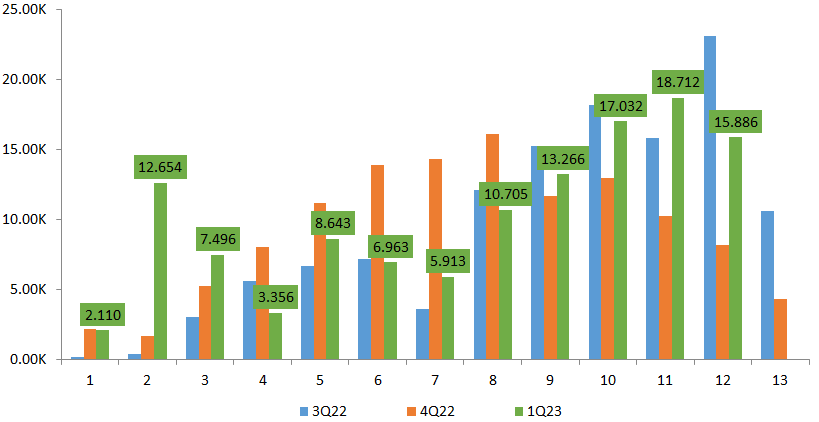
The revision comes as the firm examines new data out of China, with Johnson writing on Wednesday of this week: “Overnight, we got an update on TSLA’s sale of vehicles in China (where demand fell -15.1% week-over-week for the Mar. 20th-Mar. 26th period)”. 

Tesla China Weekly Insurance Registrations

Johnson also cited data from checks in Germany, France and the U.K. as reason to cut estimates for Tesla’s sale of cars in the EU for Q1 to 93,032 vehicles, down from 115,914. The cut represents a -19.7% drop. 

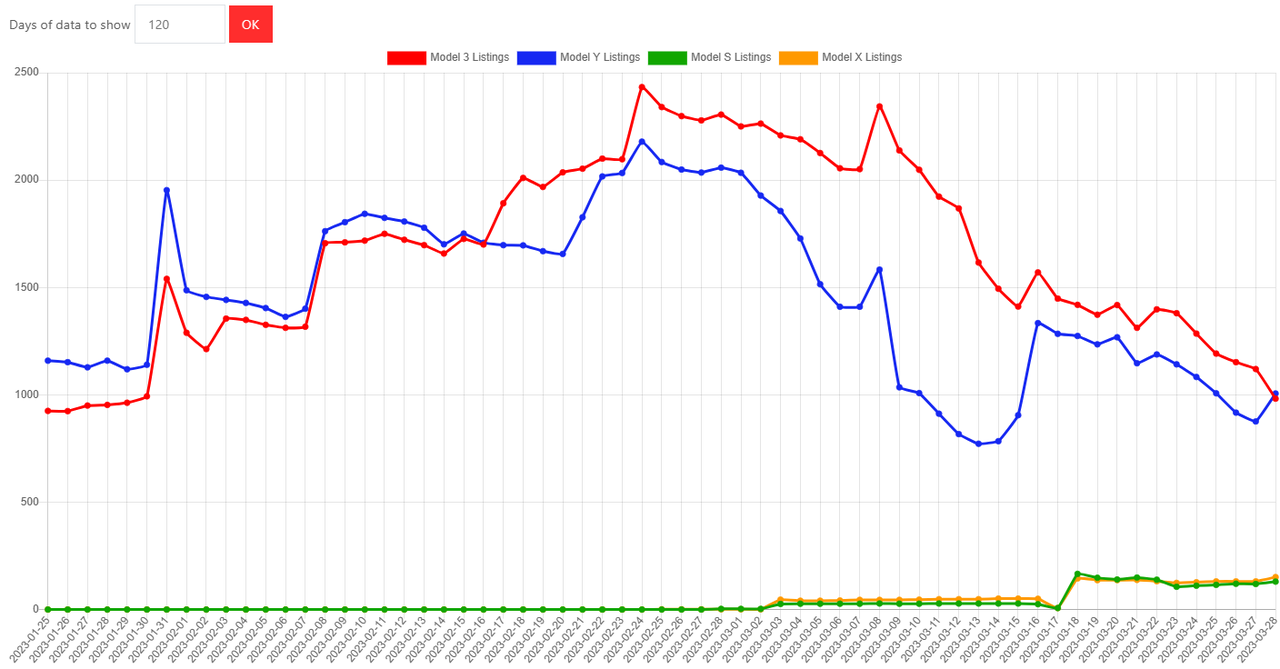
“So why such a big cut?” Johnson writes. “In short, and we apologize for such volatility over the past week in our estimates: (a) we now believe, similar to what happened in Germany last quarter (i.e., buyers of TSLA cars taking advantage of incentives in Germany, then shipping those cars to other EU countries, thus artificially boosting sales in Germany), demand in Norway + Netherlands + Spain + Sweden is trending stronger than demand in Germany + France + U.K., and (b) with inventory of TSLA’s best-selling Model Y crossover creeping back up in the EU as of 3/28/23, the Q2 demand “crush” has started early.”

Johnson adjusted his China delivery estimate to 132,948 from 135,382 “to reflect weaker-than-expected sales for the week of Mar. 20th-Mar. 26th” and has kept his U.S. estimates flat at 162,714 and his Canadian estimates flat at 9,400. 

Tesla New Europe Inventory – Individual Models

He says that consensus for the quarter currently sits at 418,756, suggesting a “beat” is on tap. But Johnson would look at such a figure starkly differently, telling his readers: “with our model pointing to an avg. 1Q23 price cut across all of TSLA’s cars of -$6.0K/car, or -11.7% QoQ, vs. sales growth of just +5.2% QoQ, THIS IS NOTHING SHORT OF A DISASTER.”

As he stated earlier in the year on a live debate with Ross Gerber, Johnson continues to expect earnings to deteriorate despite the delivery numbers. 

“Even if TSLA gets to 1.8mn cars sold in 2023 (i.e., 450K cars/quarter of sales), things still look (very) bad from an earnings perspective. Why? Well, TSLA’s 4Q22 net profit was $3.727bn on 405,278 cars sold, or = $9,196/car in net profit (we remind our readers that this net profit includes ALL EV credits and FSD from 4Q22, thus assumes new credits replace old ones and FSD revenue recognition continues at the pace seen in 4Q22 in every quarter in 2023; we also assume the other business segments contribute little to net),” he writes.

He continued: “Consequently, given TSLA’s 2023 price cuts, across all its cars, have averaged ~$6,000/car, assuming TSLA gets $1,500 recouped via cost savings/price hikes (and also doesn’t cut prices anymore throughout the year), its profit per car for the full year would decline by $4,500.”

Johnson’s estimate is for $2.67/share in EPS versus consensus of $3.98/share: 

So, taking an assumed 2023 profit per car of $9,196, then subtracting $4,500, one arrives at a new profit per car of $4,969. Then, applying the low-end of TSLA’s guidance for 1.8mn cars sold in 2023, or $4,969 * 1.8mn, one arrives at a 2023 net profit of $8.452bn. Finally, dividing this number (i.e., $8.452bn) by TSLA’s shares outstanding of 3.164mn, one arrives at an EPS of $2.67/share (vs. the current Consensus est. of $3.98/share, suggesting sharp cuts to TSLA’s earnings are on tap through 2023), or 71.8x earnings, and a -27.0% fall in EPS YoY. Consequently, even with a ~450K delivery number, the 2023 outcome for TSLA’s stock, as Consensus is forced to reckon with falling earnings, is likely (much) lower.

Tyler Durden
Thu, 03/30/2023 – 10:50

via ZeroHedge News https://ift.tt/8oBkNcn Tyler Durden