It’s Anything But Quiet Out There

It’s Anything But Quiet Out There

By Michael Every of Rabobank

Miss the Basis And The Points

I concluded yesterday that it looked to be a quiet day, but we don’t live in quiet times. Indeed, here are just some of the key developments over the past 24 hours:

  • New Zealand may join the non-nuclear part of AUKUS: can they have their cake and eat it?

  • China and Brazil have ‘reached a deal to trade in their own currencies, ditching the US dollar’, as South Africa’s Foreign Minister names Saudi Arabia, UAE, Egypt, Algeria, Argentina, Mexico, and Nigeria as wanting to join BRICS: the list of former pro-West non-aligned states grows longer.

  • Saudi Arabia applied to join the Shanghai Cooperation Organisation, taking it further away from pro-West – although India is in it too, so it isn’t all a Beijing love-in.

  • Moscow is to host a Syria-Turkey-Iran-Russia meeting – isn’t one a member of NATO?

  • Germany is finally set to send EUR12bn in military aide to Ukraine.

  • The UK is poised to join the CPTPP alongside Australia, Canada, Japan, Mexico, New Zealand, Singapore, Brunei, Chile, Malaysia, Peru and Vietnam, pivoting trade towards the Indo-Pacific: can that help empty shelves in UK supermarkets and grocery price inflation of nearly 20%? Could the USMCA be next?

  • Kenya’s President, who just got to buy Saudi oil in local currency and said people don’t need dollars anymore, says of Ukraine: “This is not about the North or the South. It’s between what’s right and wrong,” condemns the war (“This… is not de-escalating. In fact, if anything it’s escalating.”) and Russian nuclear threats, calls on China to do more, but also attacks the West for its long neglect of the Global South (“When it’s our issues, it’s our issues. When it’s other people’s issues, it’s global issues.”)

  • Low-key celebrations of the 75th anniversary of the post-WW2 Marshall Plan which built the foundations of the current West on US largesse just took place. The US this week holds another round of its marshmallow plan ‘Summit of Democracies’, which the Financial Times notes contains some decidedly illiberal democracies, excludes others, and stands vs. three quarters of the world population now living under autocracies vs. less than half five years ago, which they call a “Democratic recession”. I call it another echo of the 1930s.

  • On which, The Wall Street Journal says new US chip rules will force companies to choose between the US and China, with subsidies for US work and tech restrictions vs. China, and that the rules are tougher for Asian firms which have invested billions on fabs in China. Cargill said it would take a further step back from the Russian market by stopping handling Russian grain from its export terminal from July, although its shipping unit will continue to carry grain from Russian ports.

  • More worryingly, Foreign Policy magazine sees John Pomfret, former Beijing Bureau Chief for The Washington Post, and Matt Pottinger, Chair of the China program at the Foundation for Defence of Democracies and Deputy National Security Adviser from 2019-21, list a series of recent developments which Wall Street failed to follow while looking only at basis points to argue: ‘Xi Jinping Says He Is Preparing China for War – The World Should Take Him Seriously’. This is not a call that (more) war looms, but a –repeated– call that we can logically expect to see much more of a shake-up global trade and capital flows.

If you too are only focusing on the basis-points trees so cannot see the underlying basis for these headlines and the key points being made, consider two recent tweets from national security/IT expert @matthew_pines, which condense many of the arguments made here repeatedly.

“The “world system” is so tightly coupled that it’s not clear any particular “bloc” is well poised for its violent disintegration. That said, the dominance of capital (G7) is advantaged in peacetime, while raw commodities (OPEC+) & material production (China) are key in wartime.” In other words, there is huge pain ahead if things continue to trend as they are, for both sides, but Western capital markets don’t matter much if you don’t produce things when bullets start flying. The Pentagon agrees: and would Fed zero rates and QE help if BRICS+++ say “We don’t Truss the West now”?

“US geopolitical dominance used to be a function of deterrence. Now, it’s a matter of compellance. USD’s GRC [Global Reserve Currency] status was useful to the former but has eroded the hard power necessary to credibly wield the latter. The strategic game has changed & USD now hurts more than it helps.”

Pines is saying the US would arguably *be better off* with mercantilism from a grand strategy perspective rather than allowing geopolitical rivals to use free trade, free capital flows, and the liberal world order to weaken it, deliberately or inadvertently, to the point where its military hegemony is hollowed out – as today. We argued that in ‘Thin Ice’ (2016), ‘The Great Game of Global Trade’ (2017), ‘On Your Marx’ (2017), and ‘The World in 2030’ (2020), among other reports.

Economics professor Michael Pettis agrees, adding:

“Financial markets have grown so large relative to the underlying economies that regulators have no choice but to intervene to protect failing banks, even though this only reinforces further growth in the financial system. Perhaps the solution is not to keep saving the banks, nor even to let them fail, but to take longer-term measures to cut down the size and important of the financial system in the US and global economies. Banks should be cut down, different sectors of the financial system segregated, financial transactions taxed, and capital controls implemented that limit massive hot money flows. Critics will say that these measures will reduce the efficiency of the financial system, and they are right, but increased efficiency in the financial system has long ago stopped meaning increased efficiency in allocating capital productively, and has meant instead increased efficiency in financial flows.”
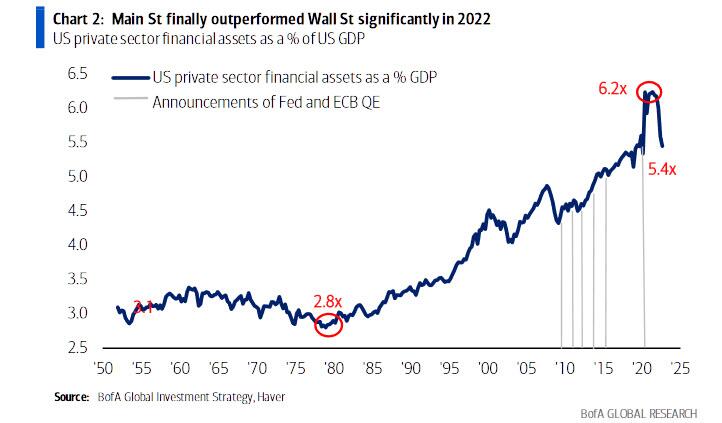
Of course, one doesn’t need to worry about an imminent collapse in Wall Street, but geopolitical winds are not blowing in their direction. Neither does one need to fear an imminent collapse in the US dollar as GRC, even if stronger headwinds are coming its way according to the headlines.

  • China’s Belt and Road Initiative (BRI) has ‘internationalised’ CNY only in that huge (now bad) loans made in CNY were de facto export credits to buy excess goods from China, while BRI debt repayments are made in US dollars(!) Likewise, Brazil or Saudi, or others, may settle in CNY: and then they immediately sell their CNY for dollar assets.
  • We showed in ‘Why Bretton Woods 3 Won’t Work’ (2022) that an anti-US BW3 bloc does not balance its trade internally by value or structure: BW3 can sell commodities to China; but unless they absorb the exports China now sends to the West, or China runs trade deficits like the US, then it can’t happen. Instead, we all just return to global mercantilism – which is happening, is inflationary, and ultimately suits the US – just not Wall Street (either in terms of mercantilism or monetary policy). When BW3 players no longer hold their official and unofficial savings in USD assets (if not Treasuries, then agencies or stocks, or property), and want to stash cash in Moscow and retire in China, then things are changing.
  • Meanwhile, the Fed can keep rates higher for longer (with acronyms and no mark-to-market for its banks alone, and deposit guarantees only for USD in the US) to punish BW3 economies.

However, the geopolitical fat tail risks of a tipping point moving us towards a deeper bifurcation, led by either Chinese *or* US actions, are a real basis for points of concern, if you pay attention.

If you really want to worry, The South China Morning Post reports: ‘Chinese team behind extreme animal gene experiment says it may lead to super soldiers who survive nuclear fallout’. They add: “Modified human embryonic stem cells showed supernatural resistance against radiation, according to paper by Academy of Military Sciences team in Beijing – Shanghai-based scientist says study may open a can of worms, particularly when funding is involved.”

You think that story just appeared out of nowhere in the Chinese press, or that this is a Watergate moment?

Or pay attention to Elon Musk and 1,000 tech experts making a public call for a temporary pause of at least six months on training AI systems exceeding GPT-4, which is already terrifying some in terms of how far it exceeds what Chat-GPT could do just months ago. They argue:

“AI systems with human-competitive intelligence can pose profound risks to society and humanity, as shown by extensive research and acknowledged by top AI labs. As stated in the widely endorsed Asilomar AI Principles, Advanced AI could represent a profound change in the history of life on Earth, and should be planned for and managed with commensurate care and resources. Unfortunately, this level of planning and management is not happening, even though recent months have seen AI labs locked in an out-of-control race to develop and deploy ever more powerful digital minds that no one –not even their creators– can understand, predict, or reliably control.

Contemporary AI systems are now becoming human-competitive at general tasks, and we must ask ourselves: Should we let machines flood our information channels with propaganda and untruth? Should we automate away all the jobs, including the fulfilling ones? Should we develop nonhuman minds that might eventually outnumber, outsmart, obsolete and replace us? Should we risk loss of control of our civilization? Such decisions must not be delegated to unelected tech leaders. Powerful AI systems should be developed only once we are confident that their effects will be positive, and their risks will be manageable.”

It suddenly seems very small beer that Canada is sending billions in checks to households to help with grocery price inflation, as if we learned nothing from 2020 and 2021.

Or that asset x went up or down y or z bps yesterday.

Tyler Durden
Thu, 03/30/2023 – 10:30

via ZeroHedge News https://ift.tt/KNcjOaQ Tyler Durden

Michael ‘Big Short’ Burry Admits “I Was Wrong To Sell”

Michael ‘Big Short’ Burry Admits “I Was Wrong To Sell”

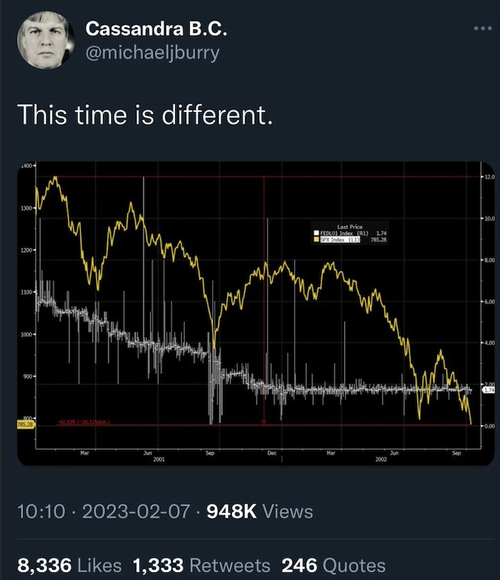
On Jan 31st, the “Big Short” Michael Burry tweeted one word: “sell.”

Burry promptly deleted not just the tweet but his entire account, only to reactivate it one week later for yet another sarcastic tweet, suggesting that this time was no different than the dot-com crisis (the tweet has also since been deleted).

However, as we noted a week later, Mr. Burry did not “sell”.

It has been quite a ride for the market since ‘Big Short’ “sold” with an initial spike after he tweeted, a significant sell-off that climaxed in the collapse of several banks and a re-establishment of Fed balance sheet expansion (and moar bailouts), which prompted a rebound back to where we started.

And that is perhaps why Mr. Burry tweeted today “I was wrong to say sell.”

This admission of an error is something seldom seen on Wall Street, so Burry deserves respect for owning the trade (and realistically, he did not ‘lose’ you money on his recc.)

So, let’s summarize:

If it wasn’t for this big ‘Fed-funded’ squeeze, he would, of course, been very right.

Who could have seen this ramp coming?

Tyler Durden
Thu, 03/30/2023 – 10:14

via ZeroHedge News https://ift.tt/4mbAC0H Tyler Durden

Transgender Shooter’s Manifesto Will Be Released Publicly

Transgender Shooter’s Manifesto Will Be Released Publicly

Authored by Paul Joseph Watson via Summit News,

The transgender shooter’s manifesto will be released publicly, but only after the FBI has combed through it to build a psychological profile of the killer.

28-year-old Audrey Hale was shot dead by police after killing three children and three adults at The Covenant School, a private Christian school for students aged three to 11.

Authorities say Hale deliberately targeted the school after considering but then rejecting two other public school targets because they had better security.

Police initially said Hale’s transgender identity was a factor in motivating her rampage, but it seemed the manifesto she left might remain secret after lobbying from LGBT groups.

However, Nashville Council Member Robert Swope told the New York Post that the manifesto will be released publicly after all.

“The manifesto is going to be released. It’s just a matter of when. There are some incredibly brilliant psychological minds and psychological analysts combing through her entire life,” said Swope.

The FBI’s Behavioral Analysis Unit is working “in tandem with” the Metro Nashville Police Department (MNPD) to complete “a very in-depth analysis of certain aspects of the shooter’s life,” Swope added.

Speculation has raged as to whether Tennessee’s ban on hormone treatments and puberty blockers for children, as well as its restrictions on drag queen shows, were motivating factors for Hale.

As we highlighted yesterday, the media narrative has switched to there being “no known motive” behind the attack, an explanation presumably based on the expectation that the manifesto would remain hidden.

This would conveniently absolve the press from having to scrutinize whether elements of the trans activist movement has become violently radicalized in recent years.

However, a new narrative has emerged that Hale’s rampage was a backlash to her trans identity being rejected by her parents, another callous angle that borderline attempts to justify the attack.

A Daily Mail report suggests Hale’s parents refused to respect her new ‘he/him’ pronouns and that the shooter would leave the home to change outfits.

According to the report, Hale’s parents “just didn’t accept” her new lifestyle.

Respondents to the story savaged the Daily Mail for appearing to place more blame on the parents than on Hale herself.

“Ah yes, blame the Christians for the mass shooting. FFS can media like @DailyMail get anymore disgusting and deranged?” one Twitter user asked.

“You’re not even trying to hide your anti-Christian bigotry,” responded another.

*  *  *

Brand new merch now available! Get it at https://www.pjwshop.com/

In the age of mass Silicon Valley censorship It is crucial that we stay in touch. I need you to sign up for my free newsletter here. Support my sponsor – Turbo Force – a supercharged boost of clean energy without the comedown. Get early access, exclusive content and behind the scenes stuff by following me on Locals.

Tyler Durden
Thu, 03/30/2023 – 09:50

via ZeroHedge News https://ift.tt/ZmlU7aG Tyler Durden

“It’s Not Rocket Science” – RH CEO Warns “This Is Not Normal, This Is Dangerous”

“It’s Not Rocket Science” – RH CEO Warns “This Is Not Normal, This Is Dangerous”

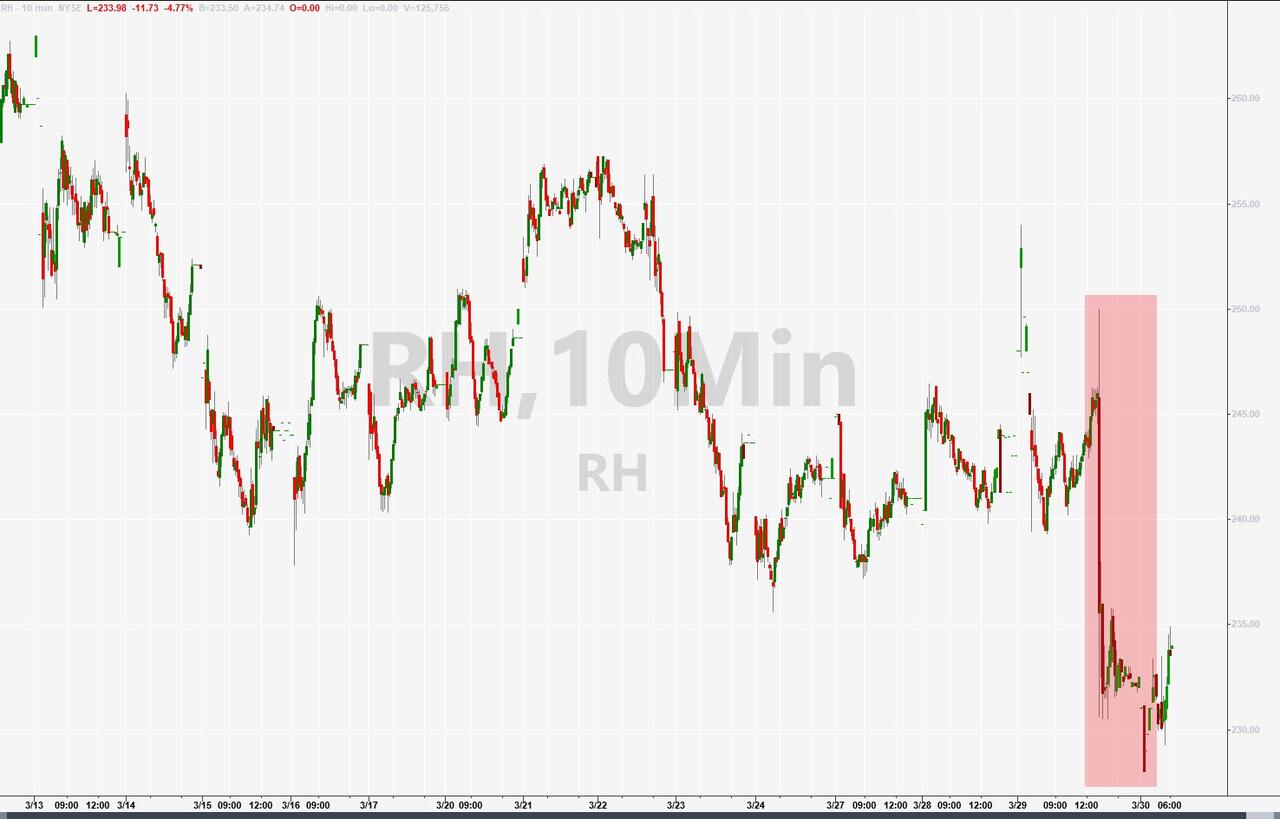
RH shares are down around 5% in the pre-market as the upscale home furnishings company issued weaker-than-expected full-year guidance for FY23

According to the letter to shareholders, business conditions for RH are anticipated to remain challenging for the “next several quarters” and maybe even longer due to a rapidly weakening housing market, the uncertainty caused by the recent banking crisis, lapping of COVID-19 driven sales and backlog reductions.

“…, inflation that was thought to be “transitory” is now deemed “persistent” by the Federal Reserve, resulting in a record rise in interest rates triggering a dramatic decline of the housing market, with luxury homes sales down 45% in the most recent quarter versus a year ago. Add to that an underperforming stock market, and a banking crisis no one saw coming and the data points to business in our sector likely getting worse before it gets better,

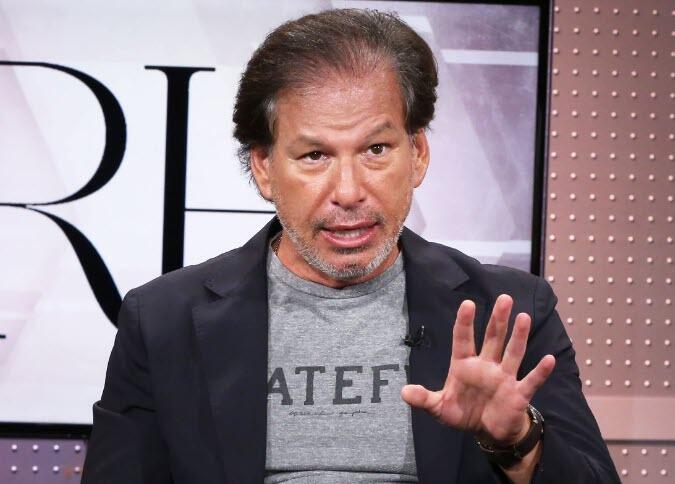
But, as always, it’s what RH CEO Gary Friedman had to say during the earnings call that caught most analysts’ ears…

In Q3 of last year, he jabbed at policymakers: “Yellen Was Massively Blind” – RH CEO Routs ‘Slow & Wrong’ Policymakers For Making Things Worse”

In Q4 of last year, he warned about the economy: “There Is No Soft Landing” – RH CEO Warns Housing Market “Looks More Like A Crash-Landing”

And now, in Q1, the comfortably outspoken Friedman turns up the threat amplifier to ’11’…

As the Q&A began, a question about a lower margin outlook prompted this:

“It’s not rocket science to know this is a really bad time,” according to a transcript from Bloomberg.

“The fact is, we’ve been in a massive housing recession for the past year,” Friedman continued.

“The data points to business in our sector likely getting worse before it gets better,” Friedman said, signaling additional headwinds from bank credit contraction ahead.

“I’ve been on the planet for long enough to know this is not normal, and this is dangerous,” he said.

He worries about the consumer (which is important given the high-end nature of his company’s products might suggest some insulation from that threat)…

“…the unsettling feeling as being a person on a Saturday afternoon is watching Warriors basketball game at the news cut to align formed around your local bank while the bank was sending hourly e-mails trying to tell you that they committed to serving you. It’s very unsettling…

And more pointedly, he exclaimed that:

“Anybody that thinks it’s not a big deal, the three banks went down… is living in a — with a euphoric view of the world.”

Finally, Friedman offered some advice to policymakers:

“Just land the plane on the other side, whether it’s hard, whether it’s bumpy,” Friedman said.

“Just don’t completely crash. A complete crash would look like the ’70s and the ’80s. That will take over a decade to recover from.”

Subtle, and scary, as ever… but hey, just keep listening to the MSM and the Biden admin about how strong the consumer is… (remember how ‘sound’ the US financial system was a month ago too?)

Tyler Durden
Thu, 03/30/2023 – 09:30

via ZeroHedge News https://ift.tt/a3r2p8R Tyler Durden

Minnesota Town Evacuated After Train Carrying Ethanol Derails, Bursts Into Flames

Minnesota Town Evacuated After Train Carrying Ethanol Derails, Bursts Into Flames

A freight train carrying ethanol derailed earlier this morning, prompting the evacuation of residents from a small town near Minneapolis, reported Fox News.

Burlington Northern Santa Fe (BNSF) Railway said 22 cars derailed around 0100 local time near Raymond in Kandiyohi County. Of the derailed cars, some were hauling ethanol and corn syrup liquid that caught on fire. 

As a result of the incident, the Kandiyohi County Sheriff’s Office evacuated the nearby town. Here’s what they said:

“Fire departments from Raymond and numerous area departments responded as several of the derailed tankers started on fire and were determined to be carrying a form of ethanol and others with a corn syrup liquid.

“An evacuation area of ½ mile was established around the crash site and law enforcement officers and other EMS assisted with that evacuation.

“Residents were instructed to leave their homes and an emergency collection site for those with nowhere to go was established at the Central Minnesota Christian School building in nearby Prinsburg, Minnesota.” 

Footage of the incident published on social media shows flames shooting from the tankers carrying ethanol — an eerie sight considering the East Palestine train disaster is still fresh in everyone’s mind. 

This incident occurred just hours after a Canadian National Railway Company train derailed near Pittsburgh on Wednesday and only days following a 70-car train carrying hazardous materials derailed in North Dakota on Sunday.

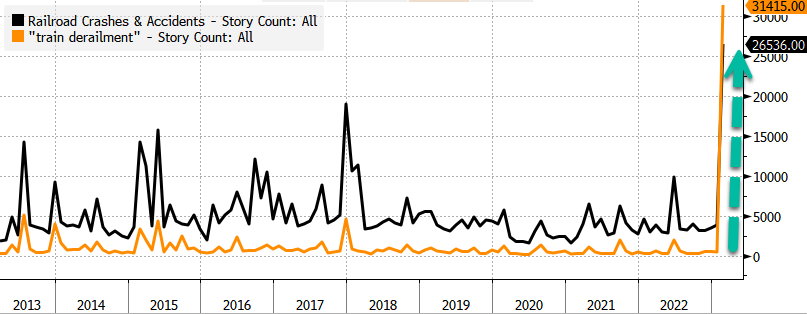
What has caught our attention is the increasing number of news stories on train derailments throughout the nation. Bloomberg data reveals that reports on derailments have reached an all-time high. 

The cause of that Minnesota train derailment remains under investigation. 

Tyler Durden
Thu, 03/30/2023 – 09:18

via ZeroHedge News https://ift.tt/aAw9qDU Tyler Durden

Senators Ask DEA To Stop Buying Its Way Around Civil Liberties


close up of chest of DEA agent with DEA logo and badge

“DEA agents were regularly paying for and receiving private customer information.” Rather than obtain a warrant for some mailed packages or consumer travel data, Drug Enforcement Administration (DEA) agents paid employees at private companies and other government agencies to simply hand over information. In a March 29 letter, Sens. Ron Wyden (D–Ore.) and Cynthia Lummis (R–Wyo.) asked the Department of Justice (DOJ) to put an end to this practice.

Wyden and Lummis noted that the DEA “has for years paid confidential sources, commonly known as informants, employed by other U.S. government agencies and companies as a means to access data held by those agencies and companies rather than using compulsory legal processes, such as an administrative subpoena or warrant, to request that data.”

This practice was first revealed in 2014, with more information coming out in a 2016 Office of the Inspector General (OIG) audit. That audit revealed that agents “were paying travel and parcel industry employees millions of dollars to covertly obtain Americans’ data, which the DEA could have readily obtained through a subpoena or court order,” noted Wyden and Lummis.

Following these revelations, the DEA said it had banned agents from paying Amtrak employees, employees of other quasi-government entities, and government employees for private information.

But “the Congressional Research Service informed Senator Wyden’s office that DEA officials said the agency does not apply the prohibition on payment for information obtained in the course and scope of a source’s employment to employees of private companies,” Wyden and Lummis wrote:

The OIG found that DEA agents were regularly paying for and receiving private customer information from these sources. One agent reportedly received daily passenger manifests for buses traveling to and from a specific station or manifests of all passengers who purchased bus fare in cash. Another agent received passenger itineraries, ticket and baggage information, origin and departure airports, connecting flights, dates of birth and seat numbers from an airline industry source. The OIG found that agents would establish confidential sources “solely because the sources have access to private company databases and facilities.”

The OIG also revealed that one DEA Special Agent recruited a parcel industry source who had unique administrative privileges to open packages en route to their destination. This source would search packages and report to the agent when packages contained currency. At the agent’s request, the source would rebox the package to be sent to the agent. While the government would normally need a warrant to open a package sent by the Postal Service, these packages in the care of a private package delivery company were inspected and shared with the DEA with no judicial oversight.

Wyden and Lummis want the DOJ to explicitly ban such practices not only at the DEA but at its other component agencies, including the FBI, the U.S. Marshals Service, the Bureau of Alcohol, Tobacco, Firearms, and Explosives, and others. They also asked the department to provide unclassified answers to a number of questions about such practices by May 8.

“Over the past several years, law enforcement agencies like the DEA, [Customs and Border Protection], and the FBI, as well as sections of the military, have been buying data from data brokers,” reports Vice. “This has included smartphone location data collected by ordinary apps.”

A trove of Department of Homeland Security (DHS) records examined by the American Civil Liberties Union (ACLU) recently revealed that DHS agents spent millions purchasing cellphone location data. Such agents are “sidestepping our Fourth Amendment right against unreasonable government searches and seizures,” commented the ACLU.


FREE MINDS

Senate Republicans spar over TikTok, free speech. Sen. Josh Hawley (R–Mo.) yesterday tried to force a vote on his bill to ban TikTok—one of two competing measures aimed at the video app and its parent company, ByteDance. But Hawley “was blocked by a fellow Republican as lawmakers in both chambers are still trying to figure out what action, if any, is appropriate against the social media app,” reports the New York Post.

Repeating the recent favorite hack trope that TikTok is “digital fentanyl,” Hawley said that a ban would send “the message to Communist China that you cannot buy us.”

“Speech is protected whether you like it or not,” pushed back Sen. Rand Paul (R–Ky.).

When Hawley tried to suggest that banning TikTok was OK because there’s no First Amendment “right to espionage,” Paul told Hawley he was “unlikely to take First Amendment advice from someone who believes that the First Amendment doesn’t protect the Communist Party…We should beware of people who peddle fear. We should beware of people who peddle half truths.”


FREE MARKETS

Americans want to cut government spending…but can’t agree on what to cut:


QUICK HITS

• The Senate successfully voted to finally end two authorizations for the use of military force in Iraq:

• “The Biden administration is fighting a Democratic-led effort to make abortion pills more accessible even as it simultaneously opposes a GOP-led effort to ban the drugs nationwide,” notes Politico.

• The Food and Drug Administration (FDA) has approved over-the-counter sales of the opioid overdose antidote Narcan.

• The FDA is meeting in May to discuss approval of an over-the-counter birth control pill.

• Fewer than half of Senate Democrats voted with Republicans to officially end the COVID-19 national emergency.

• Headline of the week? “Winnie The Pooh Escapes Copyright Hell, Grabs Some Weapons, And Immediately Gets Kicked Out Of Hong Kong.”

• North Carolina will no longer require people to get a permit from a local sheriff before buying a gun.

• “Seven California Highway Patrol officers and a nurse have been charged with involuntary manslaughter nearly three years after the in-custody death” of Edward Bronstein, “who was pulled over for a traffic stop in Los Angeles County and repeatedly said ‘I can’t breathe’ before losing consciousness,” reports ABC News.

• There are always new drugs to drug war, sigh.

• Immigration to America’s most populous counties hasn’t been able to stanch the flow of people from urban centers “to suburbs, exurbs and other regions of the country,” notes The New York Times.

• Blame regulations, not foreign buyers, for America’s high housing costs, writes Reason‘s Christian Britschgi.

The post Senators Ask DEA To Stop Buying Its Way Around Civil Liberties appeared first on Reason.com.

from Latest https://ift.tt/OTxGVeI
via IFTTT

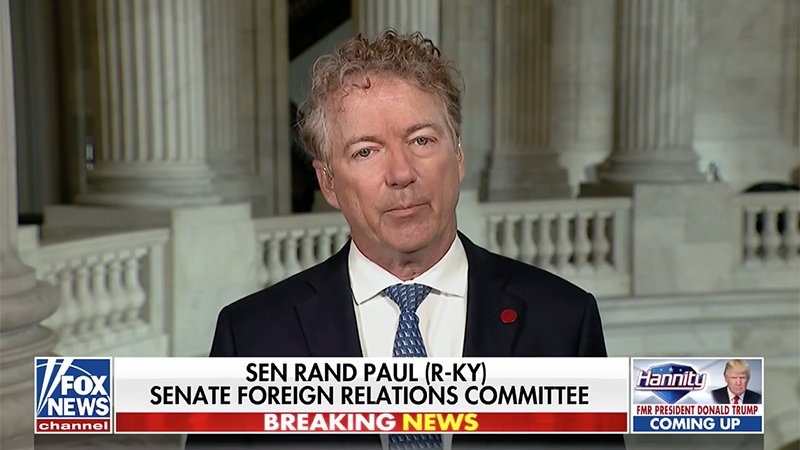
Watch: Rand Paul Claims Fauci Is Not Really Retired

Watch: Rand Paul Claims Fauci Is Not Really Retired

Authored by Steve Watson via Summit News,

Senator Rand Paul has claimed that Anthony Fauci is still working for the government in order to take advantage of federal legal protection against claims that he engaged in a cover up on the origins of the coronavirus pandemic.

Appearing on Hannity, Paul stated “There is a massive coverup going on and the lead in all of the coverup has been Fauci.”

The Senator continued, “We now have information that he is still working for the government even though he says he is retired.”

“It is my belief that he is worried about being indicted and so he continues to work so he will get legal protection under the federal government,” Paul asserted.

“This is wrong on every level of it and we are going to get to the bottom of it. We are sending a letter to find out what the actual status of his employment is,” Paul added.

Is he retired? Is he still getting a federal detail? There is a lot of stuff going on, but at the top of every sort of concern we have it is Tony Fauci,” the Senator further noted.

Watch:

Last week, Paul accused Anthony Fauci of ‘weaponising’ government to get people on board with a COVID lab leak cover up.

This guy weaponized the NIAD. He weaponized it to get his supporters,” Paul emphasised, adding “At first, they said, ‘My goodness. It came from a lab.’ And then, all of a sudden, they changed their mind. They got more money. They got more grants.”

“He used that grant-making authority — who gets it — and he weaponized government to get what he wanted,” Paul urged, adding “and that was the cover-up.”

*  *  *

Brand new merch now available! Get it at https://www.pjwshop.com/ 

ALERT! In the age of mass Silicon Valley censorship It is crucial that we stay in touch.

We need you to sign up for our free newsletter here.

Support our sponsor – Turbo Force – a supercharged boost of clean energy without the comedown.

Also, we urgently need your financial support here.

Tyler Durden
Thu, 03/30/2023 – 09:10

via ZeroHedge News https://ift.tt/0zpa5Rq Tyler Durden

Q4 GDP Comes In Below Estimates On Sharp Slowdown In Personal Spending Ahead Of Looming Credit Crunch

Q4 GDP Comes In Below Estimates On Sharp Slowdown In Personal Spending Ahead Of Looming Credit Crunch

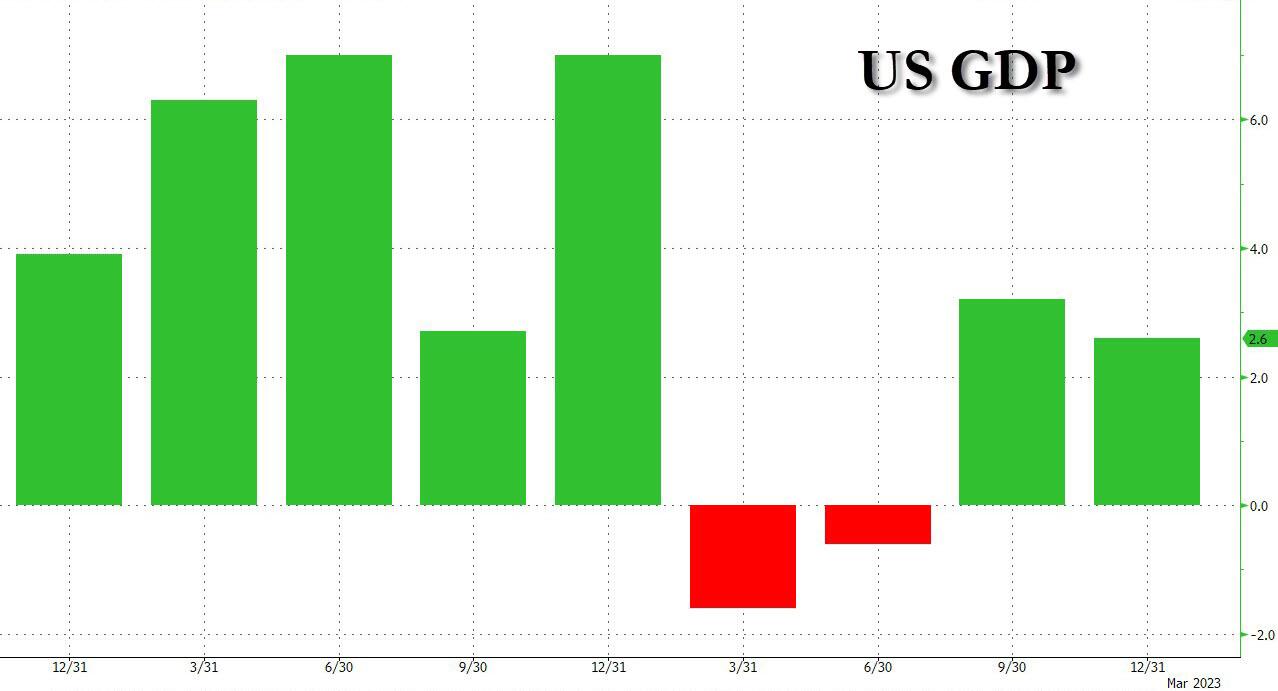
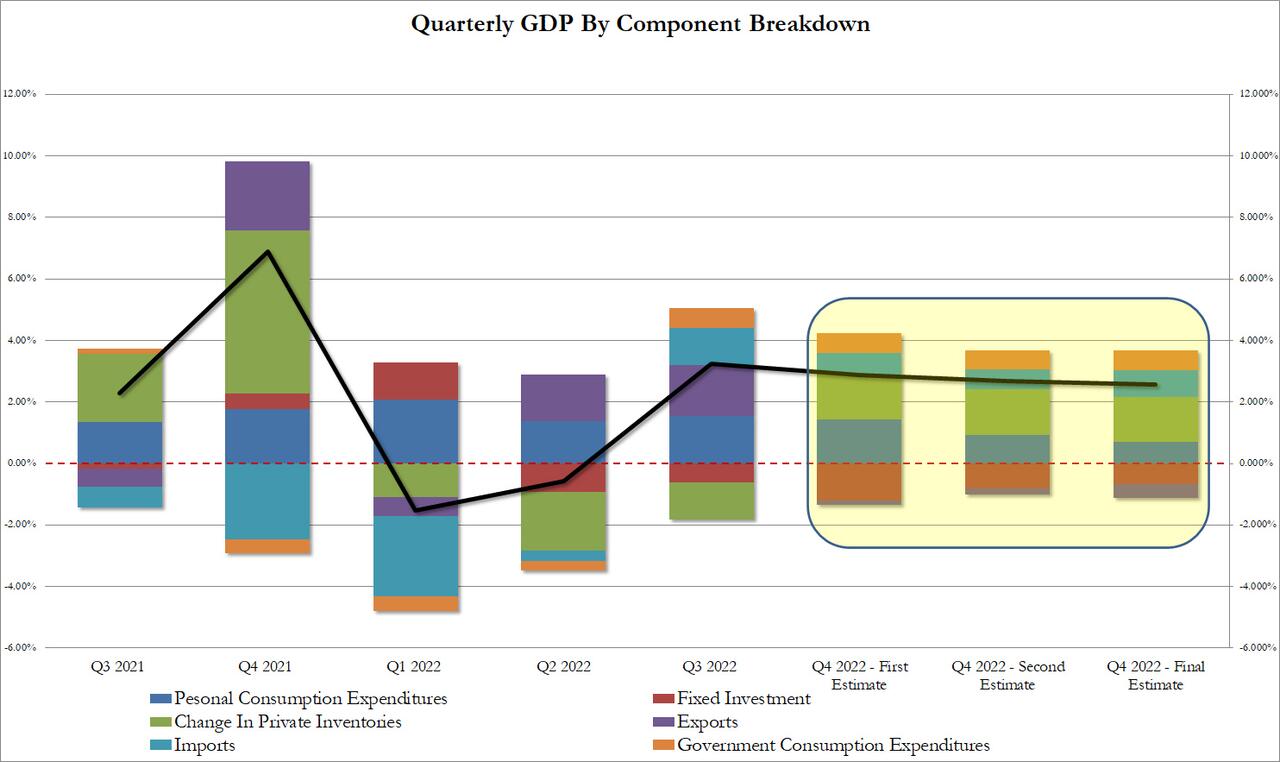
In the least relevant data point on what will otherwise be a quiet day on the data front, moments ago the BEA reported its third and final Q4 GDP estimate (to be fair this number will still be revised numerous time in coming years), and it continued the trend of declines, having printed 2.9% in the first estimate in January (above the 2.6% estimate), it then dropped to 2.7% in the second estimate in February, and it is now down again to 2.6%, exactly where the original Q4 GDP estimate was primarily reflecting downward revisions to exports and consumer spending, , and a master class in how you can “buy” two quarters of “above average” growth before converging with the original estimates. And for those keeping track, the most recent consensus estimate for Q4 GDP was 2.7% so technically we missed.

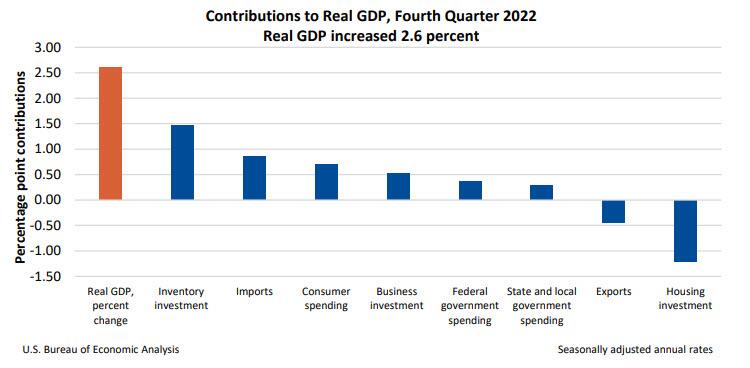
According to the BEA, the Q4 compared to Q3 increase in real GDP reflected increases in inventory investment, consumer spending, business investment, federal government spending, and state and local government spending that were partly offset by decreases in housing investment and exports. Imports, which are a subtraction in the calculation of GDP, decreased.

The increase in private inventory investment was led by manufacturing (mainly petroleum and coal products) as well as mining, utilities, and construction industries (led by utilities).

  • The increase in consumer spending reflected an increase in services (led by health care as well as housing and utilities) that was partly offset by a decrease in goods (led by “other” durable goods, specifically jewelry).
  • The decrease in housing investment was led by new single-family housing construction and brokers’ commissions

Meanwhile, comparing the final Q4 GDP to the second estimate, it was revised down 0.1% “primarily reflecting downward revisions to exports and consumer spending. The price index for GDP increased 3.9 percent in the fourth quarter, unrevised from the previous estimate.”

A look at the detailed breakdown:

  • Personal consumption contributed just 0.70% to the bottom line GDP, down notably from 0.93% in the 2nd estimate and 1.42% in the first; it was also the lowest since the covid lockdowns
  • Fixed investment (capex spending) continued to detract from GDP, and the final estimate was -0.68%, a modest improvement from the -0.81% in the second estimate.
  • Change in private inventories was flat vs the previous estimate at 1.47%, and a solid reversal from the -1.19% drop in Q3. Still, the number was a massive 57% of the total GDP contribution.
  • Net exports was fractionally lower at 0.42% (exports of -0.44% offset by imports of 0.86%), compared to 0.46% in Q3.
  • Finally, government contributed 0.65%, up from 0.63% in the second estimate, and matching the highest government contribution since Q1 2021.

And visually:

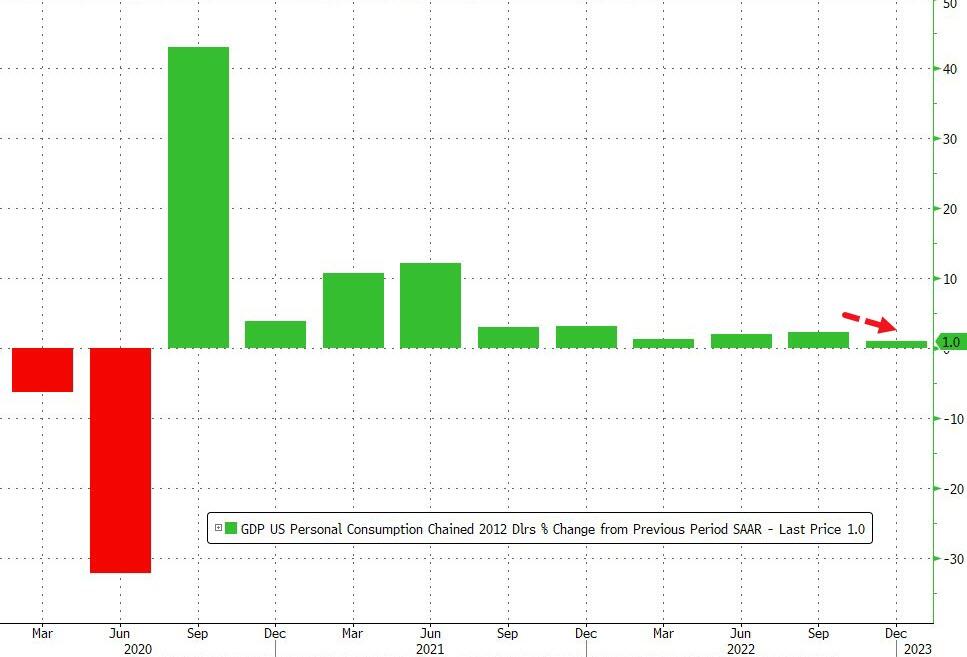
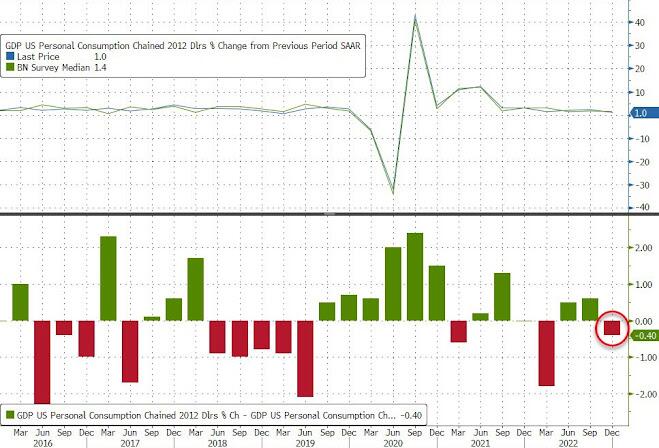
Of the above data, two things stuck out: the outsized contribution by inventories at 57% of the bottom line number, and the sharp drop in annualized Personal Consumption, which rose just 1.0%, or the least since the covid crash in Q2 2020.

The Personal Consumption number dropped from 2.3% in Q4, and missed the estimate of 1.4% by the widest margin since Q2 2022.

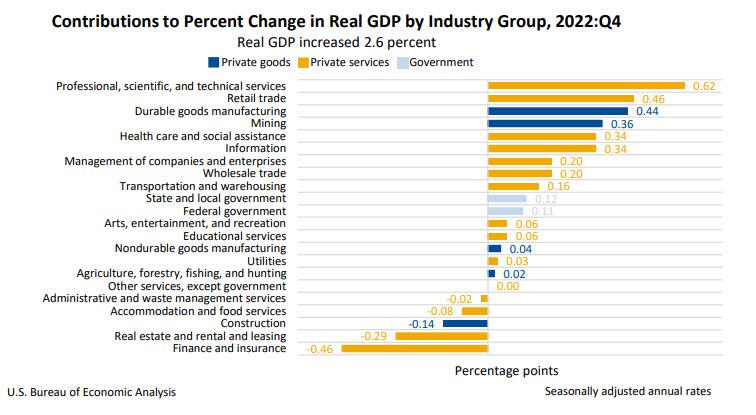
As an aside, today’s release includes estimates of GDP by industry, or value added—a measure of an industry’s  contribution to GDP. Private goods-producing industries increased 4.0 percent, private services-producing industries increased 2.3 percent, and government increased 2.1 percent. Overall, 17 of 22 industry groups contributed to the fourth-quarter increase in real GDP.

  • Within private goods-producing industries, the increase was led by durable goods manufacturing and mining. Partly offsetting these increases was a decrease in construction.
  • Within private services-producing industries, the leading contributors to the increase were professional, scientific, and technical services; retail trade; health care and social assistance; and information. Notable offsets include decreases in finance and insurance as well as real estate and rental and leasing.
  • The increase in government reflected increases in both federal government as well as state and local government.

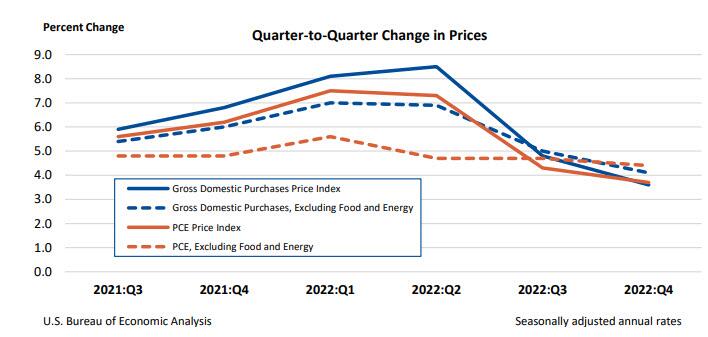
While growth slowed down, the inflation components in the GDP report came in hotter than expected, with the Core PCE rising 4.4%, above the 2nd estimate of 4.3% which was also the median consensus. The silver lining: the headline GDP price index rose 3.9% in 4Q after rising 4.4% prior quarter; at least this number came in line with expectations.

Some more details from the BEA: “Gross domestic purchases prices, the prices of goods and services purchased by U.S. residents, increased 3.6 percent in the fourth quarter after increasing 4.8 percent in the third quarter. Excluding food and energy, prices increased 4.1 percent after increasing 5.0 percent.”

Personal consumption expenditure (PCE) prices increased 3.7 percent in the fourth quarter after increasing 4.3 percent. Excluding food and energy, the PCE “core” price index increased 4.4 percent after increasing 4.7 percent.

Putting it all together, today’s report was downright stagflationary, because while inflation remains hot and well above the Fed’s (pre-revision) 2% target, consumption continues to shrink, and as Joe Lavorgna notes, “real consumption was revised down 40 bps to 1.0%. There isn’t much momentum as a potential commercial bank credit crunch looms. Last qtr is (non-pandemic) weakest since Q1 2019 (0.4%)”

And now we wait for the looming credit crunch courtesy of the bank crisis to send Personal Consumption negative.

Tyler Durden
Thu, 03/30/2023 – 09:02

via ZeroHedge News https://ift.tt/L8gXN1Q Tyler Durden

Jobless Claims Continue To Shrug Off Fed Tightening & Real-World Headlines

Jobless Claims Continue To Shrug Off Fed Tightening & Real-World Headlines

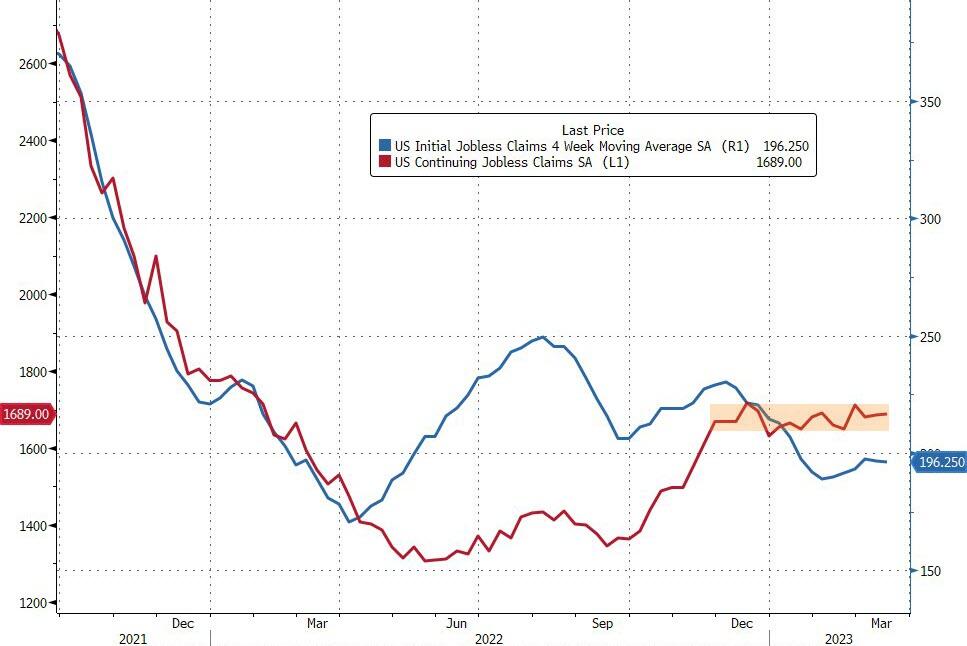
Continuing claims dropped very modestly but have basically gone nowhere in four months but initial jobless claims limped higher last week (from 191k to 198k), which was slightly worse than expected (196k)…

Source: Bloomberg

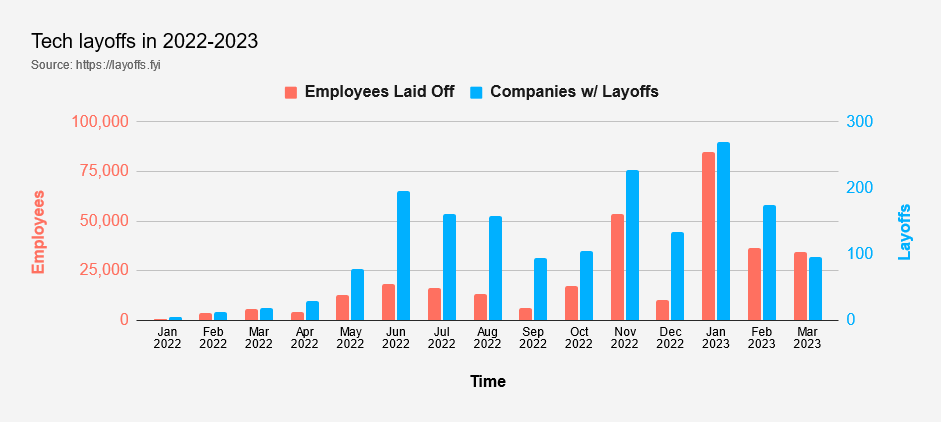
But still under 200k, despite the ongoing wave of layoffs (and WARNings)…

Source: Bloomberg

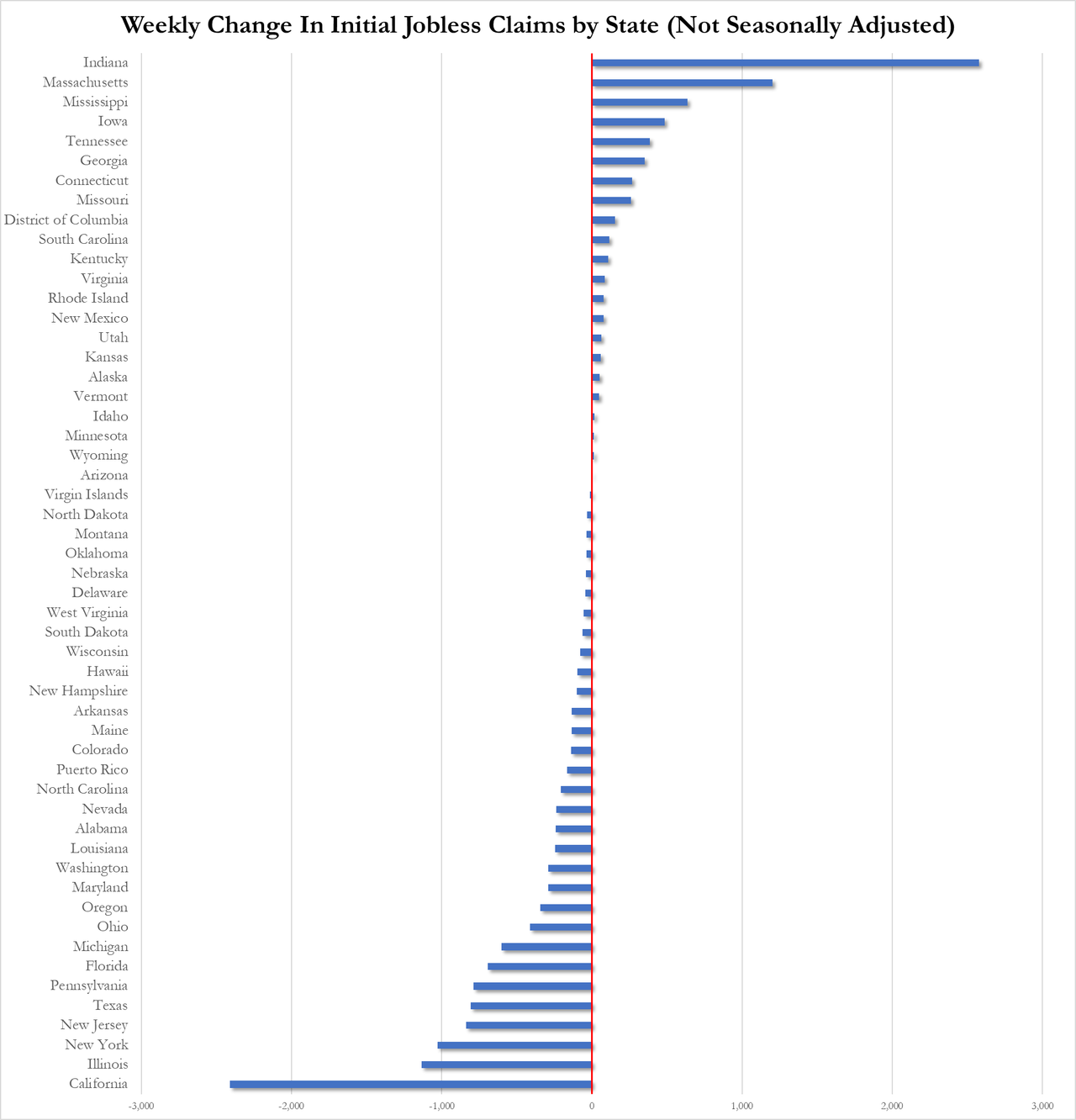
Even more shockingly, given the concentration of the layoffs in the tech sector, California saw the largest DROP in claims last week while Indian saw the biggest rise…

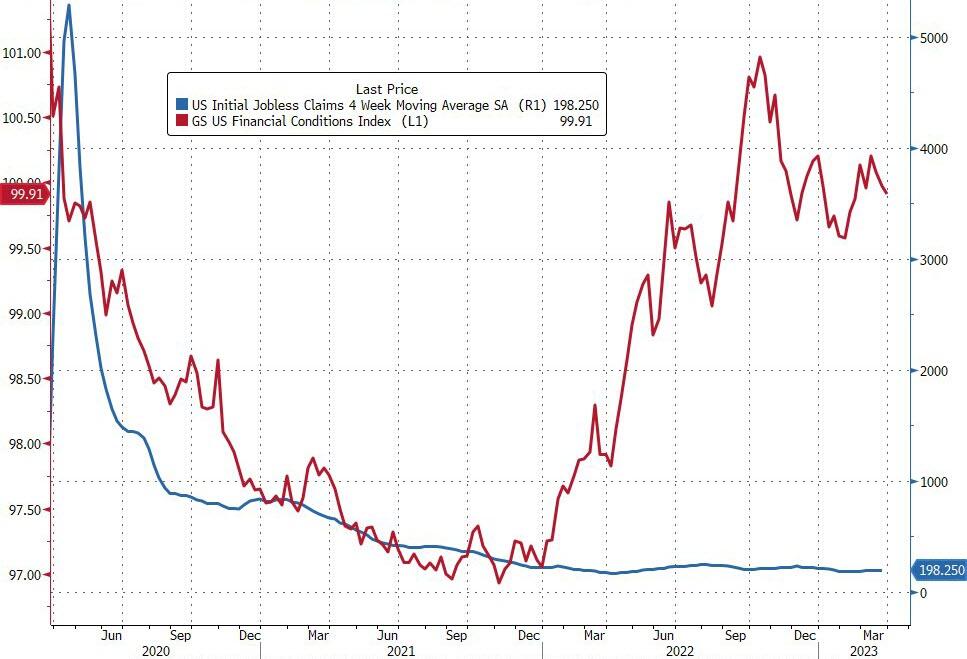
The last time financial conditions were this tight, claims were in a completely different realm to the current near-record-low levels…

Source: Bloomberg

For now, this is certainly not what Powell wants to see…

Sooner or later, reality has to hit this data, and WARNings are growing louder.

Tyler Durden
Thu, 03/30/2023 – 08:43

via ZeroHedge News https://ift.tt/YEU70Pi Tyler Durden

Bund Yields & ECB Rate-Hike Odds Jump After Mixed Messages From EU Inflation

Bund Yields & ECB Rate-Hike Odds Jump After Mixed Messages From EU Inflation

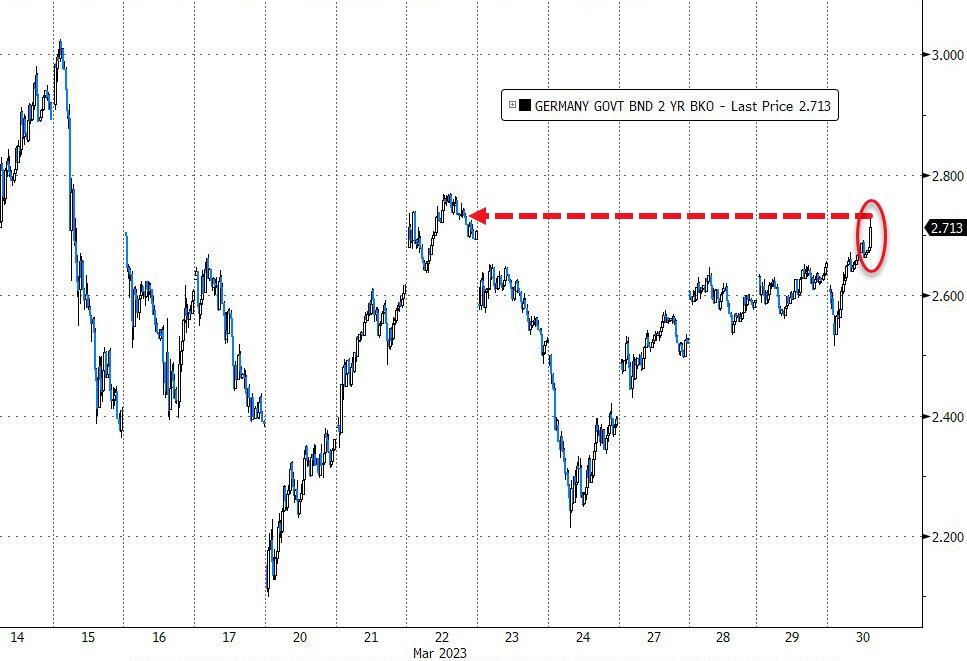
Despite declining inflation prints in Spain, Italy, and Germany, short-end bund yields are rising this morning…

Source: Bloomberg

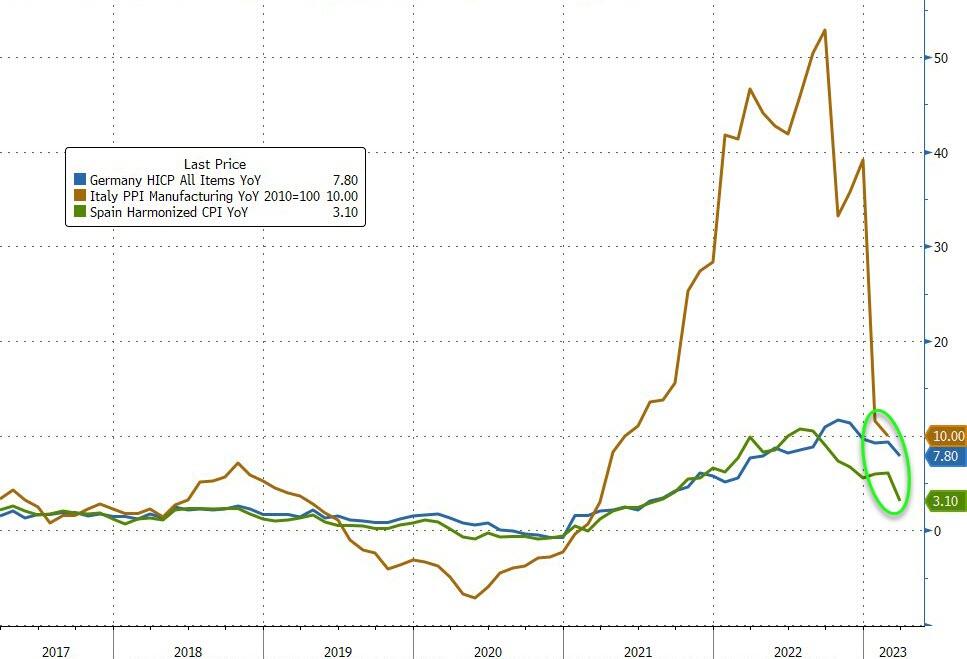
The slowing inflation prints, of course, are helped by the base effects of the collapse in energy prices is helping…

Source: Bloomberg

…but as is clear from the data below, there is more ‘stickiness’ to overall inflation than hoped (beyond energy)…

Spanish CPI plummeted as energy costs retreated. March’s headline reading came in at 3.1% YoY, down from Feb’s 6% YoY and much lower than the 3.7% YoY expected. However, core CPI – excluding volatile items like fuel and fresh produce — only dipped a smidge, to 7.5%.

Italy’s domestic producer prices fell 1.3% MoM in Feb, versus -9.9% MoM in Jan, with YoY PPI slowing to +10.0% from +11.6% in Jan.

German CPI eased significantly in preliminary March data with the headline (Eu Harmonized) print down to +7.8% YoY (from +9.3% YoY in Feb). However, the 7.8% print was considerably hotter than the expected +7.5% YoY (and is the second month in a row of hotter than expected inflation for Europe’s largest economy). Notably, Bloomberg reports that wages are a key factor that officials are monitoring for signs that price growth is becoming entrenched. Talks with workers in Germany’s public sector, who want a double-digit pay rise, ended without a deal overnight and will go to independent arbitration.

Interestingly, ECB rate-hike expectations have risen intraday as this inflation data hit

How the country-level figures feed through to the 20-nation euro zone will be revealed Friday, with analysts expecting the main measure of inflation to slow to 7.1% even as the core gauge ticks up to a record 5.7%… and none of today’s data helps to adjust that core print expectation lower.

Tyler Durden
Thu, 03/30/2023 – 08:35

via ZeroHedge News https://ift.tt/0snavcl Tyler Durden