A WARNing For Stocks In Labor Data

A WARNing For Stocks In Labor Data

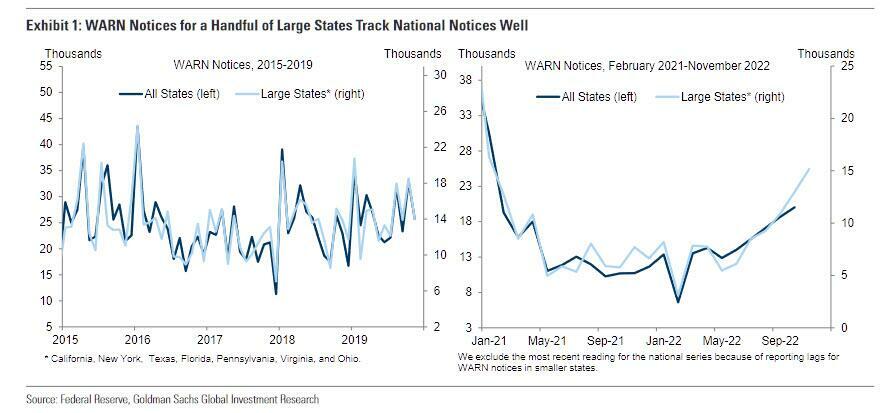
Echoing recent comments from Goldman Sachs, Bloomberg macro strategist Simon White warns (forgive the pun) that Worker Adjustment and Retraining (WARN) Notices are picking up which points to unemployment claims soon rising and a deterioration in the jobs market, posing a risk to stocks.

Unemployment claims (the latest data is out this morning) have remained resilient in the downturn, reflecting a labor market that looks robust. However, that may be about to change in the coming weeks and months.

The WARN Act obliges employers with more than 100 full-time workers to provide written notice to the state and the workers themselves at least 60-90 days ahead of planned plant closings and mass layoffs.

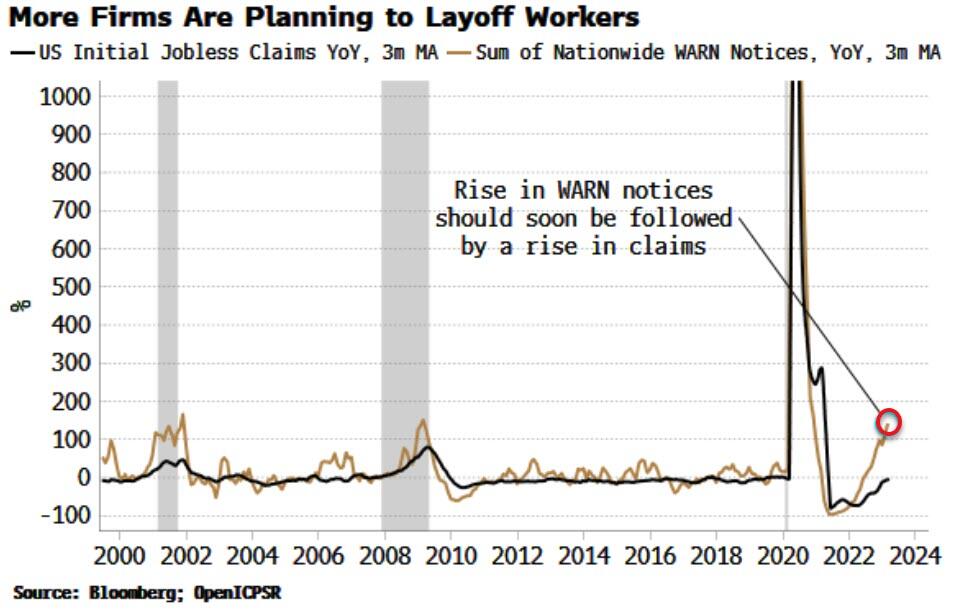
In recent months, WARN notices have been steadily rising. As the chart below shows, this generally precedes sharp rises in unemployment claims, especially around recessions.

The Cleveland Fed has done analysis on WARN notices and they show lead other labor-market indicators, including claims, changes in the unemployment rate and changes in private employment, with the strongest lead relationship over one month.

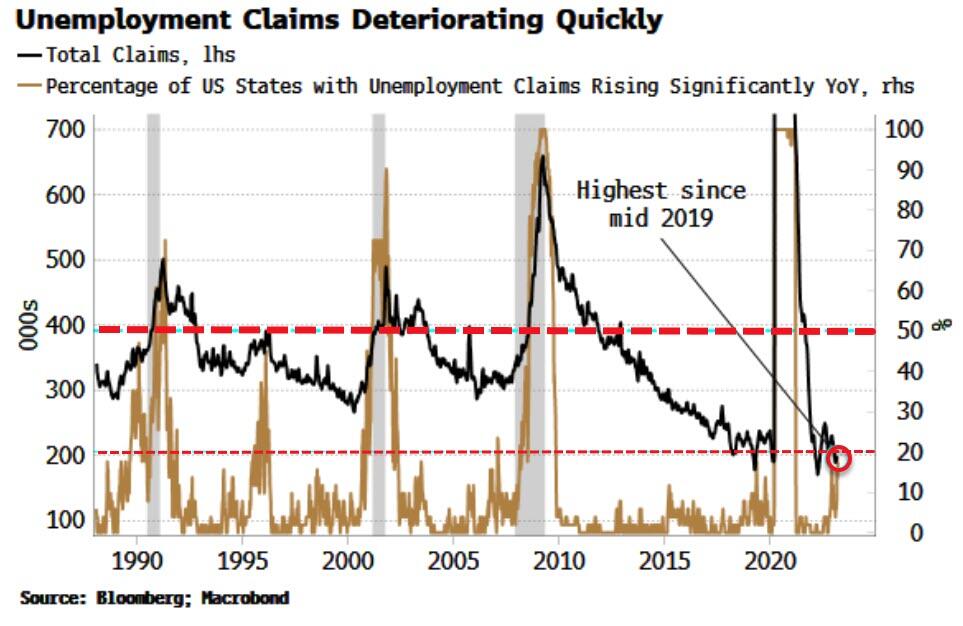
The rise in WARN notices coincides with a sudden rise in the number of US states showing an least 25% annual rise in their claims.

Often when this measure hits its current threshold, it jumps considerably higher, culminating in a recession.

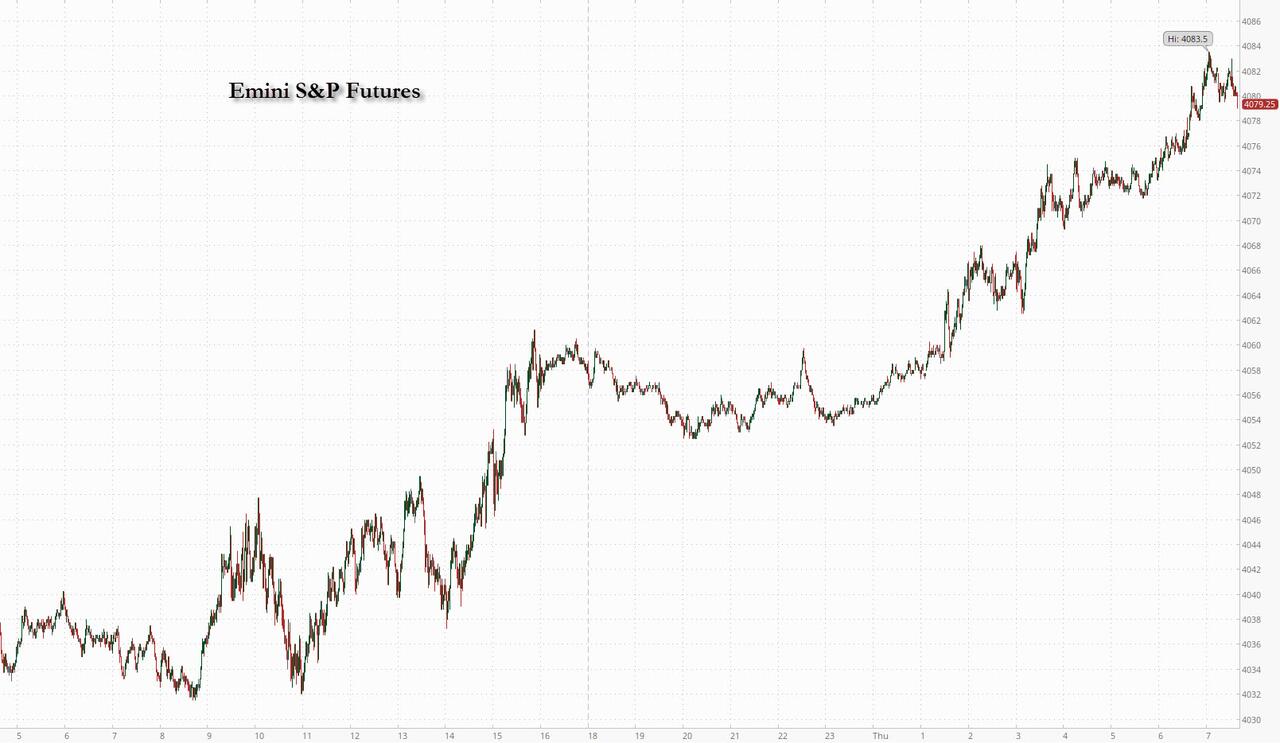
It’s clear stocks are not pricing in much chance of a recession, certainly not one that could hit quite soon, as they continue to rally towards 4,100.

But a rapid deterioration in job-market data, downwards revisions of previous data, poor liquidity and much tighter financial conditions in the wake of SVB would leave stocks facing potentially considerable further downside.

Tyler Durden
Thu, 03/30/2023 – 08:25

via ZeroHedge News https://ift.tt/CAgd3YD Tyler Durden

Futures Storm Higher On Easing Bank Stress, Looming Quarter-End

Futures Storm Higher On Easing Bank Stress, Looming Quarter-End

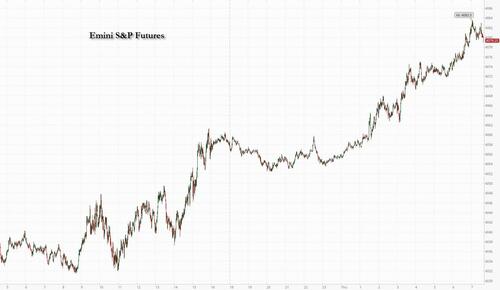
US index futures extended their gains for a third day, approaching 4,100 – the highest level in over a month – amid easing concerns around the banking crisis and as investors weighed the likelihood that a peak in interest rates is nearing. As of 730am ET, S&P 500 futures were up 0.5% near session highs of 4,080 while the Nasdaq rose 0.6%. The tech-heavy index is set for its best quarter since 2020, pushing into a bull market Wednesday and closing at the highest level since August in a sign investors are preparing for the Fed to end its interest rate hiking cycle and potentially pivot to looser policy later this year. On Wednesday, the gauge entered a new bull market, rising more than 20% from December lows. The yield curve steepened as the 10Y yield dipped 2bps to 3.54%, while the DXY has resumed its selloff and remains below its 50, 100, and 200dma. Commodities are stronger with all 3 complexes stronger.
Among premarket movers, Philip Morris rose after being raised to overweight from neutral at JPMorgan, becoming the broker’s top tobacco sector pick. Meanwhile, Viking Therapeutics fell as the biopharmaceuticals company offered $250m of shares at a discount. Here are other notable premarket movers:

  • Sprinklr shares gain 14% in US premarket trading after the software company gave a full-year forecast for both revenue and subscription revenue that is stronger than expected.
  • RH shares drop 6.8% after the upscale home furnishings company issued weaker-than-expected full-year guidance for FY23. Analysts were disappointed with the outlook, flagging management’s comments on challenging business conditions being set to continue.
  • Semtech falls 13% after the chipmaker forecast a first-quarter loss, against analysts’ estimates of a profit, while its fourth-quarter adjusted EPS fell short of projections by a penny. Cowen analysts cut their target on the stock, noting a “very difficult” start for the company following the closure of its Sierra Wireless deal.
  • Charles Schwab stock declines 1.9% as Morgan Stanley cut it to equal-weight from overweight, saying that Schwab’s clients are pulling cash out of the firm’s low- interest-rate bank accounts at twice the rate that MS expected.
  • Viking Therapeutics is down 4.3% after launching a $250m share offering at $14.50 each via William Blair, Raymond James.
  • Watch Southern Copper as it was downgraded to equal-weight from overweight at Morgan Stanley, which cited a more balanced risk-reward, with the stock adequately reflecting company’s strong cash generation and consistent returns to shareholders.

The US stocks rally comes after a week of treading water as investors weigh the likelihood of further banking turmoil alongside a slew of economic data and clues from central banks on the path for interest rates. The market is now pricing a dovish pivot by the Federal Reserve, compounded by remarks from Chair Jerome Powell yesterday saying policymakers’ forecasts anticipate one more interest-rate hike, which he subsequently clarified is in reference to the Fed’s most recent dot plot and not an actual preview of what the Fed will do. Markets now await core PCE data later today for further clues around the Fed’s next move, even as they expected US rates to drop to 4.3% by the end of the year, around 70 basis points lower than the current level.

“Some investors may be jumping the gun, I would be quite cautious about these signals,said Gilles Guibout, head of European equity strategies at AXA Investment Managers SA. “Yes the Nasdaq may be up 20%, but that does not necessarily mean that we are in a new cycle or that the same risks which weighed just recently have waned.” The current rally is built more on expectations than actions, leaving the market vulnerable should central banks disappoint investors, Veyret added.

Market sentiment remains relatively positive, and investor confidence remains high despite the recent turmoil brought by the financial sector, as appetite for risk gets supported by the prospect of dovish pivots from central banks, providing a good excuse to push stock indices higher just before the end of the quarter,” said Pierre Veyret, a technical analyst at ActivTrades.

Citigroup strategists also say markets are being complacent, having ignored recession risks and rallied from October lows on “soft” or even “no-landing” narrative. Based on their model, quantitative strategists including Alex Saunders see recession risks remaining high, with economists still having that eventuality penciled in for the second half.

On the other end, Goldman strategists said investors should buy US growth stocks with high margins, while avoiding low-margin ones even as equity and rates markets are at odds over the likelihood of a recession. If the economy avoids recession, real yields are likely to rise and valuations for growth stocks with low margins are more sensitive to higher yields, strategists including Ryan Hammond and David Kostin wrote in a note.

Meanwhile, global stocks and bonds are moving more closely in line with each other than they have in nearly three decades, providing a headache for fund managers seeking to spread their risk. On a brighter note, correlation among stocks globally is low which should be a good environment for stock pickers, according to Bernstein strategists Sarah McCarthy and Mark Diver.

European stocks rose to their highest level in almost three weeks as financial-stability concerns continue to recede. The Stoxx 600 is up 1% with retail, real estate and banks the strongest-performing sectors. Major EMEA markets are higher, led by Spain with the UK lagging. Preliminary CPI data is printing lower MoM and coming in below expectations. Recent IPOs/Hyper Growth are the best performing single baskets, +2.5%+. Vol is leading, Quality is lagging; Value over Growth; Cyclicals over Defensives. UKX +0.7%, SX5E +1.1%, SXXP +0.9%, DAX +1.0%. Real estate stocks lead European equity gains Thursday, extending the previous session’s rebound, as bond yields slipped and markets trimmed peak interest-rate bets. The Stoxx 600 Real Estate Index was 3.1% higher, with all 34 members of the gauge in the green; the index had risen 2.6% on Wednesday. Here are the biggest European movers today:

  • H&M shares jump as much as 13% after the clothing retailer reported profits that beat consensus estimates, driven by what Jefferies defines as “over-delivery”
  • SSE shares climb as much as 3% after it increased its forecast for full-year earnings, citing the strong performance of its “balanced” business model in a volatile year
  • Petrofac rises as much as 73%, the most on record, triggering volatility halts on the stock in London trading after winning a contract to design and install an offshore wind project
  • Allegro gains as much as 7.7% after Poland’s biggest e-commerce platform’s 2022 results matched guidance seen previously as ambitious
  • Vestas shares jump as much as 6.7%, after the world’s largest producer of wind turbines won its biggest ever onshore order
  • SMA Solar shares rise as much as 18%, the most in more than a year, after the German solar equipment maker increased its Ebit guidance for this year by 30%
  • JDE Peet’s shares fall as much as 4.3% after Mondelez completed the sale of about 7.7m shares in coffee and tea company at a ~6% discount to last close
  • Drax shares drop as much as 12%, the most since May 2022, after the UK power firm’s biomass project was rejected for the nation’s carbon capture and storage program
  • S4 Capital shares drop as much as 10% in early trading with analysts saying its mixed results and guidance point to a slower year ahead
  • BioMerieux falls as much as 3.4% after holder Sitam Belgique offers shares representing about 0.8% of the biotechnology company via Natixis
  • Basler shares slump as much as 18% after the consumer electronics firm released FY23 guidance, which Jefferies said was disappointing on both the top and bottom line
  • Paradox Interactive falls as much as 8.4% after the Swedish game developer was downgraded to a short-term hold from buy at Handelsbanken

Earlier in the session, Asian stocks eked out small gains after a rally in US shares overnight, as investors adjusted their positions ahead of quarter-end and markets continued to digest Chinese e-commerce giant Alibaba’s break-up plans. The MSCI Asia Pacific Index reversed earlier losses to rise as much as 0.2%, led by energy and consumer discretionary shares. Australia advanced on the back of strength in US tech shares, while Japanese stocks dropped as a majority of shares traded ex-dividend. India was closed for a holiday. Chinese tech shares gained, lifting the broader market, as investors turned more positive on the sector. In a conference call Thursday, Alibaba’s chief executive Daniel Zhang said the company would gradually give up control of some of its main businesses.

“Alibaba’s spinoffs announced spark thumping revival of Chinese tech optimism and hopes,” Vishnu Varathan, Asia head of economics and strategy at Mizuho Bank, wrote in a note. “This builds on ‘risk on’-type price action,” he said, while “banking fears are relegated for now.” In a busy day of Chinese earnings, major banks including Bank of Communications and the nation’s largest developer Country Garden reported full-year results. The current earnings season is offering investors clues on China’s recovery path as the world’s second-largest economy emerges from Covid Zero. The Asian regional stock gauge was poised to rise about 3% this quarter, extending the momentum seen in the previous quarter, as China’s reopening and easing bets on the Federal Reserve’s interest rate hikes helped sentiment in the region

Japanese equities fell, halting a three-day rally, as 1,500 Topix stocks traded without rights to the next dividend, shaving 23.5 points off the benchmark. The Topix fell 0.6% to close at 1,983.32, while the Nikkei declined 0.4% to 27,782.93. Out of 2,159 stocks in the Topix, 1,330 rose and 748 fell, while 81 were unchanged. “Japanese stocks are down mainly due to the ex-dividend trading,” said Hirokazu Kabeya, chief global strategist at Daiwa Securities. “Otherwise, the receding concerns around banking situation in the US and Europe, and the slight weakening of yen are actually decent conditions for buying Japanese stocks.”

In FX, the greenback gave up an earlier advance after strengthening as investors digested the latest remarks by Fed officials. The Bloomberg Dollar Index is down 0.2% while the Swiss franc is the best performer among the G-10s, closely followed by the British pound and Australian dollar.

In rates, Treasury yields were steady, following muted trading on Wednesday when the 10-year benchmark moved by the smallest margin in more than a month. Treasuries were mixed with the curve steeper as front-end and belly sectors richen vs Wednesday’s close while long-end cheapens slightly. Outperformance by front-end Treasuries steepens 2s10s spread by more than 1bp; 10-year yields little changed around 3.56% narrowly underperforms bunds and gilts. Bund futures rallied after the the German state of North Rhine-Westphalia reported a notable slowdown in CPI, and then extended gains after Spanish inflation came in lower than forecast. Gains proved short-lived, however, with German bonds now lower on the day.

In commodities, oil rebounded amid the continued disruption to shipments from Turkey; WTI rose 0.8% to trade near $73.60. Gold steadied and Bitcoin rose, trading briefly above $29,000. Spot gold adds 0.2% to around $1,968.

Looking to the day ahead, we get initial jobless claims and the final Q4 GDP revision, from Europe we have the Eurozone March economic, industrial and services confidence data, as well as the German March PPI and the Italian February PPI and unemployment rate. We will also be hearing from the Fed’s Barkin as well as Collins.
Market Snapshot

  • S&P 500 futures up 0.6% to 4,080
  • MXAP up 0.2% to 161.05
  • MXAPJ up 0.6% to 520.59
  • Nikkei down 0.4% to 27,782.93
  • Topix down 0.6% to 1,983.32
  • Hang Seng Index up 0.6% to 20,309.13
  • Shanghai Composite up 0.7% to 3,261.25
  • Sensex up 0.6% to 57,960.09
  • Australia S&P/ASX 200 up 1.0% to 7,122.34
  • Kospi up 0.4% to 2,453.16
  • STOXX Europe 600 up 1.0% to 454.56
  • German 10Y yield little changed at 2.31%
  • Euro up 0.3% to $1.0872
  • Brent Futures up 0.8% to $78.92/bbl
  • Gold spot up 0.2% to $1,967.88
  • U.S. Dollar Index down 0.23% to 102.40

Top Overnight News

  • China’s largest oil producer just had its best-ever year. PetroChina made a profit equivalent to around $22 billion in 2022, around two-thirds higher than it earned the year before. That was in part due to the rise in the average oil price despite a fall in the second half. PetroChina’s bumper earnings led to a jump in its Hong Kong-listed shares, which closed up 7.8% on Thursday. The shares are now trading at their highest level since October 2018. WSJ
  • Taiwan President Tsai Ing-wen arrived in New York for a two-night stop in the US amid simmering tensions between Washington and Beijing. Tsai said the security of the world hinges on the self-ruled island’s fate. China warned the trip will have a severe impact on ties with the US. BBG
  • Spain’s inflation almost halved in a month to 3.1 per cent in March as energy costs dropped, in a possible early sign of a sharp fall in European headline inflation this year. The year-on-year rise in harmonized Spanish consumer prices compared with the previous month’s rate of 6 per cent and was lower than the 4 per cent forecast by economists polled by Reuters. FT
  • Russia’s Federal Security Service said it had detained Wall Street Journal reporter Evan Gershkovich in the Russian city of Yekaterinburg on suspicion of spying, according to reports by the Interfax and RIA Novosti news agencies. NYT
  • The EU’s member states and parliament have clinched a deal on higher renewable energy targets after lengthy negotiations, including carve-outs on nuclear energy following pressure from France. FT
  • The UK is to allow investors to count nuclear energy as a “green” investment. In an announcement on Thursday, the government said it would include nuclear in the UK’s green taxonomy — a system used by investors to determine whether an investment is counted as sustainable or not. FT
  • The White House is planning as soon as this week to recommend tougher rules for midsize banks, according to people familiar with the matter, after the collapse of two lenders earlier this month sent tremors through the banking system. The recommendations are expected to call for new rules from the Federal Reserve and other agencies, including for banks with $100 billion to $250 billion in assets. WSJ
  • Dated Brent — which sets the price for about two-thirds of global supply — is about to be transformed for good as Platts will soon use West Texas crude to help determine prices. The switch, which has been fraught with controversy, comes as the existing benchmark is slowly running out of tradable oil. BBG
  • Blackstone’s Steve Schwarzman said the banking turmoil was “caused by people on iPhones and other devices” rather than a wave of bad loans. People heard on social media that a bank might be in trouble and “responded with huge withdrawals in a very short period of time,” he said in an interview. Most US banks can withstand the current crisis, which is simply an interim issue, he added. BBG
  • Bank of Japan Governor Haruhiko Kuroda changed the course of global markets when he unleashed a $3.4 trillion firehose of Japanese cash on the investment world. Now Kazuo Ueda is likely to dismantle his legacy, setting the stage for a flow reversal that risks sending shockwaves through the global economy: BBG
  • After the fall of Credit Suisse and its hastily arranged merger with its rival — and the return of former UBS chiefSergio Ermotti — Switzerland sees just one big winner and a lot of losers: BBG
  • Investors are betting one major central bank will successfully navigate the policy tightening required to cool inflation without sending its economy into reverse: the Reserve Bank of Australia: BBG

A more detailed look at global markets courtesy of Newsquawk

Asia-Pacific stocks traded mixed as the region only partially sustained the momentum from the US where the Nasdaq 100 entered a bull market after the recent bond selling slowed and as banking sector fears continued to subside. ASX 200 was higher with strength in tech, mining and financials leading the broad optimism across sectors and amid an adjustment in rate expectations with NAB lowering its peak rate forecast to 3.85% from 4.10%. Nikkei 225 was pressured heading closer to fiscal year-end amid mild upside in Japanese yields and with notable weakness across large transportation/logistics companies. Hang Seng and Shanghai Comp. were indecisive and ultimately faltered despite another substantial liquidity effort by the PBoC with participants digesting a slew of earnings releases and as US-China frictions lingered.

Top Asian News

  • Chinese Premier Li said at the Boao Forum that to achieve greater success, chaos and conflicts must not happen in Asia otherwise the future of Asia will be lost and they oppose taking sides, forming new blocs and a new Cold War. Premier Li also commented that the economic situation in March is even better than in January and February, while they will consolidate the recovering trend of China’s economy and promote a continued recovery, as well as roll out new measures to increase market access and improve the business environment, according to Reuters.
  • Spanish PM Sanchez said at the Boao Forum that relations between Europe and China, and by extension between Spain and China, do not need to be confrontational, while he added there is ample room for win-win cooperation and that they must remain partners economically and beyond, according to Reuters.
  • China and Brazil reached an agreement to trade in their own currencies, ditching the US dollar as an intermediary.

European bourses are in the green, Euro Stoxx 50 +1.2%, following soft inflation prints via Spain and the German state’s ahead of the mainland figure. Sectors are similarly bolstered with defensives lagging while Retail and Real Estate outperform given H&M and (initially) lower yields respectively. Stateside, futures are firmer though the magnitude is more modest and sees the region holding onto their recent upside ahead of data/Fed speak. Blackstone (BX) CEO Schwarzman says their property investment is in good shape. Google (GOOG) Cloud VP says Microsoft (MSFT) is selectively buying out complainants and “definitely” has a very anti-competitive posture in cloud; criticised imminent deals with EU cloud rivals.

Top European News

  • UK Chancellor Hunt is on course for a clash with BoE Governor Bailey after Hunt refused to rule out watering down post-financial crisis banking rules despite the BoE warning against weakening banking regulation, according to The Telegraph.
  • UK Chancellor Hunt said Britain will not go toe-to-toe with the US and EU by offering billions in green subsidies, according to The Times.
  • ECB’s Schnabel said a rise in unit labour costs indicates possible second-round effects on inflation and her suspicion is that the energy impact won’t drop out of core inflation quickly, while she also noted that they have not seen general outflow from Eurozone bank deposits, according to Reuters.
  • ECB’s Elderson says if the baseline scenario is met, there will be more ground to cover and rates will have to be increased further, adds we are not seeing any movements in the bond markets that give us cause for concern.

FX

  • Dollar broadly softer on the eve of PCE data, as Fed Chair Powell points to dot plots showing one more hike in the cycle, DXY dips below midweek low. between 102.780-340 parameters as month-end positioning persists.
  • Euro wobbles in wake of soft EZ inflation metrics before recovering ground vs Buck on a 1.0800 handle.
  • Pound underpinned by firm UK implied rates and yields, with Cable hovering around 1.2350 and EUR/GBP eyeing 100 DMA just under 0.8800.
  • Franc shrugs off sub-forecast Swiss Kof ahead of speeches from SNB, as USD/CHF approaches 0.9150 from around 0.9200 at one stage.
  • PBoC set USD/CNY mid-point at 6.8886 vs exp. 6.8901 (prev. 6.8771).
  • Brazil’s proposed new fiscal rules would target zero primary deficit next year, a primary surplus of 0.5% of GDP in 2025 and 1.0% of GDP in 2026, according to sources cited by Reuters.

Fixed Income

  • Bunds led an initial rally in fixed following the cooler North Rhine-Westphalia inflation reading and thereafter peaked at 136.77 following a similarly ‘cool’ Spanish figure.
  • Action which lifted USTs and Gilts in tandem to 114.23+ and 1014.47 respective peaks.
  • However, this has since seen a marked reversal which was possibly Gilt/Sonia-led, irrespective of obvious catalyst; as such, core benchmarks are now essentially unchanged on the session ahead of the German mainland and US data points/speakers.

Commodities

  • Crude benchmarks are bolstered by the softer USD and supportive risk tone following Wednesday’s slightly lower settlement; WTI and Brent at the top-end of circa. USD 1/bbl parameters.
  • Specifics have been light for crude and also gas markets, with the latter subdued and featuring Dutch TTF in relative proximity to the unch. mark.
  • Metals are marginally firmer, in-line with the magnitude of US equity futures, deriving support from the USD/sentiment; Citi cuts its 2023 Palladium view to USD 1500/oz (prev. 2025/oz).
  • Specifically, spot gold is at the mid-point of USD 1955-1971/oz boundaries, with the 10-DMA at USD 1970.80/oz capping action thus far.

Geopolitics

  • Explosions were heard in the vicinity of Syria’s capital of Damascus amid Israeli ‘aggression’, according to the state news agency.
  • China’s Defence Ministry says China’s military is willing to work with Russia’s military to strengthen strategic communication and coordination.
  • Russia’s Federal Security Service (FSB) says a WSJ reporter has been detained for espionage, according to Interfax; WSJ reporter Gershkovich detained in Russia, according to Bloomberg.

US Event Calendar

  • 08:30: 4Q GDP Annualized QoQ, est. 2.7%, prior 2.7%
    • 4Q Personal Consumption, est. 1.4%, prior 1.4%
    • 4Q GDP Price Index, est. 3.9%, prior 3.9%
    • 4Q PCE Core QoQ, est. 4.3%, prior 4.3%
  • 08:30: March Initial Jobless Claims, est. 195,000, prior 191,000
    • March Continuing Claims, est. 1.7m, prior 1.69m

DB’s Jim Reid concludes the overnight wrap

Right. I’m off skiing for the first time in nearly 3.5 years tomorrow. Wish me luck for the 14-hour drive. The good news is that Maisie is returning to ski school as her recovery from being in a wheelchair for 14 months continues well. The twins are also doing ski school for the first time. Hopefully learning this early will prevent them having the injuries I’ve had skiing (5 knee and one shoulder op in last 8 years) after taking it up when I was 30 and thinking I was of Olympic standard. Talking of injuries, I had another back injection under general anaesthetic yesterday and in the theatre, there were about 15 nurses and medical staff for a relatively simple, short procedure. I joked to the consultant that there were far less people in the room when my wife had a complicated, high risk twin birth! So hopefully my body will hold up. See you in a couple of weeks. You’ll be in good hands when I’m away.

As I pack my bags, that’s three days in a row now where not much has happened. If this carries on for much longer we’ll soon start to worry about tomorrow’s US core PCE inflation print again and maybe a Fed that will have to keep on raising rates. We also have German inflation today so it’s perhaps a good sign that we’re starting to focus on these type of things again. By the time you read this the first regional number will be out from North Rhine Westphalia. ECB Chief Economist Lane even discussed yesterday how from a macroeconomic perspective recent events were a non-event. He expects the recent turmoil in the financial sector to “settle down”, and that rather than rate cuts “more hikes will be needed” instead.

The worry I have is that policy is still not tight enough to completely tame inflation organically, but starting to get too tight to avoid accidents. Clearly if the accident is bad it can easily cause a big enough economic shock to make a big dent in lowering inflation. Has the last three weeks been a bad enough accident? Well it will almost certainly tighten bank lending standards relative to what would have happened (we think they would have tightened anyway). If that’s the worst of it, this could translate to a slow weakening for the economy over several months rather than an immediate shock. If so inflation could stay on the high side for a few months, and it will take a brave Fed/ECB to decide to ignore it and instead focus on the financial stability risks instead if we have a period of calm.

For now we’re back to risk-on. The S&P 500 (+1.42%) closed at above the levels seen before a pretty high percentage of us had ever heard of Silicon Valley Bank 3 weeks ago. At the same time US Treasury yields plateaued across the curve yesterday after climbing steadily, but substantially, since last Friday lunchtime.

In US equity markets, all industry groups were up on the day, driven by strong performance in semiconductor (+2.82%), autos (+2.64%), real estate (+2.34%) and technology hardware (+1.95%). The last of which helped the NASDAQ, which was up +1.79% and set for its best quarter since 2020 if nothing goes wrong in the next couple of days. Toward the end of the US trading session, there was a Bloomberg report that the FDIC was planning on having the biggest US banks shoulder a “larger-than-usual” share of the $23bn cost from the SVB and Signature bank failures. This news saw the S&P Banks index fall -0.8% as the news broke an hour before the US close, but bank stocks fully retraced this move and finished up +1.40% on the day.

Over the pond, the European STOXX 600 climbed +1.30%, driven by similar outperformance in the tech sector which rose by +2.67%, which tied with real estate for the best sector in Europe yesterday. Bank shares in Europe remained resilient as the index rose +1.92% on the day. Looking more closely, UBS rose +3.72% after news that the former CEO was being bought back to manage the recent acquisition of Credit Suisse.

We heard from Fed’s Barr yesterday, who highlighted that the Fed intends to maintain its “meeting-by-meeting judgement on rates” and that “incoming data” will continue to be analysed. With Barr’s comments consistent with the previous messaging coming from Chairman Powell, the expected rate for May’s meeting remained little changed, rising by +0.6bps. For December’s meeting, the implied rate rose +2.9bps, pricing in 58bps of cuts into year-end from the terminal rate priced for May. 10yr Treasury yields traded largely flat on the day, moving between small gains and losses before yields finished down -0.5bps at 3.564%, their smallest move in either direction since the news on SVB broke mid-March. There was a similar story for US 2yr yield, which traded in a 13bp range before finishing up +1.9bps to 4.10%.

Back to Europe and apart from Lane we heard from the ECB’s Kazmir yesterday who emphasised that the members of the governing council had “agreed we will not give guidance about May ECB policy meeting.” Kazmir also stated that the “ECB shouldn’t back down on rates but maybe slow the pace.”

Against this backdrop, the ECB rate priced in by overnight index swaps for the December meeting rose +3.7bps, bringing the expected rate to 3.334% so pricing in just 5bps of cuts by year-end, given the current terminal rate is priced at 3.39% in October. 10yr bund yields rose +3.8bps, while the more interest rate sensitive 2yr yield climbed +6.3bps.

Markets are a little softer in Asia overnight. As I check my screens for one last time for a couple of weeks, the Nikkei (-0.73%) is leading losses with the Hang Seng (-0.50%) also slipping even though Alibaba (c.+1%) is extending its gains after jumping +12% yesterday on news of its major shakeup. In mainland China, the Shanghai Composite (-0.24%) and the CSI (-0.21%) are also lower. Elsewhere, the KOSPI (+0.51%) is bucking the negative trend in early trade. US stock futures tied to the S&P 500 (-0.05%) and NASDAQ 100 (-0.17%) are drifting lower. Yields on the 10yr as well as 2yr Treasury are both up +1bps, trading at 3.57% and 4.11% respectively as we go to press.

Early morning data showed that Australia’s quarterly job vacancies dipped -1.5% in Feb quarter (v/s -4.6% in the November quarter), marking the third consecutive quarter of decline even as it remains above pre-pandemic levels.

We had several data releases yesterday, with pending home sales for February beating expectations to come in at 0.8% (vs -3.0% expected) month-on-month. Pending home sales year-on-year rose to -21.1% from -22.4%. We saw the US MBA purchase index continue its modest pick-up off very weak levels, coming in at +2.9%, although this is down slightly from +3% last week.

We also had the German GfK consumer confidence come in slightly above expectations at -29.5 (vs -30 expected), although still far below average. In France, the consumer confidence index was in line with expectations at 81, down from 82 in February. Data in the UK yesterday spoke to a stronger real economy, as both February UK consumer credit data (£1.41 billion vs £1.2 billion expected) and mortgage approvals (43.5k vs. 41.3k expected) beat expectations. After the data release, we heard from BoE’s Mann who emphasised that the outlook for the UK economy had improved with the lower energy costs, and for the first time called for minimum buffers for LDI funds.

Moving to commodities markets, the deadlock between Iraq and the Kurdish region was on its third day. One of the biggest oil producers in Iraqi Kurdistan, the Norwegian owned DNO ASA, has decided to lower production as the dispute continues and storage space for inventory begins to diminish. This initially led to rally for oil prices with WTI and Brent crude futures over +1.1% midday before the US stockpiles data showed weaker demand. In all, WTI crude futures fell back -0.31% to $72.97/bbl, while Brent crude also fell short of a 3-day winning streak, down by -0.37% to $78.28/bbl. Finally, off the back of the improved risk sentiment, Bitcoin rallied strongly, up +3.96% on Wednesday to break above $28,000 at $28,392.

Now to the day ahead. From the US we have initial jobless claims, from Europe we have the Eurozone March economic, industrial and services confidence data, as well as the German March PPI and the Italian February PPI and unemployment rate. We will also be hearing from the Fed’s Barkin as well as Collins.
Tyler Durden
Thu, 03/30/2023 – 08:15

via ZeroHedge News https://ift.tt/YSNIi67 Tyler Durden

Negligence Theories in “Large Libel Models” Lawsuits Against AI Companies

This week and next, I’m serializing my Large Libel Models? Liability for AI Output draft. For some earlier posts on this (including § 230, disclaimers, publication, and more), see here; in particular, the two key posts are Why ChatGPT Output Could Be Libelous and An AI Company’s Noting That Its Output “May [Be] Erroneous]” Doesn’t Preclude Libel Liability.

Yesterday, I wrote about lawsuits against AI companies claiming that they are knowingly or recklessly publishing, through their software, false and defamatory statements. Today, I’ll start on the discussion of similar negligence claims.

[* * *]

[1.] Responsibility for the equipment a company uses

Say that R.R. is a private figure, and can show that the statements about him have caused “actual injury,” in the form of “out-of-pocket loss” or emotional distress stemming from damage to reputation.[1] (Perhaps R.R. lost a contract that he was expecting to get, and it eventually came out that the reason was that the other party had looked up his name in ChatGPT.) Or say he can show that the statements about him are on a matter of “private concern” for libel purposes. Can he sue OpenAI, even in the absence of any specific notice to OpenAI that its output was defamatory?

I think so. A business is generally potentially responsible for harms caused by the equipment it uses in the course of business, at least when it negligently fails to take reasonable steps to minimize the risks of those harms. (As I’ll turn to shortly, it’s also potentially response for harms caused by products it sells, though right now AI companies actually directly provide access to the AI software, on their own computers.)

If a company knows that one of its machines sometimes emits sparks that can start fires and damage neighbors’ property, the company must take reasonable steps to diminish these risks, even if it didn’t deliberately design the machines to emit those sparks. If a company knows that its guard dogs sometimes escape and bite innocent passersby, it must take reasonable steps to diminish these risks (put up better fences, use stronger leashes, train the dogs better).

Likewise, say a newspaper knows that its publishing software or hardware sometimes produces the wrong letters, and those typos occasionally yield false and defamatory statements (e.g., misidentify a person who’s accused of a crime). I think it may likewise be sued for libel—at least, in private figure cases, where negligence is the rule—on the theory that it should have taken steps to diminish that risk. The negligence standard applies to reporters’ and editors’ investigative, writing, and editing decisions; why shouldn’t it also apply to the newspaper’s decision to use tools that it knows will sometimes yield errors? And the same logic applies, I think, to an AI company’s producing AI software and offering it for public use, when the company knows that the software often communicates false and defamatory statements.

[2.] The design defect liability analogy

Just to make this extra clear, we’re not talking here about strict liability: The AI company wouldn’t be liable for all errors in its output, just as newspapers generally aren’t liable (under modern defamation law) for all errors in their pages. Rather, the question would be whether the company as negligent, and such a claim would be analogous to a negligent design product liability claim:

A product is defective when, at the time of sale or distribution, . . . the foreseeable risks of harm posed by the product could have been reduced or avoided by the adoption of a reasonable alternative design . . . and the omission of the alternative design renders the product not reasonably safe.[2]

The analogy is not perfect: Product liability law is limited to personal injury and property damage, and not to economic loss or emotional distress stemming from damage to reputation.[3] But the premise of negligent design product liability law is that one way that people can negligently injure persons or property is by distributing negligently designed products.[4] Likewise, one way that people can negligently damage reputations is by making available negligently designed software.

Product liability law is also limited to sale or distribution of products, and excludes the use of services.[5] But this stems from the fact that, in traditional service arrangements, a court can consider the reasonableness of the service provider’s behavior in that particular relationship, while with products a court would generally need to look at the general design of the product. Even if offering an AI program is a service, it’s analogous to the sale of a product—the AI company basically makes the design decisions up front and then lets the program operate without direct control, much as buyers of a product use it after it has left the manufacturer’s control.

Of course, not all design that causes harm is negligent. Some harms aren’t reasonably avoidable, at least without crippling the product’s valuable features. Car accidents might be reduced by capping speed at 10 mph, but that’s not a reasonable alternative design. Likewise, an AI company could decrease the risk of libel by never mentioning anything that appears to be a person’s name, but that too would damage its useful features more than is justified. The design defect test calls for “risk-utility balancing”[6] (modeled on the Hand Formula), not for perfect safety. A company need not adopt an alternative design that “substantially reduc[es the product’s] desirable characteristics” to consumers.[7]

Still, there might be some precautions that could be added, even beyond the notice-and-blocking approach discussed above.

[3.] Possible precautions: Quote-checking

One reasonable alternative design would be to have the AI software include a post-processing step that checks any quotes in its output against the training data, to make sure they actually exist—at least if the prompt is calling for fact rather than fiction[8]—and to check any URLs that it offers to make sure that they exist.[9] This may not be easy to do, because the AI software apparently doesn’t have ongoing access to all its training data.[10] But that’s a design choice, which presumably could be changed; and under design defect law, such a change may be required, depending on its costs and benefits. And if an AI company’s competitor successfully implemented such a feature, that would be evidence that the feature is a “reasonable alternative design” and that its absence is unreasonable.[11]

This is especially important because quotes are so potentially reputation-damaging. As the Court explained in Masson v. New Yorker Magazine,

In general, quotation marks around a passage indicate to the reader that the passage reproduces the speaker’s words verbatim. They inform the reader that he or she is reading the statement of the speaker, not a paraphrase or other indirect interpretation by an author. By providing this information, quotations add authority to the statement and credibility to the author’s work. Quotations allow the reader to form his or her own conclusions and to assess the conclusions of the author, instead of relying entirely upon the author’s characterization of her subject.[12]

Literate American readers have spent their lifetimes absorbing and relying on the convention that quotation marks generally mean that the quoted person actually said the particular words. To be sure, there are some exceptions, such as hypotheticals, or quotation marks to mean “so-called.” As the Masson Court noted, “an acknowledgment that the work is so-called docudrama or historical fiction, or that it recreates conversations from memory, not from recordings, might indicate that the quotations should not be interpreted as the actual statements of the speaker to whom they are attributed.”[13] But those are exceptions. Generally seeing a quote attributed to, say, Reuters will lead many reasonable readers to assume that Reuters actually wrote this. And that is so even if, faced with the absence of quotes, the readers might be on guard for the possibility that the statement might not properly summarize or paraphrase the underlying sources.

Of course, a company can certainly argue that it would be technically infeasible to check quotes against the training data. Perhaps the training data is too large to host and to quickly search (despite the availability of modern storage and indexing technology). Or perhaps it’s impossible to distinguish quotes generated in response to requests for fictional dialogue (“write a conversation in which two people discuss the merits of tort liability”) from ones generated in response to requests for real data. Presumably the company would find independent computer science experts who could so testify. And perhaps a plaintiff wouldn’t find any independent expert who could testify that such alternative designs are indeed feasible, in which case the plaintiff will lose,[14] and likely rightly so, since expert consensus is likely to be pretty reliable here.

But perhaps some independent experts would indeed credibly testify that the alternatives might be viable. The plaintiff will argue: “The AI company produced an immensely sophisticated program, that it has touted as being able to do better than the average human law school graduate on the bar exam. It has raised $13 billion on the strength of its success. It was trained on a massive array of billions of writings. Is it really impossible for it to check all the quotes that it communicates—including quotes that could devastate a person’s reputation—against the very training data that the company must have had in its possession to make the program work?” It seems to me that a reasonable juror may well conclude, at least if credible experts so testify, that the company could indeed have done this.

Liability for failing to check quotes might also be available under state laws that, instead of the dominant design defect approach I discuss above, use the “consumer expectations” design defect liability test. Under that test, design defect liability can be established when a product “did not perform as safely as an ordinary consumer would have expected it to perform.”[15] For the reasons given in Part I.B, I’m inclined to say that an ordinary consumer would expect outright quotes given by AI software to be accurate (though if the AI producers sufficiently persuade the public that their software is untrustworthy, that might change the legal analysis—and the AI producers’ profits).


[1] Such liability would normally be consistent with the First Amendment. See Gertz v. Robert Welch, Inc., 418 U.S. 323, 349–50 (1974).

[2] Restatement (Third) of Torts: Product Liability § 2(b).

[3] Id. § 1 & cmt. e; id. § 21.

[4] Restatement (Third) of Torts: Product Liability § 2 cmd. d:

Assessment of a product design in most instances requires a comparison between an alternative design and the product design that caused the injury, undertaken from the viewpoint of a reasonable person. That approach is also used in administering the traditional reasonableness standard in negligence. The policy reasons that support use of a reasonable-person perspective in connection with the general negligence standard also support its use in the products liability context.

[5] Id. § 19.

[6] Restatement (Third) of Torts: Product Liability § 2 cmd. d.

[7] See id. cmt. f & ill. 9 (providing, as an example, that a car manufacturer need not replace all its compact cars with more crashworthy full-sized models, because this would “substantially reduc[e the compact car’s] desirable characteristics of lower cost and [higher] fuel economy”).

[8] For instance, if an AI program is asked to write dialog, the quotes in the output should largely be original, rather than accurate quotes from existing sources. This presupposes that it’s possible for an AI company to design code that will, with some reasonable confidence, distinguish calls for fictional answers from calls for factual ones. But given the AI program’s natural language processing of prompts, such a determination should be feasible.

[9] If the AI program outputs a quote that does appear in the training data, then the AI company would be immune from liability for that output under § 230 even if the quote itself proves to be faculty inaccurate (so long as it’s correctly rendered by the program). See supra note 17.

[10] [Cite.]

[11] See Restatement (Third) of Torts: Product Liability § 2 cmd. d (“How the defendant’s design compares with other, competing designs in actual use is relevant to the issue of whether the defendant’s design is defective.”).

Note that the “open and obvious” nature of the danger shouldn’t be relevant here. In some situations, if I’m injured by an open and obvious feature of a product that I’m using, the manufacturer might evade liability (though not always even then, id. & ill. 3), since I would have in effect assumed the risk of the danger. But this can’t apply to harm to third parties—such as the victim of an AI program’s defamatory output—who did nothing to assume such a risk.

[12] 501 U.S. 496, 511 (1991).

[13] Id. at 513.

[14] See, e.g., Pitts v. Genie Industries, Inc., 921 N.W.2d 597, 609 (Neb. 2019) (holding that expert evidence is required if the question is one of “technical matters well outside the scope of ordinary experience”); Lara v. Delta Int’l Mach. Corp., 174 F.Supp.3d 719, 740 (E.D.N.Y. 2016) (“In order to prove liability grounded upon a design defect, New York law requires plaintiffs to proffer expert testimony as to the feasibility and efficacy of alternative designs.”).

[15] Judicial Council of Cal. Jury Inst. [CACI] No. 1203.

The post Negligence Theories in "Large Libel Models" Lawsuits Against AI Companies appeared first on Reason.com.

from Latest https://ift.tt/09taio2
via IFTTT

Two Army Black Hawk Helicopters Crash In Kentucky

Two Army Black Hawk Helicopters Crash In Kentucky

Reuters reported that two US Army HH-60 Black Hawk assault helicopters collided during a training exercise near the Kentucky-Tennessee border on Wednesday night, resulting in casualties.

“We’ve got some tough news out of Fort Campbell, with early reports of a helicopter crash, and fatalities are expected,” Kentucky Governor Andy Beshear tweeted last night. 

The helicopters were from the 101st Airborne Division, based at Fort Campbell and the Army’s only air assault division. The unit confirmed, “two aircraft from the 101st were involved in an accident last night resulting in serveral casualties.” 

Here’s an update from the local police: 

A few images of the incident area have surfaced on Twitter. 

Further information about the crash, such as the number of soldiers onboard the helicopters, was not immediately available.  

Tyler Durden
Thu, 03/30/2023 – 07:45

via ZeroHedge News https://ift.tt/BjObkfd Tyler Durden

Junk Spreads Show US Economy Is Close To A Recession

Junk Spreads Show US Economy Is Close To A Recession

Authored by Ven Ram, Bloomberg cross-asset strategist,

The US economy may be on the brink of a recession if an early sign of distress in the credit markets is anything to go by.

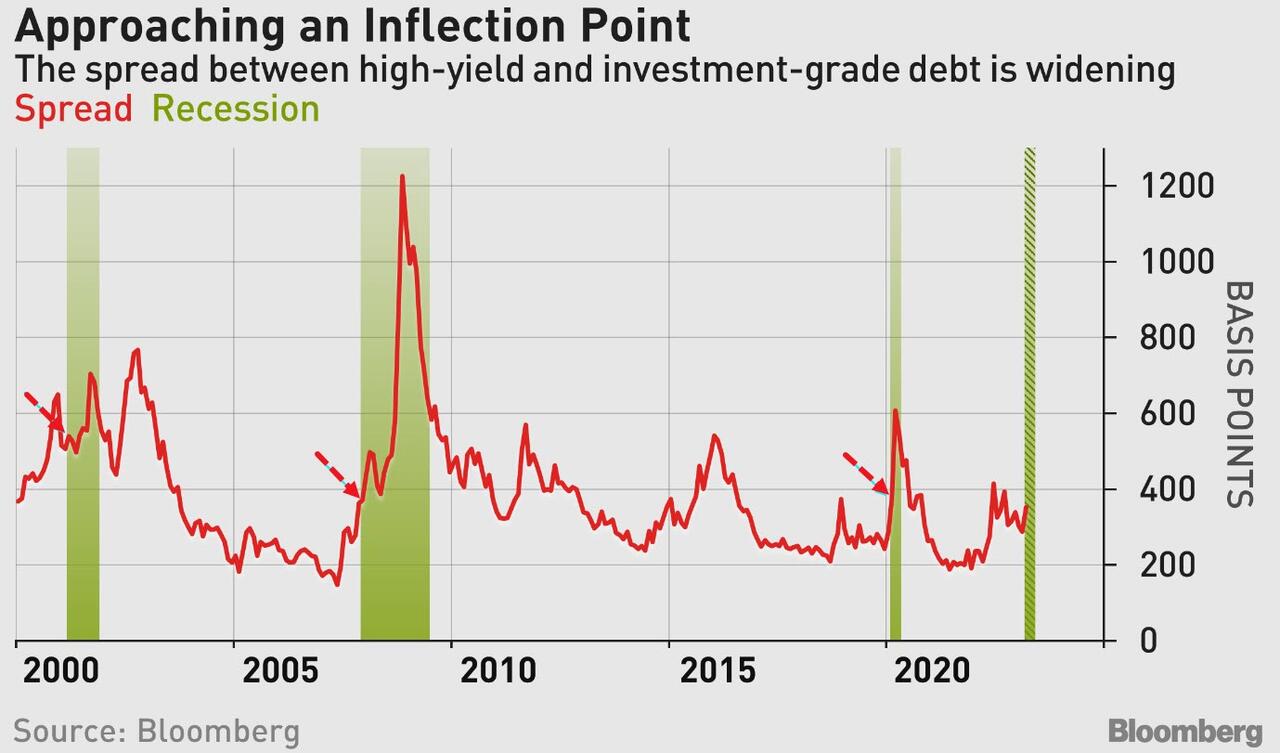
The spread between high-yield dollar-denominated corporate bonds and those on investment-grade securities widened to touch 367 basis points this month.

That level has been a sufficient trigger to herald a contraction of the world’s largest economy in data going back to the start of the millennium.

The average differential that coincided with the onset of a recession was 354 basis points in December 2007 and 276 basis points in February 2020.

Federal Reserve Bank of Minneapolis President Neel Kashkari said over the weekend that the recent bank turmoil has raised the risk of a US recession, remarking that the tumult “definitely brings us closer” to one.

Fed Chair Jerome Powell said after last week’s policy review that a significant number on the open market committee “expect credit tightening” following the failure of Silicon Valley Bank and Signature Bank. It didn’t help investor sentiment that Credit Suisse, a systemically important entity, was on the brink before its takeover by UBS.

Even so, while the Fed lowered its economic-growth estimate for 2023, it has only dropped it a notch to 0.4% from 0.5%. Rather than underscoring optimism, the latest projection may reflect the fact that it’s too early for the FOMC to assess the fallout of systemic stress.

While the Bloomberg Financial Conditions Index has gone from signaling a loose policy backdrop at the end of last month to one that is sharply tight now, it is nowhere near what it was telegraphing during, say, the onset of the pandemic-led recession. However, Powell acknowledged that financial conditions may have tightened more than traditional indexes show because they don’t capture lending metrics.

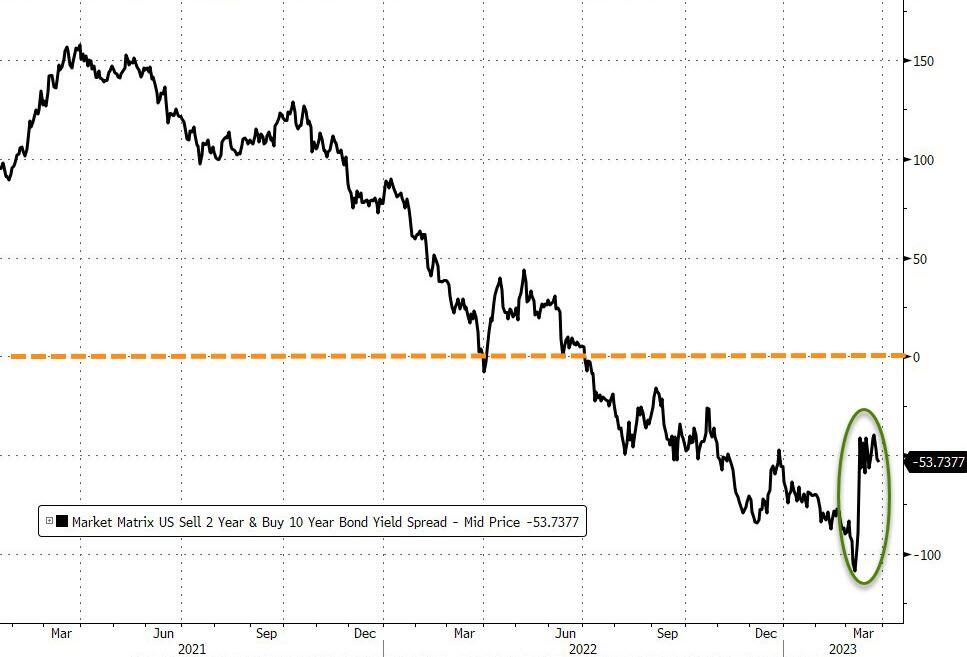
Meanwhile, the differential between 10- and two-year Treasury yields has gone to -50 basis points from -110 basis points.

That steepening after a long period of flattening usually signals an economy on the cusp of a contraction.

Still, it’s useful to keep in mind that dating recessions is far from a linear function and hence tricky to call in real time. If we are on the threshold of a contraction, we won’t know for sure right away. The National Bureau of Economic Research, tasked with determining the date, usually declares the onset with a considerable lag.

Regardless, there is little doubt that the banking failures in the US and the ripple effect of Credit Suisse’s takeover have tightened financial conditions considerably.

That’s had an adverse impact on consumer sentiment, which may be enough to hobble the US economy.

To what degree is the key question.

Tyler Durden
Thu, 03/30/2023 – 07:20

via ZeroHedge News https://ift.tt/PH3TmOj Tyler Durden

Russia Arrests WSJ Reporter On Suspicion Of ‘Espionage’

Russia Arrests WSJ Reporter On Suspicion Of ‘Espionage’

The Federal Security Service of Russia arrested Evan Gershkovich, a journalist from the Wall Street Journal, on allegations of spying.

The Federal Security Service, known as FSB, said in a statement it detained Gershkovich, a US citizen, in the eastern city of Yekaterinburg, about 900 miles east of Moscow in the Ural Mountains.

FSB said the reporter was “on the instructions of the United States, he was collecting information about one of the enterprises of the Russian military-industrial complex, which constitutes a state secret.”

WSJ released this statement about Gershkovich’s arrest: 

“The Wall Street Journal vehemently denies the allegations from the FSB, and seeks the immediate release of our trusted and unbiased reporter, Evan Gershkovich.” 

Gershkovich has worked for WSJ in Moscow for more than a year. He previously worked in Russia for Agence France-Presse and The Moscow Times. 

Over the past year, the reporter has authored articles about the effects of Western sanctions on Russia’s economy and the faltering relations between Moscow’s elite and the Wagner paramilitary group.

The FSB said it had “stopped the illegal activities” that Gershkovich was conducting and opened an espionage case against him in Yekaterinburg.

Gershkovich’s arrest follows the high-profile arrest of now-freed WNBA star Brittney Griner. In December, she was released from a Russian prison in a swap deal for arms dealer Viktor Bout

Andrei Soldatov, an expert on Russia’s security services, tweeted that Gershkovich’s arrest “is a frontal attack on all foreign correspondents who still work in Russia.” 

How much is the Biden administration considering carrying out another prisoner swap to secure the release of the American journalist?

Tyler Durden
Thu, 03/30/2023 – 06:55

via ZeroHedge News https://ift.tt/wyH39WV Tyler Durden

EU Planning To Invest Frozen Russian Assets, Give Returns To Ukraine

EU Planning To Invest Frozen Russian Assets, Give Returns To Ukraine

Authored by Kyle Anzalone via The Libertarian Institute,

The European Union is developing proposals on what to do with assets of the Russian central bank that were seized by member states. According to European officials, the bloc may invest the money and give the returns to Ukraine. 

Anders Ahnlid, a Swedish diplomat who leads the commission exploring what to do with the Kremlin’s money, told Politico that whatever decision is made will be without precedent. “There is a consensus among [EU] member states that it’s important to examine very, very carefully, what can be done under the instructions that we’ve been given, including that what is going to be done will have to be in compliance with EU and international law,” she said. “We are in an exceptional situation and probably any solution that we will come up with will be of a nature that hasn’t been there before.”

The diplomats believe the bloc will be able to legally invest the funds because Russia’s invasion of Ukraine is an “exceptional and gross violation” of international and humanitarian law. 

However, the commission admits it will have to change sanctions regulations to carry out the plan. The current statutes say once funds are unfrozen, then the target will get access to their capital as well as any returns that accrued during the sanctions period. 

The bloc hopes other Western nations will join in on the scheme. The EU said taking steps in coordination with the Group of 7 (G7) was vital to not spooking investors. The commission estimates that EU and G7 countries have frozen about $300 billion in Russian central bank assets. It believes if the money is invested, it can earn about a 2.6% return. 

The EU is not sure how it would handle losses. “Losses can never be excluded,” and so the question of “who bears any residual risk in case [of] such losses … will require a clear legal answer,” the commission admitted. Adding, losses have “political and financial implications.”

The commission was created last month at the direction of Sweden. “The mandate is to contribute to mapping which funds have been frozen in the European Union … and secondly how to legally proceed to access those funds,” Swedish Prime Minister Ulf Kristersson said.

The Swedish Prime Minister stated that Russian citizens must bear the cost of the war in Ukraine. Kristersson said that it’s “Russian taxpayers, not all other taxpayers, who must bear the cost of the necessary reconstruction work.”

Tyler Durden
Thu, 03/30/2023 – 06:30

via ZeroHedge News https://ift.tt/7azDfZg Tyler Durden

France Buys 65,000 Tons Of LNG From China In First Ever Yuan-Denominated Trade

France Buys 65,000 Tons Of LNG From China In First Ever Yuan-Denominated Trade

China has just completed its first trade of liquefied natural gas (LNG) settled in yuan, the Shanghai Petroleum and Natural Gas Exchange said on Tuesday. As OilPrice notes, the Chinese state oil and gas giant CNOOC and TotalEnergies completed the first LNG trade on the exchange with settlement in the Chinese currency, the exchange said in a statement carried by Reuters.

The trade involved around 65,000 tons of LNG imported from the United Arab Emirates (because China will never admit that it is re-exporting Russian LNG even though it now does it all the time) the Shanghai Petroleum and Natural Gas Exchange added.

The French supermajor, one of the world’s top LNG traders, confirmed to Reuters that the trade involved LNG imported from the UAE, but declined to comment further on the deal. 

China has been looking for years to establish more trade deals in yuan to increase the relevance of the petroyuan (or LNG-yuan as the case may be) on the global markets and challenge the U.S. dollar’s dominance in international trade, including in energy trade. During a landmark visit to Riyadh in December, Chinese President Xi Jinping said that China and the Arab Gulf nations should use the Shanghai Petroleum and National Gas Exchange as a platform to carry out yuan settlement of oil and gas trades.

“China will continue to import large quantities of crude oil from GCC countries, expand imports of liquefied natural gas, strengthen cooperation in upstream oil and gas development, engineering services, storage, transportation and refining, and make full use of the Shanghai Petroleum and National Gas Exchange as a platform to carry out yuan settlement of oil and gas trade,” Xi said in December, as carried by Reuters

Still, Beijing has a ways to go before it dethrones the greenback as the global reserves: while the Chinese currency has made inroads in global trade, the yuan accounts for just 2.7% of the market, compared to the U.S. dollar’s share of 41%. 

On the other hand, China’s currency has lots of momentum: over the past year, Russia has turned to trade in yuan in the wake of the Western sanctions on its exports, imports, and energy trade, as the Chinese currency has become Putin’s only alternative to reduce exposure to the U.S. dollar and the euro.

Tyler Durden
Thu, 03/30/2023 – 05:45

via ZeroHedge News https://ift.tt/ChIm0SX Tyler Durden

Risk Of Cardiac Death Tripled For Young Women Following AstraZeneca COVID-19 Vaccination: Study

Risk Of Cardiac Death Tripled For Young Women Following AstraZeneca COVID-19 Vaccination: Study

Authored by Lily Zhou via The Epoch Times (emphasis ours),

The risk of sudden cardiac death in young women more than tripled following an AstraZeneca COVID-19 shot, according to a study using England’s official data published on Monday.

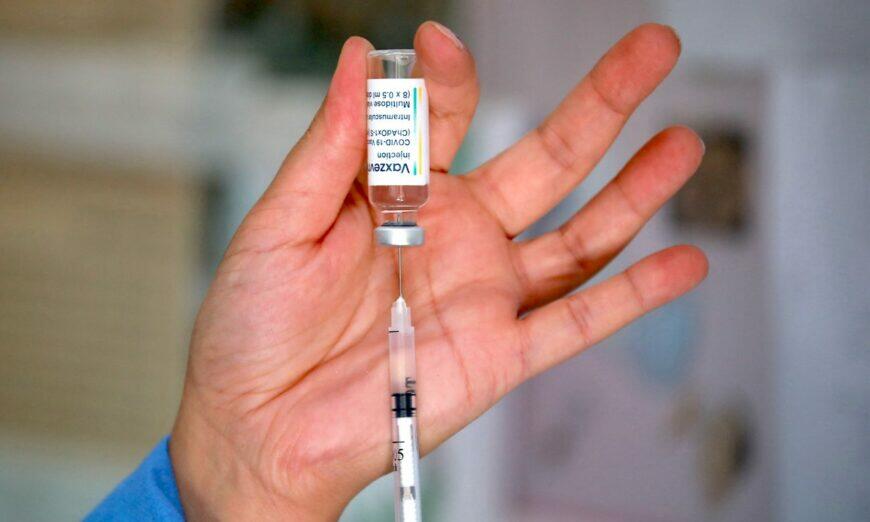
A dose of the Vaxzevria AstraZeneca vaccine in an undated file photo. (Louai Beshara/AFP via Getty Images)

Vahé Nafilyan, senior statistician at the Office for National Statistics (ONS), said researchers found “receiving a first dose of a non-mRNA vaccine was associated with an increased risk of cardiac death in young women.”

There was no evidence that the risk of death in young people increased following vaccination with mRNA shots, such as those produced by Pfizer-BioNTech and Moderna.

The ONS compared deaths of people aged between 12 and 29 that occurred within 12 weeks of COVID-19 vaccination—the so-called risk period—to those that occurred at all times after the risk period, to estimate the risk of death following vaccination.

After cross-referencing the deaths with records of COVID-19 vaccination and test results, the ONS said there had been “no significant increase in cardiac or all-cause mortality” within 12 weeks of receiving COVID-19 vaccines.

However, a breakdown of data showed that the risk of cardiac death among young women was three times higher in the 12 weeks following any dose of non-mRNA vaccination, compared with the longer-term risk.

When only the first dose was included, young women’s risk of cardiac death become 3.5 times higher within 12 weeks of vaccination.

But the ONS also noted that the subgroup who received non-mRNA vaccines “was more likely to be clinically vulnerable and may be at greater risk of adverse events following vaccination than the general population.”

It also said the absolute number of deaths was small.

“According to the statistical model, 11 out of the 15 cardiac deaths in young women that occurred within 12 weeks of a first dose of a non-mRNA vaccine were likely to be linked to the vaccine; this corresponds to 6 cardiac-related deaths per 100,000 females vaccinated with at least a first dose of a non-mRNA vaccine,” the ONS said.

Members of the public have the AstraZeneca COVID-19 vaccination at Fazl Mosque in Southfields as they host a drop in clinic, in London, on June 8, 2021. (Dan Kitwood/Getty Images)

The study also examined the effect of COVID-19 on young people, concluding that a positive test was associated with increased cardiac and all-cause mortality and that the risk was higher in those who were unvaccinated at the time of testing than in those who were vaccinated.

Noting the limitations of the method, the study said some deaths that occurred during the period may not have been registered by the cut-off date because deaths of young people and deaths that occurred soon after COVID-19 vaccination are more likely to be referred to the coroner and “registration delays can be substantial.”

Although the subgroup of deaths that occurred in hospitals were not subject to registration delays, sudden cardiac deaths mostly occur outside of hospitals and may not be captured in the data, the paper said.

Spike Protein May Be the Problem

Adam Finn, professor of paediatrics at the University of Bristol and a member of the UK’s Joint Committee on Vaccination and Immunisation, said the data generated “as many questions as answers.”

The findings are somewhat unexpected, as concerns about rare cardiac side-effects—specifically myocarditis and pericarditis—have hitherto been particularly associated with mRNA vaccine second doses in males especially when the dose interval was short, whereas the signal reported here is primarily in non-mRNA first doses in females,” Finn said in a statement.

He said the overall data seems “reassuring,” and the increased mortality associated with a positive COVID-19 test result “raises the question whether the spike protein—which is expressed both during infection and following vaccination—is the cause.”

“The next and most pressing issue that needs to be addressed is to gather more detailed information on what the nature of the reported cardiac events actually was, as this would help us begin to understand what is really being seen in these figures and might help guide future policy and vaccine design,” he added.

Read more here…

Tyler Durden
Thu, 03/30/2023 – 05:00

via ZeroHedge News https://ift.tt/Lrua4ml Tyler Durden