Lie Detectors Are Junk Science, but We Keep Using Them


woman taking a lie detector test

You’ve probably seen a lie detector in a movie or TV show, its stylus scratching an ink line across a scrolling page and jumping when the subject lies. Sometimes the polygraph is presented as infallible; sometimes its scrutiny can be evaded. In a spy thriller, the hero might put a pin in his shoe: Stepping down on a sharp point, the theory goes, will cause sufficient stress to spike his blood pressure, disguising false statements. In other tales, talented operatives can simply meditate their way down to a state of calmness and therefore appear not to be lying.

Even in the early days of the lie detector, the device’s advocates seemed dimly aware that simply being questioned by the police might make a suspect flustered or nervous and, thus, perhaps give the impression of being untruthful. Whose blood pressure wouldn’t spike when faced with criminal charges? Sure enough, police quickly found that people who were given polygraphs tended to panic. They also tended to confess: to all sorts of  offenses, from card games to illegal alcohol, separate from the crimes under investigation.

Amit Katwala, a reporter at Wired, tackles the lie detector’s early history in Tremors in the Blood. He focuses on its origins in Berkeley, California, in the 1920s and on some cases that both brought it to prominence and raised questions about its validity..

The machine attracted controversy right from the start. Katwala covers the case of Henry Wilkens, who was (probably) guilty of killing his wife but managed to get away with it. This was a front-page news story in San Francisco in 1923, and it was an opportunity for the lie detector to prove its value. Unfortunately for the prosecution, when he was subjected to a test in front of a crowd of onlookers, Wilkens passed. In the eyes of the polygraph boosters, the device had failed—or was failed, in being applied incorrectly. Wilkens was acquitted and the San Francisco Police Department swore off lie detectors. 

 The Wilkens case shows more about why police forces (and the public) wanted the lie detector, or something like it. A young woman had been shot to death. It was the sort of violent crime that was on the rise in the early 1920s, panicking suburbanites and leading authorities to grasp at any technique to catch perpetrators. People wanted answers and security.

In the preceding decades, new policing techniques had become standard (from mug shots to fingerprints) and the “science” of law enforcement had been growing apace. The lie detector looked like yet another leap forward. The era had already brought the telephone and the radio; what new magic would be next? It was the same mindset that led people to embrace the eugenic ideas of the Italian criminologist Cesare Lombroso—that there were criminal “types,” detectable by their appearance. If some people were just undesirables, the thinking went, wouldn’t it be all the better to flush them out with scientific proof?

The only “lie detector” available up to that point was a sharply wielded nightstick, so the mirage of an accurate, efficient, and peaceful truthfinder held an understandable appeal. The same impulse led investigators to try and then abandon various versions of “truth serum” over the decades. 

But the lie detector is just the 20th-century version of witch pricking, revealing a “truth” that isn’t there. The National Academy of Sciences has dismissed the polygraph’s validity, and the American Psychological Association says there is “little evidence” that it works.

The technology also quickly faced legal challenges. In Frye v. United States (1923), the Court of Appeals of the District of Columbia held that any scientific methods deployed in the courtroom had to be widely accepted by experts, which polygraphs were not. But this inadmissibility didn’t stop it from catching on, or from gaining acceptance in the public mind. Millions of tests are given in the United States every year, and it is used on anyone from suspected criminals by the FBI to suspected baby daddies by Maury Povich.

Those who use the test clearly believe it has some probative value—and at one remove, the threat of a polygraph might at least lead suspects to be forthcoming. In his 1991 book Homicide: A Year on the Killing Streets, David Simon detailed how Baltimore police fooled suspects by claiming a Xerox machine was a lie detector: They preloaded it with paper saying TRUTH or LIE and just hit the print button when their target answered a question. The rattled suspect thought the jig was up.

False confessions were an issue even in the earliest days of polygraphs, and nothing its developers tried could remove the risk. Disillusionment both with the technology’s limits and with law enforcement’s ability to solve crime is a thread through the lives of three major figures in Katwala’s book: Berkeley police chief August Vollmer, Berkeley physiologist turned police officer John Larson (who invented the device), and Larson’s teenaged assistant Leonarde Keeler (who later developed it further). Keeler became the machine’s keenest advocate, eventually hoping to patent and market it to law enforcement and civilian organizations. Nonetheless, even he came to see its flaws and potential for abuse.

That leaves the lie detector in a kind of gray area. Its advocates believe that it has now been sufficiently tweaked to be effective. Critics regard it as junk science. One of those critics is Katwala, who states firmly that the polygraph “does not work.” In the final chapter, he explores modern lie-detecting variants, based on eye movement tracking or fMRI scans. None of these can be shown to really work either, but the market for them continues. 

The underlying problems here extend well beyond the polygraph, affecting even legitimate technologies. Attorneys today talk of the “CSI effect,” with fictional high-tech detectives shaping how the public expects the police to work with advanced, completely accurate technology. Juries like blue light photos and DNA evidence, the more “sciency” the better. As forms of supposedly scientific proof—such as handwriting analysis—have come under suspicion for being more speculative than we were told, the desire persists for a technique that reveals the truth in the human heart. The polygraph and its modern variants won’t be going away any time soon.

Tremors in the Blood: Murder, Obsession and the Birth of the Lie Detector, by Amit Katwala, Crooked Lane Books, 352 pages, $18.99

The post Lie Detectors Are Junk Science, but We Keep Using Them appeared first on Reason.com.

from Latest https://ift.tt/Ci20WFO
via IFTTT

How the Media Got the Vinyl Chloride Risk All Wrong


East palestine train collision led to toxins being released into the air

The residents of East Palestine, Ohio, have more than enough to worry about. A train wreck with black fumes of burning chemicals pouring from a tank is frightening enough. The absolute last thing they need is the news media spreading even scarier—but inaccurate—information about the accident.

Yet for weeks, that is precisely what’s been going on.

Vinyl chloride, a chemical long used to make PVC plastics, is being portrayed as something more suitable for capital punishment than for a routine manufacturing process in a factory. Ohioans, like the rest of the country, are being bombarded by horrifying claims about its health risks, most of which have been just plain wrong.

There is, in fact, strong evidence that vinyl chloride not only is not deadly but is, in fact, considerably less toxic than many common, everyday drugs and chemicals. Likewise, its cancer risks have also been wildly overstated. It is easy to call a chemical a carcinogen, but in the absence of context, dose, and length of exposure, this term means little.

Fortunately, there is a longstanding, highly regarded organization that provides information on the health risks of individual chemicals. The National Fire Prevention Association (NFPA) describes itself as “a global self-funded nonprofit organization, established in 1896, devoted to eliminating death, injury, property and economic loss due to fire, electrical and related hazards.” The group maintains a database of more than 3,000 chemicals—a critical tool for first responders or other workers who must deal with the aftermath of a chemical spill or fire. Here we can begin to understand the real risks of vinyl chloride.

NFPA uses color-coded “safety diamonds” to provide easily read information about chemicals that firefighters may encounter. They quickly cover a chemical’s health hazards, flammability, and stability (that is, whether it can spontaneously explode), along with any special warnings—for example, when exposure to water must be avoided.

An example of an NFPA safety diamond

NFPA classifies health hazards on a scale of 0 to 4, where 0 indicates little or no hazard and 4 is reserved for deadly chemicals that can kill even with short exposure. Vinyl chloride has a 2 rating—a “moderate” hazard, described as posing a “temporary or minor, reversible injury [that may be] harmful if swallowed, inhaled, or absorbed through the skin.”

To put this in perspective, both alcohol and chloroform—the latter was used for general anesthesia for 125 years—are also rated 2. Both alcohol and chloroform are also known carcinogens.

NFPA safety diamonds for alcohol (ethanol), chloroform, and vinyl chloride. The 2 in the blue squares indicate a moderate hazard.

The disconnect between the data and the coverage becomes even more apparent when data from animal models of toxicity are considered. One common measure of toxicity is the LD50, which stands for “lethal dose 50 percent”—the amount of material given at once (usually orally) that kills half of the test animals. Although these data cannot be quantitatively applied to human beings, LD50 values are useful for identifying which chemicals are very toxic (and which are very safe). If vinyl chloride was highly toxic, the test would indicate it.

In rats, ethanol and vinyl chloride are both non-toxic; it takes a large dose to kill the animal. Both caffeine and aspirin are at least 10 times more toxic than vinyl chloride.

(LD50 values of vinyl chloride and five common chemicals. The higher the number, the safer the chemical. **Note – Actual LD50 values also include the body weight of the animal being dosed, which is beyond the scope of this article. The comparisons are still valid. References: a, b, c, d, e, f)

Ohio residents are being exposed primarily by inhalation, not oral consumption, which may reduce the relevance of LD50 values. But according to the Occupational Safety and Health Administration, vinyl chloride toxicity via inhalation is low in both rodents and people. It is not unreasonable to assume that the chemical would have been useful for general anesthesia when the science was in its infancy. Indeed, a 1947 study showed that it not only was efficacious in animals but was less toxic than chloroform, although the authors ultimately recommended against its use in general anesthesia because the therapeutic index—the difference between the effective and lethal dose—was too small.

The cancer risks, probably the scariest to most people, have also been badly exaggerated. But in a different way—duration of exposure.

Cancers do not result from single exposure to chemical carcinogens. It takes years for cigarette smokers to develop lung cancer. The chances of cancer developing many years later from a single or brief exposure, whether it be one cigarette, a pack, or even a carton, are infinitesimally small. The same holds true for vinyl chloride; it is an occupational carcinogen. Between its volatility and rapid metabolism, vinyl chloride does not accumulate in the human body. 

Aside from the possibility of catastrophic explosion, there is one genuine scare from vinyl chloride: its combustion products.

When it burns—as it is still doing today—vinyl chloride is known to produce deadly phosgene gas (a WWI chemical weapon) and hydrogen chloride, a highly corrosive irritant. The latter is probably responsible for residents’ symptoms and fish deaths, since fish are extremely sensitive to acidic water.

While it seems clear that hydrogen chloride exposure is real, the same cannot be said for phosgene. Had people near the accident been exposed to significant amounts of phosgene (and it doesn’t take much), the picture would be very different. Intensive care units and morgues would be full. In the absence of severe illness and death, it can reasonably be assumed that phosgene has not been released in significant quantities 

Finally, the threat from the accident could have been far worse had the train been carrying some of the highly toxic chemicals—far worse than vinyl chloride—that are routinely shipped around the country. But this is little comfort to East Palestine residents. They are still coping with a burning train containing at least five other chemicals. The last thing they need are sensationalized, inaccurate reports of a rather benign chemical in their midst.

The post How the Media Got the Vinyl Chloride Risk All Wrong appeared first on Reason.com.

from Latest https://ift.tt/2YIUjEp
via IFTTT

The Luddites’ Veto


ron

No sensible person could favor irresponsible research and innovation. So RRI—”responsible research and innovation“—may sound like an innocuous idea. As it takes hold in Europe, though, the term has clearly become a cover for what amounts to a Luddites’ veto. Now the notion is percolating among American academics. If it finds its way to the halls of state, RRI would dramatically slow technological progress and perhaps even bring it to a grinding halt.

That wouldn’t be an unexpected byproduct. Several RRI proponents have explicitly argued for “slow innovation,” even “responsible stagnation.” One of them—Bernd Carsten Stahl, a professor of critical research in technology at De Montfort University in the United Kingdom—has even compared technological breakthroughs to a pandemic. “We should ask whether emerging technologies can and will be perceived as a threat of a similar level as the current threat of the Covid virus,” he wrote in 2020. If so, he added, they would require “radical intervention.”

An Overabundance of Caution

Before we explore RRI, we should take a look at its precursor, a pernicious notion known as the precautionary principle. This concept is often summarized as “better safe than sorry”—but there’s a bit more to it than that.

In 1998, a group of environmentalists meeting at the Wingspread retreat center in Wisconsin hammered out the now more or less canonical version of the precautionary principle: “When an activity raises threats of harm to human health or the environment, precautionary measures should be taken even if some cause and effect relationships are not fully established scientifically.” The so-called Wingspread Statement explicitly shifts the burden of proof, so that anyone proposing a new activity cannot proceed without showing that it will not—or, at least, is very unlikely to—cause significant harm. This amounts to a demand for trials without error.

Political scientist Aaron Wildavsky anticipated how such an idea would actually end up doing more harm. “An indirect implication of trial without error is that if trying new things is made more costly, there will be fewer departures from past practice; this very lack of change may itself be dangerous in forgoing chances to reduce existing hazards,” he wrote in his 1988 book Searching for Safety. “Existing hazards will continue to cause harm if we fail to reduce them by taking advantage of the opportunity to benefit from repeated trials.”

But as misguided as it is, the precautionary principle is at least focused on preventing harms to health and the environment. In a 2021 article for the Journal of Responsible Innovation, three responsible research and innovation boosters—Richard Owen, René von Schomberg, and Phil Macnaghten—called RRI “a move from risk governance to innovation governance.” Two more proponents, Stevienna de Saille and Fabien Medvecky, put it more plainly in 2016: RRI, they wrote, focuses not just on an innovation’s health and environmental impact but its “impact on values, morals and social relations.”

So innovators won’t just have to prove somehow that their technologies pose no harm to human health or the environment. They’ll also have to show that they will not do too much to disrupt a society’s prevailing morals, culture, and livelihoods.

RRI’s advocates trace their intellectual roots to British chemist David Collingridge’s 1980 book The Social Control of Technology. “The social consequences of a technology cannot be predicted early in the life of the technology,” he wrote. “By the time undesirable consequences are discovered, however, the technology is often so much part of the whole economic and social fabric that its control is extremely difficult.” Collingridge called this process “entrenchment.” His modern acolytes describe it as technological “lock-in.”

Note Collingridge’s focus on social consequences. To weigh those consequences, he did not turn to the decentralized process where producers and consumers evaluate new products for their safety, quality, and efficacy via the marketplace. Collingridge called for political control.

What sort of undesirable consequences did he have in mind? One was that “modern medicine and hygiene has reduced the death rate in developing countries, but doing so has generated an uncontrollable increase in population.” Another was that “food production has increased through the use of chemicals, but at the cost of the future collapse of agriculture due to damage to soil and its supporting ecosystem.”

Collingridge’s forecasts did not come true. World population is expected to peak around the middle of this century, thanks to modern innovations such as effective birth control. Global cereal production has not collapsed and, indeed, has more than doubled since Collingridge’s book appeared. If RRI had been a part of the political system in 1980, we might not have “entrenched” or “locked in” these new technologies, but we would have entrenched and locked in a lot of hunger and substandard health care.

Collingridge also mused darkly about the coming consequences of the then-emerging technology of “microelectronics.” He warned, “This technology is in its infancy, and it is now possible to place all kinds of controls and restrictions on its development, even to the point of deciding to do without it altogether.” And why would we consider doing without it altogether? “Concern has been expressed about the unemployment which may result from the uncontrolled development and diffusion of microelectronics, but our understanding of this effect is extremely limited.”

Microelectronics—in the form of personal computing and the internet—did indeed destroy 3.5 million jobs in the U.S., according to a 2017 McKinsey Global Institute report. But the same report calculated that those technologies have created 19.3 million new jobs since 1980, yielding a net gain of 15.8 million jobs. That’s about 10 percent of the current U.S. civilian work force. It’s a good thing we didn’t have an RRI tribunal with the power to declare this technology so dire that it would be better to “do without it altogether.”

If such a tribunal had existed a century before that, hostlers and buggy whip makers—or as the RRI crowd would call them, transportation industry “stakeholders”—would have been empowered to keep cars off the roads. Collingridge and his acolytes would have nodded their heads approvingly.

The Evils of the Automobile

In her 2016 book The Ethics of Invention, Harvard-based RRI proponent Sheila Jasanoff decries cars. “The life history of the automobile,” she declares, “remains a paradigmatic case study in the limits of human foresight. The car unlocked immense possibilities for individual freedom and productivity, but these went hand in hand with drastic consequences for society that no one had imagined or regulated in timely fashion.” Cars, she continued, had brought “more than a million traffic deaths worldwide each year, the spread of deadening, routinized work practices, the blight of urban air pollution, the fragmentation of communities, the decay of once-great manufacturing centers, and eventually world-threatening climate change.” She then asks, “Could current practices of responsible innovation and anticipatory governance have turned the tide of the automobile’s history before it took a tragic course?”

When she wrote those words, Jasanoff was following in Collingridge’s footsteps. For Collingridge, the automobile is the archetypal example of an innovation that unfortunately escaped social control. “The British Royal Commission on the Motor Car of 1908 saw the most serious problem of this infant technology to be the dust thrown up from untarred roads,” he wrote. (He had the year wrong; the commission released its report in 1906.) “With hindsight we smile, but only with hindsight.” Collingridge acknowledged that “dust was a recognized problem at the time, and so one which could be tackled,” but he went on to lament that the “much more serious social consequences of the motor car with which we are now all too familiar could not have been predicted with any certainty.”

There was indeed considerable testimony at the time about the dust created by automobiles. They were much heavier than horse carriages and wagons, and their wheels were often metal, thus pounding down unpaved roads. In its 1906 report, the Royal Commission recommended experiments with applying dust preventives such as tar and mineral oils to roadways.

But that was hardly the only objection cars faced in their early days. If RRI had existed in that era, the “stakeholders” would have acted on their social values. And the social values at the turn of the 20th century were decidedly anti-automobile.

On May 23, 1902, The New York Times described the results of a postcard poll sent to 30,000 city residents on increasing the speed limit of automobiles. “Ninety-five per cent of those who responded are opposed to the extension of the speed limit from eight to ten miles per hour,” the paper reported. Four days later, a letter to the Times decried “reckless speeders of ponderous automobiles” as “the idle and vicious rich.”

A July 6, 1902, Times article noted an “increase in hostility toward automobilists.” The “admiration and interest of at least a very large part of the public has been succeeded by open hostility,” it reported. “Motor vehicles encounter abuse at almost every point, and of late passive hostility has developed into active attacks, not only upon drivers who run their machines at an illegal rate of speed, but those who observe the legal speed limit.” The article went on to recount an incident in which an irritated farmer shot a passing car.

A few years after that, the president of Princeton University (and future president of the U.S.) joined in. “Nothing has spread socialistic feeling in this country more than the use of automobiles,” Woodrow Wilson declared in a 1906 speech. “To the countryman they are a picture of arrogance of wealth with all its independence and carelessness.”

Then there were the economic interests who disliked the car. In his 2008 book Autophobia, historian Brian Ladd detects “the hand of the horse-and-cart lobby in a 1908 English poster that lamented the loss of 100,000 jobs in that industry only after capturing the attention of passersby with an attack on the ‘reckless motorists’ who ‘kill your children,’ dogs, and chickens, ‘fill your house with dust’ as well as ‘spoil your clothes with dust’ and ‘poison the air we breathe.'”

The automobile had its defenders. “The man who knows [the car] from the outside only despises it and damns it on general principles,” wrote Argosy publisher Frank Munsey in 1903. But, after their first ride, he observed that everyone is an “easy convert” to automobiles. He added, “I have never known a case, however bitter and unreasoning the prejudice, where one didn’t change squarely about on the very first ride in a good car.” With time, more people had a chance to take that ride: Cars became popular with the masses after Henry Ford introduced the mass-produced Model T on October 1, 1908, making them far more affordable. Had RRI tribunals existed back in 1900, the technology might not ever have advanced that far.

Having missed their chance to turn the tide against conventional cars, some RRI proponents have now set their sights on the emerging technology of autonomous vehicles (A.V.s). Their objections can be found in the output of several carefully plotted focus groups conducted in the name of inclusive stakeholder and public engagement. For example, Belgian anthropologist Axelle Van Wynsberghe and the European Commission official Ângela Guimarães Pereira conducted several “citizen engagement activities” to evaluate the technology. In those meetings, they reported in 2021, “citizens seem to be motivated to limit if not eliminate car use, and are invested in prioritising active modes of transport such as walking and biking….Overall, what was questioned was whether the driverless and vehicle automation was indeed the needed response to mobility problems faced by citizens.”

Without bothering with the camouflage of citizen engagement, RRI supporter Robert Braun of the Institute for Advanced Studies got right to the point. “Instead of asking whether we need self-driving vehicles, why not ask whether we need cars at all?” he wrote in 2018. Better, he argued, to walk, bike, or take public transportation.

Since relatively few people have had much experience with self-driving vehicles, it’s not surprising that many are currently concerned about their social and economic effects. In March 2022, a Pew Research Center survey found 44 percent of Americans say widespread use of driverless cars would be a bad idea for society. Only 26 percent said it would be a good idea; 29 percent didn’t know. In addition, “Roughly six-in-ten adults (63%) say they would not want to ride in a driverless passenger vehicle if they had the opportunity, while a much smaller share (37%) say they would want to do this.” Like the horseless carriages of yore, self-driving cars have also provoked some ire. People wielding rocks and knives had attacked Waymo A.V.s in Arizona and California.

Of course, as businesses with skin in the game, A.V. developers are already engaging with and learning from the public. For example, Waymo cooperated with researchers at Arizona State University and the Federal Transit Administration in a study in which older and disabled participants in the Phoenix metro area could summon autonomous Waymo vehicles by app. The study‘s “key findings were that participants felt safe, found the AV services more convenient than typical RideChoice options, and engaged in more out-of-home activities (i.e., made new trips) as a result of the AV option.” Overall, the participants rated the A.V.s’ wait times, travel times, convenience, and comfort higher than their ratings for traditional options.

Even more importantly, the report found that “riders were in general agreement in their excitement to ride in a Waymo vehicle with no trained vehicle operator,” noting that “many felt that, just as they became comfortable with the AV technology with a trained vehicle operator who was there only as back-up, they felt that they would similarly adjust to riding in fully driverless vehicles and looked forward to the opportunity to do so.” Just as first-time riders were “easy converts” to automobiles back in 1903, riders of modern autonomous vehicles are likely to come around soon. But not if RRI arbiters deploying public engagement exercises with malice aforethought succeed in blocking the technology through regulations that entrench and lock in the social values that currently reign.

Most people don’t know what they’ll think of a new technology until they have actually used it. The market is a discovery process that allows us to try out new things and either accept or reject them. The RRI crowd wants to block that process.

Standing Athwart Innovation, Yelling Stop

The same crowd wants to slow or stop the innovation unfolding in other fields, including crop biotechnology, artificial intelligence, robotics, nanotechnology, and human reproduction. With regard to the latter, Jasanoff and her colleagues argued in 2019 that germline editing threatens “the future of human integrity and autonomy as we have long understood these concepts.” Consequently, “public permission is a prerequisite to disrupting fundamental elements of social order.”

Sounds profound and serious, right? Let’s see how it sounds when applied to an earlier reproductive technology that disrupted “fundamental elements of social order.” When the birth control pill was introduced, it certainly impacted “values, morals and social relations.” How might RRI tribunals, had they existed in 1960, have entrenched and locked in the social values of the day?

As late as 1965, Gallup reported that only 18 percent of adult American women and 14 percent of adult men approved of giving the pill to women in college. In 1970, only 24 percent of men and 12 percent of women thought teens should have access to oral contraceptives. On a related question, a 1963 National Opinion Research Center (NORC) survey found that fewer than one in five respondents considered premarital sex acceptable.

Not everyone agreed with the majority, of course. In 1965, Cornell University political scientist Andrew Hacker surveyed 200 first-year college students on whether college clinics should distribute contraceptive pills to undergraduate women upon request. “It is hardly necessary to say that a good majority of the boys thought this was a splendid idea,” Hacker wrote subsequently in The New York Times. “But what surprised me was that most of the girls also agreed with this proposal.” In a subsequent letter to the editor, a father observed that since we cannot “count on the ‘old ties of family, community, church, and trade’ as strong or satisfactory deterrent to wild sexual abandon,” he would “be wise to arrange” as a high school graduation present for his daughter a “gift certificate for several free years of pills.”

At the end of his article, Hacker concluded that when the pill “receives wide distribution, as it will, it will challenge our capacity to use yet another innovation with sophistication and responsibility. Just as we have adjusted our lives to the television set and the automobile, so—in 20 years’ time—we shall take the pill for granted, and wonder how we ever lived without it.” He was prescient. A July 2022 FiveThirtyEight/Ipsos survey found that nearly 90 percent of Americans think birth control pills should be legal. Data collected by Kaiser Family Foundation in May and June 2022 showed “more than three-quarters (77%) of reproductive age females favor making birth control pills available over the counter without a prescription.”

By then, several nonsexual benefits to the technology had become clear as well: Then–University of Michigan economist Martha Bailey reported in 2013 that “individuals’ access to contraceptives increased their children’s college completion, labor force participation, wages, and family incomes decades later.” Would that have happened if RRI’s “public engagement processes” had locked in mid–20th century sexual values?

Or consider another reproductive technology: in vitro fertilization (IVF). A 1969 Harris poll found a majority of Americans believing that IVF babies were “against God’s will.” In the 1970s, the U.S. government came close to entrenching that societal value when it imposed a moratorium on federal funding of IVF research. Yet just one month after the birth in 1978 of the world’s first test-tube baby, a Gallup poll found that 60 percent of Americans approved of IVF and more than half would consider using it if they were infertile. Today, social acceptance of IVF is even more widespread. It turns out that people are perfectly happy to use new technologies to disrupt “fundamental elements of social order” and undermine “long understood concepts” if they will enable parents to have healthy babies. Had RRI locked in earlier social opposition to IVF, more than a million fewer children would have been born to American parents, along with another 7 million globally.

What about safely gene-editing human embryos? Back in 2016, a poll by the Harvard School of Public Health and the online publication STAT found that 65 percent of Americans thought it should be illegal to change the genes of unborn babies to reduce their risk of developing certain serious diseases. Just two years later, an Associated Press/NORC survey found that 71 percent favored editing embryos’ genes to prevent an incurable or fatal disease that a child would inherit, 67 percent approved of gene editing to reduce the risk of diseases that might develop later in life, and 65 percent supported using it to prevent inherited nonfatal conditions such as blindness. So the same process of growing acceptance is well underway here too.

Other biotechnological developments have fallen under RRI proponents’ baleful eyes as well. Writing last year in Agriculture and Human Values, a team of Norwegian RRI boosters celebrated the European Union’s decision to essentially ban an earlier generation of biotech-enhanced crops. “European legislation, based on the precautionary principle, has arguably served European communities well in restricting the use of ‘early’ GMOs of limited environmental and societal benefit,” they claimed.

Limited benefits? Really? A 2014 meta-analysis in PLoS One found that such technologies have “reduced chemical pesticide use by 37%, increased crop yields by 22%, and increased farmer profits by 68%.” The study also reported that “yield and profit gains are higher in developing countries than in developed countries.” A 2022 study in the journal GM Crops & Food calculated that the shift to genetically modified crops reduced greenhouse gas emissions in 2020 alone by the equivalent of taking 16 million cars off the road. More generally, a 2021 study in the Journal of Political Economy found that from 1965 to 2010, the adoption of high-yielding crops increased yields by 44 percent, which in turn raised incomes and reduced population growth. From 1961 to 2014, the adoption of high-yield crops spared 1.26 billion hectares of land that would otherwise have been plowed down to produce food. That is about the same area as the United States and India combined.

The Norwegian RRI writers demand that “neither the scale nor the agent of the application of [new genomic techniques] must be allowed to disrupt the functioning of already existing environmental, socio-cultural, or economic structures the public (or community) finds to be of value.” This amounts to a demand that farmers must grow crops just as they do now and consumers must eat just what is available now and land must stay just as it is now—forever.

Tolerating Disruption

The RRI crowd has been clear about what it is targeting. In 2021, Owen, von Schomberg, and Macnaghten celebrated the movement’s challenge to “the technology-market dyad that…unreflexively assumes innovation as being inherently good, desirable and the engine of choice to foster economic growth, productivity and prosperity.”

RRI proponents are quite right that largely unfettered technological innovations and economic growth over the past two centuries have disrupted old social values. And certainly, they have been accompanied by downsides, such as pollution, deforestation, economic dislocation, and the discord that sometimes follows the spread of new mores.

But let’s look at what humanity has gained in that time. Absolute poverty—living on less than $1.90 per person per day—has declined from 85 percent of the world’s population in 1820 to less than 9 percent now. Total global gross domestic product (GDP) stood at about $1.2 trillion (in real dollars) in 1820, then nearly tripled to $3.4 trillion in 1900. Since then, world GDP has grown nearly 40-fold to around $134 trillion in 2021. As a result, GDP per capita increased from $2,000 per person in 1900 to nearly $15,000 per person in 2016.

Global cereal production has quadrupled from 740 million metric tons in 1961 to 3 billion tons in 2020. Before 1700, about 300 out of 1,000 infants died before their first birthday; the number is around 30 now. As a result, global average life expectancy has risen from around 30 years to more than 72 years over the same period. Global literacy has increased from roughly 10 percent in 1820 to around 90 percent today. In 1900, no country allowed women to vote; now nearly all do.

All of these positive trends occurred either as a direct result of technological innovation or as a result of the economic development that innovation made possible. Adam Thierer of the R Street Institute calls this a system of “permissionless innovation.” This is, in his words, “the idea that experimentation with new technologies and innovations should generally be permitted by default and that prior restraints on creative activities should be avoided except in those cases where clear and immediate harm is evident.” In other words, innovators engage in trial-and-error experimentation to develop new products and services, whose desirability they then test in the marketplace.

University of Illinois Chicago economist Deirdre McCloskey similarly notes that the “Great Enrichment” of the past couple of centuries was driven by “technological and institutional betterment at a frenetic pace, tested by unforced exchange among the parties involved.” She calls this “market-tested betterment,” but it’s the same “technology-market dyad” that von Schomberg and other RRI proponents aim to “challenge” by requiring that new technologies obtain “public permission” before they are allowed into the marketplace. RRI would foreclose not only new technologies but the evolving social values and ways of living they make possible.

“Fostering innovation requires a certain amount of self-sacrifice,” Thierer and James Broughel of the Mercatus Center wrote in 2019. “Sometimes we must tolerate disruption today for a better world tomorrow.” That is the core truth that the RRI movement refuses to recognize.

The post The Luddites' Veto appeared first on Reason.com.

from Latest https://ift.tt/esKu16B
via IFTTT

How A Country Goes Bankrupt… In 10 Steps

How A Country Goes Bankrupt… In 10 Steps

Authored by John Rubino via Substack,

The past few decades of unnaturally easy money have created a world of “moral hazard” in which a ridiculous number of people borrowed far more than they should have.

Now, with money getting tighter, not just businesses and individuals but some governments are staring at the “suddenly” part of that old saying about bankruptcy.

Japan is the poster child for this slow walk towards – then quick rush over – a financial cliff.

Here’s how it works for a government, in 10 steps.

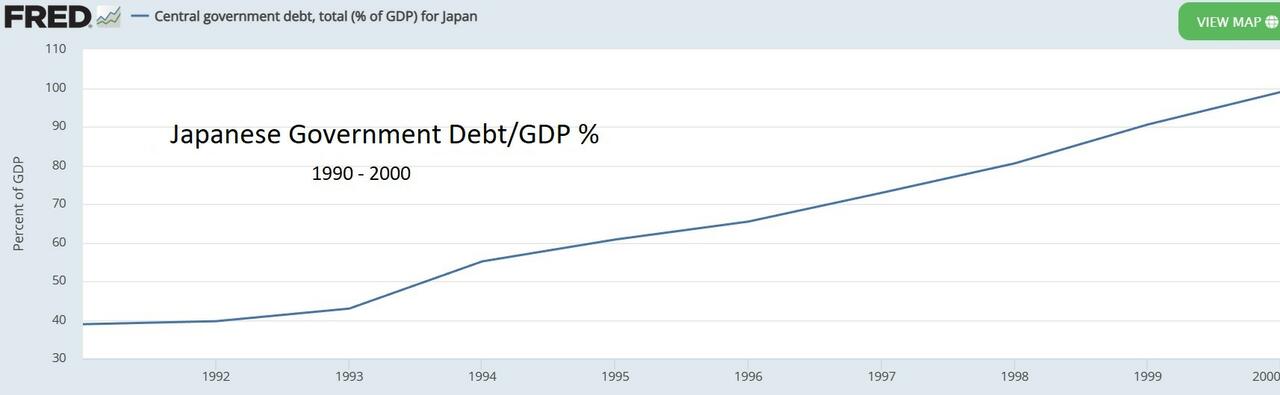
Step 1: Build up massive debt. A bursting real estate bubble in the 1990s confronted the Japanese government with a choice between accepting a brutal recession in which most of that debt was eliminated through default, or simply bailing out all the zombie banks and construction companies and hoping for the best. They chose bailouts, and federal debt rose from 40% of GDP in 1991 to 100% of GDP by 2000. 

Step 2: Lower interest rates to minimize interest expense. Paying 6% on debt equaling 100% of GDP would be ruinously expensive, so the Bank of Japan pushed interest rates down as debt rose, thus keeping the government’s interest cost at tolerable levels.

Step 3: Continue to borrow at virtually no cost. While interest rates fell, the zombie companies soaking up public funds were joined by a growing number of retirees who began drawing on japan’s versions of Social Security and Medicare. Government spending, as a result, continued to rise and deficits kept growing, further intensifying the pressure to lower interest rates. The BoJ began buying bonds with newly-created yen to force interest rates down to zero and even below (meaning that the remaining private sector buyers of Japanese government paper actually paid for the privilege). Since the government now earned money by borrowing, there seemed to be no reason to stop, and debt soared to the current 262% of GDP, which might be the highest figure ever recorded by a major government.

Step 4: Experience sudden, sharp inflation. In 2022, all that new currency finally caused the inflation that critics of easy money had been predicting. Japan’s official cost of living is now rising at a 4% annual rate, making the real yield on a zero-percent government bond -4%.

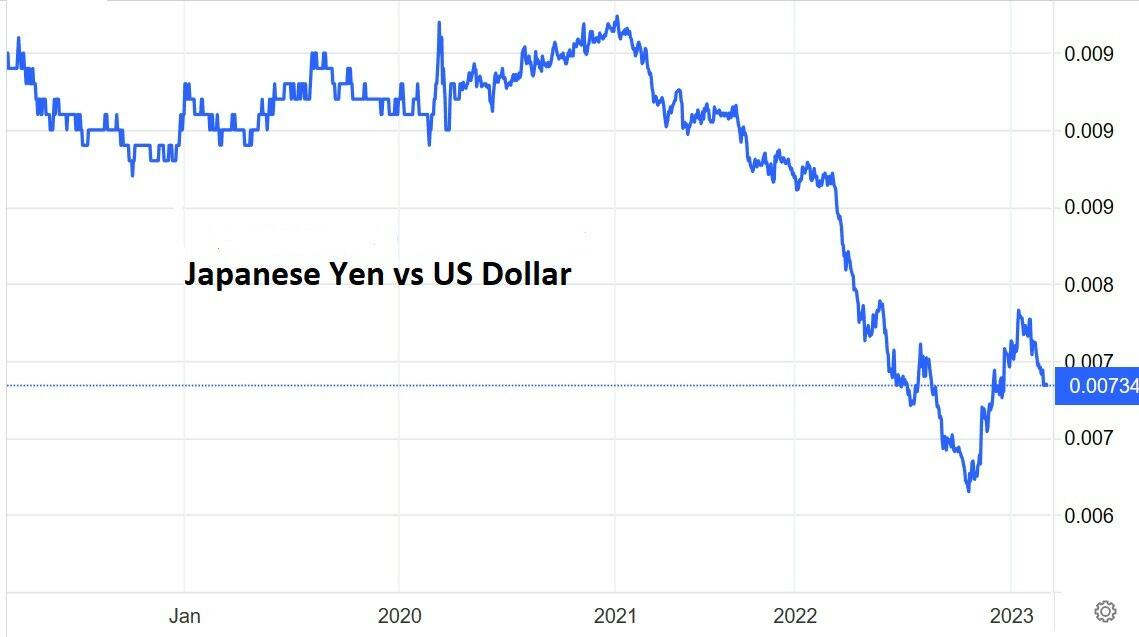
Step 5: Experience a plunging currency. With most other central banks tightening to combat inflation, the BoJ kept buying bonds to keep its interest rates low. Investors noticed this yield differential and stopped buying yen-denominated paper, sending the yen’s exchange rate down sharply versus the US dollar.

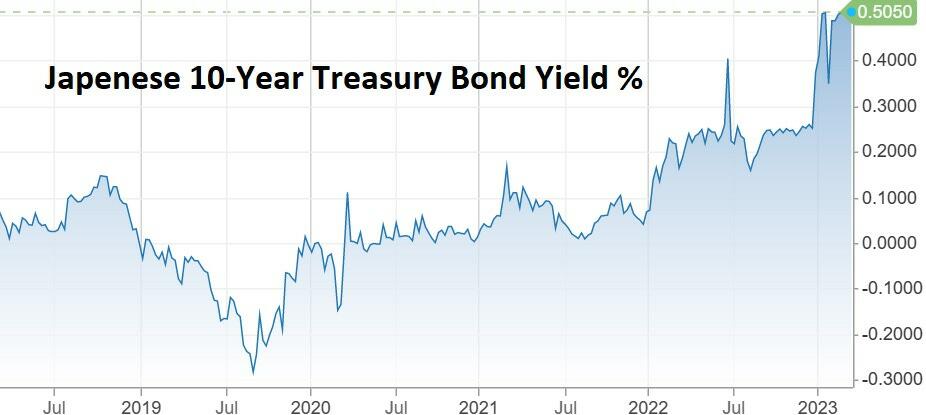
Step 6: Reluctantly allow interest rates to rise. Also in 2022, the BoJ realized that unless it wanted to buy all the paper the government was issuing, it would have to let interest rates rise a bit. Which they very quickly did, from 0% to .25% and then .5%.

Step 7: Get swamped by interest expense. Now all the debt issued or rolled over by Japan’s government carries a cost. Let’s say the average yield rises to the current 0.5%. On debt equaling 260% of GDP, interest expense equals 1.3% of GDP, a crushing burden that adds to already massive deficits, raising overall debt and therefore interest expense going forward. 

Now For The “Suddenly” Part

All of the above has either happened or is happening. The next steps are scheduled for the near future:  

Step 8: Desperately try to lower rates. Recognizing that soaring interest expense spells national bankruptcy, the BoJ tries to stop and reverse the trend by buying even more government debt with ever larger amounts of newly created yen. But the world’s other central banks are much slower to ease, so the gap between yields on Japanese paper and that of, for instance, the US and Germany, continues to widen.

Step 9: Watch impotently as the yen craters. With government debt rising parabolically and no one other than the BoJ willing to buy the resulting tsunami of paper, Japan enters the realm of full-on Modern Monetary Theory, where the government just finances itself with newly created currency. The rest of the world, recognizing the inflationary implications, dumps the yen and the currency’s exchange rate goes into free fall. A falling currency raises the cost of imports, which increases inflation, which weakens the yen further, putting upward pressure on interest rates, and so on, in what headline writers call a “death spiral”.

Step 10: Game over. Japan is forced into an official devaluation/currency reset which limits its ability to spend and inflate going forward. Everyone who trusted the government and held the old currency is impoverished while those who recognized the scam and converted cash and government bonds into real assets are enriched. It’s a familiar story. But this time it’s happening to a serious country.

Questions

The possibility of a major country going off a financial cliff raises questions about how widespread the effects might be and how US investors might prepare. And of course: “How do we short Japan”? That discussion is coming in a separate post next week.

*  *  *

Subscribe to John Rubino’s Substack to survive and thrive in the coming crisis

Tyler Durden
Tue, 03/07/2023 – 06:30

via ZeroHedge News https://ift.tt/MfRknQ3 Tyler Durden

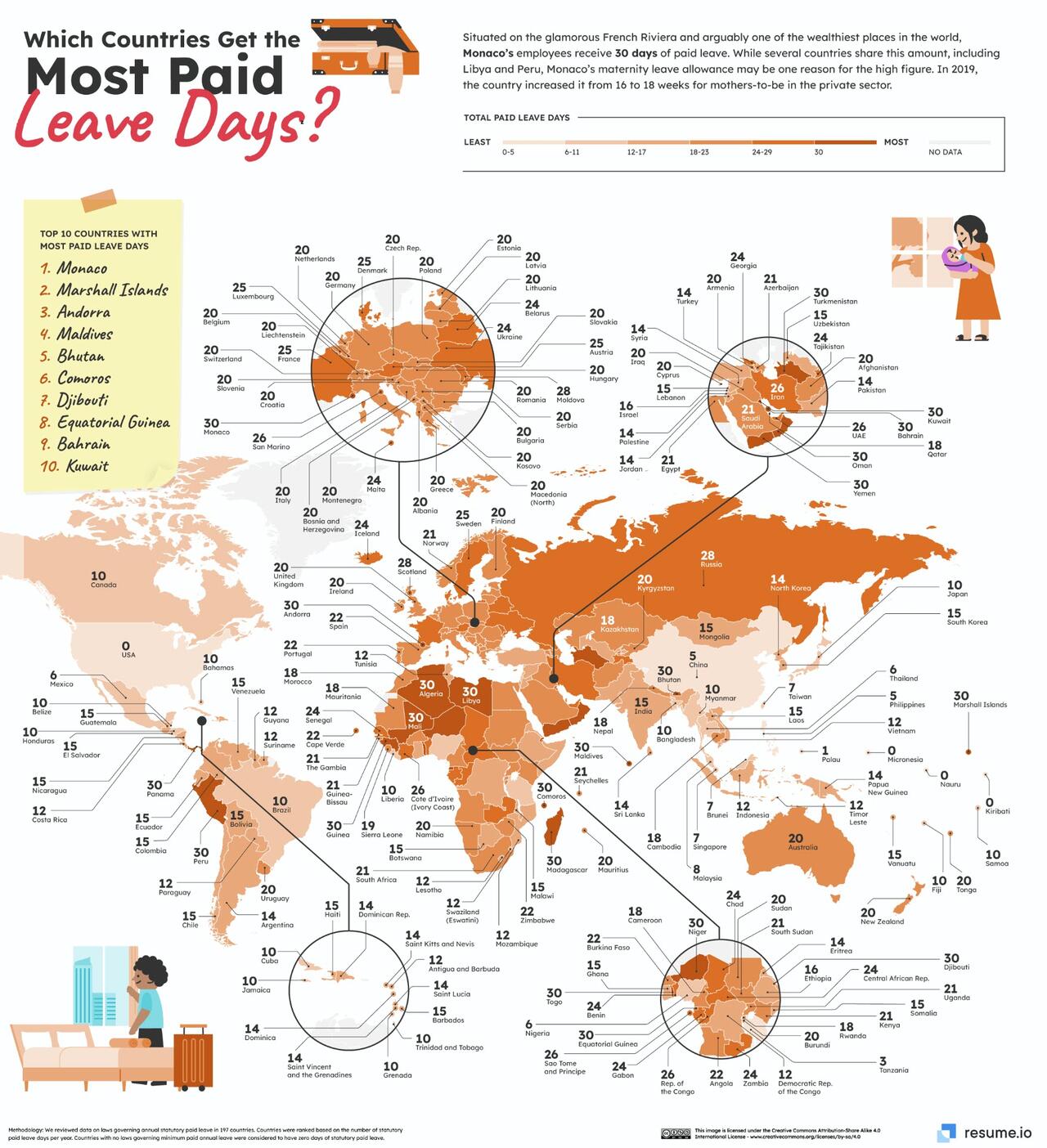
Which Countries Get The Most Paid Vacation Days?

Which Countries Get The Most Paid Vacation Days?

Whether it’s a day off in lieu of a national holiday, a religious festival, or simply a mandated minimum for paid vacation days, there are different rules in each country that set the base threshold of paid time off for workers.

As Visual Capitalist’s Freny Fernandes details below,

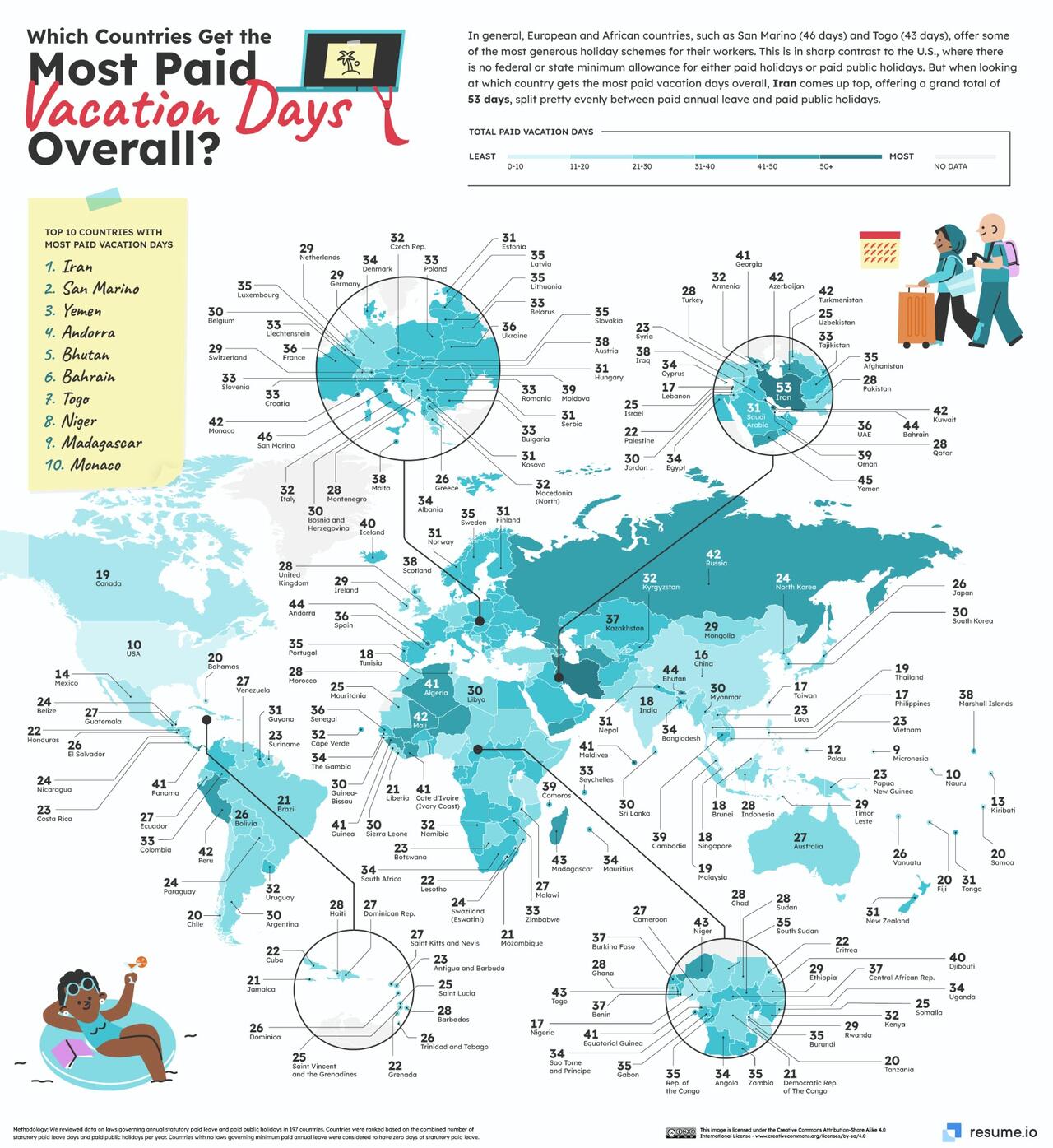
Resume.io analyzed the laws on statutory paid leave and paid public holidays in every country around the world and created these graphics to reveal the minimum amount of vacation days employees are entitled to (at least on paper).

Countries With the Most and Least Paid Vacation

The data in the study focuses in on two types of paid leave: public holidays and paid vacation days. Combine them together and you have the total amount of paid leave.

Here’s how the numbers break down on both ends of the spectrum:

Some African, European, and Central Asian countries, including Togo (43), San Marino (46) and Yemen (45), have been extremely generous with doling out vacation days.

At the very top is Iran with a total of 53 vacation days, split almost equally between public holidays and paid time off.

Meanwhile, others including the Oceanic countries of Micronesia (9) and Nauru (10) rank at the bottom of the list. The U.S. is tied with Nauru in second-last place, with employees mandated a minimum of only 10 vacation days a year.

Which Countries Have the Most Paid Leave Days?

View the full-size infographic

If you’re working full-time and devoting 40 hours per week to your workplace, many nations believe you deserve time off.

In most countries, laws to provide statutory leave to employees are in place. 22 countries have a generous 30-day leave policy, with 10 located in Africa.

However, the amount of paid leave around the world often relies on the employee’s tenure. And not all countries have the same minimums, as the U.S., Nauru, Micronesia, and Kiribati, have zero mandated paid leave days.

It’s important to note that this does not mean that all employees in these countries have zero paid leave. Instead it means that it’s up to the hiring employer, with some companies using generous paid leave to entice skilled employees while others offer none.

Which Countries Have the Most Public Holidays?

View the full-size infographic

Countries around the world celebrate public holidays for numerous different occasions. They honor significant national, cultural, and religious events.

Again, the number of these days can vary worldwide. Iran offers the highest number of paid public holidays in the world with a total 27 days per year including the Islamic Republic Day. It is followed by Bangladesh (24), Azerbaijan (21), and Cambodia (21).

On the other extreme, Libya has no paid public holidays, while Lebanon has only two paid public holidays per year.

And not every celebration is a holiday. For example, despite having a plethora of festivals and days of national importance, India has only three paid national holidays: Republic Day, Independence Day, and the birthday of Mahatma Gandhi.

However, India is also a good example of countries which also offer state-level holidays. Every state is empowered to add to its list of paid holidays based on their religious, cultural and historical occasions.

Tyler Durden
Tue, 03/07/2023 – 05:45

via ZeroHedge News https://ift.tt/wuDAlEG Tyler Durden

Brickbat: Reading Is Fundamental


A high school-aged girl reads a book in front of an open row of library shelves.

In Georgia, the Forsyth County school system has agreed to pay the legal fees of a group of mothers who sued to overturn a system policy that banned them from reading books from school libraries at school board meetings. The settlement came after a federal court issued an injunction against that policy. The group, called Mama Bears, wants the board to remove sexually explicit books from those libraries. The settlement makes the court’s injunction permanent and also bars the school system from barring speakers at board meetings from directing remarks to particular school board members or the superintendent.

The post Brickbat: Reading Is Fundamental appeared first on Reason.com.

from Latest https://ift.tt/30uIdr8
via IFTTT

Omission Of Children’s COVID-19 Vaccine Deaths In Australia Raises Concerns

Omission Of Children’s COVID-19 Vaccine Deaths In Australia Raises Concerns

Authored by Victoria Kelly-Clark via The Epoch Times (emphasis ours),

An Australian senator has said he is concerned about the country’s therapeutic authorities’ delayed approach to updating Australia’s Database of Adverse Event Notifications (DAEN) after it was revealed the government body had neglected to include a number of deaths attributed to the vaccine, including that of two children aged 7 and 9.

A nurse prepares vaccines in the Wizink Center, currently used for COVID-19 vaccinations in Madrid on Dec. 1, 2021. (Paul White/AP Photo)

This comes after a Freedom of Information request by an Australian doctor revealed the Australian pharmaceutical and drug administrator, the Therapeutic Goods Administration (TGA), had not updated its DAEN with the deaths.

Australian Liberal Party senator, Gerard Rennick, told The Epoch Times that he was deeply concerned about the TGA’s failure to update DAEN and is calling for there to be some independent oversight on the TGA, given the conflict of interest.

A third independent medical party should examine the evidence as the TGA has a conflict of interest because they approved the vaccines and would therefore be held responsible for the deaths of these children due to poor regulatory oversight,” Rennick said.

Nationals Senator Matt Canavan (L), Liberal Senator Alex Antic (C) and Liberal Senator Gerard Rennick (R) at a press conference at Parliament House in Canberra, Australia on Nov. 21, 2022. (AAP Image/Mick Tsikas)

The senator noted that he was highly concerned that the TGA had soft-pedalled the risks involved with the COVID-19 vaccines, especially those around myocarditis and cardiac arrests.

They are definitely downplaying the risks. They do not have enough information to rule it out given the known link between the vaccines and myocarditis and myocarditis and cardiac arrests,” Rennick said.

As of March 6, the DAEN states that since the beginning of the vaccination rollout in Australia, 137,576 adverse events have been reported relating to the range of COVID-19 vaccines. Of those, 134,224 are believed to be directly related to the vaccines, while 980 are vaccine-related deaths.

TGA Independent Review Board

The TGA does have a pre-existing independent review vehicle for vaccines called the Vaccine Safety Investigation Group (VSIG).

The group is meant to provide independent specialist immunisation (and other relevant) expertise to assist the TGA in investigating and managing Adverse Event Following Immunisation (AEFI) that require the services of national-level experts.

The group is described as a time-limited working group that can be convened when a single serious AEFI that is unexpected and without an obvious non-vaccine cause occurs. The TGA notes that an AEFI is considered unexpected when it is not listed in the product information document for the vaccine or is listed, but causality has not been established.

Read more here…

Tyler Durden
Tue, 03/07/2023 – 05:00

via ZeroHedge News https://ift.tt/53PZzky Tyler Durden

Porsche, Ferrari’s Plan To Save Combustion Engines Involves “eFuels”

Porsche, Ferrari’s Plan To Save Combustion Engines Involves “eFuels”

With many automakers transitioning from petrol-powered vehicles to electrified ones, Porsche and Ferrari are pursuing a new strategy by concentrating on the advancement of eFuels to preserve gas-powered engines. This decision follows the European Commission’s delay last week of the proposed 2035 ban on new internal combustion engine vehicles as the commission prepares to carve out a role for eFuels after 2035.

“Porsche and Ferrari’s status as national icons was enough to move their governments to challenge the EU plan last week just days before a scheduled vote,” Bloomberg wrote. 

Germany’s Transport Minister Volker Wissing told the European Commission that he would withhold support for the approval of the new engine standards to end the sale of new combustion engine cars unless there were a plan for eFuels post-2035. Italy also threatened to fight the reforms.

European Commission President Ursula von der Leyen met with German Chancellor Olaf Scholz on Sunday, discussing a comprise that would likely involve eFuels. 

Germany and Italy are home to the world’s top sportscar manufacturers. There has been growing opposition against Brussels’ plan to ban petrol-powered engines. That’s because who in their right mind would purchase an all-electric Porsche 911? 

The alternative route, mainly for sportscar brands, is the development of eFuels as a climate-neutral way to preserve combustion engines—just something about the sound of a twin-turbo V-8 or V-6 that captivates motorheads.

While most carmakers are pouring tens of billions into the EV shift, Porsche has also invested in an e-fuel plant in Chile, partly because the manufacturer doesn’t plan to make its 911 sports car with a plug. Operating combustion-engine vehicles in a climate-neutral way could also help speed up the decarbonization of the transport sector, according to a Porsche spokesman. Existing vehicle stock should be included in the push to lower CO2 emissions faster, he added. Ferrari has said it’s pursuing alternative fuels to keep making combustion-engine cars that preserve its heritage.

Proponents of e-fuels, say they’re essentially renewable electricity that’s been converted into a combustible, liquid fuel. To make it, scientists combine captured carbon dioxide with hydrogen that was split from water in a process powered by renewable energy, creating a synthetic hydrocarbon fuel. When burned in a combustion engine, the e-fuels create carbon dioxide. But since it was made from previously captured CO2, they argue it’s climate neutral.

We’ve outlined the growing resistance among vehicle brands and motorsport organizations that are firm in their belief the combustion engine will be sticking around for years to come. 

It’s straightforward, the push for eFuels for sportscars will likely preserve the combustion engine, but the cost per gallon might make the cost to operate the vehicle so expensive that only the rich will only be able to afford it. 

Tyler Durden
Tue, 03/07/2023 – 04:15

via ZeroHedge News https://ift.tt/oqKyv7j Tyler Durden

The West, The Rest, & The Great Everywhere

The West, The Rest, & The Great Everywhere

Authored by Amir Taheri via The Gatestone Institute,

In studying history predictions that didn’t happen are often as interesting as those that became real events.

Remember the “clash of civilization” that was to pitch one part of mankind to another in a multilayered cultural, religious, economic and, yes, even racial war? Decades later we see that at least part of the predicted clash is taking place within the same “civilization”. It is in the United States and Western Europe that we witness such phenomena as wokeism and cancel culture while many “emerging nations” are breaking some taboos to open a wider space for discussion and dissent.

It is also in Western democracies that bowdlerization even of classical texts is making a comeback.

In his seminal essay “The West and the Rest”, English philosopher Roger Scruton predicted that, with the end of the Cold War, the world was being divided into two antagonistic camps. Scruton was offering a philosophical version of Rudyard Kipling’s famous, or infamous, line, “East is East and West is West, and never the twain shall meet!”

Scruton believed that in the post-Cold War world the West will be the realm of peace, the rule of law, economic prosperity and cultural effervescence while, chained to religious, cultural and ideological traditions, the “rest” is doomed to experience wars, economic stagnation, political oppression and cultural stagnation.

Scruton didn’t specify exactly what he meant by the “rest”. But a close reading of his essay shows that, with few exceptions such as Japan, his “rest” covered all nations that were not part of the Anglosphere and the European democracies.

In his “rest,” Scruton assigned a big role to Islam, or militant fundamentalism, as a challenge to the West. Thanks to high birth rates and mass immigration, Muslims were supposed to modify the population mix in the West. Inspired by Scruton, some writers even warned against Europe becoming Eurabia (an Arabized Europe) while others feared “the great replacement” of current populations by hordes of newcomers from “the rest”.

What happened in the past two decades may offer a different picture.

To start with, with the exception of wars exported by the “west” to Afghanistan and Iraq, the “rest” has lived largely in peace while the “west” has experienced a series of wars in the Balkans; northern Caucasus, Transcaucasia, and currently in Ukraine.

These wars have produced more immigrants than did the “rest”.

The Syrian civil war produced more than 10 million refugees and displaced persons, but most of them went to neighboring countries all of which are part of the “rest”. In contrast, the estimated 13 million refugees from the Balkan wars and the current Ukrainian war ended up in the “west”.

As far as economic buoyancy is concerned, the “rest” has done better than the “west”.

Economic growth rates in the “rest” have averaged around six per cent per annum while the “west” has failed to do better than 2.2 per cent. Productivity per head has also been higher in the “rest” than in the “west”, largely thanks to massive imports of technology and capital from Europe and North America, Japan and Taiwan.

With the exceptions of China, Iran and Russia that have experienced a stiffening of authoritarian rule, most “rest” nations have timidly moved towards an opening of the political space, if not actual democratization. In contrast, several nations in Scruton’s “west” have seen the emergence of populist-authoritarian, and ultimately anti-democratic, trends.

The intensely partisan politics of the United States today and the divisive adventure that was the Brexit showed that the “west” isn’t ensured against hate-based and xenophobic platforms that Scruton sees in the “rest”.

The rapid spread of social media has brought the “west” and the “rest” together in many walks of life. Similar patterns have emerged in the way people, especially the young, dress, speak and live with cyberspace annihilating geographical distances. By last account “alternative lifestyles”, including the “rainbow” options, first shaped in the “west” have spread to almost all nations in the “rest”. Fast-food developed in the “west” has spread to almost all nations in the “rest,” and countries such as China, Brazil, India and even the Islamic Republic of Iran are now among the biggest importers of French cognac.

Visually the “rest” increasingly resembles the “west” or its clichéd vision. Today, there are more skyscrapers in Shanghai or Jakarta than in New York. The world’s tallest buildings are no longer found in Chicago, New York or London but in Dubai, Shanghai and Mecca.

Almost 5,000 brands, mostly developed in the “west” but manufactured in the “rest” dominate shopping malls across the globe. Travelers in the “rest” stay in hotels run trans-national chains, ride in Uber vehicles, eat trans-national meals and listen to music that no longer has a distinct cultural origin and watch the same series and soap operas on streaming boxes.

Last year, at least eight countries in the “rest” featured among the 20 nations with the largest number of billionaires.

The “rest” is invading the “west” in some other ways. Cinema, once dominated by the US, France and Great Britain has achieved a universal dimension with more than 40 countries in the “rest” moving beyond niche markets. In a recent visit to my favorite bookshop in Paris I spotted more than 30 new novels directly written in French by authors from the “rest”. Authors from the “rest” have already won some of the most prestigious literary prizes in the “west” as have done “rest” film-makers getting Oscars and top prizes in Berlin, Cannes and Venice film festivals.

The “west” and the “rest” have also come closer to each other in such fields as scientific research than Scruton could have imagined. Iran alone is “exporting” an average of 180,000 scientists to Europe and the United States each year. Millions of Chinese students are attending universities and colleges in the “west”, a good number of them choosing never to return home. In exchange numerous businessmen, technical experts and marketing managers from the “west” have settled in the “rest” including China, India and Indonesia helping and profiting from rapid economic growth.

Kipling’s “twain” have met and realize that what happens to either of them affects the other. Maybe we no longer have a “west” and a “rest” but a “great everywhere” in which we find the same clothes, the same food, the same brands, the same music, the same follies and strokes of genius — where even a suburb of Hanoi may remind Dorothy of her Kansas.

Tyler Durden
Tue, 03/07/2023 – 03:30

via ZeroHedge News https://ift.tt/JFZpLw1 Tyler Durden