Ranking Crypto Popularity Across European Union Nations

Ranking Crypto Popularity Across European Union Nations

Depending on where you live, investors can have wildly different preferences when it comes to choosing asset classes.

For a modern example, we can see how different countries (and regions) act when it comes to cryptocurrency. Within the European Union – one of the regions dealing with faster crypto adoption – attitudes towards investing can vary considerably.

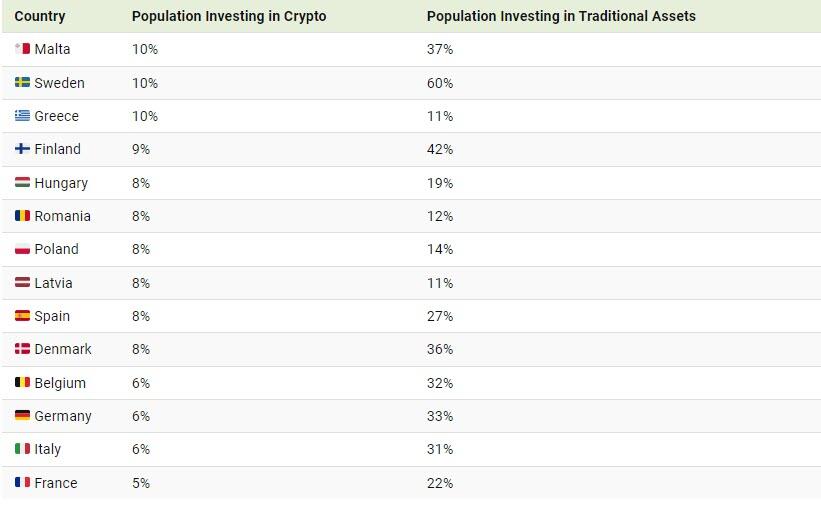
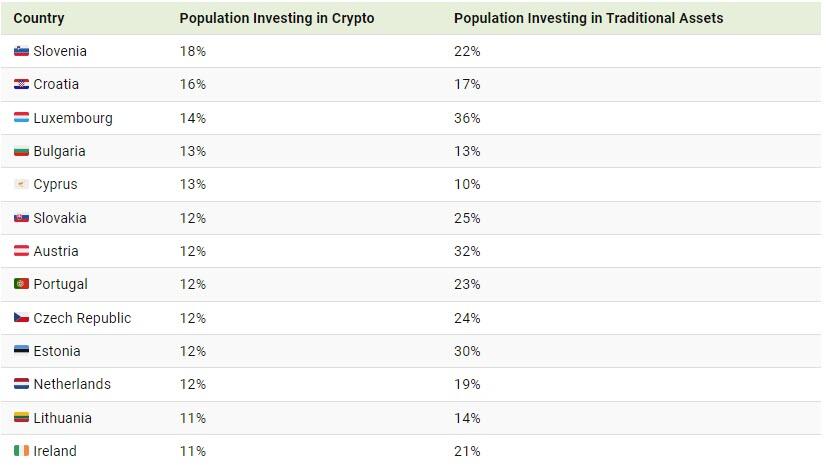
This graphic from Visual Capitalist’s Aran Ali and Gilbert Fontana looks at crypto popularity amongst investors in the EU using data from the European Commission’s Eurobarometer. It compares exposure to cryptocurrencies relative to stocks, funds, and bonds.

Crypto Popularity in Europe in 2022

Given that crypto has experienced bubble-like asset rallies, including a dramatic rise to over a trillion dollars in value before crashing, it’s fair to say it’s well known by now.

But even with a vast rise in awareness, there are still discrepancies between the level of investment crypto receives amongst European Union nations. Let’s see which countries have the highest proportion of citizens invested in crypto:

Topping the list is Slovenia, considered by some the most crypto-friendly nation in the world. According to the survey, 18% of the country’s population has some sort of investment in it. Cyprus also ranks high in its crypto-friendly rank and hits an investment figure of 13%.

Also notable is the Grand Duchy of Luxembourg, which despite having a small population of 640,000 also has a strong reputation as a global financial hub. When it comes to crypto, 14% of the population owns or has owned the asset, relative to 36% for stocks, bonds, or funds.

Crypto Unpopularity?

In regards to the countries with lower levels of crypto investment, one observation is that they tend to be wealthier and more developed EU nations. Here’s how the nations at or below the 10% crypto-investment threshold rank:

At the “bottom” of crypto interest are FranceGermany and Italy, also the EU’s largest economies. At a glance, this might suggest that citizens of stronger economies invest less in crypto.

However, it’s important to note that the countries with higher levels of crypto investment tend to have lower levels of wealth on average. Though less of their investors seem to engage in crypto trading, countries like France and Germany might have more comparable levels of crypto investment on a pure dollar-basis.

Tyler Durden
Tue, 03/07/2023 – 02:45

via ZeroHedge News https://ift.tt/obItpFs Tyler Durden

Global Doomsday Seed Vault To Get New Batch Of Seeds

Global Doomsday Seed Vault To Get New Batch Of Seeds

Authored by Naveen Anthrapully via The Epoch Times,

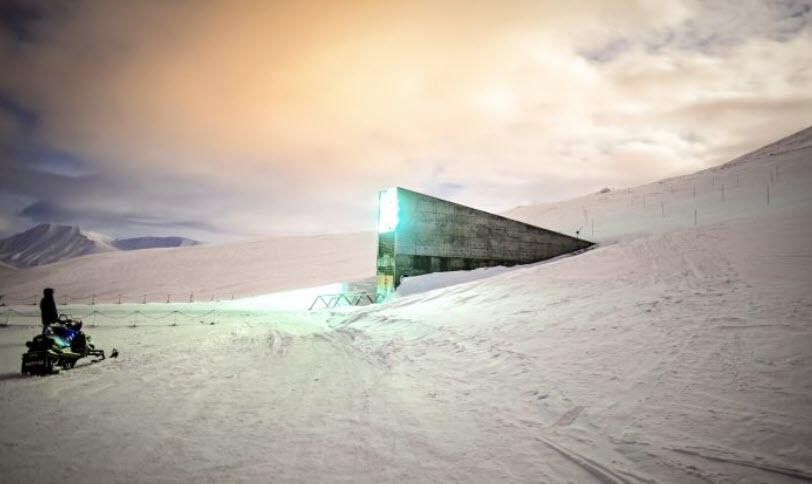
The Svalbard Global Seed Vault in Norway, which acts as a backup facility for the world’s largest variety of crops against potential seed extinction due to a global calamity, is set to receive close to 20,000 seed samples.

Officially opened in 2008, the seed vault is set about 394 feet into a mountainside on Spitsbergen Island. With 20 gene bank depositors donating 19,585 seed samples in the latest batch, the total number of seed samples at the vault now exceeds 1.2 million, according to Crop Trust, a nonprofit established by the Food and Agriculture Organization of the United Nations in 2004.

This makes the Svalbard vault home to the largest crop diversity collection in the world located in a single place. The latest batch will include seeds from countries depositing for the first time such as Albania, North Macedonia, Benin, and Croatia, Crop Trust reported.

“From here in Svalbard, the world looks different. This Seed Vault represents hope, unity, and security,” Stefan Schmitz, executive director of Crop Trust, said in the report.

“In a world where the climate crisis, biodiversity loss, natural catastrophes, and conflicts increasingly destabilize our food systems, it has never been more important to prioritize safeguarding these tiny seeds that hold so much potential to adapt our future food to such global threats.”

Svalbard Seed Vault

The Svalbard seed vault is estimated to contain 642 million seeds in total. It has the capacity to store up to 2.5 billion seeds. Food crops make up much of the stored seeds, with 69 percent being grains, of which 85 million are rice seeds.

Another 9 percent are legumes, with the remaining being seeds from vegetables, fruits, herbs, and other plants.

The pearl millet is the single largest seed species inside the vault, accounting for 13.2 percent of all seeds. Asian rice comes second at 12.7 percent, finger millet at 11.1 percent, common wheat at 8.4 percent, and broom-corn at 7.4 percent.

Just 17 nations account for half of the seeds in the vault, with India being the biggest contributor by sending 95 million seeds. The Svalbard vault has enough space to hold every seed from more than 1,700 gene banks in the world.

The vault was launched in 2008 as a backup for the world’s national and regional gene banks that store the genetic code for thousands of plant species.

“The whole of humanity relies on the genetic diversity of crops maintained in the world’s genebanks, and the Seed Vault is the last line of defense against the loss of that diversity,” Sandra Borch, minister of agriculture and food for Norway, wrote in the Crop Trust report.

Protection Against Seed Extinction

The Svalbard vault’s chambers are opened only three times per year to limit exposing the seeds to external factors, and they maintain a temperature of negative 18 degrees Celsius (negative 0.4 degrees Fahrenheit).

The seed vault offers protection against seed extinction, something that is already happening. The world used to cultivate more than 6,000 plants. Now, just three crops—rice, maize, and wheat—account for 40 percent of calories.

Being dependent on a few crops for food supplies creates vulnerabilities in food security. If the harvests for rice, maize, or wheat were to fail for some reason, it would create a global food crisis.

Between 2015 and 2019, the Svalbard vault played a critical role in rebuilding seed collections in Syria when the region was torn apart from war.

Tyler Durden
Tue, 03/07/2023 – 02:00

via ZeroHedge News https://ift.tt/PLf0Ubi Tyler Durden

Escobar: The Valdai Meeting – Where West Asia Meets Multipolarity

Escobar: The Valdai Meeting – Where West Asia Meets Multipolarity

Authored by Pepe Escobar via The Cradle,

At Russia’s Valdai Club meeting – the east’s answer to Davos – intellectuals and influencers gathered to frame West Asia’s current and future developments…

The 12th “Middle East Conference” at the Valdai Club in Moscow offered a more than welcome cornucopia of views on interconnected troubles and tribulations affecting the region.

But first, an important word on terminology – as only one of Valdai’s guests took the trouble to stress. This is not the “Middle East” – a reductionist, Orientalist notion devised by old colonials: at The Cradle we emphasize the region must be correctly described as West Asia.

Some of the region’s trials and tribulations have been mapped by the official Valdai report, The Middle East and The Future of Polycentric World.  But the intellectual and political clout of those in attendance can provide valuable anecdotal insights too. Here are a few of the major strands participants highlighted on regional developments, current and future:

Russian Deputy Foreign Minister Mikhail Bogdanov set the stage by stressing that Kremlin policy encourages the formation of an “inclusive regional security system.” That’s exactly what the Americans refused to discuss with the Russians in December 2021, then applied to Europe and the post-Soviet space. The result was a proxy war.

Kayhan Barzegar of Islamic Azad University in Iran qualified the two major strategic developments affecting West Asia: a possible US retreat and a message to regional allies: “You cannot count on our security guarantees.”

Every vector – from rivalry in the South Caucasus to the Israeli normalization with the Persian Gulf – is subordinated to this logic, notes Barzegar, with quite a few Arab actors finally understanding that there now exists a margin of maneuver to choose between the western or the non-western bloc.

Barzegar does not identify Iran-Russia ties as a strategic alliance, but rather a geopolitical, economic bloc based on technology and regional supply chains – a “new algorithm in politics” – ranging from weapons deals to nuclear and energy cooperation, driven by Moscow’s revived southern and eastward orientations. And as far as Iran-western relations go, Barzegar still believes the Joint Comprehensive Plan of Action (JCPOA), or Iran nuclear deal, is not dead. A least not yet.

‘Nobody knows what these rules are’

Egyptian Ramzy Ramzy, until 2019 the UN Deputy Special Envoy for Syria, considers the reactivation of relations between Egypt, Saudi Arabia, and the UAE with Syria as the most important realignment underway in the region. Not to mention prospects for a Damascus-Ankara reconciliation. “Why is this happening? Because of the regional security system’s dissatisfaction with the present,” Ramzy explains.

Yet even if the US may be drifting away, “neither Russia nor China are willing to take up a leadership role,” he says. At the same time, Syria “cannot be allowed to fall prey to outside interventions. The earthquake at least accelerated these rapprochements.”

Bouthaina Shaaban, a special advisor to Syrian President Bashar al-Assad, is a remarkable woman, fiery and candid. Her presence at Valdai was nothing short of electric. She stressed how “since the US war in Vietnam, we lost what we witnessed as free media. The free press has died.” At the same time “the colonial west changed its methods,” subcontracting wars and relying on local fifth columnists.

Shaaban volunteered the best short definition anywhere of the “rules-based international order”: “Nobody knows what these rules are, and what this order is.”

She re-emphasized that in this post-globalization period that is ushering in regional blocs, the usual western meddlers prefer to use non-state actors – as in Syria and Iran – “mandating locals to do what the US would like to do.”

A crucial example is the US al-Tanf military base that occupies sovereign Syrian territory on two critical borders. Shaaban calls the establishment of this base as “strategic, for the US to prevent regional cooperation, at the Iraq, Jordan, and Syria crossroads.” Washington knows full well what it is doing: unhampered trade and transportation at the Syria-Iraq border is a major lifeline for the Syrian economy.

Reminding everyone once again that “all political issues are connected to Palestine,” Shaaban also offered a healthy dose of gloomy realism: “The eastern bloc has not been able to match the western narrative.”

A ‘double-layered proxy war’

Cagri Erhan, rector of Altinbas University in Turkey, offered a quite handy definition of a Hegemon: the one who controls the lingua franca, the currency, the legal setting, and the trade routes.

Erhan qualifies the current western hegemonic state of play as “double-layered proxy war” against, of course, Russia and China. The Russians have been defined by the US as an “open enemy” – a major threat. And when it comes to West Asia, proxy war still rules: “So the US is not retreating,” says Erhan. Washington will always consider using the area “strategically against emerging powers.”

Then what about the foreign policy priorities of key West Asian and North African actors?

Algerian political journalist Akram Kharief, editor of the online MenaDefense, insists Russia should get closer to Algeria, “which is still in the French sphere of influence,” and be wary of how the Americans are trying to portray Moscow as “a new imperial threat to Africa.”

Professor Hasan Unal of Maltepe University in Turkiye made it quite clear how Ankara finally “got rid of its Middle East [West Asian] entanglements,” when it was previously “turning against everybody.”

Mid-sized powers such as Turkiye, Iran, and Saudi Arabia are now stepping to the forefront of the region’s political stage. Unal notes how “Turkiye and the US don’t see eye to eye on any issue important to Ankara.” Which certainly explains the strengthening of Turkish-Russian ties – and their mutual interest in introducing “multi-faceted solutions” to the region’s problems.

For one, Russia is actively mediating Turkiye-Syria rapprochement. Unal confirmed that the Syrian and Turkish foreign ministers will soon meet in person – in Moscow – which will represent the highest-ranking direct engagement between the two nations since the onset of the Syrian war. And that will pave the way for a tripartite summit between Assad, Russian President Vladimir Putin and his Turkish counterpart Recep Tayyip Erdogan.

Note that the big regional reconciliations are being held – once again – either in, or with the participation of Moscow, which can rightfully be described as the capital of the 21st century multipolar world.

When it comes to Cyprus, Unal notes how “Russia would not be interested in a unified state that would be EU and NATO territory.” So it’s time for “creative ideas: as Turkey is changing its Syria policy, Russia should change its Cyprus policy.”

Dr. Gong Jiong, from the Israeli campus of China’s University of International Business and Economics, came up with a catchy neologism: the “coalition of the unwilling” – describing how “almost the whole Global South is not supporting sanctions on Russia,” and certainly none of the players in West Asia.

Gong noted that as much as China-Russia trade is rising fast – partly as a direct consequence of western sanctions – the Americans would have to think twice about China-hit sanctions. Russia-China trade stands at $200 billion a year, after all, while US-China trade is a whopping $700 billion per annum.

The pressure on the “neutrality camp” won’t relent anyway. What is needed by the world’s “silent majority,” as Gong defines it, is “an alliance.” He describes the 12-point Chinese peace plan for Ukraine as “a set of principles” – Beijing’s base for serious negotiations: “This is the first step.”

There will be no new Yalta

What the Valdai debates made crystal clear, once again, is how Russia is the only actor capable of approaching every player across West Asia, and be listened to carefully and respectfully.

It was left to Anwar Abdul-Hadi, director of the political department of the Palestine Liberation Organization (PLO) and the latter’s official envoy to Damascus, to arguably sum up what led to the current global geopolitical predicament: “A new Yalta or a new world war? They [the west] chose war.”

And still, as new geopolitical and geoeconomic fault lines keep emerging, it is as though West Asia is anticipating something “big” coming ahead. That feeling was palpable in the air at Valdai.

To paraphrase Yeats, and updating him to the young, turbulent 21st century, “what rough beast, its hour come out at last, slouches towards the cradle [of civilization] to be born?

Tyler Durden
Mon, 03/06/2023 – 23:40

via ZeroHedge News https://ift.tt/Rvsrl0M Tyler Durden

Is The Greater Idaho Movement A Model For National Divorce From The Political Left?

Is The Greater Idaho Movement A Model For National Divorce From The Political Left?

They said it was an absurd waste of time, but now, the progressive coastal regions of Oregon and Democrats in Idaho are getting a little worried about the “Greater Idaho Movement,” with at least 11 eastern Oregon counties officially voting to leave the state and join their more conservative neighbors in Idaho.  Democrats were saying that the move was impossible, but with momentum growing they are now suggesting that the break-up is “bad for the country.” 

Why is it bad for the country if a handful of conservative counties decide to freely walk away from the state of Oregon and join with Idaho?  Leftists do not explain the assertion, but one can deduce from their behavior a number of probable conclusions.   

Common arguments Democrats in Oregon and Idaho make against the move are usually an attempt to dissuade Idaho citizens from wanting to pursue secession measures.  The core claim is that the state of Idaho would have to subsidize the new counties, with Dems suggesting that rural areas are a drain on high revenue centers like Portland.

This stems from the leftist argument that red counties and states “cannot survive” economically when detached from blue regions. 

It’s simply not true.

Firstly, if rural counties are a financial sinkhole for progressive states, then why are they so opposed to rural counties leaving?  Would this not enrich blue counties beyond belief?  While at least one study shows that Idaho would incur expenses such as Medicaid costs, it also shows that the state actually stands to gain an extra $170 million in net revenue with the new counties in place, along with an even greater conservative majority population, all without people being forced to relocate. 

Secondly, if we are talking about economic usefulness, it’s important to remember that the majority of people that grow food, produce goods, repair goods and keep the supply chain running are conservative leaning.  Leftists produce very little other than complaints and misery.

The big question Democrats are not asking is why so many Oregon counties want to leave the state at all?  They don’t ask because they don’t care.  Diplomacy and reconciliation with the conservative population has never crossed their minds.  Only now with the secession movement gaining traction are they suddenly interested.

Let’s use the mega-leftist sanctum of Portland as an example of why conservative regions want to break away from progressive controlled regions:

In 2021 alone, Portland witnessed a 38% spike in violent crime including homicides and rapes.  Property crime rose by 17%.  The city also set an all time record for number of homicides in 2021.  In 2022, the city breezed past the homicide record once again.  Portland was once listed among the safest cities in America – Not anymore.

Crime rates skyrocketed almost immediately after Portland embraced the far-left BLM and Antifa calls to “defund the police.”  The city had to reverse course on this stance 18 months later as the program proved to be a dismal failure. 

On the indoctrination end of things, the Oregon Board of Education has advised schools to “keep student gender identities hidden from families.”  This is on top of the already expansive agenda to inject gender identity politics into classrooms in Oregon.  So, what they are saying essentially is that “we are going to brainwash your children with woke ideology, and we are going to lie to you about our curriculum to keep you in the dark.”

Public school policies in Oregon revolve around dictates drafted in progressive controlled counties.  Rural counties can fight back by putting pressure on their local school boards, but it will be a constant battle with losing prospects unless they break from leftist influence completely.

Another big factor in making conservatives want to leave Oregon was the recent draconian covid lockdowns and mandates enforced by the Democrat controlled state government.  Many conservative county officials fought back against these mandates while enduring threats of legal retribution and even arrest.  The leftists revealed their true authoritarian natures during the pandemic event and a number of people ranging from conservative to independent suddenly realized how bad the situation can really get if they remain under the governmental oversight of Democrats.  

It makes perfect sense for red counties to want to break away from blue states after the kinds of chaos leftists have created within our nation in the past few years alone.  When Dems say this would be “bad for the country” what they really mean is that it will be bad for them.  The Greater Idaho Movement may have a very slim chance of success in the long run, but it puts the issue of national divorce front and center in the public consciousness, and they don’t like that.

Democrat representatives like Ned Burns in Idaho asserts that the political system works best “When there’s a balance of different viewpoints,” arguing that efforts “to build a one-party state lead to extremism and that can be very dangerous.”

Idaho Democrat Senate Minority Leader Melissa Wintrow echoed this sentiment:  

“While there are vast political differences in our region, Greater Idaho is not the proper remedy for those differences,” said Wintrow. “Our democratic republic depends on level heads coming together to find solutions to the issues that impact our citizens. Dividing state borders to create enclaves of politically like-minded people is the opposite of a healthy America.”  

But we already have extremist regions of the country in the form of blue states, we saw that clear as day during the covid mandates.  Not only that, cooperation within the status quo only seems to be the Democrat rally cry when progressives are in power. Only five years ago leftists in states like California widely called for secession from the US over the election of Donald Trump.  Today, they rail against a few counties seceding, not from the country, but merely from Oregon.

The political left views everything through the lens of collectivism.  They see people as property of their model of society, which they consider the only model for society.  If Americans are allowed to walk away, then this might reflect badly on progressive society as a whole.  If people are allowed to build their own systems elsewhere they might prove that the leftist system is frail, oppressive and unstable.  If people have the ability to choose and take their county and their land with them, why would they stay under the governance of a leftist dominated place?

The ability to walk away would completely destroy the leftist socialist dynamic.  They can only survive if they are able to force people to participate in their model while requiring those same prisoners to adopt woke beliefs.  They see conservative congregation and secession as a threat to their aims to absorb the entire nation; not just half of US states, but all of America. The rest of the US would do well to take the Greater Idaho Movement seriously as it represents a feeling that is growing across the country – We are at an impasse. 

There are two completely separate cultures in America today and they cannot coexist.   

Tyler Durden
Mon, 03/06/2023 – 23:20

via ZeroHedge News https://ift.tt/DKj8kMF Tyler Durden

Top Military Enlisted Say Housing And Pay Issues Hurt Recruitment, Retention

Top Military Enlisted Say Housing And Pay Issues Hurt Recruitment, Retention

Authored by Michael Clements via The Epoch Times (emphasis ours),

The military’s top enlisted members say poor housing, health care, childcare, and pay problems are deleterious to recruiting and retention.

Homes that were constructed by Balfour Beatty are seen in a neighborhood at Tinker Air Force Base, Okla., on May 1, 2019. (Nick Oxford/Reuters)

Rep. Debbie Wasserman Schultz (D-Fla.) claimed that a plan promoted by Speaker of the House Kevin McCarthy (R-Calif.) to freeze discretionary spending at FY 2022 levels would only make things worse.

We can’t take a giant leap backward,” Wasserman Schultz said.

The highest-ranking enlisted people for each service testified in an oversight hearing of the U.S. House Appropriations Subcommittee on Military Construction, Veterans Affairs, and Related Agencies on Feb. 28. They said the Department of Defense (DOD) must address quality of life issues.

Sgt. Maj. of the Army Michael Grinston told the subcommittee that the problem extends beyond just soldiers’ morale. It could impact national security.

This is an American problem,” he said.

Grinston said the Army had dedicated approximately $1.5 billion to family housing, soldiers’ barracks, and childcare facilities on Army posts worldwide. He said these problems are aggravating matters stemming from pay issues and increased demands on enlisted personnel.

Master Chief Petty Officer of the Navy James Honea agreed. He said that Navy hospitals in the Pacific Northwest had been recently downsized, forcing Navy personnel to drive farther from their bases for medical care. This only adds to the pressure already felt by many in the enlisted ranks.

We will begin losing employees that are mission critical,” Honea said.

The housing issue began around the mid-1990s as military budgets were cut after the Cold War.

Approximately 180,000 housing units needed renovation or replacement at that time, according to the Military Housing Association (MHA).

In 1996, Congress authorized the Military Housing Privatization Initiative (MHPI). Under the MHPI, each branch contracted with private property managers to handle military housing. The MHA was formed to represent those property managers.

The Government Accountability Office (GAO) had issued several reports documenting complaints about mold, pests, lack of maintenance, rundown housing units, and rude and indifferent responses from property managers when they requested help.

According to the most recent GAO report, DOD is increasing its oversight of the MHPI. However, it is hampered by the fact that it deals with civilian property managers.

Dealing With Civilians Complicates Things

“Nevertheless, oversight of the privatized family housing problem will likely continue to face challenges.

In part, because DOD cannot unilaterally make changes to projects without the concurrence of the private companies,” the March 2022 GAO report reads.

For example, the report mentions a Tenant Bill of Rights, which the DOD ordered by Congress to implement in February 2020. By March 2022, the managers of properties at five military installations had not agreed to the Bill of Rights.

Pay issues were further aggravating the problems, the military members said.

According to the U.S. Department of Agriculture, at least 20,000 military families, 213,000 National Guard and Reserve members, and 1.1 million veterans qualify for the Supplemental Nutrition Assistance Program (SNAP). Grinston said the issue is “a math problem.”

He said that across-the-board pay increases don’t address the realities that enlisted troops face. While their pay increases, it doesn’t increase comparable to that of commissioned officers. As a result, enlisted pay often fails to keep pace with inflation, the cost of living where the troops live, and other factors.

“Inflation is real, the supply chain is real, these basic needs compete with one another,” said Sgt. Major of the Marine Corps Troy Black.

Grinston said all military branches are doing more to teach enlisted members money management skills. Ultimately DOD will have to develop a better formula for adjusting military pay, according to Grinston. He said that leaving this issue unaddressed would reflect poorly on the military.

We really wouldn’t want our service members to be eligible for that benefit,” Grinston said.

Wasserman Schultz asked how a cut in the defense budget would impact the issues they had discussed.

She referenced a promise to hold discretionary spending to FY 2022 levels that the Republican “Freedom Caucus” got from McCarthy in his bid to become Speaker.

The plan does not exempt DOD. Wasserman Schultz said this could cost the military $4 billion in lost funding.

Chief Master Sgt. of the Air Force JoAnne Bass said such a cut would force all the military services to decide which programs to cut.

“Any cut to those (housing, childcare, health care) would put your services in a position where they have to make those very tough decisions.”

Tyler Durden
Mon, 03/06/2023 – 23:00

via ZeroHedge News https://ift.tt/tuVylAo Tyler Durden

Retail Investors Buy Record Amounts Of Six-Month Bills In Monday’s Auction

Retail Investors Buy Record Amounts Of Six-Month Bills In Monday’s Auction

Several months ago, a Goldman trader penned the phrase JOMO (or the Joy Of Missing Out from the daily chaos in stocks) to describe the growing infatuation – across both institutional and retail investors  – with generously-yielding fixed income instruments, at the expense of equities which not that long were the only game in town (a time when FOMO dominated). And nowhere was this more obvious than in today’s 6-Month bill auction.

As Bloomberg notes, retail investors took the most six-month Treasury bills at an auction in nearly 30 years as high interest rates trumped concerns over Federal Reserve tightening.

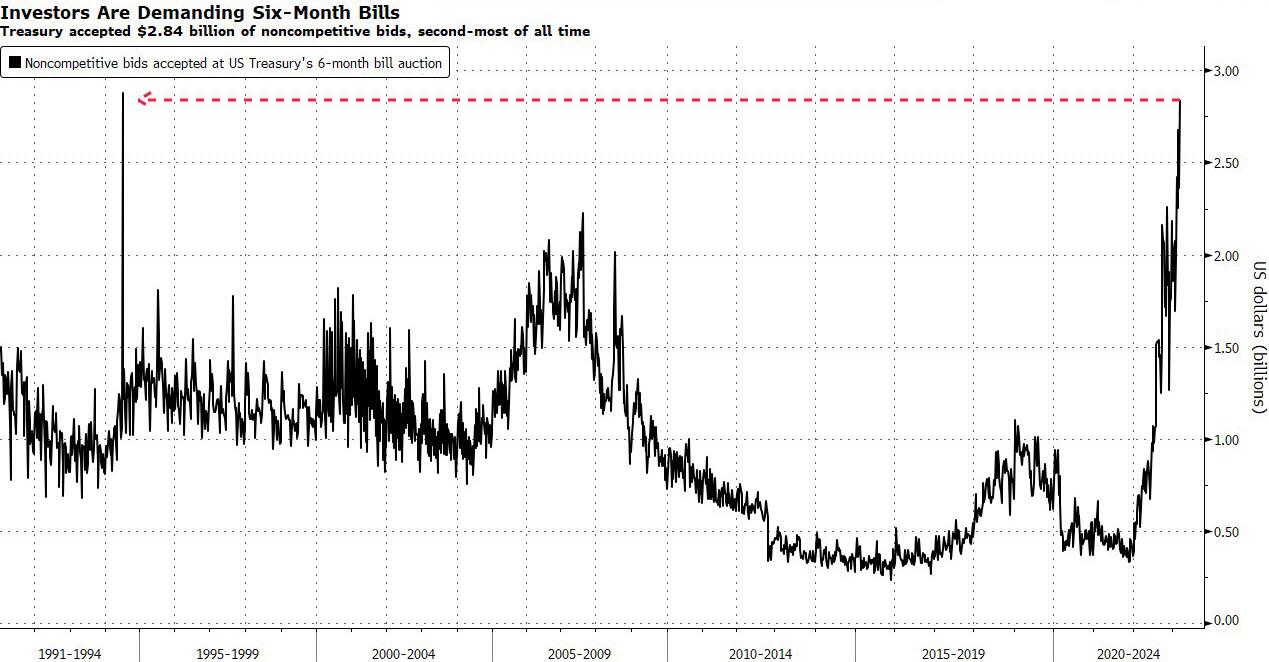
Noncompetitive bidders, a group of bond buyers which tend to be smaller investors that want to passively accept the auction yield without the risk of submitting a competitive bid, took $2.84 billion of six-month bills at Monday’s auction.

That, as shown in the chart below, was a near-record bid by retail, second only to the $2.88 billion awarded on June 27, 1994, Treasury Department data show. At this rate, expect a new record retail print as soon as next week’s 6M Bill auction.

Today’s $48 billion auction stood out in yet another way: the stop-out yield of 4.97% was the highest for a six-month offering since January 2007.

“Generally, intermediate bills have struggled to generate investor demand due to risks associated with the prospects of a more hawkish Fed, and uncertainty about the debt ceiling,” Jefferies economists Thomas Simons and Aneta Markowska say in a note. “However, with the small cut in supply for 3s, and the high outright yield levels offered, the auctions did a bit better today”

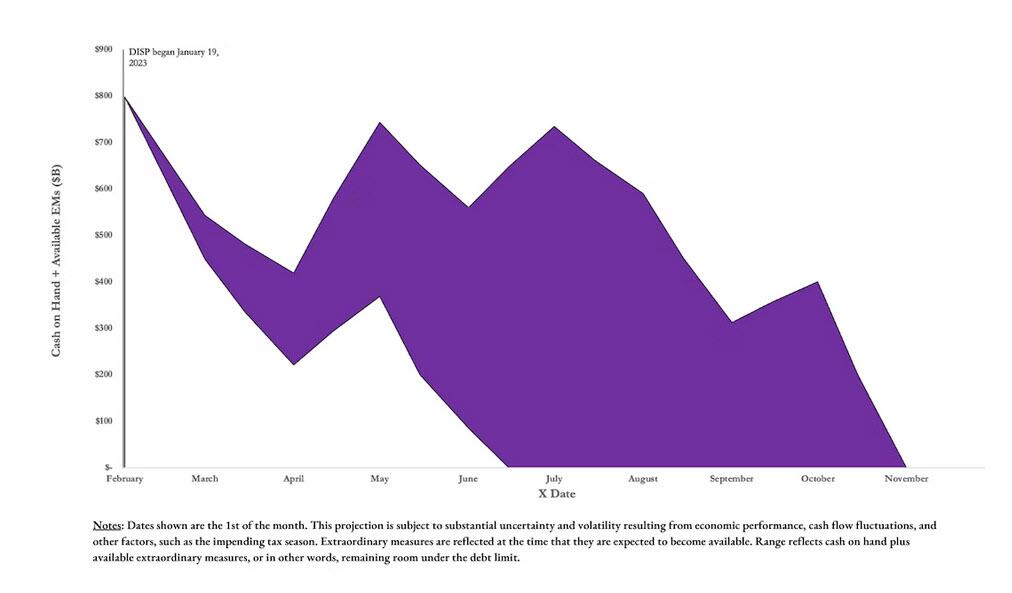
As a reminder, the yield on six-month bills initially rose above 5% on Feb. 14, making it the first US government obligation to reach that threshold in 16 years. That yield is slightly higher than those on 4-month and one-year bills, which according to BBG reflect reflecting concerns over the trajectory of Fed rate hikes and the risk that Congress will fail to raise the debt ceiling before Treasury exhausts its cash reserves. According to various forecasts, the D-Day will realistically hit some time in September or October, which roughly coincides with the maturity of the current 6Month. Of course, in case of a default, repayment on said Bill will be in limbo indefinitely.

While we doubt that the US will default (there will be the usual last minute fireworks but in the end holdout republicans will fold, although we may need a modest scare in stocks to get there), what is more interesting is that so many retail investors are shifting their portfolios to debt securities, whether floating or fixed rate, that continued tightening by the Fed – which ends up pushing yields even higher – will soon have the effect of easing financial conditions as it boosts how much disposable income savers end up getting in the form of interest income. As for those who never saved anything and live month to month on their credit card, better luck next time.

Tyler Durden
Mon, 03/06/2023 – 22:40

via ZeroHedge News https://ift.tt/O2fewRy Tyler Durden

China’s Modest Growth Target Isn’t Stalling Reopening Trade

China’s Modest Growth Target Isn’t Stalling Reopening Trade

By George Lei, Bloomberg Markets Live strategist and reporter

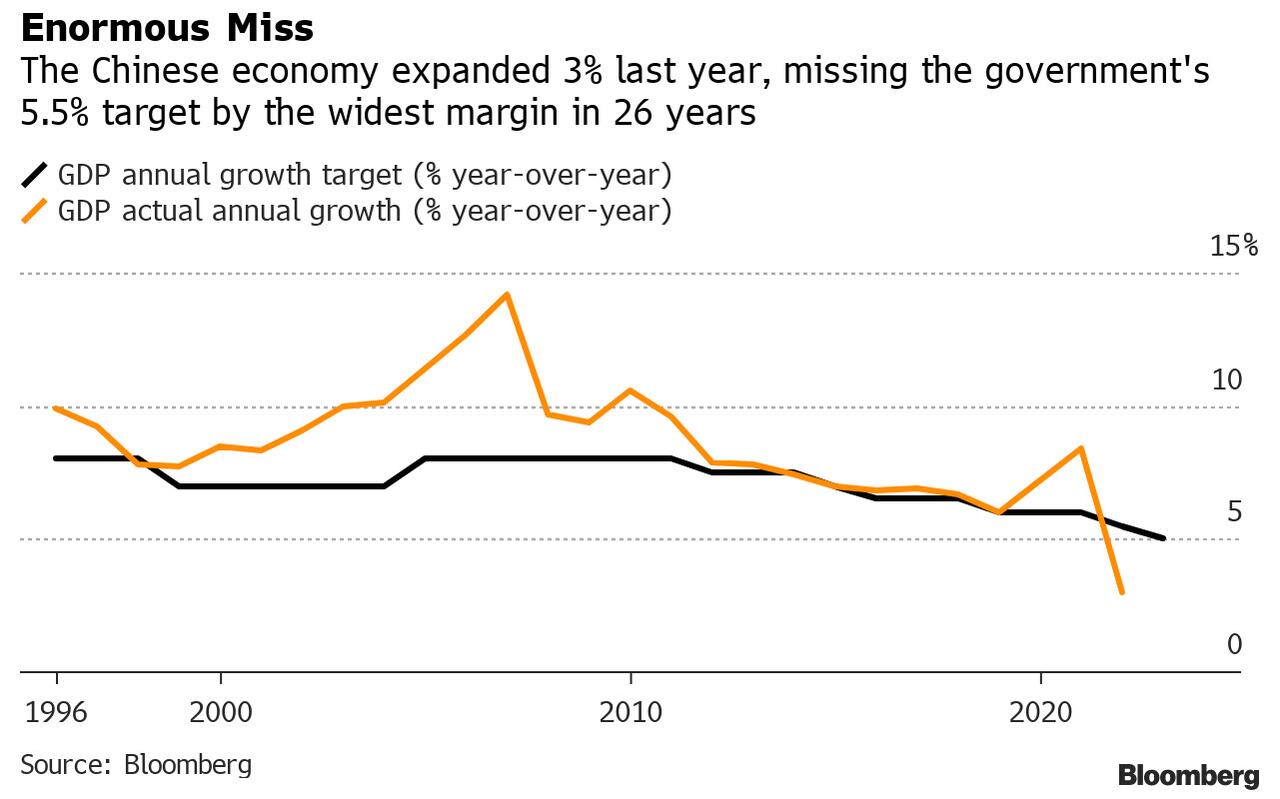
China’s 5% growth target may appear underwhelming to some, though it is very much in-line with shifting market expectations since last week’s blowout PMI. The modest objective leaves room for upside growth surprises and bodes well for Chinese equities overall, though Hong Kong stocks are likely to keep outperforming their onshore peers.

The 5% goal was below the 5.3% consensus in a Bloomberg survey, as well as the 5.5% objective for 2022 and also targets set by most provinces. Conservative as it is, the number won’t necessarily lead to a weak outcome, according to Citigroup, which noted that as recently as 2021 China managed to grow 8.1% versus a 6% target.

The ongoing Congress in Beijing leaves one thing perfectly clear, though: There will be no major stimulus on either fiscal or monetary fronts. The strength of China’s reopening exceeded the expectations of top leaders, who will be more restrained in rolling out new stimulus, Bloomberg reported last week. Now that the 5% target is in place, Citigroup believes any positive data surprises may “limit the extent of downward move” in market interest rates.

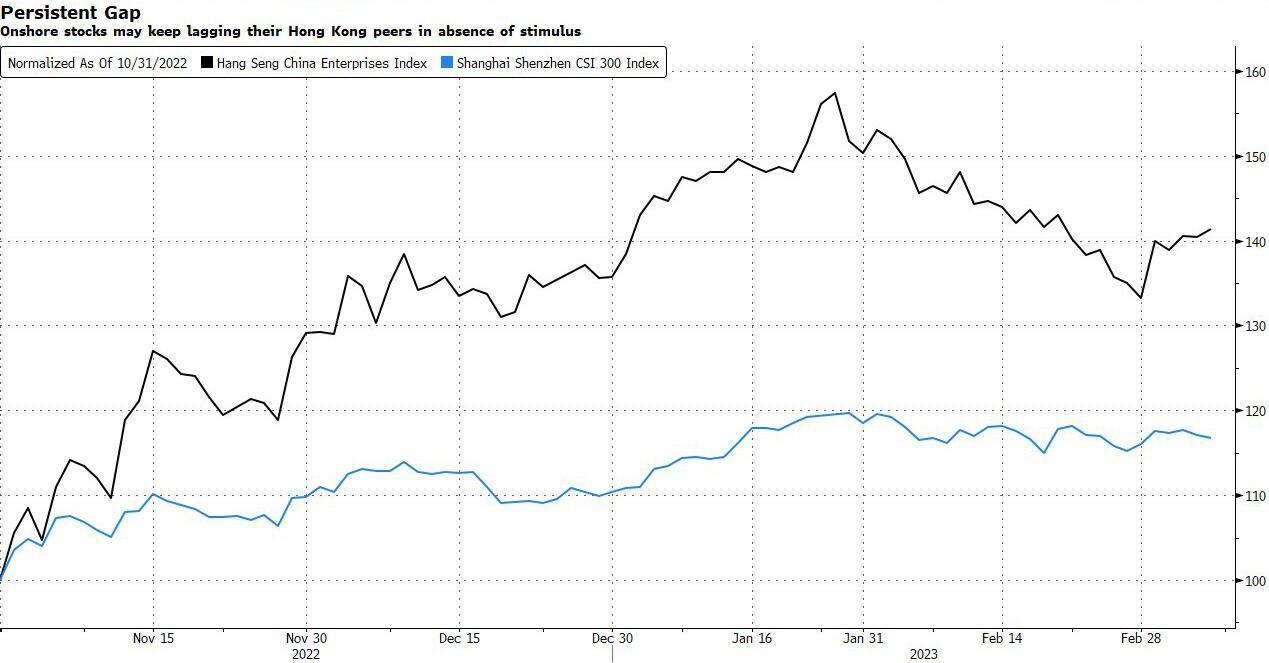
What does that mean for equities? As my colleague Sofia Horta e Costa noted, Hong Kong has so far been home to the reopening trade for investors who believe the post-Covid economy is already doing well. Onshore equities, on the contrary, are the stimulus play for those who expect Beijing to deliver more fiscal spending or PBOC liquidity.

The reopening trade has beaten stimulus bets handily since the end of October when chatter of exiting Covid Zero began to pick up steam. Hong Kong’s Hang Seng China Enterprise Index has rallied more than 40% over the period, while the onshore benchmark CSI 300 advanced less than half of that. The gap will probably persist, or even widen, in the foreseeable future.

China’s reopening is likely to be more V-shaped than consensus expectations, with substantial excess savings likely to support consumption, according to a March 6 research report from Morgan Stanley, which expects equities in North Asia ex-Japan to continually outperform as is “typical in the early phases of a bull market.”

Tyler Durden
Mon, 03/06/2023 – 22:26

via ZeroHedge News https://ift.tt/WYpCn1G Tyler Durden

Hedges: Lynching The Deplorables

Hedges: Lynching The Deplorables

Authored by Chris Hedges via The Chris Hedges Report,

There is little that unites me with those who occupied the Capitol building on Jan. 6. Their vision for America, Christian nationalism, white supremacy, blind support for Trump and embrace of reactionary fact-free conspiracy theories leaves a very wide chasm between their beliefs and mine. But that does not mean I support the judicial lynching against many of those who participated in the Jan. 6 events, a lynching that is mandating years in pretrial detention and prison for misdemeanors. Once rights become privileges, none of us are safe. 

Image: Executing the Law – by Mr. Fish

The U.S. legal system has a very sordid history. It was used to enforce segregation and legitimize the reign of terror against Black people. It was the hammer that broke the back of militant union movements. It persecuted radicals and reformers in the name of anti-communism. After 9/11, it relentlessly went after Muslim leaders and activists with Special Administrative Measures (SAMs). SAMs, established by the Clinton administration, originally only applied to people who ordered murders from prison or were convicted of mass murder, but are now used to isolate all manner of detainees before and during trial. They severely restrict a prisoner’s communication with the outside world; prohibiting calls, letters and visits with anyone except attorneys and sharply limit contact with family members. The solitary confinement like conditions associated with SAMs undermine any meaningful right to a fair trial according to analysis by groups like the Center for Constitutional Rights and can amount to torture according to the United Nations. Julian Assange faces SAMs or similar conditions should he be extradited to the U.S. The Classified Information Procedures Act, or CIPA, begun under the Reagan administration, also allows evidence in a trial to be classified and withheld from defendants. The courts, throughout American history, have abjectly served the interests of big business and the billionaire class. The current Supreme Court is one of the most retrograde in decades, rolling back legal protections for vulnerable groups and denying workers protection from predatory corporate abuse.

At least 1,003 people have been arrested and charged so far for participation in events on Jan. 6, with 476 pleading guilty, in what has been the largest single criminal investigation in U.S. history, according to analysis by Business Insider. The charges and sentences vary, with many receiving misdemeanor sentences such as fines, probation, a few months in prison or a combination of the three. Of the 394 federal defendants who have had their cases adjudicated and sentenced as of Feb. 6, approximately 220 “have been sentenced to periods of incarceration” with a further 100 defendants “sentenced to a period of home detention, including approximately 15 who also were sentenced to a period of incarceration,” according to the U.S. Attorney’s Office in Washington, D.C. There are six convictions and four guilty pleas on charges of “seditious conspiracy.” This offense is so widely defined that it includes conspiring to levy war against the government on the one hand and delaying the execution of any law on the other. Those charged and convicted of “seditious conspiracy” were accused of collaborating to oppose “the lawful transfer of presidential power by force” by preventing or delaying the Certification of the Electoral College vote. While a few of the organizers of the Jan. 6 protest such as Stewart Rhodes, who founded Oath Keepers, may conceivably be guilty of sedition, and even this is in doubt, the vast majority of those caught up in the incursion of the Capitol did not commit serious crimes, engage in violence or know what they would do in Washington other than protest the election results. 

Joseph D. McBride went to law school because his brother was serving a 15-year sentence for a crime he did not commit. He provided free legal advice as a law school student to those encamped in Zuccotti Park in New York City during the Occupy movement. Following law school, he worked as a public defender and in the Legal Aid Society. He represents several of those charged in the Jan. 6 incursion, including Richard Barnett. Barnett was photographed in Nancy Pelosi’s office with his leg propped up on her desk. Barnett was convicted by a federal jury, which deliberated for two hours, on eight counts, including disorderly conduct in the Capitol building. He faces up to 47 years in prison. He is scheduled to be sentenced on May 3.

The post 9/11 model is being applied to American citizens,” McBride told me when I reached him by phone. “That model is the 19 hijackers. Everyone who is a religious Muslim is a suspect for the next 20 years. They should be waterboarded. They should be put in fucking jail and left in Guantanamo Bay. Lock them up. Throw away the key. Because they are psychopath extremists who believe in Allah and we don’t have time for that. They’re a threat based on who they are, what they look like, what they believe in. When the truth is, the vast majority of these guys don’t do drugs, don’t drink alcohol, they have five kids and they live pretty good lives. But because of the label of ‘terrorism’ and ‘Osama Bin Laden’ and ‘al-Qaeda’, everybody who is a Muslim is now a target. If we get on a plane next to one of these people, we get nervous about it because that’s how much it’s ingrained in us. The same thing is happening, except it’s being applied to a new group of people, primarily white Christians, Trump supporters, for now.” 

“Power is going to change hands,” he warned. “The Democrats are not going to be in power forever. When power changes hands, that precedent is going to travel with it. If somebody else from the other side gets in and starts to target the people who are in power now, their families, their businesses, their lives, their freedom, then it’s over. America goes from being a free democracy to a tribalist partisan state. Maybe there’s not ethnic-cleansing in the streets, but people are cleansing each other from the workplace, from social media, from the banking system and they’re putting people in jail. That’s where we’re headed. I don’t know why people can’t see what’s on the horizon.”

The Jan. 6 protestors were not the first to occupy Congressional offices, including Nancy Pelosi’s office. Young environmental activists from the Sunrise Movement, anti-war activists from Code Pink and even congressional staffers have engaged in numerous occupations of congressional offices and interrupted congressional hearings. What will happen to groups such as Code Pink if they occupy congressional offices with Republicans in control of the White House, the Congress and the courts? Will they be held for years in pretrial detention? Will they be given lengthy prison terms based on dubious interpretations of the law? Will they be considered domestic terrorists? Will protests and civil disobedience become impossible?

McBride said those who walked to the Capitol were not aware that the Department of Justice had created arbitrary markers, what McBride called an “imaginary red line that they draw around the Capitol grounds.” Anyone who crossed that invisible line was charged with violating Capitol grounds.

He railed against the negative portrayal of the protestors in the media, the White House and Democratic Party leadership, as well as a tainted jury pool in Washington composed of people who have close links to the federal government. He said Change of Venue motions filed by the defense lawyers have been denied.

The D.C. jury pool is poisoned beyond repair,” McBride said. “When you just look at what the January 6  Committee did alone, never mind President Biden’s speeches about ‘insurrectionists,’ ‘MAGA Republican extremists’ and all this stuff, and if you just consider the fact that D.C. is very small, that people who work in the Federal Government are all by definition, kind of victims of January 6 and what happened that day, their institutions and colleagues were ‘under attack.’ How can anybody from that town serve on a jury pool? They can’t. The bias is astounding.”

Jacob Chansley, the so-called “QAnon shaman” who was adorned on Jan. 6 in red, white and blue face paint, carried an American flag on a spear-tipped pole and wore a coyote-fur and horned headdress, pleaded guilty to obstruction. He was sentenced to more than three years in prison. Chansley, who says he is a practitioner of ahimsa, an ancient Indian principle of non-violence toward all living beings, was not accused of assaulting anyone. He was diagnosed in prison with transient schizophrenia, bipolar disorder, depression and anxiety. 

Guy Wesley Reffitt, who did not enter the Capitol building, nevertheless was sentenced after three hours of deliberations to seven years and three months in prison on five charges, including “two counts of civil disorder, and one count each of obstruction of an official proceeding, entering and remaining in a restricted building or grounds with a firearm, and obstruction of justice.” His obstruction of justice charge came from “threatening” his two teenage children to prevent them from reporting him to law enforcement.

Daniel Ray Caldwell, a Marine Corps veteran, who sprayed a chemical irritant at a group of police officers outside the Capitol and entered through the Senate Wing doors where he remained inside for approximately two minutes, was sentenced to more than five years in prison. He spent, like many who have been charged, nearly two years in pretrial detention.

Even the charges against Rhodes, who faces 20 years in prison, and other militia leaders of groups such as the Proud Boys are problematic. The New York Times reported that, “despite the vast amount of evidence the government collected in the case — including more than 500,000 encrypted text messages — investigators never found a smoking gun that conclusively showed the Proud Boys plotted to help President Donald J. Trump remain in office.” The government has relied on the testimony of a former Proud Boy, Jeremy Bertino, who is cooperating with prosecutors to build an “inferential case” against Enrique Tarrio, Ethan Nordean, Joseph Biggs, Zachary Rehl and Dominic Pezzola, the five defendants in the current Proud Boy case. Bertino, on cross-examination, admitted that in previous interviews with the government, he repeatedly told investigators that the Proud Boys did not have an explicit plan to halt the election certification and that he did not anticipate acts of violence on Jan. 6. The FBI had as many as eight informants in the Proud Boys that included its leader, Enrique Tarrio, during the storming of the Capitol, raising the very real possibility of entrapment.

They’re changing the laws,” McBride said. “Look at the 1512 charge, the obstruction charge. That was used for document shredding in Enron. It has no applicability to Jan. 6 whatsoever. They took it. They repurposed it. They weaponised it against these people and made it impossible for them to defend themselves. When you look at the civil disorder charge, they are saying that if January 6 was one big civil disorder, and if you had any type of interaction with a police officer that day that may or may not have caused the police officer to step away from his duties for a moment, you can go down with civil disorder and get five years in jail.”

Ryan Nichols, a Marine Corps veteran, is living under house arrest in Texas after nearly two years in pretrial detention, much of it in solitary confinement, in Washington, D.C and Virginia jails. He faces five felony and three misdemeanor charges. Prosecutors say Nichols assaulted officers and obstructed an official proceeding. He has been ordered to “stay away from Washington, D.C.” except for business related to his case, according to court documents. He has had to submit to “location monitoring technology” and is denied access to the internet and his phone except to perform functions related to his case. He cannot have contact with anyone involved in the Jan. 6 events, including co-defendants. Nichols must remain in his home 24 hours a day except for medical and court appointments. He is permitted to attend Sunday church services at Mobberly Baptist Church in Longview, Texas. He is facing 20 years in prison. He is scheduled to go to trial on March 27.

I spoke with Bonnie Nichols, Ryan’s wife, by phone from their home in Longview, Texas. 

Ryan was arrested on Jan. 18, 2020. The FBI surrounded their house at 5:30 am in armored vehicles. They unscrewed the bulbs from flood lights and cut the wires to the couple’s security cameras before kicking in the front door. The couple and their two children, then aged 4 and 6, were at Bonnie’s parents house during the raid. The FBI confiscated their weapons, electronics and documents, including Social Security cards. 

“We wanted to cooperate,” she said. “We didn’t know anything was wrong. They asked Ryan to come in for questioning. Ryan went and turned himself in. They arrested him and I didn’t see him again for over a year and a half.”

Ryan, who had no criminal record, ran a nonprofit called Rescue the Universe where he carried out search-and-rescue operations after natural disasters. He was denied bail. He was sent to a holding facility in Grady County Oklahoma for two months before being flown to Washington, D.C. where he was met by some two dozen U.S. Marshals. His feet were shackled. His arms were shackled to a chain around his waist. He was placed in long term solitary confinement and denied video calls or visitation from his family, including his children. He was denied access to his trial documents for nearly a year and prohibited from attending religious services in the jail.

Ryan, whose most serious offense appears to be incendiary rhetoric calling for a “second American revolution,” spent nearly 22 months in solitary confinement. Depressed, struggling to cope with the physical and psychological strain of prolonged isolation, he was eventually placed on suicide watch. He was strapped to a bench in a room where a light was never turned off. Guards would periodically shout through a window “Do you feel like killing yourself?” Those on suicide watch who said  “yes” remained strapped to the bench. Those who said “no” were sent back to their cells. Ryan was often prohibited from having nail clippers — the guards told him he could chew his toenails down — or getting a haircut unless he agreed to be vaccinated for COVID-19. When Ryan appeared before Judge Thomas Hogan, who finally released him on Nov. 23, 2022, he told Ryan, with his long unkempt hair and fingernails, that he looked like Tom Hanks in the film Cast Away.

Every night, for the two years Ryan was held in solitary confinement, Bonnie and her two small boys would say prayers that Ryan would one day come home. She said she and her family have received numerous death threats.

“Ryan deals with insomnia,” Bonnie said of her husband. “He deals with extreme anxiety, depression and paranoia. He will not even go outside of his backyard because he’s scared that if he goes outside, that they’re going to take him back to jail. He has liver issues from the food that he ate because they fed him baloney sandwiches and trash while he was in D.C. He’s having a lot of medical issues. He also has lower testosterone than a 60-year-old man because he wasn’t able to have any sunlight. His vitamin D levels are low. The list goes on and on. This man does not sleep at night. He has nightmares. He whimpers at night in his sleep because he has dreams that he’s back in D.C. I mean, he’s a mess. This is the result of what has happened to him. He has vision loss. He doesn’t see as good as he used to.”

Ryan’s family, like many families of those charged, are struggling financially. Bonnie said their savings are gone. She and Ryan are heavily in debt. She has set up a fundraising page here.

“We are God-loving patriots,” she said. “Who’s going to be next? It’s not about Republican or Democrat or white or Black, Christian, or Muslim. We are all children of God. We are all U.S. American citizens. We are all entitled to our constitutional rights and freedom of speech. We can all come together and agree on that, right?”

The cheerleading, or at best indifference, by Democratic Party supporters and much of the left to these show trials will come back to haunt them. We are exacerbating the growing tribalism and political antagonisms that will increasingly express themselves through violence. We are complicit, once again, of using the courts to carry out vendettas. We are corroding democratic institutions. We are hardening the ideology and rage of the far-right. We are turning those being hounded to prison into political prisoners and martyrs. We are moving ever closer towards tyranny.

The Chris Hedges Report is a reader-supported publication. To receive new posts and support my work, consider becoming a free or paid subscriber.

Tyler Durden
Mon, 03/06/2023 – 22:20

via ZeroHedge News https://ift.tt/letOZFu Tyler Durden

Meteorologists Warn Of Big Snow And Rain Storm For Late Week

Meteorologists Warn Of Big Snow And Rain Storm For Late Week

AccuWeather meteorologists warn of a late-week storm that could bring wintry and severe weather to large swaths of the central US. 

“There is the potential for some states in the northern Plains to be hit with two snowstorms within a week,” said AccuWeather Meteorologist Joseph Bauer.

Bauer said forecasts point to a winter event, with snow expected to begin late Wednesday in the Rockies and to spread into the Upper Midwest through Friday. He said accumulating snow is expected for cities from Cheyenne, Wyoming, and Denver to Madison, Wisconsin, and Minneapolis. 

The exact snowfall and tracking of the storm have yet to be determined. The storm will take aim at the Plains and might strengthen as it moves eastward. 

In the South, warm weather will lead to an all-rain event from Texas to Tennessee. 

“Repeated rounds of rain from mid-to-late week could bring several inches of rain, especially from the Texas-Oklahoma border to Tennessee and Kentucky,” said Bauer.

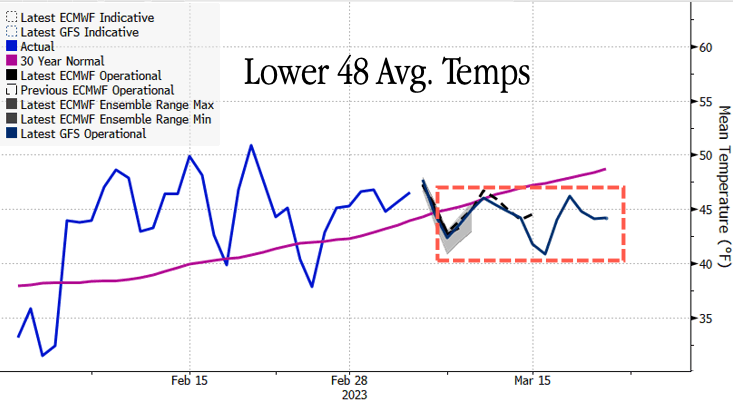
Meteorologists have yet to determine East Coast impacts from the storm. Though average temperatures across the Lower 48 will trend below 30-year seasonal averages through mid-March. 

Punxsutawney Phil was right one month ago when he saw his shadow in Punxsutawney, Pennsylvania, which translated into a forecast of six more weeks of winter. The good news is that seasonal averages are trending higher as spring is just weeks away. 

Tyler Durden
Mon, 03/06/2023 – 22:00

via ZeroHedge News https://ift.tt/FHhsjcA Tyler Durden

Judge Rules USA Powerlifting Must Allow Biological Male To Compete Against Women

Judge Rules USA Powerlifting Must Allow Biological Male To Compete Against Women

Authored by Katabella Roberts via The Epoch Times (emphasis ours),

A Minnesota judge has ruled that biological men who identify as women can compete against natural-born women in USA Powerlifting (USAPL) following a discrimination case against the organization.

An athlete in a powerlifting competition in Tokyo on Aug. 26, 2021. (Philip Fong/AFP via Getty Images)

In his ruling (pdf), District Judge Patrick Diamond said that the national powerlifting organization must “cease and desist from all unfair discriminatory practices” after finding that it had engaged in unfair discriminatory practices by denying transgender weightlifter JayCee Cooper “the full and equal enjoyment of public accommodation because of sexual orientation.”

Cooper, who was born a male, filed a complaint with the Minnesota Department of Human Rights in 2019 alleging that the organization had violated the state’s Human Rights Act after Cooper was banned from competing in the women’s division.

Cooper then filed a lawsuit against USA Powerlifting in state court in 2021 alleging claims of sex and sexual orientation discrimination under the Minnesota Human Rights Act (MHRA) against USAPL and Powerlifting Minnesota.

The lawsuit, which was filed through the Minnesota-based advocacy group Gender Justice, also alleged that Powerlifting Minnesota had aided and abetted sex and sexual orientation discrimination under the MHRA.

Cooper Was ‘Separated, Segregated’

Lawyers for the weightlifter said in the lawsuit (pdf) that Cooper began powerlifting in 2018 and “fell in love with the sport.”

Ms. Cooper sees powerlifting as a way to find strength within herself and has found a home in the community of strong supportive women who come together around a shared love of sport,” the lawyers wrote.

It goes on to note that Cooper had been training to compete in the USAPL Minnesota State Bench Press Championship and the Minnesota Women’s State Championship in January and February 2019, respectively, but in December 2018, USAPL sent an email to the weightlifter, stating that Cooper could not compete because of Cooper’s transgender identity.

“USAPL then revoked her competition card, which means that she was not eligible to compete in future USAPL events,” the lawsuit states, referring to Cooper. “USAPL MN then went on to hold both championship events, at which all transgender women athletes were prohibited from competing.”

Diamond ultimately agreed with Cooper’s attorneys.

“By denying Cooper the right to participate in the female category, the category consistent with her self-identification, USAPL denied her the full and equal enjoyment of the services, support, and facilities USAPL offered its members,” Diamond wrote in his ruling. “It separated Cooper and segregated her and, in doing so, failed to fully perform the contractual obligations it agreed to when it accepted Cooper’s money and issued Cooper a membership card.”

The judge also noted in his 46-page ruling that “the harm is in making a person pretend to be something different, the implicit message being that who they are is less than.”

“That is the very essence of separation and segregation, and it is what the MHRA prohibits,” the judge wrote. He also cited the “increased risk of depression and suicide, lack of access to coaching and practice facilities, or other performance suppression common to transgender persons,” as competitive disadvantages for transgender competitors.

USA Powerlifting Must Revise Policy

USAPL had argued that allowing male-to-female transgender athletes to compete against women was against company policy and that Cooper would have a competitive advantage over natural-born women.

In 2021, USAPL established an MX category, which is open to cisgender men and women as well as transgender men and women.

Judge Diamond ordered that USAPL submit a revised policy to remedy three specific areas of discrimination within 14 days and to comply with the revised policy thereafter.

A trial on possible damages has been set for May 1.

In a statement to Minneapolis NBC affiliate KARE-TV after the ruling, Cooper called the decision a “win.”

“After years of experiencing discrimination from USA Powerlifting, and the backlash that has occurred due to that, of course I have complex feelings about the sport,” Cooper said. “But I think that this win – [it] is a representation of where we can move forward.

‘We Respectfully Disagree’

Separately, USA Powerlifting President Larry Maile told the KARE-TV it is considering appealing the decision.

“Our position has been aimed at balancing the needs of cis- and transgender women, whose capacities differ significantly in purely strength sports,” Maile said. “We have received a summary judgment decision from the Court finding us liable for discrimination. We respectfully disagree with the Court’s conclusions. We are considering all of our options, including appeal.

The Epoch Times has contacted USA Powerlifting for comment.

The latest ruling comes shortly after 22 Republican senators, including Sens. Tommy Tuberville (R-Ala.), Mike Crapo (R-Idaho), and Mike Lee (R-Utah), reintroduced a bill aimed at protecting female athletes and ensuring fairness and safety in women’s sports at educational institutions across the United States.

Known as the “Protection of Women and Girls in Sports Act,” the bill would preserve Title IX protections for female athletes, which ban discrimination on the basis of sex in sports programs and require all educational institutions in the country to reward male and female athletes equally.

That bill would counteract the Biden administration’s expected plans to finalize rules in May that would force institutions to allow biological males to share women-only spaces and compete in women’s sports.

Tyler Durden
Mon, 03/06/2023 – 21:40

via ZeroHedge News https://ift.tt/75pdNbO Tyler Durden