Fixing The Incentives: How Fiat Funds National Corruption

Fixing The Incentives: How Fiat Funds National Corruption

Authored by Jimmy Song via BitcoinMagazine.com,

In the first two parts of this series, I wrote about the individual-level incentives and company-level incentives of fiat money. The individual-level incentives made personal lives have much higher time preferences through ubiquitous debt and lack of savings vehicles. The company-level incentives made communal life much more zombie-like and artificial through unnaturally-large companies that have replaced our families.

In this essay, I’m exploring the incentives at the nation-state level, where fiat money has perhaps its greatest effect. The power of fiat money gives governments the ability to become more authoritarian. Not only do we get a welfare/warfare state, but we also get a surveillance state, a police state and militaristic, corrupt tyrannies. The siren song of Marxism, of positivist law and an authoritarian vision are some of its rotten fruits. The unprecedented destructive power of governments in the last 100 years can be laid squarely at the feet of fiat money. Government authority and power have expanded more than the average American’s waistline and the consequences have been just as deadly.

WITH GREAT POWER COMES GREAT RESPONSIBILITY

The central control of money is an enormous prize, like the Infinity Gauntlet of Marvel fame, giving those in power the ability to steal the wealth of their nations at will. This isn’t obvious at first because the mechanisms of central banking don’t make this monetary power dynamic easy to understand. Central banking is thus very attractive to governments and pretty much all fiat money since the 20th century has been of this type.

The main beneficiary of this obscured ability to print is the government that can run deficits on its budget. This was not the de facto practice historically as taking on debt under sound money is very expensive. Free market interest rates usually hover around 5.6% or higher, depending on the economic circumstances and credit worthiness. Taking on debt under sound money generally means really having to tighten budgets or raising taxes later, neither of which are popular. There’s an opportunity cost to spending that’s inherent in sound money that more or less disappears under fiat money. The major budget battles in the past used to be about trade-offs of various budget items. Under fiat money, budget battles are about who will get to hand out more rent-seeking positions.

Running a deficit means that hard choices don’t have to be made. Instead of having to choose between high-interest debt, increased taxes or budget cuts, fiat money lets governments avoid all three with an additional option: implicit taxation through inflation in the form of low-interest, easily-renewed debt!

The ability to run a deficit not only throws all discipline out the window, but it lets the people in charge use that money for the thing that people in charge tend to care about: staying in power. Hence, policies that favor certain constituencies or even straight up bribes proliferate. The power of controlling money is great and, unlike Spiderman, governments don’t use this power with much responsibility as can be seen in how they run themselves.

STAYING IN POWER

Governments, no matter what form they take, have as a major priority the goal of staying in power. This is true not only of dictatorships, but also of representative democracies. The differences between them are the means employed. A dictatorship may arrest, jail and kill political dissidents. A representative democracy may give new entitlement benefits to political allies. The goal in each case is to neutralize threats to continued rule and to strengthen the government’s supporters.

What fiat money does to this desire is give those in power many more options. Under sound money, budgets had to be balanced, meaning that for every program that spent money, there had to be some revenue generator, such as taxes, to compensate. Generally, taxes are unpopular and too many taxes will cause a populace to revolt, which risks losing power. Fiat money is thus a godsend to those in power as it avoids making taxes explicit.

With this power of money printing, those in power can benefit themselves in various ways, which we turn to now.

ENTITLEMENTS

Governments can provide benefits to various constituents to get their support. This can include everything from healthcare to food to pensions. Indeed, since the advent of fiat money, these entitlements have become common all over the world. They are generally sold to the public as a form of compassion and they’re very popular due to the perception that they’re “free.” The hidden taxation of inflation is rarely even acknowledged, let alone blamed.

The problem with welfare is that it becomes a cost center that grows uncontrollably. In the past, welfare recipients could only get what the government could afford within a budget. It had to be restrained and traded off against lots of other budget items. With fiat money, however, the welfare benefits never really stop growing. Fiat money funds entitlements, which enter the economy and causes the prices of everything else to rise. Soon, the benefits have to compensate for the loss in purchasing power which adds even more fiat money into the economy which causes the prices to go higher and so on.

Social security, for example, started as a tiny program relatively in the U.S. budget. It’s currently 21% of the budget and has grown enormously as more and more generous benefits have been granted. Similar programs like Medicare continue to grow. Food stamps covered three million people in 1969 and covered 15 million by 1974 and some 42 million today. We’re well past the point where self-interested voting will guarantee escalation of money printing.

The problem is that there’s no political will to stop entitlement programs because they induce dependency. Dependent people are loyal and will keep the government in power.

Thus, the only ways in which these programs expire is either through hyperinflation or through externally-imposed budget constraints. The latter is imposed by quasi-international organizations like the IMF, BIS and the World Bank. And indeed, that’s the topic of the next essay, but in the event of hyperinflation, everything is thrown into chaos. This is an all too common economic result for many countries around the world, particularly those that don’t have great relationships with the U.S.

POLICE STATE

Another usage of fiat money for political power is in the enhancement of the police state. Staying in power requires a lot of vigilance and watching for would-be revolutionaries is part of every government’s agenda. Fiat money has several mechanisms for doing this.

First, as fiat money is increasingly digital, governments can restrict its movement for those that are in opposition. Taking away bank accounts is a relatively cheap way for governments to defund their opposition. Many human rights activists around the world have felt the choking hand of government constriction over their money.

Second, fiat money can fund direct surveillance. Governments have many programs for tracking individuals and from their points of view, surveillance is a small price to pay to prevent being overthrown. Surveillance is very difficult and costly, requiring a lot of technology and personnel, but since it’s such a critical part of staying in power, governments will pay for it, inflating their own currencies to do so.

Third, fiat money can fund more police and military. These are some of the most expensive budget items yet those in power will deficit spend to build these up. The reason is because they’re insurance against any sort of coup. The ability to deficit spend means those in power can make an unnaturally large police and military to impose their rule. It’s a terrible use of resources, especially in poorer places, but that’s the power that fiat money gives, the ability to spend the resources of an entire country in whatever way the leaders want.

The military can also be used for conquest outside the country’s borders and that’s what we turn to now.

WAR

Thus far, we’ve discussed the various ways in which governments can use fiat money to defend internal threats against their rule. The other major threat to staying in power are external threats, which take the form of other governments wanting to topple your country.

Defending against external threats means building up the military, especially through highly-destructive weapons like nuclear warheads. Thus, many countries use fiat money to build up their militaries.

While the military build up prevents smaller skirmishes, when war breaks out, there’s a quick degeneration into total war. Under fiat money, war can be escalated easily through money printing. This is because the normal backstop of financial bankruptcy no longer exists. Because fiat money removes normal financial considerations, wars generally bring entire countries’ economies into the war effort. Thus, wars are often waged until one side is completely destroyed.

We saw this in action in both world wars where both sides went to total war, putting all resources of an economy toward the war effort and destroying a significant portion of civilization.

RENT-SEEKING JOBS

The final use of fiat money for staying in power is bribery. We usually think of bribery going the other way, where people in industry bribe officials in government for special favors. And indeed, that still happens, but what governments do is in many ways worse. They use fiat money to buy votes. In a sense, entitlements are a form of that, but more effective is bringing more people into government itself.

Especially in countries with chronic unemployment, giving favored constituencies jobs is a much more effective way of ensuring loyalty. Combined with a moral imperative to take on more responsibility, governments can grow very large just in personnel. For example, about one third of Lebanon’s active population is employed in civil service. Is it any wonder they are suffering from hyperinflation?

Most of these people are rewarded more for their loyalty than for any functions they perform for the government, so they can rightfully be described as rent seekers.

ENORMOUS GOVERNMENT

In part two of this series, I showed how fiat money fuels the growth of large companies. The same dynamic supercharges the growth of the government, except instead of commercial banks that give the government large loans, it’s the central bank. The dynamic is all the more potent as government is a natural monopoly and there’s no pesky need to make a profit.

The government grows like cancer well beyond levels necessary to fulfill the functions that it’s assigned itself. The access to money for a government is even greater than for corporations and thus, governments grow by leaps and bounds through a few different mechanisms. Fiat money is the fertilizer on a fresh field getting invaded by the weeds of government.

The first and most obvious way governments grow is through taking on more responsibility. As we’ll see, there’s a moral imperative for governments to provide solutions to any and all problems. Hence, the responsibilities it assigns itself grows ever larger. A taken responsibility, like creating enough energy for the country, becomes its own regulatory complex. Anything perceived to be too risky for the market, or uneconomical, are natural places where the government steps in. Thus, we get stuff like national flood insurance and rural electrification. Even if the government does a good job, these programs likely lose a lot of money, because if they made money, private industry would be all over them. The more likely scenario is that the government not only loses lots of money, but also does a poor job.

A second way governments grow is through nationalization. Subsidizing large zombie companies is a normal part of a fiat economy, but at a certain point, their finances get so deep in the red that they can’t get loans from commercial banks. At this point when serious money is required, governments often step in to provide bailouts. A government bailout necessarily means more say by the government, eventually to the point where the company will now belong to the government. Nationalization is the natural end of fiat companies. Bailouts are not the only path to nationalization, however. If an industry is perceived to be unfair in some way or if there’s a sufficient war emergency, that industry may just be taken over by force.

A third way governments grow is through bureaucratic bloat. Especially in poorer countries where there isn’t much industry, creating jobs tends to be a responsibility that the government takes on. As there are often not enough responsibilities, these become make-work jobs, which are naturally rent seeking. This is the administrative equivalent of digging ditches and filling them back in. It is to this final method of growth that we now turn.

GOVERNMENTS, LIKE COMPANIES BUT WORSE

Government jobs are supposed to serve the country, by performing functions like adjudication, defense and infrastructure. These require some organization and, given that it’s the government paying these people, such jobs are sought after. The reason is that generally, government jobs are very hard to get fired from. As I mentioned in the last essay, organizations past Dunbar’s number have major disadvantages and governments, being even bigger than companies, have great disadvantages in this regard.

In particular, it’s very difficult for those in charge to know what the workers are doing and rent seeking in such organizations tends to proliferate. Further, there’s little incentive for managers to even care about employee performance as there is no direct feedback from the market. The goods and services provided by the government aren’t market driven and require election waves or regime changes for even a small amount of change. Hence, the only way that such rent seekers lose their jobs is through some form of political upheaval.

The job security inherent in government work makes them very attractive, even if they don’t pay as much as industry. As mentioned in the last essay, companies provide a lot of benefits besides salary and this is generally true of government as well. Health insurance, unemployment insurance, pensions, etc. are all available to government workers. Add job security, even for some of the worst performers, and we get a clamor for these jobs, especially in places where unemployment is high.

This, combined with a government’s desire to stay in power, generally means a gigantic bureaucratic bloat. Because fiat money obviates the need for any sort of fiscal discipline, jobs are handed out to politically-connected people. These might be political supporters, relatives or perhaps even former political opponents. Political problems are often easily solved by bribes, and these bribes can take the form of government jobs and, of course, bribes are funded by fiat money. The only limitation on the growth of government is hyperinflation, which is essentially the death of an economy. The cancer can only grow as long as the host is alive.

NOT PRICE SENSITIVE

The cancer of government waste spreads to companies through the procurement of goods and services. Not all government functions are performed by the government directly. For example, they don’t generally produce their own computers or cell phones, so contracts to buy these are again extremely lucrative opportunities for corruption.

The reason for external procurement is obvious: Government-created goods and services tend to be much poorer quality than their private industry equivalents. Just go to your local motor vehicle bureaucrat to see how poor government services can be. Thus, governments will contract out for a lot of goods and services they don’t offer on their own. These contracts are extremely valuable and there are many rent-seeking companies that sell exclusively to government.

Many are defense contractors, but they can be everything from event planners, hardware vendors, food services and pretty much anything you can think of. The key here is that governments can deficit spend and aren’t particularly worried about price. Laws and regulations may be written to try to get the government to care about price, but in practice, the budgets tend to be massively bloated.

This was the case in one of the biggest IT disasters we’ve seen from the government, healthcare.gov. The website was one of the many parts of the legislation colloquially called “Obamacare.” To get people to sign up, The government spent over $1.7 billion to build this website.

If this sounds like a lot of money, it is, and we’ll get to just how bloated a bit later, but massive bloat is not unusual for government spending. The healthcare.gov website was contracted to a firm in September 2011. After launch, America found out that the website couldn’t handle even 50 concurrent users and that the site was completely unusable.

The Obama White House got into a panic and put people on the case to fix the problem. After finding out that the system was built extremely poorly and that they needed people from the outside to fix it, they hired some software engineers from Silicon Valley. They managed to get the website up and running, but it was a Herculean task, requiring months of startup-level hours from some of the most talented programmers in the country to fix. A normal website like that takes anywhere from $3 to $10 million and private industry builds them on timelines much shorter than the 24 months government contractors were given.

That’s how inefficient government is and how little they care about cost. The power of money printing has given them so much leeway that they spent 10-times the time and 100-times the budget of people who were actually competent. This was a high-profile failure, so it’s easy to dismiss it as a one-off, but even if other parts of government are five times more efficient than the healthcare fiasco, there are a great amount of resources that are at minimum being mismanaged and wasted by the government.

Think about how these resources would be used by the free market! Think about how much prosperity such resources could be used for. Instead, they’re being wasted on bureaucracy, rent seeking, cronyism, corruption and embezzlement.

MORAL OBLIGATIONS OF FIAT MONEY

The ability to print money also has another effect on government: It increases the purview of government to be anything and everything. This is because it has the power of the money printer and can claim to use that to solve any problem. Indeed, this is what politicians promise.

Morally, the logic is understandable. If you have the power to print money, that power should be used to relieve any and all suffering. Hence, there’s a moral obligation to go solve any perceived problems and injustices.

If someone is suffering, the government has an obligation now to step in. If someone is poor or disabled or sick or oppressed, the government has an obligation to fix it. There’s no real limit to the government anymore because the government operates in a Keynesian fantasy. Governments think there are no tradeoffs to creating new money. Instead of measuring the good of one program versus another, which is what you’re forced to do with a normal budget, there’s just more money that can be printed to solve the problem through deficit spending.

Thus, there are no personal problems anymore. All problems belong to the government. More people will eschew personal responsibility because the government has the power of money printing and that power gives them the power and responsibility to give the people a good life.

Of course, this is a lie as there are tradeoffs. The value from printed money comes from savers and all of these government programs come at a cost of things that would empower individuals instead.

A TREND TOWARD STANDARDIZATION

Solving problems for people at a national scale tends toward one-size-fits-all solutions. The scale that companies have to operate at is large, but for a government, the scale is even larger. Combined with the monopoly and the long feedback loops from the market for government services, personalization of any kind gets thrown to the wayside.

Big companies also operate this way, which is why the modern world feels so impersonal. We’re being treated by companies and governments as interchangeable parts. The education system is a case in point.

For government and companies to run reasonably, each person has to be a cog in the wheel that can be replaced. An irreplaceable part doesn’t scale. Thus, corporate and government roles are very standardized and the education system facilitates this by churning out cog pieces. If you’re an accountant, you can fit into many different companies. An engineer, the same thing. Indeed, many of these roles are protected by government regulation.

Further, the process of being formed into these cog parts has implicitly given governments unprecedented authority. The government determines who can do what through licensing, from cutting hair to selling real estate. The government controls the supply of various professions and we get artificial restrictions on some of the most desirable jobs.

Because we have been made to be cogs in a system, there’s also a strong government tendency to standardize in other ways.

TENDENCY TOWARD TYRANNY

Given all the money available, and the moral responsibility they’ve taken on, most government leaders start working toward their version of utopia. Once they’ve been given a moral imperative of fixing all problems, it’s a short step to directing all of this effort toward some sort of perceived ideal.

Here’s the problem: The ideal requires significant social engineering to make it work. And that social engineering quickly leads to totalitarianism. Nazi Germany and the USSR were two examples of countries that tried to usher in a utopia through totalitarianism. The massive human suffering that resulted was funded by fiat money.

Of course, not every government will end up killing millions, but governments will want to control the behaviors of their people to aid in the bringing about of their utopia. The usual strategy to socially engineer a society toward a particular vision is to convince people of the righteousness of these outcomes. Propaganda is an outgrowth of this desire to control and the means, of course, are fiat money. Propaganda is the one thing governments tend to be good at because that’s how those in power got into power in the first place.

In addition, fiat money gives governments the ability to control behavior without obviously totalitarian laws. By paying for the outcomes they want, they can socially engineer their nations toward the outcome the authorities want through economic incentives.

For example, healthcare can be a direct benefit, which would mean conscripting a lot of doctors and medical equipment and facilities. This tends to not work very well, as government management tends to run such systems badly. But by providing fiat money, the tyranny is more obscured.

Government dependency increases and we head toward a totalitarian state through the back door.

BITCOIN FIXES THIS

Bitcoin fixes these incentives because the government no longer has the incredible power of money printing. Deficit spending becomes more expensive and thus less used. The apparatus of government will become much smaller simply because they’ll be constrained by individuals sovereign over their own wealth. No longer will there be the option of stealth theft via inflation. The Infinity Gauntlet will be destroyed.

The apparatus of government, including entitlements, bureaucracy and the military industrial complex will be sharply curtailed. The unpopularity of explicit taxation will shrink the public sector and the rent-seeking jobs that come with it. Tyranny will be limited because governments won’t be able to induce dependence with endless money printing.

As such, everything will get less political as politics won’t be in everything. The moral imperative of government will no longer be to solve everyone’s problems because their limitations will be obvious. This will reduce the role of government, especially in the sphere of moral demands. Instead of some authoritarian ideal, we’ll get to live our own dreams and set our own goals.

Bitcoin is freedom from tyranny.

Tyler Durden
Sun, 03/05/2023 – 08:10

via ZeroHedge News https://ift.tt/JaK96hS Tyler Durden
Top Food Brands Virtue Signal ‘Healthy Diets’ While Cashing In On Junk Food

Top Food Brands Virtue Signal ‘Healthy Diets’ While Cashing In On Junk Food

A new study commissioned by the World Action on Salt, Sugar & Health (WASSH) revealed a startling fact: “Four of the world’s biggest food manufacturers are over-reliant on the sales of unhealthy food despite each claiming to be active in improving the healthfulness of their products.”

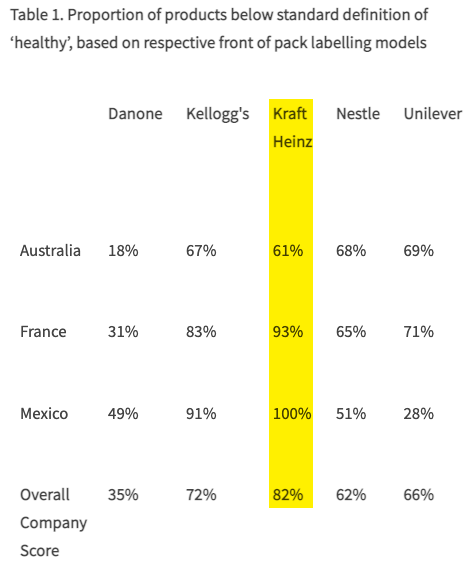
WASSH assessed 2,346 products sold by global food and drink companies Danone, Kellogg’s, Kraft Heinz, Nestlé, and Unilever in their three largest markets — Australia, France, and Mexico. It ranked the products based on commonly used standards such as Health Star Rating, Nutri-Score, and Warning Labels. With the exception of Danone, all other companies had a higher percentage of sales from unhealthy food.

“Danone was the only manufacturer with a greater share of healthier products available in each of the three countries. The remaining four manufacturers performed poorly across all three markets, with more than half of their surveyed food and drink portfolio below a standard definition of ‘healthy,'” WASSH wrote. 

Kraft Heinz, Kellogg, Unilever, and Nestle sold the bulk of junk food and drinks. 

“Improving the nutritional content of food and drink by reformulating recipes with less salt, sugar and saturated fat is by far the most important strategy that any company should make to improve public health,” Mhairi Brown, policy and public affairs lead with WASSH, said in a statement. 

Kraft Heinz, Kellogg, Unilever, and Nestle are promoting diets high in fat and sugar, which could potentially increase the risk of obesity and chronic illnesses such as cardiovascular disease, type 2 diabetes, non-alcoholic fatty liver disease, and certain cancers if consumed regularly. In addition, the consumption of junk food may cause adverse changes in the brain and result in cognitive impairment.

And riddle us this… Why are the largest food companies in the world also pushing a ‘woke’ agenda? 

Kellogg’s has promoted what appears to be unhealthy ‘woke’ cereal. 

There’s a war on your diet and a war on your body. This seems very unhealthy for the soul, body, and mind

… and if current unhealthy diet trends persist, more than half of the world could be overweight by 2035.

Tyler Durden
Sun, 03/05/2023 – 07:35

via ZeroHedge News https://ift.tt/nNCBjRX Tyler Durden

Nearly A Ton Of Cocaine Washes Up On French Beach

Nearly A Ton Of Cocaine Washes Up On French Beach

Authored by Efthymis Oraiopoulos via The Epoch Times,

Maritime police in northwest France found nearly a ton of cocaine washed up on a beach on the English Channel on Feb. 26.

The drugs were found near the town of Reville on the Cotentin Peninsula, according to France’s maritime authority for the English Channel and North Sea.

The cocaine, weighing about 1,875 pounds (850 kilograms) in total, was found in two large packages linked by a rope, the authorities said on Feb. 28.

Police are trying to determine whether the drugs fell from a ship or were intentionally floated to the shore for traffickers to pick up.

Another report by AFP citing unnamed sources said more drugs were found washed up on the northern French coast on March 1.

Drug Smuggling Surge

There has been a surge in cocaine and crack smuggling into Europe, accompanied by unprecedented drug violence in some areas.

The North Sea port cities of Antwerp in Belgium and Rotterdam in the Netherlands have become the main gateway for Latin American cocaine cartels into Europe.

On Feb. 14, two Dutchmen, aged 27 and 46, were arrested by Belgian police, and almost 8,818 pounds (4,000 kilograms) of cocaine were seized.

Police found an address in a navigation app used by the two men. That address led police to a hangar with a container filled with 68 bags of cocaine.

Police also arrested seven other men found in the hangar.

Cocaine was found in over 1,700 tins of wall filler, after German authorities seized more than 16 tons of cocaine in the northern port city of Hamburg, Germany, on Feb. 24, 2020, in Europe’s largest cocaine haul to date. (Cathrin Mueller/Reuters)

Narcotics production is growing in Europe, according to an estimate published in January by the EU drugs agency, which warned of a proliferation of new psychoactive substances being sold and consumed on the continent.

The EU drugs agency said that new evidence was emerging of rising drug production in Europe, confirming its earlier warning about the continent turning into a global hub for narcotics and no longer just a consumption market.

“Synthetic drug production continues to increase in Europe,” the report warned, noting that illegal laboratories in Europe churn out huge amounts of amphetamine, methamphetamine, and other synthetic drugs for local consumption and export outside Europe.

Drugs and the chemicals needed to produce them are still largely imported into Europe from other parts of the world, including South America and Asia.

More than 350 labs for synthetic drugs were detected and dismantled in 2020 in Europe, the latest year for which data is available, the EU agency said.

Tyler Durden
Sun, 03/05/2023 – 07:00

via ZeroHedge News https://ift.tt/PEQfslY Tyler Durden

Don’t Just Hire ‘Better Cops.’ Punish the Bad Ones.


topicsfuture

“I don’t know that there’s any law that can stop that evil that we saw,” said House Judiciary Committee Chairman Jim Jordan (R–Ohio) on NBC’s Meet the Press, shortly after video was released of five Memphis police officers brutally beating Tyre Nichols during a traffic stop.

Jordan took a lot of abuse for his remark, which was generally interpreted as boobish and nihilistic. But while Jordan has said many boobish things over many years, he is very nearly correct about this one. Congressmen know better than most that the mere act of passing a law guarantees nothing, and that making something illegal is not the same thing as eliminating it.

Three years after the death of George Floyd—and two years after the death of the George Floyd Justice in Policing Act, which passed the House in 2021 but stalled in the Senate—many of the same policing reform proposals are still being endlessly debated. Some states and cities implemented new use-of-force guidelines with similar language, along with other piecemeal reforms. The results are mixed. Even if the federal bill’s ban on chokeholds had been passed and universally honored, for example, it wouldn’t have saved Nichols, who died three days after being subject to nearly every assault imaginable other than choking. Memphis is in the middle of several other reforms, including efforts to diversify its police force. But all the officers charged in Nichols’ beating were black.

Defunding the police—the rallying cry of the angry summer of 2020—proved an unpopular idea. Most people don’t want to abolish the police; they just wish they could trust officers in their neighborhoods to do the right thing when they are needed.

Congressional micromanagement of the rules of engagement between cops and citizens isn’t the only way forward, and it’s probably not the best one. Instead of focusing primarily on prevention, the best way to prevent future abuses may counterintuitively be to consistently and publicly punish law enforcement officers who have stepped over the line after the fact.

There is a technocratic temptation to think that the problem of police brutality can be solved by making or attracting better cops. Proposals range from requiring a college education for police officers to simply increasing the number of hours of training required, from the current average of 650 to something closer to Finland’s 5,500 or at least Canada’s 1,000.

Both of those proposals were touted by Noah Smith, who issued a call to “Professionalize the Police” on his Substack. He forthrightly admits that he “can’t find good causal studies on the impact of total hours of police training on police brutality” but notes that there is some evidence that certain subtypes of training are effective. Unfortunately for Smith’s case, one of those types of training is the very same de-escalation training the Memphis police did receive.

“The worst that could happen,” writes Smith, “is that we waste some money.” But efforts to require a college education for an increasing number of professions—including day care workers—have succeeded largely in making labor scarcer and prices higher, without clear gains in quality or safety. Advocates of more training like to cite the required hours of training for other professions, especially the thousands of hours required of cosmetologists. But anyone who has ever had her hair done at a dubious salon might well wonder whether many of those hours were, in fact, an expensive waste of money and time for all parties.

If you get a bad dye job, of course, you can leave a one-star Yelp review. And if, Aphrodite forbid, you’re disfigured by bleach burns, you can sue. At the moment, both of these options are very limited for victims of police misconduct.

Too many American police officers believe it’s OK, even necessary, to react extremely aggressively when faced with perceived threats. As long as there is no external reality check on that belief, it is unlikely to change.

The five officers who attacked Nichols have been charged with murder and other crimes. But because criminal charges against police are rare, it should also be possible to hold law enforcement officials accountable in civil proceedings, where regular citizens can initiate proceedings and seek justice.

Too often, lawmakers and activists become focused on creating elaborate licensing standards, codes of conduct, education requirements, and more when what is needed most is to clear the way for a time-tested system to work as intended. We already have a system in which those who inflict harm on others in the course of their jobs can be held accountable, but decades ago the Supreme Court carved out the “qualified immunity” exception, which often blocks lawsuits for clearly unconstitutional abuses.

Memphis Police Chief Cerelyn Davis told the Commercial Appeal that she supports reforming qualified immunity, but Tennessee police have benefited from the doctrine’s bafflingly broad shield in recent years, including in 2020, when the U.S. Supreme Court declined to hear a case where a state court had concluded that a man bitten by a police dog was out of luck, because the “use of the canine to apprehend [him] did not violate clearly established law.”

The consequences for the officers who beat Nichols have been swift and severe. Their rapid expulsion from the police force and the unwillingness of the Fraternal Order of Police to stand up for them will likely do more to make the next officer think twice about wielding his Taser and truncheon than any specific set of rules Jim Jordan and his pals can dream up. Increased civil liability will help make this kind of clear resolution more common.

Some of the same developments that make it possible to hold violent, brutal police officers accountable in court will also allow innocent, effective police to defend themselves. Scrupulously acquired and maintained body camera footage will exonerate officers who have done the right thing. Unions that find it untenable—for reputational and fiscal reasons—to reflexively defend repeat offenders will ultimately be stronger and more useful to the cops that need defense from unscrupulous bosses, frivolous complaints, or poor working conditions when the need arises.

The fact that the five officers responsible for Tyre Nichols’ death are suffering is likely to be cold comfort to the 4-year-old daughter he leaves behind. But convincing law enforcement officers that those who do wrong will suffer consequences is by far the most powerful (and cost-effective) tool for changing police behavior in the long run.

The post Don't Just Hire 'Better Cops.' Punish the Bad Ones. appeared first on Reason.com.

from Latest https://ift.tt/BJwO53m
via IFTTT

San Francisco ‘Opens The Door’ To Supervised Drug Consumption Sites

San Francisco ‘Opens The Door’ To Supervised Drug Consumption Sites

Authored by Brad Jones via The Epoch Times,

Supervised drug consumption sites may be coming to San Francisco despite California Gov. Gavin Newsom’s veto of legislation with a similar plan by state Sen. Scott Wiener (D-San Francisco) last year and widespread opposition to the idea.

The San Francisco County Board of Supervisors unanimously voted on Feb. 28 to allow nonprofit groups to run supervised injection sites with private funding. Because ordinances require two readings, the supervisors will cast their final vote on March 7.

San Francisco Mayor London Breed and Supervisor Hillary Ronen introduced the proposal last month to abolish “a recently identified permitting barrier” to proceed with an overdose prevention plan – while the City awaits federal guidance on whether or not it can legally fund such programs with taxpayer dollars, the mayor said in a statement.

The legislation “opens the door for non-profits to operate drug overdose prevention sites in San Francisco,” according to the press release.

San Francisco city hall in San Francisco, Calif., on Feb. 23, 2023. (John Fredricks/The Epoch Times)

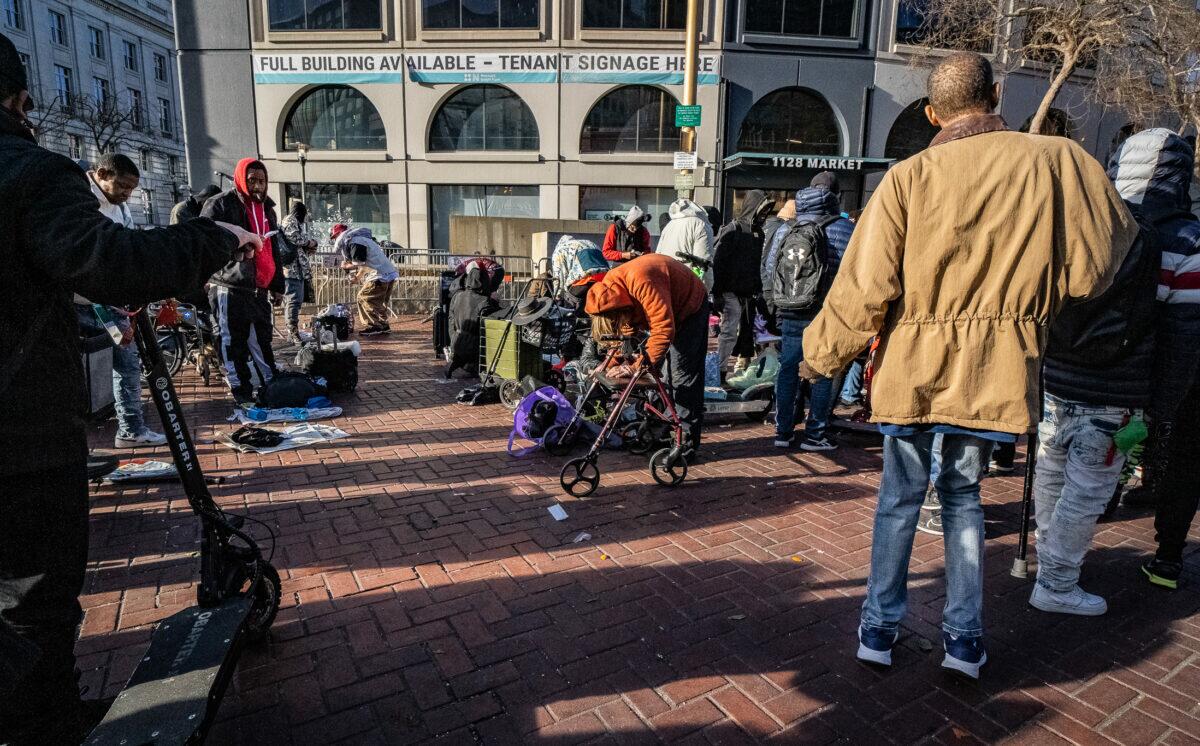
The drug crisis in San Francisco has killed nearly 2,000 people since 2020, and the city’s infamous Tenderloin district is known to be a hotspot for illicit drug deals.

“This legislation is part of our work to bring down the number of fatal overdoses and tackle the challenges driven by fentanyl head on,” Breed said.

“We will continue to work with our non-profits partners who are trying to open overdose prevention sites, fully implement our health strategies to help those struggling with addiction in our streets, and work with law enforcement to close the open-air drug markets.”

Ronen said San Francisco needs overdose prevention sites to save lives and “solutions to open-air drug use and chaotic conditions on the streets.”

‘Negative Impacts’

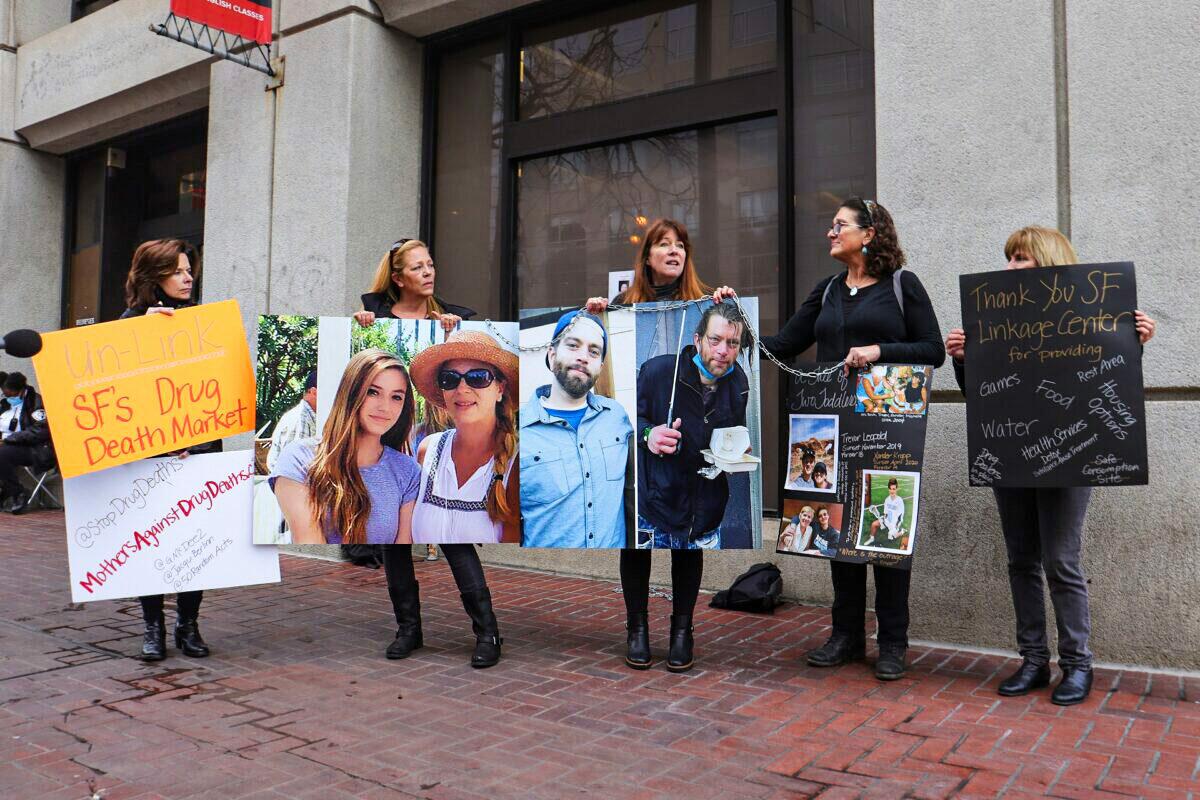
Jacqui Berlinn, co-founder of Mothers Against Drug Addiction and Deaths, whose son is addicted to fentanyl, said she opposes the creation of so-called safe injection sites.

Berlinn told the Epoch Times via text message on March 2 that the supervisors haven’t done their due diligence to research and visit safe injection sites in New York City and Vancouver to see “the negative impacts” they’ve have had on surrounding communities.

“It’s also important to talk to community members, as well as those with substance use disorders and the people who love them,” she said.

“Governor Newsom understood this when he vetoed Senate Bill 57 last year. The [San Francisco Board of Supervisors] incorrectly believes they know better even after witnessing the abject failure of the Linkage Center in [the Tenderloin district].”

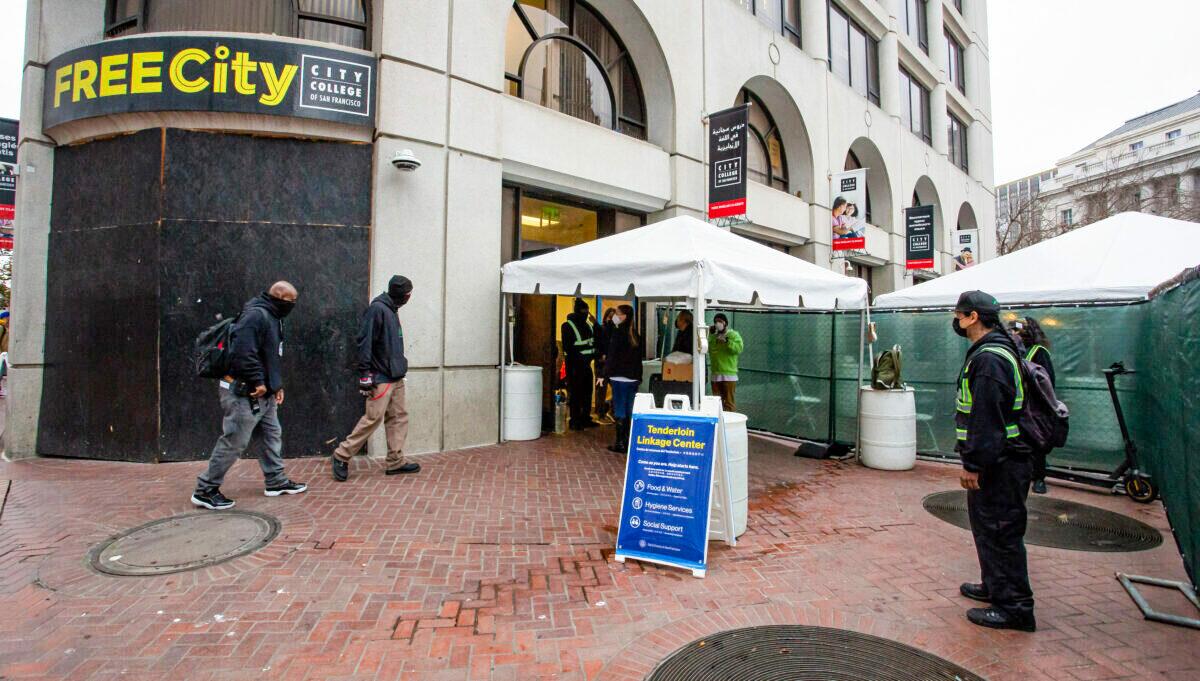
The Tenderloin Center for the homeless in San Francisco. (Courtesy of the City of San Francisco)

The Tenderloin Linkage Center, which provides services to the homeless, last year dropped the word “linkage” from its name after very few people were linked to drug recovery services and other programs connected with the site.

Wiener’s Senate Bill 57 would have permitted the creation of overdose prevention programs, including safe injection sites, where addicts could use illegal drugs at supervised facilities in Oakland and cities in Los Angeles and San Francisco counties.

“The unlimited number of safe injection sites that this bill would authorize—facilities which would authorize well into the later part of this decade—could induce a world of unintended consequences,” Newsom said in his veto message on Aug. 22.

While “it is possible that these sites would help improve the safety and health of our urban areas,” the chance they could fail and make California’s drug problem worse “is not a risk we can take,” Newsom said in his veto message in September.

Homeless people gather near drug dealers in the Tenderloin District of San Francisco, Calif., on Feb. 22, 2023. (John Fredricks/The Epoch Times)

Newsom said at the time he would be open to discussion with local officials to come back to the table with a proposal for a “truly limited pilot program” and “comprehensive plans for siting, operations, community partnerships, and fiscal sustainability that demonstrate how these programs will be run safely and effectively.”

City Takes Matter ‘Into Its Own Hands’

Wiener issued a statement on Aug. 22 saying the veto was “tragic.”

“With two successive Governors vetoing this bill, it’s crystal clear the State isn’t going to step up. San Francisco needs to take matters into its own hands & open up safe consumption sites to save lives,” Wiener wrote on Twitter.

But, Berlinn disagrees.

“The leaders of the city need to prioritize treatment and recovery before implementing sites like these that only perpetuate the open-air drug markets,” she said.

“San Francisco can’t even keep the area in front of methadone clinics clear of drug dealers and users. My own son has to walk through this toxic environment every day that he goes to the clinic for his treatment. He is actively trying to get well and free from his addiction, but the city isn’t able to keep the route to these clinics safe.”

Members of Mothers Against Drug Deaths hold a chain of posters in front of the Tenderloin Linkage Center in San Francisco on Feb. 5, 2022. (Cynthia Cai/The Epoch Times)

Recently, Berlinn helped form a new group called North America Recovers, a nonpartisan coalition of more than 20 American and Canadian community leaders, parents of the homeless, and recovering addicts seeking federal, state, and local actions that “support addiction recovery—not addiction enablement,” including untreated mental illness and homelessness.

Federal and state laws currently prohibit supervised injection sites from using government funds to operate. San Francisco’s 2020 ordinance would allow them, but only with state approval which the city has—so far—failed to achieve.

In 2021, New York established a privately funded overdose prevention site which allows addicts to bring illegal drugs such as fentanyl and heroin and use them under the supervision of trained staff. They also provide counseling.

“The opioid epidemic continues to take an immense toll on our City and claim the lives of far too many San Franciscans,” said San Francisco City Attorney David Chiu said in a statement. “To save lives, I continue to support a non-profit moving forward with New York City’s model of overdose prevention centers. Repealing this ordinance is one step towards that goal.”

Tyler Durden
Sat, 03/04/2023 – 23:30

via ZeroHedge News https://ift.tt/U0ICY8h Tyler Durden

The Global Internet Kill Switch

The Global Internet Kill Switch

The global number of internet shutdowns has been rising again for the second year in a row.

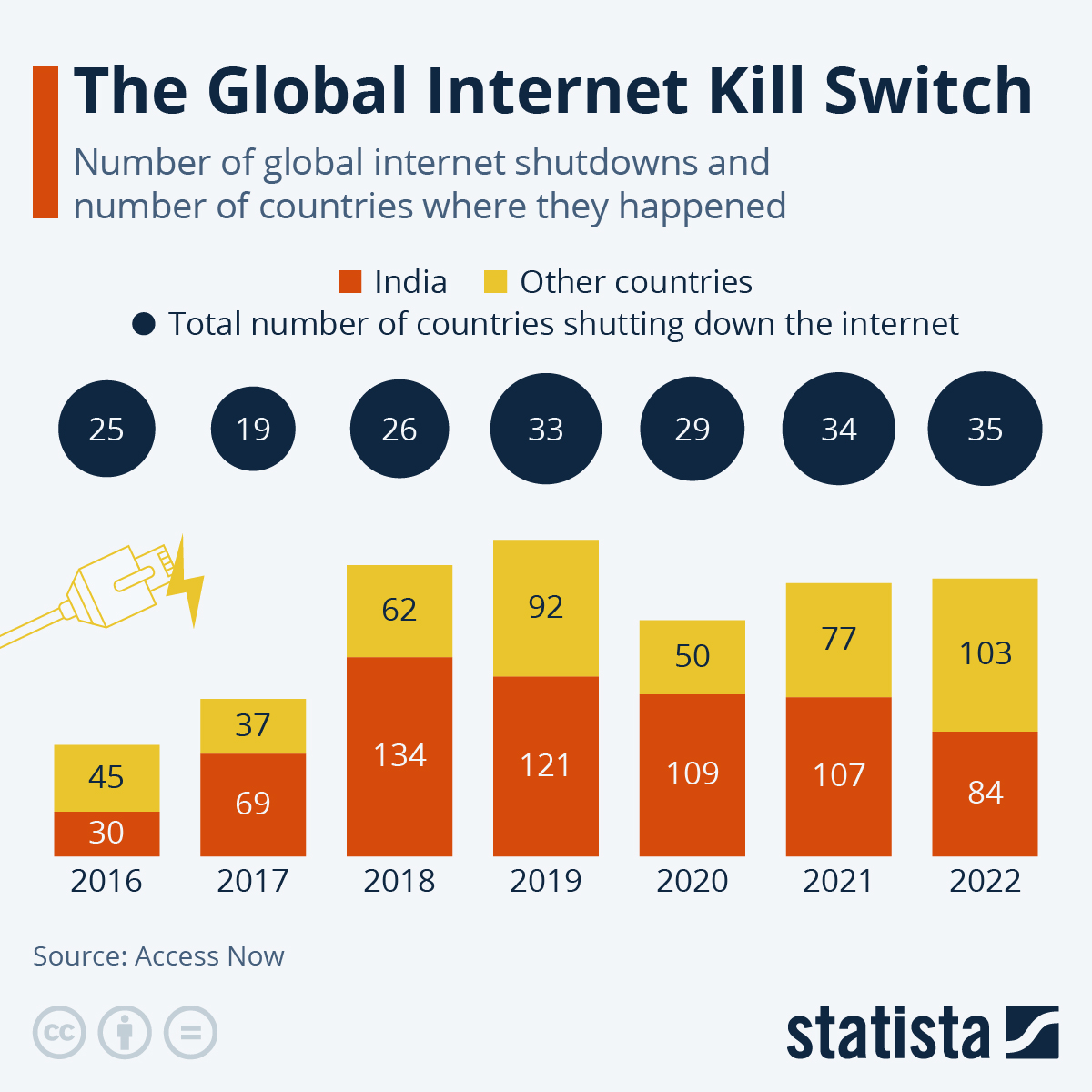
As Statista’s Katharina Buchholz reports, a newly released report by Access Now puts the number of internet shutdowns in 2022 at 187. Just under half – 84 – happened in India…

Infographic: The Global Internet Kill Switch | Statista

You will find more infographics at Statista

In the year of 2020, the number of internet shutdowns dipped.

Many government use internet shutdowns in connection with curbing protests and dissent and the pandemic likely caused fewer of these events to happen as stay-at-home orders were issued and limits on gatherings were imposed.

The highest number of internet shutdowns since reporting started in 2016 was reached in 2019 at 213. The same year also saw the highest figure of internet shutdowns in India – 121. Despite the country consistently registering the most internet shutdowns since the inception of the survey, 2022 saw India’s share in total global internet shutdowns decrease to the lowest point in years. Simultaneously, the total number of countries which employ internet shutdowns has risen, surpassing the 2019 number again as of 2021.

Shutdowns in India clustered in Kashmir in 2022, but also in Rajasthan, where they have been used during protests (and preemptively when protests were expected), but also during exams in recent months. Both regions have seen violence often tied to tension between Hindus and Muslims, in Kashmir also in connection with the Muslim-led independence movement.

Tyler Durden
Sat, 03/04/2023 – 23:00

via ZeroHedge News https://ift.tt/TUYBA8e Tyler Durden

The Attack Of The Subversive Elites

The Attack Of The Subversive Elites

Authored by Michael Rectenwald via The Mises Institute,

It is tempting, as Naomi Wolf has done recently, to ascribe the breakdown of Western civilization to the debasing of “Judeo-Christian” ethics and the reemergence of malignant supernatural forces. Witnessing the many assaults on the infrastructure and social order of the United States of late, I wouldn’t rule out metaphysical causality either. But to blame the pagan gods, or, in specifically Christian terms, to blame Satan, and not his legions, is to take comfort in an obscured perspective on the current global arrangement. To lay culpability strictly on gaseous, unknowable forces is to let the global elite off the hook.

As I write in The Great Reset and the Struggle for Liberty, the Western world is in the grips and under the control of “subversive elites.” With inordinate power and influence, these people aren’t naturally superior but have as their object the undermining of Western civilization.

They can be found in such globalist “Round Table” organizations as the Royal Institute for International Affairs (Chatham House), the Council on Foreign Relations, the Bilderberg Group, the Club of Rome, and the World Economic Forum (WEF); in their main international intergovernmental counterpart, the United Nations (UN); and in the monetary organizations that fund the globalist regime, the International Monetary Fund and the World Bank. All these organizations have had as their objective the undermining of nation states, the destruction of the free market, and the control of the world economic system by a globalist elite. These objectives are now being conducted under the rubric of “stakeholder capitalism,” with the WEF running interference for and coordinating the “public-private partnerships” that are ushering in stakeholder capitalism, supposedly to combat “climate change.”

In the economic sphere, stakeholder capitalism is a cartel scheme that benefits the compliant and destroys the noncompliant. And the economics of stakeholder capitalism spill into a governance and geopoliti­cal model: states and favored corporations in “pub­lic-private partnerships” in control of governance. The configuration yields a corporate-state hybrid largely unaccountable to the constituents of national governments. As Kurt Nimmo writes:

According to the Transnational Institute in the Netherlands, this “initiative” proposes a transition away from intergovernmental decision-making towards a system of multi-stakeholder governance. In other words, by stealth, they are marginalising a recognised model where we vote in governments who then negotiate treaties which are then ratified by our elected representatives with a model where a self-selected group of “stakeholders” make decisions on our behalf. (emphasis added)

The cozy relationship between multinational corporations and governments has even aroused the scorn of a few leftist academics. Some note that the UN-WEF partnership and the governance model of the WEF represent at least the privatization of the UN’s Agenda 2030, with the WEF bringing corporate partners, money, and supposed expertise on the Fourth Industrial Revolution (4-IR) to the table. And the WEF’s governance model extends well beyond the UN, affecting the constitution and behavior of governments worldwide. This usurpation has led political scientist Ivan Wecke to call the WEF’s governmental redesign of the world system “a corporate takeover of global governance.”

This is true, but the WEF model also represents the governmentalization of private industry. Un­der Schwab’s stakeholder capitalism and the mul­tistakeholder governance model, governance is not only increasingly privatized, but also and more im­portantly, corporations are deputized as major addi­tions to governments and intergovernmental bodies. The state is thereby extended, enhanced, and aug­mented by the addition of enormous corporate as­sets. These include funding directed at “sustainable development” to the exclusion of the noncompliant as well as the use of Big Data, artificial intelligence, and 5G to monitor and control citizens.

But first the conditions for global government must be established and these conditions include the breakdown of national sovereignty, the abrogation of natural rights, and the reduction of the standard of living of the vast majority.

“Affluence,” writes Sean Fleming for the WEF, “is the biggest threat to our world. . . . True sustainability will only be achieved through drastic lifestyle changes.”

Thus, these elites are not only subversive but also destructive. It is difficult to conclude that the many recent assaults on the infrastructure of the US are anything but part of a coordinated campaign to destroy productive capacities and terrorize the population. Consider the use of vaccine mandates to choke supply chains, the multiple train derailments and chemical bombs, the undetonated bombs on railroad tracks, the mysterious explosions at metals plants and oil facilities, the “coincidental” fires at food processing facilities and chicken egg farms, the hazardous materials explosions in public transportation facilities, the shutdown of a major baby formula production lab, etc.

Consider these in connection with the operations of cultural, social, and political demoralization—the covid lockdowns and vaccine mandates, the quasi-endorsed Black Lives Matter–Antifa riots, the election legerdemain, the January 6 show trials, the unfettered immigration, the foisting of the transgender movement and critical race theory on elementary school students, the differential treatment of crime along political lines (with the apparent rewarding of criminals carrying out subversive acts and the imprisonment of those who merely protest the regime)—and the effect is a politicized anarcho-tyranny unleashed on the populace. Do not all these phenomena have the common effect of producing social and economic insecurity and learned helplessness, while cowing any political opposition into submission?

Yet it is essentially impossible to prove that a coordinated campaign by subversive elites is afoot. As internal Twitter documents made available to the public in December reveal, one of the most powerful communications and ideological apparatuses on earth had gone to great lengths to snuff out and filter the visibility of any story that might provide a window into the coordination of the new world order.

If, however, as Pareto suggested, a governing elite is inevitable, then, as Jeff Deist has argued, we are certainly under the wrong elites. Whether a circulation of elites can be completed in time to save the world economic system from ruin and the majority from destitution and veritable slavery is a question of no little urgency.

Tyler Durden
Sat, 03/04/2023 – 22:30

via ZeroHedge News https://ift.tt/bfVkZ8v Tyler Durden

These Are The Most (And Least) Expensive Cities To Live In

These Are The Most (And Least) Expensive Cities To Live In

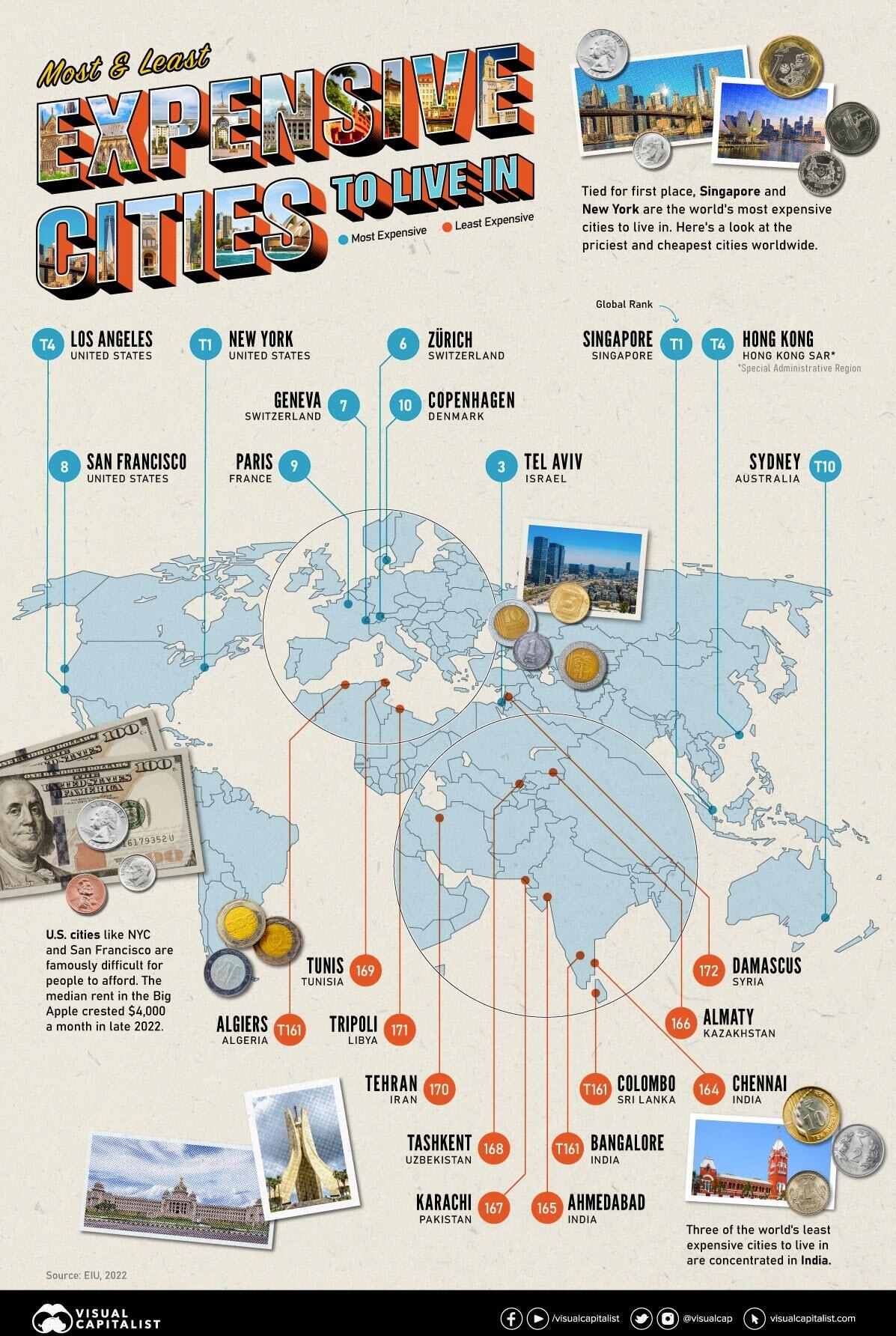
There are many benefits to living in an iconic city like New York or Singapore, but the amenities and exclusivity can come at a high cost.

As Visual Capitalist’s Avery Koop details below, cities become “expensive” due to a variety of factors such as high demand for housing, a concentration of high-paying businesses and industries, and a high standard of living. Additionally, factors such as taxes, transportation costs, and availability of goods and services can also contribute to the overall cost of living in global cities.

The infographic above uses data from EIU to rank the world most and least expensive cities to live in. To make the list, the EIU examines 400+ prices for over 200 products and services in 172 cities, surveying a variety of businesses to track price fluctuations over the last year.

Inflation + Strong Currency = Expensive Cities

If you live in a city where many residents find it challenging to put a roof over their heads, food on their plates, and make ends meet, you live in an expensive city.

But if this inflation is compounded with a strong national currency, you may live in one of the world’s most expensive cities.

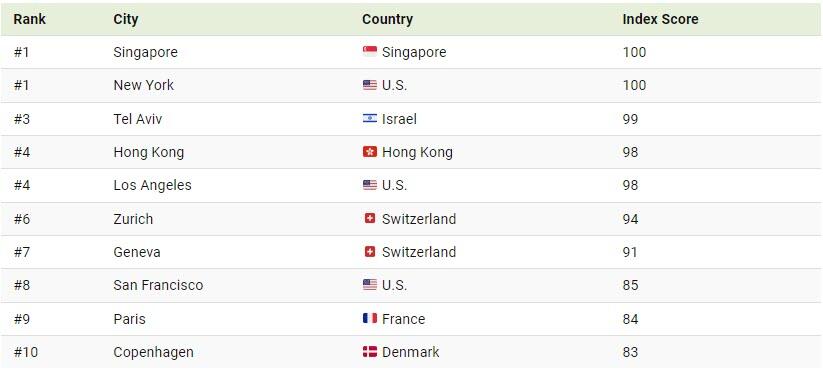
Singapore and New York City tied for the first rank amongst the world’s most expensive cities in 2022, pushing Israel’s Tel Aviv from the first place in 2021 to the third place in 2022. Both these cities had high inflation and a strong currency. Surprisingly, this is the Big Apple’s first time atop the ranking.

The city with one of the most expensive real estate markets worldwide, Hong Kong ranked fourth in this list, followed by Los Angeles, which moved up from its ninth rank in 2021.

Poor Economies = Cheaper Cities

Asia continues to dominate the list of the world’s least expensive cities, followed by parts of North Africa and the Middle East. Though affordability sounds good at face value, sitting at the bottom of the ranking isn’t necessarily a coveted position.

While the cost of living in some of the cities in these nations is low, it comes at the price of a weak currency, poor economy, and, in many cases, political and economic turmoil.

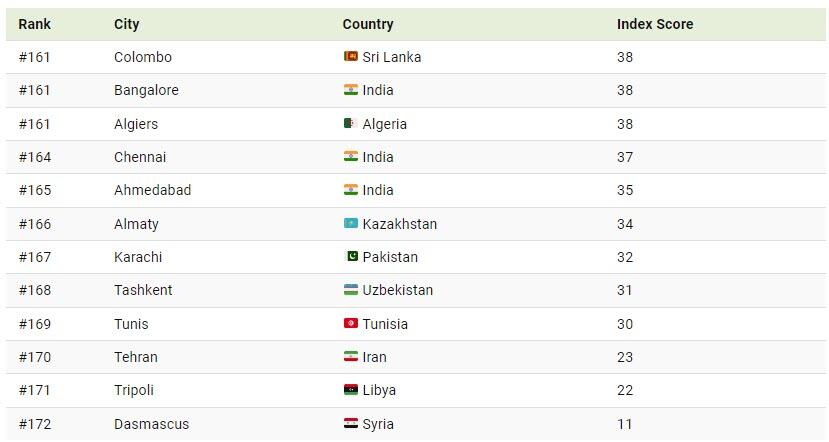
The decade-long conflict in Syria weakened the Syrian pound, led to a spiraling inflation and fuel shortages, and further collapsed its economy. It’s no surprise that its capital city of Damascus has maintained its position as the world’s cheapest city.

Tripoli and Tehran, the capitals of Libya and Iran, respectively, follow next on this list, reflecting their weakened economies.

Meanwhile, seven cities in Asia with the common denominator of high-income inequality and low wages dominate the list of the world’s cheapest cities. These include three Indian cities, Tashkent in Uzbekistan, Almaty in Kazakhstan, Pakistan’s most populous city of Karachi, and Sri Lankan capital–Colombo.

Tyler Durden
Sat, 03/04/2023 – 22:00

via ZeroHedge News https://ift.tt/aH0roqp Tyler Durden

Trump Promises “Quantum Leap” For A New America

Trump Promises “Quantum Leap” For A New America

Authored by Naveen Anthrapully via The Epoch Times,

Former President Donald Trump has revealed his dream for a new America ahead of the 2024 presidential race, promising to bring back the country’s boldness “in a very big way” and heralding a “quantum leap” in living standards.

Past generations of Americans pursued big dreams and daring projects that once seemed absolutely impossible. They pushed across an unsettled continent and built new cities in the wild frontier. They transformed American life with the interstate highway system, magnificent it was, and they launched a vast network of satellites into orbit all around the earth. But today, our country has lost its boldness. Under my leadership, we will get it back in a very big way,” Trump said in a video address released Friday.

“If you look at just three years ago, what we were doing was unthinkable. How good it was, how great it was for our country. Our objective will be a quantum leap in the American standard of living. That’s what will happen.”

Pointing out that a third of the American landmass is owned by the federal government, Trump noted that just a “very small portion of that land” amounting to “one-half of one percent” can be used to hold a contest to “charter up to 10 new cities and award them to the best proposals for development.”

“In other words, we’ll actually build new cities in our country again. These Freedom Cities will reopen the frontier, reignite American imagination, and give hundreds of thousands of young people and other people, all hard-working families, a new shot at home ownership and in fact the American dream.”

Transportation, Manufacturing

A “big opportunity” that Trump cites in the video is in the transportation sector. In the United States and China, numerous companies are “racing” to develop vertical takeoff and landing vehicles.

In the last century, it was the United States that led the automotive revolution. “I want to ensure that America, not China, leads the revolution in air mobility. These breakthroughs can transform commerce, bring a giant infusion of wealth into rural America, and connect families in our country in new ways,” Trump said.

An American company engaged in vertical takeoff vehicle development is California-based Wisk. Last January, Wisk announced that it had secured $450 million in funding from Boeing.

In August, San Jose-based Archer Aviation received a $10 million deposit from United Airlines for an order of 100 electric takeoff and landing air taxis.

Trump also proposed a “strategic national manufacturing initiative” that will turn “forgotten communities into hives of industry.” This will ensure that these communities produce goods that the United States will no longer have to import from China. The initiative is going to be “very, very successful.”

The American manufacturing sector is currently struggling through various challenges like inflation, talent scarcity, supply chain problems, and economic uncertainty.

“Manufacturers continue to grapple with talent challenges that may limit the industry’s growth momentum. Moreover, supply-chain issues, including sourcing bottlenecks, global logistics backlogs, cost pressures, and cyberattacks, will likely remain critical challenges in 2023,” Deloitte said in its 2023 manufacturing outlook report.

Lowering Costs, Other Initiatives

Trump also promised to introduce a “major initiative” to lower the cost of living, especially focusing on reducing the cost of a new car and the cost of building single-family homes.

Annual inflation has remained above 6 percent every single month since October 2021. New vehicle inflation has remained above 5 percent every month since June 2021.

The median sales price of homes in the country hit $467,000 in the fourth quarter, up 10. 4 percent from the same period a year back. The United States is estimated to be facing a shortage of 3.8 million to 5 million homes.

Trump also intends to ask Congress to support “baby bonuses” for young parents, a move he hopes will trigger a “baby boom.”

He promised to carry out a “great modernization and beautification campaign” in 50 states that will get rid of ugly buildings, refurbish public spaces and parks, ensure a pristine environment, make cities and towns more livable, and build “towering monuments to our true American heroes.”

“Very importantly, I will also make sure all of these new places are safe. We love and cherish our police. They will do the job the way they have to,” Trump said.

“It is time to start talking about greatness for our country again. I will dramatically increase living standards and build a future that brings our country together through excitement, opportunity, and success.”

Tyler Durden
Sat, 03/04/2023 – 21:30

via ZeroHedge News https://ift.tt/p9gyRQY Tyler Durden