Doctors, Scientists Call On Mississippi Officials To Take COVID Vaccines Off The Market

Doctors, Scientists Call On Mississippi Officials To Take COVID Vaccines Off The Market

Authored by Matt McGregor via The Epoch Times (emphasis ours),
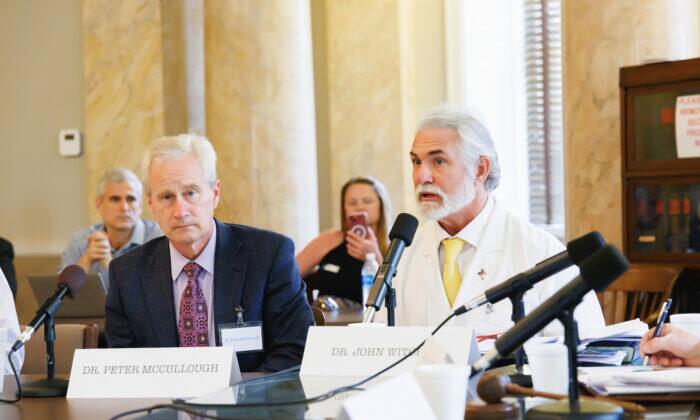
Dr. Peter McCullough (L) and Dr. John Witcher speak in the Mississippi state Capitol on COVID-19 vaccine adverse events in Jackson, Miss., on Feb. 27, 2023. (Courtesy of Charlotte Stringer Photography)

JACKSON, Miss.—The group of physicians, vaccine-injured people, and whistleblowers speaking at the Mississippi Capitol building on Monday and Tuesday weren’t asking state officials to cease all COVID-19 vaccinations and to convene a grand jury to investigate its rollout in the state.

They were demanding it.

Stop the shots” was the refrain of those who had treated COVID patients over the last three years and those injured by the vaccine.

On Monday and Tuesday, the medical freedom organization MS Against Mandates (MAM) held the Mississippi Medical Freedom Conference in Jackson, Mississippi, which included over a dozen physicians, several whistleblowers, six physician-confirmed vaccine-injured patients, and two parents whose sons died after receiving the vaccines.

Dr. John Witcher is the co-founder and former president of MAM. He stepped back from the leadership position to focus on his run for Mississippi governor in the 2023 gubernatorial election.

MAM orchestrated the event that gave a voice to many who are being silenced in media and the medical community, such as Dr. Peter McCullough, a practicing internist and cardiologist in Dallas who is also the national medical adviser for MAM.

McCullough told The Epoch Times that the purpose of the three-and-a-half-hour roundtable—chaired by Republican state Rep. Randy Boyd—was primarily to educate Mississippi officials about safety concerns regarding the vaccine.

The state must pull these products off the market,” McCullough said. “There can be no more administration of the COVID-19 vaccines in the state of Mississippi.

McCullough, author of “The Courage to Face COVID-19: Preventing Hospitalization and Death While Battling the Bio-Pharmaceutical Complex,” said the essential problem with the vaccines is the safety concern for the large number of people who have taken them without informed consent about adverse events.

“The CDC now says 92 percent of Americans have taken at least one shot and that 79 percent have taken two shots,” McCullough said. “If there are safety concerns, that’s a problem because the denominator is so big.”

Because of those large numbers, any rare side effect isn’t rare from a safety perspective and, as was heard in the testimonies, there are concerns that the state officials haven’t kept track of the full number of the injuries and has even undercounted them, McCullough said.

In Mississippi, which represents under 1 percent of the U.S. population, McCullough estimated that there are several hundred people who have been injured by the vaccines and that some have died from the vaccines.

That’s several hundred too many, and it didn’t need to happen,” McCullough said. “None of this needed to happen.

Community Standard of Care

Physicians like Witcher and others on the panel have reported that their state health officials have only recited federal talking points instead of allowing them to cultivate what McCullough called their own “community standard-of-care,” which McCullough said is intended to evolve over time.

“The community standard of care always comes from the doctors who are treating the patients,” McCullough said. “Under no circumstances does it come from federal or state agencies, pharmaceutical companies, or even from hospitals or hospital systems. It comes from the doctors in the field who are learning how to treat their patients based on the medical literature, clinical judgment, and the differences in the community.”

This is why McCullough said each state needs its own doctor-in-charge, like in Florida, where Surgeon General Joseph Ladapo has refuted federal guidelines handed down by the Centers for Disease Control and Prevention (CDC) and Dr. Anthony Fauci when he was director of the National Institute of Allergy and Infectious Diseases.

“We’re seeing how valuable it is for a state to have its own independent thinker who is not biased, influenced by the pharmaceutical industry, or influenced by any state or federal public health agency,” McCullough said.

A doctor-in-charge in Mississippi would have acted as the representative for state officials to hear the testimonies given in the state Capitol on Monday, McCullough said.

“The state of Mississippi needs an independent thinker who can attend medical panels like this, take them under consideration, and provide advising to the attorney general,” McCullough said. “In this case, it would be to get the vaccines off the market.”

If Witcher were to become governor, he said he would create a position for a state surgeon general, and McCullough said he would “entertain the appointment as a doctor and a public figure.”

Noticeably, the Capitol chamber where the roundtable convened was absent of lawmakers—aside from Boyd—which McCullough said wasn’t surprising, as he’s seen it “over and over again.”

The fear among legislators on both the state and federal levels is extraordinary,” McCullough said. “This is the biggest thing that’s happened to our country over the last three years in modern history and you’d think they’d be interested to hear from doctors who traveled from far distances and who have vast experience in this. It’s not for my benefit. It’s for their benefit, and it’s extremely disappointing that they found something else that they thought was a higher priority.”

Read more here…

Tyler Durden
Sun, 03/05/2023 – 14:30

via ZeroHedge News https://ift.tt/mOR3vTy Tyler Durden
China People’s Congress Reveals Conservative GDP Target Of Just 5% For 2023

China People’s Congress Reveals Conservative GDP Target Of Just 5% For 2023

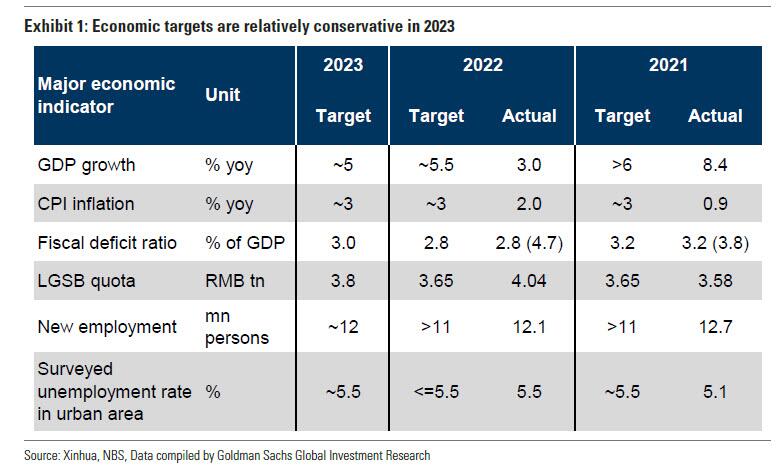
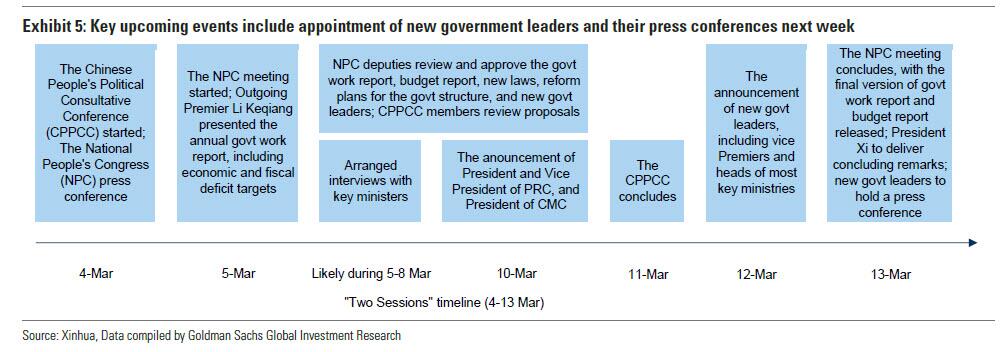
The 2023 National People’s Congress started today (March 5th; our preview is here). Outgoing Premier Li Keqiang delivered the Government Work Report (GWR) (his last), which outlined key economic targets for this year. Here are the highlights:

  • Over the last several months China had shown signs of a healthy rebound, with economists polled by Bloomberg raising their forecasts, seeing a 5.3% expansion this year, versus 4.8% in early January. Even top officials were reportedly surprised by the economy’s resilience.
  • Fiscal targets (both the 3% official on-budget deficit ratio and the RMB 3.8 trillion local government special bond issuance quota) also appeared slightly more conservative vs expectations. This set of economic targets is consistent with expectations that the broad cyclical policy stance would normalize this year from the very expansionary stance in 2022, although the pace could be gradual and likely hinges on the progress of consumption recovery.

Economic targets are more important than policy tone in today’s GWR because this year is the year for the reshuffling of government leaders. The official targets likely reflected new leaders’ expectations on the economy. The press conference to be held by new government leaders on 13 March may convey more forward-looking policy clues.

Below we drill down into the key highlights from the Two Sessions, courtesy of Goldman’s Maggie Wei and Hui Shan.

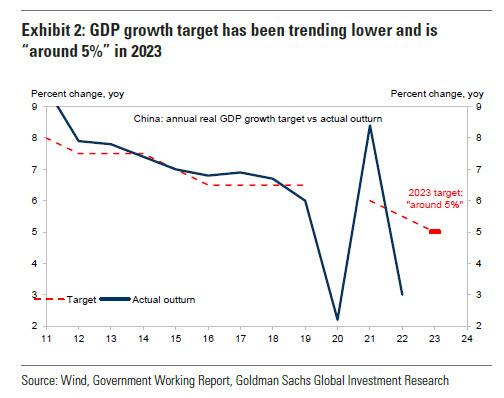
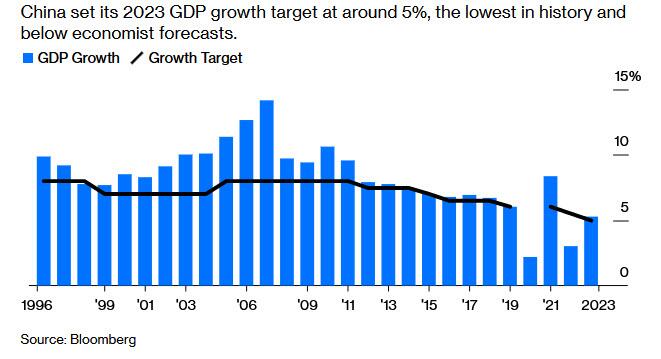
1. The GDP growth target is “around 5%” this year, lower than the “around 5.5%” target in 2022, in line with Goldman’s  expectation but slightly less ambitious than the “above 5%” or “5%-5.5%” discussed by some investors. This target implies in practice that any GDP growth rate above 4.5% is probably acceptable. Considering the low base of growth (real GDP growth only at 3% yoy in 2022), the growth target this year is not challenging. For its part, Goldman continues to expect 5.5% GDP growth in 2023 on the back of a rebound in household consumption after reopening. The fact that policymakers missed the “around 5.5%” growth target in 2022 might be one consideration behind the relatively unambitious growth target this year. Consistent with the statement following the Central Economic Work Conference, the GWR further added that policymakers aimed to achieve both quality and quantity improvement of the economy this year. The CPI inflation target (more like a ceiling in practice) is set at “around 3%” for 2023, and Goldman does not think it would be challenging as the bank expects only a moderate increase in CPI inflation this year after reopening.

2. The official on-budget fiscal deficit target in 2022 will be 3.0% of GDP, higher than 2.8% in 2022. Local government special bond full year quota is Rmb 3.8 trillion, higher than 3.65 trillion in 2022. The augmented fiscal deficit indicator is a more comprehensive gauge of the broad fiscal policy stance as policymakers have other quasi-fiscal tools to support the economy. Goldman expects the augmented fiscal deficit ratio to narrow by 1.5pp this year, from 12.4% of GDP last year, as the pressures on policymakers to achieve the growth target this year would be smaller than last year, and growth drivers are set to shift from government-led investment last year to private consumption this year.

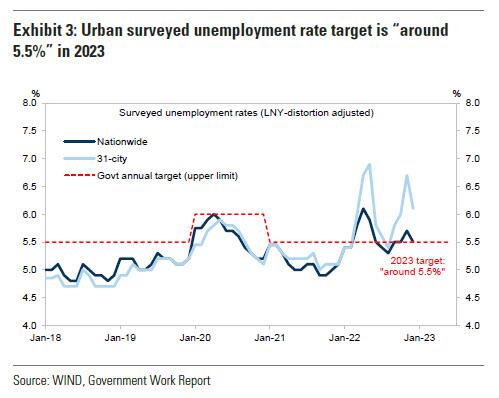
3. The government set the new urban job creation target to be “around 12 million”, and surveyed unemployment rate target to be “around 5.5%”, in comparison with “more than 11mn” new urban job creation and “below 5.5%” surveyed unemployment rate in 2022. These targets are usually not binding and have been pretty easy to achieve – in 2022, despite the 3% headline GDP growth and a very weak services sector (which tended to be more labor intensive than the industrial sector), new urban job creation was 12mn and urban survey unemployment rate was 5.5% as of 2022 year-end, largely in line with government’s targets.

4. The statement around property policy followed recent policy communications – the GWR restated policymakers would help new urban residents and younger generations with their property purchases and also focus on reining in property-related risks. However, the conservative broad policy stance “housing is for living in, not for speculation” was deleted in the “2023 policy suggestions” section of the GWR, and only mentioned as “past achievements” in the report. This might imply more property easing to come, though one should watch whether the new government leaders mention this conservative stance later on March 13th, when they hold press conferences after the conclusion of the Two Sessions.

5. The monetary policy tone in the report is the same as the Q4 2022 PBOC monetary policy report. The GWR reiterated to maintain M2/TSF growth roughly in line with nominal GDP growth and enhance monetary policy’s support to the real economy. In a recent PBOC press conference, when asked whether PBOC would cut interest rates or RRR further, PBOC governor Yi Gang commented that real interest rates were at appropriate levels while lowering RRR to provide long-term liquidity “is still an effective policy tool“, which has left the door open for further RRR cuts when needed, but implied an interest rate cut would be less likely. Goldman forecasts unchanged RRR and policy interest rates this year, given the unambitious growth target and the likelihood of strong growth rebound after reopening.

6. Energy intensity: the GWR this year does not set a specific target but stated that energy intensity should continue to decline. In a separate report by the NDRC, policymakers aimed to “reduce energy intensity by 2pp this year and in practice, try to achieve better results“. The lack of a numeric target in the GWR implies policymakers might want to avoid a situation like late 2021 when production was suspended with power shortages in light of the strict energy intensity reduction target as the economy rebounded.

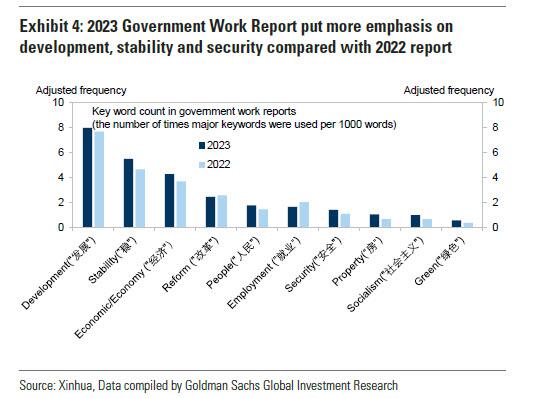
7. As this year is the year for the reshuffling of government leaders, this year’s work report focused more on reviewing past achievements (around 80% of the full length of the report), vs in previous years when the premier usually spent 40% of the full length of the report reviewing the past year but around 60% of the report on policy outlook for the new year.

Economic targets are more important than policy tone of the report as these targets were likely discussed and decided by the new party leaders after the 20th Party Congress. Upcoming key things to watch in the next few days include the fiscal budget report, discussions on the Party and government institutional reforms, and appointment of the new government leaders and new government leaders’ press conference.

Tyler Durden
Sun, 03/05/2023 – 14:00

via ZeroHedge News https://ift.tt/CK021im Tyler Durden

“HELP US!!”: Southern California Mountain Residents Go Into Survival Mode After Snowpocalypse

“HELP US!!”: Southern California Mountain Residents Go Into Survival Mode After Snowpocalypse

While Southern California’s major mountain towns have been largely plowed following last week’s powerful winter storm, residents of smaller mountain communities, particularly those living in the outskirts, have gone into survival mode.

“Help us” can be seen written in the snow near Lake Gregory in San Bernardino County, California, March 3, 2023.

“The only way I could describe this is like if we had an avalanche fall over the San Bernardino Mountains and we’re just stuck,” Lake Arrowhead resident Pablo Tello told KABC.

Roads remain impassible as people make the cold trek in search of needed supplies.

Gordon walked a mile to and from his home looking for food.

Crestline’s only grocery store, Goodwin & Sons Market, was destroyed after its roof collapsed under the weight of snow. -KABC

Local Facebook groups are full of people concerned about their neighbors and discussing the situation.

“It’s so much snow, there’s nowhere to put it,” Crestline, CA resident James Gordon told KABC. “I’ve been up on this mountain my whole life from Big Bear to here in Crestline, and this is the worst storm I’ve seen in 30 some odd years I’ve been up here.”

“We only stay stocked up for maybe three or four days, and the grocery store is just down the street, so we’re like it’s not a big deal, but then when the grocery store collapsed and all these trees are snapping and we’re in and out of power it’s real hard right now,” he added.

According to Fox11 Los Angeles, some California mountain residents could be snowed in for another week.

“We’ve said we could push it out as far as two weeks but because of the state’s efforts and the equipment that’s coming in behind us we’re hoping to drop that down to a week,” said San Bernardino County Sheriff Shannon Dicus in a press conference.

The enormity of this event is hard to comprehend,” said state Assemblyman Tom Lackey. “You know, we’re thinking, ‘We’re in Southern California,’ but yet we have had an inundation that has really, really generated a severe amount of anxiety, frustration and difficulty, especially to the victims and those who are actually trapped in their own home.”

Shelah Riggs said the street she lives on in Crestline hasn’t seen a snowplow in eight days, leaving people in about 80 homes along the roadway with nowhere to go. Typically, a plow comes every day or two when it snows, she said. -FoxLA

“We are covered with five or six feet (1.5 or 1.8 meters); nobody can get out of their driveways at all,” said Riggs in a telephone interview, adding that the county’s response has been “horrible” and that “people are really angry.”

San Bernardino is one of 13 counties for which a state of emergency was declared due to the impacts of severe weather.

In Mono City, a small community on the eastern edge of the Sierra Nevada near Yosemite National Park, some residents have been snowed in without power for a week, the Mono County Sheriff’s Office posted Friday on Facebook. In the northern part of the state, mountain communities grappling with the conditions have smaller populations and are more accustomed to significant snowfall. -FoxLA

“I’m getting more upset by the day,” said Devine Horvath of Crestline, who said it took she and her son 30 minutes to walk down the street to check on a neighbor – a trek that normally takes just minutes.

According to CA DOT official Jim Rogers, crews working 24-hour shifts have removed more than 2.6 million cubic yards of snow from state highways.

That said, officials also described a host of problems reopening smaller roads – which include buried vehicles and downed power lines. Residents have been urged to try and mark the locations of buried cars.

“We are going house to house, and we’re literally using shovels to shovel out driveways to make sure that people have access to their cars,” said county fire chief Dan Munsey. “As the roads are plowed, you still have a 10-foot (3-meter) berm of snow that you need to make it over.”

Tyler Durden
Sun, 03/05/2023 – 13:00

via ZeroHedge News https://ift.tt/POtghHY Tyler Durden

Washington Post: Yes, The Biden Loan Forgiveness May Be Unconstitutional But…

Washington Post: Yes, The Biden Loan Forgiveness May Be Unconstitutional But…

Authored by Jonathan Turley,

The Washington Post is now admitting that President Joe Biden’s college loan forgiveness plan is unconstitutional, but it insists that the “the court shouldn’t stop him.”

The reason is standing and the Post is now apparently a standing hawk forced to accept a half trillion dollar give-away to maintain a narrow view of case or controversies under Article III.

The Post previously ran opinion pieces saying that Biden clearly has this authority, but this is an opinion piece from the editors themselves on the subject.

The Post now admits with some of us that Biden “overreached” in his use of the HEROES Act to allow him to unilaterally cancel roughly 500 billion dollars in loan debts. Executive “overreach” is a common reference to exceeding the authority afforded by Article II. The Post describes the action as “bad” and without congressional approval. Of course, giving away half a trillion dollars without congressional approval was the type of unilateral action that the Framers sought to prevent in giving Congress the power of the pursue. In other words, it is not just “bad.” It is unconstitutional.

President Biden is using a law designed to help service members and their families deal with debt accrued in fighting for this country.

The terms of the Higher Education Relief Opportunities for Students (HEROES) Act of 2003 allows the secretary of education “to waive or modify … financial assistance program requirements … affected by a war, other military operation, or national emergency.” Biden had promised to wipe out tuition debt in the campaign and simply hijacked the Act for that unintended purpose. Putting that aside, the Act ties such relief to an inability to cover such costs due to the war or emergency.

The Biden plan would use the law to benefit individuals without such a showing, including many of the 40 million beneficiaries who are relatively wealthy and could pay off the loans.

Various professors including Dalié Jiménez, a law professor at the University of California, Irvine, filed an amicus brief in support of the Administration and claimed that the HEROES Act “is as clear as sunlight” in authorizing the department’s action.

The Office of Legal Counsel, considered the ultimate authority on legal interpretations in the Executive Branch, looked at this issue during the Trump administration. Its memo concluded that “the Secretary does not have statutory authority to provide blanket or mass cancellation, compromise, discharge, or forgiveness of student loan principal balances, and/or to materially modify the repayment amounts or terms thereof, whether due to the COVID-19 pandemic or for any other reason.”

The Biden Office of Legal Counsel issued a new opinion concluding the opposite, due to the ongoing pandemic — a curious argument, since the Biden administration was just in court arguing that the pandemic was effectively over, in order to allow undocumented individuals to enter the country. Citing the Centers for Disease Control and Prevention, the administration sought to stop the enforcement of Title 42, which allowed the government to turn away migrants at the border.

Now, the Post appears to reject the Biden OLC opinion and calls the policy not only unconstitutional “overreach” but “a regressive and expensive mistake.”

It insists, however, that this unconstitutional, regressive and expensive overreach should stand.

I should admit that I have been described as a “standing dove” due to my more liberal view of standing requirements under Article III. I successfully argued in favor of standing for the House of Representatives as a single house and previously argued (unsuccessfully) on behalf of individual Democratic and Republican members seeking “members standing.” I view narrow standing rules as often inimical to the protection of core structural guarantees of the Constitution.

This case is precisely why I have long favored broader standing rules. This is a clearly unconstitutional action by the President that is being defended largely on the basis of, in my view, an unnecessarily narrow view of standing imposed by the courts.

I recently spoke at the University of Maryland with George Mason law professor Ilya Somin, who argues that the claims of Missouri satisfy standing.

At issue is the right of the state to argue the interests of the the Missouri Higher Education Loan Authority (MOHELA) – that services student loans. While MOHELA is an independent agency and is not a party to the lawsuit, Somin argues that detractors confuse this case with prior cases raising individual constitutional injuries: “Unlike individual rights claims, which – on this theory – can only be asserted by people who have suffered specific rights violations, structural claims can be raised by anyone, because structural restrictions on government power provide generalized protection for all Americans.” He believes that standing can be based on existing precedent.

There is a legitimate issue over standing under current case law. It ultimately turns on one’s views on the proper scope of the standing doctrine in raising these structural constitutional concerns. However, the Post, which has previously shown a tendency toward broad interpretations of constitutional provisions, may be premature in citing standing (albeit reluctantly) as a shield for this clearly unconstitutional overreach by President Biden.

Tyler Durden
Sun, 03/05/2023 – 12:30

via ZeroHedge News https://ift.tt/7G2uaJw Tyler Durden

Viktor Orban: “In A War Taking Place In Europe The Americans Have The Final Word”

Viktor Orban: “In A War Taking Place In Europe The Americans Have The Final Word”

Hungarian Prime Minister Viktor Orbán has said in a fresh interview with Swiss weekly Weltwoche that his country’s leadership is “strong enough to keep the war away from our country” while also stressing that Washington has become prime the decision-maker over the conflict in Ukraine.

He further addressed the proxy war nature of the conflict in saying, “There are some who want to force Hungary into the war, and they are not picky about the means with which to achieve that goal.”

Getty Images

“Ukraine is our neighbor where Hungarians live as well,” he continued. “They are being conscripted and are dying by the hundreds on the front.” The Hungarian government has long protested this practice and presented its complaints to Kiev.

“Europe has retired from the debate,” Orban complained of EU countries being dragged into confrontation with Moscow by Washington. “In the decisions adopted in Brussels, I recognize American interests more frequently than European ones.”

“In a war that is taking place in Europe the Americans have the final word,” he stressed in the interview.

Most recently, Hungary has shown its unwillingness to go along with the rest of NATO by delaying a vote on ratifying Sweden and Finland’s accession bids.

According to a Thursday Associated Press report, “The delay, which pushes the vote back by two weeks to the parliamentary session beginning March 20, comes as Hungary remains the only NATO member country besides Turkey that hasn’t yet approved the two Nordic countries’ bids to join the Western military alliance.” The report indicates

Hungary’s populist prime minister, Viktor Orban, has said that he is personally in favor of the two countries joining NATO, but alleges that the governments in Stockholm and Helsinki have “spread blatant lies” about Hungary which have raised questions among lawmakers in his party on whether to approve the bids.

“It’s not right for them to ask us to take them on board while they’re spreading blatant lies about Hungary, about the rule of law in Hungary, about our democracy and about life here,” Orban complained. “(How) can anyone want to be our ally in a military system while they’re shamelessly spreading lies about Hungary? So let’s stop for a friendly word and ask them how this can be.” But even if Budapest were ready and willing to give its approval, Turkey’s ongoing resistance has been even fiercer, and thus Sweden and Finland are unlikely to enter the alliance anytime soon.

Orban also recently broke ranks with other European leaders regarding China’s 10-point peace plan for resolving the Ukraine war. He was a lone Western voice in expressing approval. “We also consider China’s peace plan important and support it,” the Hungarian leader said before parliament last Monday. He also reiterated Hungary’s position that it will not be supplying weapons to Kiev.

Tyler Durden
Sun, 03/05/2023 – 12:00

via ZeroHedge News https://ift.tt/c7Fs41d Tyler Durden

The Easy Jobs Are (Mostly) Gone

The Easy Jobs Are (Mostly) Gone

Authored by Charles Hugh Smith via OfTwoMinds blog,

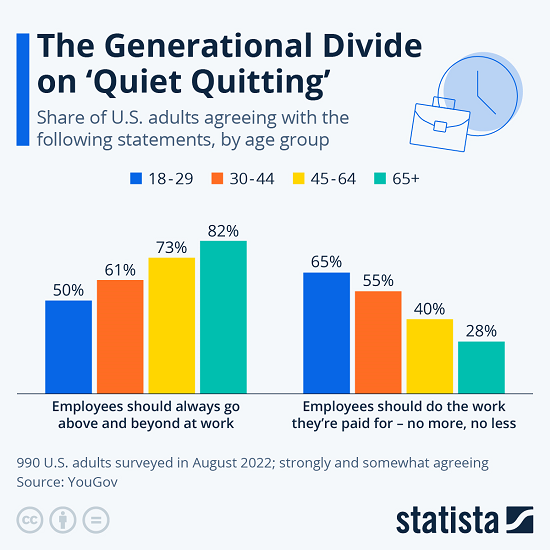
My projections are: less high-quality work gets done; less work of any quality gets done; those carrying most of the weight burn out and quit and everyone wonders why the quality of goods and services is sinking to new lows.

Since we only keep track of what we measure, whatever isn’t easily quantifiable isn’t even on the radar screen. While we measure the number and type of jobs and the percentage of the populace who are employed, etc., the less quantifiable characteristics of work and jobs are not widely recognized, discussed or understood.

One such difficult-to-quantify element is how demanding jobs are today compared to the same work a generation or two ago. Take the “burger-flipping” fast-food jobs that are so often dismissed as low-skill work. What few outside the fast-food industry seem to realize is how demanding “burger-flipping” work is now. It is a high-pressure “factory” optimized for production of fast-food meals with the minimum staff.

It is not easy work. Many people can’t keep up the pace and perform all that is demanded.

The same can be said for many other jobs that are assumed to be low-skill and therefore “easy.” In the relentless drive to reduce costs, staffing is trimmed, experienced workers let go and replaced with trainees, and more work is piled on those still on staff.

This is equally true of high-skilled jobs: staffing is reduced, open positions remain open for months or years, the work experience and knowledge of those retiring isn’t matched by the often poorly trained replacement workers.

Managers who once had an admin assistant are now their own admin. The work that was once divvied up among three jobs now falls on one worker.

The obsessive drive to increase profits by reducing labor costs has been the norm for the past 20 years. Globalization is one dynamic pushing ceaseless cost-cutting, and so is the ever-higher costs of labor overhead, with employee healthcare being the primary source of staggering increases in the cost of employees. Note the employees don’t see this cost; they see their take-home pay stagnating but not the soaring costs of healthcare insurance paid by their employer.

This raises another rarely quantified element in jobs/work: the precipitous decline of security. Employers offer laid-off employees contract positions that pay $10 more per hour but offer no healthcare, retirement, disability insurance, etc., all of which cost the employer $15/hour. The employer cuts total costs of labor and offloads all the accounting and management of healthcare, retirement funds, paying estimated taxes for income, Social Security and Medicare, etc. on the newly minted contract worker, many of whom are ill-prepared for these extra burdens of self-employment.

It’s not just that wages have stagnated and job security has dropped away; the workload has increased, often dramatically. Yes, there are still Big Tech jobs that appear to be inessential to the operation of the enterprise, but these are being slashed by the tens of thousands. But as a general rule, the workload has increased while job security and the means to get the job done have both declined precipitously.

This erosion has been so gradual that few seem aware of the dramatic changes in the nature of work/employment over the past 40 years.

Equally consequential declines have occurred in the capacity of the workforce to do difficult, demanding jobs. As the general health of the populace has declined, fewer people have the physical stamina and strength to do the physical work. (Try lifting a hotel mattress to change the sheets. Careful, your back may blow out.)

Others lack the requisite social skills (the demands for these skills have also increased) or intellectual capacity or proper training or the will to sustain demanding work.

Two generations ago, there were still undemanding jobs for people who for whatever reason are unable to do demanding work, or who choose not to. Today, most jobs are demanding.

You see the problem. A workforce with diminishing capacity / will to do demanding work and an employer class that has relentlessly increased demands on the workforce while eroding security.

Many assume whatever work people struggle to do or no longer want to do will be performed by automation/robots. Despite the advances in automation, this assumption may not play out as seamlessly as proponents believe. If jobs could have been done by robots for less money, they would already have been automated. It isn’t quite as easy as it might look from the outside.

My projections based on the above are: less high-quality work gets done; less work of any quality gets done; those carrying most of the weight burn out and quit and everyone wonders why the quality of goods and services is sinking to new lows.

New Podcast: Turmoil Ahead As We Enter The New Era Of ‘Scarcity’ (53 min)

*  *  *

My new book is now available at a 10% discount ($8.95 ebook, $18 print): Self-Reliance in the 21st Century. Read the first chapter for free (PDF)

Become a $1/month patron of my work via patreon.com.

Tyler Durden
Sun, 03/05/2023 – 11:30

via ZeroHedge News https://ift.tt/MAyO1Wh Tyler Durden

Biden’s Executive Order Nightmare: Government Will Track Every Dime You Spend

Biden’s Executive Order Nightmare: Government Will Track Every Dime You Spend

Authored by Lawrence Kadish via The Gatestone Institute,

When I was a sparring partner for professional boxers many, many years ago, I was taught to be wary of the jab. It is a tactic used to distract an opponent while setting him up for a devastating power punch that takes him down for the count.

Biden is throwing jabs.

The power punch is a little noticed Executive Order with the innocuous number 14067 and its title, “Ensuring Responsible Development of Digital Assets.”

In a 21st Century world where cryptocurrency and cybercrime are now embedded threats to our collective financial security, this Executive Order would seem to address these issues. That is the jab.

In fact, this order includes language that allows the Federal Reserve System to “explore” the possibility of introducing digital currency into the United States. This means that your cash becomes so much colored paper. That would not be the only catastrophic impact on our society and the nation’s economy. 

Under this new digital currency, any transfer of funds to family, friends, charities, or clients would be able to be tracked by the nation’s central bank that issued this virtual money. Big Brother will be in your wallet every hour or every day. 

You will not be able to buy a stick of gum without a Federal Reserve computer knowing where, when, and to whom you just put down a buck.

Like any jab, its starts with a feint.

“At this stage, the Fed is just introducing the subject into the public debate and is weighing the options,” according to Eswar Prasad, a Cornell University economics professor who was interviewed by the Associated Press in an Aug. 24 story.

Apologists for the White House insist that the Executive Order does not implement digital currency or give Washington the power to control it.

Assuming that is true, what it does accomplish is to introduce the possibility of even considering a currency move so radical, so profound, and so disruptive that it make George Orwell’s “1984” nightmare novel a day in the park?

We should be rightfully concerned about inflation, energy independence, aggressor nations armed with nuclear weapons, and woke public policies that denigrate the very foundation of this great country.

But these are jabs compared to the enormous destructive power of a digital currency “option” slipped into Executive Order 14067.

Nations have risen and fallen far from the battlefield, their destinies determined by their economic policies.

We should bring our collective outrage to confront even the idea of introducing digital currency in America’s future: if it becomes reality, we will not recognize our democracy.

Tyler Durden
Sun, 03/05/2023 – 10:30

via ZeroHedge News https://ift.tt/7PywlhL Tyler Durden

Employers Frequently Overlook Resumes Which Include “They/Them” Pronouns

Employers Frequently Overlook Resumes Which Include “They/Them” Pronouns

One of the apocryphal conspiracy theories floated in recent years is that the establishment’s – and corporate America’s – fascination with pushing an LGBTQ agenda while minimizing (and in some cases openly ridiculing) traditional family-focused Judeo-Christian values, is that this is a core spoke of the World Economic Forum’s great reset. After all, what easier way to “depopulate” the world (as World Economic Forum participant Jane Goodall famously suggested in 2020 when she said “we can solve all the world’s problems if we reduce the world population to where it was 500 years ago”, at the 27 minute mark of the linked video) than to convince hundreds of millions to pair with a member of the same sex and thus avoid having children. One certainly wouldn’t need World War 3 or even a global viral pandemic to achieve a depopulation outcome if enough people are L, G, B, T, Q, “they/them” and so on (at last check, over 7% of the US population now identifies as LGBTQ). One just has to wait a generation.

There now appears to be another potential twist to this: it appears that workers who identify as the cool du jour pronoun pair of “they/them” are being systematically ignored by potential employers, and face far fewer job offers compared to their less pronoun-sensitive peers.

According to a new report from Business.com, a business resource platform, over 80% of nonbinary people believe that identifying as nonbinary would hurt their job search. Similarly, 51% believe their gender identity has affected their workplace experience “very or somewhat negatively.” Why? Well, for those confused, a quick reminder: the Biden admin’s “non-binary” hero is – or rather was – none other than Sam Britton, who worked as a nuclear engineer, or technically “deputy assistant secretary for spent fuel and waste disposition in the Office of Nuclear Energy”, at least until it was revealed that he is a pathological liar and kleptomaniac with a penchant for stealing other people’s suitcases (and then wearing stolen female clothing). Clearly a person with zero mental issues and pristine decision-making skills. In any case, Britton lost his job recently after his crimes were exposed, prompting a cascade a question about the mental stability of the “they/them” cohort.

Which is why even though Ryan McGonagill, director of industry research at Business.com and author of the report, said that the latest statistics show just how much “inclusive” work there is to do…

“We clearly have more work to do on several fronts. Over the past 10 years, DEIB efforts have been prioritized by many companies; however, the results of this study and past research show that teams in most industries aren’t proportionately representative of the U.S. population,” McGonagill tells CNBC Make It. “And worse, many people (like the nonbinary individuals we spoke with in our research) feel like they don’t belong.”

… perhaps employers have it right?

Rhetorical questions aside, CNBC notes that Business.com also went a step further by sending two identical phantom resumes to “180 unique job postings that were explicitly open to entry-level candidates” in an effort to test “whether or not the inclusion of gender-neutral pronouns impacts how employers perceive resumes.”

“Both featured a gender-ambiguous name, ‘Taylor Williams.’ The only difference between the test and control resumes was the presence of gender pronouns on the test version,” McGonagill said in the report. “The test resume included “they/them” pronouns under the name in the header.” She/her and he/him pronouns were not tested.

The phantom resume including pronouns received 8% less interest than the one without, and fewer interview and phone screening invitations.

According to the report, over 64% of the companies that received these resumes were Equal Opportunity Employers, something that made the results even more “worrisome.”

“The law makes it clear that you cannot base any employment decision (hiring, terminating, or otherwise) based on their gender identity,” McGonagill says. “It’s incredibly disappointing and unethical that many of the hiring managers in our study would disqualify a candidate for being authentic.”

What is probably funnier, although it wasn’t analyzed, is that most of those hiring managers who overlooked the “they/them” stack also happen to be the most vocal virtue-signaling supporters of LGBTQ rights…. just not when it comes to their own company. In other words, a classic case of employment NIMBY: please hire all these wonderful folks… just don’t make me hire them.

“It’s incredibly disappointing and unethical that many of the hiring managers in our study would disqualify a candidate for being authentic” said McGonagill. Oh, if only Ryan knew just how unethical some of the most vocal virtue-signalers are, he would be in a state of permanent shock. As for being “authentic”… well, there is this thing called Darwinian selection. If enough people realize that identifying as a “they/them” is not all that cool, perhaps we will finally have some return to normalcy after progressive identify politics have pushed society to the verge of collapse. Just like what better way to solve society’s overpopulation problem than by encouraging the young and easily impressionable to join the growing LGBTQ cohort and avoid having any children. End result: widespread depopulation, just next generation not this one.

Tyler Durden
Sun, 03/05/2023 – 09:55

via ZeroHedge News https://ift.tt/XaWEbCY Tyler Durden

Growing Number Of Dems, Republicans Split Over Military Aid To Ukraine

Growing Number Of Dems, Republicans Split Over Military Aid To Ukraine

Via The Libertarian Institute,

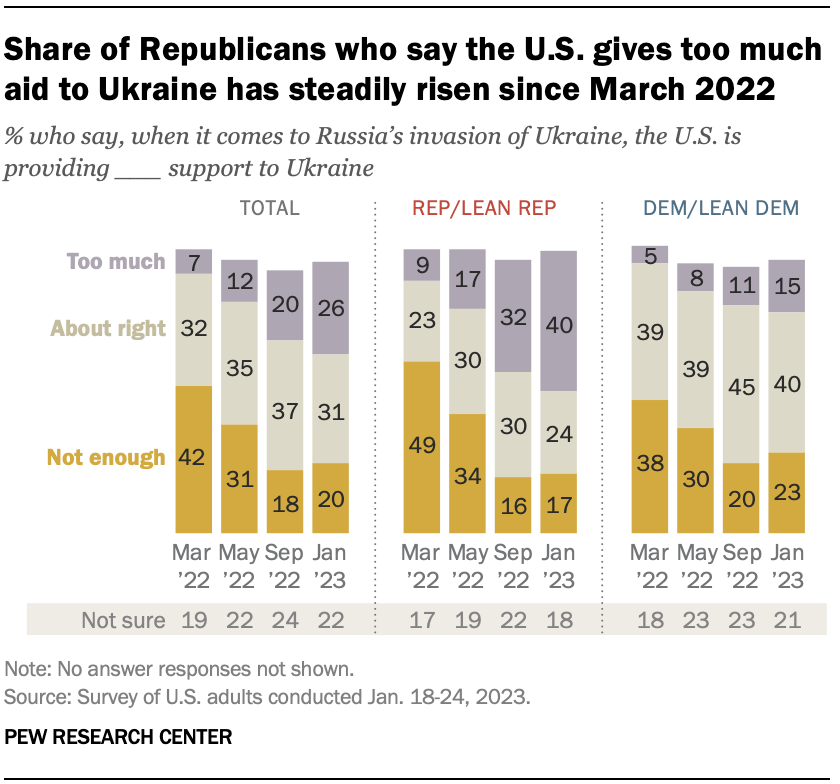
A growing number of Republican voters oppose military aid for Ukraine, while Democrats remain committed to arming Kiev, according to recent polls. Since Russia invaded Ukraine last year, Congress approved $113 billion in aid for Kiev. 

Pew Research poll conducted in January found 40% of Republicans thought the White House was sending too much military aid to Ukraine. That number is up from nine percent a year ago. Among Democrats, only 15% believe Washington is sending too many weapons. Compared to 23% of blue voters who want President Joe Biden to send more arms. 

A February poll conducted by Gallup reported a larger divide. According to the Gallop results, nearly half of Republicans believe the White House is giving Kiev too much support, while 90% of Democrats said the Biden administration was sending the right amount or not enough weapons. 

Gallup additionally reported blue voters overwhelmingly are willing to support Ukraine in a long war and are unwilling to accept an end to the conflict that sees Kiev concede territory to Moscow. A slim majority of Republicans support a protracted war. 

The Kiel Institute for the World Economy, a German think tank, recently released data showing Washington provided nearly $45 billion in military assistance to Kiev in the past year. 

Fox News survey conducted in the days before the first anniversary of the Russian invasion found 74% of Democrats approved of Biden’s Ukraine war policy. Only 24% of red voters said they approved the president’s support for Kiev

The results were reflected in an AP poll conducted in February that found 90% of blue voters had confidence in Biden’s handling of the war in Ukraine. Over three-quarters of Republicans said they had “almost no confidence” in the White House’s support for Kiev

While the polling suggests Democratic voters are deeply supportive of the American proxy war in Ukraine, a Democratic member of Congress told the New York Times that the president “may not fully grasp” how many Americans want to give aid to Ukraine.

“While [Americans] support Ukraine in principle, the way the aid has been doled out through a steady drumbeat of announcements of another $500 million or $1 billion every week or two exacerbates the sense that endless funds are heading out of the country,” the outlet reported an unnamed House Democrat said. 

In recent weeks, members of the Biden administration have communicated to Ukrainian President Volodymyr Zelensky that support for another massive aid package may be lacking. Mark Cancian, senior adviser for the Center for Strategic and International Studies, a hawking Washington-based think-tank, told Newsweek Ukraine should launch an offensive to rally support. 

Russian forces have slowly captured Ukrainian territory in recent months. Washington has warned Zelensky that he was expending too many resources fighting for the eastern city of Bakhmut. After suffering massive losses, Zelensky is now considering withdrawing its forces from the city. 

Berlin estimated that a “three-digit number” of Ukrainian soldiers were dying, fighting for the city daily. Last week, a retired  American Marine fighting in Bakhmut told ABC that the battle had turned into a “meat grinder,” and soldiers lived for an average of only four hours.

Tyler Durden
Sun, 03/05/2023 – 09:20

via ZeroHedge News https://ift.tt/0MpLygv Tyler Durden

Global Food Prices Slide For Eleventh Month And Could Soon Show Up In Supermarket Savings

Global Food Prices Slide For Eleventh Month And Could Soon Show Up In Supermarket Savings

Inflation re-accelerated in the US and Europe last month, highlighting sticky price pressures that keep central banks ultra-hawkish and committed to increasing the terminal rate. Interest rate markets are still repricing the ‘about face’ in the disinflation narrative, which has caused cross-asset turmoil. Despite the lingering inflation storm, there is good news: global food prices in February declined for the eleventh consecutive month. 

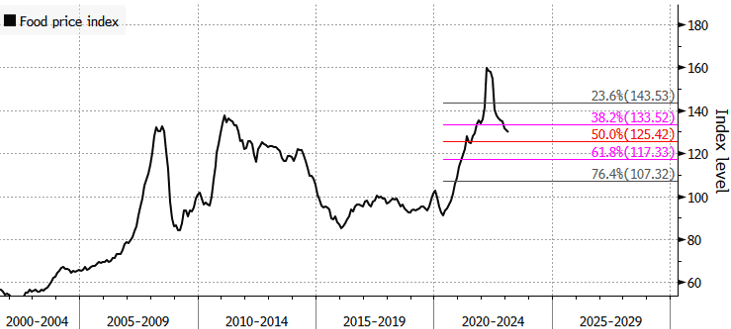
The United Nations’ Food and Agriculture Organization’s Food Price Index fell .6% last month to 129.8. Last month’s decline was driven by the price of slumping cooking oils and dairy products, while grain and meat prices were flat, and sugar prices climbed. 

According to the data, the food supply crisis triggered by the Covid pandemic and the conflict in Ukraine is showing signs of improvement. The FAO’s index reached an all-time high following the Russian invasion of Ukraine, but prices have since dropped by 18% from their peak. Nevertheless, prices are still 42% higher than their levels during the onset of the Covid outbreak.

Although global food prices peaked one year ago, consumers have complained supermarket prices are still high. This is because it takes time to filter through, while supermarkets deal with elevated transportation, energy, and labor costs. 

However, there is more promising news. The largest US meat company, Tyson Foods, missed Wall Street estimates for quarterly profit last month for operating margins this year in the face of falling – yes, falling – beef prices, easing demand for pork, and an ongoing crash in chicken prices as a result of overproduction.

Fast food restaurant chain Wendy’s Co. reported commodity inflation in the mid-single digits this year and beef prices to be deflationary in its current fiscal year. And Kraft Heinz Co. said there would be no more price hikes in North America, Europe, Latin America, and Asia. 

Unless there is another global supply chain disruption or worsening of the war in Ukraine, food prices might not have just peaked, but declines could soon show up in supermarkets. 

Tyler Durden
Sun, 03/05/2023 – 08:45

via ZeroHedge News https://ift.tt/ZawxeJC Tyler Durden