Republican politicians love to talk a good fiscal conservatism game, but they’ve been quick to throw out their penny-pinching playbooks when pro sports team owners come calling.
In states like Indiana, Kansas, and Ohio, elected officials are offering increasingly massive public subsidies for new stadium projects, using a variety of convoluted mechanisms to hide the ultimate cost to taxpayers and communities.
We can start with the story of the Chicago Bears’ replacement stadium in either Illinois or Indiana. The drama here features the deeply unusual casting of Illinois Democratic Gov. J.B. Pritzker as the nominal voice of fiscal sanity and taxpayer protection.
“I’m very interested to see how the people of Indiana and the voters of Indiana feel about the massive increases in taxes that are being proposed, about paying for a stadium in Indiana for the Chicago Bears,” he told reporters after the Indiana House of Representatives voted 95–4 in February to provide up to $1 billion in subsidies for a Bears stadium through a new public funding mechanism. (Pritzker, however, has offered undefined amounts of state funding for “infrastructure” around a new Bears stadium in Chicago or suburban Arlington Heights, and Democratic leaders in the Illinois Legislature are trying to find ways to give the team a break on local property taxes.)
Indiana’s plan includes a variety of new and redirected taxes to amass that billion dollars, including a new 1 percent food and beverage tax in Lake and Porter counties. This could be an annual $18 million tax hike, according to the state Legislative Services Agency. Making every meal across 917 square miles of northwest Indiana cost 1 percent more so that an NFL team can have a new stadium isn’t the kind of Hoosier fiscal conservatism associated with proudly tight-fisted former governors like Mitch Daniels and Mike Pence.
The Indiana plan also doubles Lake County’s hotel tax rate from 5 percent to 10 percent and assesses a 12 percent tax on any tickets—excluding season tickets—sold for events at the stadium. On top of that, it creates two new governmental authorities with the power to capture state sales and use taxes, income taxes, and property taxes in a stadium district within the city of Hammond, Indiana, on the Chicago border.
In Kansas, a similar drama is playing out with the Kansas City Chiefs’ new stadium project. Unlike Pritzker, Democratic Gov. Laura Kelly has teamed up with the Republican-dominated Kansas Legislature on a bipartisan spending binge that will throw $1.8 billion at the Kansas City Chiefs to load up their U-Hauls and drive 20 miles west over the Missouri-Kansas state line to a new stadium near Kansas Speedway in Wyandotte County.
Kelly and her allies in the Legislature tried to claim they were being fiscally responsible while committing Kansas’ taxpayers to funding 60 percent of a $3 billion stadium and practice facility/team headquarters project, saying there would be “no new state taxes and no impact on the state budget.”
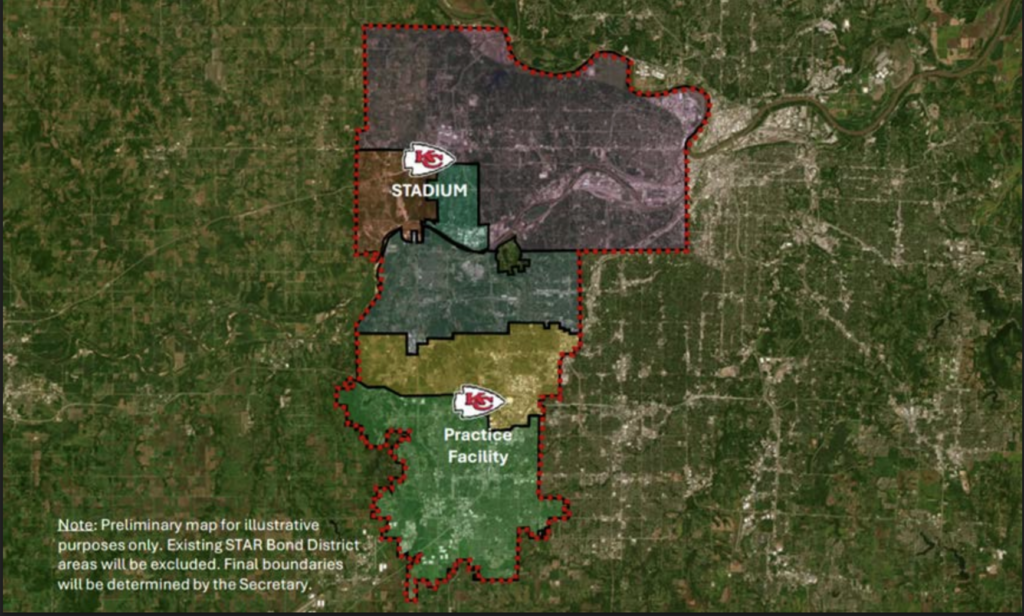
The issue, however, is what happens to existing taxes, and what impact that will have on future state and municipal budgets. The state will be issuing bonds to fund the stadium project, then diverting most future sales tax revenue growth in “neighboring communities”—a disingenuous way to describe a bond district covering as much as 290 square miles of eastern Kansas—toward repaying that debt.
This means, for example, that if business picks up over the next few decades at the Tractor Supply Company store in the South Olathe Business Park, 25 miles away by car (or tractor) from the proposed stadium site, the resulting increase in sales tax revenues will be considered to be “generated by this project” and subject to capture by the stadium bond district.
In fact, large portions of the proposed Sales Tax and Revenue (STAR) Bond District are closer to the Chiefs’ current stadium in Missouri than they are to the new Kansas stadium site. But under the logic of Kansas politicians, those communities will somehow economically benefit from being further away from an NFL stadium than they are today.
The municipal governments were pressured to get involved, and in Olathe, the city agreed to divert 1.5 percent of its municipal sales tax and 78 percent of its hotel tax revenues to the project. Wyandotte County (which includes Kansas City, Kansas) is committing most of its hotel sales tax revenues, all county sales tax revenues not already earmarked for other purposes and 61 percent of its municipal sales tax revenues inside the stadium district. The county estimates this could total $450 million in lost tax revenues over the 30-year life of the bond.
The “no new taxes” claim also glosses over the way the plan diverts revenues that currently pay for other government operations. In addition to sales tax capture in the bond district, the state is also devoting existing lottery and sports betting tax collections, along with potentially other revenue streams, to fund the project.
While Indiana’s and Kansas’ stadium subsidy plans are terrible and convoluted, the most egregious proposal is Ohio’s plan to simply take private citizens’ money and give it to sports team owners: no taxes, no fees, just a simple governmental seizure of private property. Because they can.
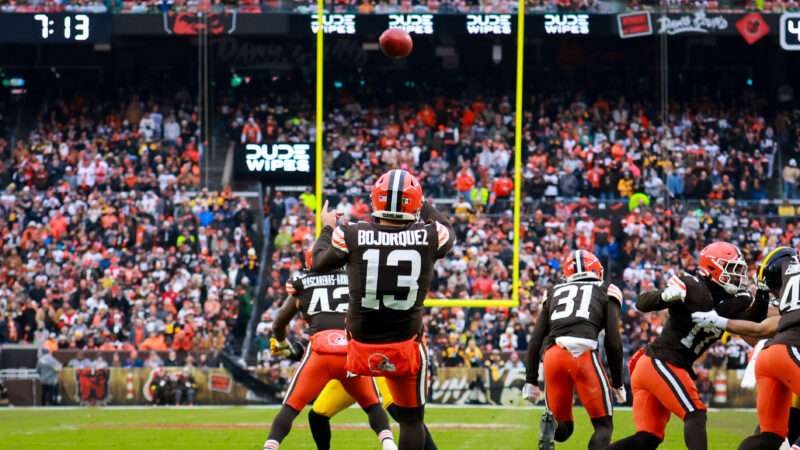
Driven by the Cleveland Browns’ desire to build a new stadium in the Cleveland suburb of Brook Park, the state’s leaders looked around for a funding source for the proposed $600 million subsidy and settled on the state’s unclaimed funds accounts, which hold an estimated $4.8 billion of private citizens’ dormant bank accounts, uncashed checks, stocks and bonds, utility deposits, unclaimed wages, and other assets.
Notably, this is money that does not belong to the state of Ohio. It belongs to someone else, even if the rightful owner doesn’t know it exists. But that didn’t matter to the state legislature, which last June set a 10-year deadline on Ohioans’ ability to claim those funds.
Ohio’s elected officials decided that this pot of free money was the perfect source of funding for a new “Ohio Cultural and Sports Facility Performance Grant Fund,” which would have the power to pay for as much as 25 percent of the cost of new stadiums.
This isn’t the first time that Ohio has come up with a strange financing mechanism for corporate welfare programs. The state uniquely funds its JobsOhio economic development agency with the profits of the state’s liquor distribution monopoly, which the agency’s website disingenuously describes as “an independent private source.”
Former Ohio Attorney General Marc Dann and former state Rep. Jeffrey Crossman filed suits in both federal and state courts on behalf of two plaintiffs who have assets in the state’s Unclaimed Funds Trust Fund. They were successful in getting a temporary restraining order and follow-up preliminary injunction halting the state’s plans, after a magistrate judge in Franklin County ruled that the plaintiffs were likely to prevail on their claims under the Ohio Constitution’s Takings and Due Process Clauses. Magistrate Judge Jennifer D. Hunt rejected the state’s claim that it could sidestep the Ohio constitution’s Takings Clause by legislatively declaring the funds to be “abandoned,” or that taking private property to subsidize a stadium district was in a “public purpose.”
Hunt was correct that Ohio’s stadium subsidy plans were not in the public interest, as the real-world economic evidence is clear that pro sports stadiums are not fiscally responsible government investments.
To be fair to Ohio Republican Gov. Mike DeWine and his colleagues in Indiana and Kansas, they are far from alone in throwing out fiscal conservatism in favor of corporate welfare for sports team owners. In recent years, governors and other elected officials in supposedly “red” states like Florida, Georgia, Oklahoma, Tennessee, Texas, and even penny-pinching Utah have cut massive stadium deals as part of the current generational wave of stadium projects spreading out across the country.
Not to be outdone, Democratic governors who talk a good game about corporate power and standing up for the little guy have been perfectly happy to fund billionaires’ stadiums in states like Maryland, Nevada, New York, North Carolina, Oregon, and Wisconsin, as well as in Washington, D.C.
There are, of course, at least a few elected officials who aren’t on board with the stadium subsidy game. On April 15, Hillsborough County, Florida, commissioner Joshua Wostal posted a message on social media regarding efforts by the Tampa Bay Rays to get public financing for a new stadium. “At this point I have to rescind all of the positive things I’ve said about the new Rays ownership,” Wostal wrote. “They have outright lied not only to my face but also the public at multiple meetings. This is them now asking literally for your property taxes.”
“May God have mercy on the soul of anyone that supports this.”
The post Republicans Fumble Away Fiscal Conservatism in Stadium Subsidy Projects appeared first on Reason.com.
from Latest – Reason.com https://ift.tt/Xh8T3Mk
via IFTTT