
Victory for Property Rights in Highly Technical Supreme Court Decision


Wil Wilkins 2
Wil Wilkins, one of the plaintiffs in Wilkins v. United States (courtesy of Pacific Legal Foundation).


Today, the Supreme Court issued its opinion in Wilkins v. United States, a highly technical procedural case that may turn out to be a significant victory for property owners, particularly those in Western states where the federal government owns large amounts of land. The ruling is a 6-3 decision featuring an unusual coalition of justices in the majority: the three liberals joined conservatives Neil Gorsuch, Amy Coney Barrett, and Brett Kavanaugh. Clarence Thomas wrote a dissent joined by Chief Justice John Roberts and Samuel Alito.

The plaintiffs, Wil Wilkins and Jane Stanton, own homes near the Bitterroot National Forest in Montana. The National Park Service owns a longstanding easement over the land which allows it to grant access to private parties engaged in logging on the National Forest. In 2006, the Forest Service put up a sign stating that the road through the plaintiffs’ land is open to general “public access.” This greatly increased traffic through the area, and disturbed Wilkins and Stanton. They filed an action against the federal government under the Quiet Title Act, which authorizes landowners to make claims protecting their property rights against federal intrusion. But the government claims they failed to do so within the 12 year statute of limitations under the Act.

The lower court ruling concluded that the time limit is an absolute “jurisdictional” rule, and therefore isn’t subject to constraints or limitations. Today, the Supreme Court reversed that ruling, and instead concluded that the time-bar is a just a “ a nonjurisdictional claims-processing rule,” which the plaintiffs might be able to get around (possibly on the ground that the government failed to properly raise the issue) or prove they didn’t really violate.

Here’s a key excerpt from Justice Sonia Sotomayor’s majority opinion:

“For purposes of efficiency and fairness, our legal system is replete with rules” like forfeiture, which require parties to raise arguments themselves and to do so at certain times…. Jurisdictional bars, however, “may be raised at any time” and courts have a duty to consider them sua sponte.When such eleventh-hour jurisdictional objections prevail post-trial or on appeal, “many months of work on the part of the attorneys and the court may be wasted…”  Similarly, doctrines like waiver and estoppel ensure efficiency and fairness by precluding parties from raising arguments they had previously disavowed.

Because these doctrines do not apply to jurisdictional objections, parties can disclaim such an objection, only to resurrect it when things go poorly for them on the merits.
Given this risk of disruption and waste that accompanies the jurisdictional label, courts will not lightly apply it to procedures Congress enacted to keep things running
smoothly and efficiently…..

Under this clear statement rule, the analysis of §2409a(g) is straightforward.“[I]n applying th[e] clear statement rule, we have made plain that most time bars are nonjurisdictional….”  Nothing about §2409a(g)’s text or context gives reason to depart from this beaten path. Section 2409a(g) states that an action “shall be barred unless it is commenced within twelve years of the date upon which it accrued.” This “text speaks only to a claim’s timeliness,” and its “mundane statute-of-limitations language say[s] only what every time bar, by definition, must: that after a certain time a claim is barred…” Further, “[t]his Court has often explained that Congress’s separation of a
filing deadline from a jurisdictional grant indicates that the time bar is not jurisdictional.”

In his dissent, Justice Thomas applies a presumption directly opposite to the one the majority relies on. Because federal sovereign immunity is at stake, he argues there should be a presumption in favor interpreting the time-bar as jurisdictional, because otherwise federal sovereign immunity would be waived:

The doctrine of sovereign immunity bars suits against the United States. But, in the Quiet Title Act of 1972, Congress waived this immunity and consented to suits against the United States in order to determine the status of disputed property. 28 U. S. C. §2409a. Congress conditioned this consent on, among other things, a 12-year statute of limitations: “Any civil action under this section, except for an action brought by a State, shall be barred unless it is commenced within twelve years of the date upon which it accrued.” §2409a(g). This Court has long construed such conditions on waivers of sovereign immunity as jurisdictional. And, it has acknowledged the jurisdictional nature of the Quiet Title Act’s statute of limitations in several precedents. In holding that §2409a(g) is not jurisdictional, the majority commits two critical errors. First, it applies the same interpretive approach to a condition on a waiver of sovereign immunity that it would apply to any run-of-the-mill procedural rule. Second, by reading the Court’s prior Quiet Title Act precedents in this way, the Court disregards their express recognition of the jurisdictional character of the Act’s time bar.

Both majority and dissent makes some good points. Because of the technical nature of many of them, this is one of those situations where you have to read the opinions in full to really understand the issues.

Ultimately, where you come down on this may depend in large part on how much priority should be assigned to preserving sovereign immunity versus protecting property owners’ rights. I am highly skeptical that sovereign immunity is a legitimate constitutional principle at all. By contrast, I think it is extremely important for courts to enforce constitutional property rights on par with other constitutional rights.

If the federal government illegally appropriates private property, it perpetrates an uncompensated taking in in violation of the Fifth Amendment (which requires “just compensation” for government seizure of private property rights). The Quiet Title Act is a tool for preventing such violations of constitutional rights. If we are going to have judicially created presumptions respecting its application, courts should pick ones that make it easier to vindicate constitutional rights over ones that provide extra protection for the dubious principle of sovereign immunity. But I can certainly understand why those who assign greater value to sovereign immunity or lesser value to property rights might reach a different conclusion.

Despite its hypertechnical nature, Wilkins may turn out be an important precedent. In Montana and other western states, the federal government owns many millions of acres of land that abut or cut through private property. Various federal agencies often do things that impinge on landowners’ rights or authorize various private parties to do so. The Quiet Title Act is an important tool for combating such intrusions on private land, one that may be of use to large numbers of people. And there may be a wide range of cases where there are statute of limitations issues that come up in these situations (e.g.—when land changes hands, or when it is unclear exactly when the intrusion started).

The unusual alignment of justices in this case is worth noting. The three liberal justices are not generally known for their solicitude for property rights. Yet they voted for the property owner in this case, with Justice Sotomayor writing the majority opinion. Justice Thomas, author of the dissenting opinion, is sometimes considered the most property-protective justice. Alito and Roberts (who joined the dissent) also have generally pro-property rights records.

It’s hard to say for sure. But I suspect that attitudes towards sovereign immunity may have trumped attitudes towards property rights for many of the justices here. While the liberal justices may not be big champions of property rights, they are also generally more skeptical of sovereign immunity than conservatives. By contrast, Justice Thomas is a particularly forceful advocate of broad sovereign immunity. The three conservative justices in the majority may be a bit less committed to immunity than he is.

Obviously this is just conjecture. There may be other explanations for the breakdown of votes here.

The Supreme Court’s decision is not the end of this litigation. The case has been remanded to the lower courts, which will now have to reconsider the statute of limitations issue, and (if the plaintiffs win on that) determine who should prevail on the merits.

NOTE: The plaintiffs in this case were represented by the Pacific Legal Foundation, which is also my wife’s employer, though she herself did not work on Wilkins. PLF has more material about the case here.


The post Victory for Property Rights in Highly Technical Supreme Court Decision appeared first on Reason.com.

from Latest https://ift.tt/81ZpkOt
via IFTTT

No Pseudonymity for Plaintiff in Lawsuit That Would Further Publicize His Criminal History

From Doe v. HireRight LLC, decided yesterday by Judge Stephen McNamee (D. Ariz.):

Four years ago, Plaintiff was charged with two felonies. As part of a plea agreement, he pled guilty to both charges in exchange for one of the charges being downgraded to a misdemeanor. Thus, he was convicted of one felony and one misdemeanor.

In January 2023, Plaintiff applied for a position at CloudKitchens. During the interview process, Plaintiff disclosed that he had been convicted of a felony but was told that this would not prohibits his hiring. Toward the end of the application process, CloudKitchens hired Defendant HireRight to perform an employment-purposed consumer report on Plaintiff, which included a criminal background check. This report ultimately stated, inaccurately, that Plaintiff had been convicted of two felonies—not the single felony that Plaintiff had previously reported to CloudKitchens. As a result of this report, CloudKitchens rescinded its job offer….

Doe sued under the Fair Credit Reporting Act, but the court refused to allow him to proceed pseudonymously:

Federal Rule of Civil Procedure 10 requires that “the title of the complaint must name all the parties.” This rule reflects the “paramount importance of open courts” such that the “default presumption is that plaintiffs will use their true names.”

Nonetheless, the Ninth Circuit allows parties to proceed pseudonymously when special circumstances justify secrecy…. Plaintiff acknowledges that his is not a situation that the Ninth Circuit has determined necessitates anonymity. Instead, Plaintiff argues that because he “worked incredibly hard to get back on track and contribute positively to society” after his convictions, he should not be forced to publicly identify himself as a felon. Plaintiff characterizes the potential harms of having to litigate under his own name as ridicule and deprivation of employment. Specifically, Plaintiff fears the “stigma of a felony conviction.”

The Court recognizes that this lawsuit might bring attention to Plaintiff’s convictions, which could in turn make finding employment more difficult. Under Ninth Circuit precedent, however, this is not the type of harm that requires anonymity. Unlike most of the cases granting anonymity, Plaintiff does not face retaliation as a direct result of this lawsuit. See U.S. v. Doe, (9th Cir.) (prisoner plaintiff faced retaliation in the form of serious bodily harm by fellow inmates for his cooperation with the government); Doe v. Ayers (9th Cir.) (finding that petitioner’s “exceptional case met the high bar for proceeding under a pseudonym” where there was “credible evidence that he would likely be subjected to more violence if his name was revealed ….”)

Any harms that Plaintiff might face stem from his prior convictions, which are—as Plaintiff acknowledges—already publicly available information. Indeed, this lawsuit is evidence that Plaintiff is already susceptible to these harms regardless of this lawsuit. Further, these harms are distinguishable from the kinds of harms for which courts typically provide anonymity—such as serious physical harm, imprisonment, or deportation.

Although courts have allowed parties to proceed pseudonymously to avoid embarrassment, these cases tend to involve allegations of sexual abuse against minors, rape victims, and other particularly vulnerable parties. E.g., Doe v. Krogh (D. Ariz. 2021). Although Plaintiff might be embarrassed by his criminal convictions, these convictions are already public and do not rise to the same level of seriousness as do details of sexual abuse. As such, Plaintiff’s embarrassment alone cannot tip the scales in favor of anonymity. Moreover, since the Plaintiff seeks to correct the record regarding his conviction status, there is a potential salient benefit to the Plaintiff in avoiding anonymity.

Courts grant anonymity in “unusual,” “extraordinary,” or “special” cases. This case is none of those things. Plaintiff’s alleged harms are far from unusual—countless Americans face difficulty finding employment as a result of their criminal record….

The post No Pseudonymity for Plaintiff in Lawsuit That Would Further Publicize His Criminal History appeared first on Reason.com.

from Latest https://ift.tt/cYAdrK5
via IFTTT
AHM v. FDA: A Contrary View and a Rejoinder

On March 15, a federal district court in Texas heard arguments in Alliance for Hippocratic Medicine v. Food & Drug Administration, in which AHM is seeking to force the FDA to revoke its approval of mifepristone, a widely use abortion medication. While most commentary on the case has focused on the substance of the suit, the administrative law questions are more likely to control the outcome.

As I noted in this post on the case, there are substantial obstacles to a court properly reaching the merits of the case, including Article III standing and the statute of limitations for suits of this kind. Drawing on an analysis by Adam Unikowsky, I explained why these issues should spell the end of the case. AHM’s case relies upon a very aggressive theory of standing and stretching the reopening doctrine to overcome the statute of limitations.

Erin Hawley of the Alliance Defense Fund is one of the attorneys representing AHM in the case. Below the fold I reproduce her response to my post, which largely focuses on the question of standing, and my reply.

Here is Hawley’s response:

Without addressing the merits of the FDA’s approval of mifepristone in 2000—under regulations requiring the FDA to find that pregnancy is a “serious or life-threatening illness”—or its deregulation of mifepristone to allow mail-in abortions in violation of the FDCA and other federal laws, Professor Adler suggested in these pages that the serious legal issues involved in Alliance for Hippocratic Medicine v. FDA should never see the light of day because the plaintiff doctors filed suit too late and because they failed to identify any particular patient who will come to them for medical help after suffering adverse consequences from a chemical abortion.

Neither procedural hurdle poses a bar here.

First, as to standing. Commentators claim that Plaintiffs’ allegations are too “speculative” under the Supreme Court’s decision in Clapper v. Amnesty International USA, 568 U.S. 398 (2013). The FDA similarly relies on Clapper, asserting that Plaintiffs seeking prospective relief must demonstrate “certainly impending” harm. Other commentators focus on Clapper, too, criticizing Plaintiff doctors for failing to allege “specific facts demonstrating that any particular patient will come to them.” But as that post acknowledges, “these facts are impossible for the doctors to provide.”

Were FDA and commentators correct about Clapper, standing to address future injuries would almost never exist. But they are wrong. At the outset, the “certainly impending” standard from Clapper does not stand alone; that case noted that the Supreme Court has also “found standing based on a ‘substantial risk’ that the harm will occur.” Clapper, 568 U.S. at 414 n.5. And Justice Thomas recently explained that the Article III injury inquiry encompasses both: “An allegation of future injury may suffice if the threatened injury is ‘certainly impending,’ or there is a ‘substantial risk’ that the harm will occur.” Susan B. Anthony List v. Driehaus, 573 U.S. 149, 158 (2014) (citing Clapper, 133 S.Ct. at 1147, 1150, n. 5) (emphasis added). In fact, cases proceeding Clapper equated “certainly impending” with the imminence requirement, rather than viewing the former as heightening the Article III inquiry. DaimlerChrysler Corp. v. Cuno, 547 U.S. 332, 345 (2006) (“[W]e have no assurance that the asserted injury is ‘imminent’—that it is ‘certainly impending.'”).

The Supreme Court’s recent decision in Department of Commerce v. New York puts a fine point on it. There plaintiffs asserted several injuries “all of which turn[ed] on their expectation that reinstating a citizenship question will depress the census response rate and lead to an inaccurate population count.” Dept. of Com. v. New York, 139 S. Ct. 2551, 2565 (2019). The Court concluded that Article III standing for the alleged future injuries existed if plaintiffs could show that “the threatened injury is certainly impending, or there is a substantial risk that the harm will occur.” Id. (emphasis added). Relying on the latter formulation, the Court upheld the district court’s conclusion that trial evidence “established a sufficient likelihood” that the inclusion of a citizen question would depress census response rates which would lead to undercounting of noncitizen households and the loss of federal funds. Id. The Supreme Court did not require plaintiffs to identify a “particular” non-citizen census respondent who would refuse to answer based on the citizenship question.

Department of Commerce also rejected the Clapper-based argument that harm was insufficiently imminent because it depended the independent action of third parties. The Court was “satisfied” that plaintiffs had “met their burden of showing that third parties will likely react in predictable ways to the citizenship question.” Id. at 2566. This was based on the lower court’s crediting “the Census Bureau’s theory” that a lower response rate among noncitizen households “is likely attributable at least in part to noncitizens’ reluctance to answer a citizenship question.” Id. As a result, the Court fund that the plaintiffs’ theory of standing did “not rest on mere speculation about the decisions of third parties; it relies instead on the predictable effect of Government action on the decisions of third parties.” Id.

In this case, Plaintiff doctors and medical associations allege facts that show a sufficiently imminent future Article III injury. Plaintiffs point to FDA’s own numbers which establish that between 5-8% of women who take chemical abortion drugs will need surgical intervention. When coupled with the fact that over 50% of abortions today are chemical abortions, the injury to plaintiff doctors who routinely treat emergency conditions resulting from chemical abortions is sufficiently imminent. Further, in contrast to the plaintiffs in Clapper who had never suffered harm, here, past is prologue. Plaintiff doctors attest that they “often” treat patients suffering adverse complications from chemical abortions—several doctors treating emergency medical conditions caused by chemical abortion a dozen times. And as the district court noted at the hearing, these injuries will only increase due to the FDA’s approval of mail-order chemical abortions. With respect to future injury, plaintiffs have clearly shown that there is a substantial risk that the harm will occur.” Dept. of Com., 139 S. Ct. at 2565. With respect to traceability, the Plaintiff doctor’s harm is not speculation but relies on “the predictable effect of Government action on the decisions of third parties.” Id.

Some commentators also suggest that there is no limiting principle to Plaintiffs’ theory of harm. But the harm suffered by Plaintiff doctors here is not only the harm of being forced to divert time and resources away from their other patients, but also a constitutional injury. They allege that when they are forced to complete an elective abortion by removing unborn children and pregnancy tissue this causes them to feel complicit in that elective abortion and violate their most deeply held moral, medical, and religious beliefs. And Plaintiffs’ allegations also fit comfortably within caselaw regarding harm caused to the plaintiff organizations (organizational standing), OCA-Greater Houston v. Texas,867 F.3d 604 (5th Cir. 2017), as well as third-party standing, June Medical Services LLC v. Russo,140 S. Ct. 2103 (2020).

Commentators and the FDA fault the Plaintiff doctors for filing suit too late. But it is the FDA that has repeatedly dragged its feet in this case, taking over a decade to respond to Plaintiffs’ 2002 citizen petition. And on the same day in March 2016 that it denied the citizen petition challenging the 2000 approval of mifepristone, the agency completely changed the regulatory framework, potentially mooting any potential court review of its decision. This delay-and-moot strategy is to blame for the decades that an unsafe drug has remained on the market. Indeed, the reopening doctrine applies to situations just like this, where the government has reexamined the necessary safeguards—here, by stripping nearly all of them from the REMS, removing in-person visits, changing the dosage, route of administration, and timing of the drugs, and allowing mail-order abortions—that served as the basis to approve the initial agency action. See Sierra Club v. Environmental Protection Agency, 551 F.3d 1019 (D.C. Cir. 2008).

The federal courts have a virtually unflagging obligation to exercise the jurisdiction given them by the Constitution. All that is required of Plaintiffs in this case, as in any case, is to establish a sufficiently imminent harm. Plaintiffs’ claims have merit and they deserve to see the light of day.

I appreciate Hawley’s arguments, and her taking the time to respond to my post, but I am not convinced. Starting withstanding, AHM relies upon an unbounded theory that would blow apart existing limits on Article III standing. In multiple cases the Court has expressly rejected the argument that an objectively reasonable likelihood of harm is sufficient to show that an alleged injury is “actual or imminent.” Indeed, that is the precise standard that a majority rejected in Clapper.

Hawley correctly notes that, in Clapper‘s footnote 5, the Court noted it had “found standing based on a ‘substantial risk’ that the harm will occur,” but she truncates the quote. What Justice Alito wrote for the Court in Clapper was that “In some instances, we have found standing based on a ‘substantial risk’ that the harm will occur, which may prompt plaintiffs to reasonably incur costs to mitigate or avoid that harm.” In other words, there have been cases in which the “substantial risk” prompts a party to take actions, at their own expense, to prevent the harm. Standing is appropriate in such cases because these costs born by the plaintiffs themselves constitute a concrete injury. The “substantial risk,” by itself, does not.

More broadly, the standing argument pressed by AHM would effectively declare open season on health, safety and environmental regulations of all stripes. Under AHM’s theory, for instance, an auto repair shop would have standing to challenge an allegedly lax NHTSA auto safety regulation on the grounds that it will result in auto accidents that will result in more vehicles for the shopt to repair. Standing does not work that way.

Unikowsky makes the same point in his post on the case:

the logical implication of the plaintiffs’ position is that medical organizations have standing to challenges literally all rules that are alleged to decrease safety in any way. Suppose OSHA lifts some safety standard. A medical organization can sue claiming that (1) this will make workplaces less safe, (2) hypothetical injured employees will come to the doctor-members, and (3) the doctor-members’ attention to their current patients will be diverted. Or suppose EPA alters some pollution rule. A medical organization can sue claiming that (1) this will cause people to breathe in more toxins, (2) hypothetical people who breathe in these toxins will seek medical care and come to the doctor-members, and (3) the doctor-members’ attention to their current patients will be diverted.

Usually slippery slope arguments don’t work because courts are able to find a limiting principle, but here, none exists—plaintiffs’ argument is logically identical to those arguments. It’s interesting to note that the defendants’ brief makes this slippery-slope argument, and the plaintiffs’ reply brief ignores it altogether. They have to ignore it, because there are no responses to it.

I am also unconvinced by Hawley’s claim that AHM has filed its suit in time. (For more on why the claims may be time-barred, see this Notice & Comment post by Susan Morse and Leah Butterfield.)

There is a six-year statute of limitations for challenging an FDA action, like its approval of mifepristone. Accepting her claim that the FDA “dragged its feet,” AHM’s suit is still too late. That is, even if we assume that AHM is challenging the FDA’s 2016 petition denial (instead of its 2000 approval of mifepristone), the statute of limitations on that claim ran in March 2022, and AHM’s suit was not filed until November.

AHM wants to claim that it can challenge the FDA’s 2000 approval of mifepristone because in 2021 the FDA denied their 2019 challenge to FDA’s 2016 approval of a supplemental petition loosening restrictions on mifepristone. This argument rests on the claim that the FDA’s 2016 action “reopened” the FDA’s 2000 approval decision, but (under the relevant reopening doctrine precedents), the FDA did nothing of the kind. For good or ill, the FDA in 2016 was not considering whether it properly approved mifepristone in 2000. It was only considering whether access to mifepristone should be expanded further by loosening the restrictions on its prescription and distribution. Not only can AHM not claim that the FDA actually reopened its prior administrative decision,  it also cannot claim that FDA’s actions somehow prejudiced its ability to challenge the FDA’s decision (a claim the Sierra Club was able to make in the D.C. Circuit case upon which Hawley relies).

As with my prior post, none of my claims are dependent upon any particular view of the merits. Whether or not the FDA should have approved mifepristone in 2000, and whether or not the FDA should continue to allow mifepristone on the market today, AHM’s suit should fail on jurisdictional grounds.

The post AHM v. FDA: A Contrary View and a Rejoinder appeared first on Reason.com.

from Latest https://ift.tt/qt6ZP15
via IFTTT

US Aircraft Carrier Holds Drills With South Korean Military Under Threat Of Missile Tests

US Aircraft Carrier Holds Drills With South Korean Military Under Threat Of Missile Tests

Authored by Dave DeCamp via AntiWar.com,

The US aircraft carrier USS Nimitz and its strike group began joint exercises in South Korean waters on Monday as Washington and Seoul continue to dramatically expand their military cooperation.

A few hours before the drills began, North Korea fired two short-range ballistic missiles into the sea, likely as a response to the new military exercises between the US and South Korea.

Source: US Navy, file image

The Nimitz and the three other ships that are part of its strike group are expected to arrive in the South Korean port of Busan on Tuesday.

The US began sending aircraft carriers to the Korean peninsula again in the fall of 2022 after a four-year lull of such deployments.

“The United States has deployable strategic assets at the ready on every day,” said Rear Adm. Christopher Sweeney, commander of Carrier Strike Group Eleven, according to The Associated Press. “We can continue to deploy those assets and we will.”

The US and South Korea announced earlier this year that they would expand joint military exercises and that Washington would deploy more strategic assets to the region, including bombers.

The war games ensure tensions will remain high on the peninsula as they will continue to provoke more North Korean weapons tests.

South Korea’s Defense Ministry announced last week that Washington and Seoul will hold their “largest-ever” live-fire exercises this June. The US and South Korea have conducted massive combined live-fire drills less than 10 times in the past, including most recently in 2017.

Tyler Durden
Tue, 03/28/2023 – 17:05

via ZeroHedge News https://ift.tt/4UG2dui Tyler Durden

Jamie Dimon In Hot-Seat As Sworn Deposition Looms In Epstein Lawsuits

Jamie Dimon In Hot-Seat As Sworn Deposition Looms In Epstein Lawsuits

JPMorgan Chase CEO Jamie Dimon will be in the hot seat, as he is expected to be deposed under oath regarding his bank’s decision to keep deceased pedophile sex-trafficker Jeffrey Epstein as a client despite public knowledge of his status as a registered sex offender, the Financial Times reports, citing people familiar with the matter.

The sworn deposition – the latest development in two combined high-profile cases, is expected to take place in May behind closed doors.

The lawsuits claim that JPMorgan, which banked Epstein for 15 years from 1998 to 2013, benefited from human trafficking and ignored several internal warnings about their client’s illegal behaviour. The lender has described the claims as meritless.

The pre-trial process unearthed communications between JPMorgan employees that contained a reference to a “Dimon review” into the bank’s relationship with Epstein. The bank has denied that Dimon had any knowledge of such a review. -FT

The US Virgin Islands and a group of Epstein victims claim Dimon had knowledge of Epstein’s activities based on emails exchanged between the late sex offender and former executive Jes Staley using his JPMorgan email address.

“Jamie Dimon knew in 2008 that his billionaire client was a sex trafficker,” argued US Virgin Islands attorney Mimi Liu during a March hearing in front of Manhattan US District Judge Jed Rakoff, referring to the year Epstein was first criminally charged with sex crimes, CNBC reports.

“If Staley is a rogue employee, why isn’t Jamie Dimon?” Liu said during the hearing to discuss the bank’s efforts to have the USVI lawsuit against the bank dismissed.

“Staley knew, Dimon knew, JPMorgan Chase knew,” Liu continued, noting that there were several cash transfers and wire transfers made by the prolific pedophile (Epstein), including several hundreds of thousands of dollars paid to several women which should have been flagged as suspicious.

“They broke every rule to facilitate his sex trafficking in exchange for Epstein’s wealth, connections and referrals,” said Liu, adding “This case was not just Jes Staley … there will be numerous documents that go far beyond his office to the executive suite.”

That said, a person familiar with the bank’s internal probe into what Dimon knew says there are no records of any direct communications with Epstein, or records of discussions related to retaining him as a client.

Last week Judge Rakoff denied JPMorgan’s request to dismiss the lawsuits, and allowed several claims to proceed against the bank. He also ordered JPMorgan to hand over documents between Dimon and former general counsel Steve Cutler from before 2006, the year Epstein was first arrested.

Dimon’s looming deposition comes after other senior figures at the bank, including Mary Erdoes, the head of the bank’s $4tn asset and wealth management business, were scheduled to be interviewed by plaintiffs’ lawyers as part of the lawsuits.

Former JPMorgan executive Jes Staley is also set to be deposed by his former employer’s lawyers in April, after the US bank countersued him for any potential damages. JPMorgan’s complaint claims Staley witnessed and participated in sex crimes at Epstein’s residences, and alleges he did not disclose this “despite having a fiduciary duty” to do so. -FT

Staley, who emailed Epstein to say “That was fun … say hello to Snow White,” has denied all knowledge of Epstein’s activities.

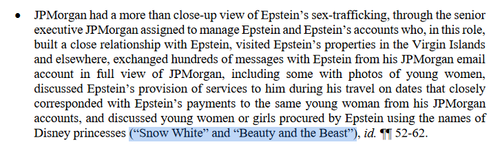
The US Virgin Islands disagrees, saying that Staley “visited Epstein’s properties in the Virgin Islands and elsewhere,” and “exchanged hundreds of messages with Epstein from his JPMorgan email account in full view of JPMorgan, including some with photos of young women, discussed Epstein’s provision of services to him during his travel on dates that closely corresponded with Epstein’s payments to the same young woman from his JPMorgan accounts, and discussed young women or girls procured by Epstein using the names of Disney princesses.”

Epstein and Staley exchanged more than 1,200 emails over several years, however up until now their contents had never been disclosed. Staley – who left JPMorgan to become CEO of Barclays two years later, stepped down from the latter in 2021 following a UK Financial Conduct Authority probe into his relationship with the pedophile financier. 

Tyler Durden
Tue, 03/28/2023 – 16:43

via ZeroHedge News https://ift.tt/bNeiCr9 Tyler Durden

WTI Extends Gains After Unexpected Large Crude Draw

WTI Extends Gains After Unexpected Large Crude Draw

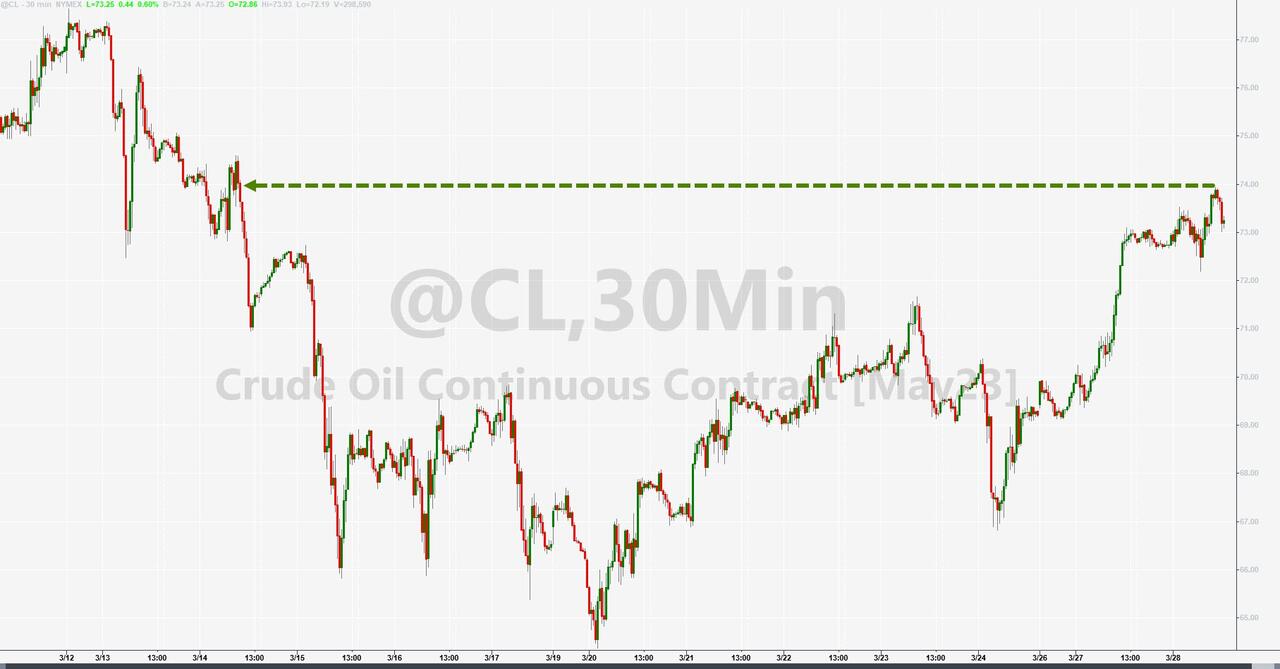
Oil prices extended gains today with WTI up near $74 as a disagreement between Iraq and Kurdish officials curtailed exports and fears of a banking meltdown receded somewhat.

A recent international ruling has resulted in at least a temporary halt of Kurdish oil exports through Turkey and the Ceyhan pipeline network, said Robbie Fraser, manager, global research & analytics at Schneider Electric, in a daily note. That’s impacting around 400,000 barrels per day or around 0.4% to 0.5% of global supply, he said.

“The ruling determined Iraq’s semi-autonomous Kurdish region could not export crude directly, but most do so with Baghdad’s approval and under the authority of the Iraqi central government,” said Fraser.

In the short-term all eyes will be back on crude stocks (after last week’s modest build while products saw big draws).

API

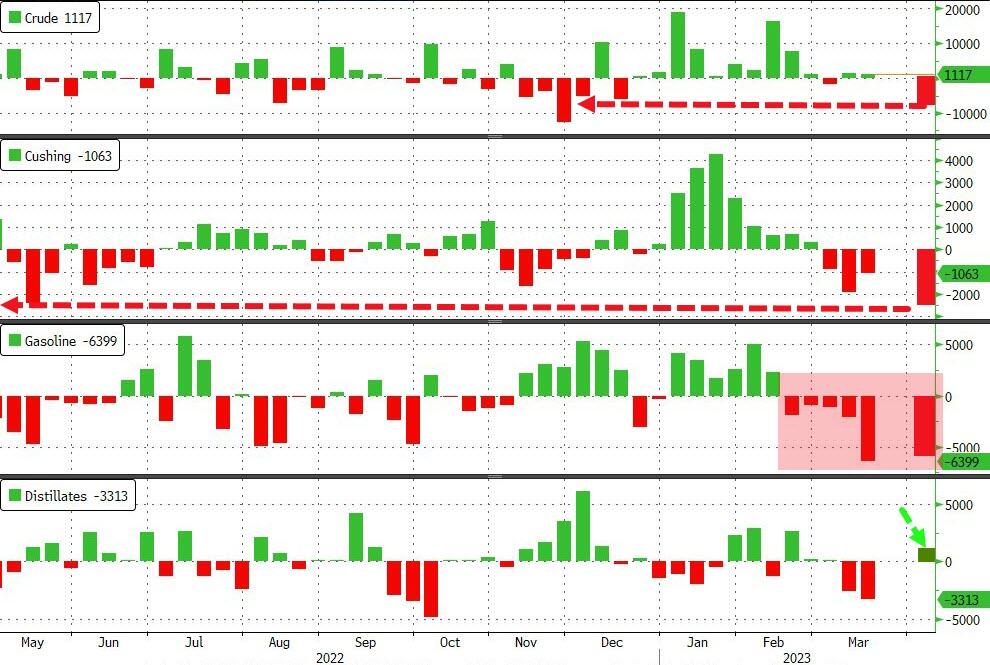
  • Crude -6.076mm (+300k exp) – biggest draw since 11/25/22

  • Cushing -2.388mm – biggest draw since Feb 2022

  • Gasoline -5.891mm (-1.6mm exp)

  • Distillates +548k (-1.1mm exp)

Against expectations of another small build, API reported a significant crude draw og over 6mm barrels. Cushing saw stocks fall and Gasoline inventories also drew-down significantly…

Source: Bloomberg

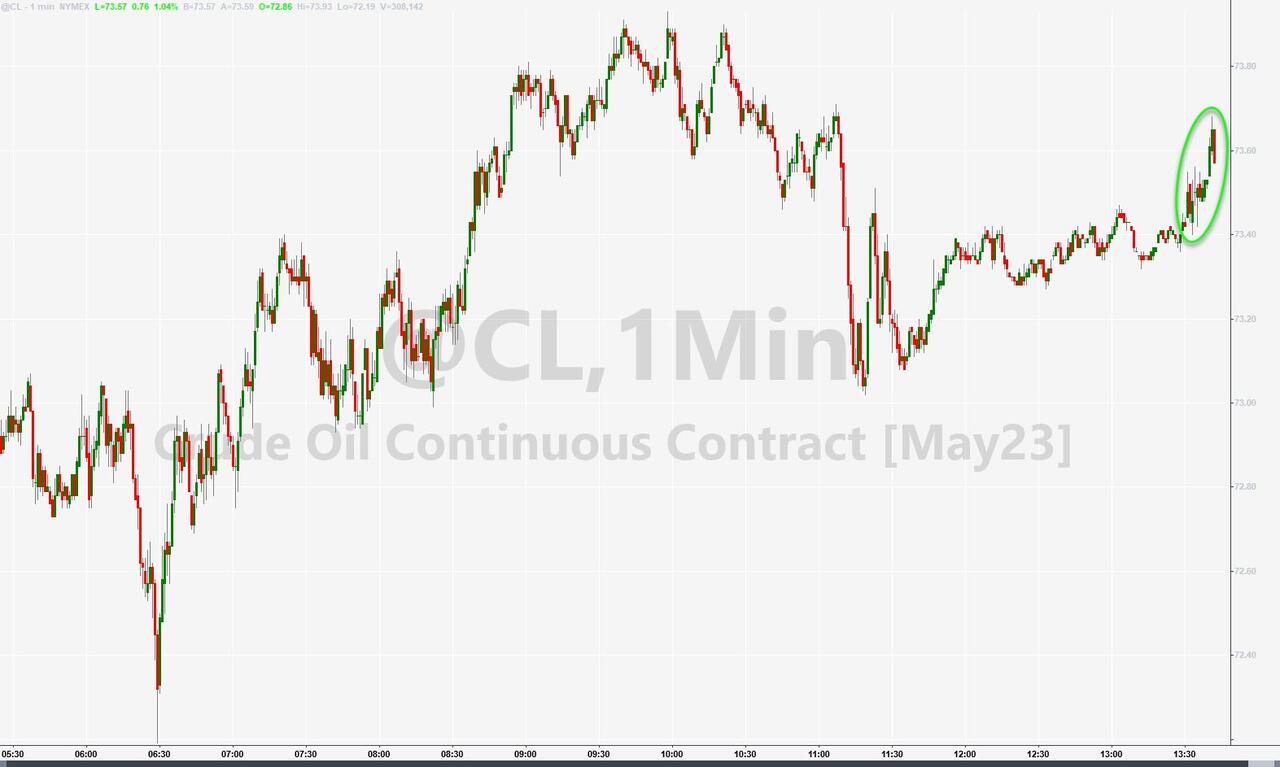
WTI was hovering around $73.40 ahead of the API print and is higher after…

Finally, as Bloomberg notes, while oil has rallied from recent lows as the banking sector stabilizes, it remains on track for a fifth monthly decline amid concerns over a potential US recession and resilient Russian energy flows. Most market watchers are still betting that China’s recovery will accelerate and boost prices later this year as demand rebounds.

Meanwhile, OPEC+ is showing no signs of adjusting oil production when it meets next week, staying the course amid turbulence in financial markets, delegates said. 

We also note that there is the ‘Biden Call’ sitting under the market as at some point he will have to start refilling the SPR.

Tyler Durden
Tue, 03/28/2023 – 16:37

via ZeroHedge News https://ift.tt/WAslC7O Tyler Durden

Culture Of Bailouts Is Destabilizing The Global Financial System

Culture Of Bailouts Is Destabilizing The Global Financial System

Authored by Ruchir Sharma, op-ed via The Financial Times,

A maximalist culture of bailouts and state support is bloating and thereby destabilising the global financial system…

As bank runs spread, it has become clear that anyone who questions a government rescue for those caught underfoot will be tarred as a latter-day liquidationist, like those who advised Herbert Hoover to let businesses fail after the crash of 1929.

Liquidationist is now challenging fascist as the most inaccurately thrown insult in politics. True, it’s no longer politically possible for governments not to stage rescues, but this is a snowballing problem of their own making. The past few decades of easy money created markets so large — nearing five times larger than the world economy — and so intertwined, that the failure of even a midsize bank risks global contagion.

More than low interest rates, the easy money era was shaped by an increasingly automatic state reflex to rescue — to rescue the economy from disappointing growth even during recoveries, to rescue not only banks and other companies but also households, industries, financial markets and foreign governments in times of crisis.

The latest bank runs show that the easy money era is not over. Inflation is back so central banks are tightening, but the rescue reflex is still gaining strength. The stronger it grows, the less dynamic capitalism becomes. In stark contrast to the minimalist state of the pre-1929 era, America now leads a rescue culture that keeps growing to new maximalist extremes.

Today’s troubles have been compared to bank runs of the 19th century, but rescues were rare in those days. America’s founding hostility to concentrated power had left it with limited central government and no central bank. In the absence of a financial system, trust was kept at a personal, not an institutional level. Before the civil war, private banks issued their own currencies and when trust failed, depositors fled.

Had the US Federal Reserve existed at the time, it would not have helped much. The ethos of contemporary European central banks was to help solvent banks with solid collateral — in practice they were tougher, protecting their own reserves and “turning away their correspondents in need”, as a Fed history puts it.

A restrained government was a key feature of the industrial revolution, marked by painful downturns and robust recoveries, resulting in strong productivity and higher per capita income growth. Right into the 1960s and 1970s, resistance to state rescues still ran deep, whether the supplicant was a major bank, a major corporation or New York City.

Though the early 1980s is seen as a pivotal moment of broader government retreat, in fact this era was marked by the rise of rescue culture when Continental Illinois became the first US bank deemed too big to fail. In a move that was radical then, reflexive now, the Federal Deposit Insurance Corporation extended unlimited protection to Continental depositors — just as it has done for SVB depositors.

Recent bank runs have been compared to the savings and loan crisis of the 1980s. Triggered in part by regulation that made it impossible for S&Ls to compete in an environment of rising rates, the crisis was resolved by regulators who wound down more than 700 of these “thrifts” at a cost to taxpayers of about $130bn. The first preventive rescue came in the late 1990s, when the Fed organised support for a hedge fund deeply tied to foreign markets, in order to avoid the threat of a systemic financial crisis.

Those rescues pale next to 2008 and 2020, when the Fed and Treasury smashed records for trillions of dollars created or extended in loans and bailouts to thousands of companies across finance and other industries at home and abroad. In each crisis, rescues held down the corporate default rate to levels that were unexpectedly low, compared with past patterns. They are doing the same now even as rates rise and bank runs begin.

The hazards are not just moral or speculative, as many insist — they are practical and present. The rescues have led to a massive misallocation of capital and a surge in the number of zombie firms, which contribute mightily to weakening business dynamism and productivity. In the US, total factor productivity growth fell to just 0.5 per cent after 2008, down from about 2 per cent between 1870 and the early 1970s.

Instead of re-energising the economy, the maximalist rescue culture is bloating and thereby destabilising the global financial system. As fragility grows, each new rescue hardens the case for the next one.

No one who thinks about it for more than a minute can wax nostalgic for the painful if productive chaos of the pre-1929 era.

But too few policymakers recognise that we are at an opposite extreme; constant rescues undermine capitalism. Government intervention eases the pain of crises but over time lowers productivity, economic growth and living standards.

*  *  *

The author is chair of Rockefeller International

Tyler Durden
Tue, 03/28/2023 – 16:20

via ZeroHedge News https://ift.tt/rf02wli Tyler Durden

Banks & Big-Tech Breakdown, Credit Calm, Bitcoin & Bullion Bounce

Banks & Big-Tech Breakdown, Credit Calm, Bitcoin & Bullion Bounce

Yesterday’s early exuberance gave way to reality today as macro data and politics were back.

Consumer confidence lifted modestly today despite weakening home prices (7 straight months of declines), wholesale and retail inventories on the rise again (maybe consumer not so strong after all), and plunging Richmond Fed Business Conditions.

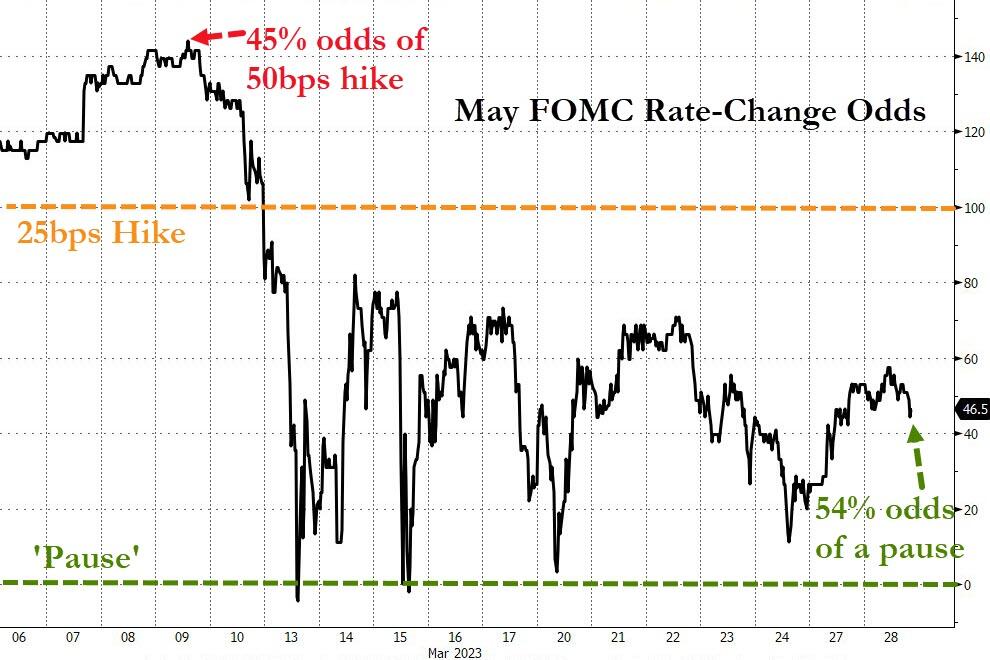
That all pushed the market dovishly, pricing in a 54% chance of a ‘pause’ by The Fed in May…

Source: Bloomberg

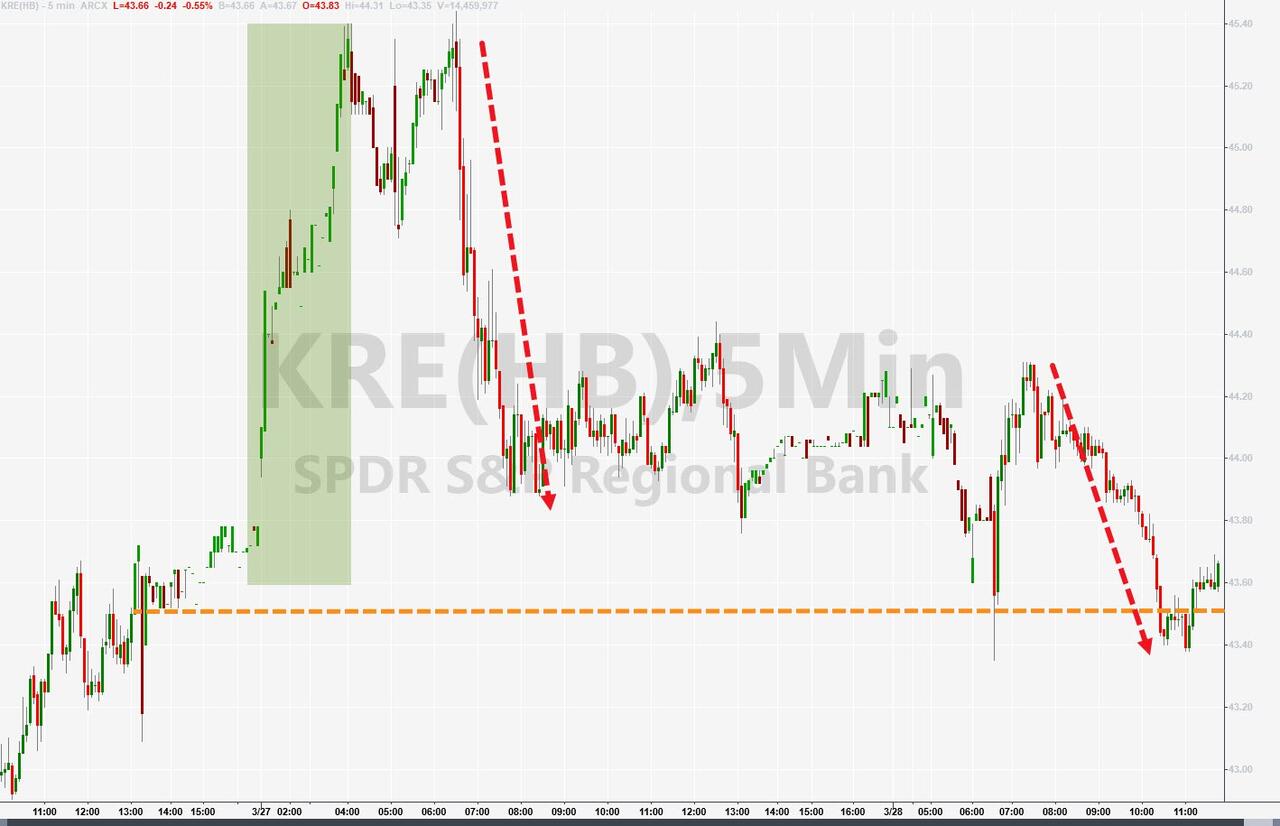
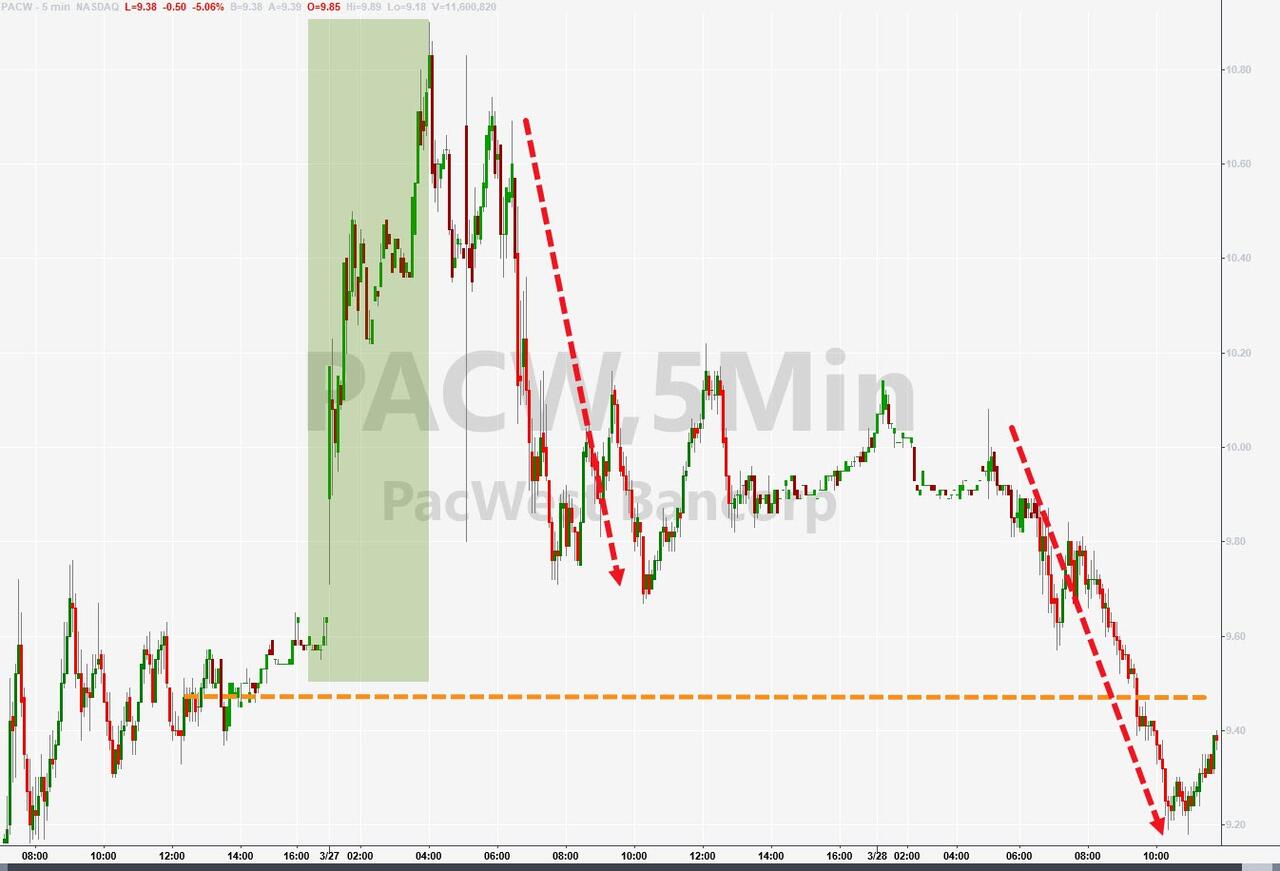
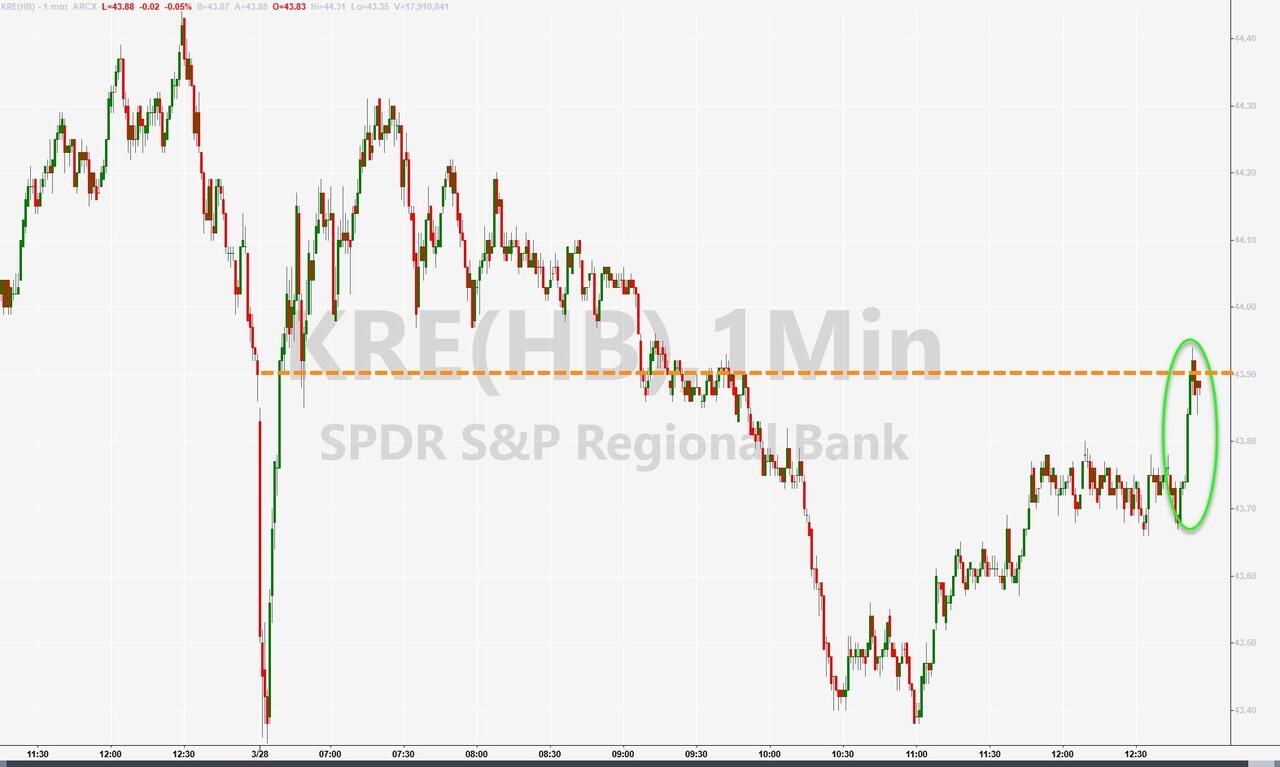
Regional Banks were dumped today as the Washington hearings on bank failures offered nothing but more regulation and more laws and tighter credit and tighter margins… and no bailouts…

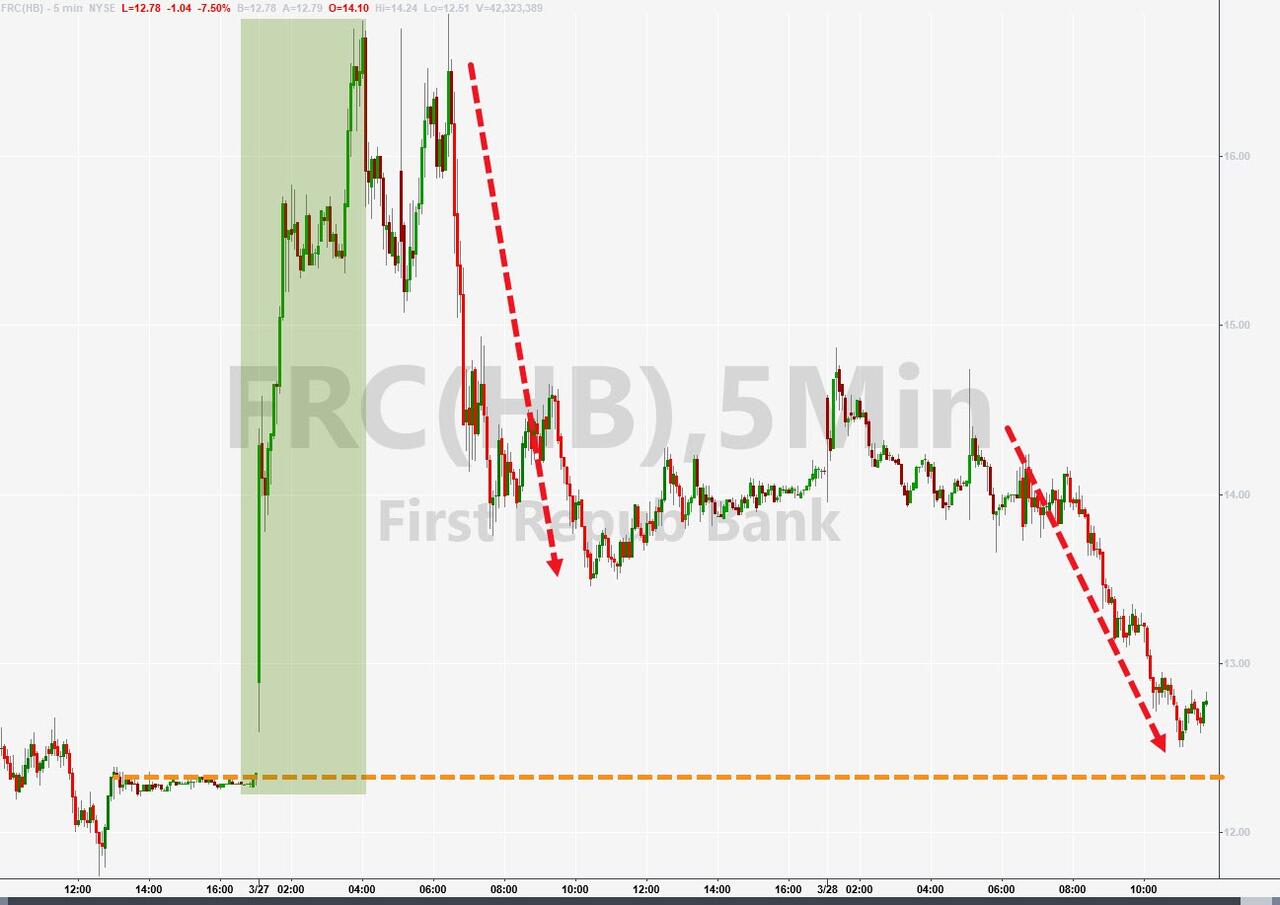
With First Republic and PacWest spanked again…

As Bloomberg noted, the $30 billion Financial Select Sector SPDR Fund (XLF), which holds the financial-related components from the S&P 500 Index, is testing its highs from nearly 16 years ago, along with its lows of the past 18 months

Source: Bloomberg

“Triple bottoms are pretty rare, but the more times you test a given level, the more likely it is to break,” Jonathan Krinsky, chief market technician at BTIG, said.

“What has surprised a lot of people, including myself, is that the weakness in financials was a benefit to tech because a lot of funds went into technology. If you’re a long-only money manager with a cash mandate where you have to be fully invested and have been selling a lot of financials and cyclicals, you have to put your money somewhere. That’s part of the reason why tech has done well.”

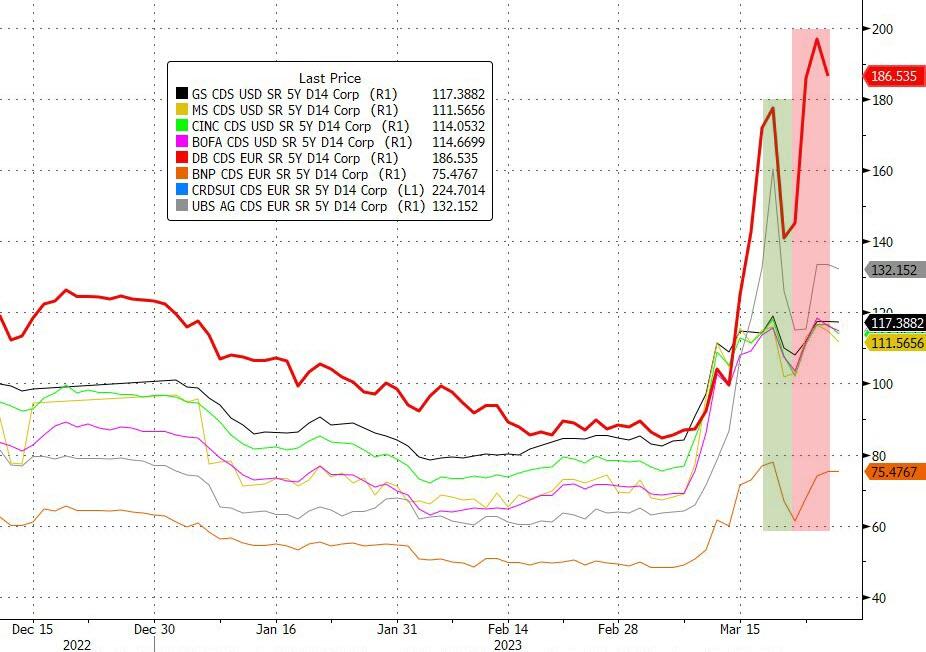
And in case you thought that Europe was fixed, bank credit spreads remain notably more elevated than immediately after the CS bailout…

Source: Bloomberg

Broadly speaking, the US majors were all lower on the day, with Nasdaq leading the drop. The S&P joined Nasdaq in erasing all of yesterday’s gains. Small Caps remain the leader this week And The Dow is holding on to gains…

There was a last second jump in stocks on headlines (from Charlie Gasparino – so consider the source) that FRC is no longer for sale…

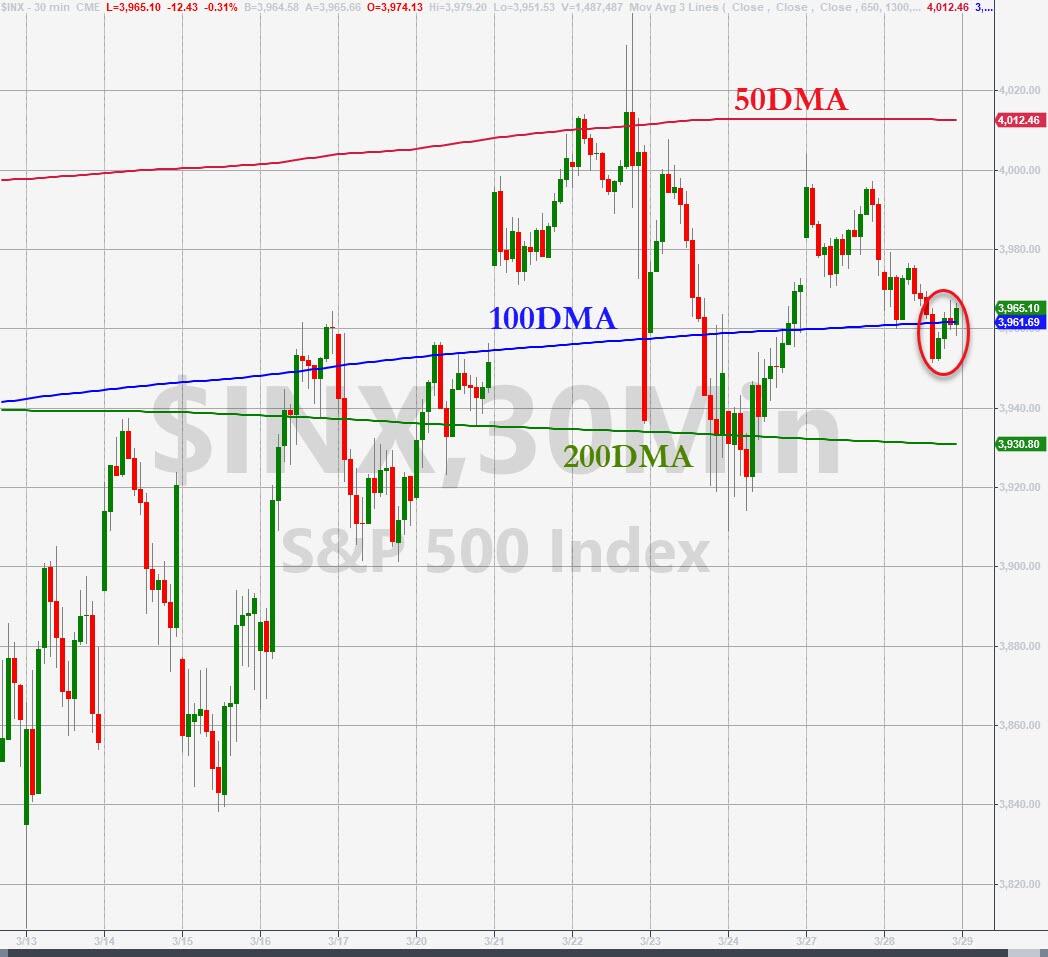
The S&P 500 fell back to its 100DMA…

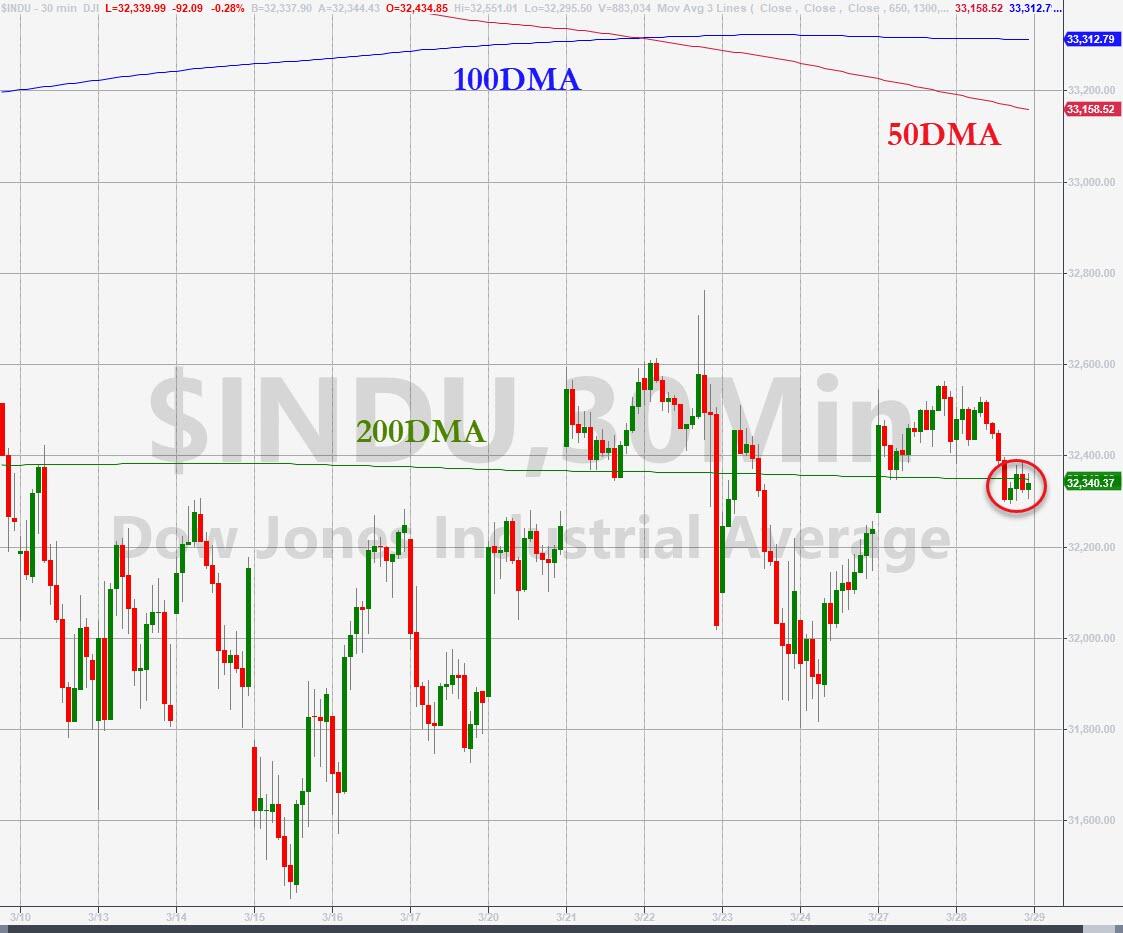
The Dow was glued around its 200DMA…

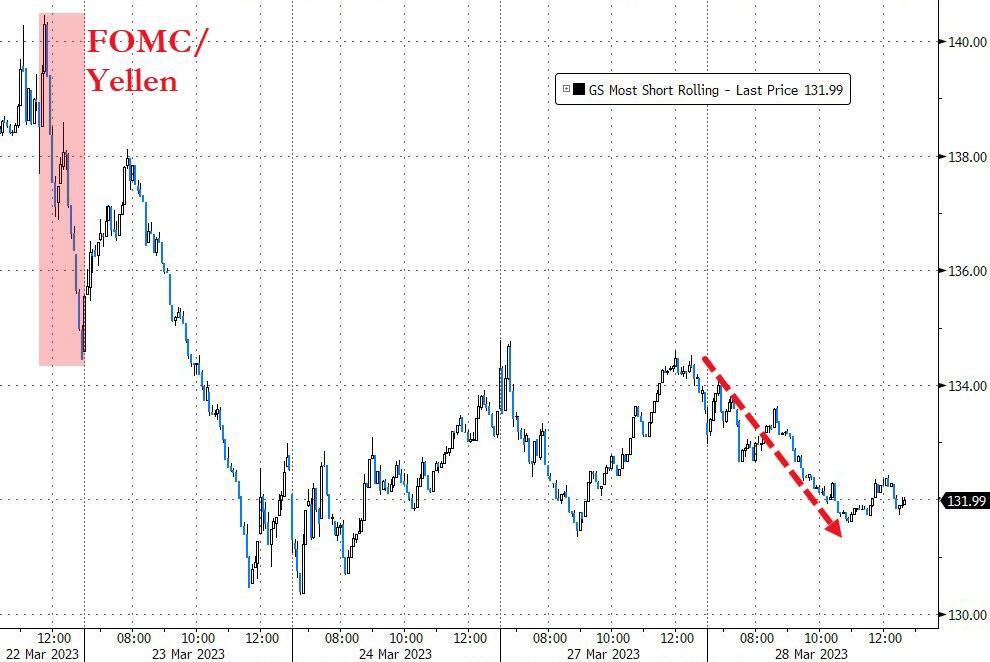
No real attempt at a squeeze in the indices today as ‘most shorted’ stocks faded most of the day…

Source: Bloomberg

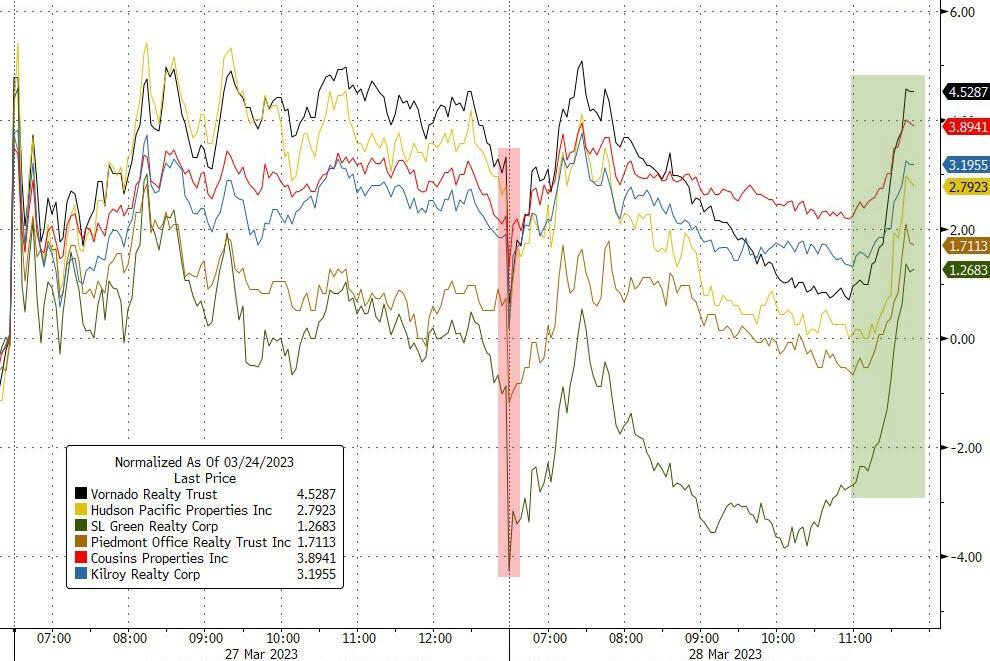
Interestingly, while banks were monkeyhammered, Office REITs/CRE stocks squeezed notably higher this afternoon…

Source: Bloomberg

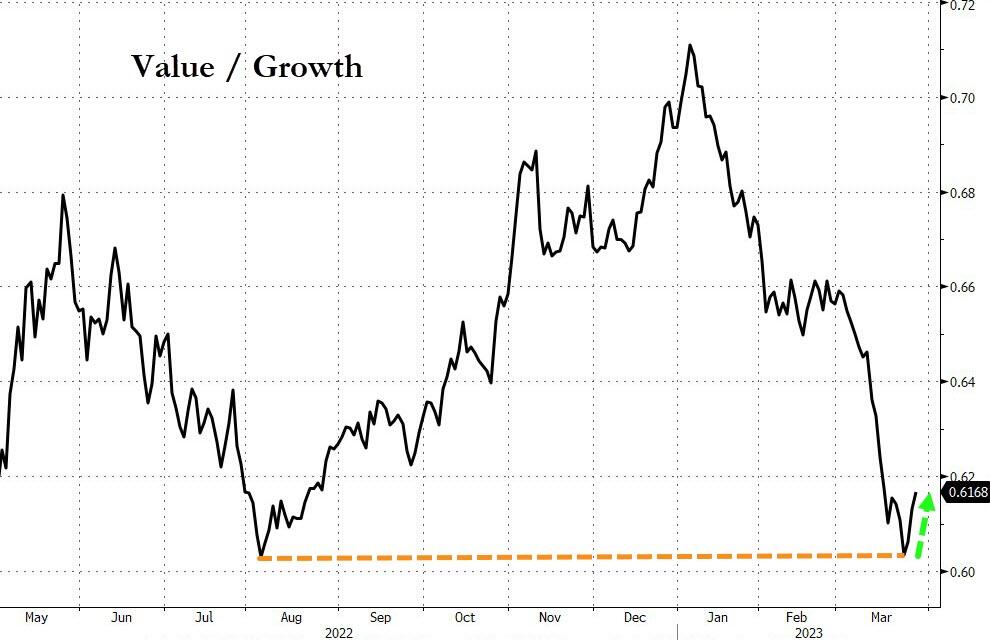
Value has outperformed Growth for 3 straight days… but note where the reversal happened (this is Russell 1000 Value / Russell 1000 Growth)…

Source: Bloomberg

The market is pricing in a lot of uncertainty around this week’s PCE print…

Source: Bloomberg

Treasury yields ended the day higher but it was a very different day than we have seen recently with the long-end very quiet relative to recent chaos. The short-end was uglier but the belly was worse today, also again not quite so much panic selling (or buying)…

Source: Bloomberg

One thing of note was that today 5Y auction was strong – as opposed to yesterday’s ugly 2Y auction.

Also we note that while issuance has been non-existent since the start of March, yesterday saw a metric fuckton of European and US corporates issuing USD bonds (which helps explain the near vertical ramp across the curve from the middle of Friday’s session) as windows opened… and why today, without that rate-lock flow and corporate supply, yields actually traded in a narrow range…

Source: Bloomberg

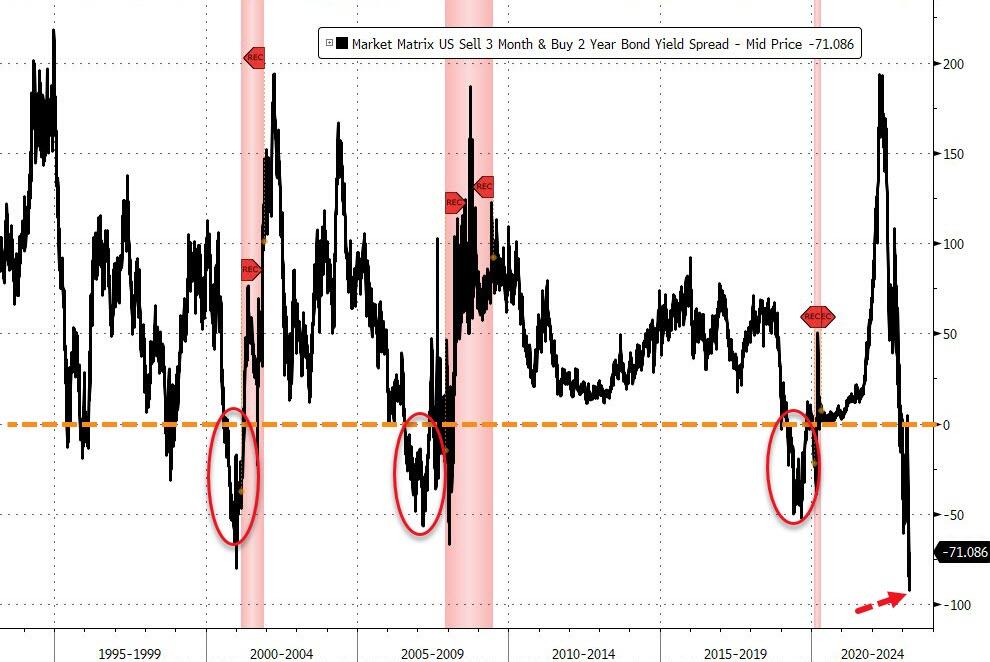
One stand out on the curve that we haven’t discussed too much is the 3m2Y spread, which hit an all-time record low (inverted) this week at (-92bps)…

Source: Bloomberg

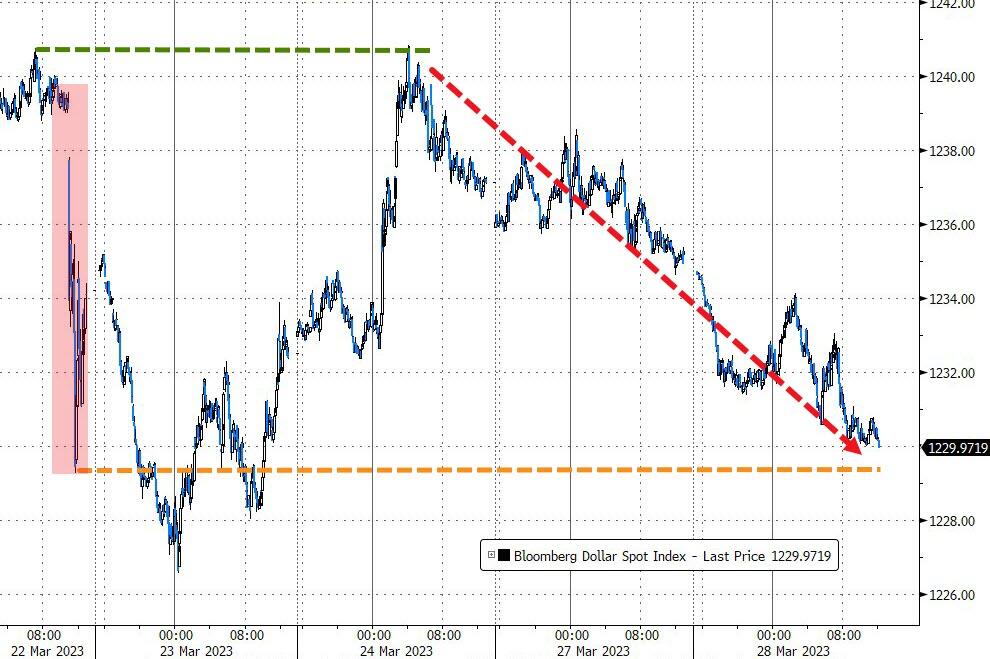
The dollar leaked lower for the second day in a row, back near post-FOMC lows…

Source: Bloomberg

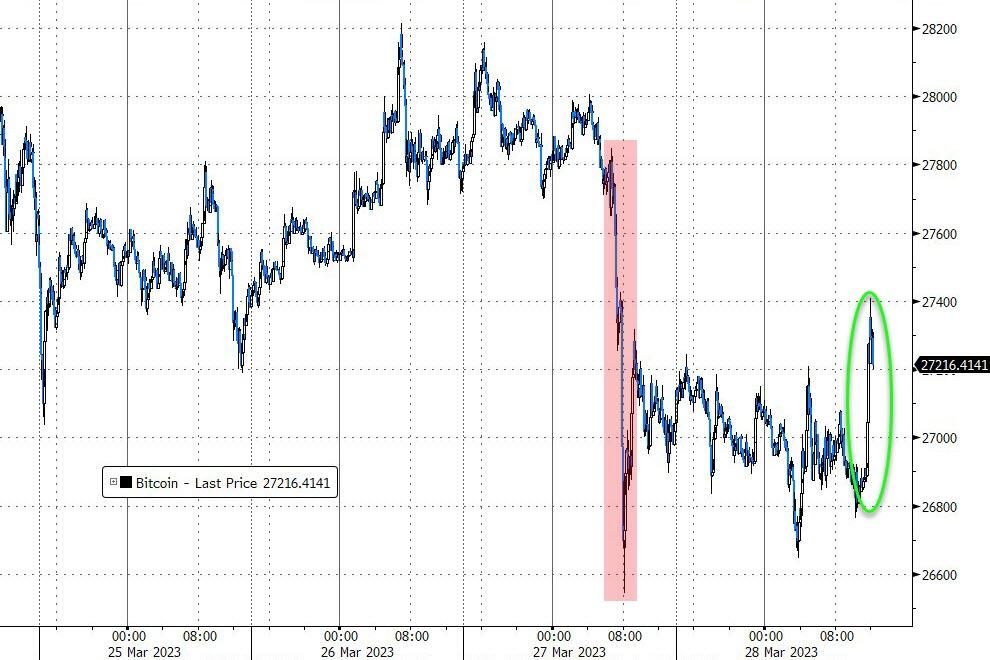
After the Binance buggering yesterday, Bitcoin bounced back above $27,000…

Source: Bloomberg

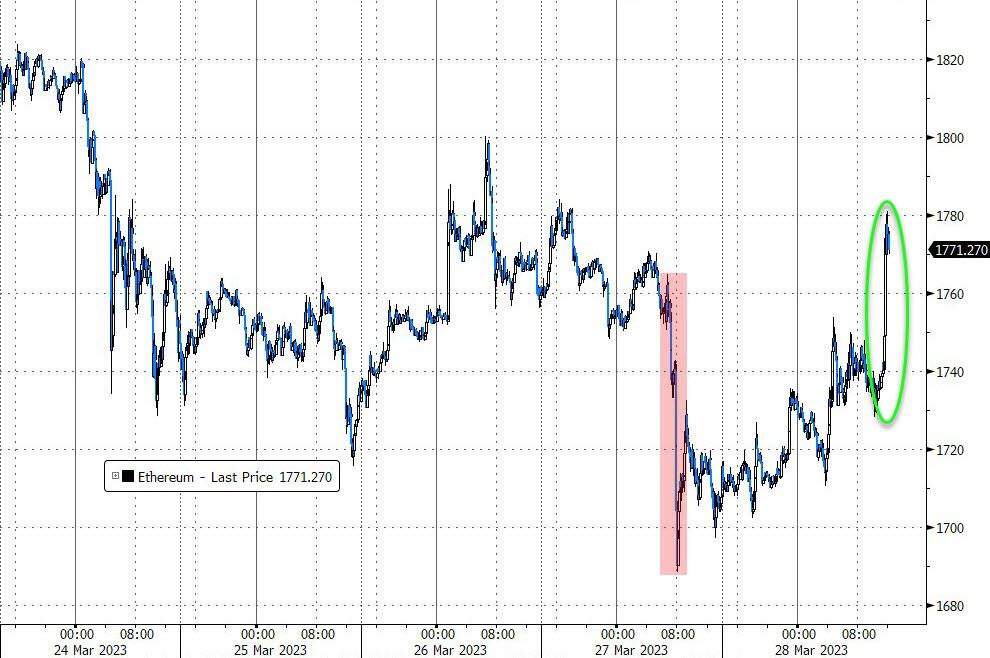
But Ethereum really jumped, back above yesterday’s highs…

Source: Bloomberg

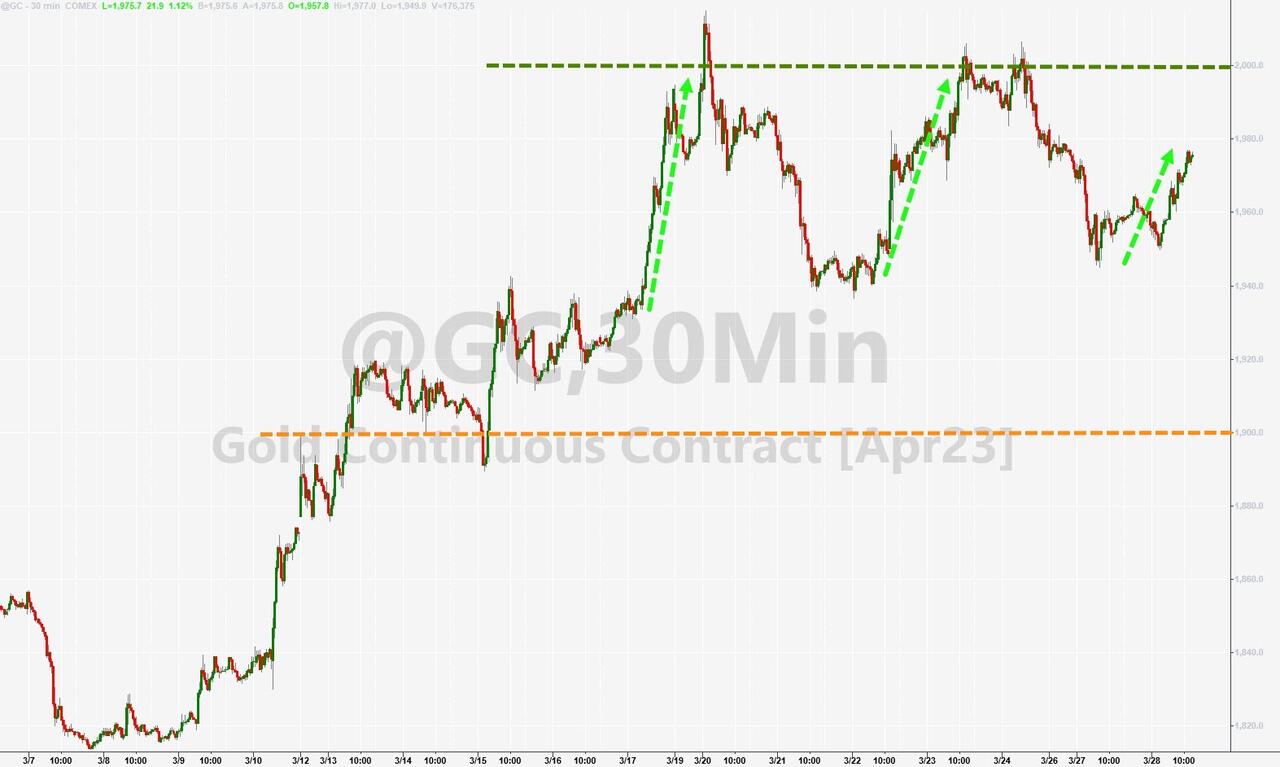
Gold gained on the day, finding support around $1950…

Oil prices rallied again today, with WTI within a tick of $74 ahead of tonight’s API inventory data…

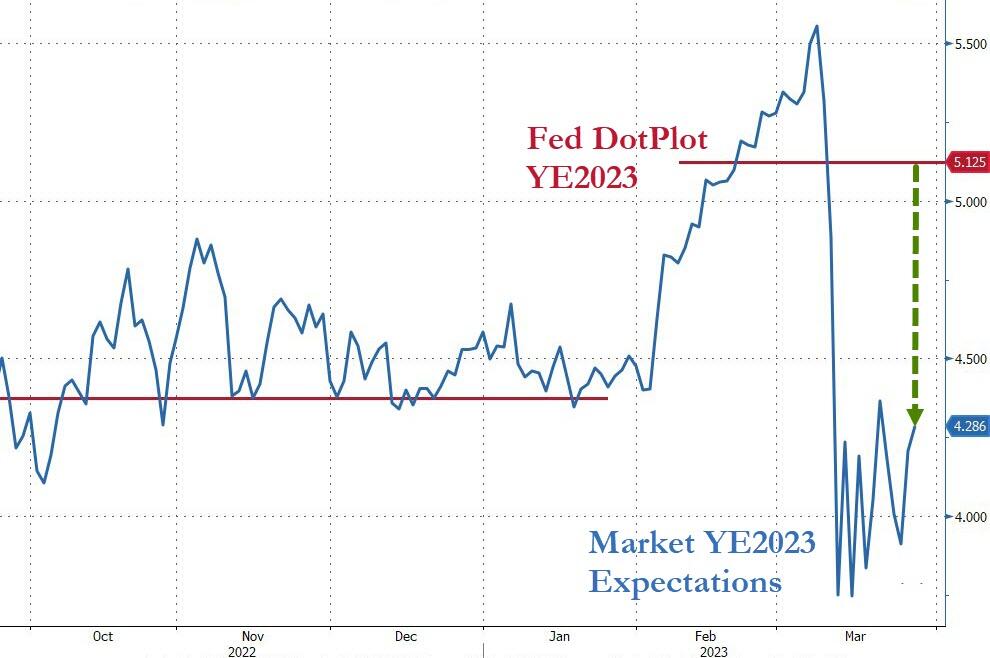
Finally, we note that the market remains dramatically decoupled The Fed’s Dot-Plot (around 90bps more dovish)…

Source: Bloomberg

If The Fed is forced to cut rates that hard, it is not something to be ‘buy buy buy’-ing stocks over – either ‘hard landing’ or ‘banking crisis’ or both…

Tyler Durden
Tue, 03/28/2023 – 16:01

via ZeroHedge News https://ift.tt/qtQYwNG Tyler Durden

Federal Agencies Keep Failing To Legally Interpret the Clean Water Act


A muddy stream flows through a field

Whether the Clean Water Act gives the federal government the power to regulate dry riverbeds, isolated streams, and land next to wetlands remains clear as mud, as a recent federal court decision illustrates.

This past Monday, the U.S. District Court for the Southern District of Texas issued a preliminary injunction against the recently finalized clean water regulations issued by the Environmental Protection Agency (EPA) and Army Corps of Engineers.

Judge Jeffrey Vincent Brown found that plaintiffs—the state governments of Texas and Idaho plus a long list of national trade associations—would likely prevail in their argument that the new rules amount to illegal and/or unconstitutional federal overreach.

The ruling makes the Biden administration the third presidential administration in a row to try and fail to establish a workable definition of which waters and properties are, in fact, governed by the 1972 Clean Water Act.

“We’ve been in this never-ending game of regulatory pingpong,” says Charles Yates, an attorney with the Pacific Legal Foundation (PLF). “The EPA and the Army Corps are batting zero on legally interpreting the” Clean Water Act.

That 1972 law requires that anyone discharging pollutants into “navigable waters”—defined as a territorial sea and the “waters of the United States” (WOTUS)—must first obtain a federal permit. Territorial seas are defined in the statute, but “waters of the United States” are not. It’s up to federal regulatory agencies and the courts to figure out what exactly that phrase means.

Environmentalists and successive Democratic administrations have pushed for an expansive WOTUS definition that would include almost every body of water, including small streams, ditches, and even land that’s only intermittently wet. The theory is that even discharges into tiny streams will eventually work their way into larger, navigable bodies of water. Therefore, they should be covered by the Clean Water Act’s regulations.

A long list of regulated industries, Republican-run state governments, and property rights advocates have all argued that this interpretation of the Clean Water Act would effectively give the federal government regulatory power over every piece of property in the country. That, they say, goes beyond the statute’s intent, as well as the Constitution’s limits on federal power.

Complicating things is a confusing 2006 U.S. Supreme Court ruling in the case Rapanos v United States in which no clear majority was able to establish a definition for “waters of the United States.”

In a plurality opinion in that case, Justice Antonin Scalia suggested a property would have to have a continuous surface connection to navigable waters in order to trigger the Clean Water Act. In a concurring opinion, Justice Anthony Kennedy suggested a broader, more convoluted “significant nexus” test that would cover wetlands if they “either alone or in combination with similarly situated lands in the region, significantly affect the chemical, physical, and biological integrity of other covered waters more readily understood as ‘navigable.'”

Since that case, it’s been an open question as to which test should apply. Regulatory agencies have also done their best to stretch the scope of the law.

The Obama administration published its own expansive Waters of the United States rule in 2015 that very quickly attracted a flurry of lawsuits. Judges in North Dakota, Texas, Georgia, and Oregon issued rulings staying the rule’s implementation in 27 states.

When the Trump administration tried to delay the implementation of the rule to 2020, the courts stopped that too, so the rule went into effect in 22 other states. (There was an open question over whether an injunction applied to New Mexico.)

In 2020, the Trump administration finalized its own replacement for the Obama administration’s rule. That rule was then vacated by a federal court in August 2021. By that time, the Biden administration was already working on reviving and tweaking the preexisting Obama rules.

That happened in January, precipitating the lawsuit from Texas, Idaho, and various trade association representing homebuilders, agricultural interests, and more. Last week’s ruling enjoins the new Biden rule in just Texas and Idaho.

The preliminary injunction is “a recognition from the court that what the agencies are doing here is not faithful to the text of the statute,” says Yates. “Guidance from the Supreme Court is really necessary before they can put together a rule that will survive judicial review.”

That guidance might soon be forthcoming.

Last year, the U.S. Supreme Court heard oral arguments in a potential landmark Clean Water Act case, Sackett v. EPA. The plaintiffs, Michael and Chantell Sackett, (who are represented by PLF) have been trying to build a home on their property in a residentially zoned, built-out subdivision in Idaho for 16 years.

Standing in their way has been the EPA, which says their landlocked property is a navigable water because it’s close to a stream that runs into a nearby lake and, therefore, meets Kennedy’s “significant nexus” test.

The agency insists that the couple needs a permit to move ahead with construction. Getting that permit could cost as much as $250,000. Preceding without a permit could see the Sacketts hit with daily fines of up to $75,000.

The Sacketts already won one Supreme Court case securing their right to sue the EPA.

Their second case argues that the scope of the Clean Water Act should be narrowed to exclude their landlocked property. They’ve suggested Scalia’s opinion in Rapanos requiring a continuous surface connection should be the standard.

The U.S. Court of Appeals for the 9th Circuit ruled against the Sacketts in an opinion that held that Kennedy’s “significant nexus” test should be the controlling standard for whether a property is subject to the Clean Water Act.

During oral arguments last October, conservative justices seemed pretty skeptical of the significant nexus test. Bloomberg Law reports that they didn’t seem fully on board with Scalia’s surface connection test either.

While the Sacketts’ case precedes the Biden administration rule, it could still upend the new regulations.

“If the Supreme Court were to enter a decision creating precedent that the significant nexus test was illegal, then substantial revisions would need to occur to the Biden rule because it would not pass muster,” says Yates.

In his opinion from last week, Brown wrote that the new EPA rule “ebbs beyond the already uncertain boundaries” of the significant nexus test. He also criticized the administration’s claim of Clean Water Act jurisdiction over all interstate waters, regardless of whether they’re navigable.

We’re still waiting on an opinion in the Sackett case. Yates says a ruling is essential to give landowners some clarity.

“Absent definitive guidance from the Supreme Court, a lawful and durable definition of navigable waters is going to remain elusive,” says Yates. “It’s ordinary landowners like the Sacketts, farmers, ranchers, people trying to use their land productively that have been stuck in the middle.”

The post Federal Agencies Keep Failing To Legally Interpret the Clean Water Act appeared first on Reason.com.

from Latest https://ift.tt/BKto2qQ
via IFTTT
Small Float SPACs Use Meme Playbook For Crazy Swings

Small Float SPACs Use Meme Playbook For Crazy Swings

By Bailey Lipschutz, Bloomberg ECB Watch reporter

The ailing SPAC market is getting wildly volatile as speculators pour into and out of low-float companies, ripping off the strategy that brought meme-stock mania to the masses.

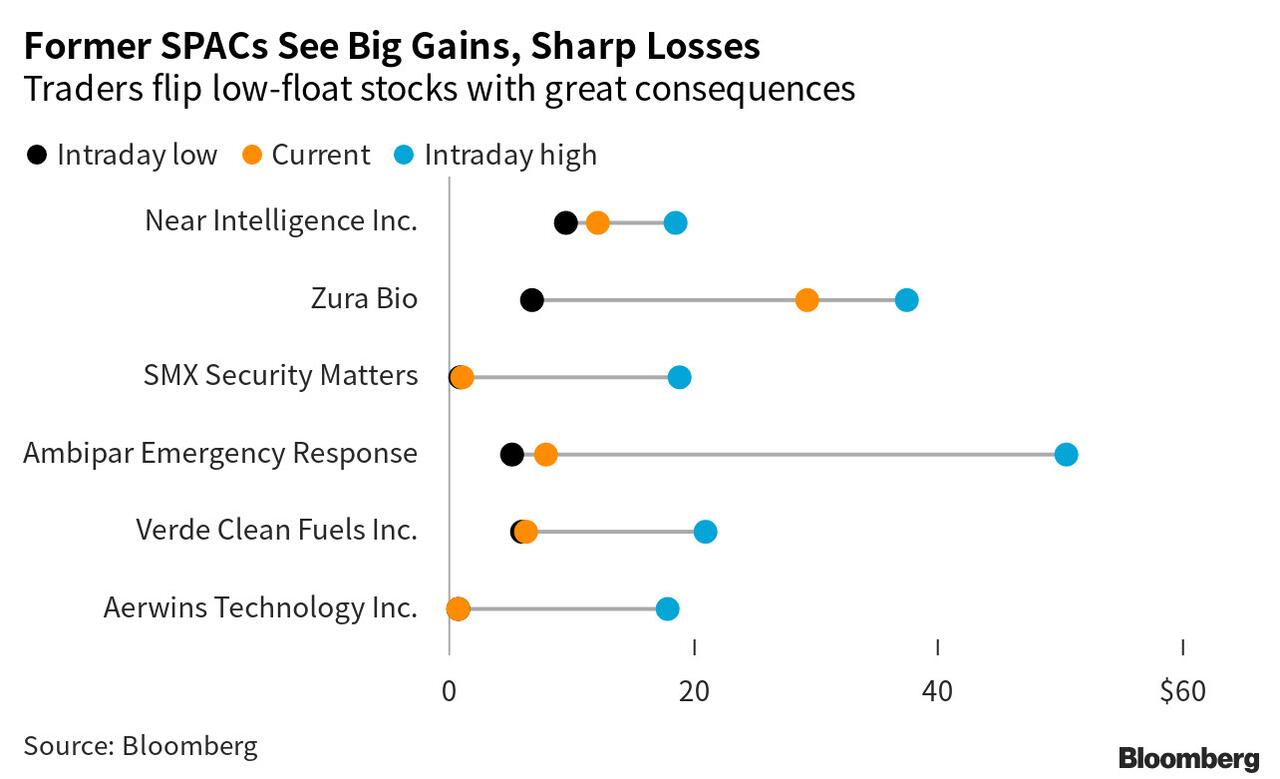
The special-purpose acquisition company that merged with Ambipar Emergency Response spiked as much as 411% after its deal won shareholder approval on Feb. 28, only for Ambipar to slump below $10 after the tie-up was  completed. Lionheart III Corp. followed a similar trajectory in its merger with SMX Security Matters on March 7, while JATT Acquisition Corp. slumped before its tie-up with Zura Bio Ltd. and then soared after it.

“For the retail guy, it’s the same playbook that they have grown to know and love over the past three years: Find something that’s a low float, put it on a screener, once it starts to move tweet it out to your closest followers,” said Matthew Tuttle, CEO and CIO of Tuttle Capital Management. “Move a little bit, and all their followers will jump in.”

The volatility is being fueled by the low floats of many SPACs, with shareholders this year redeeming an average of almost 90% of their shares before any merger is completed. Holders in the two SPACs that merged with Ambipar and SMX Security cashed in more than 95% of their stock, leaving the blank-check companies with just 918,000 and 303,000 shares, respectively.

Data as of March 24 close

The volatility is reminiscent of meme-stock mania two years ago, where wild swings in stocks such as GameStop Corp. became commonplace. The video-game retailer’s market value rose more than 18 times in January 2021 to become larger than almost half of the companies in the S&P 500 Index — before it crashed.

Buying SPACs has become an equally profitable, and risky business. Take Intuitive Machines Inc., for example. The stock soared 1,200% in a raucous stretch early in the year to become the best performing ex-SPAC of 2023, before slumping roughly 92% from an intraday high of $136 on Feb. 22.

All told, 26 companies have gone public this year via SPAC merger, according to data compiled by Bloomberg. Of those, the median de-SPAC has shed one-third of its value, underperforming the S&P 500’s 3.6% gain.

“It’s the nature of the beast,” Tuttle said. “One day a stock can be the play, and once those guys leave, ka-boom, the stock tanks. Back in the old days when you saw a stock up big there it could be takeover speculation, there could be something real. And now you see stuff rallying based on air, and the last thing you want is to be the last guy in.”

Tyler Durden
Tue, 03/28/2023 – 15:45

via ZeroHedge News https://ift.tt/xvj14H8 Tyler Durden