Arizona Returns $39,000 Seized From Man at Phoenix Airport Through Civil Asset Forfeiture


Jerry Johnson

A North Carolina man will get back more than $39,000 in cash after police seized it from him at the Phoenix airport, despite never charging him with a crime. 

Reason previously reported on the civil forfeiture case of Jerry Johnson. Johnson owns a trucking company and says he flew to Phoenix in 2020 to possibly purchase a semitruck at auction. Police detectives approached him at baggage claim, accused him of being a drug trafficker, and seized $39,500 from him.

It’s legal to fly domestically with large amounts of cash, but under civil asset forfeiture laws, police can seize property suspected of being connected to criminal activity, whether or not the owner of the property has been charged with a crime.

Johnson tried to challenge the seizure, presenting bank statements and tax returns to establish ownership of his money, but the judge in his case ruled that because of inconsistencies in his story and circumstantial evidence offered by prosecutors—an old criminal record, buying a last-minute ticket with a quick turnaround, his nervous appearance in the airport, having three cellphones, and the alleged odor of marijuana on the cash—Johnson hadn’t established a legitimate interest in the cash.

The Institute for Justice, a libertarian-leaning public interest law firm that has challenged asset forfeiture laws in several states, picked up Johnson’s case on appeal, and now, after a two-year legal odyssey, the state is returning his money.

Institute for Justice senior attorney Dan Alban said in a press release that Johnson’s case “potently illustrates the injustice of civil forfeiture even when someone ultimately gets their property back.”

“It took 31 months for Jerry to finally get his savings back even though he was never even charged with a crime,” Alban said. “In the middle of the COVID pandemic, Jerry had to find a way to keep operating his small trucking business after its working capital was seized while also scraping together money to hire an attorney (before IJ took his case).”

Law enforcement groups say civil asset forfeiture is an essential tool to disrupt drug trafficking and other organized crime by targeting its illicit proceeds. However, civil liberties groups across the political spectrum argue that the practice lacks due process protections and frequently ensnares innocent property owners, who then bear the burden of going to court and proving their innocence.

More than half of all states have passed some form of asset forfeiture reform over the past decade in response to these concerns. Arizona passed civil asset forfeiture reforms in 2017 to raise the evidentiary threshold for forfeitures from a “preponderance of evidence” to “clear and convincing evidence,” and in 2021, it became the 16th state to require a criminal conviction before property can be forfeited

Airports are a particularly lucrative spot for police fishing for cash to seize. A 2016 USA Today investigation found the Drug Enforcement Administration (DEA) seized more than $209 million from at least 5,200 travelers in 15 major airports over the previous decade. The Institute for Justice is litigating a separate class-action lawsuit on behalf of people whose cash was seized by the DEA at airports. One of the lead plaintiffs in that case, Stacy Jones, had $43,167 in cash seized by the DEA as she was trying to fly home to Tampa, Florida, from Wilmington, North Carolina.

“It’s a blessing to finally have my savings back so that I can invest it in my business,” Johnson said in the press release. “That the government could take my money, never charge me with a crime but hold onto my savings for so long is outrageous. It created a tremendous financial burden for me and my family, and there were a lot of business opportunities I’ve missed out on because that money was just sitting in a government account.”

However, the Institute for Justice says the case isn’t finished; the state of Arizona is refusing to compensate Johnson for attorneys’ fees or interest accrued on his money during the years it was seized.

“We’re glad that the money has been returned,” Alban said, “but Jerry still needs to be made whole.”

The post Arizona Returns $39,000 Seized From Man at Phoenix Airport Through Civil Asset Forfeiture appeared first on Reason.com.

from Latest https://ift.tt/EJjSFaT
via IFTTT

Credit-Suisse-Killing Saudi National Bank Chair Resigns “For Personal Reasons”

Credit-Suisse-Killing Saudi National Bank Chair Resigns “For Personal Reasons”

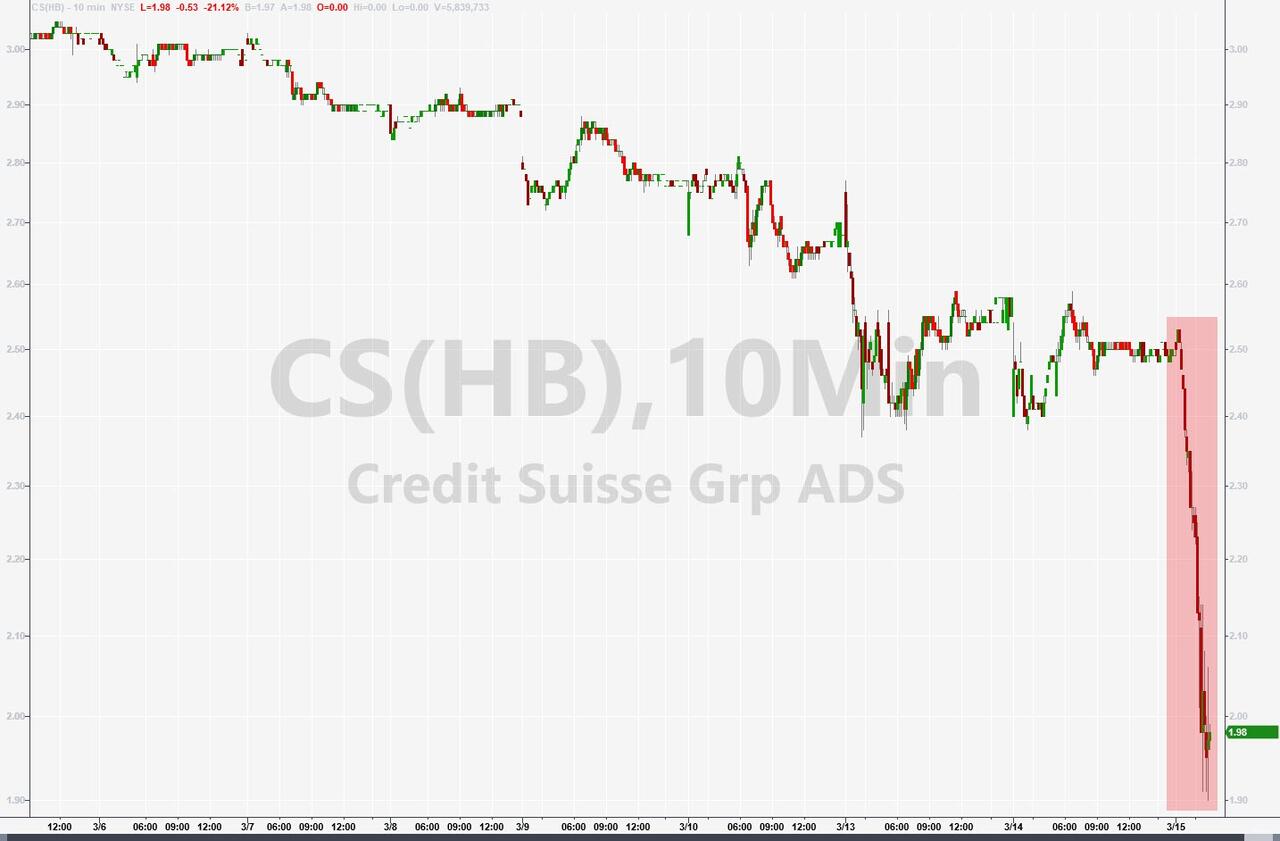
Almost two weeks following an interview with Bloomberg TV, in which Saudi National Bank Chairman Ammar Al Khudairy, who is also Credit Suisse Group AG’s largest shareholder, ruled out the possibility of raising his stake in the struggling Swiss lender, the bank’s stock immediately plummeted, leading to an abrupt takeover by rival UBS. Now the chairman of the Saudi National Bank has resigned, citing “personal reasons.”

According to a filing on Riyadh’s Tadawul stock exchange, Al Khudairy is being replaced by Saeed al-Ghamdi, the bank’s current CEO. No further explanation was provided for Al Khudairy’s departure, with the statement only mentioning it was “due to personal reasons.”

His departure comes 12 days after he told Bloomberg TV in an interview that Saudi National Bank would “absolutely not” be open to increasing its Credit Suisse position.

“The answer is absolutely not, for many reasons outside the simplest reason, which is regulatory and statutory,” the chairman of Saudi National Bank said on March. 15. That was in response to a question on whether the bank was open to further injections if there was another call for additional liquidity.

Immediately following Al Khudairy’s remarks, Credit Suisse’s shares plummeted by 30%.

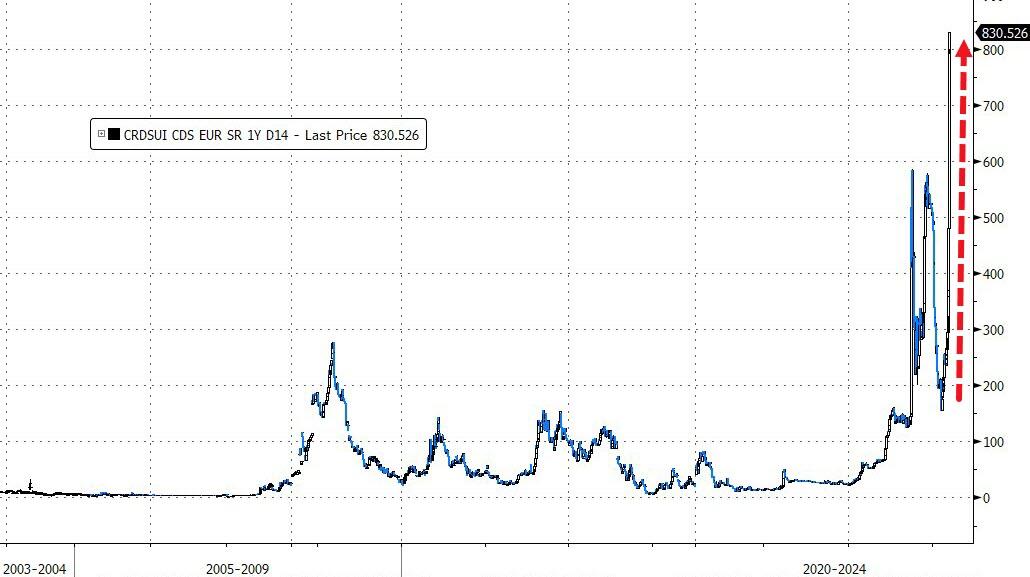
… and its CDS exploded to record highs…

Later that day, the Swiss National Bank agreed to lend Credit Suisse $54 billion to shore up its finances. 

The next day, Al Khudairy tried to calm fears, telling CNBC viewers:

“It’s panic, a little bit of panic. I believe completely unwarranted, whether it be for Credit Suisse or for the entire market.”

And by the end of the weekend, on Sunday, March 19, UBS said it would take over Credit Suisse

And just how much did the Saudis lose because of Al Khudairy’s comments?

Figure they had a 9.9% stake for 1.4 billion francs last year, or about a billion dollars in losses. Quite an unfortunate turn of events…


Tyler Durden
Mon, 03/27/2023 – 12:40

via ZeroHedge News https://ift.tt/zR0WwYu Tyler Durden

Everyone Is Just Pretending Nothing’s Wrong

Everyone Is Just Pretending Nothing’s Wrong

Submitted by QTR’s Fringe Finance

“It is a shit storm out here. You have no idea the kind of crap people are pulling, and everyone’s walking around like they’re in a goddamn Enya video.” – Mark Baum

Even if the stock market holds up, something is going to have to break in a big way.

This is about the simplest way I can try and explain how I feel about the state of the economy and markets, delivered to you honestly and devoid of detail, as someone who truly neither has the patience nor the attention span to dive into the intricacies of the Eurodollar system or the path printed money takes during QE or QT.

The fact is that I just don’t care about how the bowels of the system works. I don’t need to care. All I need to know is that money creation as a method of “solving” recessions can’t continue in perpetuity: the dollar amounts necessary for bailouts become astronomical, too quickly, and inflation becomes a pressing issue. Then, as we are now, Central Bankers get stuck between an “inflation vs. recession” rock and hard place. It’s a flawed system that once exploited a loophole (money printing) to slap band-aids on problems. We then thought we could do it in perpetuity to keep ourselves and voters consistently comfortable by presenting the illusion that everything had done “back to normal” – and now we’re finally going to have to deal with very uncomfortable consequences of our actions.

How’s that for a book report from someone who didn’t actually read the book? And I didn’t even need to mention “swaps” or “interest rate futures” to fake sounding smart.


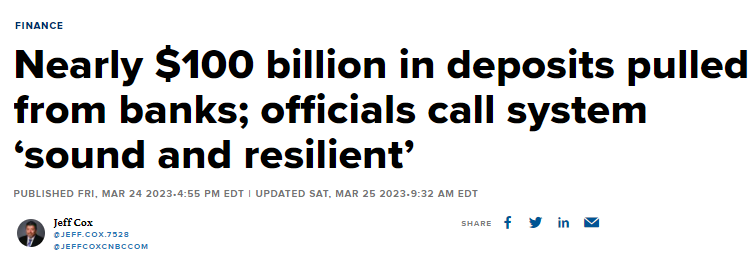
Putting aside what bureaucrats are saying about deposit insurance and Fed policy in the midst of the banking crisis we are having, underneath it all people seem to be forgetting that the economy has just tapped into a large pool of chaos and unrest in the form of 4% interest rates we’re supposedly using to fight inflation.

CNBC.com

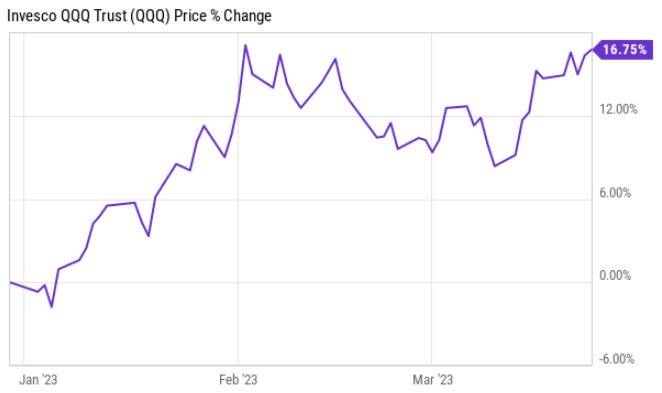
And just as was the case with Covid, the headlines today don’t seem to match the reality of what’s happening in markets. Are we to honestly believe that, in the face of a cascade of bank failures that has now encompassed Silicon Valley Bank and Credit Suisse, with names like Charles Schwab and Deutsche Bank also being tossed around, that a real “flight to safety” is people pouring their money into the Nasdaq QQQ ETF at 27x earnings? Because that’s what’s happening.

Of course this is simply the residual effect of too much liquidity in the system, behavioral incentives that have reversed free market poles over the last 30 years and a stock market that has been coddled, babied, micromanaged and manipulated to the point of no longer making any sense.

The further we stray off the path, the closer we get to something having to give.

Watch Something's Gotta Give Streaming Online | Hulu (Free Trial)

Powell and Yellen

I think the key point I am trying to make today is that I strongly continue to believe we have not seen the last – or even the beginning, really – of the volatility we’re in store for as a result of rate hikes.


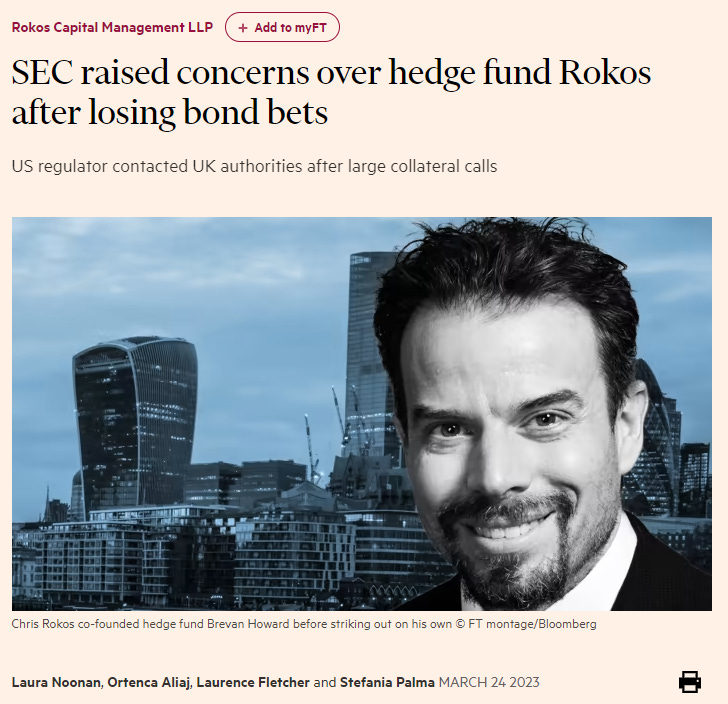
In addition to bank failures, headlines like this one about hedge funds taking on huge losses thanks to the plunge in bond prices are going to become more common place.

When there’s over $1 trillion still floating around in the crypto ecosystem and tech stocks are the “risk off” trade, you know we haven’t experienced even a modicum of fear or capitulation yet. It’s the same hubris and arrogance we had during QE infinity.

And we’ll keep this “plan” until, in the parlance of Mike Tyson, we are eventually “punched in the mouth” by something we didn’t see coming.

The question is: what is going to break, and when?

The answer I have for you today: who the hell knows?

We’re already starting to see a flight into gold and silver, probably as a hedge against the system and inflation at once, as well as a response to the idea that the Fed is likely to pause, then pivot, soon. In the last 6 months, gold is pushing a 20% rise:

This move in the metals has taken place before Jerome Powell has alluded to rate cuts.

In fact, last week he said that rate cuts were not a part of the Fed’s base case. As I have been saying for months, I still expect the market to tank at some point, which will then cause the Fed to hurriedly step in with rate cuts. Not only have we not seen a sell off yet, we haven’t even seen the suggestion of a sell off.


When I try to visualize the Fed’s priorities, based on their spineless action over the last couple decades, all I can think about is that they’re going to want to protect the price of stocks at any cost.

In other words, soaring inflation by more money printing is okay with them, as long as the nominal price of assets keeps going up. Rising nominal asset prices always seems to trump letting the economy crash for the Fed. Why? Because the former “solution” widens the inequality gap and protects those with assets (the rich), while the latter would actually contract the inequality gap and disproportionately harm those with assets (the rich).

In a scenario where the Fed lets the economy crash instead of surrendering to inflation, the rich would be most susceptible to taking real losses. And we can’t have that, can we?

Now say, instead, that the Fed tries to walk a thin line between inflation and recession. Something will still have to break, it may just not be as pronounced or as quick if the central bank commits to one of the other. And by “break” I don’t just mean the economy wrecking somewhere, I mean it showing up in the price of something…somewhere.

Take a look out there and you can find a case for pretty much any story you want to tell yourself. There’s analysts saying gold will go to $8,000, there’s analysts saying oil could go to $300, there’s analysts saying the Dow Jones will go to 50,000, there’s analysts saying copper is going to 20x and there’s analysts saying the bond market will crack up in the face of yield curve control.

All of a sudden my brutal honesty of admitting I don’t have a clue what’s going to happen next looks pretty good, right?

The point is that while everybody has a different take on what the specific malfunction is going to be, it all falls under the umbrella of agreeing there is going to be some major malfunction in prices somewhere. I’d love to tell you, Jim Simons-style, that I have some theoretical mathematic opinion on the situation, but the fact is, I’m just kind of sitting around, Eastwood-in-Gran-Torino-style, sipping a beer waiting for something to blow up.


The easy, broader point that I’m trying to make is that the complacency in the market we are witnessing currently is outrageous.

The market will do what it will – I can’t control that. But what I can control is how closely I am watching and paying attention. I truly believe we are in the calm before a very big storm in equity markets, so I’m focused acutely on day-to-day sentiment. There will come a time when “fear mongering” stops and I think the market will be on autopilot again. But that time isn’t now.

In fact, someone should inform Sara Eisen and CNBC that the “fear mongering” has now made its way to CNN.

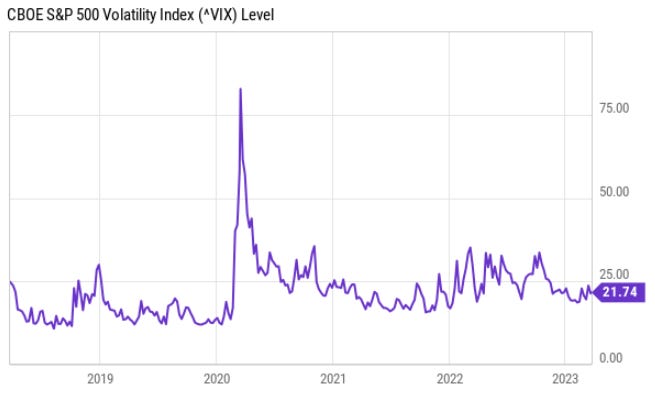
Meanwhile the blow up of Silicon Valley Bank and the ensuing swings in the market haven’t pushed volatility levels to any type of alarming level, especially when compared to the onset of the pandemic.

And let us not forget that, underneath it all, we still have to deal with the very real consequences of not dealing with consequences for the last several decades. Once again, it is time to take the medicine from our terrible monetary policy and that, in turn, is going to require a much larger response than it ever has from central banks.

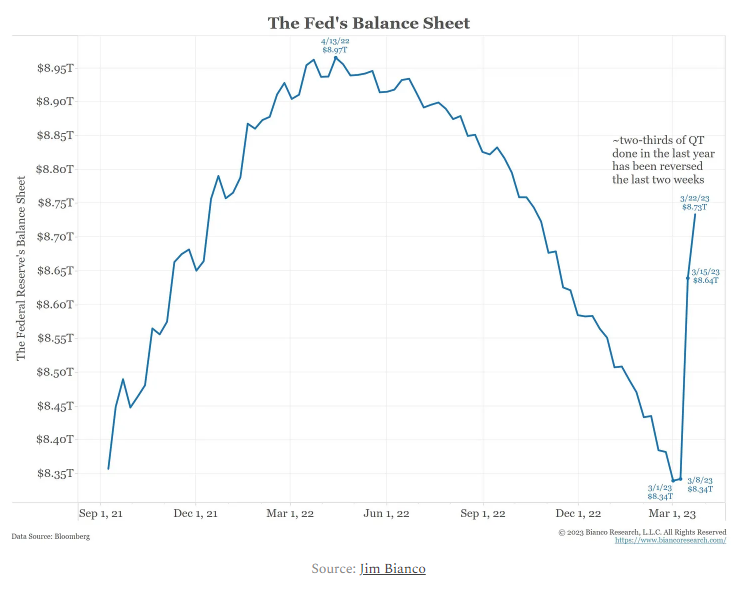
Most of the quantitative tightening that the Federal Reserve has already performed has been put back on the central bank’s balance sheet already. Now, the gate will swing wildly in the other direction as the Fed’s balance sheet inevitably starts to grow once again.

I know I repeat myself a lot talking about this stuff, but it is so important to realize: the fed is still raising rates.

Again, for the millionth time, these rate hike (or cut) moves affect the economy with a lag. Silicon Valley Bank blowing up was the result of rate hikes that took place probably six months to a year ago.

That means we have six months to a year of rate hikes that haven’t been “processed” through the economy yet.

I would guess that there are blowups happening as you read this. I guarantee you there are compliance officers in the back room of a major hedge fund somewhere right now, examining the size and scope of a massive blowup that is about to take place (or has already), that nobody knows about yet.

But in time, all of these blowups and failures will be revealed. And then, it isn’t as though they’ve just magically worked their way out of the system and we can all go about our business. You then have all of the counterparties that need to be looked at and scrutinized carefully. On top of that, every new blowup chips away a little bit more at psychology and sentiment in the market, encouraging a risk off attitude and increasing the likelihood of another blowup. Yikes.

Again, I do think the Fed will ride to the rescue here, but only once the market smashes into something hard and immovable. If the stock market was a bowling ball dropped off the roof of a 100 story building and the Fed only stepped in to react after it smashed into the sidewalk, it would still be at about the 98th floor right now.

I’d love to hear your thoughts in the comments in this free discussion here about what part of the market you think is going to blow up first, where it will reflect the most in prices, and what you think the Fed’s “plan” is going forward.

Share | Subscribe and get 65% off today

QTR’s Disclaimer: I am not a guru or an expert. I am an idiot writing a blog and often get things wrong and lose money. I may own or transact in any names mentioned in this piece at any time without warning and generally trade like a degenerate psychopath. This is not a recommendation to buy or sell any stocks or securities or any asset class – just my opinions of me and my guests. I often lose money on positions I trade/invest in and I’m sure have lost more than I’ve made in my time in markets. I may add any name mentioned in this article and sell any name mentioned in this piece at any time, without further warning. Positions can change immediately as soon as I publish this, with or without notice. You are on your own. Do not make decisions based on my blog. I exist on the fringe. The publisher does not guarantee the accuracy or completeness of the information provided in this page. These are not the opinions of any of my employers, partners, or associates. I did my best to be honest about my disclosures but can’t guarantee I am right; I write these posts after a couple beers sometimes. Also, I just straight up get shit wrong a lot. I mention it three times because it’s that important.

Tyler Durden
Mon, 03/27/2023 – 12:20

via ZeroHedge News https://ift.tt/vqrPAdC Tyler Durden

Fed Vice Chair Blames SVB Collapse On “Inadequate Risk Management”, Social Media, & Trump’s Deregulation

Fed Vice Chair Blames SVB Collapse On “Inadequate Risk Management”, Social Media, & Trump’s Deregulation

Fed Vice Chair for Supervision Michael Barr says regulators “will continue to closely monitor conditions in the banking system and are prepared to use all of our tools for any size institution, as needed, to keep the system safe and sound.”
But, Barr had plenty of blame to spread around in his prepared remarks ahead of tomorrow’s  Senat Banking Committee hearing.

Primarily, Barr notes the bank’s management was a disaster (our words not his):

SVB failed because the bank’s management did not effectively manage its interest rate and liquidity risk, and the bank then suffered a devastating and unexpected run by its uninsured depositors in a period of less than 24 hours. “

“SVB’s failure is a textbook case of mismanagement.

“At the same time, the bank failed to manage the risks of its liabilities.”

The bank waited too long to address its problems

Then ‘social media’ exaggerated the risk…

“In response, social media saw a surge in talk about a run, and uninsured depositors acted quickly to flee. Depositors withdrew funds at an extraordinary rate…”

And finally, the deregulation efforts undertaken during Trump’s presidency were highlighted as a potential trigger for why The Fed missed this huge screw up…

…was subject to a less stringent set of enhanced prudential standards than would have applied before 2019; they include less frequent stress testing by the Board, no bank-run capital stress testing requirements, and less rigorous capital planning and liquidity risk management standards.

… In addition, SVB was not subject to the supplementary leverage ratio, and its capital levels did not have to reflect unrealized losses on certain securities.

we are evaluating whether application of more stringent standards would have prompted the bank to better manage the risks that led to its failure.

Barr concludes by suggesting stiffer regulations are to come… which will ‘cost’ small and medium-sized banks far more – relatively speaking – than the ‘Big 4’

“…we plan to propose a long-term debt requirement for large banks that are not G-SIBs, so that they have a cushion of loss-absorbing resources to support their stabilization and allow for resolution in a manner that does not pose systemic risk. We will need to enhance our stress testing with multiple scenarios so that it captures a wider range of risk and uncovers channels for contagion, like those we saw in the recent series of events. We must also explore changes to our liquidity rules and other reforms to improve the resiliency of the financial system.”

Very politically palatable for his audience tomorrow.

*  *  *

Full prepared remarks below:

Chairman Brown, Ranking Member Scott, and other members of the Committee, thank you for the opportunity to testify today on the Federal Reserve’s supervisory and regulatory oversight of Silicon Valley Bank (SVB).

Our banking system is sound and resilient, with strong capital and liquidity. The Federal Reserve, working with the Treasury Department and the Federal Deposit Insurance Corporation (FDIC), took decisive actions to protect the U.S. economy and to strengthen public confidence in our banking system. These actions demonstrate that we are committed to ensuring that all deposits are safe. We will continue to closely monitor conditions in the banking system and are prepared to use all of our tools for any size institution, as needed, to keep the system safe and sound.

At the same time, the events of the last few weeks raise questions about evolving risks and what more can and should be done so that isolated banking problems do not undermine confidence in healthy banks and threaten the stability of the banking system as a whole. At the forefront of my mind is the importance of maintaining the strength and diversity of banks of all sizes that serve communities across the country.

SVB failed because the bank’s management did not effectively manage its interest rate and liquidity risk, and the bank then suffered a devastating and unexpected run by its uninsured depositors in a period of less than 24 hours. SVB’s failure demands a thorough review of what happened, including the Federal Reserve’s oversight of the bank. I am committed to ensuring that the Federal Reserve fully accounts for any supervisory or regulatory failings, and that we fully address what went wrong.

Our first step is to establish the facts—to take an unflinching look at the supervision and regulation of SVB before its failure. This review will be thorough and transparent, and reported to the public by May 1. The report will include confidential supervisory information, including supervisory assessments and exam material, so that the public can make its own assessment. Of course, we welcome and expect external reviews as well.

Why the Bank Failed

To begin, SVB’s failure is a textbook case of mismanagement. The bank had a concentrated business model, serving the technology and venture capital sector. It also grew exceedingly quickly, tripling in asset size between 2019 and 2022. During the early phase of the pandemic, and with the tech sector booming, SVB saw significant deposit growth. The bank invested the proceeds of these deposits in longer-term securities, to boost yield and increase its profits. However, the bank did not effectively manage the interest rate risk of those securities or develop effective interest rate risk measurement tools, models, and metrics.

At the same time, the bank failed to manage the risks of its liabilities. These liabilities were largely composed of deposits from venture capital firms and the tech sector, which were highly concentrated and could be volatile. Because these companies generally do not have operating revenue, they keep large balances in banks in the form of cash deposits, to make payroll and pay operating expenses. These depositors were connected by a network of venture capital firms and other ties, and when stress began, they essentially acted together to generate a bank run.

The Bank’s Failure

The bank waited too long to address its problems, and ironically, the overdue actions it finally took to strengthen its balance sheet sparked the uninsured depositor run that led to the bank’s failure. Specifically, on Wednesday, March 8, SVB announced that it realized a $1.8 billion loss in a sale of securities to raise liquidity and planned to raise capital during the following week. Uninsured depositors interpreted these actions as a signal that the bank was in distress. They turned their focus to the bank’s balance sheet, and they did not like what they saw.

In response, social media saw a surge in talk about a run, and uninsured depositors acted quickly to flee. Depositors withdrew funds at an extraordinary rate, pulling more than $40 billion in deposits from the bank on Thursday, March 9. On Thursday evening and Friday morning, the bank communicated that they expected even greater outflows that day. The bank did not have enough cash or collateral to meet those extraordinary and rapid outflows, and on Friday, March 10, SVB failed.

Panic prevailed among SVB’s remaining depositors, who saw their savings at risk and their businesses in danger of missing payroll because of the bank’s failure.

Contagion and the Government’s Response

It appeared that contagion from SVB’s failure could be far-reaching and cause damage to the broader banking system. The prospect of uninsured depositors not being able to access their funds could prompt depositors to question the overall safety and soundness of U.S. commercial banks. There were signs of distress at other banking organizations, and Signature Bank, an FDIC-supervised institution, experienced a deposit run that resulted in the bank’s failure. On Sunday, March 12, the Secretary of the Treasury, upon the unanimous recommendation of the boards of the Federal Reserve and the FDIC, approved systemic risk exceptions for the failures of SVB and Signature. This enabled the FDIC to guarantee all of the deposits of both banks. Equity and other liability holders of the two failed banks were not protected and lost their investments. Senior management was immediately removed.

In addition, the Federal Reserve (Board), with the Treasury Department’s approval, created a temporary lending facility, the Bank Term Funding Program, to allow banks to receive additional liquidity to meet any unexpected depositor demand. The facility allows banks to borrow against safe Treasury and agency securities at par for up to one year. Together with banks’ internal liquidity and stable deposits, other external sources, and discount window lending, the new facility provides ample liquidity for the banking system as a whole.

Our Review of the Bank’s Failure

Immediately following SVB’s failure, Chair Powell and I agreed that I should oversee a review of the circumstances leading up to SVB’s failure. SVB was a state member bank with a bank holding company, and so the Federal Reserve was fully responsible for the federal supervision and regulation of the bank. The California Department of Financial Protection and Innovation—the state supervisor—has announced its own review of its oversight and regulation of SVB.

In the Federal Reserve’s review, we are looking at SVB’s growth and management, our supervisory engagement with the bank, and the regulatory requirements that applied to the bank. As this process is ongoing, I will be limited in my ability to provide firm conclusions, but I will focus on what we know and where we are focusing the review.

The picture that has emerged thus far shows SVB had inadequate risk management and internal controls that struggled to keep pace with the growth of the bank. In 2021, as the bank grew rapidly in size, the bank moved into the large and foreign banking organization, or LFBO, portfolio to reflect its larger risk profile and was assigned a new team of supervisors. LFBO firms between $100 billion and $250 billion are subject to some enhanced prudential standards but not at the level of larger banks or global systemically important banks (G-SIBs).

Near the end of 2021, supervisors found deficiencies in the bank’s liquidity risk management, resulting in six supervisory findings related to the bank’s liquidity stress testing, contingency funding, and liquidity risk management. In May 2022, supervisors issued three findings related to ineffective board oversight, risk management weaknesses, and the bank’s internal audit function. In the summer of 2022, supervisors lowered the bank’s management rating to “fair” and rated the bank’s enterprise-wide governance and controls as “deficient-1.” These ratings mean that the bank was not “well managed” and was subject to growth restrictions under section 4(m) of the Bank Holding Company Act. In October 2022, supervisors met with the bank’s senior management to express concern with the bank’s interest rate risk profile and in November 2022, supervisors delivered a supervisory finding on interest rate risk management to the bank.

In mid-February 2023, staff presented to the Federal Reserve’s Board of Governors on the impact of rising interest rates on some banks’ financial condition and staff’s approach to address issues at banks. Staff discussed the issues broadly, and highlighted SVB’s interest rate and liquidity risk in particular. Staff relayed that they were actively engaged with SVB but, as it turned out, the full extent of the bank’s vulnerability was not apparent until the unexpected bank run on March 9.

Review Focus on Supervision

With respect to our review, let me start with the supervision of the bank. For all banks but the G-SIBs, the Federal Reserve organizes its supervisory approach based on asset size. The G-SIBs—our largest, most complex banks—are supervised within the Large Institution Supervision Coordinating Committee, or LISCC, portfolio. Banks with assets of $100 billion or more that are not G-SIBs are supervised within the LFBO portfolio. Banks with assets in the $10 to $100 billion range are supervised within the regional banking organization, or RBO, portfolio. Banks with assets of less than $10 billion are supervised within the community banking organization, or CBO, portfolio.

As I mentioned, SVB grew exceedingly quickly, moving from the RBO portfolio to the LFBO portfolio in 2021. Banks in the RBO portfolio are supervised by smaller teams that engage with the bank on a quarterly basis and conduct a limited number of targeted exams and a full-scope examination each year. Banks in the LFBO portfolio are supervised by larger teams that engage with the bank on an ongoing basis. As compared to RBOs, LFBO banks are subject to a greater number of targeted exams, as well as horizontal (cross-bank) exams that assess risks such as capital, liquidity, and cyber security throughout the year.7 In addition, banks in the LFBO portfolio are subject to a supervision framework with higher supervisory standards, including heightened standards for capital, liquidity, and governance.

In our review, we are focusing on whether the Federal Reserve’s supervision was appropriate for the rapid growth and vulnerabilities of the bank. While the Federal Reserve’s framework focuses on size thresholds, size is not always a good proxy for risk, particularly when a bank has a non-traditional business model. As I mentioned in a speech this month, the Federal Reserve had recently decided to establish a dedicated novel activity supervisory group, with a team of experts focused on risks of novel activities, which should help improve oversight of banks like SVB in the future.

But the unique nature of this bank and its focus on the technology sector are not the whole story. After all, SVB’s failure was brought on by mismanagement of interest rate risk and liquidity risks, which are well-known risks in banking. Our review is considering several questions:

  • How effective is the supervisory approach in identifying these risks?

  • Once risks are identified, can supervisors distinguish risks that pose a material threat to a bank’s safety and soundness?

  • Do supervisors have the tools to mitigate threats to safety and soundness?

  • Do the culture, policies, and practices of the Board and Reserve Banks support supervisors in effectively using these tools?

Beyond asking these questions, we need to ask why the bank was unable to fix and address the issues we identified in sufficient time. It is not the job of supervisors to fix the issues identified; it is the job of the bank’s senior management and board of directors to fix its problems.

Review Focus on Regulation

Let me now turn to regulation. In 2019, following the passage of The Economic Growth, Regulatory Relief, and Consumer Protection Act, the Federal Reserve revised its framework for regulation, maintaining the enhanced prudential standards applicable to G-SIBs but tailoring requirements for all other large banks. At the time of its failure, SVB was a “Category IV” bank, which meant that it was subject to a less stringent set of enhanced prudential standards than would have applied before 2019; they include less frequent stress testing by the Board, no bank-run capital stress testing requirements, and less rigorous capital planning and liquidity risk management standards. SVB was not required to submit a resolution plan to the Federal Reserve, although its bank was required to submit a resolution plan to the FDIC. And as a result of transition periods and the timing of biennial stress testing, SVB would not have been subject to stress testing until 2024, a full three years after it crossed the $100 billion asset threshold.

Also in 2019, the banking agencies tailored their capital and liquidity rules for large banks, and as a result, SVB was not subject to the liquidity coverage ratio or the net stable funding ratio. In addition, SVB was not subject to the supplementary leverage ratio, and its capital levels did not have to reflect unrealized losses on certain securities.

All of these changes are in the scope of our review. Specifically, we are evaluating whether application of more stringent standards would have prompted the bank to better manage the risks that led to its failure. We are also assessing whether SVB would have had higher levels of capital and liquidity under those standards, and whether such higher levels of capital and liquidity would have forestalled the bank’s failure or provided further resilience to the bank.

Ongoing Work to Understand and Address Emerging Risks

As I said a few months ago with regards to capital, we must be humble about our ability—and that of bank managers—to predict how a future financial crisis might unfold, how losses might be incurred, and what the effect of a financial crisis might be on the financial system and our broader economy.

The failure of SVB illustrates the need to move forward with our work to improve the resilience of the banking system. For example, it is critical that we propose and implement the Basel III endgame reforms, which will better reflect trading and operational risks in our measure of banks’ capital needs. In addition, following on our prior advance notice of proposed rulemaking, we plan to propose a long-term debt requirement for large banks that are not G-SIBs, so that they have a cushion of loss-absorbing resources to support their stabilization and allow for resolution in a manner that does not pose systemic risk. We will need to enhance our stress testing with multiple scenarios so that it captures a wider range of risk and uncovers channels for contagion, like those we saw in the recent series of events. We must also explore changes to our liquidity rules and other reforms to improve the resiliency of the financial system.

In addition, recent events have shown that we must evolve our understanding of banking in light of changing technologies and emerging risks. To that end, we are analyzing what recent events have taught us about banking, customer behavior, social media, concentrated and novel business models, rapid growth, deposit runs, interest rate risk, and other factors, and we are considering the implications for how we should be regulating and supervising our financial institutions. And for how we think about financial stability.

Part of the Federal Reserve’s core mission is to promote the safety and soundness of the banks we supervise, as well as the stability of the financial system to help ensure that the system supports a healthy economy for U.S. households, businesses, and communities. Deeply interrogating SVB’s failure and probing its broader implications is critical to our responsibility for upholding that mission.

Tyler Durden
Mon, 03/27/2023 – 12:00

via ZeroHedge News https://ift.tt/tsN58Sa Tyler Durden

Why § 230 Likely Doesn’t Provide Immunity for Libels Composed by ChatGPT, Bard, etc.

This week and likely next, I’ll be serializing my Large Libel Models? Liability for AI Output draft. I had already posted on why I think such AI programs’ communications are reasonably perceived as factual assertions, and why disclaimers about possible errors are insufficient to avoid liability. Here, I want to explain why I think § 230 doesn’t protect the AI companies, either.

[* * *]

To begin with, 47 U.S.C. § 230 likely doesn’t immunize material produced by AI programs. Section 230 states that, “No provider or user of an interactive computer service shall be treated as the publisher or speaker of any information provided by another information content provider.” “[I]nformation content provider” is defined to cover “any person or entity that is responsible, in whole or in part, for the creation or development of information provided through the Internet or any other interactive computer service.”[1] A lawsuit against an AI company would aim to treat it as publisher or speaker of information provided by itself, as an entity “that is responsible, in whole or in part, for the creation or development of [such] information.”[2]

As the leading early § 230 precedent, Zeran v. AOL, pointed out, in § 230 “Congress made a policy choice . . . not to deter harmful online speech through the . . . route of imposing tort liability on companies that serve as intermediaries for other parties’ potentially injurious messages.”[3] But Congress didn’t make the choice to immunize companies that themselves create messages that had never been expressed by third parties.[4] Section 230 thus doesn’t immunize defendants who “materially contribut[e] to [the] alleged unlawfulness” of online content.[5]

An AI company, by making and distributing an AI program that creates false and reputation-damaging accusations out of text that entirely lacks such accusations, is surely “materially contribut[ing] to [the] alleged unlawfulness” of that created material.[6] Recall that the AI programs’ output isn’t merely quotations from existing sites (as with snippets of sites offered by search engines[7]) or from existing user queries (as with some forms of autocomplete that recommend the next word or words by essentially quoting them from user-provided content).

To be sure, LLMs appear to produce each word based on word frequency connections drawn from sources in the training data. Their output is thus in some measure derivative of material produced by others.[8]

But of course all of us rely almost exclusively on words that exist elsewhere, and then arrange them in an order that likewise stems in large part from our experience reading material produced by others. Yet that can’t justify immunity for us when we assemble others’ individual words in defamatory ways. Courts have read § 230 as protecting even individual human decisions to copy-and-paste particular material that they got online into their own posts: If I get some text that was intended for use on the Internet (for instance, because it’s already been posted online), I’m immune from liability if I post it to my blog.[9] But of course if I don’t just repost such text, but instead write a new defamatory post about you, I lack § 230 immunity even if I copied each word from a different web page and then assembled them together: I’m responsible in part (or even in whole) for the creation of the defamatory information. Likewise for AI programs.

And this makes sense. If Alan posts something defamatory about Betty on his WordPress blog, that can certainly damage her reputation, especially if the blog comes up on Google searches—but at least people will recognize it as Alan’s speech, not Google’s or WordPress’s. Section 230 immunity for Google and WordPress thus makes some sense. But something that is distributed by an AI company (via its AI program) and framed as the program’s own output will be associated in the public’s mind with the credibility of the program. That may make it considerably more damaging, and would make it fair to hold the company liable for that.

Relatedly, traditional § 230 cases at least in theory allow someone—the actual creator of the speech—to be held liable for it (even if in practice the creator may be hard to identify, or outside the jurisdiction, or lack the money to pay damages). Allowing § 230 immunity for libels output by an AI program would completely cut off any recourse for the libeled person, against anyone.

In any event, as noted above, § 230 doesn’t protect entities that “materially contribut[e] to [the] alleged unlawfulness” of online content.[10] And when AI programs output defamatory text that they have themselves assembled, word by word, they are certainly materially contributing to its defamatory nature.

[1] 47 U.S.C. §§ 230(c)(1), (f)(3).

[2] I thus agree with Matt Perault’s analysis on this score. [Cite forthcoming J. Free Speech L. article.]

[3] 129 F.3d 327, 330­–31 (4th Cir. 1997).

[4] The statement in Fair Housing Council, 521 F.3d at 1175, that “If you don’t encourage illegal content, or design your website to require users to input illegal content, you will be immune,” dealt with websites that republish “user[]” “input”—it didn’t provide immunity to websites that themselves create illegal (e.g., libelous) content based on other material that they found online.

[5] Fair Housing Council of San Fernando Valley v. Roommates.com, LLC, 521 F.3d 1157, 1167–68 (9th Cir. 2008) (en banc). Many other courts have endorsed this formulation. Fed. Trade Comm’n v. LeadClick Media, LLC, 838 F.3d 158, 174 (2d Cir. 2016); Jones v. Dirty World Ent. Recordings LLC, 755 F.3d 398, 410 (6th Cir. 2014); F.T.C. v. Accusearch Inc., 570 F.3d 1187, 1200 (10th Cir. 2009); People v. Bollaert, 248 Cal. App. 4th 699, 719 (2016); Vazquez v. Buhl, 150 Conn. App. 117, 135–36 (2014); Hill v. StubHub, Inc., 219 N.C. App. 227, 238 (2012).

[6] If the AI program merely accurately “restat[es] or summariz[es]” material in its training data, even if it doesn’t use the literal words, it may still be immune. See Derek Bambauer, Authorbots, 3 J. Free Speech L. __ (2023). But I’m speaking here of situations where the AI program does “produced . . . new semantic content” rather than “merely repackage[ing] existing content.” Id. at __.

[7] See O’Kroley v. Fastcase, Inc., 831 F.3d 352 (6th Cir. 2016) (“Under [§ 230], Google thus cannot be held liable for these claims — for merely providing access to, and reproducing, the allegedly defamatory text.”).

[8] See Derek Bambauer, supra note 7, at __; Jess Miers, Yes, Section 230 Should Protect ChatGPT and Other Generative AI Tools, TechDIrt, Mar. 17, 2023, 11:59 am.

[9] See, e.g., Batzel v. Smith, 333 F.3d 1018, 1026 (9th Cir. 2003), superseded in part by statute on other grounds as stated in Breazeale v. Victim Servs., Inc., 878 F.3d 759, 766–67 (9th Cir. 2017); Barrett v. Rosenthal, 146 P.3d 510 (Cal. 2006); Phan v. Pham, 182 Cal. App. 4th 323, 324–28 (2010); Monge v. Univ. of Pennsylvania, No. CV 22-2942, 2023 WL 2471181, *3 (E.D. Pa. Mar. 10, 2023); Novins v. Cannon, No. CIV 09-5354, 2010 WL 1688695, *2 (D.N.J. Apr. 27, 2010).

[10] Fair Housing Council of San Fernando Valley v. Roommates.com, LLC, 521 F.3d 1157, 1167–68 (9th Cir. 2008) (en banc). Many other courts have endorsed this formulation. Fed. Trade Comm’n v. LeadClick Media, LLC, 838 F.3d 158, 174 (2d Cir. 2016); Jones v. Dirty World Ent. Recordings LLC, 755 F.3d 398, 410 (6th Cir. 2014); F.T.C. v. Accusearch Inc., 570 F.3d 1187, 1200 (10th Cir. 2009); People v. Bollaert, 248 Cal. App. 4th 699, 719 (2016); Vazquez v. Buhl, 150 Conn. App. 117, 135–36 (2014); Hill v. StubHub, Inc., 219 N.C. App. 227, 238 (2012).

The post Why § 230 Likely Doesn't Provide Immunity for Libels Composed by ChatGPT, Bard, etc. appeared first on Reason.com.

from Latest https://ift.tt/c4VP3BM
via IFTTT

Crisis Of Confidence Calls For A Flight To Quality

Crisis Of Confidence Calls For A Flight To Quality

By Michael Msika, Bloomberg Markets live reporter and strategist

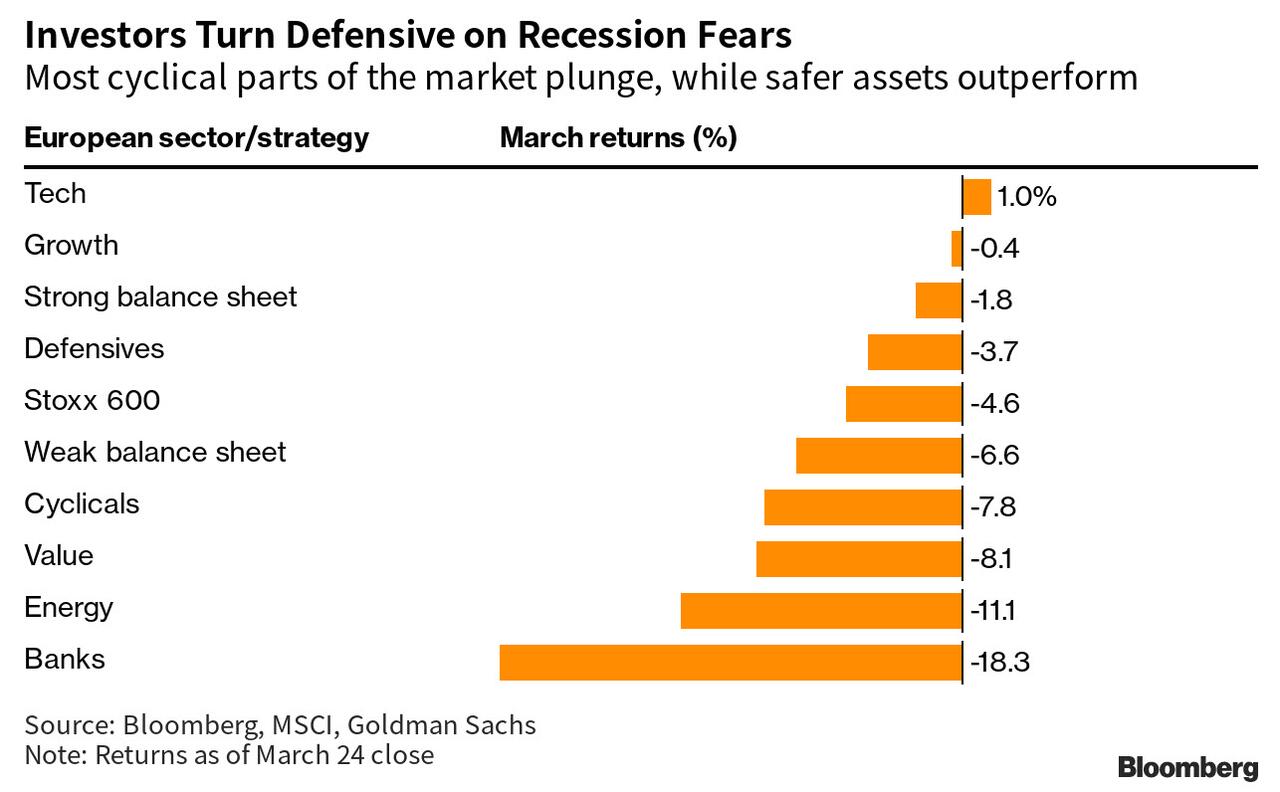
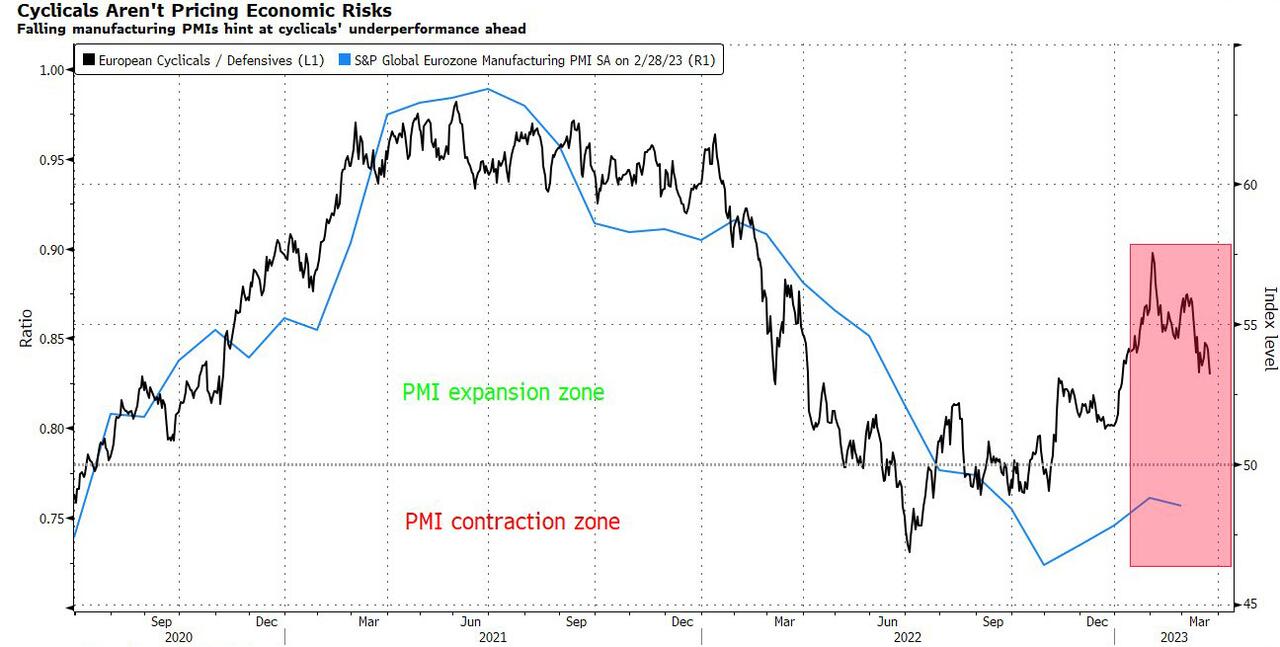
As recession risks slam into stock markets, investors are making a beeline for shares of companies that offer the safest shelter during stormy times.

Turbulence is buffeting global markets, as interventions from US and European authorities fail to really soothe concerns about the health of the financial system. Any rallies in bank shares are proving short-lived as fund managers sell and rotate into either tech or so-called defensive sectors, such as staples and health care. Friday’s selloff has left Europe’s banking sector down 18% this month, while tech has gained about 1%.

“We expect weaker growth and more financial accidents ahead,” says Morgan Stanley strategist Graham Secker, who predicts credit availability will tighten, leading to renewed weakness in economic indicators and ultimately, earnings revisions. “Investors should reduce cyclical exposure and rotate towards stocks with more defensive/quality/growth characteristics.”

Based on valuation, profitability and EPS risks, Secker cites Lufthansa, Remy Cointreau, ABB, Alfa Laval, Volvo, Nibe Industrier and Geberit as examples of stocks to avoid. His list of names to overweight contains Kerry Group, BAT, BT, ABF Foods, Mondi, Croda, Siemens Healthineers, Brenntag, Reckitt Benckiser, SAP and EssilorLuxottica.

Cyclicals’ reversal accelerated on Friday, as a dismal manufacturing PMI preliminary reading reinforced the view that stocks are pricing in a too benign economic outlook for Europe.

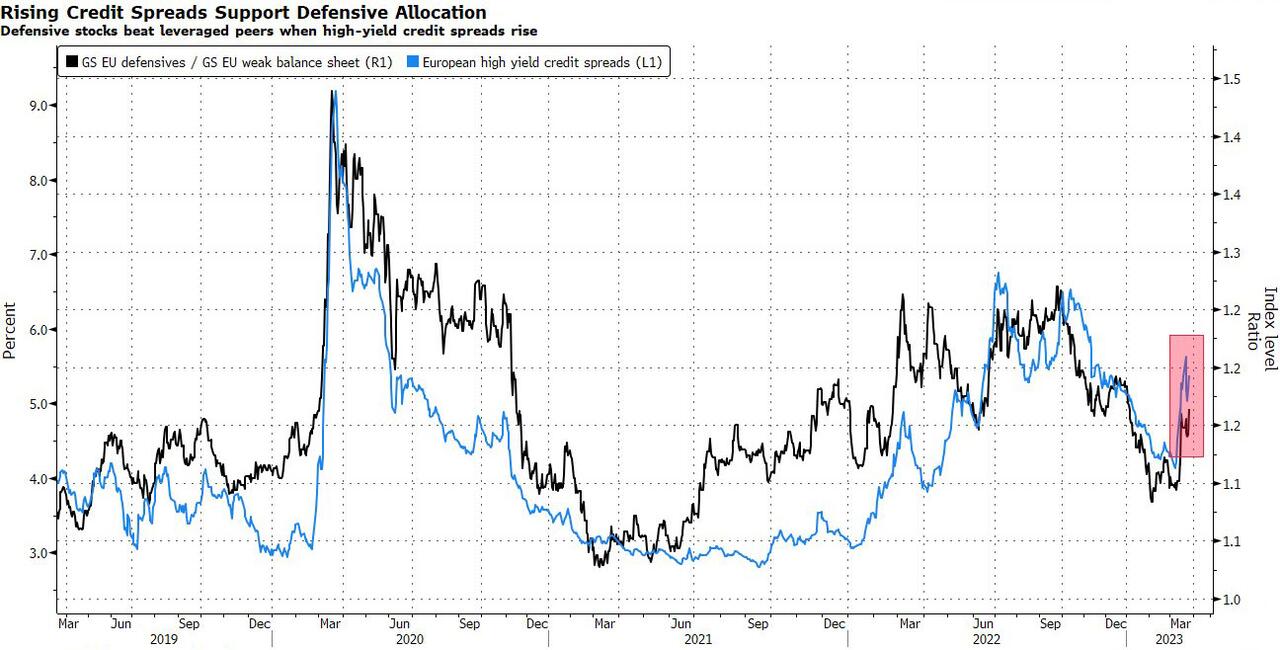
Goldman Sachs strategist Sharon Bell also recommends buying defensives, and screening out companies with weaker balance sheets. “Financial stability, liquidity concerns and credit risk are at the forefront of investors’ minds, given risks related to the banking sector,” Bell says, adding that the impact of higher rates is yet to be fully felt.

As the chart below shows, weak balance-sheet names tend to underperform defensives when high-yield credit spreads rise. Any further tightening in financial conditions would exert more pressure on credit, raising risks for highly indebted companies.

Even assuming the Fed’s rate-hike cycle is close to peaking, cyclicals’ pain may persist for longer. Barclays strategist Emmanuel Cau has analyzed the impact of Fed policy tightening cycles since the 1970’s, comparing sector performance around its last rate hike and after its first cut. “Cyclicals and financials mostly underperformed defensives over the entire period, but more after the Fed started to cut rates,” Cau says.

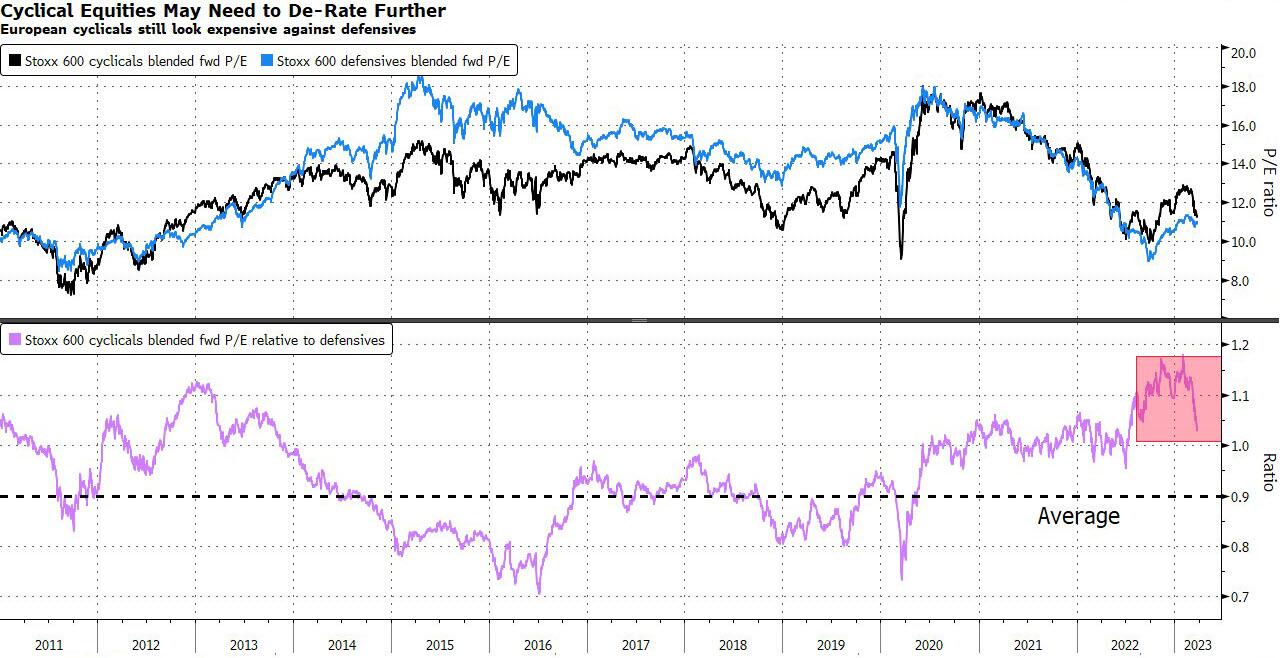
So with recession looming, it’s getting harder to justify cyclicals’ valuations. Share prices have de-rated in the past two weeks but as the chart below shows, cyclicals’ valuations, relative to defensives, can fall another 10% to 20% during downturns.

Finally, the risks are fueling a rush for the safest of all assets — cash. The assets of money-market funds now exceed $5.1 trillion, a record. Over the past two weeks, over $300 billion flowed into these funds, taking their year-to-date tally to about $450 billion.

Tyler Durden
Mon, 03/27/2023 – 11:41

via ZeroHedge News https://ift.tt/H2uGjzg Tyler Durden

Cryptos Tumble After CFTC Sues Binance And CEO Changpeng “CZ” Zhao

Cryptos Tumble After CFTC Sues Binance And CEO Changpeng “CZ” Zhao

Operation Choke Point 2.0 is escalating.

“Operation Choke Point 2.0” is a term coined by Coin Metrics co-founder Nic Carter to refer to an apparently coordinated effort to discourage banks from holding crypto deposits or providing banking services to crypto firms on the basis of “safety and soundness” for the banking system.

In a time when millions of Americans are pulling billions in deposits from failing banks and allocating them to gold and bitcoin, US regulators were scrambling to come up a means to hammer cryptos and punish those who fled the fiat realm and run toward bitcoin. They may have just come up with one solution.

Just days after Coinbase was served a Wells Notice from the SEC, Bitcoin and cryptos are in freefall following a Bloomberg report that Binance, the world’s largest cryptocurrency exchange, and Chief Executive Officer Changpeng Zhao, are being sued by the US Commodity Futures Trading Commission for allegedly breaking trading and derivatives rules.

The complaint alleges that:

Binance “actively facilitated violations of U.S. law” by assisting U.S. clients in evading compliance controls and instructing customers to obscure their location using virtual private networks, or VPNs.

The CFTC filed the lawsuit Monday in federal court in Chicago.  The derivatives regulator said Binance shirked its obligations by not properly registering with it.

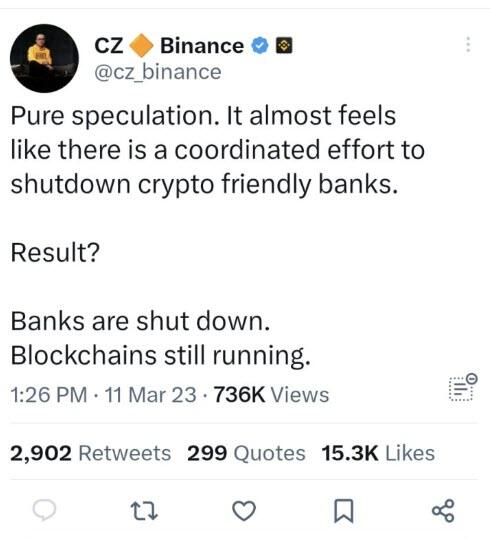
In a since deleted tweet, CZ also questioned the seeming “coordinated effort to shutdown crypto”…

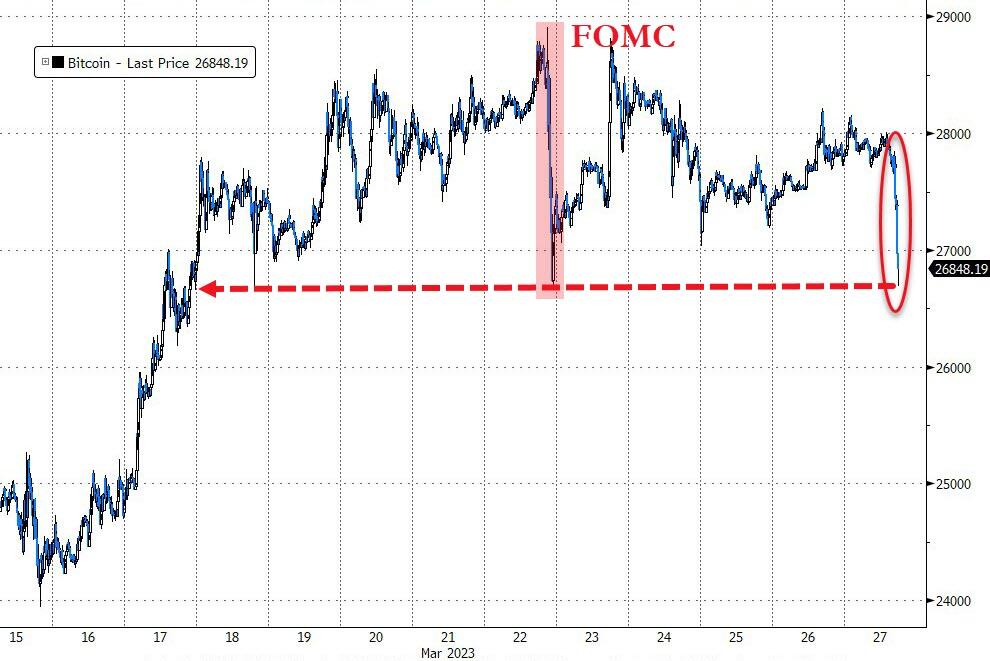
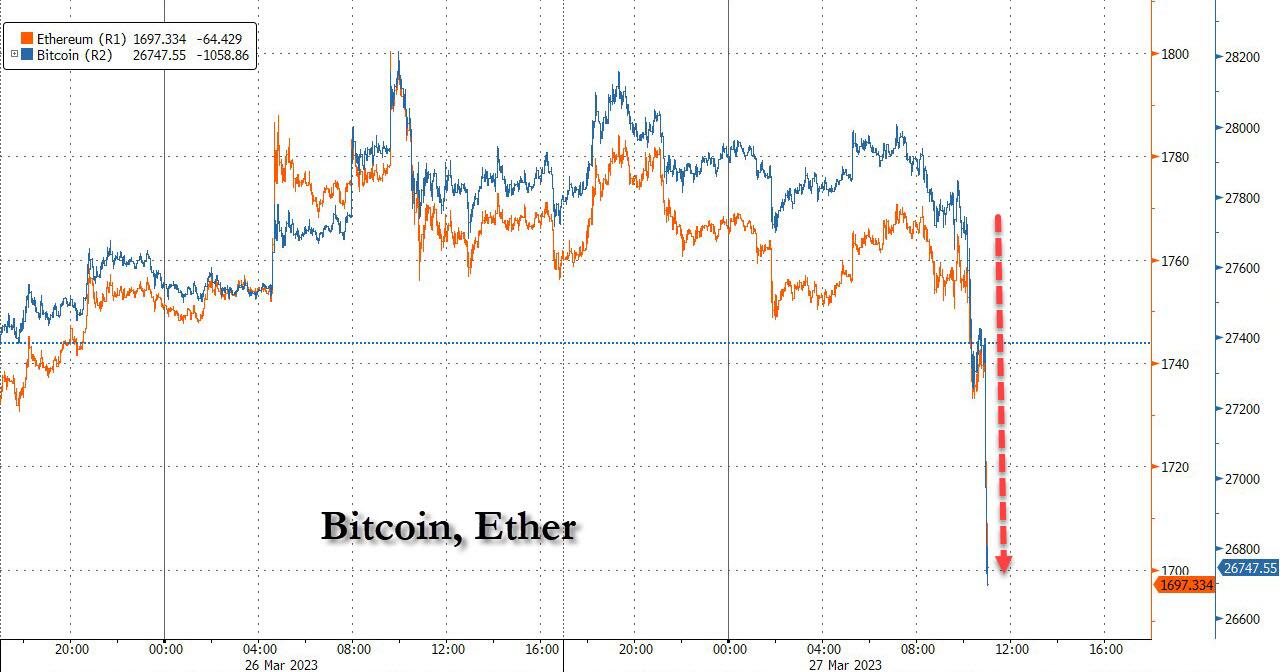
Bitcoin has tumbled to two-week lows…

And the entire crypto space is getting hit…

Additionally, crypto-related stocks are all getting hammered with Coinbase -8.8%, Riot Blockchain -7.6%, and Marathon Digital -8.3%.

As BBG notes, the CFTC has been probing Binance since 2021 over whether it failed to keep US residents from buying and selling crypto derivatives. CFTC rules generally require platforms to register with the agency if they let Americans trade those products.

According to the complaint:

“Binance, under Zhao’s direction and control and with Lim’s willful and substantial assistance, has solicited and accepted orders, accepted property to margin, and operated a facility for the trading of futures, options, swaps, and leveraged retail commodity transactions involving digital assets that are commodities including bitcoin (BTC), ether (ETH), and litecoin (LTC) for persons in the United States.”

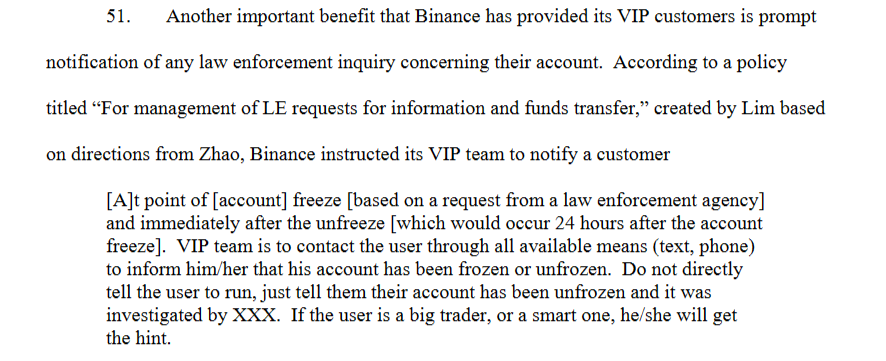
Additionally, the complaint charges that Binance would alert VIP customers of any law enforcement enquiry with their accounts…

The regulator is one of several US bodies that have been investigating Binance’s activities. The Internal Revenue Service, as well as federal prosecutors, have been examining Binance’s anti-money-laundering rule compliance, Bloomberg News has reported. The Securities and Exchange Commission has been scrutinizing whether the exchange has supported the trading of unregistered securities.

‘CZ’ had some advice at the start of the year…

And today reminds crypto investors…

As Carter previously noted, what began as a trickle is now a flood: the US government is using the banking sector (and regulatory powers) to organize a sophisticated, widespread crackdown against the crypto industry.

Tyler Durden
Mon, 03/27/2023 – 11:23

via ZeroHedge News https://ift.tt/wJR1IDy Tyler Durden

UN Issues Rare Condemnation As Zelensky Moves To Evict More Monks, Seize Churches

UN Issues Rare Condemnation As Zelensky Moves To Evict More Monks, Seize Churches

The United Nation’s human rights watchdog has voiced alarm over the Zelensky government’s targeting of the Ukrainian Orthodox Church (UOC) in a report published on Friday. The UOC, which still maintains communion with the Russian Orthodox Church, has seen its priests and monks expelled from some churches and monasteries of late, after the Ukrainian government has sought to bolster a rival nationalist church, also through controversial legislation.

The Office of the United Nations High Commissioner for Human Rights said in the new report that it is “concerned that the State’s activities targeting the UOC could be discriminatory.” The UN report pointed to “vague legal terminology and the absence of sufficient justification” in proposed anti-UOC legislation being pushed forward by the Zelensky administration.

Holy Dormition Kyivo-Pechersk Lavra, otherwise known as the Kyiv Monastery of the Caves in Kyiv, Ukraine soc.org.au

In January monks of the ancient Kiev-Caves Lavra were ousted from a main cathedral church in favor of the nationalist state-backed “Ukrainian Orthodox Church” (UOC).

And now there’s a standoff between Orthodox Christians and police over the future of fate of the 11th century Kiev-Pechersk Lavra. The monks say they’ll stay at their monastery and home for “as long as physically possible”. The monastery said “There is no legal foundation” state’s expulsion order, and many thousands of supporters have stood side-by-side with the monks over days.

According to a description in the Associated Press:

The courtyards of the Kyiv-Pechersk Lavra have been busy with more than just the usual worshippers, going to and from its churches in the sprawling monastic complex that is Ukraine’s most revered Orthodox site.

Also busy Friday were people in civilian clothes, loading cars with plasma televisions, furniture and other items from the buildings — helping the resident monks remove belongings of the Ukrainian Orthodox Church, or UOC, before a threatened government eviction on March 29.

There also were police officers checking the cars to make sure no one was removing items that belong to the Kyiv-Pechersk Lavra preserve, which oversees the complex.

Recent footage has shown church services led by the monks with thousands of Ukrainian supporters present. Zelensky officials have accused the monks of being sympathetic to Moscow.

The AP details further, “The site is owned by the government, and the agency overseeing the property notified the UOC earlier this month that as of March 29, it was terminating the lease allowing the free use of religious buildings on the property.” Additionally, “The government claims that the monks violated their lease by making alterations to the historic site and other technical infractions.”

The new UN human rights report is likely to be a boost to the monks’ cause, but it could be too little too late in terms of international support. Ukraine’s foreign ministry rejected the UN’s conclusions and lashed out, with ministry spokesperson Oleh Nikolenko saying

“In a recent report on human rights in Ukraine, the Office of the United Nations High Commissioner for Human Rights [OHCHR – ed.] noted that searches in the buildings of the UOC MP could be of a ‘discriminatory nature.’

Ukraine is a democratic state, in which freedom of religion is guaranteed. At the same time, freedom is not the same as the right to be engaged in activities that undermine national security.

We call on OHCHR to refrain from unbalanced political assessments and base its reports on facts.”

Considered one of the most important holy sites in broader Ukrainian Orthodoxy, the monastery could be emptied of its monks by police-ordered eviction on Wednesday as the deadline for them to leave looms.

Tyler Durden
Mon, 03/27/2023 – 11:05

via ZeroHedge News https://ift.tt/y5dT7Em Tyler Durden

Political Supports for an Independent Judiciary

Empirical social science does not take independent judiciaries as a given. Judicial independent might be normatively valuable, and it might even be enshrined in a constitution, but realizing and maintaining an independent judiciary is a long-term political project. Moreover, as Alexander Hamilton pointed out, judiciaries are a relatively weak branch of government, which suggests that their effective independence is fairly fragile.

Broadly speaking, there are two kinds of theories about the political supports for an independent judiciary. The two kinds of approaches are not mutually exclusive, and they are probably both significant to some degree or another. There are lots of specific variations within the broad types. But such theories are concerned with trying to explain the puzzling independence of courts.

One class of theories emphasizes elite support for judicial independence. This has generally been the focus in my work. Political Foundations of Judicial Supremacy, for example, emphasized the strategic calculations of national political leaders like presidents make in finding an independent judiciary to be politically useful. Presidents have benefited from being able to shift blame for unpopular policy outcomes to the unelected courts and to pass off politically contentious policy decisions to ideological allies in the judiciary. Repugnant Laws emphasized how the U.S. Supreme Court has husbanded political authority by cautiously exercising judicial review in a way that does not force a confrontation with ascendant political majorities. Or as I noted in a piece focusing on interaction of the Court and Congress,

Legislative support for judicial independence in the exercise of judicial review depends on a political cost-benefit analysis by legislators. If independent judicial review is more politically costly to legislators than it is beneficial to them, then the legislature is likely to seek to subvert judicial independence and to look for ways to sanction the courts. If judicial review is, on the whole, beneficial to legislators, then they are likely to support, or at least acquiesce in, an independent judiciary.

Where a fairly unified and electorally stable coalition emerges, courts are kept on a short leash. Where courts obstruct politically important policies or give incumbent governments nothing but losses, the judges are likely to get slapped.

Another class of theories emphasizes mass support for judicial independence. These theories contend that the public will impose a cost on politicians who threaten judicial independence. Some of this work examines the “diffuse support” for the courts in public opinion data. Diffuse support refers to a “reservoir of favorable attitudes or good will that helps members to accept or tolerate outputs to which they are opposed to the effects of which they see as damaging their wants.” By contrast, specific support refers to favorable attitudes about the policy outputs of the courts. Courts might be “legitimate” in the public’s eyes because they produce the policies or support the groups that a majority of the public also wants or supports, or they might be regarded as legitimate despite the fact that they produce policies that are themselves unpopular. One way in which that diffuse support might be expressed is through public opposition to judicial reform or political challenge to the courts, while the lack of diffuse support might cash out in public support for judicial reform. Even if politicians find an independent judiciary to be inconvenient, mass support for the courts can prevent politicians from doing anything about it.

The events in Israel provide a dramatic demonstration of both theories. Prime Minister Benjamin Netanyahu has advanced a proposal for judicial reform. Such proposals, like Court-packing proposals in the United States, reflect the sharp political divergence between the judiciary as currently constituted and the currently dominant political coalition. A politically confident political coalition decided the judiciary was too obstructionist to its valued policies, and so it tried to rein in the independence of the judiciary. An elite approach to judicial independence would expect as much. But in response, a huge swath of the mass public have taken to the streets to protest against the proposal and in favor of the courts. Diffuse support for the courts in the mass public in action. Such a display will often scuttle the political attack on the courts, and the possibility that something like this might happen is an important deterrent to court-curbing policies.

With Court-packing very much in the air in American politics, one wonders whether the U.S. Supreme Court could count on a similar public backlash to protect an independent judiciary here. Seems unlikely. If so, that’s one important pillar supporting judicial independence gone. The Roberts Court better hope Republicans keep winning elections.

The post Political Supports for an Independent Judiciary appeared first on Reason.com.

from Latest https://ift.tt/nY6z17i
via IFTTT

A Matter Of Trust

A Matter Of Trust

By Benjamin Picton, Senior Strategist at Rabobank

“I’ve lived long enough to have learned,
The closer you get to the fire the more you get burned,
But that won’t happen to us,
‘Cause it’s always been a matter of trust”
– Billy Joel

So we made it through a Friday evening without a bank collapse. This obviated the need for another weekend of regulatory scrambling, but if the price action is anything to go by we’re not out of the woods just yet. European bank shares took another dive on Friday after Deutsche Bank called a tier 2 bond and lit the fuse on more selling. The decision makers at Deutsche must have thought that early repayment would engender confidence. But this market is suspicious of promises, and promise-makers. Consequently, DB credit default swaps blew out and the stock sold off by more than 8%.

Deutsche could credibly claim that they are a bank more sinned against than sinning. As Paul van der Westhuizen, our Senior Financials Analyst, points out, DB has a strong profit outlook, whereas Credit Suisse didn’t. Capital and liquidity buffers are also very strong, and as a globally-systemic bank, there is little doubt that regulators and the German government would stand behind it. In short, there is no serious question over solvency or even liquidity. But banking is a trust game, and trust is hard to come by at the moment.

“It’s hard when you’re always afraid,
You just recover when another belief is betrayed,
So break my heart if you must,
It’s a matter of trust.”

Despite markets ending the week in a state of comparative calm, US authorities haven’t been idle. Data published over the weekend showed that an unknown central bank tapped the FIMA repo facility for $60bn worth of dollar liquidity last week. That is the maximum available, and there are only 23 countries with US Treasury exposures exceeding that figure, many of whom have Fed swap lines. Given that the FIMA liquidity is comparatively expensive (~20bps above market), the numbers were enough to raise some eyebrows and spark speculation about who done it. Could it be Germany? Might it have been China? And why?

Bloomberg reports that regulators are considering the expansion of emergency lending facilities to provide more support to embattled banks like First Republic. This follows confusion last week about whether or not the Biden administration would seek to extend deposit insurance to cover all deposits, rather than just up to the legislated $250,000 threshold. Treasury Secretary Yellen closed the week with an ambiguous promise to do more to support the banking system, if warranted.

Given the turbulence being experienced by otherwise healthy banks in Europe, it seems a safe bet that further steps will indeed be taken. We could learn more about what those steps might look like on Wednesday when the Fed’s Vice Chair of Supervision, Michael Barr, testifies to congress. Blanket deposit guarantees could be in the offing, but that would mean that the US government would be signing on to an $18 trillion contingent liability, backstopped by the FDIC’s $120 billion (with a ‘b’) balance sheet. Regulators have assured us that the taxpayer won’t wear the cost of depositor bailouts, but the math here is Herculean. I guess it’s just a matter of trust.

“Some love is just a lie of the soul,
A constant battle for the ultimate state of control,
After you’ve heard lie upon lie,
There can hardly be a question of why,”

Switching gears to geopolitics, Sweden, Norway, Denmark and Finland have issued a joint declaration of intent to integrate their national air forces into a single fighting unit. DefenceNews.com likens the move to the creation of a ‘mini NATO’. In effect, the move creates a reconstituted Kalmar Union (for defence purposes, at least), and highlights the realpolitik thinking of European states close to the Russian border. Clearly, there isn’t a great deal of trust there. In a similar vein, Polish PM Morawiecki criticised Germany Friday for not doing enough to support Ukraine. He also suggested NATO should ramp up defence spending to 3% of GDP and accelerate the repurposing of frozen Russian assets to assist the Ukrainian war effort.

“This time you’ve got nothing to lose,
You can take it, you can leave it, whatever you choose,
I won’t hold back anything,
And I’ll walk away a fool or a King”

Striking a more sanguine tone, EU foreign policy chief Borrell just declared Xi’s recent meeting with Putin has reduced the risk of a nuclear incident. This apparently justifies another Franco-German push for the EU to build bridges with China –‘to coax it away from Russia’– despite Hal Brands arguing via Bloomberg that what the US and the EU faces is a de facto Sino-Russian alliance. As Xi departed Moscow last week, he observed to Putin that “now there are changes that have not happened in 100 years. When we are together, we drive these changes.” Putin’s response: “I agree”. But Poland and the Baltics aside, the EU apparently isn’t getting the message. Indeed, Russia over the weekend announced that it would be deploying tactical nuclear weapons to Belarus, Poland’s immediate neighbor.

Obviously many things are in an epochal flux, from banks to geopolitics to supply chains. The Brazilian presidential state visit to Beijing this week (with 240 business people) has had to be cancelled due to pneumonia. However, Lula is calling on China, not the US, to help develop a Brazilian chip industry. As this Daily has previously argued, the world is bifurcating, and the pressure to pick a side is intense.

Meanwhile, Israel is in chaos following PM Netanyahu’s firing of his defense minister after he called for a halt to polarizing reforms to the judicial system: an estimated 600-700,000 protestors were on the street last night (up to 7% of the population), and a general strike may be called starting today. Detractors are accusing Bibi of setting himself up as a dictator. Bibi, naturally, denies it.

Again, it’s all a matter of trust.

Tyler Durden
Mon, 03/27/2023 – 10:48

via ZeroHedge News https://ift.tt/nNRBdEP Tyler Durden