Shocking Satellite Images Reveal Mississippi Town “Lies In Ruins”

Shocking Satellite Images Reveal Mississippi Town “Lies In Ruins”

Maxar Technologies tweeted shocking before and after satellite imagery of the EF4 tornado devastation across Rolling Fork, Mississippi. 

Maxar collected images before the storm unleashed a deadly twister that leveled parts of the town on Friday night, killing at least 23 people. 

Here’s more from Maxar:

To provide some context, an EF4 tornado has wind speeds ranging from 166 to 200 mph. EF4 tornadoes account for only 1% of all tornadoes, making last week’s storm extraordinarily rare.

Tyler Durden
Mon, 03/27/2023 – 15:25

via ZeroHedge News https://ift.tt/sPNwOQY Tyler Durden

Dismal 2Y Auction Sees Record Tail As Demand Crumbles Amid Bone-Crushing Daily Swings

Dismal 2Y Auction Sees Record Tail As Demand Crumbles Amid Bone-Crushing Daily Swings

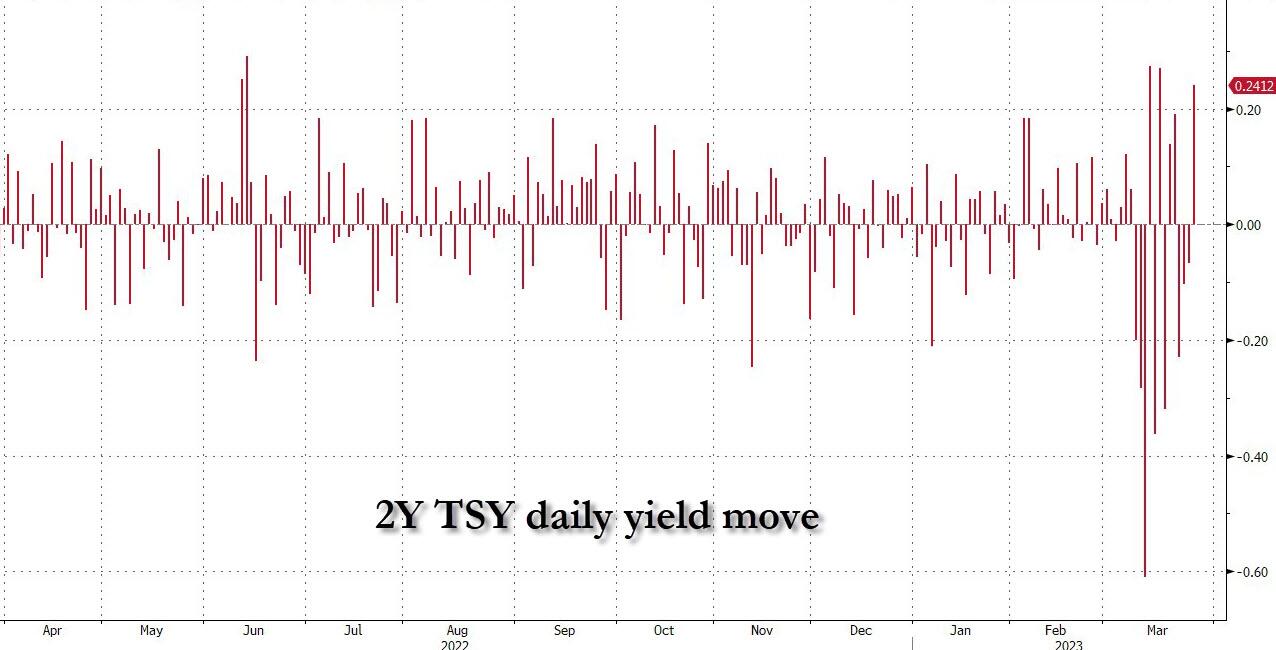
With 2Y yields swinging like a drunken sailor every day in the past three weeks, and regularly clocking at least 20bps in intraday moves as the bipolar market prices 4 rate cuts one day, and multiple rate hikes the next…

… it wasn’t a stretch to expect that today’s 2Y auction would be brutal, and it was.

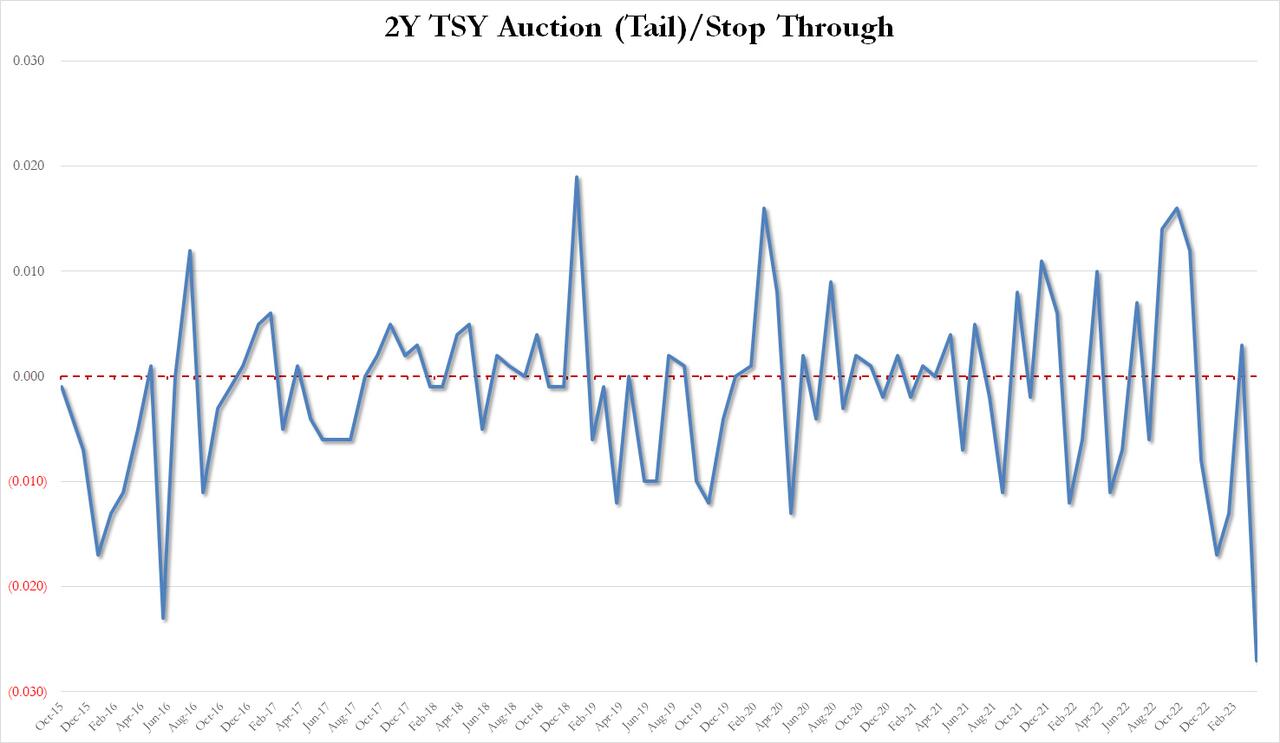
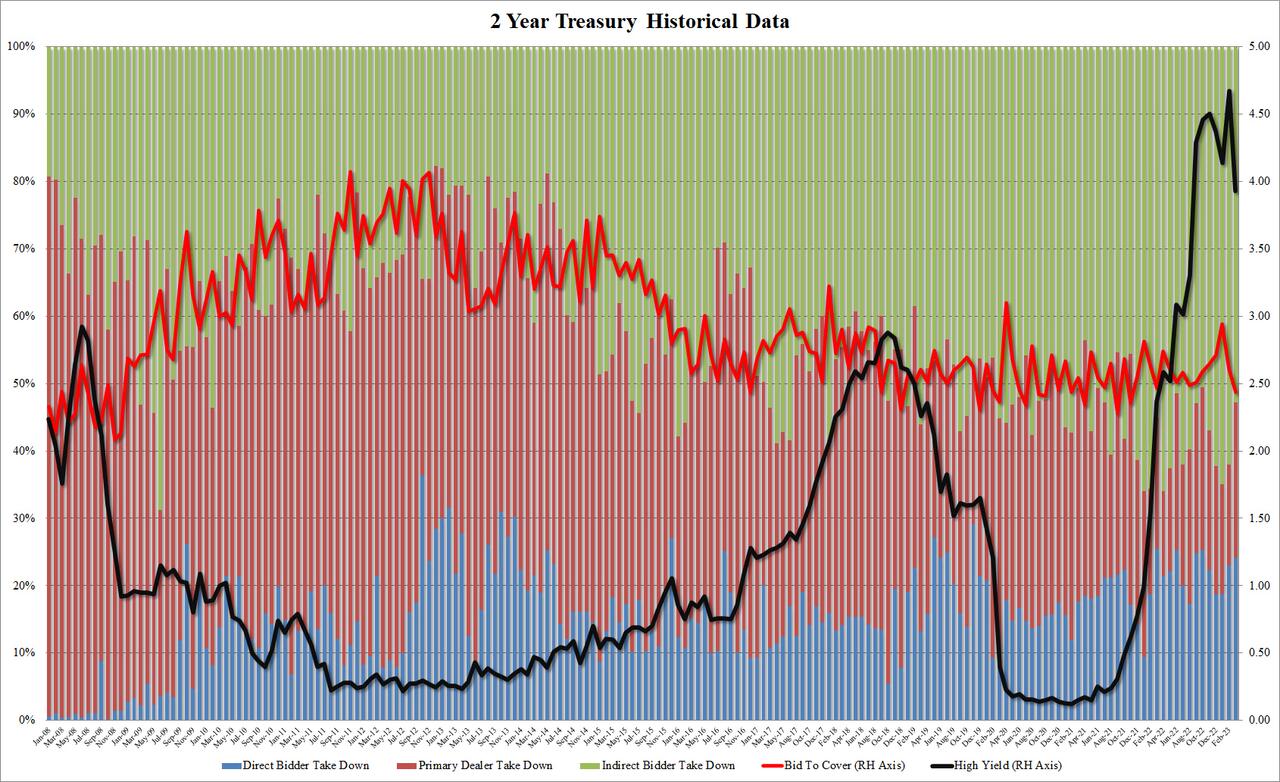
Pricing at a high yield of 3.954%, today’s 2Y auction saw the lowest yield since the 3.31% in August, and was the first sub-4% yield since September. What was more notable, however, is that high yield tailed the When Issued 3.954% by a whopping 2.7bps, which was the biggest tail since our records began in October 2015.

The bid to cover was also dismal, tumbling from 2.613 to 2.438, the lowest since Nov 2021; the internals were just as ugly with Indirects awarded just 52.8%, down sharply from 62.0% and far below the recent average of 58.3%. And with Directs awarded 24.2%, or not that far off the six-auction average, Dealers saw their take down soar to 23.03%, the highest since June 2022.

Overall, this was a surprisingly auction auction, which tailed by a record amount despite the huge concession into the 1pm deadline, which is most likely a function of the catastrophically low liquidity…

… and hence low investor demand – for the paper at a time when the market is perfectly torn whether we get even one more rate hike (latest odds of a 25bps hike were 50%) followed by multiple rate cuts… and how long until the next leg of the bank crisis claims the next victim.


Tyler Durden
Mon, 03/27/2023 – 15:09

via ZeroHedge News https://ift.tt/HkcAqf7 Tyler Durden

The Everything Bubble And Global Bankruptcy

The Everything Bubble And Global Bankruptcy

Authored by Charles Hugh Smith via OfTwoMinds blog,

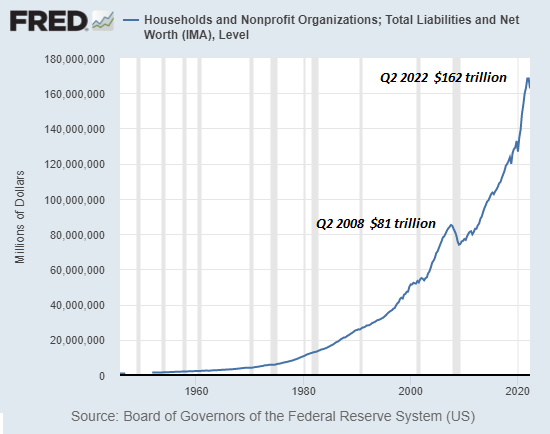
The resulting erosion of collateral will collapse the global credit bubble, a repricing/reset that will bankrupt the global economy and financial system.

Scrape away the complexity and every economic crisis and crash boils down to the precarious asymmetry between collateral and the debt secured by that collateral collapsing. It’s really that simple.

In eras of easy credit, both creditworthy and marginal borrowers are suddenly able to borrow more. This flood of new cash seeking a return fuels red-hot demand for conventional assets considered “safe investments” (real estate, blue-chip stocks and bonds), demand which given the limited supply of “safe” assets, pushes valuations of these assets to the moon.

In the euphoric atmosphere generated by easy credit and a soaring asset valuations, some of the easy credit sloshes into marginal investments (farmland that is only briefly productive if it rains enough, for example), high-risk speculative ventures based on sizzle rather than actual steak and outright frauds passed off as legitimate “sure-fire opportunities.”

The price people are willing to pay for all these assets soars as the demand created by easy credit increases. And why does credit continue increasing? The assets rising in value create more collateral which then supports more credit.

This self-reinforcing feedback appears highly virtuous in the expansion phase: the grazing land bought to put under the plow just doubled in value, so the owners can borrow more and use the cash to expand their purchase of more grazing land. The same mechanism is at work in every asset: homes, commercial real estate, stocks and bonds: the more the asset gains in value, the more collateral becomes available to support more credit.

Since there’s plenty of collateral to back up the new loans, both borrowers and lenders see the profitable expansion of credit as “safe.”

This safety is illusory, as it’s resting on an unstable pile of sand: bubble valuations driven by easy credit. We all know that price is set by what somebody will pay for the asset. What attracts less attention is price is also set by how much somebody can borrow to buy the asset.

Once the borrower has maxed out their ability to borrow (their income and assets-owned cannot support more debt) or credit conditions tighten, then those who might have paid even higher prices for assets had they been able to borrow more money can no longer borrow enough to bid the asset higher.

Since price is set on the margin (i.e. by the last sales), the normal churn of selling is enough to push valuations down. At first the euphoria is undented by the decline, but as credit tightens (interest rates rise and lending standards tighten, cutting off marginal buyers and ventures) then buyers become scarce and skittish sellers proliferate.

Questions about fundamental valuations arise, and sky-high valuations are found wanting as tightening credit reduces sales, revenues and profits. Once the “endless growth” story weakens, the claims that bubble prices are “fair value” evaporate.

As defaults rise, lenders are forced to tighten credit further. The first tumbling rocks are ignored but eventually the defaults trigger a landslide, and the credit-inflated bubble in asset valuations collapses.

As valuations plummet, so too does the collateral backing all the new debt. Debt that appeared “safe” is soon exposed as a potential push into insolvency. When the bungalow doubled in value from $500,000 to $1 million, the trajectory of valuation gains looked predictably rosy: every decade housing prices went up 30% or more. So originating a mortgage for $800,000 on a house that looked to be worth $1.3 million in a few years looked rock-solid safe.

But the $1 million was a bubble based solely on easy, abundant, low-cost credit. When credit tightens, the home is slowly but surely repriced at its pre-bubble valuation ($500,000) or perhaps much lower, if that value was merely an artifact of a previous unpopped bubble.

Now the collateral is $300,000 less than the mortgage. The owner who made a down payment of $200,000 will be wiped out by a forced sale at $500,000, and the lender (or owner of the mortgage) will take a $300,000 loss.

Given the banking system is set up to absorb only modest, incremental losses, losses of this magnitude render the lender insolvent. The lender’s capital base is drained to zero by the losses and then pushed into negative net-worth by continued losses.

The collateral collapses when bubbles pop, but the debt loaned against the now-phantom collateral remains.

This is the story of the Great Depression, a story that’s unloved because it calls into question the current series of credit-inflated bubbles and resulting financial crises. So the story is reworked into something more palatable such as “the Federal Reserve made a policy error.”

This encourages the fantasy that if central banks choose the right policies, credit bubbles and valuations detached from reality can both keep expanding forever. The reality is credit bubbles always pop, as the expansion of borrowing eventually exceeds the income and collateral of marginal borrowers, and this tsunami of cash eventually pours into marginal high-risk speculative ventures that go bust.

There is no way to thread the needle so credit-asset bubbles never pop. Yet here we are, watching the global Everything Bubble finally start collapsing, guaranteeing the collapse of collateral and all the debt issued on that collateral, and the rabble is arguing about what policy tweaks are needed to reinflate the bubble and save the global economy from bankruptcy.

Sorry, but global bankruptcy is already baked in. Too much debt has been piled on phantom-collateral and income streams derived from bubble assets rising (for example, capital gains, development taxes, etc.). The asymmetry is now so extreme that even a modest decline in asset valuations/collateral due to a garden-variety business-cycle recession of tightening financial conditions will trigger the collapse of The Everything Bubble and the mountain of global debt resting on the wind-blown sands of phantom collateral.

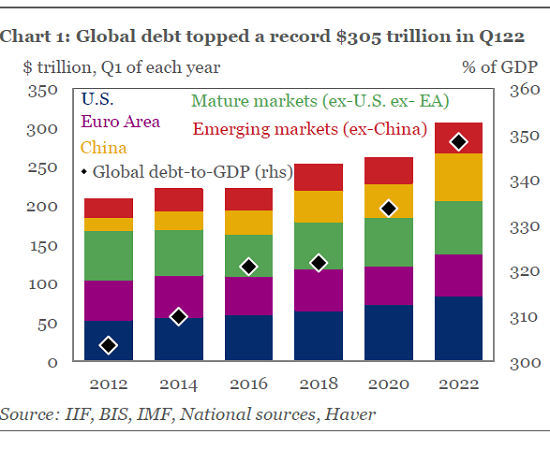
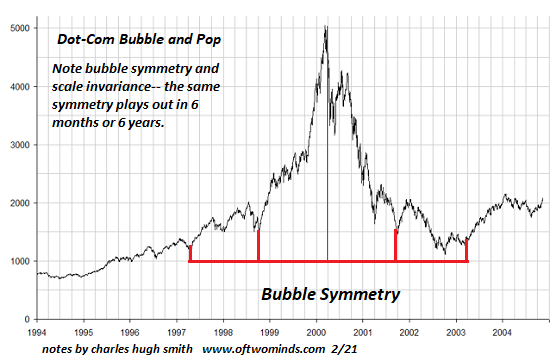
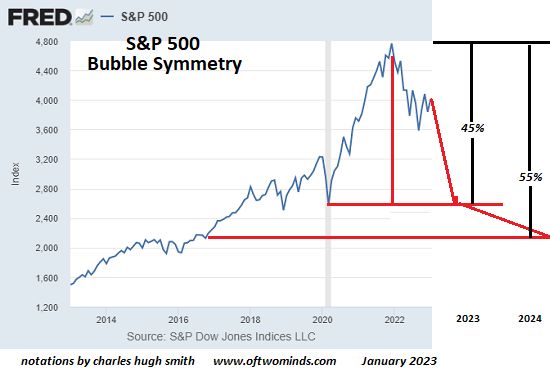
There are persuasive reasons to suspect global debt far exceeds the official level around $300 trillion, most saliently, the largely opaque shadow banking system. When assets roughly double in a few years, bubble symmetry suggests that valuations will decline back to the starting point of the bubble in roughly the same time span.

The resulting erosion of collateral will collapse the global credit bubble, a repricing/reset that will bankrupt the global economy and financial system.

*  *  *

My new book is now available at a 10% discount ($8.95 ebook, $18 print): Self-Reliance in the 21st Century.

Read the first chapter for free (PDF)

Become a $1/month patron of my work via patreon.com.

Tyler Durden
Mon, 03/27/2023 – 15:00

via ZeroHedge News https://ift.tt/cISmkx0 Tyler Durden

Agatha Christie Books Get Woke Makeover, Join Roald Dahl and Ian Fleming


Agatha Christie

The sensitivity readers have found another target: Agatha Christie.

Books by the acclaimed mystery author—who was born in the 19th century and passed away in 1976—have been edited, ostensibly to comport with modern sensibilities. “The new editions of Christie’s works are set to be released or have been released since 2020 by HarperCollins, which is said by insiders to use the services of sensitivity readers,” noted The Telegraph. “It has created new editions of the entire run of Miss Marple mysteries and selected Poirot novels.”

As was the case with recent edits to the works of Roald Dahl and Ian Fleming, the changes hardly seem necessary; there are few readers clamoring for them. The sensitivity readers, who are hired to rewrite texts and prevent offense, are making the books less colorful and descriptive. In the original Death on the Nile, some characters were described as Nubian—as in the ethnic group from the region of Nubia in northern Africa—but no longer. A character in The Mysterious Affair at Styles who was referred to as a Jew—because, well, he is a Jew—is now just a person. And a servant identified as black no longer has a race at all.

It’s one thing to change outdated ethnic references or references that specifically malign a specific race. Christie is no stranger to that: Her 1939 book, And Then There Were None, was originally published under the name Ten Little Niggers in the United Kingdom, where the racial slur was not as broadly offensive. (The book was named after a children’s rhyme.)

It’s quite another matter to delete all references to ethnicity because… why do it? Who is offended by knowing the race of a specific character? Should books cease acknowledging Africans, Jews, and Indians?

The great irony is that many progressives are correctly outraged about Republican attempts to remove references to LGBT characters in public schools and libraries; critics have characterized these bills, like the one in Florida, as “Don’t Say Gay” legislation. A similar law that restricts racial content in schools prompted a publisher to delete references to Rosa Parks’ race due to compliance concerns. This stuff from Republicans is idiotic; it’s also a mirror version of precisely what book publishers are doing to Christie, Dahl, and others at the behest of woke literary scolds.

The post Agatha Christie Books Get Woke Makeover, Join Roald Dahl and Ian Fleming appeared first on Reason.com.

from Latest https://ift.tt/CbV5N80
via IFTTT

Federal Courts Clash Over Financial Watchdog’s Constitutionality


CFPB Director Rohit Chopra

The U.S. Court of Appeals for the 2nd Circuit on Thursday ruled that the way in which Congress funds the Consumer Financial Protection Bureau is, in fact, constitutional. The ruling contradicts an opinion published in October by the U.S. Court of Appeals for the 5th Circuit, which held that the agency’s funding “violates the Constitution’s structural separation of powers.” The Supreme Court, which had already agreed to review the 5th Circuit case, will likely resolve the circuit split next year.

The argument against the CFPB’s constitutionality is simple. The Constitution’s appropriations clause requires that monies drawn from the treasury be authorized by “Appropriations made by Law”—a power vested in Congress. Per statute, however, the CFPB funds itself unilaterally, requisitioning funds from the Federal Reserve (limited to 12 percent of the Fed’s operating expenses). The CFPB bypassing the congressional appropriations process is an unconstitutional delegation by Congress of its “power of the purse.”

“I hope the justices provide clarity on a number of issues there, because the CFPB has been constitutionally problematic from its inception,” Ilya Shapiro, director of constitutional studies at the Manhattan Institute, tells Reason

Judge Cory T. Wilson, writing for the 5th Circuit panel in October, argued that Congress “double-insulated” the CFPB from the traditional appropriations process: Not only does the agency self-fund, but its funding originates in the Federal Reserve, another entity that lives “outside the appropriations process.” Wilson further noted that the Consumer Financial Protection Act “tacitly admits such a distinction in its decree that ‘[f]unds obtained by or transferred to the Bureau Fund shall not be construed to be . . . appropriated monies.'”

The CFPB has long weathered accusations that its structure violates constitutional separations of powers. More than a decade ago, C. Boyden Gray, who is a trustee for the Reason Foundation, which publishes this magazine, and Adam J. White, a professor at George Mason University’s Antonin Scalia Law School, warned that Congress “delegate[d] effectively unbounded power to the CFPB, and couple[d] that power with provisions insulating CFPB against meaningful checks.” Indeed, until the Supreme Court’s ruling in Seila Law v. CFPB (2020), the CFPB director was largely statutorily insulated from removal by the president. “The bureau is a self-perpetuating body so extra-constitutional that it’s really a fifth branch of government beyond even ‘independent’ agencies like the SEC and FCC that legal wags have dubbed the ‘fourth branch,'” Shapiro says.

“Congress relinquished its jurisdiction to review agency funding on the back end,” Wilson wrote. “Wherever the line between a constitutionally and unconstitutionally funded agency may be, this unprecedented arrangement crosses it.”

Democrats constructed the CFPB as a quintessentially progressive regulatory institution: A partnership of government and big business, helmed by putatively disinterested and de facto unaccountable bureaucrats. Insulation from democratic accountability is, however, incompatible with the Constitution’s plain text. “An elective despotism was not the government we fought for,” wrote James Madison in Federalist No. 48, “but one which should not only be founded on free principles, but in which the powers of government should be so divided and balanced…that no one could transcend their legal limits, without being effectually checked and restrained by the others.”

The post Federal Courts Clash Over Financial Watchdog's Constitutionality appeared first on Reason.com.

from Latest https://ift.tt/BY8q94i
via IFTTT

28-Year-Old Woman Kills 6 In Nashville Christian School Mass Shooting

28-Year-Old Woman Kills 6 In Nashville Christian School Mass Shooting

A 28-year-old woman carried out a mass shooting at a private Christian school in Nashville on Monday, resulting in the deaths of at least three children and three staff members. The Tennessean reported that police killed the female shooter.

Don Aaron, a spokesperson for the Metro Nashville Police Department, said the female shooter entered The Covenant School on Burton Hills Boulevard with two rifles and a handgun.

“The police department response was swift.

“Officers entered the first story of the school and begin clearing it. They heard shots coming from the second level; they immediately went to the gunfire,” Aaron said.

The Tennessean said a five-member police team shot the woman around 1030 ET in the second-floor lobby of the school. 

*Developing

Tyler Durden
Mon, 03/27/2023 – 14:43

via ZeroHedge News https://ift.tt/FRn5BOp Tyler Durden

CNN Blasted After Lecturing People Not To Use “Digital Blackface”

CNN Blasted After Lecturing People Not To Use “Digital Blackface”

Authored by Steve Watson via Summit News,

Mass backlash has ensued after a CNN report accused white people of using ‘digital blackface’ by posting memes of black people’s reactions as a way of expressing their feelings about situations.

In the piece, headlined What’s ‘digital blackface?’ And why is it wrong when White people use it, CNN writer John Blake states the following:

Blake argues that such memes and gifs are “radicalized reactions,” and that while black people “get a pass” for using them, white people posting them have “inadvertently perpetuated one of the most insidious forms of contemporary racism.”

Blake goes on to declare that the use of the memes by whitey is a “modern-day repackaging of minstrel shows.”

Yeah… no:

And then the inevitable happened:

Time to call the meme police?


*  *  *

Brand new merch now available! Get it at https://www.pjwshop.com/

In the age of mass Silicon Valley censorship It is crucial that we stay in touch. We need you to sign up for our free newsletter here. Support our sponsor – Turbo Force – a supercharged boost of clean energy without the comedown. Also, we urgently need your financial support here.

Tyler Durden
Mon, 03/27/2023 – 14:23

via ZeroHedge News https://ift.tt/owiEPXT Tyler Durden

Russia To Complete Infrastructure For Poseidon-Capable Nuclear Submarine Fleet By 2024

Russia To Complete Infrastructure For Poseidon-Capable Nuclear Submarine Fleet By 2024

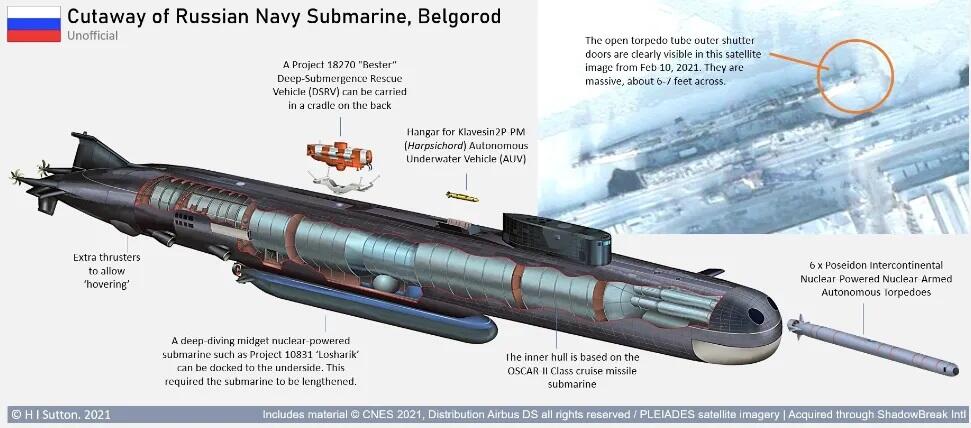
Russia’s TASS news agency reported this week that, according to the Russian Defense Ministry, infrastructure development plans for updated Pacific fleet nuclear submarine operations are set to be completed in early 2024.  Pacific operations, once considered a long neglected element of Russia’s navy, have been undergoing a revamp since 2015 under orders from the Kremlin.  The completion of base improvements coincides with the reported deployment of Russia’s new Poseidon super torpedoes, which were also commissioned in 2015.

Though TASS is often accused of acting as a propaganda platform for the Russian government, developments on the Poseidon torpedo are confirmed by multiple sources including the US Department of Defense and Congress.

The first delivery of Poseidon torpedoes was officially announced in January of 2023, and dummy rounds were tested in the arctic around the same time period.  The weapons, which some sources refer to as “terrifying Apocalypse torpedoes” are 65ft long, though estimates greatly vary on the nuclear yield of the weapons.  Some experts argue the Poseidon could carry a 2 megaton warhead, others argue that it is capable of carrying up to a 100 megaton yield.  A 2 megaton warhead would be 100 times the explosive power of the bombs dropped on Hiroshima and Nagasaki in WWII.


But what makes the Poseidon more dangerous than the average nuke?  Data on the device is limited, but the torpedoes are suspected to be a mixture of missile and drone technology.  They carry a nuclear powered propulsion engine and can travel 80 miles per hour underwater (making countermeasures difficult).  To give a sense of the speed, the average US nuclear submarine travels around 30 miles per hour (complete details are top secret), and the average US sub torpedo travels at around 57 miles per hour.  In other words, catching and killing a Poseidon torpedo would be almost impossible.  

The Poseidon system functions essentially as a fast roaming autonomous underwater nuke which can stalk an enemy coast for long distances until it is ordered to strike a particular target.


The Poseidon is not considered a first-strike weapon because of its design, but is instead meant to act as a post-attack trump card.  Meaning, even if a large number of Russian nuclear launch facilities were destroyed in a first strike, and even if Russian subs were countered, Russia would still have the Poseidon torpedoes traveling under the oceans waiting to hit targets in an evolving battle-space, acting independently of their submarine fleet.  By extension, if US or European defenses improved to intercept standard ICBMs, the Poseidon would still be able to deliver nuclear payloads to coastal targets.  

That said, there is first strike potential for the weapons given their speed and the relative difficulty of defense against them.  They can be used, not as a direct strike system, but as an indirect system by exploding just off the coast of a target city, creating a 500 foot radioactive tidal wave.  They can also be used as a cavitation weapon that wipes out entire carrier battle-groups.    

US Defense Department estimates suggest that Russia is constructing or refitting at least four nuclear subs to carry the large torpedoes, and that at least 30 Poseidons are being built.  The latest news of the coming completion of infrastructure for Pacific bases suggests these preparations are almost finished.  

With the war in Ukraine continuing unabated and the country acting as a veritable proxy for NATO, the question of nuclear conflict between the West and Russia has been entertained often.  While it’s unlikely that a nuclear exchange would benefit either side in any measurable way, the potential is ever present.  With Belarus apparently ready to establish Russian tactical nuke sites within their borders this year and Vladimir Zelensky admitting this week that Ukraine is “out of ammo”, one has to wonder how the conflict will escalate in the coming months.            

Tyler Durden
Mon, 03/27/2023 – 14:00

via ZeroHedge News https://ift.tt/4QxS5VW Tyler Durden

Will Havens Realty Be “Abandoned” Like The Lemon Test?

In recent years, the Supreme Court has overruled several precedents. However, the Court has largely left in place the seminal doctrine from the Warren Court. Rather, the Justices have clawed back at decisions from the Burger Court. Roe v. Wade was overruled, but Griswold v. Connecticut remains safe. Lemon v. Kurtzman is gone, but Engel v. Vitale abides. Rucho v. Common Cause overruled Davis v. Bandemer, but Baker v. Carr survives. Janus overruled Abood but did not disturb Railway Employees’ Dept. v. Hanson. Franchise Tax Board of California v. Hyatt overruled Nevada v. HallKnick v. Township of Scott overruled Willimason County. Obergefell overruled Baker v. Nelson. Wait, scratch that last one. But you get the picture.

Another precedent from the Burger Court may soon be on the chopping block: Havens Realty v. Coleman (1982). This case found that an organization can assert an Article III injury based on a “drain of the organization’s resources.” For example, an organization that sends a “tester” to determine if there was a violation of the law could claim the money needed to send the tester was an injury in fact. This injury seems to be self-inflicted, as that term is understood today: anyone can generate standing-on-demand by spending money to investigate the alleged illegal activity.

I became intimately familiar with Havens Realty during the early days of the Emoluments Clause litigation. Eventually, the lead plaintiffs were owners of hotels and restaurants that competed with Trump properties. But initially, the lone plaintiff was CREW, a public interest organization. Unsurprisingly, CREW’s only basis for standing was Havens Realty. Here is how I described the self-inflicted injury in January 2017:

In short, the complaint argues that because CREW is spending time on Trump’s emolument issue, they are not able to do things they would otherwise do. Therefore, they are injured under Article III, and can bring suit.

In hindsight, CREW would spend four years opposing everything Trump would do, so I’m not sure they could even claim such an injury! And also in hindsight, CREW was found to not have standing in SDNY, and the organization did not appeal that decision. But more importantly, at the time, I did not understand how Havens could be reconciled with more recent standing doctrine, like Spokeo v. Robbins (2016) and Clapper v. Amnesty International (2012). Neither case even cited Havens Realty. Then again, Larry Tribe called my standing arguments a “linguistic sleight of hand.” So what did I know?

Fast-forward to the TransUnion LLC v. Ramirez (2021). Like Spokeo and Clapper, the Court did not even mention Havens Realty. The case is mentioned in Justice Thomas’s dissent, though he focuses on the congressional enactment of the statute, and not the self-inflicted injury question.

Today the Supreme Court granted cert in Acheson Hotels v. Laufer. The case involves a so-called “tester.” Specifically, a disabled person would visit the website of a hotel that she has no intent of staying at. Then she would sue the hotel for failing to provide enough information about accommodations for disabilities. The cert petition wisely does not ask the Court to squarely overrule Havens Realty. Rather that precedent can be distinguished. But the petition does question how Havens Realty can survive TransUnion.

Third, this case presents an issue only this Court can resolve. This case is difficult for lower courts because they must reconcile older Supreme Court case law taking a more lenient view of standing, see Havens Realty Corp. v. Coleman, 455 U.S. 363 (1982), with this Court’s more recent decision in TransUnion LLC v. Ramirez, 141 S. Ct. 2190 (2021). Indeed, the First Circuit noted that its ruling was in significant tension with TransUnion, but nonetheless deemed Havens Realty to be the on-point binding precedent. As Judge Jordan similarly concluded, “Havens Realty may be inconsistent (in whole or in part) with current standing jurisprudence,” but “[f]or now, though, it remains binding precedent that governs here.” Arpan, 29 F.4th at 1276 (Jordan, J., concurring). By contrast, the Second, Fifth, and Tenth Circuits have held that TransUnion, not Havens Realty, is the more pertinent precedent. This Court’s review is warranted because only this Court can provide guidance on what its own precedents mean. As Judge Newsom put it: “I suspect that the law concerning ‘stigmatic injury’ will remain deeply unsettled until the Supreme Court steps in to provide additional guidance.” Id. at 1287 (Newsom, J., concurring).

Finally, the Court should grant certiorari because the First Circuit’s decision is wrong. Laufer’s abstract desire to ensure compliance with federal law does not give her Article III standing. To the extent Havens Realty survives TransUnion, it is readily distinguishable. In Havens Realty, the plaintiff was personally denied information on the basis of her race, and this Court found standing based on its view that.

In many regards, Havens Realty reminds me of the Lemon Test. In all the big Establishment Clause cases, the Court did not rely on LemonMarsh v. ChambersMcCreary CountyVan OrdenTown of GreeceAmerican Legion, and so on. How could Lemon possibly survive all those cases? Thus, the Court deemed Lemon as “abandoned.” Likewise, the Court did not even cite Havens Realty in Spokeo, Clapper, or TransUnion. Has Havens Realty been abandoned? We’ll find by June 2024.

The post Will <i>Havens Realty</i> Be "Abandoned" Like The <i>Lemon</i> Test? appeared first on Reason.com.

from Latest https://ift.tt/0RH6rEz
via IFTTT

Second Amendment Roundup: District Court Invalidates California’s Unsafe Handgun Act

On March 20, 2023, U.S. District Judge Cormac J. Carney of the Central District of California issued a preliminary injunction in Boland v. Bonta against enforcement of California’s ban on the retail sale of semiautomatic pistols that do not have a chamber load indicator, a magazine disconnect mechanism, and microstamping capability.  Since no pistols with all three features are manufactured nationwide, the Unsafe Handgun Act amounts to a prohibition that violates the Second Amendment.  The Act requires Californians who want to exercise their Second Amendment rights to purchase pistols designed over two decades ago and prohibits, with narrow exceptions, their acquisition of modern-day pistols.

A chamber load indicator may take the form of either a visual recess or a small stud that protrudes upward from atop a pistol slide when a cartridge is in the chamber.  A magazine disconnect prevents a pistol from being fired unless a magazine is fully engaged in the pistol. These designs do exist, but the latter is rejected by many for the very reason that it may prevent the pistol from being fired in an emergency.

Microstamping is the mostly-theoretical process that consists of the transfer from a firearm’s firing pin to the cartridge casing of a fired round of ammunition microscopic characters identifying the firearm’s make, model, and serial number. This is not a feasible technology and just doesn’t exist in reality.  That’s why, Boland found that, “no handgun available in the world has all three of these features.”

When it originally passed, the Unsafe Handgun Act required a drop test, firing test, and other tests for pistols to be placed on the Roster of Not Unsafe Handguns (they couldn’t bring themselves to say “Safe Handguns”).  Some 800 “grandfathered” pistols remain on the Roster from the original requirements.  In 2007, the chamber load indicator and magazine disconnect requirements were enacted, although few pistols had those features, and only 32 pistols with those features were thereafter added to the Roster.

But since 2013, when the microstamping requirement was imposed, not a single new pistol has been added to the Roster.  Since they are grandfathered, the 832 pistols left on the Roster are not required to have the three newest features, and thus don’t meet the current definition of “not unsafe.”

To top that off, the Act doesn’t apply to law enforcement or other government entities.  They can buy all the “unsafe” pistols they like.  And when they upgrade, they can sell the “unsafe” pistols at inflated prices to private citizens, although few go on the market.

Manufacturers regularly improve their firearms by making them safer and more reliable, but these improved models may not be sold at retail in California.  Once a year, manufacturers must certify that no changes have been made to their models listed on the Roster, which prevents use of newer, better parts. Pistol designs are frozen in time as of 2007, leading Judge Carney to find: “Requiring Californians to purchase only outdated handguns for self-defense without question infringes their right to keep and bear arms.”

Since the Supreme Court decided Heller, it cannot be argued that it’s okay to ban some guns if others are allowed.  Indeed, while the Boland opinion doesn’t explicitly mention Heller‘s test that arms in common use are protected arms and may not be banned, it could and should have stopped right there and invalidated the Act on the basis that post-2007 handgun designs are in common use by law-abiding citizens for lawful purposes throughout the United States.

In Heller, the Supreme Court effectively applied Bruen’s text-and-history test (before it became the Bruen text-and-history test) to arrive at the “common-use” test, which governs questions about the constitutionality of firearm prohibitions.  Because the Heller Court did the text and historical work already, lower courts (such as Judge Carney) do not need to consider alleged historical analogues when deciding arms ban cases. Heller’s common-use test is the governing law and the standard that every court should apply.

In Boland, the court went straight to Bruen, with its presumption that bearable arms are protected, skipping over Heller’s test that the common use of those bearable arms precludes any justification by the government of its restrictions via analogues to regulations in the founding era.  Historical tradition becomes relevant only for arms that are not in common use.

Even so, California’s attempt to assemble historical evidence fell flat. Through its expert historian Saul Cornell, the state relied on “proving” laws and gunpowder storage rules as analogues from the founding period.

“Proving” or “proofing” refers to the testing of firearm barrels with higher-than-normal amounts of gunpowder to ensure that they will not crack or fail under pressure. For centuries, European states have required testing in proof houses, which stamp barrels that pass the test with proof marks.

In the United States, such testing has been largely prompted by gun makers striving for a good reputation and being subject to tort liability.  However, a few early states mandated proving by law. For instance, Massachusetts enacted a “proving” law in 1804 requiring that muskets and pistols manufactured in the Commonwealth had to be tested with certain loads of gunpowder to demonstrate that they were safe to fire.  An inspector would stamp the barrel to show that it had been proved.

The court found California’s ban not to be analogous to such proving laws.  While “proving laws supported the use of firearms for self-defense by ensuring the weapon worked properly and safely,” California’s requirement that a pistol will not fire without a magazine inserted “can actually work against the use of a handgun for self-defense….” Proving laws were enacted to ensure that barrels would not burst on firing and that shots would fire minimum distances, while California’s restrictions suppress design improvements that make pistols safer and more effective. Indeed, California has banned the sale of “virtually all new, state-of-the-art handguns.”

Nor is California’s law analogous to gunpowder storage laws at the founding.  As a fire prevention measure, an outlier 1783 Massachusetts law prohibited the storage of a loaded firearm in a building, and other states limited the amount of gunpowder that one could store.  (For well over a century now, the highly volatile black powder has been replaced with the more stable smokeless powder.) It is noteworthy the Supreme Court in Heller also distinguished these fire code-related black powder laws.

As the Boland court found, “the main goal of gunpowder storage laws was to prevent fire,” while California’s loaded chamber and magazine requirements “are meant to prevent inadvertent discharge or firing of the firearm.”

The court further rejected California’s argument that microstamping is similar to requiring serial numbers on firearms.  “In contrast to the requirement of a serial number, which has been universally and easily implemented by manufacturers across the globe, not a single manufacturer has implemented microstamping technology, and indeed it is not feasible to implement such technology broadly.” And, again, the “why” of this law has nothing to do with helping gun owners discharge safe and effective arms, but instead was enacted to help law enforcement (in theory) solve crimes.

While Americans elsewhere have access to pistols that are “more ergonomic, durable, reliable, affordable, and possibly even safer,” Californians are stuck with pistols with designs frozen in time in 2007.  And these grandfathered pistols do not have the supposed safety features that are now required.  Not to mention that government actors may buy any pistols they wish, leaving the safety arguments with little credibility.

The Boland court issued a preliminary injunction against enforcement of the Unsafe Handgun Act, but stayed it for two weeks (to April 3) to give the Attorney General an opportunity to seek a further stay from the Ninth Circuit. What are the chances that the Ninth won’t issue a further stay, given its history of consistently reversing pro-Second Amendment decisions?

There is a back story to the opinion expressed in three days of hearings before Judge Carney.  California’s star witness was Saul Cornell, who testified that in his opinion, California’s law fully complied with the Bruen decision.  That was based on historical analogues like the proving laws and gunpowder storage laws.

The fun began with the cross-examination by plaintiffs’ counsel Joshua Dale.  Cornell started with his usual attack on “law office history,” which misuses history “to advance a contemporary policy agenda.”  (Sounds kinda like what he himself does.)  Scholars supporting the individual-rights view of the Second Amendment, which Cornell has derided for decades, are “libertarians” who “read 18th century texts as if they were ghost-written by Ayn Rand.”  And that would include the majority on the Supreme Court.

Just after Bruen was decided, Cornell wrote a piece for SCOTUSBlog. Mr. Dale asked Cornell if his opinions now were based on Bruen.  In the article, Cornell described “Justice Thomas’s decision as an illustration of the current Supreme Court’s new interpretative model – fiction, fantasy, and mythology.”  He referred to “the bizarro constitutional universe inhabited by Thomas,” said the Court cherry-picked evidence to “support the ideological agenda of the federalist society [sic],” and referred to Justices Gorsuch and Barrett as “ideological warriors and political hacks.”

Whew!

That caused Dale to ask, “what assurances you can give to the Court in light of the fact that your views were rejected by the Court in Heller; they were rejected, again, in Bruen.”  Cornell responded that he easily moves between his roles as a writer and as an expert witness, which he described as “the very definition of an accomplished scholar.”

Judge Carney wasn’t buying it.  We’ll see what the Ninth Circuit does.

It goes without saying that whether a firearm restriction violates the Second Amendment is a pure question of law to be decided by the courts.  “It is, emphatically, the province and duty of the judicial department, to say what the law is,” as Chief Justice John Marshall famously said.  As Cornell’s testimony illustrates, the opinions of a historian “expert” may be highly biased and are irrelevant.  Courts are fully capable of deciding whether old laws provide ample historical analogues for modern restrictions.  See this author’s post “Should Courts Appoint Historians as Experts in Second Amendment Cases?”

One thing was left unsaid.  The theory of microstamping is that the firing pin would be coded to leave certain marks on a cartridge case when it is fired, allowing law enforcement to identify the pistol from which it was discharged.  What could go wrong?  Hint: just file down or exchange the firing pin for a new one and presto, the pistol will become anonymous.

The post Second Amendment Roundup: District Court Invalidates California's Unsafe Handgun Act appeared first on Reason.com.

from Latest https://ift.tt/qZGrdiV
via IFTTT