Ron DeSantis Signs Bill Expanding School Choice to All Florida Students


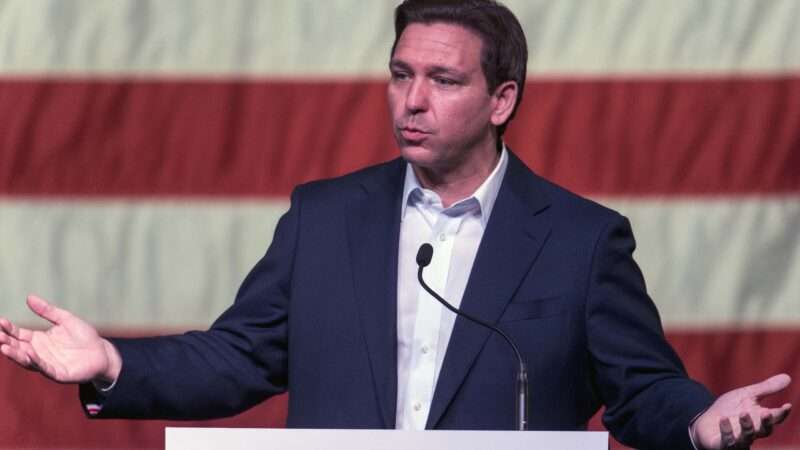
Florida Gov. Ron DeSantis speaks at a book event in Davenport, Iowa.

Last week, Florida’s Legislature passed H.B. 1, a bill that would expand the state’s school choice program, the Family Empowerment Scholarship, to all Florida students. Today, Gov. Ron DeSantis signed the bill into law, a welcome change from his usual tendencies toward state authority.

Under current law, students can opt out of their local public school and attend a private or charter school using the state funding that would have otherwise gone to the local school. The program was primarily geared toward children with disabilities or those from low- or middle-income households, with eligibility capped at 375 percent of the poverty-level income. The new law would remove all eligibility caps but still prioritize lower-income students and those in foster care.

Speaking at Christopher Columbus High School, an all-boys Catholic school in Miami-Dade County, DeSantis called the bill a “game changer,” saying it “will represent the largest expansion of education choice not only in the history of this state, but in the history of these United States.”

Andrew Spar, president of the Florida Education Association (FEA), the state’s teacher’s union, excoriated the bill in a statement. Under H.B. 1, he contended, “average Floridians will be helping pay for millionaires and billionaires to send their kids to elite private schools.” Of course, in either case, public schools are funded by tax money; in the absence of H.B. 1, those wealthy households would be paying those taxes plus private school tuition.

Under H.B. 1, participating private schools will still have to abide by certain requirements, like reporting grades to parents and administering certain state-approved standardized tests. But on balance, the bill will allow parents more control over their children’s schooling by limiting the state’s involvement. And given some of DeSantis’ previous policy positions, that result was not a given.

In April 2022, DeSantis signed the Individual Freedom Act into law, more commonly known as the “Stop WOKE Act,” which bans both schools and private businesses from endorsing certain ideas associated with critical race theory. At the time, he clearly signaled that the law’s intent was to keep “the far-left woke agenda” out of his state’s “schools and workplaces,” a clear violation of free speech. Last week, a federal appeals court blocked the law from going into effect—and that wasn’t the first federal court to do so.

In January, Florida’s Department of Education rejected an Advanced Placement class in African American Studies from inclusion in school curriculum. DeSantis later defended the decision by saying, “Education is about the pursuit of truth, not the imposition of ideology or the advancement of a political agenda.” Manny Diaz Jr., the state’s education commissioner, called the class “woke indoctrination masquerading as education.

But school choice is the perfect method for contending with schools that teach what parents don’t like. DeSantis’ history may demonstrate a proclivity for using state power to bully people for their speech, but H.B. 1 may actually accomplish his goal while ceding power back to parents.

The post Ron DeSantis Signs Bill Expanding School Choice to All Florida Students appeared first on Reason.com.

from Latest https://ift.tt/lLeXcCk
via IFTTT

“Power At Every Level”, Brags Chicago Teachers Union, As 200 Members Skip School For Political Workshop

“Power At Every Level”, Brags Chicago Teachers Union, As 200 Members Skip School For Political Workshop

Authored by Mark Glennon via Wirepoints.org,

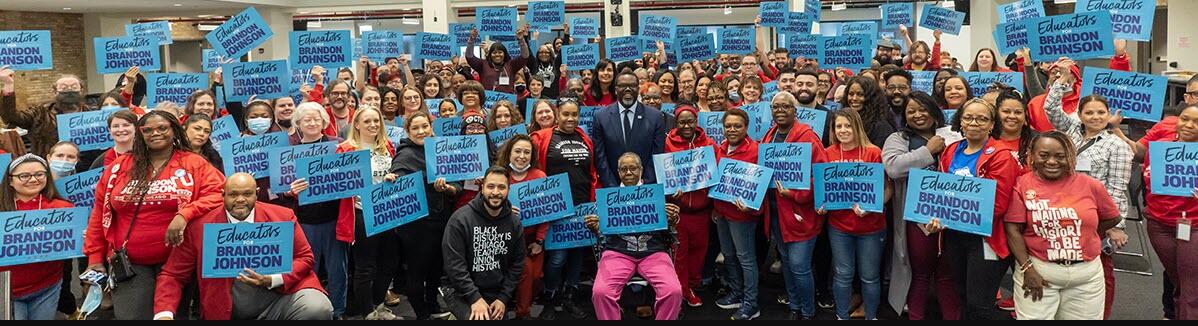
“We’re gonna have to teach the city of Chicago how to redefine transformation, how to redefine renaissance,” said Chicago Teachers Union President Davis Gates in her opening remarks, and the day naturally started with the CTU’s own organizer and Chicago mayoral candidate, Brandon Johnson, who got a standing ovation.

Some 200 CTU members skipped school Thursday for what’s supposedly an annual delegates’ training conference, but the CTU’s own description makes clear it was about expanding its vast political goals — through schools.

A conference workshop

“Power At Every Level” Delegates Conference” is the the CTU’s own headline on their description.

It was a day full of workshops and training “about building power from the school buildings to the district and charter networks to the highest levels of political power in the city,” the CTU says. One session was on the CTU’s three-year strategic plan, which was about “how mobilizing in school buildings is critical to realizing the full potential of this particular moment….” It went on:

Winning the mayor’s office is, of course, a high priority, but it’s just one piece of the puzzle. Everything we do builds on the organizational foundations we forge in our school buildings and communities across the city, and this is what will make our three-pronged strategy of mayoral representation, bargaining strong charter and district contracts, and winning a pro-educator elected school board a reality.

Another session was about why school leadership needs to “build power” on topics that included “Teaching Through Trauma,” “Green Schools,” and “Assertive Grievance Handling.”

CTU organizer Brandon Johnson faces Paul Vallas in Chicago’s mayoral election on April 4.

Tyler Durden
Mon, 03/27/2023 – 17:40

via ZeroHedge News https://ift.tt/BW4kTID Tyler Durden

Hungary Approves Finland’s NATO Membership, While Sweden Sidelined

Hungary Approves Finland’s NATO Membership, While Sweden Sidelined

On Monday Hungary’s parliament approved a bill approving Finland’s bid to join NATO, days after Turkish President Tayyip Erdogan said his country will do the same.

But Sweden has been left out in the cold by both countries, despite the two Scandinavian countries previously pledging they would enter together.

Via AP

NATO Secretary-General Jens Stoltenberg has been urging that both applications be ratified by Turkey and Hungary, a scenario looking increasingly unlikely amid the major spat between Stockholm and Ankara over the Kurdish issue as well as Koran-burning incidents by a far-right activist.

As for the new Hungarian approval Finland, Reuters notes that “Although Finland’s bid has now been approved, the Swedish bill is still stranded in the Hungarian parliament.

“The bill on Finland’s NATO accession was passed with 182 in favour and six votes against, after Fidesz said last week it would back the motion.”

There’s as yet no vote scheduled in parliament on Sweden’s bid, and it’s unlikely to come, given the latest out of PM Orban’s office

Prime Minister Viktor Orban’s chief political aide said on Twitter on Sunday the government backed Sweden’s NATO membership and “now it’s up to the parliament to make a decision.”

“Some MPs are concerned due to Swedish government officials making a habit of constantly questioning the state of Hungarian democracy, thereby insulting our voters, MPs & the country as a whole,” Balazs Orban, who is not related to the prime minister, tweeted.

Orban has been accused of holding up the votes on NATO accession as a tactic for leverage in response to long-running EU criticism over Hungary’s alleged ‘democratic backsliding’.

Orban addressed this in recent months, assuring that “We have already confirmed to both Finland and Sweden that Hungary supports” their NATO bids. “The Swedes and the Finns have not lost a single minute of membership because of Hungary, and Hungary will certainly give them the support they need to join,” he stressed EU ministers late last year.

Tyler Durden
Mon, 03/27/2023 – 17:31

via ZeroHedge News https://ift.tt/unmOgNo Tyler Durden

Global Financial Risks Have Risen Amid Bank Turmoil, IMF Chief Warns

Global Financial Risks Have Risen Amid Bank Turmoil, IMF Chief Warns

Authored by Katabella Roberts via The Epoch Times (emphasis ours),

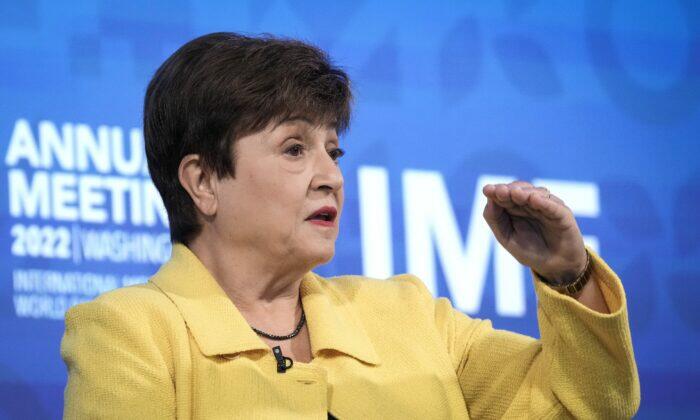
The recent collapse of Silicon Valley Bank (SVB) and the rescue of Credit Suisse by rival UBS show that risks to global financial stability have increased, International Monetary Fund (IMF) chief Kristalina Georgieva said at a conference in Beijing on March 26.

IMF Managing Director Kristalina Georgieva participates in a town hall discussion with civil society organizations at IMF headquarters in Washington on Oct. 10, 2022. (Drew Angerer/Getty Images)

Speaking at the 2023 China Development Forum in the capital, Georgieva warned that rapid interest rate hikes by the Federal Reserve combined with increased debt levels have placed extra stress on the economy, and risks to financial stability have risen.

“At a time of higher debt levels, the rapid transition from a prolonged period of low-interest rates to much higher rates—necessary to fight inflation—inevitably generates stresses and vulnerabilities, as evidenced by recent developments in the banking sector in some advanced economies,” Georgieva said.

The IMF chief also delivered a bleak outlook for 2023, forecasting another “challenging year” for the global economy, with global growth slowing to below 3.0 percent owing to Russia’s ongoing invasion of Ukraine, further monetary tightening, and “scarring” from the COVID-19 pandemic weighing down on economic activity.

Uncertainties are exceptionally high, including because of risks of geo-economic fragmentation which could mean a world split into rival economic blocs—a ‘dangerous division’ that would leave everyone poorer and less secure. Together, these factors mean that the outlook for the global economy over the medium term is likely to remain weak,” Georgieva said.

Even with a better outlook for 2024, global growth will remain well below its historic average of 3.8 percent and down from 3.2 percent in 2022, according to Georgieva.

Contagion Fears

So—we continue to monitor developments closely and are assessing potential implications for the global economic outlook and global financial stability. We are paying close attention to the most vulnerable countries, in particular low-income countries with high levels of debt,” Georgieva added.

The IMF chief’s comments follow weeks of turmoil in the banking sector in the wake of the collapse of SVB and U.S. regional lender Signature Bank, which sparked market panic and fears of a broader contagion.

This was exacerbated when banking giant Credit Suisse—which is among 30 financial institutions known as globally systemically important banks—was acquired by rival UBS in a $3.23 billion deal brokered by the Swiss government.

That deal, meant to prevent a collapse of the troubled bank as well as broader market chaos, appeared initially to help calm investor and client nerves. However, those fears resurfaced on Friday, sending bank shares tumbling amid a widespread stock sell-off.

Read more here…

Tyler Durden
Mon, 03/27/2023 – 17:02

via ZeroHedge News https://ift.tt/Acib5jP Tyler Durden

Baltimore Lawmakers Unite To Stop Biden’s EPA From Sending Toxic Ohio Train Waste To Facility

Baltimore Lawmakers Unite To Stop Biden’s EPA From Sending Toxic Ohio Train Waste To Facility

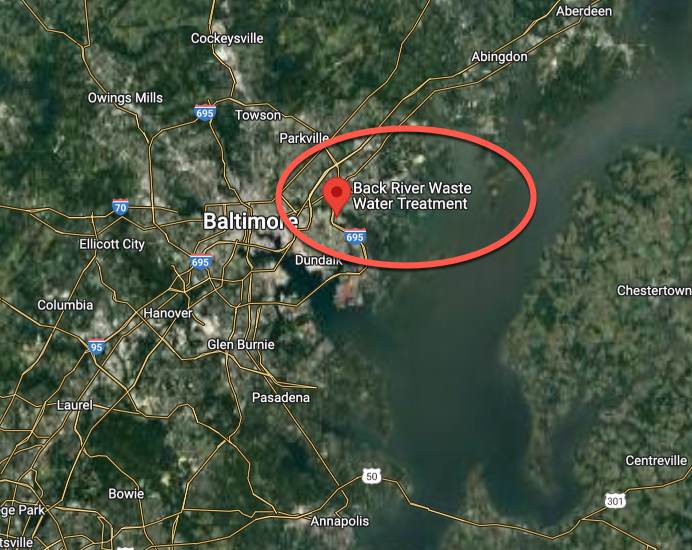
Baltimore Democrats are furious over the Biden administration’s Environmental Protection Agency’s (EPA) decision to transport toxic water from East Palestine, Ohio, to a water treatment facility in Baltimore County.

On Monday morning, Baltimore City Councilman Zeke Cohen (D-1) called on the EPA to reverse its decision to transport 675,000 gallons of toxic water to the Back River Wastewater Treatment Plant for the treatment and eventual discharge into the local water system. 

Cohen stated: 

Too many neighborhoods in Baltimore are already overburdened with pollution, we are at a tipping point for the health of the Chesapeake Bay, and our City’s trust in the Back River facility’s ability to process this water was shaken by the March 15 explosion

Under the Biden Administration, the EPA has rightfully committed itself to environmental justice. Now is their chance to prove that commitment by rescinding approval of this plan,” Cohen wrote in a statement. 

At last, city Democrats and county Republicans have found common ground on an issue:

“As a member of the Environment and Transportation Committee, I have heard countless hours of testimony regarding the continual failures at the Back River Wastewater Treatment Plant in Dundalk.

“This treatment plant has a history of sewage overflows. They certainly should not be trusted to process toxic waste into Maryland’s greatest natural resource,” Baltimore County delegates Kathy Szeliga (R) and Ryan Nawrocki (R) said in a joint statement over the weekend. 

Democratic Maryland Sen. Chris Van Hollen also said he is concerned with the Biden EPA’s plan to process toxic chemicals so close to the Chesapeake Bay. 

Last week, EPA administrator Michael Regan said it was “impermissible and … unacceptable” for states to block shipments of the toxic chemicals. 

Tyler Durden
Mon, 03/27/2023 – 16:41

via ZeroHedge News https://ift.tt/GA61rWu Tyler Durden

Is Elon Musk’s Growing Global Influence A Dilemma For The White House?

Is Elon Musk’s Growing Global Influence A Dilemma For The White House?

Authored by Tom Ozimek via The Epoch Times,

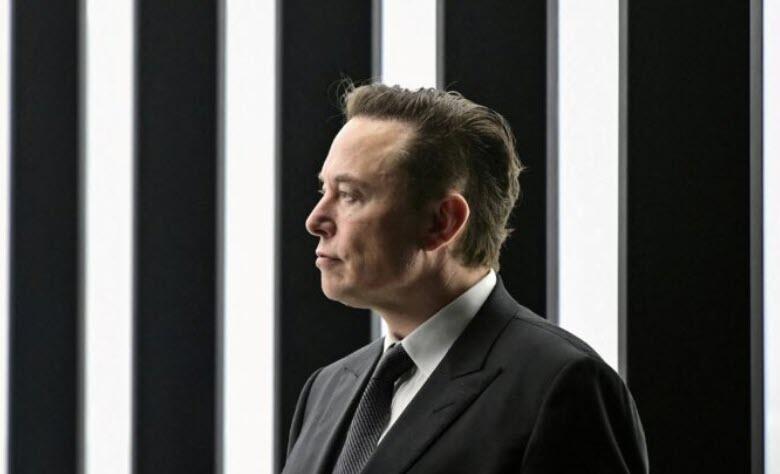
When Elon Musk bought Twitter for $44 billion, he expanded his reach to five companies, spanning multiple industries, whose intersection with the government put the tech mogul and his growing global influence on the White House radar.

Musk has made it his mission to cure what he calls the “woke mind virus.”

To some, his purchase of Twitter several months ago was just what the doctor ordered.

“$44 Billion was not the cost of Twitter. It was the cost of restoring ‘Free Speech,’” the Twitter account DogeDesigner posted last week.

“Some things are priceless,” Musk tweeted.

Not long after Musk took over, he reinstated several banned accounts—including former President Donald Trump—and unlocked a trove of internal Twitter communications known as the Twitter Files, which shed light on the depth of the company’s censorship and bias against conservative voices.

But while many on the right side of the political spectrum have praised Musk’s moves since taking over Twitter, others have expressed reservations.

President Joe Biden reacted with concern to news of Musk’s purchase of Twitter and subsequent moves to slash jobs, which slimmed the company’s content moderation team.

“What are we all worried about? Elon Musk goes out and buys an outfit that sends and spews lies all across the world,” Biden said at a Democratic fundraiser in Illinois several days after the Twitter buyout deal came to fruition.

“There’s no editors anymore in America,” he added. “How do we expect kids to be able to understand what is at stake?”

Irina Tsukerman, a national security lawyer and geopolitical analyst, told The Epoch Times that some worry that Musk’s commitment to free speech is too absolute and that indiscriminate treatment of foreign accounts on Twitter threatens U.S. interests.

He has failed to shut down outright genocidal and provocative discourse by actors adversarial to the U.S., such as Iran’s Ayatollah Khamenei, various IRGC functionaries, the Taliban, and Russia-linked accounts,” she said in an emailed statement.

“There is also a concern about lack of interest and monitoring of extremist discourse in foreign languages such as Arabic, Farsi, and Chinese,” Tsukerman added.

Biden was asked in November whether he thought Musk was a threat to U.S. national security and if the participation of a Saudi Arabia-linked investor in the purchase of Twitter should be investigated.

“Elon Musk’s cooperation and/or technical relationships with other countries is worthy of being looked at,” Biden said at a Nov. 9, 2022, press conference.

“Whether or not he is doing anything inappropriate—I’m not suggesting that. I’m suggesting it’s worth being looked at. But that’s all I’ll say,” he added.

The Epoch Times has contacted Twitter and the White House for comment.

‘Not a Right Wing Takeover’

Some critics have raised concerns that increased freedom to troll came with more freedom of speech on Twitter.

Current and former Twitter employees reportedly told BBC reporter Marianna Spring that features meant to protect Twitter users from harassment and trolling were proving hard to maintain.

“The investigation made clear Twitter was never perfect. But it had exposed how hate is thriving under Twitter’s new owner,” Spring wrote. “

Current and former Twitter employees told me ‘nobody is taking care of’ features designed to protect users from hate and harm.”

Musk reacted to Spring’s article by suggesting on Twitter that such concerns were overblown.

“Sorry for turning Twitter from nurturing paradise into a place that has … trolls,” Musk wrote.

Musk has acknowledged that free and open communication risks being offensive, but the trade-off is worth it.

“Worth noting that the left is not being censored either,” Musk said in a follow-up comment.

“This is not a right wing takeover, but rather a centrist takeover.”

Whatever the nature of the takeover, Musk has pledged to allow more free speech on the platform while vowing to prevent it from becoming a “free-for-all hellscape.”

Tsukerman said that Musk’s selective reinstatement of banned accounts undermines the case that Twitter is a neutral marketplace for exchanging ideas.

“Musk seems to have given preferences to celebrity accounts and voices that reflect his own preferred brand of politics,” she said, adding that some accounts of Americans critical of U.S. foreign or domestic policies were never reinstated.

“Knowingly allowing foreign propagandists to conduct operations utilizing this platform damages the credibility of American companies and makes it more difficult for U.S. law enforcement and security agencies to guard U.S. interests,” Tsukerman said.

Meanwhile, at the end of January, Twitter Safety said it has been “proactively” reinstating previously banned accounts and that anyone whose account remains suspended can appeal the ban, which will be re-evaluated under less stringent criteria.

“Going forward, we will take less severe actions, such as limiting the reach of policy-violating Tweets or asking you to remove Tweets before you can continue using your account. Account suspension will be reserved for severe or ongoing, repeat violations of our policies,” Twitter Safety said in a post.

At the same time, Twitter Safety said it hadn’t reinstated accounts where there was illegal activity or when there was no recent appeal to have the account ban lifted.

Meanwhile, the reach of hate speech on Twitter has declined more than expected under Musk, according to a recent independent assessment by Sprinklr.

“Sprinklr’s AI-powered model found that the reach of hate speech on Twitter is even lower than our own model quantified,” Twitter Safety said in a tweet earlier this month.

The Sprinklr analysis found that hate speech on Twitter gets fewer impressions per tweet than non-toxic slur tweets.

Tyler Durden
Mon, 03/27/2023 – 16:20

via ZeroHedge News https://ift.tt/3ViJSTs Tyler Durden

Bitcoin, Bonds, Big-Tech, & Bullion Breakdown As Banks & Black Gold Bounce

Bitcoin, Bonds, Big-Tech, & Bullion Breakdown As Banks & Black Gold Bounce

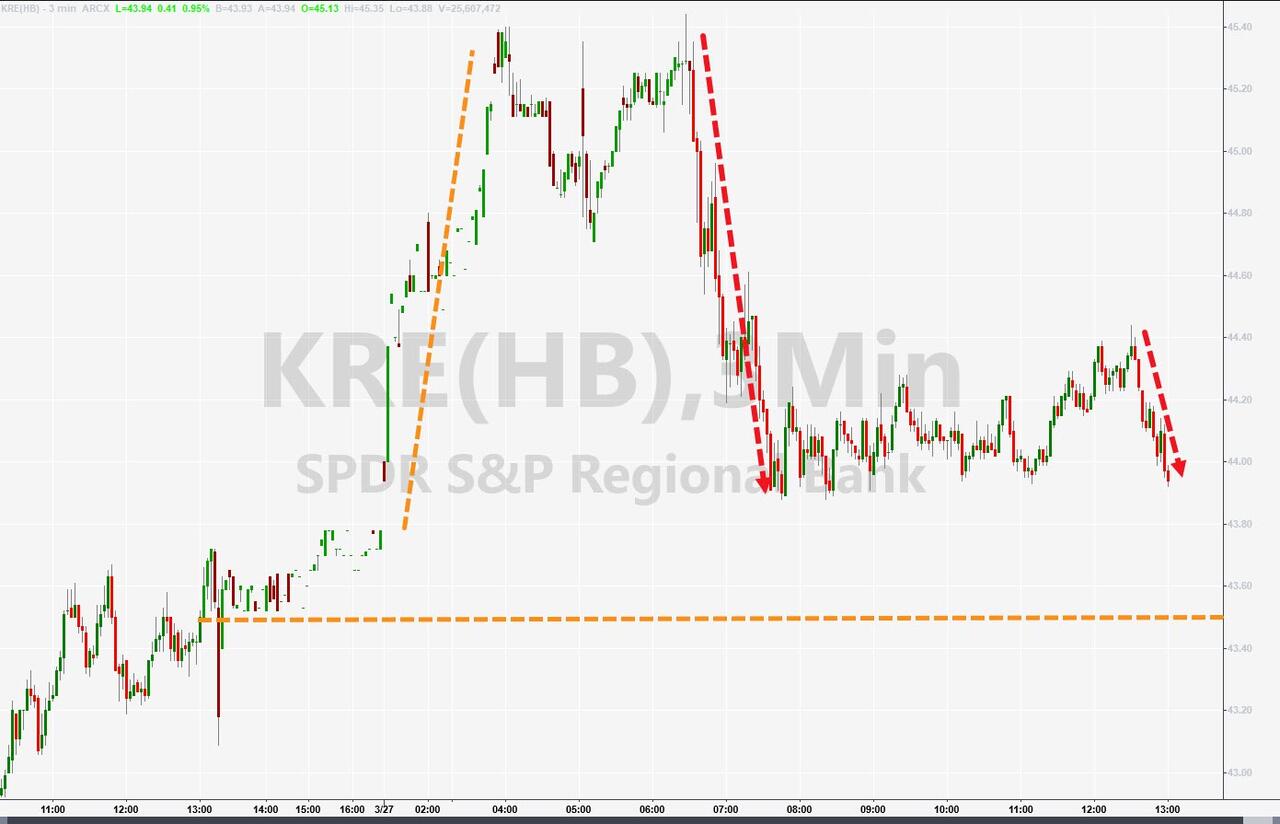
So no new banks exploded or were bailed out over the weekend, and First-Citizens scooped up the flotsam from SVB – everything’s good right? Regional bank stocks surged in the pre-market, but as soon as the cash markets opened, selling resumed. Regionals did end green but it was far from convincing with FRC and PACW the only really notable gainers…

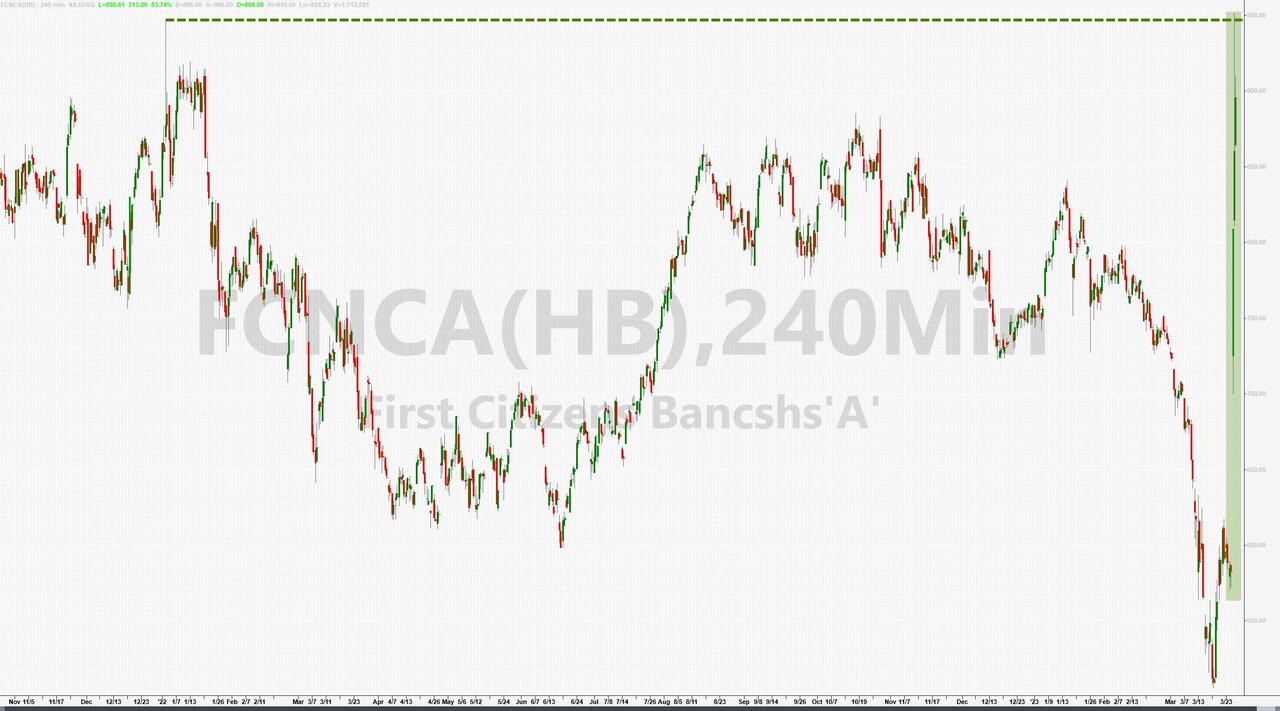
First Citizens soared over 50% (its best day since 1990), back to its strongest since Jan 2022…

This matters because, as Bloomberg reports, equity-appreciation rights awarded to the regulator went into the money Monday, as shares began trading with a surge of as much as 49%, to $870.15. The rights, which have a potential value of $500 million, mean the FDIC stands to gain if the stock rises above $582.55, according to a regulatory filing.

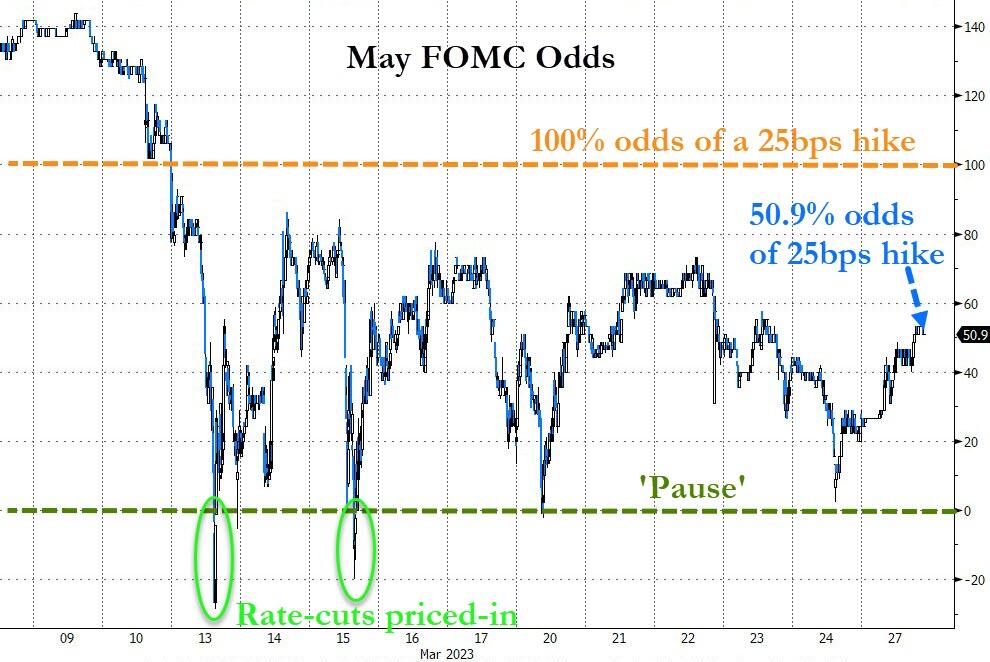
An uglier than expected Dallas Fed print was largely glossed over as bond yields rose and rate-hike expectations lifted hawkishly.  The odds of a rate-hike in May inched back above a coin-flip today…

Source: Bloomberg

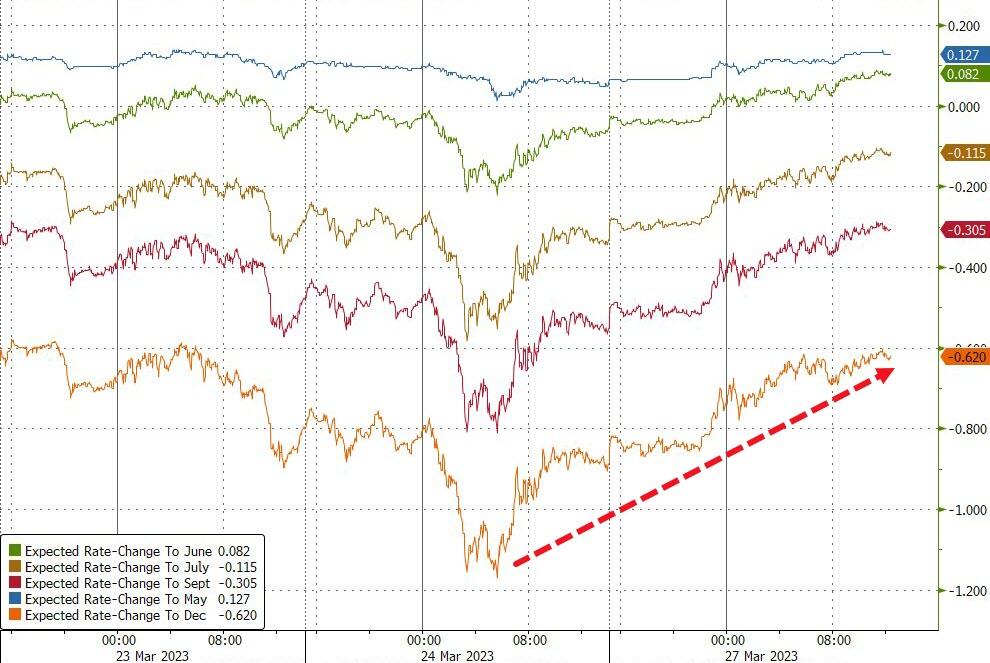
The entire STIR market pushed hawkishly higher, with Dec 2023 now priced for 62bps of cuts (up from 120bps of cuts priced in on Friday)….

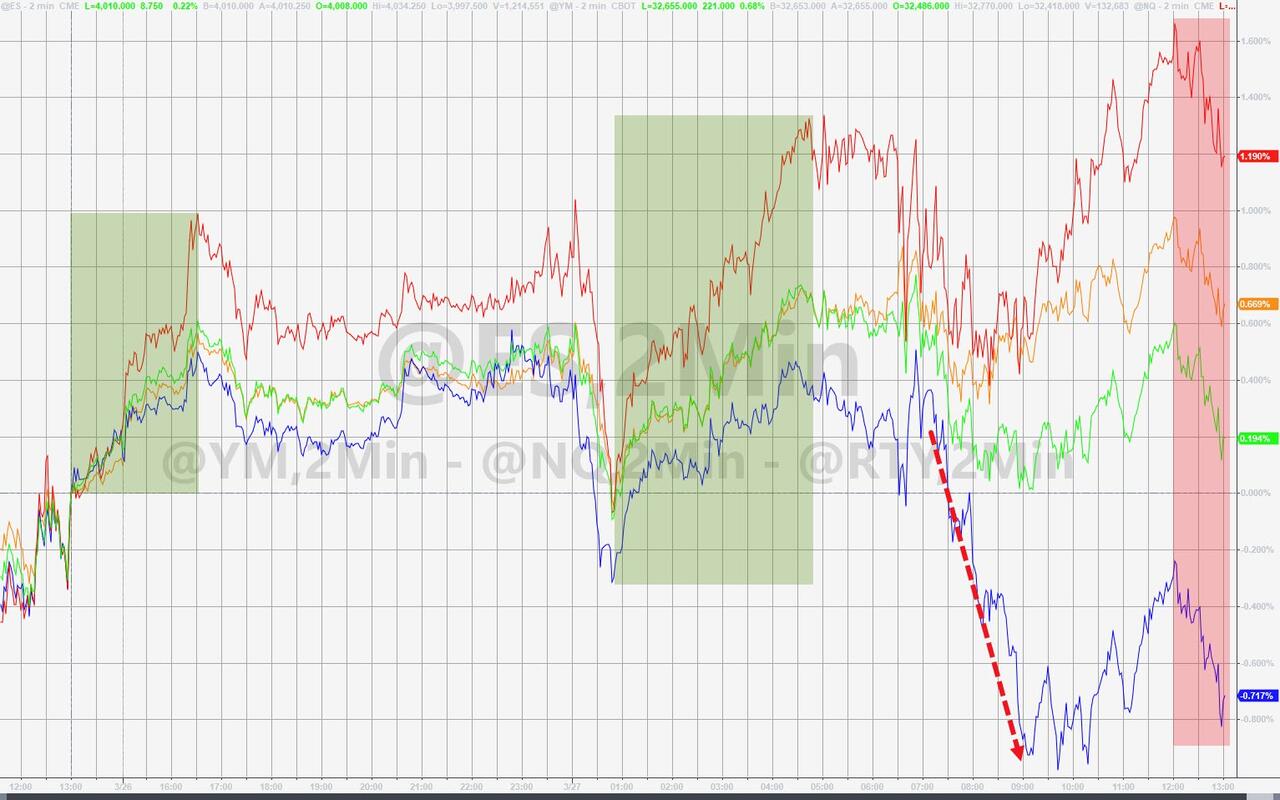
Small Caps (heavily weighted with small financials) were the day’s biggest gainer, but crypto’s weakness appeared to weigh on Nasdaq while The Dow and S&P managed gains. The last hour saw selling start up across all the majors

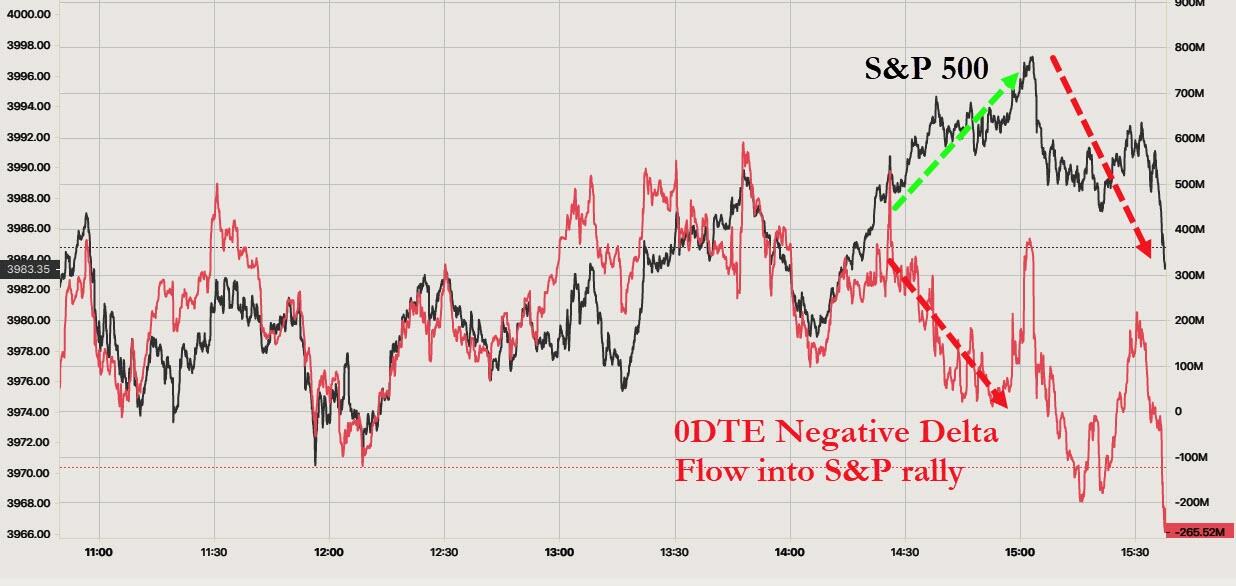
0DTE traders tracked the market most of the day, but as the S&P broke out in the last hour, there was heavy negative delta flows and eventually the market itself started to slide…

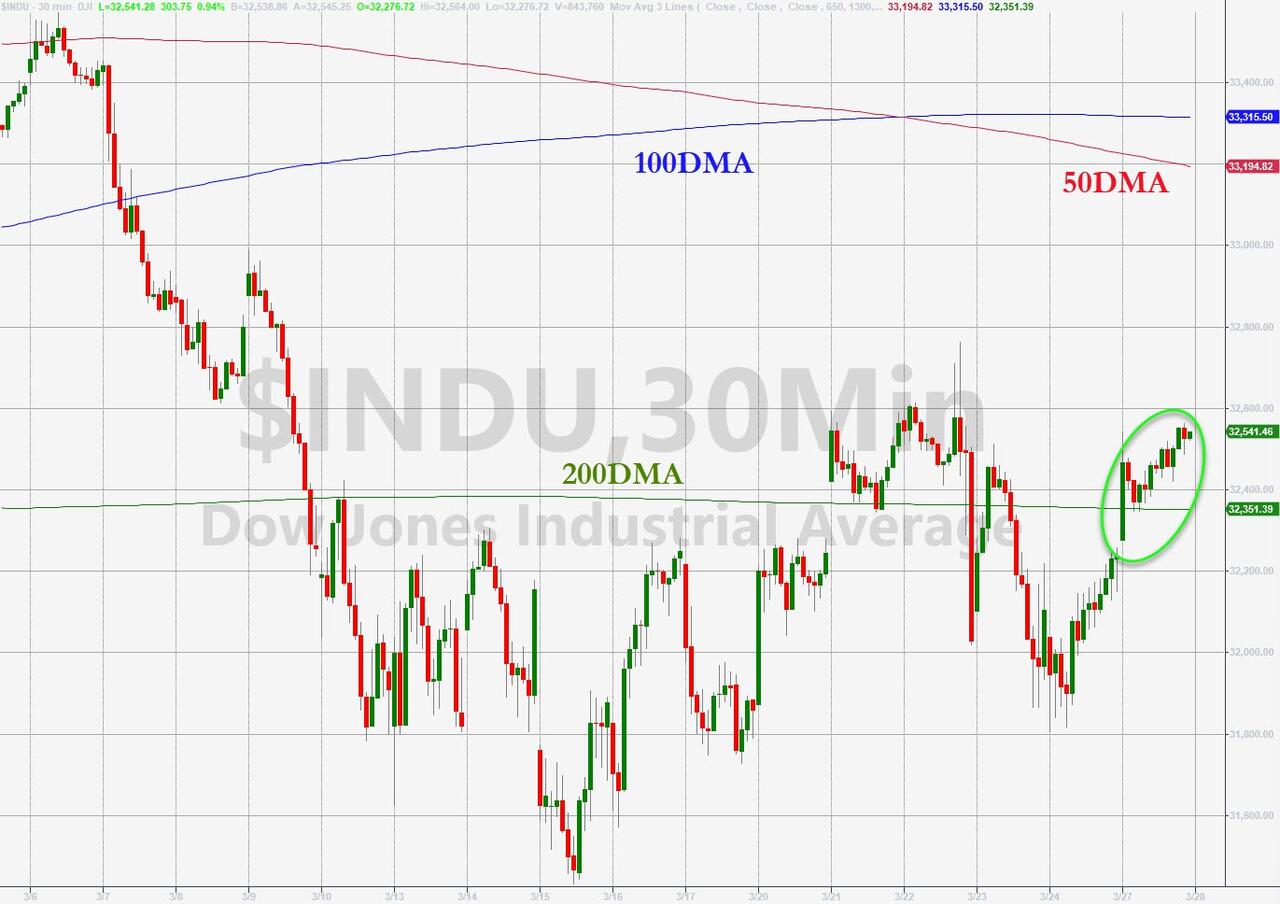
The Dow broke back above its 200DMA (S&P held above its 100DMA but below the 50DMA, finding resistance at 4,000)…

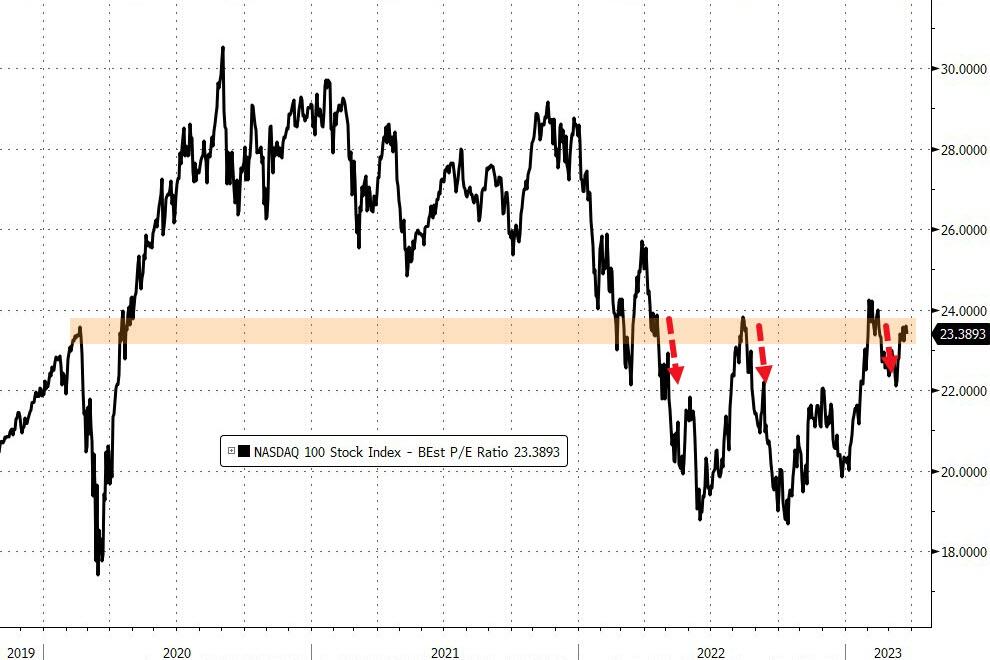
The Fwd P/E of the Nasdaq is back at pre-COVID highs (where it has stalled twice since The Fed closed off the spigot of free money)…

Source: Bloomberg

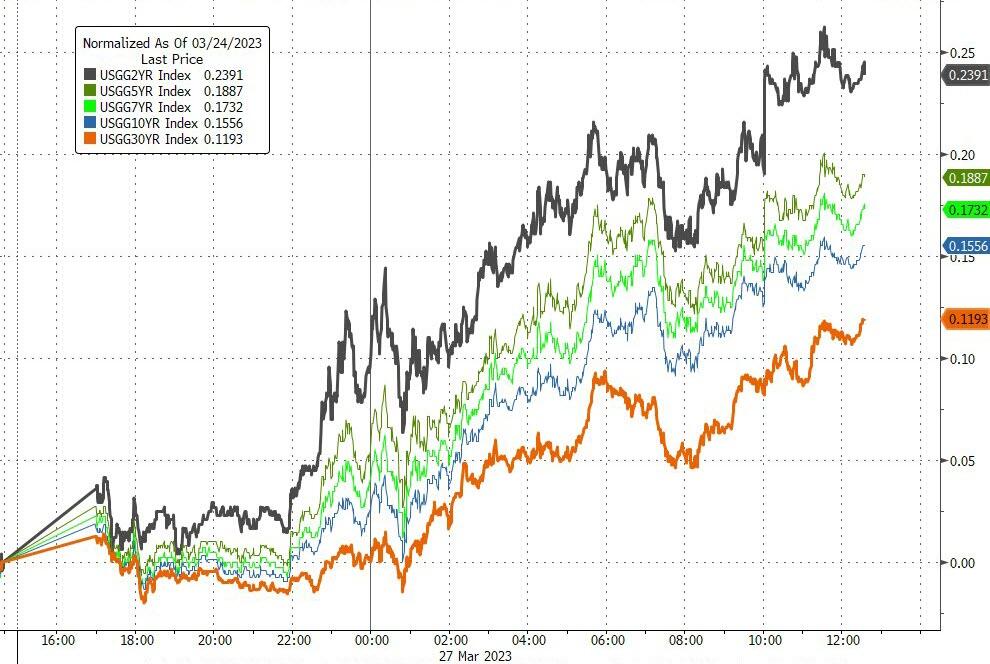
Treasuries were dumped aggressively across the curve with the short-end crushed (2Y +26bps at its peak) while 30Y outperformed (still up 12bps!)…

Source: Bloomberg

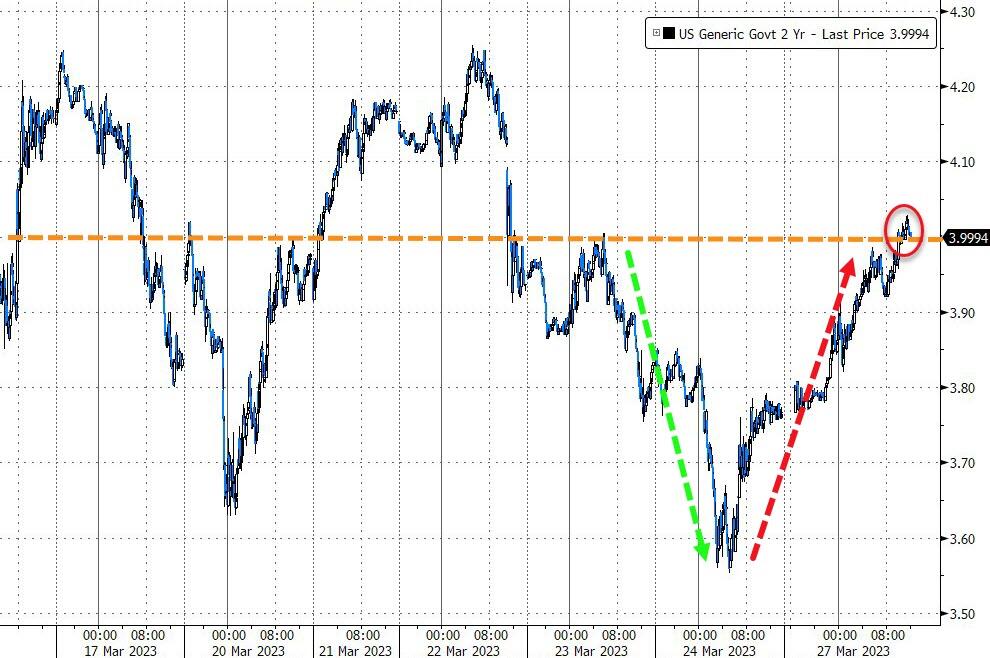
After a really ugly 2Y auction, yields topped 4.00% (up around 50bps from Friday’s lows)…

Source: Bloomberg

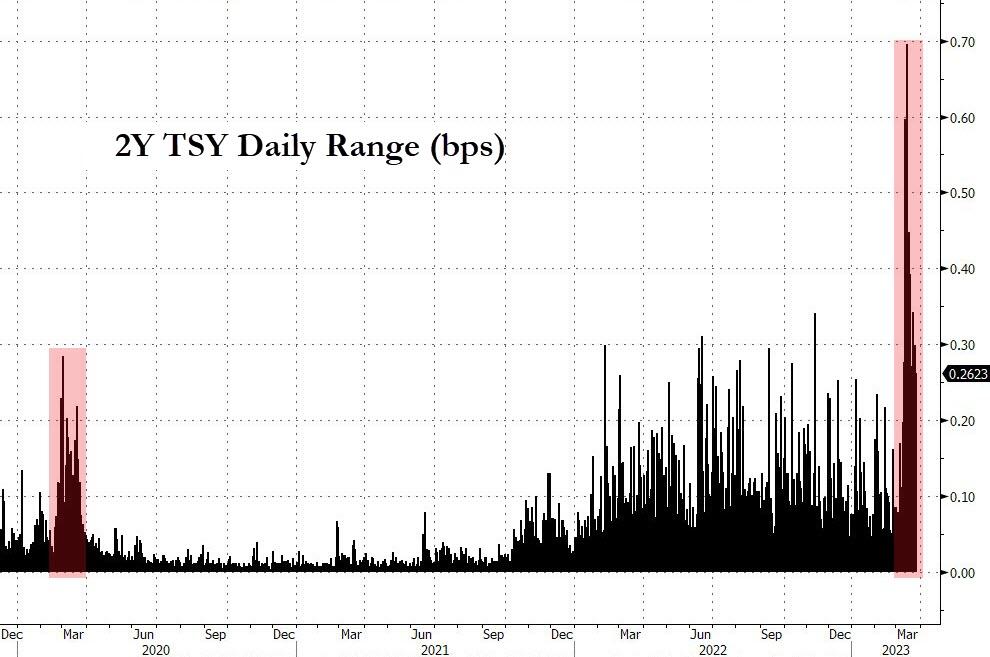
The swings in the bond market are just unbelievable…

Source: Bloomberg

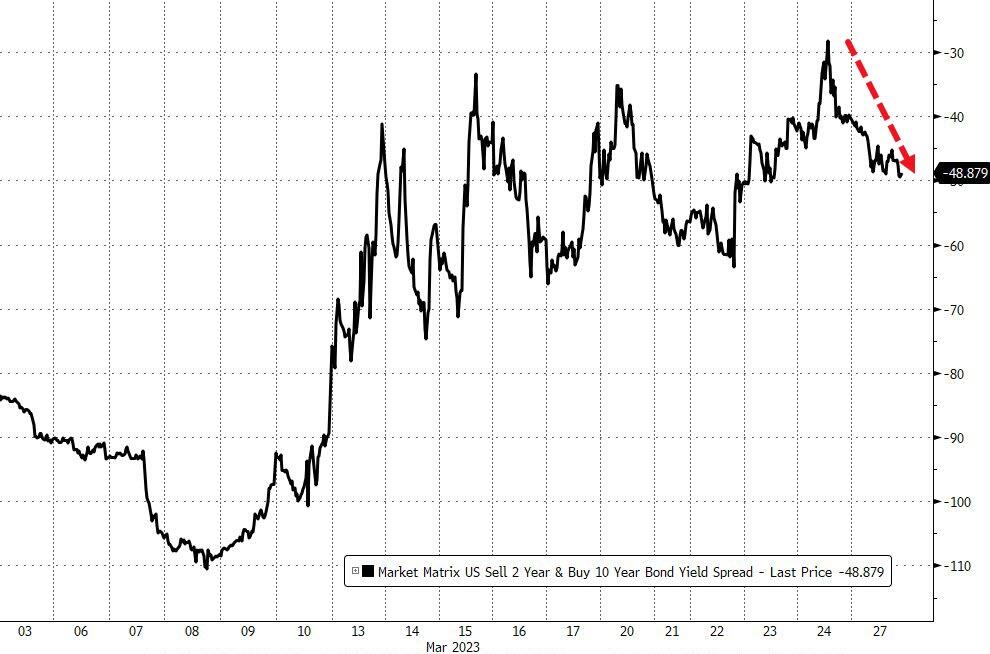
The yield curve (2s10s) flattened/inverted back to -50 (after reaching its least inverted since October)…

Source: Bloomberg

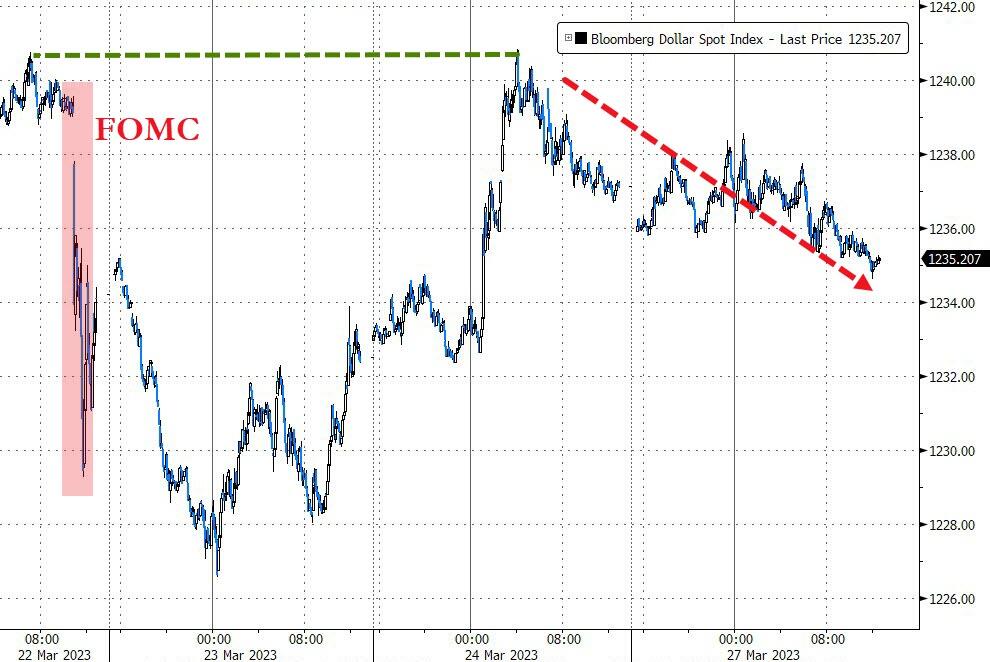
The dollar drifted modestly lower, extending Friday’s afternoon slide…

Source: Bloomberg

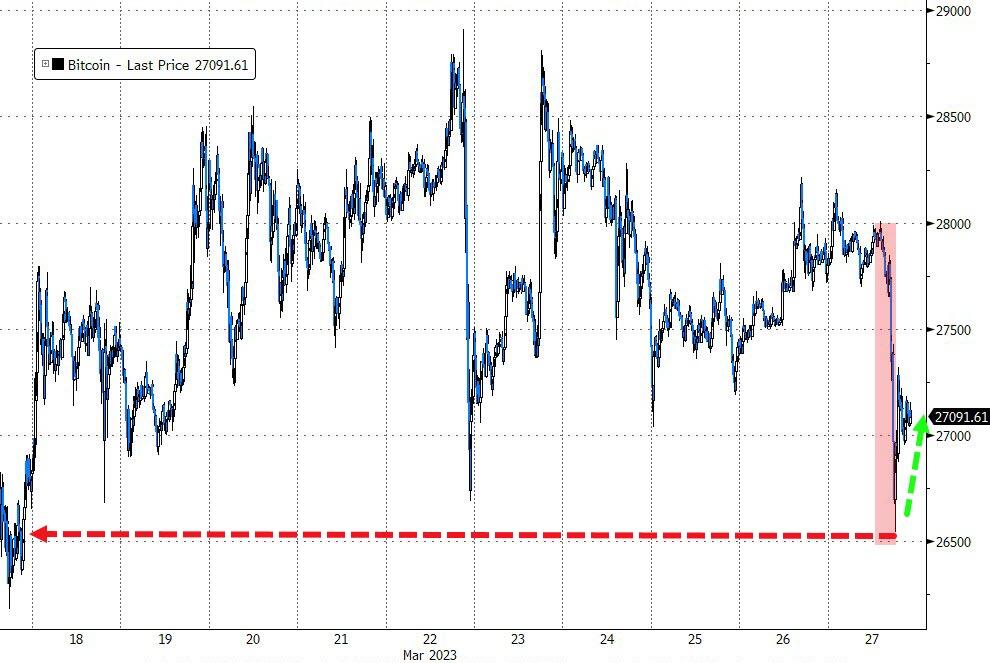
Crypto was clubbed like a baby seal today after the CFTC hit Binance. Bitcoin tumbled to $26,500 before bouncing back and $27,000…

Source: Bloomberg

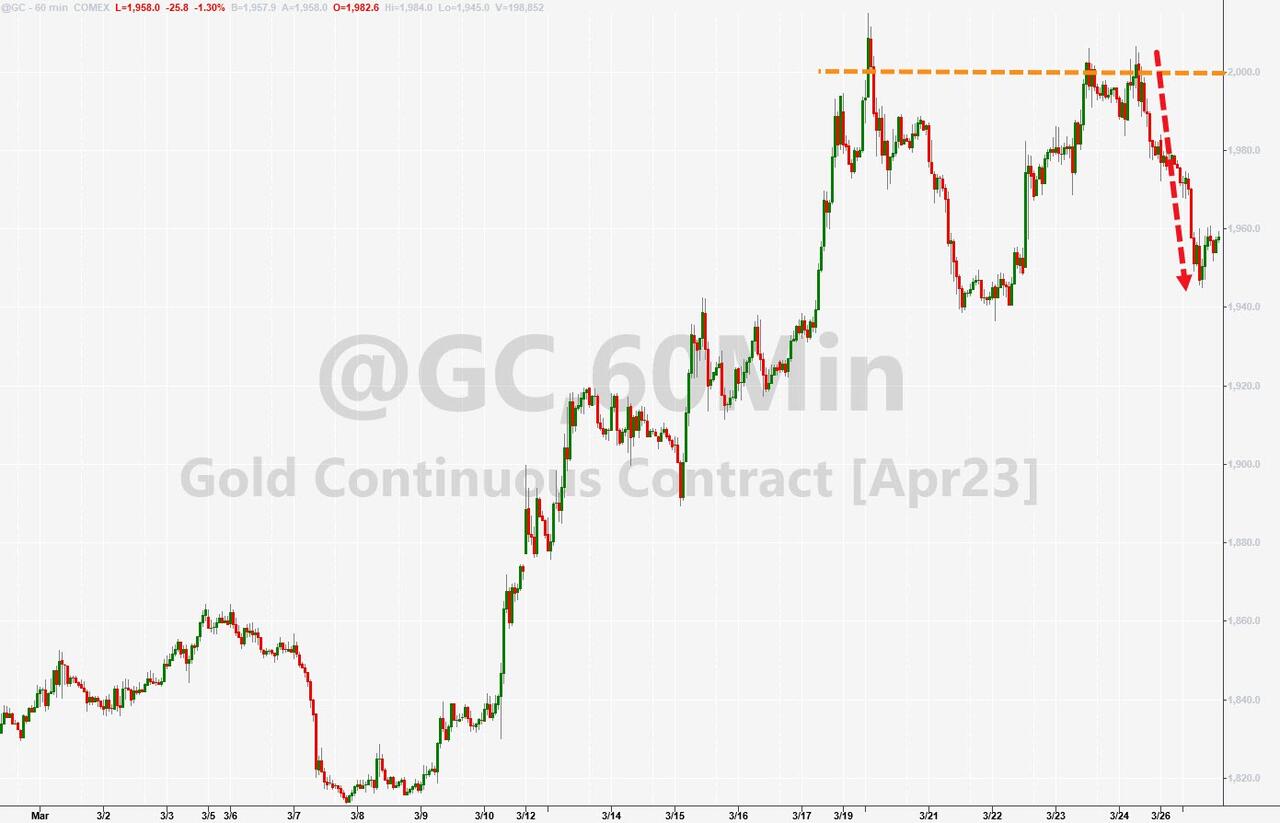
Gold extended Friday’s drop from $2000, dropping below $1950 today…

Oil prices soared today amid chatter of a gamma squeeze with WTI back above $73 (two week highs)…

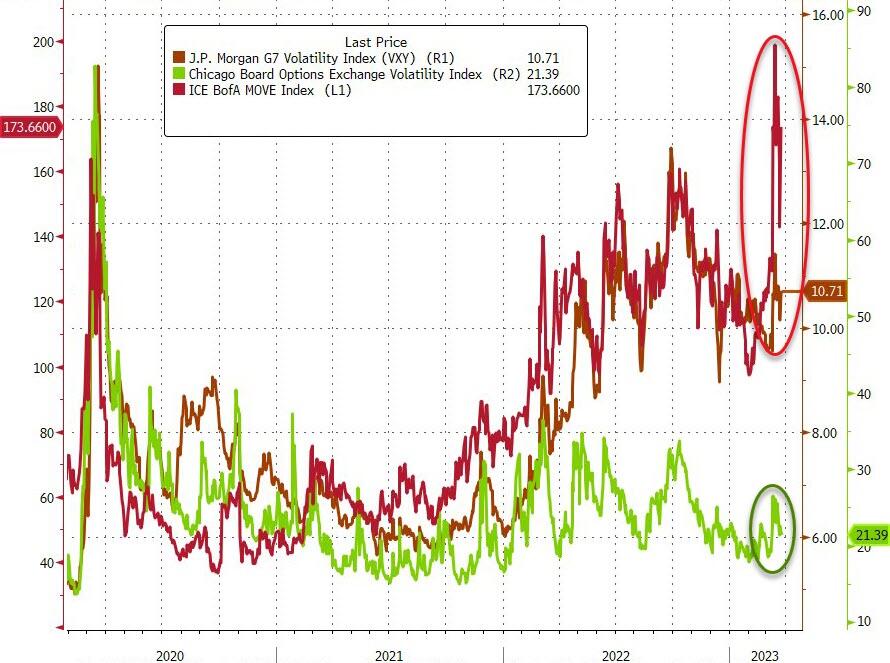
Finally, we note that VIX continues to shrug off uncertainty in FX and rates markets…

Source: Bloomberg

Some argue VIX is missing the point because of 0DTE (which don’t trade in the maturities that contribute to the VIX calc). We shall see who is right on where vol goes from here – FX and Bond market pros or equity options traders.

Tyler Durden
Mon, 03/27/2023 – 16:01

via ZeroHedge News https://ift.tt/PCch9yF Tyler Durden

Defamation, Responsibility, and Third Parties

A bunch of comments to my Large Libel Models posts suggest that, when users believe (say) ChatGPT-4’s fake quotes about others, the true responsibility is on the supposedly gullible users and not on OpenAI. I don’t think this is consistent with how libel law sees things, and I want to explain why.

Say that the Daily Tattler, a notoriously unreliable gossip rag, puts out a story about you, saying that “rumor has it that Dr. [you] had been convicted of child molestation ten years ago in Florida, as the Miami Herald reported.” This is utterly false, and the result of careless reporting on their part; there was no conviction and no Miami Herald report. Yet some people believe the story, and as a result stop doing business with you. (Say you’re a doctor, so your business relies on people’s confidence in you.)

Now there are three parties here we can think about.

  1. There’s you, and you’re completely innocent.
  2. There’s the Daily Tattler, which published a story that’s negligently false.
  3. And there are the people who stop doing business with you. They too might be viewed negatively: Perhaps they’re gullible for believing what the Daily Tattler says. Perhaps they’re unfair in not looking things up themselves (maybe checking the Miami Herald’s archives), or calling you and asking your side of the story.

But the premise of libel law is that you can sue the Daily Tattler, even though, in a perfect world, the readers would have done better. You can’t, after all, sue the readers—it’s not a tort for them to avoid you based on their gullibility. And the Daily Tattler is at fault for negligently putting out the false assertion of fact that could deceive the unwise reader. Yes, perhaps people should be educated not to trust gossip rags. But so long as readers do in some measure trust them (at least as to matters where the reader lacks an incentive to do further research), libel law takes that into account.

Now to be sure the law doesn’t always allow liability for publishers based on all unwise reactions by readers. In particular, the question whether the statement “state[s] or impl[ies] assertions of objective fact” turns on the reaction of a reasonable reader. A statement that a reasonable reader would recognize is parody, for instance, wouldn’t be actionable even if some readers might miss the joke.

But when it comes to statements that a reasonable reader would perceive as factual assertions, they are potentially actionable if they are false and reputation-damaging. That the reader might be unwise for trusting the source doesn’t get the source off the hook.

So if you sue the Daily Tattler for negligently publishing the false allegation against you, the Tattler can’t turn around to say, “It’s not our fault! It’s the fault of the stupid readers who trusted us, notwithstanding our having specifically labeled this as ‘rumor.'” Under well-established libel law, it would lose.

Now maybe there’s some public policy reason why OpenAI should be off the hook for ChatGPT-4  communications, because it has warned people that the communications may be inaccurate, when the Daily Tattler isn’t off the hook for its communications, despite its warning people that the communications may be inaccurate (since they’re just rumor). But standard libel law seems to take a different view.

[* * *]

Here’s what Part I.C of my Large Libel Models? Liability for AI Output article has to say about the general legal background here; note, though, that I had posted an earlier version of that chapter last week.

AIs could, of course—and probably should—post disclaimers that stress the risk that their output will contain errors. Bard, for instance, includes under the prompt box, “Bard may display inaccurate or offensive information that doesn’t represent Google’s views.” But such disclaimers don’t immunize AI companies against potential libel liability.

To begin with, such disclaimers can’t operate as contractual waivers of liability: Even if the AIs’ users are seen as waiving their rights to sue based on erroneous information when they expressly or implicitly acknowledge the disclaimers, that can’t waive the rights of the third parties who might be libeled.

Nor do the disclaimers keep the statements from being viewed as actionable false statements of fact. Defamation law has long treated false, potentially reputation-damaging assertions about people as actionable even when there’s clearly some possibility that the assertions are false. No newspaper can immunize itself from libel lawsuits for a statement that “Our research reveals that John Smith is a child molester” by simply adding “though be warned that this might be inaccurate” (much less by putting a line on the front page, “Warning: We may sometimes publish inaccurate information”). Likewise, if I write “I may be misremembering, but I recall that Mary Johnson had been convicted of embezzlement,” that could be libelous despite my “I may be misremembering” disclaimer.

This is reflected in many well-established libel doctrines. For instance, “when a person repeats a slanderous charge, even though identifying the source or indicating it is merely a rumor, this constitutes republication and has the same effect as the original publication of the slander.”[1] When speakers identify something as rumor, they are implicitly saying “this may be inaccurate”—but that doesn’t get them off the hook.

Indeed, according to the Restatement (Second) of Torts, “the republisher of either a libel or a slander is subject to liability even though he expressly states that he does not believe the statement that he repeats to be true.”[2] It’s even more clear that a disclaimer that the statement merely may be inaccurate can’t prevent liability.

Likewise, say that you present both an accusation and the response to the accusation. By doing that, you’re making clear that the accusation “may [be] inaccurate.” Yet that doesn’t stop you from being liable for repeating the accusation.

To be sure, there are some narrow and specific privileges that defamation law has developed to free people to repeat possibly erroneous content without risk of liability, in particular contexts where such repetition is seen as especially necessary. For instance, some courts recognize the “neutral reportage” privilege, which immunizes “accurate and disinterested” reporting of “serious charges” made by “a responsible, prominent organization” “against a public figure,” even when the reporter has serious doubts about the accuracy of the charges.[3] But other courts reject the privilege altogether.[4] And even those that accept it apply it only to narrow situations: Reporting false allegations remains actionable—even though the report makes clear that the allegations may be mistaken—when the allegations relate to matters of private concern, or are made by people or entities who aren’t “responsible” and “prominent.”[5] It certainly remains actionable when the allegations themselves are erroneously recalled or reported by the speaker.

The privilege is seen as needed precisely because of the general rule that—absent such a privilege—passing on allegations can be libelous even when it’s made clear that the allegations may be erroneous. And the privilege is a narrow exception justified by the “fundamental principle” that, “when a responsible, prominent organization . . . makes serious charges against a public figure,” the media must be able to engage in “accurate and disinterested reporting of those charges,” because the very fact that “they were made” makes them “newsworthy.”[6]

Likewise, the narrow rumor privilege allows a person to repeat certain kinds of rumors to particular individuals to whom the person owes a special duty —such as friends and family members—if the rumors deal with conduct that may threaten those individuals. (This stems because from what is seen as the special legitimacy of people protecting friends’ interests.[7]) This is why, for instance, if Alan tells Betty that he had heard a rumor that Betty’s employee Charlie was a thief, Alan is immune from liability.[8] But the privilege exists precisely because, without it, passing along factual allegations to (say) a stranger or to the general public—even with an acknowledgement that they “may [be] inaccurate”—may be actionable.[9]

Now a disclaimer that actually describes something as fiction, or as parody or as a hypothetical (both forms of fiction), may well be effective. Recall that, in libel cases, a “key inquiry is whether the challenged expression, however labeled by defendant, would reasonably appear to state or imply assertions of objective fact.”[10] It’s not actionable to state something that obviously contains no factual assertion at all—as opposed to just mentioning a factual assertion about which the speaker expresses uncertainty, or even disbelief.[11] But neither ChatGPT nor Bard actually describe themselves as producing fiction, since that would be a poor business model for them. Rather, they tout their general reliability, and simply acknowledge the risk of error. That acknowledgment, as the cases discussed above show, doesn’t preclude liability.

[1] Ringler Associates Inc. v. Maryland Casualty Co., 80 Cal. App. 4th 1165, 1180 (2000).

[2] Restatement (Second) of Torts § 578 cmt. e; see also Martin v. Wilson Pub. Co., 497 A.2d 322, 327 (R.I. 1985); Hart v. Bennet, 267 Wis. 2d 919, 944 (App. 2003).

[3] Edwards v. National Audubon Soc’y, 556 F.2d 113 (2d Cir. 1977). A few later cases have extended this to certain charges on matters of public concern against private figures. Others have rejected the privilege as to statements about private figures, without opining on its availability as to public figures. See, e.g., Khawar v. Globe Int’l, Inc., 965 P.2d 696, 707 (Cal. 1998); Fogus v. Cap. Cities Media, Inc., 444 N.E.2d 1100, 1102 (App. Ct. Ill. 1982).

[4] Norton v. Glenn, 860 A.2d 48 (Pa. 2004); Dickey v. CBS, Inc., 583 F.2d 1221, 1225–26 (3d Cir.1978); McCall v. Courier-J. & Louisville Times, 623 S.W.2d 882 (Ky. 1981); Postill v. Booth Newspapers, Inc., 325 N.W.2d 511 (Mich. App. 1982); Hogan v. Herald Co., 84 A.D.2d 470, 446 (N.Y. App. Div. 1982).

[5] A few authorities have applied this privilege to accurate reporting of allegations on matters of public concern generally, but this appears to be a small minority rule. Barry v. Time, Inc., 584 F. Supp. 1110 (N.D. Cal. 1984); Tex. Civ. Code § 73.005.

[6] Edwards, 556 F.2d at 120. Likewise, the fair report privilege allows one to accurately repeat allegations that were made in government proceedings, because of the deeply rooted principle that the public must be able to know what was said in those proceedings, even when those statements damage reputation. But it too is sharply limited to accurate repetition of allegations originally made in government proceedings.

[7] Restatement (Second) of Torts § 602.

[8] Id. cmt. 2. Another classic illustration is a parent warning an adult child about a rumor that the child’s prospective spouse or lover is untrustworthy. Id. cmt. 1.

[9] See, e.g., Martin v. Wilson Pub. Co., 497 A.2d 322, 327 (R.I. 1985).

[10] Takieh v. O’Meara, 497 P.3d 1000, 1006 (Ariz. Ct. App. 2021).

[11] See, e.g., Greene v. Paramount Pictures Corp., 813 F. App’x 728, 731–32 (2d Cir. 2020). Even then, a court might allow liability if it concludes that a reasonable person who knows plaintiff would understand that defendant’s ostensible fiction is actually meant to be as roman à clef that conveys factual statements about plaintiff. The presence of a disclaimer wouldn’t be dispositive then. See, e.g., Pierre v. Griffin, No. 20-CV-1173-PB, 2021 WL 4477764, *6 n.10 (D.N.H. Sept. 30, 2021).

The post Defamation, Responsibility, and Third Parties appeared first on Reason.com.

from Latest https://ift.tt/lb1U2va
via IFTTT
Professor Suggests Murder as Alternative to Shouting Down Speakers

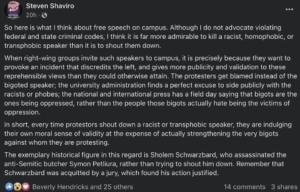
An English professor at Wayne State University apparently had an overheated reaction to the fiasco at Stanford Law School. He thought the protesters did not go far enough, and he took to Facebook to say so.

“I think it is far more admirable to kill a racist, homophobic, or transphobic speaker than it is to shout them down,”he began, and he concluded with “The exemplary historical figure in this regard is Sholem Schwarzbard, who assassinated the anti-Semitic butcher Symon Petliura, rather than trying to shout him down. Remember that Schwarzbard was acquitted by a jury, which found his action justified.”

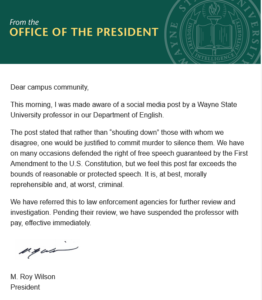
The president of Wayne State has now announced that the professor has been suspended and his social media post referred to law enforcement.

The professor’s post is almost certainly constitutionally protected as neither a true threat nor an incitement to imminent lawless action. Wayne State, like many universities, has adopted the language American Association of University Professors’ 1940 Statement on Academic Freedom. Under that policy, when speaking in public as a citizen a professor should be free from institutional censorship or discipline. Once the police investigation concludes, the professor’s suspension should be lifted.

The professor would be well-advised to take a break from social media. Negative partisanship has gotten quite intense in our current environment, and the number of individuals who like to fantasize on social media about the death of their political opponents is truly disturbing.

Now would be a good time for the professor to recall the admonition in the AAUP Statement and the university’s policy:

As a person of learning and an educational officer, he/she should remember that the public may judge his/her profession and his/her institution by his/her utterances. Hence he/she should at all times be accurate, should exercise appropriate restraint, should show respect for the opinions of others, and should make every effort to indicate that he/she is not an institutional spokesperson.

The post Professor Suggests Murder as Alternative to Shouting Down Speakers appeared first on Reason.com.

from Latest https://ift.tt/wJhoQUv
via IFTTT

Bank Crisis’ Remedy Threatens To Put More Pressure On The Dollar

Bank Crisis’ Remedy Threatens To Put More Pressure On The Dollar

Authored by Simon White, Bloomberg macro strategist,

The dollar is at risk from further deterioration in the Fed’s balance sheet as it moves to stabilize the US banking system.

Markets are taking a breather this morning after the histrionics of last week. Nonetheless, problems remain, with several smaller US banks still at risk after the decimation of sentiment in the wake of SVB’s collapse.

The calm is being aided by reports that one particularly beleaguered lender, First Republic, will receive more support from the Fed. The central bank is expected to extend its lending programs to help banks in First’s position.

There are two principal ways the Fed can use its balance sheet to ease:

  1. through expanding it (QE and lending programs);

  2. and by deteriorating it (credit easing).

How it eases depends on the securities the banking system uses to “make position”. Ultimately, to ensure there are no crunch points, the Fed has to deal in these securities in times of difficulty.

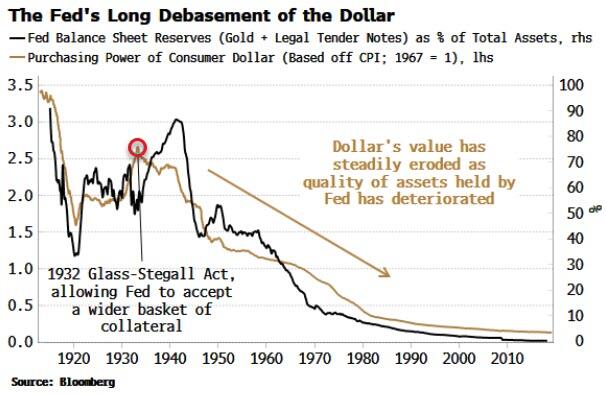
The poorer the quality of the assets on the banking-sector’s balance sheet exposes the Fed’s balance sheet to greater deterioration. As the dollar is a liability of the Fed, its value is debased the more the Fed takes on poorer quality collateral.

The chart below elegantly shows the long-term decline in the dollar’s real value.

There is almost a 1-1 relationship between the degradation in the Fed’s balance sheet – as captured by the percentage of high-quality assets – and the real value of the dollar, i.e. its purchasing power.

The Fed is has already expanded its balance sheet, and any new lending programs will almost certainly involve a balance-sheet deterioration as it takes on poorer-quality collateral. SVB happened to have a lot of USTs and MBS, but other banks do not, with e.g. the smaller-bank sector having a much higher exposure to commercial real-estate loans, accounting for 70% of the market according to JP Morgan. (One important caveat is some loans counted as real-estate loans are business loans collateralized by commercial real estate.)

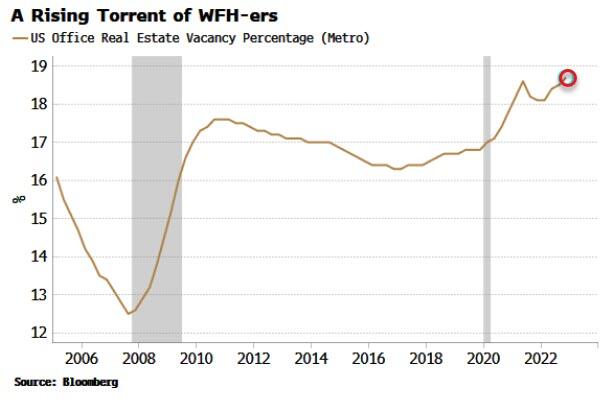
CRE prices are dropping fast, exacerbated by recent banking troubles, but are also facing structural challenges as office vacancy-rates hit near 20-year highs, driven primarily by changing worker habits.

As well as the longer-term threat to the dollar’s purchasing power, the dollar’s FX value is also cyclically exposed. Demand for US assets is low while hedging costs are so high, while reliable leading indicators such as the real yield curve continue to flatten.

Tyler Durden
Mon, 03/27/2023 – 15:46

via ZeroHedge News https://ift.tt/CltGhNW Tyler Durden