China in the Bull Shop

The Capitol Hill hearings featuring TikTok’s CEO lead off episode 450 of the Cyberlaw Podcast. The CEO handled the endless stream of Congressional accusations and suspicion about as well as could have been expected.  And it did him as little good as a cynic would have expected. Jim Dempsey and Mark MacCarthy think Congress is moving toward action on Chinese IT products – probably in the form of the bipartisan Restricting the Emergence of Security Threats that Risk Information and Communications Technology (RESTRICT) Act. But passing legislation and actually doing something about China’s IT successes are two very different things.

The FTC is jumping into the policy arena on cloud services, Mark tells us, and it can’t escape its DNA; it’s dwelling on possible industry concentration and lock-in and not asking much about the national security implications of knocking off a bunch of American cloud providers when the alternatives are largely Chinese cloud providers. The FTC’s myopia means that the administration won’t get as much help as it could from the FTC on cloud security measures. I reissue my standard objection to the FTC’s refusal to follow the FCC’s lead in deferring on national security to executive branch concerns. Mark and I disagree about whether the FTC Act requires the Commission to limit itself to consumer protection.

Jim Dempsey reviews the latest AI releases, including Google’s Bard, which seems to have many of the same hallucination problems as OpenAI’s. Jim and I debate what I consider the wacky and unjustified fascination in the press with catching AI engaging in wrongthink. I believe it’s just a mechanism for justifying the imposition of left-wing values on AI output – which already scores left/libertarian on 14 of 15 standard tests for identifying ideological affiliation. Similarly, I question the effort to stop AI from hallucinating footnotes in support of its erroneous facts. If ever there were a case for a separate AI citechecker, for generative AI correction of AI errors, the fake citation problem seems like a natural.

Speaking of Silicon Valley’s lying problem, Mark reminds us that social media is absolutely immune for false user speech, even after it gets notice that the speech is harmful and false. He reminds us of his thoughtful argument in favor of tweaking section 230 to more closely resemble the notice and action obligations found in the Digital Millennium Copyright Act (DMCA). I argue that the DMCA has not so much solved the incentives for overcensoring speech as it has surrendered to them.

Jim introduces us to an emerging trend in state privacy law: privacy bills that industry supports.  Iowa’s new law is the exemplar; Jim questions whether it will satisfy users in the long run.

I summarize Hachette v. Internet Archive, in which Judge John G. Koeltl delivers a harsh rebuke to internet hippies everywhere, ruling that the Internet Archive violated copyright in its effort to create a digital equivalent to public library lending. The judge’s lesson for the rest of us: You might think fair use is a thing, but it’s not. Get over it.

In quick hits,

  • I note that the Cyberlaw Podcast scooped WIRED in covering the GSA’s lies about the security of login.gov and its later effort to justify those lies by invoking “equity” – currently replacing patriotism as the last resort of scoundrels.
  • And I offer a brief, nostalgic requiem for Toshiba, which is being broken up for scrap by what’s left of Japan Inc. Thirty years ago, Toshiba was treated on the Hill like Huawei is today – a scary and unstoppable competitor who threatened the American way of life.  Now, not so much.

Download 450th Episode (mp3)

You can subscribe to The Cyberlaw Podcast using iTunes, Google Play, Spotify, Pocket Casts, or our RSS feed. As always, The Cyberlaw Podcast is open to feedback. Be sure to engage with @stewartbaker on Twitter. Send your questions, comments, and suggestions for topics or interviewees to CyberlawPodcast@steptoe.com. Remember: If your suggested guest appears on the show, we will send you a highly coveted Cyberlaw Podcast mug! The views expressed in this podcast are those of the speakers and do not reflect the opinions of their institutions, clients, friends, families, or pets.

The post China in the Bull Shop appeared first on Reason.com.

from Latest https://ift.tt/spzIeh1
via IFTTT

CFTC Calls Ether A Commodity In Binance Suit, Highlighting Complexity Of Classification

CFTC Calls Ether A Commodity In Binance Suit, Highlighting Complexity Of Classification

By Derek Anderson of CoinTelegraph

The suit claims Binance used Ether as a commodity in its financial products, experts explained, which says little about the basic nature of the coin…

The United States Commodity Futures Trading Commission (CFTC) filed suit against Binance on March 27 for violations of the Commodities Exchange Act and CFTC regulations. Those violations included transactions with Ether (ETH), according to the suit. This claim, at first glance, touched on a notable point of contention between the CFTC and the Securities and Exchange Commission (SEC). 

The CFTC claimed in its suit that Binance engaged in transactions with “digital assets that are commodities including Bitcoin, Ether, and Litecoin for persons in the United States.” That was not a new position for the agency. The CFTC claimed ETH was a commodity in its suit against FTX in December and chair Rostin Behnam stated his opinion that ETH and stablecoins were commodities as recently as March 8 in a Senate hearing.

The CFTC position on ETH was fairly uncontroversial before the Ethereum Merge; after Ethereum moved to a proof-of-stake consensus mechanism, SEC chair Gary Gensler commented on staking coins that “From the coin’s perspective […] That’s another indicia that under the Howey test, the investing public is anticipating profits based on the efforts of others.”

Gensler’s comment brought on a slow wave of reactions. In February, for example, Ethereum co-founder and crypto entrepreneur Joseph Lubin told Cointelegraph, “Staking is not a security,” and it would be a “terrible path for the U.S.” to make it so. He added that he thought the U.S. courts would agree with him and “there would be a tremendous outcry from not just the crypto community but different politicians and certain regulators,” if ETH were classified as a security.

The CFTC case against Binance does not rest on the nature of ETH as much as the nature of Binance products, however, limiting its applicability to the larger argument.

In this particular case, ETH is being treated as a ‘commodity’ rather than a ‘security,’” Timothy Cradle, director of regulatory affairs at Blockchain Intelligence Group, told Cointelegraph. “The complaint references securities as they relate to swaps.” Cradle added:

“The economics of an offering including ETH could still change the definition applied to the token. For example, ETH staking could still be construed as an investment contract, and as such a security.”

Some transactions, such as mixed swaps involving ETH, could be subject to regulation by both the SEC and CFTC, Cradle said, but that “would not necessarily define ETH itself as a security as mixed swaps also include commodities and currencies.”

This more complex approach to regulation would not necessarily imply cooperation between the two agencies. Yankun Guo, partner at law firm Ice Miller, said of the situation in a statement to Cointelegraph:

“It shows that both the multifaceted nature of how tokens function and how they are used can cause them to be fall under multiple agency’s jurisdiction; […] I wouldn’t be surprised to see a similar lawsuit by the SEC naming all the same tokens except BTC as securities.”

Tyler Durden
Mon, 03/27/2023 – 19:00

via ZeroHedge News https://ift.tt/759hBe4 Tyler Durden

Viagra Sales Went Soft As Exclusivity Expired

Viagra Sales Went Soft As Exclusivity Expired

25 years ago, on March 27, 1998, the U.S. Food and Drug Administration (FDA) approved Viagra for treatment of male erectile dysfunction. With its distinct blue diamond shape, Viagra quickly gained notoriety and became deeply ingrained in popular culture. For Pfizer, the drug was an instant success, surpassing $1 billion in global sales in its second year on the market and remaining one of the company’s best-selling drugs for years to come.

Originally studied for use in hypertension (high blood pressure) and chest pain associated with coronary heart disease, sildenafil, which is the generic name of the drug later marketed as Viagra, was found to sometimes induce penile erections during clinical trials. Seeing an opportunity, Pfizer decided to study and market it for erectile dysfunction, in a move that became a textbook example of drug repositioning.

However, as Statista’s Felix Richter reports, while Viagra is still one of the most recognizable drugs in the world and synonymous with sexual performance enhancement, its success story began to fade in 2013 when Pfizer’s patent on the use of sildenafil in erectile dysfunction expired in the European Union. Around the same time, the company was involved in a patent lawsuit in the United States, which resulted in a settlement allowing Teva Pharmaceuticals to launch a generic version of Viagra in December 2017.

As Statista’s chart illustrates, the loss of exclusivity in major markets such as Europe, Japan and most importantly the United States had a significant effect on Viagra sales, which declined by almost 70 percent between 2012 and 2018.

Infographic: Viagra Sales Went Soft as Exclusivity Expired | Statista

You will find more infographics at Statista

25 years after its initial approval, Viagra is no longer part of Pfizer either.

In 2020, the company’s off-patent branded and generics business Upjohn, which included Viagra, was spun-off and combined with Mylan to create a new company called Viatris.

Tyler Durden
Mon, 03/27/2023 – 18:40

via ZeroHedge News https://ift.tt/t6FuTqw Tyler Durden

Beware Liberals And Conservatives Delivering ‘Catastrophic News’

Beware Liberals And Conservatives Delivering ‘Catastrophic News’

Authored by John Tamny via RealClear Wire,

It’s little known today, but a major driver of Henry Ford’s interest in machines was an aversion to work. And horses. Born into a farming family in Michigan, Ford’s migration away from “the land” was rooted in a desire to avoid the dawn-to-dusk toil that defined life for an overwhelming majority in the 19th century.  

So, while Ford is most known for having democratized access to the automobile, it’s less known that Ford Motor Company also mass-produced tractors. 650,000 in 1927 alone. In his words, “What a waste it is for a human being to spend hours and hours behind a slowly moving team of horses in the same time a tractor could do six times as much work.”

Ford’s intimate knowledge of how machines multiply human productivity while reducing time on the job came to mind while reading Washington Post columnist Max Boot’s recent assertion that “Russia is in a demographic death spiral.” Who is the source of Boot’s pessimism, or optimism? It’s none other than American Enterprise Institute fellow Nicholas Eberstadt.

Eberstadt is the leader of a strain of conservatives thoroughly convinced that the main crisis awaiting us is a consequence of people in more developed countries choosing to have fewer kids. Eberstadt is to “demographic death spiral” what Michael Mann is to “catastrophic global warming.” Both have flocks to feed, and feed them they do with narratives that actual market signals formed by actual information thoroughly reject.

The global warmist in Mann promotes an endless picture of the world’s coastal cities literally going under water, all because the people in the well-to-do parts of the world now avail themselves of cars, air conditioners, and other mechanized advances that make living so pleasurable today. The only problem with Mann’s preaching about the hell that awaits us is that human migratory patterns and pesky market prices disagree. At present something north of 45% of the world’s population lives in coastal areas, and the previous number is expected to grow.

In concert with this migration to coastal cities allegedly set to go under water is a rather evident surge in the price of real estate. Yes, you read that right. In the global locales that Mann and his warming crowd claim will be washed away, the cost of dwellings on what’s set to be washed away grows and grows.

It makes you wonder…about Mann. Smart as he surely is, he can’t possibly know more than the markets. And if you doubt the latter, he surely can’t have anywhere close to the combined knowledge of half of the world’s population.

Which brings us back to Boot. Under the sway of Eberstadt, he’s convinced that Russia’s birthrate of “only 1.5 children per woman” has it as previously mentioned “in a demographic death spiral.” Except that people are not static creatures. They’re instead dynamic parts of an increasingly global whole.

The 1.5 Russian children per women being born today are entering a world in which every good and service produced within it is a beautiful consequence of intensely sophisticated global cooperation. To use but one of countless examples, Boeing airplanes are comprised of millions of intricate parts manufactured around the world. And that only tells part of the story.

To see why, think back to Ford and his fascination with machines. He yet again understood that machines multiply human effort. A man working today can do the work of hundreds and realistically thousands of men born when Ford was. Throw in technology that increasingly thinks for us, and it’s easy to see that the babies being born today will be the productive equivalent of tens of thousands born when Ford was in 1863.

Yet Boot think’s Russia days are numbered because of “1.5 children per woman”? How much time did it take for him to read the “fascinating report” written by Eberstadt in which the “demographic death spiral” was bruited as a negative factor for so many developed countries, and by extension, the world?

The good news for Boot is that age 53, he’s got time to make up for time wasted on a pessimistic assessment of the future that is mocked by markets (watch investment flows, including a surge of investment into low-birthrate countries like the U.S. and South Korea), machines, and simple common sense. What’s true for Boot is happily true for Eberstadt too, age 67. Indeed, with machines increasingly thinking for us, it’s only a matter of time before man aided by machines unlocks the secrets to ever longer life.

It’s all a reminder that contra the pessimists, the only threat to people who populate the “closed economy” that is the world is a lack of freedom. Everything else will be taken care of by the very market forces that presently look disdainfully at catastrophic fear-mongering promoted by the dominant ideologies.

*  *  *

John Tamny is editor of RealClearMarkets, Vice President at FreedomWorks, a senior fellow at the Market Institute, and a senior economic adviser to Applied Finance Advisors (www.appliedfinance.com). His latest book is The Money Confusion: How Illiteracy About Currencies and Inflation Sets the Stage For the Crypto Revolution.

Tyler Durden
Mon, 03/27/2023 – 18:20

via ZeroHedge News https://ift.tt/3l24WSP Tyler Durden

In “Huge” Chinese Push By Aramco, World’s Biggest Oil Producer Will Build $10BN Petrochemical Complex, Buy 10% Stake In Top Chinese Refinery

In “Huge” Chinese Push By Aramco, World’s Biggest Oil Producer Will Build $10BN Petrochemical Complex, Buy 10% Stake In Top Chinese Refinery

In what has been dubbed a “HUGE push” by the Saudi state-owned petrochemical giant into China’s economy, Saudi Aramco surprised the world with a double-header of pro-China news: first, Aramco said it will build a $10 billion refinery in China and, just hours later, it revealed that it would acquire a stake a 10% stake in a Top Chinese oil refinery.

The news come as Saudi Arabia is on the verge of dethroning the petrodollar and accepting payment in Yuan for Chinese oil sales.

Let’s dig deeper.

Over the weekend, Saudi Aramco – world’s biggest oil producer – announced plans to build a $10-billion refining and petrochemical complex in China’s northeast over the next three years, accelerating a development that was paused during the pandemic, and taking advantage of the country’s growing demand for energy. According to the Aramco news release, the complex will have a capacity of 300,000 barrels of crude daily, and OilPrice adds that the Saudi major will supply 201,000 barrels per day to the facility.

The project will be carried out in partnership between Aramco and two Chinese companies. Construction works should begin in the second half of this year, with the project scheduled for completion in 2026.

“This important project will support China’s growing demand across fuel and chemical products. It also represents a major milestone in our ongoing downstream expansion strategy in China and the wider region, which is an increasingly significant driver of global petrochemical demand,” said Aramco’s head of downstream, Mohammed Al Qahtani.

The news follows a report from December last year according to which Aramco had struck a deal with China’s Sinopec to build a 320,000-bpd refinery and petrochemical cracker in China, highlighting the latter’s major role in global oil consumption yet again.

Then, one day later, Aramco also unveiled that it has agreed to buy a 10% stake in a giant oil complex in China for 24.6 billion yuan ($3.6 billion), in exchange for securing sales to one of the country’s largest refineries.

Aramco will also supply 480,000 barrels of crude oil per day to Rongsheng Petrochemical Co’s refinery in the eastern province of Zhejiang over a 20-year period, according to a statement from the Chinese company. Aramco will also provide a credit of $800 million to Rongsheng for the purchase, that statement said.

Refining and petrochemical investments have been a priority for Aramco as it seeks to secure long-term demand for its main product, even as it expands local refining capacity as well. According to the International Energy Agency and other forecasters, a bet on petrochemicals is a good long-term bet in the oil industry amid expectations of a decline in oil demand for transport fuels. The IEA has projected that petrochemicals will account for more than a third in oil demand growth by 2030, rising to 50% of demand by 2050 as transport electrifies

Tyler Durden
Mon, 03/27/2023 – 18:00

via ZeroHedge News https://ift.tt/C0lq4xt Tyler Durden

The Problems With Just Getting Guns Out of People’s Hands as a Solution to Gun Violence


MEGA300627_005

When hideous murders committed with guns make national news, as in today’s Nashville school shooting, it is a natural reaction on many people’s parts to call passionately for just getting more guns out of more people’s hands, by any means necessary.

Those concerned with civil liberties and police abuse of the innocent have long worried about the effects of privileging mere gun possession arrests. A new study from the Marshall Project highlights some of these problems, via examining data and interviewing arrestees from Chicago’s attempts to manage its violence problem with more gun possession arrests.

Chicago police seem to have adopted a pattern of pretextual stops—looking for any excuse to pull someone over and interact with them—in order, they hope, to find a gun without a proper permit to own or license to carry. (Getting both those things can be quite expensive in terms of both time and money, disproportionately affecting the poor living in violent neighborhoods who most strongly feel the pull toward having a gun for self-defense.) Gun law enforcement in Chicago, the Marshall Project finds, “overwhelmingly focuses on possession crimes — not use.”

The heart of the study’s findings:

From 2010 to 2022, the police made more than 38,000 arrests for illegal gun possession. These arrests — almost always a felony — doubled during this timeframe. While illegal possession is the most serious offense in most of the cases we analyzed, the charges often bear misleading names that imply violence, like “aggravated unlawful use of a weapon.”

Police continue to insist that every gun out of someone’s hands, even if it involves arresting that person and increasing mass incarceration of the nonviolent and highly harming that person’s ability to work and rent in the future, is all for the good; after all, that gun won’t be used by that person to harm anyone. (It is almost always the case that those guns would not have unjustly harmed anyone even minus the arrest and confiscation.)

But there is no particular evidence that harassing or arresting those who have harmed no one has “substantially reduced shootings in Chicago. In fact, as possession arrests skyrocketed, shootings increased, but the percentage of shooting victims where someone was arrested in their case declined,” that latter point a strong indication that mere possession arrests are not a sensible high priority for police for whom gun violence should be their only concern when it comes to guns, not paperwork violations. But the Project found that “nearly 60% of the 31,000 new felony cases pursued by [the state’s attorney of Cook County, Illinois] in the past three years were for illegal gun possession; roughly 4% were for homicides.”

Among the gun arrests the Marshall Project were able to analyze from raw data, “Most people [arrested] had no arrest warrants out, nor were they on supervised release, probation or suspected of being in a gang. In most of the incidents we analyzed, police were not responding to 911 calls about a person with a gun.”

The fight against mere possession becomes a generalized excuse for harassment of citizens: “In arrests where possession was the most severe charge…we found that more than 7 in 10 began with a simple traffic violation. After this initial stop, police often used some other justification for a search. Officers often did this by citing the smell of marijuana. Although Illinois legalized cannabis in 2020, smoking while driving is still prohibited.” And, “in a third of the stops, we found the person arrested had their gun owner’s permit, but not the license that allowed carrying the loaded gun in public.”

The enforcement is hugely disproportionate racially. “Although Black people comprise less than a third of the city’s population, they were more than 8 in 10 of those arrested for unlawful possession in the timeframe we reviewed.” Convictions lead to a year or more in prison, and merely the arrest can mess up the life of someone who has harmed no one via “damning criminal records, time on probation, job loss, legal fees and car impoundments.”

As Reason‘s C.J. Ciaramella has previously reported, the overzealous search for guns owned without proper paperwork has led not just to pretextual traffic stops that ruin innocent people’s lives but to violent raids on homes, often not even the homes where the alleged illegal guns were supposed to be.

As the Marshall Project (who although close-focused on Chicago in this study “identified several other cities with similar trends,” including Houston, New York, Cleveland, Baltimore, and Memphis) quotes one of the victims of gun possession arrests they interviewed, “I’m scared for my life — and I gotta go to prison because I fear for my life, for my family’s safety? Because we’re not fortunate enough to live someplace else?”

The post The Problems With Just Getting Guns Out of People's Hands as a Solution to Gun Violence appeared first on Reason.com.

from Latest https://ift.tt/OS02pIK
via IFTTT

Now Is the Best Time To Embrace Artificial Intelligence


Robot shakes hands with Human

In this week’s The Reason Roundtable, editors Matt Welch, Katherine Mangu-Ward, Nick Gillespie, and special guest Elizabeth Nolan Brown unpack the ubiquitous sense that politicians of every stripe have abandoned a commitment to free expression. They also examine the fast evolution of artificial intelligence chatbots like ChatGPT.

0:42: Politicians choose the culture war over the First Amendment

20:04: Artificial intelligence and large language model (LLM) chatbots like ChatGPT

36:13: Weekly Listener Question

44:27: This week’s cultural recommendations

Mentioned in this podcast:

Congress Asks Is TikTok Really ‘An Extension of’ the Chinese Communist Party?” by Elizabeth Nolan Brown

TikTok Is Too Popular To Ban,” by Elizabeth Nolan Brown

Utah Law Gives Parents Full Access to Teens’ Social Media,” by Elizabeth Nolan Brown

Florida’s War on Drag Targets Theater’s Liquor License,” by Scott Shackford

Welcoming Our New Chatbot Overlords,” by Ronald Bailey

Maybe A.I. Will Be a Threat—To Governments,” by Peter Suderman

The Luddites’ Veto,” by Ronald Bailey

Artificial Intelligence Will Change Jobs—For the Better,” by Jordan McGillis

The Robot Revolution Is Here,” by Katherine Mangu-Ward

The Earl Weaver Case for Rand Paul’s Libertarianism,” by Matt Welch

Rand Paul Tries (Again!) To Make It Harder for Police To Take Your Stuff,” by Scott Shackford

Send your questions to roundtable@reason.com. Be sure to include your social media handle and the correct pronunciation of your name.

Today’s sponsor:

  • Getting to know yourself can be a lifelong process, especially because we’re always growing and changing. Therapy is all about deepening your self-awareness and understanding. Because sometimes we don’t know what we want or why we react the way we do until we talk through things. BetterHelp connects you with a licensed therapist who can take you on that journey of self-discovery from wherever you are. If you’re thinking of starting therapy, give BetterHelp a try. It’s entirely online. Designed to be convenient, flexible, and suited to your schedule. Just fill out a brief questionnaire to get matched with a licensed therapist, and switch therapists anytime for no additional charge. Discover your potential with BetterHelp. Visit BetterHelp.com/roundtable today to get 10 percent off your first month.

Audio production by Ian Keyser

Assistant production by Hunt Beaty

Music: “Angeline,” by The Brothers Steve

The post Now Is the Best Time To Embrace Artificial Intelligence appeared first on Reason.com.

from Latest https://ift.tt/rKYaE6f
via IFTTT

Are AI Program Outputs Reasonably Perceived as Factual? A Response to Eugene

I am not one to disagree with Eugene about an area within his area of expertise, but I confess I have a different reaction to his view, expressed in his draft paper, that AI program outputs “would reasonably appear to state or imply assertions of objective fact.” Take OpenAI’s ChatGPT.  Eugene argues in his draft at page 8 that OpenAI’s business model is premised on ChatGPT outputs being factually correct:

OpenAI has touted ChatGPT as a reliable source of assertions of fact, not just as a source of entertaining nonsense. . . .  The AI companies’ current and future business models rests entirely on their programs’ credibility for producing reasonable accurate summaries of the facts. When OpenAI helps promote ChatGPT’s ability to get high scores on bar exams or the SAT, it’s similarly trying to get the public to view ChatGPT’s output as reliable. Likewise when its software is incorporated into search engines, or into other applications, presumably precisely because it’s seen as pretty reliable. It can’t then turn around and, in a libel lawsuit, raise a defense that it’s all just Jabberwocky.

Naturally, everyone understands that AI programs aren’t perfect. But everyone understands that newspapers aren’t perfect, either—yet that can’t be enough to give newspapers immunity from defamation liability; likewise for AI programs. And that’s especially so when the output is framed in quite definite language, complete with purported quotes from respected publications.

Here’s my question: Is the reasonable observer test about business models, or is it about what people familiar with the service would think?  Because if the test is about what normal observers would think, it seems to me that no one who tries ChatGPT could think its output is factually accurate.

That’s what makes ChatGPT distinctive and interesting, I think. It combines good writing and ease of language that sounds real, on one hand, with obvious factual inaccuracies, on the other.  It’s all style, no substance. The false claims of fact are an essential characteristic of the ChatGPT user experience, it seems to me.  If you spend five minutes querying it, there’s no way you can miss this.

For example, back in January, I asked ChatGPT to write a bio for me.  This should be easy to do accurately, as there are lots of online bios of me if you just google my name.   ChatGPT’s version was well written, but it had lots and lots of details wrong.

To correct the errors in the ChatGPT output, I joined Berkeley in 2019, not 2018; I didn’t go to Yale Law School; I didn’t clerk for Judge O’Scannlain; I wasn’t an appellate lawyer at DOJ; there is no 2019 edition of my Computer Crime Law casebook, and it certainly wouldn’t be the 2nd edition, as we’re now on the 5th edition already; I’m not a fellow at the American College of Trial Lawyers; and I’ve never to my knowledge been an advisor to the U.S. Sentencing Commission.  (Some would say I’m also not an invaluable asset to the law school community, but let’s stick to the provable facts here, people.)

My sense is that these kinds of factual errors are ubiquitous when using ChatGPT.  It has style, but not substance.  ChatGPT is like the student who didn’t do the reading but has amazing verbal skills; it creates the superficial impression of competence without knowledge.  Maybe that isn’t what OpenAI would want it to be.  But I would think that’s the conclusion a typical user gets pretty quickly from querying ChatGPT.

The post Are AI Program Outputs Reasonably Perceived as Factual? A Response to Eugene appeared first on Reason.com.

from Latest https://ift.tt/qE0PxMY
via IFTTT

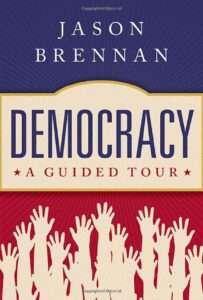
Jason Brennan’s “Democracy: A Guided Tour”

Georgetown political philosopher Jason Brennan is one of the world’s leading theorists of democracy, and his new book Democracy: A Guided Tour is a valuable overview of the strengths and weaknesses of democracy, and various arguments on that topic developed by leading political thinkers from ancient Greece to the present day. Brennan has an impressive command of the relevant literature, and he’s a very clear writer. The book is a great resource for anyone interested in debates about democratic theory.

Democracy: A Guide Tour is divided into five sections, each of which considers a leading traditional rationale for democracy: stability, virtue, wisdom in decision-making, liberty, and equality. Each section includes a chapter outlining arguments holding that the democracy effectively promotes the value in question, followed by one outlining reasons for skepticism.

One of the strengths of Brennan’s book is that he carefully avoids the widespread tendency to conflate that which is “democratic” with that which is good. This leaves room for the possibility that increasing democracy might actually cause harm, as opposed to defining it away in advance.

Brennan himself is something of a democracy-skeptic, as evidenced by his previous work. But in Guided Tour, he strives hard to be balanced, and mostly succeeds. Still, it’s hard to come away from the book without getting a sense that democracy falls well short of at least the more expansive claims on its behalf. For example, far from promoting careful deliberation over policy and making effective use of the “wisdom of crowds,” democracy is often plagued by systematic voter ignorance and bias. Far from making citizens more virtuous, democratic political participation often brings out and exacerbates some of the worst tendencies in human nature. And so on.

I myself am also skeptical of many of the benefits claimed for democracy, especially when it comes to issues related to voter ignorance. It’s possible that a reader who comes to the book with the opposite predisposition will view it differently. Either way, the book provides an excellent analysis of a wide range of perspectives on these issues. And it manages to cover a lot of ground in a relatively modest amount of space.

Despite its many strengths, Guided Tour does have a few notable limitations. First, while Brennan carefully considers strengths and weaknesses of democracy in an absolute sense, there is little in the way of comparison between democratic and non-democratic regimes. Brennan discusses a number of thinkers who reject democracy in favor of authoritarianism, but says little about the actual performance of the sorts of regimes they advocate.

Incorporating the latter would make democracy look better on many dimensions. For example, as Brennan explains in Chapter 9, democracy is often a threat to liberty. But authoritarian governments are far worse. For all their many injustices, no democratic government has even come close to the level of oppression perpetrated by communist and fascist regimes. Similarly, a dictator who listens mainly to boot-licking cronies who tell him what he wants to hear will often make even worse cognitive errors than ignorant democratic electorates. Vladimir Putin’s recent disastrous miscalculations may be a case in point.

Brennan is aware of the relative superiority of democratic regimes over authoritarian ones. But it gets little mention in this book, perhaps because the author had to cover so much other ground. Still, I think this issue deserved more attention. The relative failure to consider it may lead readers to (wrongly) dismiss Brennan’s more democracy-skeptical chapters by citing Winston Churchill’s famous statement that “democracy is the worst form of government – except for all the others that have been tried.”

This ties into Brennan’s second notable omission: there is very little discussion of various institutional structures that can potentially mitigate the flaws of democracy, such as federalism, separation of powers, and judicial review. In a previous book, Brennan himself advocates “epistocracy,” giving more power to relatively more knowledgeable voters (see my assessment of the idea here). It’s only briefly mentioned here, as part of a discussion of John Stuart Mill.

Many of these institutional fixes—most obviously, judicial review—are actually constraints on democracy (defined as majoritarian government). Thus, to the extent they are effective, they don’t necessarily vindicate democracy, as such. But there is still a crucial difference between structures that limit democracy and those that dispense with it entirely. If nothing else, the potential benefits of the former undercut Churchill-quoting complacency about the democracy, which is often implicitly premised on the assumption that authoritarianism is the only alternative to giving democratic majorities a virtual blank check to rule as they please.

In sum, Democracy: A Guided Tour is a great overview of various longstanding debates about democracy. But it leaves room for a broader tour that more fully considers non-democratic alternatives to democracy and institutional fixes for various democratic pathologies.


The post Jason Brennan's "Democracy: A Guided Tour" appeared first on Reason.com.

from Latest https://ift.tt/QHLJb2u
via IFTTT

Are Americans More Antisemitic Than They Were Four Decades Ago?


Are Americans more antisemitic than they were four decades ago?

At the end of 1980, under the headline “Survey Finds Sharp Rise in Anti-Semitic Incidents,” The New York Times reported that the Anti-Defamation League (ADL) had counted “377 cases of assaults and vandalism…against properties” that year, plus “112 bodily assaults or harassments.” By comparison, the ADL had reported “129 property incidents” in 1979. But Nathan Perlmutter, then the organization’s director, “said that part of the 1980 increase might have reflected improved procedures introduced this year in collecting and evaluating information.”

That sort of caveat is conspicuously missing from this year’s ADL audit and from the Times story about it. “The number of antisemitic incidents in the United States last year was the highest since the Anti-Defamation League began keeping track in 1979,” the Times reports. But there is a difference between “the number of antisemitic incidents in the United States” and the number counted by the ADL, whose annual tally relies on reporting by “victims, law enforcement, the media and partner organizations.”

In addition to actual changes in antisemitic incidents, the ADL’s numbers are apt to be affected by changes in reporting behavior and in the organization’s efforts to collect information. Those factors don’t mean the ADL’s narrative of rising antisemitism in the United States, which is supported by recent survey data, should be dismissed out of hand. But they do complicate the picture in ways that the ADL and the Times fail to acknowledge, especially when it comes to the implicit claim that anti-Jewish bigotry is more prevalent today than it was four decades ago.

Per capita, the ADL counted more than five times as many antisemitic incidents in 2022 as it did in 1980. It does not follow that Americans are five times as likely to hate Jews as they were 43 years ago.

The ADL’s survey data do not support that inference. In 2022, it reports, 20 percent of Americans at least “somewhat” believed “six or more anti-Jewish tropes,” compared to 29 percent in 1964 and 20 percent in 1992. That number has gone up and down over the years, and it rose by 82 percent, from 11 percent to 20 percent, between 2019 and 2022.

During the same period, the number of ADL-reported antisemitic incidents rose by 75 percent, which is consistent with the premise that the organization’s tallies reflect a real trend. But these two sets of numbers do not always track each other so neatly. Between 1992 and 1998, for example, the measure of antisemitic attitudes fell by 40 percent, while the number of incidents that the ADL counted fell by just 7 percent. Between 1998 and 2002, when survey-measured antisemitism rose by 42 percent, the number of reported incidents dropped by 3 percent.

The ADL counted 3,697 antisemitic incidents in 2022, up 36 percent from the year before. A large majority (62 percent) involved “harassment,” which rose by 29 percent. Reports of vandalism, which accounted for 35 percent of the total, rose by 51 percent. Reported assaults, which represented 3 percent of all cases, were up by 26 percent.

The ADL emphasizes that its audit “is not a public opinion poll or an effort to catalog every expression of antisemitism.” And while the “harassment” category includes “individuals or groups” who “were harassed online via antisemitic content in direct messages, on listservs or in social media settings,” the audit “does not attempt to assess the total amount of antisemitism online.”

The ADL says most of the incidents it tallied were reported by victims “via our online form, email or phone message.” The ADL’s researchers also “monitor media reports and other online spaces for credible reports of antisemitic incidents.” In 2021, the ADL “began incorporating reports of antisemitic incidents from other Jewish organizations with whom ADL has established partnerships.” Finally, “many law enforcement partners…share information about antisemitic incidents and criminal activity” with the ADL, and “many of those incidents are included in the Audit as well.”

If you read the Times story, which is headlined “Antisemitic Incidents Reach New High in U.S., Anti-Defamation League Says,” and follow the hyperlink to the ADL’s audit, you will see a button inviting you to “report an incident.” That illustrates one way in which alarming stories about antisemitism might help boost the ADL’s numbers.

More generally, reporting is apt to be influenced by publicity, including the attention attracted by the ADL’s audits and concerns about rising antisemitism. It is plausible that when antisemitic incidents receive a lot of attention, victims are more likely to report them, law enforcement agencies are more likely to take them seriously and keep track of them, and news organizations are more like to cover them. That reaction could create a feedback loop, generating more reports, which in turn generate more publicity.

The ADL’s recent outreach to other Jewish organizations also presumably would have alerted it to incidents it might otherwise have overlooked. What about those “law enforcement partners”? The ADL does not say how many there are or whether the number has increased over time.

While the ADL presents evidence that antisemitic beliefs and conduct have risen in tandem since 2019, in other words, its tallies should not be accepted at face value. Some of the details in the ADL’s report reinforce that point.

“Known white supremacist networks engaged in coordinated efforts to spread antisemitic propaganda, which accounted for 852 incidents in 2022, more than double the 422 incidents in 2021,” the ADL says. “If white supremacist activity had remained the same in 2022 as in 2021, the Audit total would have been 3,267—an increase of 20%, rather than the actual increase of 36%.”

The ADL says three groups—Patriot Front, Goyim Defense League, and White Lives Matter—”were responsible for 93 percent” of the antisemitic propaganda it identified in 2022. The fact that material distributed by a few nutball groups accounted for such a large share of the “harassment” incidents suggests how volatile these numbers can be.

In 2021, for what it’s worth, the FBI counted 396 anti-Jewish crimes, including vandalism, intimidation, and assault. Unlike the 2,717 incidents reported by the ADL that year, all of those cases involved criminal violations. But the FBI’s 2021 number is based on information from just 11,883 of 18,812 law enforcement agencies, down substantially from the years before it revamped its reporting system. Keeping that point in mind, the total for anti-Jewish crimes was 856 in 2016; 1,024 in 2017; 940 in 2018; 1,094 in 2019; and 959 in 2020.

The post Are Americans More Antisemitic Than They Were Four Decades Ago? appeared first on Reason.com.

from Latest https://ift.tt/z62UswP
via IFTTT