Large Libel Models: An AI Company’s Noting That Its Output “May [Be] Erroneous]” Doesn’t Preclude Libel Liability

AIs could, of course—and probably should—post disclaimers that stress the risk that their output will contain errors. Bard, for instance, includes under the prompt box, “Bard may display inaccurate or offensive information that doesn’t represent Google’s views.” But such disclaimers don’t immunize AI companies against potential libel liability.

To begin with, such disclaimers can’t operate as contractual waivers of liability: Even if the AIs’ users are seen as waiving their rights to sue based on erroneous information when they expressly or implicitly acknowledge the disclaimers, that can’t waive the rights of the third parties who might be libeled.

Nor do the disclaimers keep the statements from being viewed as actionable false statements of fact. Defamation law has long treated false, potentially reputation-damaging assertions about people as actionable even when there’s clearly some possibility that the assertions are defamatory. No newspaper can immunize itself from libel lawsuits for a statement that “Our research reveals that John Smith is a child molester” by simply adding “though be warned that this might be inaccurate” (much less by putting a line on the front page, “Warning: We may sometimes publish inaccurate information”). Likewise, if I write “I may be misremembering, but I recall that Mary Johnson had been convicted of embezzlement,” that could be libelous despite my “I may be misremembering” disclaimer.

This is reflected in many well-established libel doctrines. For instance, “when a person repeats a slanderous charge, even though identifying the source or indicating it is merely a rumor, this constitutes republication and has the same effect as the original publication of the slander.”[1] When speakers identify something as rumor, they are implicitly saying “this may be inaccurate”—but that doesn’t get them off the hook.

Indeed, according to the Restatement (Second) of Torts, “the republisher of either a libel or a slander is subject to liability even though he expressly states that he does not believe the statement that he repeats to be true.”[2] It’s even more clear that a disclaimer that the statement merely may be inaccurate can’t prevent liability.

Likewise, say that you present both an accusation and the response to the accusation. By doing that, you’re making clear that the accusation “may [be] inaccurate.” Yet that doesn’t stop you from being liable for repeating the accusation.

To be sure, there are some narrow and specific privileges that defamation law has developed to free people to repeat possibly erroneous content without risk of liability, in particular contexts where such repetition is seen as especially necessary. For instance, some courts recognize the “neutral reportage” privilege, which immunizes evenhanded reporting of allegations and responses in certain situations: “[W]hen a responsible, prominent organization … makes serious charges against a public figure, the First Amendment protects the accurate and disinterested reporting of those charges,” even when the reporter has serious doubts about the accuracy of the charges.[3] But other courts reject the privilege altogether.[4] And even those that accept it apply it only to narrow situations: Reporting allegations and responses remains actionable—even though the report makes clear that the allegations may be mistaken—when the allegations relate to matters of private concern, or are made by people or entities who aren’t “responsible” and “prominent.”[5] It certainly remains actionable when the allegations themselves are erroneously recalled or reported by the speaker.

The privilege is seen as needed precisely because of the general rule that—absent such a privilege—passing on allegations can be libelous even when it’s made clear that the allegations may be erroneous. And the privilege is a narrow exception justified by the “fundamental principle” that, “when a responsible, prominent organization … makes serious charges against a public figure,” the media must be able to engage in “accurate and disinterested reporting of those charges,” because they are “newsworthy” just because “they were made.”[6]

Likewise, the narrow rumor privilege allows a person to repeat certain kinds of rumors to particular individuals to whom the person owes a special duty —such as friends and family members—if the rumors deal with conduct that may threaten those individuals. (This stems because from what is seen as the special legitimacy of people protecting friends’ interests.[7]) This is why, for instance, if Alan tells Betty that he had heard a rumor that Betty’s employee Charlie was a thief, Alan is immune from liability.[8] But the privilege exists precisely because, without it, passing along factual allegations to (say) a stranger or to the general public—even with an acknowledgement that they “may [be] inaccurate”—may be actionable.[9]

Now a disclaimer that actually describes something as fiction, or as parody or as a hypothetical (both forms of fiction), may well be effective. Recall that, in libel cases, a “key inquiry is whether the challenged expression, however labeled by defendant, would reasonably appear to state or imply assertions of objective fact.”[10] A statement that obviously contains no factual assertion at all—as opposed to just mentioning a factual assertion about which the speaker expresses uncertainty, or even disbelief—isn’t actionable.[11] But neither ChatGPT nor Bard actually describe themselves as producing fiction, since that would be a poor business model for them. Rather, they tout their general reliability, and simply acknowledge the risk of error. That acknowledgment, as the cases discussed above show, doesn’t preclude liability.

[1] Ringler Associates Inc. v. Maryland Casualty Co., 80 Cal. App. 4th 1165, 1180 (2000).

[2] Restatement (Second) of Torts § 578 cmt. e; see also Martin v. Wilson Pub. Co., 497 A.2d 322, 327 (R.I. 1985).

[3] Edwards v. National Audubon Soc’y, 556 F.2d 113 (2d Cir. 1977). A few later cases have extended this to certain charges on matters of public concern against private figures. Others have rejected the privilege as to statements about private figures, without opining on its availability as to public figures. See, e.g., Khawar v. Globe Int’l, Inc., 965 P.2d 696, 707 (Cal. 1998); Fogus v. Cap. Cities Media, Inc., 444 N.E.2d 1100, 1102 (App. Ct. Ill. 1982).

[4] Norton v. Glenn, 860 A.2d 48 (Pa. 2004); Dickey v. CBS, Inc., 583 F.2d 1221, 1225–26 (3d Cir.1978); McCall v. Courier-J. & Louisville Times, 623 S.W.2d 882 (Ky. 1981); Postill v. Booth Newspapers, Inc., 325 N.W.2d 511 (Mich. App. 1982); Hogan v. Herald Co., 84 A.D.2d 470, 446 (N.Y. App. Div. 1982).

[5] A few authorities have applied this privilege to accurate reporting of allegations on matters of public concern generally, but this appears to be a small minority rule. Barry v. Time, Inc., 584 F. Supp. 1110 (N.D. Cal. 1984); Tex. Civ. Code § 73.005.

[6] Edwards, 556 F.2d at 120. Likewise, the fair report privilege allows one to accurate repeat allegations that were made in government proceedings, because of the deeply rooted principle that the public must be able to know what was said in those proceedings, even when those statements damage reputation. But it too is sharply limited to accurate repetition of allegations originally made in government proceedings.

[7] Restatement (Second) of Torts § 602.

[8] Id. cmt. 2. Another classic illustration is a parent warning an adult child about a rumor that the child’s prospective spouse or lover is untrustworthy. Id. cmt. 1.

[9] See, e.g., Martin v. Wilson Pub. Co., 497 A.2d 322, 327 (R.I. 1985).

[10] Takieh v. O’Meara, 497 P.3d 1000, 1006 (Ariz. Ct. App. 2021).

[11] See, e.g., Greene v. Paramount Pictures Corp., 813 F. App’x 728, 731–32 (2d Cir. 2020). Even then, a court might allow liability if it concludes that a reasonable person who knows plaintiff would understand that defendant’s ostensible fiction is actually meant to be as roman à clef that conveys factual statements about plaintiff. The presence of a disclaimer wouldn’t be dispositive then. See, e.g., Pierre v. Griffin, No. 20-CV-1173-PB, 2021 WL 4477764, *6 n.10 (D.N.H. Sept. 30, 2021).

The post Large Libel Models: An AI Company's Noting That Its Output "May [Be] Erroneous]" Doesn't Preclude Libel Liability appeared first on Reason.com.

from Latest https://ift.tt/apkC8X6
via IFTTT

Even After Bodycam Footage Release, Questions Remain Around Alleged Shoplifter Killed by Virginia Police


Side-by-side of security camera footage of Timothy Johnson, who was suspected of shoplifting sunglasses from Nordstrom before later being shot and killed by Fairfax County Police.

Last month, police in Virginia’s Fairfax County shot and killed a man suspected of shoplifting sunglasses. This week, the department released body camera footage and fired an officer involved, but questions remain over why a suspected thief had to die.

On February 22, officers responded to reports of a shoplifter at Tysons Corner Center, a large mall outside Washington, D.C. The officers in question were part of the Tysons Urban Team (TUT), a specialized division of the Fairfax County Police Department (FCPD) assigned to the mall around the clock.

Asset protection had alerted police to a shopper, later identified as 37-year-old Timothy Johnson, whom they suspected of swiping some designer sunglasses at Nordstrom with the intent to steal them. Responding officers saw Johnson set off multiple anti-theft alarms and followed him outside to the parking garage. One uniformed and one plainclothes officer chased Johnson into a nearby wooded area where they each discharged their weapons. Johnson was struck once in the chest and later pronounced dead at the hospital.

On Thursday, the FCPD released the full body camera footage of the encounter, plus a shorter narrated video that included both body camera and security camera footage. Chief Kevin Davis also announced that one of the officers who fired his weapon, Sergeant Wesley Shifflett, had been fired, citing “a failure to live up to the expectations of our agency, in particular use of force policies.” The other officer is on restricted duty until the investigation concludes, though Davis did not specify why only one officer was fired or which one wore the body camera.

In the body camera video, as the officers pursue Johnson through the parking lot and into the woods, the scene is too dark to easily make out what’s going on. The uniformed officer yells “get on the ground” several times before shots are fired; at that point, he dives to the ground and shouts “Stop reaching!” Moments later, he tells another officer, “He didn’t get any rounds off. I don’t know if he’s armed. He was continually reaching in his waistband, I told him to ‘let me see your hands, let me see your hands.'”

But it’s clear from the footage that during the chase, the officer only ever said “get on the ground.” He didn’t say anything about Johnson reaching until after shots were fired.

At a press conference this week, Davis said, “More often than not, the police body camera footage speaks for itself. This time, it does not.” He acknowledged that state authorities and the department’s Internal Affairs Bureau were still investigating.

Davis told reporters at the time of the shooting that he didn’t know whether Johnson was armed and wouldn’t “speculate why the officers discharged their firearms,” but he did note that Johnson was “very well known to law enforcement in the National Capital Region; he, in fact, has a significant violent criminal history.” This week, Davis admitted, “At the time of the officer-involved shooting, they did not [know his criminal history]. They didn’t even know who he was.” Davis also apologized to Johnson’s family and admitted, “I should have answered that question differently…I should have answered it with much greater sensitivity than I did.”

While body camera footage is certainly a good thing in any case involving an officer’s use of force (and for that matter, most any other case), there are still a lot of unanswered questions. For one, Johnson is barely visible in the moments leading up to the shooting. For another, Davis declined to answer a reporter’s question of whether “the use of force in this case matched the situation,” and it’s still unclear whether Johnson had a weapon. (For her part, Johnson’s mother told The Washington Post that he did not own a gun.)

It’s also not clear why Johnson should ever have been in a position to lose his life over some sunglasses. Davis said in his press conference that the Police Executive Research Forum, a policing research think tank, could only find 18 police departments in the country that have policies regarding foot pursuits. But regardless of policy, when stealing some sunglasses and running away ends in getting shot by the police, it’s hard to argue that the punishment fits the crime.

The post Even After Bodycam Footage Release, Questions Remain Around Alleged Shoplifter Killed by Virginia Police appeared first on Reason.com.

from Latest https://ift.tt/9EtA56C
via IFTTT
Michigan Repeals Right-To-Work Law


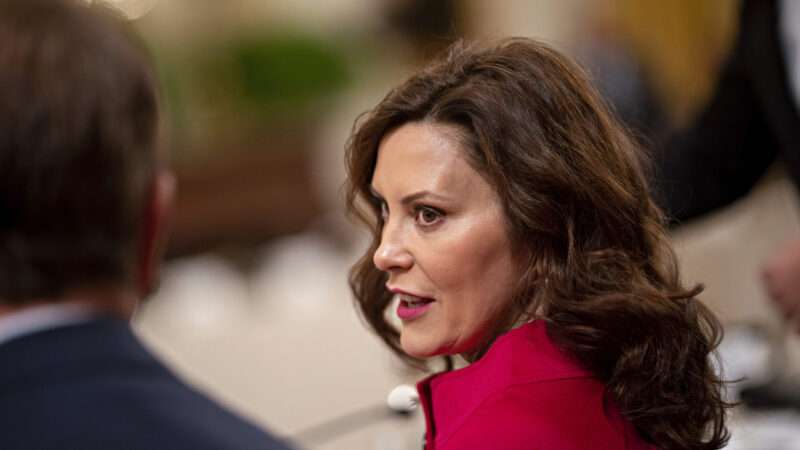
A side profile photo of Michigan Governor Gretchen Whitmer

With the swipe of a pen held by Democratic Gov. Gretchen Whitmer, Michigan on Friday became the first state to repeal a right-to-work law in over 60 years. That’s unfortunate not just for the workers who have lost their choice about whether to associate with a union, but also for the state economy. Michigan will be a less prosperous state without right-to-work, and its workers will be less free.

Right-to-work is a simple policy. At its core, right-to-work is about choice. For private sector workers, the National Labor Relations Act establishes rules for what happens when union membership is mandatory. Once a union is recognized, it speaks for all employees within the bargaining unit. An employer must bargain with that union, and only with that union, to set the terms and conditions that will govern the workplace. Employees who do not wish to associate with the union have no choice but to accept its representation and terms of the contract it negotiates. They cannot negotiate for themselves.

Right-to-work restores some voice to dissenting workers by allowing them to keep their jobs without being forced to pay a union “agency fees.” Agency fees are a portion of dues, which workers must pay to a union for its representational activities. Typically, these fees are 70 percent to 80 percent of the dues payment. In states without right-to-work protections, workers who do not want the union to speak for them can be forced to pay these fees. Right-to-work gives these workers a voice by allowing them to at least not have to pay for their legally mandated silence when it comes to their compensation and working conditions.

Although right-to-work laws are simple, their impacts are broad. The economic impacts of right-to-works have been positive both in Michigan and across the country.

Studies have consistently shown that right-to-work leads to stronger economic growth. A 2002 study by the Mackinac Center for Public Policy (where I am director of labor policy) found gross state product, statewide employment, manufacturing employment, construction employment, and per-capita disposable income all grew faster in right-to-work states from 1970–2002, compared to states without right-to-work. That same study showed lower average annual unemployment, poverty rates, income inequality, and labor costs in right-to-work states. A 2007 Mackinac Center study reached similar findings, as did a later review. These findings have remained more or less consistent in the years since.

Right-to-work states also are more likely to create job opportunities. From 2020 to 2021, 867,104 people moved to a right-to-work state away from a state that wasn’t. One reason for this might be that job opportunities are more prevalent in right-to-work states. Companies looking for new locations often consider right-to-work as one key factor. Right-to-work is one way that states can compete economically without having to resort to corporate welfare programs.

In October 2022, the unemployment rate in right-to-work states was 3.4 percent, compared to 3.9 percent in states without the law. Since the pandemic, right-to-work states have added 1.6 million jobs, while other states have lost 809,000 jobs.

Anyone who thinks manufacturing is important should favor right-to-work. A 2021 Harvard study found that the share of manufacturing employment in the economy was 28 percent higher in right-to-work states, compared to neighboring states without right-to-work. The study also showed that average wages and labor compensation weren’t negatively affected by the passage of the law. A similar study conducted by the Mackinac Center in 2022 shows similar results.

Michigan’s economic conditions in the 10 years before right-to-work and the 10 years that followed offer an excellent case study on the positive impact of right-to-work. According to the federal Bureau of Labor Statistics, in the 10 years before right-to-work, Michigan’s unemployment rate averaged 8.5 percent. In the following decade, it was 6 percent. Michigan’s labor force lost 350,657 people from 2002–12, but it gained 90,648 people from 2012–2020. Inflation-adjusted income growth went from 0.06 percent to 21.9 percent.

In nearly every measurable way, Michigan has been better off.

Right-to-work gives workers greater choice about how to manage their lives and offers significant economic benefits for the state they call home. The 60,000 private sector workers in Michigan who have opted out of union membership are not the only ones who will be hurt by the repeal of right-to-work. Union members are also likely to find they are worse off.

The reasons for this lie in simple market forces. In a right-to-work state, a union’s financial stability requires it to please its members. If the union fails to deliver services that justify the price of dues, workers may opt out, denying the union revenue. This incentive is gone once right-to-work is repealed. A union is guaranteed that nonmembers will pay agency fees that are the vast majority of union dues. Repealing right-to-work gives unions a guaranteed income stream, which removes the incentive for them to provide the best services possible to the employees they represent. Repealing right-to-work, then, harms both those who would voluntarily pay the union and those who would not.

The post Michigan Repeals Right-To-Work Law appeared first on Reason.com.

from Latest https://ift.tt/3O9xk4z
via IFTTT
Trump’s Anti–First Amendment Skylarking Is DeSantis’ Anti–First Amendment Action


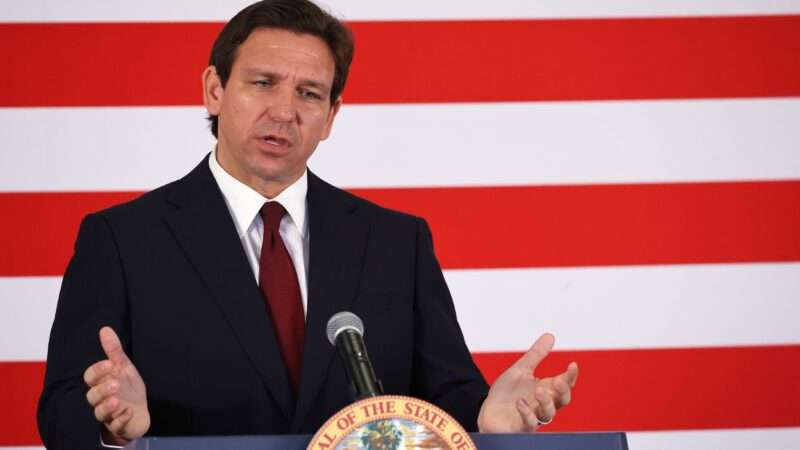
DeSantis giving a speech in Florida

Standing in front of a large American flag at an event touting civics education “on topics including rights and responsibilities of citizens…and also understanding the philosophical underpinnings of the American republic,” Florida Gov. Ron DeSantis (R) made a case for abrogating press freedom.

He supports Florida House Bill 991, DeSantis explained, in its plan to make it easier to sue journalists for defamation, perhaps most controversially by changing the legal status of anonymous sourcing. “If somebody is defamed…if [the journalist is] using anonymous sources, that can be a presumption that that was done with malice,” DeSantis said Thursday. “I think what’s happened is particularly corporate media outlets have relied on anonymous sources to smear people.”

But don’t worry, H.B. 991’s discouragement of anonymous sourcing isn’t “going to cause much of a difference in terms of free speech,” DeSantis added. It will merely “cause some people to not want to put out things that are false, that are smearing somebody’s reputation.”

Of course, it will also cause some people not to want to put out things that are true but unflattering to public figures like DeSantis—or, to point to the obvious case of anonymous sourcing proving correct, President Richard Nixon.

This bill isn’t all bad, and there’s a fair critique to be made of overreliance on anonymous sources where trivial matters are concerned. But, on balance, this legislation is an attack on the freedom of the press, and its support from DeSantis suggests that on an important constitutional matter, there’s not much daylight between him and his presumptive presidential primary rival, former President Donald Trump.

H.B. 991 is in some regards reasonable. For instance, it provides that you don’t become a public figure merely by giving an interview to the press; defending yourself “publicly against accusations;” being the subject of a viral video or photo; or holding “public employment other than elected office or appointment by an elected official.”

In other words, being a teacher or DMV clerk doesn’t make you a public figure. Nor does, say, becoming the “Central Park Karen” or the “ain’t nobody got time for that” woman. In a defamation suit, H.B. 991 says that absent some other sort of fame—some willful entrance into public life, like cultivating celebrity or running for office—these people should be treated like private figures who enjoy a stronger standard of reputational protection.

I’m not sure this distinction is right exactly as written. Protection for people who give a man-on-the-street interview or unwillingly become viral memes makes sense, but police officers strike me as public employees who should be treated as public figures because of their unique role, which includes legally protected use of force. Some critics have also argued H.B. 991’s delineation could violate Supreme Court precedent. Still, the underlying idea—of specifying what it means to be a public figure in a digital era where sudden, unsought notoriety is possible in a way it wasn’t in the very recent past—seems fair.

It’s also fair to say that sometimes the media goes overboard with anonymous sourcing. I’ve thought this myself, especially during the Trump administration, when comments from unnamed “people close to the president” were regularly the basis of high-profile but objectively low-stakes coverage of White House personal drama which mostly told us what we already knew: that Trump was petty, deceptive, and ill-equipped for his office. A story doesn’t have to rise to the significance of Watergate to justify reliance on sources who won’t consent to be named, but that hardly means every snippet of anonymous gossip deserves publication.

And yet, as ever where basic individual rights are concerned, there is—or should be—a yawning gap between this is a dumb or imprudent or risky way to exercise that right and we should make this functionally illegal, which is what H.B. 991 very nearly does with anonymous sourcing.

That’s not the only problem with the bill, either. Its provision that an “allegation that the plaintiff has discriminated against another person or group because of their race, sex, sexual orientation, or gender identity” is automatically enough for a defamation suit is similarly troubling for its likely effects on free speech.

So is its mention of “any one presentation to an audience” or “utterance on the Internet” as bases for defamation cases. As a New York Times editorial notes, that could mean, respectively, “statements made at school board hearings and other public meetings” or “a tweet or a Facebook post written by anyone.” It’s not as bad as the United Kingdom’s prosecutions for “grossly offensive” tweets, but it’s a move in that direction of chilling public speech.

It’s a move, too, in the direction Trump wants to go. “One of the things I’m going to do if I win,” he said in 2016, “I’m going to open up our libel laws so when they write purposely negative and horrible and false articles, we can sue them and win lots of money.”

This was always a fantasy, because the relevant legislation, like H.B. 991 itself, is overwhelmingly set at the state level and therefore isn’t under the president’s purview. But the animosity undergirding the threat, and Trump’s ability as president to curtail press freedom using tools also employed under the Obama and Biden administrations, is quite real.

That animosity is apparently something DeSantis shares. If elected president, he may well reach for the same anti-press tools of surveillance and suppression of dissent. And in the meantime, as a governor, he might well “open up” Florida’s defamation laws, doing in real life what Trump only imagined.

The post Trump's Anti–First Amendment Skylarking Is DeSantis' Anti–First Amendment Action appeared first on Reason.com.

from Latest https://ift.tt/sQE5rNm
via IFTTT
Short Circuit: A Roundup of Recent Federal Court Decisions

Please enjoy the latest edition of Short Circuit, a weekly feature written by a bunch of people at the Institute for Justice.

D.C.-area friends, come and join us on Friday, March 31 to commemorate a real American hero, Robert T. Meyer, who violated a Nebraska law banning instruction in a foreign language and fought his case all the way to the U.S. Supreme Court, which, in 1923, ruled in his favor and gave us one of its most stirring and all-too-rare defenses of individual liberty. Click here to RSVP! Or click here for a nice little article on the exciting backstory to Meyer v. Nebraska.

New on the Short Circuit podcast: Professor Katy Ramsey Mason of the University of Memphis joins the show to talk crime free rental ordinances, which force landlords to evict tenants after anyone in a household is merely charged with (not convicted of) a crime.

  • Separation-of-powers buffs may recall the Supreme Court’s Seila Law decision in 2020. That decision held that the statute protecting the Director of the Consumer Financial Protection Bureau from removal (other than “for cause”) unconstitutionally limited the President’s removal power. Does that mean that the CFPB’s civil investigative demand to a (different) law firm was void ab initio? Second Circuit: No. Then was the demand unenforceable because the CFPB’s funding structure violates the Constitution’s Appropriations Clause? Second Circuit: Also no, and the Fifth Circuit’s contrary holding is unpersuasive. Then perhaps the Consumer Financial Protection Act violates the nondelegation doctrine? Second Circuit: Still no. Surely, though, this particular civil investigative demand was unduly burdensome? Second Circuit: We would agree with you if today were Opposite Day, but today is not that day.
  • While most of us were doing sad Zoom happy hours and binging on Tiger King in the early days of the COVID-19 pandemic, entrepreneurial lawyers representing students and parents sued just about every university for refunds when they shut down in-person facilities. Because the great thing about America is that everyone gets their decade in court, three years later in a suit against NYU, two judges of the Second Circuit decide that parents who paid their kids’ tuition don’t have standing to sue, a different two judges say maybe a student can sue so please start this all over again, one judge has some concerns about conflating merits and standing questions, and one judge thinks we should just be done with this all.
  • Former federal inmate, a devout Muslim, sues under the Religious Freedom Restoration Act, alleging that when he would try to perform his required daily prayers during shift breaks at the prison commissary where he worked, his guards—who also said “There is no good Muslim but a dead Muslim” and put a sticker on his back reading “I love pork bacon”—would follow him and deliberately interfere by making noises, talking loudly, and kicking boxes. Guards: What gov’t official could possibly know that violated the law? Third Circuit (over a dissent): You two. You could have known. No qualified immunity.
  • Fourth Circuit (2021): This petitioner’s state court death sentence was defective. We rely on evidence introduced in his federal habeas proceedings. Supreme Court (2022): Reconsider in light of Shinn v. Martinez Ramirez, where we said you can’t do that. Fourth Circuit (2023): Same answer because the State didn’t properly raise the argument that the evidence was inadmissible. Dissent: But have you heard of the “tipsy coachman” rule?
  • New IJ cert petition: The Fifth Amendment says that the gov’t must pay just compensation when it takes private property for public use. But the Fifth Circuit recently held, in a one-page opinion, that this requirement doesn’t matter if the legislature hasn’t chosen to enforce it. That, says IJ’s petition, is both wrong and contrary to quite a bit of precedent. And Judge Oldham, joined by four other Fifth Circuit judges, seems to agree, writing that “barring Supreme Court intervention . . . [t]he panel decision is an insuperable obstacle to any plaintiff asserting any federal takings claim against any State in federal or state court.” Sounds like a big deal!
  • In which the Fifth Circuit, sitting en banc, upholds a nationwide preliminary injunction against President Biden’s mandate that federal employees get vaccinated against COVID-19.
  • In Knick v. Township of Scott, the Supreme Court eliminated the requirement that takings plaintiffs exhaust their state-court remedies before suing in federal court, in part because that rule created a “preclusion trap” that prevented property owners from ever getting to federal court. But that, says the Fifth Circuit, is cold comfort for this plaintiff, which filed its case in state court before Knick and is therefore squarely caught in that same preclusion trap.
  • More breaking news on the Fifth Circuit‘s e-cigarette docket: the FDA’s denial of an application to market menthol-flavored e-cigarettes is stayed.
  • Allegation: During a 2015 traffic stop (over a minor infraction), Houston police officer approaches with gun drawn and then shoots motorist five times as he reaches for his wallet. Officers drag the man from the vehicle, handcuff him, and do not seek medical attention for six minutes. He dies. Officer: In fact, the motorist pulled a gun. And yet! Seven officers searched the vehicle and did not find a gun. Rather, an investigator who took another look 22 days later found one in plain view on the back seat. Fifth Circuit: The district court’s grant of qualified immunity to the officer is reversed. The claims against the city were properly dismissed, however; just because the officer was promoted and awarded a certificate of bravery for the incident doesn’t mean the city approved of any excessive force.
  • Man calls 911 to report that a store clerk pulled a gun on him and threatened him. When Saginaw, Mich. police arrive, they arrest him for filing a false police report. He spends 18 days in jail before being released and all charges against him are dropped. Sixth Circuit: And since they decided he was a “f*cking liar” before he even spoke, dismissed his story as “bull sh*t” before talking to any witnesses, and are alleged to have deliberately avoided reviewing video evidence that could have confirmed his story, there’s enough for this to go to a jury.
  • “Steven Moss was sentenced to 15–45 years in prison after an entrapment hearing for which his attorney, David Steingold, arrived entirely unprepared, and a bench trial that lasted only 20 minutes. At every step along the way, from his failure to investigate and interview witnesses to his failure to meaningfully test the prosecution’s case, Steingold failed to conduct himself in the manner consistent with effective representation.” Which would be an absolutely killer first paragraph for Moss if it had appeared in the Sixth Circuit‘s panel opinion considering his ineffective-assistance claim, instead of in the dissent.
  • Legally blind prisoner in Tennessee is stabbed by gang members. He sues the prison (and others), alleging civil-rights violations. District court appoints him pro bono counsel, but he files a flood of complaints against the lawyer and she withdraws. Now pro se, he has (understandable) difficulties complying with discovery and other deadlines, so district court dismisses the case for his failure to prosecute it. Sixth Circuit: It looks like the district court might have overstepped, since the blind, incarcerated plaintiff doesn’t appear to have been deliberately flouting his discovery obligations. Judge Readler, concurring in the judgment: Based on the district court’s threadbare analysis, I’ll agree that dismissal was improper. But let’s be real: The plaintiff effectively fired his free lawyer (from “a well-equipped Nashville law firm”) who was doing a perfectly fine job representing him, and then he started missing deadlines and filing frivolous documents. Not great.
  • If you’re going to appeal to the Sixth Circuit, Tennessee attorney fired from the state Board of Professional Responsibility allegedly because of your anti-Muslim tweets, remember that court-watchers are going to look up what your tweets were. Apparently, things like “Where’s the evidence that ‘Islam is a religion of peace’? They’ve gone to war against every society they’ve encountered for 1000s of years.” This is the “Streisand effect,” a form of “situational irony.” (One of the attorney’s First Amendment claims can proceed.)
  • South Dakota police arrest man based on a warrant that was mistakenly left active. Obviously, inactive warrants don’t supply probable cause. Suppress the meth they found? Eighth Circuit: The exclusionary rule is supposed to deter intentional police misconduct, not paperwork goofs. So, no.
  • California-based fast-fashion upstart Honey Bum sues larger rival Fashion Nova for organizing a group boycott against it, alleging Fashion Nova threatened to stop purchasing from clothing vendors who continued selling to Honey Bum. Ninth Circuit: A group boycott requires that the clothing vendors have conspired with each other to boycott Honey Bum. Here they were just sort of independently bullied into it.
  • This Ninth Circuit decision contains three judges, yet generates four opinions, but it’s easy to discern the holding: You see, Parts I, II, and III(A) of the lead opinion have three votes, Part III(B)(i) has two votes, and Part III(B)(ii) has two votes, but not the same two votes as the other bit with two votes, except for footnote 16, which has one vote—we have this all written down, but we can show it to you tomorrow if you want to see it.
  • Tribe: We have “aboriginal title” to these lands in New Mexico because we had exclusive occupation of them from around 1300 to 1650, and then still used them a lot since then. Further, the “sovereign” (the U.S.) has never properly taken them away, so they’re still ours. District court: No. Tribe on motion to reconsider: How about just these bits of the lands? District court: Still no. Tenth Circuit: There’s still a claim for one of the bits. Concurrence 1: No bits for you. Concurrence 2: Two bits.
  • Woman on the state of Oklahoma’s Death Row: The federal district court denied my habeas petition. Would you please certify my appeal on ten issues for why my sentence should be thrown out? Tenth Circuit (2017): Sure, we’ll take a look. Tenth Circuit (2023): But you still lose on all of them. Dissent: OMG there were so many errors in her trial.
  • Mining company files an application with the Bureau of Land Management to mine certain claims in Wyoming. The Interior Secretary then sits on the application and soon afterward Congress orders the office to not consider any more. Repeatedly. For 26 years. Company then sues. Does it have a claim that the application should have been initially processed but was unreasonably delayed? District court: It’s time barred. Tenth Circuit: The case can proceed due to the repeated violations doctrine.
  • Some people say a Florida Man is stubborn as a mule. He’ll pick fights that don’t need to be picked and continue them long past the point of any conceivable personal benefit. Cross a Florida Man and he’ll hold a grudge against you until the day he dies. I forget where I was going with this. (Ed.: We suspect these reflections by our summarist, himself an erstwhile Florida Man, may have been inspired by these two unpublished cases from the Eleventh Circuit.)

Law students! Come to IJ’s annual Law Student Conference, a two-day event hosted in our Arlington, Va. office on June 3 and 4 that will focus on our recent First Amendment retaliation work. (Like this and like that and also see here. And don’t sleep on this.) Students who aren’t local will receive a travel scholarship. The program includes a dinner cruise on the Potomac River along with an opportunity to meet a few of our clients (as well as this newsletter’s beleagered profreading staff). Click here to have a look at the agenda and to register. Registration includes a simple application that is due by Monday, April 17. Apply today! Spots will go fast!

The post Short Circuit: A Roundup of Recent Federal Court Decisions appeared first on Reason.com.

from Latest https://ift.tt/0FdkB6q
via IFTTT
Biden Says “Banks In Pretty Good Shape” As Small Banks See Biggest Deposit Outflow On Record

Biden Says “Banks In Pretty Good Shape” As Small Banks See Biggest Deposit Outflow On Record

The Fed just released its weekly commercial bank data dump showing deposit inflows/outflows.

Two things to note:

1) This is for the week up to 3/15/23 (which includes the SVB collapse but nothing more)

2) ‘Large Banks’ includes the top 25 banks (which means SVB was among that group, hence, we get no indication of SVB rotation flows)

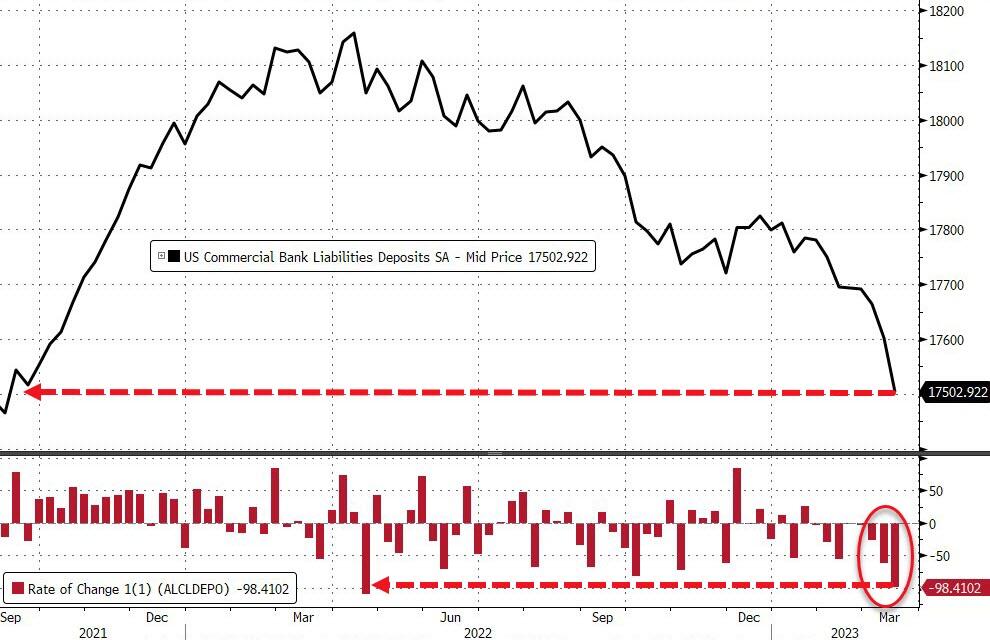
The overall data shows that domestic commercial banks saw over $98 billion in deposit outflows (seasonally-adjusted) that week to just over $17.5 trillion (8th straight week of aggregate outflows).

Source: Bloomberg

That is the largest (seasonally-adjusted) outflow since April 2022 (tax-related?) as we suspect much of that flowed into money-markets. Deposits have been on a steady decline over the past year or so, falling $582.4 billion since February 2022.

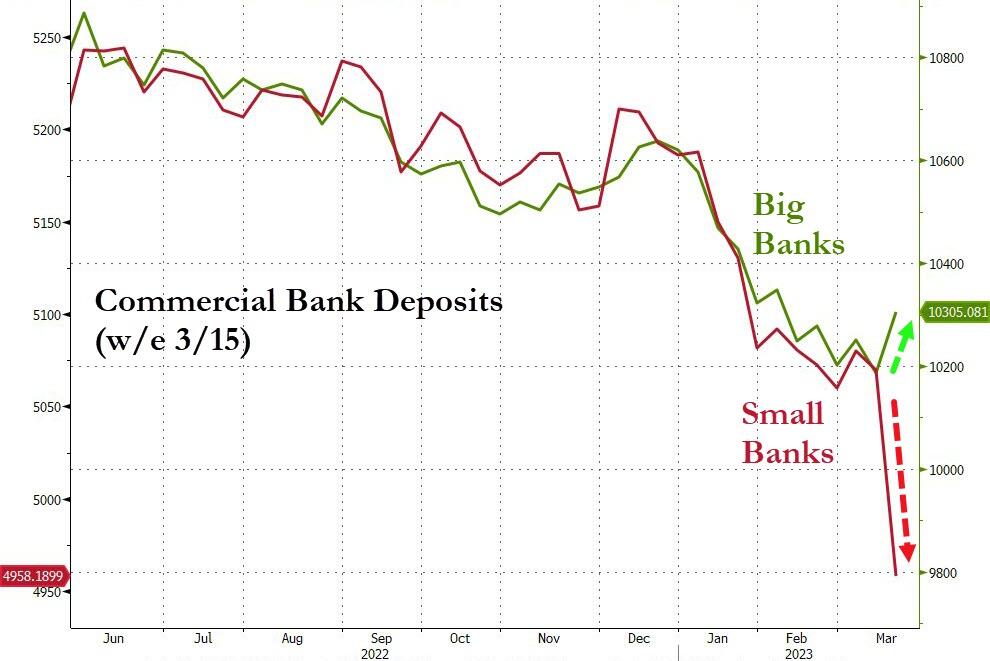
There was a notable rotation however with the large banks seeing deposit inflows of $117.9 billion on a non-seasonally-adjusted basis (the biggest weekly inflow since Dec 2021).

Small banks, on the hand, saw a massive $111 billion outflow (non-seasonally-adjusted)…

Source: Bloomberg (note different scales)

That is the largest weekly outflow ever (by multiples) and drops ‘small bank’ total deposits to the lowest since Sept 2021…

Source: Bloomberg

Bear in mind this data does not include the last 10 days, where we have US regional banks all tumbling further and Yellen offering no guaranteed deposits, FRC stock collapse amid bailouts (though that will skew the data due to that $30bn infusion), and the fear of Credit Suisse’s collapse.

Will banks start to compete for deposits? (Well not the biggest ones, for sure)…

“There are two key questions raised by the recent deposit turmoil,” Barclays Plc strategist Joseph Abate wrote in a note.

“How many deposits do banks ultimately lose to higher yielding money market funds? And how costly is it to replace this funding?”

Until now, when banks have lost deposits they haven’t had to compete aggressively so rates have lagged the Fed’s rate increases, and balances at government-only money fund balances had been flat since the hiking cycle began.

“But now that depositors have noticed, this dynamic is about to change,” Abate said.

And if the small ones start to ‘compete’ their profitability will collapse even further.

But as FSOC ‘reassured’ everyone today, “while some institutions have come under stress, the U.S. banking system remains sound and resilient.

Thanks Janet.

President Biden chimed in on the state of the US financial system after the close, saying that “it’s going to take a little while for things to calm down,” adding that:

“The banks are in pretty good shape… I don’t see anything on the horizon about to explode”

Reassured much?

Tyler Durden
Fri, 03/24/2023 – 17:21

via ZeroHedge News https://ift.tt/cYWPh92 Tyler Durden

Julie Kelly: Informants Everywhere

Julie Kelly: Informants Everywhere

Authored by Julie Kelly via American Greatness (emphasis ours),

After nine weeks of testimony from multiple government witnesses, including FBI agents, the Justice Department finally concluded its case-in-chief in the Proud Boys’ seditious conspiracy trial on Monday.

Five Proud Boys, including the group’s leader, Enrique Tarrio, are accused of conspiring to “oppose the lawful transfer of presidential power by force” on January 6, 2021. It is Attorney General Merrick Garland’s most consequential case related to January 6; convictions will help build a similar case against Donald Trump largely based on his infamous “stand back and stand by” remark to the Proud Boys during an October 2020 presidential debate.

Most of the evidence is nothing more than inflammatory, braggadocious chatter in group texts; Tarrio wasn’t even present at the Capitol on January 6. Another defendant, Ethan Nordean, can be seen on surveillance video walking through an open door as Capitol police stood nearby.

Similar to other so-called “militia” groups tied to January 6, no one brought weapons to the Capitol that day; no one was charged with assaulting police officers or lawmakers. A key piece of evidence that prosecutors claimed was a road map for the “attack” on the Capitol wasn’t produced by any Proud Boy but by a former intelligence asset who himself sent the plan to Tarrio through a third party.

The document represented just one more instance of how a government agent helped shape the government’s narrative that the Proud Boys plotted in advance to carry out an “insurrection” on January 6. In fact, much like the FBI-engineered plan to “kidnap” Michigan Governor Gretchen Whitmer in 2020, court proceedings confirm that FBI assets might outnumber criminal defendants.

At least 10 and possibly up to 15 FBI informants were embedded in the group months before and continuing after the events of January 6. Informants participated in numerous group chats, cozied up to leadership, and even accompanied the Proud Boys to Washington.

One known informant, according to a September 2021 New York Times report, was involved in the first breach of Capitol grounds and entered the building that afternoon.

But prosecutors and Judge Timothy Kelly have tried their best to prevent the public from learning the full scope of the FBI’s involvement. The docket is littered with sealed hearings and filings; prosecutors presented to the defense team heavily redacted reports related to FBI informants just before the trial began. 

Everything has been done under cover,” one defense attorney recently complained in court. A consortium of major news corporations also knocked Kelly this week for holding “sealed hearings and exclud[ing] the press and public from attending proceedings in this high-profile case.”

Kelly also took the highly unusual and prejudicial step of requiring the defense to “pre-clear” questions with prosecutors before asking a witness about the use of informants—but information is slowly trickling as the defense finally gets their turn.

For the second time this month, Kelly suspended the trial on Wednesday after prosecutors confessed that a key witness for the defense, who was scheduled to testify on Thursday, had worked as an FBI informant during the entire investigation. Although prosecutors have known for months that the defense might call this person as a witness, they waited until the last minute to tell defense attorneys, who were blindsided by the news.

It got worse from there. A bombshell motion filed by the defense shortly after the disclosure revealed the informant cozied up to defendants and their attorneys for more than 20 months—from April 2021 until January 2023 when the trial began.

“During this period of time, the CHS (confidential human source) has been in contact via telephone, text messaging and other electronic means, with one or more of the counsel for the defense and at least one defendant,” wrote Carmen Hernandez, the public defender representing Zachary Rehl. “During this period of time, the CHS also participated in prayer meetings with members of one or more of the defendants’ families. The CHS also engaged in discussions with one of the defendant’s family members about replacing one of the defense counsel. The above may not include all the communications that were initiated by or engaged in by the CHS.”

Hernandez demanded “all recordings or reports that it may have regarding the defense team, all interview reports or FBI memos relating to the recording or reporting of the defense team, and all internal memos prepared by the United States Attorney’s Office and Department of Justice attorneys relating to any reporting on and recordings of the defense team.”

Prosecutors responded by claiming no such records exist and that “the FBI never tasked the CHS with gathering any information on the defendants or their defense counsel” even though the FBI was “generally aware that the CHS was active in assisting defendants—and their families, including by assisting in fundraising efforts and protesting against their conditions of confinement.” 

Further, U.S. Attorney Matthew Graves’ office argued, the fact that “defense counsel chose to communicate with the CHS about matters related to this prosecution is a decision made by them.”

As the trial drags on, Kelly has his hands full running interference for the Justice Department. (Kelly is a former assistant U.S. attorney for the District of Columbia, the same office handling every January 6 prosecution.) The judge abruptly suspended the trial a few weeks ago amid the discovery of thousands of hidden messages exchanged between FBI agents that discussed doctoring a report about an informant, destroying evidence, and FBI surveillance of communications between Rehl and his former attorney. 

After prosecutors claimed, without evidence, that the evidence-destruction chatter pertained to a closed case and that Rehl surrendered his rights to attorney-client privileged by using a monitored communications system from jail, Kelly dropped the matter entirely. 

Kelly this week similarly quashed a defense subpoena to compel testimony from another Proud Boy who also turned out to be an FBI informant. Proud Boy member Kenneth Lizardo, Kelly admitted in his order, “closely interacted” with the group, particularly Tarrio. Lizardo picked Tarrio up from jail on January 5—he had been arrested on charges of burning a Black Lives Matter banner in December 2020—and drove him to an underground garage where Tarrio met with Stewart Rhodes, the now-convicted head of the Oath Keepers.

Lizardo warned he would invoke his Fifth Amendment privilege to avoid potential criminal charges himself for his involvement with the Proud Boys and presence at the Capitol on January 6. So Kelly let him off the hook while noting Lizardo “has had a reporting relationship with the FBI.”

That’s one way to put it.

FBI officials to this day refuse to answer questions about the bureau’s foreknowledge and engagement in the events of January 6. The January 6 committee did not bother to interview FBI Director Christopher Wray or then-head of the Washington FBI field office, Steven D’Antuono, who also ran the Whitmer fednapping hoax.

But the shroud of secrecy is gradually disintegrating no matter how hard Beltway lifers like Judge Kelly attempt to keep it intact. Recent polls indicate a solid majority of Americans believe federal assets provoked the Capitol protest; revelations emerging from the Justice Department’s biggest case will only bolster those justified suspicions.

About Julie Kelly

Julie Kelly is a political commentator and senior contributor to American Greatness. She is the author of January 6: How Democrats Used the Capitol Protest to Launch a War on Terror Against the Political Right and Disloyal Opposition: How the NeverTrump Right Tried―And Failed―To Take Down the President. Her past work can be found at The Federalist and National Review. She also has been featured in the Wall Street Journal, The Hill, Chicago Tribune, Forbes, and Genetic Literacy Project. She is the co-host of the “Happy Hour Podcast with Julie and Liz.” She is a graduate of Eastern Illinois University and lives in suburban Chicago with her husband and two daughters.

Tyler Durden
Fri, 03/24/2023 – 17:00

via ZeroHedge News https://ift.tt/WYD0Qap Tyler Durden

Hungary Will Not Arrest Putin, Blasts ICC Warrant, While South Africa Seeks Legal Advice

Hungary Will Not Arrest Putin, Blasts ICC Warrant, While South Africa Seeks Legal Advice

Following the International Criminal Court (ICC) last Friday issuing an arrest warrant for President Vladimir Putin, Hungary says it will not arrest the Russian head of state if he were to enter the country.

Hungarian Prime Minister Viktor Orban’s chief of staff, Gergely Gulyas, “shocked” European allies with the Thursday declaration. “We can refer to the Hungarian law and based on that we cannot arrest the Russian President… as the ICC’s statute has not been promulgated in Hungary,” Gulyas said.

He noted the Hungarian government has not yet “formed a stance” on the question of the ICC’s arrest warrant. But resistance to the possibility of arresting Putin is no surprise when it comes to Hungary, given Orban’s consistent warnings that NATO is “drifting” toward war with Russia, and that this steady escalation needs to be stopped.

Gulyas referenced this stance in his Friday remarks, explaining, “These decisions are not the most fortunate as they take things towards further escalation and not towards peace, this is my personal subjective opinion.”

CNN called these words “sympathetic” to the Kremlin, given the criticism heaped on the Hague-based court’s decision. However, Budapest has consistently urged the West to get more serious about peace negotiations. The Hungarian presidency’s office was responding to the German government declaring earlier this week that it will act on the warrant and arrest Putin if he ever chose to fly to German soil.

At the same time, the Kremlin has warned it is prepared to attack any country that moves to arrest the Russian head of state.

In the summer, Putin is due to visit South Africa, a signatory 1998 Rome Statute that established the international court…

Given the ICC doesn’t have a police force, any actual attempt to detain Putin would be the decision of a government, so needless to say it could not possibly be enforced by ICC authorities alone. 

But it does clearly complicate Putin’s ability to travel to European or other capitals which cooperate with the ICC. This also means it could hinder peace efforts in the scenario Putin might choose to personally engage in negotiations or diplomacy in a European city. 

Meanwhile, South Africa is nervous over the August BRICS summit, given Putin is expected to attend

“We are, as the government, cognisant of our legal obligation. However, between now and the summit we will remain engaged with various relevant stakeholders,” spokesperson Vincent Magwenya said.

While there has been no official confirmation of Putin’s visit, he has been expected to attend the 15th BRICS summit, as he did in 2013.

According to more from Reuters, “But such a visit would place Ramaphosa’s government, which has not condemned Russia’s invasion of Ukraine, in a precarious position after the arrest warrant issued by the International Criminal Court (ICC) on Friday.”

Tyler Durden
Fri, 03/24/2023 – 16:41

via ZeroHedge News https://ift.tt/mszSjIl Tyler Durden

The Hierarchy Of Money And The Case For $8,000 Gold

The Hierarchy Of Money And The Case For $8,000 Gold

By Jan Nieuwenhuijs of GainesvilleCoins.com

In the hierarchy of money gold is superior to fiat money. From an historical perspective the past decades have been characterized by trust in fiat money, whereby fiat made up the lion share of global international reserves. The war between Russia and Ukraine (and by extension West and East), inflation, and systemic risks are reversing this trend. A long-term gold valuation model, which assumes gold will account for the majority of international reserves, suggests the gold price to exceed $8,000 in the coming decade.

The trend of central banks increasing gold reserves is likely to continue.

The Hierarchy of Money

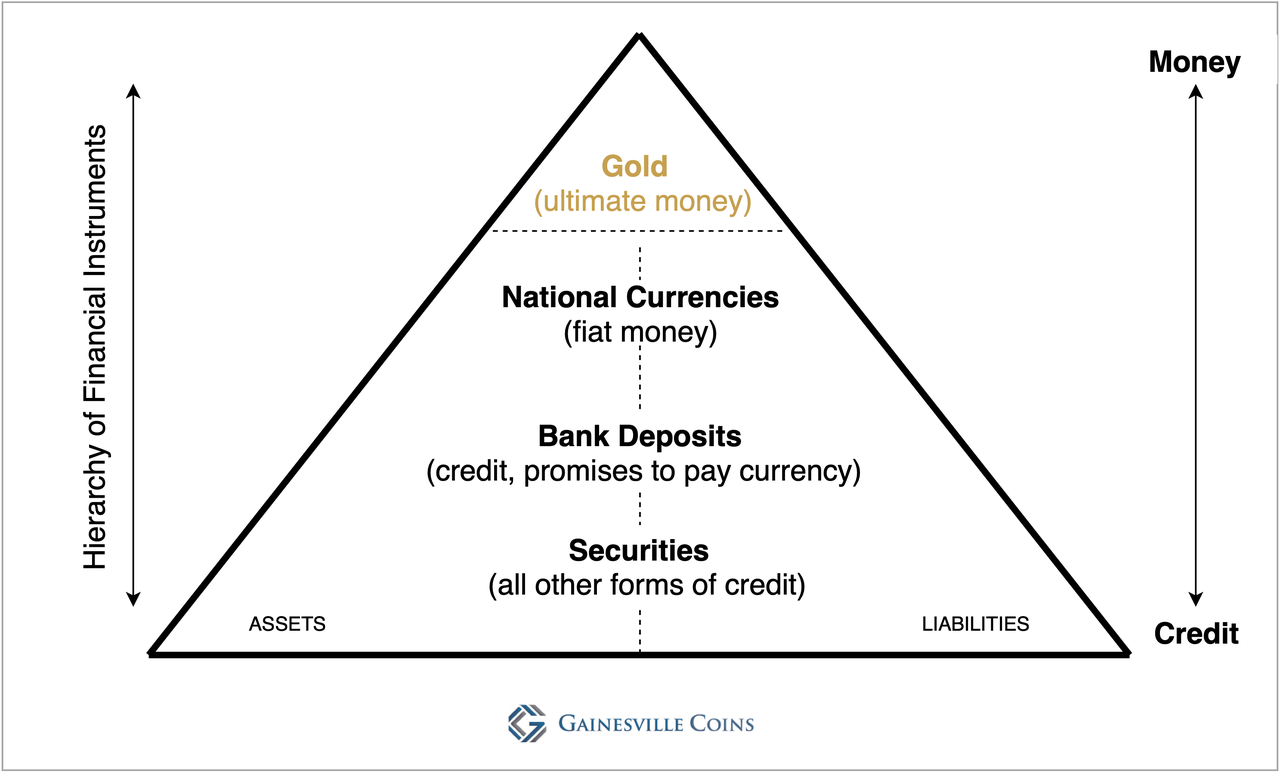
Reading Zoltan Pozsar’s analyses for a few years led me to read books and follow lectures by his intellectual mentor Perry Mehrling, Professor of International Political Economy. According to Mehrling there is a natural hierarchy of money, to be visualized as a pyramid.

Pyramid of the hierarchy of money.

At the top of the pyramid sits the ultimate money, which is scarce, universally accepted, and has no counterparty risk because it’s no one’s liability: gold. Below gold are national currencies issued by central banks. Then come deposits that are created by commercial banks. Securities, such as bonds and equity, are at the bottom.

Because everything underneath gold can be created out of thin air, the base of the pyramid can be easily widened. Throughout the business cycle balance sheets (assets and liabilities) are extended—credit is created—causing an economic boom. During a recession, balance sheets contract and the shape of the pyramid is remodeled.

Horizontally, the pyramid is all about quantity and leverage. Vertically, the pyramid is about quality: the higher up the better the quality of money. From Mehrling:

In a boom, credit begins to look like money. Forms of credit become much more liquid, they become much more usable to make payments with. And in contraction, you find out that what you have is not money, it’s credit actually. In a contraction, you find out that gold and currency are not the same thing. That gold is better. You find out that deposits and currency are not the same thing. That currency is better.

Now my interpretation…

A Long-term Gold Valuation Model

What has happened in the past decades, after severing the gold standard in 1971, is a massive increase in supply of fiat money, credit, and securities. The pyramid is out of shape with a tiny tip and a fat debt belly. Global debt to GDP is near its all-time high established in 2020.

Policy makers won’t allow the debt to default—a contraction of credit—because the global financial system has grown too big and intertwined. One default too much could risk the stability of the entire arrangement. The only way to restore the shape of the pyramid is by an increase in the price of gold.

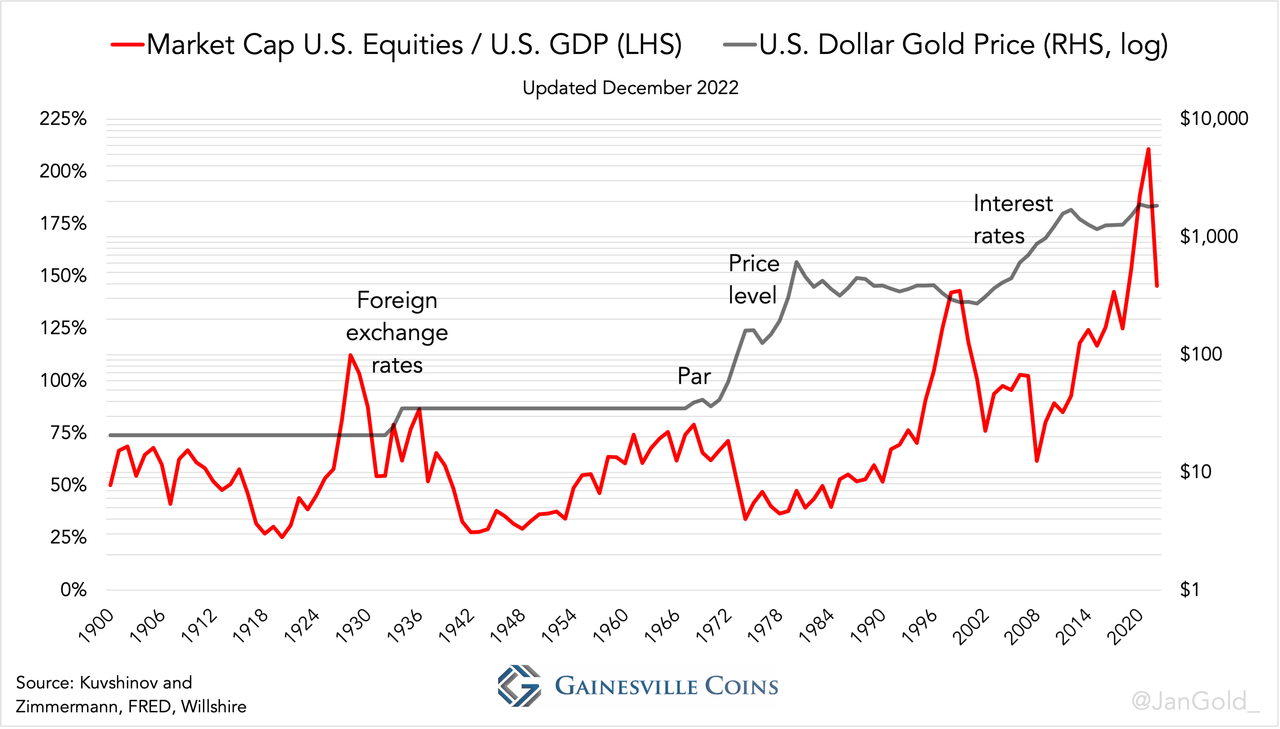
In a previous article we discussed the relationship between the price of gold and equities over the past one hundred years. These are dynamics between the top of the pyramid and the bottom. We concluded that the current decline of the equity market capitalization, relative to GDP, is signaling a new gold bull market.

In an economic downturn the US equity market cap to GDP ratio falls, and the dollar is debased through one of the four prices of money (par, interest rates, foreign exchange rates, price level) to boost the economy. As a result, the price of gold denominated in dollars increases.

In today’s article, we will use Mehrling’s hierarchy of money framework, and examine the relationship between national currencies and gold to get a sense of where the price of gold is headed.

Central banks have created so much “money” since 2008 that from an economic perspective the relation with bank deposits has weakened. Measuring the value of official gold reserves versus the monetary base (central bank money) may not satisfy to predict the future price of gold.

Instead, we will evaluate how much gold central banks are willing to hold relative to foreign national currencies. In other words, the composition of international reserves (foreign exchange and gold), which underpin their balance sheets. By going through the archives, I have been able to conceive a long run data series of gold as a percentage of international reserves from 1880 until present*.

The chart shows world official gold reserves as a percentage of official international reserves.

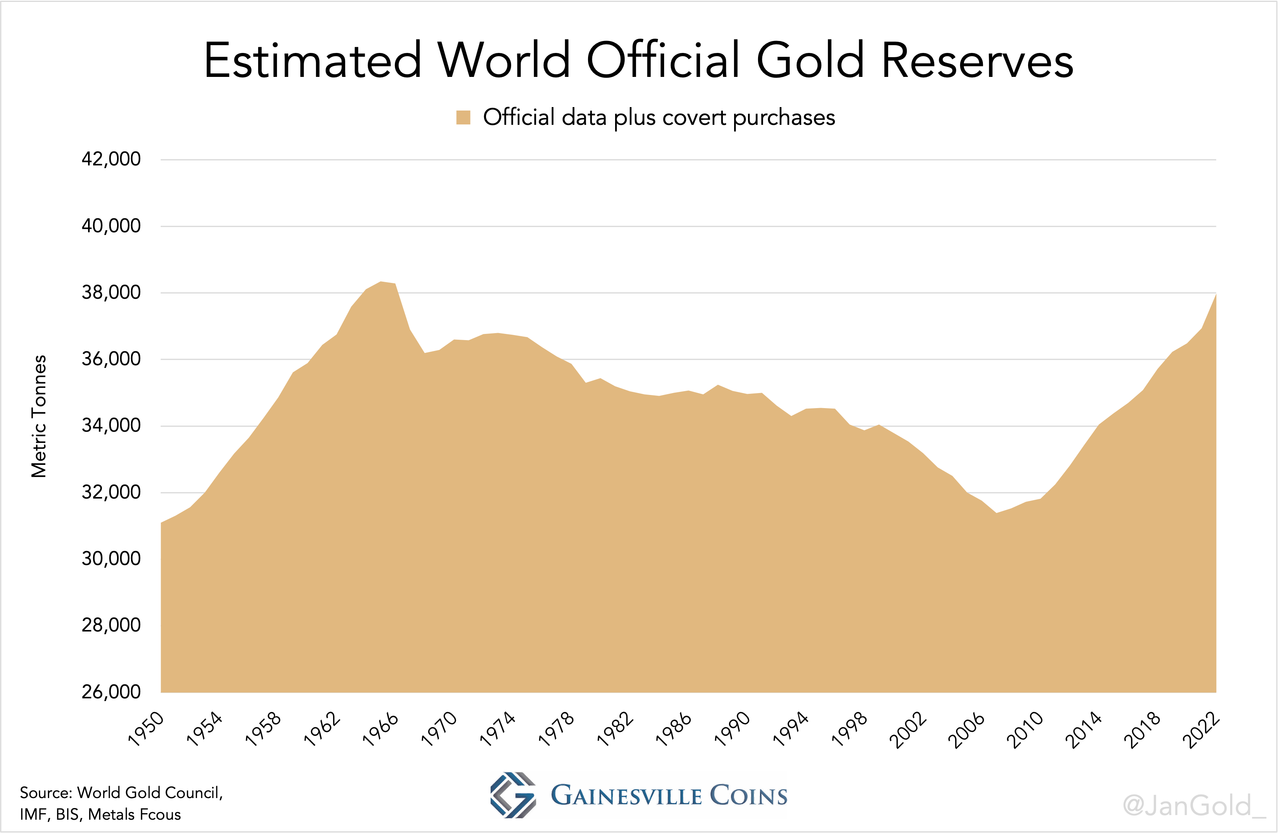
Central banks in aggregate have an unusual faith in foreign exchange, as gold’s percentage of total reserves accounted for 16% in 2022, against a historical average of 59%. These central banks, however, are starting to lose confidence in the currencies issued by their peers. In 2022 official gold reserves went up by a record 1,136 tonnes, while foreign exchange reserves went down by a record $950 billion. Large purchases by central banks on all continents in recent years indicate how central banks think the system will stabilize, by a rising gold price, confirming they have no intention in designing a new pyramid.

Global gold reserves.

In light of the war, which caused the US to freeze the Russian central bank’s dollar holdings, inflation, and systemic risks, the trend of gold increasing its share of total reserves is logical.

Should we extend this trend and assume gold to make up a conservative 51% of global international reserves, the price of gold would need to be $10,000 per troy ounce. Naturally, in the process of raising the gold price central banks increase the weight of their gold and sell foreign exchange, resulting in a lower price of gold required to make up the majority of total reserves. On the other hand, over time central bank balance sheets grow and so does their demand for international reserves, possibly revaluing gold in urgency.

I use central banks as a proxy for the entire economy. The private sector is in a similar boat as central banks: they have little exposure to gold versus credit assets as well. It’s definitely not just central banks that will drive up the price. Let’s say $8,000 per ounce, a ballpark figure, would make gold’s share of total reserves exceed 50%.

Conclusion

Throughout the ages the price of gold always rises as the amount of physical metal available is insufficient to meet mankind’s liquidity needs. National currencies devaluing against gold to increase liquidity is a fact of life.

In the old days, coins were debased by lowering their bullion content, resulting in more units of national currency. Since the gold standard was abandoned in 1971, fiat money can be created by the stroke of a key, aimed at boosting growth, or revitalizing the base of the pyramid. But the top inevitably follows. The price of gold has to go up to reset the shape of the pyramid. Now—given war, inflation, and systemic risk—will be one of those moments for the gold price to adjust.

*For this article I have excluded Special Drawing Rights, IMF Tranche Positions, and silver from international reserves, for the consistency of the data series and because they make up only a small part of total international reserves. Data from 1880 until 1913 is mainly sourced from Peter Lindert and Timothy Green. The numbers include official gold and foreign exchange reserves, not foreign exchange held by private banks or gold coins in circulation. Data from the interwar period is sourced from multiple publications by the League of Nations, Central Bank Annual Reports, the World Gold Council, and the Federal Reserve. Data since 1950 is sourced from the IMF, the World Gold Council, Metals Focus, and the BIS. Data from Robert Triffin is used as a check on my calculations. The numbers from 1880 until 1935 must be viewed as estimates.

Sources

  • Bank for International Settlements (BIS), Annual and Monthly Reports.
  • Banca D’Italia (1987). Gold In the International Financial System.
  • Bloomfield, A. I. (1963). Short-Term Capital Movements Under the Pre-1914 Gold Standard.
  • Board of Governors of the Federal Reserve System (1943). Banking and Monetary Statistics 1914-1941. Part 1.
  • Eichengreen, B. & Flandreau, M. (2009). The rise and fall of the dollar (or when did the dollar replace sterling as the leading reserve currency?)
  • Green, T. (1999, for the World Gold Council). Central Bank Gold Reserves. An historical perspective since 1845.
  • International Monetary Fund. International Financial Statistics.
  • League of Nations, multiple publications.
  • Lindert, P. H. (1967). Key Currencies and The Gold Exchange Standard, 1900-1913.
  • Lindert, P. H. (1969). Key Currencies and Gold 1900-1913.
  • Mehrling, P. (2012). Economics in Money and Banking.
  • Triffin, R. (1961) Gold and the Dollar Crisis, The Future of Convertibility.
  • Triffin, R. (1964). The Evolution of the International Monetary System: Historical Reappraisal and Future Perspectives.
  • World Gold Council, Gold Demand Trends reports and Datahub.

Read more about gold’s role as international reserves from the author:

Tyler Durden
Fri, 03/24/2023 – 16:22

via ZeroHedge News https://ift.tt/nGRgqIc Tyler Durden

‘What Lies Beneath’? Market Headlines Mask Mayhem Below The Surface This Week

‘What Lies Beneath’? Market Headlines Mask Mayhem Below The Surface This Week

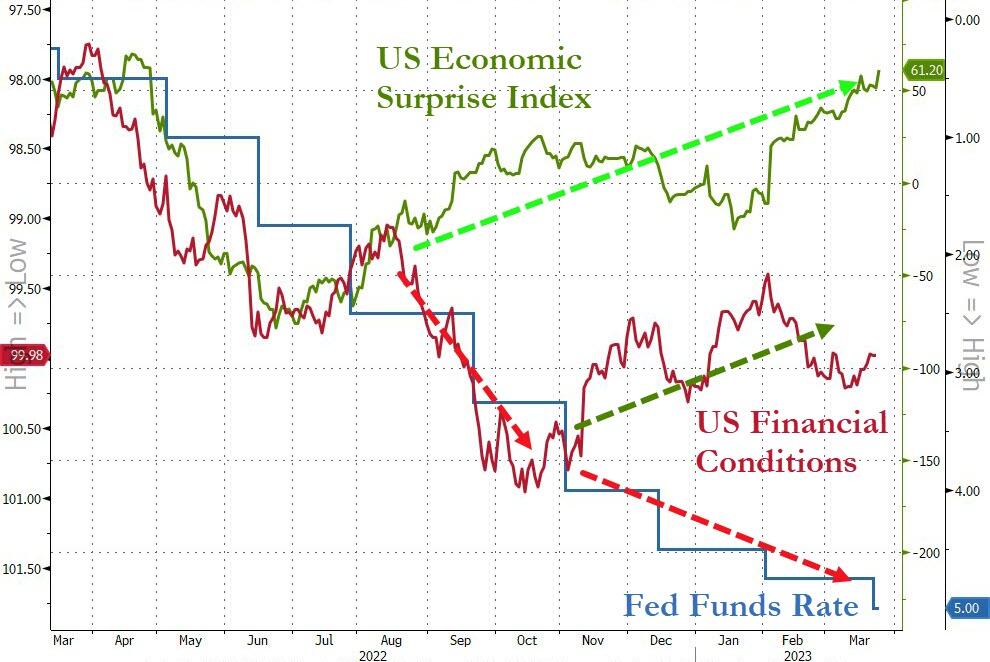
At the macro level, strong PMI data today was the icing on the cake of a ‘strong’ economy, pushing the US Macro Surprise Index to its strongest since April 2022 As Fed Funds were hiked to fresh cycle highs. Financial Conditions appear to be back into decoupling mode from ‘tight’ monetary policy. Whether it’s rate or credit-tightening, the transmission process is broken…

With more of a market focus, here are some facts from this tempestuous week that may surprise:

  • US Regional bank stocks unch on week

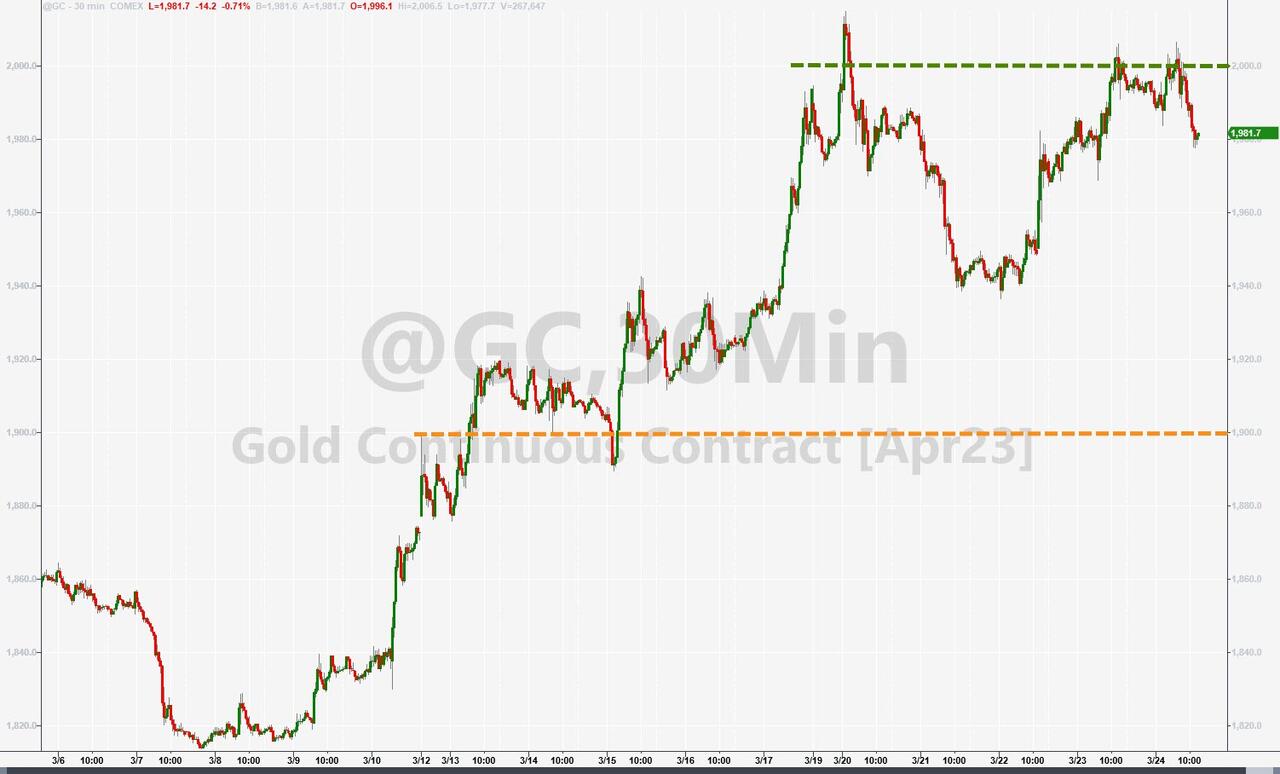
  • Gold unch on week

  • 30Y Yield higher on week (2Y yields down notably)

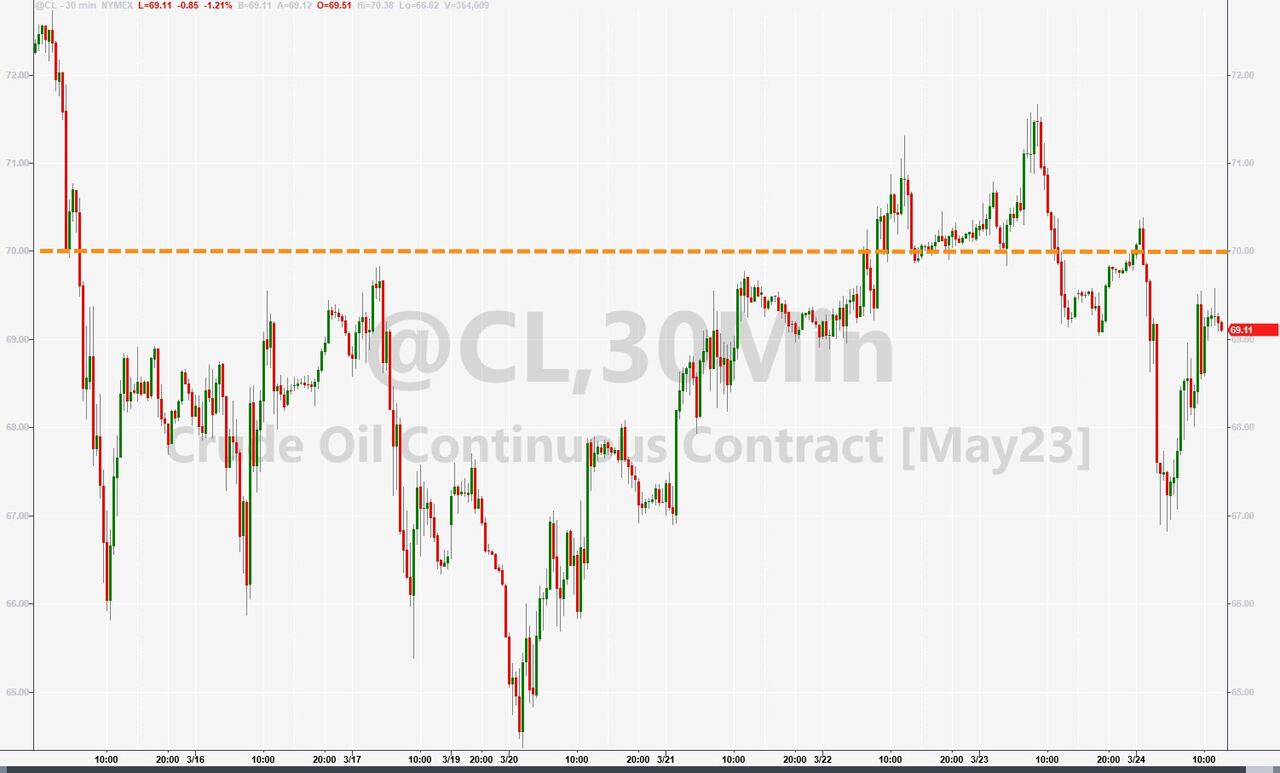
  • Crude higher on week

  • US Stock Indices higher on week (led by tech)

  • Crypto small higher on week

  • Rate-hike odds plunged on week (recession)

  • EU Stocks up on week

  • EU bank stocks unch on week

  • EU bank credit risk lower on week

  • EU bank counterparty risk lower on week

But below the surface of these headline moves, there are some rather large fault-lines appearing…

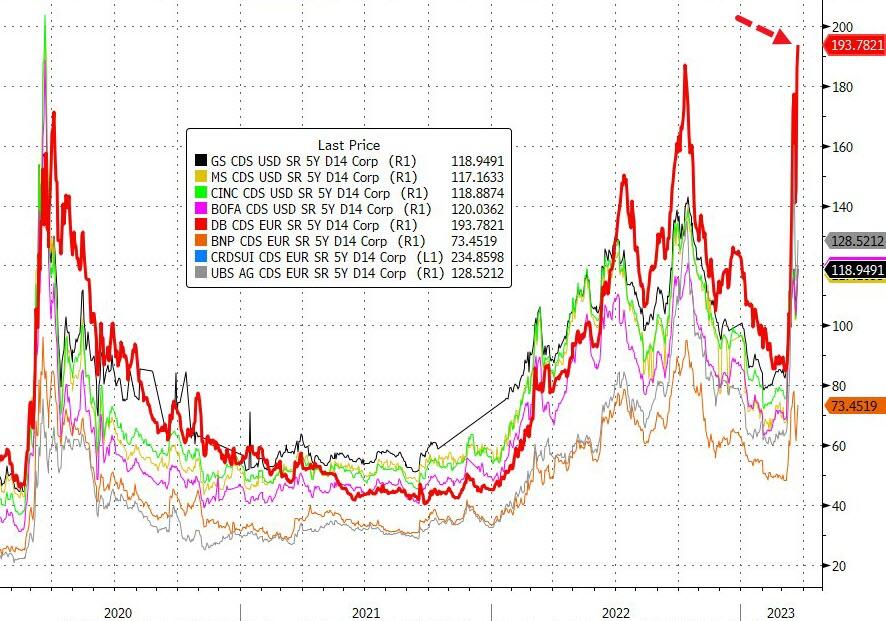
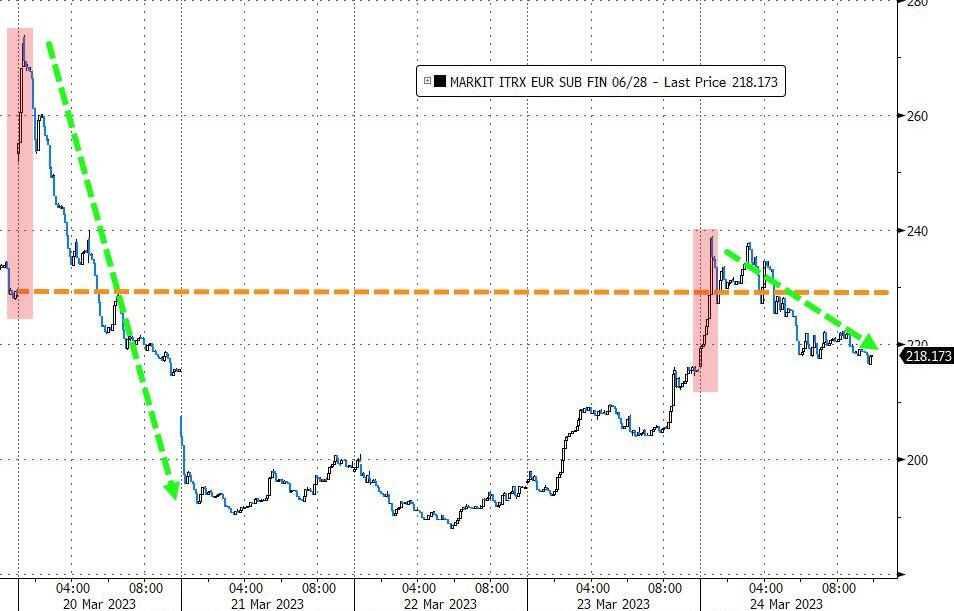
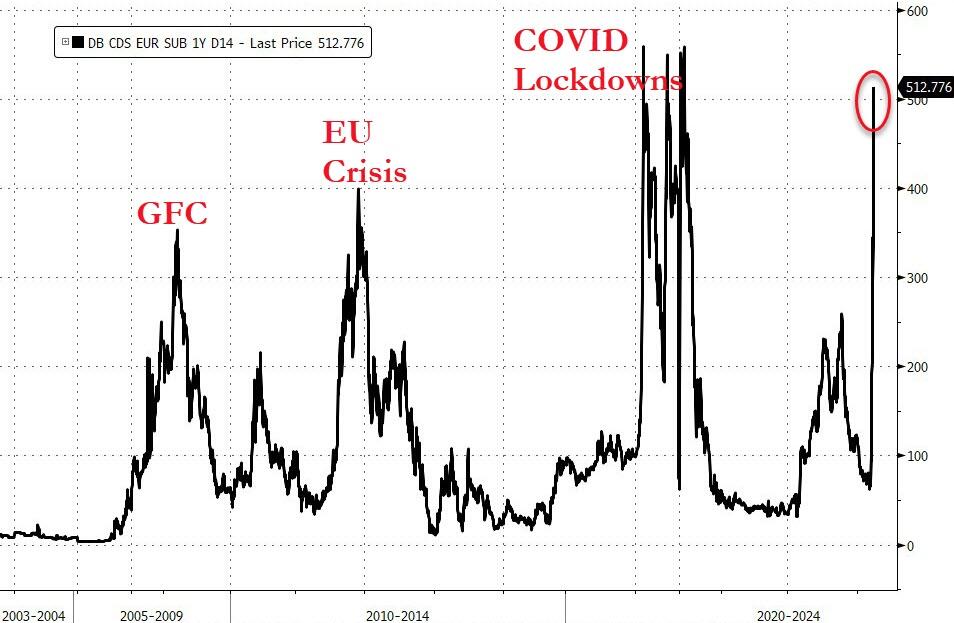
Let’s start in Europe, because today’s chaos started there. Deutsche Bank’s credit risk exploded higher today…

The jawboning was magnificent – nothing to see here, move along!

“Deutsche Bank has fundamentally modernized and reorganized its business model and is a very profitable bank,” Chancellor Scholz said Friday at a news conference in Brussels when asked about the lender’s situation.

“There is no need to worry about anything.”

“We view this as an irrational market,” Citigroup Inc. analysts including Andrew Coombs wrote in a note.

“The risk is if there is a knock on impact from various media headlines on depositors psychologically, regardless of whether the initial reasoning behind this was correct or not.”

“We have no concerns about Deutsche’s viability or asset marks,” Stuart Graham, an analyst at Autonomous Research wrote.

“To be crystal clear – Deutsche is NOT the next Credit Suisse.”
“It is a clear case of the market selling first and asking questions later,” said Paul de la Baume, senior market strategist at FlowBank SA.

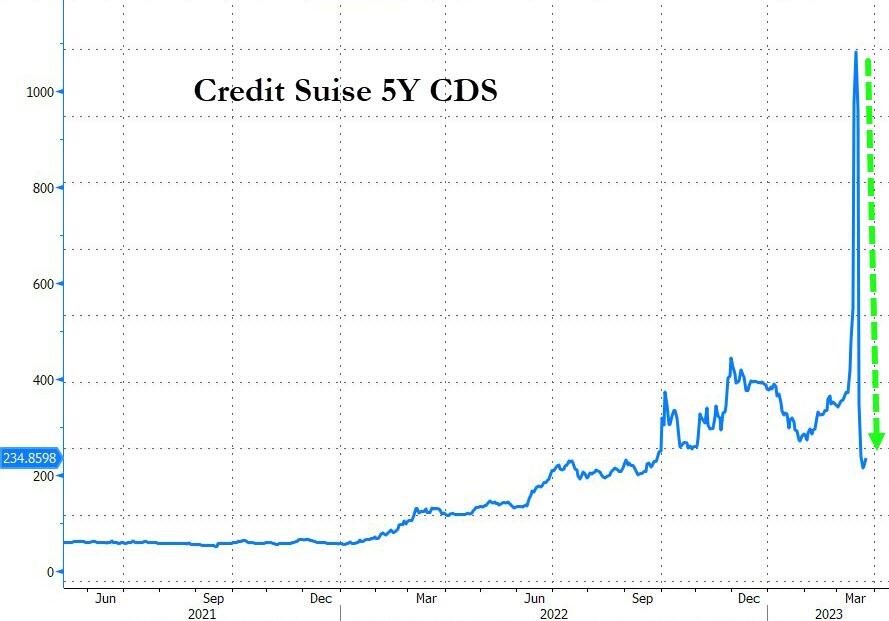
But the collapse in Credit Suisse CDS spreads helped put some lipstick on the EU banking system’s pig…

Source: Bloomberg

Overall, European bank markets roller-coastered dramatically, rallying off the opening lows after the CS bailout then reversing weaker to end the week. By the close, EU bank stocks were only modestly lower while Senior EU bank credit was tighter

Source: Bloomberg

European ‘sub’ debt ended better on the week with spreads modestly tighter…

Source: Bloomberg

But while the index looked fine, Deutsche Bank’s 1Y Sub CDS (classic derivative counterparty risk hedge) literally exploded…

Source: Bloomberg

Despite today’s carnage in European banks, Europe’s broad stock markets ended the week in the green (thanks in large part to Monday’s post-CS bailout panic-bid short-squeeze)…

Source: Bloomberg

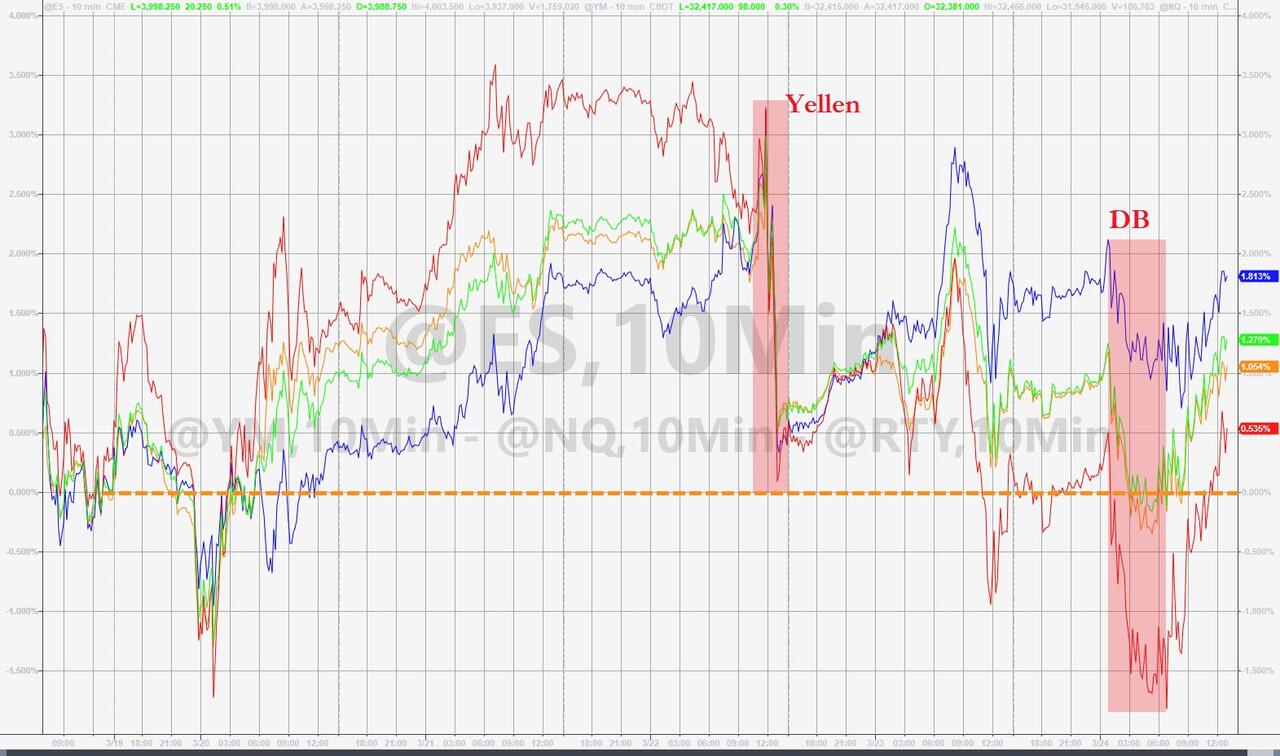
Back to the US, the major equity indices remained largely resilient this week (rising Fed balance sheet?). As today’s Emergency FSOC meeting took place, stocks began to rebound… Small Caps ended the week in the red with Nasdaq leading (as MSFT, AAPL ‘safe havens’ soared). S&P and Dow ramped today

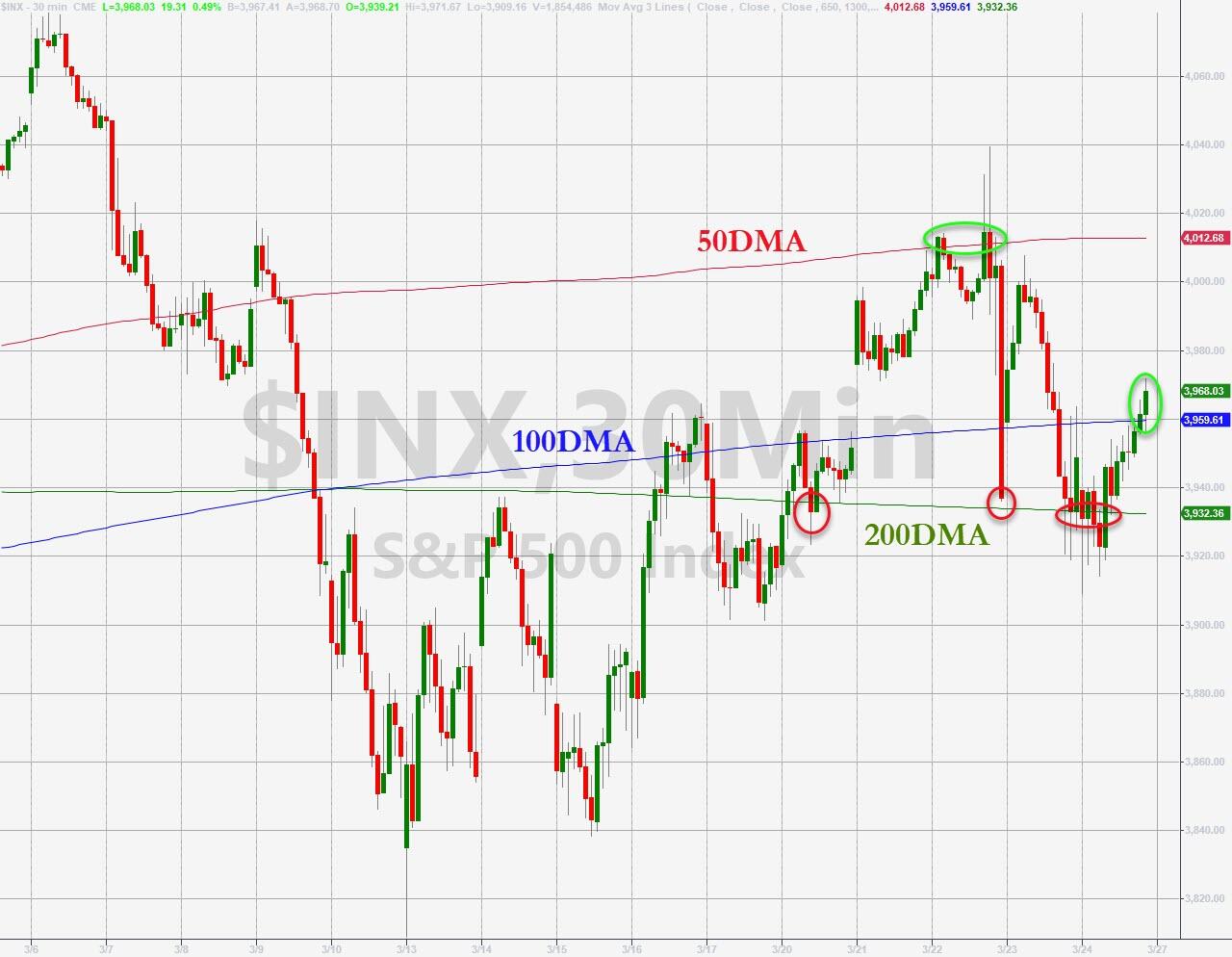
The S&P 500 was very technical again this week. finding support early in the week at the 200DMA, rallying up to its 50DMA and reversing there. Falling back down to find support at the 200DMA again before bouncing back above the 100DMA today…

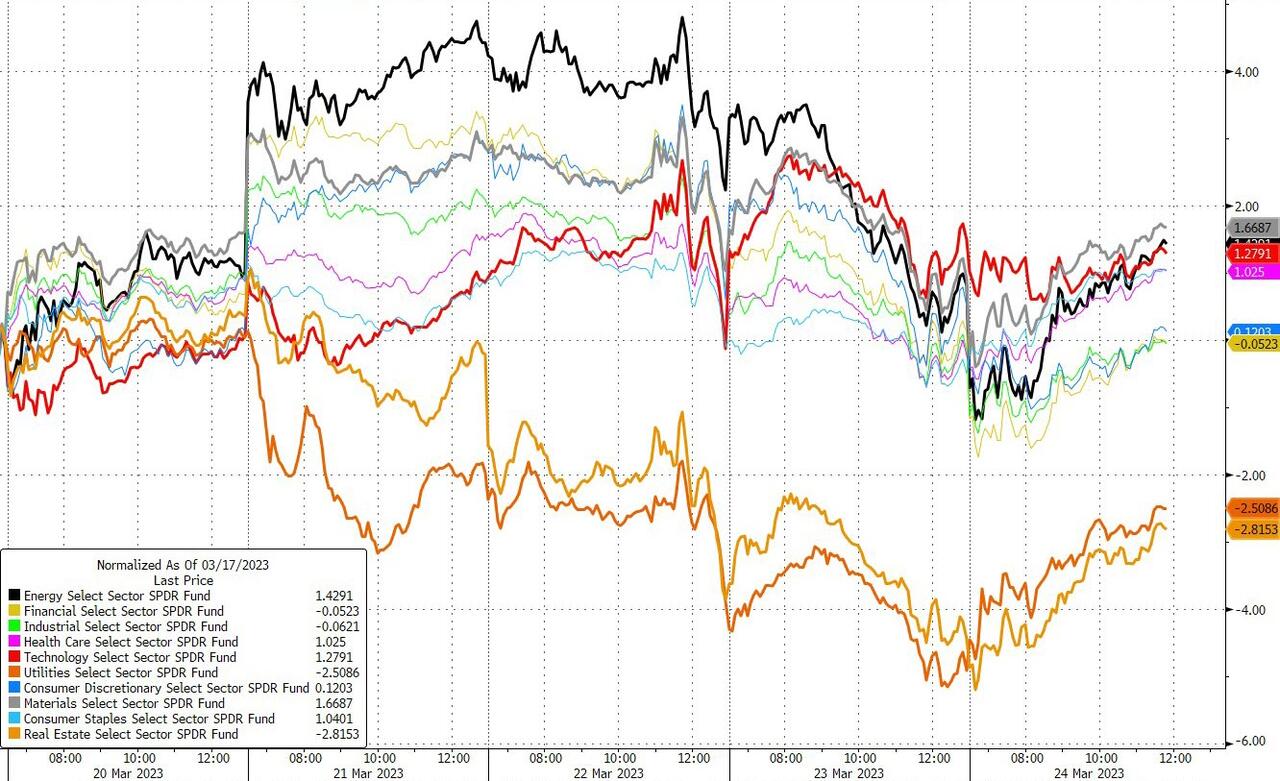
Utes and Real Estate were ugly this week as Tech, Energy, and Materials outperformed. Financials were flat…

Source: Bloomberg

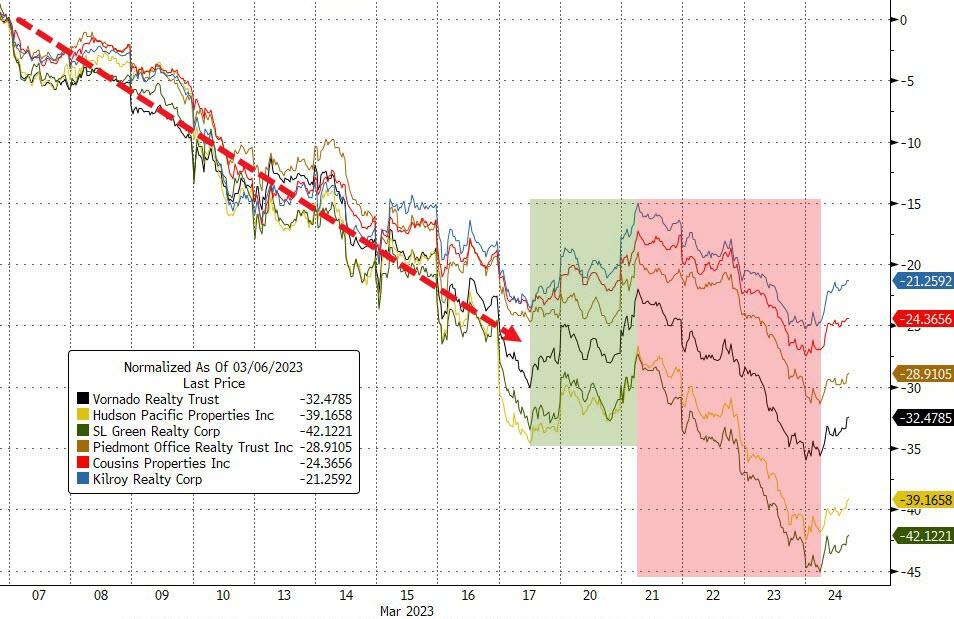
CRE/Office REITs continued to collapse this week…

Source: Bloomberg

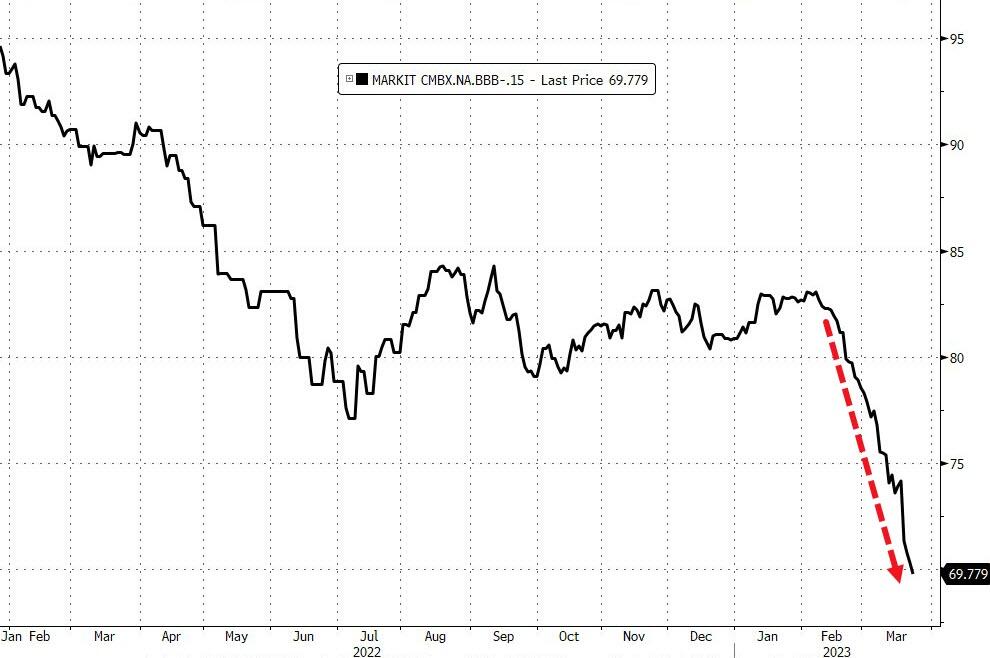
Which shouldn’t be a surprise as ‘Big Short 3.0’ CMBX crashes to fresh lows…

Source: Bloomberg

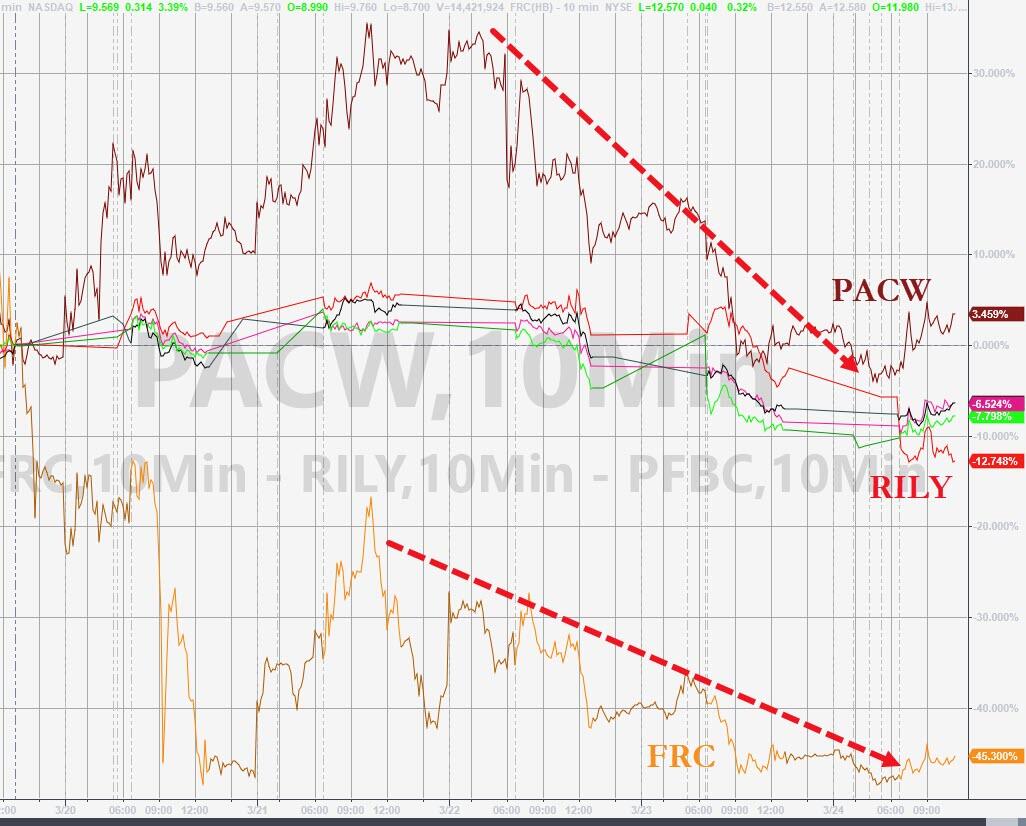
The Regional Bank stock index ended the week practically unchanged (after ramping up to unchanged today)…

But under the surface things were ugly for FRC, RILY, TCBI, COLB, and PACW plunged from early week gains…

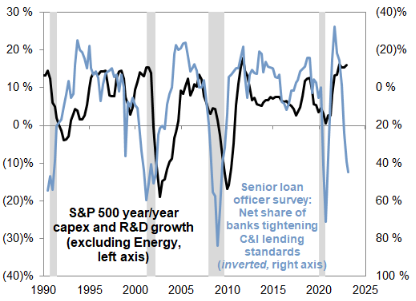
Before we leave equity-land, as Goldman’s Chris Hussey points out, corporate investing activity was already poised to shrink before the recent bank stress, but the tightening lending standards coming out of the recent bank volatility is likely to further way on corporate investment spending

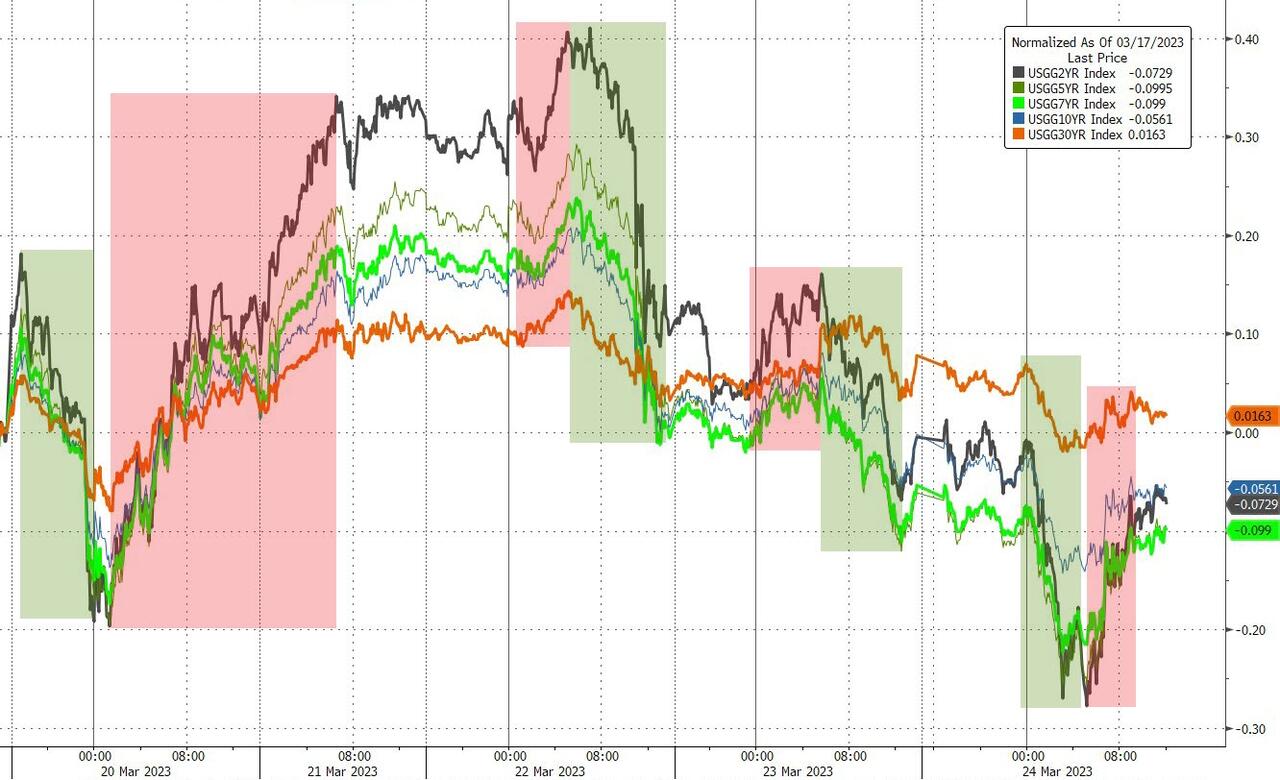
Treasuries were mixed on the week with the long-end underperforming and the belly best. However, overall, it was another week of crazy vol in bond-land

Source: Bloomberg

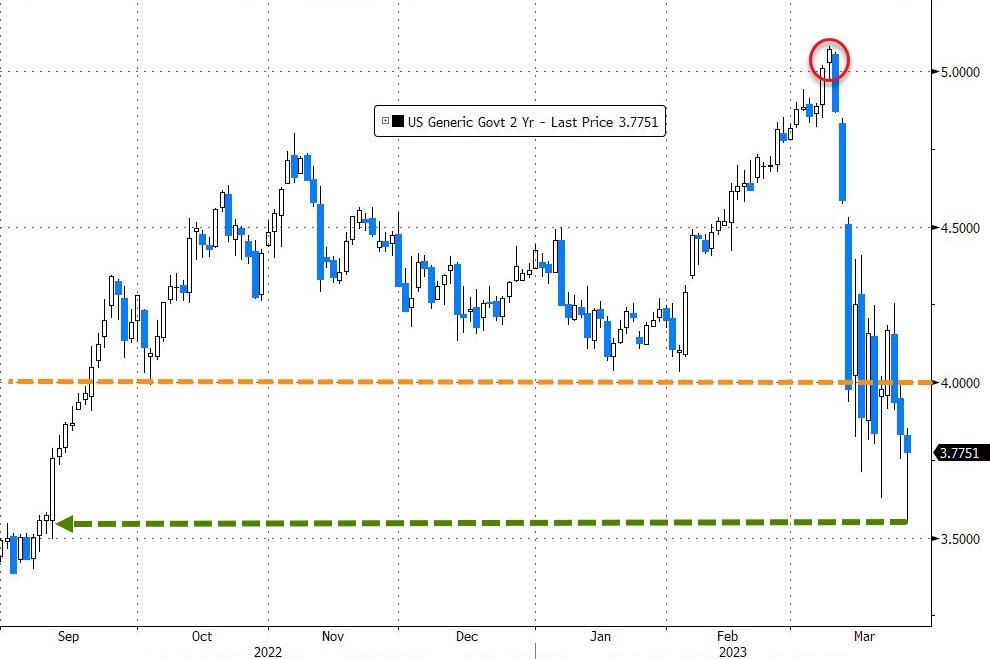
The 2Y Yield tumbled today to its lowest in almost 7 months, well below the 4.00% level…

Source: Bloomberg

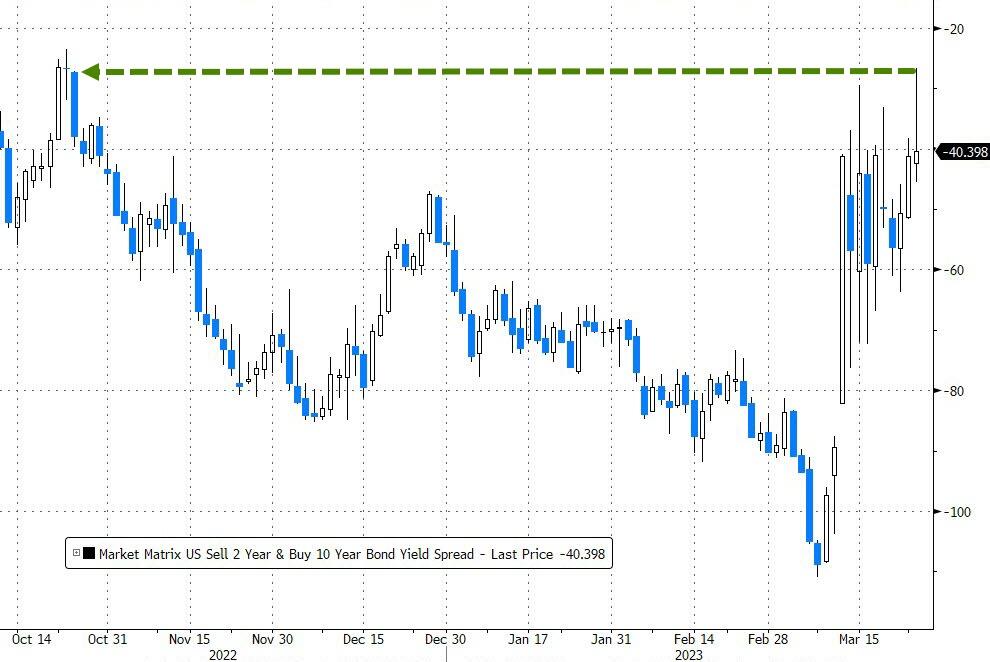
The yield curve steepened notably this week (5s10s uninverted) with 2s10s back at its least inverted since October…

Source: Bloomberg

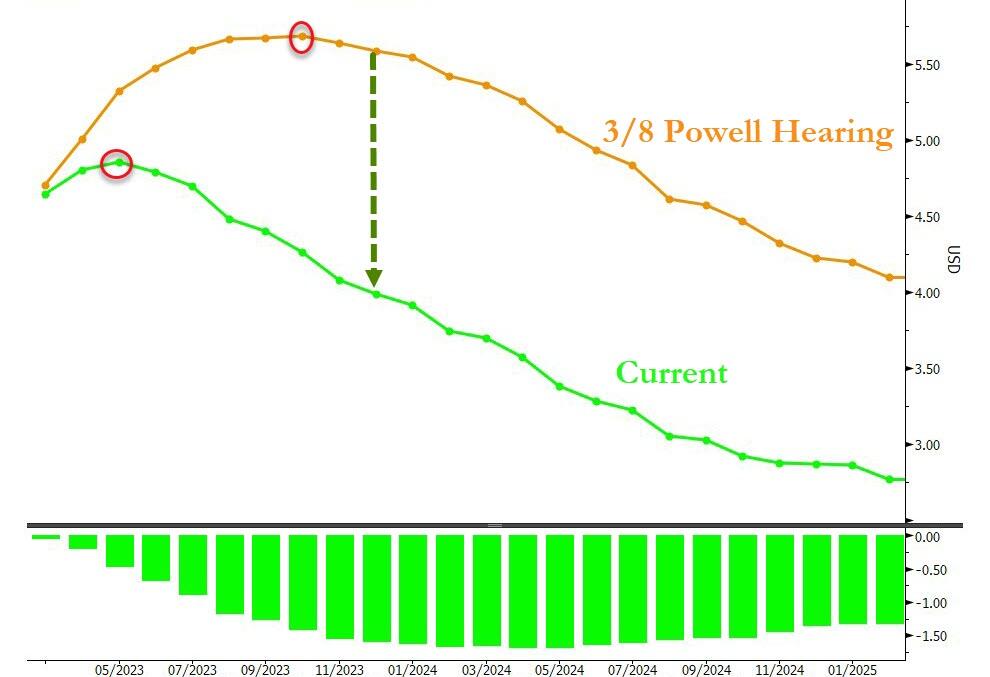
At the short-end of the curve, the yield curve collapsed from Powell’s hawkish Congressional hearings…

Source: Bloomberg

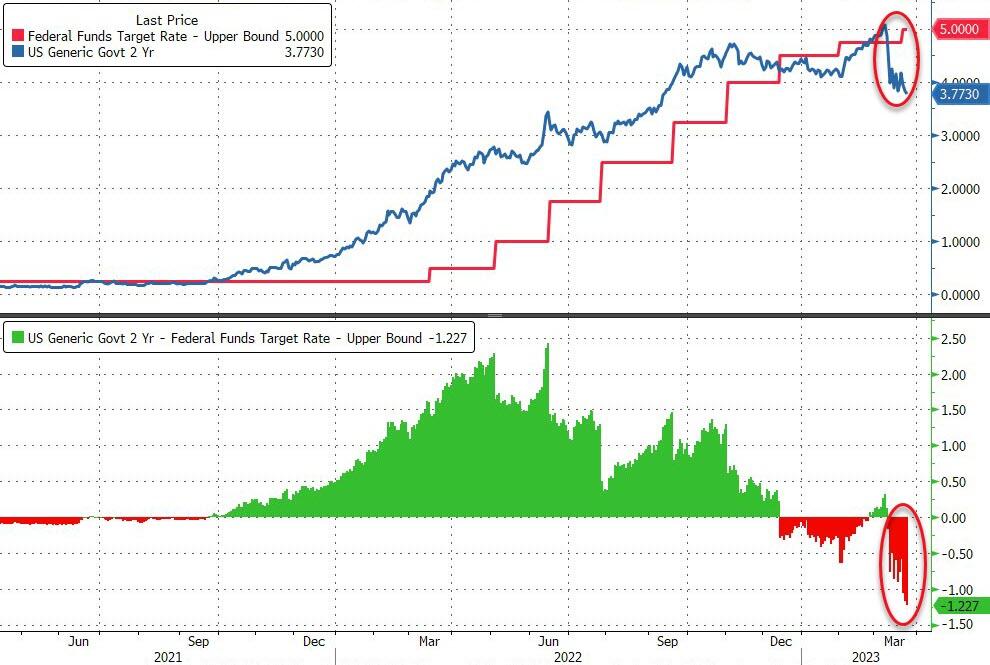
And the 2Y yield is now over 120bps below the current Fed Funds rate…

Source: Bloomberg

Jeff Gundlach says it all…

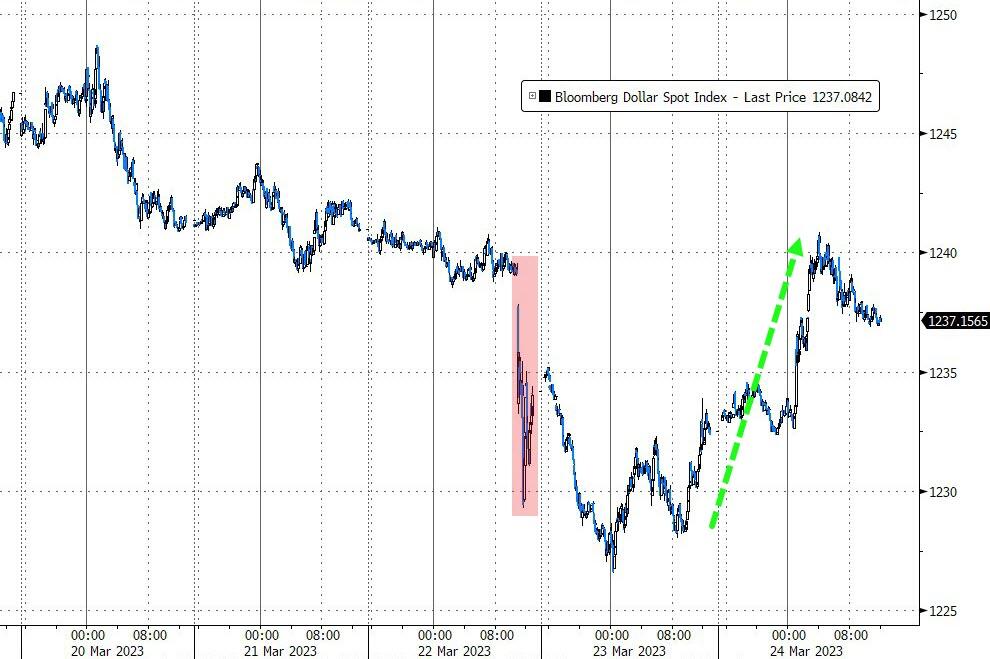
The dollar erased all of the post-Powell plunge but ended the week lower (3rd week lower of the last 4)…

Source: Bloomberg

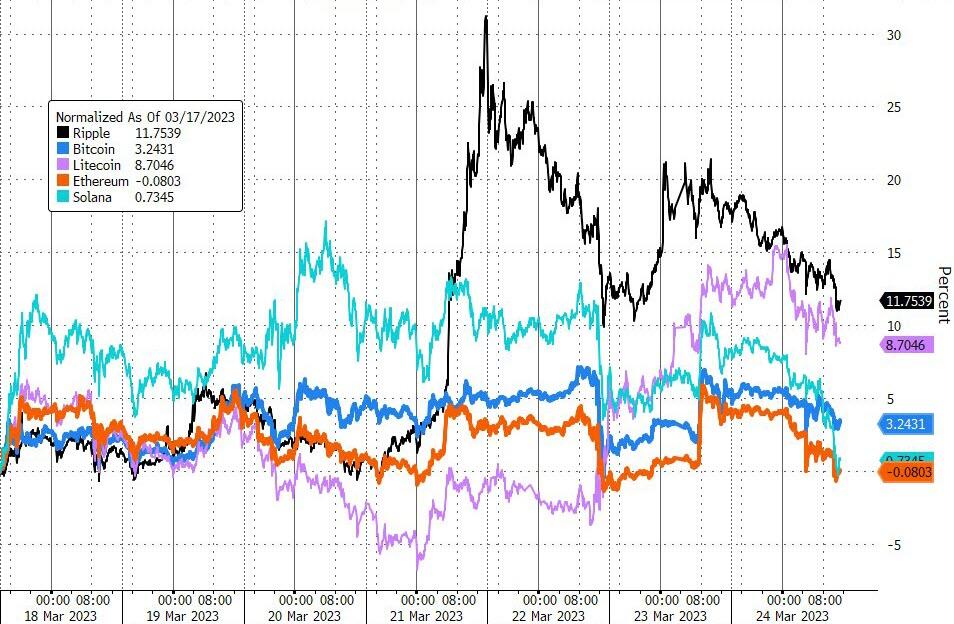
Crypto was modestly higher on the week with BTC and ETH both up around 5% at their best but giving back most of those gains today…

Source: Bloomberg

Copper, Oil, and Silver all rallied on the week (while NatGas tumbled)…

Source: Bloomberg

Despite gold’s appeal, it ended the week basically unchanged, rebounding from the early week losses and topping $2000 twice intraweek…

WTI could not hold above $70…

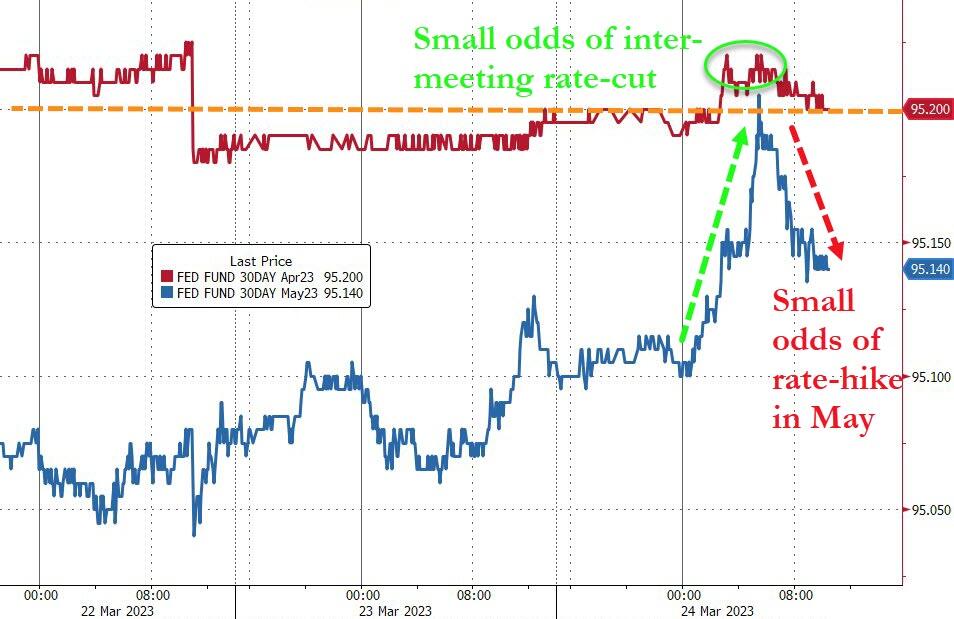
Finally, at one point today, the market priced for a small chance of an inter-meeting rate-cut (but overall has reduced the odds of a May hike to just 25%)…

Source: Bloomberg

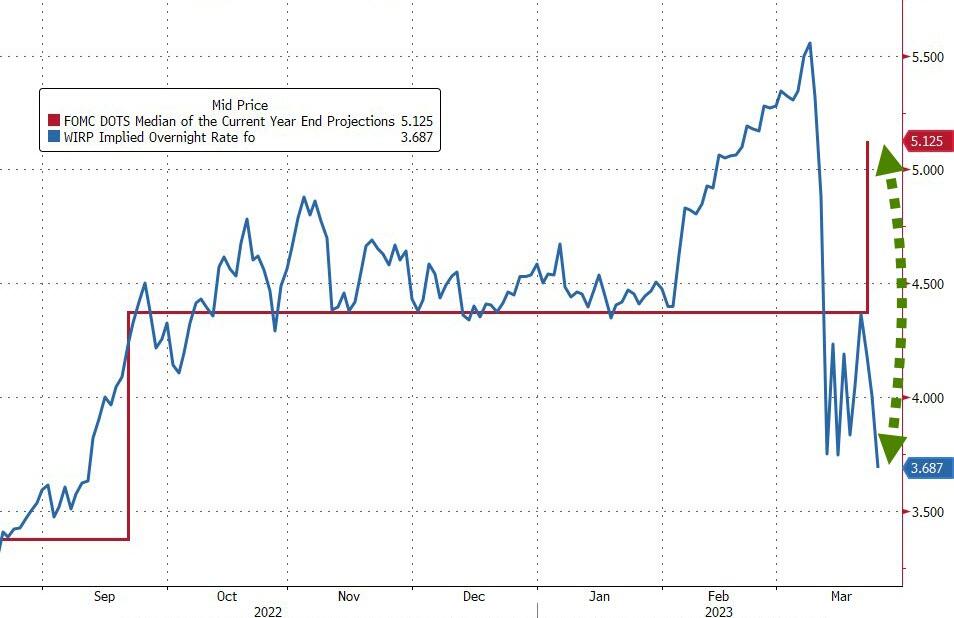
Additionally, we note that the market is massively more dovish than The Fed’s dotplot with regard to where rates will be at year-end

Source: Bloomberg

That is 150bps! The market is clearly projecting a worsening financial crisis and/or a hard-landing recession… and stocks sure ain’t pricing that in!

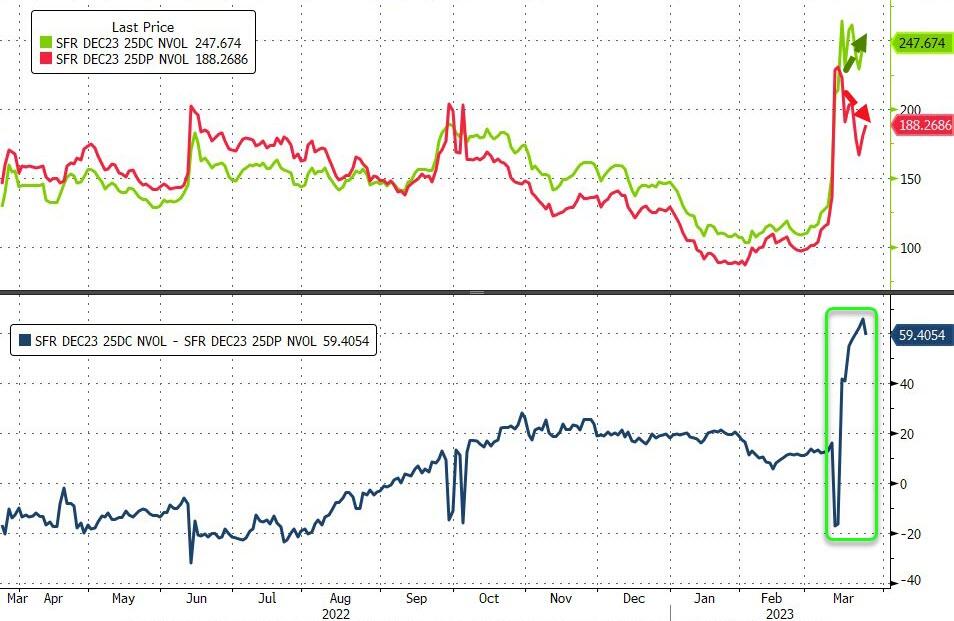
Additionally, options traders are dramatically betting on lower rates/yields down by year-end as SOFT Dec23 Skews show incessant upside demand (h/t Nomura’s Charlie McElligott)

Source: Bloomberg

Larry McDonald perhaps summed up the situation best:

“Dear Central Banks – When you see suppress the true, market driven cost of capital for longer and longer periods of time. You incentivize the HTM yield reach across the banking system. Then you juice rates 500bps in 13 months to “fight” inflation and light it all on 🔥 fire”

It took The Fed’s QT program 11 months to reduce its almost $9 trillion balance sheet by $625bn… and 2 weeks to retrace two-thirds of that!!

Source: Bloomberg

If everything’s “fine” then why is The Fed balance sheet exploding higher again?

Tyler Durden
Fri, 03/24/2023 – 16:00

via ZeroHedge News https://ift.tt/FXkg82I Tyler Durden