Zero Dark Trump

Zero Dark Trump

Authored by Michael Shellenberger and Leighton Woodhouse via ‘Public’ Substack,

Since he first announced last Saturday that he would be arrested by New York City police the following Tuesday, millions of Trump-obsessed Americans have now waited nearly a week for the big day to arrive. 

This may be the only chance in a lifetime for so-called journalists like us to write ledes like:

“The former president may be perp-walked for paying hush money to a porn star.”

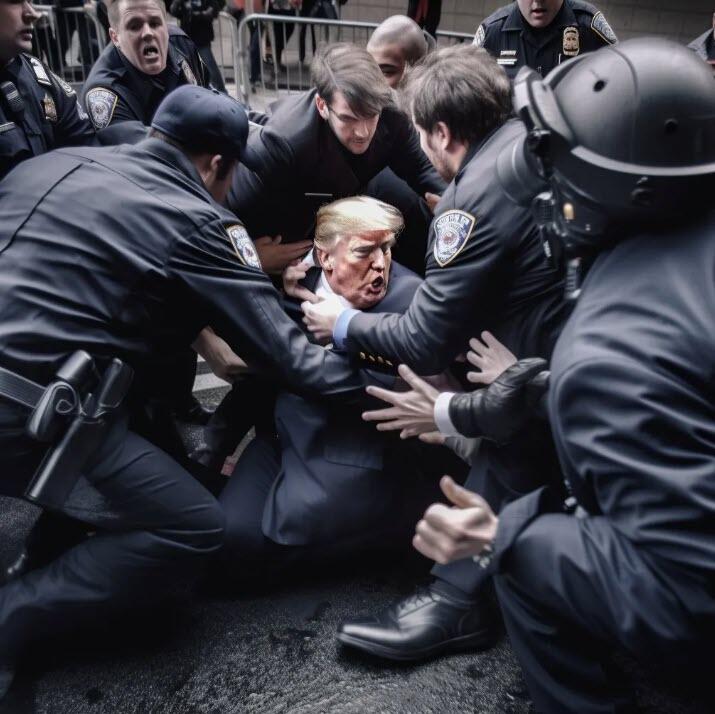
But even before the big day arrived, the overproduction of elites had created an overproduction of “deep fakes,” made by A.I., of Trump being arrested.

Deep fake by Eliot Higgins

Naturally, Trump supporters were having none of it. 

“As per sources on the ground,” tweeted another deep faker, @MadMikeOfficial, “Trump has taken command of the NYPD and has become the undisputed warlord of Manhattan.”

Deep fake by @MadMikeOfficial

Wait, Wait It’s Even Weirder Than That

The people who have taken upon themselves the great burden of spying on and censoring their fellow citizens for wrongthink — the hall monitors within the Censorship Industrial Complex — have been warning for years that deep fakes like the Trump images above would result in “disinformation” campaigns and “influence operations” by “malign actors.”

Funny, then, that it was one of the leading members of the Censorship Industrial Complex, Eliot Higgins of the creepy Bellingcat, who was the first to create and tweet out the Trump deep fakes.

Here’s his best one:

Another deep fake by Eliot Higgins

“Making pictures of Trump getting arrested while waiting for Trump’s arrest,” tweeted Higgins cheerily.

“This blew up etc, so donate to Bellingcat so we can catch bad guys and make scenes like this real.”

Higgins’ Bellingcat has been funded by the U.S. government’s National Endowment for Democracy, a widely-acknowledged C.I.A. front group, that is supposed to act nonpartisan, at least in public. 

Watching Higgins use deep fake disinformation to attack his political enemies was a bit like learning the homophobic preacher was caught with a choir boy. 

“Ironic,” responded a Twitter user to Higgins, “that YOU’RE the bad guy, in this case (fake pictures, spread across the internet..yeah, you said it was “AI created”, but you KNEW, people would believe it!”

“Well,” responded Higgins, “I can’t help stupid.” 

Read more here…

Tyler Durden
Fri, 03/24/2023 – 15:45

via ZeroHedge News https://ift.tt/uZAFyNB Tyler Durden

Hundreds Of Funds On Brink Of Losing ESG Ratings

Hundreds Of Funds On Brink Of Losing ESG Ratings

The Financial Times reports that Environmental, social, and governance (ESG) investing is on the verge of a significant transformation, as index provider MSCI is set to remove the ESG ratings from hundreds of funds. This change is part of a major overhaul of the MSCI’s rating methodology. 

According to unpublished research by BlackRock Inc.’s iShares unit, cited by FT, MSCI intends to downgrade the ESG rating of hundreds of funds. The adjustments, scheduled to be implemented by the end of April, will apply to all exchange-traded and mutual funds worldwide.

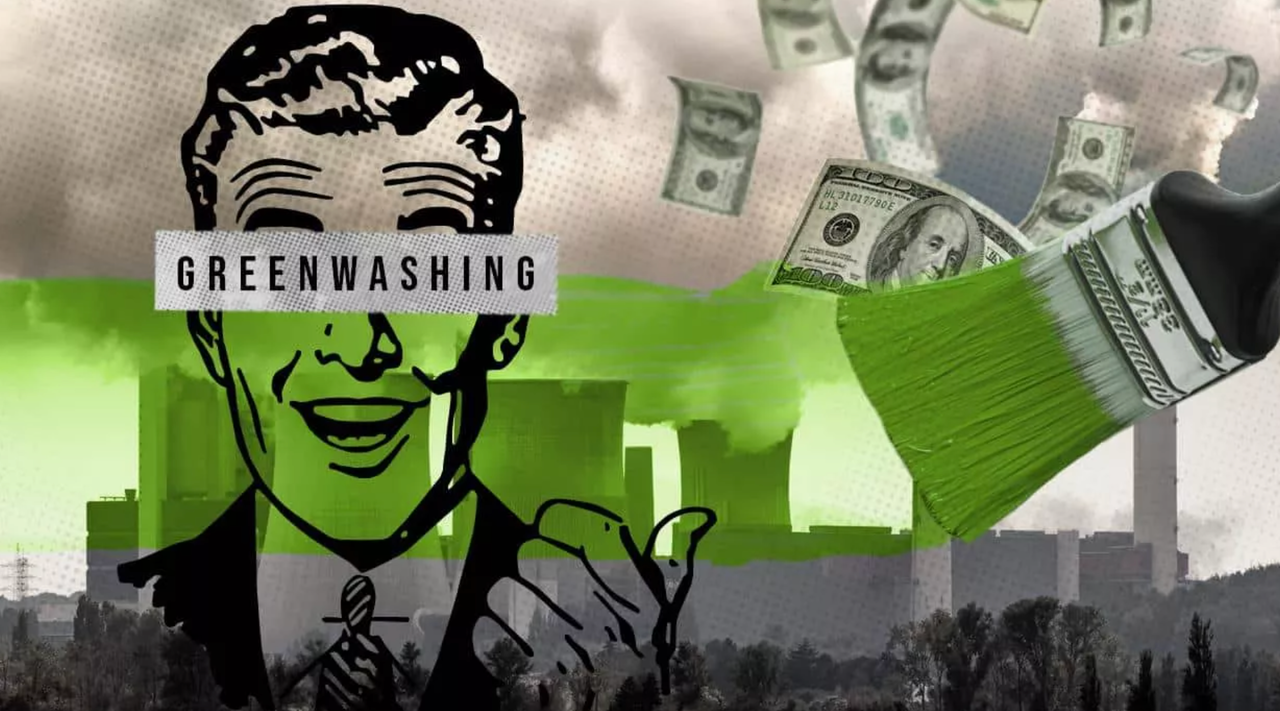
Index providers are pushing the changes to tighten the requirements for what qualifies as an ESG-compliant fund amid pressure from regulators concerned about “greenwashing.” 

One of the highest-profile greenwashing scandals has been Deutsche Bank AG and its asset management arm, DWS Group, in Frankfurt, Germany, which exaggerated green investments in ESG products. 

The decline in funds with top ESG ratings implies that ESG-focused investors will face limited investment options, which could potentially increase the price of assets with a sustainable label. 

Under MSCI’s changes, all “synthetic” ETFs that use swaps to track the value of assets will lose their ESG rating — even if funds that own the identical underlying assets are rated highly.

In addition, most “physical” funds, which directly hold portfolios of equities or bonds, are likely to have their rating lowered. 

The changes, due to take effect by the end of April, will apply to all ETFs and mutual funds globally. -FT

MSCI did not provide details on the extent of the downgrades but said these changes “will lead to fewer funds being rated as AAA or AA and will reduce the volatility in ESG fund ratings, which are outcomes that our client base broadly supported.” 

The unpublished research reveals 1,476 Europen ETFs will have their ESG rating slashed, 905 will remain unchanged, and 78 will receive a rating boost. A staggering 446 funds, including over 400 derivative-based funds, will lose their ratings entirely.

Perhaps the ESG hype cycle is well beyond its peak… 

… and all along, Elon Musk was right. 

Tyler Durden
Fri, 03/24/2023 – 15:24

via ZeroHedge News https://ift.tt/L1oQx3d Tyler Durden

The Fed Is Pushing The Accelerator & The Brake Pedals At The Same Time

The Fed Is Pushing The Accelerator & The Brake Pedals At The Same Time

Authored by Simon White, Bloomberg macro strategist,

Collapsing velocity will lead to financial conditions continuing to tighten even as the Fed rapidly expands its balance sheet.

When banks are in trouble, it has a geared impact on the rest of the economy. In 2008, money velocity (essentially, how many times each dollar changes hands in a given period) collapsed as banks stopped lending; central banks responded by cutting rates to zero and massively expanding their balance sheets.

To no avail, however, and velocity kept falling until 2020 when it started to rise again – it’s no coincidence we now have an inflation problem. The remedy has created a new nightmare for policymakers as banks around the world are reeling from the fastest rate-hiking cycles seen for several decades.

Central banks are now back in the game of trying to arrest the fall in velocity – deteriorating their balance sheets – to avert the deep recession that would result. The signs are so far it is not working.

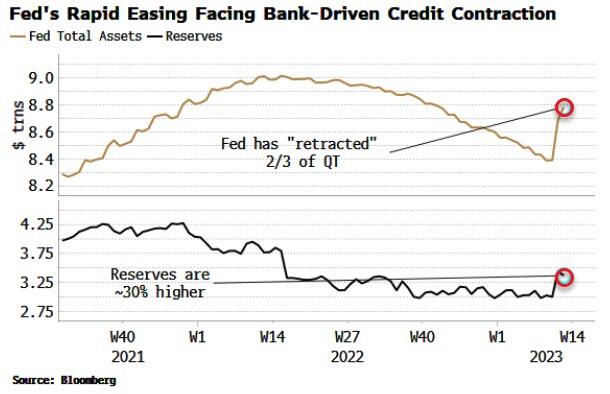
The Fed over the last two weeks has effectively reversed two-thirds of QT, if we look at the size of its balance sheet. But the key metric to watch is reserves – these are the higher-velocity part of the central bank’s liabilities, as they are the other side of the coin of bank deposits. Yet even reserves are 30% higher.

Despite the expansion, velocity is still falling. Why?

Deposits are leaving small banks, with some of them going to large banks (we’ll see how much when the latest data is released this evening). But the large banks don’t want them (observe their stubbornly-low deposit rates). Thus higher-yielding money-market funds will keep attracting funds.

Indeed, the latest data showed another rise in MMF assets, climbing by almost $250 billion over the last two weeks.

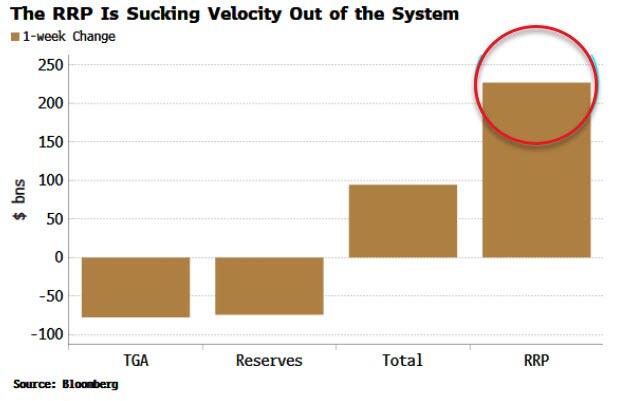
MMFs are a low velocity use of reserves, as they generally invest in bills and low-risk short-term loans. But an even lower velocity use is the RRP, where they are effectively neutralized.

The RRP is growing again, rising about $220 billion over the last week to new all-time highs of $2.65 trillion – expected given the facility offers a higher rate than T-bills (the curve is now very negatively sloped at the front).

There is very likely more banking distress to come as lenders harbor an estimated $2 trillion in losses in hold-to-maturity securities.

Unfortunately for the Fed, the current set-up means the accelerator and brake pedals are joined together.

Tyler Durden
Fri, 03/24/2023 – 15:05

via ZeroHedge News https://ift.tt/pKJwai0 Tyler Durden

Mystery Object Found Near Nord Stream Pipelines Could Point To Culprit

Mystery Object Found Near Nord Stream Pipelines Could Point To Culprit

Russia says it is supporting efforts to recover forensic evidence from the underwater site of the Nord Stream sabotage blasts, which may provide clues as to the culprit behind it. Images of a new mystery object have emerged, with Moscow saying it is vitally important that it be carefully examined.

The Kremlin in a Friday briefing called the recovery and examination of the object “critically important” as it has been discovered lying next to one of the damaged Nord Stream pipelines.

Via Danish Ministry of Defense: Mystery object may contain clues related to sabotage attack.

Kremlin spokesman Dmitry Peskov said during a daily briefing: “It is critically important to determine what kind of object it is, whether it is related to this terrorist act – apparently it is – and to continue this investigation. And this investigation must be transparent.”

The Danish Energy Agency has invited the Russia’s Gazprom (owner of Nord Stream 2 AG) to assist in salvaging the mystery object. It was actually Putin who was the first to publicly reference the object and ongoing investigative efforts to ascertain what it is, per the AFP:

Russian President Vladimir Putin, who revealed the discovery of the object earlier this month, said experts believe that the object could be a signal antenna to activate an explosive in that part of the pipeline. 

…The Danish energy agency released a photo late Thursday of the cylindrical object standing near the Nord Stream 2 pipeline at the bottom of the sea.

The agency said it is “possible” that the object is a maritime smoke buoy, 40 centimeters tall and 10 centimeters wide, and that it “does not pose an immediate safety risk.”

Peskov meanwhile said regarding the ongoing German, Swedish and Danish investigation that it is “certainly positive news” that Copenhagen invited Nord Stream 2 AG to take an active role in the investigation.

Since the September 26 clandestine bombings which permanently disabled the Russia to Germany natural gas pipelines running under the Baltic Sea, the prevailing narrative has shifted dramatically. Initially, Western officials and media pointed the finger at Moscow, but then in February legendary journalist Seymour Hersh issued an investigative report detailing that it was a CIA and US Navy covert operation.

After the Hersh report, allegations that Russia bombed its own pipeline have largely died down (given also it would obviously run counter to Russia’s self-interests), and instead a new theory has been advanced by mainstream media – that a small group of rogue Ukrainian operatives did it. However, the Kremlin has blasted this as ludicrous, pointing out that only a state and military would have the resources to carry out such a difficult and complex operation. Hersh has since alleged based on his sources that the CIA itself planted the “Ukrainian partisans” narrative in friendly media outlets in order to shield the White House.

Tyler Durden
Fri, 03/24/2023 – 14:48

via ZeroHedge News https://ift.tt/mVFp6MO Tyler Durden

The Inflation Reduction Act Is Screwing Up the Market for Electric Vehicles


Volkswagen's ID.2all electric hatchback concept car sits onstage at an event in Hamburg, Germany.

Amid issues like climate change and fluctuations in the global price of oil, American motorists are increasingly interested in electric vehicles (E.V.s). In early 2022, new E.V. registrations rose 60 percent even as overall new car registrations declined by 18 percent.

Of all considerations, the biggest barrier to acceptance is price: The price of the average new E.V. runs nearly $67,000, while the overall average new car costs just under $50,000. Clearly the key to greater adoption of E.V.s is bringing the price down to be more in line with gas-burning alternatives.

Last week, Volkswagen introduced a new concept car, the ID. 2all. The all-electric hatchback boasts a 280-mile range and says it can charge from 10 percent to 80 percent in just 20 minutes. The company plans to sell it for less than €25,000 (around $26,900), roughly the same price as a Toyota Camry.

There’s only one problem: Volkswagen has no plans to bring the ID. 2all to the United States. And if it did, it would be at a disadvantage thanks to protectionist policies.

Heatmap noted that the most likely reason why Volkswagen is avoiding the U.S. is that Americans tend to prefer larger vehicles, with trucks and SUVs now accounting for more than 80 percent of new car sales. Volkswagen’s own Golf, which is similar in size to the ID. 2all, sold so poorly in recent years that the company discontinued its sale in the United States.

But there will always be a market for cars at entry-level prices, especially for people who just need to get from point A to point B as inexpensively as possible and don’t live near mass transit. If that car also insulates its owner from having to worry about fluctuations in the global oil market, even better.

Tesla CEO Elon Musk has promised an affordable Tesla since 2006, including a “confident” pledge to introduce a $25,000 model by 2023, but he has yet to deliver on it. (He’s currently the closest he’s ever been, with Tesla slashing prices on its Model 3 to $42,990.) The two closest competitors right now are the Chevrolet Bolt and the Nissan Leaf, each of which currently retails for $26,000 and up. But each of those models uses outdated technology that takes much longer than its competitors to charge.

And yet even if Volkswagen wanted to make a play for the budget E.V. market, U.S. law would put it at a competitive disadvantage. As part of last year’s Inflation Reduction Act (IRA), Congress established tax credits of up to $7,500 for anyone who purchases an electric vehicle. But the credit has a lot of requirements, including that the vehicle must “undergo final assembly in North America.”

Volkswagen does have factories in Tennessee and Mexico; it makes the ID.4 electric SUV in Tennessee and recently pledged over $7 billion toward building out its North American footprint, part of which would “modernize” its factories in Mexico.

But if it wanted to sell the ID. 2all in the U.S. and let buyers take advantage of the tax credit, Volkswagen would have to produce the car here as well. The cost of moving production to the States wouldn’t make sense unless the company knew it could sell them in high volumes. Without the tax credit, consumers would likely opt for other models based on artificially lowered prices.

The IRA’s E.V. credits were a clear case of economic protectionism. Sen. Joe Manchin (D–W. Va.) opposed the credits on principle but ultimately agreed to them with strict requirements that would exclude E.V.s made in China or with Chinese-sourced materials. As a side effect, this also excludes E.V.s made in the European Union, which Manchin later admitted he hadn’t realized at the time.

The Chevrolet Bolt and Nissan Leaf may have outdated charging technology, but they each qualify for the full tax credit; the ID. 2all, if it ever came to America, very likely would not. In a free market, consumers would get to choose the products to buy based on cost and dependability. A choice between a $26,000 electric car that charges in minutes and a $28,000 electric car that charges in hours seems like not much of a choice at all. But when the government, over misplaced protectionist sentiments, uses the tax code to artificially advantage one product over another, it disadvantages not only competitors but consumers.

The post The Inflation Reduction Act Is Screwing Up the Market for Electric Vehicles appeared first on Reason.com.

from Latest https://ift.tt/SsaZmcD
via IFTTT

The 5th Circuit Rebukes the FDA for Flouting the Law While Imposing a De Facto Ban on Flavored E-Cigarettes


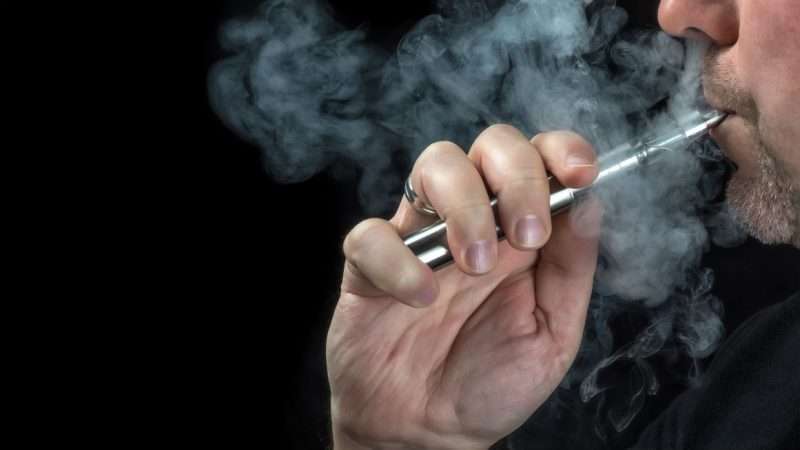
The 5th Circuit says the FDA's de facto ban on flavored e-cigarettes is probably illegal.

Since 2020, when the Food and Drug Administration (FDA) began considering millions of applications from companies seeking permission to keep selling their nicotine vaping products, it has rejected almost all of them. All of the products it has approved are tobacco-flavored, reflecting the agency’s conviction that other flavors, which are the ones that former smokers overwhelmingly prefer, are dangerously appealing to teenagers. Yesterday a federal appeals court said that pattern and the shifting regulatory criteria underlying it amount to an unacknowledged and probably illegal policy change: The FDA moved the goal posts for applicants without admitting it was doing that, let alone justifying its decision.

The U.S. Court of Appeals for the 5th Circuit was responding to a lawsuit by R.J. Reynolds Vapor Company (RJRV), which challenged the FDA’s decision to reject an application for the company’s menthol-flavored e-cigarettes while allowing tobacco-flavored versions to remain on the market. The court granted RJRV’s request for a stay that bars the FDA from enforcing a “marketing denial order” it issued in January until the case is resolved. Explaining its reasoning, a unanimous 5th Circuit panel said the company was likely to prevail in arguing that the FDA had violated the Administrative Procedure Act (APA) in several ways.

“RJRV demonstrates that the FDA failed to reasonably consider the company’s legitimate reliance interests concerning the need for longitudinal studies and marketing plans,” 5th Circuit Judge Edith H. Jones writes. She adds that the FDA “failed to consider relevant evidence, inter alia, that youthful users do not like menthol-flavored e-cigarettes” and that it has “created a de facto rule banning all non-tobacco-flavored e-cigarettes without following APA notice and comment requirements.”

To pass muster with the FDA, applicants must demonstrate that approval of their products is “appropriate for the protection of the public health”—the nebulous standard prescribed by the 2009 Family Smoking Prevention and Tobacco Control Act. In applying that standard, the 5th Circuit says, “the FDA inexplicably switched its position on menthol-flavored e-cigarettes in at least two crucial ways.”

One change involved the kind of evidence that vaping companies had to submit. “Before the application deadline,” Jones notes, “the FDA represented that long-term studies were likely unnecessary and that applicants had discretion to use [research on] ‘products that consumers are most likely to consider[] interchangeable’ when submitting ‘comparative health risk data.'” In seeking approval for “flavored products (other than menthol),” the FDA told RJRV, it should submit evidence that the products “increase[d] the likelihood of complete switching among adult smokers relative to tobacco or menthol-flavored products.”

The FDA “never told RJRV that similar evidence would be required” for its menthol Vuse Vibe e-cigarettes, Jones notes. The company “relied upon these representations when crafting its [applications] and supplemental filings.” Yet when the FDA rejected the menthol application, it complained that “studies were not brand- or product-specific” and “thus did not demonstrate that [RJRV’s] menthol-flavored new products are more likely to promote complete switching or significant cigarette reduction compared to tobacco-flavored products.”

The FDA said RJRV’s studies failed to “assess the impact of menthol-flavored ENDS [electronic nicotine delivery systems] on cigarette smoking switching behavior” such as “complete switching or significant cigarette reduction over time.” It added that the company “did not submit evidence from a [randomized controlled trial] or cohort study showing that its menthol-flavored ENDS provide an added benefit to adult smokers in terms of complete switching or significant cigarette reduction over tobacco-flavored ENDS.”

In other words, after indicating that manufacturers of menthol-flavored vapes did not need longitudinal or product-specific studies, the FDA suddenly decided that they did. “The lack of that evidence became the very basis on which the FDA denied RJRV’s application,” Jones notes.

The FDA’s second about-face involved precautions aimed at preventing underage consumption. “Final guidance” that the FDA issued in 2020 “enumerated ‘adequate measures’ manufacturers could take ‘to prevent minors’ access’ to ENDS,” Jones writes. “These included: (1) age-verification barriers for retail websites; (2) enforcement monitoring programs with retailers; (3) a limit on the number of ENDS that can be purchased at once or over a period of time; and (4) a mystery shopper program.” The guidance “also listed common ways manufacturers improperly target minors, such as advertising with ‘social media influencers,’ ‘popular children’s characters,’ and kid-friendly ‘cartoon or animated characters.'”

RJRV’s application “accounted specifically for these and many more measures,” Jones notes. Yet the FDA deemed the company’s proposed “marketing restrictions and other mitigation measures” inadequate. “The only measures described as potentially effective were ‘age-gating technologies that require user identification by fingerprint or other biometric parameters in order to unlock and use a tobacco product or geo-fencing technologies,'” Jones says. “These extreme measures were not listed in the 2020 Guidance.”

In addition to contradicting its prior advice to manufacturers, the 5th Circuit says, “the FDA did not adequately address RJRV’s evidence that substantial health benefits would accrue to adult and youth cigarette smokers alike who switched to menthol Vuse, while popularity among youth would remain low overall.” Internal memos that came to light as a result of a separate but similar lawsuit by Logic Technology show that the Office of Science at the FDA’s Center for Tobacco Products (CTR) initially agreed with that assessment but reversed its position after Brian King, who succeeded Mitch Zeller as the CTR’s director in July 2022, objected.

The FDA’s scientists originally recommended approval of Logic Technology’s menthol-flavored products. Although the evidence was inconclusive, they thought it was reasonable to think that menthol cigarette smokers would be more inclined to try vaping products with similar flavors and therefore more likely to replace smoking with a much less hazardous nicotine habit. They also noted that menthol vapes were not very popular among teenagers.

The FDA’s 2020 guidance cited 2019 data from the Monitoring the Future Study indicating that just 6 percent of 12th-graders who vaped Juul e-cigarettes reported using menthol-flavored pods. According to the 2022 National Youth Tobacco Survey, which was conducted after the FDA banned all cartridge flavors except for tobacco and menthol, 85 percent of adolescent vapers used vaping products “with flavors other than tobacco.” The “fruit” category was by far the most popular, mentioned by 69 percent of respondents, compared to 27 percent for menthol.

“Based on new awareness and understanding” of King’s position, however, the Office of Science “reassessed” and decided the boss was right. The upshot of that reversal was that all vape flavors other than tobacco, including menthol, would be treated as inherently suspect. The FDA would approve them only if manufacturers presented product-specific evidence that a particular flavor increased the likelihood that adult smokers would switch to vaping. It was not enough to show that the vast majority of former smokers who vape favor flavors other than tobacco.

When it rejected RJRV’s menthol application, Jones says, “the FDA brushed over its prior statements about the low popularity of menthol-flavored e-cigarettes among youth and substantial benefits for cigarette smokers who make the switch.” That “sudden turnabout,” she adds, “further reinforces” the conclusion that the FDA’s decision was “likely arbitrary, capricious, or otherwise unlawful.”

The FDA’s current position, the 5th Circuit says, amounts to a new “tobacco product standard” that was never formally proposed and therefore did not go through the “notice-and-comment rulemaking procedures” that the APA requires. “RJRV has adduced evidence that the FDA has effectively banned all non-tobacco-flavored e-cigarettes, pursuant to its new and secret heightened evidentiary standard,” Jones writes, “without affording affected persons any notice or the opportunity for public comment.”

The question of whether that de facto ban qualifies as a “substantive rule” is “not a close call,” the 5th Circuit says. A 2021 FDA memo explained the “heightened evidentiary standard” for flavored ENDS, which allowed the agency to peremptorily reject nearly all of the applications it had received.

That memo was “binding on its face by mandating that applications contain ‘the necessary type of studies,'” Jones writes. “It has been applied in a way that indicates it is binding….It took away the FDA reviewers’ former discretion to consider individual [applications] solely on their merits and instead requires a cursory, box-checking review. Finally, it affected the rights of literally hundreds of thousands of applicants whose [applications] were denied.”

Yesterday’s order is not a final ruling on the merits of RJRV’s case. It merely maintains the status quo, allowing the company to continue selling menthol e-cigarettes while its lawsuit is pending. RJRV still has to persuade the courts that the FDA’s flavor ban is not just dubious on public health grounds but also inconsistent with the APA’s requirements. Given the reasoning underlying the stay, however, the company probably will not have much difficulty making that case.

The post The 5th Circuit Rebukes the FDA for Flouting the Law While Imposing a De Facto Ban on Flavored E-Cigarettes appeared first on Reason.com.

from Latest https://ift.tt/AOsh08q
via IFTTT

This College President Knows the First Amendment Protects the Drag Show He Canceled. He Just Doesn’t Care.


Drag queen in front of legal documents

This week, the president of West Texas A&M University canceled a student group’s upcoming drag show. The move was unconstitutional—and he knew it.

“I will not appear to condone the diminishment of any group at the expense of impertinent gestures toward another group for any reason, even when the law of the land appears to require it,” he wrote.

Now the school is facing a lawsuit, which alleges that the president’s conduct violated students’ First Amendment rights.

On Monday, West Texas A&M University President Walter Wendler announced in an email to students that he was going to cancel a drag show hosted by Spectrum WT, a student LGBT group. Wendler made it clear that he was canceling the performance—which was a charity event raising funds for the Trevor Project, an LGBT suicide-prevention group—because it offended him personally.

“I believe every human being is created in the image of God and, therefore, a person of dignity,” wrote Wendler. “Does a drag show preserve a single thread of human dignity? I think not.”

Wendler went so far as to compare drag to blackface in order to justify his censorship. “As a university president, I would not support ‘blackface‘ performances on our campus, even if told the performance is a form of free speech or intended as humor. It is wrong,” he wrote. “I do not support any show, performance or artistic expression which denigrates others—in this case, women—for any reason.”

However, Wendler seemed aware that he was engaging in unconstitutional censorship. In a blog post, he wrote that he knew the “law of the land appears to require” him to allow the performance, yet he would proceed in canceling it anyway.

On Friday, the Foundation for Individual Rights and Expression announced that it had filed a lawsuit against Wendler and other university administrators, with the student group’s president and vice president acting as plaintiffs.

“President Wendler’s edict canceling the student group’s charity drag show is textbook viewpoint discrimination,” reads FIRE’s complaint. “Of course, as a private citizen, President Wendler enjoys the First Amendment right to criticize expression he finds offensive, distasteful, or immoral. But as a public official, he cannot bar Spectrum WT and its members from exercising their First Amendment rights merely because he believes his personal opinions override the Constitution.”

The lawsuit was filed after FIRE sent a letter to Wendler reminding him of his legal obligations and urging him to reinstate the performance. After the letter was ignored, FIRE filed suit.

“President Wendler has made it clear to us that he knows what his legal obligations are, but he chose to ignore them,” Spectrum WT President Bear Bright said in a Friday press release. “Hopefully, this lawsuit will not just help us the LGBTQ+ students here at WTAMU protect our rights, but also help protect students’ rights across the U.S.”

The post This College President Knows the First Amendment Protects the Drag Show He Canceled. He Just Doesn't Care. appeared first on Reason.com.

from Latest https://ift.tt/G8e49gS
via IFTTT

Fifth Circuit Again Stays FDA Denial of E-Cigarette Product Application

In January, the Food & Drug Administration denied R.J. Reynolds Vapor (RJRV) Company’s application to market menthol-flavored electronic cigarettes. This is no surprise as the FDA has denied most e-cigarette applicaitons and has yet to approve a non-tobacco-flavored e-cig application. RJRV sued, and sought a stay of the FDA’s order (so that RJRV could continue to market its products pending the outcome of litigation). Yesterday, the U.S. Court of Appeals for the Fifth Circuit granted RJRV’s petition for a stay and, in the process, provided further evidence that the FDA has a serious vaping problem.

In R.J. Reynolds Vapor Co. v. FDA, a unanimous panel concluded that the RJRV made a strong showing that it would prevail on the merits of its challenge to the FDA’s denial, and satisfied the other requirements of a stay. As Judge Edith Jones summarized for the panel:

RJRV demonstrates that the FDA failed to reasonably consider the company’s legitimate reliance interests concerning the need for longitudinal studies and marketing plans; failed to consider relevant evidence, inter alia, that youthful users do not like menthol-flavored e-cigarettes; and has created a de facto rule banning all non-tobacco-flavored e-cigarettes without following APA notice and comment requirements.

This ruling is significant beyond the court’s conclusion that the FDA’s denial of RJRV’s specific product applications was likely to be found to be arbitrary and capricious. Because the FDA has treated product applications from other manufacturers in a similar fashion, the court is in effect concluding that the FDA has been arbitrary across-the-board.  (Of note, the en banc Fifth Circuit is currently considering similar claims from another product manufacturer which also complained of a “surprise switcheroo.”)

More significantly, the Fifth Circuit recognized that the FDA’s conduct exhibits that the agency has created a de facto rule against approving certain sorts of products (non-tobacco-flavored e-cigarettes) without going through the required notice-and-comment process. Further, in raching these conclusions, the Fifth CIrcuit expressly disagreed with teh analyses of other circuits that have rejected challenges to FDA product denials, setting up the possiblity of Supreme Court review.

The Fifth Circuit’s emphasis on how the FDA disregarded RJRV’s reliance interests is interesting as it confirms the potential impact of the Supreme Court’s DACA decision on the ability of agencies to make policy changes without going through more extensive administrative processes. From the court:

The FDA did not reasonably consider RJRV’s legitimate reliance interests before changing its position on the types of comparative studies and marketing plans critical to a compliant and complete PMTA. . . .

. . . the FDA’s prior representations were that RJRV need not submit long-term studies showing that its menthol-flavored ecigarette was more likely than a tobacco-flavored e-cigarette to cause smokers to quit. Yet the lack of that evidence became the very basis on which the FDA denied RJRV’s application. . . .

The FDA’s second unexplained switch was from the policy on marketing plans it announced in its April 2020 Final Guidance (“2020 Guidance”). The 2020 Guidance enumerated “adequate measures” manufactures could take “to prevent minors’ access” to ENDS products. . . . RJRV’s proposed marketing plan accounted specifically for these and many more measures.

The FDA changed positions on this front as well, cursorily stating in its Denial Order that RJRV’s “marketing restrictions and other mitigation measures” were insufficient. . . .

The FDA’s Denial Order wholly failed to explain both of these “about face” maneuvers.

The FDA also failed to adequately consider evidence RJRV submitted indicating that its significant health benefits for smokers who switchedto RJRV’s products that would not be offset by an increasein youth use because menthol-flavored e-cigs are not particularly popular with younger tobacco users. As the court noted, “This evidence was overlooked even though it comports with the FDA’s own findings published at the time RJRV filed its PMTA.” The court goes on:

When rejecting RJRV’s evidence in the Denial Order, the FDA brushed over its prior statements about the low popularity of mentholflavored e-cigarettes among youth and substantial benefits for cigarette smokers who make the switch. Because its “new policy rest[ed] upon factual findings that contradict those which underlay its prior policy,” the FDA had to provide “a more detailed justification.” FCC v. Fox Television Stations, Inc., 556 U.S. 502, 515, 129 S. Ct. 1800, 1811 (2009). It did not do so. This sudden turnabout further reinforces that the Order is likely arbitrary, capricious, or otherwise unlawful.

Were that not enough, the court also concluded that the FDA appears to have adopted a de facto “product standard” for electronic cigarettes that precludes the use of any non-tobacco flavor, but without having ever gone through the required regualtory process to establish such a standard.

RJRV has adduced evidence that the FDA has effectively banned all non-tobacco-flavored e-cigarettes, pursuant to its new and secret heightened evidentiary standard, without affording affected persons any notice or the opportunity for public comment. There is no dispute that the TCA requires the FDA to abide by notice-and-comment rulemaking procedures before establishing a “tobacco product standard.” 21 U.S.C. § 387g(c)–(d). Similarly, it is clear that a ban on all but tobacco-flavored e-cigarettes would constitute a “tobacco product standard.” See id. § 387g(a)(1)(A); id. § 387g(a)(2); id. § 387g(a)(3). The FDA admits that it “has yet to grant” a single application to market non-tobacco-flavored e-cigarettes. This means it has denied over 355,000 such applications, which amount to 99% of all timely-filed PMTAs. . . . The only question, then, is whether the FDA has instituted a de facto ban on non-tobacco-flavored e-cigarettes. If so, then it has violated the APA by failing to provide those regulated with notice or an opportunity for public comment.

The de facto rule was issued in the form of a memorandum—the “Fatal Flaw memo”—adopted by the FDA to help it speed up product application reviews and summarily deny most such applications.

We conclude that the Fatal Flaw memo’s heightened evidentiary standard “bears all the hallmarks” of a substantive rule. City of Arlington, 668 F.3d at 242. First, the memo is binding on its face by mandating that applications contain “the necessary type of studies.” Second, it has been applied in a way that indicates it is binding; indeed, the subsequent, myriad Denial Orders refer to the same deficiencies identified as “fatal” in the memo. Third, it took away the FDA reviewers’ former discretion to consider individual PMTAs solely on their merits and instead requires a cursory, boxchecking review. Finally, it affected the rights of literally hundreds of thousands of applicants whose PMTAs were denied. This is not a close call. . . .

In sum, the FDA has articulated reasons to be concerned about youth vaping. But “[r]egardless of how serious the problem an administrative agency seeks to address, . . . it may not exercise its authority ‘in a manner that is inconsistent with the administrative structure that Congress enacted into law.'” FDA v. Brown & Williamson Tobacco Corp., 529 U.S. 120, 125, 120 S. Ct. 1291, 1297 (2000) (holding that Congress had not yet empowered the FDA to regulate tobacco products). Here, RJRV is likely to show that the FDA has instituted a de facto ban on non-tobacco-flavored e-cigarettes without going through notice-and-comment. Such action would be held unlawful and set aside as promulgated “without observance of procedures required by law.” 5 U.S.C. § 706(2)(D).

The FDA has managed to successfully defend several e-cig product denials, and has avoided defeats in some other cases by strategically confessing error in some of the most extreme cases (as it did with Juul). But as this decision makes clear, when courts look carefully at how the FDA has been considering these applications, they discover an agency acting in an arbutrary and procedurally deficient fashion. The was not the FDA’s first loss in an e-cig case, and it will almost certainly not be the last.

The post Fifth Circuit Again Stays FDA Denial of E-Cigarette Product Application appeared first on Reason.com.

from Latest https://ift.tt/9jkvlWN
via IFTTT

Yesterday’s Airstrikes Are Our Periodic Reminder That We’re Fighting a War in Syria


Four years after IS was officially defeated, the U.S. continues to keep hundreds of troops in Syria to fight the vanquished terrorist group.

It’s easy to forget that the U.S. has hundreds of troops stationed in Syria whose official mission is to prevent the resurgence of the defeated Islamic State (IS) terrorist group. The American public received its periodic reminder of their presence when those troops were attacked by an “Iranian-backed militia” that’s also dead set on preventing an IS resurgence.

Late last night, the Department of Defense (DOD) announced that one U.S. contractor was killed and five service members were injured when a drone of reported Iranian origin attacked a maintenance facility in northeastern Syria.

Defense Secretary Lloyd Austin said the U.S. launched retaliatory airstrikes against groups “affiliated with Iran’s Islamic Revolutionary Guards Corps.”

The U.K.-based Syrian Observatory for Human Rights said that U.S. air raids on three different militia posts in the country killed 11 fighters, reported Al Jazeera. Iranian state media claim the raids hit not military posts, but a rural development center and a grain facility.

“We will take all necessary measures to defend our people and will always respond at a time and place of our choosing,” said Austin in a statement. “No group will strike our troops with impunity.”

No group in Syria would even have the opportunity to strike U.S. forces if they weren’t there. Given that IS lost its last piece of territory roughly four years ago, that would seem to eliminate the stated justification for maintaining an active anti-IS mission there.

The argument now is that we have to keep troops in Syria so that IS stays defeated.

“If you completely ignore and turn your back, then you’re setting the conditions for a resurgence,” Gen. Mark A. Milley, chairman of the Joint Chiefs of Staff, told The New York Times during a recent visit to Syria.

What exactly the U.S. interest is in further suppressing a rump remnant of a vanquished terrorist group goes unexplained. As yesterday’s hostilities illustrate, a byproduct of keeping U.S. military personnel in Syria is that we periodically will bomb other forces who also have a keen interest in suppressing the return of IS.

Foreign policy experts and administration officials say that the “unofficial” reason U.S. troops have to stay in Syria is to forestall a fight for influence over the vacuum we’d leave behind.

“The way the experts and the administration see it, maintaining fewer than 1,000 troops in Syria is worth the occasional risk and minimal cost,” reported Politico last year.

The recent deadly attack on U.S. forces shows that the cost is still not zero. One contractor won’t be coming home to their family. Five other Americans are injured.

The frenzied diplomacy following yesterday’s strikes illustrates how much risk there is for much greater loss of American lives. U.S. National Security Advisor Jake Sullivan put in an immediate call to the Qatari foreign minister, according to Qatari state media, who in turn was in contact with Iran’s foreign minister in an attempt to prevent any escalation.

A similar tit-for-tat cycle of violence preceded the 2020 U.S. assassination of Iranian general Qasem Soleimani, which came very close to sparking a wider conflict between America and Iran.

It certainly doesn’t seem like preserving a tiny sphere of influence in far-off Syria is worth the constant risk of U.S. casualties and America being plunged into a wider regional conflict with Iran. At a minimum, it would be nice to have an open, democratic debate about the pros and cons of keeping troops in Syria.

Regrettably, it seems like we won’t ever get that debate.

Congress never voted to authorize U.S. hostilities in Syria, as the Constitution would seem to demand. Presidents Barack Obama, Donald Trump, and Joe Biden have all made war in that country on their own initiative.

A proposal from Sen. Lindsey Graham (R–S.C.) to authorize military force against Iranian-backed militias in Iraq was resoundingly voted down yesterday, notes Brianna Rosen at Just Security, “suggesting there may be little support for broadening authorities to Syria.”

Direct U.S. military involvement in the region lumbers on as if on autopilot without any real democratic discussion or debate. Absent that debate, we can expect our contradictory presence in Syria to continue.

From that same Politico article last year: “No one we spoke to could describe the conditions under which U.S. troops could leave Syria. It’s hard to predict when ISIS would be thoroughly unable to reconstitute its ranks or when the Iraqi government no longer needs cross-border help fending off Iranian militias, experts and officials said.”

It would be unfair to call this a “forever war” in that the inevitable heat death of the universe will eventually end the possibility of kinetic action in Syria. Odds are we’ll go back to forgetting it’s happening until the next American gets killed, and/or it escalates very quickly.

The post Yesterday's Airstrikes Are Our Periodic Reminder That We're Fighting a War in Syria appeared first on Reason.com.

from Latest https://ift.tt/CohceTz
via IFTTT

Caution Is The Better Part Of Valor… Again

Caution Is The Better Part Of Valor… Again

Authored by Peter Tchir via Academy Securities,

I did not like what happened on Wednesday and reiterated that view as stocks were popping yesterday morning. Today, a relatively calm overnight session got spooked as European bank CDS (particularly contracts linked to sub debt) spiked. That continued into the U.S. session until headlines that Treasury Secretary Yellen had convened a FSOC meeting. Maybe something comes out of that meeting, but here are issues that I think resurface once that meeting is done, unless something surprisingly aggressive is done (I don’t expect that).

What Good are the Numbers?

This is probably something that a lot of people are thinking about.

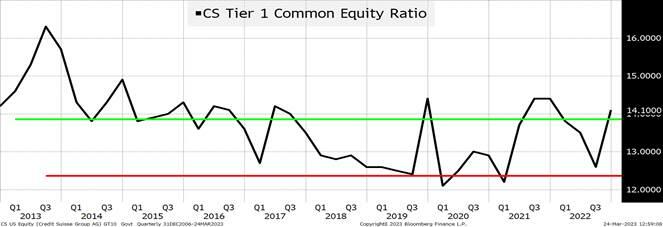
As of Dec. 31, CS had a common equity ratio well above many prior periods. It had been much lower in 2020 and 2021. It was lower in September when bond yields in many countries peaked. Presumably it had moved down again, but I am left scratching my head how this chart leads to AT1 being wiped out and additional loss provisions from the SNB were needed?  I know CS had a lot of issues, but how many were new or got materially worse in Q1? I don’t know, but this chart concerns me, because it speaks of susceptibility to me.

It is About Yields

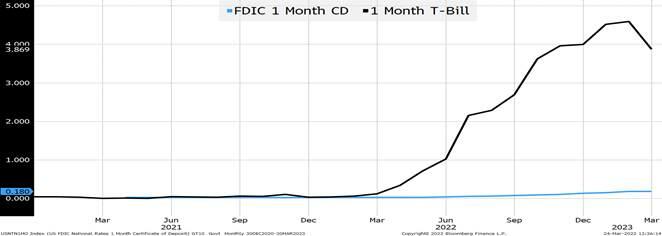
While deposit insurance and safety are issues (one I think that was overstated), the reality is that we live in a world where it is easy to move money to higher yielding, but still safe assets. Yes, you get a lot of benefits and features and utility out of a bank account, but for some yield matters and that really wasn’t an issue throughout ZIRP!

The “Unrealized” Mark to Market Losses

I remain dumbfounded by some of the duration risk that was obviously taken at, at least, one bank. The sense that I get, from talking to people is more time is being spent on what other issues could be out there?

On the bright side, housing as a whole seems strong enough, the job market is solid and corporate credit is doing well, so maybe there won’t be other risks that the market decides some subset of banks is facing (though CRE, in some regions, comes up as yet another issue where if assets needed to be sold, they wouldn’t receive par bids).

The risk, is that these risks get identified, dragging a new set of banks into the limelight (I suspect, if we see that, it will be small, relatively unknown banks), but does it end there?

Skewed Towards Risk-Off

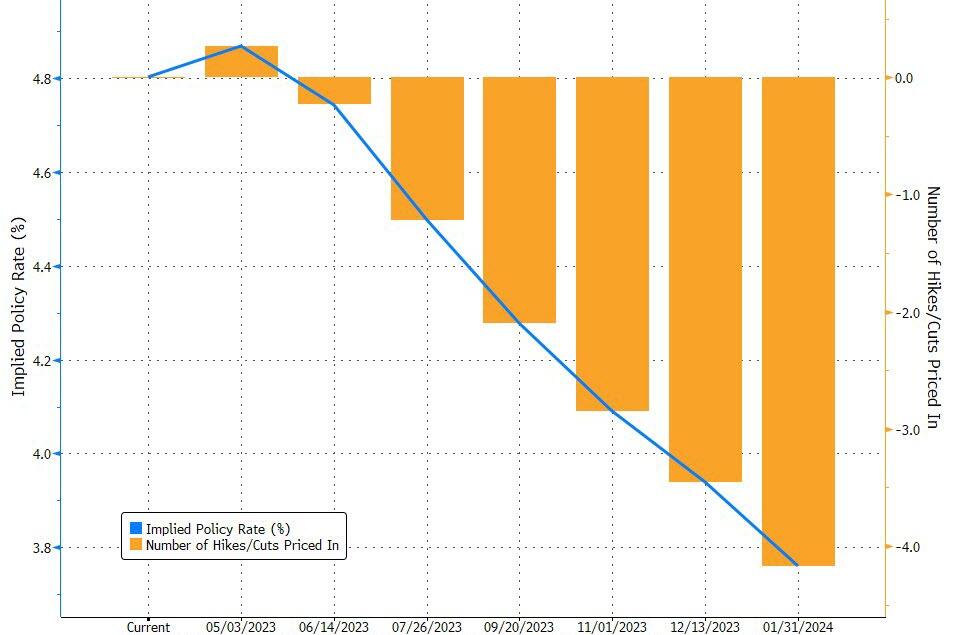
The big bull case seems to depend on the Fed being done hiking. That may or may not be the case, and even if it is, I’m not sure what is left to price in?

So for now stay cautious on risk. So far, sadly, thing are not playing out as well as I’d hoped on the central bank/policy maker front, and I think we’ve seen those in charge being Too Clever By Half.

Tyler Durden
Fri, 03/24/2023 – 14:25

via ZeroHedge News https://ift.tt/NoSCQZY Tyler Durden