What else are the “Experts” ignoring?

In 1898, a Polish author named Jan Bloch published a 3,000+ page volume on modern warfare entitled Future War and its Economic Consequences.

Bloch had studied military technology and saw the rapid pace with which destructive new weapons and munitions were being developed. And he came to the conclusion that the next war would be absolutely devastating.

Bloch predicted, in fact, that the days of classical warfare– cavalry charges and large troop movements on an open battlefield– were over. And that the next war would entail long, bloody, pointless trench warfare that would be unimaginable in its destruction.

In short, he predicted World War I.

Bloch was even invited to speak at a diplomatic conference in the Hague in the following year in 1899, and he urgently warned the attendees to do everything they could to prevent war.

The experts listened politely… and then completely ignored him. 15 years later Bloch’s prediction came true when the Great War broke out. Millions died. Europe was destroyed.

And yet in retrospect it was all so obvious. The warning signs were there all along. But somehow the people in charge not only managed to NOT avoid war, they managed to steer directly into the path of destruction.

This is often the case with major world events, including wars and major economic catastrophes. They’re seldom accidents, nor do they sneak up without announcing themselves years in advance.

And after the crisis is over, it all seems so obvious in retrospect. Yet the people in charge failed to see it coming, and often contributed to the cause.

Another great example is the Global Financial Crisis of 2008, where banks and financial institutions engaged in high-risk behavior that nearly brought down the entire global economy.

Once again, the people in charge not only failed to notice, but they played a key role in engineering the crisis to begin with.

The Federal Reserve slashed rates to just 1% after 9/11 in the early 2000s, which led to a massive asset bubble. The Fed didn’t seem to notice.

Then when they started aggressively raising interest rates in 2005 (to help fight inflation), asset prices fell dramatically. The Fed failed to predict this too.

Banks lost billions of dollars as a result, and many banks failed entirely. This triggered a chain reaction in the financial system and the worst economic crisis since the Great Depression. And the Fed not only missed the warning signs, they steered directly into the disaster.

We’ve just seen a similar crisis unfold with this month’s bank runs.

The Fed slashed rates to zero, sparking yet another major asset bubble. The Fed failed to notice.

Banks paid record high prices to buy US government bonds using their depositors’ funds. The Fed failed to notice.

Then when the Fed aggressively raised rates, they failed to predict that asset prices (including bonds) would plummet in value, causing widespread solvency problems at banks.

Banks have even reported $600+ billion in unrealized bond losses to the Federal Reserve– one of the banks’ primary supervisors. And yet the Fed still failed to notice.

In fact just three days before Silicon Valley Bank went bust, the Fed insisted to Congress that everything was fine in the financial system.

These experts are consistently wrong. And it reminds me of World War I: the warning signs were obvious, yet the people in charge failed to notice… and steered directly into the path of disaster.

So in today’s podcast, I spend some time exploring an important question: what other key risks are lurking out there which the people in charge have failed to notice?

At this point, frankly, it would be stupid to assume that the government and central bank have everything under control. What are they missing?

I talk about five separate risks today– including further fallout from these aggressive interest rate hikes. We also discuss Social Security (which is a pretty obvious risk), war, energy challenges in the US, and– the biggest flashing red warning sign I see– fading dominance of the US dollar.

You can listen here.

Source

from Sovereign Research https://ift.tt/X9kZvVD
via IFTTT

Bull Or Bear? The Ultimate Source Of Market Instability

Bull Or Bear? The Ultimate Source Of Market Instability

Authored by Charles Hugh Smith via OfTwoMinds blog,

Everyone wants a trend they can trade for effortless gains. That may no longer be realistic.

Market commentators tend to focus on Bulls and Bears and Federal Reserve policies as drivers of stock market gyrations, but there’s a far more profound dynamic working beneath these veneers: the forces of adaptation and evolution transforming the economy and society as conditions change.

While the general expectation is that the post-Covid economy “should” revert to the stability of 2019, this ignores what was already unraveling in 2019. The global economy experienced fundamental shifts in technology, production, energy, capital flows, labor, currencies and geopolitics in the past 25 years, and all these forces are not just in motion but accelerating in ways that are destabilizing the status quo.

The necessity of adaptation and evolution can be summed up very simply: adapt or die. This is the natural state not just of Nature and species but of systems such as societies and economies. Those which cling on to failing models stagnate and decay, while those which embrace dissent, transparency and a constant churn of experimentation and trial-and-error will adapt and evolve and emerge stronger and more adaptable.

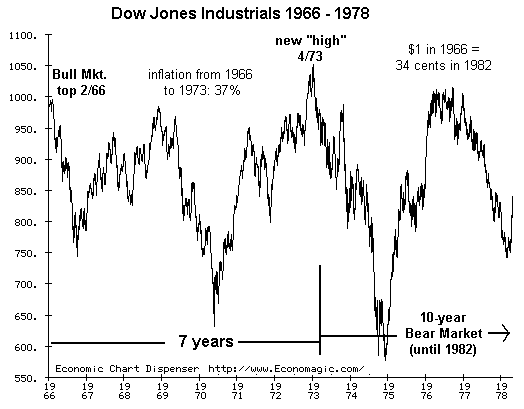
The US economy went through a comparable period of instability and forced adaptation in the 1970s, a dynamic I explored in The Forgotten History of the 1970s (January 13, 2023). Everyone benefiting from the status quo arrangements fought the much-needed changes tooth and nail, and so progress was uneven. Transitioning to a more efficient and responsive industrial base required tremendous capital investments and scaling up new technologies.

The transition is more costly and takes more time than we would like; the 1970s transition took about a decade. We can anticipate a similar scale of capital investment and time will be needed for this structural adaptation.

As the chart below illustrates, the 1970s was characterized by high inflation and big swings up and down in the stock market. Successful adaptations generated hope for quick recovery, while lagging adaptations tempered the hope with painful realities.

Again, it is likely that the decade ahead will track this same general dynamic of big swings generated by hope that the worst is over and the realities that progress is only partial and instability still reigns.

Everyone wants a trend they can trade for effortless gains. That may no longer be realistic.

*  *  *

My new book is now available at a 10% discount ($8.95 ebook, $18 print): Self-Reliance in the 21st Century. Read the first chapter for free (PDF)

Become a $1/month patron of my work via patreon.com.

Tyler Durden
Fri, 03/24/2023 – 10:20

via ZeroHedge News https://ift.tt/FkdcqJ0 Tyler Durden

Yellen Convenes Emergency Financial Stability Meeting On Friday As Banking Crisis Explodes

Yellen Convenes Emergency Financial Stability Meeting On Friday As Banking Crisis Explodes

“Capital markets stop panicking when officials start panicking”Michael Hartnett

Here comes the panic.

Bloomberg just reported that Treasury Secretary Janet Yellen – who was singlehandedly responsible for stoking and restarting the bank crisis on Wednesday which until that day was easing back, with her comments that nobody in charge was even talking about a uniform deposit insurance, let alone working on one – will convene the heads of top US financial regulators Friday morning for a previously unscheduled meeting of the Financial Stability Oversight Council.

The meeting will be closed to the public, the Treasury Department said in a statement. The Treasury didn’t say what time the meeting would begin, and it wasn’t immediately clear whether the council would issue a statement following the meeting.

The step comes as regulators continue efforts to instill calm in financial markets and among bank depositors following the recent failure of two mid-sized lenders in the US and the near-collapse of banking giant Credit Suisse Group AG before its government-brokered takeover by rival UBS Group AG.

FSOC’s members include the heads of the Federal Reserve, the Federal Deposit Insurance Corp. and several other regulatory agencies. It has little legal authority but serves as a coordinating forum. Here is a list of the full members:

The Council’s voting members are:

Yesterday we asked “What is the record for shortest interval between a final rate hike and the first rate cut.”

Are we about to discover that the answer is “just two days.”

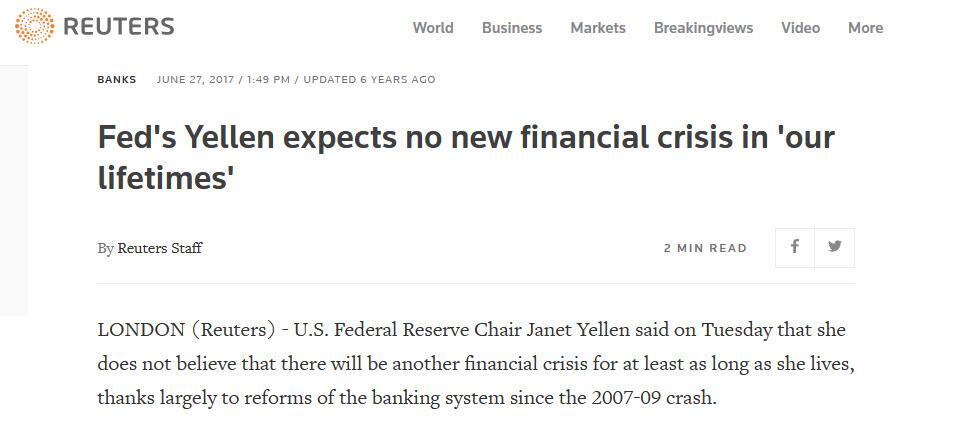
Finally, one can’t help but wonder if this is the final pre-financial crisis meeting in Yellen’s lifetime…

Developing

Tyler Durden
Fri, 03/24/2023 – 10:01

via ZeroHedge News https://ift.tt/egAoQNb Tyler Durden

US Manufacturing & Services PMIs Come In Hot As Inflation Re-Surges

US Manufacturing & Services PMIs Come In Hot As Inflation Re-Surges

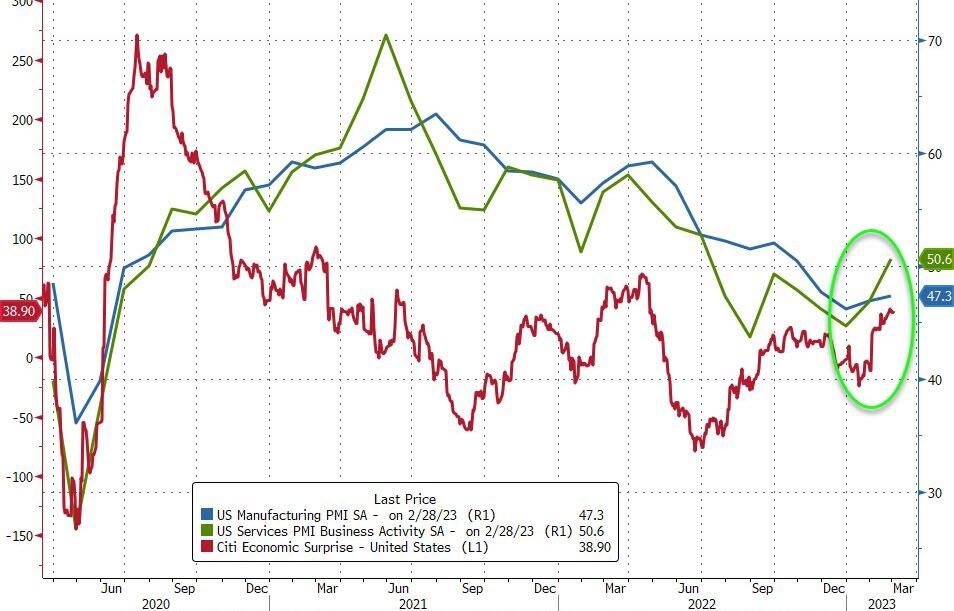
S&P Global’s PMI data surprised to the upside in preliminary February data with both Manufacturing and Services coming in hotter than expected.

  • Flash US Services Business Activity Index at 53.8 (February: 50.6). 11-month high.

  • Flash US Manufacturing Output Index at 51.0 (February: 47.4). 10-month high.

  • Flash US Manufacturing PMI at 49.3 (February: 47.3). 5-month high.

Commenting on the US flash PMI data, Chris Williamson, Chief Business Economist at S&P Global Market Intelligence said:

“March has so far witnessed an encouraging resurgence of economic growth, with the business surveys indicating an acceleration of output to the fastest since May of last year.

“The PMI is broadly consistent with annualized GDP growth approaching 2%, painting a far more positive picture of economic resilience than the declines seen throughout the second half of last year and at the start of 2023.

The upturn is uneven, however, being driven largely by the service sector.

Although manufacturing eked out a small production gain, this was mainly a reflection of improved supply chains allowing firms to fulfil backlogs of orders that had accumulated during the post-pandemic demand surge. Tellingly, new orders have now fallen for six straight months in manufacturing. Unless demand improves, there seems little scope for production growth to be sustained at current levels.

In services, there are more encouraging signs, with demand blossoming as we enter spring.

It will be important to assess the resilience of this demand in the face of the recent tightening of interest rates and the uncertainty caused by the banking sector stress, which so far only seems to have had a modest impact on business growth expectations.

There is also some concern regarding inflation, with the survey’s gauge of selling prices increasing at a faster rate in March despite lower costs feeding through the manufacturing sector. The inflationary upturn is now being led by stronger service sector price increases, linked largely to faster wage growth.

That ‘good’ news is definitely not what Powell and his pals were hoping to see.

Of course, all this ‘good’ news hit before the current ‘credit-tightening’ crisis occurred.

Tyler Durden
Fri, 03/24/2023 – 09:54

via ZeroHedge News https://ift.tt/f42QpXR Tyler Durden

Central Banks Decided To Continue Their Fight Against Inflation Despite The Banking Crisis

Central Banks Decided To Continue Their Fight Against Inflation Despite The Banking Crisis

By Phillip Marey, Senior US strategist at Rabobank

Another week of banking turmoil did not halt the fight against inflation for the central banks that were scheduled to make monetary policy decisions this week. However, the Fed seems to have been impacted the most as concerns about credit tightening have averted the rise in the projected peak for the hiking cycle that Powell had announced only a few weeks ago. Nevertheless, we continue to doubt the rate cuts that have been priced in by the markets for this year, as inflation in the US remains persistent.

Banking turmoil

This week saw additional efforts to stabilize the banking system across the globe.

On Sunday, six central banks – the Bank of Canada, the Bank of England, the Bank of Japan, the ECB, the Fed and the SNB – announced a coordinated action to enhance the provision of US dollar liquidity through an increase of the frequency of US dollar swap line operations to daily from weekly, at least through the end of April. The network of swap lines is a set of standing facilities that serve as a liquidity backstop for global funding markets.

First Republic Bank is the third casualty in the US banking turmoil. The similarity to Silicon Valley Bank, being a midsize bank with wealthy clients and largely uninsured deposits, makes it a prime suspect in the eyes of depositors and investors. A $30 billion deposit injection by 11 large US banks, led by JPMorgan Chase and facilitated by the Treasury Department, only provided temporary relief for First Republic. Note that these large banks received major inflows of deposits from midsize banks such as First Republic, so they are basically sending the hot money back. However, First Republic’s stock is still trading at low levels.

The first European casualty of the banking turmoil is Credit Suisse. After depositors fled the bank that has been suffering from scandals and trading losses for years, the Swiss central bank organized a takeover by UBS. The deal was announced on Sunday, with UBS buying Credit Suisse for $3.2 billion and getting a more than $200 billion liquidity line from the SNB and a Swiss government guarantee of $9 billion against potential losses. For more details, we refer to the Bank Bulletin by Paul van der Westhuizen.

During the week, US Treasury Secretary Yellen gave some mixed messages on bank deposit guarantees. On Tuesday, speaking to the American Bankers Association convention, she said the government stood ready to repeat the actions it took in case of Silicon Valley Bank and Signature Bank to rescue uninsured deposits if smaller institutions suffer deposit runs that pose the risk of contagion. Yellen’s remarks shored up confidence in midsize banks as many interpreted her words as a de facto guarantee of all $17.6 trillion in US bank deposits. However, on Wednesday, during a hearing before the Senate Financial Services and General Government Subcommittee, Yellen said that regulators are not looking to provide blanket deposit insurance to stabilize the US banking system without working with lawmakers. This led to an adverse market reaction, in regional bank shares, but also more broadly. Then came another change of tone on Thursday when she testified before the House and said that “we would be prepared to take additional actions if warranted.” On balance, it remains unclear how far the Treasury exactly is willing to go with raising deposit insurance, which contributes to market anxiety regarding the banking sector.

Decision time

This week was decision time for several monetary policy committees around the world. After the breakout of the banking turmoil, and efforts to stabilize the banking system, the Fed, the Banco Central do Brasil, the Bank of England, the Swiss National Bank, Norges Bank and the Bank of England had to decide how much impact the financial instability was going to have on their monetary policies. A week before, the ECB had already raised the policy rate by 50 bps with ECB President Lagarde stressing that there is no trade-off between price stability and financial stability, and that several facilities are available should they be needed. In fact, our ECB watchers already noted that the Fed’s new Bank Term Funding Program (BTFP) reminds them of the ECB’s series of (T)LTROs.

On Wednesday, the FOMC unanimously decided to raise the target range for the federal funds rate by 25 bps. However, wary of the banking turmoil and its impact on the economy and inflation, the FOMC does not want to go much higher and expects only one more 25 bps rate hike this year. Instead, the FOMC expects credit tightening by banks to do the rest of the inflation fighting for the central bank. Consequently, we have lowered our forecast for the target range of the fed funds rate to 5.00-5.25% from 5.25-5.50%. In other words, we now expect only one more hike of 25 bps instead of two. However, because of persistent inflation, we stick to our forecast that the FOMC will not cut rates this year. For more details, we refer to our FOMC Post-Meeting Comment.

Also on Wednesday, for the fifth time, the BCB‘s Copom unanimously decided to keep the Selic rate at 13.75%. The decision was in line with what we and the market had predicted. The Copom reinforced once again that they will remain “vigilant” and assess if holding the Selic rate for a sufficiently long period will drive inflation back to levels around the targets. And they hawkishly reiterated that they would not hesitate to resume tightening if need be, to reanchor inflation expectations. Going forward, we maintain our expectation that easing is not in sight until 2023Q4. We expect the Copom to keep the Selic rate at 13.75% until the November meeting when a cutting cycle begins, but we now add an upward bias to our 2024Q4 Selic rate forecast of 8.50%. For more details we refer to the BCB Post-Meeting Comment by Mauricio Une and Renan Alves.

On Thursday, it was decision time for several central banks in Europe. The SNB raised its policy rate by 50 bps to 1.5%. Swiss inflation is lower than in other European countries, but has been rising. The SNB said that “it cannot be ruled out that additional rises in the SNB policy rate will be necessary to ensure price stability over the medium term.” Regarding financial stability, the SNB said that the takeover of Credit Suisse by UBS, facilitated by the SNB, had “put a halt to the crisis.” Norges Bank raised its policy rate by 25 bps to 3.00%. Governor Ida Wolden Bache said that “there is considerable uncertainty about future economic developments, but if developments turn out as we expect, the policy rate will be raised further in May.”

Also on Thursday, the Bank of England raised its policy rate by 25bps to 4.25%. This was in line with our own expectations and with market pricing after the publication of the ‘hot’ February CPI report. The vote was split 7-2-0, with external members Tenreyro and Dhingra voting for a hold. The BoE will tighten policy further in May if price pressures persist and credit conditions permit. The shift to a meeting-by-meeting approach is not as dovish as some expected. The Monetary Policy Committee continues to focus on labor market tightness and what this means for wage and services inflation. We see risk that tightness persists. The Financial Policy Committee has judged that the UK banking system remains resilient, effectively giving the green light to this rate increase. For now, we hold on to our long-held view that Bank rate could rise as high as 4.75% with the next 25bps hike in May. This requires that global financial stability risks remain contained. For more details, we refer to the Bank of England Post-Meeting Comment by Stefan Koopman.

Overall, central banks decided to continue their fight against inflation this week, despite the banking turmoil. However, in particular the Fed has become more careful. Only a few weeks ago, prior to the collapse of SVB, Powell said that there would be an upward revision to the rate projections at the March meeting. However, this week the peak of the projected hiking cycle remained unchanged from the previous projections in December. Concerns about credit tightening are already playing a central role in the Fed’s mind, in contrast to other central banks

Tyler Durden
Fri, 03/24/2023 – 09:35

via ZeroHedge News https://ift.tt/oZHDTMs Tyler Durden

Utah Law Gives Parents Full Access to Teens’ Social Media


teen in darkness

Utah teens can no longer use social media platforms without explicit approval from a parent or guardian, per new measures that Republican Utah Gov. Spencer J. Cox signed into law yesterday. Social media platforms must also provide a way for parents to access their kids’ accounts.

These measures (Senate Bill 152 and House Bill 311) represent the latest of intensifying nationwide attempts to make online platforms age-verify users. Sold as a way to “protect” kids, they put the privacy of all social media users at risk.

Under the new Utah laws, social media companies will have to check the ages of new and existing Utah account holders—which of course means collecting and storing identifying information about every Utah user. That leaves people’s personal information vulnerable to hackers, government snoops, unscrupulous tech employees, and more.

Under-18-year-olds trying to sign up for social media accounts must be barred unless they have parental permission and will be banned from logging on between 10:30 p.m. and 6:30 a.m. if they do join. In addition, Senate Bill 152 requires social media companies to provide parents or guardians of minor account holders “with a password or other means for the parent or guardian to access the account, which shall allow the parent or guardian to view: (1) all posts the Utah minor account holder makes under the social media platform account; and (2) all responses and messages sent.”

This means teenagers can no longer count on using social media to express an identity or feelings they don’t want parents to know about—something that could be especially problematic for people with abusive parents or exploring sexual orientation or gender identity in ways of which parents disapprove. It could also leave tech platforms open to a ton of new liability if teens find a way to game the system (which—let’s be honest—they will).

That’s not the only way that the new laws open up platforms to new liability. They also say that it’s illegal for social media companies to show minors any ads or to use “a design or feature that causes addiction for a minor to the company’s social media platform,” as Cox put it, and make “it easier for people to sue social media companies for damages.”

But basically any existing facet of social media platforms could be said to encourage unhealthy use. These are platforms by nature designed to keep people engaged and to highlight the most salient content. And while most people (including most teens) do not develop pathological social media habits, those who do could easily blame it on the same features that are fine for most users (just as alcohol, junk food, video games, and other things with which some people struggle with overuse are fine for most but dangerous to those with certain psychological or social issues).

People have previously blamed social media “addiction” on any sort of algorithm-based feeds, on features that highlight the most popular content, on the fact that apps send notifications, on the fact that users can “like” posts by other users, and just about every other central aspect of social media as we know it. This means that social media platforms will have to completely overhaul their entire design and operating structure or face a constant onslaught of lawsuits in Utah, unless they simply ban Utah-based minors entirely.

Even banning under-18-year-olds entirely isn’t likely to solve the problem. “Companies are already prohibited from collecting data on children under 13 without parental consent under the federal Children’s Online Privacy Protection Act,” notes the Associated Press. “To comply, social media companies already ban kids under 13 from signing up to their platforms — but children have been shown to easily get around the bans, both with and without their parents’ consent.”

The Utah laws are slated to take effect in March 2024. But before that happens, we can surely expect serious court battles.

“Protecting teens online is a worthy goal, but these Utah bills are both counterproductive to this end and unconstitutional,” said Nicole Saad Bembridge, litigation center associate director for the tech-industry association NetChoice. “Utah will soon require online services to collect sensitive information about teens and families, not only to verify ages, but to verify parental relationships, like government-issued IDs and birth certificates, putting their private data at risk of breach.”

“These laws also infringe on Utahns’ First Amendment rights to share and access speech online—an effort already rejected by the Supreme Court in 1997,” Bembridge added.

Groups such as the Electronic Frontier Foundation (EFF) and TechFreedom have also criticized the Utah laws. EFF called them “dangerous” and likely to “make users less secure, and make internet access less private overall.”

These laws establish “a *government* restriction on First Amendment rights by default, with a parental veto,” tweeted Ari Cohn, free speech counsel for TechFreedom. “Minors have significant First Amendment rights to speak and receive protected expression. Yes, there are some materials that can be restricted more for minors, but those circumstances have almost entirely been with respect to content *obscene* as to minors, but not adults.”

“This new Utah law would unduly curtail the First Amendment rights of both young people to access advertising-based information and businesses to share it,” suggested Chris Oswald, executive vice president of the Association of National Advertisers, in a statement. “In doing so, the law limits the ability of older teens to get important information they need, including ad-based information about colleges, trade programs, military recruitment, job opportunities, apartments, and other resources for their futures. A Utah teen who is old enough to work and drive a car should also be old enough to see an ad for a job or an auto dealer.”

The way this plays out could prove instructive for other states, a number of which (including Arkansas, Texas, Ohio, Louisiana, and New Jersey) are considering similar proposals.


FOLLOW-UP

In House hearing on TikTok, lawmakers probe the sound of their own voices. In yesterday’s RoundupReason mentioned that the CEO of TikTok was scheduled to testify before the House Committee on Energy and Commerce. In the hourslong hearing, lawmakers showed little interest in actually learning or revealing anything new. TikTok CEO Shou Zi Chew could barely get a word in edgewise among all their grandstanding. On complicated—or insanely loaded—questions about TikTok’s effect on kids, its relationship to the Chinese government, and other tough issues, the representatives demanded yes or no answers and snapped at Chew when he tried to answer anything in a nuanced way. They also demonstrated a typical-for-tech-hearings cluelessness about technology.

Here’s more on the hearing, complete with examples of the inanity.

See also:


FREE MINDS

Evaluating the First Step Act and long prison sentences. A new report from the Government Accountability Office (GAO) looks at the implementation of the First Step Act, a federal criminal justice reform bill passed in 2018. “About 45% of people released from federal prison are re-arrested or return within 3 years. The First Step Act of 2018 requires the Bureau of Prisons to regularly assess incarcerated people’s needs and their risk of reoffending,” noted a GAO summary of the report. “But the Bureau doesn’t have reliable data on the timeliness of completing such assessments and lacks clear, measurable goals and milestones to evaluate whether its programs are working. Also, people participating in these programs can earn credits to reduce their time in prison, but accurate data is needed to apply such credits. We recommended addressing these issues.”

Another new report, this one from the nonpartisan Council on Criminal Justice (CCJ) Task Force on Long Sentences, looks at the effect of long sentences on the criminal justice system and the people involved in it, including incarcerated people, crime victims, and correctional staff. The task force defined long prison sentences as 10 years or longer.

“The nation’s use of long sentences raises challenging questions about the relationship between crime, punishment, and public safety,” states the report’s introduction. “What role, for example, do long sentences play in deterring people from engaging in crime? How long do prison sentences need to be to prevent incarcerated people from committing new offenses once they are released? Is there an effective way to distinguish which people serving long sentences can be safely released and which cannot?”

Ultimately the task force came up with 14 recommendations to make sentencing more fair and productive, including increasing judicial discretion in sentencing (“the strict application of mandatory minimum penalties can lead to unjust results that do not serve public safety interests”), expanding earned sentence credit opportunities, and decoupling drug quantity from sentence lengths.


FREE MARKETS

“Doomsday predictions” about mergers haven’t panned out. A new paper from the International Center for Law & Economics (ICLE) looks at panicky predictions about past business mergers that haven’t panned out as the doomsayers warned. The paper comes as the Federal Trade Commission (FTC) and the Department of Justice “prepare to release updated federal merger guidelines that the agencies say will better detect and prevent illegal and anticompetitive deals,” notes ICLE in a press release. But bureaucrats and politicians don’t have a great track record on predicting the effects of particular mergers, suggest Brian Albrecht, Dirk Auer, Eric Fruits, and Geoffrey A. Manne in “Doomsday Mergers: A Retrospective Study of False Alarms.”

The authors point to alarms sounded over Amazon’s 2017 purchase of Whole Foods, Bayer’s 2018 merger with Monsanto, Google’s 2019 purchase of Fitbit, and Anheuser-Busch InBev’s 2016 acquisition of SABMiller. In the latter case, “critics claimed [the acquisition] would increase the price of beer and decimate the burgeoning craft-beer segment,” they write:

Instead, the concentration of the beer industry decreased after the mergers, prices did not increase on average, and the craft-beer segment thrived. This is not to say that all is rosy; the price of some beers did indeed increase after the wave of mergers. Regardless, it is clear the post-merger outcome was a far cry from the doomsday scenario that critics predicted.

People feared that Google’s purchase of Fitbit would lead to consumer privacy violations and make Google more dominant in advertising, because Google would use data from the devices in its advertising business. “The fear was that, by purchasing Fitbit, Google would be in a position to better target ads throughout its entire platform, thereby increasing its hold on the broader advertising industry,” note the authors. But:

Four years on, however, the opposite appears to have happened. From 2017 to 2022, Google’s share of online advertising spend has steadily declined, falling from 34.7% to 28.8%.118 And it is not just in relative terms; the company’s quarterly earnings reports show a clear decline in ad revenue, including year-over-year drops in the fourth quarter of 2022 of 8.6% for the Google network and 7.0% for YouTube. As usual, critics may retort that Google’s revenues and market shares would have declined even more absent the merger but, once again, that was not the initial claim. Instead, they wrote that the merger would give Google an unbreakable grip on the online-advertising industry—the “horse has bolted” as Gregory Crawford put it—and that has not been the case.

You can read the full report here. The authors conclude with a warning: “We should be skeptical of kneejerk projections of doom, whether from activists, competition scholars, or media pundits.”


QUICK HITS

• Law enforcement severely beat this innocent man. Will the U.S. Supreme Court let him seek recourse?

• In Chicago, “gun enforcement overwhelmingly focuses on possession crimes — not use,” and it’s black men who are overwhelmingly paying the price, reports The Marshall Project.

Reason Senior Editor Brian Doherty explains the Securities and Exchange Commission’s beef with the crypto exchange Coinbase.

• “A federal judge in San Diego has ruled in favor of a New York pastor who sued the U.S. Department of Homeland Security over a sweeping surveillance program, ruling that federal agents violated her civil rights and retaliated against her for protected First Amendment activity,” reports The San Diego Union-Tribune.

• How poppy seed bagels are leading to protective services investigations of new moms.

• The FBI sent a pink-haired detective pretending to be a sex worker to infiltrate racial justice groups in Colorado Springs in 2020.

• New Hampshire’s House of Representatives has passed a ban on no-knock raids:

Reason Editor in Chief Katherine Mangu-Ward reviews Kat Rosenfield’s latest mystery novel.

The post Utah Law Gives Parents Full Access to Teens' Social Media appeared first on Reason.com.

from Latest https://ift.tt/fwYi0AO
via IFTTT
France Burns As Million Protesters Rage Against Pension Reforms

France Burns As Million Protesters Rage Against Pension Reforms

France is engulfed in turmoil following President Emmanuel Macron’s controversial decision to raise the retirement age. Over a million people participated in nationwide protests on Thursday, transforming urban areas into scenes of chaos. These demonstrations, the largest in years, have triggered fuel shortages, hundreds of arrests, and even claims of “civil war.” 

Interior Minister Gerald Darmanin told French media outlet CNews on Friday morning that more than 900 fires were reported in the streets of Paris on Thursday night — in one of the most violent days of protests in a while. 

“There were a lot of demonstrations and some of them turned violent, notably in Paris,” Darmanin said. He said more than a million people marched yesterday. 

Police warned anarchist groups were infiltrating marches across Paris and other demonstrations. Men wearing hoods and facemasks were seen smashing windows and setting fire to trash piles and, in some cases, burning buildings. 

Chaos on the streets of Paris

Darmanin said 457 people were arrested last night, and 441 security forces were injured. He praised the police for their brave actions. 

Meanwhile, the demonstrations and violence have caused a significant fuel shortage, impacting gas stations nationwide. Other disruptions have been reported due to widespread strikes across many sectors of the economy, such as garbage piling up in the streets of Paris because trash collectors are protesting pension reforms. 

Far-right leader Marine Le Pen accused Macron of sparking conditions for a “social explosion.” 

“Consciously, the government is creating all the conditions for a social explosion, as if they were looking for that,” she told AFP.

Le Pen’s sentiment was shared with the Wall Street Silver Twitter account, which asked, “is France is on the brink of civil war?”

Recall earlier this week. We penned a note asking if “European Spring” had arrived. 

France is so dangerous right now that even King Charles III of Britain postponed his visit. 

And let’s not forget that massive protests are scheduled for Germany early next week. 

This all comes as a banking crisis spreads across the Western world. 

Tyler Durden
Fri, 03/24/2023 – 09:15

via ZeroHedge News https://ift.tt/u1atEWk Tyler Durden

Recession Indicators Says The Fed Broke Something

Recession Indicators Says The Fed Broke Something

Authored by Lance Roberts via RealInvestmentAdvice.com,

Recession indicators a ringing loudly.

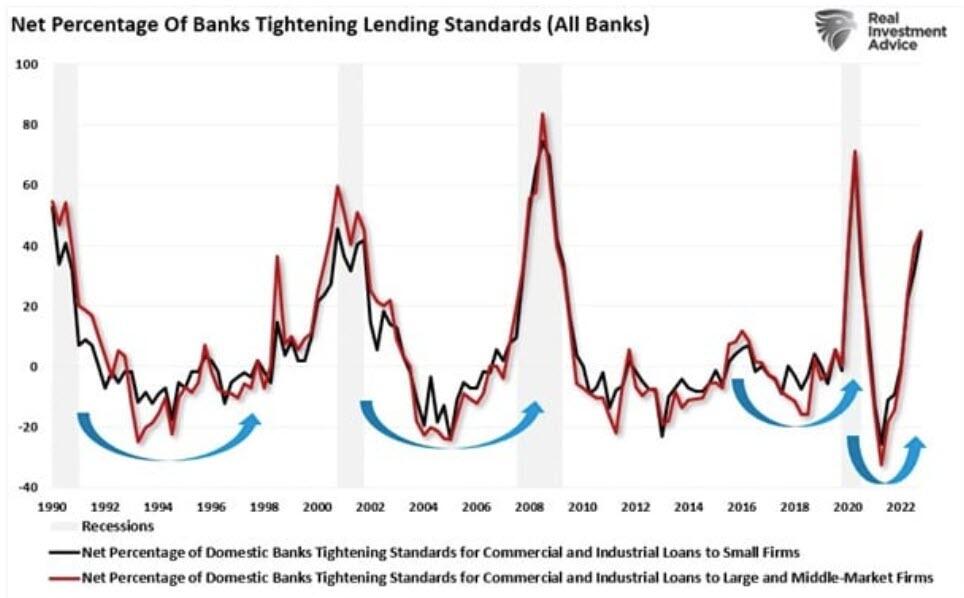
Yet, the Fed remains focused on its inflation fight, as repeatedly noted by Jerome Powell following this week’s FOMC meeting. During his press conference, he specifically made two critical comments. The first was that inflation remains too high and is well above the Fed’s two-percent goal. The second was that the bank crisis would tighten lending standards which would have a “policy tightening” effect on the economy and inflation.

As shown, lending conditions have tightened markedly, and such tightening always precedes recessionary slowdowns.

While the market is starting to price in just one additional rate hike by the Fed, the “lag effect” of rate hikes remains the most significant risk.

The problem for the Fed is that the economy still shows plenty of strength, from recent employment numbers to retail sales. However, much of this “strength” is an illusion from the “pull forward” of consumption following the massive fiscal and monetary injections into the economy.

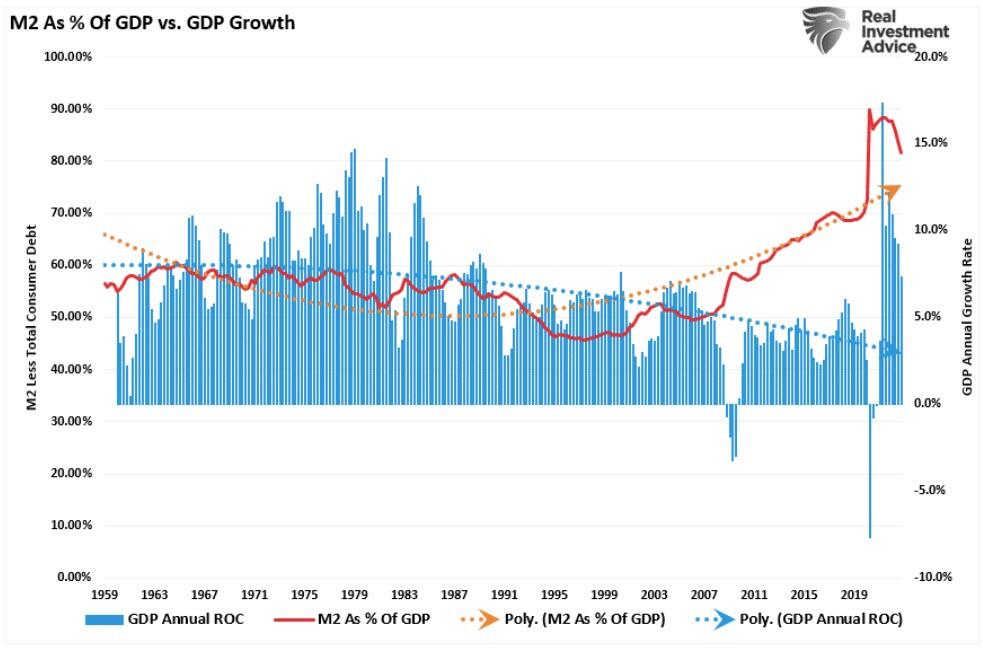
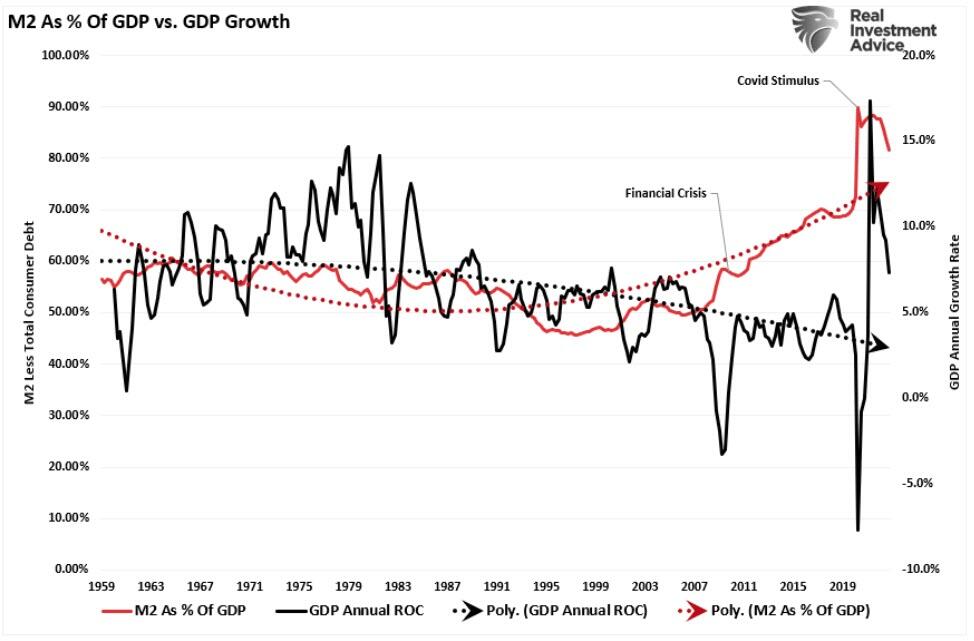
As shown, M2, a measure of monetary liquidity, is still highly elevated as a percentage of GDP. This “pig in the python” is still processing through the economic system. Still, the massive deviation from previous growth trends will require an extended time frame for reversion. Such is why calls for a “recession” have been early, and the data continues to surprise economists.

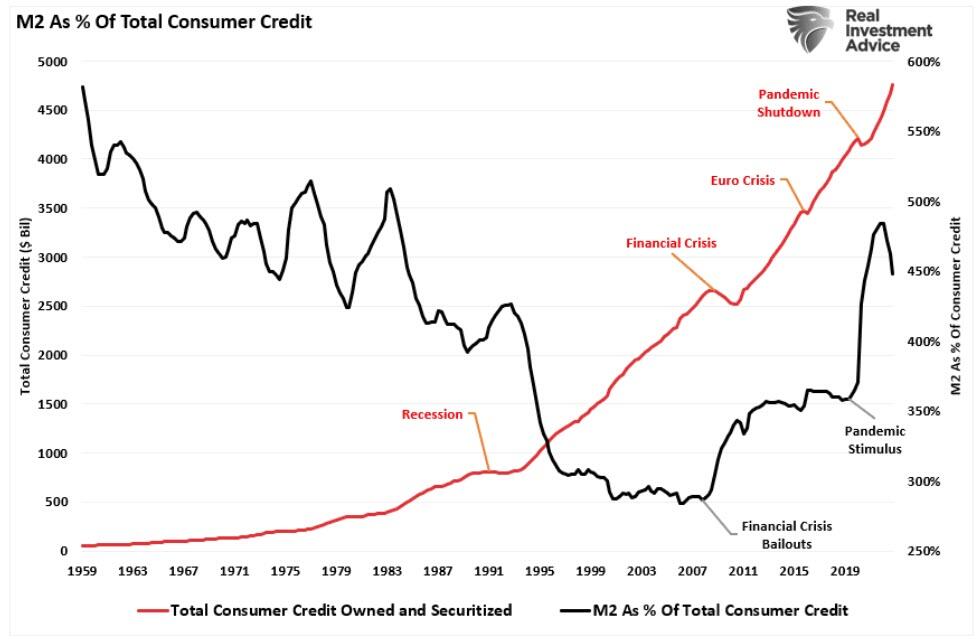
Given that economic growth is comprised of roughly 70% consumer spending, the ramp-up in debt to “make ends meet” as that liquidity impulse fades is not surprising. You will note that each time there is a liquidity impulse following some crisis, consumer debt temporarily declines. However, as we said previously, the inability to sustain the current standard of living without debt increases is impossible. Therefore, as those liquidity impulses fade, the consumer must take on increasing debt levels.

Monetary & Fiscal Policy Is Deflationary

The problem is that the Federal Reserve and the Government fail to grasp that monetary and fiscal policy is “deflationary” when “debt” is required to fund it.

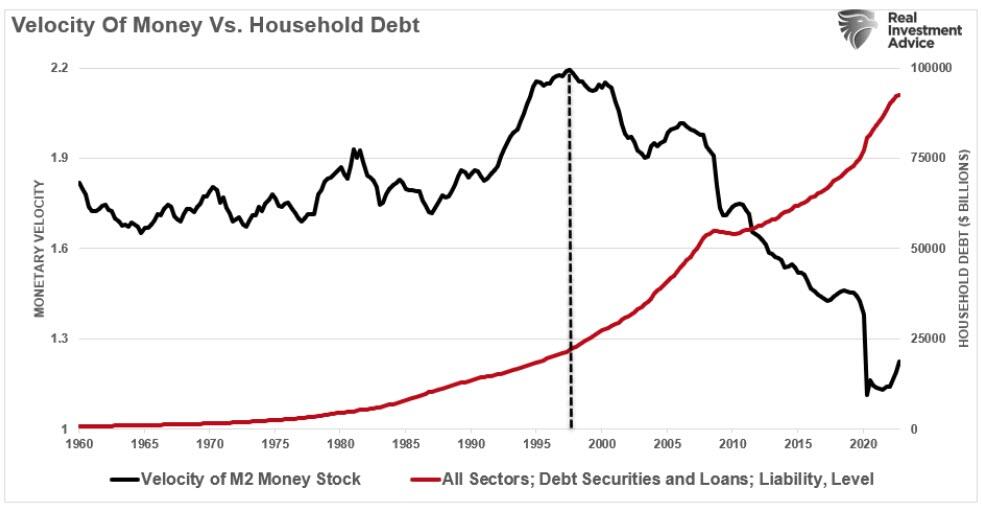
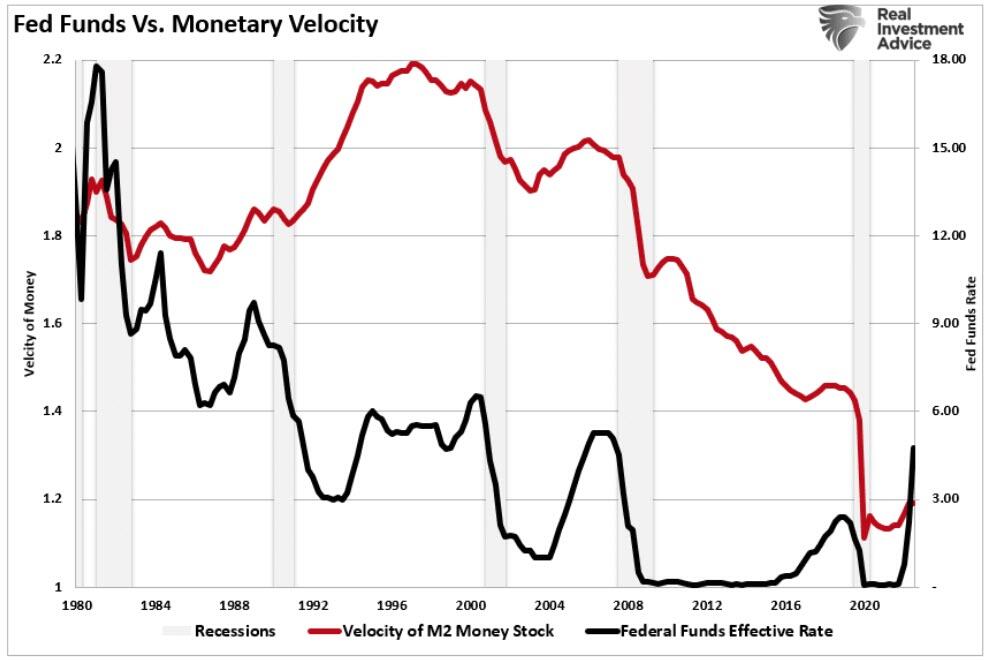
How do we know this? Monetary velocity tells the story.

What is “monetary velocity?”

“The velocity of money is important for measuring the rate at which money in circulation is used for purchasing goods and services. Velocity is useful in gauging the health and vitality of the economy. High money velocity is usually associated with a healthy, expanding economy. Low money velocity is usually associated with recessions and contractions.” – Investopedia

With each monetary policy intervention, the velocity of money has slowed along with the breadth and strength of economic activity.

While, in theory, “printing money” should lead to increased economic activity and inflation, such has not been the case.

With each monetary policy intervention, the velocity of money has slowed along with the breadth and strength of economic activity. While, in theory, “printing money” should lead to increased economic activity and inflation, such has not been the case.

Beginning in 2000, the “money supply” as a percentage of GDP exploded higher. The “surge” in economic activity is due to “reopening” from an artificial “shutdown.” Therefore, the growth is only returning to the long-term downtrend. The attendant trendlines show that increasing the money supply has not led to more sustainable economic growth. It has been quite the opposite.

Moreover, it isn’t just the expansion of M2 and debt undermining the economy’s strength. It is also the ongoing suppression of interest rates to try and stimulate economic activity. In 2000, the Fed “crossed the Rubicon,” whereby lowering interest rates did not stimulate economic activity. Therefore, the continued increase in the “debt burden” detracted from it.

It is also worth noting that monetary velocity improves when the Fed is hiking interest rates. Interestingly, much like the recession indicators we will discuss next, monetary velocity tends to improve just before the Fed “breaks something.”

Recession Indicators Ringing Alarm Bells

Many “recession indicators” are ringing alarm bells, from inverted yield curves to various manufacturing and production indexes. However, this post will focus on two related to economic expansions and recessions.

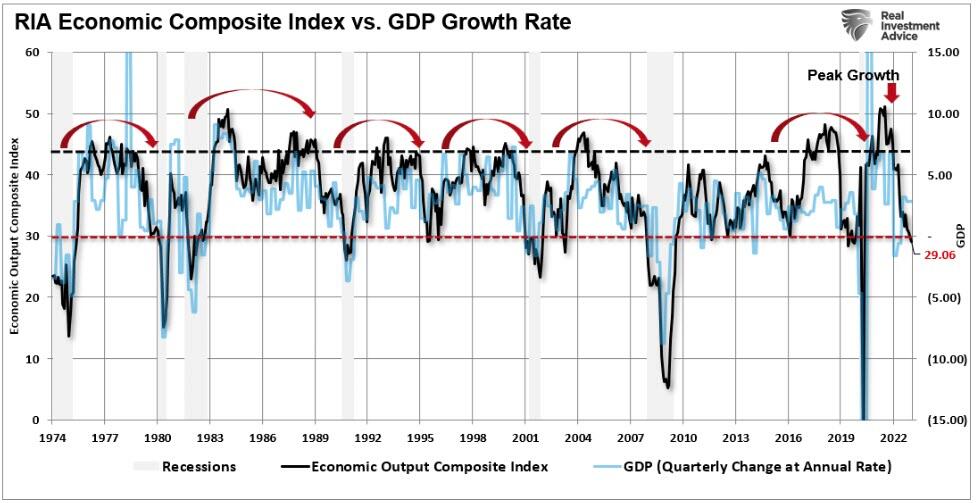
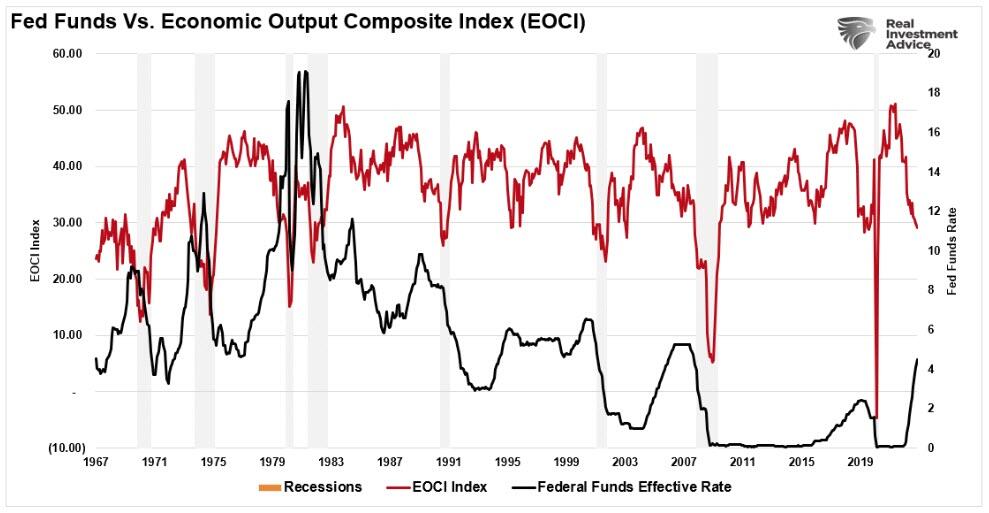
The first is our composite economic index comprising over 100 data points, including leading and lagging indicators. Historically, when that indicator has declined below 30, the economy was either in a significant slowdown or recession. Just as inverted yield curves suggest that economic activity is slowing, the composite economic index confirms the same.

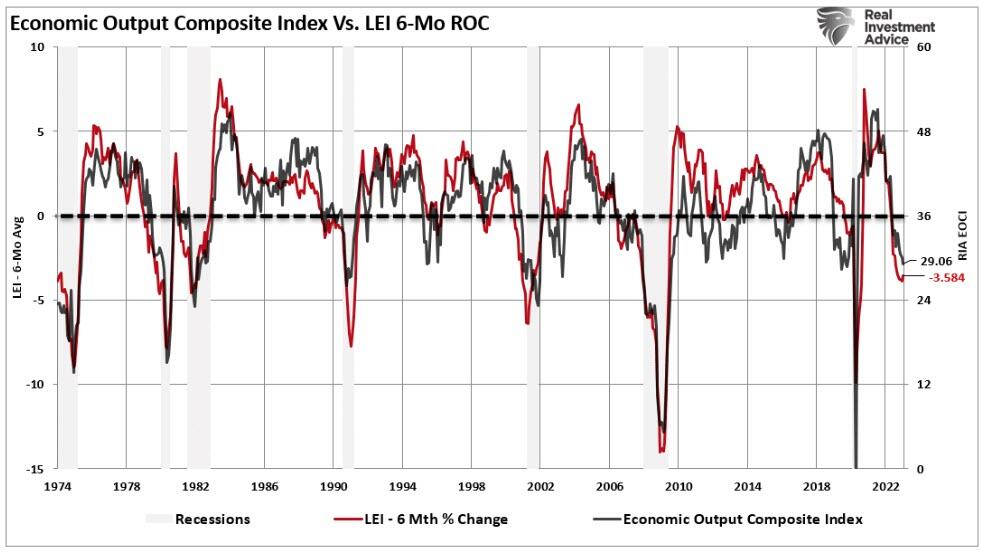
The 6-month rate of change of the Leading Economic Index (LEI) also confirms the composite economic index. As a recession indicator, the 6-month rate of change of the LEI has a perfect traffic record.

Of course, today’s debate is whether these recession indicators are wrong for the first time since 1974. As stated above, the massive surge in monetary stimulus (as a percentage of GDP) remains highly elevated, which gives the illusion the economy is more robust than it likely is. As the lag effect of monetary tightening takes hold later this year, the reversion in economic strength will probably surprise most economists.

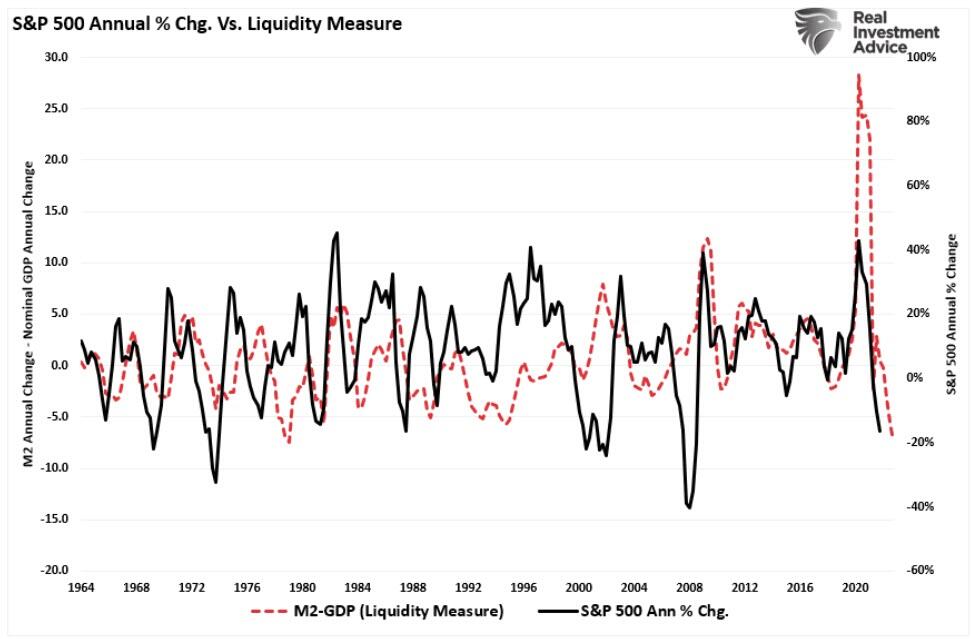
For investors, the implications of reversing monetary stimulus on prices are not bullish. As shown, the contraction in liquidity, measured by subtracting GDP from M2, correlates to changes in asset prices. Given there is significantly more reversion in monetary stimulus to come, such suggests that lower asset prices will likely follow.

Of course, such a reversion in asset prices will occur as the Fed “breaks something” by over-tightening monetary policy.

The Fed Broke Something

As the Fed continues to hike rates to fight an inflationary “boogeyman,” the more considerable threat remains deflation from an economic or credit crisis caused by overtightening monetary policy.

History is clear that the Fed’s current actions are once again behind the curve. While the Fed wants to slow the economy, not have it come crashing down, the real risk is “something breaks.” Each rate hike puts the Fed closer to the unwanted “event horizon.” When the lag effect of monetary policy collides with accelerating economic weakness, the Fed’s inflationary problem will transform into a more destructive deflationary recession.

If we overlay periods of Federal Reserve tightening on our economic composite recession indicator, the risk becomes quite clear.

While the Fed is hiking rates due to inflationary concerns, the real risk becomes deflation when something breaks.

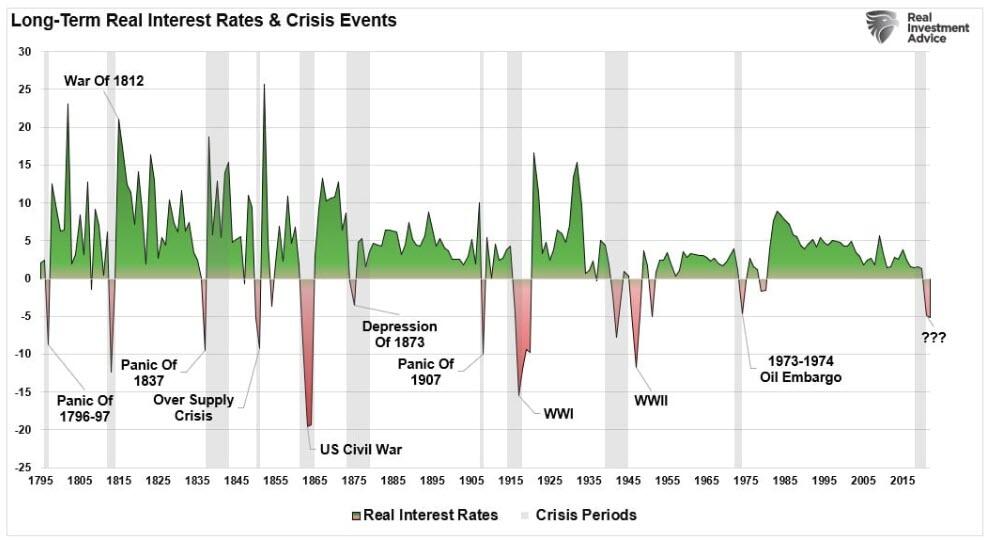
“Such is because high inflationary periods also correspond with higher interest rates. In highly indebted economies, as in the U.S. today, such creates faster demand destruction as prices and debt servicing costs rise, thereby consuming more of available disposable income. The chart below shows “real interest rates,” which include inflation, going back to 1795.”

Not surprisingly, each period of high inflation is followed by very low or negative inflationary (deflation) periods.

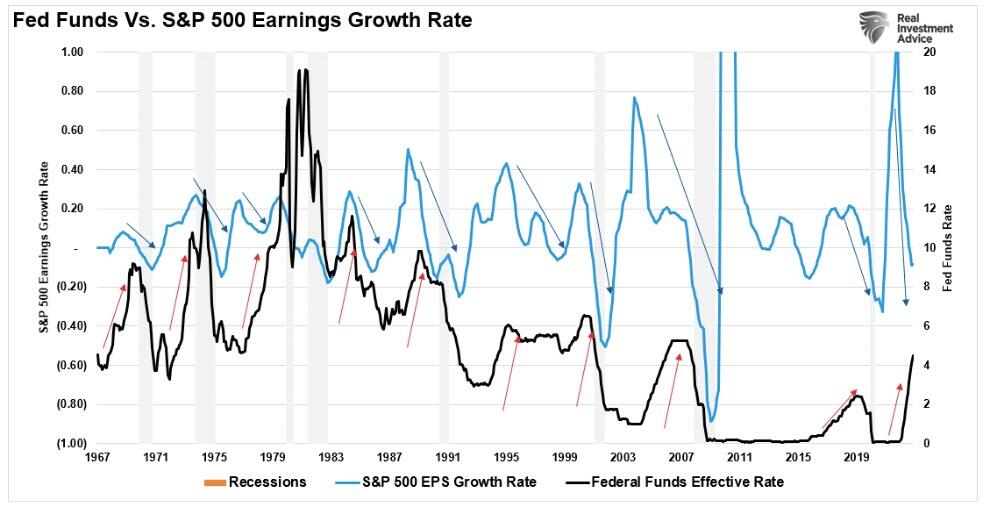
For investors, these recessionary indicators confirm that earnings will decline further as tighter monetary policy slows economic growth.

Historically, periods of Fed tightening have never had a positive outcome on earnings, and it likely won’t this time either.

That is particularly the case when the Fed “breaks” something.

While this time “could be different,” from an investing standpoint, I wouldn’t bet my retirement on that view.

Tyler Durden
Fri, 03/24/2023 – 08:46

via ZeroHedge News https://ift.tt/IV9E0Yv Tyler Durden

US Durable Goods Orders Unexpectedly Drop In Feb; Weakest YoY In 2 Years

US Durable Goods Orders Unexpectedly Drop In Feb; Weakest YoY In 2 Years

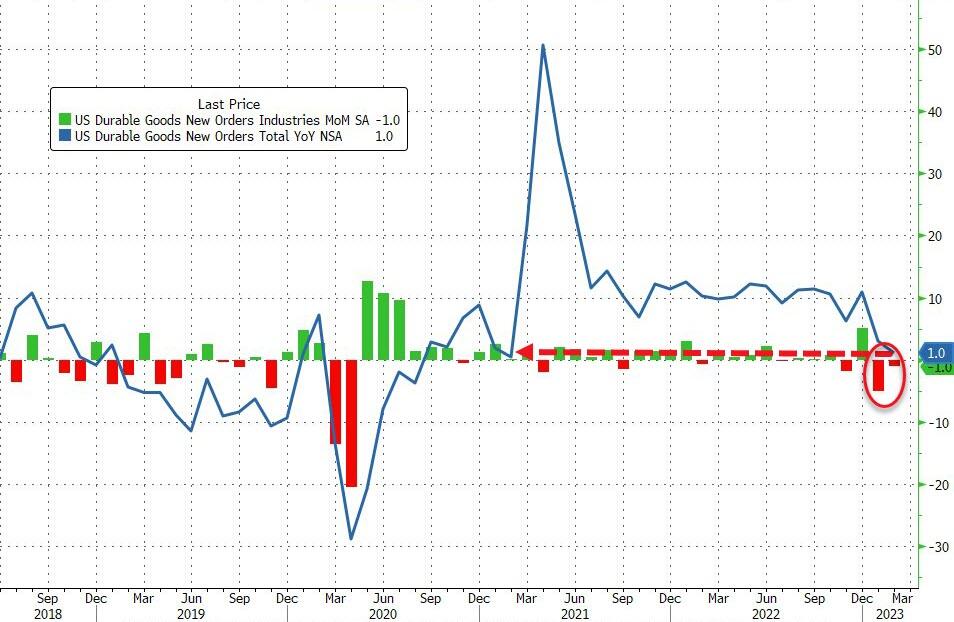
After tumbling in January (thanks to no big Boeing plan order that juiced December’s data), analysts expected a modest rebound (+0.2% MoM) in preliminary February data. However, they were wrong as durable goods orders dropped 1.0% MoM. And it’s worse because this happened even after January’s 4.5% drop was revised even lower to -5.0% MoM.

That is the weakest YoY rise in Durable Goods Orders since Feb 2021…

Source: Bloomberg

Core orders (ex transports) also disappointed – printing unchanged (below the +0.2% MoM exp), with the prior month’s 0.8% MoM cut in half to +0.4% MoM downward revision.

On the positive side, the value of core capital goods orders, a proxy for investment in equipment that excludes aircraft and military hardware, rose 0.2% last month after a 0.3% advance in January.

However, this is all lagged and preliminary data for February (an eon ago relative to the current crisis levels).

Tyler Durden
Fri, 03/24/2023 – 08:37

via ZeroHedge News https://ift.tt/8fHZL3A Tyler Durden

US Contractor Killed, 5 Service Members Wounded In Syria – Airstrikes Ensue

US Contractor Killed, 5 Service Members Wounded In Syria – Airstrikes Ensue

The United States struck Iranian-linked groups in Syria on Thursday after a US contractor was killed and five military service members and another US contractor were wounded in a purported drone strike. 

The Pentagon said the US casualties were suffered on a base near Hasakah in the northeast part of the country, when a “one-way, unmanned, aerial vehicle” hit a maintenance facility at 1:38 pm local time. The statement said intelligence assessed the drone to be “of Iranian origin.” 

Three service members and the surviving U.S. contractor were medically evacuated to military medical facilities in Iraq. Two service members were treated at the base. No details were provided about which military branches the service members were affiliated with, nor the identity of the contractors. 

Syria’s Hasakah province is south of Turkey and west of Iraq 

“At the direction of President Biden, I authorized U.S. Central Command forces to conduct precision airstrikes tonight in eastern Syria against facilities used by groups affiliated with Iran’s Islamic Revolutionary Guards Corps (IRGC),” said Secretary of Defense Lloyd J. Austin III in a statement. “The airstrikes were conducted in response to today’s attack as well as a series of recent attacks against Coalition forces in Syria by groups affiliated with the IRGC.”

The violence came on the same day as reports that Syria and Saudi Arabia are on the brink of fully restoring diplomatic relations — to include reopening embassies. As we wrote just yesterday: 

It seems the Gulf has been willing to recognize that the Syrian government won the decade-long war and move on, but not Washington. The US has continued its military occupation of northern Syria, and Israel has extended its bombing campaign, even this week with strikes on Aleppo international airport.

The violence also comes alongside a Chinese-brokered rapprochement between Saudi Arabia and Iran, which will see the long-time archrivals restore full diplomacy. An aide to Israeli Prime Minister Netanyahu, disappointed over the prospect of more peaceful relations between Saudi Arabia and Iran, said it was the result of American “weakness.” 

US troops near the Suwaydiyah oil fields in the Hasakah province in 2021 (Delil Souleiman/AFP via Getty Images and Axios)

In August of last year, US helicopters attacked Iranian-linked militants in Syria after rockets were fired at US bases. 

In separate statement on Thursday’s events, US Central Command said, “Our troops remain in Syria to ensure the enduring defeat of ISIS, which benefits the security and stability of not only Syria, but the entire region.” 

Officially, about 900 US service members are deployed in Syria, against the wishes of the Syrian government. The presence dates back to 2015, with successive administrations claiming the deployments are legal under the aging 2001 and 2002 Authorizations for Use of Military Force (AUMFs). The first authorized force against the perpetrators of 9/11, and the second authorized the disastrous invasion of Iraq.  

Earlier this month, the House rejected a resolution that would have directed President Biden to withdraw U.S. troops within 180 days. Introduced by Florida Republican Rep. Matt Gaetz, it failed in a 103-321 vote. Both the yea and nay votes were highly bipartisan; 56 Democrats joined 47 Republicans in calling for troops to leave. 

In a 9-86 vote on Wednesday, the Senate killed an amendment offered by Sen. Rand Paul that would have put a six-month sunset on the 2001 AUMF.  ​​​​​“No one in Congress in 2001 believed they were voting for a decades-long war fought in at least 19 countries,” wrote Paul at Responsible Statecraft, noting that the six-month window would give Congress time to debate “where and how to authorize force.” 

Tyler Durden
Fri, 03/24/2023 – 08:25

via ZeroHedge News https://ift.tt/n8U5MHf Tyler Durden