Futures Tumble, Treasuries And Rate Cut Odds Soar Amid Panic That Deutsche Bank Is The Next To Go

Futures Tumble, Treasuries And Rate Cut Odds Soar Amid Panic That Deutsche Bank Is The Next To Go

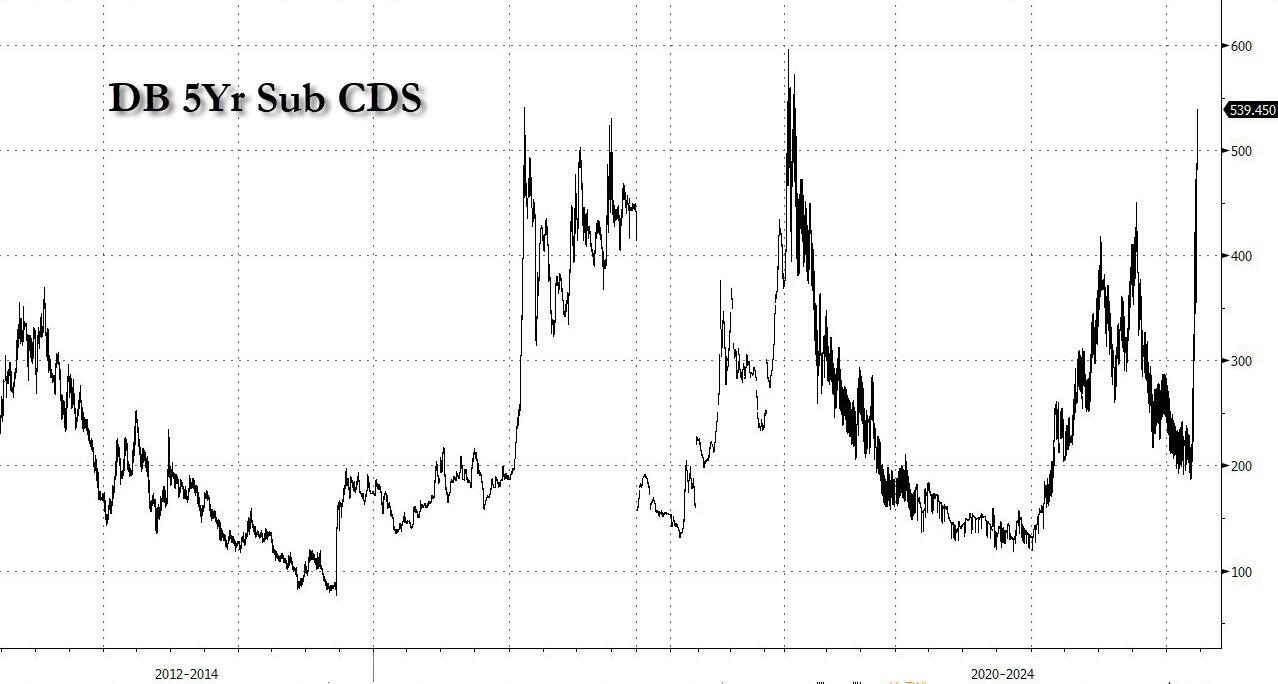
Yesterday, while attention was still focused on the US banking system and the ongoing botched response by the Fed and especially the Treasury’s senile Secretary, who more than two weeks after SIVB collapsed, have still not been able to stabilize confidence in banks – thereby assuring the US is about to slam head first into a brutal recession, just as Biden ordered to contain inflation, as US consumer spending is now in freefall – we pointed out that something bad was taking place in Europe: the credit default swaps of perpetually semi-solvent banking giant Deutsche Bank were quietly blowing out to multi-year highs.

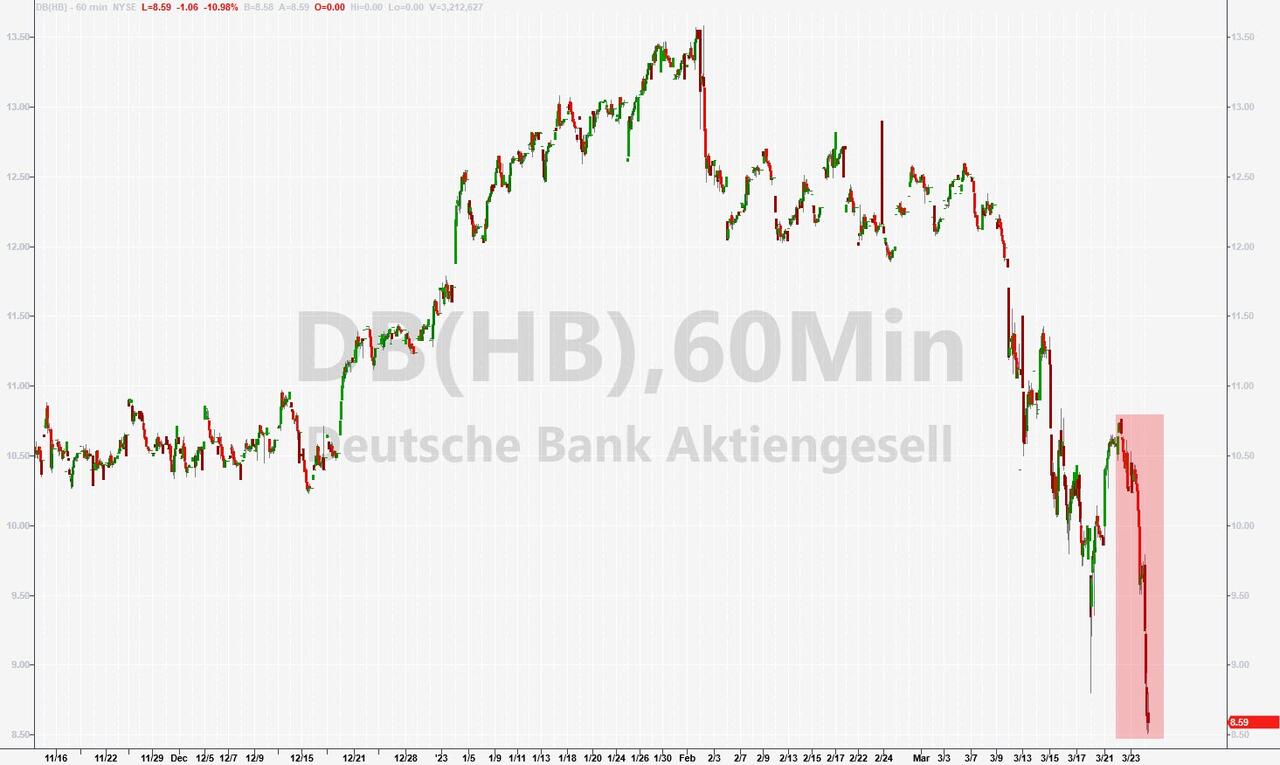
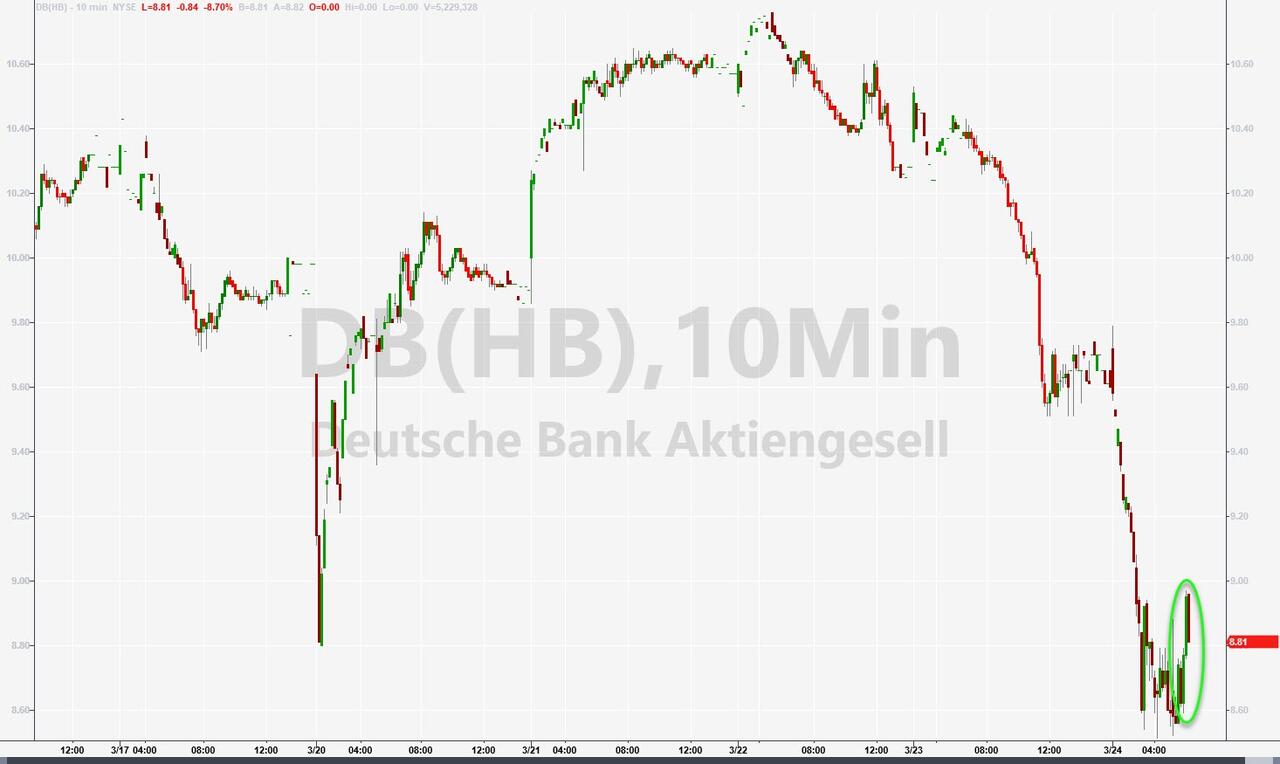
Well, we didn’t have long to wait before everyone else also noticed and this morning it’s official: the crisis has shifted to Germany’s and Europe’s largest TBTF bank, with even Bloomberg now writing that Deutsche Bank “has become the latest focus of the banking turmoil in Europe as ongoing concern about the industry sent its shares slumping the most in three years and the cost of insuring against default rising.” The bank – which has staged a recovery in recent years after a series of crises that nearly brought it down – said Friday it will redeem a tier 2 subordinated bond early. And while such moves are usually intended to give investors confidence in the strength of the balance sheet, though the share price reaction suggests the message isn’t getting through, and the stock plunged 13% in German trading…
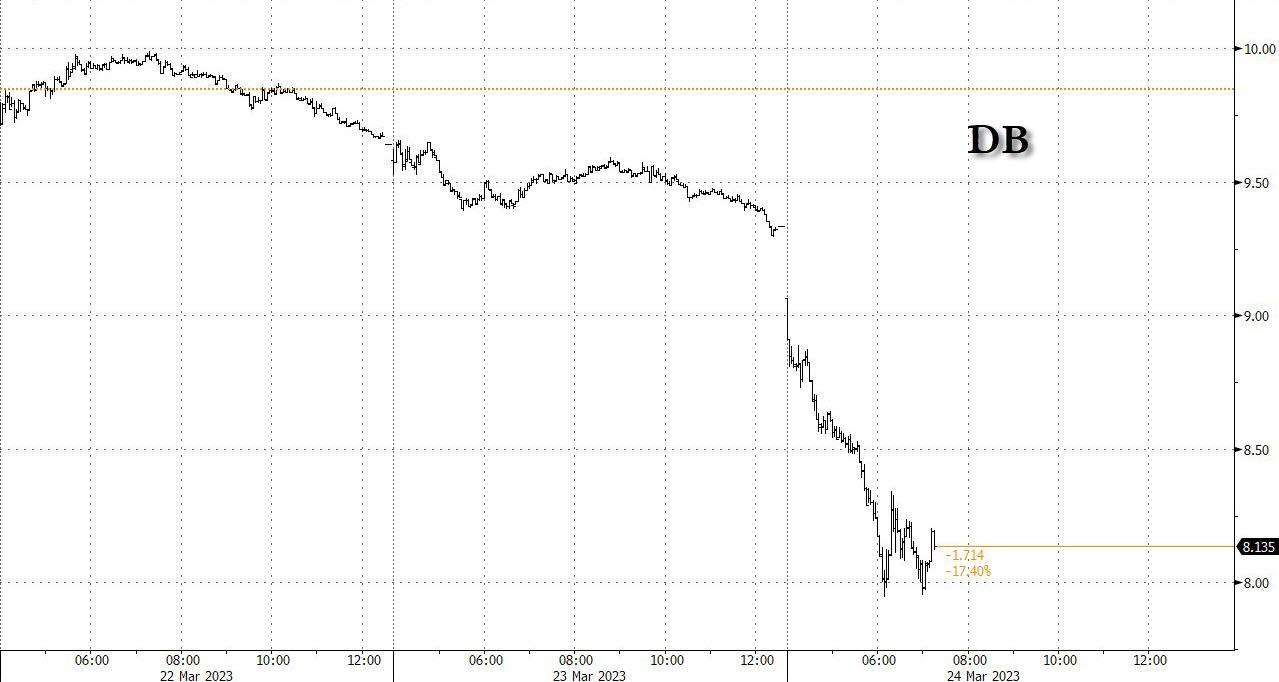
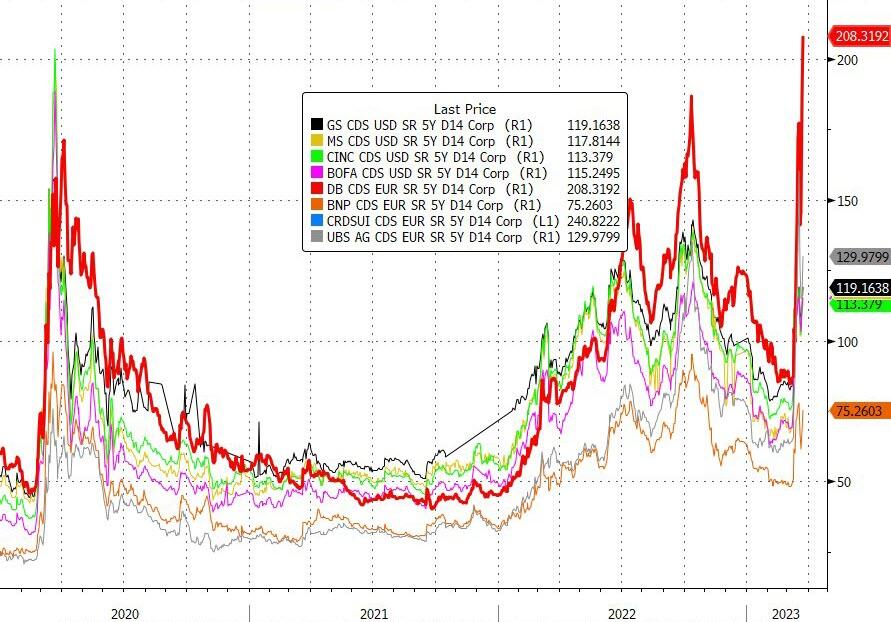
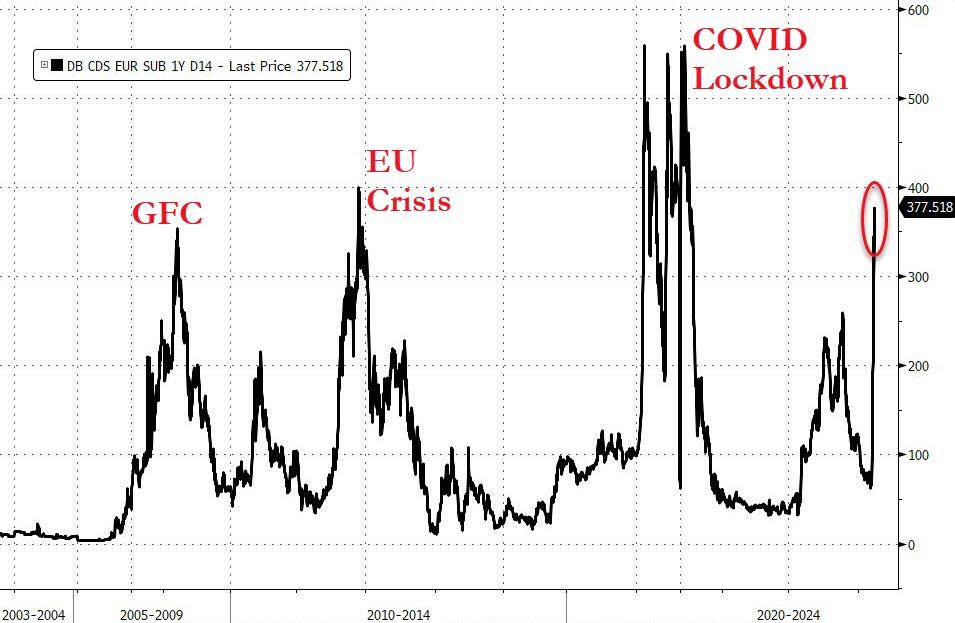
… while DB’s CDS has exploded to level surpassing the bank’s near-collapse in 2016, and is about to take out the covid wides.
“It is a clear case of the market selling first and asking questions later,” said Paul de la Baume, senior market strategist at FlowBank SA. “Traders do not have the risk appetite to hold positions through the weekend, given the banking risk and what happened last week with Credit Suisse and regulators.”

It wasn’t just Deutsche Bank: UBS Group AG shares also dropped as Bloomberg reported that it’s one of the banks under scrutiny in a US Justice Department probe into whether finncial professionals helped Russian oligarchs evade sanctions, according to people familiar with the matter. In any case, the sudden, violent spike in DB default risk which quickly carried over to all big European banks, and which will not reverse until first the ECB then the Fed both cut rates…

… sent broader risk sentiment reeling with S&P 500 futures at session lows, sliding 1% to 3940.
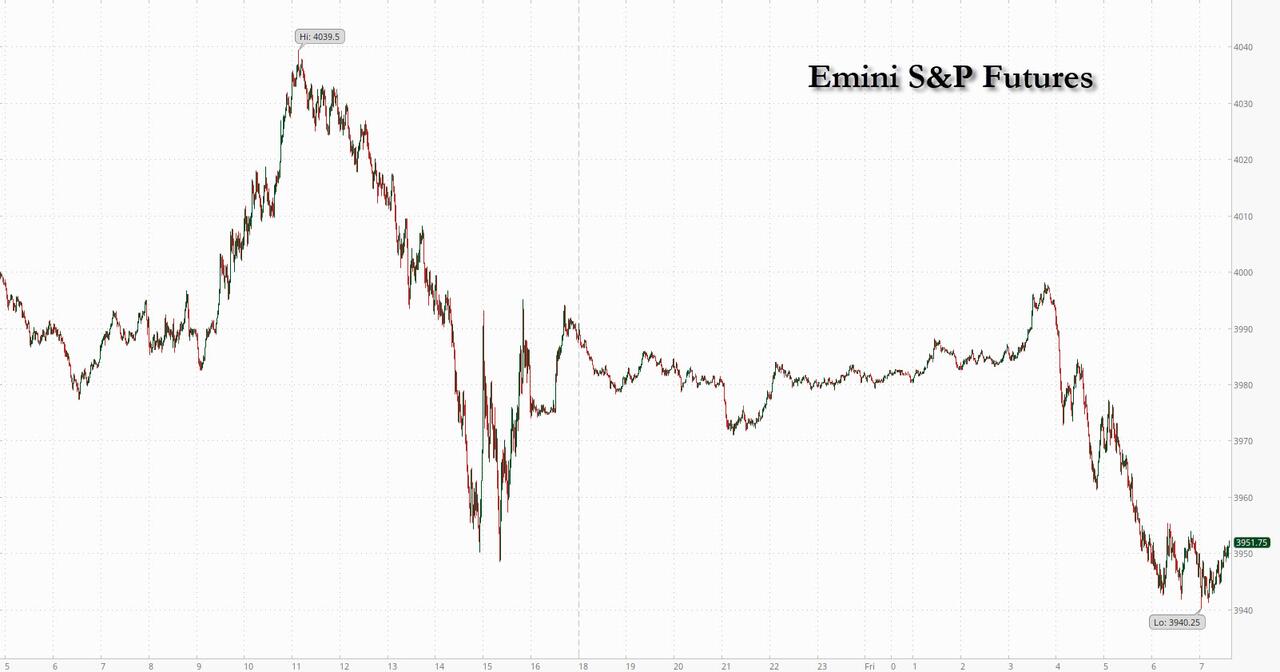
While there was no one big story setting off these moves. It could be a rush to havens heading into the weekend as traders wait for another shoe to drop — which has been a theme during recent weekends.

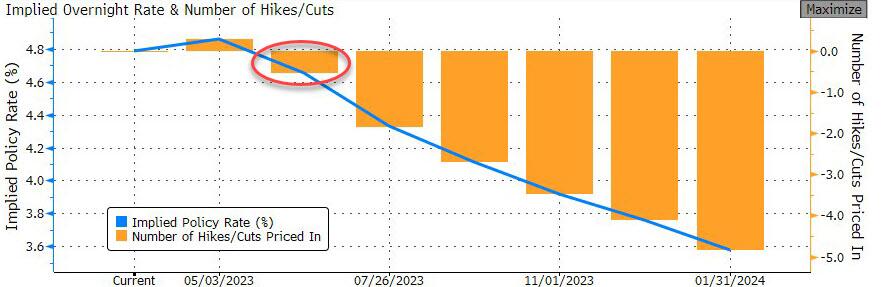
In any case, the latest global equity rout and bank crisis which is now spreading to TBTF banks has sent bond yields crashing with the 2-year US yield plumbing new session lows, breaking down as low as 3.55%, and the resulting shockwave has collapsed odds of another rate hike in May to just 28% while the odds of a rate cut in June have exploded to 83% as the Fed’s pivot finally arrives just on time: with the Fed having again broken the global financial system.
In premarket trading, First Republic Bank swung between gains and losses as investors digested Treasury Secretary Janet Yellen’s comments about regulators being prepared to take additional steps to guard bank deposits if warranted. Fellow regional banks and bigger lenders decline, and after a volatile session on Thursday took the stock’s March slump to 90%. Block fell another 5%, extending Thursday’s 15% plunge as it announced potential legal action against short seller Hindenburg Research for its report on the payment processor.  Here are some other notable premarket movers:

  • US cryptocurrency-exposed stocks decline, taking a pause from recent gains as the price of Bitcoin falls amid broader risk-off sentiment. Marathon Digital (MARA US) slid 0.9%, Hut 8 Mining Corp (HUT US) -1%, Coinbase (COIN US) -1.9%, Riot Platforms (RIOT US) -1.4%.
  • ReNew Energy Global gains 12% after Bloomberg reported, citing people familiar with the matter, that the Canada Pension Plan Investment Board is exploring buying the shares of the power producer that it doesn’t already own and taking the Nasdaq- listed firm private.
  • Joann slumped 6.2% in extended trading on Thursday after the fabric and crafts retailer reported adjusted earnings per share and Ebitda that missed the average analyst estimates, even as sales topped expectations.
  • Oxford Industries fell 5.5% in postmarket trading after the owner of Tommy Bahama and Lilly Pulitzer issued a forecast for net sales in the current quarter that trailed the average analyst estimate at the midpoint of the guidance range.

“Confidence is fragile, market volatility is likely to stay high, and policymakers may have to go further to make sure faith in the global financial system stays solid,” said Mark Haefele, chief investment officer at UBS Wealth Management. “Financial conditions are also likely to tighten, which increases the risk of a hard landing for the economy, even if central banks ease off on interest-rate hikes.”

“Credit and stock markets too greedy for rate cuts, not fearful enough of recession,” a team led by Michael Hartnett wrote in a note. The strategist, who was correctly bearish through last year, said investment-grade spreads and stocks will be taking a hit over the next three to six months. Global cash funds had inflows of nearly $143 billion, the largest since March 2020 in the week through Wednesday — adding up to more than $300 billion over the past four weeks, according to the note citing EPFR Global data.

European stocks are also plumbing lower, with European bank stocks sliding for a third day, and erasing weekly and yearly gains, as sentiment remains fragile on the sector. Deutsche Bank slumped nearly 15% as credit-default swaps surged amid wider concerns about the stability of the banking sector. The Stoxx 600 Banks Index is 5.3% lower as of 11:20am in London, erasing earlier weekly gains; the index is now -2.8% YTD. Meanwhile, UBS, which is not in the banking sector index, slumped as much as 8.4% as Jefferies cut its rating to hold from buy and it was among the banks under scrutiny in a US Justice Department probe into whether financial professionals helped Russian oligarchs evade sanctions. European oil stocks are also underperforming on Friday, dragging down the regional benchmark, as crude prices slump under pressure from a stronger dollar and concerns about the impact on growth of a fresh bout of stress facing the banking sector. The Energy sub-index slid as much as 4.3%, the most since March 15, while the Stoxx Europe 600 benchmark fell about 2%. Here are some other notable European movers:

  • Casino Guichard-Perrachon SA fell as much as 6% to a fresh record low after Moody’s cut its long-term debt rating on the company further into junk territory
  • Dino Polska drops as much as 5%, after its 4Q report showed that the Polish food supermarket chain is unable to maintain profitability amid inflation pressures
  • Smiths Group gains as much as 2.1%, after the industrial firm beat expectations on Ebita, while also surpassing projections on its full-year sales outlook
  • JD Wetherspoon jumps as much as 9.3% after the British pub operator posted a revenue beat for 1H, with Jefferies analysts noting resilience in like-for-like sales

Earlier in the session, Asia equities were set to snap a three-day rally as lingering concerns over the health of the banking sector pushed a gauge of the region’s financial shares lower. The MSCI Asia Pacific Index fell as much as 0.5% before trimming losses, with its 11 sectoral sub-gauges showing mixed moves. Most markets declined, led by Hong Kong’s Hang Seng Index, while Chinese tech shares extended their rally on the back of positive earnings.  An index of Asian financial stocks dropped as much as 0.9%, tracking overnight declines in a measure of US financial heavyweights to the lowest since November 2020. Treasury Secretary Janet Yellen’s comments that authorities can take further steps to protect the banking system if needed failed to fully assuage concerns. 

“The unease in the financial space will continue to weigh on the Asian financial sectors,” said Hebe Chen, an analyst at IG Markets Ltd. “The flip-flop in the market this week is seeing overwhelmed investors scratching their heads in the face of the mixed bag from Fed.”  Even with Friday’s lackluster moves, the MSCI Asia benchmark was set to notch its best weekly performance in about two months. The shares rose earlier in the week thanks to assurances from regulators in the US and Europe over protecting the banking sector and the Federal Reserve’s dovish tilt.   Meanwhile, a gauge of tech stocks in Hong Kong advanced for the fourth day close at its highest in a month. Lenovo led the gain, with JPMorgan lifting its recommendation on a bottoming of PC demand. “We like the internet sector, especially within China right now,” Marcella Chow, JPMorgan Asset Management’s global market strategist, said in an interview with Bloomberg TV. “China tech sector is attractive given improving regulatory outlook, leaner and more cost effective cost structure, improving margin.” 

Japanese stocks Inched lower as worries linger over the financial sector while investors assess statements made by US Treasury Secretary Janet Yellen. The Topix Index fell 0.1% to 1,955.32 as of market close Tokyo time, while the Nikkei declined 0.1% to 27,385.25. Mitsubishi UFJ Financial Group Inc. contributed the most to the Topix Index decline, decreasing 1.1%. Out of 2,159 stocks in the index, 976 rose and 1,039 fell, while 144 were unchanged. “Assuming that the fallout from the US financial sector woes doesn’t spread significantly, Japanese stocks will likely stop its decline and pick up as the earnings period starts next month,” said Takeru Ogihara, a chief strategist at Asset Management One

Australian stocks slumped to post a seventh week of losses; the S&P/ASX 200 index fell 0.2% to close at 6,955.20, with financials the biggest drag, as the malaise hanging over the global banking sector continued to damp sentiment. The benchmark erased 0.6% for the week, the seventh straight decline, maintaining the longest losing streak since 2008.  In New Zealand, the S&P/NZX 50 index fell 0.1% to 11,580.82.

Indian stocks declined for a third straight week in the longest losing streak since December spurred by a late selloff in key gauges amid risk-off sentiment in global equities. The Nifty 50 index ended just shy of entering a so-called technical correction given the index’s near 10% drop from its December peak. For the week, the Nifty 50 fell 0.9% while the Sensex declined 0.8%. The S&P BSE Sensex fell 0.7% to 57,527.10 as of 3:30 p.m. in Mumbai, while the NSE Nifty 50 Index declined 0.8% to 16,945.05.  The selloff in small and mid cap counters contributed to the broader losses, with the Nifty Mid cap 100 and Nifty Small Cap 100 indexes ending nearly 2% lower each. Stocks of asset management companies were hammered after the government dropped the benefit of long-term capital gains tax for debt mutual funds in order to ensure parity in tax treatment with other such products. Shares of HDFC AMC dropped 4.1%, Aditya Birla AMC -2%, UTI AMC -4.8% and Nippon Life India AMC -1.2%. Reliance Industries contributed the most to the index decline, decreasing 2%. Out of 30 shares in the Sensex index, six rose and 24 fell

In FX, the dollar’s recent weakness, which had supported the outlook for the region’s currencies and other assets, also took a breather on Friday. The Bloomberg dollar index rose 0.3% after a six-day run of declines. The yen rallies to the highest in six weeks amid demand for haven assets due to concerns over the health of the global banking sector. The yen was the biggest gainer versus the greenback among the Group-of-10 currencies. Treasury yields continued to decline reflecting expectations for Federal Reserve rate cuts this year

“JPY’s strong performance we believe is driven by the return of its safe haven appeal, especially given that we see that Japanese banks are in a relatively better standing,” said Alan Lau, a strategist at Malayan Banking Bhd in Singapore. “Falling UST yields have also given the JPY support recently. Overall, we are positive on the yen and see the spot being on a downward trend this year with our year-end forecast at 122”

In rates, Treasuries front-end adds to Thursday’s gains, with 2-year yields richer by over 20bp on the day, as the yield continues to plumb new session lows, breaking as low as 3.55%, dropping below th 2023 lows, and steepening the curve as traders continue to price out rate-hike premium for the May meeting and start pricing for cuts as early as June. Yields were near lows of the day while rest of the curve is richer by 17bp across belly to 9bp out to long-end; front-end led gains steepens 2s10s, 5s30s by 10bp and 8bp on the day. SOFR white-pack futures surge higher, with gains led by Dec23 contract which rallied 27bp vs. Thursday close; Fed-dated OIS shows just 4bp of rate hike premium for the May policy meeting with almost a full cut then priced into the June policy meeting — around 120bp of rate hikes are then priced into year-end

In commodities, oil slipped the most in over a week, with Brent below $75, tracking a slide in equity markets and feeling the effects of a stronger dollar. Aluminum and copper headed toward their biggest weekly gains in more than two months on increasing demand in China and bets on looser Federal Reserve policy. Uranium Energy is among the most active resources stocks in premarket trading, falling about 9%. Gold traded just shy of $2000 and is about to break solidly higher.

To the day ahead now, and data releases include the March flash PMIs from Europe and the US, along with UK retail sales for February, and the preliminary US durable goods orders for February. Otherwise from central banks, we’ll hear from the ECB’s De Cos, Nagel and Centeno, the Fed’s Bullard and the BoE’s Mann.


Market Snapshot

  • S&P 500 futures down 1% to 3,940
  • MXAP down 0.2% to 160.13
  • MXAPJ down 0.5% to 515.46
  • Nikkei down 0.1% to 27,385.25
  • Topix down 0.1% to 1,955.32
  • Hang Seng Index down 0.7% to 19,915.68
  • Shanghai Composite down 0.6% to 3,265.65
  • Sensex down 0.2% to 57,801.12
  • Australia S&P/ASX 200 down 0.2% to 6,955.24
  • Kospi down 0.4% to 2,414.96
  • STOXX Europe 600 down 0.7% to 443.10
  • German 10Y yield little changed at 2.11%
  • Euro down 0.4% to $1.0791
  • Brent Futures down 0.6% to $75.46/bbl
  • Gold spot down 0.3% to $1,987.17
  • U.S. Dollar Index up 0.30% to 102.84

Top Overnight News

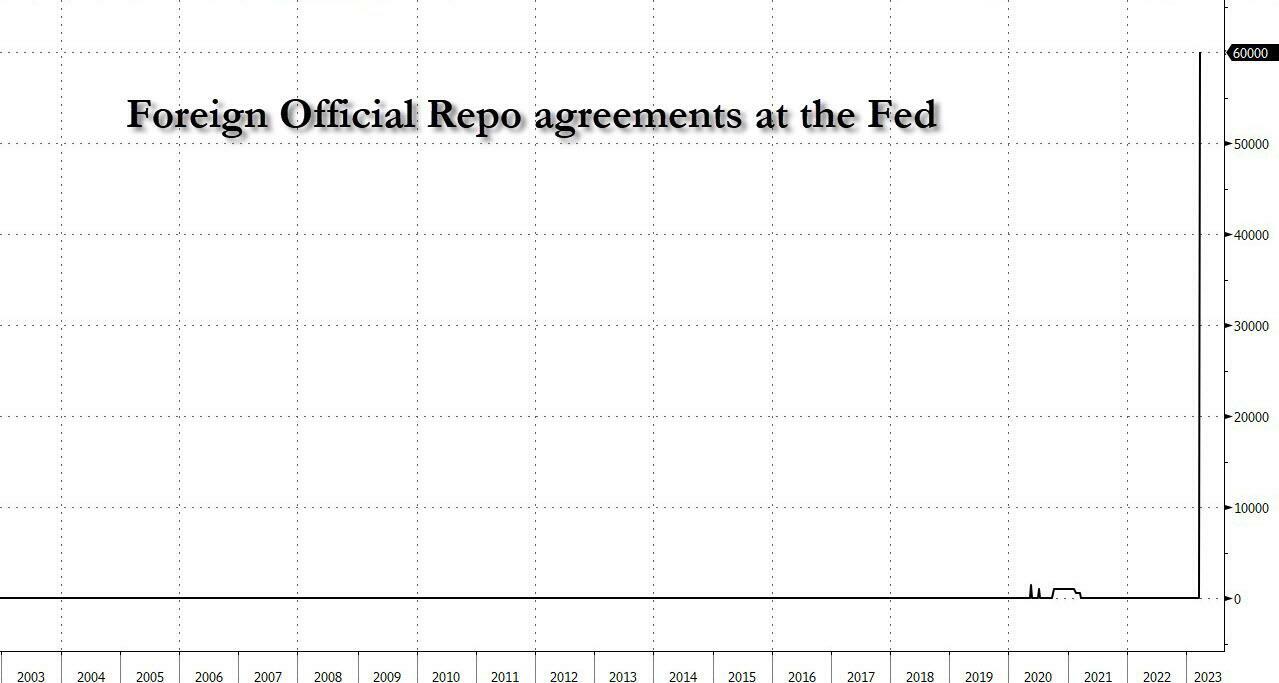
  • A Federal Reserve facility that gives foreign central banks access to dollar funding was tapped for a record $60 billion in the week through March 22: BBG
  • Deutsche Bank AG was at the center of another selloff in financial shares heading into the weekend: BBG
  • Credit Suisse Group AG and UBS Group AG are among banks under scrutiny in a US Justice Department probe into whether financial professionals helped Russian oligarchs evade sanctions, according to people familiar with the matter: BBG
  • Japan’s headline national CPI for Feb cools to +3.3% (down from +4.3% in Jan and inline w/the St) while core ticks higher to +3.5% (up from +3.2% in Jan and ahead of the St’s +3.4% forecast). RTRS
  • Copper prices will surge to a record high this year as a rebound in Chinese demand risks depleting already low stockpiles, the world’s largest private metals trader has forecast. Global inventories of the metal used in everything from power cables and electric cars to buildings have dropped rapidly in recent weeks to their lowest seasonal level since 2008, leaving little buffer if demand in China continues to pace ahead. FT
  • Authorities this week raided the Beijing offices of Mintz Group, detaining all five of the New York-based due diligence firm’s staff members in mainland China, the company said—an incident likely to unnerve global businesses operating in the country. WSJ
  • China’s top diplomat Wang Yi urged Europe to play a role in supporting peace talks for Russia’s war in Ukraine, though the US has warned Beijing’s proposals would effectively freeze the Kremlin’s territorial gains. BBG
  • Ukrainian troops, on the defensive for months, will soon counterattack as Russia’s offensive looks to be faltering, a commander said, but President Volodymyr Zelenskiy warned that without a faster supply of arms the war could last years. RTRS
  • Europe’s flash PMIs for March were mixed, with upside on services (55.6, up from 52.7 in Feb and ahead of the St’s 52.5 forecast) but downside on manufacturing (47.1, down from 48.5 in Feb and below the St’s 49 forecast). “Inflationary pressures have continued to moderate, with input prices falling sharply in manufacturing… overall input costs rose at the slowest rate since March 2021…the record easing of supply constraints marks a major reversal from the record delays seen during the pandemic” S&P
  • Deutsche Bank was at the center of another selloff in financials. The bank tumbled 11% in Frankfurt and default-swaps on its euro, senior debt surged to the highest since they were introduced in 2019, when Germany revamped its debt framework to introduce senior preferred notes. Other banks with high exposure to corporate lending also declined. Commerzbank slid 9% and Soc Gen 7%.  BBG
  • The Swiss authorities and UBS Group AG are racing to close the takeover of Credit Suisse Group AG within as little as a month, according to two sources with knowledge of the plans, to try to retain the lender’s clients and employees. RTRS
  • Citizens Financial is set to submit a bid for SVB’s private banking arm, Reuters reported. Customers Bancorp is also said to be exploring a deal for all or part of SVB. Carson Block said depositors at SVB and Signature Bank should have taken haircuts after regulators seized the firms. BBG

A more detailed look at global markets courtesy of Newsquawk

APAC stocks were mostly subdued after the recent bout of central bank rate hikes and choppy performance stateside where Wall Street just about closed higher amid a dovish market repricing of Fed rate expectations.     ASX 200 was lower with risk appetite sapped by weak PMI data which returned to contraction territory. Nikkei 225 lacked conviction after the latest inflation data printed mostly in line with estimates. Hang Seng and Shanghai Comp. retreated after the central bank drained liquidity and as participants digest earnings releases, while it was also reported that the US added 14 Chinese entities to the red flag list.

Top Asian News

  • HKMA said Hong Kong has very little exposure to the European and US banking situation, while it needs to monitor the situation carefully for any further volatility but is not concerned about risks to the Hong Kong banking sector.
  • China is to extend some tax relief measures, according to local media.

Equities are back under marked pressure as banking sector concern re-intensifies within Europe, Euro Stoxx 50 -2.3% & ES -0.8%. Specifically, the European banking index SX7P -5.0% is the standout laggard amid broad-based pressure in banking names as CDS’ for the stocks continue to rise alongside focus on the redemption of notes by Deutsche Bank and Lloyds; currently, Deutsche Bank -12% is the Stoxx 600 laggard. Stateside, futures are pressured in tandem with the above price action though with the magnitude less pronounced ahead of the arrival of US players and as we await potential updates to the regions own banking names. Apple (AAPL) supplier Pegatron (4982 TW) is reportedly looking to open a second factory within India, to construct the latest iPhone models, via Reuters citing sources.

Top European News

  • ECB is likely to reassure EU leaders regarding bank stability on Friday and is to call for EU deposit insurance, according to Reuters.
  • ECB’s Nagel says it is necessary to increase policy rates to sufficiently restrictive levels, whilst the APP wind down should accelerate from Q3. Domestic price pressures are likely to last for longer, whilst underlying inflation is increasingly concerning. There are signs of second-round effects from inflation-induced higher wage increases.
  • ECB’s Nagel says there is often a bumpy road after similar instances in the banking sector, not surprising there have been market moves. On Deutsche Bank’s share slide, ECB’s Nagel will not comment.
  • BoE’s Bailey says rates will rise again if firms hike prices, via BBC; “If all prices try to beat inflation we will get higher inflation,”

Bank headlines

  • Deutsche Bank (DBK GY) announces a decision to redeem its USD 1.5bln fixed to fixed reset rate subordinated Tier 2 notes, due 2028. Lloyds (LLOY LN) has issued a notice of redemption for the entire outstanding principal amount of the USD 1bln 0.695% senior callable fixed-to-fixed rate notes due 2024. In terms of the accompanying risk-off price action, the desk notes the early redemption(s) can perhaps be taken as a negative if we assume the justification is that the bank(s) expect to see more dovishness/risk-off before the next fixed-to-fixed rate adjustment.
  • UBS Wealth Management head Khan offered a retention package to Credit Suisse’s Asia staff in Hong Kong town hall which focuses on stabilising the Credit Suisse Asia team and boosting banker confidence, according to sources.
  • Credit Suisse (CSGN SW) and UBS (UBSG SW) are among the banks facing a US Russia-sanctions probe.
  • Fed Balance Sheet: 8.784tln (prev. 8.689tln); Total factors supplying reserve funds 8.784tln (prev. 8.689tln); Loans 354.191bln (prev. 318.148bln); Bank Term Funding Program 53.669bln (prev. 11.943bln); Other credit extensions 179.8bln (prev. 142.8bln).

FX

  • The USD is benefitting from the marked risk-off move with the index surpassing 103.00 from a 102.50 base in short-order and extending further to a 132.25+ peak since.
  • Action which comes to the detriment of peers ex-JPY, as USD/JPY has been lower by roughly a full point at worse (best) given its haven allure and with JPY repatriation factoring.
  • Notably, CHF is outperforming its peers, ex-JPY, but is still softer overall as its proximity/exposure to the European banking situation continues to overshadow traditional haven status vs USD though it is markedly outperforming the EUR as the focus is on EZ banks this morning.
  • As such, EUR is the standout laggard with EUR/USD down to a 1.0722 trough vs initial 1.0830 best, antipodeans are similarly hampered given their high-beta status and after Thursdays firmer action.
  • Cable failed to see a lasting benefit from the morning’s retail data while the subsequent PMIs were slightly softer than expected; but, again, the action is very much USD-driven.
  • PBoC set USD/CNY mid-point at 6.8374 vs exp. 6.8367 (prev. 6.8709)

Fixed Income

  • Core benchmarks are experiencing a marked bid given the risk-off price action that we are seeing with an accompanying dovish re-pricing being seen for Central Banks.
  • Specifically, Bunds have surpassed 139.50 and USTs above 1.17 with the respective 10yr yields down to 2.02% and 3.29% with market pricing in favour of an unchanged outcome at the next ECB and Fed meetings as such.
  • Gilts are moving in tandem with EGB/UST peers and have eclipsed 107.00; BoE pricing is now heavily in favour of an unchanged outcome at the May meeting.

Commodities

  • Commodities diverge given the marked risk-off action with crude and base metals pressured while precious metals glean incremental support as the USD offsets the benefit of haven demand.
  • Specifically, WTI and Brent are under USD 68.00/bbl and USD 74.00/bbl respectively which places them at the mid/lower-end of the current WTD USD 64.12-71.67/bbl and USD 70.12-77.44/bbl parameters.
  • Spot gold is incrementally firmer though is yet to convincingly surpass USD 2k/oz while base metals are dented by the aforementioned tone with 3-month LME Copper slipping further below 9k to a USD 8940 low.
  • Russia could recommend a temporary halt to wheat and sunflower exports, via Vedomosti; due to the sharp decline in prices.
  • US base at North-east Syria’s Al-Omar oil field has been targeted in an attack, according to security sources cited by Reuters.
  • UBS maintains a positive outlook on Gold and targets USD 2050/oz by the end of the year.

Geopolitics

  • Ukraine’s top ground forces commander said Ukrainian troops are to launch a counterassault soon as Russia’s large winter offensive weakens without capturing the eastern city of Bakhmut, according to Reuters.
  • Russian Security Council Deputy Chairman Medvedev says cannot rule out that Russian forces will need to reach Kyiv or Lviv to ‘destroy the infection’, according to RIA.
  • US Pentagon said the US conducted air strikes in Syria which targeted an Iranian-backed group in response to a deadly UAV attack, according to Reuters and Wall Street Journal.
  • US Treasury Secretary Yellen said sanctions on Iran have created a real economic crisis in that country and the US is constantly looking at ways to strengthen Iran sanctions but added that sanctions may not be sufficient to change a country’s behaviour, according to Reuters.
  • China’s Defence Ministry said it monitored and drove away a US destroyer which entered the South China Sea Paracel Islands on Friday again and sternly demands the US to immediately stop such provocations, according to Reuters.
  • North Korea said it conducted an important weapon test and firing drill from March 21st-23rd, while it added that it conducted a new underwater attack system in which it tested a new nuclear underwater attack drone and launched strategic cruise missiles. Furthermore, North Korea said its leader Kim guided the military activities and that Kim seriously warned enemies to stop reckless anti-North Korea war drills, according to KCNA.
  • South Korean President Yoon said they will step up security cooperation with the US and Japan against North Korea’s nuclear and missile provocations, while he said they will make sure North Korea pays the price for its reckless provocations, according to Reuters.

US Event Calendar

  • 08:30: Feb. Durable Goods Orders, est. 0.2%, prior -4.5%
  • 08:30: Feb. -Less Transportation, est. 0.2%, prior 0.8%
  • 08:30: Feb. Cap Goods Orders Nondef Ex Air, est. -0.2%, prior 0.8%
  • 08:30: Feb. Cap Goods Ship Nondef Ex Air, est. 0.2%, prior 1.1%
  • 09:45: March S&P Global US Manufacturing PM, est. 47.0, prior 47.3
  • 09:45: March S&P Global US Services PMI, est. 50.2, prior 50.6
  • 09:45: March S&P Global US Composite PMI, est. 49.5, prior 50.1
  • 10:00: Revisions: Wholesale Inventories
  • 11:00: March Kansas City Fed Services Activ, prior 1

DB’s Jim Reid concludes the overnight wrap

There’s a bad bout of conjunctivitis going round the school at the moment and every member of the family has now had it with the last hold out being me until yesterday. So my eyes are a bit blurry this morning looking at screens. One of the twins believes he has conjunctiv”eye-test” as he thinks it’s called. If he hadn’t given it to me I’d think he was quite sweet.

As I was looking at screens last night through weepy eyes, markets looked like they were trying to normalise. However late weakness in financials again was a big drag on the last couple of hours of US trading. Just after the European close, the S&P 500 was up over +1.2% and looked set to reverse a good portion of the previous day’s losses. However by the end of the session, further weakness in banks and cyclicals more broadly left the index only +0.30%, but having been down nearly half a percent with 30 minutes left in trading. The VIX, which intraday was near its lowest level (20.18) since the SVB issues became prominent, ended the day 0.35pts higher at 22.6. Today we’ll see if the flash PMIs around the world are impacted by the early part of the mini banking crisis we’ve seen in the last two weeks. So watch the European and US numbers carefully.

The renewed weakness in banks yesterday actually started in Europe with the STOXX Banks index down -2.27%. The STOXX 600 recovered from an intraday low of almost -1.0% to finish -0.21% lower overall. CDS markets highlighted the stress in European financials as the Subordinated Financial CDS index widened (+20bps) for the first time since last Friday – before the CS-UBS merger news – while the Senior CDS index was +9bps wider. In the US, the Regional bank ETF, KRE, was down -2.78% yesterday whilst the broader KBW Bank index was -1.73% lower as liquidity concerns of the smaller banks continue to permeate.

Staying with bank liquidity, after the US close last night, the Fed’s weekly balance sheet data showed that the use of the Fed’s discount window was down from $153bn to $110bn, while the credit deployed to SVB and Signature was up from 143bn to 180bn, and lastly the new emergency bank lending facility (BTFP) was up from $12bn to $54bn. So net of the two failed banks there was little change, indicating that banks were not finding it necessary to access cheap capital. The market should look favourably on that from a contagion standpoint. Overnight S&P and Nasdaq futures are both up around +0.2% and 2 and 10yr UST yields are both around -4.5bps lower as we go to press.

Far before that balance sheet data came out the S&P 500 opened much stronger, up +1.8% and stayed buoyant through the first three hours of trading, before the weakness in regional banks weighed on overall sentiment throughout the US afternoon. This was most pronounced with a bout of selling just before Treasury Secretary Yellen spoke in front of a House of Representatives subcommittee an hour or so before the US close. The selling might have been nervousness ahead of her remarks, given the negative market reaction to her comments before the Senate on Wednesday. Regardless, the S&P actually saw a +1.0% whipsaw move when Yellen said that the US government was “prepared for additional deposit action if warranted.” This was quickly faded, with the index continuing to trade between smaller gains and losses until it ended the day +0.30% higher.

Despite the weakness in banks and Energy (-1.4%) on the back of lower oil prices, the S&P finished in the green thanks to Tech stocks outperforming on the lower rate outlook. The FANG+ index surged by +2.53%, whilst the NASDAQ 100’s gains (+1.19%) mean it’s now up nearly 20% from its lows at the end of December, almost meeting the traditional definition of a bull market.

On the rates side, 10yr Treasury yields held up for the most part, with the 10yr yield -0.08bps to 3.427%. Short-dated rates were another story, with 2yr yields -10.4bps lower to 3.833% fully on the back of lower inflation expectations (-13.3bps), while 5yr rates were -7.2bps lower. This saw the 2s10s yield curve normalise a further +9.4bps yesterday to -41.3bps, which is the least inverted the curve has been in over 5 months. This drop in yields led by inflation expectations was also borne out in fed future pricing, where the market now only sees a 40% chance of a 25bp hike during the May meeting.

In Europe there was a sharp decline in longer dated yields that accelerated later in the session, with yields on 10yr bunds (-13.3bps), OATs (-12.3bps) and BTPs (-10.4bps) all moving lower. Furthermore, those moves came in spite of some of the ECB’s hawks calling for further tightening. For example, Austria’s Holzmann said that the ECB would “probably have to add” to its rate hikes at the next meeting in May. And the Netherlands’ Knot said that “I still think that we need to make another step in May, but I don’t know the size of that”.

Speaking of central banks, we had the Bank of England’s latest decision yesterday, who hiked rates by 25bps as expected. That takes the Bank Rate up to a post-2008 high of 4.25%, and 7 of the 9 MPC members were in support, with the other 2 preferring to remain on hold. Looking forward, the BoE said that they still expected inflation “to fall significantly” in Q2, aided by falling energy prices and the government’s move to extend the Energy Price Guarantee in last week’s budget. And when it comes to inflationary pressures, they said that if “there were to be evidence of more persistent pressures, then further tightening in monetary policy would be required.”

In his review (link here), our UK economist writes that while he sees some upside to growth and pay, there are downsides to services CPI and credit conditions, making the next meeting in May a difficult decision to call. On balance, he sees more downside risks than upside, and holds onto his call for the Bank Rate to remain where it is at 4.25%, with the risks tilted to one further hike.

Whilst we’re on central banks, yesterday also saw the Swiss National Bank hike rates by 50bps, taking the policy rate up to 1.5%. There were a number of hawkish-leaning details, including an upgrade in their inflation forecast relative to December, and their statement said that inflation was “still clearly above the range the SNB equates with price stability.” In the meantime, SNB President Jordan said that a “Credit Suisse bankruptcy would have had serious consequences for national and international financial stability and for the Swiss economy” and that “taking this risk would have been irresponsible.”

This morning in Asia equity markets are lower with the KOSPI (-0.72%) the biggest underperformer with the Nikkei (-0.41%), the Shanghai Composite (-0.54%), the CSI (-0.27%) and the Hang Seng (-0.21%) trading in negative territory.

Data from Japan has shown that consumer price inflation (+3.3% y/y) slowed in line with forecasts but for the first time in 13 months in February, compared to a +4.3% increase in January, mainly due to the effect of government’s energy subsidy program. At the same time, core-core CPI (excluding both fresh food and fuel costs) advanced further to +3.5% y/y in February (v/s +3.4% expected), notching the fastest y-o-y gain since January 1982. It followed a +3.2% increase in January highlighting the underlying inflationary pressures. Staying with Japan, the preliminary estimate for manufacturing PMI showed that sector activity remained in contraction for the fifth consecutive month in March after the reading came in at 48.6, albeit up from the previous month’s final reading of 47.7 as output and new orders remained under pressure. On the contrary, activity in the services sector expanded for the seventh straight month in March as the PMI edged up to 54.2, recording the fastest pace since October 2013, against prior month’s reading of 54.0.

Elsewhere, manufacturing as well as services in Australia slipped into contractionary territory as the manufacturing PMI fell to 48.7 in March from 50.5 in February with the services PMI deteriorating to 48.2 from the prior print of 50.7.

When it came to yesterday’s data, the US weekly initial jobless claims came in at a 3-week low of 191k over the week ending March 18 (vs. 197k expected), pointing to continued strength in the labour market. Continuing claims saw a small increase to 1694k (1690k expected) and remains in a slight up-trend but not at a concerning level yet. Meanwhile, the new home sales data for February showed a modest rise to an annualised rate of 640k (vs. 650k expected), taking them up to a 6-month high. Over in the Euro Area, the European Commission’s preliminary consumer confidence data for March showed a decline to -19.2 (vs. -18.2 expected), marking a reduction after 5 consecutive monthly improvements.

To the day ahead now, and data releases include the March flash PMIs from Europe and the US, along with UK retail sales for February, and the preliminary US durable goods orders for February. Otherwise from central banks, we’ll hear from the ECB’s De Cos, Nagel and Centeno, the Fed’s Bullard and the BoE’s Mann.

Tyler Durden
Fri, 03/24/2023 – 08:09

via ZeroHedge News https://ift.tt/RZHmTvq Tyler Durden
Scholz: ‘No Reason To Worry’ As Deutsche Bank Bloodbath Reignites Global Bank Crisis Fears

Scholz: ‘No Reason To Worry’ As Deutsche Bank Bloodbath Reignites Global Bank Crisis Fears

Update (0900ET): The jawboning has begun:

  • GERMANY’S SCHOLZ: EUROPEAN BANKING OVERSIGHT IS ROBUST AND STABLE, DEUTSCHE BANK IS `VERY PROFITABLE’, NO REASON FOR WORRY

  • ECB’S LAGARDE TELLS EU LEADERS EURO AREA BANKING SECTOR STRONG, ECB FULLY EQUIPPED TO PROVIDE LIQUIDITY TO EURO AREA FINANCIAL SYSTEM, IF NEEDED

  • MACRON: EUROPEAN BANKS HAVE SOLID FUNDAMENTALS

That prompted a (very) brief pop in bank stocks…

Goldman Sachs’ traders said they think the pain in European banks issimply a function of market selling leveraged and opaque business models post CS, with some discomfort on what may roll out of 1Q IB earnings following the spike in rates vol. There’s also 7% of the loan book in CRE (EUR33bn), of which 51% in the US. Total office exposure is 34%, which is the market’s core area of concern, so could say the range for US office is EUR5.5-11bn”

But then there’s this…

*  *  *

Last night, amid the Fed’s H.4.1 report, we noted an unprecedented surge in foreign official Repo ($60 billion) under the Fed’s new FIMA repo facility, which means that the offshore scramble for dollars was alive and well, and someone  really needed access to USD. The assumption was that it was Credit Suisse (or UBS) shoring up some shortfalls, but with the action of the last couple of days, others are worrying that there is more afoot in the EU banking system.

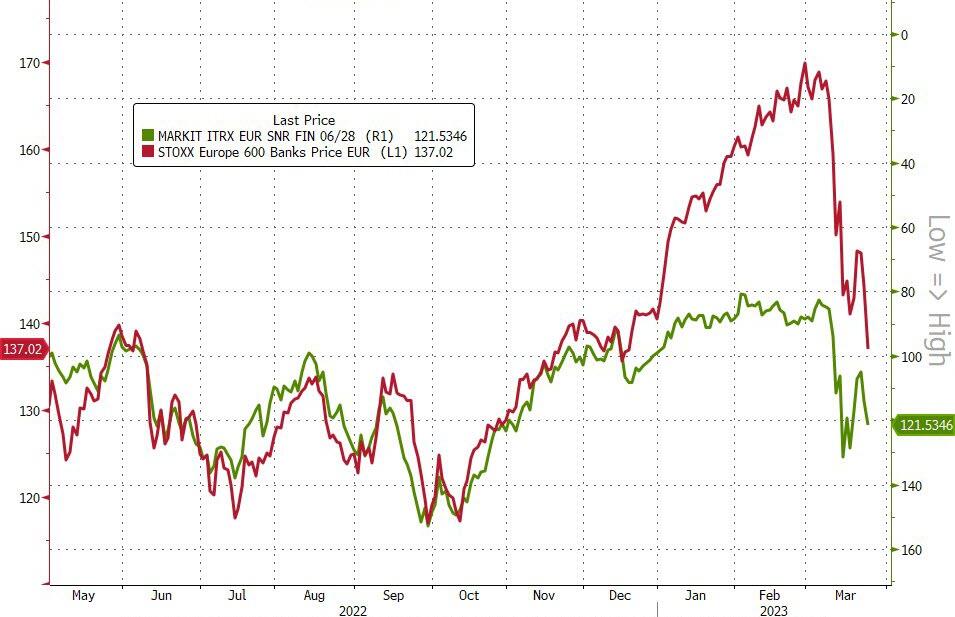
After brief respite earlier in the week, European bank stocks are cratering once again, now at 3-month lows (catching down to Senior Financial CDS)…

Deutsche Bank stock has crashed to 5-month lows…

Deutsche Bank CDS is soaring (Commerzbank is also rising rapidly) – now higher than at peak of the COVID lockdowns…

Source: Bloomberg

With the most crucial aspect (short-dated protection mainly used as a counterparty risk by derivatives trading partners) is very aggressively bid…

Source: Bloomberg

Notably, Deutsche unexpectedly announced its decision to redeem a tier 2 subordinated bond on Friday in a reassuring effort.

“Deutsche’s decision to redeem (having received all required regulatory approvals) should be a reassuring signal to credit investors,” Autonomous analyst Stuart Graham wrote in a note on Friday.

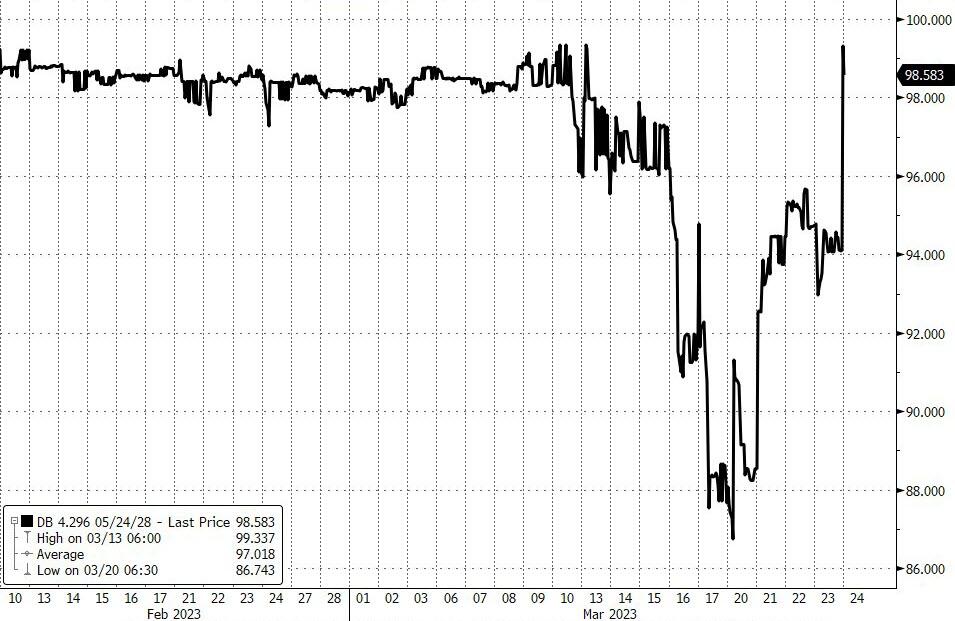
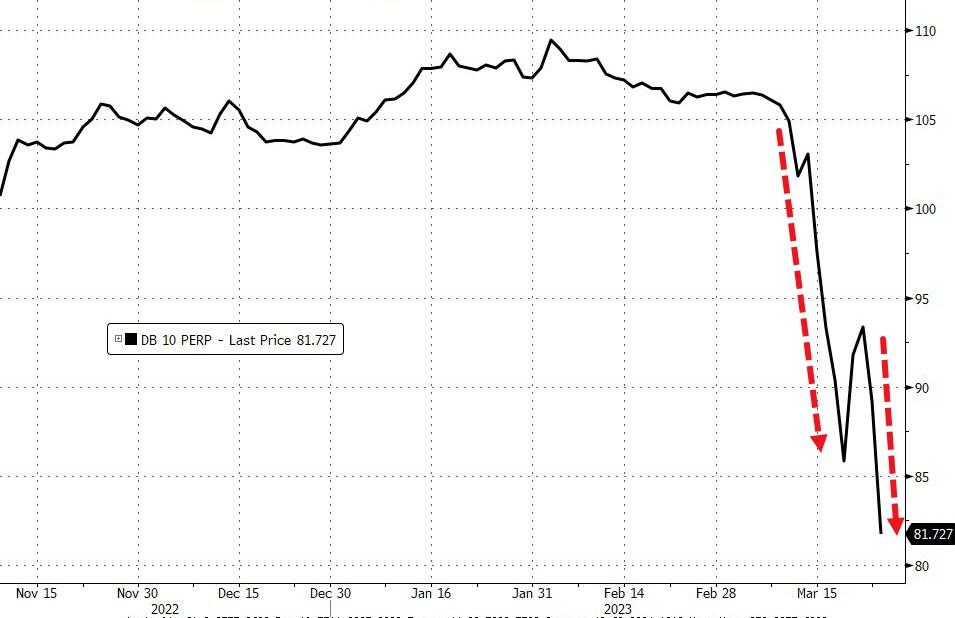
But instead, other Deutsche Bank AT1 bonds have plunged in price (with yields soaring above 16%)…

Source: Bloomberg

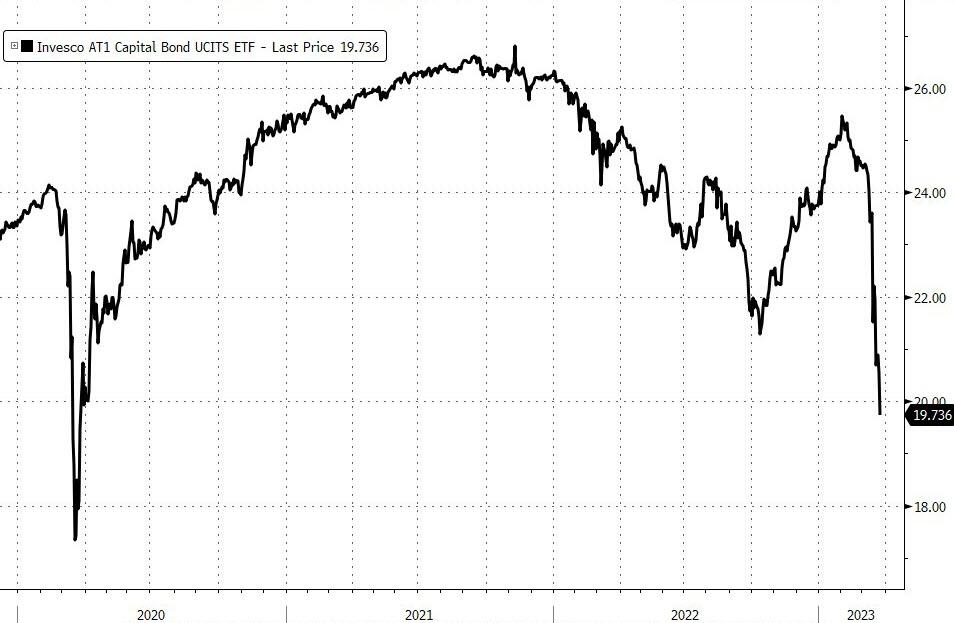
UBS and Barclays are also seeing AT1 bonds getting smashed lower as the entire CoCo bond market plunges in Europe (well down SNB!)

AT1mber…

Source: Bloomberg

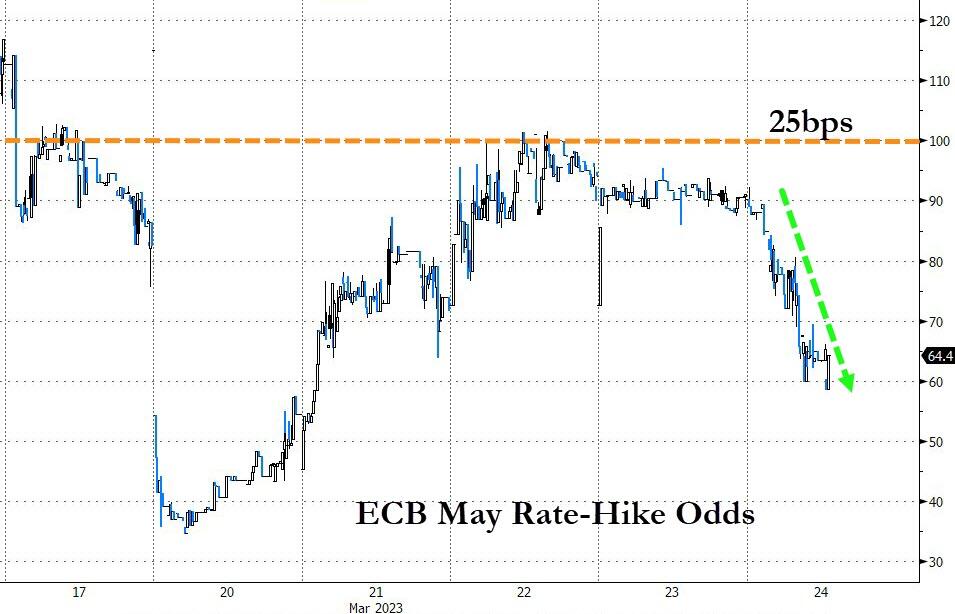
Notably, ECB rate-hike odds have plunged this morning from a 25bps in May fully priced-in to just 60% odds now…

Source: Bloomberg

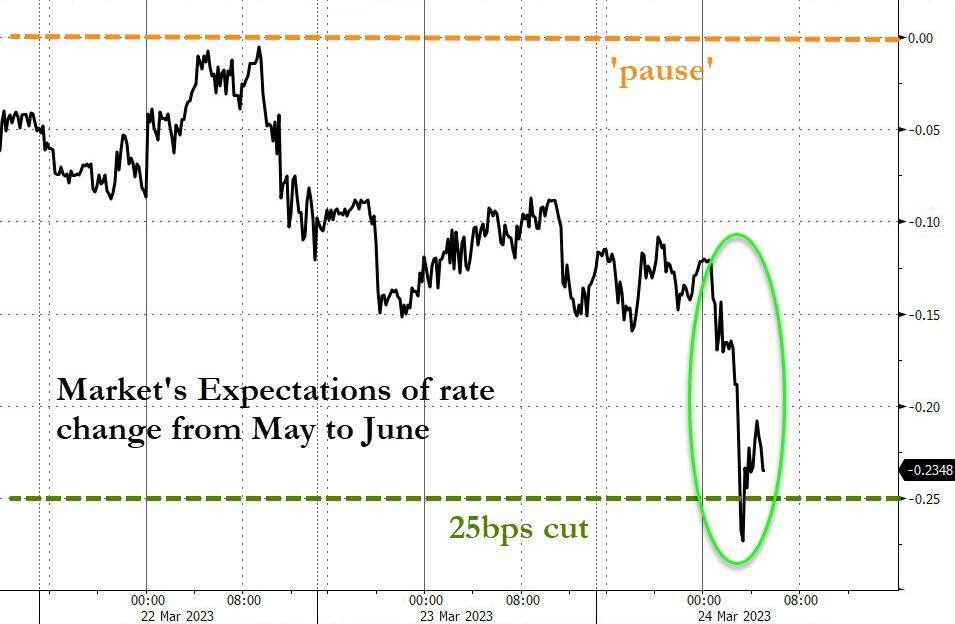
Even more stunningly, US money markets are now pricing in a rate-cut in June..

Source: Bloomberg

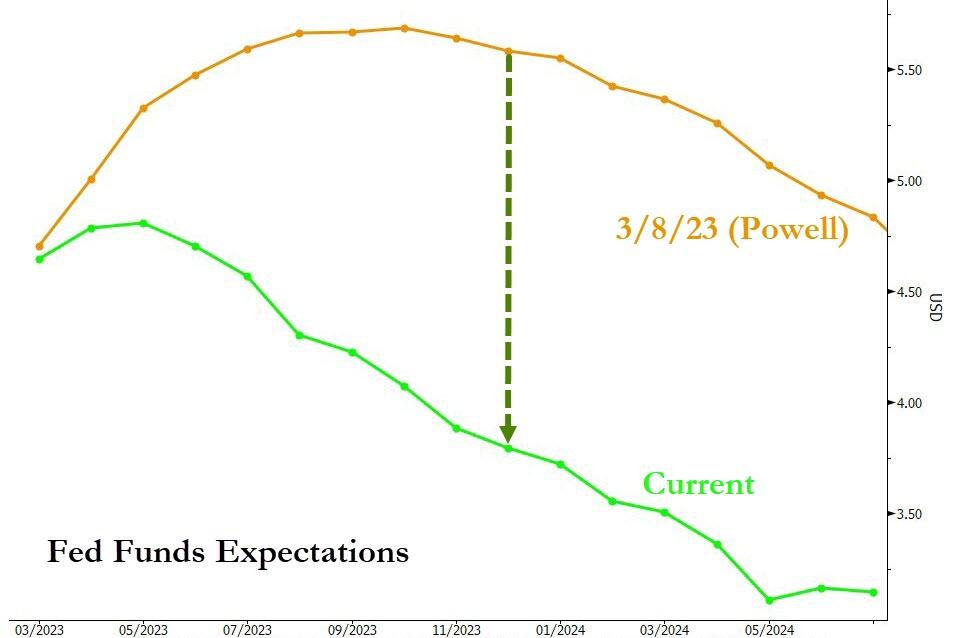
Expectations for The Fed’s rate trajectory have literally collapsed in the last two weeks…

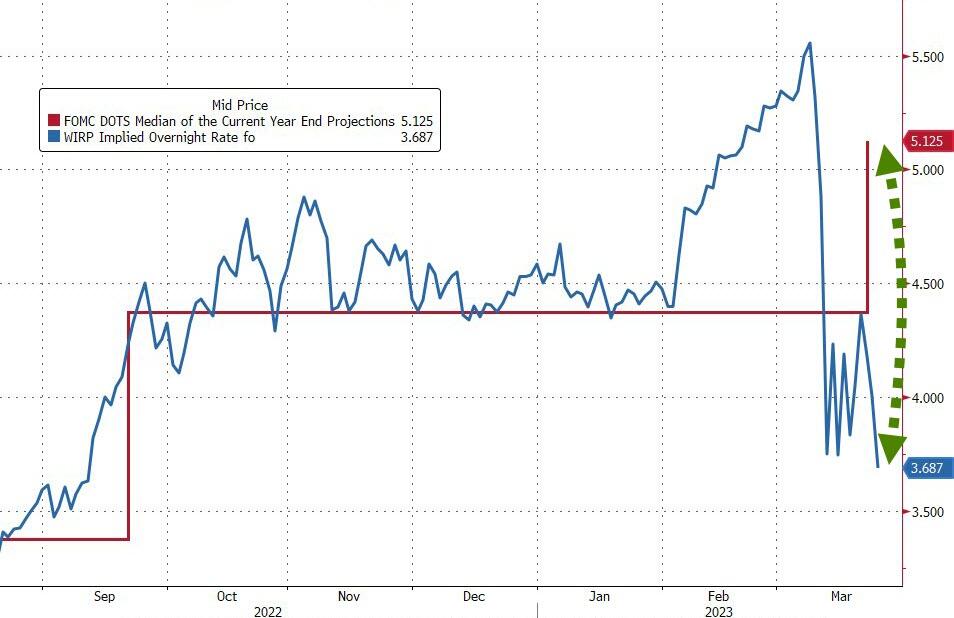
For context, the market’s expectations for The Fed’s rate at year-end is now 150bps lower than the Dot-Plot

The government-brokered takeover of Credit Suisse by UBS is “no indication” of the state of European banks, Deutsche Bank management board member Fabrizio Campelli said at a conference yesterday.

There is no specific news on DB to catalyze these moves but if DB is next, then the world’s financial system has a serious problem that makes CS look like SVB.

Tyler Durden
Fri, 03/24/2023 – 07:56

via ZeroHedge News https://ift.tt/whZzofL Tyler Durden

Relocation Grants: Five places in Italy that will pay you to move there

In a recent episode, we looked at places in the US that will pay you to move there. But the world is a big place, and if you’re up for an international move, your available options expand exponentially. Today, we take a look at your options when it comes to relocation incentives in Italy…

Five places in Italy that will pay you to move there

Relocating can come with a host of benefits, ranging from enhanced quality of life to reduced overhead costs – and even substantial tax savings.

Most countries across Europe face the dual challenge of rapid urbanization and aging populations, leading to large swathes of the continent’s rural areas becoming ghost towns.

In Spain, for example, this phenomenon is known as ‘Empty Spain’, or España Vacía. And around 53% of Spain’s municipalities are considered to be at risk of becoming depopulated.

Across the Mediterranean, Italy suffers from the exact same problem. In an effort to turn this trend around, scores of its rural hamlets are marketing themselves as “Zoom Town” destinations, in reference to the popular teleconferencing software.

AND they’re sweetening the deal with cash incentives for new permanent residents.

The advent of Digital Nomad Visas – especially in Southern Europe – will help make such a move a LOT easier. And in Italy, you can also benefit from a superb range of tax incentives that could bring your effective tax rate down into the single-digit range.

NOTE: Sovereign Confidential members have access to a range of deep-dive reports on topics like:

  • The available visa programs for Italy, including options for retirees, digital nomads, and Golden Visa investors.
  • ALL the most attractive tax incentives for new Italian residents (yes, you can pay as little as a single-digit tax rate).
  • The top competing tax residencies and most accessible visa programs across all of Europe, and Southern Europe, in particular.
  • And much, much more.

You can find out more about this class-leading internationalization product here.
But without further ado, let’s have a look at some of the most widely publicized relocation incentives available in Italy…

Five Italian towns offering attractive financial incentives for relocating there

PRESICCE, ITALY: The quaint Italian towns of Presicce in Puglia recently announced that they’ll be offering new residents €30,000 ($~32,000) to move there in 2023. (It’s situated at the “heel of the boot”, when you look at the map of Italy.)

The catch?

You have to put this money towards buying a house there that was built before 1991. You’ll also have to register there as an official, settled resident.

The specifics of the program are still being finalized, and applications will be made available on the local town hall’s website in due course.

In addition, the town’s officials are also offering financial incentives to encourage population growth, including €1,000 grants for every new baby you have there.

SARDINIA, ITALY (ISLAND): As the second largest island in the Mediterranean (Sicily is the biggest), Sardinia packs a punch in terms of sun-drenched island living. And given a sizable €15,000 (~$16,000) relocation grant for new residents who move there, the island becomes even more attractive.

To qualify for the grant, you’ll have to move to a Sardinian municipality with a population of less than 3,000 inhabitants. The grant you receive must be used to buy or renovate a home.

In addition, the grant cannot exceed 50% of the total cost of the house or renovation – and the government may not always hand over the entire €15,000 sum.

Finally, recipients must live in their new property full time, and have to register for permanent residency in Sardinia within 18 months of their arrival.

CALABRIA REGION, ITALY:

Fancy moving to a bucolic Italian hamlet with less than 2,000 residents? To combat population decline, the Calabria region – situated on the tip of the “boot” if you look at the map, northeast of Palermo – is offering new residents a relocation grant of up to €28,000 (~$30,000) over a period of three years.

That’s about $10,000 per year to help you get settled in.

Since mid-2021, at least nine villages have signed up to participate in the program, including:

ALBIDONA, CALABRIA: Situated about 7 miles inland from the Ionian Sea, and about 11 miles from the mountains of Pollino National Park, Albidona will cater to both beach and mountain lovers. And in case that doesn’t sell it well enough, it’s one of the places you can pick up a property for just €1.

SANTA SEVERINA, CALABRIA: Perched on a rocky cliff and boasting palm trees and river views, Santa Severina is surrounded by hills. The Neto river runs through it for around six miles, and the town offers a showcase of the architectural transition from the Norman period to that of the Byzantine Empire.

Sleepy? For sure. But if safety, peace and tranquility sounds like your thing, these towns can deliver in spades.

Of course, some T&Cs apply under the Calabria region’s program:

  • You have to be younger than 40 years
  • You have to live there full-time
  • You have to commit to either starting a new business (or working within a specific profession that’s in demand there).
  • And you have to move there within 90 days if you’re approved, so you’ll need to have a handle on your visa application by the time you apply for this grant…

According to the program website, around $755,000 in funding has been made available to support new residents in launching hotels, restaurants and other tourism businesses.

So if you’re young, and looking to kickstart a lifestyle business in small-town Italy, then this could be a nice way to get started…

SANTO STEFANO DI SESSANIO, ABRUZZO REGION: Santo Stefano di Sessanio needs YOU – as long as you’re aged 18-40, that is, and willing to move there for a minimum of five years.

Unlike many of the other locations mentioned here, Santo Stefano di Sessanio is not situated in the southern parts of the country. It’s more centrally situated, just northeast of Rome.

Here, the authorities there will pay new residents a maximum grant of up to €8,000 ($8,632) per year for three years, paid out monthly.

And In addition, new residents can apply for a one-time grant of up to €20,000 to start a new business in the area.

That’s a maximum total of over $44,000 over three years – which is nothing to be sneezed at…

In conclusion

At Sovereign Man we remain ever optimistic about the future. Let’s look at the upsides in the following scenario:

You’re an American remote worker, spending thousands of dollars on rent. What if you could pick up a European home for just over a dollar, and only had to spend $20,000 or so to renovate it?

Or what if you could pick up a semi-renovated property cheaply, AND get an additional $16,000 in free money to complete the project?

How much more money could you save and sock away every single month while living rent-free, working remotely, and earning hard currency?

And how much fun and adventure could you have while launching a lifestyle business in an idyllic European country location?

Also, that’s even before you benefited from the incredible tax incentives in places like Southern Italy

Of course, these types of programs won’t work for everyone. But if you’re yearning for an exciting opportunity in a beautiful location, then Italy is standing by to deliver.

Yours in freedom,

Team Sovereign Man

Source

from Sovereign Research https://ift.tt/97mtHvl
via IFTTT

The COVID-19 Pandemic Permanently Damaged Property Rights


A medical animation of a COVID-19 virus

I don’t pay particular attention to health scares, so when talk of a spreading pandemic started dominating the news cycle I largely shrugged and went about my business. I was staying at a cheap motel in Calexico, taking photos of the New River and the Salton Sea for my That was the weekend when the shutdowns began. I recall stopping at a grocery store near Modesto, when I noticed meandering lines and a run on toilet paper. The rest, as they say, is history. Like most people, I never could have predicted the coming shutdown of the economy, government orders to stay at home, an end to restaurant dining and public gatherings, and profligate “relief” payments.

As that (probably fake) George Washington quotation put it, “Government is not reason, it is not eloquence—it is force.” Government officials aren’t wiser than the rest of us, so when they tried to deal with a serious public health problem, they did so in a forceful, ineloquent, and unreasonable manner. Unfortunately, many of its worst approaches leave permanent scars.

In my column last year summarizing lessons from COVID-19, I concluded that it left us as a “nation of rulers, not laws.” American governors—and California Gov. Gavin Newsom in particular—quickly and eagerly used their broad emergency powers to begin issuing edicts. Given the extent of the public-health threat, some of the more modest and temporary ones were understandable, but they bypassed the normal legislative process in cynical and expansive ways.

One Republican lawmaker published a 138-page document detailing the 400 laws that Newsom unilaterally imposed or changed—many of them that only tangentially had anything to do with protecting public health. In particular, officials used the crisis to impose policies they already supported but couldn’t get through the normal legislative process.

The worst example involved anti-eviction orders that have literally destroyed our property rights. Virtually all mom-and-pop landlords depend on the rental income. With one fell swoop, governors (and the federal Centers for Disease Control) declared that tenants no longer had to pay their full rent if they faced a pandemic-related hardship. Sure, landlords could potentially collect rent in the future in civil court, but good luck with that.

In making it virtually impossible to evict non-paying tenants, policymakers imposed the full cost of their public-health plans on individual property owners, who could no longer count on getting a return on their investment. Often, property owners have mortgages—and they always have tax and insurance bills. When a heating system or roof leaks, they’re still required (ethically and legally) to make repairs. But they no longer could count on receiving rent.

Someone posted my column detailing the plight of landlords on a liberal housing-related news group, and you can probably guess the ensuing negative responses. No landlord I know expects any sympathy given that it’s the type of investment they freely chose.

However, I thought that most people—even renters who have had less-than-stellar rental experiences—might understand that if the government deprives owners of their supposed state constitutional right to a fair return on their investment, fewer people will go into the business and even fewer will upgrade their properties. That helps no one.

The result is obvious: fewer available rentals and fewer rentals in tip-top condition. Investing in rental property has always been a prime means for middle-class people to build wealth. My grandfather was an immigrant paperhanger (remember wallpaper?) who invested in Philadelphia row houses decades ago. Now, I talk to many people who won’t dare buy a rental house out of the legitimate fear that the government can suspend rent payments at will.

Tenants often outnumber owners, especially in larger cities such as Los Angeles. We see groups of activists lobbying for rent controls in Costa Mesa (and previously in Santa Ana). By eliminating property rights and shifting decisions to city councils (and tenant-dominated rental boards), the government has made owners’ livelihoods dependent on the political system. As the saying goes, democracy is two wolves and a sheep voting on what’s for dinner.

Certainly, many cities (San Francisco, Santa Monica, New York) embraced strict rent control long before the pandemic was a thing. They largely destroyed their housing markets of course, as renters stayed put in under-market units while investors high-tailed it elsewhere. But COVID added a new level of uncertainty. Look at how Los Angeles continually extended its anti-eviction provisions.

Any time I hear of a bad flu season or other health scare, I fully expect Newsom and others to return to their COVID-19 anti-eviction playbook. In other words, we no longer have property rights when officials can eliminate them by executive order, legislation, or regulatory fiat. That is COVID’s lasting legacy—and the lasting result will not be pretty.

This column was first published in The Orange County Register.

The post The COVID-19 Pandemic Permanently Damaged Property Rights appeared first on Reason.com.

from Latest https://ift.tt/i96jxJf
via IFTTT

Energy Transition Advocates Get A Reality Check

Energy Transition Advocates Get A Reality Check

Authored by Irina Slav via OilPrice.com,

  • The choice between energy security and decarbonization is not one that tends to attract a lot of attention.

  • Following the energy crisis in Europe last year, world leaders are more aware of energy security.

  • The UN Intergovernmental Panel on Climate Change is calling for an acceleration of the decarbonization push.

This week, the Intergovernmental Panel on Climate Change released a new report. Unsurprisingly alarming, the report aimed to turn up the heat on governments, the business world, and every one of us to do more about the energy transition. Decarbonization, the report said, had to move faster and more dramatically. Yet that wasn’t the only document that made the headlines this week. Shell also released a report in which it detailed two different scenarios for the future to 2050. In those scenarios, the supermajor’s analysts pitted energy security against the energy transition – something the IPCC reports have never done. 

The choice between energy security and decarbonization is not one that tends to attract a lot of attention. It is a sensitive topic because it exposes the shortcomings of low-carbon energy.

Yet, as Europe found out last year, it may be wise to discuss this topic before we splash $110 trillion on the energy transition.

In one of its scenarios, dubbed Archipelagos, Shell paints a familiar picture of the world of the future, at least politically. With a focus on energy security rather than decarbonization, the Archipelagos scenario describes a world similar to 19th-century Europe, where spheres of interest shift and nations ally with a view to energy security and resilience.

In that scenario, emission reductions and the Paris Agreement take a back seat, but work continues on deploying low-carbon energy technology. It simply progresses at a much slower pace.

The IPCC would probably be quick to point out that this scenario is effectively a doomsday scenario because nothing should take priority over emission reduction and the race to net zero. However, it is much easier to make computer models of future global temperatures and sound the alarm about them than find the money and the raw materials necessary to effect the transition at the pace that the IPCC wants it.

The raw materials problem of the transition has been garnering more and more attention from the media and, with it, from various stakeholders. The United States came up with the idea of friend-shoring to source these raw materials because it has no mine capacity to meet all of its projected demand from local supply. The EU plans to set up a Critical Raw Material Club, which effectively amounts to a buyers’ cartel, but this time for metals and minerals.

The chances of success of either of these approaches are yet to become clear, but in the meantime, another thing is becoming clear: the transition bill will be even bigger than previously expected.

The sum total of transition investments has always been in the trillion-dollar territory, but the latest estimate from a climate think tank pegs the annual spend necessary to hit net zero by 2050 at $3.5 trillion. That’s a more than threefold increase on last year’s record investment in wind, solar, and other decarbonization efforts, which for the first time topped $1 trillion. Unfortunately, that record investment—some of its actual spent, the rest in commitments—brought us nowhere near either net zero or energy security.

In Shell’s second scenario, however, these investments will work their miracle, with the indispensable help of everyone deciding to work for the common goal of cutting emissions and achieving what the company referred to long-term energy security.

In this scenario, governments, citizens, and businesses team up to bring those emissions down and deploy as much low-carbon energy capacity as possible, notably driven by energy security concerns. Energy security has indeed been one of the strongest arguments in favor of wind and solar—the energy produced locally is better than imported energy. 

That leaves the reliability and affordability issue, which decision-makers appear determined to tackle with excess capacity—for reliability—and with massive investments and subsidies—to solve the affordability problem. Because much as climate think tanks and activists like to repeat that wind and solar are the cheapest form of energy available, the wind and solar industries themselves appear to disagree.

“We are walking when we should be sprinting,” the chairman of the Intergovernmental Panel on Climate Change, Hoesung Lee, said at the release of the body’s latest report.

There are “no big fundamental barriers to the energy transition,” said the deputy director of that climate think tank that produced the report estimating the cost of said transition.

Based on these statements and the documents behind them, the transition seems like a no-brainer, however you look at it. Except if you look at it from an energy security perspective. Or a financial one. Because if there were no big fundamental barriers to decarbonization, such as reliability issues or affordability challenges, the transition would be happening everywhere, organically, without the need for such strong government support. This is what happens with successful, beneficial technology.

Which of the two scenarios that Shell has developed for the future remains to be seen. For now, the Archipelago scenario seems more realistic, not least because it does not rely on as many assumptions as the Sky 2050 scenario, such as a global ban on ICE cars by 2040.

So do all the scenarios of transition advocates. They are all based on a series of assumptions, some of them dangerously far-fetched, such as the assumption that there will be enough metals for EVs to take over roads. And assumptions are risky allies. Although sometimes grounded in reality, most of the transition assumptions appear to be grounded in wishes rather than facts. And wishes do not make reality or bring energy security into spontaneous existence.

Tyler Durden
Fri, 03/24/2023 – 07:20

via ZeroHedge News https://ift.tt/cA5ULk2 Tyler Durden

Switzerland “Looking More Like A Banana Republic” After CS ‘Rescue’

Switzerland “Looking More Like A Banana Republic” After CS ‘Rescue’

Having enraged bondholders (who saw their entire AT1 debt tranche wiped out before the equity was fully impaired, violating every conventional liquidation waterfall):

Mark Dowding, chief investment officer at RBC BlueBay, which held Credit Suisse AT1 bonds, said Switzerland was “looking more like a banana republic”

“If this is left to stand, how can you trust any debt security issued in Switzerland, or for that matter wider Europe, if governments can just change laws after the fact,” David Tepper, the billionaire founder of Appaloosa Management, told the Financial Times.

“Contracts are made to be honored.”

Swiss authorities attempted to defend their actions, claiming that all the contractual and legal obligations had been met for it to act unilaterally given the urgency of the situation.

However, as Gavekal Research’s Louis-Vincent Gavekal writes, as books get written about Credit Suisse’s demise, fundamental questions will have to be asked:

  • Was the bank condemned once Switzerland gave up its bank secrecy laws five years ago?

  • Did the negative yield curve that prevailed in Switzerland for over a decade push the bank into taking excessive risk and accepting rotten deals (Greensill, Archegos, Wirecard)?

  • Was its management just poor compared to other banks?

  • Are private banks and investment banks condemned to be poor bedfellows?

Whatever the reasons, it is hard to see a storied institution disappear and not feel a degree of compassion.

But taking a step back, Credit Suisse may not be the only thing that died today. For amid the Swiss bank’s weekend “rescue”, the notion that the Swiss can be counted on to be both punctilious and the ultimate “rule followers” has also been blown out of the water.

Indeed, the episode creates two precedents:

1) A bank can merge with another bank without shareholder approval being granted.

The logic runs that if a bank is systemically important, minority shareholder rights have to be overrun in the name of the “greater good”.

This is an important precedent that minority shareholders in all systemically important banks will no doubt take notice of.

2) Even as the “take-under” of Credit Suisse leaves equityholders with cents on the dollar, contingent convertible bond holders (known as CoCos or AT1 bonds) are being wiped out.

This is an arresting development, given that even unsecured bondholders usually rank above equityholders in the capital structure. So for equityholders to get “something” and CoCo bond holders to get “nothing” raises serious questions about the real value of CoCo bonds. This is important since CoCo bonds were widely used by European banks to bolster their balance sheets after the 2008 mortgage crisis and 2011-13 eurozone crisis.

To cut a long story short, the terms of the Credit Suisse take-under is likely to kill the CoCo market.

Imagine being the Saudi National Bank, which in October invested US$1.5bn for a 9.9% stake in Credit Suisse, no doubt on the premise that Switzerland is one of the safest jurisdictions for foreign investors. Yet in less than six months, the Saudi bank’s investment has been merged into UBS, crystallizing a loss of some 80%, without a vote being offered on the matter. How likely are Saudi institutions to invest more in Switzerland, or perhaps even in the wider Western world?

This situation brings me to two of my longstanding themes:

Firstly, that Western economies keep on undermining their main comparative advantage, namely, the rule of law and sacrosanct property rights. After all, when China was accepted into the World Trade Organization in 2001, the hope was that as trade grew, China would become more rules-based, democratic and civic rights-minded. Instead, the reverse has occurred, with Western countries following China to permit less free speech and impose more government interventions that include directed bank lending policies. The West embraced stupid Covid restrictions, imposed vaccine mandates and repressed demonstrations of dissent (see Who Is Copying Who? Part II? & What Freezing Russia’s Reserves Means). In the battle between “individual rights” and the “common good”, the West could usually be relied on to strongly favor “individual rights”. But can one believe that today? The Credit Suisse take-under shows that, given a chance, policymakers will trample all over “individual rights” in the name of promoting the “common good”.

This is probably doubly true if the individuals in question are both foreign and from non-democratic countries. Since most current account surpluses accumulate in countries like China, Saudi Arabia and Qatar and most of the world’s twin deficits occur in democracies like the US, France and Britain, a difficult question arises: if Western economies no longer treat property rights as sacrosanct, why should capital keep flowing from the “greater South” into the “unified West”, as it has since the late 1990s Asian Crisis?

Secondly, Western policymakers seem ready to sacrifice “individual rights” on the altar of the “common good” due to a bad brew stemming from the 2008 crisis, social media’s development and our current cultural predilection for virtue signaling (see The Guiding Principle Of Our Time & CYA As A Guiding Principle (2022)). All of this has shortened policy time horizons to the “here and now”. Hence, the more involved a population is with social media, the more the policy time frame shortens, with the “common good” tending to prevail over “individual rights”. So more individual freedoms expressed on social media seems to lead to weaker individual rights!

Putting it all together, the unfolding Credit Suisse debacle and the Swiss government’s policy responses lead to the following conclusions:

1) The effect of government interference is to raise regulatory uncertainty and so again make the broader financial industry uninvestible.

2) Breaking the CoCo bond market means that in the next crisis banks will have to fund themselves in new ways, or shareholders will simply face massive dilution.

3) Emerging market savings will increasingly stay at home. I exaggerate for effect, but if I was a Saudi banker today, I might feel that, like the Russians last year, my assets had just been seized.

4) Policymaking in the Western world remains a shambles. This means that emerging market bonds will continue to outperform developed market bonds, and gold is likely to continue outperforming both.

Tyler Durden
Fri, 03/24/2023 – 06:55

via ZeroHedge News https://ift.tt/BQnXqKl Tyler Durden

That Giant Sucking Sound Is Velocity Leaving The System

That Giant Sucking Sound Is Velocity Leaving The System

By Simon White, Bloomberg Markets Live reporter and analyst

The Fed’s actions to stem the banking crisis are beginning to accelerate the effects of QT, causing money velocity to drop and intensifying the tightening of financial conditions.

In an implicit acknowledgement that policy may have been overtightened, the Fed at its meeting Wednesday hiked rates by 25 bps, but gave the impression it is on the verge of stepping back from further raises.

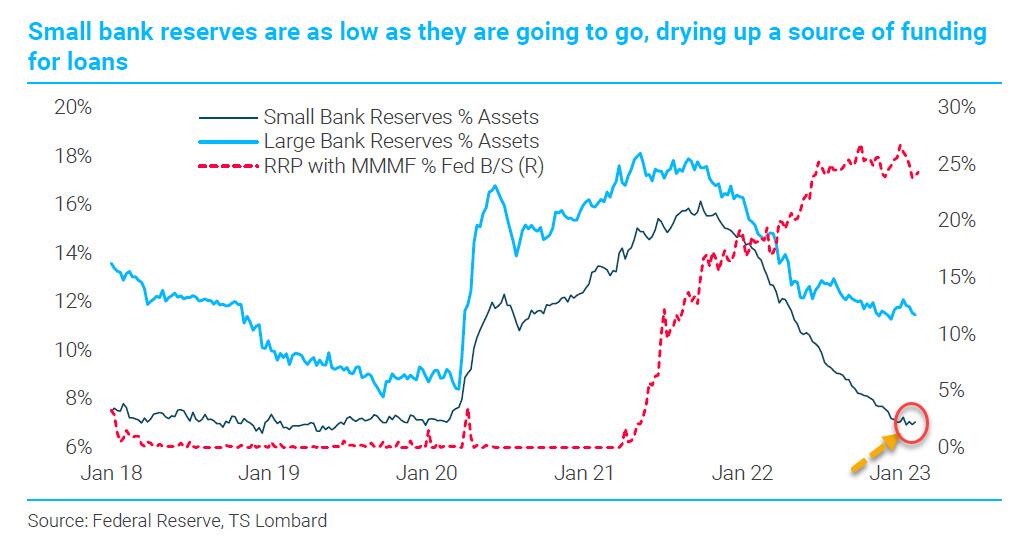
The rescue of SVB et al has shifted the landscape and compromised moral hazard, and prompted a reorganization of how bank deposits and Fed reserves are spread through the system. Money has migrated to large banks from small ones as the credit risk of the latter is reappraised in the wake of recent lender failures.

The system overall is saturated with reserves. But there is a distributional problem, with three-quarters of domestically-held reserves with the big four banks, while only 10% are with the next 300 largest, according to JPMorgan (and Zero Hedge which first pointed this out weeks ago).

Source: Why Small Banks Are In Big Trouble: As Hedge Funds Pile Into The New “Big Short”, The Next ‘Credit Event’ Emerges

This disconnect showed up in the LIBOR-OIS spread barely going above 20 bps in the midst of the crisis (versus 350 bps in 2008), even though Discount Window use was ballooning.

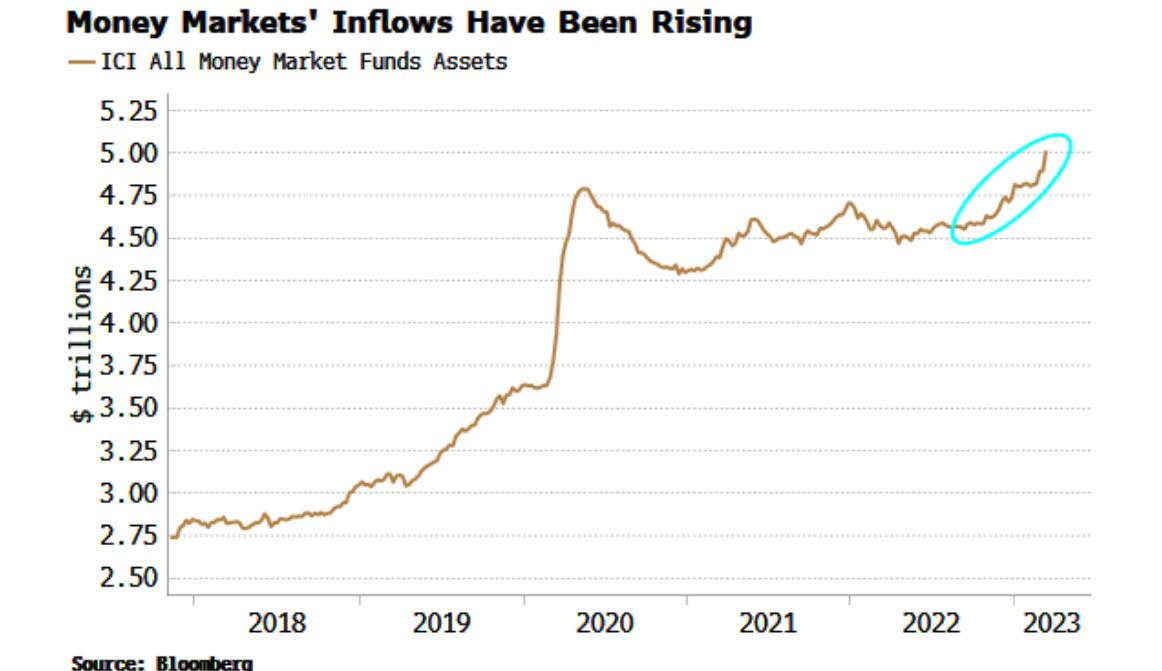
This is why there’s a good chance that reserves could end up with money market funds. The big banks don’t want the deposits and may, as they have done before, point larger depositors in MMFs’ direction. They offer a higher yield, and even though they’re uninsured, they invest mostly in ultra-safe assets, so they are very low risk.

We only have the data to last week, but MMFs had already been seeing a rise in their assets.

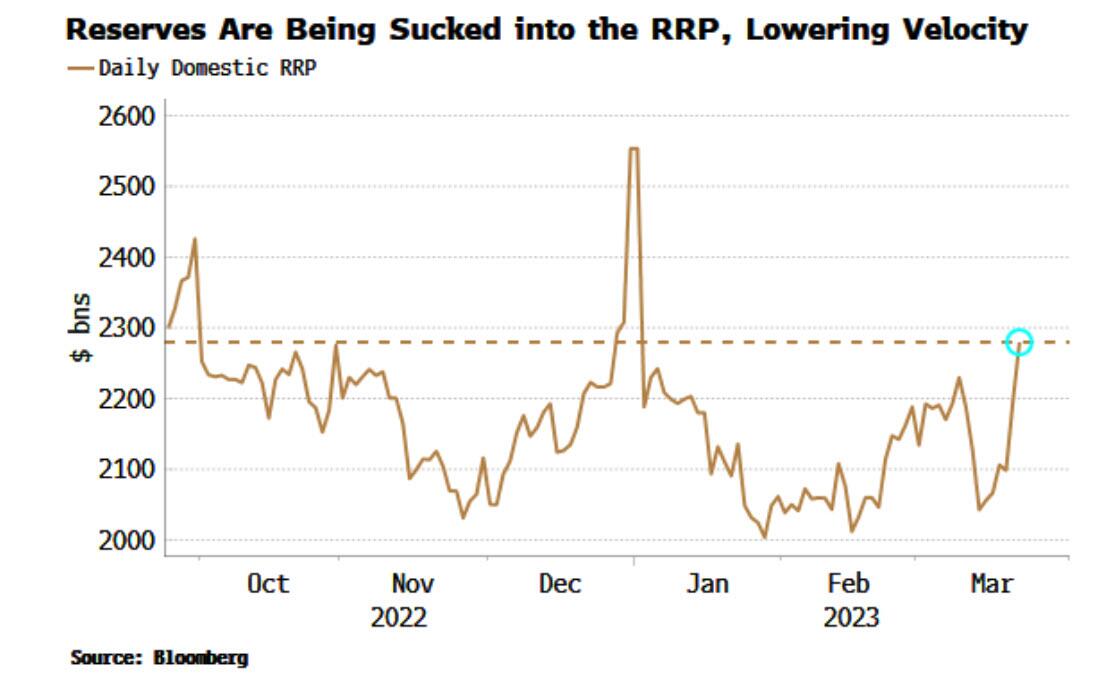
And some of this may already be finding its way to the RRP facility, which yesterday rose to its high for the year.

With the overnight RRP facility offering ~15 bps more than a 3-month Treasury bill after Wednesday’s rate hike, there’s a strong likelihood that MMFs will continue deposit cash there.

We’ll find out how bank deposits have moved around when the data comes out this evening in the Fed’s H.4.1 release, but in the coming weeks and months we are likely to see reserves leaving the high-velocity world of smaller banks, where they were being lent out more, to the effectively zero-velocity black-hole of the RRP.

Moreover, the Treasury may soon start to build back up its account at the Fed, a further suck on reserves and velocity.

It’s hard not to think conditions are going to get much tighter from here on out, making the Fed’s more cautious stance look prudent.

Tyler Durden
Fri, 03/24/2023 – 06:30

via ZeroHedge News https://ift.tt/alivC1G Tyler Durden

Federal Agencies Are Still Using Our Phones as Tracking Beacons


A cell phone held sideways with a stylized eye on the screen.

While technically unconnected to each other, recent reports about the Secret Service and Immigration and Customs Enforcement playing fast and loose with rules regarding cellphone tracking and the FBI purchasing phone location data from commercial sources constitute an important wake-up call. They remind us that those handy mobile devices many people tote around are the most cost-effective surveillance system ever invented. We pay the bills for our own tracking beacons, delighted that in addition to tagging our whereabouts, they also let us check into social media and make the occasional voice call.

Fooling Your Phone Into Revealing Your Presence

“The United States Secret Service and U.S. Immigration and Customs Enforcement, Homeland Security Investigations (ICE HSI) did not always adhere to Federal statute and cellsite simulator (CSS) policies when using CSS during criminal investigations involving exigent circumstances,” the Department of Homeland Security’s Office of the Inspector General reported last month. “Separately, ICE HSI did not adhere to Department privacy policies and the applicable Federal privacy statute when using CSS.”

The OIG report referred to the use of what is commonly called “stingray” technology—devices that simulate cellphone towers and trick phones within range into connecting and revealing their location. “When used to track a suspect’s cell phone, they also gather information about the phones of countless bystanders who happen to be nearby,” the ACLU warns about their use.

Because of their indiscriminate nature, stingrays are supposed to be used only with court authorization. That usually means a warrant, and the report found the agencies got a warrant when required. But in “exigent” circumstances requiring fast action, law enforcement is still supposed to get a lesser pen register order. Even under emergency circumstances involving risk of death or serious injury, applications for a pen register order are required within 48 hours of use, essentially authorizing surveillance after the fact. That doesn’t always happen.

For a subset of investigations from 2020 to 2021, “the Secret Service did not obtain pen register court orders for [redacted] investigations using CSS under exigent circumstances, as required by policy and statute,” noted the OIG. During the same period, for a redacted category of investigations, “ICE HSI did not obtain warrants and was unable to provide evidence it applied for or obtained pen register court orders.”

Investigating agents from the agencies also failed to document “supervisory approval before CSS use and data deletion upon mission completion.”

“The fact that government agencies are using these devices without the utmost consideration for the privacy and rights of individuals around them is alarming but not surprising,” commented Matthew Guariglia, senior policy analyst for the Electronic Frontier Foundation (EFF). “The federal government, and in particular agencies like HSI and ICE, have a dubious and troubling relationship with overbroad collection of private data on individuals.”

Your Whereabouts Are Available for the Right Price

And that brings us to the FBI’s cellphone surveillance. This revelation might be a bit less dramatic, referring as it did to a (supposedly) past practice of determining where people have been rather than where they are now, but it was still eye-opening.

“To my knowledge, we do not currently purchase commercial database information that includes location data derived from internet advertising,” FBI Director Christopher Wray responded to a question from Sen. Ron Wyden (D-OR) during a March 8 Senate Intelligence Committee hearing. “I understand that we previously, as in the past, purchased some such information for a specific national security pilot project. But that’s not been active for some time.” He then offered to provide more information in closed session.

“When we use so-called adtech location data it is through court-authorized process,” Wray added.

Wray’s “adtech” is software and tools used to target digital advertising campaigns. In order to personalize advertising, the apps we use on our mobile devices gather a lot of data on us, what we do, and where we’ve been that is tied to a unique ID.

“The IDs, called mobile advertising identifiers, allow companies to track people across the internet and on apps,” Charlie Warzel and Stuart A. Thompson wrote for The New York Times in 2021. “They are supposed to be anonymous, and smartphone owners can reset them or disable them entirely. Our findings show the promise of anonymity is a farce. Several companies offer tools to allow anyone with data to match the IDs with other databases.”

The tracking-beacon nature of our phones is so obvious and intrusive that the Supreme Court ruled in Carpenter v. United States (2018) that “the Government will generally need a warrant to access [cell-site location information].” But adtech gathers GPS data from commercial tools, not locations from cellphone companies, and is considered marketing data. That data is openly available for sale. Among the buyers are government agencies working around the Carpenter decision. 

Wray said that, to his knowledge (nice hedge there), the FBI doesn’t currently purchase adtech. But even if true, that’s a policy decision, not a legally binding guarantee. Other agencies very definitely do purchase commercial cellphone location data, and the courts have yet to weigh in.

High-Tech Fishing Expedition

And, post-Carpenter, even the most precise phone company location data remains available with court approval. The courts are currently mulling multiple cases involving “geofence warrants” whereby law enforcement seeks data not on individuals, but on whoever was carrying a device in a designated area at a specified time. Think of high-tech fishing expeditions made possible by smart phones.

“We argue these warrants are unconstitutional ‘general warrants’ because they don’t require police to show probable cause to believe any one device was somehow linked to the crime under investigation,” EFF surveillance litigation director Jennifer Lynch wrote in January. “Instead, they target everyone in the area and then provide police with unlimited discretion to determine who to investigate further.”

So, the next time you leave your home to do something you’d rather leave unobserved, give some thought to what’s in your pockets. If their contents include your phone, you might as well be carrying a tracking beacon.

The post Federal Agencies Are Still Using Our Phones as Tracking Beacons appeared first on Reason.com.

from Latest https://ift.tt/HCvMGaX
via IFTTT

Review: You Must Remember This Grapples With the Dangers of Nostalgia


minisyoumustrememberthis

A Maine family fortune founded on rum running. Star-crossed lovers. Dementia. Fire. Ice. You Must Remember This, the latest novel from Reason contributor Kat Rosenfield (author of No One Will Miss Her), grapples with the temptation to imagine a simpler, happier past when the present is tough.

At the center of the whodunit is Delphine, a 26-year-old woman who combines the sincere burnt-out weariness of a New York City refugee with profound naivete about the complications of adult love and family life. Her obsession with her fading grandmother’s love story upends nearly a dozen lives by the end of the tale—and leaves the reader cautious about rose-tinted nostalgia in all its forms.

The post Review: <i>You Must Remember This</i> Grapples With the Dangers of Nostalgia appeared first on Reason.com.

from Latest https://ift.tt/n5E1I4V
via IFTTT