Parents of Oxford High School Shooter Can Be Prosecuted for Negligent Homicide,

From today’s Michigan Court of Appeals decision in People v. Crumbley, written by Presiding Judge Christopher Murray and joined by Judges Michael Riordan & Christopher Yates:

Defendants James and Jennifer Crumbley are the parents of EC, who shot and killed four fellow students and injured many others at Oxford High School on November 30, 2021. EC pled guilty to four charges of first-degree murder. In these proceedings, the state has charged defendants with four counts of involuntary manslaughter related to those same deaths….

The court discusses in detail the facts that the parents knew about EC’s statements “that reflected instability in his mental health,” and went on to conclude that, given all the evidence, their prosecution can go forward (recall that they haven’t yet been tried or convicted of anything):

Causation is, of course, “an element of involuntary manslaughter.” … “[I]n the criminal law context, the term ’cause’ has acquired a unique, technical meaning. Specifically, the term and concept have two parts: factual causation and proximate causation.” “Factual causation exists if a finder of fact determines that ‘but for’ defendant’s conduct the result would not have occurred.”

“The existence of factual causation alone, however, will not support the imposition of criminal liability. Proximate causation must also be established.” Concerns arise regarding “whether the defendant’s conduct was the proximate or legal cause of the decedent’s death,” when “the death is so remote from the defendant’s conduct that it would be unjust to permit conviction.” In other words, proximate causation “is a legal construct designed to prevent criminal liability from attaching when the result of the defendant’s conduct is viewed as too remote or unnatural.” Importantly, under the criminal law, there can be more than one cause of harm, and a defendant’s acts need only be a contributory cause that was a substantial factor in producing the harm ….

“For a defendant’s conduct to be regarded as a proximate cause, the victim’s injury must be a ‘direct and natural result’ of the defendant’s actions.” … “[A]n act of God or the gross negligence or intentional misconduct by the victim or a third party will generally be considered a superseding cause [that prevents the defendant’s actions from being treated as proximate cause -EV] … .” Nevertheless, “[t]he linchpin in the superseding cause analysis [] is whether the intervening cause was foreseeable based on an objective standard of reasonableness.” “If it was reasonably foreseeable, then the defendant’s conduct will be considered a proximate cause.” “If, however, the intervening act by the victim or a third party was not reasonably foreseeable—e.g., gross negligence or intentional misconduct—then generally the causal link is severed and the defendant’s conduct is not regarded as a proximate cause of the victim’s injury or death.” …

[T]he relevant facts revealed that, prior to arriving at the school on November 30, 2021: (1) defendants were aware that EC had been repeatedly experiencing significant episodes of hallucinations and/or extreme paranoia; (2) EC was in a distressed mental state because of the loss of his grandparent and the family dog, and the departure of his best friend; (3) EC himself realized his poor mental state such that he requested defendants to help him obtain medical assistance; (4) despite defendants’ knowledge of EC’s mental state, they purchased him a handgun which was readily accessible to EC; (5) on November 29, the day before the shootings, EC was researching bullets while in school; and (6) during first hour of class on November 30, EC watched a video involving a shooting, and during second hour drew pictures of a bullet, a gun resembling the SIG Sauer, a person bleeding from bullet holes, and wrote “Blood everywhere,” “The thoughts won’t stop Help me,” “My life is useless,” and “The world is dead.” Defendants were also presented with the significant modifications EC made to that worksheet, where he clearly intended to portray a different, happier message about the school and himself.

Despite their knowledge of all of these circumstances, when given the option to help EC and take him out of school, defendants did nothing. They did not, contrary to the recommendations of Hopkins, take EC home and get him immediate medical help. Nor, when they decided to leave him at school, did they tell school officials about EC’s history of mental health issues nor explain to them that EC had access to a gun similar to the one he drew on the math worksheet. Defendants neither asked EC if he had the gun with him nor did they look in his backpack. And, when they left the school, defendants did not go home and ensure EC had not taken the gun.

Given all those facts, it was not an abuse of discretion to conclude that there was probable cause to believe that a juror could conclude that a reasonably foreseeable outcome of defendants’ alleged gross negligence was EC committing a shooting that day. One of the few reasonably foreseeable outcomes of failing to secure the firearm that was gifted to EC was that it would be accessible to EC and that, in his mentally deteriorated condition, he might use it in unlawful ways. In light of those foreseeable events, when presented with what he had just drawn, written, and viewed that morning, a reasonable juror could conclude that it was foreseeable that EC possessed his recently gifted gun and intended to use it that day. As a result, a reasonable juror could conclude that EC’s intervening acts were not a superseding cause of the murders.

In fact, given the uniqueness of the connection between EC and defendants, we question whether EC’s acts are properly considered as intervening causes capable of superseding defendants’ criminal responsibility…. Defendants’ actions and inactions were inexorably intertwined with EC’s actions, i.e., with the intervening cause. This connection exists not simply because of the parent-child relationship but also because of the facts showing that defendants were actively involved in EC’s mental state remaining untreated, that they provided him with the weapon used to kill the victims, and that they refused to remove him from the situation that led directly to the shootings. In this circumstance, a reasonable juror could conclude that defendants’ “conduct ‘increase[d] the foreseeable risk of a particular harm occurring through … a second actor.”

{We acknowledge defendants’ argument that no parent could reasonably foresee their child committing a mass shooting. But these issues are based on the facts and what is reasonably foreseeable under an objective standard, and the circumstances defendants were presented with on November 30, 2021, provided a heightened set of warnings that could lead a jury to find causation. Additionally, with respect to foreseeability, more relevant than the number of people shot is the foreseeability that EC would shoot someone that day.}

Finally, we share defendants’ concern about the potential for this decision to be applied in the future to parents whose situation viz-a-viz their child’s intentional conduct is not as closely tied together, and/or the warning signs and evidence were not as substantial as they are here. But those concerns are significantly diminished by several well-established principles. First, the principle that grossly negligent or intentional acts are generally superseding causes remains intact. We simply hold that with these unique facts, and in this procedural posture and applicable standard of review, this case falls outside the general rule regarding intentional acts because EC’s acts were reasonably foreseeable, and that is the ultimate test that must be applied.

Second, our decision is based solely on the record evidence, and the actions and inactions taken by defendants despite the uniquely troubling facts of which they were fully aware.And this point is important, as although the judiciary typically recognizes that a decision’s precedent is limited by the facts at issue, it is particularly true when the court expresses that limitation.

Third, our decision is premised upon a deferential standard of review, and is based only upon the record established at the preliminary exam. Whether a jury actually finds that causation has been proven after a full trial, where the record will almost surely be more expansive (including evidence produced by defendants), is an issue separate from what we decide today.

Judge Riordan joined the majority opinion, but added:

In the typical case, of course, the parents of a child, who might be characterized as troubled, cannot be held criminally liable for that child’s own crime. “Criminal guilt under our law is personal fault. It is highly individualistic. It comes not from association, without more, be it with family or friends.” Moreover, it long has been recognized that the failure of a parent to provide proper care for a child generally “is not a crime.”

In a nutshell, the law simply does not permit criminal liability for poor parenting or insensitivity when confronted with a child’s emotional swings or mental-health issues such as depression. Nor does the law permit criminal liability for parental irresponsibility with respect to a difficult, aggressive, or angry child. The fact that a child with such issues also may have access to a potentially dangerous instrumentality made available by his or her parents, such as a motor vehicle, a knife, or even a gun, does not necessarily affect these principles.

If we do not prohibit a troubled child of driving age from operating a car provided by his or her parents, I discern no principled reason why those parents should automatically be subject to criminal liability if the troubled child uses the car to cause harm. So too with a gun, or any other commonly available instrumentality.

The difference between this case and the typical case in which a child commits a crime with a potentially dangerous mechanism, however, is that EC was not merely a troubled child with obvious mental-health problems. Instead, the morning of the shooting, EC drew a picture of a body that appeared to have two bullet holes in the torso, apparently with blood streaming out of them, which was near another drawing of a handgun that resembled the gun his parents, defendants James Crumbley and Jennifer Crumbley, had very recently gifted to him. The body in the drawing obviously could not have inflicted such wounds upon itself, so the logical inference is that the body was shot by another. Thus, this drawing suggests that EC not only was potentially suicidal, as school counselor Shawn Hopkins believed at the time, but also that he presented a danger to others with his handgun. In other words, there was visual evidence, known by defendants, that EC was contemplating the act of gunshot wounds being inflicted upon someone.

In my view, this drawing, coupled with the other evidence aptly discussed by … the majority opinion, establishes probable cause that EC’s conduct on the afternoon of November 30, 2021, was reasonably foreseeable by defendants. Simply put, this discrete evidence of considered harm to others distinguishes the situation here from the overwhelming majority of cases in which parents may not, and should not, be criminally liable for a child’s crime. In the absence of such discrete evidence as is before us, the outcome of the instant appeal easily may have been different….

The post Parents of Oxford High School Shooter Can Be Prosecuted for Negligent Homicide, appeared first on Reason.com.

from Latest https://ift.tt/R3w4Bam
via IFTTT

Capitalism, Socialism, and Fan Complaints About the Role of Giant Eagles in “The Lord of the Rings”


Giant Eagle

NOTE: This post contains some plot spoilers for The Lord of The Rings and other Tolkien books.

In a fascinating recent blog post, economist Bryan Caplan highlights some similarities between standard socialist complaints about capitalism, and long-running fan claims that the giant Eagles didn’t do enough to fight Sauron in J.R.R. Tolkien’s The Lord of the Rings. Most obviously, fans have long argued that the Eagles should have just flown the Ring of Power to Mount Doom and dropped it in, thus sparing the Fellowship of the Ring great suffering, and saving the may lives lost in the War of the Ring. The so-called “eagle plot hole” is a longstanding focus of debate.

Caplan lists some other things fans believe the Eagles should have done:

“Why didn’t the eagles transport Gandalf everywhere instead of making him ride a horse?”

“Why didn’t the eagles fight at Minas Tirith?”

“Why didn’t the eagles fly Bilbo and the Dwarves straight to the Lonely Mountain?”

“Why didn’t the eagles grab Azog from his command post in the Battle of the Five Armies and drop him to his death?”

Caplan suggests less criticism of the Eagles for what they could have done but didn’t, and more gratitude for all the good they did do:

Give the eagles a break! The eagles are already doing a ton of great stuff for Middle Earth! They’re giant eagles. Top of the food chain. They could easily just roost safely in their eyries and live out their lives in peace. Yet without asking for the slightest compensation, these heroic birds…

…saved Gandalf at Isengard,

…fought the Nazgul at the Black Gate,

…rescued the Dwarves from the trees when they were surrounded by Goblins and Wargs,

… and delivered the coup de grace at the Battle of the Five Armies.

The eagles aren’t perfect, but they are awesome. Instead of asking the eagles to do even more, how about a little freakin’ gratitude?

It’s worth adding that never once did the Eagles get rewarded for all the good they did. At the end of the Lord of the Rings, King Elessar (as Aragorn is now called) takes care to acknowledge and reward all the various humanoid peoples and races who fought against Sauron. But the Eagles get nothing.

Caplan applies similar reasoning to standard socialist attacks on markets:

I submit that this is a handy allegory for popular complaints about markets. They offer vastly greater benefits than the eagles of Tolkien. To start, these glorious markets…

…fill our stores with cornucopian wealth,

…create endless new products,

…endlessly improve the products we already have,

…offer great convenience,

…build massive amounts of spacious, comfortable housing,

…pay salaries ten, twenty, a hundred times our physical needs,

…offer a vast range of jobs: the whole continuum from low commitment to high commitment, low risk to high risk, low social interaction to high social interaction, low comfort to high comfort,

…will pay you something to do practically anything,

…incentivize the world’s most creative and industrious people to share their gifts with the world,

…while respecting the principle of voluntary consent. Truly, no one makes you shop at WalMart.

Yet in politics and popular culture, markets gets even less love than the eagles. Instead, we get childish complaints:

“Incomes aren’t equal.”

“Wealth isn’t equal.”

“This product could be better.”

“Why can’t this stuff be free?”

“My pay sucks.”

“My co-workers suck.”

“My boss sucks.”

“We’re so materialistic.”

What makes such complaints about markets so childish?

First, most of them apply at least as well to every other economic system. Actually-existing socialism is anything but equal. Its products are notoriously crummy. The pay stinks. Lots of co-workers and bosses still suck. And the victims of socialist poverty are notoriously “materialistic” because they spend most of their time struggling to fulfill their basic material needs.

Second, the market itself offers practical solutions for many of the complaints. Free immigration and free construction are mighty battering rams against inequality. Don’t like your pay, coworkers, or boss? Find a better match using the First Law of Wing-Walking. Given time and persistence, this Law totally works. Abhor materialism? It’s easier to focus on the finer things in life if the coarser things in life are dirt cheap.

Like Tolkien’s eagles, markets aren’t perfect, but they are awesome.

Just as the peoples of Middle Earth are vastly better off with Eagles than without them, so real-world people are vastly better off with markets than would likely be the case with any other economic systems. Indeed, real-world socialism looks a lot like Mordor under the rule of Sauron. Ditto for real-world fascism and statist nationalism.

Caplan’s line of argument doesn’t work as well against people who agree free markets have great value, but argue we need marginal tweaks and constraints to make them better, or eliminate negative side-effects. For example, perhaps governments should do more to limit externalities, help the poor, or provide public goods. But it is a compelling point against wholesale rejections of free markets in favor of socialism and other such alternatives.

I will also take this opportunity to point out that the Eagles are even better than Caplan suggests. The main complaint against them—that they could have easily destroyed the Ring of Power by flying it to Mount Doom—is totally unwarranted. The following is an adaptation of a 2017 Facebook post I wrote on this subject:

There is no “Eagle plot hole” because the Eagle plan was a terrible idea all along! Giant Eagles are very conspicuous. The Eye of Sauron would literally have seen the Eagle coming from a thousand miles away. He would surely have sent up his Nazgul to investigate; they would sense the presence of the Ring, and capture it.

If the Eagle somehow managed to evade the Nazgul and got to Mordor, Sauron (by that time aware of the presence of the Ring) would have ordered all the thousands of orcs in Mordor to shoot at it. If even one of them manages to put a lucky arrow or ballista bolt through the Eagle’s eye, the game is up. Sending in a whole squadron of Eagles (as suggested in some variants of the plan) just makes them even more conspicuous, which means that Sauron would detect them sooner.

And, by the way, the Eagles could not defeat the Nazgul, even with the advantage of numbers, because the latter are immune to non-magical weapons (and, presumably, also non-magical talons and claws).

In addition, as Gandalf explains, the Ring is a major temptation for “those who have already a great power of their own.” Giant Eagles are very powerful, and would be tempted to take the ring for themselves, much as Boromir was (only more so, because they are more powerful than he is). An Eagle could easily overpower the Ringbearer, then take the Ring and try to use it, thereby rendering itself visible to Sauron. This scenario also ends with Sauron recapturing the Ring (or at best with a corrupted Giant Eagle becoming the new Dark Lord).

In sum, the supposedly brilliant Eagle plan would have ended up handing the Ring to Sauron on a silver platter. The reason why Gandalf didn’t bring it up at the Council of Elrond is that he would have been embarrassed to present such a stupid idea to the Elves and Rangers. He would surely have been laughed out of Rivendell! And the same fate should befall the fanboys who keep bringing this up.

Some may argue that this is still a plot hole because Tolkien did not explain in the book why this plan won’t work. But he also didn’t have the characters analyze every other possible hare-brained scheme for destroying the Ring, such as having Dwarven sappers tunnel into Mount Doom. No one claims that Tolkien’s failure to address these theories is a plot hole. The same goes for the Eagle plan.

The post Capitalism, Socialism, and Fan Complaints About the Role of Giant Eagles in "The Lord of the Rings" appeared first on Reason.com.

from Latest https://ift.tt/3OJSbZX
via IFTTT
Charter School Principal “Forced to Resign” Allegedly Because 6th-Grade Students Were Shown Michelangelo’s David

Thanks to Wikipedia, from which I copied this.

From Tallahassee Democrat (Ana Goñi-Lessan) (paywalled):

A local charter school principal said she was forced to resign after a parent complained a Renaissance art lesson was pornographic…. She believes the catalyst for the ultimatum was complaints about an art lesson on the Renaissance period….

[Board Chair Barney Bishop III], who confirmed he did give Carrasquilla that ultimatum, said he could not say why he asked her to resign because of the school’s employment lawyer’s advice….

Out of the three parents [who had complained], two said they wished they had been notified of the lesson beforehand, and the other parent complained the lesson was pornographic, Carrasquilla said.

A letter notifying parents of the art lesson should have been sent to parents, Carrasquilla said, but a breakdown in communication between the principal, the director of operations and the art teacher led to an administrative oversight, and parents were not informed.

The board passed a new rule last month that would require parental notification two weeks in advance of any curriculum that is taught that is “potentially controversial,” Bishop said….

I don’t think there’s a First Amendment violation here, even if the facts are as alleged: Charter schools are apparently treated as public schools, so they are bound by the First Amendment, but individual K-12 teachers and principals don’t have a First Amendment right to make curriculum decisions; legislatures, boards of educations, and the governing boards of schools can be the ones who decide what is taught.

Nonetheless, if the facts are as alleged, then this seems like a foolish decision. This is one of the great works of Western art—part of America’s, and the world’s, cultural patrimony—and possibly the most famous example of fine art sculpture (the Statue of Liberty and Mt. Rushmore might be rivals as to fame, especially in the U.S., but they belong to a somewhat different genre). It illustrates the power of sculpture to evoke a person or a story, even without color or motion.

It’s not pornographic in the sense of being aimed at sexually arousing people, or being likely to cause such arousal. It seems to me to be an eminently proper subject for 6th graders (i.e., 11-to-12-year-olds) to view. Any sensible lesson on Renaissance art history has to show it, I think. And even to the extent that this is “potentially controversial” in a descriptive sense (it did seem to create controversy), and given that the principal had erred in failing to notify parents, the situation doesn’t seem to be a basis for firing.

The post Charter School Principal "Forced to Resign" Allegedly Because 6th-Grade Students Were Shown Michelangelo's <i>David</i> appeared first on Reason.com.

from Latest https://ift.tt/Rryl9dE
via IFTTT

Hospitals Are Still Reporting New Mothers for Neglect Based on Drug Tests Triggered by Poppy Seeds


Poppy seed bagel

Before Kate L. gave birth to a baby girl last September, a nurse at New Jersey’s Hackensack University Medical Center collected a urine sample from the soon-to-be mother. Kate thought nothing of it, because she was accustomed to having her urine tested for protein levels during her pregnancy. She had no idea that her urine would be tested for drugs, which resulted in a terrifying, monthslong investigation aimed at determining if she was a fit mother.

Kaitlin K. had a similar experience when she gave birth to a baby boy at Virtua Voorhees Hospital in Camden County, New Jersey, the following month. The immediate culprit in both cases seems to have been a poppy seed bagel that triggered a false positive for opiates. That, in turn, led to state investigations of alleged child neglect. But the real blame, according to complaints filed this month by the American Civil Liberties Union (ACLU) of New Jersey, lies with the hospitals, which it says conducted nonconsensual, medically unnecessary, and woefully inadequate drug tests, then reported the erroneous results to the New Jersey Department of Child Protection and Permanency (DCPP).

The ACLU, which is asking the New Jersey Department of Law and Public Safety’s  Division on Civil Rights to stop that practice and award compensatory damages, argues that a policy of “drug testing perinatal patients on the basis of sex and pregnancy” constitutes illegal discrimination under state law. Whatever the legal merits of that claim, the sneaky, arbitrary, high-handed, and cruel treatment described in the complaints shows what can happen when medical personnel forsake their ethical responsibilities in service of the war on drugs.

“No one should be subjected to unnecessary and nonconsensual drug tests,” says ACLU of New Jersey staff attorney Molly Linhorst. “Our clients are sending a clear message to hospitals that these testing and reporting policies are unacceptable. Discriminatory testing policies like these upend what should be a time of joy for families, and so often subject them to further trauma and unwarranted investigation by the state.”

The message that the ACLU is trying to send should have been received long ago. Given the history of false positives caused by poppy seed consumption and litigation involving precisely the circumstances described in the ACLU complaints, it is astonishing that hospitals continue to treat new mothers as presumptively unfit based on nothing more than the results of fallible urine tests conducted without permission or medical justification.

The hospitals cannot plausibly claim they did not realize poppy seeds could trigger those tests. “Concerns with poppy seeds and drug testing are not new,” the Department of Defense notes in a memo it issued last month. It has long been recognized that poppy seeds “may be contaminated during harvest with morphine and codeine,” the Defense Department says, and “recent data suggests certain poppy seeds varieties may have higher codeine contamination than previously reported.” The memo advises service members to steer clear of foods containing poppy seeds, “which could cause a codeine positive urinalysis result and undermine the Department’s ability to identify illicit drug use.”

To guard against false positives, the Mandatory Guidelines for Federal Workplace Drug Testing Programs, published in 2017, require a codeine cutoff of 2,000 nanograms per milliliter of urine. But the Hackensack University Medical Center’s lab, according to Kate’s complaint, used a cutoff of 300 ng/ml, less than one-sixth the federal standard. Virtua Voorhees Hospital’s lab, according to Kaitlin’s complaint, used a cutoff of just 10 ng/ml, 99.5 percent lower than the recommended level.

The specific problem of pregnant women falsely identified as illegal drug users by hospital urine tests likewise has been widely recognized for years. Women who suffered ordeals similar to those described by Kate and Kaitlin recently have sued hospitals in Pennsylvania (2020), New York (2021), and Illinois (2022).

One such lawsuit, filed 13 years ago, resulted in a $143,500 settlement with a hospital and child welfare agency in Pennsylvania. It was followed the next year by another lawsuit involving the same hospital and the same agency, which led to a $160,000 settlement.

Reason reported similar cases in Maryland, Pennsylvania, and Alabama in 2018, 2019, and 2020, respectively. In 2020, the U.S. Court of Appeals for the 6th Circuit ruled that Kentucky caseworkers violated the Fourth Amendment when they conducted interviews and imposed a “prevention plan” on new parents in response to a false-positive urine test.

The American College of Obstetricians and Gynecologists opposes drug testing of perinatal patients. It notes that “a positive drug test result is not in itself diagnostic of opioid use disorder or its severity.” It adds that “false-positive test results can occur,” and “legal consequences can be devastating to the patient and her family.”

In short, the hospitals that treated Kate and Kaitlin had plenty of notice that their policies and practices were problematic. They nevertheless conducted drug tests surreptitiously with no medical basis and used recklessly low cutoffs. In Kate’s case, the hospital failed to confirm the test results, ignoring guidelines that the U.S. Department of Health and Human Services published in 2018. “Not completing confirmatory urine testing can be disastrous,” the guidelines warn, “because it can result in false-positive results that may mean the loss of custody of children and, in some states, legal prosecution.”

Unlike some of the plaintiffs in earlier lawsuits, Kate and Kaitlin did not lose custody of their children. But that possibility resulted in months of anxiety and anguish as the DCPP completed its investigations, which included home visits and, in Kaitlin’s case, three interrogations of her 7-year-old son. Both women still worry that records of the drug test results and the ensuing investigations will result in unjustified suspicions that could separate them from their children.

“I felt like the doctors were questioning my character and parenting skills,” Kate says. “I’m terrified of ever going to a hospital again; I’m always going to worry that our family could be torn apart. That’s why we are doing all we can to stop this from happening to anyone else.”

Kaitlin’s experience likewise has left a lingering mark. “I feel violated,” she says. “This whole ordeal has been extremely stressful and has turned our lives upside down and now, because of what happened, I live in fear of medical tests and how they might be used against me as a mother.”

The situation that Kate encountered seemed designed to destroy patients’ confidence in the medical system. Her urine test came up positive for opiates on September 20, but she was not informed of that result until four days later. Meanwhile, her baby, identified as A.L. in her complaint, was kept in the neonatal intensive care unit (NICU) for reasons that were not clear. The hospital secretly did a second drug test on Kate’s breast milk, which came up negative. According to her complaint, the baby “never showed signs of withdrawal and was never diagnosed with neonatal opioid withdrawal syndrome or neonatal abstinence syndrome.”

The day after Kate learned that she was suspected of using opioids—five days after she gave birth—the hospital “refused to discharge” her, the complaint says. That afternoon, DCPP caseworkers separately interrogated Kate and her husband, Jesse. Kate agreed to a second urine test, which came up negative. She was finally released that evening, but her baby did not come home until October 1, “ten days after her birth and five days after DCPP cleared Kate to bring her baby home.”

Why the delay? “One of the doctors working in the NICU stated to Kate and Jesse that she would need to feel ‘comfortable’ before permitting Kate to take A.L. home,” the complaint says. “Kate felt that the doctor was judging her as a mother and insinuating that she was not trustworthy.”

Meanwhile, DCPP caseworkers visited Kate and Jesse’s home on September 26 to “conduct an inspection.” That encounter “was extremely distressing for the new parents,” the complaint says. “It was terrifying that a representative from the government was inspecting their home to determine whether they were fit to parent, despite months preparing for their baby to come home.”

Although the DCPP “cleared Kate and Jesse to take baby A.L. home,” the hospital kept the baby for another five days, and the agency’s investigation continued. It included a “Certified Alcohol and Drug Counseling evaluation” and yet another urine test, which was “negative for all substances.” In November, Kate received a letter saying the DCPP had concluded that “the allegation of neglect was ‘unfounded.'” But the letter also said the agency would “retain the family’s file for at least three years, leaving Kate and Jesse anxious that DCPP will again subject them to an invasive investigation and family separation without any valid basis.”

As a result of this ordeal, the complaint says, “Kate has lost all confidence in medical professionals and feels she cannot trust any doctors. She fears that the initial positive test result will be part of her permanent electronic medical record, as well as her baby’s medical record, and cause all subsequent doctors who view it to distrust her as a patient and as a mother.”

Although Kate and Jesse had planned to have another child, “she is terrified of returning to a hospital for any medical procedure, especially labor and delivery.” She “is so distressed by her experience that she is frightened to give birth again.” She “does not trust hospitals or OB/GYN physicians with her information or with her health.”

The hospitals have declined to comment on the complaints. A Virtua spokesperson said the company is “dedicated to providing safe, comprehensive, and equitable care to the community” and “fully committed to reviewing this matter.”

Like the scandalous abandonment of pain patients that resulted from the government’s crackdown on prescription opioids, these cases illustrate how the war on drugs corrupts everything it touches. It encourages doctors to sacrifice patients’ welfare in the name of fighting substance abuse, shatters relationships on which people rely for health care, and even threatens to sever the supposedly sacred bond between mother and child.

The hospitals that treated Kate L. and Kaitlin K. like criminals instead of patients are not responsible for those incentives. But they are responsible for their blind embrace of the anti-drug agenda, which may end up costing them. They could have avoided that potential liability if they had been paying attention to a problem that has been obvious for more than a decade.

The post Hospitals Are Still Reporting New Mothers for Neglect Based on Drug Tests Triggered by Poppy Seeds appeared first on Reason.com.

from Latest https://ift.tt/6MEWLeH
via IFTTT

Largest Jobs Website Lays Off Thousands Of Employees

Largest Jobs Website Lays Off Thousands Of Employees

It is rather ironic that while the unexpected weekly drop in initial jobless claims highlights the structural shortage of workers in a very tight labor market, internet job-search platform Indeed plans to lay off approximately 2,200 employees, representing 15% of its workforce.

In a blog post, Indeed CEO Chris Hyams expressed that he was “heartbroken to share that I have made the difficult decision to reduce our headcount through layoffs.” 

“We anticipate we will be letting approximately 2,200 people go. This is roughly 15% of our team. The cuts come from nearly every team, function, level and region at Indeed and Indeed Flex,” Hyams wrote. 

He warned about mounting macroeconomic headwinds that will dent revenues:

“It is becoming increasingly likely that HR Tech revenue will decline in FY2023 and potentially again in FY2024.” 

… as with many tech companies, the CEO acknowledges the error of excessive hiring in recent years:

“With future job openings at or below pre-pandemic levels, our organization is simply too big for what lies ahead. We need clarity, focus, and urgency to ensure that all of our energy is directed towards investing in our future. We have held out longer than many other companies, but the revenue trends are undeniable. So I have decided to act now.” 

The irony of the Indeed layoffs lies in the fact that the labor market continues to be exceptionally tight.

“Found it quite ironic that as we are debating the strength of the labor market Indeed.com (major online us recruitment website) is slashing jobs citing a challenging macroeconomic backdrop,” Goldman Sachs analysts told institutional clients Thursday morning. 

What’s likely happening is that companies are pulling sponsor job listings posts from Indeed as recession threats surge. 

We shared with readers early Thursday morning one surprising chart that shows a possible 3-month lag between monetary policy and its effect on the job market. 

So, in summary, layoffs at one of the largest job websites in the US might serve as a telling sign of potential turbulence in the job market. 

Tyler Durden
Thu, 03/23/2023 – 16:40

via ZeroHedge News https://ift.tt/2iSLG4Z Tyler Durden

Why Can Only 6 Of Every 100 Chicago Black Students Do Math At Grade Level? Chicago Mayoral Candidate Johnson Offers Some Clues

Why Can Only 6 Of Every 100 Chicago Black Students Do Math At Grade Level? Chicago Mayoral Candidate Johnson Offers Some Clues

By Ted Dabrowski of Wirepoints

If you’re looking to make sense of why so few Chicago Public School students can read and do math at grade level, you’ll want to listen to Brandon Johnson’s words from a 2018 talk he gave along with author Mark Warren, a former professor at Harvard, and Bill Ayers of the Weather Underground.

Johnson’s views on education matter because he could be the next mayor of Chicago. Equally important is that the Chicago Teachers Union has donated more than $2 million to his campaign. It’s the CTU’s philosophy, in part inspired by Johnson’s ideology, that for decades has run CPS schools. Today just 1 in 10 black CPS students can read at grade level and only 1 in 20 are proficient in math. 

If Johnson – a former CPS teacher and now a CTU organizer – takes control of City Hall, you can count on even more of the union’s influence. Less testing, less homework, lower expectations and more passing of kids along to the next grade, whether they’re ready or not. 

Brandon Johnson has already told us he wants to rebel “against the structure.” The talk in question was published on YouTube by Midwest Socialist, a publication of the Chicago Democratic Socialists of America. Johnson is asked a question (45:38) regarding the politics around education and how he handled conflicts between his personal philosophy and the requirements of the education system – in particular because Johnson taught at a selective enrollment school. His response: 

I taught at Westinghouse. Westinghouse was a selective enrollment school. That is in conflict with my philosophy. It’s actually a contradiction, it’s hypocritical. I’m teaching in a structure that actually weeds out a certain element of my neighborhood.

One of the ways I would deal with it, was, I believe I had an additional responsibility to challenge those of us who taught in selective enrollment schools. So one of the things that I did personally, it’s why I began to really push for opting out and not buying into the standardization of our public schools. Sometimes my colleagues actually had a tough time with the way I taught. I spent less time offering tests to my students. They were frustrated. I taught at a selective enrollment school much like I taught at a neighborhood school, I used a lot of inquiry based and I would challenge my honor students in particular to think beyond whatever it is they’re able to remember, they’re ability to just regurgitate.

But I also had to challenge myself. Seeing a school within a school system that provides more for a particular segment of our population is most frustrating because when those students succeed at a selective enrollment school, particularly black students, what ends up happening is, all other black students who don’t meet those same standards get shamed. ‘See, so and so made it out, what’s your problem? How come you can’t do it, these students are doing it?’ 

And so what it taught me, though, was pushing to eliminate some of the standardization of our public schools. My students, sometimes, would get frustrated. I didn’t offer any of the test prep that my other colleagues were pushing at the time. I was pushing our administration to move away from it. 

To be quite frank with you, I didn’t issue a lot of homework for students. That was my own way of rebelling against the structure. I don’t think I ever gave a kid an ‘F.’ I don’t know how a student sits in front of you and fails. I know some professors may find that slightly troubling…”  

I think the last thing is, it actually gave me that much more motivation to actually leave the class and become a full-time organizer with the CTU…

Some takeaways.

First, you can’t disagree with everything Johnson says. Too much standardization in schools isn’t good, especially if it overtakes the system. And who can disagree with inquiry-based thinking?

But this isn’t some idealistic teacher talking about improving his students’ chances by challenging them on the virtues of merit, achievement and excellence. Rather, it’s a CTU organizer talking about how “troubling” it is to hold children to specific, measurable standards.  Forget testing, forget grades, forget homework. He was a teacher willing to undermine the selective enrollment school where he worked at the expense of his own students. 

It’s a destructive mindset. Instead of raising all students up, Johnson would rather tear down high-achieving students for the sake of “equity.”

For more evidence, Johnson said in 2020, “part of it is removing ourselves away from this, you know, state-sponsored policing, but also the tools that have been placed against Black folks that have been used violently, whether it’s policing, or administering standardized tests, or … around how white supremacy finds its way in every facet of our lives, that we have to fight and resist that.”

His type of thinking is what for decades has led to a dismissiveness of standards, leaving the overwhelming majority of black 3rd-grade CPS students unable to pass basic reading tests. 

Less than 10% of black 3rd-graders read at grade level based on the most recent Illinois Assessment of Readiness test. It’s even worse for math readiness.

And if standards don’t matter – as Johnson appears to imply – then it’s no big deal for schools to just move kids through the system, whether they can read or not. Social promotion, it’s called. If teachers can’t and won’t fail a student for a lack of performance, then they’ll just automatically move students on to the next grade.  

Which is exactly what’s happening. Check out reading ability grade by grade for Chicago’s black students. The system fails them year after year after year after year. By 11th grade, just 10 percent of black students can read at grade level on the SAT.

The rejection of standards doesn’t end there. Nearly 80% of those black students in 11th grade end up graduating – accompanied by the self-congratulations of Chicago’s leadership.

And that’s not the only way accountability is bastardized and the failure covered up. The CTU makes sure its members and schools are protected regardless of student outcomes.

98% of CPS teachers were rated “proficient or excellent” in 2020. 100% of teachers got the same rating in 2021. And in 2022, 84% of all evaluated CPS teachers were rated either “proficient or excellent

Schools, too, get protected under updated state board of education measurements. School ratings aren’t based on whether kids can read or do math but instead on “improvements.”

It’s how black-majority schools in Englewood and Bronzeville can have zero students reading at grade levelnot even one student – and yet still get “commendable” ratings from the state board. A commendable rating is the state’s second best rating and is for “a school that has no underperforming student groups, a graduation rate greater than 67%…” 

No, Johnson alone doesn’t own the mess the CTU has made for decades, a mess we reported on in detail in Why the Chicago Teachers Union Always Gets What It Wants

But based on his own words, Johnson is ready and willing to take the union’s extreme positions even further. 

Tyler Durden
Thu, 03/23/2023 – 16:20

via ZeroHedge News https://ift.tt/1DKuHJS Tyler Durden

Markets To Yellen: ‘F**k Off’

Markets To Yellen: ‘F**k Off’

“Where’s Janet!?”

Remember this…

The Treasury Secretary tried to fix her faux pas from yesterday, editing some text from her prepared remarks

Deleted paragraph from March 22:

“As I said last week, the US banking system is sound. The federal government’s recent actions have demonstrated our resolute commitment to take the necessary steps to ensure that depositors’ savings remain safe.”

New paragraph on March 23:

“As I have said, we have used important tools to act quickly to prevent contagion. And they are tools we could use again. The strong actions we have taken ensure that Americans’ deposits are safe. Certainly, we would be prepared to take additional actions if warranted.

But she removed the “US banking system is sound”, sparking total chaos. (Bear in mind, as we detailed earlier, that ‘the math just doesn’t work’ for any industry-wide deposit insurance scheme, so what is she going to say?)

Banks saw some hope-filled pre-market gains battered lower with regional banks suffering most. Yellen’s changed remarks sparked a brief recovery, but that didn’t last long as bank stocks tumbled back towards their lows…

FFWM (First Foundation), PACW, ZION, KEY and FRC dominated the downturn (with Yellen’s attempt to save the day failed)…

European bank CDS (5Y) have generally narrowed somewhat since the CS debacle, we do note that short-dated CDS (more used for counterparty risk management among derivatives traders) have not declined with Deutsche Bank remaining extremely high…

Source: Bloomberg

What started off as a relief-rally overnight, with multiple CNBC anchors sighing comfortably that the ‘worst must be over and that the ‘market just needed time to digest how dovish Powell was’; ended an utter shit-show.

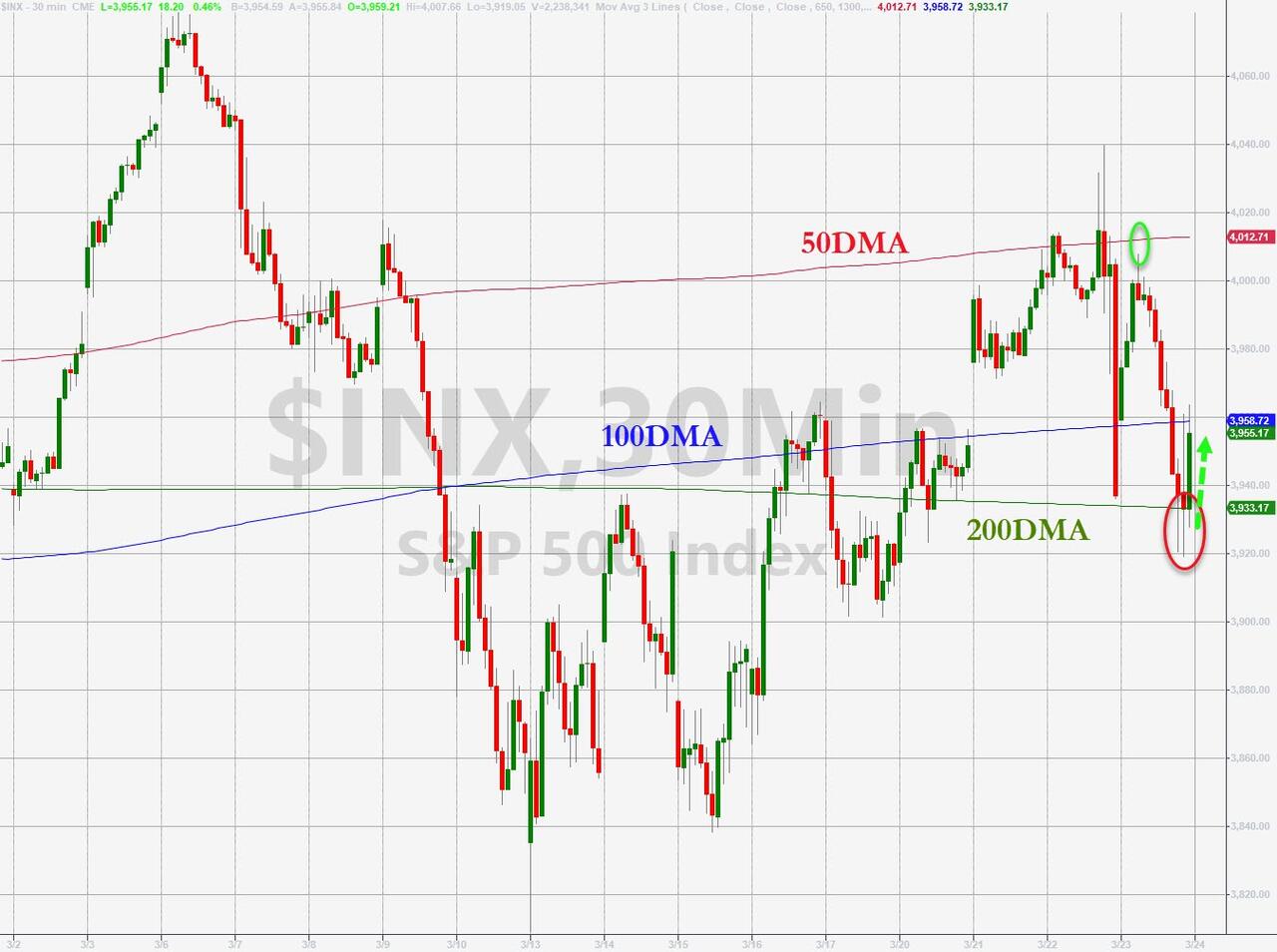
Nasdaq, S&P and The Dow all ramped after the US cash open, erasing the post-Powell losses. But that was all she wrote and as Europe closed, everything everywhere went just a little bit turbo as stocks collapsed below yesterday’s lows. The last 30 mins saw a bounce as 0DTE traders unwound earlier negative delta flows at a profit and the S&P bounced off technical support, but overall, all the US majors remain lower than pre-Powell/Yellen levels (Nasdaq the least ugly horse in the glue factory while Small Caps ended below yesterday’s lows)…

It seems pretty clear the market wants to test Yellen and Powell to see if they will step up and bailout the next bank that goes boom in the night.

S&P broke back below its 100- and 200-DMA (after trying to tag its 50-DMA on the morning ramp), then bounced off its 200DMA, back up to its 100DMA… a very technical day…

CRE/Office REITs were hammered again today (‘Big Short 3.0 doing well since we issued on March 9th)…

Source: Bloomberg

Treasuries were more mixed today with the long-end notably underperforming and short-end ripping lower in yield. After Yellen’s remarks, yields extended lower (30Y +1bps, 2Y -17bps). On the week, all yields are lower now except 30Y…

Source: Bloomberg

2Y Yields tumbled back below 4.00%…

Source: Bloomberg

The yield curve saw a major steepening today with 5s30s uninverting…

Source: Bloomberg

Overall, STIRs drifted dovishly with December now pricing in rates 90bps below current levels…

Source: Bloomberg

The odds of a 25bps hike in May have tumbled to 26%…

Source: Bloomberg

Which leaves the Fed’s expected rate-trajectory dramatically more dovish than the ECB’s…

The dollar fell for the 6th straight day (10 of the last 11 days), bouncing a little intraday off 7-week lows…

Source: Bloomberg

Bitcoin ripped back up towards $29,000, erasing all of yesterday’s losses, but then faded back after Yellen’s revised remarks…

Source: Bloomberg

Gold surged back above $2000…

Source: Bloomberg

Oil prices rollercoastered again today, with WTI rallying above $71 into the European close and then dumping back down to a $69 handle…

Finally, we note it is the three-year anniversary of the COVID lockdown lows today. Bitcoin is the biggest gainer since that date, bonds are the ugliest of all with the dollar basically unchanged and gold and stocks up handsomely…

Source: Bloomberg

Additionally, it appears alternative currencies are gaining favor since the global financial system started showing cracks again…

Gold has soared over the last two weeks…

Source: Bloomberg

And Bitcoin has dominated everything…

Source: Bloomberg

No wonder the Dems have made crypto the new ‘boogeyman’.

Tyler Durden
Thu, 03/23/2023 – 16:01

via ZeroHedge News https://ift.tt/mIPCerN Tyler Durden

Mexican President Says Trump Arrest Is About Keeping Him Off The Ballot

Mexican President Says Trump Arrest Is About Keeping Him Off The Ballot

Authored by Paul Joseph Watson via Summit News,

Mexican President Andres Manuel Lopez Obrador slammed the Biden administration for accusing him of corruption while abusing the justice system in America to engage in a political witch hunt against Donald Trump “so that he doesn’t appear on the ballot”.

AMLO made the comments in response to a U.S. government report that accused his an administration of “human rights violations,” a charge which he asserts is a tissue of “lies”.

Over the weekend, Trump said he expects to be arrested in connection with a potential indictment for ‘hush money’ payments made to Stormy Daniels before the 2016 election.

“Right now, former President Trump is declaring that they are going to arrest him,” said AMLO, adding, “If that were the case…it would be so that his name doesn’t appear on the ballot.”

Obrador said he sympathized with Trump because he too had been targeted with “the fabrication of a crime, when they didn’t want me to run.”

“And this is completely anti-democratic… Why not allow the people to decide?” said AMLO.

The president also shot down claims that he was responsible for the mistreatment of journalists by pointing to America’s treatment of Wikileaks founder Julian Assange, adding that the report criticizing his administration, “should not be taken seriously.”

“Let’s see, human rights? Why don’t you release Assange?” he asked. “If you are talking about journalism and freedom, why are you holding Assange?”

Obrador also said the U.S. had no right to browbeat him about violence given their alleged role in blowing up the Nord Stream oil pipelines.

“If you talk about acts of violence, how is it that an award-winning United States journalist tells us that the United States government sabotaged the Russian-European gas pipeline?” the president stated.

“Why is a cartel, or several cartels, allowed to operate in the United States, freely distributing the fentanyl that does so much harm to young people in that country?” he asked.

AMLO said the U.S. should stop trying to “be the government of the world” when their own behavior is rife with inconsistencies.

Last night, a letter written by Michael Cohen’s attorney said that Cohen acted alone when paying off Stormy Daniels in 2016, with the case against Trump looking increasingly flimsy and more likely to collapse altogether.

*  *  *

Brand new merch now available! Get it at https://www.pjwshop.com/

In the age of mass Silicon Valley censorship It is crucial that we stay in touch. I need you to sign up for my free newsletter here. Support my sponsor – Turbo Force – a supercharged boost of clean energy without the comedown. Get early access, exclusive content and behind the scenes stuff by following me on Locals.

Tyler Durden
Thu, 03/23/2023 – 15:40

via ZeroHedge News https://ift.tt/ymXIn1E Tyler Durden

Sen. Rand Paul: ‘Dr. Fauci Is Disingenuous. He Is Conflicted.’


Sen. Rand Paul

Sen. Rand Paul (R–Ky.) responded to the recent criticism he received from former White House coronavirus czar Anthony Fauci. In a new documentary, Fauci accused Paul of misrepresenting the science on U.S.-funded gain-of-function research, which Fauci says could not have caused the COVID-19 pandemic.

Paul disagreed.

“He’s arguing a straw man argument,” said Paul in an interview on Rising, the show I host for The Hill. “We have never argued that anything that’s been published by the Wuhan lab became COVID-19. What we are arguing is that the lab in Wuhan has over 100 coronaviruses that they have manipulated in a lab and have not published.”

Federal health advisers have not been sufficiently forthcoming about the extent of the grants authorized by the National Institute of Health (NIH) for research in Wuhan, China, according to Paul.

“Dr. Fauci is disingenuous. He is conflicted,” said Paul. “The reason he is conflicted is that if this came from a lab that he funded, he shares culpability. He’s been trying to cover this up from the beginning. There’s a great deal of information that from January of 2020, in the early days, a cover-up began, and it continued for Fauci’s entire term in office.”

Paul also expressed frustration that the Senate did not act on his amendment to repeal the 2001 authorization of military force that undergirds the war on terror. The vote failed Wednesday night.

“The bill before us will repeal the Iraqi resolution, the one that says we are authorized to fight against Saddam Hussein’s Iraq,” said Paul. “The absurdity is that war’s been over for 20 years, that resolution is very specific to Hussein, and we still can’t get some of these neocons to vote for it.”

To stop the United States’ forever wars, Congress must repeal the “forever authorizations,” added Paul.

Watch the full interview below.

The post Sen. Rand Paul: 'Dr. Fauci Is Disingenuous. He Is Conflicted.' appeared first on Reason.com.

from Latest https://ift.tt/n4mZqtz
via IFTTT

Congress Asks Is TikTok Really ‘An Extension of’ the Chinese Communist Party?


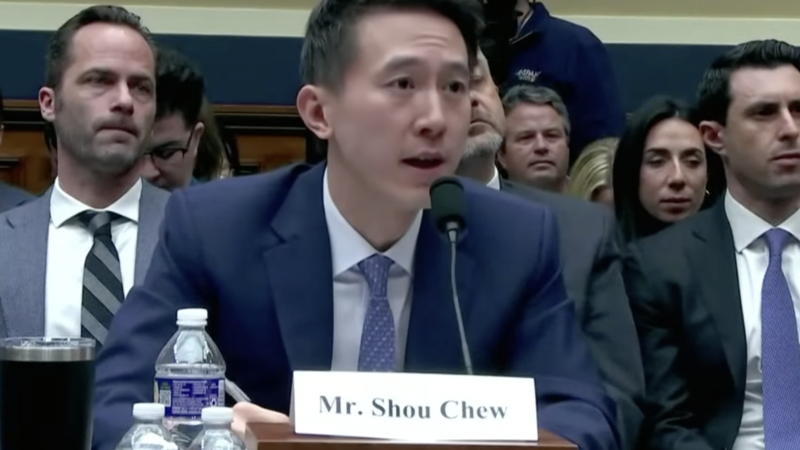
screenshot of TikTok CEO Shou Zi Chew testifying before the House committee

Today’s congressional hearing on TikTok was supposed to probe the company’s ties to China, its plans to secure U.S. user data, and its effect on kids. For this purpose, the House Committee on Energy and Commerce called in TikTok CEO Shou Zi Chew to testify. But it quickly became clear that lawmakers weren’t at all interested in hearing what he had to say. Chew was there—as so many tech company leaders have been in recent years—as part punching bag and part prop, a body against which the dozens of participating lawmakers could hurl rants about algorithms, social media, and, in this case, communists.

During the first several hours of the TikTok hearing, lawmakers were largely split between focusing on issues of user privacy and national security and on whether TikTok is harming teenagers and other vulnerable populations. But on both fronts, Chew’s interrogators seemed more intent on grandstanding than on actually learning or uncovering anything new.

Imagine someone repeatedly asking you if you plan to stop killing puppies. You would probably want to assert that you did not, in fact, kill puppies in the first place. Now imagine that every time you tried to say this, your interrogator yelled that whether you would stop murdering puppies was a simple yes or no question—so yes or no? That’s basically what happened with Chew at this hearing, over and over again.

This is a shame, because there are actually lots of issues on which his answers could have been illuminating—especially about Project Texas, TikTok’s plan to protect user data and give a third party (Oracle Corp.) access to its code.

Instead, the parts about TikTok’s parent company ByteDance and its ties to the Chinese government followed a predictable pattern. A lawmaker would assert some unsubstantiated claim about Chew, TikTok, and/or ByteDance being tools of the Chinese Communist Party (CCP) and ask Chew some variation on whether he planned to remedy this. When Chew would start to object to the premise of the question, the lawmaker would quickly interrupt, insisting either that Chew was being untruthful or that it was a simple binary question and Chew could only answer yes or no.

It was maddening to watch, making clear just how little lawmakers cared about anything but hearing themselves talk. A few samples exchanges:

Rep. Anna Eshoo (D–Calif.) asked how TikTok can say there’s a firewall on U.S. user data because “the Chinese government has that data.” Chew responded, “Congresswoman, I have seen no evidence that the Chinese government has access to that data.” Eshoo countered, “I find that preposterous.”

Rep. Kat Cammack (R–Fla.) closed her time by telling Chew, “Your app is an extension of the CCP.” Chew asked if he could respond but was told no, it was time to move on.

Rep. Bill Johnson (R–Ohio) claimed that TikTok’s code was “riddled” with avenues of CCP “censorship” and asked Chew whether he had directed TikTok employees to “change that source code.” Chew started to object, saying he didn’t understand the question, and was told by Johnson that he should just answer yes or no.

Rep. Tim Walberg (R–Mich.) claimed ByteDance is “connected directly to the Chinese Communist Party.” Chew said that wasn’t true. Walberg said, “It’s a fact,” and Chew—starting to appear the slightest bit frustrated by this point—said, “It’s not actually.” Walberg said Chew reports directly to ByteDance, followed by, “Let me move on.”

The demand that Chew provide yes or no answers to questions that clearly required more nuance was also a prominent feature of folks asking him whether TikTok was bad for children, people with eating disorders, and other groups. Lawmakers would offer a tragic anecdote about a kid who did something harmful after allegedly learning about it on TikTok or some sort of cartoonishly evil take on TikTok’s operations. Then they would demand Chew answer yes or no to an inquiry premised on the fact that this evil caricature was true or to a complicated question about how TikTok’s algorithm factored in or something like that.

“Your technology is literally leading to death,” said Rep. Gus Bilirakis (R–Fla.) after telling a story about a young man who was supposedly driven to suicide by watching TikTok videos. “Mr. Chew, yes or no, do you have full responsibility for your algorithms used to prioritize content?”

When Chew tried to express sympathy to the kid’s family, as any normal human being might in such a situation, Bilirakis interrupted, barking “Yes or no?” before launching into a tirade about how “we must save our children from big tech companies.”

A lot of lawmakers took their turn questioning Chew to go on generic rants about how social media, algorithms, and tech companies were dangerous to minors. For instance: Big tech platforms, like cigarette companies, made a deliberate choice “to addict kids,” said Rep. Kathy Castor (D–Fla.).

Others wanted to berate Chew because not everything posted to TikTok is 100 percent accurate (welcome to the internet, folks!). For instance, Rep. Diana DeGette (D–Colo.) was concerned that people could find incorrect information about self-induced abortions and COVID-19 treatments.

And what would a congressional hearing about tech issues be without a few doses of utter cluelessness about technology?

Rep. Richard Hudson (R–N.C.) wanted to know if TikTok accessed home Wi-Fi networks (if a person with TikTok on their phone connected to a home Wi-Fi network, then yes, Chew explained) and if that means TikTok was also accessing other devices connected to that Wi-Fi network. Rep. John Curtis (R–Utah) asked Chew if TikTok could write an algorithm that would “persuade me to change my view on a policy issue?”

Rep. Paul Tonko (D–N.Y.) asked if Chew could pledge that TikTok would stop using data about users’ mental health to push particular content to them. When Chew responded, “We don’t do that,” he was greeted with the familiar refrain: “Yes or no?”

Tonko went on to ask what percentage of content seen by a TikTok user could be categorized as “harmful” and seemed annoyed by Chew’s inability to simply spit out a percentage (as if there’s some way to say definitively if every single video is harmful or not and if TikTok deliberately chooses to push some amount of dangerous videos to all users). Tonko upped this absurd question with more specific versions of it, demanding Chew say how much “distressing content” was pushed to teens, to expecting or new parents, to people with eating disorders, and to people with addiction issues (as if TikTok even knows such details about the personal lives of its users in the first place).

Rep. Brett Guthrie (R-Ky.) asked why TikTok couldn’t be as good as some Chinese social media apps at removing potentially harmful content about government officials. “They dance around the issue, but of course the reason is that there’s less free speech in China,” commented Daniel Castro, vice president of the think tank Information Technology and Innovation Foundation. “Americans should be glad that US social media is more free.”

That gets at perhaps the central paradox of the hearing. U.S. lawmakers profess worry about the control the Chinese government has over private businesses, social media platforms, and internet user data of Chinese companies. At the same time, they’re seeking ever more information from and control over U.S. platforms.

The post Congress Asks Is TikTok Really 'An Extension of' the Chinese Communist Party? appeared first on Reason.com.

from Latest https://ift.tt/ISEd7i4
via IFTTT