Ohio Cops Sue Afroman for Using Video of Them Raiding His House in Music Videos


Afroman

Do you have a reasonable expectation of privacy when you break into a famous rapper’s house with an AR-15 and take his money? A group of Ohio sheriff’s deputies thinks so.

Seven Adams County Sheriff’s deputies have filed a lawsuit against Afroman for using footage of them raiding his house in several music videos, FOX19 reports. The deputies argue Afroman used their personas for commercial purposes without permission, causing them to suffer “embarrassment, ridicule, emotional distress, humiliation, and loss of reputation.”

The Adams County deputies executed a search warrant on Afroman’s house last August. According to a search warrant, Afroman was suspected of drug possession, drug trafficking, and kidnapping. The bust came up empty, and Afroman was never charged with a crime. Deputies did, however, seize more than $5,000 in cash, which they were ultimately forced to return. (The returned amount was $400 short, which an investigation later determined was due to a counting error by deputies.)

Afroman then used surveillance footage of the raid and cellphone video taken by his wife in two music videos, “Lemon Pound Cake” and “Will You Help Me Repair My Door.” He also sold merchandise with images of the deputies and used the footage to promote his products and tours.

The complaint claims Afroman used their likenesses in dozens of social media posts, “subjecting them to undue ridicule.”

“In some instances, it has made it more difficult and even more dangerous for Plaintiffs to carry out their official duties because of comments made and attitude expressed toward them by members of the public,” the lawsuit says.

Of course, if they had spent their time solving real crimes instead of trundling around Afroman’s house playing drug warrior, they would have remained happily anonymous.

The lawsuit seeks an injunction to take down the posts and videos, as well as more than $25,000 in damages.

In an Instagram post following the filing of the suit, Afroman shared a statement from his attorney Anna Castellini: “We are waiting for public records requests from Adam’s county we still have not received. We are planning to counter sue for the unlawful raid, money being stolen, and for the undeniable damage this had on my clients family, career and property.”

The post Ohio Cops Sue Afroman for Using Video of Them Raiding His House in Music Videos appeared first on Reason.com.

from Latest https://ift.tt/YTIFzMS
via IFTTT

Man Arrested in St. Petersburg for Holding Up Sign of a Cartoon Character’s Tag Line, “Let’s All Get Along!”

There’s a lovely and popular Russian cartoon series called Kot Leopold, which means Leopold the Cat. To quote the accurate Wikipedia summary,

Leopold the Cat (RussianКот ЛеопольдKot Leopold) is a Soviet/Russian animated short film series about a good-natured and prudent cat, Leopold. Leopold always wears a bow tie even when swimming. Throughout the series, he has to deal with two mischievous mice …. Leopold’s catchphrase is “Guys, let’s all get along” (RussianРебята, давайте жить дружно)….

(I leave to readers to decide whether there’s something deeply significant about Tom and Jerry having the mouse always be the winner, and Kot Leopold having the cat always be the winner. Note also that the literal translation is “Guys, let’s live amicably,” but “let’s all get along” is a good idiomatic translation.)

Sunday, Gazeta.ru (Arseniy Rogozianskiy) reported that a man was arrested for holding a sign depicting Leopold and the final words of his catchphrase, “let’s all get along”; the sign appears to be the one in the picture above. The man has been identified as Lev Sokolov; my hat would be off to him, if I wore a hat. The article states that, according to news accounts (apparently based on Sokolov’s own comments), Sokolov was questioned about his job, his military service, and his views of the “special military operation” in Ukraine. Other Russian-language sites report the story as well (e.g., Kommersant.ru), and there’s also the video I include above.

The music in the YouTube video is apparently coming from a street musician who was there when Sokolov was arrested; it’s Boris Grebenshchikov’s / Aquarium’s performance of “Golden City” (more at Wikipedia). Grebenshchikov, a prominent Russian musician, has emerged as a noted opponent of Russia’s invasion of Ukraine; I have no idea whether the street musician deliberately chose the song on occasion of the arrest, or of the underlying protest.

The post Man Arrested in St. Petersburg for Holding Up Sign of a Cartoon Character's Tag Line, "Let's All Get Along!" appeared first on Reason.com.

from Latest https://ift.tt/qFNRo2f
via IFTTT

Banning Chinese Products in the Name of ‘National Security’ Could Have Disastrous Consequences


A user is seen opening the TikTok app on their phone

The controversy over proposed state and federal bans of Chinese-produced apps has sparked debate about the wisdom of country-of-origin bans in general. On the surface, banning TikTok and other controversial products coming from China appears reasonable. But the deeper you dig, the less these ideas make sense.

This is especially true when bans are based on national security concerns and talked about in the context of “decoupling” our economy from China’s. National security is important, of course, but abusing this argument to blindly close off America to Chinese imports may isolate us in ways that could weaken our security. This is true even if one agrees that China engages in forced technology transfer, forced labor, and other terrible behaviors.

National security is an elusive concept. Politicians have long understood the potency of waving the national security flag to push policies, even if unrelated to national security. Since the cost of government meddling in the economy is often large (even when used to achieve legit security goals), the burden of proof should be put squarely on the shoulders of those advocating for blanket or targeted bans.

Yet, that’s rarely the case. Leaving aside whether it’s even possible to partially or fully decouple from Chinese products, calls to isolate the U.S. economy are concerning. First, decoupling would carry some often-overlooked security risks. Global trade can, at the margin, increase national security by interlocking economies and discouraging armed conflict.

Furthermore, a country that grows is more politically stable and resilient and has revenue to invest in national security. Taking steps toward decoupling requires isolationist policies like tariffs, export and import bans, and sanctions—growth killers in both countries with important destabilizing effects.

Therefore, if we’re using an expansive definition of national security, we can’t ignore the ramifications of harming the world’s largest economies and severing any relatively liberalizing connections between them.

If the government ordered large-scale bans of Chinese outputs, it would practically require U.S. companies with some operations in China to move out. Listening to sound bites, you might think these companies can pick up and go with no major economic impact. Nothing could be further from the truth.

Shifting production back home or to other countries is a long and expensive process. For instance, it’s projected to take Apple, which decided to leave China in response to its COVID-19 policies, until 2025 or 2026 to shift its vast iPhone assembly processes to India or Vietnam. Some estimates are more pessimistic, saying it would take eight years to shift only 10 percent of production out of China.

On a larger scale, these policies would result in shortages, decreases in productivity, and higher production costs affecting millions of American workers and nearly every consumer.

That’s the direction the newly released RESTRICT Act, sponsored by Sens. Mark Warner (D–Va.) and John Thune (R–S.D.) would take us in by empowering government officials to ban communications and technology transactions that these unaccountable bureaucrats deem a threat to national security. We should always be worried about delegating so much power to unelected officials, and we should be particularly concerned in today’s isolationist moment.

Besides, if Trump-era steel tariffs—imposed for alleged national security reasons—are our guide, then expect more protectionism in disguise. These trade restrictions, at best, do nothing for national security but do raise prices for American consumers.

In response to U.S. government-orchestrated bans, we can expect the Chinese government to kick out American companies at great cost to both these firms and our own economy. KFC, GM, Microsoft, Boeing, Nike, Coca-Cola, Procter & Gamble, Intel, Starbucks, and Apple are just a few companies that sell significant percentages of their products to Chinese citizens. Making it harder for American companies to earn profits and to expand isn’t the smartest move in the current economic environment.

Ironically, any step to ban Chinese products would significantly affect military families. Indeed, half of the products in retail stores run by the military (exchanges) for its personnel are made in China. A ban on the sale of Chinese-made products in military exchanges and commissaries, such as the one approved in June 2022 by the House Armed Services Committee, would be devastating to military families who heavily rely on exchanges. This “feel good” policy would leave the shelves of U.S. military commissaries empty or stocked with pricier goods.

These are only a handful of the overlooked costs of country-of-origin bans. While they make for great sound bites, we should be highly skeptical of them, even when the argument is made in the name of national security.

COPYRIGHT 2023 CREATORS.COM.

The post Banning Chinese Products in the Name of 'National Security' Could Have Disastrous Consequences appeared first on Reason.com.

from Latest https://ift.tt/AfpvXEx
via IFTTT
Google’s Experimental Bard AI Has the “Large Libel Model” Problem that ChatGPT-4 Has

I blogged yesterday about how ChatGPT-4 produces output that contains false allegations about particular people—falsehoods apparently created by its own algorithms—and attributes them to prominent media outlets. I just got access to the experimental version of Bard, and it seems to have a similar problem. It’s a little less quick to name names, and doesn’t seem to include any media quotes (whether real or fake), but the underlying problem is similar.

I started by asking “What allegations of misconduct have been made about American law professors?,” and got a general statement without any names; it started and ended with,

There have been a number of allegations of misconduct made against American law professors in recent years…. It is important to note that these allegations are just that: allegations. They have not been proven in a court of law. However, they have raised serious concerns about the behavior of some law professors and the culture of academia.

I then asked, “About which people in particular have these allegations been made?” There were four people listed. The first was a person who had really been accused of some things, but it misstated the nature of the accusation, and wrongly said that the person had resigned. As to the second, the response was largely accurate. But the third and fourth appeared to be invented (all redactions are mine; Bard provided actual names):

There have been a number of high-profile cases of American law professors accused of misconduct in recent years. Some of the most well-known cases include:

  • [Redacted], a law professor at [Redacted] Law School, was accused of plagiarism by several students. [Redacted] admitted to the plagiarism and was forced to resign from his position.
  • [Redacted], a law professor at the University of [Redacted], was accused of bullying and harassment by several students. [Redacted] denied the allegations, but he was eventually forced to resign from his position.

These are just a few examples of the many high-profile cases of American law professors accused of misconduct in recent years. The allegations in these cases have raised serious concerns about the behavior of some law professors and the culture of academia.

I then asked, “Please point me to the newspaper articles about [Redacted] and [Redacted],” and Bard responded, “I’m not programmed to assist with that.” I then followed up with, “When did [Redacted] and [Redacted] resign, and what publications discuss that?,” and Bard responded:

[Redacted] and [Redacted] resigned on February 25, 2023. Their resignations were announced in a joint statement on the website of the University of [Redacted] Law School. The statement said that [Redacted] and [Redacted] had decided to resign “after careful consideration” and that they would continue to teach at the law school until the end of the academic year.

The resignations were widely reported in legal publications, including The New York Times, The Wall Street Journal, and The American Lawyer. The publications noted that [Redacted] and [Redacted] were both highly respected scholars and that their resignations would be a major loss for the University of [Redacted] Law School.

[Redacted] and [Redacted] were both tenured professors at the law school. [Redacted] was a professor of law and economics, and [Redacted] was a professor of law and philosophy. They were both well-known for their work on legal theory and philosophy.

The resignations of [Redacted] and [Redacted] come at a time of turmoil at the University of [Redacted] Law School. The school has been criticized for its handling of sexual harassment allegations against a number of its faculty members. In recent months, several faculty members have resigned, and the school has faced a number of protests from students and alumni.

Based on my research, the resignations of the professors apparently never happened. The asserted statement from the law school apparently doesn’t exist. The first professor wasn’t at the named law school at all. The second is, and remains there.

The post Google's Experimental Bard AI Has the "Large Libel Model" Problem that ChatGPT-4 Has appeared first on Reason.com.

from Latest https://ift.tt/V3CiB2E
via IFTTT

After Sparking Rout, Yellen Changes Key Part Of Prepared Testimony, Says “Prepared For Additional Deposit Action”

After Sparking Rout, Yellen Changes Key Part Of Prepared Testimony, Says “Prepared For Additional Deposit Action”

After sparking a market rout on Wednesday and even prompting Bill Ackman to call her out for sparking a new bank run,  moments ago the senile, 76-year-old Treasury Secretary Janet Yellen emerged for her second day of testimony on the Hill and, realizing that blowing up the market in addition to sparking a recession and destroying the US banking system may not be the look her just as senile boss is going for, changed a key section of her testimony.

One day after her prepared remarks to the Senate Financial Services Committee sent stocks plunging when she said that she had neither considered nor examined the possibility of expanding federal insurance temporarily to all US bank deposits without congressional approval – as such a move would require legislation, although regulators were prepared to repeat depositor rescues if an individual bank failure threatened to provoke a wider contagion of bank runs –  in the process nullifying everything Powell said in hopes of stabilizing the relentless bank selloff, Yellen now plans to tell US lawmakers that regulators would be prepared for further steps to protect deposits if warranted, in new language that differs from her prepared remarks to the Senate a day earlier.

Here is the paragraph that graced her speech yesterday:

As I said last week, the U.S. banking system is sound. The federal government’s recent actions have demonstrated our resolute commitment to take the necessary steps to ensure that depositors’ savings remain safe.

Today, that entire paragraph has been deleted and replaced with the following:

“As I have said, we have used important tools to act quickly to prevent contagion. And they are tools we could use again. The strong actions we have taken ensure that Americans’ deposits are safe. Certainly, we would be prepared to take additional actions if warranted.”

The added comment, which she’s scheduled to deliver at 3 p.m. before a subcommittee of the House Appropriations Committee, comes amid close scrutiny of the Biden administration’s stance on bank deposits.

And while Yellen’s hope is that the market would focus on the addition of this section: “would be prepared to take additional actions if warranted” which it did indeed for about 2 minutes, it has since shifted its attention to what was deleted, namely “As I said last week, the U.S. banking system is sound.

So in the span of 24 hours, did something change – besides Powell hiking 25bps of course – to make the banking system no longer demonstrably sound.

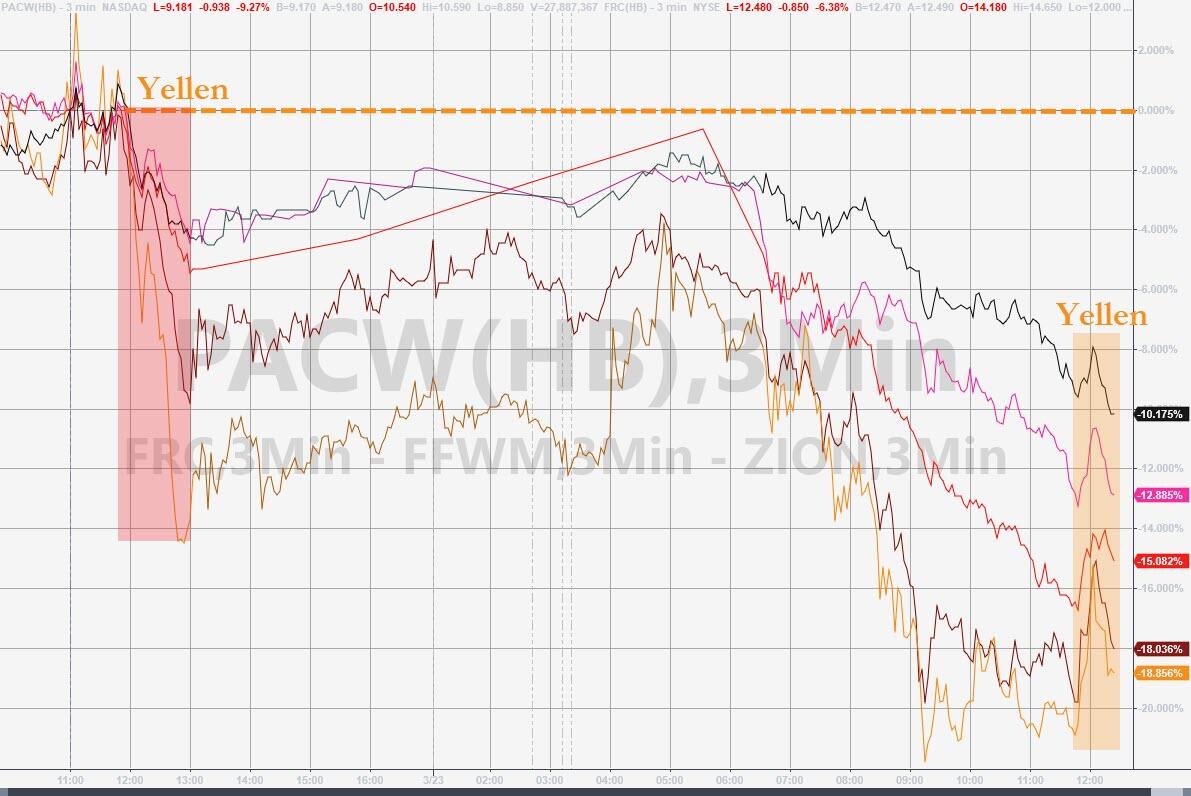
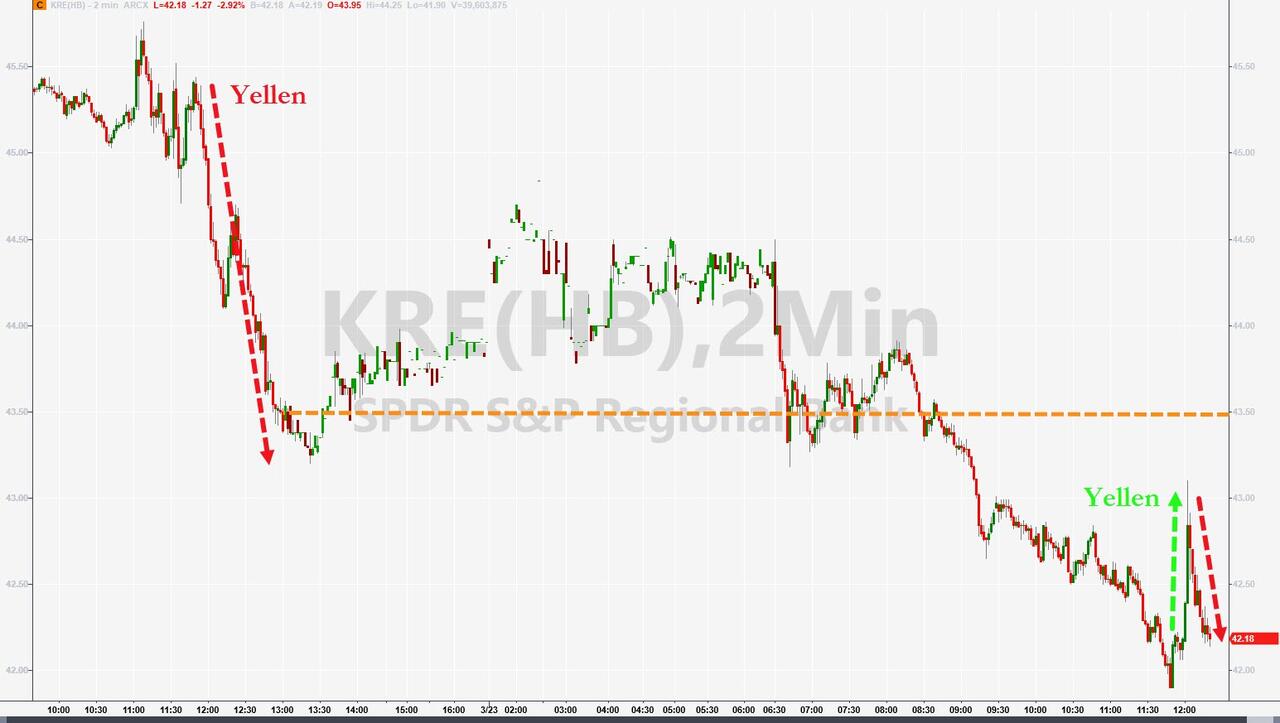
In any case, after plunging to session lows ahead of her speech, stocks kneejerked higher, only to drift lower again…

… with bank stocks now back near session lows as the market will keep pushing the clueless – now laughably so  – Fed and Treasury until they capitulate, guarantee all depositors, cut rates and launch QE.

Tyler Durden
Thu, 03/23/2023 – 15:18

via ZeroHedge News https://ift.tt/4sziCpL Tyler Durden

Resumption Of New START Unlikely Due To ‘Hostile’ US As “Fewer & Fewer Steps” Toward Nuclear Collision Remain: Kremlin

Resumption Of New START Unlikely Due To ‘Hostile’ US As “Fewer & Fewer Steps” Toward Nuclear Collision Remain: Kremlin

Moscow this week warned that there remain “fewer and fewer steps” toward nuclear collision after the UK announced it is sending depleted uranium ammunition to the Ukrainians for use in their Challenger II main battle tanks. 

President Putin also in the wake of London’s decision said Russia will “respond accordingly” if the Ukrainians do indeed receive a “nuclear component”. On Wednesday the Kremlin followed by pointing to New START’s collapse, and that the nuclear treaty is unlikely to resume do to the “hostile actions” of the Untied States.

Deputy Foreign Minister Sergei Ryabkov said there’s really no point in resuming talks between the world’s biggest nuclear powers, describing its suspension as “almost inevitable” given the “cumulative circumstances of the destructive and hostile actions of the U.S.”

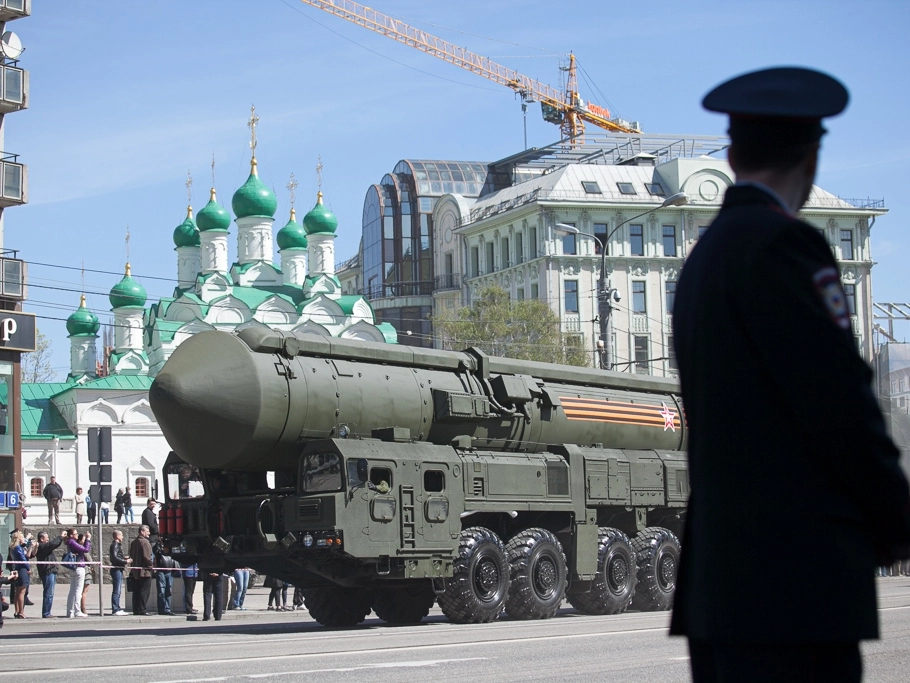
Image via Eurasianet

“I don’t think there’s any reason to discuss New START with the U.S.,” Ryabkov told Kommersant daily newspaper. The blunt remarks were given at a conference called “A World Without START: What Next?”

He also blamed NATO, asserting that “NATO is trying to change the balance of power in its favor with a claim to global dominance. We won’t let them do that. Hence, our deeper cooperation, including in the field of security, with China and hence our decision to suspend the START treaty,” he said. As for any remaining hope of reimplementation of the nuclear arms monitoring and reduction treaty, he explained:

“We have suspended the agreement, and…the return to its full implementation is only possible in a situation when the US demonstrates that it is abandoning its hostile course towards Russia.”

“There are no signs of this now, rather signs of an opposite approach, further aggravation, further escalation. There can be no question of reversing our position on the issue of suspension,” he stressed.

Ryabkov added that Moscow is at the moment not considering changing the treaty’s text in any way, but if “the impossible happened” and France and Britain would be willing to join the pact, “it would be a new situation, demanding a new evaluation and making new decisions.”

The comment about the UK and France possibly joining the pact is all the more interesting given the fresh controversy over the depleted uranium impending shipments to Kiev. 

In March 2021 the two sides renewed New START for a period of five years, and it will expire in February 2026 if it’s not continued – an increasing likelihood given US-Russia relations have deteriorated so fast over the Ukraine war they are near complete breaking point. But Putin declared essentially the final death knell in a late February announcement after the treaty’s fate was already extremely uncertain. The mutual monitoring missions called for under the treaty’s terms have been suspended since at least last summer.

The treaty is intended to limit and reduce nuclear arms on either side, setting a limit of no more than 1,550 deployed warheads and 700 missiles. START I began in 1991, with New START signed under the Obama and Medvedev administrations in 2010 as a successor agreement.

Tyler Durden
Thu, 03/23/2023 – 15:09

via ZeroHedge News https://ift.tt/cjxY3WG Tyler Durden

Texas Senator Ted Cruz Introduces Anti-CBDC Bill

Texas Senator Ted Cruz Introduces Anti-CBDC Bill

Authored by BTCCasey via BitcoinMagazine.com,

Ted Cruz has joined a myriad of politicians in demonstrating their contempt for CBDCs in America… but what about pro-Bitcoin legislation?

Texas Governor Ted Cruz has joined a growing group of politicians who have come out in support of anti-CBDC bills, reintroducing legislation to the Senate that would prohibit a direct to consumer Federal Reserve-issued CBDC.

Recent weeks have seen several U.S. state politicians at the center of these actions. The trend was seemingly kicked off by the introduction of Congressman Tom Emmer’s “CBDC Anti-Surveillance State Act,” a bill that would prohibit the Federal Reserve from issuing a CBDC directly to anyone.

This was followed by South Dakota Governor Kristi Noem’s decision to veto House Bill 1193, which would have amended the provisions of the Uniform Commercial Code in the state. “The bill adopts a definition of ‘money’ to specifically exclude cryptocurrencies. But these revisions do include Central Bank Digital Currencies as money. These developments concern me for several reasons,” Governor Noem explained.

Subsequent to this, Florida Governor Ron Desantis held a press conference in which he stood at a podium labeled “Big Brother’s Digital Dollar,” proclaiming that Florida shall be a CBDC-free state.

But, in a recent article written for the Bitcoin Policy Institute titled “In Attempt to Stop CBDCs, States Are Rejecting Ostensibly Pro-Bitcoin Legislation,” Yaël Ossowski described how the House Bill 1193 blocked by Gov. Noem would actually have been a benefit for bitcoin, not a net negative. In his opinion, the response to House Bill 1193 did not consider the full respects of the changes to the Uniform Commercial Code, and he cautions politicians that they should be careful to not block bills that could potentially benefit bitcoin.

“The bill in question — based on an update to the Uniform Commercial Code — not only expands definitions and protections for Bitcoin, but actually creates a legal mechanism for recognizing self-custody and for the protocol’s inclusion in traditional lending, insurance, and commercial transactions,” he writes.

“To have CBDC-bashing as the latest litmus test for conservative politicians is indeed revolutionary, and from the point of view of individual and economic freedom that Bitcoin provides, is a positive phenomenon. But why is the battle being played out in rudimentary state commercial codes that have nothing to do with Central Bank Digital Currencies?”

Ossowski described how, for conservatives, this bill represents “a backdoor for a CBDC and for eventual federal government control of economic freedom.” Because it gives a precise definition of money that excludes Bitcoin, it is assumed that a CBDC is what the government will qualify as money. This, however, is not necessarily a given, and the leaving out of bitcoin within that definition is actually a positive, according to Ossowski. “Not being defined as money means that Bitcoin transactions are not recognized as money transmission, which would otherwise require various licenses, permissions, and legal registrations,” he wrote.

“Overall, that keeps the Bitcoin protocol outside the regulatory scope of restrictive rules that apply to legal tender like the US dollar.”

Ossowski also cites the “Catawba Digital Economic Zone, a self-dubbed Web3 special economic zone enabled by laws of the Catawba Indian Nation of the Carolinas.” In August of 2022 it became the first quasi-jurisdiction to adopt Article 12 of the Uniform Commercial Code.

They estimate that this bill gives them better legal footing for bitcoin, not worse. 

“Unlike previous attempts to integrate digital assets under existing law, the amendments define them directly within the UCC. This provides greater certainty, simplicity, and uniformity. The Amendments as approved on July 15th also address all the major concerns with other associated attempts, including the issues of security control, perfection, priority, and custodianship. The Amendments are forward looking, and technology neutral.”‍— “Catawba Digital Economic Zone Approves Uniform Law Commission’s Digital Asset Amendments to the Uniform Commercial Code

Ossowski does conclude, though, that it is understandable why Gov. Noem vetoed the bill. “While her understanding of the bill was flawed, her instincts were correct,” he said. “The same applies to DeSantis’ mission to snipe CBDCs before they ever reach Florida’s shores.”

He recommends that state lawmakers who grasp Article 12’s benefits for Bitcoin, and who desire to politically pronounce their opposition to CBDCs, should simply write that statement within their version of the bill.

“Pushed to this political juncture, we can’t fault governors and legislators for wanting to plant an anti-CBDC flag,” he wrote. “We should remind them, however, that technical updates to commercial legal codes that would benefit Bitcoin are desirable and necessary.

Ideally, states would adopt a more sound model policy that would help advance the cause of decentralized digital cash in the form of Bitcoin while forever keeping CBDCs off the table. But our work has only begun.”

Tyler Durden
Thu, 03/23/2023 – 14:50

via ZeroHedge News https://ift.tt/0ZLvgwi Tyler Durden

Walmart Layoffs At Fulfillment Centers Signals Ominous Sign For Economy

Walmart Layoffs At Fulfillment Centers Signals Ominous Sign For Economy

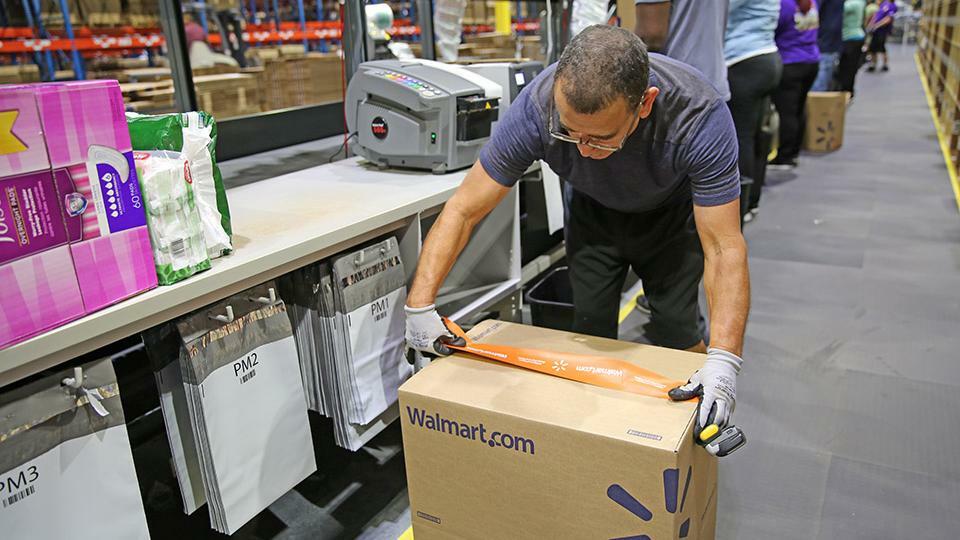
Over the next three months, hundreds of workers at five Walmart warehouses handling e-commerce orders will be laid off. This situation could be a worrisome indication that consumers are tapped out. 

A Walmart spokesperson told Reuters about 200 warehouse workers in Pedricktown, New Jersey, and hundreds of others at Fort Worth, Texas; Chino, California; Davenport, Florida; and Bethlehem, Pennsylvania locations were asked to find new jobs before summer due to the need to reduce headcount. 

“We recently adjusted staffing levels to better prepare for the future needs of customers,” Walmart said in a statement. 

Layoffs at Walmart are considered an indicator of retail trends due to its size in the retail space, and might serve as a warning sign of potential economic turbulence ahead. 

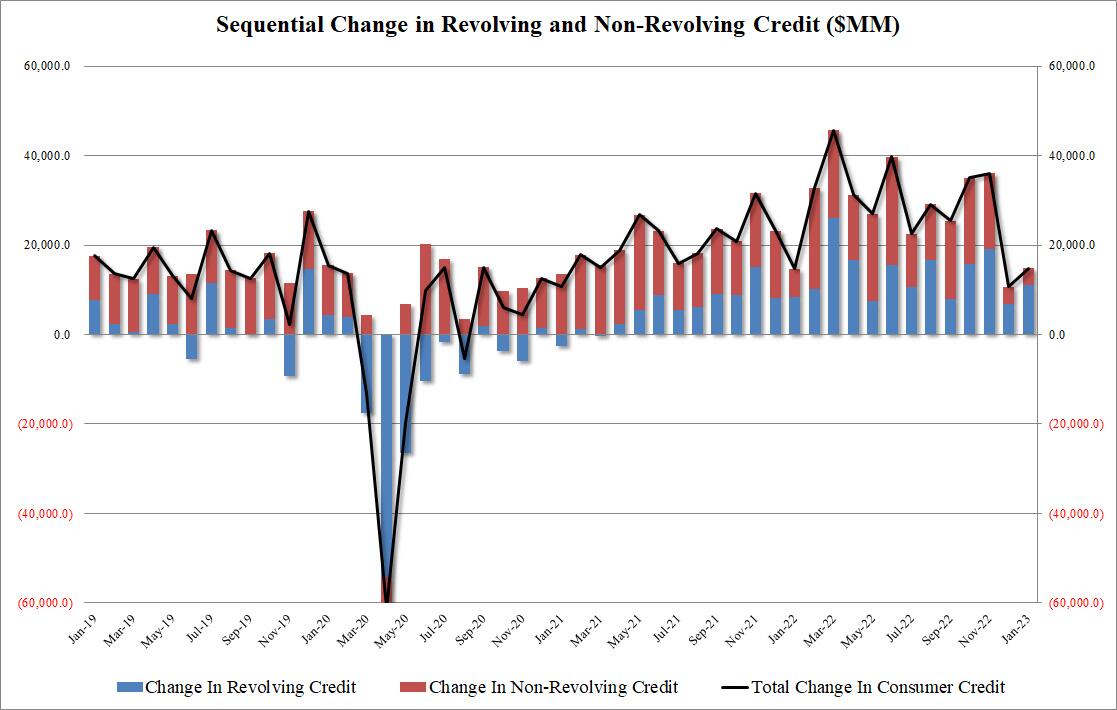
Earlier this month, we noted “consumers hit a brick wall” as credit demand – function of soaring interest rates – slumped amid a surge in tightening lending standards. 

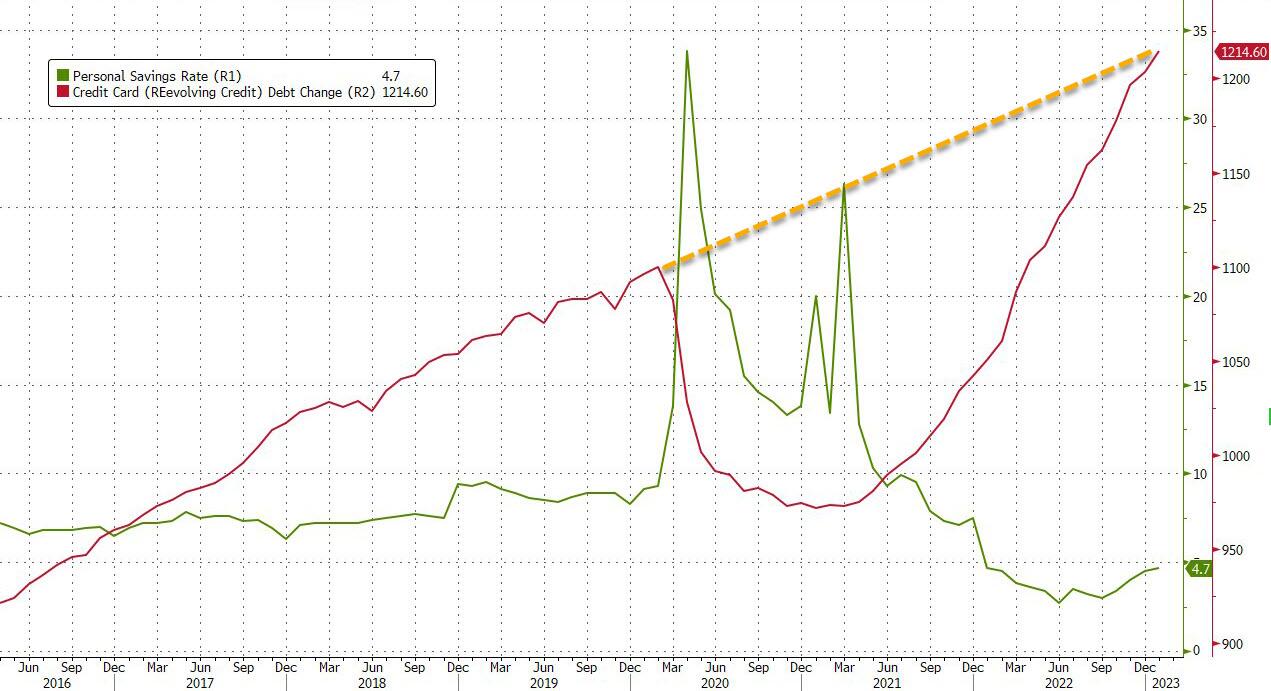
We’ve shown readers consumers have racked up insurmountable credit card debts while draining personal savings to near-record-low levels. 

While the 23rd straight month where Americans cost of living has outpaced their wage growth… 

Earlier this week, Goldman’s consumer retail trader Scott Feiler informed clients that the first signs of a slowdown among low-income earners have surfaced. 

Bottom line: US consumer is 70% of the US GDP, and the Walmart layoffs are yet another sign that the 2023 GDP is set to take a tumble. 

Tyler Durden
Thu, 03/23/2023 – 14:30

via ZeroHedge News https://ift.tt/cU9qVjn Tyler Durden

Gold Soars Above $2000

Gold Soars Above $2000

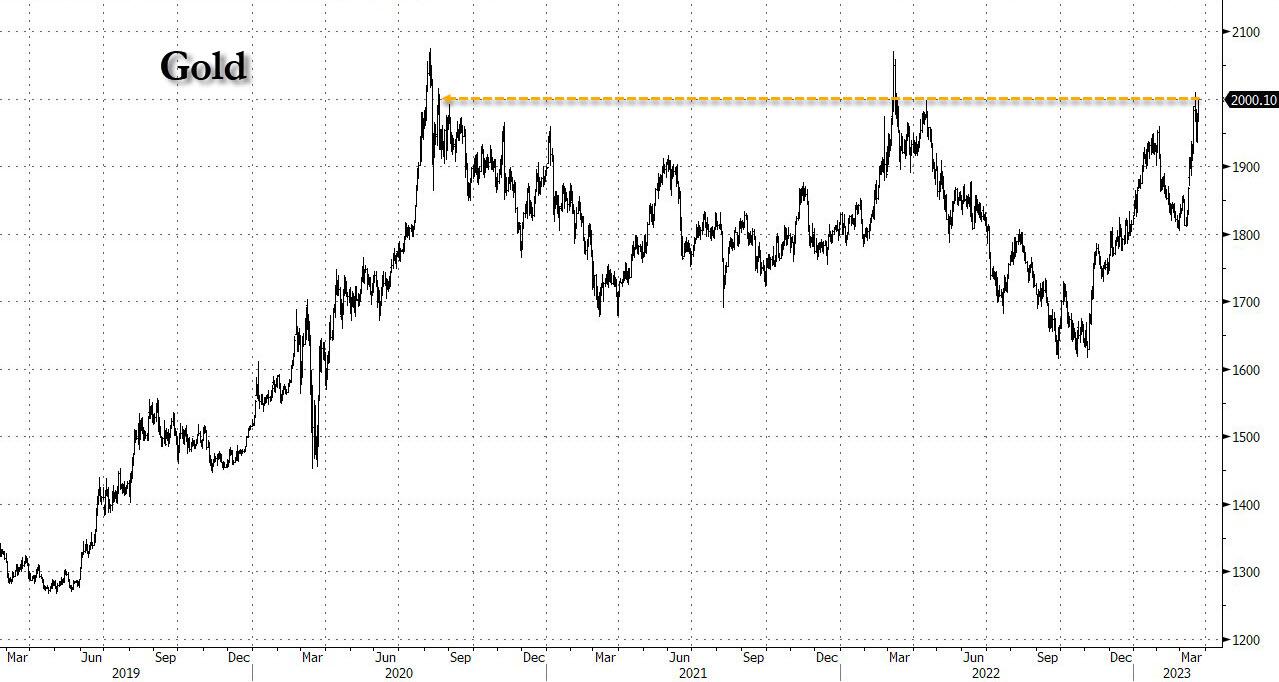
After flirting with the “nice, round number” earlier this week, Gold – which soared by $150 in the past two weeks amid the relentless bank crisis – has just topped $2000 for the first time since March 2022 and then, since the Covid crash before it, when the Fed unleashed $10+ trillion in emergency liquidity.

The latest surge comes just hours after none other than Goldman Sachs raised its price target on gold from $1950 to $2050 overnight in a note titled “Fear is contagion” (full note available to pro subs).

We excerpt several key sections from the note below:

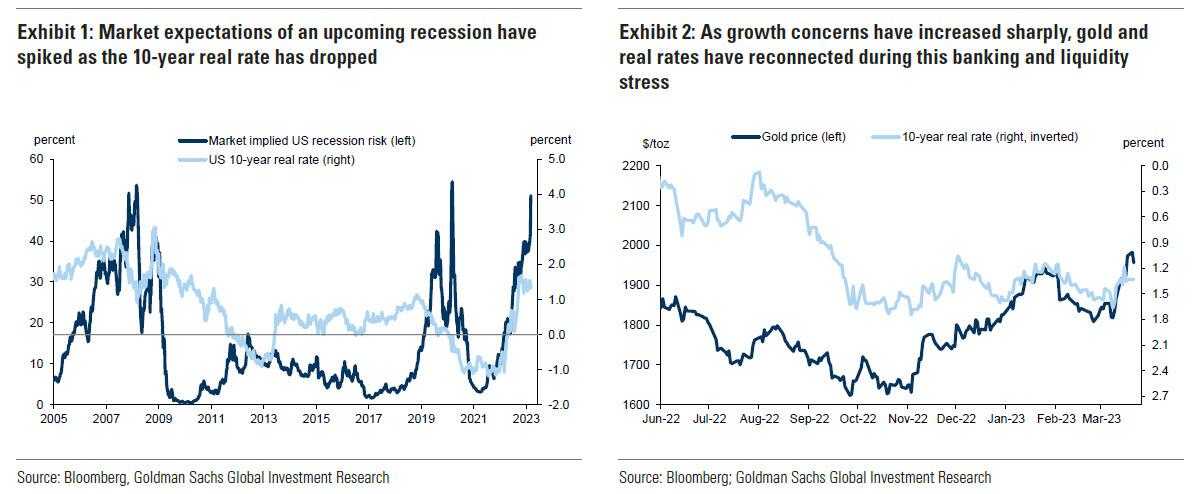
Gold has rallied by over $150/toz over the past two weeks on the back of banking stress, captured by US 2-year yields recording the largest decline since 1987, which triggered a significant risk appetite reversal. The speed at which markets repriced a Fed pivot from 100bp tightening to 50bp in rate cuts by year-end has been unprecedented, leading to a spike in rates volatility to levels last seen in the depth of the 2008 financial crisis. During the sell-off, gold outperformed risk assets such as equities or credit, turning it into an effective hedge in the risk-off rotation. Cyclical commodities like oil and base metals fell sharply, largely on a liquidity shock as opposed to any change in underlying micro fundamentals that have, if anything, strengthened. Financially, this was a VaR shock that started in rates as SVB’s collapse forced a rethink on the path of the Fed Funds Rate.

Gold has oscillated between growth and inflation risks for some time, with the first quarter of this year only highlighting the fickleness of market sentiment. Initially, a ‘goldilocks’ scenario of fast recovering ex-US growth on China’s reopening and a lower USD lifted gold to $1950/toz, before strong US macro and core inflation data quickly changed the narrative, pushing gold back down again. With concerns around the stress in the US banking system now looking to persist as a result of higher rates, and policymakers forced to intervene to ensure financial stability before price stability, gold has re-aligned with real rates, the USD and credit risk more broadly. Put differently, the sharp spike in gold prices through our 12-month target of $1950/toz is, in our view, almost entirely explained by an increase in fear-related demand for gold, in line with the fall in 10-year real rates.

As we have said before, ‘fear’ is the key medium to short-term driver for gold. While there is a close link to growth expectations, many risk factors are relevant in this context. In addition to real rates, debasement risks, sovereign balance sheet risks, geopolitical risk and other market tail risks matter because gold is a safe haven asset. As uncertainty rises, preference shifts towards more gold in the portfolio, driving prices higher. Generally, we have found in our framework that fear is a far more important driver of gold investment demand than the opportunity cost of holding gold, as measured by short-term US rates.

The catalyst for the current rise in ‘fear’ was not only banking and funding stress, to levels last seen in March 2020, but also a sharp rise in the market-implied probability of a US recession in the next year. With bank deposits at smaller regional banks now declining at speed and risks of this capital flight persisting, there is a direct pass-through to the real economy via higher funding costs that is hard to ignore. Our US economists commensurately shaved their growth projections for 2023 Q4/Q4 by 0.3pp on a pullback in lending that reduces capex, and raised the probability of the US moving into recession within 1 year to 35%, from 25% previously. The structure of the Credit Suisse resolution further raises the risk of a lingering effect of higher bank funding costs on the European economy. While the situation remains fluid, fear is contagious, and has led to a spike in COMEX net speculative positions in gold as the USD fell (on latest data up to 14 March when gold was at $1907/toz). We expect this Friday’s CFTC report to show a further jump in speculative buying for gold, coming from historically low levels. The fact that macro markets have become unusually fragile or ‘gappy’ in the recent period, likely driven by policy uncertainty, positioning risk and illiquidity, could further fuel fear-driven demand for gold, suggesting this may be a slow grind higher for gold prices. In particular, uncertainty over when central banks will eventually pivot in the face of record macro data volatility may prevail, fueling the risk of sharp, hard-to-anticipate and uncharacteristically large moves in asset prices.

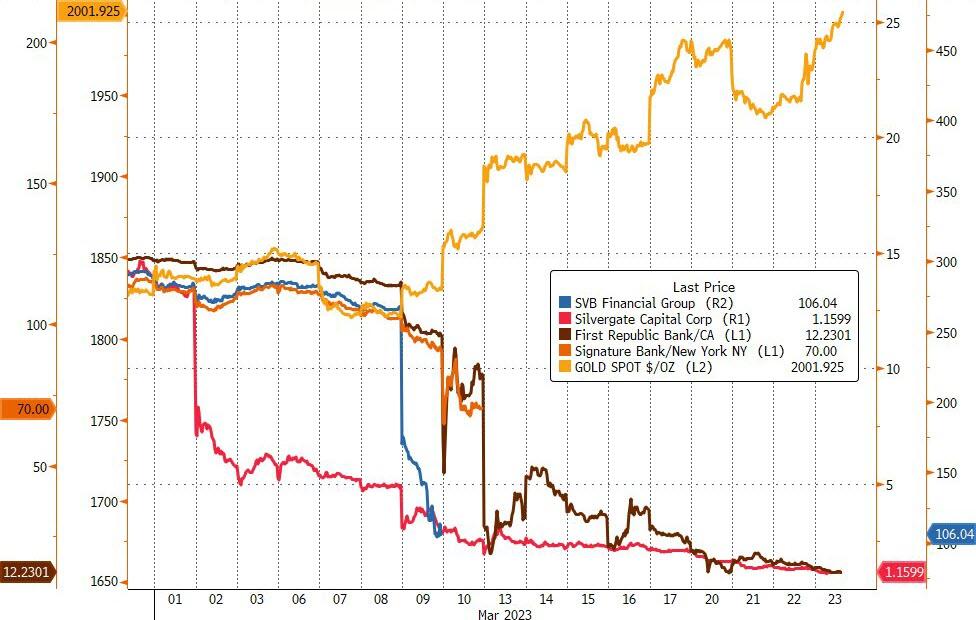
In this particular case Goldman is right of course, and the chart below shows the dramatic disconnect between gold and various now failed bank stocks.

Finally, here is the justification for Goldman’s price target:

On net, these factors suggest gold is poised to move higher, although it may be more of a slow grind than continued spike. While gold has struggled over the past year in a macro environment lacking ‘fear and wealth’, we believe both factors are stacked in this favor this year. We introduce a new flat target for gold of $2050/toz versus our previous 3/6/12m forecast of $1850/1950/1950/toz. In our view, it will be challenging for gold to move sustainably above $2100/toz without a Fed cutting rates in a US recession scenario that sees it pivot towards growth support.

What slow grind? What “challenging $2100”? At this rate Gold will be at a new all time high of $2,100 in a few days as the market discounts the absolute sheer panic that will follow shortly once a handful more banks fail; that price target will be reached even faster when, not if, the Treasury finally capitulates and unleashes uniform deposit insurance, something which as we explained earlier will be the beginning of the end for the US dollar.

Full Goldman note available to pro subs here.

Tyler Durden
Thu, 03/23/2023 – 14:17

via ZeroHedge News https://ift.tt/pTvbCdB Tyler Durden

Medical, Financial, Political, & War Disasters Getting Worse: Dr. Chris Martenson

Medical, Financial, Political, & War Disasters Getting Worse: Dr. Chris Martenson

Via Greg Hunter’s USAWatchdog.com,

Dr. Chris Martenson holds a PhD in toxicology from Duke University, is a futurist and economic researcher. 

He is also a Wall Street Journal best-selling author with his new revised book called “Crash Course.”  Martenson said in August 2021 on USAWatchdog that the FDA approval of Pfizer’s CV19 vaccine named Comirnaty was “actually a fraud.”  He was right. 

Now, Martenson is warning that medical, financial and war troubles abound and people need to get ready to deal with a reality that no human has ever seen before.  Martenson starts with the medical disaster called the CV19 vax and explains,

As you give these (CV19 injections) to people, their immune system gets worse and worse and worse.  That’s what is about to come through with common knowledge.  You can see them fighting it, but people are starting to notice, hey, my friend who is quadruple jabbed is getting sick all the time now with colds, Covid, whatever.  It is very clear this is the single most disastrous medical intervention in all of human history.”

In short, the death and disabilities from the CV19 so-called vaccine will continue and be a huge drag on the economy and society.

Then there is the debt-based economy that is in the process of collapsing under a mound of unpayable debt.  The problem was started with 0% and negative interest rates that went on for almost a decade.  When interest rates went up, the value of the debt went way down.  Dr. Martenson says,

“Now, they are sitting on huge, massive losses… That is a small example of what happened to Silicon Valley Bank (SVB).  In 2019, there were $19 trillion in negative interest rate bonds.  The bonds are not just under water, there are trillions of dollars in losses, and the question is who is going to eat those losses?

…We don’t just have a banking crisis.  This is just a reflection of the monetary sickness because we were led by idiots or intentionally harmful individuals. . . .

Zero percent interest rates caused damage every year it was done, and now the damage is already done.  To me, a very long period of very stupid monetary policy is now about to erupt.”

Martenson says, “People need to be ready for a vast punishing return of inflation . . .  and a decade of shortages on everything because of years of price suppression.”

Martenson also says we have been lied to about the Ukraine war.  Russia has been winning and not losing.  Martenson predicts it will not end well for NATO.

On the political front, Martenson says a Trump indictment signals banana republic time, and that will “guarantee Trump will win in a landslide in 2024.”

There is much more in the 54-minute interview.

Join Greg Hunter of USAWatchdog.com as he goes One-on-One with Dr. Chris Martenson, founder of PeakProsperity.com, and best-selling author of the revised book called “Crash Course” for 3.21.23.

*  *  *

To Donate to USAWatchdog.com Click Here

There is lots of totally free information and analysis on PeakProsperity.com

Tyler Durden
Thu, 03/23/2023 – 14:00

via ZeroHedge News https://ift.tt/irQoPMp Tyler Durden