Virtue Signaling by Scientific Journals Backfires, New Study Finds


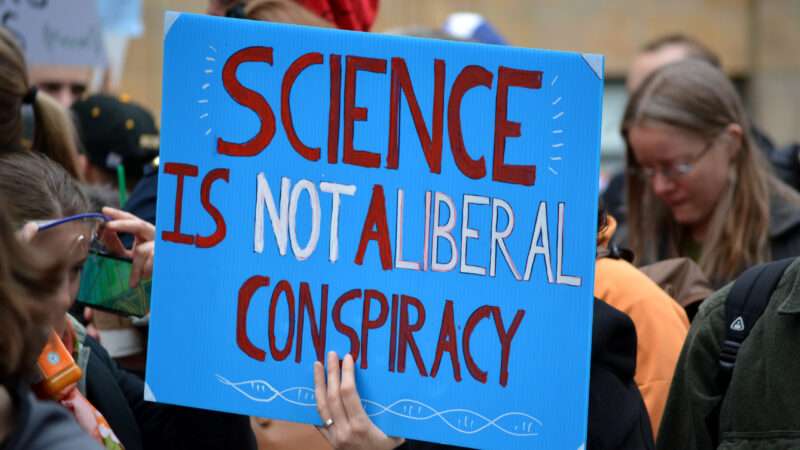
According to a new study, political endorsements by scientific journals persuade no one but do significantly undermine trust in science by out-party voters.

“Political endorsement by scientific journals can undermine and polarize public confidence in the endorsing journals and the scientific community,” reports a new study by Stanford economist Floyd Zhang in Nature Human Behavior. Shocked? Not at all.

A month before the U.S. presidential election, Nature published an editorial supporting Democratic candidate Joe Biden for president. The editorial justified its endorsement by citing Donald Trump’s “disastrous response to the COVID-19 pandemic” and also decrying his promotion of “nationalism, isolationism and xenophobia — including tacitly supporting white-supremacist groups.” Consequently, the editors declared, “We cannot stand by and let science be undermined. Joe Biden’s trust in truth, evidence, science and democracy make him the only choice in the US election.”

In his study, Zhang conducted an online survey during July and August of 2021 randomly exposing more than 4,000 Trump and Biden supporters to two conditions. The treatment group saw a summary of the Nature endorsement, and the control group read a description of Nature‘s new redesign. Both groups were reminded that Nature is one of the world’s most prominent science publications.

Zhang reports:

The endorsement message caused large reductions in stated trust in Nature among Trump supporters. This distrust lowered the demand for COVID-related information provided by Nature, as evidenced by substantially reduced requests for Nature articles on vaccine efficacy when offered. The endorsement also reduced Trump supporters’ trust in scientists in general. The estimated effects on Biden supporters’ trust in Nature and scientists were positive, small and mostly statistically insignificant. I found little evidence that the endorsement changed views about Biden and Trump. These results suggest that political endorsement by scientific journals can undermine and polarize public confidence in the endorsing journals and the scientific community.

Rather than being chastened by Zhang’s findings, the editors of Nature doubled down, responding with a new editorial insisting that they will continue to endorse political candidates. “The study shows the potential costs of making an endorsement,” acknowledge the editors, however adding, “But inaction has costs, too.”

Zhang responded on Twitter that he finds the new editorial’s “counter-arguments and the conclusion unconvincing.” As he notes, while it may well be true that the original editorial was calling out a truly disastrous situation, “there’s no evidence that ‘inaction has costs’—a bad situation is not ‘costs’ of someone’s inaction unless their action can materially change the situation for the better, which is exactly what the study suggest to be *not* the case.” Zhang’s research shows that Nature‘s 2020 endorsement of Biden, in which the editors asserted that they “cannot stand by and let science be undermined,” did just the opposite by significantly eroding trust in the scientific enterprise among out-party voters.

The new Nature editorial asserts, “Political endorsements might not always win hearts and minds, but when candidates threaten a retreat from reason, science must speak out.” What for? If editorial endorsements are NOT about winning hearts and minds, they amount to useless virtue signaling. Nature‘s editors should follow the science and stop issuing counterproductive political endorsements.

The post Virtue Signaling by Scientific Journals Backfires, New Study Finds appeared first on Reason.com.

from Latest https://ift.tt/g3fj4c2
via IFTTT

Florida Decides To Extend LGBT School Censorship to All Grades After All


Censored teacher

Florida’s “Don’t Say Gay” law may actually earn its nickname as the state considers an Education Department proposal to ban almost all instruction about LGBT issues in all grades.

When Florida lawmakers passed H.B. 1557 last year with the support and encouragement of Republican Gov. Ron DeSantis, the text of the bill forbid educators and schools from encouraging any sort of discussion of sexual orientation and gender identity in classrooms from kindergarten through third grade.

Opponents of the bill called it a “Don’t Say Gay” law. Many media outlets accepted the shorthand description, while some conservatives objected to the label and accused the media of misleading people. Those who defended the bill noted that the censorship only applied to the youngest of students and that the purpose was to postpone discussions on sexuality to a more appropriate age.

But Reason took note at the time of H.B. 1557’s potential to extend this censorship far beyond K-3 classes. Its text didn’t just ban LGBT discussions in early grades—it also banned any instruction on sexual orientation or gender identity in any grade “that is not age-appropriate or developmentally appropriate for students.” The bill itself did not give any definition of what would or would not be appropriate for different ages or grades. That would be something leaders at the Florida Department of Education would have to hammer out later.

It’s been a year since the law passed, and this week, Education Department leaders submitted a proposed rule for how sexual orientation and gender identity could be taught in all grade levels in the state—or more accurately, a proposed rule for how those topics will not be taught in schools. Under the state’s “Principles of Professional Conduct for the Education Profession in Florida,” leaders say teachers:

Shall not intentionally provide classroom instruction to students in grades 4 through 12 on sexual orientation or gender identity unless such instruction is either expressly required by state academic standards as adopted in Rule 6A-1.09401, F.A.C., or is part of a reproductive health course or health lesson for which a student’s parent has the option to have his or her student not attend.

So, the warnings were, indeed, correct. H.B. 1557 was intended ultimately to significantly restrict the circumstances under which sexual orientation and gender identity may be discussed in all public school classrooms in the state. This is censorship.

I took a glance at Florida’s education standards in social studies. On their list of benchmarks updated in 2022, it calls for teaching high-schoolers how Nazis rounded up homosexuals along with Jews and other minorities during the Holocaust. High school psychology classes are also expected to teach about sexual orientation and gender identity. But those are the only references in the state’s 86-page description of standards for classes ranging from history to civics to humanities courses. There are exactly five references to sexual orientation, gender identity, or homosexuality.

And so the inclination here would be to say, “Well, the school districts will still be teaching about sexual orientation in these relevant contexts, right?” Not so fast. The Department of Education has just submitted a plan to update the state’s social studies standards to remove four benchmarks for grades nine through 12, and while the request doesn’t list which benchmarks are being removed (there will be a hearing in April) the department lists the criteria of H.B. 1557 as the reason for their removal.

I attempted to get the list of benchmarks being removed directly from the administrator who submitted the proposed changes but ended up getting funneled to the Department of Education’s communications office, which directed me to send an email request for more information. As of publication, the department has not responded.

I don’t want to make assumptions, but it would be reasonable given the context to predict that the proposed changes would be to remove the standards in the psychology section that call for teachers to educate students about sexual orientation and gender identity. If that’s the case, deleting these standards and applying the proposed rule mentioned above would forbid psychology teachers from teaching high school students about what is arguably a core topic in that field.

These proposed rule changes aren’t just about making sure teachers discuss sexual orientation and gender identity only when it is appropriate. Evidence suggests that Florida officials are attempting to censor LGBT discussions in classrooms as much as they possibly can. The “Don’t Say Gay” label is becoming more and more apt as time goes by.

The post Florida Decides To Extend LGBT School Censorship to All Grades After All appeared first on Reason.com.

from Latest https://ift.tt/rESJyqc
via IFTTT

Maybe A.I. Will Be a Threat—To Governments


Maybe new A.I. technology will be a threat—to authoritarian governments.

It’s easy enough to find warnings that artificial intelligence (A.I.) will eventually, perhaps soon, be a threat to humankind. Those warnings have loomed in science fiction sagas for decades, from the murderous HAL 9000 of 2001: A Space Odyssey to the obliterating robots of the Terminator and Matrix movies. These are modern-day Frankenstein stories, in which man’s hubris becomes humanity’s downfall as intelligent creations take on a life of their own and come back to kill their makers.

Now, as we enter a new age of readily available consumer A.I. thanks to large language model (LLM) chatbots like ChatGPT, similar warnings have entered popular discourse. You can find those warnings on op-ed pages and in reports about worried lawmakers and policy makers, who, according to a recent New York Times article, are struggling to understand the technology even as they seek to regulate it. Indeed, part of the fear about A.I. is that, unlike, say, a search engine, its inner workings are somewhat mysterious, even to its creators.

At a conference on the subject of “Man, Machine, and God” last year, Henry Kissinger captured the mood of concern, and the sense that something must be done, when, as The Washington Post‘s David Ignatius reported, he said that if authorities don’t find ways to control A.I., to limit its reach, “it is simply a mad race for some catastrophe.”

The precise nature and identity of the authorities in question were left unspecified. But presumably, they are people with access to or influence over government power. With that in mind, consider an alternative scenario: Powerful A.I. might end up being a threat—not to humanity, but to governments, and in particular to authoritarian governments that have sought to limit access to ideas and information.

Don’t take it from me: That’s more or less the possibility raised by Fang Binxing, a computer scientist and former government official who was a key player in the development of China’s Great Firewall. The Great Firewall is an information control system intended to censor and limit access to anything the Chinese government finds objectionable, with an emphasis on political speech. But that sort of censorship relies on the fundamental knowability of how search engines and websites function: Specific offending links, articles, publications, or programs can simply be blocked by government authorities, leaving the rest of the internet accessible. In this architecture, censorship is possible because information-discovery processes are clear, and information itself is discrete and severable.

An A.I., however, is much more of an all-or-nothing proposition. In some sense, an A.I. just “knows” things based on processes that cannot be clearly observed or documented. And that, presumably, is why Binxing recently warned that generative A.I.s “pose a big challenge to governments around the world,” according to a South China Morning Post summary of his remarks. “People’s perspectives can be manipulated as they seek all kinds of answers from AI,” Binxing reportedly told a Chinese-backed news site.

Accusations of manipulation are more than a little bit ironic coming from someone behind one of the world’s broadest efforts at population-level information control. But one can sense genuine worry about the inevitability of change that appears to be on the way. At his blog Marginal Revolution, economist Tyler Cowen draws out the implications of Binxing’s remarks in a post titled “Yes, the Chinese Great Firewall will be collapsing.”

“I would put it differently, but I think he [Binxing] understands the point correctly,” Cowen writes. “The practical value of LLMs is high enough that it will induce Chinese to seek out the best systems, and they will not be censored by China.” Intriguingly, Cowen also raises the question of what happens when “good LLMs can be trained on a single GPU and held on a phone.”

Obviously, all of this is somewhat abstract at the moment, but let me try to put it a little more concretely. Although it’s still early, it’s clear that A.I. will be too powerful to ignore or restrict entirely. But the nature of LLM-style A.I., with its holistic, contextual, quasi-mysterious approach to synthesizing knowledge, will inevitably mean exposure to facts, arguments, ideas, and concepts that would have been censored under the Great Firewall. In order for China to keep up with the West, it will have to let those complex A.I. systems in, and that will mean letting all the previously objectionable things those A.I.s “know” in as well. Furthermore, as A.I. tech advances and decentralizes, becoming operable based on smaller devices, it will become even more difficult to censor information at scale.

A.I. technology is still in its infancy, and it’s too early to predict its future with any great confidence. The scenario I’ve laid out is hopeful, and not necessarily representative of the path a world populated by A.I.s will take. It’s a possibility, not a certainty. 

But amid the warnings of apocalypse and doom, and the Frankenstein narratives about rogue A.I., one should at least consider the more optimistic alternative: that advanced artificial intelligence will become a tool of individual empowerment, that it will circumvent traditional systems of top-down information control, that it will be a threat not to human civilization but to authoritarian rule—and, perhaps, more broadly, a kind of rival power center to many of the world’s authorities as well. It’s no surprise, then, that lawmakers are already looking to regulate A.I. before they even really understand what it is: They know that it’s powerful, and that’s enough.

The post Maybe A.I. Will Be a Threat—To Governments appeared first on Reason.com.

from Latest https://ift.tt/zABXeW1
via IFTTT

Law Enforcement Beat This Innocent Man to a Pulp. Will the Supreme Court Allow Him To Seek Recourse?


James King is seen in front of his Supreme Court petition

It has been almost a decade since James King, then a college student in Grand Rapids, Michigan, was choked and beaten by an FBI agent and a local police detective after they mistook him for a suspect with whom he shared no resemblance. And yet, after all this time, it is unclear if King will be permitted to merely ask a jury if he deserves some compensation for the government’s misconduct, the likes of which left his face temporarily disfigured.

That legal odyssey is finally nearing a conclusion as King asks the U.S. Supreme Court to consider his case for a second time. If the justices choose to hear his plea, they’ll have to decide if FBI agent Douglas Brownback and Grand Rapids detective Todd Allen are immune from facing a civil suit for their actions, simply because of their government status.

Aaron Davison (left) and King (right) (Courtesy of the 6th Circuit)

In 2014, King was walking from one job to the next when Brownback and Allen, who were not in uniform, accosted him without identifying themselves as law enforcement. “Are you mugging me?” King asked. He then ran. The two officers, who were part of a police task force, responded by tackling him to the ground, beating his face to a pulp, and choking him unconscious. But they were looking for someone named Aaron Davison, who had been accused of stealing alcohol from his former employer’s apartment, and who, perhaps more importantly, looked nothing like King.

Even still, police arrested King and handcuffed him to a hospital bed as he received treatment, despite the fact that the only malfeasance here was committed against, not by, King.

What followed in the proceeding years is a case study in the level of protection given to rogue government actors and the byzantine obstacle course that victims of government misconduct have to navigate should they want the privilege of achieving any sort of recourse. Indeed, King’s case has ricocheted up and down the ladder of the U.S. legal system, from the bottom to the top and back again.

The officers first received qualified immunity, the legal doctrine that blocks victims of government misbehavior from seeking recourse in civil court if the precise way the state violated their rights has not yet been “clearly established” in a prior court precedent. In practice, that means clearly unconstitutional conduct—like, say, beating an innocent person—may not be a sturdy enough basis for a lawsuit unless the court has evaluated a case with near-identical circumstances. It is, for example, why two men in Fresno, California, were not allowed to sue the officers who allegedly stole over $225,000 during the execution of a search warrant. We should all know stealing is wrong, the thinking goes, but without a court precedent scrutinizing a similar situation and expressly spelling that out, can we really expect the government to know for sure?

The U.S. Court of Appeals for the 6th Circuit overturned the decision granting Brownback and Allen qualified immunity, paving the way for King to sue. But the government then petitioned the Supreme Court to instead grant them a different immunity. Under the Federal Tort Claims Act (FTCA), the government said, victims of federal government misconduct, like King, are prohibited from pursuing claims over constitutional infringements if they cannot pursue the feds via a state tort claim. “The government has essentially said ‘if you lose one claim, you’re out of luck, and you lose all of your claims,'” Anya Bidwell, an attorney at the Institute for Justice, which is representing King, said in a statement. “That’s not how any other area of the law works and that’s not how the FTCA should work, either. It turns a statute that was supposed to expand government accountability into one that swallows it up.”

In 2021, the Supreme Court volleyed the case back to the 6th Circuit, which granted the additional immunity. So it is now back to the high court to decide if government employees have even more license to violate the laws they are supposed to uphold.

Victims of federal misconduct have long faced an onerous road to recourse. As a teenage girl, Hamdi Mohamud found herself in a Minnesota jail, where she would remain for two years, after St. Paul police officer Heather Weyker filed bogus charges against her in connection with a sex trafficking ring Weyker fabricated. As a part of her “investigation,” Weyker lied under oath, conjured fake evidence, and tampered with police reports. For that, she was denied qualified immunity. But because Weyker was working on a federal task force, Mohamud was prevented from suing, as federal officers are often afforded what amounts to absolute immunity. The Supreme Court further cemented that last year.

“Qualified immunity makes it very, very difficult to sue government officials,” Patrick Jaicomo, who represents King at the Institute for Justice, told me in 2021. “This makes it impossible.”

If the Supreme Court demurs at King’s latest petition, then that process will somehow get even harder.

The post Law Enforcement Beat This Innocent Man to a Pulp. Will the Supreme Court Allow Him To Seek Recourse? appeared first on Reason.com.

from Latest https://ift.tt/fibqULc
via IFTTT

Disney Begins 7000 Job Cuts After String Of Theatrical Failures

Disney Begins 7000 Job Cuts After String Of Theatrical Failures

Disney has finally hit the financial wall after a long string of money losing theatrical and streaming service failures, with the company committing last month to at least 7000 job cuts to help cover a $5.5 billion total savings target.  The move followed the abrupt replacement of former CEO Bob Chapek and the return of Bob Iger, and has been blamed on “macroeconomic headwinds.”

Those layoffs are being initiated in March, with the bulk of pink slips expected to be handed out in April as new details of the mass firings emerge.  Already, Marvel Studios VFX head and notorious woke promoter Victoria Alonzo has abruptly left the company, indicating that layoffs may extend to management.       

Disney has made little mention of the role their “diversity and inclusion” methodology might have played in plummeting audience numbers both for theatrical releases and streaming subscriptions.  Disney+ lost over 2.4 million subscribers in February, while movies like Lightyear, Strange Worlds, Pinocchio and Ant Man 3 have all flopped at the box office in the past year.  Pending releases including live action adaptations of The Little Mermaid and Peter Pan are heavily injected with identity politics and audience reactions to trailers are so far extremely negative, hinting that these films will also have a dismal showing.  

Beyond the lack of interest in woke movies and media, the company seems to be reeling from its catastrophic attempt to use economic leverage to intimidate the State of Florida as it passed the ‘Parental Rights In Education Act’, which was designed to stop sexualized lessons in public schools for children in grades K-3.  The bill was specifically motivated by the proliferation of gender identity ideology within Florida classrooms and was attacked by Democrat opponents who called it the “don’t say gay bill.”  

It has become clear that Disney backed the wrong horse in that fight.  They have now lost their special autonomy under the Reedy Creek Improvement District and the Florida government has taken over management.  The majority of major media companies in the US are scrambling to survive dwindling profits and collapsing audiences, but many would argue that Disney in particular triggered their own downfall.

Disney stock was up slightly on the news that layoffs would begin, with investors happy to see costs being reduced. 

Tyler Durden
Thu, 03/23/2023 – 13:40

via ZeroHedge News https://ift.tt/jLefBTt Tyler Durden

Watch: Amid Banking Collapse, White House Says “We See A Strong Economy”

Watch: Amid Banking Collapse, White House Says “We See A Strong Economy”

Authored by Steve Watson via Summit News,

As inflation continues to skyrocket and amid huge banking collapses, the White House press secretary declared Wednesday that the Biden administration “sees a strong economy.”

CBC’s Caitlin Huey-Burns asked Karine Jean-Pierre about Joe Biden’s support for Federal Reserve Chairman Jerome Powell and what the Fed is doing to attempt to reduce inflation. 

“We understand what the American people are feeling, that is why we have made it a priority to do everything that we can to lower costs for Americans,” Jean-Pierre responded.

Then came the kicker.

“We do not see a recession or pre-recession. We see a strong economy and it’s because of the work that this president has done,” Jean-Pierre declared.

You don’t see it or there isn’t a recession?

Strange choice of words.

Keep saying it and it might become reality:

When asked if there will be an economic downturn owing to two giant bank collapses, KJP had no answer, other than to quote the Fed chairman saying the economy is sound:

Powell claims that rampant money printing isn’t driving inflation:

Treasury Secretary Janet Yellen claims that just growing debt forever is sustainable:

Are they willfully ignorant or just flat out lying?

*  *  *

Brand new merch now available! Get it at https://www.pjwshop.com/

In the age of mass Silicon Valley censorship It is crucial that we stay in touch. We need you to sign up for our free newsletter here. Support our sponsor – Turbo Force – a supercharged boost of clean energy without the comedown. Also, we urgently need your financial support here.

Tyler Durden
Thu, 03/23/2023 – 13:20

via ZeroHedge News https://ift.tt/iI9MzO1 Tyler Durden

Crypto Fugitive Do Kwon Arrested In Montenegro

Crypto Fugitive Do Kwon Arrested In Montenegro

Famous South Korean fugitive and “crypto-entrepeneur” Do Kwon, who was behind the $40BN implosion of the terraUSD and luna digital tokens last year which sparked the initial leg of the crash sweeping the crypto space, has been arrested in Montenegro according to local authorities.

Do Kwon in his company’s office in Seoul in 2022: Bloomberg

In a statement on Twitter, Montenegro’s interior minister Filip Adzic said “the former cryptocurrency king” was detained by police at Podgorica Airport with falsified documents. “We are waiting for official confirmation of identity,” Adzic added.

As a reminder, it was the collapse of terraUSD coin in May of 2022 that unleashed an unprecedented crash in crypto markets which engulfed many of the industry’s leading players. As the FT notes, Kwon, co-founder of Terraform Labs, was charged with fraud and breaches of capital markets law in his home country and sparked an international manhunt after authorities were unable to locate him.

Last year South Korean authorities said Kown had traveled to an unknown country, believed to be Serbia, via Dubai after leaving Singapore, where Terraform was headquartered. His South Korean passport was also revoked.

The meltdown of terraUSD and luna coins affected hundreds of thousands of investors, many of whom were drawn in by a scheme in which clients could lend their terra coins for a yield of up to 20%.

Kwon and Terra have also been sued by the US Securities and Exchange Commission for allegedly arranging a cryptocurrency fraud that led to billions of dollars in losses by selling a number of digital assets not properly registered with regulators.

The SEC said the alleged fraud took place between April 2018 and May 2022.

In May last year, terraUSD’s peg collapsed in dramatic fashion, sparking an unprecedented crisis of confidence in crypto markets which plunged companies such as Celsius and Three Arrows Capital into bankruptcy.

The collapse of terraUSD fuelled concerns among international regulators that the stablecoin industry poses stability risks to established finance as crypto becomes more integrated with conventional payment systems.Shortly before the collapse (former?) billionaire Mike Novogratz tattooed Luna on his arm, saying “I’m officially a Lunatic!!!  Thanks @stablekwon” His entire investment was wiped out 5 months later.

In September last year, Interpol issued a red notice against Kwon, representing a plea to worldwide law enforcement to arrest the Terraform boss. Since his disappearance, Kwon has continued to make statements on social media without sharing his location. His last known tweet is below.

Following the news of his alleged arrest, bitcoin and crypto spiked to session highs.

Tyler Durden
Thu, 03/23/2023 – 13:00

via ZeroHedge News https://ift.tt/8OWe57r Tyler Durden

SEC to Coinbase: Nice Crypto Exchange You Got There, It’d Be a Shame if Something Happened to It


Coinbase announces the SEC has threatened it with enforcement action for alleged but unspecified violations of securities laws.

Coinbase, which is by trade volume the largest cryptocurrency exchange in the United States, announced yesterday it had been hit by the Securities and Exchange Commission (SEC) with a threat of looming legal action.

As a public Form 8-K filed by Coinbase with the SEC explained, “On March 22, 2023, Coinbase…received a ‘Wells Notice’ from the Staff…of the Securities and Exchange Commission….stating that the Staff has advised the Company that it made a ‘preliminary determination’ to recommend that the SEC file an enforcement action against the Company alleging violations of the federal securities laws.”

In that 8-K filing, which is required to inform the public about important events that might affect shareholders, Coinbase explained that, based on what SEC staff have communicated to them, “these potential enforcement actions would relate to aspects of the Company’s spot market, staking service Coinbase Earn, Coinbase Prime and Coinbase Wallet. The potential civil action may seek injunctive relief, disgorgement, and civil penalties.” (The news is indeed affecting stockholders, with Coinbase’s stock down roughly 13 percent today as of this article’s publication.)

Coinbase Chief Legal Officer Paul Grewal went public with a lot of the frustration that has hit market participants in crypto (and even federal bankruptcy judges) as they try to navigate the SEC’s approach to virtual currencies. Grewal explained how the SEC under chair Gary Gensler has been reshaping regulatory law and policy via enforcement (and the occasional vague public threat).

Grewal echoed the complaints many have had while trying to understand exactly why and when the SEC believes that a cryptocurrency is a security and able to be regulated as such, and thus that companies facilitating trading in them face certain registration requirements. “We asked the SEC specifically to identify which assets on our platforms they believe may be securities, and they declined to do so,” Grewal wrote.

“We continue to think rulemaking and legislation are better tools for defining the law for our industry than enforcement actions,” Grewal went on to say. He again echoed a long-term frustration with the SEC’s apparent desire to reveal what it believes the law requires not through rigorous understandable written notice—something more like actual law or rule making—but by just bashing certain crypto market players against the wall, seemingly at random.

Grewal defended Coinbase’s efforts in trying to understand the law and follow it. In the course of the investigation that led to this week’s notice, “the SEC asked us if we would be interested in discussing a potential resolution that would include registering some portion of our business with the SEC. We said absolutely yes. Specifically, the SEC asked us to provide our views on what a registration path for Coinbase could look like – because there is no existing way for a crypto exchange to register.”

Grewal said that after trying to get the SEC to give feedback on various registration models that Coinbase proposed, the agency generally stonewalled, was unresponsive, and eventually in January just “told us they would be shifting back to an enforcement investigation.” Coinbase insisted “our staking and exchange services are largely unchanged since 2021, when the SEC reviewed our S-1 and allowed us to become a public company,” he wrote. “Our core business model remains the same.”

Grewal noted that different federal agencies have given conflicting reports on the way to legally categorize certain virtual currencies: “The Chair of the CFTC [Commodity Futures Trading Commission] recently testified to Congress that Ethereum is a commodity, which the public has long understood to be the case. Then-CFTC Commissioner Quintenz has said that ‘the SEC has no authority over pure commodities or their trading venues, whether those commodities are wheat, gold, oil…or crypto assets.’ Current SEC Chair recently opined that perhaps BTC [bitcoin] is the only digital asset commodity, which is entirely at odds with the position of the CFTC.”

“If our regulators cannot agree on who regulates which aspects of crypto, the industry has no fair notice on how to proceed,” Grewal concluded. “Against this backdrop, it makes no sense to threaten enforcement actions against trusted public companies like Coinbase who are committed to playing by the rules.”

Whether or not a financial instrument, agreement, or coin in the virtual currency space constitutes a “security” under the reigning “Howey test,” based on the 1946 Supreme Court case SEC v. W.J. Howey Co, continues to be a matter that courts seem to have to sort out on a case-by-case basis. While complex, as most legal definitional principles are, a central element of Howey is that the buyer and seller of the product are involved in a common enterprise involving a monetary investment in which reasonable expectation of profit is derived from the effort of others. Most argue that most virtual currencies are more like commodities whose values fluctuate based on mass market demand, not based on any effort of the original issuer. As Coin Center Director of Research Peter Van Valkenburgh explained in an interesting article assessing whether ether (the second-highest-market-cap virtual currency) should be legally categorized as a security, there is a meaningful distinction between a virtual object that may at some time have been part of some arrangement or offer that might be reasonably seen as a security and a virtual object that is in and of itself always a security.

Grewal insisted that nothing on his exchange should qualify as a security, including the staking services that he said the SEC has been familiar with since 2019. “Until this investigation, we had heard no concerns at all from the SEC about” them, he explained.

Grewal believes, as do many in the crypto space who have been watching with dismay as the SEC’s wrecking ball swings unpredictably, that SEC actions like this “will only drive innovation, jobs, and the entire industry overseas.”

The post SEC to Coinbase: Nice Crypto Exchange You Got There, It'd Be a Shame if Something Happened to It appeared first on Reason.com.

from Latest https://ift.tt/ZRQdWUb
via IFTTT

Feds Say A.I.-Generated Art Is Ineligible for Copyright


A federal agency says material authored by A.I. can’t be copyrighted

The U.S. Copyright Office (USCO) has issued guidance clarifying that material created solely by artificial intelligence (A.I.) cannot be copyrighted. Under the new rule, though applicants may claim a copyright for an arrangement or editing of such material, the original work is ineligible. “In these cases, copyright will only protect the human-authored aspects of the work, which are ‘independent of’ and do ‘not affect’ the copyright status of the AI-generated material itself,” the USCO says.

The USCO’s new rule closely follows the agency’s decision to revoke a copyright granted to artist Kristina Kashtanova for A.I.-generated images in a graphic novel, reported by Reason‘s Joe Lancaster. Kashtanova retains copyright privileges over the work’s text and the arrangement of the images, though not over the images themselves.

Generative A.I. such as the chatbot ChatGPT and image maker DALL-E can create artistic content in response to human prompts. A prompted A.I. creation does not fit traditional legal conceptions of expression and property rights.

“In the case of works containing AI-generated material, the Office will consider whether the AI contributions are the result of ‘mechanical reproduction’ or instead of an author’s own original mental conception, to which [the author] gave visible form,'” the USCO states. “The answer will depend on the circumstances, particularly how the AI tool operates and how it was used to create the final work.” The USCO recognizes the novel legal ground it treads, adding that “this is necessarily a case-by-case inquiry.” 

The new rule is explicit, however, that content generated by A.I. in response to prompts is ineligible for copyright. “For example, when an AI technology receives solely a prompt  from a human and produces complex written, visual, or musical works in response, the ‘traditional elements of authorship’ are determined and executed by the technology—not the human user,” it states.

“These guidelines only stress the difficulty in applying conceptions of authorship from a prior industrial era to this 21st century challenge,” Mathew Dryhurst, an artist and the co-founder of spawning.ai, tells Reason, adding that a system reliant on applicants’ self-reporting of A.I. authorship “seems a little frail.” He questions the USCO’s ability “to scrutinize which parts were created by [a machine learning] system, particularly as the generated output becomes less and less discernibly synthetic with every new model release.”

Dryhurst says that “rather than avoiding the co-authorship question,” we should “encourage artists and writers to experiment with offering their unique models with assurances that such a step could be economically beneficial for them and legally clear for the people who used the model.” When publishing his own voice model, Holly+, Dryhurst implemented “economic incentives set to encourage those using the Holly+ model to cite Holly as a co-collaborator, and cut her into any potential profits made from her voice.”

The Austrian economist Joseph Schumpeter wrote that innovation, the hallmark of capitalism, “incessantly revolutionizes the economic structure from within, incessantly destroying the old one, incessantly creating a new one.” Such a force is generative A.I.; it likely requires similarly innovative policy solutions.

The post Feds Say A.I.-Generated Art Is Ineligible for Copyright appeared first on Reason.com.

from Latest https://ift.tt/t3jHGzn
via IFTTT

“She Confessed That Her Husband Killed Alexander and Herself Died a Month Later at the Age of 28. That’s Strange”: Libel by Implication?

From Judge John Cronan’s decision Tuesday in Goldfarb v. Channel One Russia(S.D.N.Y.):

Plaintiff Alex Goldfarb claims that Defendant Channel One Russia … libeled him and intentionally inflicted emotional distress upon him through statements made during four television programs it broadcast in 2018. Those statements, Goldfarb claims, either asserted or implied six claims about him that constitute libel per se: that he murdered Alexander Litvinenko …, a Russian dissident who was killed in London in 2016; that he murdered his own wife; that he is a CIA operative; that he persuaded Marina Litvinenko …, Litvinenko’s widow, to give false testimony to a parliamentary inquiry that was carried out in the U.K. into Litvinenko’s death (the “Owen Inquiry”); that he and Litvinenko together operated an illegal business helping criminal asylum-seekers; and that he conspired with Boris Berezovsky, an exiled Russian oligarch, to defraud the U.K. into granting asylum to Berezovsky….

Now before the Court is Channel One’s motion for summary judgment on all causes of action in Goldfarb’s Complaint and on all of its counterclaims…. For reasons that follow, Channel One’s motion for summary judgment is granted in part and denied in part. Because an accusation of membership in the CIA is not defamatory on its face, and because Goldfarb has not alleged any extrinsic facts that would make that accusation defamatory, his claim that Channel One libeled him as a CIA member is dismissed. Channel One’s motion is denied in all other respects.

A reasonable person could understand certain statements that were made on Channel One’s broadcasts to imply that Goldfarb killed his wife, and a false accusation that Goldfarb influenced Litvinenko’s wife to lie to the Owen Inquiry constitutes libel per se. Further, when considered in context, the statements Channel One broadcast were statements of fact rather than of opinion. And because the evidence disclosed in the record raises a genuine issue of fact as to whether Channel One acted with actual malice, the question of actual malice must be resolved at trial….

I focus in this post on the question “whether Channel One’s broadcasts accused Goldfarb of killing his wife”:

The transcripts of the relevant programs contain no express allegation that Goldfarb killed her; instead, his theory is that the accusation was implied by the discussion of Walter’s purported conversation with her and her subsequent death. First, the following exchange took place during the March 20, 2018 episode of Let Them Talk:

[Borisov:] Good evening to everyone again…. So Walter Alexandrovich said he considers CIA complicit in the murder of Alexander Litvinenko and you even said you know who specifically did it?

[Walter:] Yes Goldfarb. It was his work

[Borisov:] And you know that it was Alexander Goldfarb, an associate of Boris Berezovsky from what you’ve heard from Alexander’s own wife.

[Walter:] Yes the wife. She told me about that. And a month later she herself died suddenly …

[Unidentified Guest:] She died suddenly.

[Unidentified Guest:] Was she a young woman?

[Walter:] 28 years old. She was very young.

Second, Walter participated in a similar exchange during the March 30, 2018 episode of Man and Law:

[Walter:] There was a woman weeping, Goldfarb’s wife. She was about your age, very pretty. She was sitting there crying, weeping: “Walter, Walter, Alex killed Alexander.”

[Reporter:] That was Goldfarb’s wife?

[Walter:] Goldfarb’s wife. She died within a month.

[Narrator:] She confessed that her husband killed Alexander and herself died a month later at the age of 28. That’s strange.

Thus, the question is whether the accusation that Goldfarb killed his wife was expressed during these exchanges.

Under New York law, “it is for the court to decide whether the words are susceptible of the meaning ascribed to them.” In particular, the court must decide whether “there is a reasonable basis for drawing the defamatory conclusion” from those words. Id. Nonetheless, while the question of whether the words could express the alleged defamatory meaning must “be resolved by the court in the first instance,” the actual meaning of those words must ultimately be determined at trial: “If the contested statements are reasonably susceptible of a defamatory connotation, then it becomes the jury’s function to say whether that was the sense in which the words were likely to be understood by the ordinary and average reader.” In evaluating the published words, the court must give them a “fair reading” and must “not strain to place a particular interpretation” on them.

{New York recognizes a distinction between “a defamatory connotation from statements … that are alleged to be expressly false … [and] ‘… false suggestions, impressions and implications arising from otherwise truthful statements.'” “The concern that substantially truthful speech be adequately protected has led courts to embrace different standards for” claims involving such speech. For example, the Appellate Division of the New York Supreme Court has held that a plaintiff must make “a rigorous showing that the language of the communication [expressing truthful statements] as a whole can be reasonably read both to impart a defamatory inference and to affirmatively suggest that the author intended or endorsed that inference.”

Those heightened standards do not apply, however, to a case, such as this one, “of allegedly false statements of verifiable fact, with inferences flowing from those facts.” For instance, Channel One has not argued that Walter’s literal statements about the death of Goldfarb’s wife—i.e., that she was 28 years old and died suddenly one month after her conversation with Walter about Goldfarb killing his son—were substantially true. And Goldfarb expressly denies the factual accuracy of those statements. See Pl. Opp. at 20 (“[Goldfarb’s wife] was actually 51…. Goldfarb’s wife did not die a month after Litvinenko’s poisoning. She died of cancer three and a half years later.” Thus, Goldfarb need only make the ordinary showing that Channel One’s statements were reasonably susceptible to the defamatory connotation that he killed his wife.}

The conversations that Channel One broadcast on March 20, 2018 and March 30, 2018 about the death of Goldfarb’s wife are “reasonably susceptible of a defamatory connotation.” During the March 20 episode of Let Them Talk, immediately after citing a purported conversation with Goldfarb’s wife as his primary evidence for the accusation that Goldfarb killed Litvinenko, Walter claimed that she, a young, 28-year-old woman, died suddenly only a month after she told Walter that Goldfarb had killed Litvinenko.

This discussion first alleged that Goldfarb was a murderer through Walter’s accusation that he killed Litvinenko. Then, Walter suggested a motive that Goldfarb might have for killing his wife—namely, to prevent her from telling others of his alleged responsibility for Litvinenko’s death. Furthermore, by claiming that she was young and died suddenly, Walter implied that no plausible innocent explanation existed for her death, since ordinarily young women do not die suddenly. And by highlighting the supposed close temporal connection between her death and Litvinenko’s, Walter implied a causal connection between the two.

The conversation aired during the March 30 episode of Man and Law was very much in the same spirit. Walter once again conveyed to a reporter that Goldfarb’s wife told him that Goldfarb had killed Litvinenko, and that she then died within a month. This was immediately followed by the narrator’s conspiratorial commentary: “She confessed that her husband killed Alexander and herself died a month later at the age of 28. That’s strange.” Taken collectively, these purported facts—Goldfarb’s motive for killing his wife, the temporal proximity between her death and the events from which that motive arose, and the absence of any alternative innocent explanation for her death—constitute “a reasonable basis for drawing the defamatory conclusion” that Goldfarb killed her.

In other cases, the New York Court of Appeals has found published words defamatory when they would justify analogous inferences. And the defamatory connotation of the words uttered during the March 20, 2018 Let Them Talk episode is further reinforced by the exchange that immediately followed. After describing Goldfarb’s wife’s death, Walter continued: “That’s how it started. Then it went on and on. Also Berezovsky. The death of Boris Berezovsky brings about many questions.” Other guests then speculated that Berezovsky, who died in “mysterious circumstances” in 2013, was the victim of foul play. The claim that what began with the death of Goldfarb’s wife “went on and on” to culminate in Berezovsky’s death, which in fact occurred in sufficiently mysterious circumstances that the coroner could not rule out foul play, clearly suggests that Goldfarb’s wife, too, died from foul play.

In short, because the words Channel One broadcast on March 20, 2018 and March 30, 2018 are susceptible to being interpreted as conveying the accusation that Goldfarb killed his wife, Goldfarb’s claim that Channel One libeled him with respect to those statements survives summary judgment. It is for the factfinder to decide at trial whether that defamatory meaning would likely have been “understood by the ordinary and average” viewer.

If you’re curious whether S.D.N.Y. is a proper forum for the case, and whether it has jurisdiction over Russia One, see this opinion. Congratulations to Bertrand Charles Sellier and Richard Edward Rosberger (Rottenberg Lipman Rich P.C.) and Rodney Alan Smolla (Vermont Law School), who represent plaintiff.


The post "She Confessed That Her Husband Killed Alexander and Herself Died a Month Later at the Age of 28. That's Strange": Libel by Implication? appeared first on Reason.com.

from Latest https://ift.tt/aP2DmMk
via IFTTT