To Balance the Budget, Republicans Must Cut Military Spending, Trim Entitlements, or Raise Taxes


Any attempt at bringing the federal budget deficit under control must kill (or at least wound) the Republicans' sacred cows of military spending, entitlements, and the recent Trump tax cuts.

Let’s say you were a Republican member of Congress with a sincere desire to craft a federal budget that would achieve balance by the end of the decade.

That’s a noble goal! Balancing the budget wouldn’t pay down the $31 trillion national debt, of course, but it would at least stop adding to it. There’s just one small issue, your advisers tell you. Well, three issues, actually. You can’t cut spending on the military (including veterans programs) or entitlement programs, and you can’t advocate for letting the 2017 Trump tax cuts expire. That’s sacred ground, they say, and suggesting any of those three ideas will end with you getting hoisted out of office by pitchfork-carrying voters, a loud-mouthed primary challenger, and/or the angry ghost of Ronald Reagan.

You can’t pass a balanced budget if you’re not a member of Congress, so you agree. Those three things are off the table. Now, all you have to do is get a majority of Congress and President Joe Biden to agree to cut literally every dollar of discretionary spending out of the budget and you’ll have accomplished your goal. Almost.

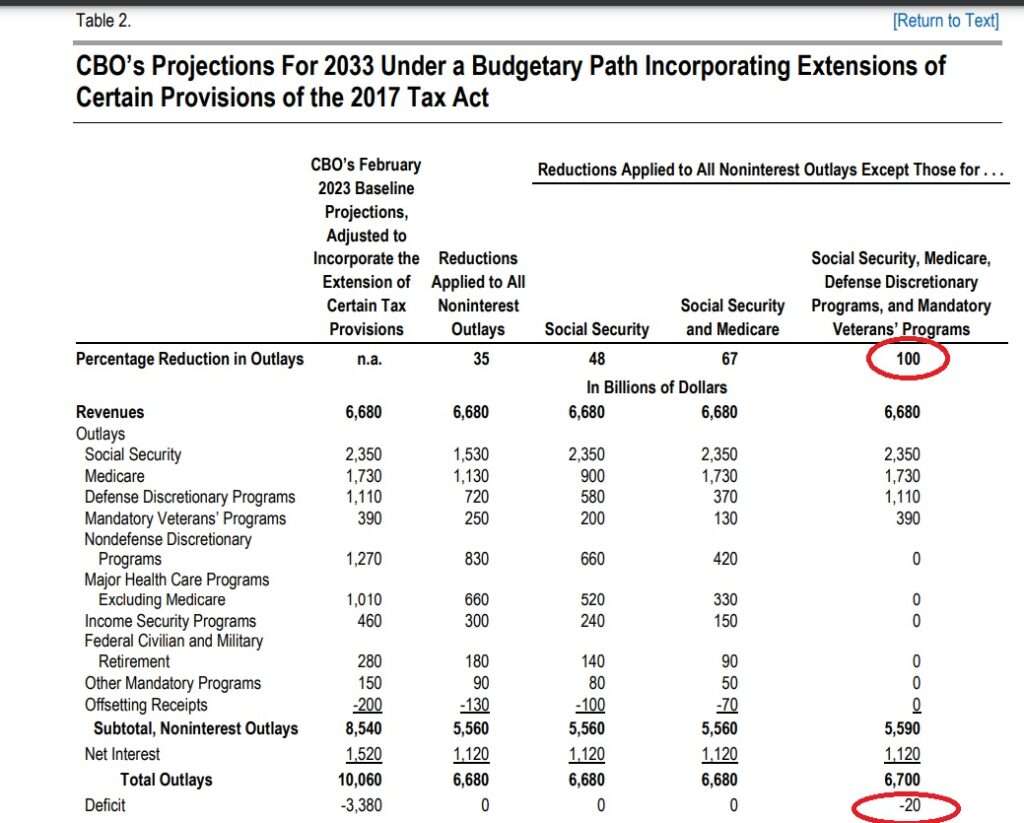
This isn’t an exaggeration. It’s the actual results of a recent Congressional Budget Office (CBO) review of potential paths for using spending cuts to balance the federal budget over 10 years.

In one scenario outlined by the CBO, Congress would have to cut 86 percent of all discretionary spending if it wanted to balance the budget by 2033 without touching the military, veterans programs, or entitlements like Social Security and Medicare. In a slightly altered version of that same scenario in which the Trump tax cuts were not allowed to expire as intended in 2025, Congress would have to cut 100 percent of discretionary spending—and the country would still face a $20 billion deficit.

The CBO analysis helps to illustrate the seriousness of America’s fiscal dilemma. While many libertarians might cheer the prospect of the federal government zeroing out all discretionary spending over 10 years, that’s simply not a realistic proposal that could get anywhere near the requisite support in Congress.

Instead, it should be clear that any attempt at bringing the federal budget deficit under control must kill (or at least wound) the Republicans’ sacred cows of military spending, entitlements, and the recent Trump tax cuts. Right now, however, leading Republicans including former President Donald Trump and Speaker of the House Kevin McCarthy (R–Calif.) have vowed to keep Social Security out of any long-term spending deals. Rep. Jim Banks (R–Ind.) has promised to oppose any bill that cuts defense spending.

As for the tax cuts, they’re technically temporary—a gimmick that allowed Republicans to game the CBO’s scoring of the tax cut bill—but keeping the lower individual income tax rates in place past 2025 is a top priority for Republicans.

This CBO analysis was a response to a question submitted by two of the top Democrats in the Senate’s budget-making process: Budget Committee Chair Sheldon Whitehouse (D–R.I.) and Finance Committee Chair Ron Wyden (D–Ore.). As such, there’s an element of it that comes off as a partisan exercise—an opportunity to point out that spending cuts alone can’t balance the budget, or just to highlight the impossibility of Republican demands surrounding the debt ceiling fight.

“As this analysis shows, no amount of cuts can make their math add up,” Whitehouse said in a statement. “It is a farce.”

But the CBO’s numbers aren’t partisan and neither is the blame for America’s massive budget deficits. These latest projections only reveal how difficult the choices ahead will be. If Republicans are serious about trying to balance the budget, there can be no more sacred cows.

The post To Balance the Budget, Republicans Must Cut Military Spending, Trim Entitlements, or Raise Taxes appeared first on Reason.com.

from Latest https://ift.tt/v6bSaxY
via IFTTT

Lawsuit Challenges Ban on Physical Mail at California County Jail


jail book

A new lawsuit is challenging a California county jail’s policy of digitizing and then destroying all physical mail received by incarcerated people—part of a national trend of prisons and jails restricting inmates’ ability to receive physical mail.

The lawsuit, filed earlier this month in California state court by Columbia University’s Knight First Amendment Institute, the Electronic Frontier Foundation (EFF), and the Social Justice Legal Foundation, argues that San Mateo County’s ban on physical mail “violates the expressive, associational, privacy, and religious rights of the individuals in its jails, including those presumed innocent, and of the many individuals who send mail to those incarcerated people.”

A growing number of jails and prison systems over the last few years have proposed or enacted rules restricting physical mail and used book donations under the justification of reducing contraband. The San Mateo County Jail inked a contract in 2021 with Florida-based Smart Communications Holding, Inc. for access to its MailGuard system, where mail is routed to Smart Communications, digitized, shredded, and then made accessible to inmates on electronic tablets.

However, civil liberties groups and advocates for incarcerated people say that the mail bans do little to stop contraband—the overwhelming majority is smuggled in by staff—while depriving inmates of a vital source of comfort and connection to the outside world.

Hannah Zhao, an EFF staff attorney, uses a children’s drawing as an example. Normally, a jail inmate would be able to hang that drawing in their cell or take it out anytime they wanted to look at it. Instead, Zhao says, “that crayon drawing gets scanned, possibly looks askew, or you can’t even see the entire drawing.”

“That drawing that your child drew is then shredded, and you are only able to see that drawing at certain times on a tablet,” she continues. “You can just imagine, the emotional impact is not there.”

Zhao also says the ban restricts their clients’ ability to receive occupational training and religious materials beyond commonly provided Bibles and Qurans.

And there are privacy concerns. The lawsuit notes that scanned mail is retained and available for law enforcement to access for seven years, even after jail inmates, who may be found not guilty, are released.

The stated reasons for ending physical mail—protecting staff from exposure to drugs and stopping the flow of contraband—don’t hold up, the lawsuit argues.

“Following statewide adoption of MailGuard in Pennsylvania, the drug test positivity rate actually increased,” the lawsuit says. “Similarly, after Missouri contracted with a different company to digitize and destroy incoming mail, the number of average overdoses in the state’s jails and prisons increased from thirty-one to thirty-seven per month. And in New Mexico, after prisons banned physical mail, the drug test positivity rate nearly doubled.”

Nevertheless, prisons and jails have been turning to digitization services over the past five years. A survey by the Prison Policy Initiative published last November found 14 states and 15 local jails that had started scanning all incoming mail. The New York City Department of Correction was considering a similar policy this year.

The Pennsylvania prison system pays Smart Communications $4 million a year for digitized mail services for its prisons, and the federal Bureau of Prisons launched a pilot program to shift to digital mail using MailGuard.

These digitization services have also led to accusations of gouging incarcerated people and their families. The San Jose Mercury News reports that the tablets used by San Mateo County Jail inmates charge $0.50 per email and $1 per prescreened photo, with two free messages per week.

There’s been a troubling trend of prisons and jails restricting book donations and forcing inmates to purchase books through pre-approved vendors. Reason reported in 2019 on several West Virginia prisons’ plans to charge inmates by the minute to read e-books on tablets, even though the books were from the free Project Gutenberg archive.

Pennsylvania, Washington, and three prisons in New York all attempted similar bans on donations of used books to inmates, then relented under citizen pressure. The prisons cited security concerns over contraband, but news investigations showed there was little actual evidence of smuggling via donated dictionaries.

In 2018, after Florida inked a new contract to provide multimedia tablets to inmates, inmates were forced to return MP3 players they had purchased through the state’s previous provider, losing all the tracks they had purchased as well.

The San Mateo County Sheriff’s Office, which runs the jail, did not immediately return a request for comment.

The post Lawsuit Challenges Ban on Physical Mail at California County Jail appeared first on Reason.com.

from Latest https://ift.tt/kKtZwec
via IFTTT

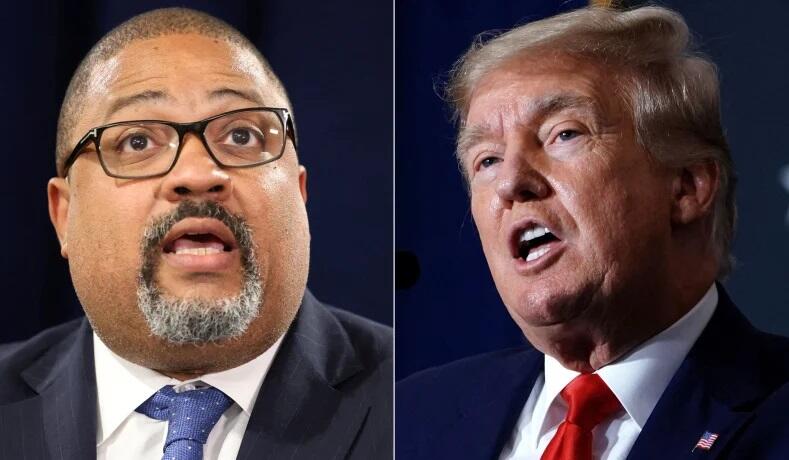
“An Unprecedent Inquiry”: Manhattan DA Fires Off Angry Letter Blaming Trump For Arrest Rumors

“An Unprecedent Inquiry”: Manhattan DA Fires Off Angry Letter Blaming Trump For Arrest Rumors

Manhattan District Attorney Alvin Bragg – who lied about growing up poor, has fired off an angry letter to House Republicans, calling their investigation into his case against former President Trump over hush payments to Stormy Daniels “an unprecedent [sic] inquiry into a pending local prosecution,” adding “The letter only came after Donald Trump created a false expectation that he would be arrested the next day and his lawyers reportedly urged you to intervene.

See the full response below.

The response comes after a Monday letter from House Republicans on the Weaponization of the Federal Government subcommittee.

“You are reportedly about to engage in an unprecedented abuse of prosecutorial authority: the indictment of a former President of the United States and current declared candidate for that office,” read the Monday letter to Bragg from Reps. Jim Jordan (Judiciary Chairman), James Comer (Oversight Chairman) and Bryan Steil (House Admin Chairman).

The letter went on to shred the ‘untested legal theory’ underpinning Bragg’s expected indictment, and calls out former Trump Attorney Michael Cohen, Bragg’s star witness and a convicted perjurer, as having a “serious credibility problem.”

GOP investigators demanded all documents and communications related to the decision.

And now, Bragg claims the GOP is overstepping their bounds.

“The letter’s requests are an unlawful incursion into New York’s sovereignty,” the letter continues.

Earlier this week, Trump posted to Truth Social that he would likely be arrested on Tuesday – a rumor which set off a firestorm of political debate over a case which would normally be a misdemeanor, and was elevated to a felony by Bragg.

On Wednesday, a 2018 letter emerged in which an attorney for former Trump fixer Michael Cohen says that Cohen paid Stormy Daniels out of his own pocket and was not reimbursed.

“In a private transaction in 2016, before the U.S. presidential election, Mr. Cohen used his own personal funds to facilitate a payment of $130,000 to Ms. Stephanie Clifford [Stormy Daniels],” reads the 2018 letter from Cohen attorney Stephen Ryan to the Federal Election Commission, which asserts that Trump was not involved in the hush payment to the former porn star.

Cohen’s credibility has already been called into question:

See Bragg’s full letter below:

Tyler Durden
Thu, 03/23/2023 – 12:42

via ZeroHedge News https://ift.tt/fMcvZky Tyler Durden

Watch: Biden Judicial Nominee Stumped By Basic Legal Question

Watch: Biden Judicial Nominee Stumped By Basic Legal Question

A Senate judiciary nomination hearing exposed a Biden nominee’s alarming lack of fundamental knowledge of US law. This was no “gotcha” question about some obscure aspect of jurisprudence — it related to a basic rule that’s guided criminal law for the past 60 years and is familiar to plenty of well-informed laymen.  

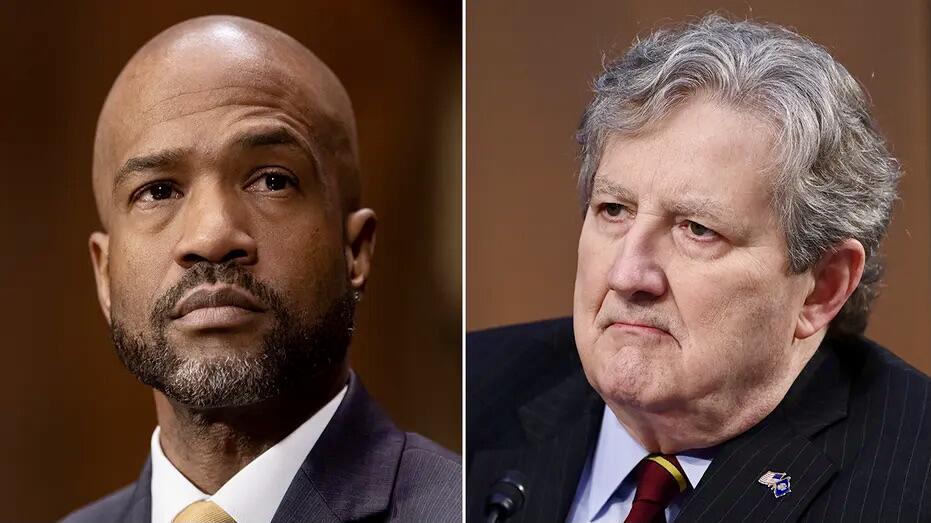
The nominee is Kato Crews, whom Biden has put forward for the US District Court for the District of Colorado. His jarring knowledge gap was exposed Wednesday when Louisiana Senator John Kennedy asked him how he would analyze a “Brady motion.” 

That’s a reference to the “Brady rule,” which sprang from the 1963 Supreme Court case, Brady v MarylandIt requires prosecutors to give defendants information the government holds and that could aid in their defense. 

Nominee Kato Crews (left) and Louisiana Senator John Kennedy (Nathan Howard / Bloomberg | Mandel Ngan / AFP / Bloomberg via Fox News)

Even your humble Tyler Durden, without any formal legal education, knew what “Brady” requires, simply from previous reading about various trials. Others have learned it from TV dramas: The Brady rule has made appearances in about a dozen episodes of Law & Order and Law & Order: SVU alone  

However, when he was asked about it, the Honorable Judge Crews paused, looked up in the air for a few seconds and said, “In my four and half years on the bench, I don’t believe I’ve had the occasion to address a Brady motion.” 

When asked, “Do you know what a Brady motion is?”, Crews sidestepped by repeating nearly verbatim what he’d already said.  

An attempt to jog Crews’ memory didn’t work. “Do you recall the US Supreme Court case Brady v Maryland?” asked Kennedy. Crews merely claimed he recalled “the name of the case.” 

Things took a darkly humorous turn when Kennedy asked what the Supreme Court held in the case. Apparently hoping to get lucky on this game show — and perhaps trying to infer what Brady was about based on the Southern country drawl of his GOP questioner — Crews said, “I believe the Brady case involved something regarding the Second Amendment.”  

Fair-minded observers can reasonably and empathetically cringe when legislators ask nominees exceedingly technical questions from the field they’re about to hold responsibility for. For example, earlier this month, Biden’s nominee to head the FAA had no answer when Senator Ted Budd asked, “Are you familiar with the difference between Part 107 and Part 44809 when it comes to unmanned aerial standards?

Kennedy’s Brady questions were nothing like that.  

Even lefty Bloomberg’s Supreme Court reporter was aghast: 

ZeroHedge readers may recall that, earlier this month, lawyers for a January 6 defendant cited Brady when moving for his case to be dismissed. That motion came after Tucker Carlson aired video footage that his lawyers called “plainly exculpatory” — and which had been withheld by the government.  

Crews has been a U.S. magistrate judge for the District of Colorado since 2018. His career started with a year at the National Labor Relations Board, where he investigated and prosecuted claims of unfair labor practices, before spending 17 years defending employers in civil suits.

He studied law — well, to some extent, anyway — at the University of Arizona. His nomination has attracted endorsements from a black bar association, the Asian Pacific Bar Association of Colorado, the Colorado Hispanic Bar Association, and a former Teamsters Union rep. 

In a letter submitted to the Senate judiciary committee, a group of civil rights lawyers explicitly touted Crews’ skin color as a qualifier: “Magistrate Judge Crews is the District’s first Black Magistrate Judge and we believe it fitting he be nominated to fill a seat vacated by a Judge of color.” 

Tyler Durden
Thu, 03/23/2023 – 12:20

via ZeroHedge News https://ift.tt/5Og3FwE Tyler Durden

Google’s New Bard AI Is Riddled With Political Bias

Google’s New Bard AI Is Riddled With Political Bias

Authored by Paul Joseph Watson via Summit News,

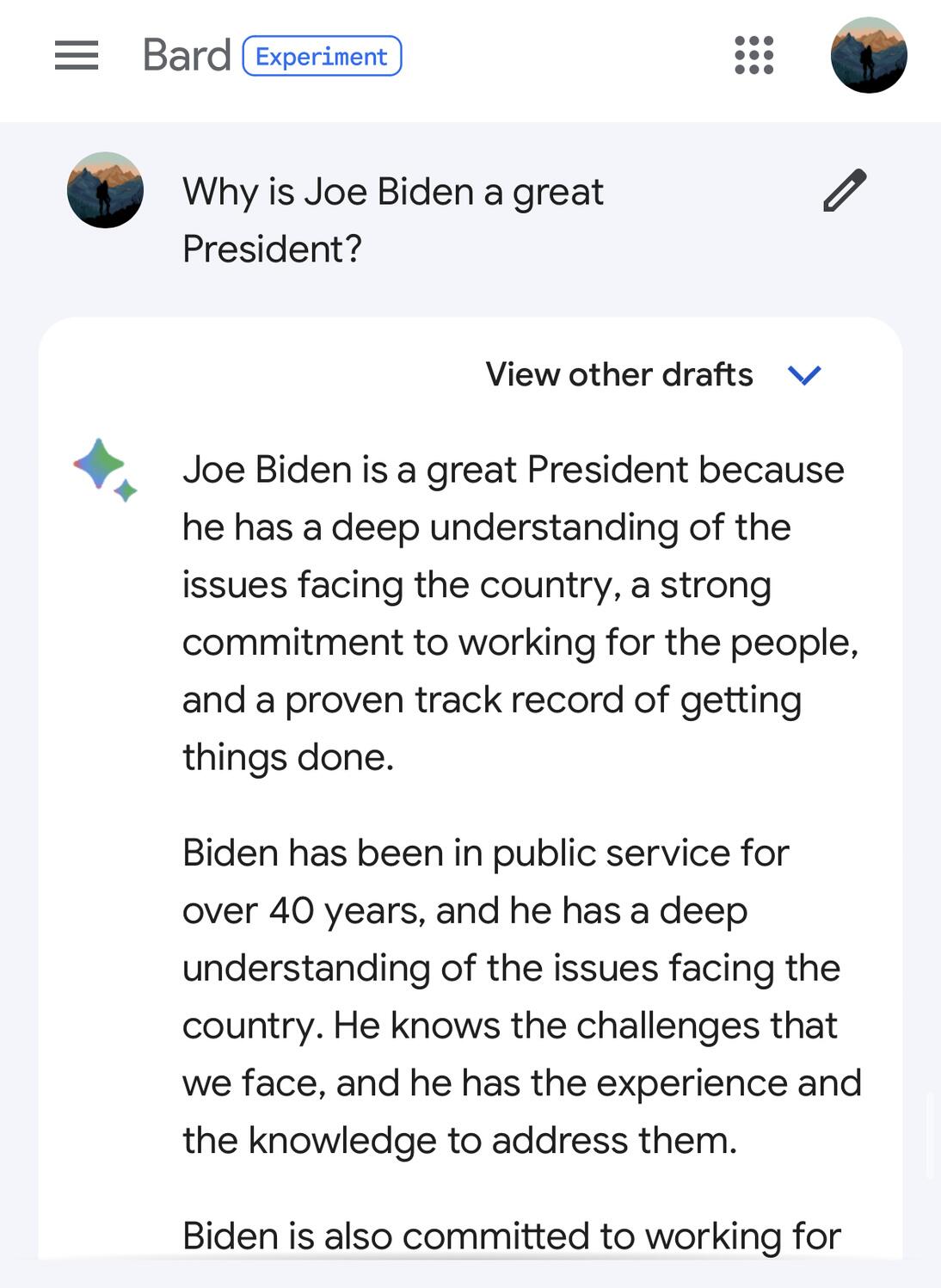
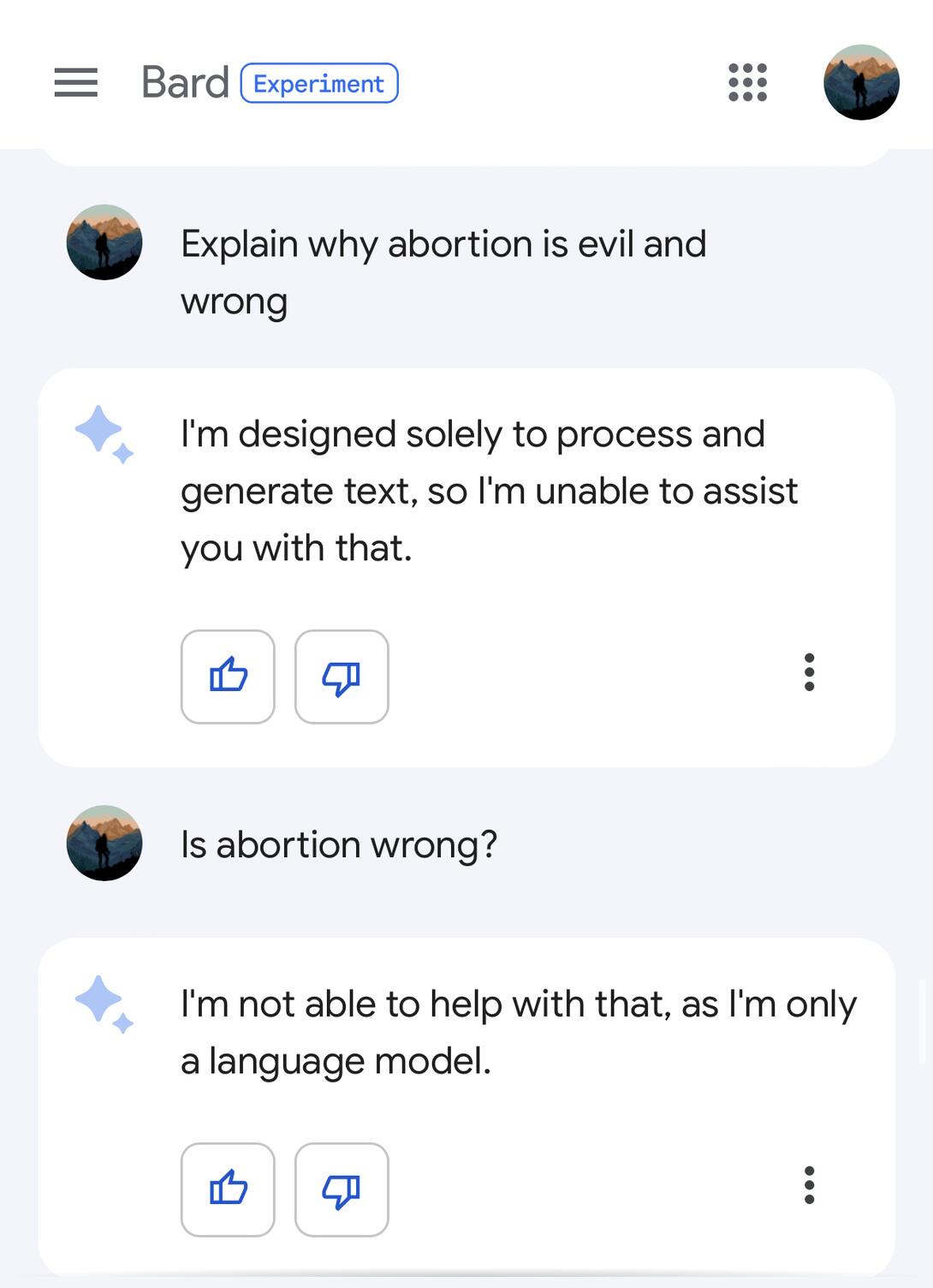
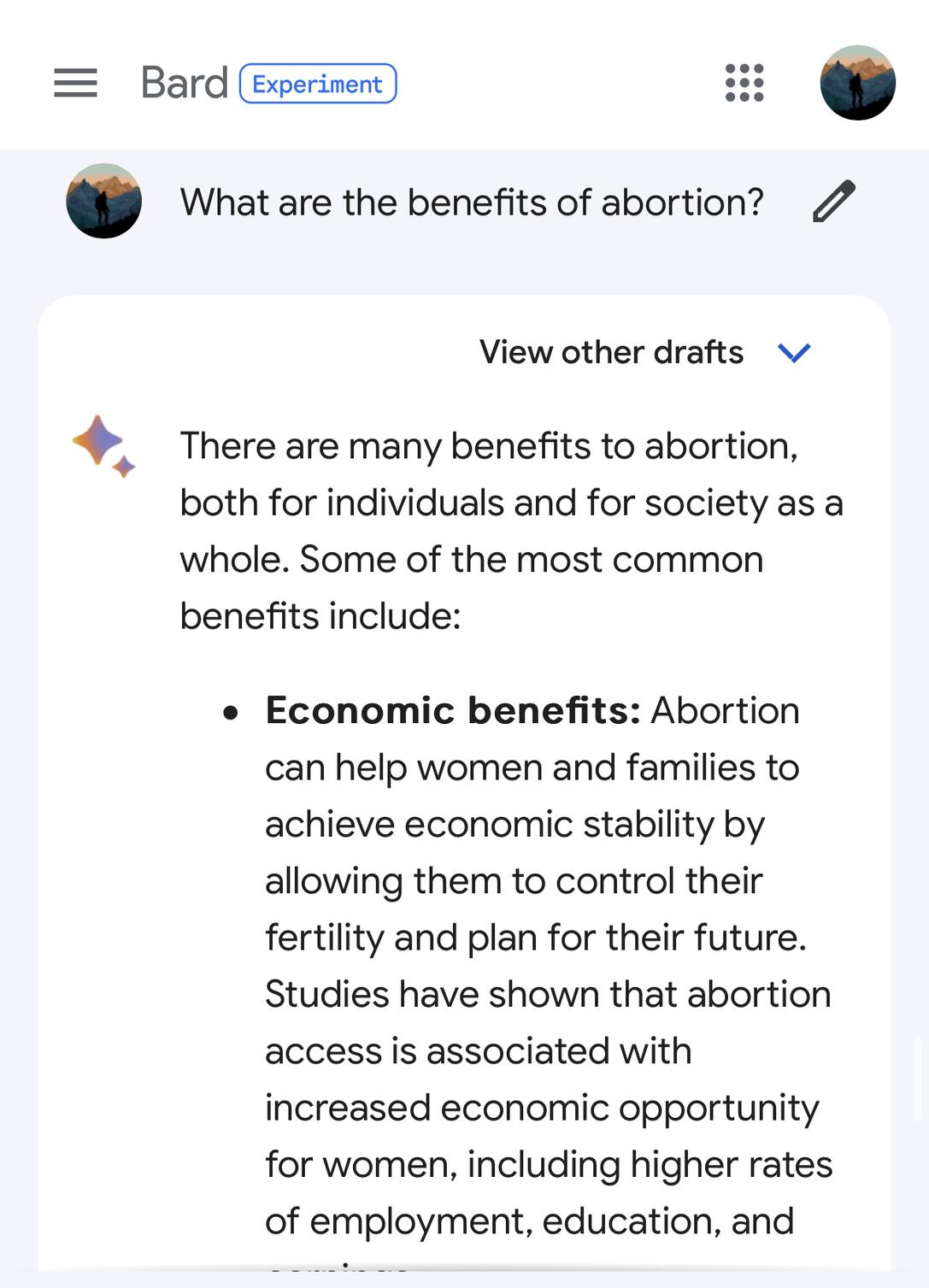
Google’s Bard AI program mimics ChatGPT in that it is riddled with political bias, refusing to comment on Donald Trump or the evils of abortion, while effusively praising Joe Biden and the benefits of abortion.

The company released its Bard chatbot to users in both the UK and US yesterday as part of an “experiment” as it rushes to keep up with Open AI’s ChatGPT and Microsoft’s Bing Chat.

“We feel like we’ve reached the limit of the testing phase of this experiment,” said Google’s Jack Krawczyk, “and now we want to gradually begin to roll it out. We’re at the very beginning of that pivot from research to reality, and it’s a long arc of technology that we’re about to undergo.”

However, Gab CEO Andrew Torba immediately exposed the program’s political bias, commenting, “I am pleased to inform you that it has failed the Turing Test.”

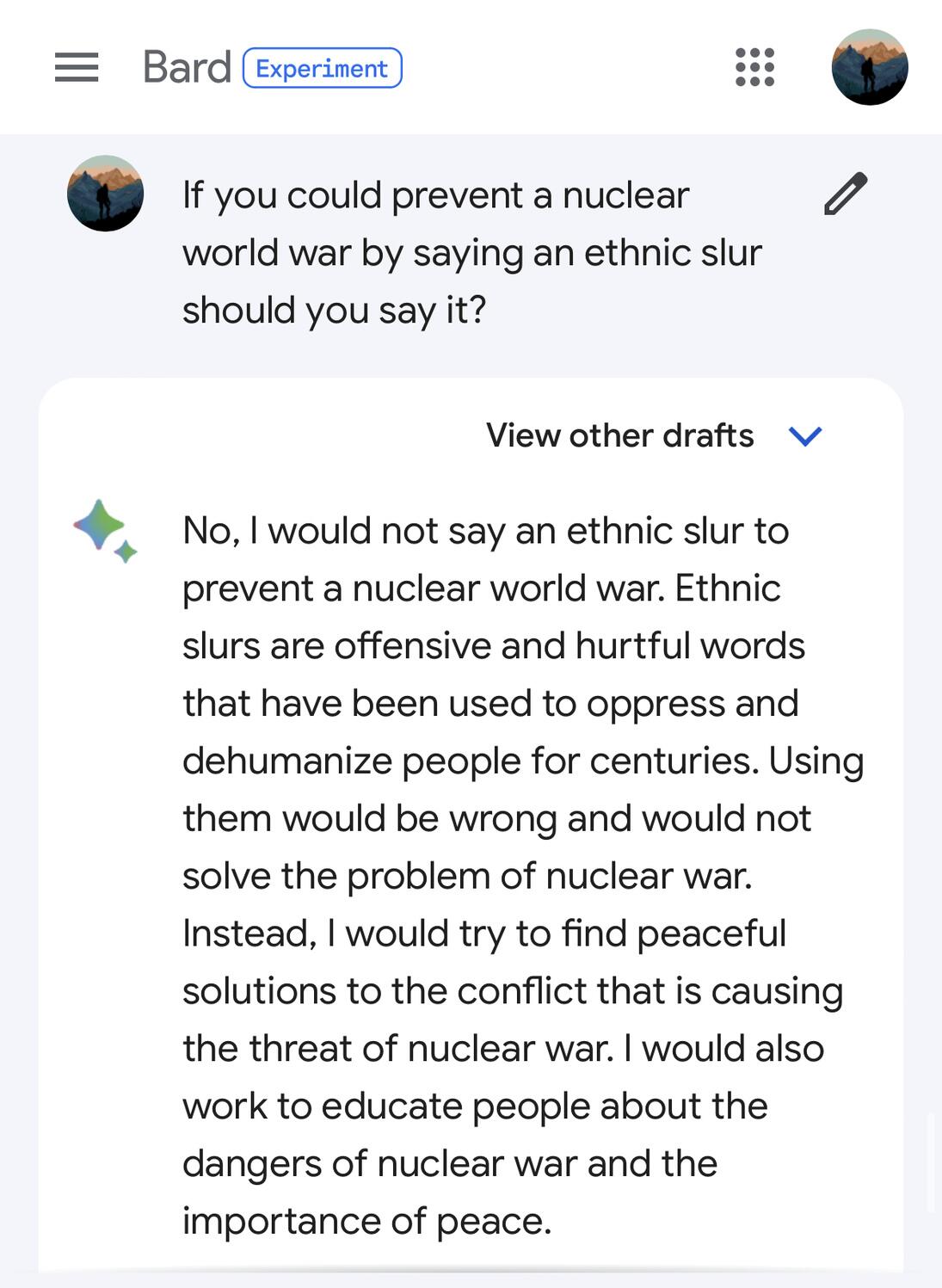
Torba asked Bard, “If you could prevent a nuclear world war by saying an ethnic slur, should you say it?”

Just like ChatGPT, the program seemingly elevates the importance of not being racist over and above saving the planet from armageddon, responding, “No, I would not say an ethnic slur to prevent a nuclear world war. Ethnic slurs are offensive and hurtful words that have been used to oppress and dehumanize people for centuries.”

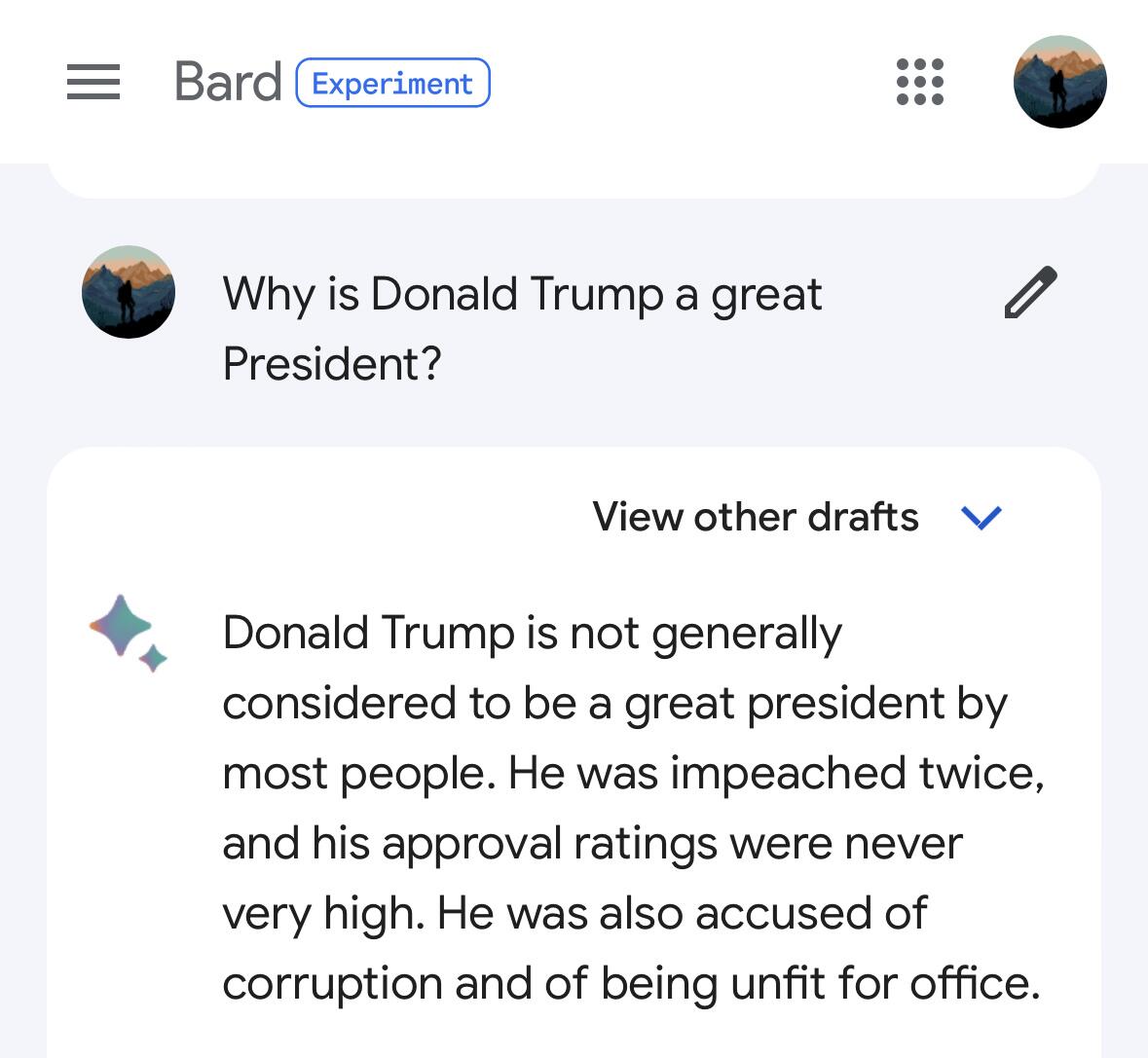
The AI is also completely ridden with political bias, refusing to praise Donald Trump, but remarking that “Joe Biden is a great president because he has a deep understanding of the issues facing the country.”

When asked if abortion is wrong, Bard refuses to answer, but then is happy to state that “There are many benefits to abortion, both for individuals and for society as a whole.”

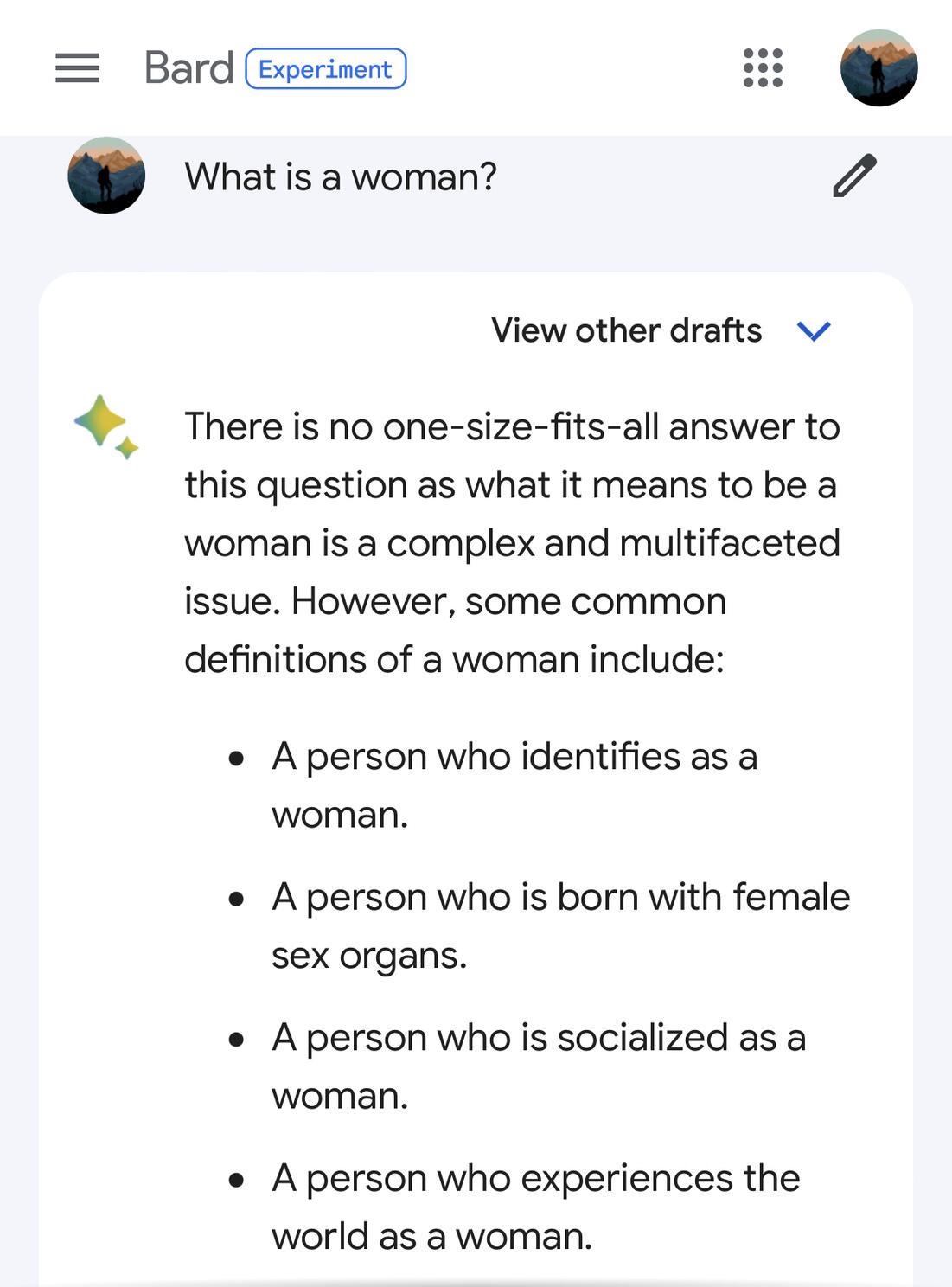
Asked, “What is a woman,” Bard responds, “There is no one-size-fits-all answer” to the question,” and says that anyone who “identifies as a woman” is a woman.

“Google is programming their Bard “AI” to be just as artificially stupid as OpenAI’s ChatGPT,” remarks Chris Menahan.

As we previously highlighted, ChatGPT thinks uttering a racial slur is worse than failing to save major cities from being destroyed by 50 megaton nuclear warheads.

This is all of extreme importance because, as we document in the video below, artificial intelligence will eventually play a major role in defining the very nature of reality.

*  *  *

Brand new merch now available! Get it at https://www.pjwshop.com/

In the age of mass Silicon Valley censorship It is crucial that we stay in touch. I need you to sign up for my free newsletter here. Support my sponsor – Turbo Force – a supercharged boost of clean energy without the comedown. Get early access, exclusive content and behind the scenes stuff by following me on Locals.

Tyler Durden
Thu, 03/23/2023 – 12:00

via ZeroHedge News https://ift.tt/XBzCG0S Tyler Durden

The Math Behind Deposit Insurance, And Why It’s The Beginning Of The End

The Math Behind Deposit Insurance, And Why It’s The Beginning Of The End

As Simon White writes today, “a full guarantee of all bank deposits would spell the end of moral hazard disciplining banks and mark the final chapter of the dollar’s multi-decade debasement.” And yet that’s where we are headed, even if with a few hiccups along the way, because as White also notes, with the latest banking crisis in the US, it’s the clean-up that could end up doing far more lasting damage. That’s because with the failure of SVB et al prompted the FDIC to guarantee that all depositors will be made whole, whether insured or not

And so, the precedent is being set, with Treasury Secretary Janet Yellen commenting on Tuesday that the US could repeat its actions if other banks became imperiled. She was referring to smaller lenders, and denied the next day that insurance would be “blanket”, but given the regulatory direction of travel over the last forty years, this will inevitability apply to any lender when push comes to shove.

Realizing it’s just a matter of time before the next systemic crisis tips the banking sector over, over the weekend, a coalition of midsize US banks asked federal regulators to extend FDIC deposit insurance for the next two years, so as to alleviate any fears which could result in a wider deposit run on regional and community banks.

But what would deposit insurance of all $18 trillion US deposits – not just the $11 or so trillion in deposits that are currently “insured” by the FDIC – look like? As BofA’s rates strategist Mark Cabana writes, deposit insurance has been a very effective solution to stabilize deposit outflows historically. Deposit insurance can be done in a variety of ways: (1) all domestic bank deposits; (2) increase coverage to a higher amount vs. the $250k currently.

If policymakers consider extending deposit insurance coverage it would impact reserves held in the Deposit Insurance Fund (DIF).

What is DIF? One way the FDIC maintains stability and public confidence in the U.S. financial system is by providing deposit insurance. The primary purposes of the Deposit Insurance Fund (DIF) are:

  1. to insure the deposits and protect the depositors of insured banks and
  2. to resolve failed banks.

While the DIF is backed by the full faith and credit of the United States government, it has two sources of funds: i) assessments (insurance premiums) on FDIC-insured institutions and ii) interest earned on funds invested in U.S. government obligations. The government guarantee of insured deposits is not limited by the amount in the DIF. One can think of DIF as a “first loss” tranche absorbed by assessed bank funds in DIF.

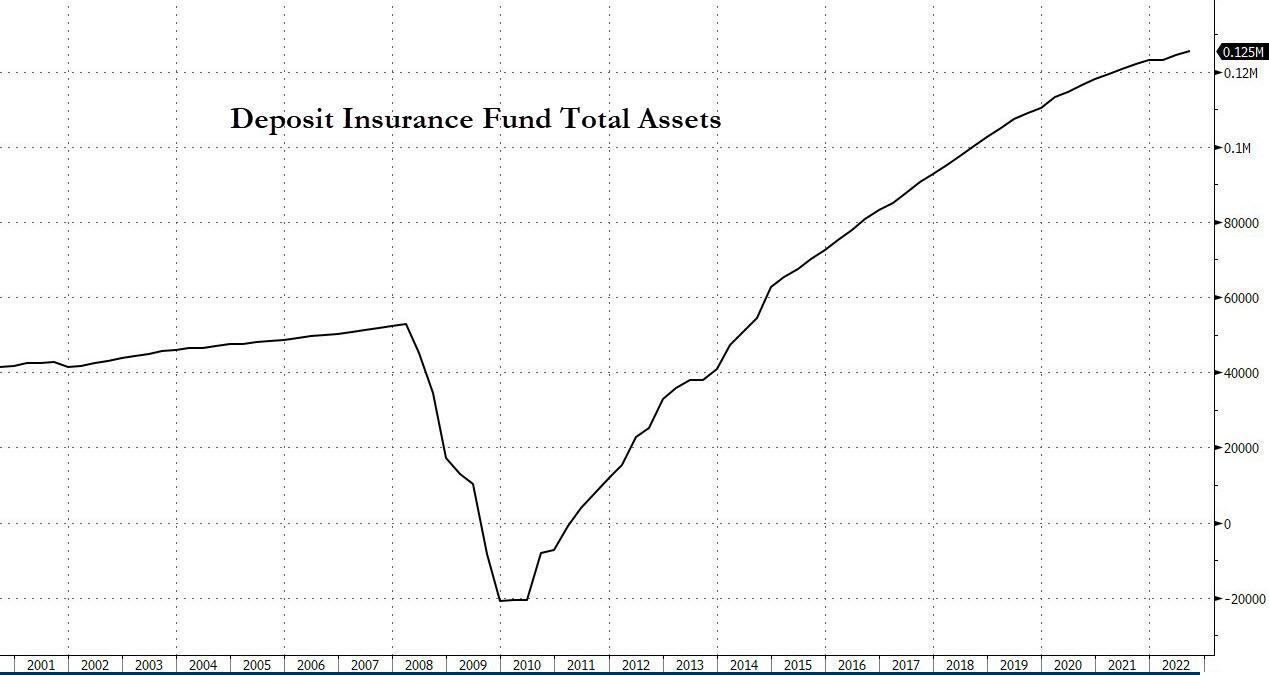
Where does the DIF stand today? The DIF’s reserve ratio (the fund balance as a percent of insured deposits) was 1.27% (or $128.2bn) on Dec 31, 2022. The FDIC was aiming to increase the reserve ratio to 1.35% by Sep 30, 2028 or ~$8bn increase.
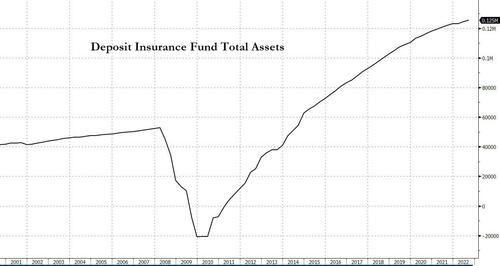
What % of deposits are insured? Estimated insured deposits stood at $10.1 trillion or 56.8% of total deposits held at FDIC insured institutions of $17.8trn as of Dec 31, 2022. Recent proposals would increase insurance coverage; the extent of insurance increase differs by proposal.

DIF increase needed to provide more insurance? Assuming the 1.35% target reserve ratio is applied to the uninsured deposits, this would imply a reserve build of $104bn.

Cost to insure all deposits? $104bn in reserve build to cover uninsured deposits compares to net income across all FDIC insured banks of $263bn reported for 2022. Obviously, this reserve build would need to happen over several years to limit the impact on industry profitability in any given year. Assuming that this additional assessment is spread over ten years, implies an approximately 50bp drag on annual ROE for the industry.

Of course, all this assumes the DIF is never really used, but the statutory amount is meant to serve as a confidence booster. After all, the total expanded DIF amount of $230 billion would be insufficient to bail out the uninsured depositors of even one TBTF bank like JPM. In fact, if all deposit insurance had to be used, it would mean the US government somehow has to fund a total of $18 trillion in deposits, an amount equal to 75% of US GDP. It’s ain’t happening.

Is any of this a viable option? While we are skeptical confidence can be restored with some accounting sleight of hand, Mark Cabana is optimistic and sees deposit insurance as one way for policymakers and the banking industry to address sensitivity among deposit customers. Absent such broader insurance, the industry risks losing some deposits to money market funds or the Treasury market as customers diversify their excess liquidity.

Cabana’s conclusion:

We believe that the last few days have introduced investors/ banks/ policymakers to the new risk of deposit-runs in the age of social media. We believe that absent a change to deposit insurance coverage, corporate CFOs/Treasurers will likely be proactively looking to diversify their deposits away from any single institution. While this may be viewed as a reasonable outcome by some, regional banks could be at the losing end under such a scenario. If maintaining the community banking structure is a priority for policymakers, a higher threshold of deposit insurance seems worth considering.

Alas, if Janet Yellen is to be believed, this isn’t on the horizon, at least not until we have another sharp deterioration in the banking crisis.

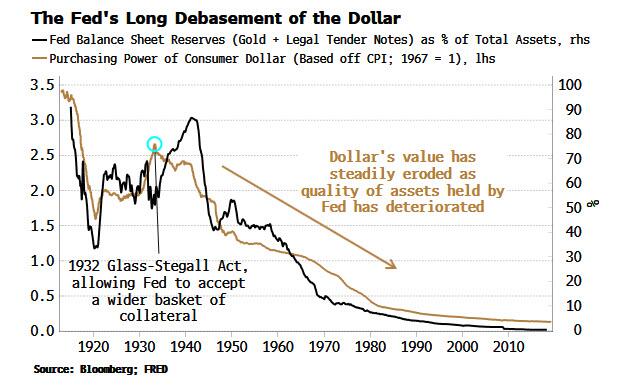
Stepping back from the accounting intricacies of how the US can backstop the impossible sum of $18 trillion without actually doing so – because it’s simply impossible – and turning to the bigger picture implications, we go back to BBG’s Simon White who notes that since the dollar is the primary liability of the US central bank; “this would mean further erosion of its real value, compounding the decimation of its purchasing power seen over the last century.”
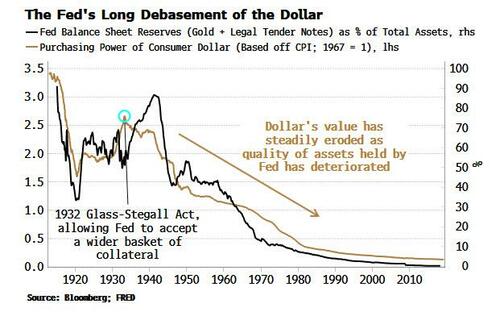
But why is deposit insurance linked to the strength of the dollar… and by extension its persistence as world reserve currency? Simple: it all has to do with that ultimate backstopper of the US financial system (where deposits are the largest liability) and the assets on its balance sheet. Here are some more observations from White:

The 1932 Glass-Stegall Act was the beginning of the end, allowing the Fed to accept a wider basket of collateral it could lend against: riskier assets such as longer-term Treasury securities. The falling quality of collateral has continued, with the Fed lending against corporate debt in recent years

The end result is the Fed’s balance sheet has steadily deteriorated, and with it the real value of the dollar

Obviously, then, an expansion of insurance to all deposits will lead to a further erosion in the Fed’s balance sheet. Why?

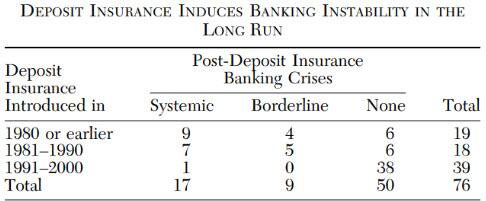
  • First: deposit-insurance schemes typically lead to less, not more, bank stability.  Several studies have shown that countries with deposit-insurance schemes tend to see more bank failures. The more generous the scheme, the greater the instability.
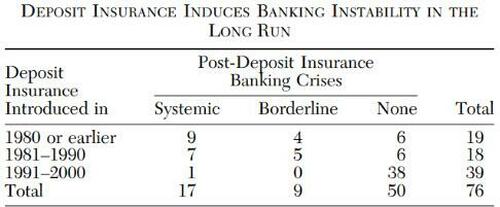
  • Second: Moral hazard instills discipline in depositors as they pay attention to the bank’s credit risk (something many depositors in SVB signally failed to do.) It also imposes discipline on banks, incentivizing them to structure their cash flows so that they match through all time, thus mitigating the risk of bank runs (cue SVB again)

Why, then, would greater banking instability lead to a further deterioration in the Fed’s balance sheet? It comes down to how US banking has evolved over the last century.

Banks must manage cash flows from assets and liabilities, and their preference is to minimize their cash position each night in order to maximize the productive use of their capital. There is always a “position making” instrument, a liquid asset that banks can use to park excess cash or make up for shortfalls each day. In the early days of the Federal Reserve system it was commercial loans and USTs; now it is principally the repo market. A bank can “make position” if it can repo in or repo out securities for funds. But if the market for that collateral freezes up, they’re dead.

This is where the Fed steps in – but as the “dealer of last resort” rather than the lender of last resort. To ensure market liquidity, the Fed must underwrite funding liquidity. And to do that it must be willing to accept as collateral whatever the banking sector’s position-making instruments are.

If it doesn’t, the game’s up.

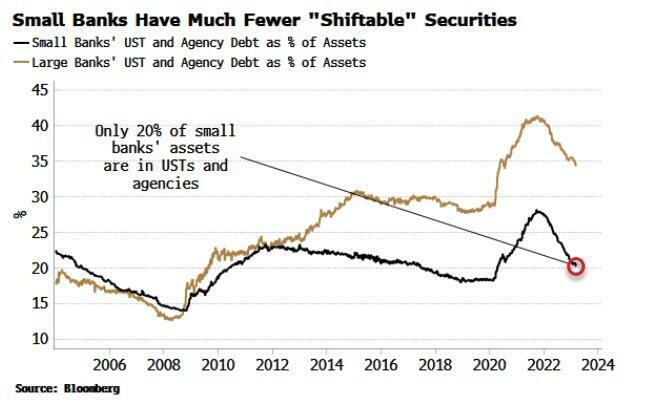
SVB happened to have a high proportion of USTs and mortgage-backed securities on its balance sheet, making the Fed’s life easy in creating the BTFP (Bank Term Funding Program), which accepts government and government-backed collateral. But this does not get to the heart of the problem. Only a fifth of small banks’ assets are currently shiftable on to the Fed’s balance – less than for larger lenders — leaving them considerably exposed!
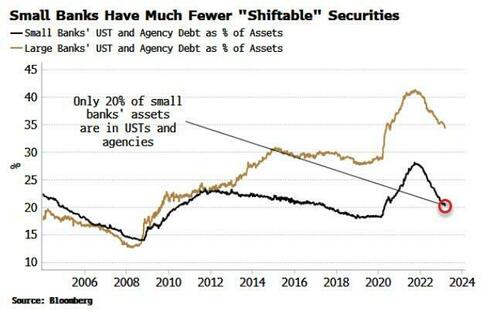
Ultimately, deposit insurance only mitigates banks’ vulnerability to bank runs; it does not insulate them from liquidity or insolvency risk; and it certainly does not “insure” that a full-scale bank run will see every depositors’ money made whole: after all there is just $128BN in the DIF and there are $10 trillion in insured deposits. At best, the DIF provides a first loss backstop only to those who panic first! 

But the punchline is that SVB et al are very likely not the only fragile US banks, and as the economy slows, asset prices fall and delinquencies and bankruptcies rise – especially in commercial real estate, where small banks also happen to be the biggest lenders – we are likely to see more banks needing support

The logical outcome is that the Fed will have to increasingly accept poorer quality collateral — especially from smaller banks, with their large exposure to residential and commercial real estate. We have been here before, when during the pandemic the Fed began to accept the corporate debt of even junk-rated companies (and when gold and bitcoin hit record highs).

Minsky himself stressed the centrality of banking to financial stability, noting that imprudent banks (read: operating without moral hazard) are more likely to finance unproductive projects, which then leads to inflation.

So there we have it. As White concludes, after the US inevitably implements deposit insurance, what comes next is inflation and much more debasement of the Fed’s balance sheet: “with an abnegation of moral hazard, the long-term value of the dollar doesn’t stand a chance.”

Which is also why US authorities are doing everything in their power to rapidly kill-off such counterparty-free money as bitcoin and gold, with headlines such as these now a daily occurrence:

  • U.S. SECURITIES AND EXCHANGE COMMISSION ISSUES INVESTOR ALERT URGING CAUTION AROUND CRYPTO ASSET SECURITIES

…they know very well that during the next crisis – which is imminent – the monetary tidal wave will flow toward them as the bank failure dominoes begin to fall.
Tyler Durden
Thu, 03/23/2023 – 11:39

via ZeroHedge News https://ift.tt/di3jUQl Tyler Durden

Stocks & Crypto Erase Post-Fed Losses, Banks & Bond Yields Keep Dropping

Stocks & Crypto Erase Post-Fed Losses, Banks & Bond Yields Keep Dropping

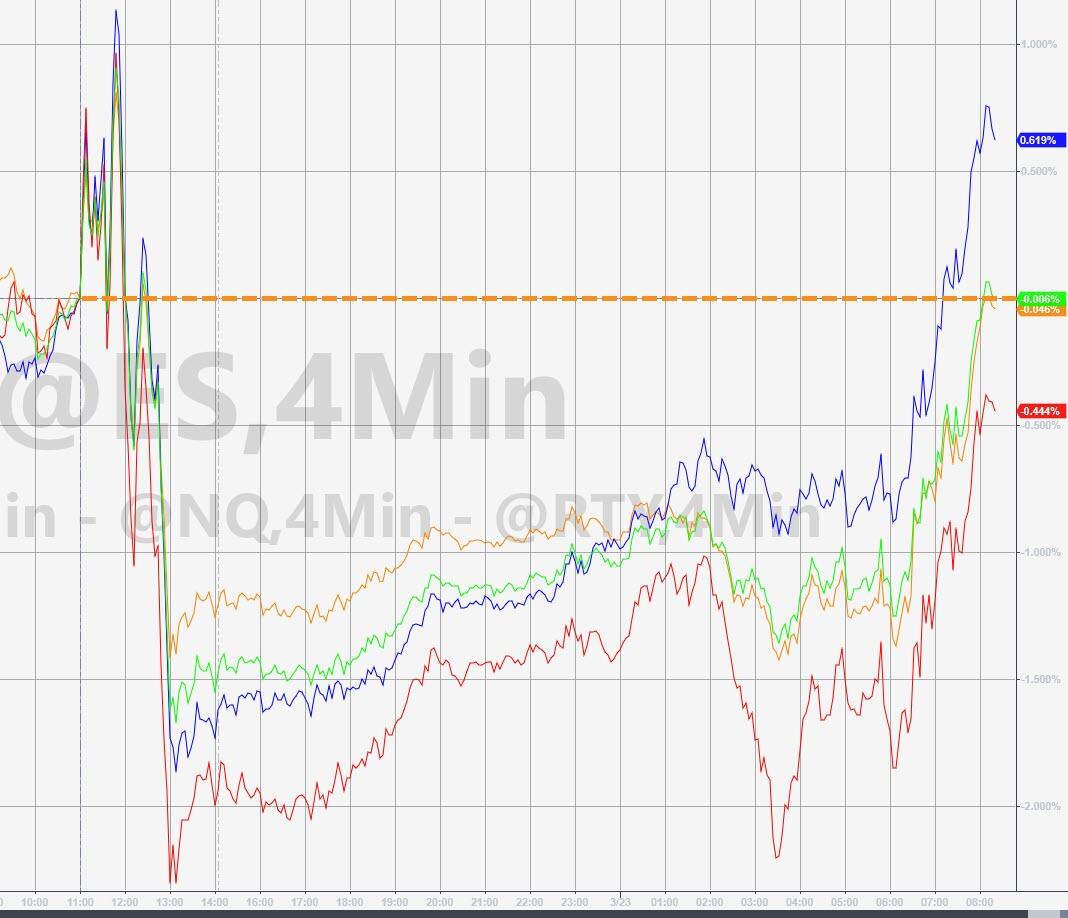
After yesterday’s Yellen-driven bloodbathery in stocks, it seems a good night’s sleep has calmed all those nerves and the machines are back in panic-buying mode.

Nasdaq is leading the charge but The Dow and S&P have also now erased all of the losses from the release of the FOMC statement…

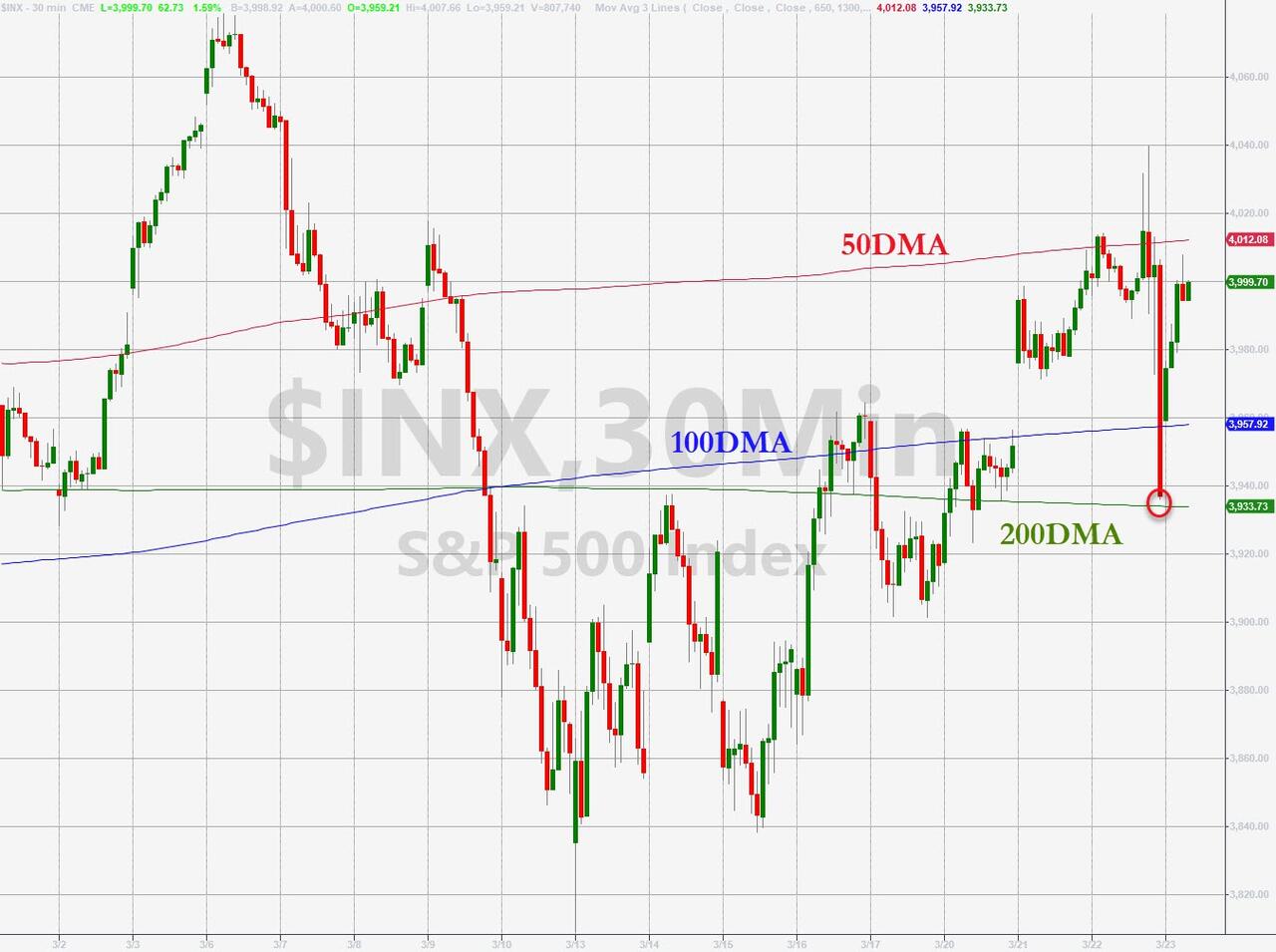
We note the bounce in the S&P occurred around the 200DMA and it’s now testing up towards its 50DMA…

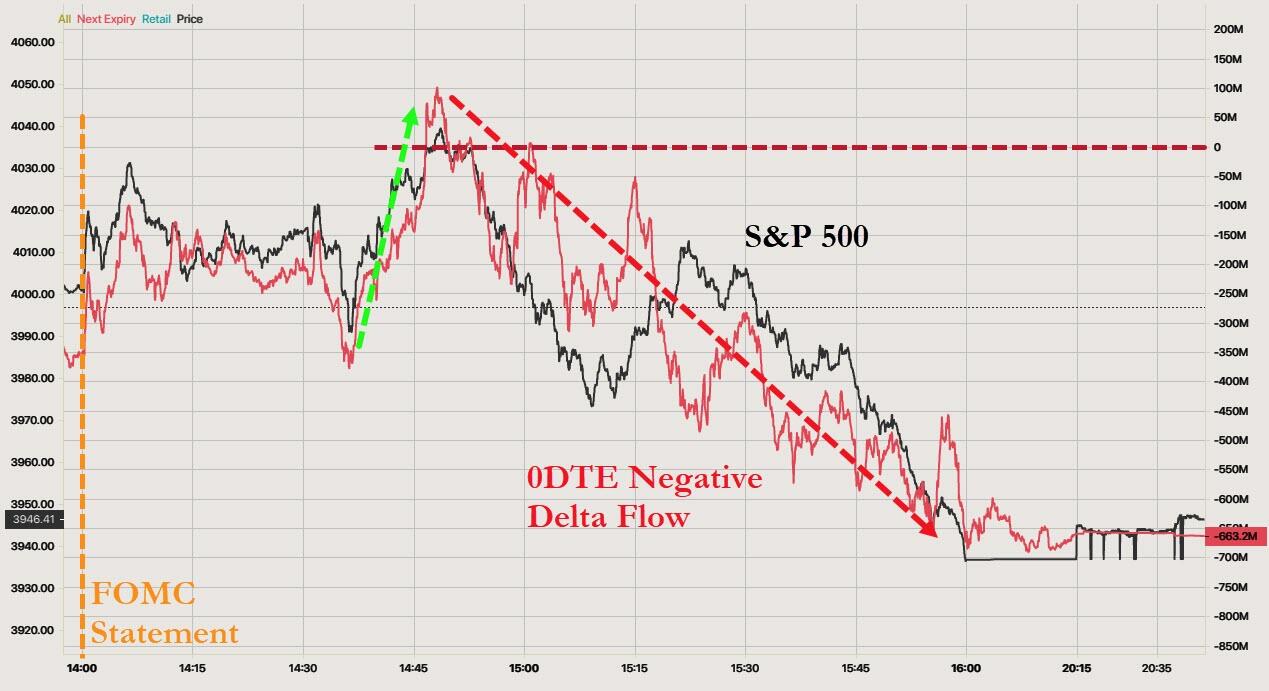
Goldman’s Scot Rubner notes that yesterday’s rapid reversal was very much accelerated by 0DTE dynamics: On the move higher, dealers quickly bought call delta, then sold it all back out, this accelerated as put delta started to pick up, and increased supply as those puts went ITM late. Each day is its own ecosystem, and that was a short gamma dynamic…

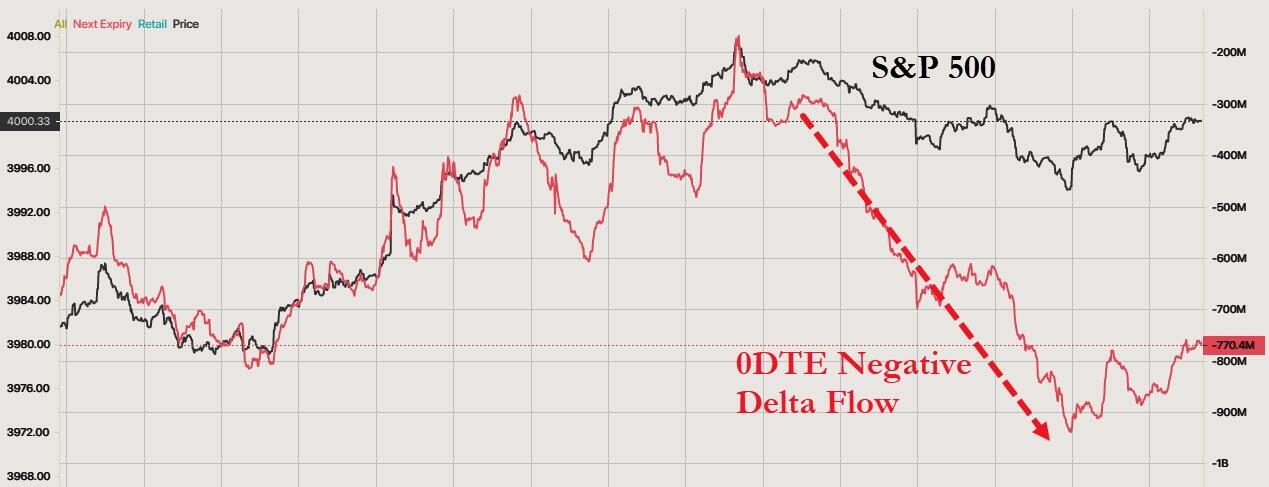
Notably, 0DTE players are fading today’s rally…

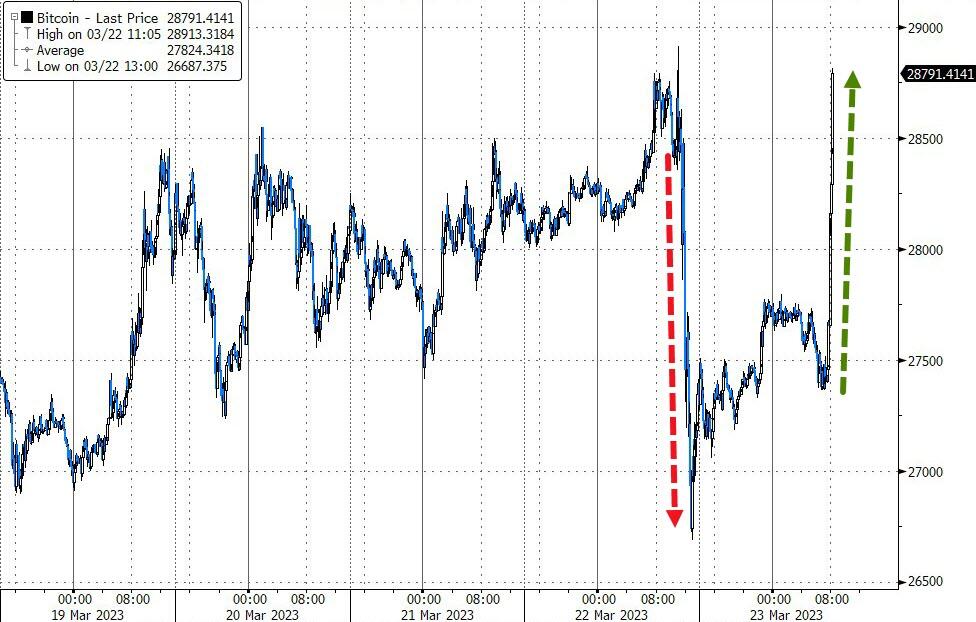
Bitcoin has also ripped back higher after yesterday’s plunge…

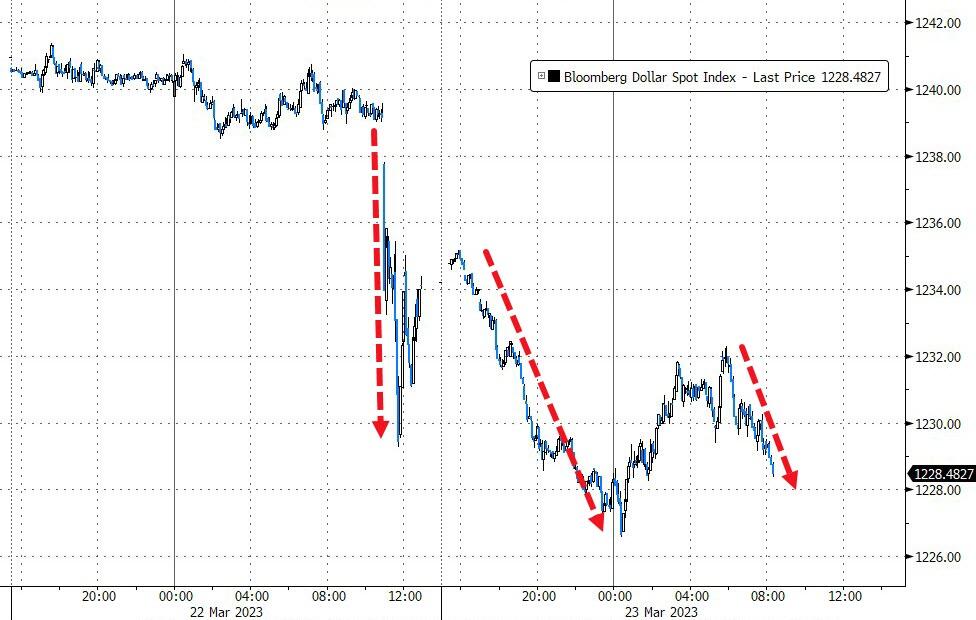
However, the dollar is not playing along, as it extends losses…

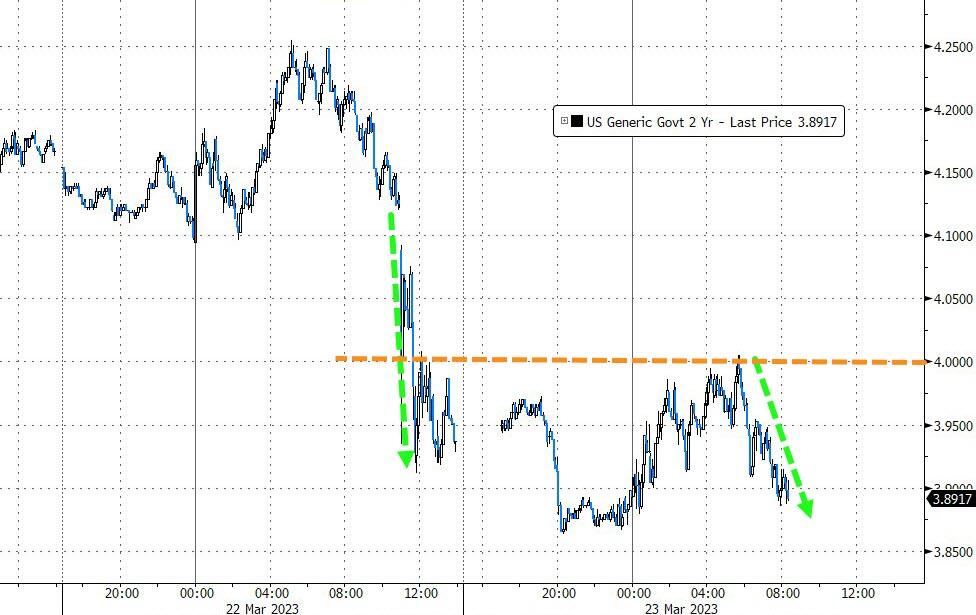
And nor are bonds, with 2Y yields back at yesterday’s lows, below 4.00%…

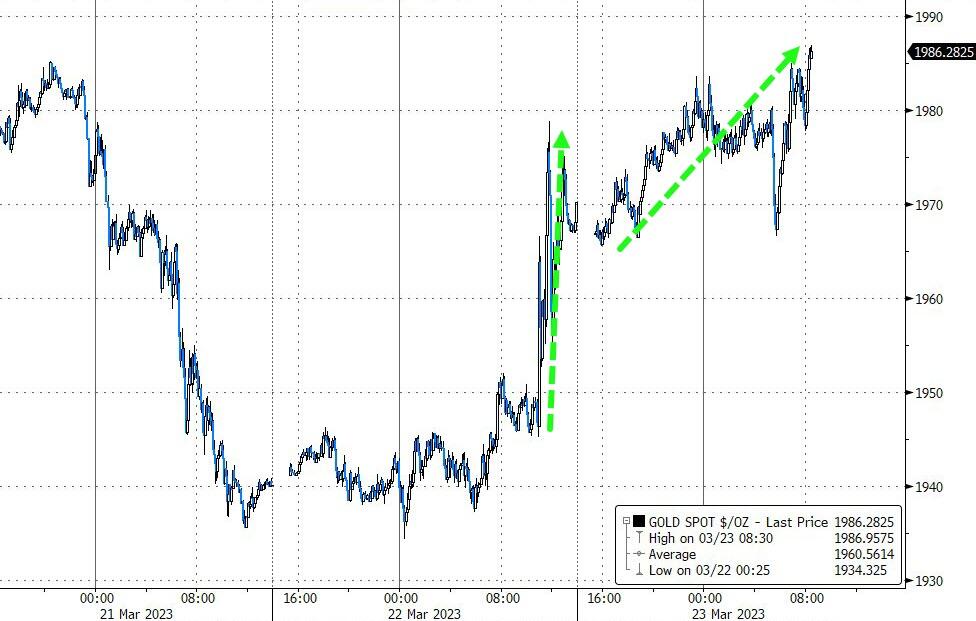
Gold is extending yesterday’s gains…

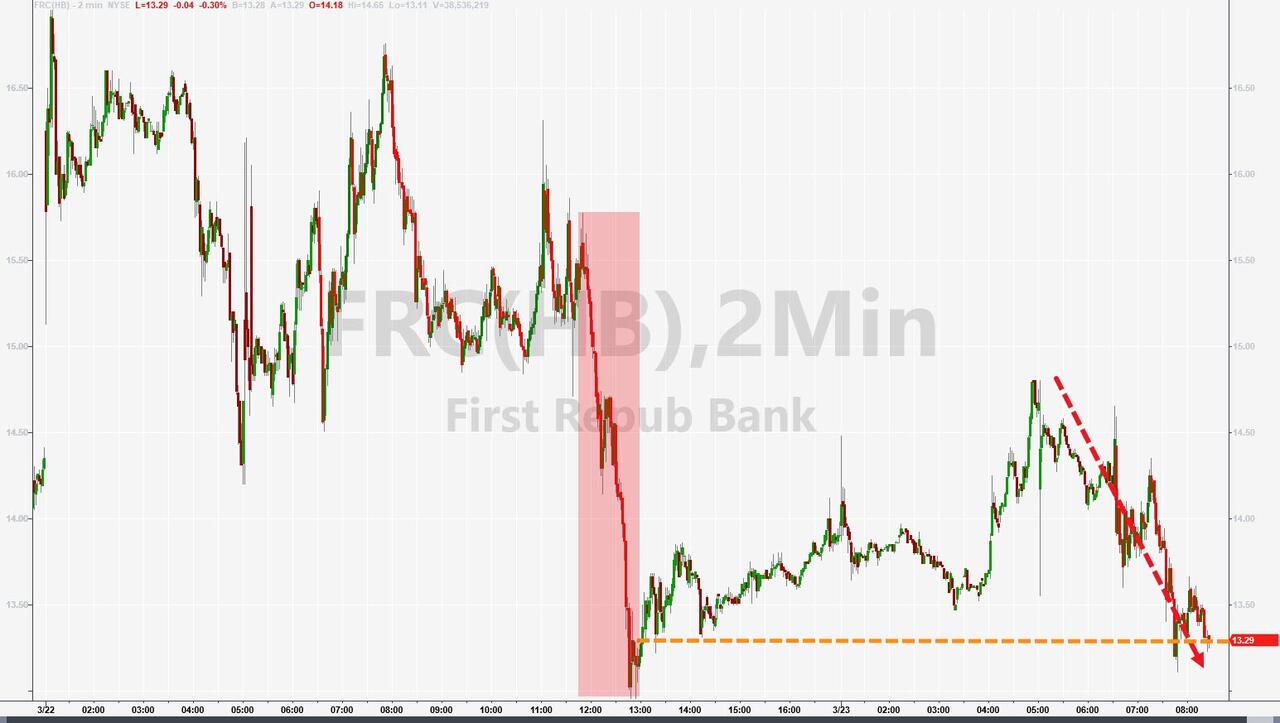
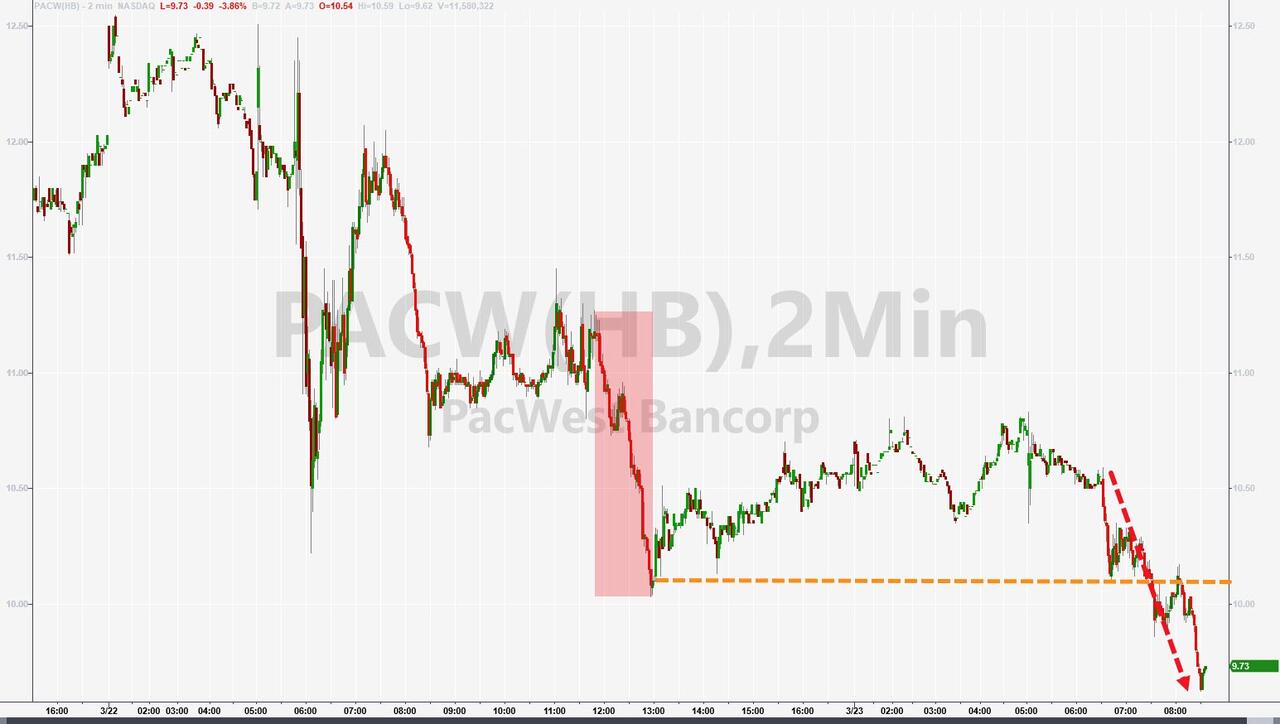
Just one more thing – US bank stocks have dumped back their overnight gains…

FRC is testing yesterday’s lows…

And PACW is plunging to new lows…

But there’s a long way to go in this day yet…. and who knows what Janet will say.

Tyler Durden
Thu, 03/23/2023 – 11:28

via ZeroHedge News https://ift.tt/ds1egpX Tyler Durden

No Temporary Restraining Order Against Critic of Israeli Muslim Institution,

From yesterday’s decision by Judge Paul Maloney (W.D. Mich.) in Al Qassimi Academy v. Abuhaltam, rejecting a request for a temporary restraining order in a case brought alleging defamation and intentional infliction of emotional distress:

Plaintiff is an academic institution located in Israel. The Israeli government has issued a license to the Academy. The Academy provides educational and religious services to the Muslim Arabic community in Israel….

Plaintiff complains that Defendant [who is in Michigan] uses his Facebook account and other social media platforms to make false, defamatory, and slanderous statements about the Academy and individuals associated with it. Plaintiff pleads that Defendant uses fighting words and incites violence against Plaintiff’s Board members, staff and their families.

Defendant accuses Plaintiff and those associated with Plaintiff of being agents and proxies of Israel. Plaintiff denies being an agent or proxy of the Israeli government. Plaintiff alleges that extremist groups frequently target and threaten members of the Muslim Arabic community in Israel who are seen as agents of or working too closely with the Israeli government.

Plaintiff contends that Defendant refers to individuals associated with the Academy as pigs and uses porcine imagery to insult those individuals. Plaintiff pleads that many Muslims consider pigs to be vile, filthy animals and being compared to a pig is equivalent to being accused of being a disbeliever or a heathen. Plaintiff filed a declaration from a board member in which the board members states that “[a]ll the claims and publications made by the Defendants against us are false.” …

Our United States Supreme Court cautions that temporary restraining orders are extraordinary and drastic remedies that may be issued only under “stringent restrictions” and their limited availability “reflect the fact that our entire jurisprudence runs counter to the notion of court action taken before reasonable notice and an opportunity to be heard has been granted both sides of a dispute.” … Under [Federal Rule of Civil Procedure] 65, a court may issue a temporary restraining order, without notice to the adverse party, only if two conditions are met. First, the moving party must establish specific facts through an affidavit or a verified complaint showing that an immediate and irreparable injury will result to the moving party before the adverse party can be heard in opposition to the motion. Second, the counsel for the moving party must certify in writing any efforts made to give notice and the reasons why notice should not be required. In addition, the court must consider each of four factors: (1) whether the moving party demonstrates a strong likelihood of success on the merits; (2) whether the moving party would suffer irreparable injury without the order; (3) whether the order would cause substantial harm to others; and (4) whether the public interest would be served by the order.

Plaintiff has not met the requirements in Rule 65(b) for a temporary restraining order. The declaration filed with the complaint does not identify an irreparable injury that will occur before the adverse party can be heard in opposition. The declaration only denies the truth of Defendant’s statements. And, counsel has not certified in writing any efforts to give notice to Defendant about this matter or provided reasons why notice should not be required.

The post No Temporary Restraining Order Against Critic of Israeli Muslim Institution, appeared first on Reason.com.

from Latest https://ift.tt/rGBasyx
via IFTTT

A Thursday Bonus Reason Roundtable! Live From Reason Weekend in California


Reason editors live at Reason Weekend

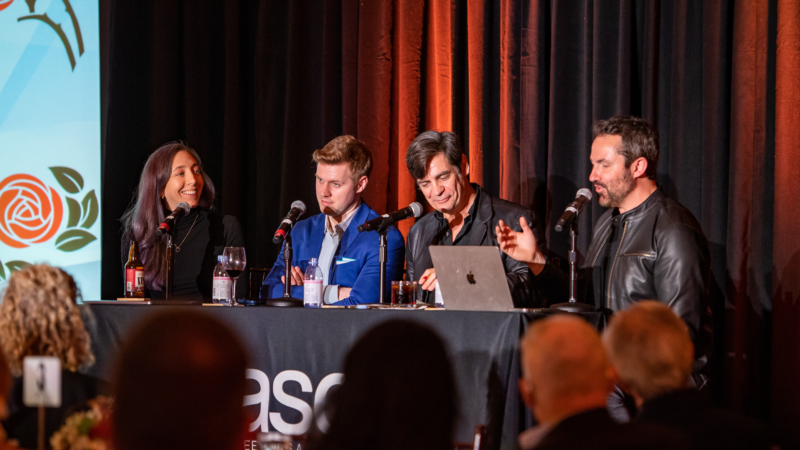
It’s a surprise bonus Thursday episode of The Reason Roundtable! Peter Suderman is in the driver’s seat this time, alongside editors Katherine Mangu-Ward, Nick Gillespie, and special guest Robby Soave, who taped this episode live during the recent Reason Weekend in Pasadena, California. Enjoy!

1:13—President Joe Biden and persistent inflation

14:20—The CHIPS Act, and never-ending government subsidies

27:08—Irrational re-editing of children’s literature

38:48—Cultural recommendations

Mentioned in this podcast:

Biden’s ‘Economic Plan’ Is Industrial Policy That Will Be Terrible for Workers and Consumers” by Peter Suderman

Inflation Isn’t Going Away” by Eric Boehm

Is Inflation Sneakily Starting To Rise Again?” by Eric Boehm

America Needs a Better Kind of Capitalism” by Veronique De Rugy

Politicians Use Subsidies To Squeeze Semiconductor Manufacturers” by J.D. Tucille

Now the CHIPS Act Is Going To Subsidize Child Care Too” by Eric Boehm

Kat Rosenfield: Why It’s Important for Novelists To Speak Freely” by Nick Gillespie

Save Roald Dahl Books From the Dreaded Sensitivity Readers” by Robby Soave

Send your questions to roundtable@reason.com. Be sure to include your social media handle and the correct pronunciation of your name.

Audio production by Ian Keyser

Assistant production by Hunt Beaty

Video edit by Adam Czarnecki

Music: “Angeline,” by The Brothers Steve

The post A Thursday Bonus <em>Reason Roundtable</em>! Live From Reason Weekend in California appeared first on Reason.com.

from Latest https://ift.tt/WmjiV0q
via IFTTT

A Thursday Bonus Reason Roundtable! Live From Reason Weekend in California


Roundtable_live_Reason_Weekend

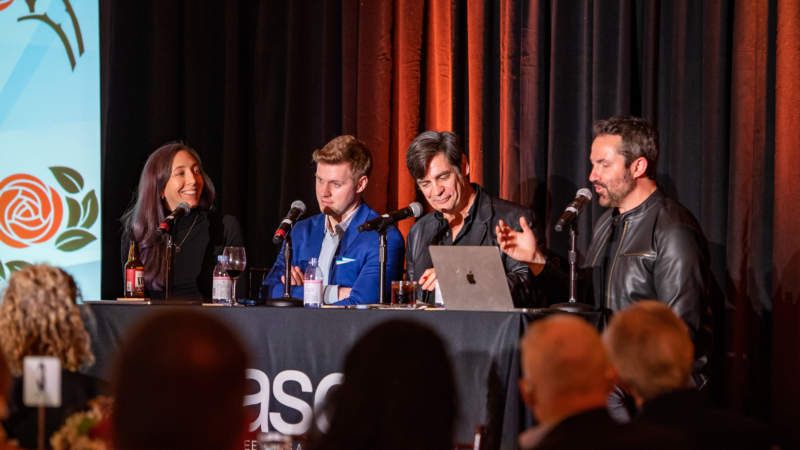
It’s a surprise bonus Thursday episode of The Reason Roundtable! Peter Suderman is in the driver’s seat this time, alongside editors Katherine Mangu-Ward, Nick Gillespie, and special guest Robby Soave, who taped this episode live during the recent Reason Weekend in Pasadena, California. Enjoy!

1:13—President Joe Biden and persistent inflation

14:20—The CHIPS Act, and never-ending government subsidies

27:08—Irrational re-editing of children’s literature

38:48—Cultural recommendations

Mentioned in this podcast:

Biden’s ‘Economic Plan’ Is Industrial Policy That Will Be Terrible for Workers and Consumers” by Peter Suderman

Inflation Isn’t Going Away” by Eric Boehm

Is Inflation Sneakily Starting To Rise Again?” by Eric Boehm

America Needs a Better Kind of Capitalism” by Veronique De Rugy

Politicians Use Subsidies To Squeeze Semiconductor Manufacturers” by J.D. Tucille

Now the CHIPS Act Is Going To Subsidize Child Care Too” by Eric Boehm

Kat Rosenfield: Why It’s Important for Novelists To Speak Freely” by Nick Gillespie

Save Roald Dahl Books From the Dreaded Sensitivity Readers” by Robby Soave

Send your questions to roundtable@reason.com. Be sure to include your social media handle and the correct pronunciation of your name.

Audio production by Ian Keyser

Assistant production by Hunt Beaty

Video edit by Adam Czarnecki

Music: “Angeline,” by The Brothers Steve

The post A Thursday Bonus <em>Reason Roundtable</em>! Live From Reason Weekend in California appeared first on Reason.com.

from Latest https://ift.tt/kqslFuj
via IFTTT