
Arlington, Virginia Enacts “Missing Middle” Zoning Reform


Arlington

Yesterday, Arlington County, Virginia (where I live) enacted “missing middle” zoning reform:

Arlington lawmakers voted Wednesday to allow multiunit residential buildings across the county, a controversial decision that shifts this Northern Virginia community away from the core suburban principle it was once designed around: single-family-only zoning.

The 5-0 approval of the policy, which had prompted months of explosive debate in this wealthy, liberal county, will make it easier to build townhouses, duplexes and small buildings with up to four — and in some cases six — units in neighborhoods that for decades required one house with a yard on each lot.

As housing stock locally and nationally has failed to keep up with demand, Arlington becomes the first locality in the D.C. region — and much of the East Coast — to loosen its zoning rules for more “missing middle” housing, an increasingly popular but often contested idea in urban planning. Governments both nearby and nationwide are weighing whether to follow suit with their own versions of a plan that had divided Arlington’s 240,000 residents, who alternately said it would either diversify or destroy their neighborhoods.

In an October 2022 article in The Hill, I addressed the broader issues at stake in the Arlington “missing middle” fight and explained why people across the political spectrum have good reason to support this kind of zoning reform:

With housing demand booming over the last decade, the average price for a single-family home in Arlington has risen to some $1.2 million — unaffordable for most working and middle-class people. By abolishing single-family zoning restrictions, “missing middle” would greatly improve the situation, adding thousands of additional housing units to our stock. The fight over this issue is part of a broader nationwide struggle over affordable housing, property rights, and economic opportunity.

Arlington’s housing crisis is microcosm of a broader national problem, under which zoning rules and other restrictions have priced millions of people out of areas where they could otherwise find valuable job and educational opportunities….

Exclusionary zoning disproportionately impacts the minorities and the poor, who are less likely to be able to afford expensive housing than affluent whites. Historically, restrictions like those currently in force in Arlington were often enacted for the specific purpose of keeping out Blacks and other non-whites. That’s one reason why the Arlington NAACP supports Missing Middle. Liberalizing the construction of new housing is an under-appreciated common interest of racial minorities and the white working class….

Libertarians, conservatives and others who value property rights, also have good reason to support zoning reform. In Arlington and many other jurisdictions, zoning rules are the most severe constraints on owners’ traditional ability to use their land as they see fit. Single-family zoning prevents them from building anything but one type of structure — even if the land could be more valuable and productive if used in a different way. Zoning restrictions are also a major constraint on economic growth and entrepreneurship of the kind that many on the political right seek to promote.

In that article, and in greater detail here, I also explained how zoning deregulation can benefit current homeowners in places like Arlington.

Arlington’s new policy is by no means ideal. The version that passed only allows four or six unit  buildings, as opposed to the maximum of eight in earlier versions of the proposal. The Washington Post notes some other limitations:

The zoning changes passed Wednesday make some concessions to critics: Starting July 1, the county will initially issue 58 permits annually for “missing middle” housing, which is called that because it falls into the “middle” of the scale between single-family houses and high-rise apartment buildings. An annual cap would be lifted in 2028.

Home builders will only be allowed to put the densest structures — with five or six units — on lots that are at least 6,000 square feet in most cases and 7,000 square feet in others, further limiting where they can actually go. All construction must also adhere to the same rules regulating height, lot coverage, floor area and setbacks of single-family houses.

It would be better to dispense with these restrictions and instead allow property owners to build any type of housing they want, unless it somehow poses a serious threat to public safety.

Nonetheless, this is still a big improvement over previous policies. As the Post notes, it’s a milestone for the greater Washington, DC region that other jurisdictions in the area may imitate.

Zoning reform is an issue that unites progressives and libertarians, policy experts across the political spectrum, and also such disparate political leaders as California Democratic Gov. Gavin Newsom, and Virginia’s own Republican Governor Glenn Youngkin. It’s also a rare issue where Youngkin has common ground with Arlington’s very liberal county government. Of course, zoning deregulation also has “NIMBY” opponents on both right and left, including such figures as Donald Trump and various far leftists.

Hopefully, Arlington’s new policy will create momentum for further progress, both here and elsewhere.

The post Arlington, Virginia Enacts "Missing Middle" Zoning Reform appeared first on Reason.com.

from Latest https://ift.tt/8oKCaQh
via IFTTT

Morgan Stanley Allegedly Organizing Saudi, UAE Investors To Plow Billions In Musk’s SpaceX

Morgan Stanley Allegedly Organizing Saudi, UAE Investors To Plow Billions In Musk’s SpaceX

Morgan Stanley is said to be coordinating a group that includes a unit of Saudi Arabia’s investment fund and a company based in Abu Dhabi to invest billions of dollars in a funding round for SpaceX, the private space company owned by Elon Musk, The Information reported on Wednesday, citing people familiar with the matter.

“Representatives of SpaceX and Morgan Stanley, which is organizing the ongoing funding effort, have told investors that Badeel—Saudi Arabia’s Water and Electricity Holding Company, which is part of the country’s Public Investment Fund—along with the United Arab Emirates’ Alpha Dhabi are both involved in the round,” the people said. 

The funding round could value SpaceX at approximately $140 billion, positioning it as one of the world’s most highly valued privately-owned companies. 

Space Capital, a venture capital firm, reports that SpaceX secured $2 billion in funding in 2022 and an additional $2.6 billion in 2020. The people noted that the precise amount for this multibillion-dollar funding round had not been disclosed. 

The Information’s report comes as news last year showed Musk privately raged at Yasir Al-Rumayyan, governor of the Kingdom of Saudi Arabia’s Public Investment Fund (PIF), for failing to back his bid to take Tesla private in 2018.

Tesla blog Teslarati pointed out SpaceX is firing on all cylinders as Starship is about to be launched, Falcon 9 lands the 100th consecutive landing, and SpaceX’s Starlink satellite internet business is exploding across the world

Tyler Durden
Thu, 03/23/2023 – 11:14

via ZeroHedge News https://ift.tt/G9AsXBi Tyler Durden

The Federal Reserve Is Walking A Tightrope In A Hurricane

The Federal Reserve Is Walking A Tightrope In A Hurricane

Authored by Michael Maharrey via SchiffGold.com,

The Federal Reserve is trying to walk a tightrope — in a hurricane.

After rate hikes resulted in the collapse of Silicon Valley Bank and Signature Bank, the Federal Reserve and the US Treasury stepped in with a bailout. With that hole in the dam seemingly plugged for the time being, the Fed pushed forward and raised interest rates by another 25 basis points at its March meeting.

In effect, the bank bailout ended the inflation fight while allowing the Fed to continue the pretense of an inflation fight for a little while longer.

THE RATE HIKE

At its March meeting, the FOMC raised interest rates by another quarter percent. That brings the target range for the Fed funds rate to between 4.75 and 5%. It was the ninth consecutive rate increase.

The official FOMC statement asserted that the “US banking system is sound and resilient.”

It also noted that inflation “remains elevated.”

CPI came in at 6% in February. Although the CPI has ticked down in recent months, it remains closer to the 2022 highs than it does the 2% Fed target.

The FOMC statement indicated that “the Committee anticipates that some additional policy firming may be appropriate in order to attain a stance of monetary policy that is sufficiently restrictive to return inflation to 2 percent over time.”

But it removed language from the statement saying the committee expects “ongoing increases” and replaced it with a line saying the committee “will closely monitor incoming information and assess the implications for monetary policy.”

This was widely viewed as a doveish indication that the Fed might be close to the end of rate hikes.

But the statement emphasized that “the Committee is strongly committed to returning inflation to its 2 percent objective.”

During the post-meeting press conference, Powell indicated that the banking crisis may actually help the Fed beat down inflation by tightening lending conditions.

Or maybe not.

It’s possible that these events will turn out to be very modest effects on the economy, in which case inflation will continue to be strong, in which case, you know, the path might look different. It’s also possible that this potential tightening will contribute significant tightening in credit conditions over time. And in principle, that means that monetary policy may have less work to do. We simply don’t know.”

The 25 basis point rate hike was widely anticipated. With price inflation still running far above the target, the Fed couldn’t plausibly pivot and end rate hikes. But make no mistake, the inflation fight ended the moment the central bank created the bank bailout program.

SOMETHING BROKE

The collapse of SVB and Signature Bank were the first things to break as a result of Fed tightening.

They won’t be the last.

As I’ve been saying for months, this was inevitable. This bubble economy is built on artificially low interest rates and money creation. The Fed took some of that away when it started tightening monetary policy. In effect, the central bank has dug the foundation out from under the economy and the financial system. You can’t undermine a foundation without eventually causing the entire building to collapse.

During his post-FOMC meeting press conference, Powell tried the paint the collapse of SVB and Signature Bank as “an outlier.”

“These are not weaknesses that are at all broadly through the banking system,” Powell claimed.

This is simply false.

In fact, the collapse of SVB and Signature Bank was the tip of the iceberg. According to a Washington Post report, hundreds of banks are at risk because the Fed rate hikes have decimated the value of bonds held by these banks.

According to the Post, the capital buffer in the US banking system totals $2.2 trillion. Meanwhile, total unrealized losses in the system is between $1.7 and $2 trillion.

In other words, if banks were suddenly forced to liquidate their bond and loan portfolios, the losses would erase between 77 percent and 91 percent of their combined capital cushion. It follows that large numbers of banks are terrifyingly fragile.”

The fact that the Fed loaned banks some $300 billion in the first week of the bailout indicates the problem wasn’t “an outlier.”

KICK THE CAN DOWN THE ROAD

The Fed executed a shrewd move with its bank bailout. It created a way to mitigate the impact of interest rate hikes on bank balance sheets without having to lower interest rates more broadly.

After the failure of Silicon Valley Bank, the Federal Reserve announced a loan program that will allow other banks to easily access capital “to help assure banks have the ability to meet the needs of all their depositors.”

The Bank Term Funding Program (BTFP) will offer loans of up to one year in length to banks, savings associations, credit unions, and other eligible depository institutions pledging US Treasuries, agency debt and mortgage-backed securities, and other qualifying assets as collateral. Banks will be able to borrow against their assets “at par” (face value).

According to a Federal Reserve statement, “the BTFP will be an additional source of liquidity against high-quality securities, eliminating an institution’s need to quickly sell those securities in times of stress.”

Keep in mind, banks are struggling precisely because the Fed raised interest rates so fast after holding them at zero for so long. As Peter Schiff noted, “It was the Federal Reserve that created all these distortions by its artificial suppression of interest rates, and it caused financial institutions to take incredible risks in order to get a return.”

With this loan program in place, banks can access capital based on their devalued bond holdings without selling their Treasuries and mortgage-backed securities into the market at a big loss (as SVB was forced to do). This provides some stability for both the banks and the bond markets.

This is how the Fed was able to raise interest rates and make a show of staying in the inflation fight. It can even keep shedding Treasuries and mortgage-backed securities from its balance sheet.  Meanwhile, the banks can avoid the pain by accessing this crazy loan program. In effect, it can have its cake and eat it too – at least for a little while.

I think Powell and Company are hoping this loan boondoggle will buy them time to keep tightening for a while longer in the hope that CPI will drop enough in the next couple of months to claim victory over inflation and then pivot without losing face.

THE INFLATION FIGHT IS OVER

But make no mistake, no matter what Powell says, the inflation fight is over.

You don’t fight inflation by handing banks $300 billion of money created out of thin air. The purpose of monetary tightening is to squeeze liquidity out of the system. This loan program does the opposite. It injects liquidity into the system. It is the exact opposite of inflation fighting. It literally creates inflation.

Furthermore, it’s only a matter of time before something else breaks in the economy or the financial system. Banks aren’t the only things being impacted by increasing interest rates. Corporations are levered to the hilt. The federal government continues to borrow and spend, running up its debt. American consumers have buried themselves under record credit card debt. The entire economy is based on artificially low interest rates.

And the Fed just raised rates again.

The Fed may have managed to get a finger in one crack in the dam — for now — but it won’t be long before another hole appears. And then another. And then another.

It’s only a matter of time before the Fed has to abandon the pretense of an inflation fight, pivot, and start cutting rates.

In other words, inflation has won.

But for now, Powell and Company can continue to pretend to be tough on inflation. It can keep walking the tightrope. But tightrope walking in a hurricane is doomed to fail.

Tyler Durden
Thu, 03/23/2023 – 10:58

via ZeroHedge News https://ift.tt/29pkXxw Tyler Durden

Giant 3D-Printed Rocket Fails To Reach Orbit

Giant 3D-Printed Rocket Fails To Reach Orbit

A mostly 3D-printed rocket, measuring 110 feet high, blasted off from Cape Canaveral, Florida, on Wednesday night and encountered a mid-flight problem preventing it from reaching orbit.

Launch startup Relativity Space Inc.’s Terran 1 is the first of its kind with an 85% 3D-printed structure. A live stream of the launch showed the two-stage rocket failed to ignite its upper-stage engine that would’ve propelled the rocket into orbit. 

Relativity launch director Clay Walker confirmed an “anomaly” occurred with the rocket’s upper-stage engine. He said more information would be provided “over the coming days” about the Terran 1’s problems after his team reviews flight data. 

“There were no satellites on the Terran 1 rocket’s first test flight. Debris from the rocket likely fell into the Atlantic Ocean around 400 miles east of Cape Canaveral,” rocket news website Spaceflight Now said. 

Even though the fight test was a failure, the company tweeted:

What’s unique about Relativity’s mission is that it wants to send the first 3D-printed commercial rocket into orbit. The Terran 1 is about 85% 3D-printed, though it expects future rockets will be about 95%. 

If Relativity’s space venture works out, the Terran 1’s payload will be about 1,250 kilograms (2,755 pounds), designating it as a “medium lift” rocket of the US launch market. 

Tyler Durden
Thu, 03/23/2023 – 10:35

via ZeroHedge News https://ift.tt/HcznPYa Tyler Durden

What A Mess

What A Mess

By Michael Every of Rabobank

I start the Global Daily today with the concluding comment to our Fed-watcher Philip Marey’s post-FOMC note titled ‘Credit Tightening’:

“A final observation. The Fed continues to stumble its way through the fight against inflation. First they tried to explain inflation away by claiming it was transitory. Consequently, they were late in starting the hiking cycle. Now that they are finally approaching positive territory for the real federal funds rate, they are close to ending the hiking cycle and leaving the rest of the fight against inflation to credit tightening by the banks. Because the Fed in its regulatory role failed to prevent the recent banking turmoil. Failing as a central bank on both fronts, so now it’s up to the banking sector to get inflation under control? What a mess.”

Except it’s even worse than that. The Fed hiked 25bps and shifted language such that Philip now sees only one more 25bps step in May. So, closer to a pause. Yet, as I kept saying a few months ago, this is ‘the pause that doesn’t refresh’. Indeed, the 2024 median dot plot was increased from 4.1% to 4.3%, and those cuts were stressed as contingent on inflation coming down, when the UK yesterday showed CPI is quite capable of suddenly surprising to the upside again.

Moreover, while Fed Chair Powell was underlining that the US banking system is safe and sound, Treasury Secretary Yellen –who doing Powell‘s job in 2017 told us there would not be another financial crisis “in my lifetime”– was telling markets the FDIC would not extend deposit insurance, increasing the risks of outflows and credit tightening. It would be nice if Powell and Yellen coordinated their policies rather than working in opposite directions, as yesterday, and over QT vs. the TGA.

On the credit tightening front, plucked from FinTwit: “This was the first week of [Citi credit card] data following the disruption within the financial sector, and we were curious if it might have had an impact on the consumer. It sure did….[seeing the] biggest decline in total retail spending .. since the pandemic began (April 2020).” If that trend continues, pressures for greater action, and institutional coordination, will only build.

On which, if you think what we have now is a mess, try the Bloomberg long-read about coming paradigm-shifts in banking and central-banking: ‘Finance is going back to the age of mercantilism’. It makes arguments regular readers of the Global Daily will immediately recognise, is of juicy quotes, and worth reading in full, but a summary runs:

“Since the history of financial regulation is a history of crisis management, it is inevitable the current chaos in the financial sector will bring forth new rules designed to prevent a repeat. Already, there is a debate on whether there is a better way to govern banks. On one side are those who think depositors should be protected even more fully; on the other are those who say bailing banks out leads to moral hazard.

There is some optimism that the rule changes may not be as dramatic as after the crisis of 2008, mostly because banks have much more capital now. But, as John Micklethwait and Adrian Wooldridge point out, regulators are also operating against a very different global backdrop. In 2008, governments everywhere were committed to a liberal finance system. Now the world’s economy is breaking up into competitive regional blocs, and political rhetoric has shifted toward creating national champions and directing consumers toward local providers. The idea of finance as an arm of the state is back.

The post-crisis restructuring this time will likely reflect this new mindset: a mercantilist form of finance, in line with the statist policies of modern geopolitics. Already, banks are becoming more intertwined with governments, which in turn are picking winners and trying to back the industries of the future. Politicians welcome this because it increases their control over the economy.”

Consider, hypothetically, what that implies for rates. In 2018’s deep dive into the economic strategy of Europe’s Great Powers, I argued the country with the lowest cost of borrowing emerged the winner. That’s true if Great Power struggle-relevant production is funded by it: but not if commodity bubbles or consumer appetites are. Moreover, if a rival mercantilist bloc leans on commodities as an anchor (as Brazil’s President Lula heads to Beijing on March 28 with 240 business representatives), then the risk is that US rates need to be higher, not lower, as a defence or offence. Of course, there would have to be credit exceptions for key Great Power sectors (‘Pentagon Creates Cell to Oversee Expansion of Weapon Production Lines’): so we end up with ‘rate hikes and acronyms’ – which, like mercantilism, is the historical norm, not neoliberalism.

Of course, one can push back:

  • In the US, Senator Warren tweets: “The Fed under Chair Powell made a mistake not pausing its extreme interest rate hikes. I’ve warned for months that the Fed’s current path risks throwing millions of Americans out of work. We have many tools to fight inflation without pushing the economy off a cliff.” Such as…? (And see the reply to her Tweet immediately below.)

  • NBC news wails ‘TikTok ban would be ‘a slap in the face’ to young Democratic voters, activists warn: Gen Z voters lean overwhelmingly Democratic, but some Democrats warn they’ll stay home if the White House bans their favourite app’. Expensive lobbying efforts are getting results – but too little too late?

  • In Germany, Handelsblatt reports Deutsche Telekom has been helping Huawei circumvent US sanctions after Deutsche Bahn opted for Huawei for their train control system. Meanwhile, a Bundestag report says at the present rate of rearmament, it will take Germany until 2073 to achieve the shift to military preparedness it pledged in 2022. In short, there may be an extra D –Deutschland– missing from the recent CSIS ‘Deny, Deflect, Deter’ report on China – though the tech export controls flagged yesterday do suggest mercantilism, not Merkelcantilism.

No matter what kind a mess you think the Fed is in today, those looking at things from a ‘Grand Strategy’ perspective are even more worried.

Tyler Durden
Thu, 03/23/2023 – 10:17

via ZeroHedge News https://ift.tt/6fsRlIZ Tyler Durden

New Home Sales Unexpectedly ‘Rose’ In February, Median Price Rebounds

New Home Sales Unexpectedly ‘Rose’ In February, Median Price Rebounds

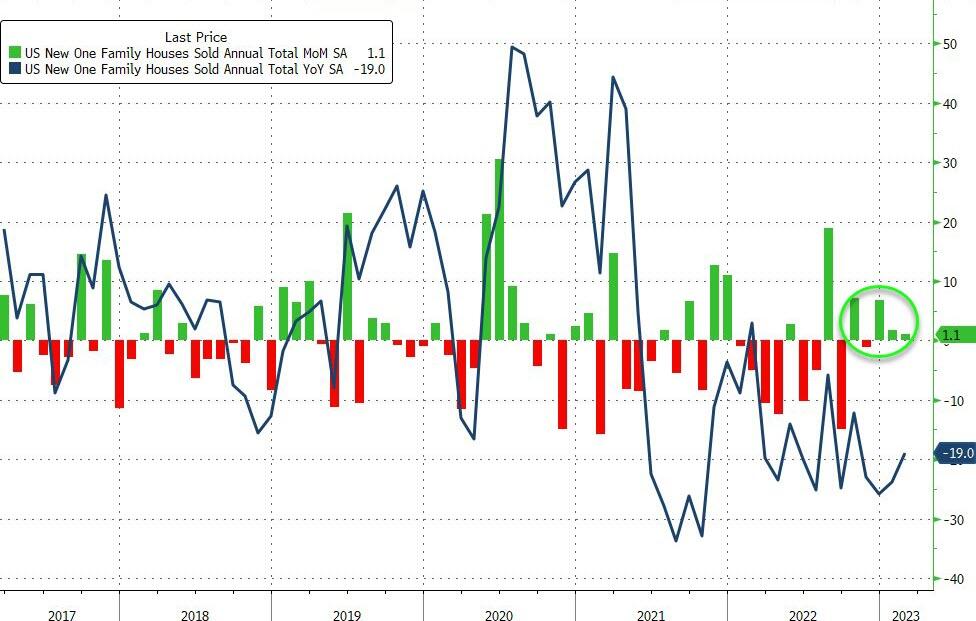
After surging far more than expected in December and January (and beaten expectations in each of the last six months), new home sales were expected to slide in February (despite the unexpected jump in existing home sales as mortgage rates took a pause from their blast off higher). However, like existing home sales, new home sales rose 1.1% MoM (-3.1% exp). This is the seventh beat in a row, but only because January’s +7.2% MoM spike was revised dramatically lower to a mere +1.8% MoM… if that January level had held this would have been a 4.5% MoM drop…

Source: Bloomberg

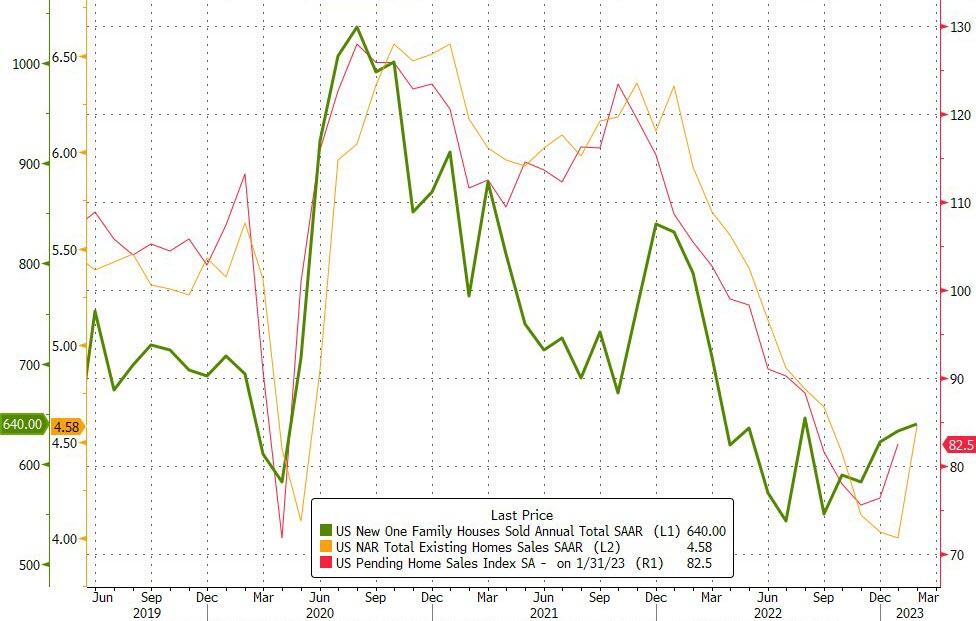
Year-over-year, new home sales remain down 19%, but on a SAAR basis are back near their highest since last April…

Source: Bloomberg

Sales rose in the West and South, the two largest regions by purchases. The number of homes sold in the Northeast plunged to the lowest since June.

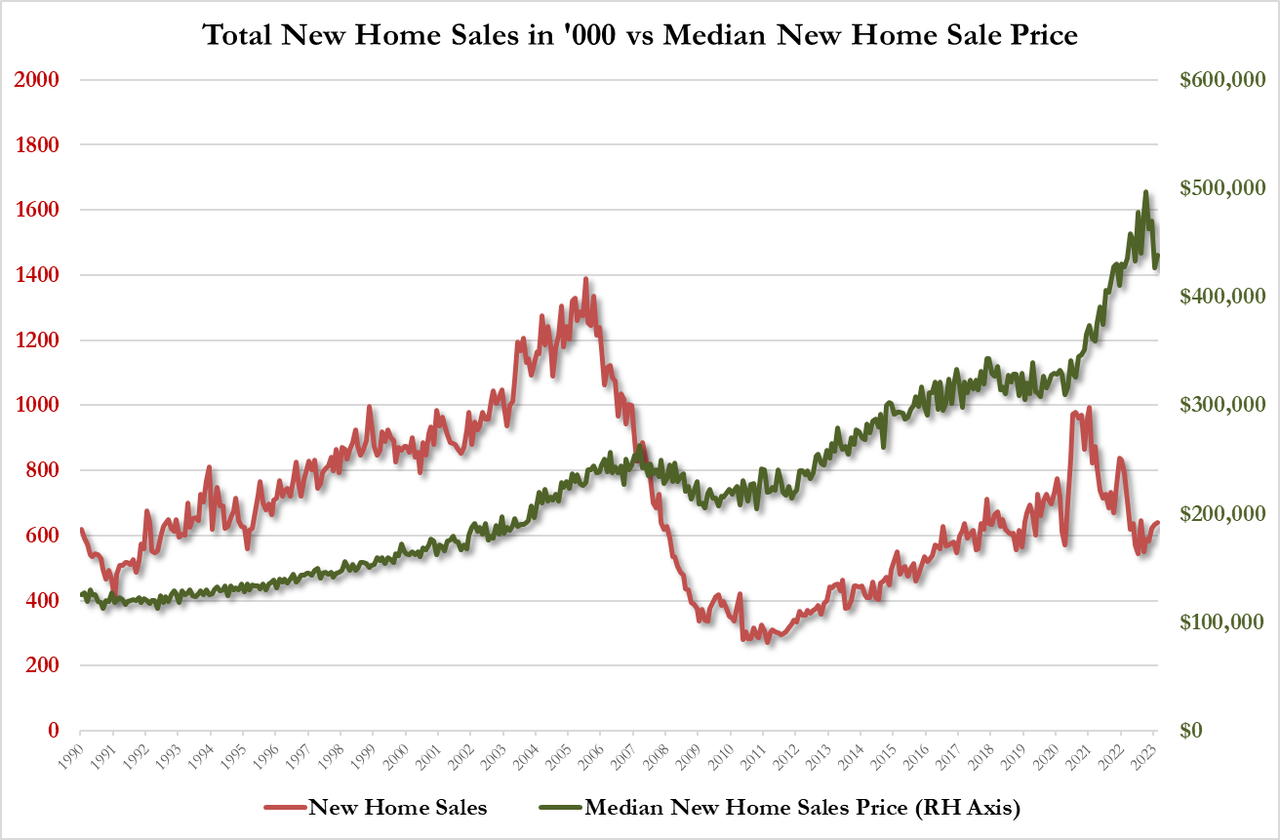
The median home price rose from $426.5K (lowest since Sept Dec 21) to $438.2K…

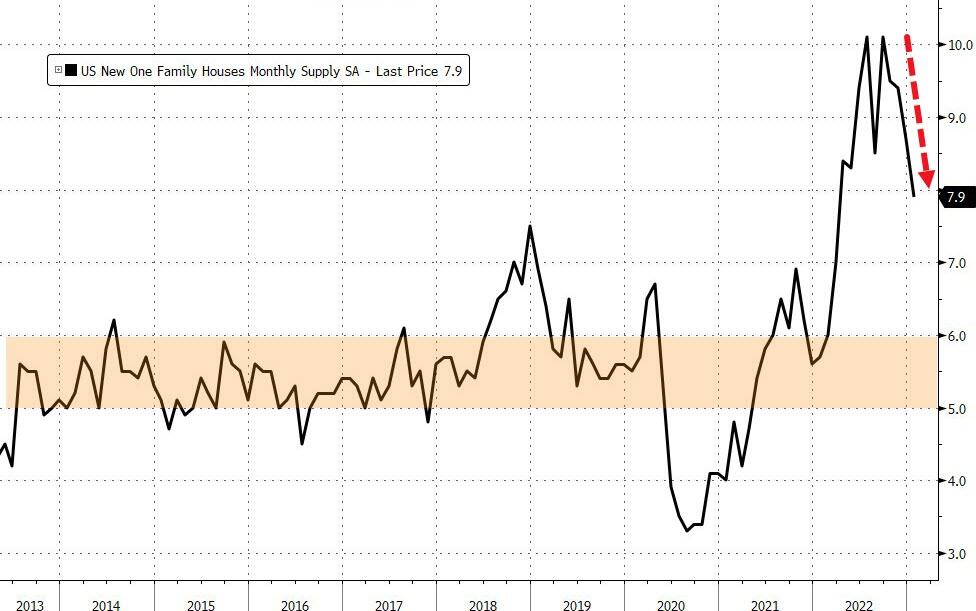
Supply continues to contract (some might say ‘normalize’). There were 436,000 new homes for sale as of the end of last month, the lowest since April. That represents 8.2 months of supply at the current sales rate. …

Source: Bloomberg

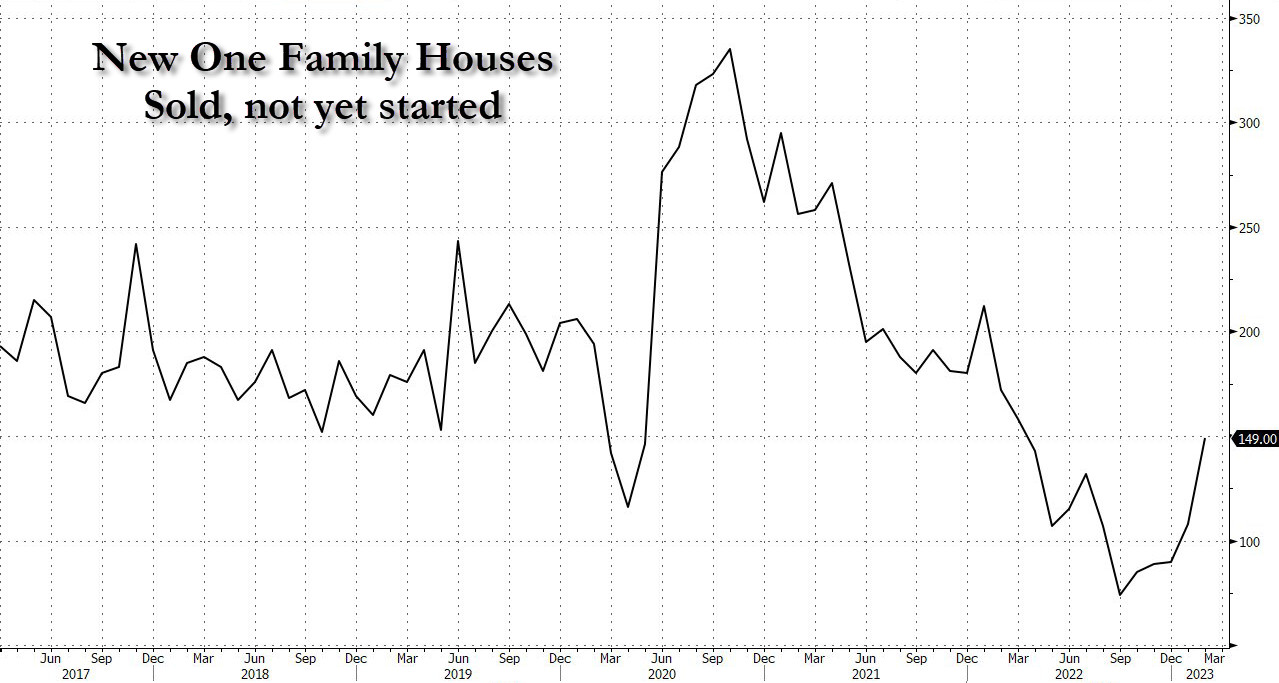
Interestingly, the number of homes sold, but not yet started, continues to rise, surging to 149K, from 108K, the highest since March 2022…

Source: Bloomberg

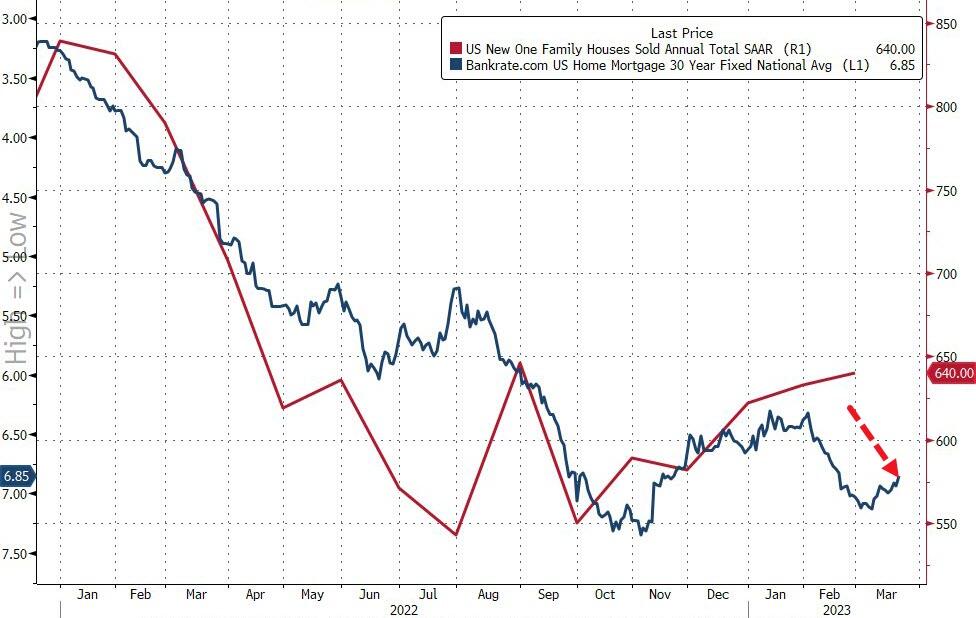
Of course, the problem is, mortgage rates have resurged back above 7.00% since this data

Source: Bloomberg

Resurgent home sales (and prices) is not what Powell wants to see – don’t expect mortgage rates to save any homebuyers anytime soon (especially as banks tighten lending standards amid a liquidity/solvency crisis).

Tyler Durden
Thu, 03/23/2023 – 10:09

via ZeroHedge News https://ift.tt/EDvWNKG Tyler Durden

Watch Live: TikTok CEO Testifies Before Congress; China Opposes Forced Sale

Watch Live: TikTok CEO Testifies Before Congress; China Opposes Forced Sale

As TikTok mulls a demand from the Biden administration that the video-app divest itself from Beijing-based parent ByteDance (a move strongly opposed by the Chinese Ministry of Commerce), CEO Shou Chew is preparing to testify before Congress for the first time on Thursday, where US lawmakers will grill him over how the app handles sensitive US user data, as well as the risks it may pose to teens and children.

The hearing will commence at 10 a.m. before the House Energy and Commerce Committee.

TikTok – one of China’s first global internet success stories which has 150 million users, has become a battleground in a technical cold war of sorts between Washington and Beijing – as the US has repeatedly demanded that it be blocked from various platforms out of security concerns.

In order to keep operating in the US under ByteDance’s ownership, TikTok has sought approval from the Committee on Foreign Investment in the United States, or CFIUS, for a plan called Project Texas – which would prevent the Chinese government from accessing US user data or manipulating content recommendations. Oversight would be provided by government-approved officials and third-party auditors.

Watch Live:

Both ByteDance and US officials struck a preliminary agreement last year which stipulated that TikTok data on US users would be hosted by Oracle Corp. TikTok, meanwhile, said it will delete the private data of US users from its own data centers in Virginia and Singapore as it transitions to fully store data with Oracle. The company has also said that access to US data by anyone outside of a newly established division to govern US data security would be limited by, and subject to, its protocols – which would be overseen by Oracle.

Last week, news emerged that the Biden administration wants ByteDance to sell the app or face a possible ban – a move which China said on Thursday that it would “firmly oppose,” according to a commerce ministry spokeswoman, who added that it would “seriously undermine the confidence of investors from various countries, including China, to invest in the United States.”

More than two dozen US states, various colleges, and Congress, have announced bans on TikTok in recent months, with the Biden administration recently backing a bipartisan Senate bill that would give the US government more power to deal with TikTok – which would include a potential ban. Scrutiny of the app includes a lawsuit from the state of Indiana, a ban in South Dakota, calls to ban TikTok ‘everywhere,’ and a major snag in negotiations with the Biden administration over national security concerns.

“TikTok’s Chinese parent company, ByteDance, is required by Chinese law to make the app’s data available to the Chinese Communist Party (CCP),” read a December statement from Sen. Marco Rubio’s office. “From the FBI Director to FCC Commissioners to cybersecurity experts, everyone has made clear the risk of TikTok being used to spy on Americans.

Rubio – who introduced the Averting the National Threat of Internet Surveillance, Oppressive Censorship and Influence, and Algorithmic Learning by the Chinese Communist Party Act (ANTI-SOCIAL CCP Act) – was joined by Reps. Mike Gallagher (R-WI) and Raja Krishnamoorthi (D-IL), who introduced companion legislation in the US House of Representatives.

TikTok is digital fentanyl that’s addicting Americans, collecting troves of their data, and censoring their news,” said Gallagher. “It’s also an increasingly powerful media company that’s owned by ByteDance, which ultimately reports to the Chinese Communist Party – America’s foremost adversary.”

Chew may also be asked about ByteDance’s surveillance of US journalists.

The hearing is expected to last up to 4.5 hours.

Tyler Durden
Thu, 03/23/2023 – 09:55

via ZeroHedge News https://ift.tt/AZCu01v Tyler Durden

Republicans Introduce Bills To Prevent Biden Administration From Banning Gas Stoves

Republicans Introduce Bills To Prevent Biden Administration From Banning Gas Stoves

Authored by Savannah Hulsey Pointer via The Epoch Times (emphasis ours),

Two House Energy and Commerce Committee Republicans announced on March 20 they are introducing legislation to prevent the Biden administration from banning gas stoves.

A gas stove in a file photograph. (Joe Klamar /AFP via Getty Images)

The legislation was introduced by Reps. Kelly Armstrong (R-N.D.) and Debbie Lesko, (R-Ariz.) in response to the Biden administration’s two-pronged push to ban gas stoves, and might go to the House floor for a vote later this year.

Lesko introduced H.R. 1640, also known as the Save Our Gas Stoves Act, while Armstrong introduced H.R. 1615, the Gas Stove Protection and Freedom Act. Both bills are currently in committee.

The pieces of legislation would prohibit the Consumer Product Safety Commission (CPSC) from using federal funding to implement any regulation that would classify gas stoves as a prohibited dangerous product under current law.

The bills also prohibit the CPSC from enforcing any consumer product safety standards that would prohibit the use of gas stoves or impose regulations that would raise gas stove prices.

In a press release announcing the legislation, Armstrong emphasized his frustration with the administration’s attempts to ban the stoves.

“Inflation is hurting everyone. We have a crisis at our Southern Border. North Dakotans are worried about being able to provide for their families. What is the Biden administration focused on? Controlling the kind of stove Americans use,” Armstrong said.

This is further incompetence from an administration that seems more interested in dictating every aspect of our lives than solving real problems. Our bill makes it clear that Americans should decide if a gas stove is right for their families, not the federal government.”

Lesko also spoke to the proposed ban: “The Biden Administration’s extreme proposed regulation that will ban nearly every gas stove on the market is just another example of out-of-touch bureaucrats trying to control Americans’ everyday lives.”

A member of the CPSC stated in January that a ban on gas stoves was possible due to the health concerns they bring to users.

After a public uproar and derision, the CPSC backed down, but soon after, the Department of Energy proposed an energy-efficiency requirement that officials admit is so strict that 96 percent of the gas stoves currently in use would not pass muster.

However, a March 17 report indicated that the CPSC had made a formal request for information about the possible health hazards of gas-powered stoves—another signal that the United States may be moving towards a ban on those appliances under the Biden administration.

Read more here…

Tyler Durden
Thu, 03/23/2023 – 09:40

via ZeroHedge News https://ift.tt/Nsa8706 Tyler Durden

FDIC Unexpectedly Delays Bid Deadline For Silicon Valley Private Bank

FDIC Unexpectedly Delays Bid Deadline For Silicon Valley Private Bank

Over the past weekend, it was determined that the Federal Deposit Insurance Corporation (FDIC) would break up Silicon Valley Bank into two separate auctions. But now, the auction for SVB’s wealth-management unit has been delayed. 

FDIC was set to receive bids for Silicon Valley Private Bank, successor to Boston Private, which SVB acquired in 2021 at 2000 ET Wednesday. However, without any reasoning, government regulators shifted the auction until Friday, according to Bloomberg, citing people familiar with the matter.

Additionally, on Friday, the deadline for submitting bids for the so-called “bridge bank” that the FDIC set up earlier this month to take receivership of SVB’s assets and liabilities.

Last weekend, FDIC decided to break up the sale of SVB into two auctions after failing to find a buyer. We noted First Citizens BancShares Inc participated in the first round of auctions but had its bid rejected. 

It’s worth noting there were eager buyers for SVB days after the collapse, but the FDIC prevented the sale.

FDIC also tapped advisors from the investment bank Piper Sandler Companies to assist in the upcoming auctions.

It might be as late as Friday night or Saturday before potential new buyers for SVB’s wealth management and bridge bank emerge. 

Tyler Durden
Thu, 03/23/2023 – 09:20

via ZeroHedge News https://ift.tt/GUpVBek Tyler Durden

Swiss Defend $17BN AT1 Bond Wipeout In Credit Suisse Deal As Furious Creditors Including David Tepper Vow To Sue Switzerland

Swiss Defend $17BN AT1 Bond Wipeout In Credit Suisse Deal As Furious Creditors Including David Tepper Vow To Sue Switzerland

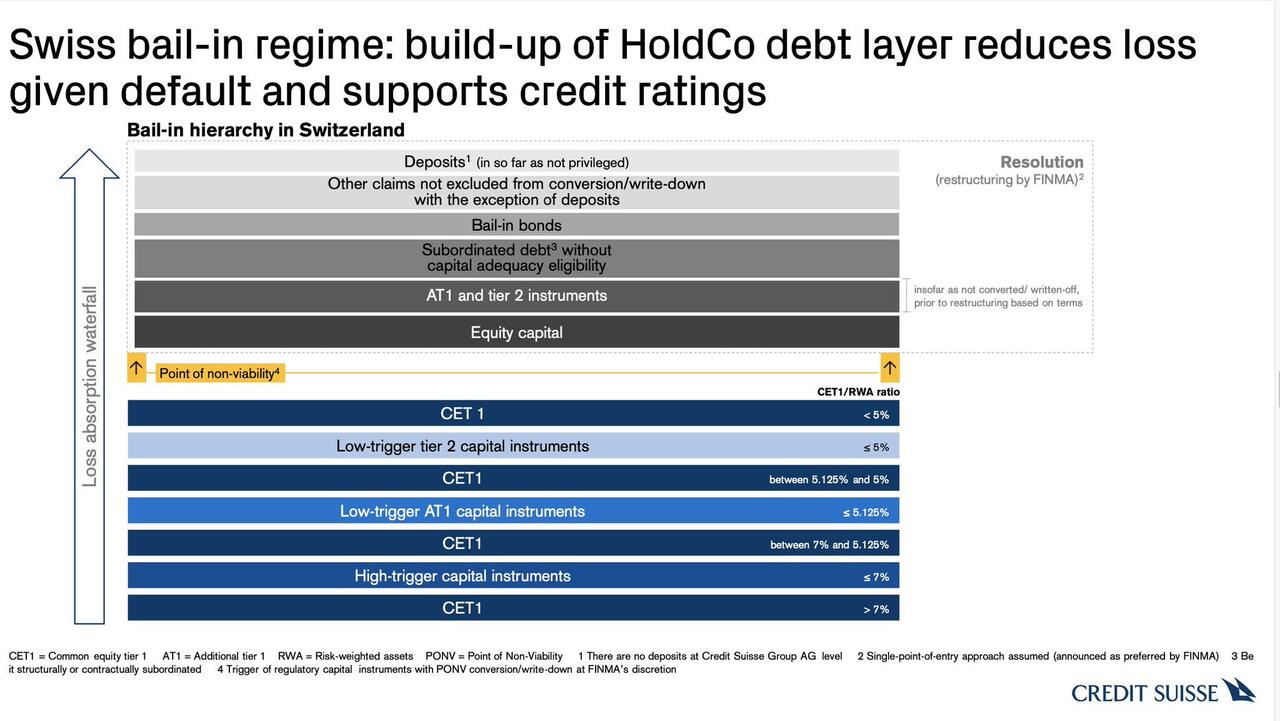
Amid the justifiably shocked outcry from Credit Suisse junior debtors, who saw their entire AT1 debt tranche wiped out before the equity was fully impaired, violating every conventional liquidation waterfall, on Thursday Swiss financial regulator Finma has defended its decision to wipe out a huge swath of risky subordinated bonds as part of the Credit Suisse rescue deal even as an army of bondholders is preparing to sue the Swiss government.

Sunday’s shocking bail-in, which rendered $17BN of investments worthless, has become one of the most controversial elements of the shotgun marriage between Credit Suisse and its larger rival, UBS, brokered by Swiss authorities. Just hours after the deal was announced, other large market regulators began to distance themselves from the decision, fearful that it would endanger banks’ ability to raise capital in the future.

Meanwhile, enraged bondholders have pledged to sue the Swiss government and Finma over the matter the FT reported

In its first statement on the deal since the weekend, Finma said on Thursday that all the contractual and legal obligations had been met for it to act unilaterally given the urgency of the situation.

“On Sunday, a solution was found to protect clients, the financial centre and the markets,” said Finma’s chief executive Urban Angehrn. “In this context, it is important that Credit Suisse’s banking business continues to function smoothly and without interruption.”

Speaking to the press on Thursday, Swiss National Bank chair Thomas Jordan argued that the purchase by UBS had been the only option for Credit Suisse, saying that a takeover of the bank by the government and stabilization of it in a process known as resolution would have risked a systemic crisis.

“Resolution in theory is possible under normal circumstances, but we were in an extremely fragile environment with enormous nervousness in financial markets in general,” said Jordan. “Resolution in those circumstances would have triggered a bigger financial crisis, not just in Switzerland but globally.”

“[It] would not have worked to stabilize the situation but, on the contrary, created enormous uncertainty . . . It was clear that we should avoid it if there was any other possibility.”

None of that explains why the decision was taken to preserves CHF3.25BN in value for CS shareholders – who would nominally be subordinated to any bondholders in the capital structure – even as junior creditors were wiped out.

That said, the additional tier 1 (AT1) bonds in question were warned as they contained explicit contractual language that they would be “completely written down in a ‘viability event’ in particular if extraordinary government support is granted”, Finma said. This allowed the regulator to prioritise equity holders ahead of AT1 holders. Furthermore, when AT1s were created as a hybrid debt instrument after the financial crash of 2008, their whole purpose was to give banks greater capital flexibility in the event of crises, and for the bonds to be bailed in in case of need.

Meanwhile, the government’s intervention to bail out the combined UBS-CS entity – because if Credit Suisse had gone under, UBS was certainly next – is undisputable: as part of the acquisition deal by UBS, the combined bank will receive CHF9BN of government guarantees and a CHF100bn liquidity lifeline from the SNB. An additional emergency government ordinance issued by Bern on Sunday had further confirmed the power to take decisions over elements of a bank’s capital structure in Swiss law, Finma said.

“[The] instruments in Switzerland are designed in such a way that they are written down or converted into [equity] before the equity capital of the bank concerned is completely used up or written down,” it said, pointing out that the bonds were designed for the use of sophisticated institutional investors because of their risky hybrid nature.

None of that however has helped ease the anger of bondholders who over one weekend saw their entire investment wiped out. Quinn Emanuel Urquhart & Sullivan and Pallas Partners are among the law firms representing bondholders that have pledged to fight the Swiss decision. Quinn hosted a call on Wednesday joined by more than 750 participants.

Partner Richard East told the Financial Times the deal was “a resolution dressed up as a merger” and pointed to statements by the European Central Bank and the Bank of England, which distanced themselves from the Swiss approach.

“You know something has gone wrong when other regulators come and politely point out that in a resolution [they] would have respected ordinary priorities,” he said.

“If this is left to stand, how can you trust any debt security issued in Switzerland, or for that matter wider Europe, if governments can just change laws after the fact,” David Tepper, the billionaire founder of Appaloosa Management, told the Financial Times. “Contracts are made to be honored.”

Tepper is among the most successful investors in troubled financial companies, famously making billions of dollars on a 2009 wager that US banks would not be nationalised during the last financial crisis. Appaloosa had bought a range of Credit Suisse’s senior and junior debt as the bank descended into chaos.

Mark Dowding, chief investment officer at RBC BlueBay, which held Credit Suisse AT1 bonds, said Switzerland was “looking more like a banana republic”. His Financial Capital Bond fund is down 12.2 per cent this month.

No matter how the lawsuits turn out, however, one thing is certain: Swiss banking as an industry that thrived and prospered for centuries, is effectively over and nobody will voluntarily either deposit or invest in Swiss banks after this catastrophically bundled government intervention. For the sake of what’s left of the Swiss economy, we can only hope that the cheese and chocolate industries are not in need of bailouts.

Tyler Durden
Thu, 03/23/2023 – 09:03

via ZeroHedge News https://ift.tt/RnHjgD3 Tyler Durden