‘Operation Choke Point 2.0’ May Have Contributed To SVB’s Collapse: Mulvaney

‘Operation Choke Point 2.0’ May Have Contributed To SVB’s Collapse: Mulvaney

Authored by Luke Huigsloot via CoinTelegraph.com,

While the existence of “Operation Choke Point 2.0” has not been confirmed, Mick Mulvaney spoke of “rumors” of its existence and the potential side effects of such a policy…

If the United States government really is implementing “Operation Choke Point 2.0,” it will hurt financial stability and may have contributed to the collapse of Silicon Valley Bank, according to Donald Trump’s former acting White House chief of staff, Mick Mulvaney.

“I don’t want to think that the government would actually do that,” Mulvaney said in a March 22 Bloomberg interview in reference to the rumored operation. He did however recall attending hearings on the original Operation Choke Point — a government initiative that aimed to limit certain industries’ access to U.S. banking services.

“You have to wonder if there’s not certain policies that the administration is putting in place that have — perhaps the intended, perhaps the unintended — consequences of raising the risk, and of increasing instability, and did we just see that at SVB?” he added.

“Were people at SVB because they were really good at it, or was there some factor in there that said we’re at SVB because no one else will take us.”

Mulvaney elaborated that he believes crypto played no role in the downfall of SVB and suggested poor risk management was to blame. He implied, however, that the pressure being put on U.S. banks to avoid crypto may have contributed to SVB’s collapse.

“Operation Choke Point 2.0” is a term coined by Coin Metrics co-founder Nic Carter to refer to an apparently coordinated effort to discourage banks from holding crypto deposits or providing banking services to crypto firms on the basis of “safety and soundness” for the banking system.

While is it unclear whether “Operation Choke Point 2.0” is an official strategy, Carter has claimed there is evidence supporting its existence.

In a Feb. 9 blog post, Carter outlined some supposed evidence, highlighting a Jan. 3 joint statement on crypto assets from the Federal Reserve, Federal Deposit Insurance Corporation (FDIC), and the Office of the Comptroller of the Currency (OCC), which warned that decentralized blockchain networks are “highly likely to be inconsistent with safe and sound banking practices.”

More recently, critics pointed to the FDIC’s different treatment of crypto assets during the takeover of Signature Bank as further proof of the existence of “Operation Choke Point 2.0.”

Tyler Durden
Thu, 03/23/2023 – 06:30

via ZeroHedge News https://ift.tt/Ab8OEqy Tyler Durden

Raising Fees Won’t Fix the Visa Process


topicsimmigration

In May 2020, U.S. Citizenship and Immigration Services (USCIS), the agency within the Department of Homeland Security that processes visa and naturalization applications, warned Congress that it was on the brink of serious budget trouble. The agency is funded almost entirely by the fees it collects from applicants, which plummeted under the Trump administration.

With legal migration and naturalizations now inching toward pre-pandemic levels, USCIS has proposed solving its cash problems by hiking fees for nearly every category of immigrant. USCIS Director Ur M. Jaddou said the fee increases would help improve the agency’s “customer service operations” and manage “the incoming workload.” But the agency’s proposal ignores the reality that its dysfunction is a result of bureaucratic bloat, not lack of revenue.

USCIS wants to drastically increase fees for family-based and employment-based visas. Employers hiring high-skilled workers on H-1B visas would have to pay 70 percent more. The application fees for one kind of investment visa would rise from $3,675 to $11,160. The cost of filing all the forms needed to gain permanent resident status in the U.S. would increase from $1,225 to $2,820. If the changes are finalized, according to Bloomberg Law, they “would represent a weighted average increase of 40% across the board.”

But processing times have “nothing to do with money,” David Bier, associate director of immigration studies at the Cato Institute, wrote in a January 2023 report. Bier noted that “the average of the median processing times across all forms for which [USCIS] reports data increased threefold” between 2012 and 2022, from less than four months to more than a year.

The agency’s immigration forms have ballooned from a total of 193 pages in 2003 to 701 in 2022, according to a Cato analysis. The length of almost every form increased during that period. The result is longer processing times, which contribute to an ever-growing application backlog. It will take about 10 million man-hours for USCIS adjudicators to work through that backlog.

USCIS says the new fee structure would help it hire about 8,000 new workers to process applications. It should instead address why those applications are taking so long to process. Upping the cost of applying for legal status while increasing the paperwork burden is apt to deprive the U.S. of talented foreigners.

The post Raising Fees Won't Fix the Visa Process appeared first on Reason.com.

from Latest https://ift.tt/bf0e3Ic
via IFTTT

Cooking Oil Shortage Looms As Biofuel Demand Surges Due To ‘Climate Solution’

Cooking Oil Shortage Looms As Biofuel Demand Surges Due To ‘Climate Solution’

A key ingredient commonly found in kitchens could face a shortage in the coming months as global biofuel consumption surges due to climate change initiatives. 

As reported by Bloomberg, Western nations are increasingly adopting plant-based energy sources, such as soybean or canola oils, or even animal fats, in a move to reduce carbon emissions by transitioning away from fossil fuels. This shift has presented a profitable opportunity for vegetable and palm oil producers to redirect some cooking oil supplies toward the transportation sector rather than their traditional use in food production. 

Hot demand for biofuels combined with the war in Ukraine disrupting ag flows and extreme weather in Argentina curbing vegetable oil supplies and other top producers reeling from declining production could push vegetable oil production into a deficit in the second half of the year, according to Thomas Mielke, executive director of Hamburg-based Oil World.

Mielke pointed out biofuels account for a large share of the vegetable oil market but only a fraction of energy demand. He’s alarmed that biofuel targets pushed by governments might spark a cooking oil shortage. 

Soaring demand for biodiesel, renewable diesel, and biojet fuel has primarily been concentrated in the US, Europe, Brazil, and Indonesia. 

However, the global palm oil market could struggle to meet demand. Their production levels stagnate, with Indonesia and Malaysia responsible for 85% of global supply. 

“In periods of supply shortages, the necessary rationing of demand must not take place only on the shoulders of the food consumers.

“This is a lesson we have to learn from last year,” Mielke said.

Global decarbonization efforts might result in unintended consequences for consumers, who could soon face the prospect of rising cooking oil prices or potential shortages. 

Tyler Durden
Thu, 03/23/2023 – 05:45

via ZeroHedge News https://ift.tt/9SqBIsP Tyler Durden

The World Economic Forum And The West’s Next Act?

The World Economic Forum And The West’s Next Act?

Authored by J.B.Shurk via The Gatestone Institute,

If you are a consumer today, inflation is only one of the problems harming you.

As prices go up, quality continues to go down.

What most stores have to offer you might crassly be called “cheap crap.” In fact, economic writer Charles Hugh Smith has repeatedly warned that the “crapification” of the U.S. economy is the natural result of a “neoliberal-hyper-financialization-hyper-globalization model,” in which quasi-monopolist manufacturers mass-produce goods with the cheapest possible components, while customers with scant other buying options are forced to accept that few purchases will last.

“Planned obsolescence,” combined with a free market “in name only,” creates a rigged system in which downstream consumers are forced to pay more over time, while owning little that will maintain value for long. Appliances that used to work for decades now barely make it through legally required warranty periods. Metal tools that could be passed from one generation to the next now tend to rust before they can be used on more than a handful of jobs. When expensive electronic devices survive more than two years, cash-strapped households breathe a sigh of relief. Just about anybody who is old enough to remember the 9/11 terrorist attacks can tell a story about some product that was so much cheaper, yet so much more reliable, when it was purchased long ago.

Likewise, customer service is more pitiful than it has ever been. Try to speak with a real human on the phone. It is nearly impossible. Automated assistance has eliminated personal interaction from most buying experiences. Gas stations, fast-food restaurants, and convenience stores have replaced human cashiers with camera-equipped machines designed for self-service. Even a visit to a grocery or home goods store now routinely requires the use of a self-checkout kiosk when making a purchases. It has become entirely normal to witness people struggling through the routine of lifting everything out of their shopping carts, scanning each item, and placing the load into bags, before throwing everything back onto carts, paying, and shuffling away. It is somewhat perplexing to consider that not so long ago, helpful, smiling employees worked hard to take care of all those services as part of the ordinary relationship maintained between a business and its customers.

Cutting out the cost of extra employees whose hourly wages have been pushed higher and higher by minimum wage laws that try to keep workers aligned with the rising cost of everything might help prevent already inflated prices from rising even further, but it is difficult to watch shoppers performing jobs once done by paid workers without concluding that “progress” has taken the market experience to a place that feels closer to “regress.”

Politicians seem to be heading in a similar direction.

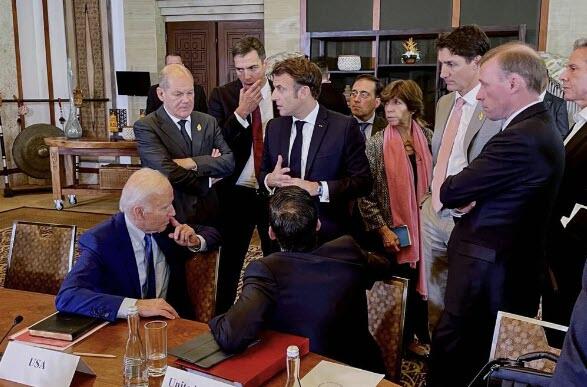
Pictured: National leaders, including US President Joe Biden, German Chancellor Olaf Scholz, French President Emmanuel Macron, British Prime Minister Rishi Sunak, Spanish PM Pedro Sanchez and Canadian PM Justin Trudeau strike a deep, contemplative pose at the G20 summit on November 16, 2022 in Nusa Dua, Indonesia. (Photo by Hebestreit/Bundesregierung via Getty Images)

Politics, as a profession, has always been known to attract at least as many ambitious “empty suits” as it does leaders of substance.

Still, the great writers, orators, and thinkers that occasionally rose to political prominence in the past seem to have left the stage for good.

Winston Churchill not only led the United Kingdom to victory during WWII but also won the 1953 Nobel Prize in Literature “for his mastery of historical and biographical description as well as for brilliant oratory in defending exalted human values.”

Daniel Patrick Moynihan not only represented New York as a U.S. Senator but also drew on his own sociological expertise while serving in the Labor Department to produce a thorough report on the endemic causes of, and potential remedies for, systemic poverty in America.

President Abraham Lincoln not only was instrumental in preserving the Union but also a dedicated student all his life; he kept the works of William Shakespeare on his White House desk.

In contrast, few deep thinkers rise to high office today.

There are no great statesmen whom the broader public see as towering above the herd of self-centered and cynical political lemmings. Few professional politicians, especially those in the United States, are even capable of speaking extemporaneously before an audience for any stretch of time. Too many rely on the assistance of teleprompters or similar devices to provide an exact script for every publicly spoken utterance, no matter how trivial or informal — suggesting that either they or their staffs cannot trust just what might otherwise escape their lips.

Rather than pursuing political office after having accomplished great things in other fields, the vast majority of today’s officeholders choose politics as a vocation for life. The end result is that Western governments are filled to the brim with people entirely lacking in real-world experience or specialized knowledge.

In recent decades, a noticeable trend in the West has been to elevate politicians, as young and inexperienced as possible, into offices as high as possible.

Many of the most famous politicians today no sooner secure a single election victory than their colleagues began pushing them into government roles at the top of the political hierarchy. Former U.S. President Barack Obama, Canadian Prime Minister Justin Trudeau, French President Emmanuel Macron, U.K. Prime Minister Rishi Sunak, Finnish Prime Minister Sanna Marin, former New Zealand Prime Minister Jacinda Ardern, and her successor Chris Hipkins all ascended to the zeniths of national power exceptionally early in their careers.

Looking around at the legislators, presidents, and prime ministers today who are leading Western nations on the world stage, you could be forgiven for extrapolating that the quickest path to political power is to accomplish little in the real world, while scrambling up the political pyramid before there is time to make or learn from mistakes. Such a system — in which those who have proven themselves the least are given responsibilities that would test even those who have proven themselves time and again — hardly looks ideal.

On the flip side is someone such as U.S. President Joe Biden, the oldest to have ever held the office. Whereas Biden’s near half-century in national elected office has surely afforded him the chance to make and remedy many mistakes, he is now so “seasoned” that few weeks go by when some publication does not question either his mental competencyability to keep up with the rigors of such a demanding job, or the wear and tear on the “influence” possibly peddled.

Two stories, embodying the “crapification” of products, recently emerged, concerning the authenticity of a presidential speech. In the first, a fake video created through the use of artificial intelligence showed Biden announcing the implementation of the Selective Service Act and the imminent drafting of young Americans born on a certain date into military service. Amid heightening tensions with Russia and China, many Americans who came across the video mistakenly assumed that the United States had officially gone to war.

In the other video, Biden’s quite real but somewhat confusing and meandering storytelling during a speech about health care was mistakenly labeled as “doctored” or “fake” by enough viewers that Twitter actually added a certification label attesting, “This is in fact unedited legitimate footage from a Joe Biden speech which took place on 2/28/23.” Clearly, in a world where fake videos have become remarkably easy to construct, everyone’s credibility and reputation are now at risk.

Chintzy products and tinpot politicians are nothing new. Whether spending money or casting votes, the same caveat emptor principle applies: Let the buyer beware. Still, it is worth considering whether the political and economic knockoffs flooding Western markets today have something in common.

A Nigerian proverb warns against small singing birds with loud voices, because they almost always have much stronger protectors hidden behind thicker leaves. What today’s Western political leaders might lack in lengthy experience or trustworthy rhetoric, they certainly make up with bombastic pronouncement.

Ever since the dawn of COVID, “Build Back Better” has been repeated by “young global leaders” flocking to Klaus Schwab’s World Economic Forum in Davos, Switzerland. When Schwab and his WEF companions turned COVID tragedy into an opportunity for unleashing a “Great Reset” that would transform global markets, governance and power, nearly every Western political leader agreed. The synchronicity is enough to make you wonder whether it is your nation or the World Economic Forum that actually leads. Perhaps as the Nigerian proverb warns, today’s Western political leaders chirp about “Build Back Better” so loudly because Klaus Schwab’s financial predators stand directly behind them in the bush.

If so, then the West has become an oligarchy of financial “elites,” no matter how many times its political leaders extol the virtues of “democracy.”

financial oligarchy over political power is like a manufacturing monopoly over economic power: In both markets, goods are mass-produced with the cheapest possible components. The end result is that things break easily, and systems do not last. If Western politicians seem just as second-rate these days as what customers all too often find in stores, there may be a simple reason why: International financial titans make, sell, and own both… and may be planning to own you, too.
Tyler Durden
Thu, 03/23/2023 – 05:00

via ZeroHedge News https://ift.tt/wQSpfhn Tyler Durden

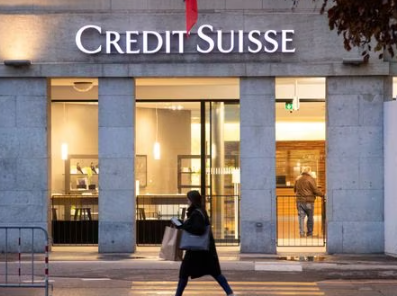
Credit Suisse Employees Flood Headhunters Looking For New Jobs

Credit Suisse Employees Flood Headhunters Looking For New Jobs

Bankers from the failed Credit Suisse Group AG are in the midst of creating a deluge for headhunters and job recruiters ahead of the banks takeover by UBS, according to a new Bloomberg report

“Anxious Credit Suisse staff” have created a flood of calls as they look for new jobs, the report says, with one firm in Singapore claiming it took in questions from 30 private bankers from Credit Suisse on Monday of this week alone. 

Another firm, focused just on managing director hires, said it has received similar interest since last Friday. 

The bank has about 5,500 employees in London, leading one job search firm to be receiving calls all throughout last week, especially from bankers in the equities division, where there’s the most overlap with new parent company UBS. 

In New York, “several thousand people at Credit Suisse had been hoping to join Credit Suisse First Boston”, one headhunter told Bloomberg. Others have turned their focus to trying to join UBS. 

But UBS doesn’t seem keen to that plan, according to a second report:

UBS executives have told their Credit Suisse counterparts that they prefer selectively bolstering their own investment bank while dumping the riskier operations, the people said, asking for anonymity because the review has just begun and no final decisions have been made. In initial talks, the acquiring bank indicated little interest in continuing the planned effort for a CS First Boston carveout that would create a new competitor, the people said. 

All this means Klein’s dream of leading a new investment bank under the revived CS First Boston brand looks increasingly unlikely. Still, some Credit Suisse staff are holding out hope that Klein and banking chief David Miller can line up an alternative plan, the people said. Some executives have reached out to potential suitors for the investment bank including Japan’s Mizuho Financial Group Inc. to generate interest that they could then pitch to UBS, the people said.

Michael Nelson, managing director at recruitment firm Quest Group in New York, said: “If they aren’t going to CSFB they will have to be emigrated into UBS fixed-income, which is a much smaller business than Credit Suisse. My guess is they will dismiss them and turn them out onto the street.”

The alarm amongst current employees during the midst of Credit Suisse’s “emergency rescue” is high. The deluge of job seekers ironically comes at a time when most banks – and businesses in most other industries – are in the process of reducing their staffs. 

One Singapore-based Credit Suisse spokeswoman concluded: “We are encouraging colleagues to continue to the best of their abilities against a difficult backdrop. Ultimately, we will do everything we can to ensure an orderly transition and to serve our clients as best as possible.”

Tyler Durden
Thu, 03/23/2023 – 04:15

via ZeroHedge News https://ift.tt/KV0iJ52 Tyler Durden

Brickbat: Walk This Way, Don’t Drive


A crowd of shoppers walk on a busy London street, with no cars in sight.

In England, the council for the London borough of Hackney has announced plans to ban through traffic from from motorized vehicles from 75 percent of city streets. Electric vehicles and bicycles would still be allowed to travel through, as will emergency vehicles and trash collection trucks. The plan will be rolled out over three years.

The post Brickbat: Walk This Way, Don't Drive appeared first on Reason.com.

from Latest https://ift.tt/IDKFtJT
via IFTTT

Watch: MSNBC Panel Says That Criticising George Soros In Any Way Is “Dangerous”

Watch: MSNBC Panel Says That Criticising George Soros In Any Way Is “Dangerous”

Authored by Steve Watson via Summit News,

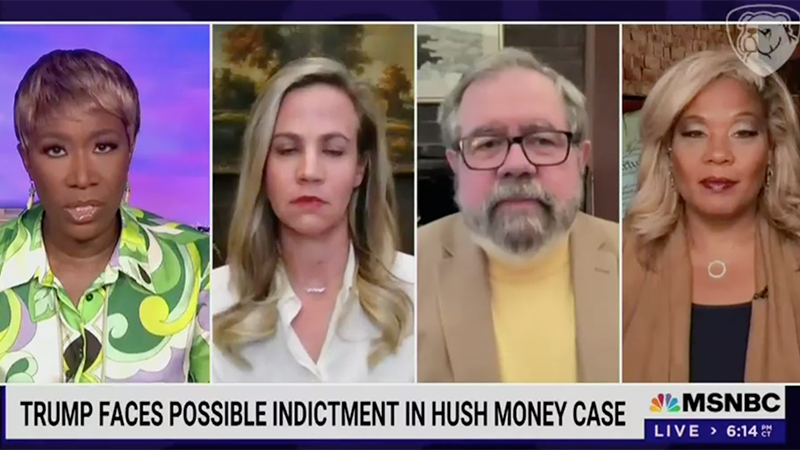
During a discussion on the potential Trump indictment, an MSNBC panel claimed that Trump supporters, and anyone else for that matter, are “dangerous” for criticising George Soros.

Perpetual race baiting grifter Joy Reid turned to former CIA officer Tracy Walder, and said “The fact that they keep throwing George Soros’ name, we’ve talked a lot in our show meetings, is it definitely feels like a dog whistle that is dangerous.”

Walder replied, “It absolutely feels like a dog whistle that’s dangerous.”

She continued, “Look, most of these groups, the Oath Keepers, Boogaloo Boys, Proud Boys, they all subscribe to what you are all referring to as the great replacement theory.”

“This is why we see these spikes in racism and anti-semitism,” and “they are ascribing to this belief and it’s stoking this division,” Walder added. 

She then suggested that “Trump has for multiple years now called for a civil war.”

There were no actual facts provided as to why criticising George Soros’ manipulation of U.S. politics and culture is racist.

Watch:

Of course, Joy Reid and MSNBC are going to propagandise for Soros, given that he pumps millions into Democrat election campaigns, as well as “black-led justice organizations”.

Soros Has Pumped $50 MILLION (So Far) Into 2020 Democrat Election Campaigns

Soros Foundation Announces It Is ‘Doubling Down’ On Funding “Black-led Justice Organizations”

Is journalist Glenn Greenwald a dangerous racist for pointing out how Soros continually seeks to control the reality narrative?

*  *  * 

Brand new merch now available! Get it at https://www.pjwshop.com/

In the age of mass Silicon Valley censorship It is crucial that we stay in touch. We need you to sign up for our free newsletter here. Support our sponsor – Turbo Force – a supercharged boost of clean energy without the comedown. Also, we urgently need your financial support here.

Tyler Durden
Thu, 03/23/2023 – 03:30

via ZeroHedge News https://ift.tt/ZdrmwPL Tyler Durden

US Moves Drone Flight Paths Further From Crimea On Russian Threats Of “Countermeasures”

US Moves Drone Flight Paths Further From Crimea On Russian Threats Of “Countermeasures”

Russia is again putting the US on notice after last week’s drone intercept incident which resulted in an American MQ-9 Reaper drone crashing into the Black Sea. The Pentagon said it intended to continue patrolling international territory despite the Kremlin asserting it had closed down some airspace over the Black Sea as part of its ‘special operation’ in Ukraine.

Russia’s Deputy Foreign Minister Sergei Ryabkov in a new warning has said Moscow will take “countermeasures” against any further US or NATO drone flights over these parts of the Black Sea where the intercept incident occurred.

“We warn them against trying to play on their nerves, testing our patience,” Ryabkov said, according to RIA Novosti. The US drone “was in a zone where we introduced a special regime associated with conducting military exercises,” he said.

March 14 incident – Handout via Reuters

He vowed that Russia’s sovereignty and security will be ensured “by all means available” and that “no American drones, whether reconnaissance, strike, strategic or any other kind” will “shake their determination.”

According to sources cited in CNN, the Pentagon has altered the paths of its drone flights further away from the Crimea peninsula on fears that another incident such as last week’s could spark a shooting war with Russia:

The drone flights have remained in international airspace, but since the collision between one of the Russian jets and the MQ-9 Reaper drone last Tuesday, the US has moved its drone flights further away from airspace surrounding the Crimean peninsula and eastern portions of the Black Sea.

One of the officials said the routes are part of an effort “to avoid being too provocative,” as the Biden administration remains careful to avoid an incident that could potentially escalate into a direct conflict between US and Russian forces.

And more: 

The official said the drone flights would continue this way “for the time being,” but added there is already “an appetite” to return to the routes closer to Russian-held territory

We are soon likely to witness more jostling over airspace in the Black Sea, and in response Russia will continue to assert more of its red lines, possibly again by force as was the case with the Reaper drone. Meanwhile the Russians are still reportedly trying to recovered the downed US drone, which reportedly sank in very deep waters.

Tyler Durden
Thu, 03/23/2023 – 02:45

via ZeroHedge News https://ift.tt/udcqTZx Tyler Durden