“Concerning”: Myocarditis Diagnoses Spiked In Military in 2021, New Data Show

“Concerning”: Myocarditis Diagnoses Spiked In Military in 2021, New Data Show

Authored by Zachary Stieber via The Epoch Times (emphasis ours),

The rate of myocarditis spiked in the military in 2021, newly disclosed data show.

U.S. Marines in Kin, Japan, in an undated image. (Carl Court/file/Getty Images)

Diagnoses of myocarditis, a form of heart inflammation, jumped 130.5 percent in 2021 when compared to the average from the years 2016 to 2020, according to data from the Defense Medical Epidemiology Database (DMED).

The data was downloaded by a whistleblower and presented to Sen. Ron Johnson (R-Wis.).

Myocarditis is a serious condition that can lead to death.

All four of the COVID-19 vaccines authorized in the United States can cause myocarditis, according to U.S. officials. They added a warning for Johnson & Johnson’s shot this month.

COVID-19 can also cause myocarditis, though some experts say the data on that front is weaker.

The whistleblower downloaded the data from DMED in 2023, about a year after the Pentagon said it fixed a data corruption issue with the military health system.

The data also showed spikes in diagnoses of pulmonary embolism (41.2 percent), ovarian dysfunction (38.2 percent), and “complications and ill-defined descriptions of heart disease” (37.7 percent).

Johnson called the spike in diagnoses “concerning.”

The Pentagon and the Defense Health Agency, which manages the DMED, did not respond to requests for comment.

[ZH: Take a few minutes to watch Senator Rand Paul asking the Moderna CEO questions about myocarditis today…]

Difference in Percentages

The newly disclosed data also showed higher increases than the Pentagon previously reported.

The military, for instance, had claimed that the rate of pulmonary embolism had increased just 25.4 percent in 2021.

Both rates were much lower than 468 percent.

That was among the shocking spikes in disease diagnoses identified by whistleblowers in 2022.

After the spikes were made public, military officials claimed the increases were not correct because some diagnoses in the years 2016 to 2020 had not been counted.

The undercounts stemmed from “corrupt” data, the military told Sen. Ron Johnson (R-Wis.) in a 2022 letter. The problem was fixed in early 2022, officials said. They gave Johnson a list of percentage increases of 15 diagnoses on Feb. 15, 2022.

Read more here…

Tyler Durden
Wed, 03/22/2023 – 16:21

via ZeroHedge News https://ift.tt/3PBeLRb Tyler Durden

Yellen Pulls Rug Out From Powell’s Dovish Promises: Gold Gains As Banks Bust

Yellen Pulls Rug Out From Powell’s Dovish Promises: Gold Gains As Banks Bust

Tl; dr: “Damn it, Janet!”

Nothing sums up the ‘trapped’ Fed better than today’s price action…

  • GME soaring: a legacy of record QE and helicopter money

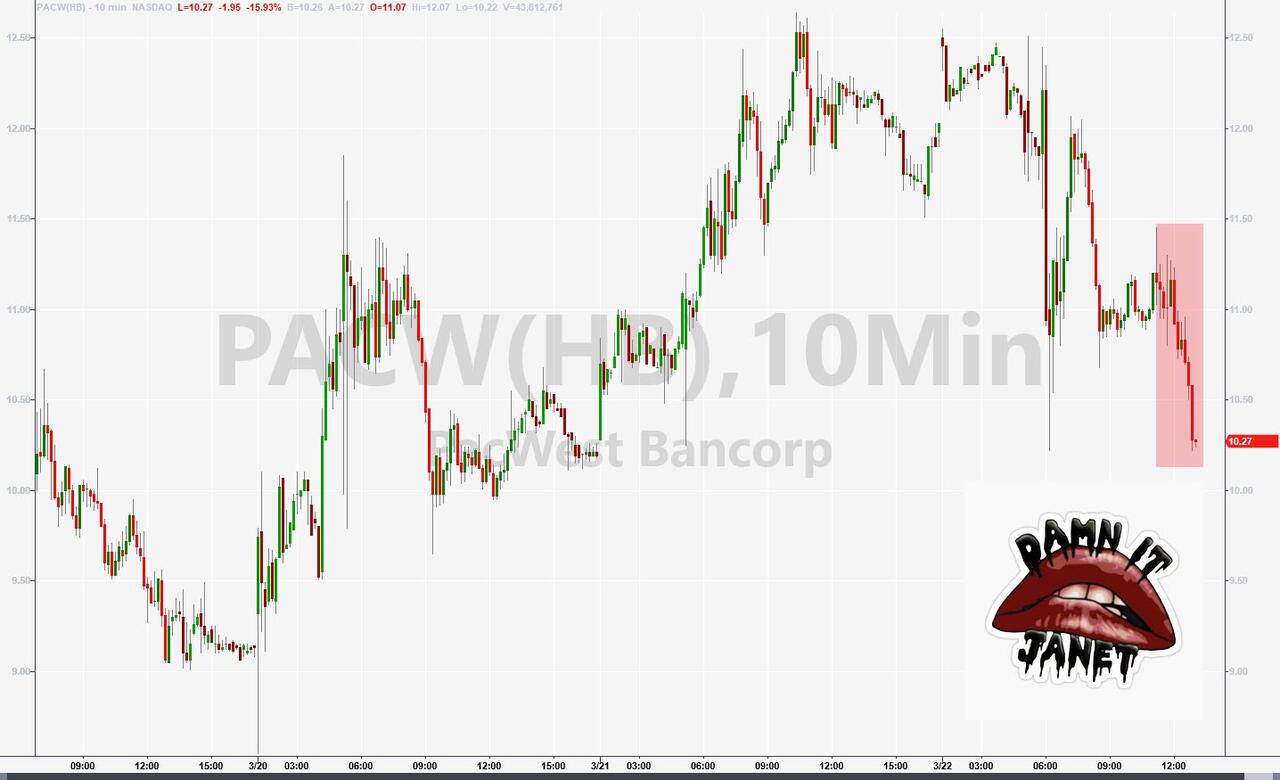
  • PACW crashing: a legacy of the fastest rate-hikes since Volcker

Fed Chair Powell hiked rates by 25bps and maintained QT (as expected), offering a dovish tilt in the statement and his comments.

But, he summed it all up succinctly early in his press conference: “It will be bumpy” describing the process of getting inflation back down, adding that it “has a long way to go.”

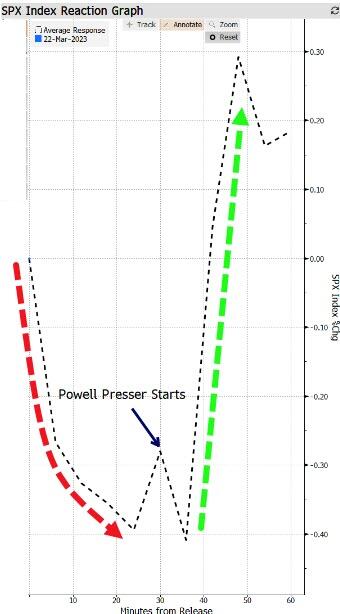
But as usual, all the major price action took place as Powell spoke.

As Guy LeBas (@lebas_janney2m) commented:

“The choice to start the presser with a discussion of the banking system has a clear policy message: the mini-banking crisis is the most important thing in the Fed’s thinking right now. Second is the focus on the labor markets, which policymakers still seem to view as too tight.”

Powell claimed that “deposit flows in the banking system have stabilized”, noting their strong actions, but he fails to comment on the massive rotation likely below the surface from small-banks to big-banks (since deposit flows OUT of the banking system may have stabilized but we suspect the rotation hasn’t).

Someone forgot to tell banking system investors…

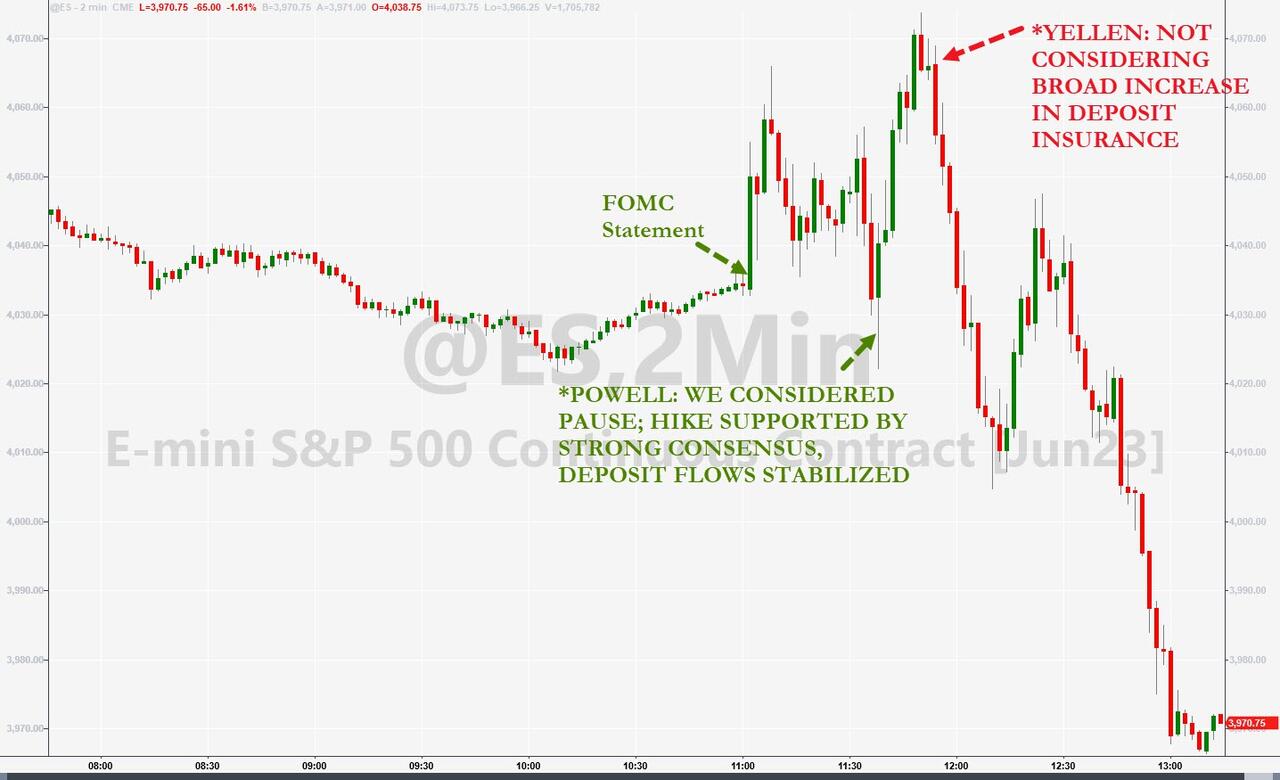
Powell says FOMC considered a pause, but hike was supported by “strong consensus”.

Powell dismissed market’s expectations: “Rate cuts are not in our base case.”

Powell said some members recognized the impact of the financial system crisis on credit tightening – which could do the job of some rate-hikes.

This prompted a ramp in stocks (and bonds) as the market smells fewer rate-hikes if the credit market tightens itself.

We have our own opinion on that relative to the impact on the consumer…

Not exactly something stocks should get excited about.

Bloomberg’s model suggests Powell’s opening remarks from the post-meeting press conference were much more dovish than the recent trend, though still slightly hawkish, according to Ira Jersey. This move was driven mostly by more dovish statements, but also less hawkish ones, he said.

“The indicator is quite close to neutral, suggesting the possibility of a pause has increased meaningfully at the May meeting compared with the recent past.”

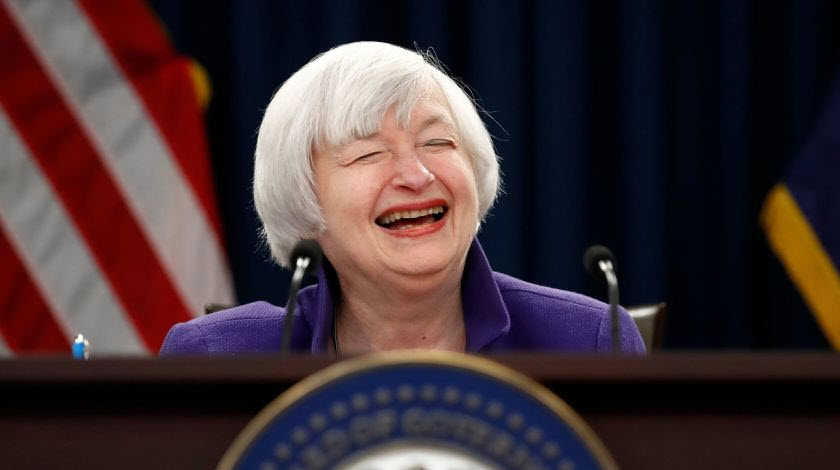
Then Janet struck:

*YELLEN: NOT CONSIDERING BROAD INCREASE IN DEPOSIT INSURANCE

And that took stocks to the lows of the day…

Stocks bounced – as they do – after Powell ended his presser, but that faded too.

Small Caps (small financial-heavy) were the ugliest horse in the glue factory while big-techs (Nasdaq) was the least bad of all…

The S&P reversed around the 50DMA then plunged back below its 100DMA…

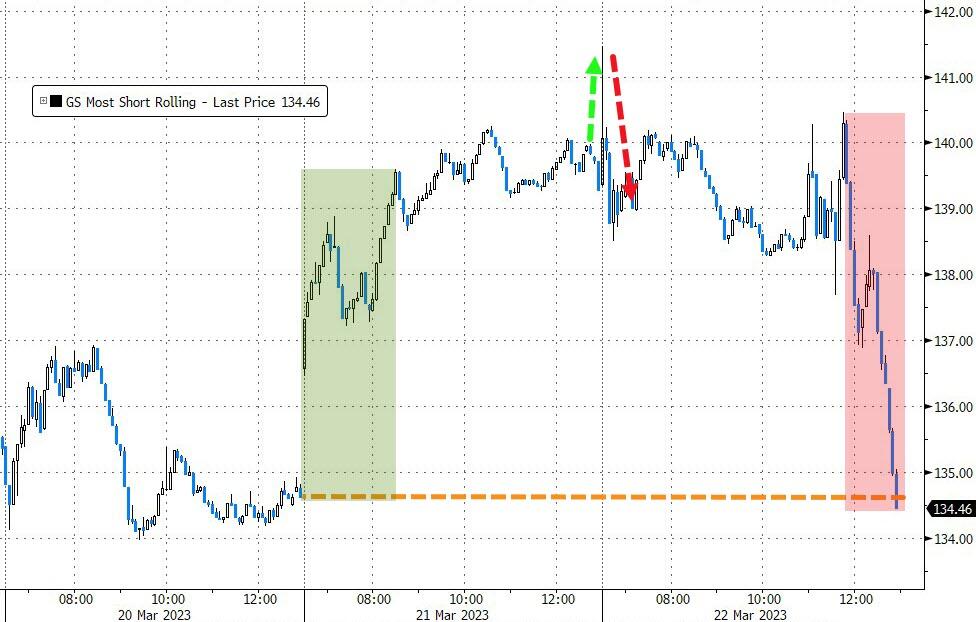
Yesterday’s short squeeze was completely erased…

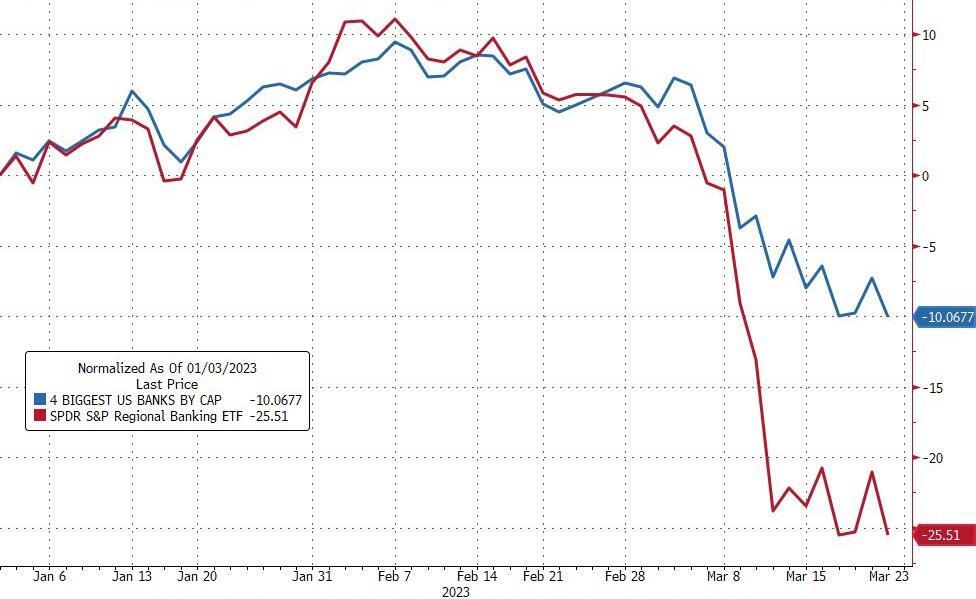
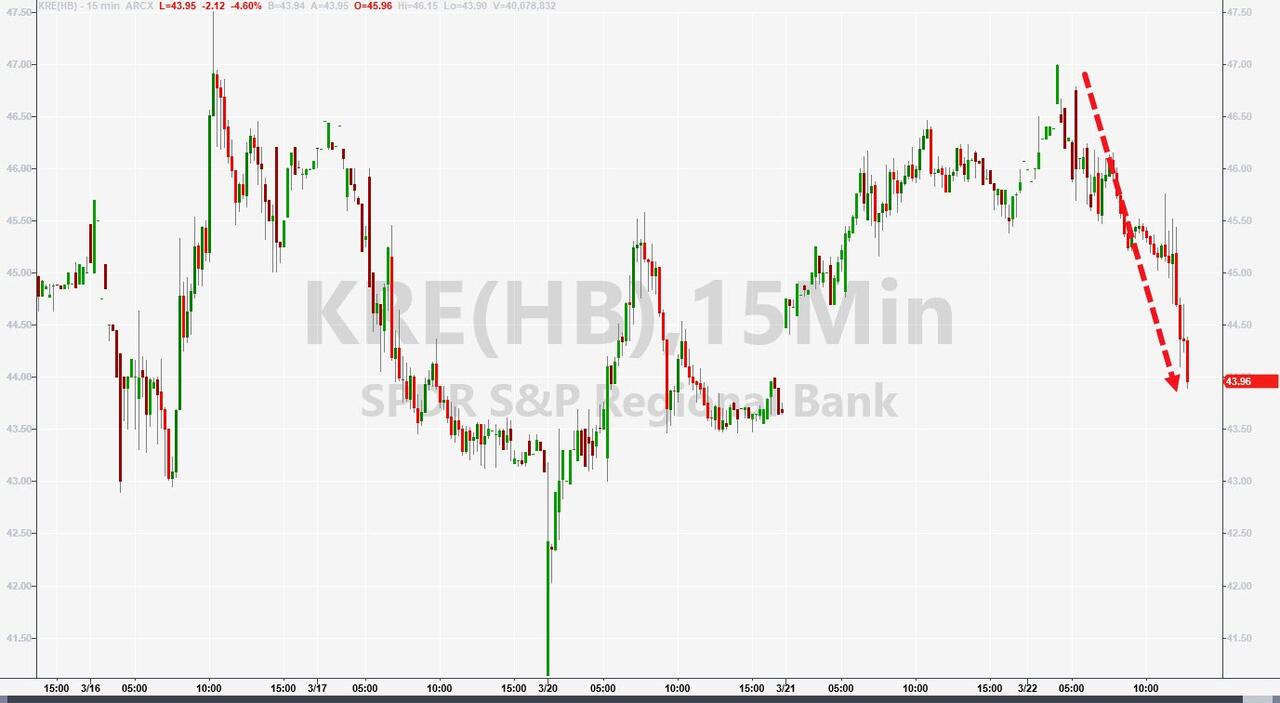
Regional banks took a hit…

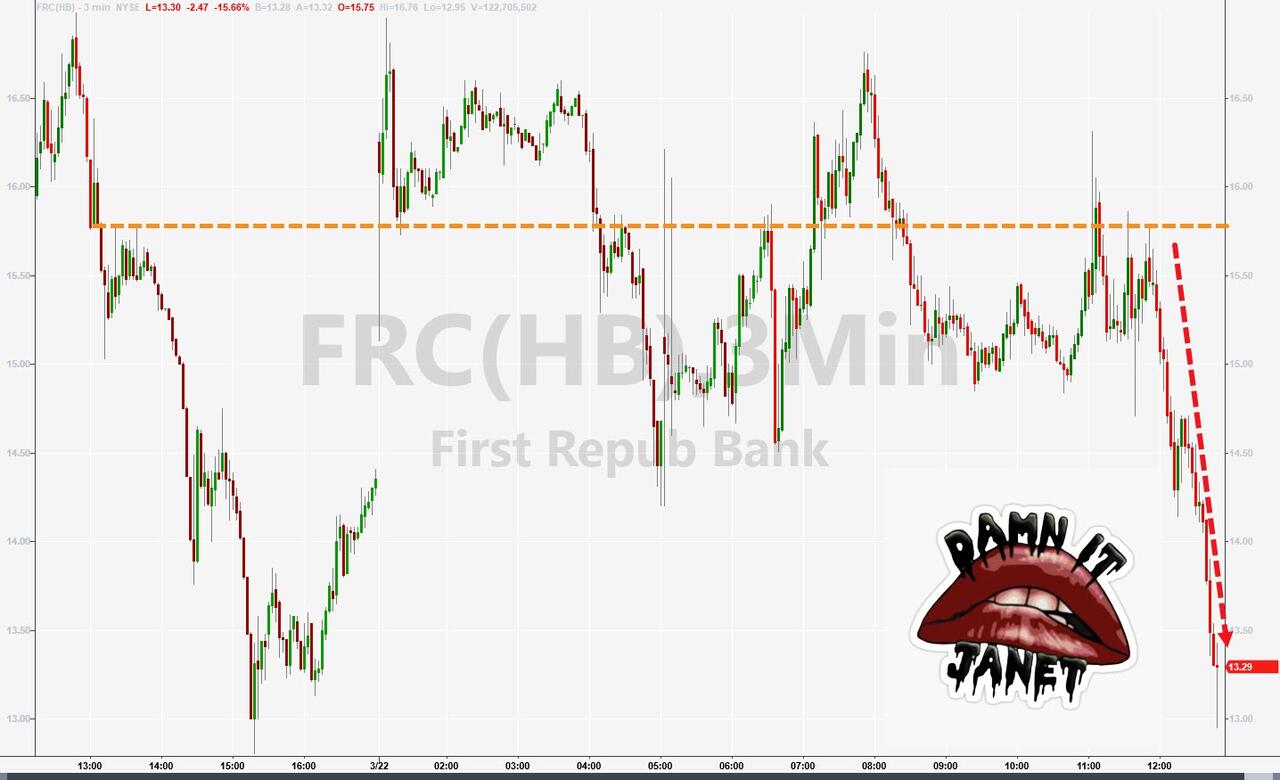
With First Republic Bank getting slammed…

And PacWest plunged…

So, the goal of today was to stabilize banks and instead, they blew them up… “Damn it, Janet!”

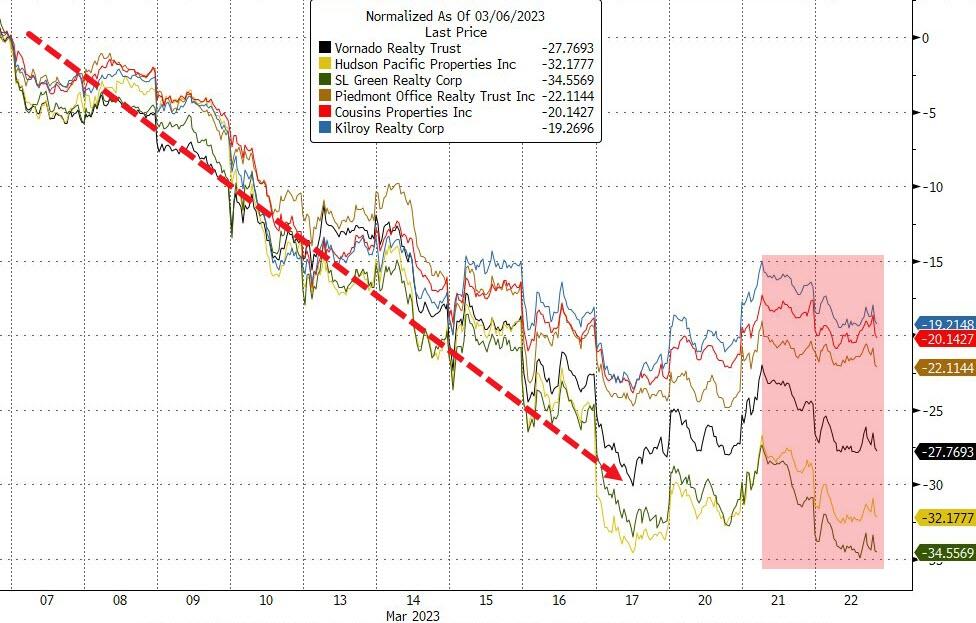
Office REITS hammered again

Source: Bloomberg

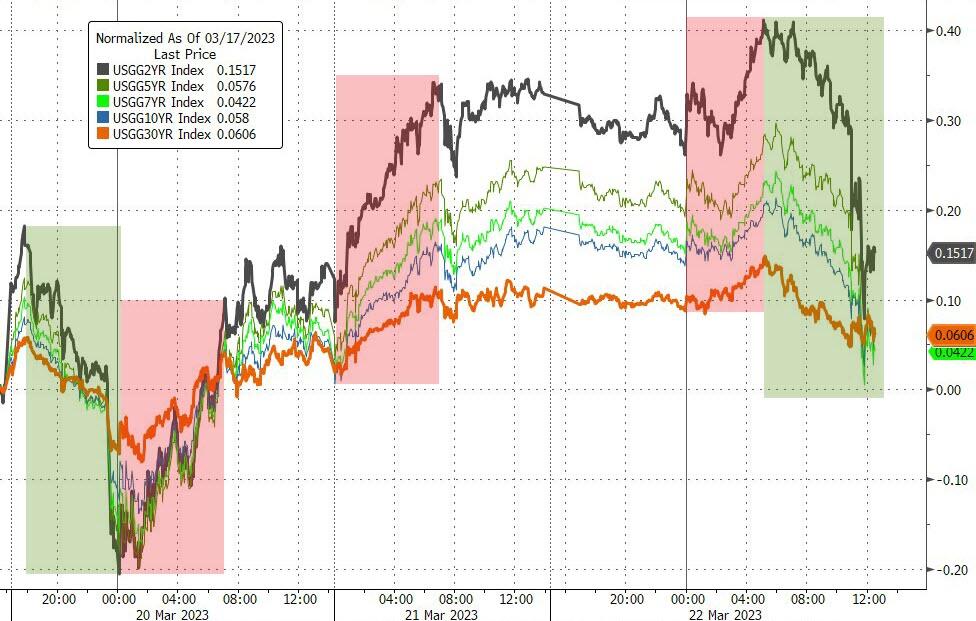
Treasury yields jumped overnight and were drifting lower into The Fed statement. The dovish bias sparked a further plunge in rates with the short-end notably outperforming (2Y -20bps, 30Y -6bps). On the week, 2Y remains the laggard (+15bps) while 30Y is up just 4bps…

Source: Bloomberg

…and the yield curve steepened…

Source: Bloomberg

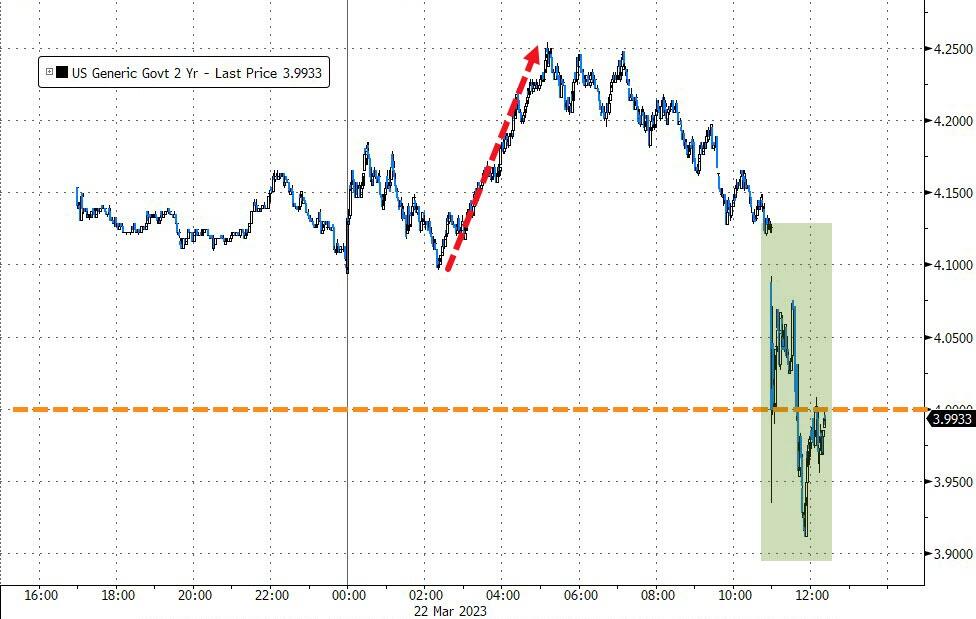
The 2Y yield dropped back below 4.00%…

Source: Bloomberg

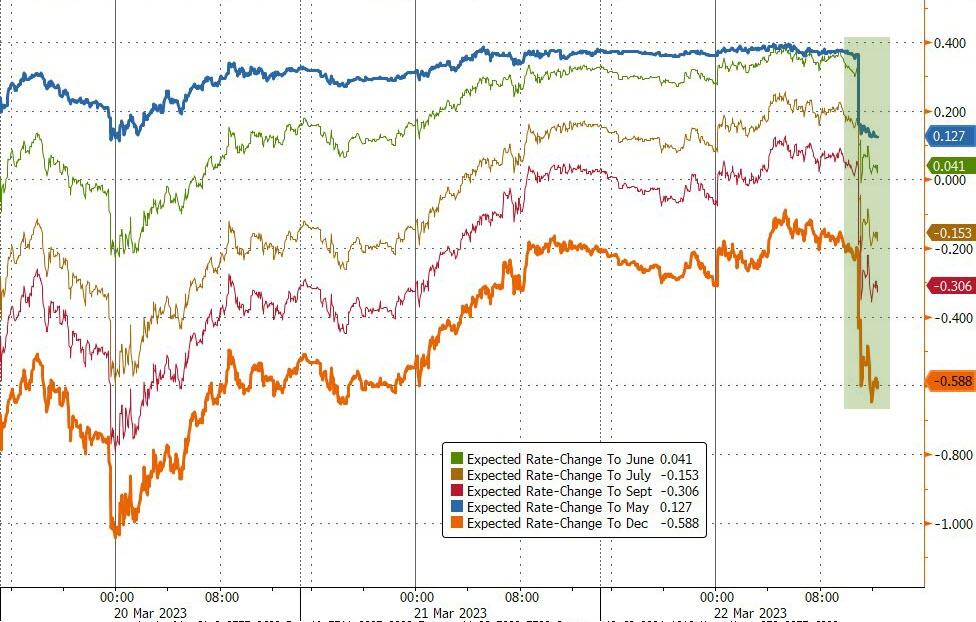
Rate-hike expectations tumbled for the latter half of 2023…

Source: Bloomberg

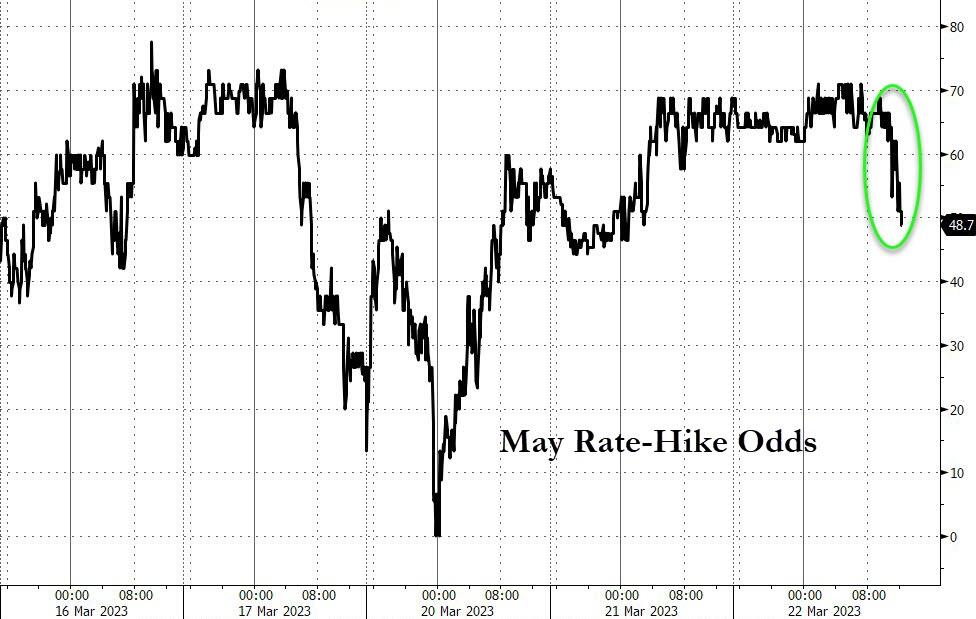
The odds of a 25bps hike in May dropped from around 70% to below 50%…

Source: Bloomberg

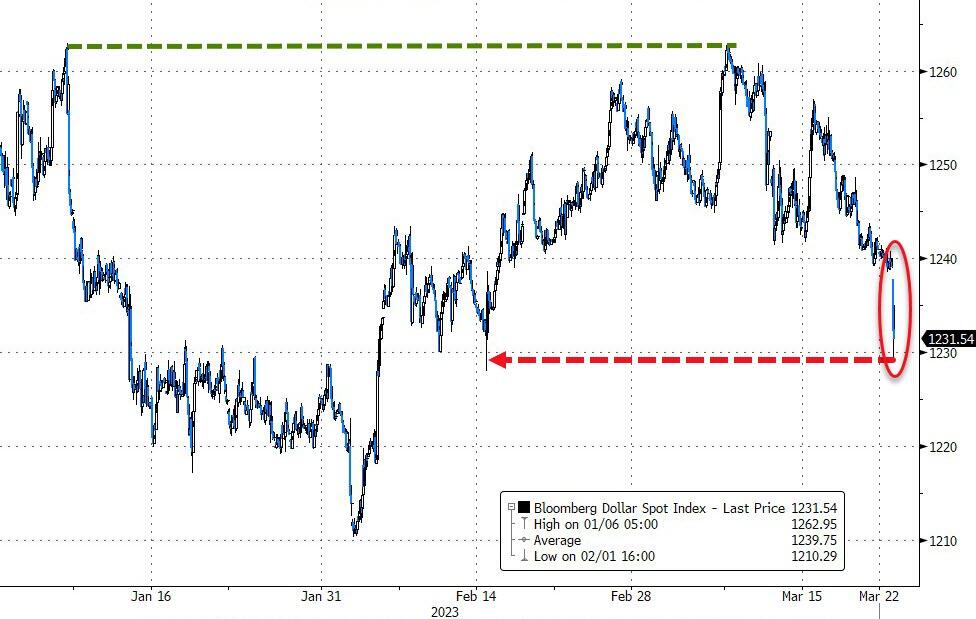
The dollar puked to 6-week lows…

Source: Bloomberg

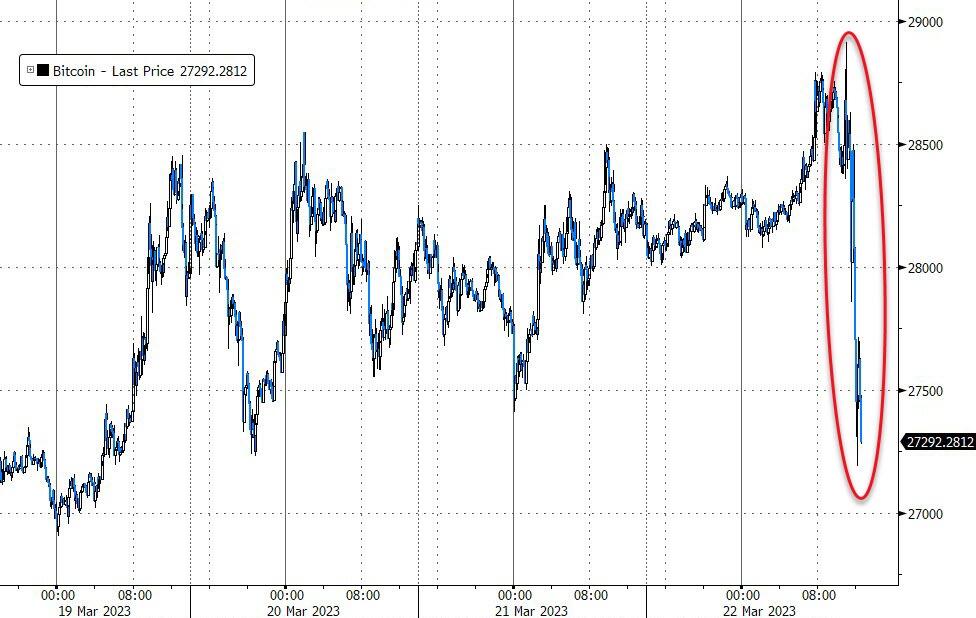
Bitcoin was clubbed like a baby seal, down from almost $29k to below $27,500…

Source: Bloomberg

Gold spiked on the dovish statement…

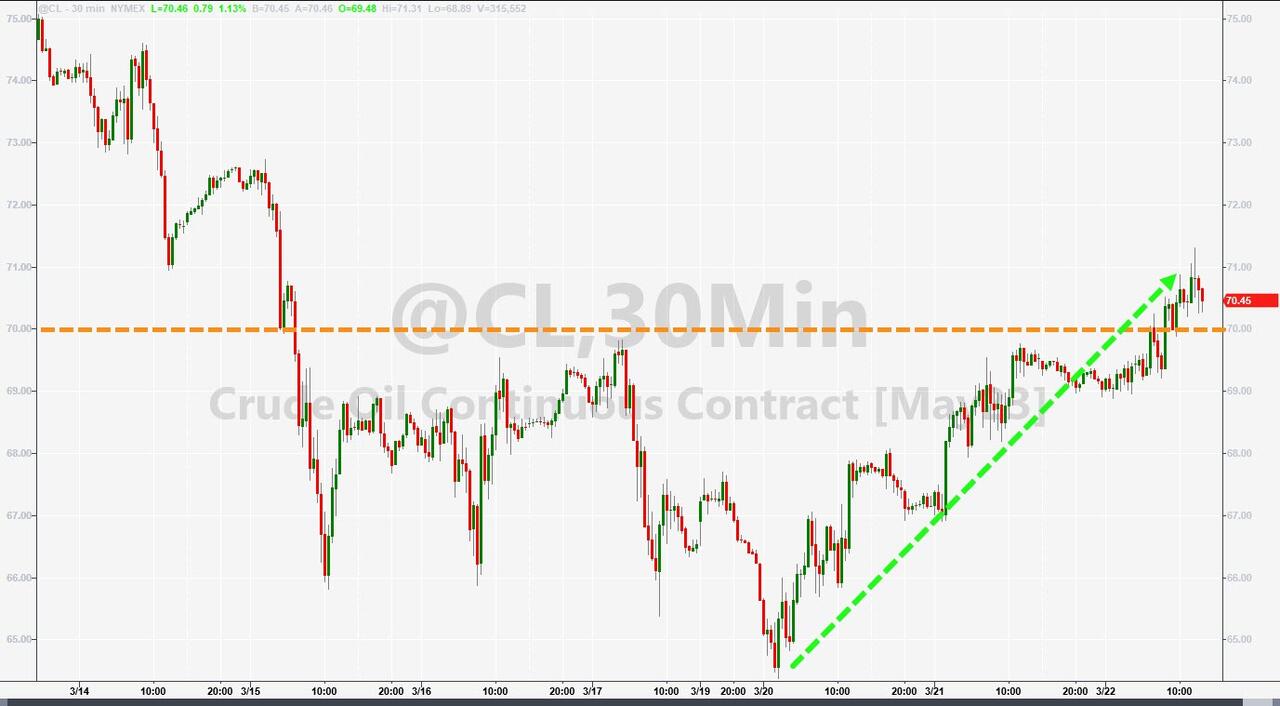
Oil extended its gains from yesterday with WTI back above $70…

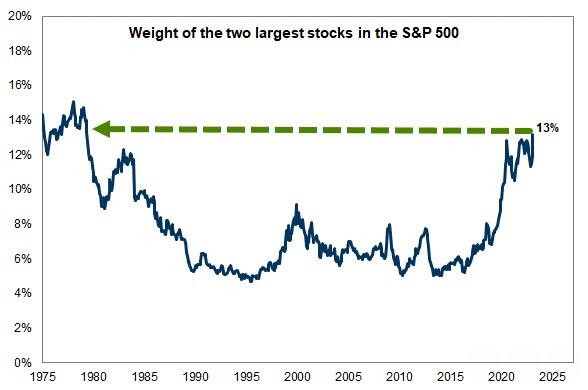
Finally, it is worth noting that two stocks account for over 13% of the S&P 500 for the first time since the 1970s

Source: Goldman

As goes MSFT and AAPL, so goes America.

Tyler Durden
Wed, 03/22/2023 – 16:00

via ZeroHedge News https://ift.tt/GlvjP5k Tyler Durden

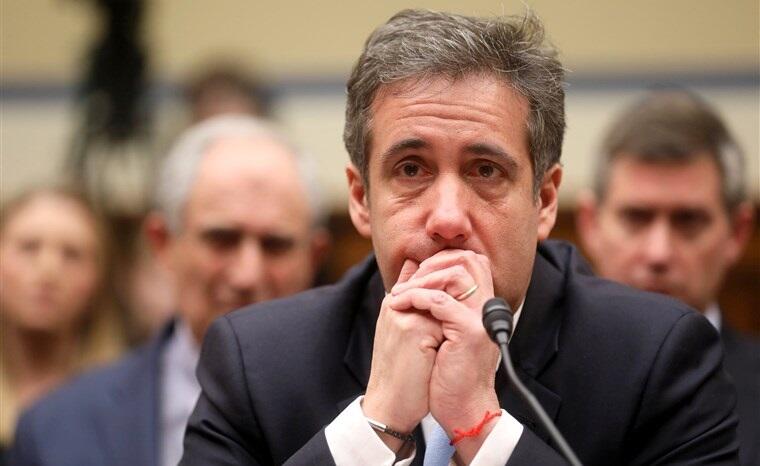
The Return Of Michael Cohen: A Disbarred Attorney Takes Center Stage In Dubious Prosecution

The Return Of Michael Cohen: A Disbarred Attorney Takes Center Stage In Dubious Prosecution

Authored by Jonathan Turley,

If former President Donald Trump is indicted, Manhattan District Attorney Alvin Bragg would be prosecuting a case that has been widely criticized as long on politics and short on the law.

The courts would have to address a controversial case in which a city prosecutor attempts to prove a federal crime long ago declined by the U.S. Department of Justice. They also would have to deal with a charge brought seven years after the alleged offense, despite a two-year statute of limitations for the underlying misdemeanors (or a five-year period for a felony).

And Bragg would have an even more unpalatable prospect in putting two key witnesses on the stand embodying a case that borders on the legally indecent: a former porn star and a disbarred lawyer.

Michael Cohen worked for Trump

The star witness is one of the most repellent figures in New York. It is only the latest reinvention of Michael Cohen – this time from legal heavy to redemptive sinner. Cohen spent much of his time when he worked for Trump threatening critics, journalists and even students.

In 2015, students writing for The Harvard Lampoon played a harmless prank on Trump by having him sit in the stolen “president’s chair” from the Harvard Crimson for a photo. In response, Cohen used his signature bludgeoning style against the students. He was quoted by a student on the Lampoon staff as saying: “I’m gonna come up to Harvard. You’re all gonna get expelled. If this photo gets out, you’ll be outta that school faster than you know it. I can be up there tomorrow.”

On another occasion, when a journalist pursued a story he did not like, Cohen told the reporter that he should “tread very f—ing lightly because what I’m going to do to you is going to be f—ing disgusting. Do you understand me?”

After he was arrested and Trump refused to pardon him, Cohen proved that when you scratch a lawyer, you can find a foe.

Cohen may be joined on the stand by Stormy Daniels, who agreed to a $130,000 payment to hush up an alleged affair with then businessman Trump. Bragg would have to show that Trump made the payment only with the election in mind, which would have made the money an undeclared campaign donation to himself. But there are a host of other reasons why a married celebrity would want to hush up a one-night stand with a porn star.

Case is similar to failed prosecution of John Edwards

In John Edwards’ prosecution in 2012, the Justice Department used the same theory to charge the former Democratic presidential candidate after a disclosure that he not only had an affair with filmmaker Rielle Hunter but also sired a child with her. Edwards denied the affair, and it was later revealed that Fred Baron, Edwards’ campaign finance chairman, gave money to Hunter.  Andrew Young, an Edwards campaign aide, also obtained funds from heiress Rachel “Bunny” Mellon to pay to Hunter.

The Justice Department spent a king’s ransom on the case to show that the third-party payments were a circumvention of campaign finance laws, because the payments were designed to bury an election scandal. Edwards was ultimately found not guilty on one count while the jury deadlocked on the other five.

The jury clearly believed there were ample reasons to hush up the affair beyond the election itself.

Despite legal flaws in the case, Bragg is counting on favorable judges and jurors in New York City. Win or lose, he would reap a huge political reward in being the first to charge Trump.

Ironically, Trump also could come out ahead politically. Of all the possible charges he could face, this is the one he would likely invite. Bragg would give Trump strong evidence that Democrats have politically weaponized the criminal justice system against him.

However, it’s Cohen who might profit the most. He already has tried to cash in on the burgeoning market of liberals obsessed with Trump, even hawking a T-shirt with the image of a jailed Trump as a way to “celebrate the fall of the Mango Mussolini.”

Cohen’s cross examination will be the most target rich environment since the Battle of Thermopylae. Of course, prosecutors often put dubious figures on the stand, but Cohen is someone who has shredded legal ethics and the criminal code in pursuit of his own interests.

Cohen’s primary talent has been an impressive moral and ethical flexibility. He gladly did the dirty work for Trump until it became more beneficial to turn against him.

One could say that Trump and Cohen deserve each other, but the legal system does not deserve what may soon unfold in a New York courtroom.

Jonathan Turley, a member of USA TODAY’s Board of Contributors, is the Shapiro Professor of Public Interest Law at George Washington University. Follow him on Twitter @JonathanTurley

Tyler Durden
Wed, 03/22/2023 – 15:44

via ZeroHedge News https://ift.tt/ONsdDYv Tyler Durden

Rick Scott, Liz Warren Unveil Bipartisan Fed Oversight Bill

Rick Scott, Liz Warren Unveil Bipartisan Fed Oversight Bill

Sens. Rick Scott (R-FL) and Elizabeth Warren (D-MA) are introducing legislation on Wednesday which would replace the Federal Reserve’s internal watchdog with one appointed by the president, following the failures of Silicon Valley Bank and Signature Bank.

Our legislation fixes that by establishing a presidentially-appointed, Senate-confirmed inspector general at the Fed, like every other major government agency,” reads a joint press release from Scott and Warren, who blame the collapse of the two bangs on regulatory failures at the US central bank, which currently employs an inspector general who reports to the Fed board, according to Reuters.

According to Warren, this month’s banking failures “have underscored the urgent need for a truly independent inspector general to hold Fed officials accountable for any lapses or wrongdoing.”

The legislation was due to be introduced later on Wednesday. According to a four-page legislative text, the measure would replace the Fed’s inspector general with an independent IG who would oversee the Federal Reserve and the Consumer Financial Protection Bureau. The CFPB is an independent bureau within the central bank that is responsible for consumer protection within the financial sector.

Warren played a key role in setting up the CFPB under Democratic President Barack Obama following the 2007-2008 financial crisis. The U.S. Supreme Court last month agreed to hear a case challenging the CFPB’s funding structure, which some conservatives argue violates the U.S. Constitution. -Reuters

“We may end up in one of these strange-bedfellows situations,” said former House Financial Services Committee staffer and banking lobbyist, Chris Brown, referring to the bipartisan aspect of the legislation.

“I do think there’s overarching concern about what happened here.”

Meanwhile, House Financial Services Committee Chairman Patrick McHenry (R-NC) and Maxine Waters (D-CA) have scheduled a March 29 hearing which will feature testimony from Fed and FDIC officials.

Tyler Durden
Wed, 03/22/2023 – 15:32

via ZeroHedge News https://ift.tt/jK68I7T Tyler Durden

Alito: “I went to a law school where I didn’t learn any law.”

I was pleased to attend oral argument today in Jack Daniel’s Properties, Inc. v. VIP Products–my first argument since the pandemic. This fun IP case considers a doggy toy that closely resembles a bottle of Jack Daniels whisky. It is always fun to see Lisa Blatt argue in person. She never disappoints. This exchange, in particular, was delightful:

MS. BLATT: Well, just showing how confused I was suggests that I would be your perfect consumer.

(Laughter.)

MS. BLATT: Justice Alito, I don’t know how old you are, but you went to law school, you’re very smart, you’re analytical, you have hindsight bias, and maybe you know something –

JUSTICE ALITO: Well, I went to a law school where I didn’t learn any law –

MS. BLATT: Okay. But –

JUSTICE ALITO: –so don’t –

(Laughter.)

MS. BLATT: –it’s just a little rich for people who are at your level to –to say that you know what the average purchasing public thinks about all kinds of female products that you don’t know anything about or dog toys that you might not know anything about. And so I just think –

JUSTICE ALITO: I don’t know. I had a dog. I know something about dogs.

MS. BLATT: Okay.

Alito has said many times before that he learned no actual law at Yale Law School. As soon as Blatt mentioned law school, I knew Alito would jab back at his alma matter.

The post Alito: "I went to a law school where I didn't learn any law." appeared first on Reason.com.

from Latest https://ift.tt/ao69OXV
via IFTTT

The DOJ Says Forbidding Pot Users To Own Guns Is Like Telling People Not To Carry Guns When They’re Drunk


Cannabis leaves

Every state prohibits driving while intoxicated, recognizing that alcohol use impairs the ability to safely operate a motor vehicle and increases the risk of potentially lethal accidents. Using a cellphone also impairs the ability to safely operate a motor vehicle and increases the risk of potentially lethal accidents. It therefore makes sense to prohibit cellphone users from owning cars.

That faulty syllogism bears more than a passing resemblance to the Biden administration’s defense of the federal law that makes it a felony for cannabis consumers to possess firearms. That law, the U.S. Department of Justice (DOJ) argues in an appeal brief filed last week, is “consistent with this Nation’s historical tradition of firearm regulation”—the constitutional test established by the Supreme Court’s 2022 decision in New York State Rifle & Pistol Association v. Bruen. To make its case, the government cites laws passed in the 17th, 18th, and 19th centuries that prohibited people from carrying or firing guns while intoxicated, which it implausibly argues are analogous to the gun ban for marijuana users that Congress imposed in 1968.

The DOJ is asking the U.S. Court of Appeals for the 11th Circuit to uphold a 2022 decision in which Allen Winsor, a federal judge in Florida, dismissed a Second Amendment challenge to that gun ban by state-authorized medical marijuana patients. In the 10th Circuit, meanwhile, the Biden administration is appealing a contrary 2023 ruling by Patrick Wyrick, a federal judge in Oklahoma who concluded that the law, 18 USC 922(g)(3), is unconstitutional.

The government’s 11th Circuit brief wisely eschews the DOJ’s earlier reliance on what Wyrick called “ignominious historical restrictions” that disarmed slaves, Catholics, loyalists, and Native Americans. Those precedents, the government had argued, showed that legislators have the authority to withhold gun rights from any group they deem “untrustworthy.” But the DOJ is still arguing that “the people” protected by the Second Amendment are limited to “law-abiding, responsible citizens,” a category that it says does not include cannabis consumers or anyone else who breaks the law, no matter how trivial the offense.

That claim seems inconsistent with President Joe Biden’s position that marijuana use should not be treated as a crime. But the meat of the Justice Department’s argument is the claim that early laws targeting drunken gun handlers establish a “historical tradition” that justifies threatening cannabis consumers with up to 15 years in prison if they dare to exercise their Second Amendment rights. That argument glosses over crucial details that show these “historical analogues” were fundamentally different from the law that the Biden administration is defending.

“As early as 1655,” the DOJ notes, “Virginia prohibited “shoot[ing] any gunns at
drinkeing [events].” A 1771 New York law “likewise barred firing guns during the New Year’s holiday,” a regulation that “was aimed at preventing ‘the great Damages…frequently done on [those days] by persons…being often intoxicated with Liquor.'” In 1731, Newport, Rhode Island, “forbade the firing of ‘any gun or pistol’ in any tavern at night, a time and place where people were at a heightened risk of drinking to excess.”

Notably, those colonial laws applied in public places, and they were aimed at the specific danger posed by drunken gun use. By contrast, 18 USC 922(g)(3) is a categorical ban on firearm possession in any setting by any “unlawful user” of a “controlled substance,” regardless of whether he carries or fires a gun while intoxicated. An analogous rule regarding alcohol would deny Second Amendment rights to all drinkers, include occasional or moderate consumers who never handle guns irresponsibly.

The 19th century laws cited by the government likewise were narrowly tailored to address a public hazard. An 1867 Kansas law made it misdemeanor for “any person under the influence of intoxicating drink” to “carr[y] on his person a pistol…or other deadly weapon.” An 1878 Mississippi law banned the sale of concealable, deadly weapons to “any person intoxicated” when the seller knew the buyer was “in a state of intoxication.” A 1879 Missouri law prohibited people from carrying “any kind of firearms…when intoxicated or under the influence of intoxicating drink.”

An 1883 Wisconsin law said “it shall be unlawful for any person in a state of intoxication” to “go armed with any pistol or revolver.” An 1890 Oklahoma law said “public officers” were not allowed to carry “arms” while “under the influence of intoxicating liquors.” In 1899, South Carolina forbade “boisterous conduct” while “under the influence of intoxicating liquors,” including “discharg[ing] any gun” near a public road. A 1909 Idaho law made it a crime for “any person” to “have or carry” a “pistol, revolver, gun or any other deadly or dangerous weapon” while “intoxicated” or “under the influence of intoxicating drinks.”

All of these laws were limited to people who were actively intoxicated, who were not permitted to carry or fire guns in public (or, in Mississippi’s case, buy guns). The state laws cited by the government “imposed a far narrower burden” than 18 USC 922(g)(3) “and, as a result, left ample room for the exercise of the core right to armed self-defense,” Wyrick noted in his February 3 decision:

First, the restrictions imposed by each law only applied while an individual was actively intoxicated or actively using intoxicants. Under these laws, no one’s right to armed self-defense was restricted based on the mere fact that he or she was a user of intoxicants. Second, none of the laws appear to have prohibited the mere possession of a firearm. Third, far from being a total prohibition applicable to all intoxicated persons in all places, all the laws appear to have applied to public places or activities (or even a narrow subset of public places), and one only applied to a narrow subset of intoxicated persons [“public officers”]. Importantly, none appear to have prohibited the possession of a firearm in the home for purposes of self-defense.

While those laws “took a scalpel to the right of armed self-defense—narrowly carving out exceptions but leaving most of the right in place—§ 922(g)(3) takes a sledgehammer to the right,” Wyrick added. “Recall that § 922(g)(3) imposes the most severe burden possible: a total prohibition on possessing any firearm, in any place, for any use, in any circumstance—regardless of whether the person is actually intoxicated or under the influence of a controlled substance. It is a complete deprivation of the core right to possess a firearm for self-defense, turning entirely on the fact that an individual is a user of marijuana. Section 922(g)(3)’s ‘burden on the right of armed self-defense’ is thus not ‘comparable’ to the seven historical intoxication laws.”

How does the DOJ deal with these points in its 11th Circuit brief? By ignoring them.

“The founders recognized that intoxicating substances render users unable to responsibly bear arms,” the government’s lawyers say. “Historical legislatures accordingly adopted a variety of measures calculated to separate firearms and alcohol….Both Section 922(g)(3) and historical laws mitigate the ‘mischief’ threatened when intoxicated individuals ‘go[] abroad with fire-arms.’…Both Section 922(g)(3) and historical laws disarm individuals who currently or recurringly use drugs that impair their ability to possess firearms responsibly.”

Those laws “separate[d] firearms and alcohol” by saying people were not allowed to publicly carry guns when they were drunk, not by saying people who drink may not possess firearms, period. They aimed to address the danger posed by “intoxicated individuals” who “go[] abroad with fire-arms” by prohibiting precisely that sort of behavior. As Wyrick noted, 18 USC 922(g)(3) goes much further than that.

The DOJ’s dubious logic is clear in this passage: “Plaintiffs do not suggest they will surrender their firearms every time they use marijuana. Plaintiffs will accordingly possess firearms while intoxicated and thus fall within the class of individuals subject to disarmament under these historical laws.”

Contrary to the implication, “these historical laws” did not require gun owners to “surrender their firearms” whenever they had a drink or two. They did not prohibit people from “possess[ing] firearms while intoxicated” in the sense of retaining ownership of those weapons and keeping them at home when they visited a tavern. The laws specifically forbade the conjunction of two activities that were otherwise legal: 1) consuming alcoholic beverages and 2) carrying guns in public.

Returning to the opening analogy, a person’s status as a drinker does not disqualify him from owning a car, and he retains legal ownership of his car even when he is intoxicated, provided he does not try to drive it in that condition. Logically, the same distinctions should apply to marijuana use and gun ownership, which unlike car ownership is explicitly protected by the Constitution.

“The question is not, as plaintiffs seem to suggest, whether a modern law mirrors a ‘historical twin,'” the DOJ says. “Rather, the question is whether the modern law is ‘relevantly similar’ to a ‘historical analogue.'” But the government’s attempt to argue that laws targeting gun-toting drunks are “relevantly similar” to a law targeting anyone who consumes marijuana, regardless of the circumstances, relies on slippery reasoning and deliberate obfuscation.

The Biden administration thinks the 11th Circuit (and the 10th) should defer to “Congress’s judgment that marijuana is a controlled substance the users of which cannot responsibly possess firearms.” When Congress passed the Gun Control Act in 1968, the DOJ says, it was worried about the “ready availability” of guns to “narcotic addicts,” “criminals,” and “others whose possession of firearms is similarly contrary to the public interest.” Legislators also mentioned “juveniles,” “mental defectives,” and “armed groups who would supplant duly constituted public authorities.”

According to the Biden administration, it was perfectly reasonable to put cannabis consumers in the same category as “narcotic addicts,” “criminals,” children, armed revolutionaries, and “mental defectives.” The DOJ explicitly compares marijuana users to “the mentally ill,” saying both can be “dangerous when armed.” The government approvingly quotes a 2016 decision in which the U.S. Court of Appeals for the 9th Circuit averred that illegal drug users, “like those with mental illnesses,” are apt to “experience or impaired mental states that affect their judgment and that can lead to irrational or unpredictable behavior.”

The DOJ also quotes a 1946 history noting that “at the founding ‘those afflicted with mental diseases were generally treated as though they had been stripped of all… their rights and privileges.'” In the 18th century, the government adds, quoting a 2009 law review article, “justices of the peace were authorized to ‘lock up’ ‘lunatics’ who were ‘dangerous to be permitted to go abroad.'” Evidently, marijuana users should be thankful that they have been stripped only of their Second Amendment rights and not all of their other “rights and privileges,” including the right to be free of arbitrary and indefinite imprisonment.

The constitutional question is not whether this attitude makes sense. It manifestly does not, as Biden himself should be willing to concede, since he decries the injustice of criminalizing marijuana use. The constitutional question, as framed by the Supreme Court in Bruen, is whether the policy based on that attitude is “consistent with this Nation’s historical tradition of firearm regulation.” If these are the best “historical analogues” the government can come up with, the answer seems clear.

The post The DOJ Says Forbidding Pot Users To Own Guns Is Like Telling People Not To Carry Guns When They're Drunk appeared first on Reason.com.

from Latest https://ift.tt/riKcCYy
via IFTTT

Interest Payments On Treasury Debt Up 29% YoY

Interest Payments On Treasury Debt Up 29% YoY

Via Global Macro Monitor,

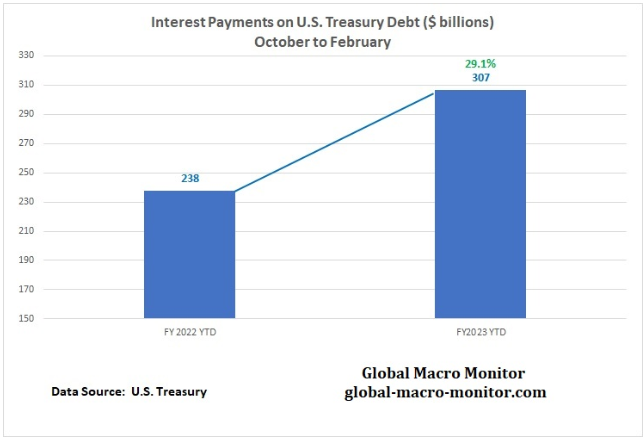
Here is a follow-up on last week’s chart with some excellent granular detail.   

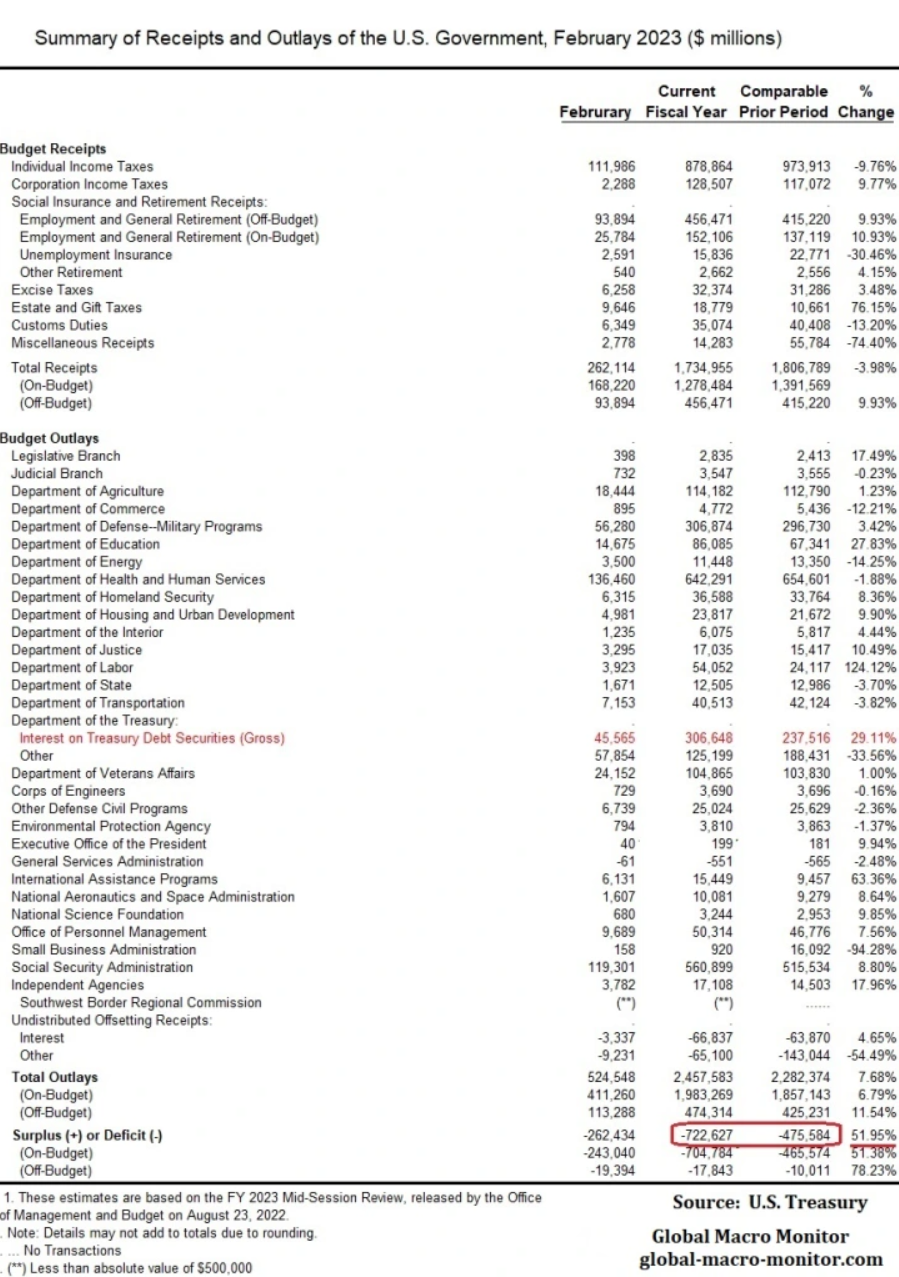
Interest payments on the national debt during the current fiscal year (October to February) are up 29 percent y/y, one of the fastest-growing expenditure components of the Federal budget (see table below). 

Revenues are down, especially individual income taxes, which may reflect the slowing economy.  

Theory dictates (ceteris paribus) that government tax revenues should be rising with inflation, however.  Hmmm. 

The fact income tax receipts are lower but self-employment tax revenues (1099 employees) are higher, coupled with what is happening with the employment data, can we hypothesize that high income earners are leaving the workforce (or getting fired) and starting their own businesses, such as consultants, for example?  

Or could it be just a timing issue? 

The overall deficit is exploding, btw, up 50 percent.  

If the current situation normalizes and Treasury securities lose their flight-to-quality bid, interest rates are going to spike faster than one of Elon’s rockets

Tyler Durden
Wed, 03/22/2023 – 15:15

via ZeroHedge News https://ift.tt/Qgf9nbt Tyler Durden

Wall Street Reacts To Powell’s 25bps Rate Hike In The Middle Of A Banking Crisis

Wall Street Reacts To Powell’s 25bps Rate Hike In The Middle Of A Banking Crisis

The Fed decision has may have come and gone but the hot takes from Wall Street experts are just starting. Below we excerpt from some of the more notable reactions to the Fed’s latest 25bps hike.

Jan Hatzius, chief economist at Goldman:

The FOMC raised the target range for the federal funds rate by 0.25pp to 4.75-5%. The post-meeting statement noted that, while the “banking system is sound and resilient,” the recent banking stress is likely to “weigh on economic activity, hiring, and inflation.” The FOMC removed the reference to “ongoing” hikes in the post-meeting statement and noted instead that “additional policy firming may be appropriate.” The Committee reiterated that it “remains highly attentive to inflation risks.” The median dot in the Summary of Economic Projections shows a funds rate of 5.125% at end-2023, unchanged from the December projections. The median projection in the SEP showed lower GDP growth and somewhat higher core inflation in 2023 and 2024.

Eric Winograd, senior US economist at AllianceBernstein:

“So far my takeaway is that the committee has left all the hard work for Chair Powell in his press conference. If you just look at the statement and the materials, there isn’t a change to their outlook from a few months ago, so he will have to describe how they are thinking about the banking issues as they relate to the economy.”

Quincy Krosby, chief global strategist for LPL Financial:

“The statement acknowledged that the backdrop remains uncertain in terms of economic activity that may be constrained as financial conditions tighten. Certainly, the press conference will be more in-depth as reporters seek to ascertain the Fed’s forward trajectory, as the futures market sees another 25 basis point hike in May and the beginning of rate cuts in the summer.”

Peter Boockvar, author of the Boock Report:

“I said this morning that this over-hyped meeting was most likely going to be a non-event and it certainly was. That said, the Powell press conference will certainly be a forum for more notable market moves. We’ll see how he does the financial stability vs price stability dance.”

Ira Jersey, strategist at Bloomberg Intelligence:

“The 25-bp hike and dovish statement was in line with our expectations. Another hike to a peak policy rate will be highly dependent on bank turmoil not becoming systemic. We note that it is institutions with little to no reserves that have been affected so far. In fact, as deposits have moved from smaller banks to money-center banks, bank reserves have increased by about $200 billion, which has driven bank net interest margins higher even amid an inverted yield curve. The issue is the distribution of those profits — smaller institutions aren’t able to take advantage.”

More from BI’s Jersey:

“For the rate market, though the shape of the curve may shift abruptly over the next month, we think there may be a bias toward bull steepening going forward. Even if rate cuts don’t materialize as the market currently expects, it will continue to price for such an event for the time being.”

Eddy Vataru, portfolio manager at Osterweis Capital Management:

“My biggest takeaway from this statement is the change here. The Committee anticipates that some additional policy firming may be appropriate. So I think they’re leaning on tighter conditions, courtesy the bank debacle. They might not hike at all anymore, or at the very least they’ll balance the two. And they’ll explicitly pay attention to financial conditions. They might be done. They’ll pause for a while though until they can’t. We had a good chunk of a hike priced in for next month but I think they might pause now.”

Bloomberg Economics’ US team says:

“The Fed weighed the pros and cons of a wait-and-see approach against a continuation of hikes, and chose the latter. That signals an unconditional commitment to the price-stability leg of the Fed’s dual mandate. We think they made the right decision.”

Source: Bloomberg, primary sources.

Tyler Durden
Wed, 03/22/2023 – 15:04

via ZeroHedge News https://ift.tt/kB4hbNm Tyler Durden

Rolling Stone Boss Edited Out Child Porn Accusations After Journo-Pal Raided By FBI

Rolling Stone Boss Edited Out Child Porn Accusations After Journo-Pal Raided By FBI

After the FBI conducted a raid on a journalist last April, Rolling Stone national security reporter Tatiana Siegel wrote that it was “quite possibly, the first” carried out by the Biden administration on a reporter – in this case, former ABC national security reporter James Gordon Meek, who was previously an investigator for the House Homeland Security Committee.

James Gordon Meek

The RS article, which casts Meek as an unimpeachable truthsayer, framed the raid as an abuse of power, NPR reports.

Meek appears to be on the wrong side of the national-security apparatus,” reads the article.

Siegel’s sources told her that “federal agents allegedly found classified information on Meek’s laptop during their raid.” But what we didn’t know at the time was that Rolling Stone Editor-in-hief Noah Shachtman – a friend of Meek, made the rare decision to personally edit Siegel’s article to remove all mention that the raid was part of a federal investigation into child porn.

As edited by Rolling Stone Editor-in-Chief Noah Shachtman, however, the article omitted a key fact that Siegel initially intended to include: Siegel had learned from her sources that Meek had been raided as part of a federal investigation into images of child sex abuse, something not publicly revealed until last month.

Why did Rolling Stone suggest Meek was targeted for his coverage of national security, rather than something unrelated to his journalism?

When Siegel detailed the seriousness of the allegations against Meek, Shachtman warned her against turning in a story that included the words “child pornography” in it. –NPR

According to the report, Shachtman “considered Meek a peer with whom he was friendly,” and told colleagues that the two men “travel in the same professional circles.”

Shortly before Shachtman joined Rolling Stone, Meek suggested on Twitter that Shachtman should pay attention to an obscure band from Niger — the location of the botched military mission that Meek helped investigate for ABC. Shachtman replied by linking to an earlier review.

Meek soon emailed Shachtman to gauge interest in covering his Hulu documentary series. The new Rolling Stone editor passed the note along to colleagues; the magazine posted a glowing review some weeks later, in November 2021. -NPR

Shachtman also insisted that staffers use a generic photograph instead of Meek’s image. “let’s not use a picture of the guy in question, james gordon meek,” he requested, adding “something FBY-y please.”

According to NPR, citing two anonymous sources, Washington attorney Mark “I’ve gotten clearances for guys who had child porn issues and love hanging out at Disney World by myself” Zaid called Shachtman on Meek’s behalf while Siegel was writing up the story.

Attorney Mark Zaid

Zaid confirmed to NPR that he called Shachtman – and admitted that Meek was a longtime friend and client who he was representing on any potential prosecution or investigation of his potential possession of classified material.

Then things get even weirder

According to the report, “The accounts given by the associates, colleagues and friends of the two key figures — Siegel and Shachtman — diverge here.”

According to what Siegel told others, Shachtman and she agreed that the article would reflect that the FBI’s interest stemmed from concerns of possible criminal behavior outside the scope of Meek’s work — that is, it had nothing to do with national security or journalism.

Shachtman later told others that he did not believe that she had nailed down her sourcing adequately. Rolling Stone parent company Penske Media notes that authority to make such choices for Rolling Stone’s coverage lies with Shachtman. “That was true in this case, as reflected in the final edits to the story,” the company said in a statement to NPR. “Some material was added late in the process, other material was dropped.” -NPR

Aaaand it’s gone

As NPR reports, after Siegel had to step away from the article to care for her ailing mother, Shachtman changed Siegel’s draft to remove all suggestions that the raid was about anything other than Meek’s FBI reporting, just hours before it was set to go to publication – saying only that the FBI had allegedly found “classified information” on Meek’s devices.

The article left many readers with the distinct impression that the investigation was linked to Meek’s reporting — which could lead to a clash of the government and the press. Rolling Stone’s official Twitter account promoted the story this way: “Exclusive: Emmy-winning ABC News producer James Gordon Meek had his home raided by the FBI. His colleagues say they haven’t seen him since.” The tweet’s thrust was echoed by WikiLeaks, Glenn Beck and the Freedom of the Press Foundation, which wrote, “If this was related to his work, as this @RollingStone report suggests it might be, it is a gross press freedom violation.” -NPR

Aaaand she’s gone

According to colleagues and friends, Siegel says she didn’t know about the changes to her story until it appeared online, and was furious about what she considered Shachtman’s interference with the independence of her reporting.

Two months later, Siegel accepted a position at a sister publication.

My how the wagons circle…

Tyler Durden
Wed, 03/22/2023 – 14:42

via ZeroHedge News https://ift.tt/VFOkMwo Tyler Durden

Watch Live: Fed Chair Powell Attempts High-Wire Walk Between Price & Financial System Stability

Watch Live: Fed Chair Powell Attempts High-Wire Walk Between Price & Financial System Stability

Having raised rates by 25bps (as expected) and offered a dovish bias to the statement with regard future rate-hikes, Fed Chair Powell now has the unenviable task of threading the needle between too-dovish (what does Powell know about just how bad the banking crisis really is…and what will that do to inflation) and too-hawkish (omfg, Powell’s going to kill the banks to crush inflation).

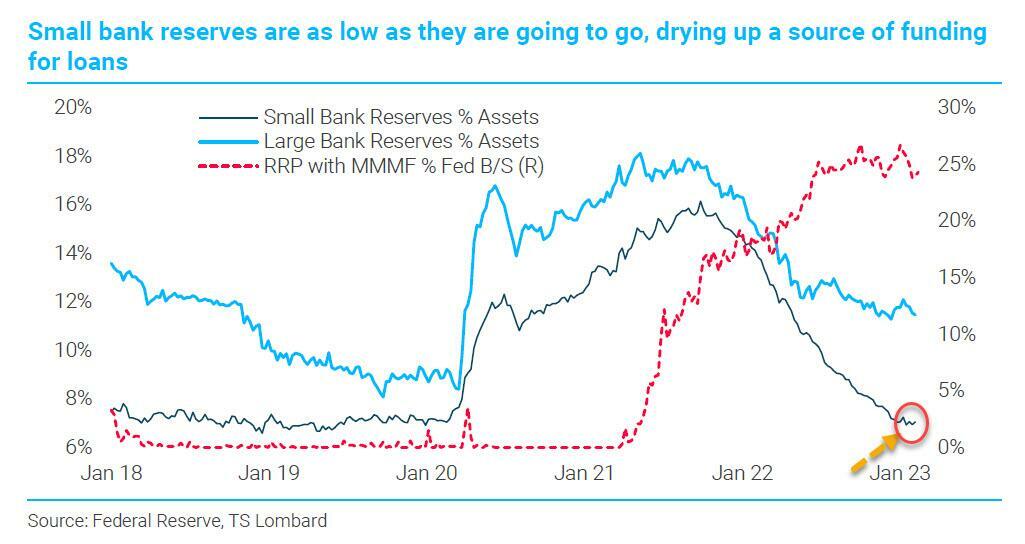
The goldilocks path, we are sure, will involve Powell using the words “we have the tools” and cajoling reporters along into believing that “the banking system is sound” – which of course ‘in aggregate’ it is, but the whole point is the massive decoupling between reserve rations of smaller banks and larger banks (and the contagion from the former on the economy and the rest of the banking system).

At the presser, Bloomberg looks for Powell to say interest-rate policy is the primary tool for achieving the Fed’s dual mandates of price stability and full employment, and shouldn’t be used as the first line of defense against threats to financial stability.

Powell will reject the idea that opening the Fed’s liquidity tool kit, and banks’ use of the discount window, represent an end to quantitative tightening.

Of course, he could just say f**k it!

Keep in mind that it’s been a consistent pattern that stock markets tended to rebound soon after Powell speaks at press conferences.

Watch Powell walk the tight-rope live here (due to start at 1430ET):

Tyler Durden
Wed, 03/22/2023 – 14:25

via ZeroHedge News https://ift.tt/y648RqC Tyler Durden