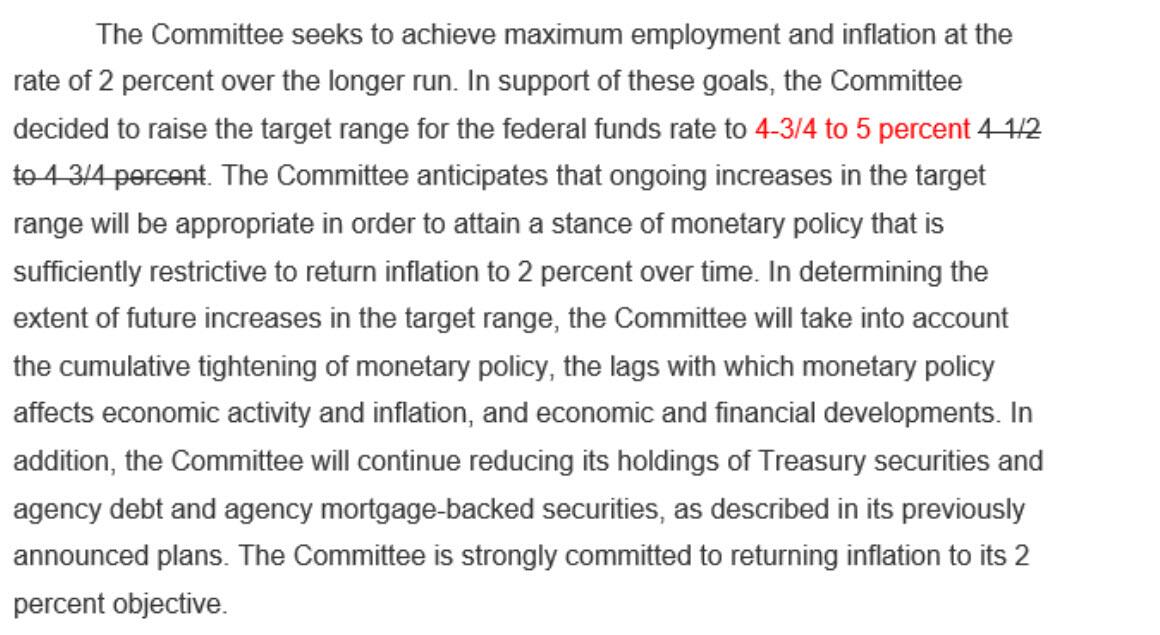
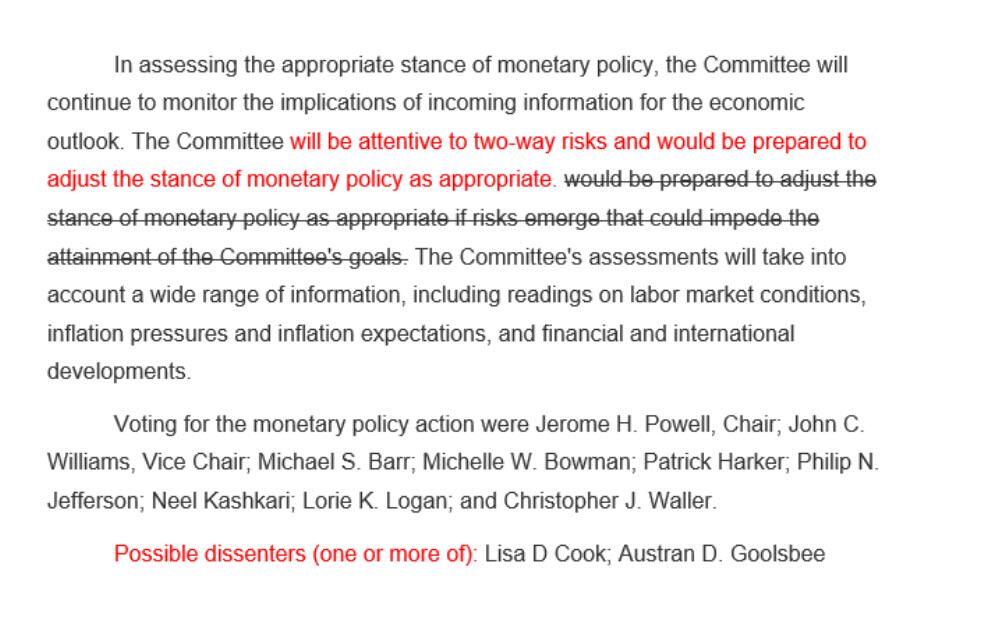
Fed Hikes Rates 25bps, Maintains QT, Removes Hawkish Guidance

Fed Hikes Rates 25bps, Maintains QT, Removes Hawkish Guidance

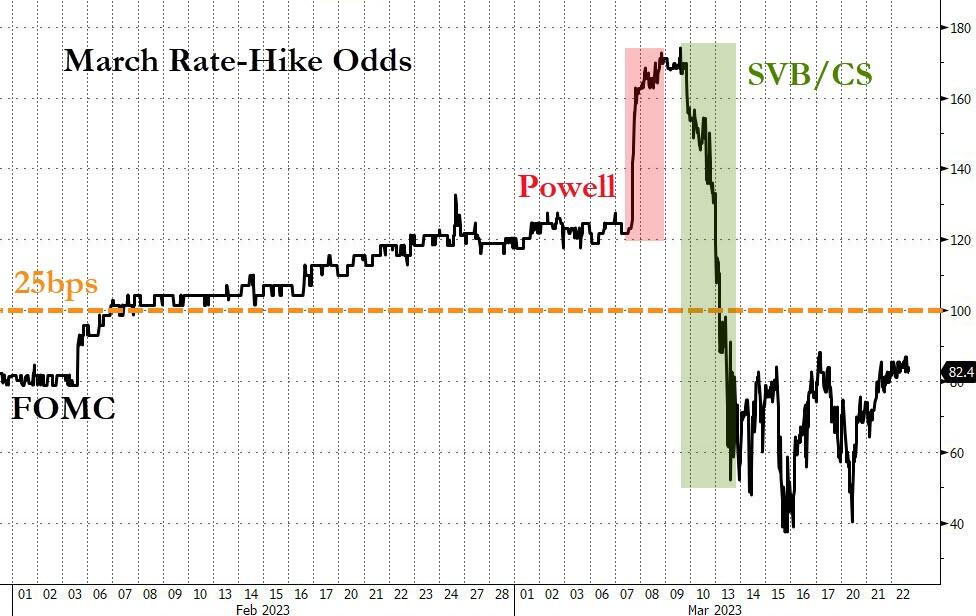
A lot has changed since The Fed last met on February 1st and decided to hike 25bps. Between Powell’s hawkish hearings with Congress and the dovish-inference of a global financial system crisis, the market’s expectations for The Fed’s actions today have swung wildly – but ironically, are basically unchanged since the Feb 1st meeting.

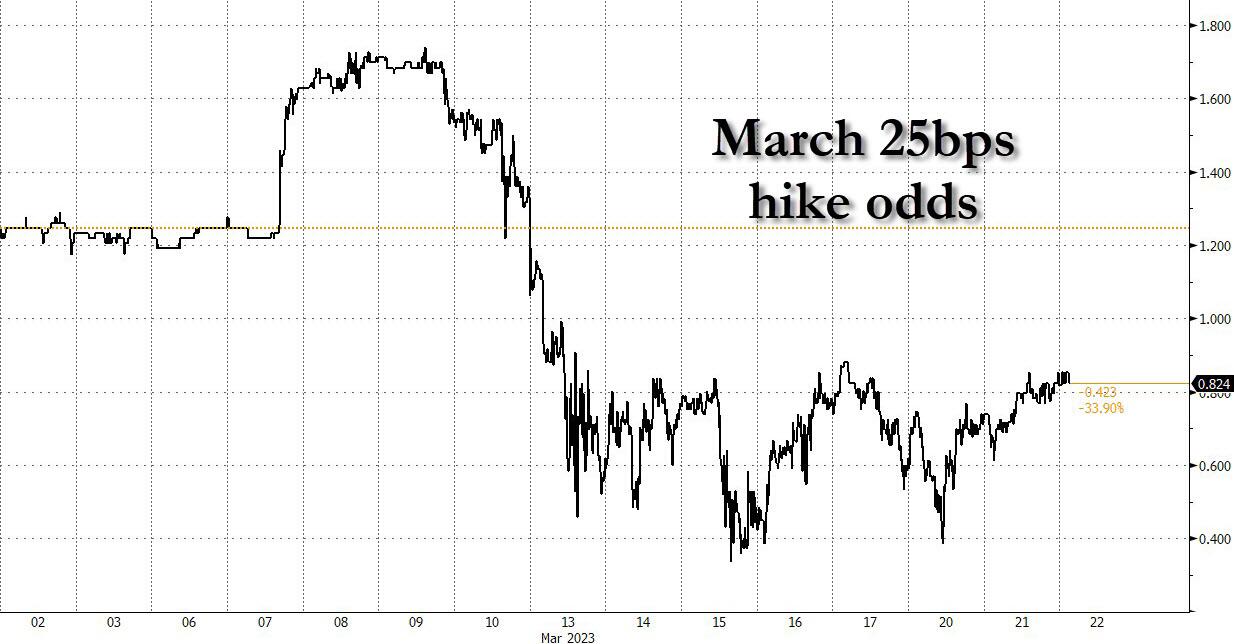
At its most hawkish the market priced in a 75% chance of a 50bps hike (after Powell’s hearings). That then collapsed to a 63% chance of a ‘pause’ by The Fed following the collapse of SVB and CS. The last week has seen expectations rise back to 80% or so of a 25bps hike…

Source: Bloomberg

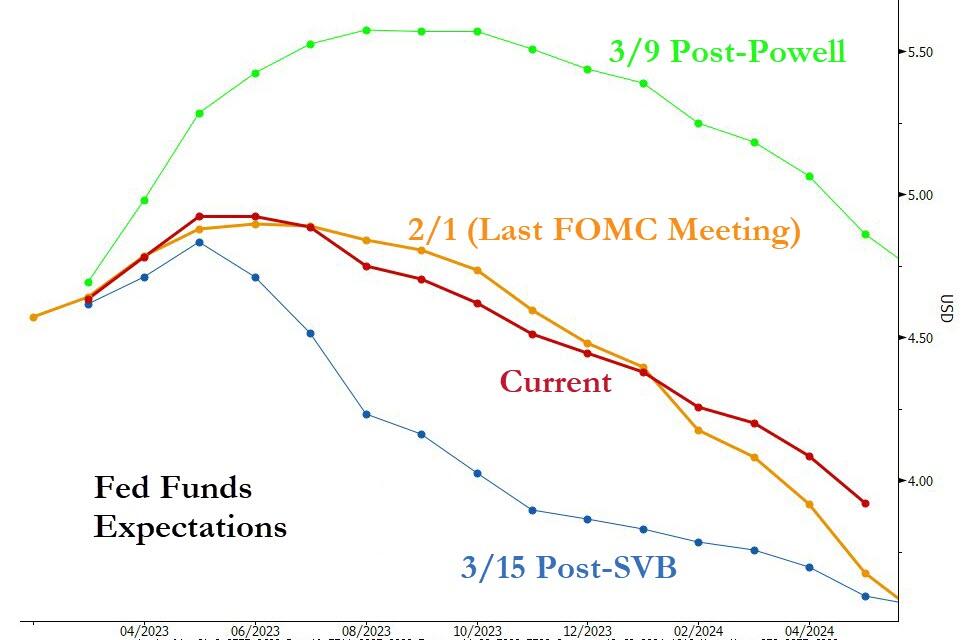
Interestingly the entire Fed Funds curve is back at very similar levels to where it stood at the last FOMC meeting – after a wild ride in between…

Source: Bloomberg

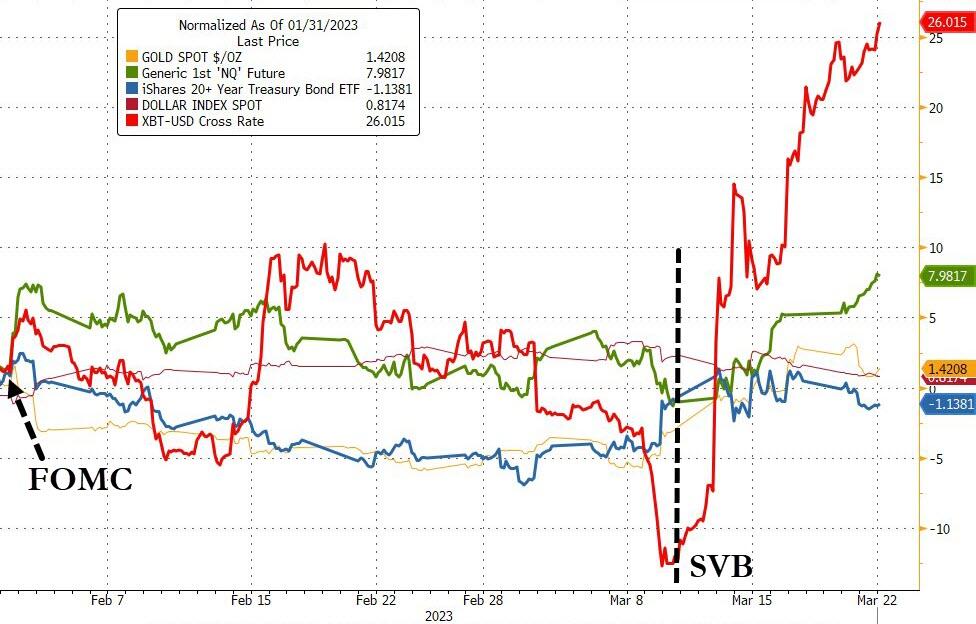
Crypto and tech stocks have soared since the last FOMC meeting (but more driven by the post-SVB fallout) while gold and the dollar have managed modest gains while bond (prices) are broadly lower…

Source: Bloomberg

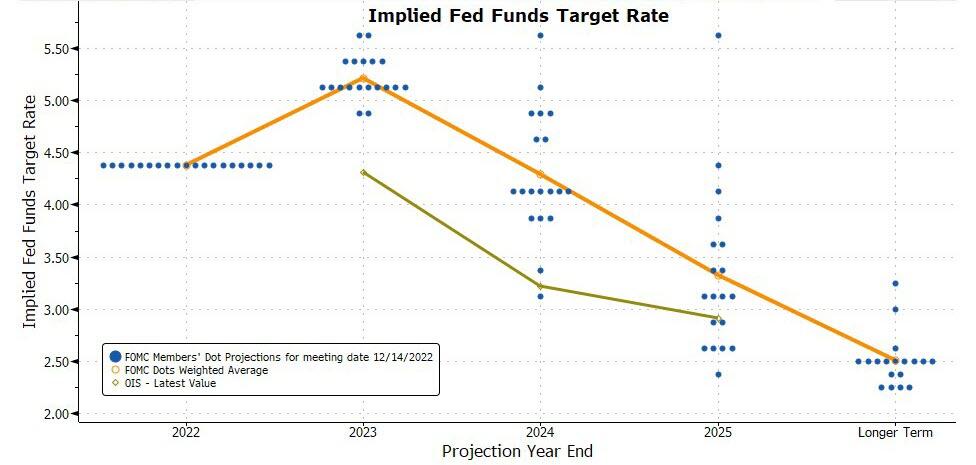
The Dot-Plot gets a makeover today with expectations for considerably larger variations (and a dovish drift) from where it stood in December…

Source: Bloomberg

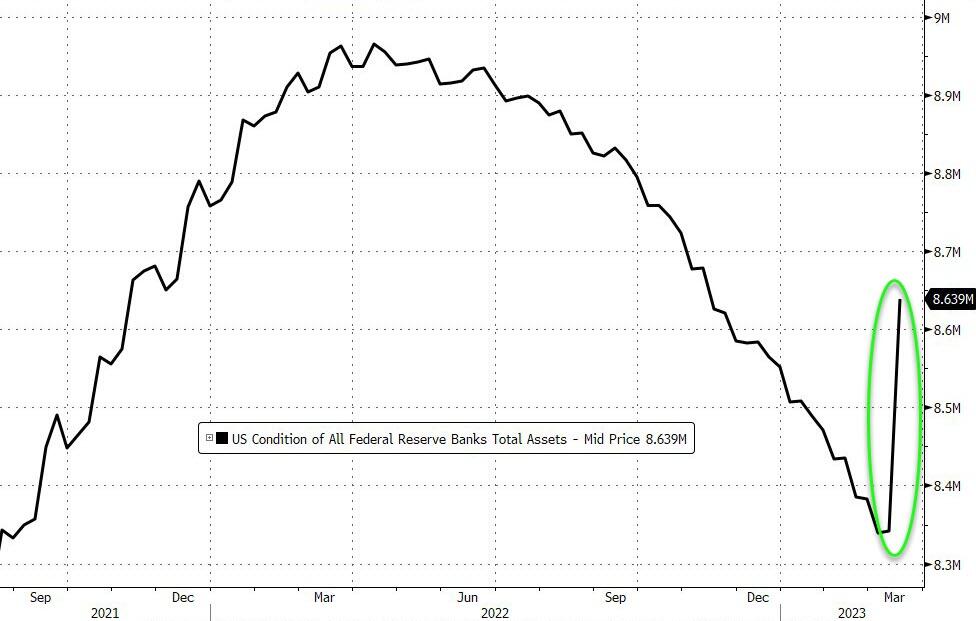
And, of course, The Fed Balance Sheet exploded higher…

Source: Bloomberg

Goldman Sachs economists looked at how the Fed has set policy in the past when stresses in the financial system threatened to disrupt lending and economic activity. Excluding severe recessions, they looked at 1966, 1984, 1994-95 and 1998. The central bank eased monetary policy in two of the four cases and paused tightening in a third, they found.

They write:

“Overall, the historical record suggests that the FOMC tends to avoid tightening monetary policy in times of financial stress and prefers to wait until the extent of the problem becomes clear, unless it is confident that other policy tools will successfully contain financial stability risks.”

So, here’s what The Fed said…

Fed hiked 25bps as expected…

*FED RAISES BENCHMARK RATE 25 BPS TO 4.75%-5% TARGET RANGE

Fed will keep QT going as expected…

*FED WILL CONTINUE SAME PACE OF REDUCING TREASURY, MBS HOLDINGS

Fed offers some dovish guidance

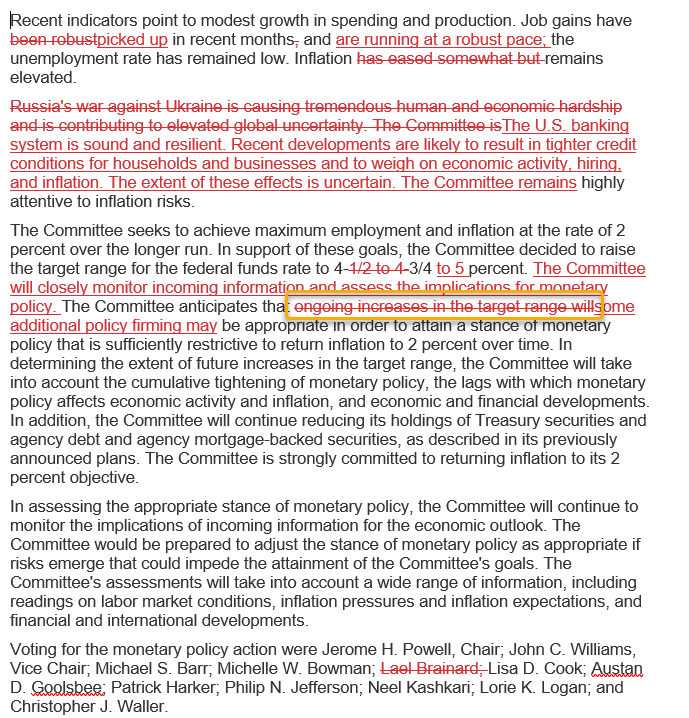
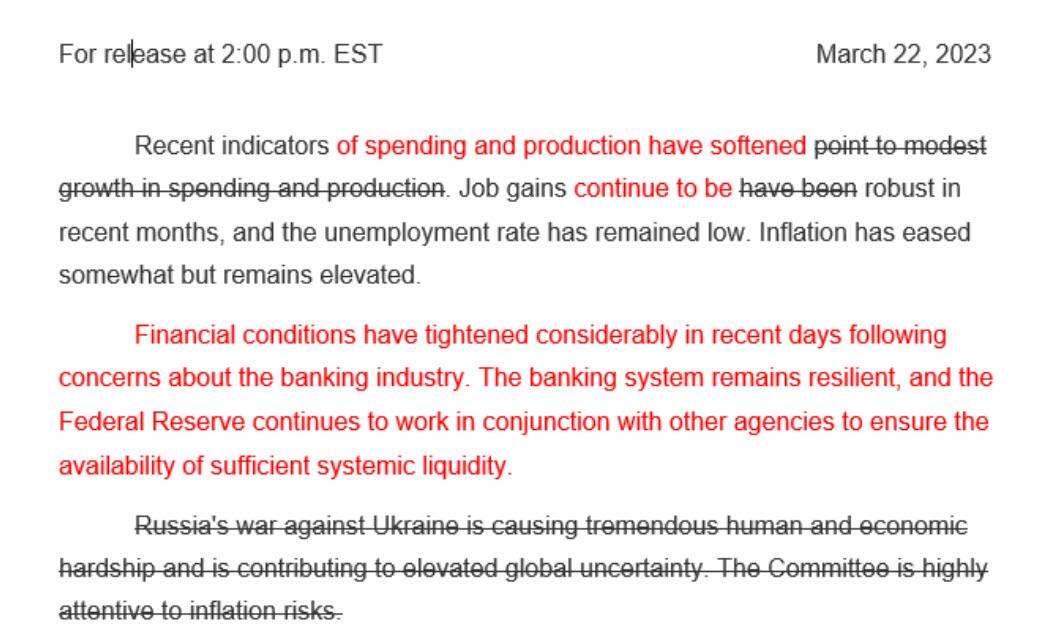
…language about “ongoing increases in the target range” will be appropriate removed and replaced with “some additional policy firming may be appropriate”

Fed gives a nod to the banking system in a new addition to the statement…

The U.S. banking system is sound and resilient. Recent developments are likely to result in tighter credit conditions for households and businesses and to weigh on economic activity, hiring, and inflation. The extent of these effects is uncertain.

The Fed also added this new line, perhaps in a nod to their own impact on bank balance sheets (and how much more data dependent they may become):

“The Committee will closely monitor incoming information and assess the implications for monetary policy”

And as far as the new ‘dots’ go, the terminal rate is unchanged from the December dots…

Additionally, unemployment decreases a little, inflation up. Doesn’t seem like the last two weeks has changed the view of the FOMC.  

See the full redline below…

Tyler Durden
Wed, 03/22/2023 – 14:08

via ZeroHedge News https://ift.tt/On7ZqGb Tyler Durden

Don’t Expect Looser Conditions Even As Fed Reverses Much Of QT

Don’t Expect Looser Conditions Even As Fed Reverses Much Of QT

Authored by Simon White, Bloomberg macro strategist,

The Fed’s actions to stave off the banking crisis should not be taken as a loosening in financial conditions – far less QE – and in fact tighter conditions should be expected.

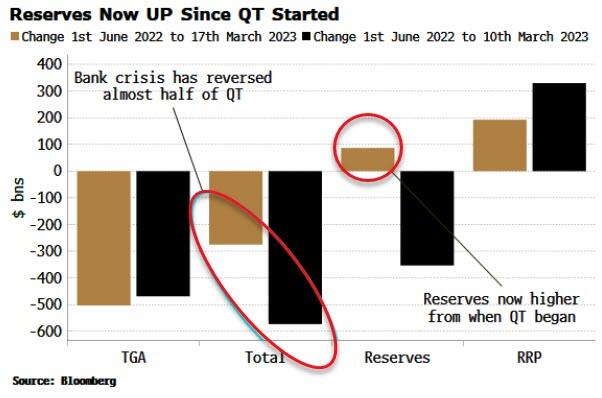
The banking crisis led to an almost $300 billion rise in the Fed’s balance sheet last week, reversing almost half of the decline since QT began last June.

But even more relevant is the change in reserves. Reserves are generally higher velocity, and therefore the true economic and financial impact from QT comes from the changes in reserves. Reserves are now actually higher than they were before QT began.

First of all, this is not QE. QE is the open-ended purchase of securities. The Fed’s new BTFP facility (to which much of the discount window lending is likely to migrate) is essentially a repo facility (although with no haircut) with a maturity of up to one year.

Furthermore it cannot be used as a limitless carry vehicle for banks to buy discounted debt, and repo it to the Fed at par. The small print shows that the BTFP can only be used for collateral that was owned by the borrower as of March 12.

Secondly, financial conditions are likely to tighten even as the Fed’s balance sheet has recently expanded. The reserves that are leaving the smaller banks in the shape of bank deposits are going to larger banks, who don’t want them (one reason why deposit rates have remained stubbornly low).

While bill rates are similar or lower to the rate offered by the RRP facility, much of the new reserves are poised to end up at the RRP, or the Treasury’s account at the Fed (the TGA) as they replenish it after any debt-ceiling resolution.

So new reserves created could soon end up in the “black-hole” of the RRP facility or the TGA, leading to a steep fall in money velocity and hence much tighter financial conditions.

Tyler Durden
Wed, 03/22/2023 – 13:45

via ZeroHedge News https://ift.tt/P0XrQOj Tyler Durden

China Gives US Advice On Ukraine After Xi, Putin Pledge To Shape New World Order

China Gives US Advice On Ukraine After Xi, Putin Pledge To Shape New World Order

China’s President Xi Jinping has arrived back in Beijing after his two-day visit with President Vladimir Putin over the China-proposed Ukraine peace plan. On the Ukraine crisis, there was nothing that can be considered a breakthrough, but the talks did prompt swift reaction from Washington.

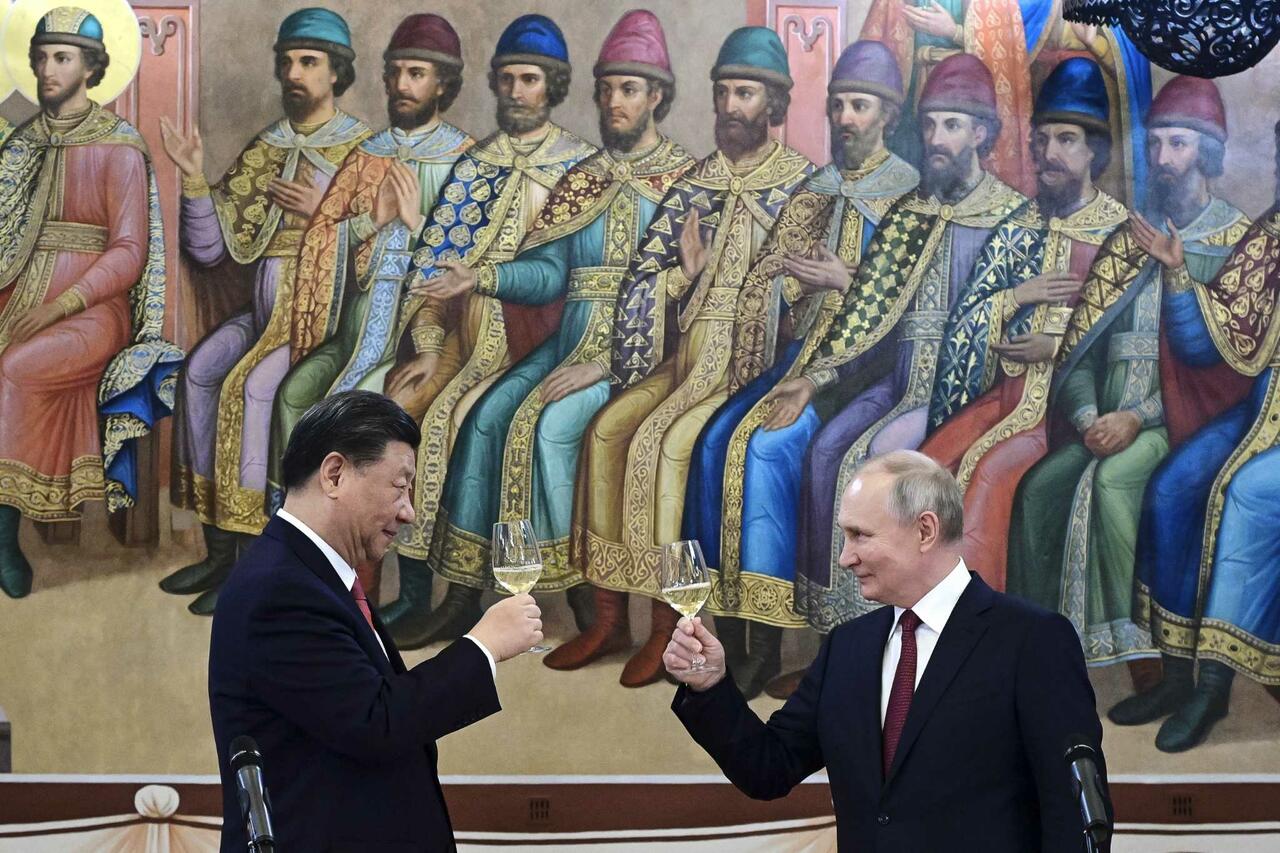
More important are the broader implications of the two ‘dear friends’ pledging to shape a new world order and signing multiple pacts on economic, technological, and strategic cooperation. These were the words captured in a Reuters headline Wednesday… “China’s President Xi Jinping and Russia’s President Vladimir Putin set their sights on shaping a new world order as the Chinese leader left Moscow, having made no direct support for Putin’s war in Ukraine during his two-day visit.” Arguably the most important exchange came during the sendoff before Xi’s entourage headed to the airport, and was captured by (or rather intended for) the cameras…

Xi Jinping: “Change is coming that hasn’t happened in 100 years and we are driving this change together.”

Putin: “I agree.”

Putin had told Xi that the peace plan “correlates to the point of view of the Russian Federation”; but the message out of Biden officials was “don’t be fooled” as it’s all about Moscow seeking to “freeze the war on its own terms,” in the words of Secretary of State Blinken. Also on Tuesday, NSC spokesman John Kirby said China is not an impartial mediator and that China “keeps parroting the Russian propaganda”.

On Wednesday the Chinese foreign ministry hit back, charging that Washington is “adding fuel to the fire” of the conflict by its “continuous supply” of weapons to the battlefield. Spokesman Wang Wenbin was asked directly about Kirby and Blinken’s comments from the day prior.

“The US side claims that China’s stance isn’t impartial. But is it impartial to continuously supply weapons to the battlefield? Is it impartial to constantly escalate the conflict? Is it impartial to allow the effects of the crisis to spill over globally?” Wang said.

“We advise the American side to rethink its own stance on the Ukraine issue, turn away from the erroneous path of adding fuel to the fire, and stop shifting the blame to China,” he added. The spokesman further insisted Beijing has “no selfish motives on the Ukraine issue, has not stood idly by… or sought profit for itself,” but that “what China has done boils down to one thing, that is, to promote peace talks.”

He went on to assert that contrary to popular assumptions in the West, the global community stands by China on the side of diplomatically pursuing peace. According to a transcript

On the Ukraine issue, voices for peace and rationality are building. Most countries support easing tensions, stand for peace talks, and are against adding fuel to the fire. This is also China’s position. President Xi Jinping’s visit to Russia is a journey of friendship, cooperation and peace. It has been warmly received internationally. We call on the US to reflect on its own role in the Ukraine issue, stop fueling the flames, and stop deflecting the blame on China.

AP image: a toast during this week’s summit in Moscow.

Wang spelled out that “We will continue to stand firm on the side of peace and dialogue and on the right side of history and work together with the rest of the world to play a constructive part in facilitating a political settlement of the Ukraine issue.”

To the surprise of many, Ukraine’s President Zelensky on Tuesday invited China to start talks on a path forward based on offering a “Ukraine formula” for peace negotiations. It’s unclear what Beijing’s response will be, but it was widely seen as an unexpected and positive overture. It has also become clear that whatever peace talks might come to fruition involving China mediation, the US is not going to lead, but will likely be sidelined – despite the closeness to Kiev.

Below, Rabobank gives hard-hitting commentary on the overall implications of the Xi-Putin meeting, and the rapidly bifurcating world driven by Russia and China increasingly uniting against their common enemy the United States.

* * *

For a strident view on the Putin-Xi meeting and its broader implications, @samagreene, professor at the Russia Institute at King’s College London, notes:

“…China’s domination of Russia is complete. Xi praised Putin, touted strong relations with Russia, unity in the UNSC, and promised coordination on IT and natural resources trade. And that’s it. Putin, by contrast, was almost obscenely generous – and not just with his praise…. He pledged completion of the Strength of Siberia 2 pipeline… [which] replaces structural dependence on Europe with structural dependence on China, at a time when Russia is a price taker for hydrocarbons. That’s a strategic win for China.

Further, Putin announced a reorientation of agricultural trade towards China and a strategic role for China in  developing Russia’s far east and high north – a move Putin’s own security apparatus has long resisted (for obvious reasons). Again, strategic wins for China… And Russia offered Chinese companies first dibs on the assets of departing Western companies – again strengthening China’s presence in Russia, with no reciprocal strengthening of Russia’s presence in China…

While there were undoubtedly agreements we are not meant to know about, there is no indication here of a significant increase in military support for Russia – nor even of a willingness on Xi’s part to ramp up diplomatic support. A swing and a miss for Putin…

Putin greeted Xi with a rhetorical bear hug. Xi gave Putin a pat on the head and told him to run along now and play… Putin tells his people he’s fighting for Russia’s sovereignty. In truth, he’s mortgaged the Kremlin to Beijing. The question now is one for Xi: What will he do with his newest acquisition?”

That leaves the EU facing a two-for-one in Russia and China, and as Politico notes, ‘Europe’s China policy will shape transatlantic relations’. The implication is large German firms lean on the large German government, “putting Europe’s priorities on a likely collision course with US strategic goals, which will focus on confronting China in economic, military and, increasingly, ideological domains.”

On which, US historian Kotkin says, “So I’m in love with the Cold War. I’m in favour of the Cold War. The Cold War is not only a good thing – it’s a necessary thing, because we have to uphold…the terms of the way we share the planet…. You know, I hear a lot of people saying, “Oh my God, no Cold War with China. God forbid we should have a Cold War with China.” And I think to myself, “What world do these people live in?” First, we’re already in a Cold War with China, because China started that long before we understood that that’s what they were doing. And secondly, would you prefer a hot war? The alternative to Cold War is capitulation– which you can imagine I’m not in favour of– or hot war.”

Yet maybe the EU is feeling Cold too. As @Schuldensuehner points out, China is losing importance as a German export destination: February exports to it were -12.4% while those to the US were +19%, making it by far the most important market, as well as supplying key LNG imports (and Fed swaplines); France is number two, far ahead of China. Moreover, Germany is considering China export restrictions similar to those of the US, according to its economy minister, who adds, “We have to prevent losing our technology leadership because we don’t look closely.”  Notably, China just threated the Netherlands over its tech export controls (“This will not be without consequences. I’m not going to speculate on countermeasures, but China won’t just swallow this.“): how long until the same message is heard in Berlin?

A bifurcating world like this only complicates real economy investment decisions, supply chain issues, and monetary policy decisions.

Tyler Durden
Wed, 03/22/2023 – 13:24

via ZeroHedge News https://ift.tt/tRpTvQF Tyler Durden

Fed, Central Banks Created The Current Crisis And Are On Course To Making Matters Worse

Fed, Central Banks Created The Current Crisis And Are On Course To Making Matters Worse

Authored by Yves Smith via NakedCapitalism.com,

The incompetence of our financial regulators, most of all the Fed, is breathtaking. The great unwashed public and even wrongly-positioned members of the capitalist classes are suffering the consequences of Fed and other central banks being too fast out of the gate in unwinding years of asset-price goosing policies, namely QE and super low interest rates. The dislocations are proving to be worse than investors anticipated, apparently due to some banks having long-standing risk management and other weaknesses further stressed, and other banks that should have been able to navigate interest rate increases revealing themselves to be managed by monkeys.

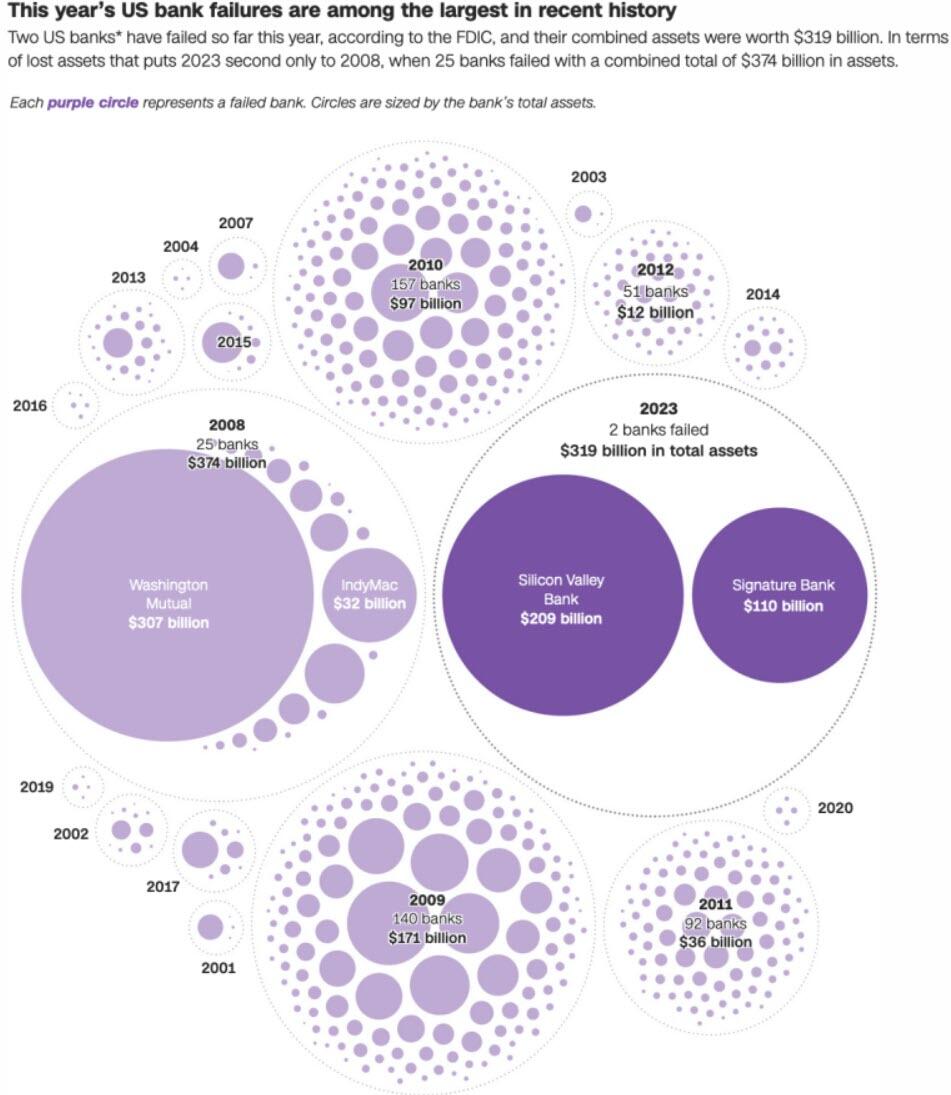
What is happening now is the worst sort of policy meets supervisory failure, of not anticipating that the rapid rate increases would break some banks. Here we are, in less than two weeks, at close to the same level of bank failures as in the 2007-2008 financial crisis. From CNN:
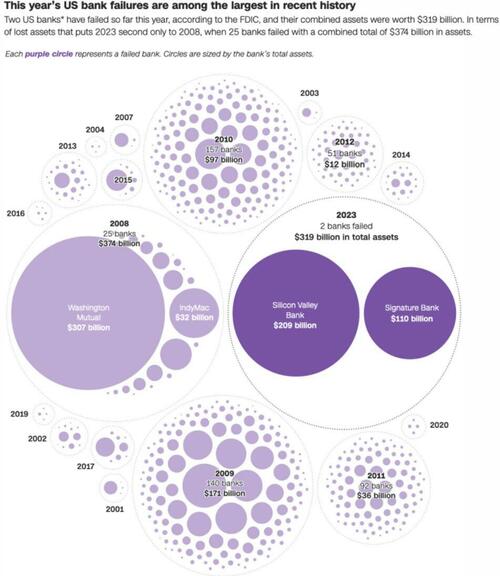
And even mainstream media outlets are fingering the Fed:

As we’ll explain in due course, the regulators’ habitual “bailout now, think about what if anything to do about taxpayer/systemic protection later” is the worst imaginable response to this mess. For instance, US authorities have put in place what is very close to a full backstop of uninsured deposits (with ironically a first failer, First Republic, with its deviant muni-bond-heavy balance sheet falling between the cracks). But they are not willing to say that. So many uninsured depositors remained in freakout mode, not understanding how the facilities work. Yet the close-to-complete backstop of uninsured deposits amounted to another massive extension of the bank safety net.

The ultimate reason the Fed did something so dopey as to put through aggressive rate hikes despite obvious bank and financial system exposure was central bank mission creep, of taking up the mantle of economy-minder-in-chief. That was in tune with the widespread acceptance of neoliberal views of minimizing not just oversight and regulation but also overt microeconomic policy. Can’t be choosing winners and losers, national interest be damned.

That orientation allowed the executive branch and Congress to engage in pork-oriented economic policy, resulting in industrial policy by default that bloated preferred sectors like the military industrial complex, the medical industry, higher education, real estate, and finance. But it is Congress and the Administration that have the much greater ability to devise and implement more targeted programs, and make a point of favoring ones that are countercyclical.

Instead we have the Fed using the blunt instrument of interest rates to try to crush labor, when unlike the 1970s, labor bargaining power is weak and this inflation is largely the result of supply issues. As we predicted, the only way for te Fed get inflation down via interest rate increase would be to kill the economy stone cold dead. It appears to be reaching that end faster than anticipated by killing banks.

Mind you, reversing super low interest rate policies would inevitably lower asset prices, particularly those of highly-responsive financial assets. But there are better and worse ways to administer painful remedies, and the Fed has been particularly inept. The central bank did do one thing right, which was to signal its rate increases way in advance. But it bizarrely ignored how the crypto collapse might affect depositor/investor perceptions of risk. And per the New York Times, it saw serious problems at Silicon Valley Bank, yet the official strictures didn’t rise to the level of wet noodle lashings:

In 2021, a Fed review of the growing bank found serious weaknesses in how it was handling key risks. Supervisors at the Federal Reserve Bank of San Francisco, which oversaw Silicon Valley Bank, issued six citations. Those warnings, known as “matters requiring attention” and “matters requiring immediate attention,” flagged that the firm was doing a bad job of ensuring that it would have enough easy-to-tap cash on hand in the event of trouble.

But the bank did not fix its vulnerabilities. By July 2022, Silicon Valley Bank was in a full supervisory review — getting a more careful look — and was ultimately rated deficient for governance and controls. It was placed under a set of restrictions that prevented it from growing through acquisitions. Last autumn, staff members from the San Francisco Fed met with senior leaders at the firm to talk about their ability to gain access to enough cash in a crisis and possible exposure to losses as interest rates rose.

It became clear to the Fed that the firm was using bad models to determine how its business would fare as the central bank raised rates: Its leaders were assuming that higher interest revenue would substantially help their financial situation as rates went up, but that was out of step with reality.

By early 2023, Silicon Valley Bank was in what the Fed calls a “horizontal review,” an assessment meant to gauge the strength of risk management. That checkup identified additional deficiencies — but at that point, the bank’s days were numbered.

This shows that the Fed actually knew what a hot mess Silicon Valley Bank was, using risk models that assured it would be positioned 180 degrees wrong in the event of the absolutely gonna happen Fed interest rate increases.

And what did the regulator do? Scold and restrict acquisitions. Help me. That plus restricting dividends was the sanction the Fed has sometimes applied to wayward big banks. But the Fed made public these big banks were in the doghouse, using shareholders to punish bank executives (remember all big US concerns have stock-price-linked executive pay). And these big banks are presumed to be in the business of consolidation, so barring acquisitions is a bit of a ding. By contrast, Silicon Valley Bank had just acquired Boston Private in July 2021, so it’s not as if it would be likely to be on the acquisition trail any time soon.

The New York Times makes much of weakening of supervision of banks under $200 billion playing a role in this affair. But the regulators were on to the problems at Silicon Valley Bank. What appears to have been missing was not recognizing the Silicon Valley Bank was train wreck in the making, but the failure to make adequate interventions.

The Times does serve up one idea:

Officials could ask whether banks with $100 billion to $250 billion in assets should have to hold more capital when the market price of their bond holdings drops — an “unrealized loss.” Such a tweak would most likely require a phase-in period, since it would be a substantial change.

First, this is not such a hot idea because when interest rates are rising, bank stock prices are weak. This is why banks can get into a doom loop: they need more equity precisely at the time no one except Warren Buffett (who is usually able to extract official subsidies) is willing to give it to them. The time to strengthen capital levels are when times are good. Rules like this could well wind up being prejudicial: if a bank was healthy but trying to build up more reserves pre-emptively in a tightening cycle, it could be assumed to be already in trouble.

Second, the regulators had already started dinging Silicon Valley Bank and were giving it more demerits, yet actual punishment was non-existent. Some think, as the Times mentions, that the SVB CEO being on a San Francisco Fed advisory board contributed to the overly deferential treatment. Bear in mind the regional Fed boards have absolutely zero influence over those bodies. They do not supervise regional Fed operations or staff in any way, shape or form.

However, cozy relations at the top could easily make staffers fear that their critical assessment would be watered down or ignored, even before getting to the general pattern in the US of undue deference towards the regulated. This sort of thing has happened, witness the case of New York Fed whistleblower Carmen Segarra, who was fired from the New York Fed for not being willing to weaken her findings about deficiencies at Goldman.

Where are the Benjamin Lawskys, who threatened recidivist money launderer Standard Chartered with revoking its New York banking license?4 Without going down the rabbit hole of the finer points of procedure, if noting else, the Fed has the power to take formal enforcement actions. The New York Times account suggests things were going enough off the rails for the regulator to at least threaten one as of a date certain if Silicon Valley Bank failed to remedy some of its deficiencies. But obviously no serious action was taken.

Now to the other big news sick bank, Credit Suisse. Its collapse reflects the even bigger regulatory failure in Europe, whose post-crisis reforms managed to make ours look good.

Admittedly, Europe has the big misfortune to have universal banks. These are banks that do everything from retail banking to fancy Wall Street wizardry. They are also much bigger in GDP terms in aggregate than US banks because Europe has much smaller bond markets, so bank lending is an ever more important source of funding.

But these institutions grew up from being retail banks and never grew out of it. That means they are typically slow-footed and not well run. If more competent leaders come in, they usually can’t effect much change or like Jospf Ackermann of Deutsche Bank, succeed in “transforming” the bank so as to facilitate executive enrichment.

Europe had undercapitalized banks going into the 2008 crisis and failed to make them do enough in lowering their overall leverage levels. They also failed to undo the pernicious relationship between sovereign debt and bank balance sheets, where weak banks hold the debt of weak countries like Italy, where only the tender ministrations of the ECB keep those bond yields down, which helps these states fund at the expense of having ticking time bombs on bank balance sheets (if the ECB let sovereign bond yields go to market levels, a lot of banks would have big holes in their balance sheets).

So long before this crisis got a good head of steam, Deutsche Bank and the Italian banking system were widely recognized as wobbly. Monte del Pasci was bailed out in 2016. There have been complicated efforts to defuse UniCredit, the biggest, sickest Italian bank. Deutsche Bank, despite having raised nearly $30 billion in equity over time, looked positively green in 2017, with Mr. Market rejecting a turnaound plan.

But as Nick Corbishley has dutifully chronicled, Credit Suisse became the sickest European bank in 2021 due to weak earnings and some impressively bad business calls, most importantly being very exposed to the failed supply chain financier Greensil. Why didn’t the Swiss National Bank act after it took that body blow?

Keeping in mind that both of Switzerland’s behemoths, UBS and Credit Suisse, got in a heap of trouble in the crisis, with UBS being one of the most enthusiastically self-destructive users of CDOs. Not only did they eat a lot of their own bad cooking, but they were a leader in the so-called negative basis trade, which was a spectacular form of looting. The short version is traders bought other people’s CDOs, supposedly insured them with credit default swaps, and then got to book all the expected future profit in the current P&L and get paid bonuses on those fictive profits.

Switzerland, after an enormous rescue of UBS, ordered both big banks to get out of investment banking and go back to being private banks. That resolve to revert to the simple life was undermined by the US going after Swiss banking secrecy, leading sneaky American customers to decamp to “no tell” jurisdictions like Singapore and Mauritius. I am not up to speed on Swiss oversight, but l’affaire Greensil suggests the SNB was letting its big charges walk on the wild side again.

To confirm the debilitated state of Credit Suisse has been well known, some snippets from Nick’s posts:

September 2022 Fast-Shrinking TBTF Giant Credit Suisse Is Living Dangerously:

It was in the Spring of 2021 when Credit Suisse’s current crisis began. And that crisis has revealed glaring flaws in its risk management processes.

As readers may recall, two of the bank’s major clients — the private hedge fund Archegos Capital and the Softbank-backed supply chain finance “disruptor” Greensill — collapsed in the same month (March 2021). By the end of April 2021, Credit Suisse had reported losses of $5.5 billion from its involvement with Archegos. Its losses from its financial menage á trois with Greensill and its primary backer, Softbank, are still far from clear, as the bank is trying to claw back almost $3 billion of unpaid funds for its clients (more on that later).

October 2022 Credit Suisse is One of 13 Too-Big-to-Fail Banks in Europe, But It Looks Like It Could Be Failing:

Credit Suisse is one of 13 European lenders on the Financial Stability Board’s list of Global Systemically Important Banks (G-SIBs). In other words, it is officially too big to fail, but it is nonetheless precariously close to failing. Yesterday it disclosed a whopping third-quarter loss of $4 billion — more than eight times average estimates of just under $500 million. The loss was largely the result of a reassessment of so-called deferred tax assets (DTA).*

This is Credit Suisse’s fourth quarterly net loss in a row. So far this year, it has posted $5.94 billion of losses. Net revenue, at $3.8 billion, was up marginally on the previous quarter but down 30% from Q3-2021. The value of its asset base has shrunk drastically, from $937 billion in December 2020 to $707 billion today. The group’s common equity Tier 1 ratio has also fallen to 12.6%, well below its target of at least 13.5%.

To right the ship, CS has presented a new strategic overhaul — its third in recent years….

I could give you more of what amount to interim reports from Nick, but you get the drift of the gist.

To keep this post to a manageable length, as most of you know, UBS entered into a shotgun marriage with Credit Suisse over the weekend. The nominal purchase price was close to $3 billion, but watch the shell game. From the Wall Street Journal:

The Swiss government said it would provide more than $9 billion to backstop some losses that UBS may incur by taking over Credit Suisse. The Swiss National Bank also provided more than $100 billion of liquidity to UBS to help facilitate the deal.

UBS and European bank stocks opened down, in a vote of not much confidence, although the bank stocks have pared their losses. Mr. Market appears to have worked out that merging two dogs does not produce one healthy cat.

Central banks are also signaling panic by opening emergency swap lines. This action is aimed at helping banks whose home county is not the US get dollar funding (their home country bank will create home country currency, swap it into dollars, and then lend it to their banks). This suggests that foreign banks are having trouble borrowing dollars, or at least on good enough terms. They would need to borrow dollars to fund dollar positions. Are we to assume that this intervention is occurring because haircuts on Treasuries used in repos have gone up? Informed reader input appreciated. From the Financial Times:

The Federal Reserve and five other leading central banks have taken fresh measures to improve global access to dollar liquidity as financial markets reel from the turmoil hitting the banking sector.

In a joint statement on Sunday, the central banks said that, from tomorrow, they would switch from weekly to daily auctions of dollars in an effort to “ease strains in global funding markets”.

The daily swap lines between the Fed and the European Central Bank, the Bank of England, the Swiss National Bank, the Bank of Canada and the Bank of Japan would run at least until the end of April, the officials said.

Of course, the Fed could have addressed the problem of interest rate increase overshoot directly by cutting interest rates by 50 basis points and making noises that quantitative tightening was on hold for the moment. But panic is too far advanced for that sort of simple intervention to now have much impact.

Finally, back to a main point, that yet more subsidies of banks will simply enable more incompetence and looting absent getting bloody-minded regulators, a prospect that seems vanishingly unlikely.

Elizabeth Warren is again taking up her bully pulpit of calling for more bank reform, but technocratic fixes are inadequate with a culture of timid enforcement. The only remedy in all the years I have read about that might have a real impact quickly creates real skin in the game. It proposed by of all people former Goldmanite, later head of the New York Fed William Dudley.

Dudley recommended putting most of executive and board bonuses in a deferred account, IIRC on a rolling five-year basis. If a bank failed, was merged as part of a regulatory intervention, or wound up getting government support, the deferred bonus pool would be liquidated first, even before shareholder equity. Skin in the game would do a lot more to curb reckless behavior than complex new rules.

Of course, Dudley’s proposal landed like a lead balloon.
Tyler Durden
Wed, 03/22/2023 – 13:05

via ZeroHedge News https://ift.tt/B04CQGD Tyler Durden

I Propose a New Term: “Chatbot Lawyer”

Black’s Law Dictionary reports that “headnote lawyer” means

A lawyer who relies on the headnotes of judicial opinions rather than taking the time to read the opinions themselves.

“He’s a chatbot lawyer” would mean that he’s a lawyer who relies on ChatGPT-4 etc. summaries of court opinions (or of legal questions more broadly) rather than taking the time to read the relevant cases, statutes, regulations, and the like. On the other hand, one downside is “chatbot lawyer” is already coming to mean chatbots that are actually acting, or trying to act, or being planned to be acting, as lawyers ….

The post I Propose a New Term: "Chatbot Lawyer" appeared first on Reason.com.

from Latest https://ift.tt/Pwitn7C
via IFTTT

In Flashing Red Alert For Stocks, For The First Time Since Lehman Five Ominous Events Hit At The Same Time

In Flashing Red Alert For Stocks, For The First Time Since Lehman Five Ominous Events Hit At The Same Time

When it comes to the Morgan Stanley house view, it’s not just Michael Wilson that is borderline apocalyptic, most recently warning on Monday of a “vicious” end to the bear market, one which drags stocks to fresh cycle lows: it appears that the bank’s global head of research, Katy Hubary, is not too far behind.

In her latest weekly closely read “Charts that Caught my Eye” report (available to pro subs here), she writes that there has been a lot of market debate over the past year about whether yield curve inversion, which historically has been a precursor of US recessions, meant that a recession was inevitable this time, in light of key idiosyncrasies in the current environment.

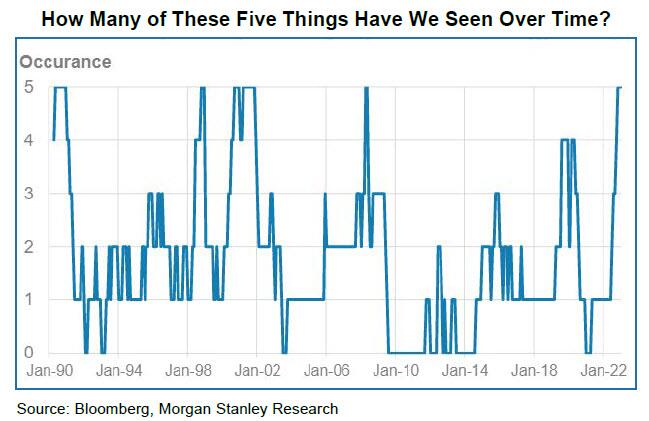
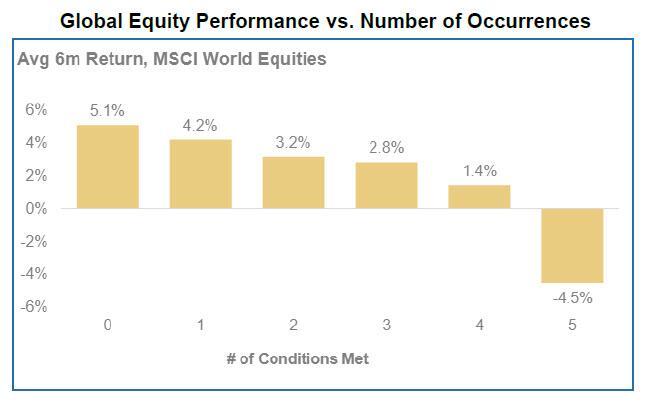
She then points to an “interesting section” of the bank’s Cross-Asset Strategy team’s latest dispatch which examines the confluence of five macro developments that, like inversion, are consistent with a strong economy that is starting to slow and leads to a sharp drop in risk assets:

  1. S&P 500 forward earnings are declining relative to three months ago;

  2. The yield curve is inverted (or has been over the last 12 months);

  3. Unemployment is below average;

  4. US Manufacturing PMIs are below 50; and

  5. More than 40% of US banks, on net, are tightening lending standards.

Pointing to the chart below, which shows that these five events tend to cluster just before major market crises (2007, 2001) that “all five are in place today, which is rare”

… but what is more ominously is that as the MS team highlights, since 1990, the more of these conditions that are in place, the worse global equity performance has tended to be:

Tyler Durden
Wed, 03/22/2023 – 12:45

via ZeroHedge News https://ift.tt/8GdiMft Tyler Durden

Phase Two Of The Fed Follies

Phase Two Of The Fed Follies

Authored by Michael Lebowitz via RealInvestmentAdvice.com,

With Silicon Valley Bank and Credit Suisse defunct, the Fed must restore confidence in the financial sector. The historical treatment for financial instability has been lower interest rates and more liquidity. The problem, however, is that the Fed is simultaneously trying to reduce inflation. The Fed must preside over higher interest rates and less liquidity to tame inflation. Welcome to the paradox facing the Fed in phase two of the Fed follies.

During phase one of the Fed’s tightening campaign, it raised the Fed Funds rate at almost double any pace in the previous 40 years. Furthermore, they are reducing their balance sheet by nearly $100 billion a month via QT. To the Fed’s chagrin, high inflation is proving hard to conquer because economic activity remains brisk, and unemployment sits near 50-year lows. Fighting inflation requires tight monetary policy to weaken economic demand.

Phase two, unlike phase one, introduces financial instability. This inconvenient crisis drags the Fed in opposing directions. Lower interest rates and more liquidity are the keys to boosting confidence in the financial sector, but it impedes the Fed’s ability to fight inflation.

Fed Mandates

Per the San Francisco Fed:

“Congress has given the Fed two coequal goals for monetary policy: first, maximum employment; and, second, stable prices, meaning low, stable inflation.

The Fed’s Congressional mandates argue the Fed should continue to focus on inflation as the unemployment rate is at historic lows and prices are far from low and stable. Economic activity, which significantly affects employment and prices, is robust.

If the Fed were to follow its mandates strictly, there would be no phase two of the Fed monetary policy. Fed Funds would remain “higher for longer” until inflation moderates.

Decades ago, the Fed expanded its boundaries by prescribing a third mandate. The Fed believes they must also maintain a stable financial system to keep the economy’s engine, banking, on sound footing.

Phase Zero Follies

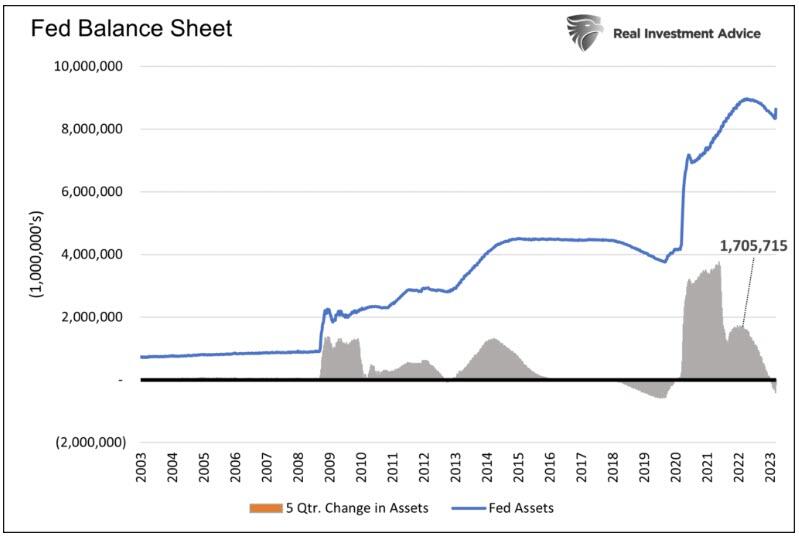
Before phases one and two, there was phase zero. Phase zero, occurring in 2021 and the first quarter of 2022, laid the foundation for today’s difficulties. During 2021 and the first quarter of 2022, the Fed kept interest rates at zero and bought over $1.7 trillion of Treasury and mortgage assets.

As shown below, the Fed added $1.7 trillion of assets between January 2021 and March 2022. Such a five-quarter increase was more than any other five-quarter period during the financial crisis in 2008/2009. Despite rapid economic growth and wild market speculation, the Fed was turbocharging the economic engines to a degree never seen before.

The Fed had its foot on the gas pedal despite inflation rising from 1.4% in January 2021 to 5.28% in just six months. Inflation was running at 8.5% before they decided to do something about it. Further, inflation expectations implied by markets and forecasted by the Cleveland Fed were increasing rapidly.

Had the Fed realized supply lines were crippled, and demand for goods and services was fueled by one of the most extraordinary doses of fiscal stimulus, they would have easily recognized inflation was a problem. They didn’t, and their folly results in sticky levels of high inflation today.

Furthermore, had they started raising rates and curtailed QE in early 2021, not only would the inflationary pressures lessened, but stock and crypto speculation would not have formed the bubbles they did. Lastly, pertinent to the banking crisis, a more restrictive policy would have kept interest rates lower as the confidence in the Fed’s ability to manage inflation would have been greater.

The banks were improperly hedging against loan losses and keeping deposit rates too low, but the Fed made their bed.

Phase One

A little more than a year ago, the Fed started raising rates. Nine months ago, they gradually began reducing their balance sheet. Unfortunately, both actions were about a year too late. As such, they had to be more aggressive than they would have been.

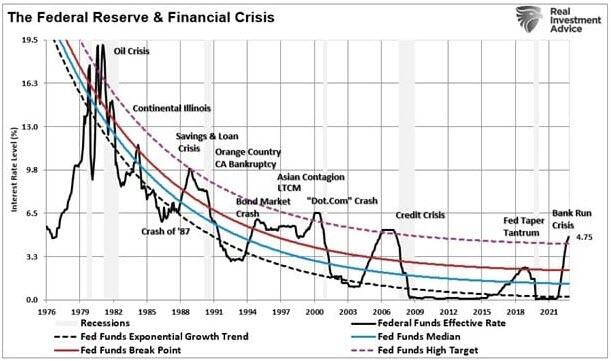
Over the last year, we warned that the Fed would raise rates until something breaks. As labeled below, soaring interest rates are breaking the banks. 

Transitioning Monetary Policy

In Speak Loudly Because You Carry a Small Stick we gave Jerome Powell our two cents on monetary policy. Speak more hawkish and put fear into the markets. Let the markets and banks tighten financial conditions and lending standards and therefore avoid raising rates too much.

Little did we know that hours after publishing our article, Silicon Valley Bank would fail and drag the global banking sector down. Jerome Powell’s stick is now much smaller as the odds of a financial crisis are considerable.

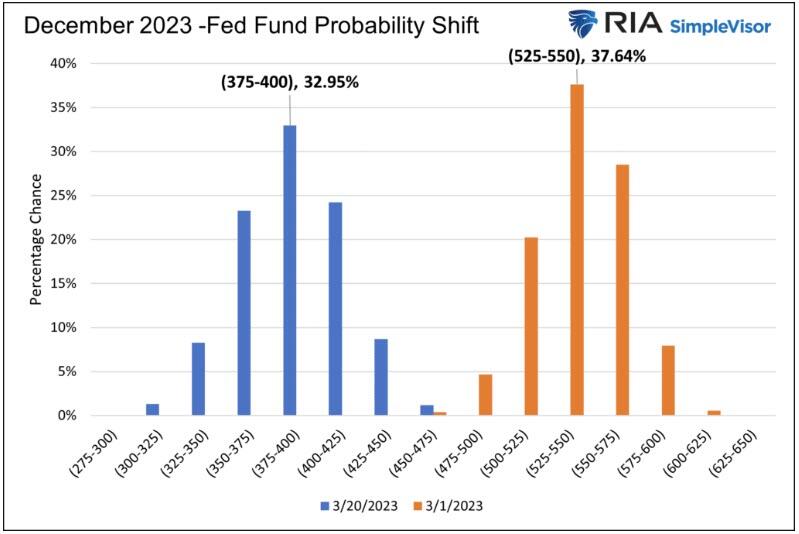
As we share below, the Fed Funds futures market sniffed out the Fed was up against a new opponent. On March 1, the market implied a 37% chance Fed Funds would end the year between 5.25-5.50%. Some traders bet Fed Funds could be 6% or more. Only twenty days later, the market thinks Fed Funds may end up below 4% by year-end.

Phase Two

Phase two is the delicate balance of inflation and financial stability. The Fed must maintain credibility that its determination to fight inflation is still strong. But also convince the market it will provide ample liquidity to restore confidence in the banking system.

We are concerned that maintaining a balance between such opposing objectives is fraught with risk.

If the Fed leans too much toward financial stability, the reignition of inflation fears may scare markets. In such a case, bond yields and commodity prices will rise and further inflame the banking crisis. It will also require the Fed to take more action to stamp out inflation.

Conversely, the banking crisis can quickly spread if the Fed does not provide enough liquidity because it worries too much about inflation.

Tightening Lending Standards = Recession

As if balancing two opposing forces weren’t complicated enough, it now appears that recent bank events significantly increase the odds of a recession. Following the events of the last week, banks have no choice but to bolster their balance sheets. Consequently, they will tighten loan standards, making borrowing harder and more expensive.

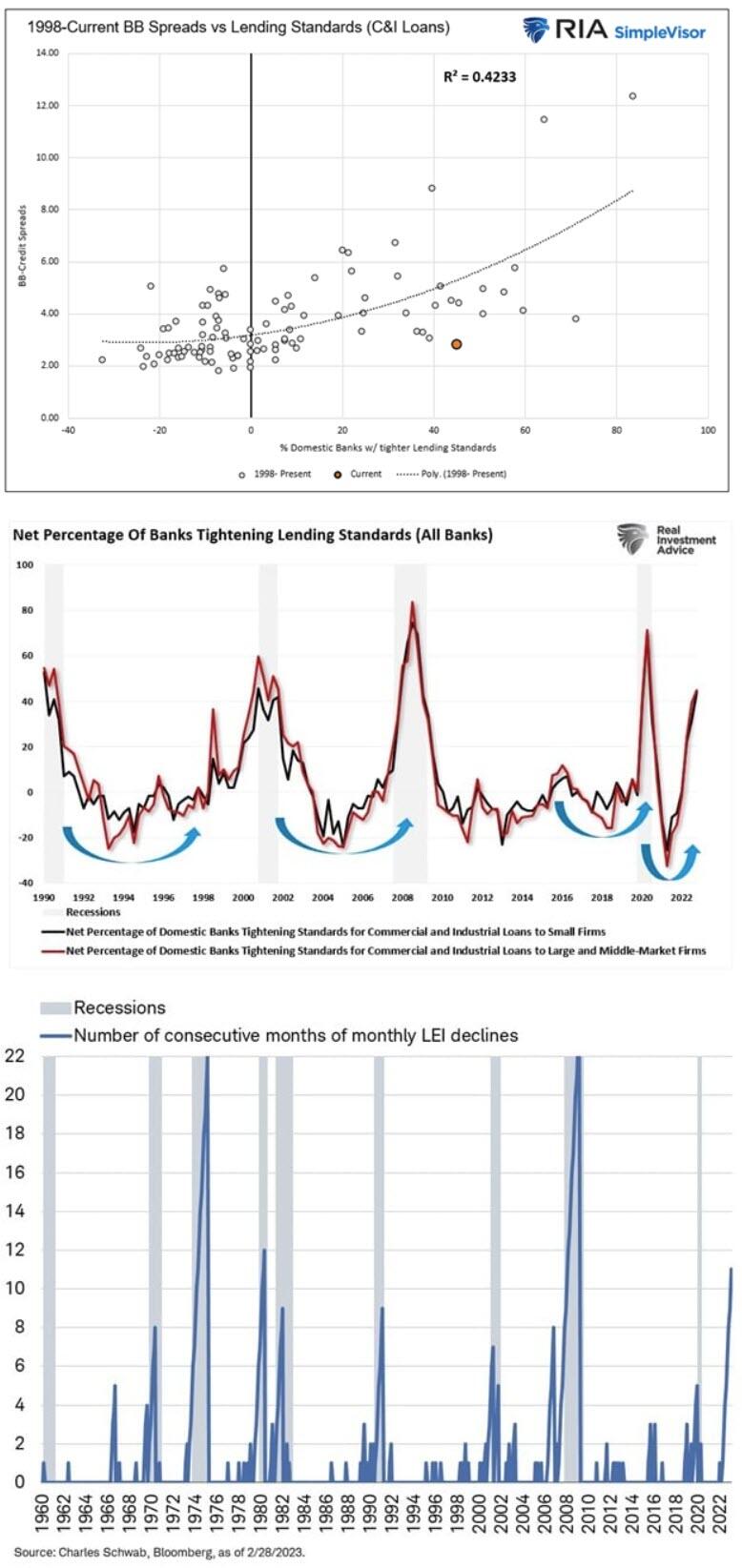
The first graph below shows the strong correlation between tightening standards and corporate high-yield bond spreads. High-yield bond spreads are a good proxy for bank loans. Based on the scatterplot, a 2.5% increase in corporate bond spreads is likely. Further, the estimate may be understated as lending standards have yet to reflect recent events. The following graph highlights the robust relationship between tighter lending standards and recessions. The third graph shows Leading Economic Indicators have declined for 11 straight months. 11 consecutive months of monthly declines in the indicator have never been seen without the economy being in or heading into a recession.

Summary

In the longer run, stocks are fraught with risk.

If the Fed provides liquidity and restores confidence in banking, inflation fears will resurrect the “higher for longer” policy. As we saw last year, such policy accompanied higher bond yields and lower stock prices.

If the Fed is not supportive enough of the banking sector with lower rates and liquidity, the banking crisis can quickly get out of hand. A waterfall in stock prices and much lower bond yields can quickly occur if they lose control of the crisis narrative.

Of course, there is a probability the Fed threads the needle and tackles inflation while avoiding deepening the banking crisis. Even in that preferred case, the economy must still grapple with tighter financial standards resulting from the banking crisis. A recession, lower corporate earnings, and weaker stock prices are likely in that situation. Bond yields will likely decline in an economic downturn as inflationary pressures lessen.

Stocks may rally in the coming weeks or months as it appears the banking crisis is over, and the Fed is set to pause and pivot. We offer caution; this may be the calm before the recession.

Following your trading rules will prove very important as the year progresses.

Tyler Durden
Wed, 03/22/2023 – 12:25

via ZeroHedge News https://ift.tt/s0gfyZc Tyler Durden

Who’s The Incremental Buyer If Powell Shades Dovish?

Who’s The Incremental Buyer If Powell Shades Dovish?

Currently, the market is ‘expecting’ a 25bps hike (80%-plus odds) and a dovish-leaning message of hope (for the financial system) from Powell (as the Fed Funds curve has shifted back in line with where it was at the last FOMC meeting)…

If Powell delivers (or over-delivers), Goldman Sachs trader Michael Nocerino says the question of who is the incremental buyer keeps coming up in conversations.

His answer is shocking.

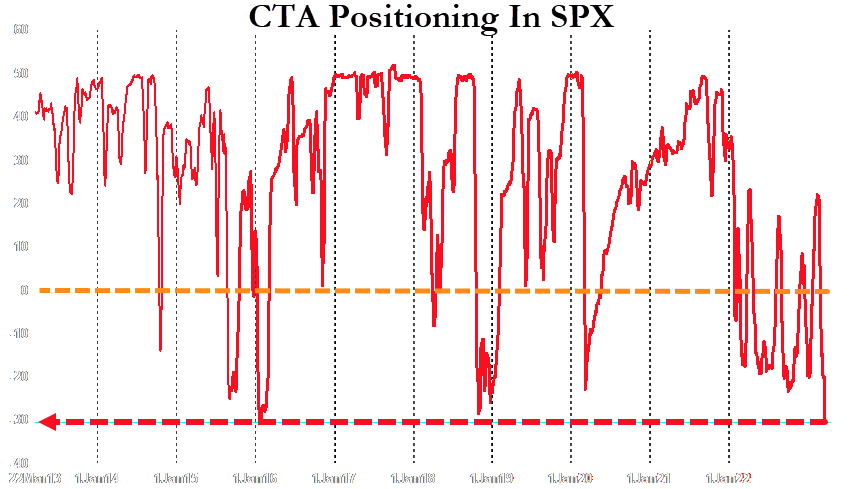
While many still believe that CTAs are potential sellers, it turns out they’ve derisked massively already.

Nocerino gives a nod to a good flag from his colleaugue Lee Coppersmith:

Our CTA positioning metrics estimate positioning in SPX is at the LOWEST LEVEL OF ALL TIME (-$31bn)…

The asymmetry is massively skewed towards repurchases (up to $60bn to buy over a month vs. a worst-case scenario of negligible flow).

Our client conversations have leaned massively bearish as of late, but this is something to make sure folks are aware of.

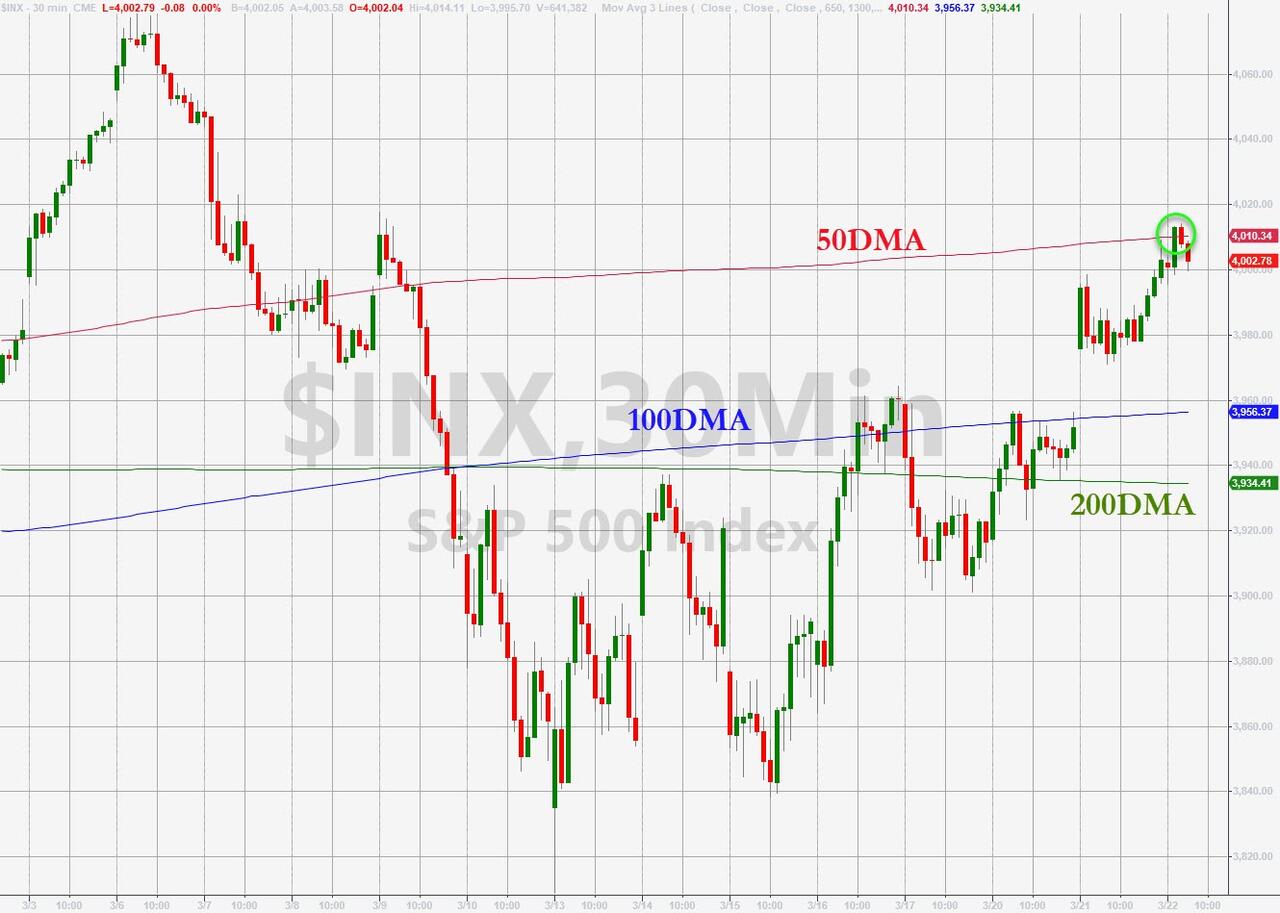
With the S&P 500 trading right around the 50DMA, the technical breakout from this covering flow could be more impressive than many suspect.

SpotGamma suggests 4065 as an upside resistance/pin level base don options positioning with 4100 having persistently seen a big drop-off in call-demand (acting as resistance).

Tyler Durden
Wed, 03/22/2023 – 12:05

via ZeroHedge News https://ift.tt/6oFBaGN Tyler Durden

Here’s How Gasoline Prices Fared Under The Last Four Presidents

Here’s How Gasoline Prices Fared Under The Last Four Presidents

Authored by Robert Rapier via OilPrice.com,

  • In reality, there’s not a lot a president can do to impact gasoline prices in the short term.

  • A president’s popularity is strongly influenced by what’s happening with gasoline prices.

  • The fracking boom, COVID-19 and oil price wars have had a great impact on gasoline prices during the last 4 U.S. Presidencies.

In June 2022, driven by a combination of the Russian invasion of Ukraine, an economic recovery from Covid-19, and arguably certain policies of the Biden Administration, the average weekly retail gasoline price hit an all-time high of $5.07 per gallon. (Source). Since then, gasoline prices have fallen substantially, and were most recently $3.51/gallon. But I thought it might be interesting to look at the average gasoline price under each president over the past 20 years or so. (Prior to that, gasoline prices were generally under $2.00 a gallon).

Presidents get a lot of credit and blame over rising and falling gasoline prices. In reality, there’s not a lot a president can do to impact gasoline prices in the short term. Longer term, a president can pass policies that impact supply and demand in such a way that they do impact gasoline prices. But in the short term, a president has relatively few handles for influencing gasoline prices.

Nevertheless, a president’s popularity is strongly influenced by what’s happening with gasoline prices. So, let’s take a look at the average gasoline price overseen by each of the past four presidents.

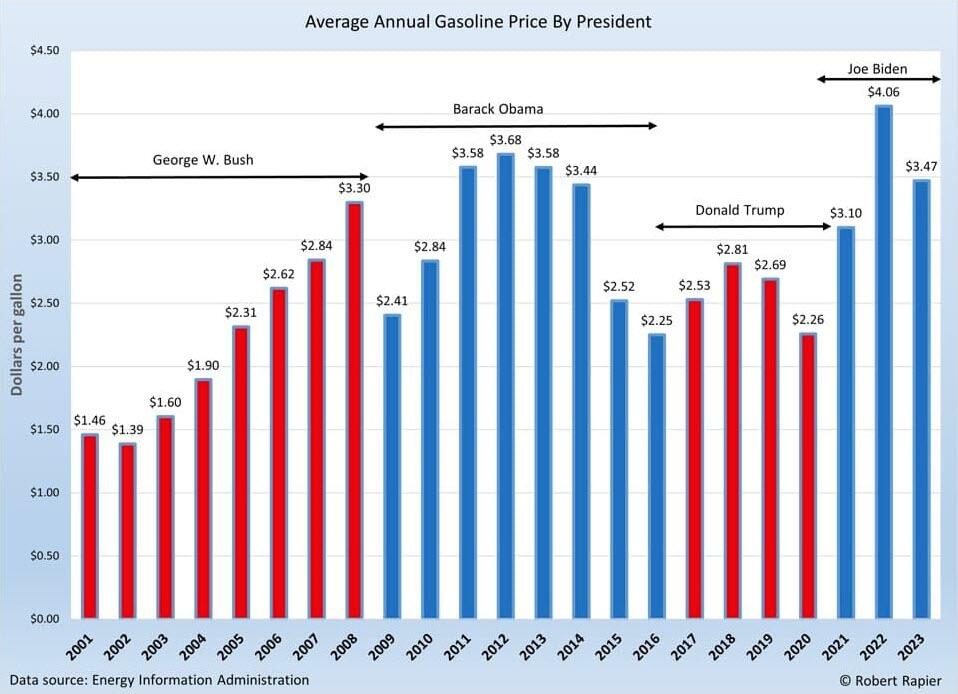
The following graphic shows the average annual gasoline price during each year of the last four presidential terms. Republican presidents are shown in red, Democrats in blue. The numbers come from the EIA, and they represent the average retail price of all grades of gasoline. You can see the raw data here.

Average Annual Gasoline Price 2001 to 2023. ROBERT RAPIER

This graphic shows the data, but it needs context. There are many stories that could be spun from a superficial reading of the data, but many of them would be wrong. For example, President Bush saw a huge rise in gasoline prices when he was in office. It would certainly be easy to cast blame on him for this, but President Bush was very pro-oil and gas development.

In fact, the technologies that led to the fracking boom largely developed under President Bush. But fracking didn’t begin to show huge benefits until President Obama’s term.

What happened under President Bush was that Chinese demand grew sharply, and Saudi Arabia was slow to increase production. This led to a widespread belief that global oil production had peaked, and that helped create a bubble in oil prices. That bubble finally burst in 2008 when a recession caused a drop in global oil demand.

Like Bush, Obama initially experienced rising gasoline prices. Those prices reached a peak at the highest annual average to date of any president, before falling back down to the lowest level since Bush’s first term. The reason for the crash in gasoline prices was that Saudi Arabia decided to engage in a price war with the U.S. to win back market share that had been lost to the U.S. shale oil boom.

Thus, most of the rise and fall under Bush and Obama didn’t really have a lot to do with their policies. One could argue that the pro-oil policies under Bush did usher in the eventual glut of oil that happened under Obama, but these are once again long-term policy effects.

Gasoline prices rose during each of President Trump’s first two years in office, reversing the two-year trend that ended Obama’s second term. By Trump’s third year in office, prices fell slightly, but then prices were down sharply in Trump’s fourth year as a result of the Covid-19 pandemic and its impact on oil prices. Gasoline prices in 2020 were at their 2nd lowest level since 2004.

When President Biden came into office, gasoline prices had been rising for several months as the world began to recover from Covid-19. But, demand outstripped supply, and oil prices continued to soar. Then, in early 2022 Russia invaded Ukraine, and that helped propel the average annual gasoline price that year to $4.06/gallon, the highest annual average on record.

Obviously 2023 is incomplete, but so far this year the average annual price of gasoline is $3.47/gallon. That marks a 14.5% decline from 2022, but there’s still a lot of year left.

To date, the average gasoline price during President Biden’s term – with nearly two years still to go – is $3.60/gallon. That is on a pace to be the highest average under any president. Here is how prices stack up per gallon, from lowest to highest average for their terms:

  1. Joe Biden (partial term) — $3.60

  2. Barack Obama first term — $3.12

  3. Barack Obama second term — $2.95

  4. George W. Bush second term — $2.77

  5. Donald Trump — $2.57

  6. George W. Bush first term — $1.59

So, you can see how someone could argue that Republicans are better for gasoline prices. Presidents Bush and Trump were the only presidents that oversaw average gasoline price below $3.00/gallon for four consecutive years of a term.

But the truth is more nuanced than that. The technologies that led to the fracking boom were developed under a Republican president. That, in turn, is responsible for much of the ups and downs in the price over the years. But, Saudi Arabia/OPEC and the Covid-19 pandemic and subsequent recovery also had a huge impact. These factors were largely outside of a president’s control.

In the next article, I will discuss the evolution of oil production during each president’s term. President Obama presided over the largest expansion of oil (and gas) production in U.S. history. But, as with gasoline prices, context is important.

Tyler Durden
Wed, 03/22/2023 – 11:50

via ZeroHedge News https://ift.tt/0iu1d6h Tyler Durden

Your Last Minute FOMC Preview: What Traders Expect, What The FOMC Statement May Say, And What’s Next For The Dots

Your Last Minute FOMC Preview: What Traders Expect, What The FOMC Statement May Say, And What’s Next For The Dots

While we previously shared a detailed FOMC preview, below we excerpt from the Fed preview by Bloomberg Markets Live reporter and strategist Ven Ram, who breaks down his analysis in three parts: i) what traders are watching from the Fed today, ii) what the FOMC statement may look like, and iii) the Fed’s dot plot options.

Starting at the top, here is…

What Traders Are Watching From The Fed Today

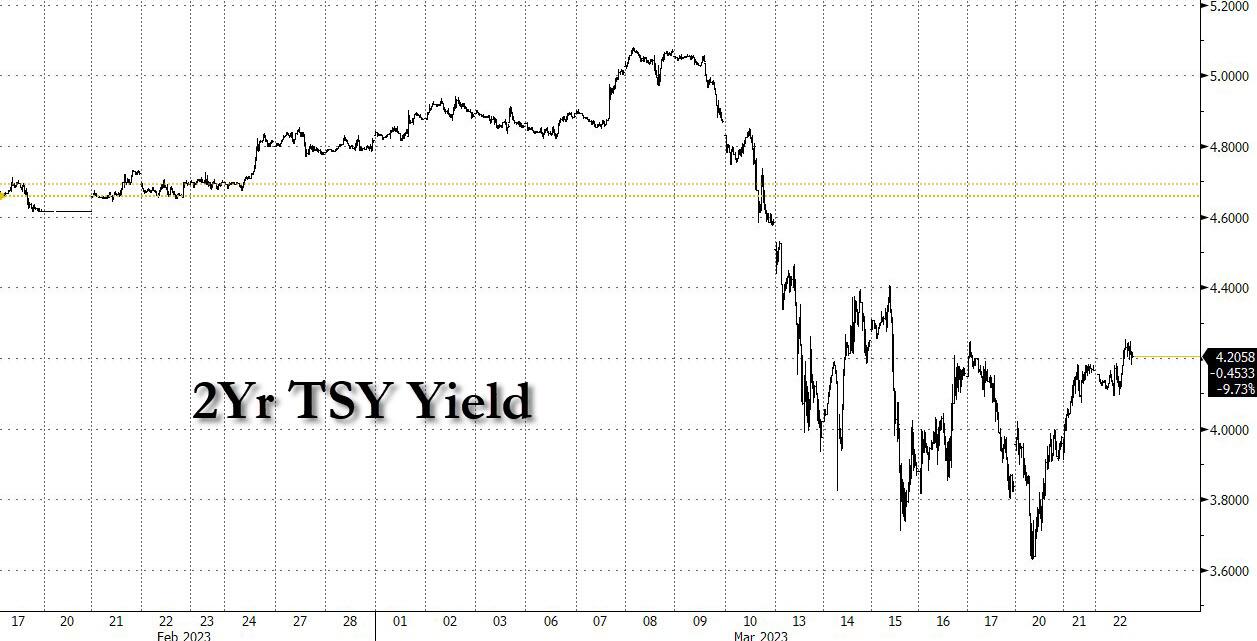
Treasury two-year yields have bobbed almost 150 basis points in their range since the Federal Reserve met last month, enough to give any roller-coaster ride a run for its money. They are still looking for a definitive direction, and today’s Fed decision holds the key.

Decision & dissent:

  • As of the close on Tuesday, overnight indexed swaps were factoring in slightly more than a 80% chance of a 25-basis point increase. While the tail risk of the Fed standing pat isn’t insignificant for the first time in the current cycle, given that we haven’t had any media leaks yet from the Fed’s trusted sources to steer the markets away from pricing a hike, we should perhaps expect the central bank to follow through

  • And like the European Central Bank, Chair Jerome Powell may be inclined to think there is no trade-off between financial and price stability
  • The Fed entered its traditional quiet period just as the crisis at Silicon Valley Bank was boiling over, so we don’t quite know if all policymakers will be on the same page when it comes to Wednesday’s decision. Still, there are clues from the Fed’s December dot plot, which showed that two of 19 members had penciled in a top rate of 5%. The question then is what those two think in light of the crisis
  • Should the Fed, however, hold, long-dated Treasuries will rally big

Dot plot:

  • The FOMC will likely envision 50 more basis points of tightening over and above Wednesday’s move to primarily drive home two points: a) that the Fed believes that the financial landscape isn’t as broken as the markets reckon; and b) the Fed isn’t shifting its focus away from inflation

Summary of Economic Projections:

  • Given the adverse impact of the tumult in the banking sector, it’s likely that the Fed will revise its growth forecast for this year lower, possibly by a notch to 0.4% from 0.5%, while leaving the estimate for the jobless rate at 4.6%
  • Bloomberg Economics expects that core PCE inflation will be revised higher to 3.7% from 3.5% and to 2.7% for next year from 2.5% now

Powell’s Pyrotechnics:

  • Should the Fed go through with the hike, Chair Jerome Powell will doubtless face a barrage of questions on whether:
    • The FOMC is hiking rates into a hard landing. His likely response: The Fed sees the economy losing momentum, but given the tightness of the labor market, the FOMC hopes any blip will be transitory
    • What he makes of the market pricing on rate cuts down the line. Powell may say that inflation remains the Fed’s central focus and he doesn’t expect the current tumult in the banking landscape to spill over into the wider economy in light of the backstop that has already been put in place and other measures taken to shore up confidence.

Here’s What the Fed Statement May Look

The Fed faces the unenviable prospect of having to craft a policy statement at a time when it is still coming to grips with a banking crisis and its fallout on the wider economy. In light of the recent market tumult, revisions to the statement will be the most extensive in a long while.

The top:

  • There are two ways the Fed could go about changing its preamble. It may start off with its time-tested boilerplate on recent macroeconomic inputs — that is, spending, production and the jobs market — before moving on to acknowledge the recent stress in the banking sector.
  • The second way would be to acknowledge the latter right off the bat, at the very top. This choice may suggest that the Fed is placing greater weight on financial stability and what that implies for the broader economy.

Rate increase:

  • Though it’s a close call, the Fed may opt to raise rates by 25 basis points to signal that it is still intent on battling inflation and also that it views the recent market stress as temporary:
  • As reminder, JPMorgan disagrees with Ram here and as we noted last night, the bank’s economist Michael Feroli expects the Fed’s forward guidance to drop the phrase “ongoing increases…will be appropriate” and substitute language which will indicate that the bias is toward further tightening

Dissent:

  • It is possible that the Fed may acknowledge that there two-way risks in the economy. However, the markets may interpret such a clause to mean that the Fed is willing to cut rates, so the FOMC may open a Pandora’s box in doing so
  • FOMC members Lisa Cook and Austan Goolsbee are dovish in their leanings, and either or both of them may vote in favor of a pause

What About The Dot Plot

The Fed’s dot plot could broadly go one of three ways today:  

Option I: Cop-out

  • The Fed could simply not do a dot plot, a reprisal of what happened in March 2020. However, that would end up alarming the markets, and seems unlikely.

Option II: The Dovish Choice

  • This is one where Fed policymakers stick to the same dot plot as the one they unveiled in December — that is, one that shows the Fed funds rate topping at 5.125%. That would mean one more 25- basis point increase assuming the Fed raises rates by a similar margin today
  • In the light of recent inflation and jobs market data, that would be dovish — but one that acknowledges the recent tightening in financial conditions

Option III: Dovish & Hawkish Simultaneously

  • In this scenario, the median of policymakers will pencil in a top rate of 5.375%. In effect they would reckon that the Fed has more work to do on inflation in light of recent macroeconomic data
  • While it may look hawkish given the market jitters, there is perhaps little question that the dot plot would have been even more ambitious were it not for the tumult in the banking industry

Tyler Durden
Wed, 03/22/2023 – 11:26

via ZeroHedge News https://ift.tt/oKLFAPy Tyler Durden