US Banks See Massive Deposit Flight (Biggest Since SVB) As Fed Ends BTFP ‘Arb’

US Banks See Massive Deposit Flight (Biggest Since SVB) As Fed Ends BTFP ‘Arb’

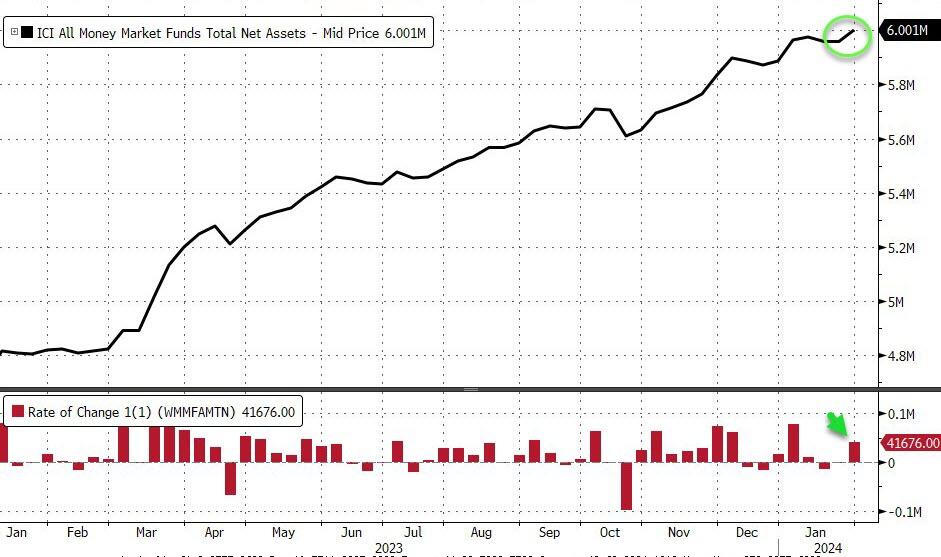
After two weeks of outflows, money market funds saw $42BN of inflows last week, sending the total assets above $6TN for the first time ever..

Source: Bloomberg

Not exactly a bullish sign for stocks as investors are choosing super safe money markets, where six-month bills yield about 5.17%, as the Fed sticks to its higher-for-longer policy.

In a breakdown for the week to Jan. 31, government funds – which invest primarily in securities like Treasury bills, repurchase agreements and agency debt – saw assets rise to $4.89 trillion, a $31.6 billion increase. 

Prime funds, which tend to invest in higher-risk assets such as commercial paper, meanwhile, saw assets rise to $994 billion, a $7.32 billion increase.

Institutional funds saw a large $33BN inflow and retail funds saw yet another inflow…

Source: Bloomberg

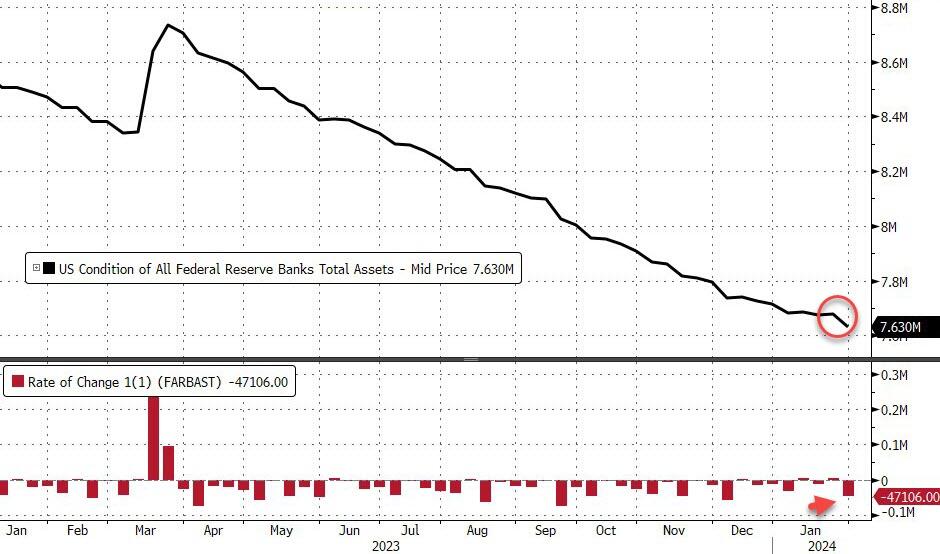
After a small expansion in the prior week, The Fed’s balance sheet contracted by $47.2BN last week…

Source: Bloomberg

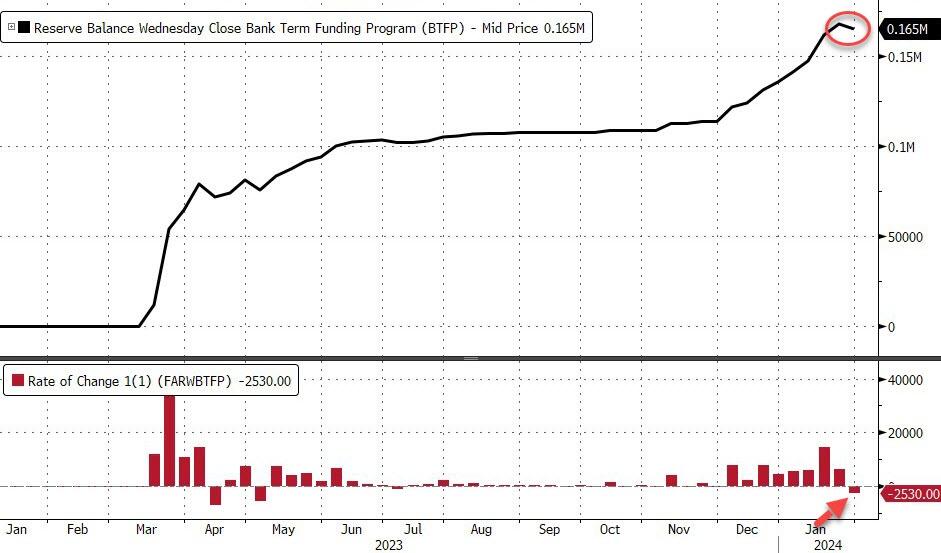
And for the first time since May of last year, usage of The Fed’s BTFP facility dropped (by $2.5BN to still $165BN), after The Fed crushed the arb and vowed to end it on time in March…

Source: Bloomberg

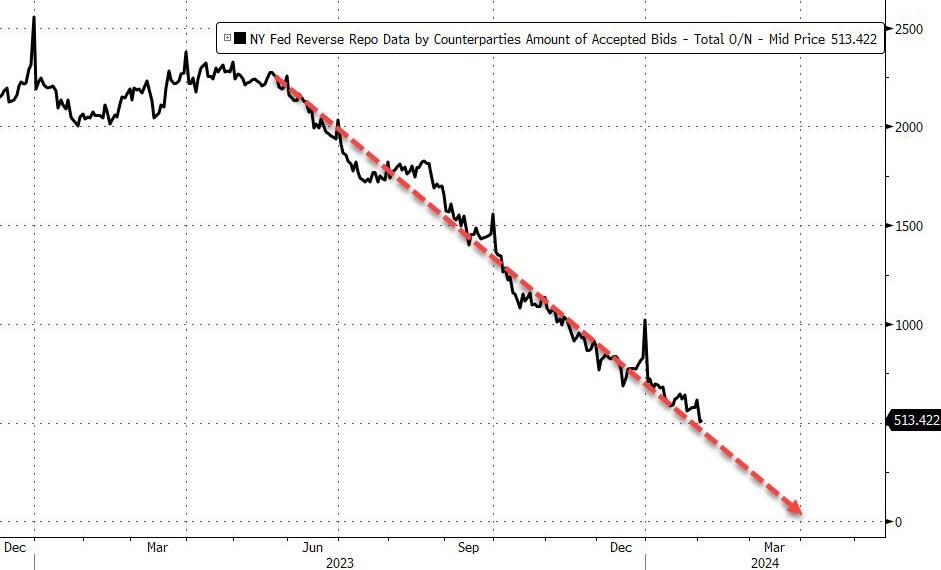
The Reverse Repo facility saw more liquidity drawn down, testing down to $500BN left…

Source: Bloomberg

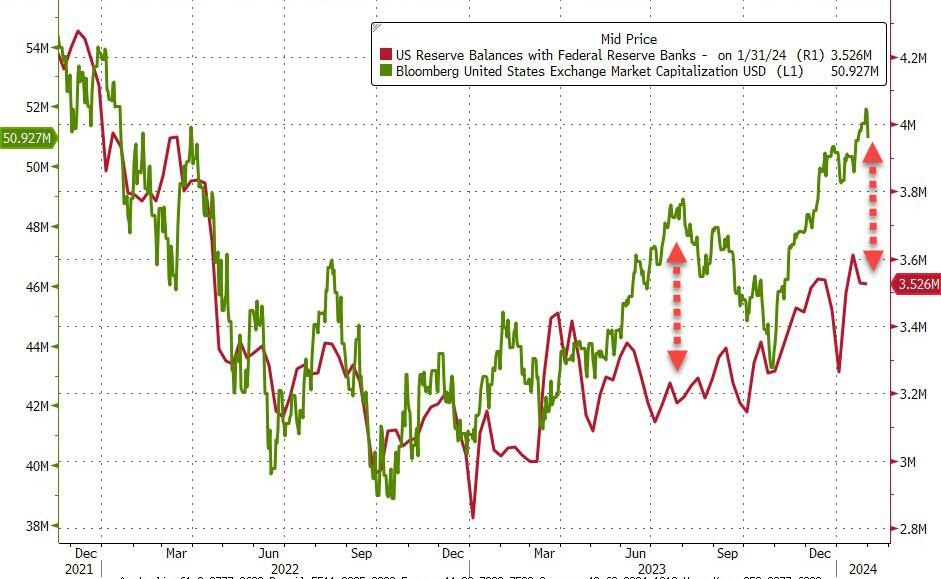
US equity market cap remains decoupled from the shrinking reserves at The Fed once again…

Source: Bloomberg

The timing of the end of the arb, the imminent end of BTFP, and the rapid approach of zero liquidity left in the RRP all line up for a March D-Day for the banks.

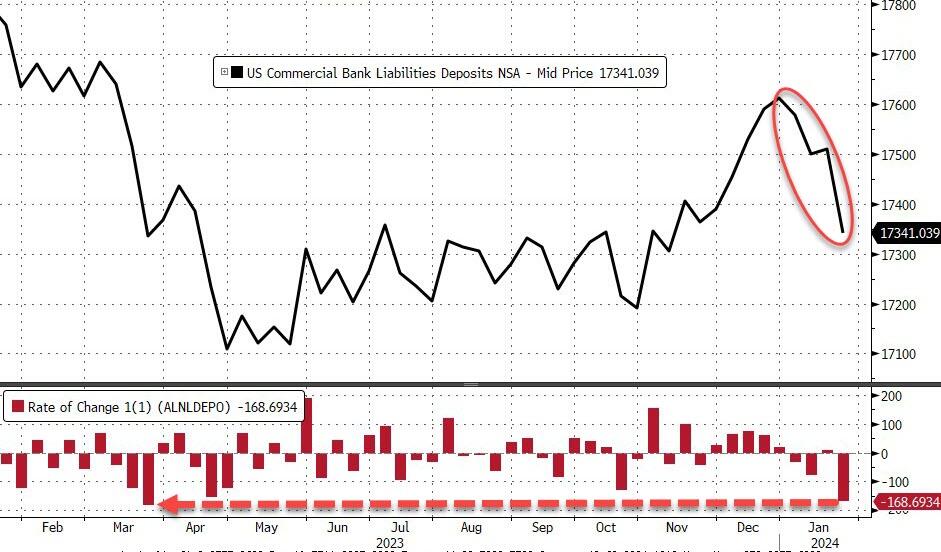
Talking of which, on a non-seaonally-adjusted basis, total deposits plunged by a stunning $168BN last week – the biggest weekly drop since the SVB crisis…

Source: Bloomberg

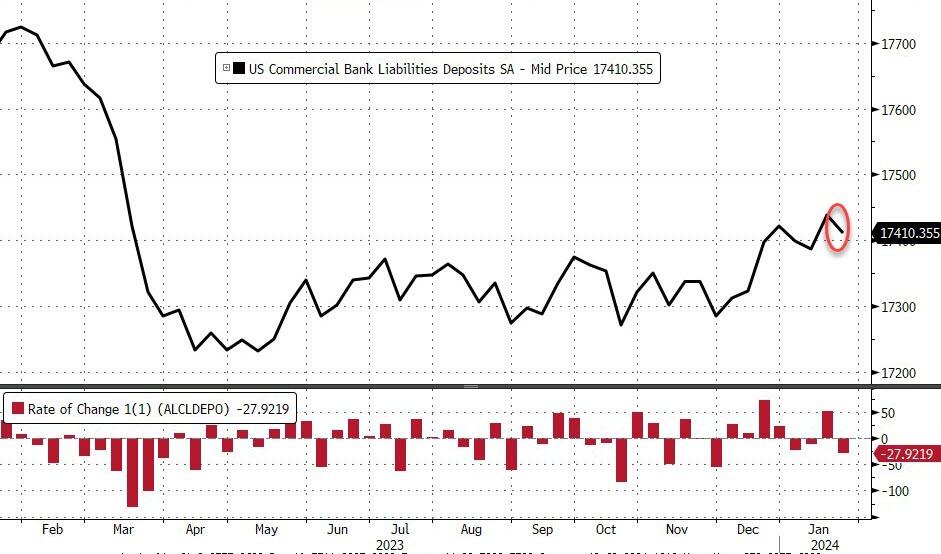
Seasonally-adjusted total deposits also decline, by $28BN…

Source: Bloomberg

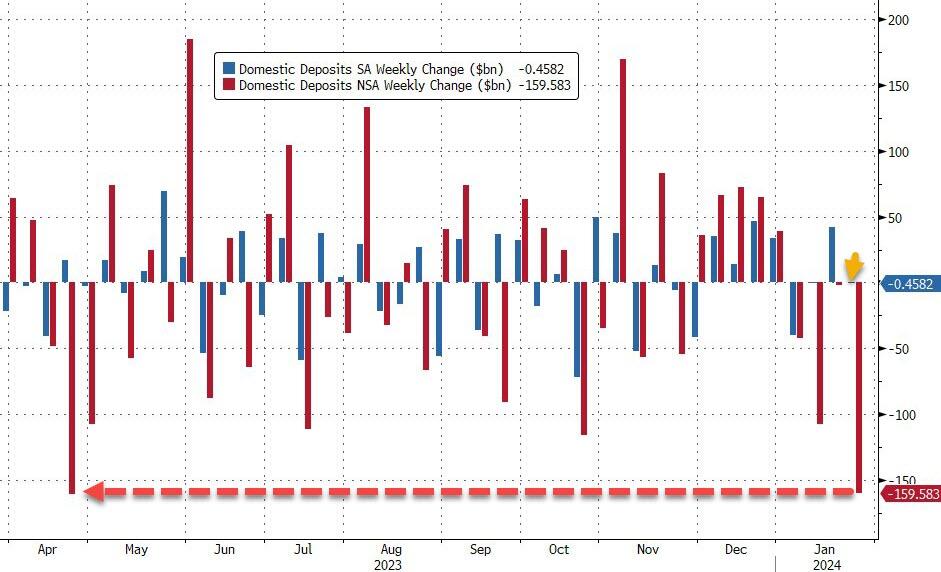
And, excluding foreign deposits, The Fed managed to turn a giant domestic deposit flight of $160BN NSA (Large banks -$141BN, Small banks -$19BN) into a tiny domestic deposit decline of $458MN only (Large banks -$16BN, Small banks +$15.5BN)…

Source: Bloomberg

On the other side of the ledger, loan volumes rose byjust over $10BN with Small banks adding $10.5BN while large banks saw loan volumes drop $238MN…

Source: Bloomberg

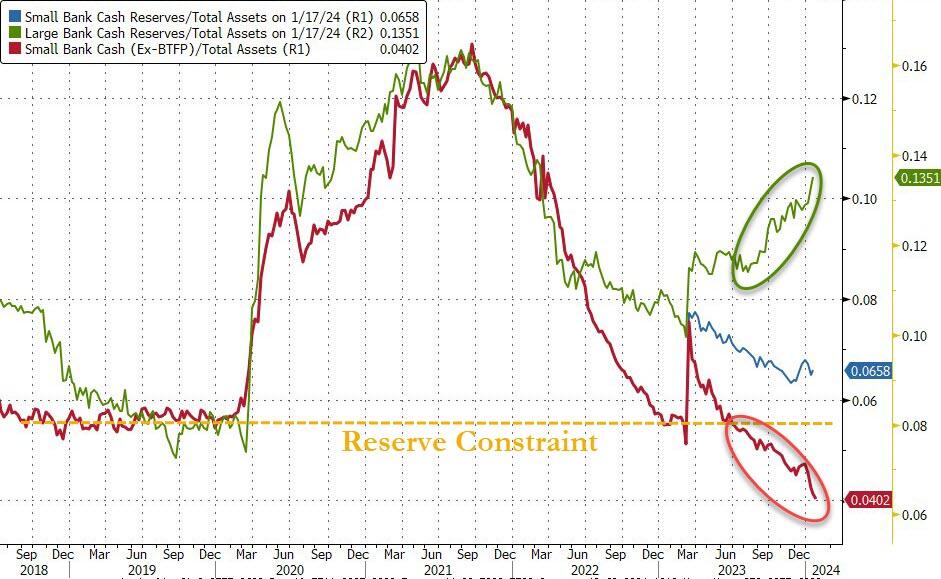
And finally, as is now finally becoming evident in the share prices, the regional bank crisis is back (it never left) as evidenced by the red line below (without The Fed’s BTFP facility there is a major hole) and big banks have money to burn (green line) with help from the FDIC…

Source: Bloomberg

So, when will Powell be forced to admit a March rate-cut is back on the table? Or QE?

Tyler Durden
Fri, 02/02/2024 – 16:40

via ZeroHedge News https://ift.tt/ijOIpvZ Tyler Durden

They Don’t Want A Nation Of Critical Thinkers

They Don’t Want A Nation Of Critical Thinkers

Authored by Jim Quinn via The Burning Platform blog,

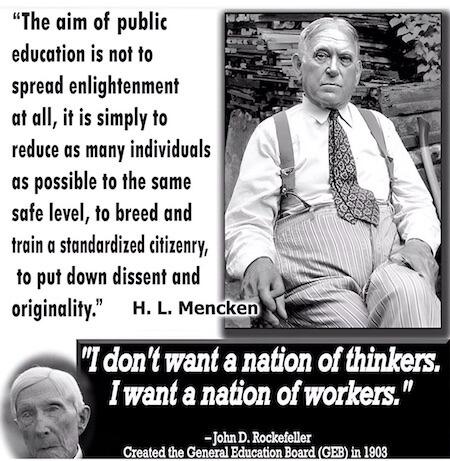
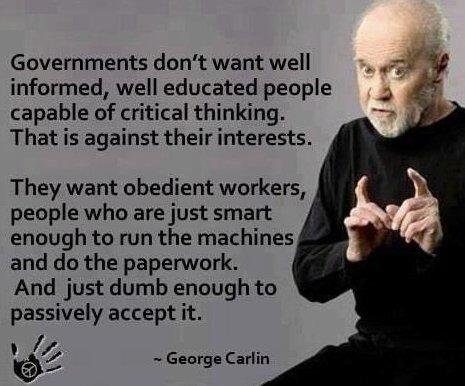
When you read quotes from H.L. Mencken and John D. Rockefeller from over a century ago describing how government schools, in conspiracy with Big Business, had the sole purpose of matriculating non-thinking, non-questioning, standardized robotic workers into the workforce, you understand why the country is in such a state of degeneracy, degradation, debt, and dumbed down state of infantilism. This didn’t happen over night.

It was a plan implemented methodically over the last century by those controlling the levers of society. They were described succinctly by Edward Bernays in his 1928 book Propaganda as:

“Those who manipulate this unseen mechanism of society constitute an invisible government which is the true ruling power of our country. …We are governed, our minds are molded, our tastes formed, our ideas suggested, largely by men we have never heard of.”

These men operate in the shadows; have enormous wealth which they use to buy politicians, academics, government bureaucrats, the media, international organizations, and technological platforms; and have a primary objective of increasing their wealth, power and control, while enslaving the working class in debt, and keeping them distracted with high tech bread and circuses. Even though a few slip through their net, educate themselves, think critically, question everything, and distrust their government, they probably comprise less than 5% of the population.

After decades of government indoctrination, propaganda, disinformation, and Big Corporation poisoning of mind and body, the ignorant masses have become so mentally and physically debilitated they are incapable of comprehending how they have been manipulated and misled and unequipped to revolt against their captors. The covid/vaccine scamdemic was the ultimate test, and the ignorant masses failed miserably. The noose is tightening and they are still focused on Taylor Swift, the stock market, climate change, border invasion, and ongoing presidential political clown show.

They have a number of irons in the fire to utilize in taking away more of your liberties, freedoms, rights, and wealth.

These irons include: possible war with Iran, Russia, and China; possible civil war initiated with Texas over the border invasion; the fake climate emergency; Disease X or some other fake health crisis; denying Trump the presidency in 2024 through illegal means; and whatever financial crisis they create as cover for more pillaging the national treasury.

The Great Taking/Great Reset is real. They want it all and they will take it, if we let them. You will own nothing, if they have their way. They have the power and will not relinquish it willingly. The power will need to be reclaimed through the use of force, cunning, and surprise. We can’t let them set the rules of the conflict. The 5% constituting the critical thinkers will need to convince a portion of the ignorant masses to start thinking. We will need to throw sand into the gears of their machinery. The middle level bureaucrats doing the bidding of the elite ruling class, will need to worry about whether they will make it home at night to their families. Removing ourselves from their system will further degrade their system.

Apathy and passivity are no longer possible when they are trying to strip you of your wealth and force you into their digital gulag of CBDCs and social credit scores. Obedience to corrupt, powerful, psychopaths who want us dead is an unacceptable choice for me. Voting is absolutely worthless at this point. The politicians are not running anything. The system has been rigged to benefit the few, while impoverishing the rest. When they pull the plug on this system, they have “legally” arranged for all the wealth to be consolidated in their hands.

We know what they want. The question is whether we allow it to happen.

*  *  *

To support Jim’s ‘The Burning Platform’ blog, via Stripe, click here.

Tyler Durden
Fri, 02/02/2024 – 16:20

via ZeroHedge News https://ift.tt/rf2Xasy Tyler Durden

Mega-Cap Tech Melts-Up Moar Despite Powell Punch-In-The-Face & Regional Bank Rout

Mega-Cap Tech Melts-Up Moar Despite Powell Punch-In-The-Face & Regional Bank Rout

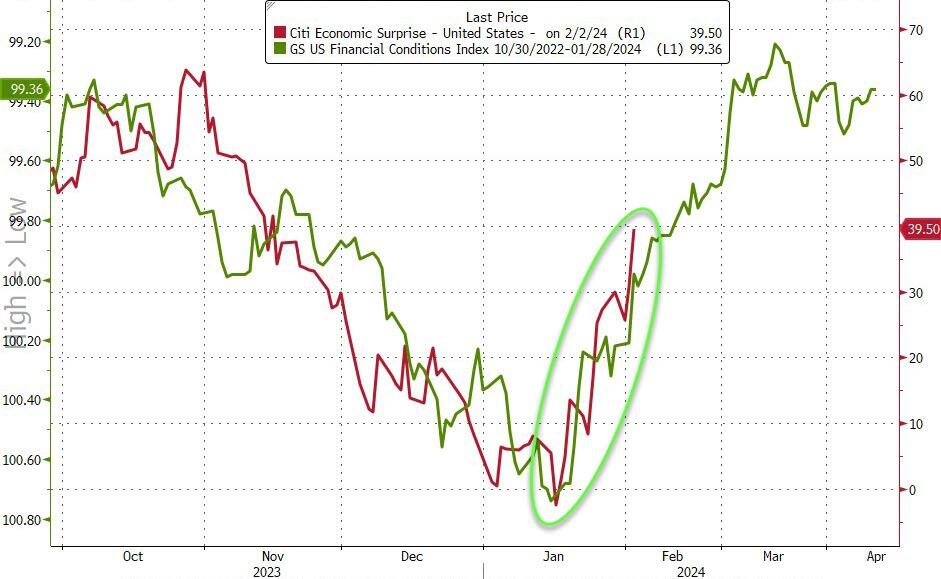
First things first, economic ‘animal spirits’ are back baby… and we know why (as we noted for months, the lagged effect of the massive loosening of financial conditions is now hitting and NOT doing The Fed’s job)…

Source: Bloomberg

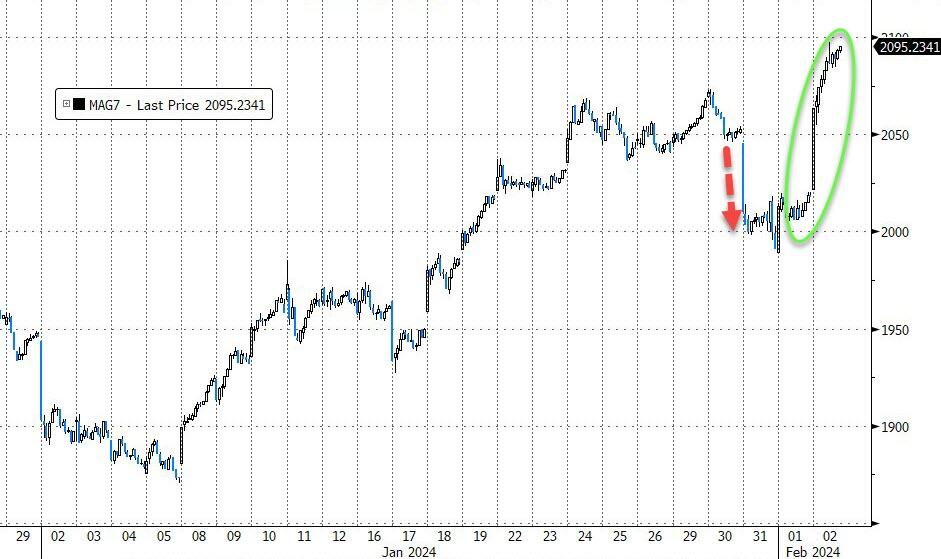
But, away from The Fed’s Tyson-esque punch in the dove’s face, it was all about ‘The Magnificent 7’ – the basket of 7 stocks soared to new highs this week…

Source: Bloomberg

But the 7 is now 4…

Source: Bloomberg

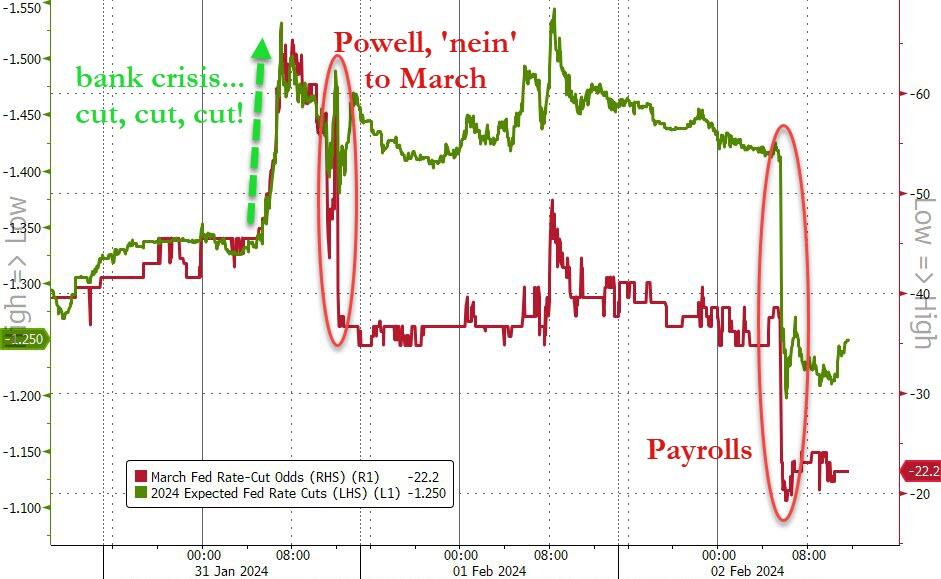
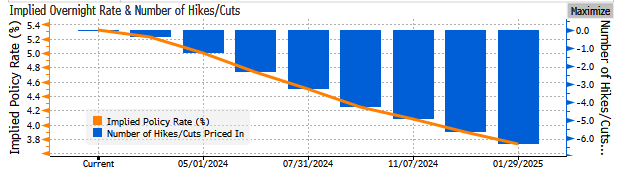
As job gains… and productivity gains… and AI… and stuff… trumped a hawkish Powell and anything-but-soft-landing/goldilocks jobs data – that sent rate-cut expectations lower…

Source: Bloomberg

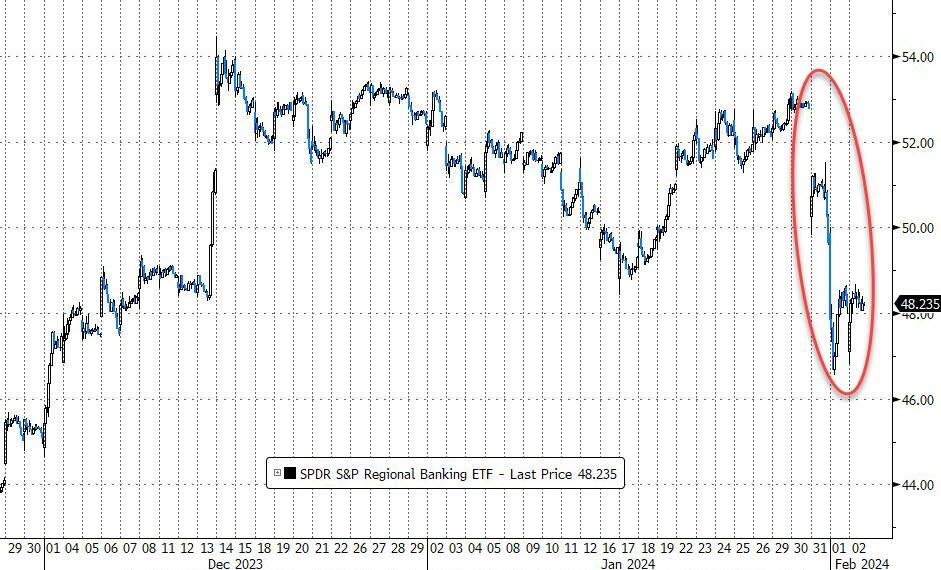
Meanwhile, the bank crisis is back as Regional banks suffered their worst week since May 2023…

Source: Bloomberg

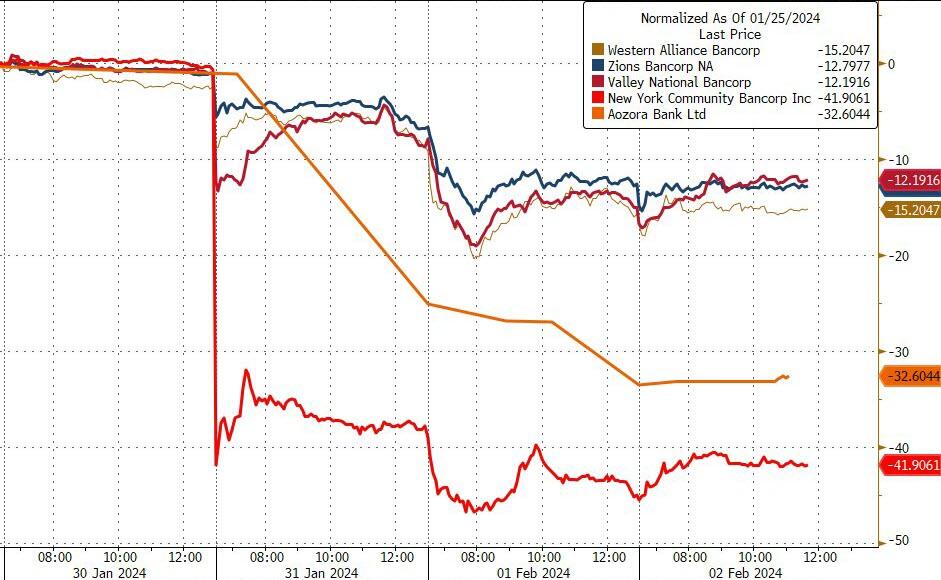
As ‘whack-a-mole’ has begun again among the most levered…

Source: Bloomberg

But, away from the bank crisis (just ignore it, right), Apollo’s Slok notes, there are several current themes in markets

1. Soft landing/Goldilocks priced in everywhere, but probability of hard or no landing is not zero

2. Supply of US Treasuries growing, and Treasury auctions are getting more and more attention

3. Extreme concentration in S&P 500 driven by growing AI bubble

4. China slowing driven by deflating housing bubble, falling exports, and demographic headwinds

5. Germany in trouble because of China slowdown, costly energy transition, and housing disinflation

By the end of this week, 1 is dead, 2 is serious, 3 is worse, 4 remains a problem, and 5 is even uglier.

But none of that matters to tech which soared for the 13th week in the last 14 as Nasdaq rallied 1.5% this week. Small Caps were only index of the majors to close red…

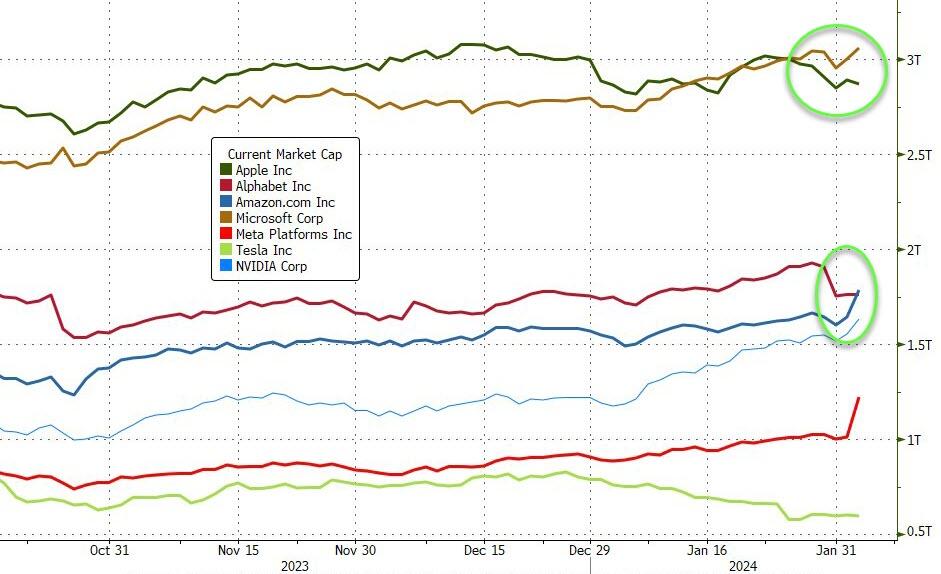
MSFT is now bigger than AAPL, and AMZN is now bigger than GOOGL…

Source: Bloomberg

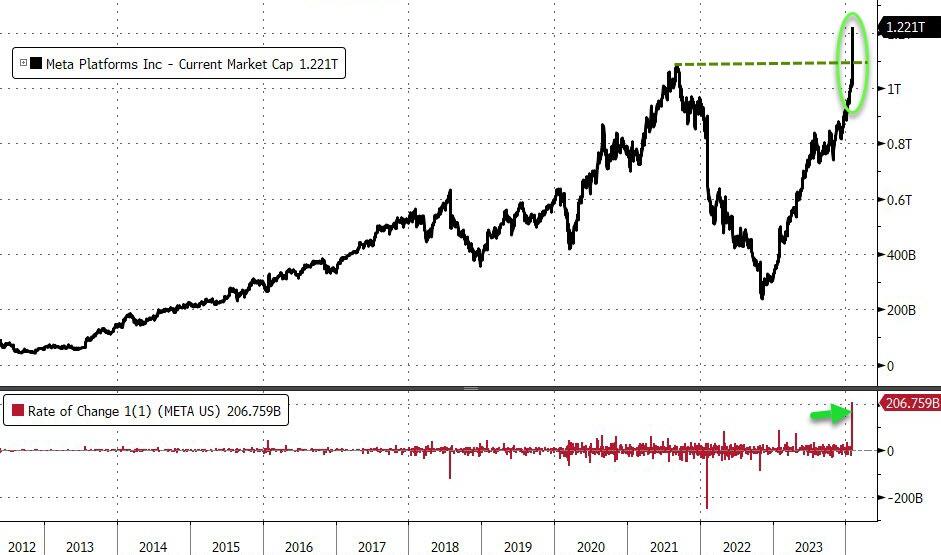
Today’s gain for META is the biggest single-session market value addition, eclipsing the $190 billion gains made by AAPL and AMZN in 2022…

Source: Bloomberg

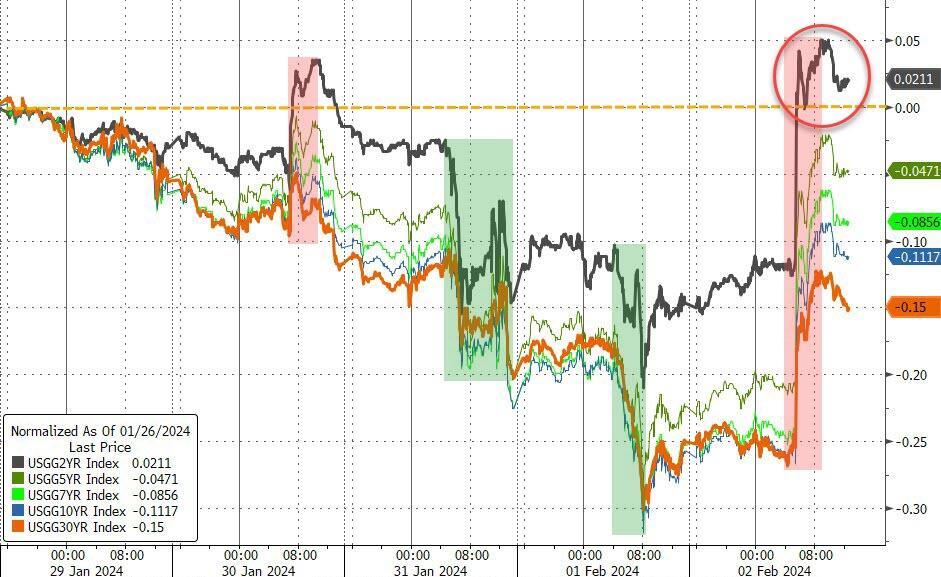
Treasury yields all exploded higher today, with the short-end underperforming (2Y +17bps, 30Y +10bps) leaving the 2Y the only part of the curve higher on the week…

Source: Bloomberg

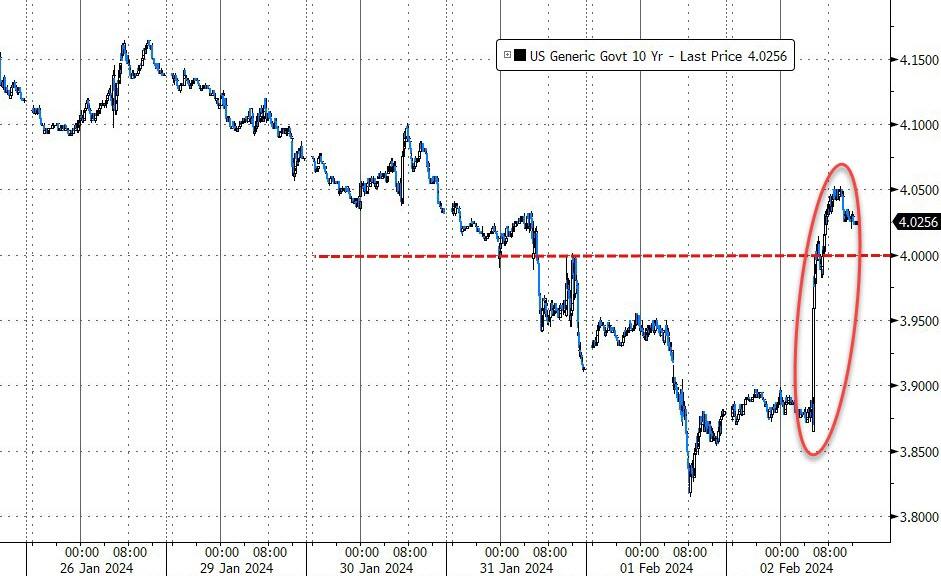
With the 10Y Yield back above 4.00% by Friday’s close…

Source: Bloomberg

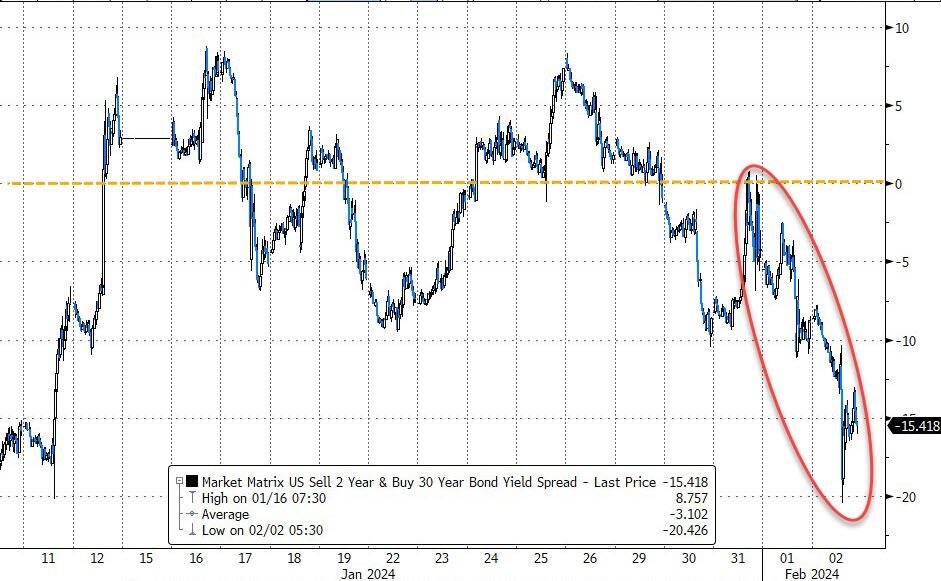
And a big flattening of the yield cure (2s30s) back into inversion (erasing all the steepening from the Dec FOMC)…

Source: Bloomberg

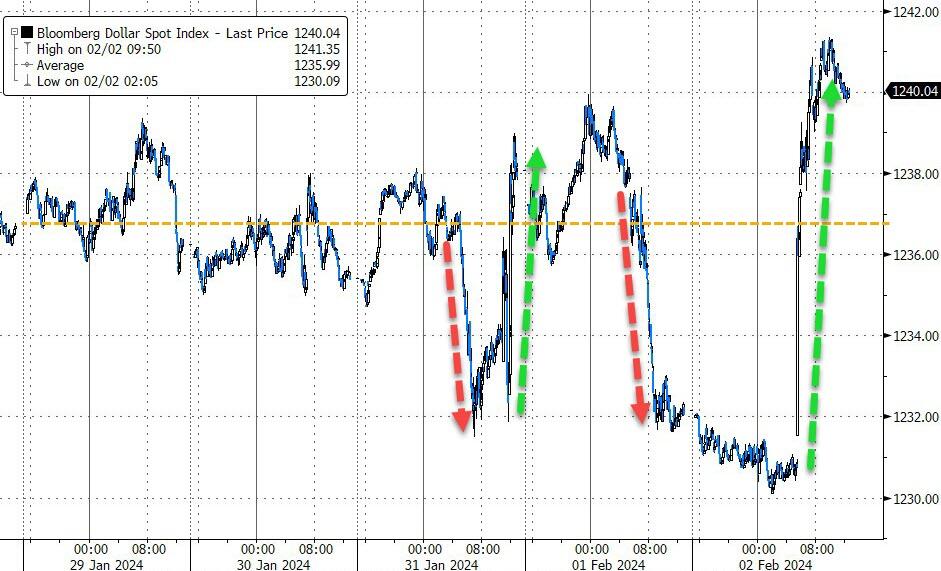
Thanks to a huge surge in the dollar today, the week ended green for the greenback…

Source: Bloomberg

Bitcoin was higher on the week, chopping around the $43000 level…

Source: Bloomberg

Notably, Bitcoin ETFs have seen net inflows for the last 5 days…

Source: Bloomberg

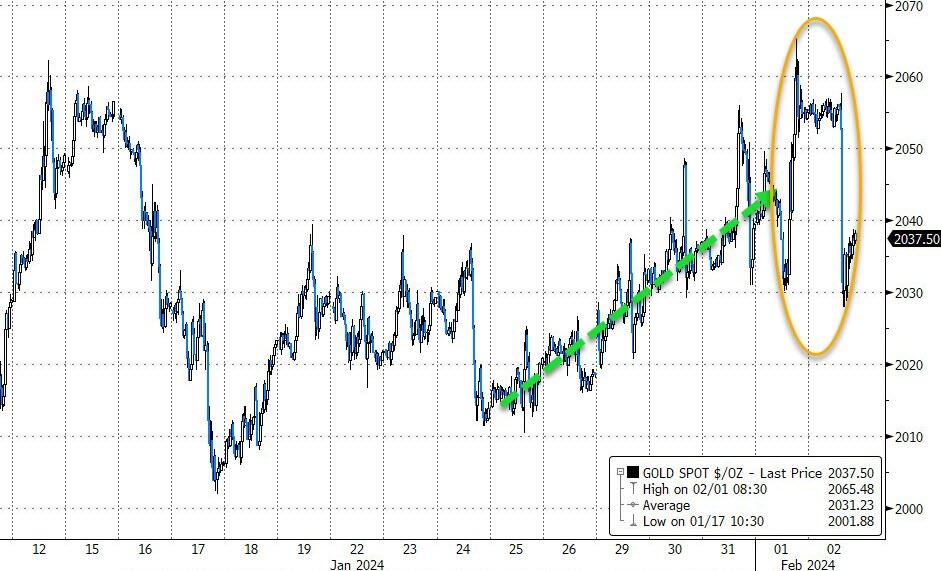
Gold ended the week higher, despite a big drop today, erasing yesterday’s gains…

Source: Bloomberg

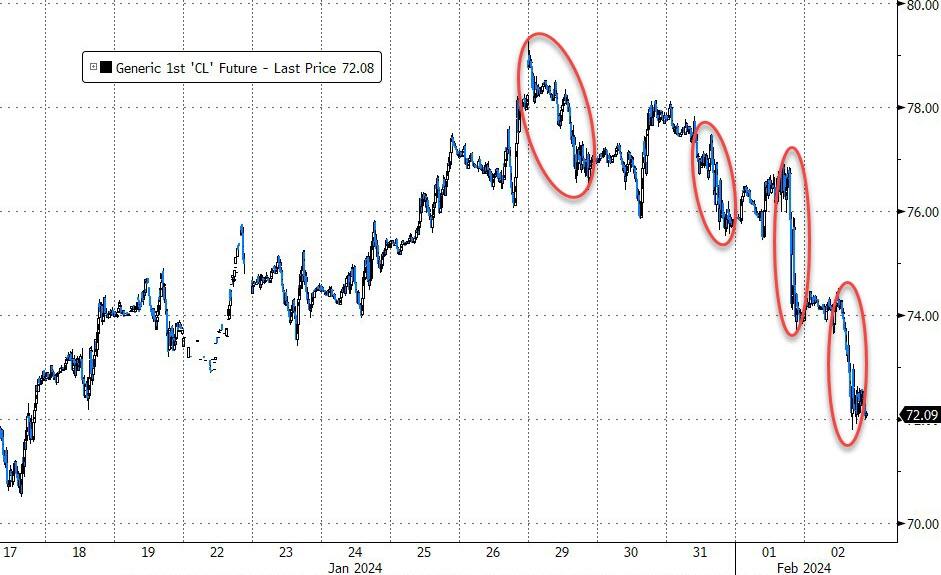
Oil prices ended the week lower (last week’s outsized gain completely erased). This was the worst week for WTI since early October…

Source: Bloomberg

And finally, as one wise prognosticator noted.

Market is soaring because AI hasn’t displaced any jobs.

Market is soaring because every tech company is betting AI will displace millions of jobs.

And so, ‘you are here’

Source: Bloomberg

…just remember, this didn’t end well last time.

Tyler Durden
Fri, 02/02/2024 – 16:00

via ZeroHedge News https://ift.tt/K9tIDgs Tyler Durden

‘Zero Illegal Crossings’ Is an Unattainable Goal for the Border


Migrants pictured along the U.S.-Mexico border fence | For the past several months, congressional lawmakers have attempted to forge a bipartisan border security deal. By many indications, that deal is effectively dead—but that hasn’t stopped politicians from voicing some very unrealistic policy goals for the border.  “Any border ‘shutdown’ authority that ALLOWS even one illegal crossing is a non-starter,” said House Speaker Mike Johnson (R–La.) on X, formerly known as Twitter, on Monday. “Thousands each day is outrageous. The number must be ZERO.” (A group of senators, meanwhile, reportedly struck a deal that would “automatically reject migrants and asylum seekers from crossing the border illegally once the daily average for border crossings surpasses 5,000 over a week or…8,500 on a single day,” per Axios.)  President Joe Biden, in turn, vowed to “shut down the border when it becomes overwhelmed” if Congress granted him that authority. “I would use it the day I sign” a bipartisan bill “into law,” he said. (Former President Donald Trump, meanwhile, has claimed that Biden already has this authority and said that he should get on with using it.)  As good as those promises might sound to border hawks, they’re not even remotely feasible. The U.S. government, for all the money and agents it’s thrown at the border over the past several decades, has never been able to “shut down the border” or achieve zero illegal crossings.  Between the creation of the Department of Homeland Security in 2003 and January 2021, the U.S. has spent $333 billion to fund the agencies tasked with immigration enforcement, according to the American Immigration Council, a pro-immigration nonprofit. The budgets for those agencies have been rising for years.  But more enforcement money doesn’t necessarily lead to lower illegal crossings. As budgets have gone up, apprehensions of people who crossed the border between authorized ports of entry have gone up, down, and remained static. In other words, they don’t cleanly align: Though Customs and Border Protection (CBP) reported 2.05 million apprehensions in FY 2023, it reported somewhat close to that number—over 1.5 million—in FY 2000. Annual apprehensions hovered below 500,000 from FY 2010 through FY 2018.  Tough enforcement doesn’t bring illegal crossings down to zero, either. Even the pandemic-era Title 42 border order that effectively “closed the border to unauthorized border crossers” and asylum applicants couldn’t keep arrivals down, per a January report from the Migration Policy Institute (MPI). “Arrivals at the border increased dramatically through 2021 and 2022, despite the order remaining in place.”  A policy brief last May from the National Foundation for American Policy, drawing on 100 years of Border Patrol apprehensions data, found that “none of the three U.S. periods with a significant decline in illegal immigration were due to enforcement policies.” Rather, they were due to increased legal pathways as well as changing demographics and labor demand.  The U.S.-Mexico border stretches nearly 2,000 miles, much of it treacherous. No matter the funding and no matter the enforcement mandate, there’s no way that agents could stop every illegal crosser traversing the deserts, mountains, and waters that make up the border region. That’s proven impossible along much smaller and more surveilled borders, such as the boundaries of East Germany and North Korea.  All this suggests that it’s time for some reflection from today’s zero-illegal-crossings proponents.   “The contemporary challenge at the southwest border is one of border control rather [than] border security,” suggests the MPI. “The national objective must be not to solve the border control challenge by apprehending and removing 100 percent of unauthorized migrants, but rather to manage it in a manner consistent with the law and reasonably satisfactory to the American people.”  Any workable border deal should focus on ways to make legal immigration more accessible—and more attractive—than illegal immigration. That’s the most proven way to reduce illegal crossings, and the most promising way to ensure that border agents are focusing on actual threats rather than the vulnerable migrants who are simply seeking a safe place to live and work.

For the past several months, congressional lawmakers have attempted to forge a bipartisan border security deal. By many indications, that deal is on shaky ground—but that hasn’t stopped politicians from voicing some very unrealistic policy goals for the border.

House Speaker Mike Johnson (R–La.) floated one such goal while discussing a deal reportedly struck by a group of senators. “It seems the authority to shut down the border would kick in only after as many as 5,000 illegal crossings happen a day. Why? Why would we do that?” he said on Tuesday. “That would be surrender. The goal should be zero illegal crossings a day.”

(The deal would “automatically reject migrants and asylum seekers from crossing the border illegally once the daily average for border crossings surpasses 5,000 over a week or…8,500 on a single day,” per Axios.)

President Joe Biden has vowed to “shut down the border when it becomes overwhelmed” if Congress grants him that authority. “I would use it the day I sign” a bipartisan bill “into law,” he said. (Former President Donald Trump, meanwhile, has claimed that Biden already has this authority and said that he should get on with using it.)

As good as those promises might sound to border hawks, they’re not even remotely feasible. The U.S. government, for all the money and agents it’s thrown at the border over the past several decades, has never been able to practically “shut down the border” or achieve zero illegal crossings (all the legal issues with those proposals aside).

Between the creation of the Department of Homeland Security in 2003 and January 2021, the U.S. has spent $333 billion to fund the agencies tasked with immigration enforcement, according to the American Immigration Council, a pro-immigration nonprofit. The budgets for those agencies have been rising for years.

But more enforcement money hasn’t necessarily led to lower illegal crossings. As budgets have gone up, apprehensions of people who crossed the border between authorized ports of entry have gone up, down, and remained static. In other words, they don’t cleanly align: Though Customs and Border Protection reported 2.05 million apprehensions in FY 2023, it reported somewhat close to that number—over 1.5 million—in FY 2000. Annual apprehensions hovered below 500,000 from FY 2010 through FY 2018.

Tough enforcement doesn’t bring illegal crossings down to zero either. Even the pandemic-era Title 42 border order that effectively “closed the border to unauthorized border crossers” and asylum applicants couldn’t keep arrivals down, per a January report from the Migration Policy Institute (MPI). “Arrivals at the border increased dramatically through 2021 and 2022, despite the order remaining in place.”

A policy brief last May from the National Foundation for American Policy, drawing on 100 years of Border Patrol apprehensions data, found that “none of the three U.S. periods with a significant decline in illegal immigration were due to enforcement policies.” Rather, they were due to increased legal pathways as well as changing demographics and labor demand.

The U.S.-Mexico border stretches nearly 2,000 miles, much of it treacherous. No matter the funding and no matter the enforcement mandate, there’s no way that agents could stop every illegal crosser traversing the deserts, mountains, and waters that make up the border region. That’s proven impossible along much smaller and more surveilled borders, such as the boundaries of East Germany and North Korea.

All this suggests that it’s time for some reflection from today’s zero-illegal-crossings proponents.

“The contemporary challenge at the southwest border is one of border control rather [than] border security,” suggests the MPI. “The national objective must be not to solve the border control challenge by apprehending and removing 100 percent of unauthorized migrants, but rather to manage it in a manner consistent with the law and reasonably satisfactory to the American people.”

Any workable border deal should focus on ways to make legal immigration more accessible—and more attractive—than illegal immigration. That’s a proven way to reduce illegal crossings and a promising way to ensure that border agents can focus on actual threats rather than the vulnerable migrants who are simply seeking a place to live and work in peace.

The post 'Zero Illegal Crossings' Is an Unattainable Goal for the Border appeared first on Reason.com.

from Latest https://ift.tt/RCiQe7I
via IFTTT

Study Funded by Shell Convinced Pennsylvania To Give Shell $1.6 Billion Tax Break


An oil storage tank bearing the Shell Oil logo, at a harbor in Rotterdam, The Netherlands. | André Muller | Dreamstime.com

In 2012, Pennsylvania lawmakers—including then-Gov. Tom Corbett, a Republican—crafted a proposal for Shell Oil Co. In exchange for tax incentives estimated to be worth as much as $66 million per year over 25 years—a total state investment of over $1.6 billion—plus a credit that would exempt the company from most, if not all, of its state and local taxes, Shell would build a polymer manufacturing plant in Beaver County, near Pittsburgh, instead of in Ohio or West Virginia. The plant, known as an “ethane cracker,” would refine ethane, a natural gas, to produce single-use plastics.

While that’s a huge investment from the state—and, by extension, from taxpayers—proponents said the project would more than pay for itself, generating millions of dollars in economic benefit that would create thousands of jobs. Two economic impact studies—each funded by Shell—backed up their claims.

But as it turns out, that optimism was misplaced, and the studies used to support the largest subsidy in Pennsylvania’s history were themselves shoddy. That finding comes from a new report by the Ohio River Valley Institute (ORVI), a think tank located in the Appalachian region.

The original studies “were used to justify an ‘investment’ of billions of dollars in Shell’s plan on the premise that the return-on-investment for taxpayers would be positive,” wrote the authors of the ORVI report. “It is, unfortunately, unlikely to be so.”

One study was conducted by professors at the Robert Morris University (RMU) School of Business in 2014, two years after the state approved the tax credits but before Shell purchased the site or began construction; the other study, conducted by some of the same professors, was released in 2021 as a follow-up.

The original study found, according to the ORVI report, that “the construction of the facility would bring millions of dollars in economic benefits to Beaver County.” ORVI finds numerous issues with the methodology of the study, but it’s worth noting that they didn’t have access to it: “Correspondence with two of the RMU authors revealed that the study is the property of Shell and, thus, could not be shared with the authors of this report,” they write. “The study was widely cited in media outlets in 2014, but does not appear online despite considerable search effort.”

ORVI was only able to examine the original study because “some assumptions and findings in the 2014 report were used as the basis to support assumptions made in the second report,” which is available online.

The ORVI report finds that RMU used “methodology that is not appropriate for long-term economic forecasting” and mischaracterized the type of plant that Shell was building, which “potentially led to unrealistically high estimates of economic benefits.” The study also used a 40-year timeline to assess the project’s benefits, which “implausibly assumes no global market shifts, no consumer attitude shifts around single-use plastics, no political and regulatory changes, and no need to re-invest capital for upkeep or modifications to the facility for four decades.”

Further, RMU “completely omits consideration of the costs of billions of dollars in public subsidy” and ignores Shell’s competitive economic advantage as a result of state incentives.

That’s not all: “Hidden costs, including environmental degradation, chronic healthcare costs to residents due to air pollution, and declining home values near a large plastics plant, as well as the cost of what else could have been done with some of the subsidy money, are not considered. Nor does the study consider the offsetting impact of Shell’s facility crowding out investment from other local businesses by driving up construction wages and material and land prices.”

The facility finally opened in November 2022, more than a decade after the deal was struck. “Now, just over one year since production officially began, the plant has been mired in problems. The facility exceeded its allotted pollution limits within months of operating and repeated flaring has deepened air quality and health concerns of Beaver County residents,” the report notes.

In May 2023, the state government found that since beginning operation, the factory had exceeded total emission limitations for gases including carbon monoxide, volatile organic compounds (VOCs), and hazardous air pollutants. Shell agreed to pay nearly $10 million in civil penalties; just two months earlier, the company had been approved to receive over $4.9 million in tax incentives for 2022.

“Furthermore,” the report continues, “the plant seems to have fallen short so far in generating the economic benefits promised to residents, as Beaver County continues to trail the state across most economic metrics.”

The plant’s underperformance and pollution are troubling. But those troubles are exacerbated by the fact that the state chose to dole out billions of dollars in tax credits and abatements. Even more galling is the fact that the state apparently justified its expenditure on the basis of bad economic studies funded by the company set to receive the benefits.

The post Study Funded by Shell Convinced Pennsylvania To Give Shell $1.6 Billion Tax Break appeared first on Reason.com.

from Latest https://ift.tt/AmFIghL
via IFTTT

Short Circuit: A Roundup of Recent Federal Court Decisions

Please enjoy the latest edition of Short Circuit, a weekly feature written by a bunch of people at the Institute for Justice.

New on the Short Circuit podcast: Two former Judge O’Scannlain clerks join the show to talk about a suspended progressive prosecutor and a preempted ban on gas stove piping.

  • Bangor, Me. hospital employs five psychologists: two men (paid $90 and $95 per hour), and three women (paid around $50 per hour). The disparity was not based on any differences in seniority, shifts worked, or merit increase system; the hospital contends it’s based on market factors, whereas one of the women says it’s plain old sex discrimination. Hospital: Maine law requires the woman prove that we intended to discriminate, which you should ask Maine’s high court about. First Circuit: We can figure it out ourselves, and there’s no such requirement. Liability plus treble damages affirmed. Dissent: No Maine court has construed this law, and the majority’s interpretation of it makes it a far more sweeping prohibition than the federal counterpart or most pay-equity statutes nationwide.
  • When an attorney trusts ChatGPT for case law, she ends up citing a legal phantom. Second Circuit: Sends her to the Grievance Panel with a lesson—AI may pass the Turing test, but it hasn’t passed the bar. (Summarized by ChatGPT.)
  • Male college student goes to Paris and has a disputed encounter with a female classmate who was undisputedly intoxicated. She claims sexual assault. He’s brought up on charges at a university discipline hearing and suspended. He later claims that she defamed him in an anonymous tweet. He then has another disputed encounter, this time stateside, with another female. Which leads to another discipline hearing and expulsion. Title IX violation? District court: Even taking the male student’s version of the facts as true, case dismissed. Second Circuit: No evidence of gender bias, so affirmed. Dissent: An inexplicable decision is in itself bias.
  • Buffalo. N.Y. cops driving at night without their headlights nearly hit two women crossing the street. An onlooker yells: “turn your lights on, asshole.” Instead, the officers stop, argue with the onlooker, and give him a ticket for making excessive noise. Onlooker sues, including under the First and Fourth Amendments. District court: You didn’t know they were cops when you yelled, so it’s not First Amendment-protected speech. Case dismissed. Second Circuit: Yelling at a dangerous driver to turn on his lights seems pretty free-speech-ey to us (Ed. note: and tame language by Empire State standards), and we’re dubious there was probable cause to treat that speech as unreasonable noise pollution. To a jury this must go.
  • Pullman abstention allows federal district courts to refrain from deciding federal claims until complicated state-law issues are resolved in state court. But, reminds the Fourth Circuit, district courts can’t do this without, like, identifying a state-law issue that would require abstention.
  • “‘Close'”—your summarist’s father sometimes opines—”is only good enough for horseshoes and hand grenades.” And, evidently, SWAT raids in Lancaster, Tex., where a SWAT team tasked with raiding 573 8th Street erroneously approached 583 8th Street before course-correcting and smash-bang-crashing through 593 8th Street. Fifth Circuit: The SWAT commander at least tried to identify the right house. Qualified immunity. Dissent: Did the commander not compare the wheelchair ramp in front of the 593 address with the obvious lack of a wheelchair ramp in his photo of the 573 address?
  • Missouri prisoner alleges that his arms and legs were twice shackled to a restraint bench in a “sitting hog tie” for hours, causing bleeding and pain, and making him urinate himself. He sues the prison warden, among others, for violating the Eighth Amendment. Eighth Circuit: The only allegations against the warden personally are that she allowed a policy of using restraint benches, and that is not unconstitutional on its own. Qualified immunity. Dissent: What’s unconstitutional isn’t restraint in the abstract, but that the warden allegedly allows unnecessary forceful restraint.
  • “When Reed blocked Felts on Twitter, he executed a final municipal policy in his area of the City’s business” is definitely a clause you can write in 2024, as the Eighth Circuit does here, but it’s not a clause that should make anybody involved feel good about their life choices.
  • Shortly after learning from a fellow officer that his girlfriend had filed a confidential complaint against him for domestic violence, Clovis, Calif. officer brutally sexually and physically assaults her. Can the girlfriend sue the fellow officer? Ninth Circuit: “The danger was obvious.” But not so obvious that every reasonable officer would have known not to divulge such reports to an abuser. Qualified immunity. Going forward, though, officers are now on notice not to do that. Concurrence: The “Frankenstein’s monster-like” state-created danger exception (to the normal rule that gov’t officials can’t be liable for violence by committed private parties) is very wrong and bad.
  • Oregon inmates sue the state’s governor and the director of the state’s health authority. Allegation: You prioritized vaccines for prison guards over vaccines for prison inmates, which violated the Cruel and Unusual Punishments Clause. Ninth Circuit: Under the Public Readiness and Emergency Preparedness Act, the governor and the health director have immunity from suits about their COVID-19 countermeasures.
  • Aurora, Colo. teen uses mobile app to advertise used car for sale, murders the couple who show up to buy it, posts selfies with their cash on social media. (He gets two life sentences.) Can the couple’s estates sue the app? Tenth Circuit: Dismissal affirmed.
  • And in en banc news, the Fifth Circuit will reconsider its decision refusing to dissolve a 1992 consent decree that reapportioned Louisiana’s supreme court districts to create a majority Black district. The state argues that the purposes of the 30-year-old decree have been fulfilled. The panel disagreed, holding—over a dissent—that the decree must remain in place until the “vestiges of past discrimination [have] been eliminated to the extent practicable.”
  • And in more en banc news, the Eighth Circuit will not reconsider its decision that Section 2 of the Voting Rights Act does not confer a private right of action. As the dissent to the original panel opinion pointed out, that’s a bit surprising considering that federal courts have resolved hundreds of such cases, including one that resulted in the 1992 consent decree at issue in the Fifth Circuit case mentioned in the previous summary, which made it all the way to the U.S. Supreme Court.
  • And in further en banc news, the Ninth Circuit will not reconsider its decision that a district court abused its discretion when it excluded plaintiff’s expert testimony on coerced confessions. Ten judges dissent from denial, arguing that the ruling creates a circuit split and a virtually per se rule that expert testimony be admitted in any lawsuit alleging coerced confession.
  • And in unusual en banc news, the Tenth Circuit has decided following panel argument that, rather than issue a panel opinion, it will sit en banc to decide in the first instance whether a pretrial detainee’s Sixth Amendment rights were violated when the United States Attorney’s Office obtained a recording of a phone conversation with his attorney (see trial court ruling here). Far from an isolated incident, the office collected more than 1,400 attorney-client communications over a 7-year period—spawning sprawling consolidated litigation—and was previously held in contempt for failing to cooperate with a special master’s investigation into the scandal.

Partial victory! Way back in 2017, Dottie Rivera sued Pottstown, Penn. over its rental-inspection ordinance, which allowed code enforcement officials to enter renters’ homes without any notice or any sort of individualized suspicion of a violation. They’d just show up at the door and force their way in. But last month, a state trial court finally ruled that the Pennsylvania Constitution requires notice and a hearing before the execution of a search warrant. Sadly, however, the court did not require officials to actually present any evidence of a violation when seeking such a warrant. To the appeals court! Click here to learn more.

The post Short Circuit: A Roundup of Recent Federal Court Decisions appeared first on Reason.com.

from Latest https://ift.tt/6icRHDv
via IFTTT

Presidential Ballot Will Be Crowded With Third Party Candidates


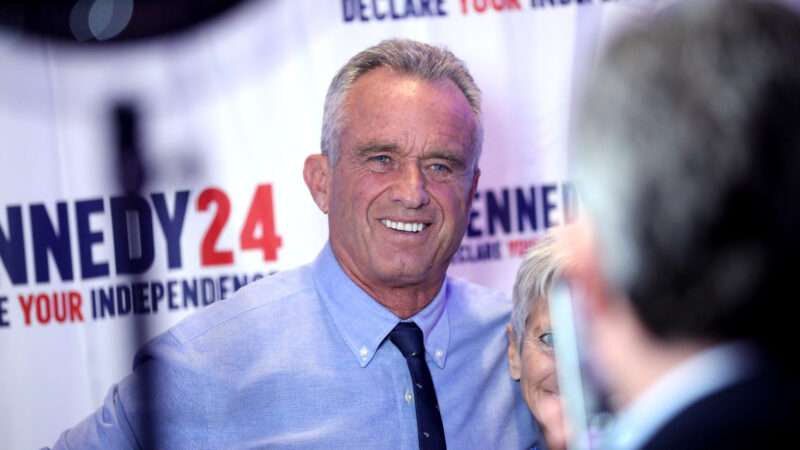
Robert Kennedy Jr. | Gage Skidmore/ZUMAPRESS/Newscom

The next general-election presidential poll you see will almost certainly be inaccurate.

Not because today’s projected percentages for President Joe Biden and former president Donald Trump won’t match what goes down in November; that’s a near-certainty. But rather, because the majority of polls right now list just those two candidates, in a voter-disillusioned year where most states’ ballots will feature at least five, maybe six.

And we’re not just talking about repeat randos like Rocky De La Fuente, either—independent Robert F. Kennedy Jr., with by far the highest favorability ratings in the race, has consistently polled higher than any nontraditional presidential candidate since Ross Perot in 1992. The centrist 501(c)(4) nonprofit No Labels, which is busy racking up ballot access in preparation for a post-Super Tuesday decision about whether to enter the fray, has been eyeing such nationally known figures as Sen. Joe Manchin (D–W.Va.) and former New Jersey Gov. Chris Christie.

Jill Stein, with more name recognition than any Green candidate since Ralph Nader, is again seeking the nomination of a party confident about improving on its 30 ballot lines from 2020. And the Libertarian Party (L.P.) may have lesser-known presidential candidates running thus far but is riding a three-election streak of third-place finishes, enjoys a large lead in third party registration, and expects to be on the ballot in 48 states. “I think that 47 would be a failure,” said Libertarian National Chair Angela McArdle.

When it comes to ballot access, an election-year February is a lot like spring training in Major League Baseball—every team predicts a pennant, players are in the best shape of their lives, etc. And the timeline for frequently onerous and always arbitrary state-by-state criteria is confusing enough to render much of the discussion about potential third party effects speculative, even conspiratorial.

What we do know is this: As of January 26, according to the indispensable Ballot Access News, the L.P. was on the ballot in 35 states, the Green Party 19, No Labels 12 (that number is now 14), the Constitution Party 12, and RFK Jr. just one. For the three holdover parties, those numbers represent slight declines from where they were four years ago.

This does not remotely mean that Kennedy will lag behind the Constitution Party, whose 2020 nominee, Don Blankenship, ended up on 18 ballots and received just 0.04 percent of the vote. It instead means that pre-existing political parties are pre-qualified for certain states based on past performance and that the deadlines for every state except Utah (which will have at least a half-dozen names on the ballot, including Kennedy’s) are in the future, beginning with North Carolina on May 18.

“We won’t really know anything in February much,” Ballot Access News Editor Richard Winger says. “You’ll have to wait ’til March.”

RFK Jr. is sitting on dollar amounts that all the other long-toiling third parties can only dream about. Federal Election Commission reports released this week showed the Kennedy campaign closing 2023 with $5.4 million cash in hand, while his biggest supporting super PAC, American Values, ended the year with $14.8 million in the bank. Such money can go a long way in paying for petitioners in the three dozen or so states where independent candidates need to present 10,000 or fewer valid signatures to get on the ballot.

The Kennedy campaign—whose ballot access page is the niftiest in the biz—effectively reduced its signature requirements by a whopping quarter-million voters in mid-January, by announcing the formation of the We the People Party in five states (California, Delaware, Hawaii, Mississippi, and North Carolina), as well as the Texas Independent Party. In some states, like California, independent candidates have a much larger signature-gathering requirement than political parties (219,403 to an estimated 75,000, according to Ballot Access News); in others, such as Idaho, the ratio is reversed: just 1,000 for independents, 17,000 for parties.

“It’s a heavy lift,” Kennedy Press Secretary Stefanie Spear says. “Every state has their own rules, and some are easier than others….The Kennedy campaign is up to the task.” Spear, who is confident that RFK Jr. will be on the ballot “in all 50 states and the District of Columbia,” blamed the two-party system for making competitors spend a disproportionate amount of their time jumping through those procedural hoops. “Ballot access is the name of the game right now,” she says.

Richard Winger, for one, thinks that 50-state access for Kennedy is achievable, given the way the campaign has approached the problem to date, including having volunteers petition outside polling places during the New Hampshire primaries and exceeding the needed 3,000 signatures. “I think he can probably do it,” Winger says. “I was impressed that he got on in New Hampshire in one day.”

The two biggest ballot roadblocks for non-Democratic/Republican presidential candidates are in two of the country’s three largest progressive-run states: New York and Illinois. “There are the two problem-child states right now,” the L.P.’s McArdle says.

New York in 2019 moved up its petitioning deadline from August to May, then in 2020 jacked up the threshold for third parties to maintain their ballot status from 50,000 votes in the previous gubernatorial or presidential election to 130,000, or 2 percent of the vote. The upshot? “We only have six weeks to gather 45,000 verified signatures,” says Green Party Ballot Access Committee Co-Chair Tony Ndege. “So that means we’re really going to have to shoot for over 60,000, really close to the 70,000. And that’s a really tall order. Very few parties, and almost no one without millions of dollars, have been able to achieve that.”

Ndege, like many people who work in these trenches, expresses something close to wonder when talking about the volume of challenges. “It’s just insane,” he said. “You can spend four years studying it, nothing but that, and it’s still very difficult, and it always changes too, because that’s how politics works.” Yet he’s bullish for the Greens this year. “We’re definitely far ahead of where we were in 2020,” he says, predicting that the party will “absolutely” clear that election’s 30 ballot-qualified states, and is pushing toward the goal of matching 2016’s 45.

The biggest wild card in the third party/independent space right now is No Labels, since there is still no indication whether, let alone how, the problem-solving centrists will compete against Trump and Biden. Amid a flurry of lawsuits and other legal maneuvers, the organization is giving itself until March to make a decision, and then (if the answer is “yes”) rush to select a ticket.

The comparative lateness of those decisions will keep the organization from obtaining clean ballot access everywhere. But still, says No Labels Chief Strategist Ryan Clancy, the group is on target to be on the ballot in 32 states.

“The reason for us to get 32,” Clancy says, “is there’s 18 states where they fall into one of two categories: Either one, you need to have a named candidate; or two, the threshold for a candidate is just much lower than a group like No Labels. So for example, a state might require No Labels to get 30,000 signatures, whereas a candidate would only have to get 3,000….So the way this would work is, in the end, No Labels will get 32. If we offer our ballot line to a ticket, the campaign itself would be responsible for getting those final 18. The good news, though, is we are absolutely ahead of schedule, relative to basically anybody else historically. Just for context, Ross Perot at this point in 1992 hadn’t even started getting signatures, and he ended up on all 50 states by September. So we’re exactly where we need to be.”

The Green Party, too, will be looking to fill ballot gaps with individual exertions from their eventual nominee.

Because of the group’s comparatively large war chest and potentially higher-profile candidates, No Labels has already attracted a nearly vicious level of interest from political professionals looking to remove obstacles from the reelection of Joe Biden.

“Through every channel we have, to their donors, their friends, the press, everyone — everyone — should send the message: If you have one fingernail clipping of a skeleton in your closet, we will find it,” a participant in a December anti–No Labels strategy session attended by the likes of Move On  and The Lincoln Project said, according to Semafor. “If you think you were vetted when you ran for governor, you’re insane. That was nothing. We are going to come at you with every gun we can possibly find. We did not do that with Jill Stein or Gary Johnson, we should have, and we will not make that mistake again.”

Clancy, who used to be a speechwriter for Biden, said he has been surprised by the vitriol. “Look, I’m not naive. I didn’t expect either party would welcome us with open arms,” he says. “But the depth of the cynicism and hypocrisy has surprised me. Because if you listen to the groups that are coming after us,…they all wrap themselves in the banner of protecting democracy, saving our republic. So it’s all this high-minded B.S., and yet what they’re really doing is just the most bare-knuckled, ruthless things they can. Not just the lawfare kind of stuff…but threatening donors, candidates.”

While No Labels deliberates, the main public third-party focus is likely to remain on Kennedy, which, along with some shared policy interests, is one reason that some L.P. officials are nurturing relationships with the independent, including inviting him (along with Cornel West) to the California Libertarian Party convention in late February.

CNN’s Michael Smerconish set off a round of headlines and intra-Libertarian discussion last week by asking a mostly demurring RFK Jr. about his interest in seeking the L.P. nomination in late May. It would be “a big controversy,” McArdle says, “but it would definitely save us on ballot access.”

“We can go with Bobby Kennedy and get 50-state ballot access very easily, or we can stick very closely to our principles, because he does deviate from our platform in a handful of areas at least,” McArdle continues. “But I want us to be sober about the decision we make, conscious of it, and to not have regrets and sour grapes.”

Asked if a potential L.P. nomination factors into the Kennedy campaign’s ballot-access deliberations, Press Secretary Spear said, “No.”

The post Presidential Ballot Will Be Crowded With Third Party Candidates appeared first on Reason.com.

from Latest https://ift.tt/HeBL25M
via IFTTT
Trump Election Case Now On Hold For 50 Days Amid Immunity Appeal

Trump Election Case Now On Hold For 50 Days Amid Immunity Appeal

Authored by Jack Phillips via The Epoch Times (emphasis ours),

Former President Donald Trump’s federal election case has been on hold for 50 days as he appeals to a higher court on grounds that he is immune from prosecution.

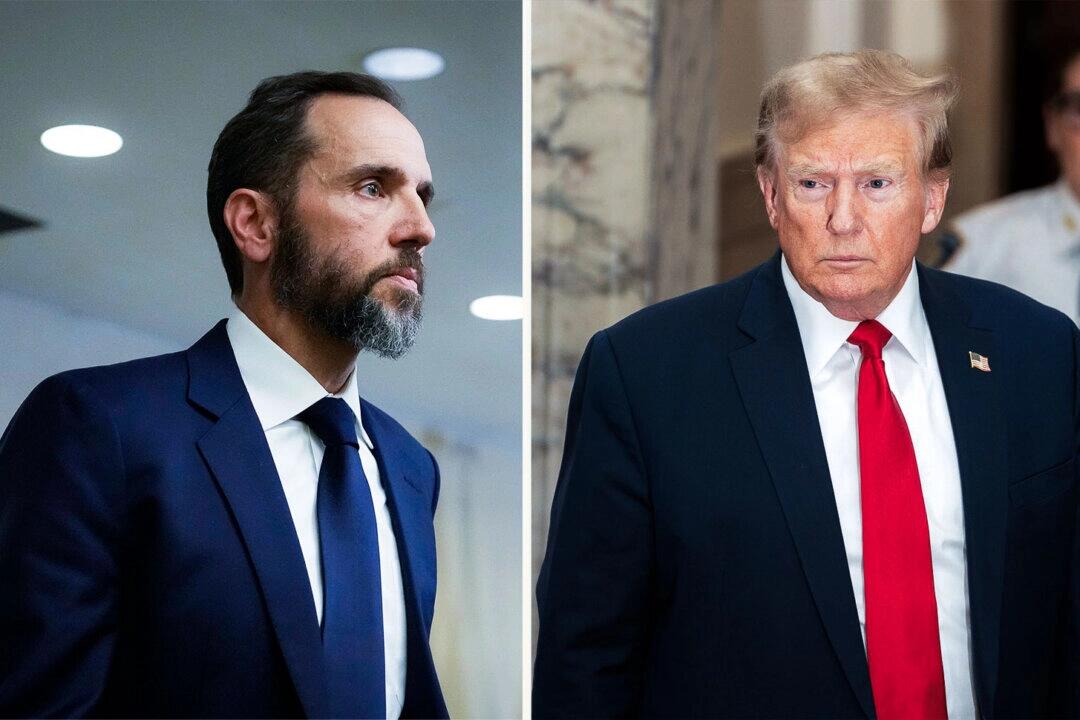
(Left) Special counsel Jack Smith in Washington on Aug. 1, 2023. (Right) Former President Donald Trump. (Drew Angerer/Getty Images; David Dee Delgado/Getty Images)

On Dec. 13, 2023, U.S. District Judge Tanya Chutkan issued a pause in the election case in Washington and has signaled, on at least two occasions, that the March trial date that was scheduled last year will likely not hold. The judge also halted the submission of any major motions by President Trump’s attorneys and federal prosecutors.

The case will not resume until the D.C. Circuit Court of Appeals resolves the question of whether the former president is immune from criminal prosecution. His attorneys have argued that this is because his activity after the 2020 election was part of his official duties.

When the appeals court, which hasn’t signaled when it will issue an order, renders its decision, President Trump will likely appeal the matter to the U.S. Supreme Court. If that happens, it’s not clear when the election case will resume.

The timing of a decision by the panel will indeed be a critical determinant of whether the case can go forward expeditiously, Daniel Richman, a Columbia University law professor, told Politico this week. “Quite a few stars would have to align before the trial can proceed,” he added.

Matthew Seligman, a former appeals court law clerk who filed a separate court motion in the immunity case, told the outlet that it’s not clear when the D.C. appeals court will issue a decision. There’s no sign that “we’re really close to a point where the judges in the majority would consider taking whatever measures they could … and it’s not clear what those are,” he said.

D.C. Appeals Court Judge Karen Henderson, the senior judge on the panel, has said she opposes taking the immunity case on an expedited timeline. She also has the right to write the majority opinion if she is part of the majority, as she is the most senior judge on the panel. If she dissents, the judge could also delay the ruling for weeks, the article noted.

Other Activity

In January, Judge Chutkan signaled for a second time that there is a good chance the Trump trial date will likely be postponed to a later date. In a case involving a Jan. 6 defendant, she scheduled a trial for that individual for early April.

Special prosecutor Jack Smith, who brought the charges against the former president, has said that President Trump’s trial will likely take four to six weeks to complete, meaning that the March 4 date will very likely push up against or even conflict with the Jan. 6 defendant’s trial.

Weeks before that order, the U.S. district judge wrote that the March 4 date was meant to provide both the Trump team and the Smith team with more time to prepare. She also adopted President Trump’s lawyers’ recommendations to prevent both the defense and prosecution from issuing new “further substantive pretrial motions without first seeking leave from the court” and that the former president “forfeits no arguments or rights by choosing not to respond at this time.”

Judge Chutkan wrote in January that the Trump team could file more objections to any recent court motions made by the special counsel, even if the D.C. Court of Appeals sends the case back to her jurisdiction.

Several weeks ago, multiple legal analysts said that the March 4 trial start appears to be unlikely at that point. One, a former federal prosecutor, has said it appears unlikely that the trial will start before the November 2024 election due to the appeals process.

“That process will take months, and unless Judge Chutkan lifts the stay, there is a possibility that Trump’s trial does not happen before the November election. The other trial scheduled in April is a reflection of that reality,” Neama Rahmani, the head of West Coast Trial Lawyers, said.

Prosecutors acknowledged in December that the case had been paused, but they said the government would “continue to meet its own deadlines as previously determined” by the court “to promote the prompt resumption of the pretrial schedule” if and when the case returns to Judge Chutkan.

President Trump is accused of conspiring to overturn the 2020 election, which he has vehemently denied. It is one of four criminal cases the Republican candidate is facing as he vies to return to the White House this year.

He has pleaded not guilty to the four cases against him, arguing that the charges were brought to denigrate him politically.

He also faces a civil lawsuit brought by New York Attorney General Letitia James and was recently ordered by a jury to pay writer E. Jean Carroll $83 million in a defamation case she brought against him. President Trump also denied the accusations made in that case.

The Associated Press contributed to this report.

Tyler Durden
Fri, 02/02/2024 – 15:45

via ZeroHedge News https://ift.tt/ZOJksbi Tyler Durden

Forget AI Bubble. A New One Emerges As Space Firms Prepare For IPO Launchpad

Forget AI Bubble. A New One Emerges As Space Firms Prepare For IPO Launchpad

The world’s first commercial spaceplane entered the final testing phase ahead of its first flight in 2024 in December. Now, the company behind the orbital-class spaceplane, Sierra Space Corp., is laying the groundwork for an initial public offering and possible acquisitions.

On Thursday, Sierra Space Chief Executive Officer Tom Vice spoke with Bloomberg about Sierra’s plans to tap public markets. Vice said IPO timing is uncertain but will take the leap “when the market looks like it’ll give us the right credit for valuation.”

“We want access to the public markets,” the exec said, adding, “We’ve been working for a year and a half to make sure that we are public company ready.”

When Powell starts cutting interest rates? 

Vice also said “inorganic add-ons” and “consolidation activity” – this is fancy CEO speak for mergers and acquisitions. 

Vice’s comments were ahead of a media event yesterday at NASA’s facility in Sandusky, Ohio. The space agency revealed Sierra’s Dream Chaser to the public, indicating it could resupply cargo to the International Space Station. 

At the event, Vice said, “The most significant industrial revolution is underway in space.” 

He continued: “The signs are all around us that we’re now living in the orbital age.”

Separately, a recent Bloomberg report indicated Elon Musk’s SpaceX company might spin off Starlink for an IPO later this year. 

So, forget the AI bubble. There’s a new one emerging: space. 

Tyler Durden
Fri, 02/02/2024 – 15:20

via ZeroHedge News https://ift.tt/P8J3qhY Tyler Durden

VIX – The Calm Before The Storm

VIX – The Calm Before The Storm

Via SchiffGold.com,

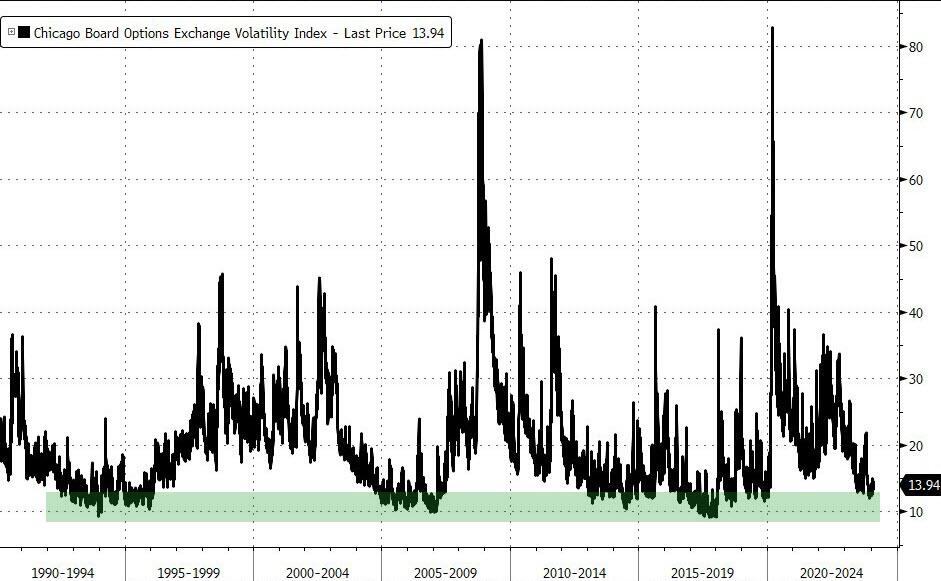
The VIX, often referred to as ‘Wall Street’s fear gauge,‘ is currently portraying a sense of calm among investors, registering well below the 20 level. 

For those not acquainted, the VIX draws its value from S&P index options with near-term expiration dates, providing a 30-day projection of volatility.

While the VIX isn’t a precision instrument, it serves as a barometer of market sentiment.

Presently, the VIX hovers near its lowest point since January 2020, a period preceding the upheaval caused by the COVID-19 pandemic. Investors, lifted by this low volatility, have been propelling the equity rally for a substantial eight to nine weeks.

In early January, investor Steve Eisman highlighted the excessive confidence that marked the end of 2023 in the markets. For those unfamiliar, Steve Eisman gained notable fame for his role in ‘The Big Short,’ portrayed by Steve Carell in the movie adaptation of Michael Lewis’ book, with the character’s name changed to Mark Baum.

In a CNBC appearance, Eisman expressed unease about the current year, stating, “Everybody’s just a little too fricking happy.”

Over the past year, the S&P 500 index has surged by 24%. There is a strong inverse correlation between the US equity markets and VIX. As the VIX declines, stocks typically rally, and vice versa. 

Eisman’s cautionary stance towards market hype resonates with the age-old trader axiom concerning the VIX: ‘When the VIX is high, it’s time to buy, when the VIX is low, it’s time to go.’

At present, the prevailing VIX levels reflect a naive yet robust risk appetite in the financial markets, spurred by discussions of rate cuts for 2024.

“The market scaled a wall of worry throughout the entire year [2023],” remarked Eisman, highlighting that the majority of investors currently harbor optimistic sentiments about the economy.

He added, “Everybody is entering the year so bullish that if there are any disappointments, what’s going to sustain the market?”

The clear message here is that investors currently feel at ease driving up equities, buoyed by higher returns from the Magnificent Seven and a more accommodating interest rate environment, with no significant market shocks in sight.

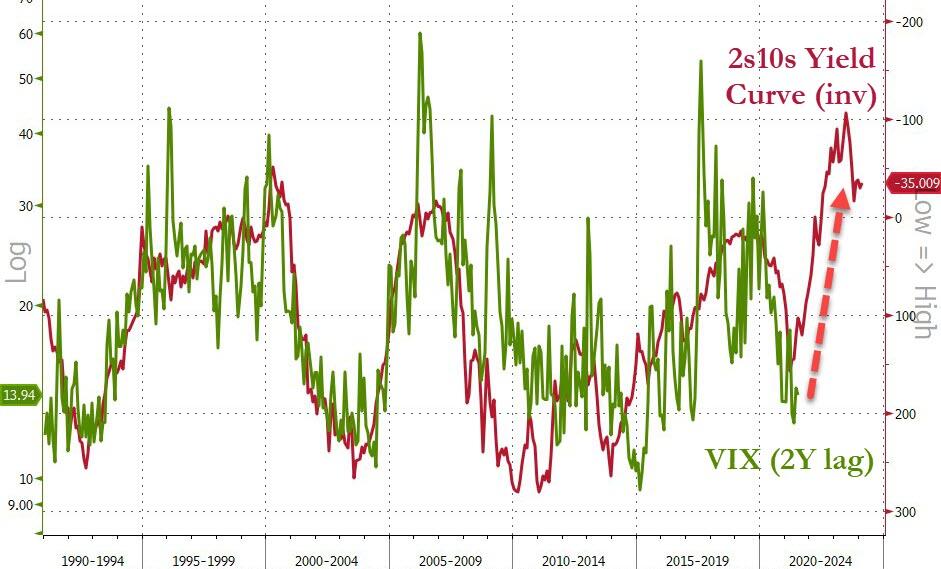
[ZH: And remember, the lagged yield curve is screaming for some serious volatility ahead…]

If the equity rally continues to gain momentum, there’s a potential for the rumored market melt-up. For the cautious observer, this raises sustainability concerns. Warren Buffett’s timeless advice resonates perfectly in this season of soaring equity prices: ‘When everyone else is scared, get greedy—and when everyone else is greedy, get scared.’

Tyler Durden
Fri, 02/02/2024 – 15:00

via ZeroHedge News https://ift.tt/IWCgZ13 Tyler Durden