How Increasing Immigration Can Reduce the Deficit


Colored game pieces on a map | Photo 158287155 © Chernetskaya | Dreamstime.com

Congress’ official number-crunching agency is using a flawed method of calculating the economic benefits of greater immigration—potentially leading lawmakers to have a skewed understanding of how more immigration can help reduce federal deficits.

That’s the argument made in an interesting new report by the Penn Wharton Budget Model, a fiscal policy think tank housed at the University of Pennsylvania, which claims that the Congressional Budget Office (CBO) is wildly underestimating how handing out more green cards to high-skilled immigrants could reduce the deficit by hundreds of billions of dollars.

Specifically, the Penn Wharton analysis reviews the CBO’s score of one portion of the America COMPETES Act, a sprawling Democratic proposal that rolls together a whole bunch of unrelated policies from manufacturing subsidies to wildlife trafficking. As Reason has previously reported, the bill is a mess. However, there are two worthy immigration-related proposals included in it, and the important one for the Penn Wharton analysis has to do with giving out more green cards to would-be immigrants with advanced degrees in science, technology, engineering, or mathematics (STEM).

When the CBO scored that part of the bill—Section 80303, if you’re following along at home—it found that allowing more STEM workers to immigrate to the U.S. would slightly add to the deficit because the CBO’s model assumes that a larger population means higher federal spending on health insurance programs like the subsidies delivered via the Affordable Care Act.

However, as the Penn Wharton report highlights, the CBO’s method of calculating the impact of greater immigration “excluded effects on taxable compensation and therefore on income and payroll tax revenues.” In other words, the CBO did not estimate how immigrants would inevitably contribute tax revenue to the federal government and instead looked exclusively at how immigrants would be consumers of federal spending.

That’s not the CBO’s fault. Under the rules that guide its work, the CBO is instructed to use so-called “conventional” estimates for most pieces of legislation, and conventional estimates do not account for the possibility that the size of the economy will change in response to certain policies. Under a different method of making estimates—known as “dynamic scoring”—the CBO is allowed to take into account economic growth and other factors, but that method was not used to score the America COMPETES Act (and is generally not used for evaluating immigration proposals).

“Because conventional budget estimates hold employment unchanged relative to current law, such estimates do not fully capture the budgetary impact of proposed changes in immigration policy,” the Penn Wharton report notes.

What happens when dynamic scoring is used to estimate the fiscal impact of handing out more green cards to highly skilled immigrants? Instead of causing a small net increase in the budget deficit, the Penn Wharton analysis found a huge reduction in the long-term deficit. While federal spending would still increase by about $4 billion over the decade, federal revenues would increase by $133 billion in the same period. That’s due to “additional collections of individual income taxes (about two-thirds of the total) and payroll taxes (about one-third of the total) that would result primarily from an expansion of the U.S. labor force.”

That’s a huge difference. And it reflects what other research has shown: More legal immigration grows the economy, helps fund government programs, and doesn’t strain entitlement or welfare programs.

As the Penn Wharton analysis points out, this is more than a debate over the proper way to score a piece of legislation. Underestimating the fiscal benefits of immigration can have a material impact on the passage of legislation, because “the estimated effect of a proposal on the deficit is especially salient in the legislative process,” the Penn-Wharton report points out. “Proposals that are estimated to increase deficits are subject to additional points of order and other procedures that affect their consideration by Congressional committees and by the full House or Senate.”

Fixing America’s broken immigration system is going to be hard enough without Congress relying on faulty economic estimates that hide, among other things, how greater legal immigration can help reduce the budget deficit.

The post How Increasing Immigration Can Reduce the Deficit appeared first on Reason.com.

from Latest https://ift.tt/yO3javp
via IFTTT

Must Government Fund Science?


Tony Mills debates Terence Kealey | Illustration: Brett Raney

M. Anthony (Tony) Mills of the American Enterprise Institute and Terence Kealey of The Cato Institute debate the resolution, “Government must play a role in fostering scientific and technological progress by funding basic research.”

Defending the resolution is Mills, a senior fellow and director of the Center for Technology, Science, and Energy at the American Enterprise Institute. He is also a senior fellow at the Pepperdine School of Public Policy and a scholar associate of the Society of Catholic Scientists. Dr. Mills was previously a resident senior fellow at the R Street Institute and an editor for numerous publications. His writings have appeared in The New York Times, The Wall Street Journal, The New Atlantis, National Affairs, Issues in Science and Technology, and various peer-reviewed journals. He holds a Ph.D. in philosophy from the University of Notre Dame.

Taking the negative is Kealey, an adjunct scholar at the Cato Institute. Originally trained in medicine and biochemistry, he is a former lecturer in clinical biochemistry at the University of Cambridge. Between 2001 and 2014 he was the vice-chancellor of the University of Buckingham. He is known for his 1996 book, The Economic Laws of Scientific Research.

The post Must Government Fund Science? appeared first on Reason.com.

from Latest https://ift.tt/PuLmb0j
via IFTTT

Houston Faces First Amendment Lawsuit for Cracking Down on Feeding the Homeless


Food Not Bombs table with donated food on it | Stephen Zenner / SOPA Images/Sip/Newscom

For months, Houston police have been citing and arresting local volunteers for the radical act of feeding the needy. Now the city is facing a lawsuit alleging that its crackdown on charitable giving violates the First Amendment.

The Texas Civil Rights Project filed a federal civil rights lawsuit Wednesday on behalf of the Houston chapter of Food Not Bombs (FNBH), a volunteer group that distributes free food in cities worldwide. Since last March, Houston has been trying to force FNBH activists and other volunteers to move their charitable food services to a city-approved parking lot rather than near the downtown library where they had been operating with the city’s consent for more than a decade. According to the suit, FNBH members have received over 89 citations from police so far, amounting to $178,000 in fines. 

The suit argues that Houston’s anti–food sharing ordinance is unconstitutional both on its face and as applied to FNBH by imposing an invalid prior restraint on the activists’ protected First Amendment rights. The city is also violating FNBH’s right to expressive association, the group argues, by attempting to force them to move to the parking lot, which happens to be next to a Houston Police Department building and is patrolled by several officers during events.

Randy Hiroshige, a Texas Civil Rights Project attorney, says the issue isn’t just about handing out sandwiches; it’s about the government trying to suppress political speech.

“They’re a protest group,” Hiroshige says of Food Not Bombs. “They want to be visible, and the reason they conduct their food sharing is to show the public what it looks like when a community looks out for each other’s needs and really provides mutual aid to one another.”

FNBH and other groups had been operating outside the library with the city’s consent since the 2012 ordinance was passed, but city officials now say the situation is a health and safety issue. Former Houston Mayor Sylvester Turner suggested that the charity operations were driving families away from the library.

FNBH’s lawsuit notes that they serve food at 7:30 at night, well after the library has closed.

The city’s attempts to enforce the ordinance, which outlaws providing free food to more than five people “in need” at outdoor locations without permission, have not gone well. One activist was acquitted, while other cases have been dismissed and delayed because prosecutors can’t find jurors who are willing to fine people $500 for the crime of feeding the needy.

The city of Houston may not fare much better in civil court either. In 2014, the city of Dallas was forced to rewrite its food safety regulations and pay two ministries $250,000 after the ministries won a lawsuit challenging restrictions on charitable giving.

Similar cases have popped up elsewhere. The U.S. Court of Appeals for the 11th Circuit ruled in 2018 that distributing food was “expressive conduct” protected under the First Amendment. That decision was a response to a lawsuit by the Food Not Bombs chapter in Fort Lauderdale.

As Reason has previously reported, crackdowns on good Samaritans began spreading across the country during the first decade of the century, and that trend has accelerated in recent years as the number of homeless people in the U.S. has surged to record highs. Anti-camping and anti-panhandling laws are also proliferating.

“The city is also sending a message that they don’t want unhoused people to be visible to the public,” Hiroshige says. “And so in addition to this crackdown on the protected activity of food sharing, there’s also just this deeper trend of cities trying to remove unhoused people from the public sphere.”

The Houston mayor’s office did not immediately respond to a request for comment.

The post Houston Faces First Amendment Lawsuit for Cracking Down on Feeding the Homeless appeared first on Reason.com.

from Latest https://ift.tt/2BdNre5
via IFTTT

Texas Cops Held a Terrified Couple at Gunpoint After Raiding the Wrong House


Couple being raided by police | Illustration: Lex Villena

Tyler Harrington and his wife were asleep in their beds when four Harris County, Texas, Constable Officers burst into their home and held the terrified couple at gunpoint. While the cops eventually realized they were in the wrong house, they didn’t leave without admonishing the couple for keeping their door unlocked.

Harrington has now filed a lawsuit, arguing that the officers’ invasion of his home was an unconstitutional breach of his Fourth Amendment protections against unreasonable search and seizure.

On September 24, 2022, Officer James Lancaster responded to a call from a woman, named “Mrs. H” in the complaint, who said that she heard a knock at her back door. Lancaster spoke to Mrs. H and examined the outside of her property, finding nothing suspicious. 

Mrs. H also told Lancaster that her daughter and her daughter’s boyfriend would arrive to check out the house themselves. Mrs. H then decided to “get in her car and drive around until others came home.” When Mrs. H’s daughter and her boyfriend arrived, another neighbor, named “Mr. S,” called the police to report their truck as suspicious. When talking to dispatchers, Mr. S accidentally gave the wrong address for Mrs. H’s house, reporting Harrington’s address instead.

Soon, two more officers arrived. According to the complaint, Lancaster clearly should have known that dispatch had been given the wrong address. While pointing to Mrs. H’s house, he told the other officers, “That’s the house with the person knocking on the back door, that was the house earlier….I checked the one across the street.” In reference to Harrington’s address, he said he had “never been to this house.”

But the officers decided to enter the Harrington’s home anyway, testing both the front and back doors and finding them unlocked. A fourth officer arrived, and according to the suit, Lancaster told him that they were “waiting on the owner,” despite knowing that it was a different house than the one owned by Mrs. H, where the owner had left and was to return shortly.

Around midnight, two of the officers burst into the Harrington’s home with their guns drawn, shouting “Constable’s Office, come up with your hands out!” Harrington’s wife, whose full name wasn’t identified in the suit, was woken up by the officer’s shouting. She confirmed that she lived at the house, and one of the officers, Jared Lindsay ordered her to get her ID and come to the door.

Around the same time, Lancaster entered the home with his gun drawn, shouting the Spanish phrase for “hands up,” and began searching the home. As the officers held his wife at gunpoint, Tyler Harrington woke up and walked out of the bedroom, at which point the officers began pointing their guns at him as well, shouting questions at the couple. 

Eventually, the officers realized they were at the wrong house but still led the couple back into their own home at gunpoint. After releasing the couple, Lindsay told them that “someone had reported people searching the front and back doors of this house,” adding that the caller had told them the owner was gone. 

After again confirming that the Harringtons were the owners of their own home, the complaint claimed that Lindsay lectured the couple for not keeping their doors locked, telling them “because when we see a door unlocked like that, we’re gonna come in and make sure everybody’s safe.”

Several minutes later, the complaint alleges that Lindsay said of the couple, “Oh yeah they’re gonna complain…they’re gonna complain…we scared them.”

“No reasonable officer could have believed there was probable cause to enter and search Mr. Harrington’s house,” the complaint states. “Defendants’ flagrant disregard for Mr. Harrington’s constitutional rights subjected him to agonizing emotional pain, fear, severe and ongoing emotional injuries.”

Unfortunately, the Harringtons are far from the first people to be terrorized by police entering the wrong home. In 2020, Seattle police terrified an innocent woman when they burst into her apartment, which wasn’t even in the same building as the apartment they meant to search. In 2021, Illinois police detained a family for over six hours when they executed a search warrant on the wrong house. And a report released last year found that Chicago police raided the wrong house over 20 times between 2017 and 2020.

The post Texas Cops Held a Terrified Couple at Gunpoint After Raiding the Wrong House appeared first on Reason.com.

from Latest https://ift.tt/108CPu9
via IFTTT

Exxon, Chevron Beat Estimates, Report Second-Biggest Annual Profits In Past Decade

Exxon, Chevron Beat Estimates, Report Second-Biggest Annual Profits In Past Decade

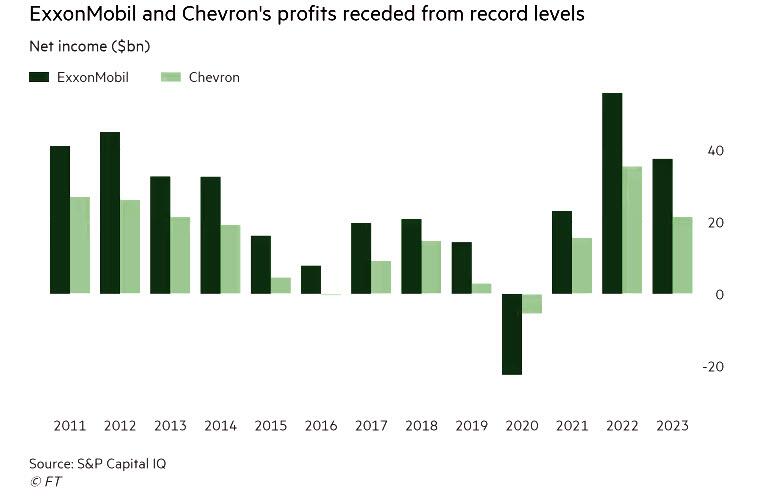
One wouldn’t know it from their stock price today, which has been slammed by tech bros shorting anything that does not mention AI at least 100 times in its press release/conference so they can fund their purchase of META 20% higher on the day, but in a time when two-thirds of US companies do not generate any GAAP profits, two of America’s cash flow titans – ExxonMobil and Chevron – reported their second-biggest annual profits in a decade thanks to surging oil production which offset a slide in prices that tempered earnings from the records hit in 2022.

At a time when OPEC+ and Saudi Arabia has been hurting due to a flood of oil by US companies, America’s oil supermajors increased output sharply in their own backyard in 2023, pursuing a strategy of doubling down on oil and gas that has prompted blowback over their commitment to cutting emissions .

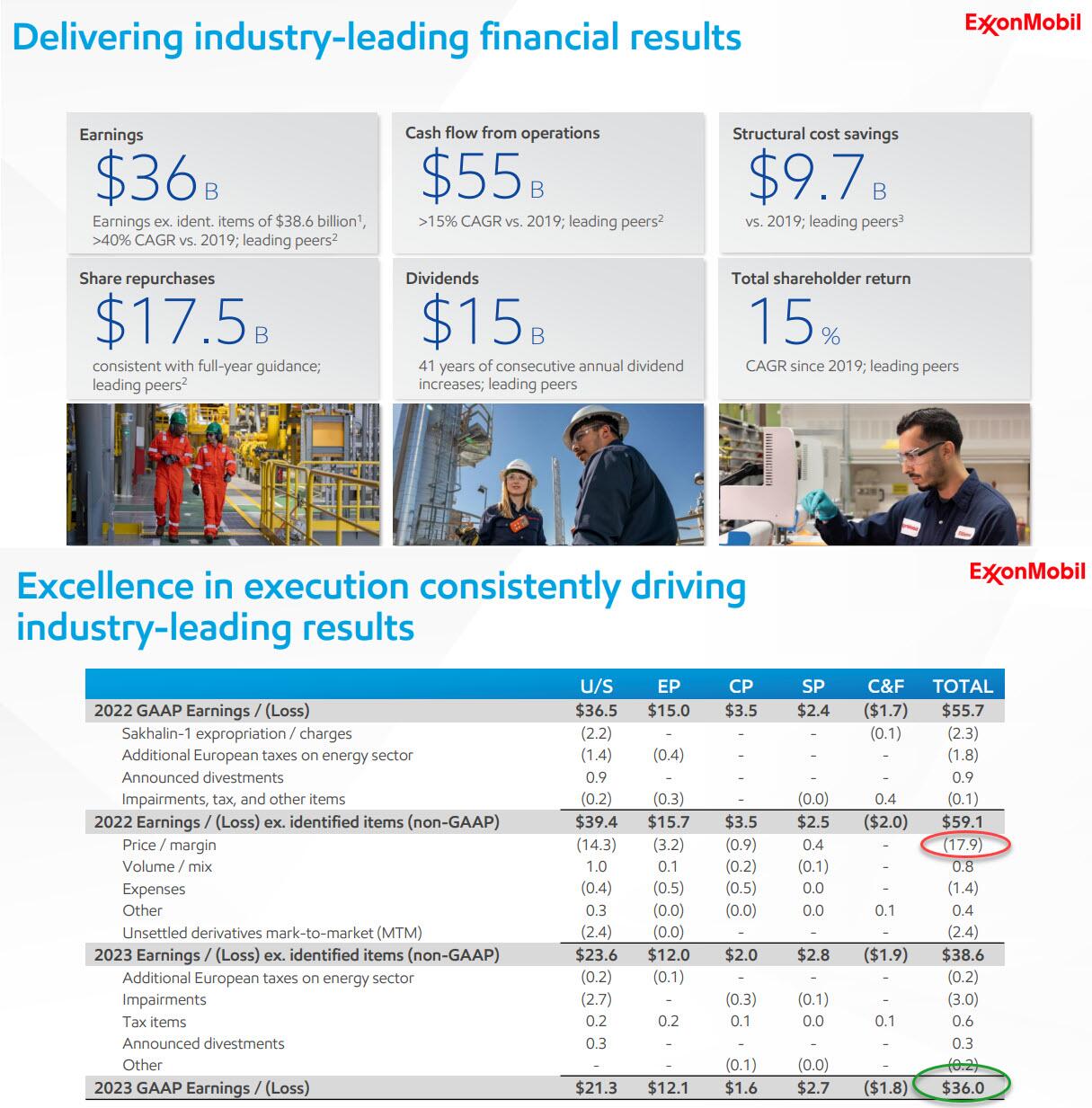
Exxon posted full-year net income of $36bn, down from $55.7bn the previous year due to a $17.9BN drop in price/margin, but otherwise its biggest since 2012 as Exxon CFO Kathryn Mikells hailed a “great end to a great year”.

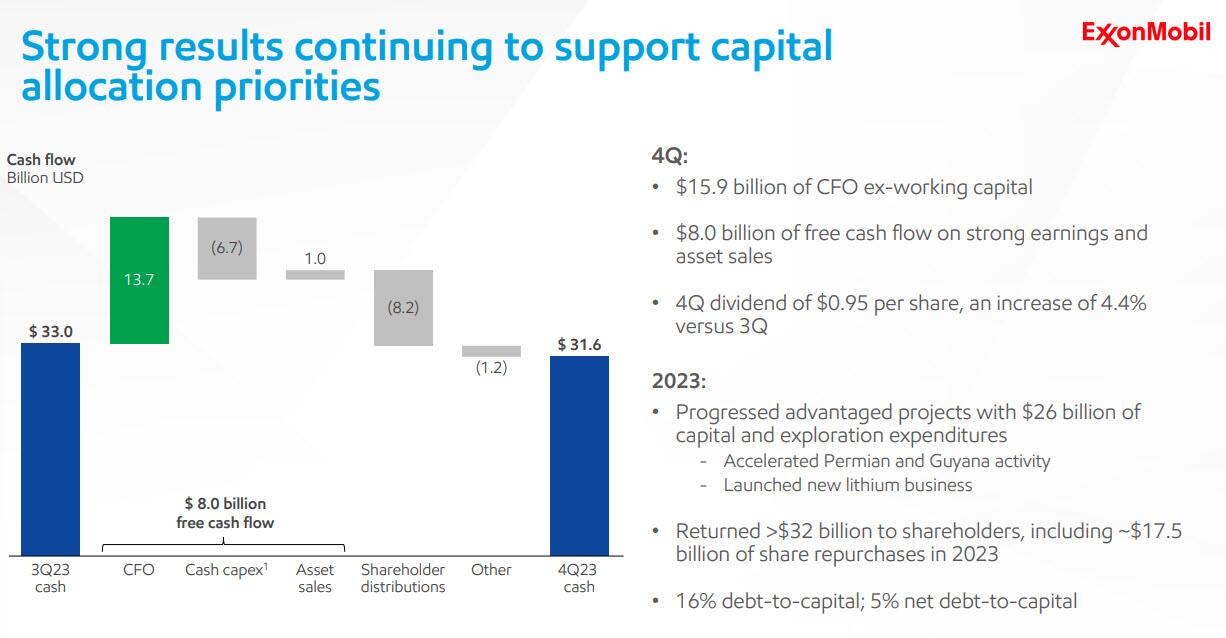
It also generated $55BN in cash from operations and returned $32.5BN to shareholders in the form of dividends and buybacks.

Also, as noted previously, Exxon’s nascent trading operation earned more than $1 billion in the last three months of 2023, an early sign the company’s expansion strategy is paying off. Exxon posted a $1.14 billion gain from trading for the fourth quarter, helping cushion the $410 million blow inflicted by lower oil prices and fuel production, the company said Friday. The company’s trading strategies were particularly successful in crude oil and refined-products markets, said Chief Financial Officer Kathy Mikells.

Exxon’s smaller peer, Chevron, reported net income of $21.4bn, down from $35.5bn the previous year, but otherwise its strongest since 2013.

Exxon’s net income for the fourth quarter was $7.6bn compared with $12.8bn the previous year. Chevron’s fell from $6.4bn to $2.3bn. Both companies were hit by writedowns flagged in January relating to paring back investment in California, where moronic regulators have taken a strong line against fossil fuel producers.

Bottom line: both companies beat earnings forecasts as bigger-than-expected oil output from shale fields helped cushion the blow from weakening crude prices.

Here are give key takeaways from Exxon’s earnings, courtesy of Bloomberg:

  1. Exxon is “well ahead” of its plan to double earnings-per-share from 2019 to 2027 at constant oil prices, CFO Kathy  Mikells said
  2. Executives pushed back on analysts’ concerns about Exxon’s high fourth-quarter capital spending. The company sometimes needs to front-load spending to take advantage of opportunities, with Guyana and the Permian benefiting from this approach, CEO Darren Woods said.
  3. Trading profits will be “embedded” into Exxon’s earnings going forward, but will bounce around quarter-to-quarter, Woods said. The company is still focused on trading around its assets rather than speculative bets
  4. Woods and Mikells highlighted Exxon’s strong project “execution,” which comes in marked contrast to peers that have struggled with major developments, like Chevron
  5. Chemicals will be “marginally better” this year than in 2023, but there won’t be a radical improvement, Woods said. Exxon’s new projects are both earnings and cash flow positive in the current environment, he said

And here is Chevron:

  1. No new delays at Tengiz, a critical megaproject in Kazakhstan; Chevron is on track for full startup in 2025, at which point it will “generate a lot of cash,” CFO Pierre Breber says
  2. Capital spending in the Permian Basin shouldn’t increase much more than the current $5 billion even as Chevron ramps from 867,000 barrels a day to 1 million barrels a day through next year
  3. The $10 billion to $15 billion of assets flagged for sale after the Hess transaction are more likely to come from Chevron’s legacy portfolio than the acquired company, CEO Mike Wirth said.
  4. Permian performance was much improved in the fourth quarter, especially drilling times, easing concerns from earlier in the year
  5. Chevron will continue to buy back shares consistently and not only when profits are healthy, CFO Breber says. The company bought back 5% of its outstanding stock last year, more than in 2022 when it had record profits.

While high commodity prices in the wake of Russia’s full-scale invasion of Ukraine pushed oil and gas companies globally to record profits in 2022 before receding last year, the steep drop in 2023 depressed revenues and profits, but in the end both US supermajors managed to more than offset what would have been a far worse outcome by increasing domestic production contributing to a boom in American output that took the market by surprise and helped keep a lid on prices even as the Opec+ group of oil exporters implemented substantial production cuts.

According to the DOE, the US pumped 13.3mn barrels of oil a day in November, more than any country in history and despite a sharp drop in operating wells. Much of the production growth has focused on the sprawling Permian Basin, which stretches across Texas and New Mexico, and where Exxon recently acquired giant shale driller, Pioneer Natural Resources which dominates the Midland Basin.

Exxon said combined 2023 output in the Permian and Guyana — where it has a stake in the biggest oil discovery of the past decade — was up 18%. Its overall US oil output rose to 851,000 barrels a day during the quarter from 789,000 b/d a year ago.

Chevron increased its Permian production by 10% in 2023, despite struggles with the productivity of ageing wells in the oilfield earlier in the year. It produced 1.16mn b/d in the US in the quarter versus 895,000 b/d previously, boosted in part by its acquisistion of PDC Energy.

“We had a strong quarter and it was really led by record production in the Permian,” Chevron’s chief financial officer Pierre Breber told the Financial Times. “There’s always things that are happening — it’s a big business — but we delivered on the plan.”

Unlike their woke, and increasingly more broke, European rivals which have idiotically shifted to renewable sources such as wind and solar, Exxon and Chevron have committed to increasing oil and gas production; to that end, both companies in October announced megadeals to acquire rivals, which are being reviewed by US regulators. Exxon announced it is buying Pioneer Natural Resources, the biggest producer in the Permian, for $60bn, while Chevron is paying $53bn for Hess, giving it access to the Guyana discovery as well as assets in the Bakken shale of North Dakota.

Sensing that the time of global ESG idiocy is over, Exxon recently took the unusual step of suing climate activists to block an emissions resolution from appearing at its annual meeting, arguing the regulators have been too lax in allowing repeat motions on to the ballot.

“We support the right of investors to bring proposals, but the process to get proxy proposals excluded is just flawed, with activists that are masquerading as investors who make the same proposals year after year that are garnering only minimal support along the way,” said Mikells.

Both companies ratcheted up capital expenditure during the year as Wall Street eased constraints on the industry’s ability to spend. Exxon’s outlay rose from $22.7bn to $26.3bn, while Chevron’s was up from $12bn to $15.8bn. They also ramped up share buybacks and dividends following last year’s profit haul, distributing $32.4bn and $26.3bn, respectively, to investors.

Shares in both companies rose about 2 initiall in pre-market trading, but have since dripped in the red as idiots short their stock to fund purchases of such AI bubbles as META and NVDA.

Tyler Durden
Fri, 02/02/2024 – 14:40

via ZeroHedge News https://ift.tt/8gw4Xj2 Tyler Durden

Asia’s Oil Imports Hit An 8-Month High In January

Asia’s Oil Imports Hit An 8-Month High In January

By Tsvetana Paraskova of OilPrice.com

Strong buying from China and India at the end of last year pushed Asia’s crude oil imports in January 2024 to the highest level in eight months, data compiled by LSEG Oil Research showed on Thursday.  

Crude cargo arrivals in Asia, the prized oil-importing region and the world’s biggest rose to 28.57 million barrels per day (bpd) in January 2024, up from 27.03 million bpd in December 2023, per the data reported by Reuters columnist Clyde Russell.  

Chinese crude imports were estimated at slightly lower levels compared to December, but much higher than in January 2023. India, for its part, is likely to have imported a record high volume of crude last month amid strong economic growth and rising fuel margins in Asia.

China, the world’s biggest crude oil importer, saw arrivals at 11.31 million bpd in January, just below the 11.48 million bpd imports in December, according to LSEG data. Last month’s imports into China were more than 1 million bpd higher than the 10.24 million bpd imports in January 2023.

China has boosted crude purchases since October, when oil prices started sliding from the 2023-year of over $95 a barrel in September, to take advantage of the lower prices.

Considering the time lag of around two months between crude purchases and nominations and the arrival of the crude in China, it could be concluded that Chinese refiners have continued to buy more oil when prices were falling.

China has also allocated a massive batch of crude oil import quotas to refiners, issuing full-year quotas to some. The early allocation of a large volume of import allowances would help refiners better plan their crude purchases in 2024, according to analysts. 

India, the world’s third-largest crude importer and Asia’s second-biggest, is estimated to have imported a record-high 5.33 million bpd of crude in January, up from 4.65 million bpd in December, per LSEG vessel-tracking data. Russia kept its top spot as India’s largest crude supplier, slightly ahead of second-placed Iraq.

Tyler Durden
Fri, 02/02/2024 – 14:20

via ZeroHedge News https://ift.tt/QZeNogi Tyler Durden

French Shipping Giant Is Latest To Suspend Red Sea Transit, As Details Emerge Of US Destroyer’s ‘Close Call’

French Shipping Giant Is Latest To Suspend Red Sea Transit, As Details Emerge Of US Destroyer’s ‘Close Call’

French container shipping giant CMA CGM has announced suspension of all its Red Sea transit due to security risks, Bloomberg has reported Friday, adding to a growing list of major firms now deeming the area too unsafe. 

The Bloomberg note additionally confirms that “CMA CGM will keep operating in the northern Red Sea but will not send its fleets through the southern part that is unavoidable for any vessel seeking to use Egypt’s Suez Canal to go between Europe and Asia.” With every addition of a shipping major, there’s yet further confirmation that the US-led ‘Operation Prosperity Guardian’ is failing

Via Reuters

“Hundreds of container ships and large numbers of oil tankers and commodity carriers have elected to avoid the area altogether,” Bloomberg underscores.

Until this week, CMA CGM had continued sending some vessels through the vital transit passage despite the almost daily Houthi missile and drone attacks, but which have been supported by French navy escort. But at this point it appears even the large Western warship presence isn’t enough.

This week, the US Navy saw its closest call yet when a Houthi-launched cruise missile came within a mere mile of the destroyer USS Gravely.

Details have only just emerged late in the week based on the accounts of several US defense officials. Presumably other longer range anti-air defenses failed as the missile was inbound close the ship. CNN describes:

In the past, these missiles have been intercepted by US destroyers in the area at a range of eight miles or more, the officials said. But the USS Gravely had to use its Close-In Weapon System (CIWS) for the first time since the US began intercepting the Houthi missiles late last year, which ultimately succeeded in downing the missile, officials said.

The CIWS, an automated machine gun designed for close-range intercepts, is one of the final defensive lines the ship has to shoot down an incoming missile when other layers of defense have failed to intercept it.

So this “last line of defense” which utilizes a 20 mm radar-guided canon had to be activated. The mounted weapon is a General Dynamics and Raytheon-produced ship defense system which engages closely inbound targets

Fox News’ Pentagon correspondent Lucas Tomlinson has said this week marks the “first time in history CIWS (‘sea-wiz’) has been used in combat from a warship to destroy an incoming cruise missile seconds away from impact.

What has been clear based on other recent incidents is that Houthi drones and missiles are in some instances slipping through the Western navel coalitions ‘defense umbrella’.

We detailed a week ago how the US Navy essentially “lost a battle at sea” given that a missile landed in the water very close to a commercial vessel which was being escorted by no less than three US warships. During that time two American merchantmen – the Maersk Detroit and the Maersk Chesapeake – had been attempting to run the Bab al-Mandeb from south to north while being covered by the USS Gravely. But as with this fresh incident of the Gravely’s CIWS system having to engage at close range, one missile apparently slipped through in that Jan.17 encounter.

Below is a very different ‘close call’…

Tyler Durden
Fri, 02/02/2024 – 14:00

via ZeroHedge News https://ift.tt/XKF8bIV Tyler Durden

COVID-Era Back-Rent Now Due In Los Angeles

COVID-Era Back-Rent Now Due In Los Angeles

Authored by Rudy Blalock via The Epoch Times,

Starting Feb. 1, Los Angeles renters owe, in full, any unpaid rent between Oct. 1, 2021, and January 31, 2023, ending a pandemic-era policy.

In a statement issued Tuesday, Mayor Karen Bass assured Angelenos there are abundant resources to help renters in arrears.

“We must do all that we can to prevent people from falling into homelessness in the first place,” she said.

“Together with locked arms, we will continue our work to provide resources for the people of Los Angeles.”

According to the statement on the city’s website, for renters who may lose their rental now if they don’t pay back what’s owed, the Los Angeles Housing Department can help direct them to city resources, such as StayHoused LA—which offers free legal services—and encouraged those affected to “read their paperwork carefully” of any three-day eviction notices they receive, and file an answer within five days to avoid eviction.

Last week the Los Angeles City Council voted to continue eviction protections for those who are approved for rent relief and are awaiting funds, with the latest round—funded by the voter-approved 2022 Measure ULA, which adds a tax on home sales over $5 million to fund affordable housing and help prevent homelessness—totaling $30 million. So far only $7.9 million has been distributed, according to media reports.

Los Angeles landlords alone are owed an estimated $898 million, according to a recent analysis by Oakland-based Policy Link, a research organization, and the USC Equity Research Institute, which focuses on advancing racial and economic equity nationwide.

Apartment Association of Greater Los Angeles President Daniel Yukelson told The Epoch Times now that the deadline is here for those who owe back rent there shouldn’t be more eviction filings, as most tenants who owe have either moved or are now negotiating with landlords to settle their debt.

He said a rise in evictions is also unlikely “because owners are so financially strapped today. That’s the last thing that they want to do,” noting that many small mom-and-pop landlords are already struggling to stay afloat and don’t want to take on legal fees.

Because Los Angeles tenants can get free legal aid and their attorneys can fight for them at no cost, such can drag out the process costing the landlord tens of thousands in legal fees.

“Tenants get free attorneys, and these attorneys just drag the process along. They ask for a jury trial; they ask for continuance on continuance. Any minor thing that they could think of,” he said.

According to Mr. Yukelson, an eviction in Los Angeles can cost property owners as much as $50,000 and nearly a year in time, after everything is all said and done, so evictions are a last option for them, usually.

“These are very expensive endeavors,” he said.

Instead of the city of Los Angeles funding the potential for long-dragged-out legal affairs, Mr. Yukelson said it could save money, instead, by giving tenants what they owe to keep a roof over their head.

“They’re spending hundreds of dollars an hour on these private attorneys … when all the tenants need is a couple $1,000 just to get them over the hump,” he said.

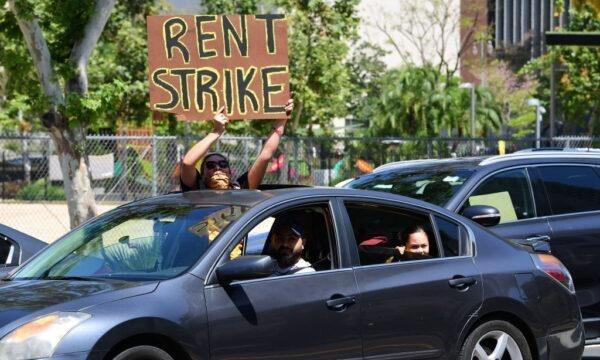
Demonstrators call for a rent strike during the COVID-19 pandemic as they pass City Hall in Los Angeles on May 1, 2020. (Frederic J. Brown/AFP via Getty Images)

According to data compiled by City Controller Kenneth Mejia, landlords sent an estimated 77,000 notices to Los Angeles renters from last February to December with 96 percent of such for overdue rent, with the average rent owed about $3,774. Hollywood had the most with over 5,000 notices followed by the Fairfax District with over 3,800.

In Los Angeles, eviction notices may only be filed for renters who owe at least one month of fair market rent, which varies by zip code ranging from around $2,000 in South Los Angeles to nearly $4,000 in the Fairfax, Melrose, Wilshire-La Brea area.

According to Mr. Mejia’s analysis, there were around 12,200 eviction notices filed where the rent owed was below one’s fair market monthly rent, which disqualifies the eviction.

Jan. 31 also marked the last day landlords with properties built before 1978 were prohibited from rent increases, a rule that has been in place since March 2020. Now landlords on those properties can increase the rent, until June 30, between 4 percent and 6 percent.

The Los Angeles County Board of Supervisors last year capped rent increase at 3 percent on rentals in unincorporated areas, which expired at the end of the year. The rent cap has now been extended until June 30, limiting increases to 4 percent.

Tyler Durden
Fri, 02/02/2024 – 13:40

via ZeroHedge News https://ift.tt/MZAkQdy Tyler Durden

Exxon CFO Calls Biden’s LNG Export License Halt A Big “Mistake”

Exxon CFO Calls Biden’s LNG Export License Halt A Big “Mistake”

It’s been one week since the Biden administration, under the guise of saving the planet from an alleged imminent climate disaster, slapped Texas with a “temporary pause on pending decisions of Liquified Natural Gas exports.”

Industry insiders, Wall Street, and even some government officials have been absolutely dumbfounded as to why the president would pause new LNG approvals in Texas, considering it the third-largest exporter of LNG in the world. Plus, Europe, more than ever, needs US LNG following the Nord Stream incident

However, it has become apparent that radicals in the White House punished Gov. Greg Abbott for defying the federal government over the border invasion. 

Even Senate Energy Committee Chairman Joe Manchin (D-W.Va.), a top critic within the Democratic Party on energy policies, recently vowed an investigation into the suspension of export licenses. 

Earlier this week, Jack Fusco, CEO of Cheniere Energy Inc., was quoted at the Baker Hughes annual conference in Florence, Italy, via Bloomberg, saying that the Biden administration’s decision to pause approvals of LNG export licenses “was very confusing.” He pointed out that US LNG helps lower dirtier fossil fuel generation emissions. 

Mike Sommers, president of the American Petroleum Institute, said the decision was “probably the worst energy decision that” Biden has made. He said, “Because of this pause, you’re probably going to see some investment that would have come to the United States, go elsewhere.” 

Then, on Friday, Exxon Chief Financial Officer Kathy Mikells was quoted in an interview by Bloomberg as saying the pause in new LNG approvals is a “mistake” and will reduce climate-damaging emissions. 

“Reducing production of LNG actually harms the world achieving net zero sooner rather than later,” Mikells said during an interview, adding, “It’s a mistake.”

Exxon and Qatar are constructing an LNG export terminal along the US Gulf Coast, called the Golden Pass project, which is slated for operation next year and has already secured all necessary government approvals, according to Mikells. 

LNG is 50% cleaner than coal when used in power generation. It makes zero sense why the admin would hit Texas unless one were familiar with Biden’s weaponization of federal agencies against opponents. 


Tyler Durden
Fri, 02/02/2024 – 13:20

via ZeroHedge News https://ift.tt/nRhHzDe Tyler Durden

CU Boulder Professor Dresses Like Butterfly To Fight “Climate Anxiety”

CU Boulder Professor Dresses Like Butterfly To Fight “Climate Anxiety”

Via The College Fix,

A theatre professor at the University of Colorado Boulder fights her “climate anxiety” by dressing and performing as a butterfly.

Theatre Professor Beth Osnes (pictured), who also teaches environmental studies classes, became “increasingly discouraged about the perilous state of our planet,” according to Colorado Public Radio. Her despair came while “she began doing research for one of her classes, Creative Climate Communication.

“I started to get that terrible ooze feeling, that comes in like a sickness that you get from despair. It was like swallowing crude oil or something,” Osnes told the news station. “Just the knowledge of what’s happening to our planet, it feels almost disabling. It almost puts your heart on the ground. And we can’t address the climate crisis if our hearts are on the ground.”

“In fact, the emotions that Osnes is describing — feeling helpless and despair around the climate crisis — have a name: climate anxiety,” CPR reported.

She performs her “Butterfly Affect Experience” “to inspire a collective commitment to co-create a world that is equitable, sustainable, and conducive to thriving life and ecosystems,” according to promotional material for a recent performance.

Florida State University Professor Sarah Fahmy also partakes, according to the event description. Fahmy previously studied at CU Boulder.

Osnes also produced a “climate musical” for young people to perform, according to her faculty bio and founded a group “for female and non-binary youth vocal empowerment.”

The performance does help her cope with her grief from losing her spouse, as well.

“I was widowed two years ago and I had to do a complete re-changing of myself … We can learn from the natural world that change doesn’t have to be scary, it can be beautiful even after loss,” Osnes said.

Most of her scholarship focuses on the intersection between creative arts and climate change.

Published papers include, “Lens on Climate Change: Making Climate Meaningful Through Student-Produced Videos,” “A Laughing Matter? Confronting climate change through humor,” and “Examining Climate Change and Sustainable/Fast Fashion in the 21st century: ‘Trash the Runway.’”

Young America’s Foundation, which first reported on Osnes, commented that “‘Climate anxiety’ has been peddled by the Left for decades. Unfortunately, many young people are being misguided by their teachers and professors into believing that the world is going to end, and the only way to stop it from doing so is to fall in line with the Left’s climate agenda.”

“Climate anxiety” afflicts most of Gen Z, according to a 2018 Gallup poll. “70% of Americans age 18 to 34 worry about global warming,” the polling company reported.

However, at least one professor is concerned that most of the concern comes primarily from white people.

“[A] year into the pandemic, after the murder of George Floyd and the protests that followed, and the attack on the U.S. Capitol, I am deeply concerned about the racial implications of climate anxiety,” California State Polytechnic University Humboldt Professor Sarah Ray wrote in 2021, as previously reported by The College Fix.

“If people of color are more concerned about climate change than white people, why is the interest in climate anxiety so white? Is climate anxiety a form of white fragility or even racial anxiety?”

Tyler Durden
Fri, 02/02/2024 – 13:00

via ZeroHedge News https://ift.tt/2Svifhc Tyler Durden