Atlanta Remains The World’s Busiest Airport

Atlanta Remains The World’s Busiest Airport

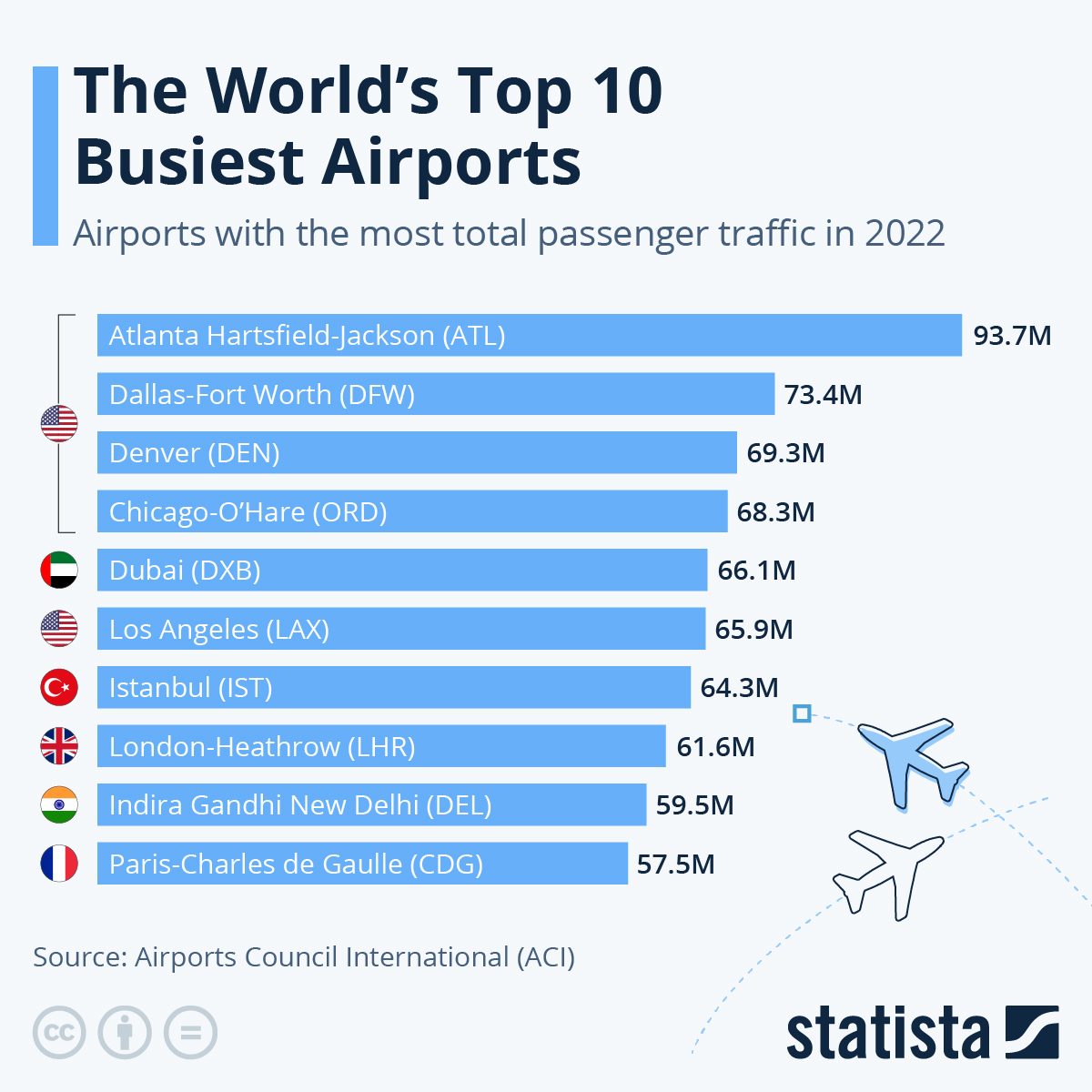
The airports with the highest number of embarking and disembarking passengers in 2023 have largely regained their pre-pandemic momentum, with Istanbul, Denver and Dallas-Fort Worth climbing 21, 10 and seven spots, respectively, to their current ranks.

Four of the eight airports in the top list can be found in the United States.

As Statista’s Florian Zandt reports, according to data released by industry association Airports Council International (ACI) in July 2024, Atlanta Hartsfield-Jackson was and remains the airport with the highest volume of passenger traffic.

The airport served 105 million passengers in the past year, down five percent compared to 2019 figures. Overall passenger figures, however, are still marginally below their 2019 level.

Infographic: The World’s Busiest Airports | Statista

You will find more infographics at Statista

ACI analysts saw 2023 passenger levels at 94.3 percent of the pre-pandemic year 2019, with a projection based on current trends putting passenger numbers at 104 percent for 2024 and 129 percent for 2029. In total, the ACI estimates a global volume of 8.7 billion passengers for 2023, up from 6.7 billion in 2022, with a domestic flight share of 59 percent. By 2025, the passenger volume is expected to cross the ten billion mark.

Other sources utilizing different methodologies paint a more conservative picture, even though the basic trend line shows a similar development. The airline interest group International Air Transport Association (IATA) estimated 4.4 billion scheduled passengers for 2023 in their December 2024 factsheet, with 2024 figures rising by around 500 million to roughly five billion. According to Kalliopi Lazari, Senior Communications Specialist at the IATA, the forecast “comprises total traffic, both domestic and international, and includes connecting traffic”.

Tyler Durden
Fri, 12/06/2024 – 22:35

via ZeroHedge News https://ift.tt/tzNZWD1 Tyler Durden

Canadian Government Wants To Send Guns It Just Banned To Ukraine

Canadian Government Wants To Send Guns It Just Banned To Ukraine

Authored by Dave DeCamp via AntiWar.com,

The Canadian government announced on Thursday that it was prohibiting its citizens from owning another 324 types of firearms and is working to send them to Ukraine.

“As part of its comprehensive approach, on December 5, 2024, the Government announced the prohibition of more military-style assault-style firearms,” Canada’s Public Safety Department said in a press release

“Amendments to the Classification Regulations have resulted in the prohibition of 104 families of firearms, encompassing 324 unique makes and models,” it added.

Canadians who own the newly banned guns have an amnesty until October 30, 2025, and during that time, the government will implement a buy-back program. Canadian Defense Minister Bill Blair said the government is in talks with Ukraine about sending them the firearms.

“We’ve been working very closely with our friends in Ukraine to ensure that weapons that were intended to be used in combat, could be made available to them,” Blair said.

“The Department of National Defence will begin working with the Canadian companies that have weapons that Ukraine needs and which are already eligible for the assault-style firearm compensation program, in order to get these weapons out of Canada, and into the hands of the Ukrainians,” Blair added.

Historically, Ukraine has had one of the largest black markets for weapons, and there has been very little oversight when it comes to Western military aid to the country.

Not a Babylon Bee headline despite all appearances… 

The Pentagon’s inspector general said in a report last year that some Western-provided weapons had been stolen by criminals, volunteer fighters, and arms traffickers.

Tyler Durden
Fri, 12/06/2024 – 22:10

via ZeroHedge News https://ift.tt/Zcjh9b6 Tyler Durden

Feds Accuse HelloFresh Of Employing Migrant Kids At Factory In Sanctuary State Illinois

Feds Accuse HelloFresh Of Employing Migrant Kids At Factory In Sanctuary State Illinois

German meal-kit company HelloFresh, the largest meal-kit provider in the US, faces fresh accusations from the US Department of Labor of employing migrant children at a factory located in the sanctuary state of Illinois.

ABC News has learned that federal investigators with the Labor Department are looking into allegations of migrant children working at HelloFresh’s cooking and packaging facility in Aurora, Illinois. 

Cristobal Cavazos, the executive director for Immigrant Solidarity, a migrant rights advocacy group that first reported the incident to the labor agency, told ABC that at least six teenagers from Guatemala were found working night shifts at the factory. 

“They’re minors working dangerous jobs,” Cavazos said. 

The labor agency is also investigating Midway Staffing, an agency that hires migrants, for possibly violating federal child labor rules, according to documents obtained by ABC.

“We were deeply troubled to learn of the allegations made against a former temporary staffing agency,” a spokesperson for HelloFresh told ABC in a statement, adding, “As soon as we learned of these allegations, we immediately terminated the relationship.”

Even though the hiring of migrant children to pack meal kits for US consumers may have been facilitated through a staffing company, HelloFresh is a partner of the Tent Partnership for Refugees.

Tent is an advisory nonprofit that mega-corporations use to work with resettlement agencies, staffing agencies, and other nonprofits, to source cheap migrant labor. You heard that correctly, this is not ‘America First’ – this is globalist open borders of cheap labor first.

For some context, Tyson Foods partnered with Tent for cheaper migrant labor, and as of March, the meat packer boasted about employing 42,000 migrants in its US 120,000 workforce. 

“We would like to employ another 42,000 if we could find them,” Garrett Dolan, who leads Tyson’s efforts to eliminate employment barriers, told Bloomberg in March. 

Of course, let’s not forget that Illinois Governor JB Pritzker signed legislation in 2021 that “expands protections for immigrant and refugee communities and further establishes Illinois as the most welcoming state in the nation.” 

Migrant children working in factories in a sanctuary state… Guess who made that possible… 

Staffing companies rounding up migrants like cattle and supplying them to mega food factories is a national phenomenon. It’s been observed in Springfield, Ohio and Charleroi, Pennsylvania and cities in Colorado, among many other places.

It’s a national national phenomenon. 

Last month, incoming “border czar,” Tom Homan, told “Fox & Friends” hosts that “Public safety threats and national security threats will be the priority…they pose the most danger to this country.” 

Homan said, “Where do we find most victims of sex trafficking and forced labor trafficking? At worksites…” 

Homan’s comment about the potential for large-scale worksite raids by Immigration and Customs Enforcement (ICE) agents next year reminded us of a note we shared with readers in March titled “How Shadowy Network Of NGOs Supplies Mega-Corporations With Migrants To Exploit Cheap Labor.”

Lining America’s food supply chain with unvetted migrants is a national security threat on so many levels. 

More companies will be exposed next year for employing illegals and even children. Shame on corporate America and Democrats who made this all possibly through open borders and a complex network of NGOs funded by you, the taxpayer. In return, the American people received armed and extremely dangerous Venezuelan prison gang members running amok nationwide

There’s a very simple solution: stop purchasing food from mega-corporations that heavily rely on migrants and instead buy from mom-and-pop farmers—or even the Amish

Tyler Durden
Fri, 12/06/2024 – 21:45

via ZeroHedge News https://ift.tt/8SGFbAQ Tyler Durden

Los Angeles Council Approves ‘Sanctuary City’ Ordinance To Protect Illegal Immigrants

Los Angeles Council Approves ‘Sanctuary City’ Ordinance To Protect Illegal Immigrants

Authored by Kimberly Hayek via The Epoch Times (emphasis ours),

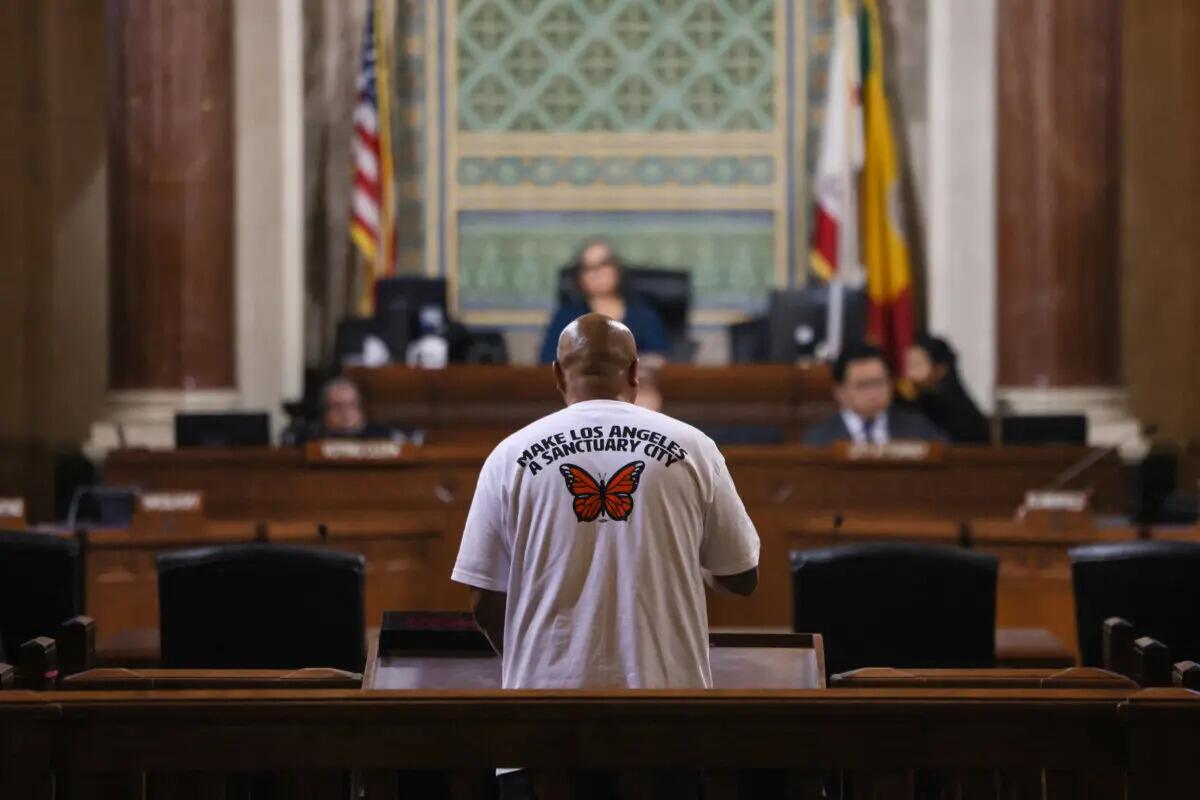
The Los Angeles City Council on Dec. 4 formally approved a “sanctuary city” ordinance, which will prohibit resources or personnel from assisting with federal enforcement of immigration laws.

The council voted 12–0 in favor of the ordinance with an urgency clause, meaning it could go into effect within 10 days of being signed by Mayor Karen Bass.

People in the audience hold up signs as the Los Angeles City Council considers a “sanctuary city” ordinance during a meeting at City Hall in Los Angeles on Nov. 19, 2024. Etienne Laurent/AFP via Getty Images

The council’s actions come after President-elect Donald Trump has indicated that he’s prepared to declare a national emergency to initiate mass deportations.

On Nov. 19, the council voted unanimously to move forward with the proposed ordinance. Because amendments were made to the language, however, it was brought up for a second vote.

In particular, the council adopted changes to the ordinance to align it with California’s “sanctuary state” law, Senate Bill 54, the California Values Act of 2017.

The council also created an exception whereby the Los Angeles Police Department (LAPD) is permitted to assist federal immigration officers for cases involving serious offenses.

For example, LAPD can communicate with U.S. Immigration and Customs Enforcement in cases where an illegal immigrant has been convicted of a violent felony, deported, but then came back to the United States. This procedure is already in line with LAPD practices, and has been used twice since 2018, according to city officials.

Elected officials celebrated the new ordinance as codifying protections for immigrants residing in the country illegally and prohibiting the sharing of data—direct or indirect—with federal immigration authorities.

The mayor has said she supports the measure.

This moment demands urgency,” Bass said in a statement last month. “Immigrant protections make our communities stronger and our city better.”

The ordinance enshrines some policies put into place by former Mayor Eric Garcetti during the first Trump presidency.

“We have been a pro-immigrant city for a number of years, we know that there is a target on our back from this president-elect, and what we are doing here is we are hardening our defenses,” Councilman Bob Blumenfield said on Nov. 19 during a discussion of the ordinance.

“We are codifying our good policies on protecting immigrants.”

A man speaks in support of a proposed “sanctuary city” ordinance during a meeting at City Hall in Los Angeles on Nov. 19, 2024. Etienne Laurent/AFP via Getty Images

The city first voted to approve the ordinance just two weeks after Trump won the 2024 presidential election on the back of a campaign in which he highlighted border security and deporting those without legal status in the United States as key parts of his platform.

“We’re going to send a very clear message that the city of Los Angeles will not cooperate with ICE in any way,” Councilman Hugo Soto-Martinez said, referring to Immigration and Customs Enforcement. “We want people to feel protected and be able to have faith in their government and that women can report domestic violence, crimes.”

The Los Angeles County Republican Party criticized the sanctuary city ordinance, saying, “A country without secure borders isn’t a country at all.”

Whether drunk driving, robbery, sexual violence, assault or murder, none of those should go unpunished. Perpetrators should definitely not be protected by the largesse taken from hard-working taxpayers.” the party wrote in a statement posted on social media.

Los Angeles has historically followed specific policies protecting illegal immigrants. For instance, the LAPD adheres to Special Order 40, implemented in 1979, mandating that officers do not inquire about immigration status or make arrests over an immigrant’s legal status.

Moreover, the city’s new police chief, Jim McDonnell, has pledged to not help with deportations or determining people’s immigration status.

The Los Angeles Unified School District Board of Education in November adopted a resolution reaffirming its status as a “sanctuary district.” In addition, the Los Angeles County Board of Supervisors recently approved a motion to create a task force to track the impact of evolving federal immigration policies. The board will also consider creating a Department of Immigration Affairs.

Upon passing the new ordinance, Los Angeles will join more than a dozen cities across the United States with similar provisions.

The Associated Press and City News Service contributed to this report.

Tyler Durden
Fri, 12/06/2024 – 21:20

via ZeroHedge News https://ift.tt/TGKqan5 Tyler Durden

Taylor Swift Remains The Queen Of Spotify

Taylor Swift Remains The Queen Of Spotify

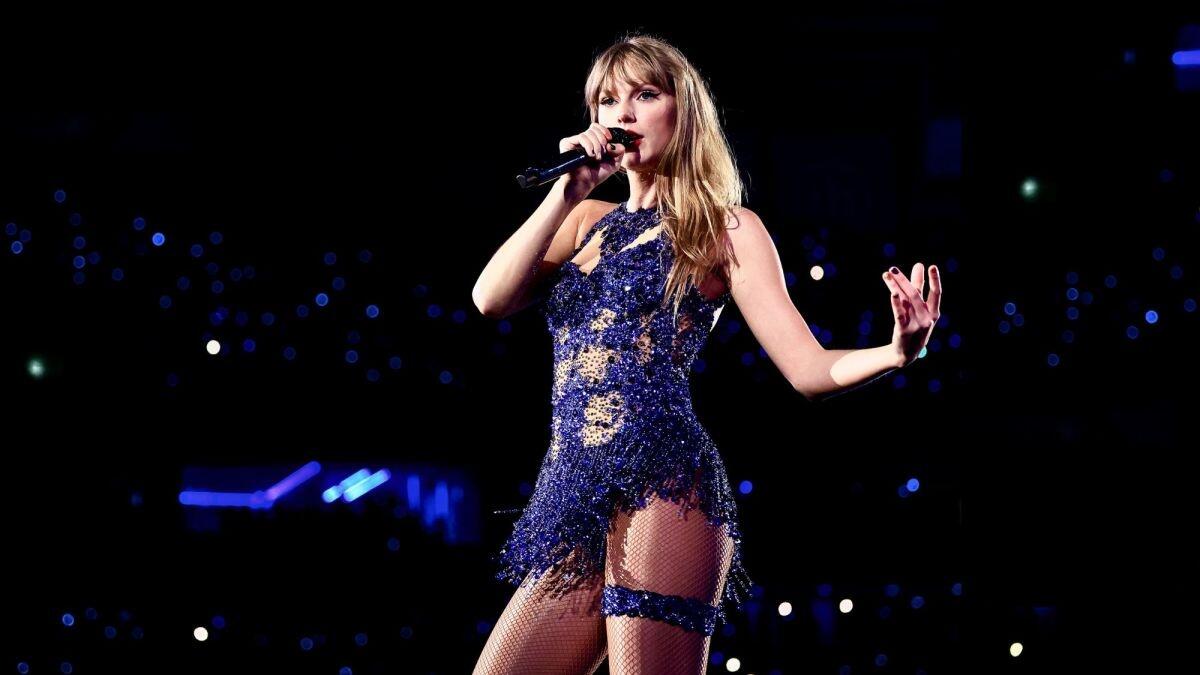
Spotify unleashed its annual Spotify Wrapped playlist on Wednesday, bringing subscribers around the world a run-down of their most played songs and artists. Data shows that pop queen Taylor Swift has once more topped the global charts as the most streamed artist this year, after having come first in 2023 and second in 2022.

The Weeknd comes in second place worldwide and in first place as the most streamed male artist.

The rap/R&B singer is followed by Bad Bunny, who has featured in the top three positions for the past three years.

As Statista’s Anna Fleck shows in the chart below, the rap/R&B genre as well as pop tend to perform well with a global audience. Rounding off the top ten in 2024 are Peso Pluma, Kanye West, Ariana Grande and Feid.

Infographic: Taylor Swift Remains the Queen of Spotify | Statista

You will find more infographics at Statista


The top five globally streamed songs this year are Sabrina Carpenter’s Espresso, followed by Benson Boone’s Beautiful Things, Billie Eilish’s Birds of a Feather, Floyy Menor and Cris Mj’s Gata Only and Teddy Swims’ Lose Control. Pop stars to have risen to the top of the charts in 2024 include the likes of Chappell Roan, Shaboozey and the aforementioned Sabrina Carpenter.

So, how did Spotify Wrapped come to be?

In 2016, Spotify renamed its “Year In Music” feature with the title “Spotify Wrapped” and also launched the “Your Top Songs” playlist. In 2021, the music streaming platform then introduced videos from fans’ favorite artists as well as the “Audio Aura” feature to show “top music moods”.

In 2023, Spotify Wrapped showed listeners which part of the world listened to music most similar to them, while in 2024, the theme focuses on listeners’ “Music Evolution”.

This latest edition nods to this year’s successful collaborations between artists such as Billie Eilish and Charlie xcx, Lady Gaga and Bruno Mars and Beyoncé and Miley Cyrus, with the company explaining that it is about celebrating how “unexpected genres emerge and merge, timeless influences meet fresh ideas, and what once was niche now shapes pop culture.”

Tyler Durden
Fri, 12/06/2024 – 20:55

via ZeroHedge News https://ift.tt/0TaAk6C Tyler Durden

These Upstart Classes Hold A Woeful Lack Of Civics Education To Be Self-Evident

These Upstart Classes Hold A Woeful Lack Of Civics Education To Be Self-Evident

Authored by John Murawski via RealClearEducation,

As the autumn sun warms the historic campus outside, a professor specializing in ancient and modern political philosophy guides undergraduate students through the seemingly ruthless nuances of Machiavelli’s 16th-century philosophy of morals. 

In another class, a professor specializing in political theory offers students a guided tour of the early American republic, as seen through the enlightened eyes of French political philosopher Alexis de Tocqueville. 

And a professor of rhetoric, who moonlights as a conservative political consultant in national races, diagrams the components of a bulletproof argument on a blackboard as he preps students for an upcoming class debate on the pros and cons of universal basic income. 

These vignettes may seem unexceptional, but they are at the center of an ambitious movement to reform what many see as the left-wing capture of America’s leading universities. The classes taught this fall in the University of North Carolina at Chapel Hill’s newly launched academic experiment, the School of Civic Life and Leadership (SCiLL), revive approaches and values that were once accepted as essential to shaping informed and virtuous citizens in a liberal democracy, but are now regarded with deep suspicion by many academics: the classical liberal arts, the great books, Western Civilization, Socratic dialogue, civil discourse.

More than 100 civics programs have arisen in the past quarter-century in academia – emphasizing everything from the Great Books and the Western canon to free markets and entrepreneurship. But UNC’s program is part of a new wave that’s on a wholly different scale in scholarly ambition and political heft. In less than a decade, conservative reformers have created 13 relatively large civics centers at eight public universities – including five in Ohio alone – designed to operate autonomously, similar to law schools or business schools, with their own deans, their own majors, sometimes their own Ph.D. programs, and in a few cases, their own designated buildings. 

Much of the mainstream media coverage of this movement has focused on criticism from the educational establishment – which commonly derides them as “freedom schools” and conservative “safe spaces” – because of the circumstances of their creation. Most have been launched by Republican legislatures, fast-tracked by conservative regents, and bankrolled by conservative donors. The civic schools often enjoy a great degree of independence as they are typically granted full control over faculty hiring, promotion, and tenure.

The education establishment, accustomed to having sole control over academic programming, casts these developments as a threat to academic freedom. Civics advocates say they must bypass the conventional procedural protocols because the left’s ideological capture of most campuses would make it difficult, if not impossible, to approve these programs. 

The classical learning and civics revival has long been associated with Christian private schools at the K-12 level and independent colleges like Hillsdale College, the Michigan private institution that staunchly refuses any federal funding, and the recently launched University of Austin. But the new wave of civics centers, while enthusiastically backed by conservatives, is rejecting the appeal of a cloistered virtue, and instead adapting traditional educational philosophies to operate within existing university cultures. 

After a series of faltering attempts to establish a viable liberal arts tradition over a century, the new civics centers are being built with longevity in mind. In some sense, they are the intellectual mirror of the successful effort by leftwing scholars and activists that began in the 1960s to seed departments – in African-American studies, ethnic studies, and women’s studies – that would exert a powerful influence on America’s universities and the broader culture. The 13 civics centers, which are expected to employ several hundred scholars, have been designed to supply the infrastructure – including financial support, academic posts, and professional conferences – to foster the next generation of civics intellectuals and further expand the movement. 

Civics pioneer Paul Carrese, founding director of the civics department at Arizona State University who also served as a consultant for UNC’s civics initiative, said he’s in “serious discussions” with faculty and administrators about creating civics centers at public institutions in four more states. Carrese also said there has been renewed interest in civics at elite private universities ever since Stanford University three years ago restored its common core, called Civic, Liberal, and Global Education, including a course in which students read and discuss a mix of canonical texts and contemporary scholars. 

Donald Trump’s election could aid the movement, as the president-elect and his supporters are vowing to reclaim universities from “Marxist maniacs,” in part by withholding accreditation, freezing federal funding, and taxing endowments, or by mothballing the U.S. Department of Education.

As an intellectual movement, civics represents more than a surgical strike against the dominant progressive mindset and hyper-partisanship that define elite campuses. The professors and leaders involved describe civics as nonpartisan, apolitical, and pluralist. They see themselves as leading a revival of the classical liberal tradition that not only rejects social justice advocacy as a university’s prime directive but also challenges academia’s hyper-focus on careerism and vocationalism and pushes back against the academic fetish for arcane sub-specialization within some disciplines.  

“It is based on an ancient and powerful set of ideas,” said SCiLL dean Jed Atkins, a classics scholar in Greek and Roman political thought and moral philosophy. “I’m not making any of this up whole cloth. This comes from an established tradition.” Among the movement’s immediate challenges: attracting undergraduates to sign up for civics courses and to major in the discipline. In addition to stock courses on federalism, diplomacy, military history, constitutional rights, and the like, civics schools offer classes that are hip, cool, fun, and philosophical at the same time: explorations of happiness, friendship, immortality, faith, war, espionage, and other perennial themes that could easily be the subject of a Ted Talk. 

Some civics professors wade into present-day moral minefields where tenured faculty fear to tread, exposing students to readings and discussions of the most sensitive subjects, like reparations, misgendering, trans athletes, abortion, and polyamory.  

Carrese said civics education is maligned as affirmative action for conservatives but should be understood as the restoration of the original charter of the public and private university:  to prepare educated, responsible, engaged citizens. 

Part of the challenge for this movement going forward is to show that although in every single case these programs have been initiated by Red States, they’re not ipso facto a Republican partisan ideological enterprise,” said Carrese, who now consults on strategy for the Jack Miller Center, a suburban Philadelphia nonprofit that provides training and support for civics professors and K-12 teachers. 

The Jack Miller Center has provided workshops and programs for more than 1,200 professors, including Carrese and most of the leadership cadre of the 13 civic centers, serving as a kind of networking hub for the movement. 

“You can look at who’s been hired, what the courses are, what the enrollment is, what the public speakers programs are,” said Carrese, who is also a professor of moral and political thought in the Arizona civics program. 

For Nadège Sirot, a first-year UNC student who plans to major in classics and minor in civics, SCiLL has been a revelation. Her high school experience was marked by “tons of trigger warnings,” the occasional land acknowledgment, and open invitations for students to walk out of class if they felt uncomfortable or offended by the subject.

In civics, core knowledge, as understood in the American context, is not presented as just another perspective in a subjective buffet of equally valid options but as the intellectual foundation for all other learning. In the Carolina civics course, Sirot said, the approach is not “Do you agree with Machiavelli?” but rather, “Do you understand what Machiavelli is trying to say? What can this thinker teach us today?”

It’s a teaching method that has worked for centuries,” Sirot said. “And SCiLL is now trying to return to it.”

The new civics centers are generously funded, unmistakably ambitious, and already reshaping campus culture. The University of Florida’s Hamilton Center for Classical and Civic Education, which aims to build the nation’s top program in the study of Western Civilization, has 35 tenured faculty, runs about two dozen classes a semester with more than 500 students, and is slated to expand to 60 full-time professors. 

The Hamilton Center has recruited professors with pedigrees from the Ivy League, Oxford University, and other marquee institutions to teach such courses as “The Crisis of Liberalism,” “The Origins of Totalitarianism,” “God and Science,” “Utopias and Dystopias,” “Political Violence and Power,” and “Why Spy?”

UNC’s SCiLL department is set to expand from three courses this semester to 14 courses next year. Planned offerings include “The Politics of the Bible,” “Science and Society,” and “Lab Coats and Legislatures: Science and Policy.” The school is in the process of developing a residential program on the Chapel Hill campus, modeled on the civil discourse dorm offered at nearby Duke University. In the long term, SCiLL leaders hope to create a semester study program in Washington, D.C. 

Notably, the UNC school has already been green-lighted to lead a mandatory free speech session during orientation week next fall for all 4,700 first-year undergraduates – a requirement noteworthy for a university that has recently disbanded diversity, equity, and inclusion (DEI) programs. 

Sirot’s professor, Dustin Sebell, whose Foundations of Civic Life course covers modern political thinkers and moral philosophers – including Machiavelli, Hobbes, Locke, Rousseau, Marx, and Nietzsche – said that recognizing the immense contributions of the great thinkers stands in stark contrast to the prevailing trend in academe, where it’s often assumed that classic books and ideas are past their expiration date.

“The presumption is that the present is the peak – we can look down on the past with contempt and pity,” Sebell said. “It’s a kind of chauvinism, almost a kind of xenophobia.”

Civics advocates have hashed out a variety of strategic approaches in a series of articles in the Wall Street Journal, Law & Liberty, and other publications.

Some warn against the natural temptation to hire faculty based on political beliefs and wage warfare against the woke machine, and thereby risk becoming rightwing echo chambers and alienating professors and students. “The solution to politicization from the left is not politicization from the right,” wrote Harvard historian James Hankins last year. 

Others say that to disrupt the status quo, civics should borrow from the playbook of politicized programs like women’s studies, ethnic studies, African-American studies, and gender studies. These sectarian, advocacy-oriented departments were once upstarts that muscled their way onto campus with boycotts, protests, and sit-ins, and were often treated with indifference or scorn by the Greatest Generation professoriate, but over time, the activist-scholars ended up producing a critical mass of scholarship – on implicit bias, microaggressions, systemic racism, structural oppression, power and privilege – that has proven highly influential in law, medicine, education, government, and corporate management. 

“This is a legitimate tactic. It’s how universities work,” wrote two American Enterprise Institute scholars in the WSJ this year in a piece titled “Follow the Left’s Example to Reform Higher Ed.” “They develop ways of thinking that cohere as a discipline, in which students can be trained. They create associations; journals spring up; grants get funded; students get degrees. One generation of faculty acts as mentors to the next.”

The objections to civics range from rightwing political meddling to duplication of subjects already taught. Some skeptics go further and say that civics is a nostalgic throwback to a triumphalist, Cold War era scholarship limited by Eurocentrism and cultural myopia that now seem quaint and misguided. 

UNC historian Jay Smith, who is president of the North Carolina conference of the American Association of University Professors, said SCiLL is an “invasion” and an “intrusion” on the campus. He acknowledged that the professor bios and course descriptions look solid – in fact, some SCiLL faculty are full-time professors in other UNC departments – but he said he would advise students to pass over SCiLL and instead take a class in the history department or political science department, where they can be sure the curriculum was not created under political pressure.

“To me civics is a code word the Right uses,” Smith said. “This is all intended to get students to get focused more on American greatness. Everything that’s special about America. And capitalism, too, in its way. They don’t have ‘capitalism studies’ in their title … but making the world safe for the capitalists is one of the unspoken objectives.” 

The critics typically downplay or deny the amply documented grievance that a progressive overrepresentation on campus is stifling viewpoint diversity on campus and creating a climate of censorship and conformity. 

Danaya Wright, a law professor at the University of Florida, is deeply suspicious of the legislature dictating a civics program by “a top-down, heavy-handed approach” but acknowledged that the Hamilton Center has hired “outstanding scholars” and is offering legitimate courses in a subject that is worth studying. Her concern is that the civics posture of intellectual humility toward the Western tradition betrays a tendency for sanitizing and mythologizing the past. 

She said there are compelling reasons for exposing the moral blindness of the past from the contemporary perspective of social justice advocacy, and even acknowledging today’s perspective as morally superior.  

“Don’t we think that people who are woke are actually more evolved?” she posed. “If there is a one-way direction of knowledge in engineering, isn’t becoming more moral and more empathetic – and more aware of the world around you – isn’t that a one-way ratchet, too ?”

And one other sore point bears mentioning. 

“There’s a little bit of bad feeling because they’re getting a lot of funding,” Wright said, “and these other colleges and departments are not – they’re being starved.”

However, some civics courses do expose students to contemporary critiques of the West and of the American project – specifically, theories of power, privilege, and oppression as applied to intersectional identities of race, sex, and gender. 

The Institute of American Civics at the University of Tennessee in Knoxville is teaching eight sections of classes this semester, with about 200 students enrolled, said Josh Dunn, the executive director. Dunn said that two of the courses include readings from The New York Times’ 1619 Project, a book-length collection of revisionist essays that characterize the United States as a “slavocracy” and center racism and discrimination as the nation’s core values. The 1619 Project is always paired with readings from critics who assess the project’s omissions and misrepresentations.

“To give a true version of American history, you have to expose students to these different perspectives of the debate over these conflicts and over our purpose as a nation,” Dunn said. “You’re doing a disservice to students if you don’t expose them to all these different sides.” 

Civics also exposes students to both sides of current, ongoing controversies, a perspective students say they don’t get today. The topics are so radioactive that many professors won’t touch them for fear of offending students or administrators. The issues covered are the alpha-omega of contemporary tripwires and taboos: nonbinary pronouns and misgendering; transgenderism and female athletics; puberty blockers and teenage transitions; biological sex as a social construct; legalizing polyamory; white privilege, reparations, abortion, Israel/Palestine, among others. 

These controversies are currently taught in Duke University’s civil discourse program by John Rose, a specialist in Christian ethics who has joined SCiLL and will be teaching the same subjects at UNC this spring. At Duke, Rose’s classes have included visits from prominent scholars directly involved in the controversies – including Harvard economist Roland Fryer (whose research shows that police don’t disproportionately kill black people), Duke economist Peter Arcidiacono (the expert witness for Asian plaintiffs opposing affirmative action in the recent Supreme Court case involving Harvard and UNC), and detransitioner Chloe Cole (who opposes medicalized “gender-affirming care” for minors). 

SCiLL’s planned class on Israel and Palestine will take students on a university-funded trip over spring break to visit Israel and the Palestinian territories.

That approach is catching on. In May and June, Rose led seminars for university faculty on teaching these polarizing topics in college. To date, 84 professors from 70 colleges have attended these workshops, and some are teaching a version of this class, Rose said. 

Addie Geitner, a Duke senior double majoring in economics and public policy, took Rose’s polarization class last spring. She described the class as “a total overhaul of what I was used to – there’s a 50-50 balance of perspectives.” 

She said a typical policy class is very one-sided, exposing students to a narrow range of perspectives one might experience listening to NPR: “We focus on issues generally related to equity, and how it’s achieved. And we almost solely focus on what the federal government needs to provide to address those problems, as opposed to exploring any other route.” 

Civics is only one example of recent efforts to course-correct academia. 

Around the country, faculty have formed faculty free speech alliances, led by the example of Harvard’s Council on Academic Freedom, which opposes enforcing ideological compliance through mandatory “diversity statements” in faculty hiring, counsels faculty on free speech threats, and sponsors public events. The Harvard organization was launched in 2023 by Flynn Cratty, a historian who served as the Council’s founding executive director and has been described by The New York Times as a “prominent Harvard academic”; Cratty has since joined UNC’s School of Civil Life and Leadership.

A chief rationale for civics is the ideological monoculture on U.S. campuses. The conservative National Association of Scholars said in a 2017 report that civics has been replaced by the progressive ideal that “a good citizen is a radical activist.” 

That claim may be hyperbolic, but studies consistently find that faculty political affiliations skew leftward, usually leaning liberal or leftist 10 to 1, and in some colleges leaning left more than 100 to 1. In a climate of cancel culture, shutdowns, and callouts, the majority of students are hesitant to discuss or ask questions about controversial subjects.

Dunn, who directs Tennessee’s civics initiative, is co-author of “Passing on the Right: Conservative Professors in the Progressive University” (2016), a well-received book that describes conservative professors as a “stigmatized minority” on campus who sometimes resort to the coping strategies used by LGBTQ people. According to the Atlantic magazine review: “Many conservative professors are – as they put it – closeted. Some of the people they interviewed explicitly said they identify with the experience of gays and lesbians in having to hide who they are. One tenure-track sociology professor even asked to meet Shields and Dunn in a park a mile away from his university.”

Murmurs about civics deficiencies in education aren’t new, as universities continually face pressures to produce marketable graduates, publish cutting-edge research, and compete for federal research funding. According to a recent study by the American Council of Trustees and Alumni, 100% of the top colleges allow students to graduate without taking a single course in American history, and three-fourths of the colleges don’t require students to take any history course at all. 

The School of Civic Leadership at the University of Texas in Austin is led by Justin Dyer, who once described himself as “a conservative, straight out of central casting, a pro-life evangelical who is an unapologetic admirer of the American Founding Fathers and the U.S. Constitution.” 

Dyer said the center is nonpartisan but does approach the American founding “from a posture of gratitude” and an appreciation of the Western inheritance that produced the U.S. Constitution and the American experiment.

“It’s not simply an uncritical exercise,” Dyer said. “We’re not value-neutral or value-free.”

The school has eight faculty with tenure or on tenure track and another 13 lecturers and adjuncts, and is legislatively mandated to have at least 20 tenured faculty. It has a budget of $6 million this year from state sources, and private donations and pledges have soared, exceeding $20 million. Top donors include Republican political funder Robert Rowling, a hotel magnate who is ranked 126 on Forbes 400 richest Americans, and Republican contributor Harlan Crow, a real estate magnate whose generous gifts to his friend, Supreme Court Justice Clarence Thomas, have been subjects of media coverage. 

Rowling’s expectation is that the School of Civic Leadership will become a highly selective and competitive program, attracting world-class faculty and top-performing students. 

But right now, the school is regarded with wariness by the university faculty. 

“Look, I’m not foolish,” Rowling said. “If you voted among the faculty up or down on the School of Civic Life, they would absolutely say No.”

The director of the University of Florida’s Hamilton Center, William Inboden, said the Hamilton Center is animated by an “appreciation for the American founding” and the “uniqueness of the Western tradition. “We see history as more than a simplistic morality tale of the oppressor versus the oppressed,” he said.

“You will find more conservative viewpoints on our faculty,” Inboden acknowledged. “That’s not because of a political litmus test, but because we have removed the political litmus test.”

The Chronicle of Higher Education recently ran a lengthy, detailed account of how the University of Florida humanities faculty discriminated against students who became involved with the Hamilton Center. One student met with a Hamilton Center official at an off-campus coffee shop, where they wouldn’t be seen. Within the university, some professors regarded university officials who were involved in the Hamilton Center’s creation as “agents of the state.”

The university subsequently retaliated by subjecting six professors to an investigation. Ultimately, the probe was dropped after Ken McGurn, a former UF Foundation board chair, got involved. McGurn, a Kamala Harris supporter who has donated or pledged more than $10 million to the university, met several times with Inboden this spring to try to get to the bottom of the Hamilton Center’s purpose and agenda. 

In an interview with RealClearInvestigations, McGurn said he has been impressed with the credentials of the Hamilton Center faculty and has received assurances that it’s not a political boondoggle, but he is concerned about an academic unit for which Republicans are “writing the checks.” 

“This group that started the Hamilton Center,” McGurn said of state GOP lawmakers, “they went out there banning books. They went out there taking away civil liberties. It’s very suspect, very suspect.”

UNC’s School of Civic Life and Leadership has been subject to similar scrutiny. A nonprofit news site, The Assembly, recently ran an exposé about SCiLL, intimating that Jed Atkins’ “vision for the program is becoming clearer.” 

The suspicion borders on the irrational when insinuating that Atkins’ scholarly interest in Cicero betrays a fascination with Roman statesmen that is a proclivity of the political right. The article further notes in conspiratorial tones that “Atkins is a Christian whose kids were homeschooled.”  

Inger Brodey, SCiLL’s associate dean of faculty development and curriculum, is a UNC professor of English and Comparative Literature. 

Brodey shared a draft syllabus for a civics course she plans to teach this spring entitled “Seeking the Good Life.” Reading selections for the class include the Bible, Bhagavad Gita, Aristotle, Nietzsche, the Quran, Confucius, Simone de Beauvoir, C.S. Lewis, and James Baldwin, among others. 

Asked if SCiLL is a source of controversy among the professoriate, Brodey replied: “I have people hugging me and thanking me for taking this on, and people who won’t speak to me in the elevator.”

John Murawski reports on the intersection of culture and ideas for RealClearInvestigations. He previously covered artificial intelligence for the Wall Street Journal and spent 15 years as a reporter for the News & Observer (Raleigh, NC) writing about health care, energy and business. At RealClear, Murawski reports on how esoteric academic theories on race and gender have been shaping many areas of public life, from K-12 school curricula to workplace policies to the practice of medicine.

Tyler Durden
Fri, 12/06/2024 – 20:30

via ZeroHedge News https://ift.tt/bVParUS Tyler Durden

Wawa Closes Its 9th Location In Philadelphia Since 2020

Wawa Closes Its 9th Location In Philadelphia Since 2020

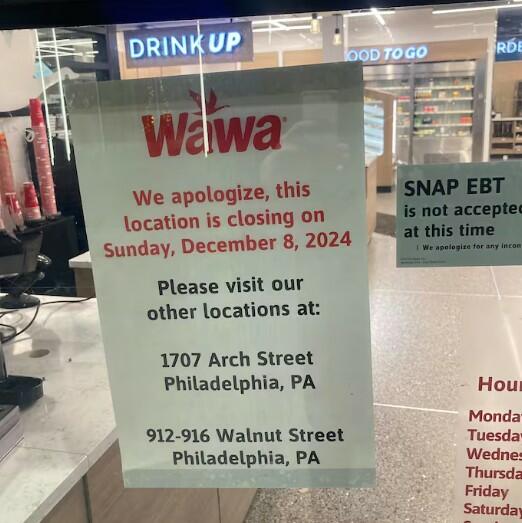
Wawa is (once again) moving out of Center City Philadelphia.

Joining other retailers like Target, Wawa has not been shy about its exodus from Philadelphia. The company has closed nine different locations in Center City Philadelphia since 2020, according to the Inquirer

Lori Bruce, a spokesperson with Wawa, confirmed to the Philadelphia Inquirer this week that the company’s location at 16th and Ranstead in downtown Philadelphia is going to be closing. 

The company line is: “Our 16th and Ranstead store initially opened in 2020 as a pilot test of a smaller urban store concept, which also included a walk-up window.”

Bruce continued: “However, due to its limited size, we have determined that we are not able to provide the same kind of in-store experience and full Wawa offer that customers expect.”

Workers “have been offered the opportunity to work at other nearby Wawa stores,” she said. 

In 2022, Wawa attributed several city closures to crime and homelessness, though the 16th and Ranstead store had the city’s highest incident reports.

Since then, the company has shifted focus to larger suburban stores with gas stations. Recent city closures include locations in Port Richmond and the Art Museum District, where leases were not renewed.

MM Partners, the building owner, expressed surprise at Wawa’s decision but remained confident in finding a new tenant. David Waxman, founder, commented: “There’s been a lot of new leasing activity on Chestnut and Walnut over the last couple years. There’s interesting tenants coming into the city who weren’t here before. It seems like food uses are what we are seeing the most openings of, and that would be a logical tenant.”

Tyler Durden
Fri, 12/06/2024 – 20:05

via ZeroHedge News https://ift.tt/S5H0XFK Tyler Durden

The War-Whores Of The Military-Industrial Complex Are Lighting The World On Fire

The War-Whores Of The Military-Industrial Complex Are Lighting The World On Fire

Authored by Leo Hohmann via substack,

Syria is just the latest case of U.S. meddling and the timing could not be more suspicious…

The Biden administration has triggered another proxy war for Donald Trump to deal with when he becomes president next month.

The U.S. deep state is fighting a proxy war in Syria, which appears to be waged with the intention of further destabilizing the Middle East and stirring up another front in World War III.

Syria is collapsing under the weight of another U.S.-sponsored proxy Civil War, with the US, Israel and Sunni jihadists on one side and Russia, Iran, Assad, and Shiite jihadists on the other.

Al Nusra (which is comprised of Al-Qaida and ISIS affiliates) is taking over the country with the help of Turkey, a U.S. ally and key member of the NATO military alliance. These rebels have seized the city of Aleppo and many smaller towns and villages.

M. Dowling at The Independent Sentinel notes that “Jake Sullivan has said Al-Qaida is on our side in Syria.”

Jake Sullivan is Biden’s national security adviser and a key enabler, along with Secretary of State Antony Blinken, of the anti-Russia obsessed deep-state club that shares one thing in common. They all belong to the Trilateral Commission and the Council on Foreign Relations.

Dowling notes that Syria’s civil war started in 2011 after an uprising against President Bashar Assad’s rule. The U.S., Russia, Israel and Iran all have a military presence in Syria. Forces opposed to Assad, along with U.S.-backed rebels, control more than a third of the country and now Russia and Iran have launched a counter-offensive. Russia is very upset with Turkey for instigating the coup against Assad, likely with the direct assistance of the CIA.

The false narrative being proffered by the US mockingbird media is that a rag-tag coalition of so-called “noble rebels” has somehow organically emerged to save Syria from the dictator Assad. No, what we have here are Sunni jihadists backed by the U.S. and NATO fighting Shia jihadists backed by Russia.

As Dowling points out, “All jihadists are bad guys.” They are bad because as soon as they get in power one of the first things they do is start raping the Christian women and executing the Christian men. It happened in Iraq after Saddam Hussein was overthrown and it’s happening now in Syria.

Congress funded jihadist rebels in Syria for years. The chief war whores of the military-industrial complex, Senators Lindsey Graham and John McCain, led the way.

Graham is now turning on Trump’s pick for Defense Secretary, Pete Hegseth, because he’s afraid the Fox News host might not be fully on board with the U.S. forever wars.

Dowling quotes Joe Kent, a former chief warrant officer in the U.S. Army special forces, saying that the U.S. is “in an endless cycle of violence” and a “regime-change war” in Syria that the US has pushed.

The world is aflame and the regime in Washington appears to be dowsing it with gasoline in anticipation of handing the chaos over to Donald Trump to deal with as the 47th president.

Dowling ends her article with this truth bomb:

“We need to be out of Syria. We’re helping no one, certainly not Americans. This is another spear in World War III.”

The U.S. is also stirring the pot in the Eastern European country of Georgia, where protesters continue to be out in the streets. The U.S. is complicit in the deaths of more than half a million Ukrainians.

I would say we need to be out of every country in the world where there is no direct compelling national interest for America’s national security. Rein in the CIA and limit its actions strictly to intelligence gathering (no more fomenting of revolutions and coups) bring our boys home and return the concept of “defense” to our U.S. Department of Defense.

Tyler Durden
Fri, 12/06/2024 – 19:40

via ZeroHedge News https://ift.tt/Mqxw940 Tyler Durden

Data Centers Are Sending Global Electricity Demand Soaring

Data Centers Are Sending Global Electricity Demand Soaring

Authored by Felicity Bradstock via OilPrice.com,

  • The rapid growth of data centers to support AI is significantly increasing global electricity demand.

  • This surge in demand threatens to outpace the development of renewable energy sources.

  • International regulations are needed to ensure tech companies use clean energy and minimize their impact on climate goals.

The global electricity demand is expected to grow exponentially in the coming decades, largely due to an increased demand from tech companies for new data centers to support the rollout of high-energy-consuming advanced technologies, such as artificial intelligence (AI). As governments worldwide introduce new climate policies and pump billions into alternative energy sources and clean tech, these efforts may be quashed by the increased electricity demand from data centers unless greater international regulatory action is taken to ensure that tech companies invest in clean energy sources and do not use fossil fuels for power.

The International Energy Agency (IEA) released a report in October entitled “What the data centre and AI boom could mean for the energy sector”. It showed that with investment in new data centers surging over the past two years, particularly in the U.S., the electricity demand is increasing rapidly – a trend that is set to continue. 

The report states that in the U.S., annual investment in data center construction has doubled in the past two years alone. China and the European Union are also seeing investment in data centers increase rapidly. In 2023, the overall capital investment by tech leaders Google, Microsoft, and Amazon was greater than that of the U.S. oil and gas industry, at approximately 0.5 percent of the U.S. GDP.

The tech sector expects to deploy AI technologies more widely in the coming decades as the technology is improved and becomes more ingrained in everyday life. This is just one of several advanced technologies expected to contribute to the rise in demand for power worldwide in the coming decades. 

Global aggregate electricity demand is set to increase by 6,750 terawatt-hours (TWh) by 2030, per the IEA’s Stated Policies Scenario. This is spurred by several factors including digitalization, economic growth, electric vehicles, air conditioners, and the rising importance of electricity-intensive manufacturing. In large economies such as the U.S., China, and the EU, data centers contribute around 2 to 4 percent of total electricity consumption at present. However, the sector has already surpassed 10 percent of electricity consumption in at least five U.S. states. Meanwhile, in Ireland, it contributes more than 20 percent of all electricity consumption.

While the speed and manner in which AI use will grow remains uncertain, and efficiency improvements are expected to be made, electricity demand from data centers, cryptocurrencies, and AI could reach as much as 1,000 Terawatt Hours (TWh) in 2026 – roughly equivalent to the electricity consumption of Japan – compared to 460TWh today, the IEA predicts.

The organization calls for more public-private dialogue, with policymakers, the tech sector, and the energy industry coming together for discussions to manage both expectations and energy use. Greater international regulation of the tech sector is required to ensure that the growing electricity demand for data centers does not outweigh the green transition achievements currently being seen worldwide. 

There are growing fears that, if left unregulated, the electricity consumption of data centers could surpass the electricity demand of some U.S. cities or even states. Many data center developers are concerned about finding enough land to house new sites and enough clean power to run them. The facilities could increasingly require 1 GW of power or more, which is equivalent to around twice the 2023 residential electricity consumption of Pittsburgh

The president of Lancium, a company that secures land and power for data centers in Texas, Ali Fenn, explained that U.S. tech companies are in the “race of a lifetime to global dominance”. Fenn said, “They’re going to keep spending” because there’s no more profitable place to deploy capital. 

At the rate the advanced technologies are expanding, renewable energy sources will not be sufficient to meet the growing demands of the tech industry. Many tech companies are expected to use natural gas to power operations, particularly in the U.S. where the gas sector is set to continue expanding rapidly. 

Currently, many tech companies operate data centers with a capacity of around 40 MW. However, in the coming years, more firms are expected to invest in campuses of 250 MW or more. As a growing number of campuses of 500 MW or more emerge in the 2030s and 2040s, which is equivalent to the power needed for 350,000 homes, this could lead to a surge in demand for gas-generated electricity, following years of national investment in a green transition.  

While the U.S. is expected to see the greatest data center expansion in the coming decades, Europe’s data center power consumption is expected to nearly triple by the end of the decade. Meanwhile, China has invested over $6.12 billion in a national project to develop data centers in recent years, according to a senior government official. 

A joined-up approach to regulating the energy usage of data centers is required to prevent the anticipated rise in electricity demand from challenging the progress of the global green transition. Governments worldwide must establish clear regulations and limits on the energy use of tech companies for advanced technologies, such as AI, if they hope to meet Paris Agreement climate pledges. This may include requiring tech companies to fulfill their energy needs through clean energy sources, such as renewables and nuclear power, as well as slowing the pace of deployment of these technologies.  

Tyler Durden
Fri, 12/06/2024 – 18:00

via ZeroHedge News https://ift.tt/iU2Kw8r Tyler Durden

Crimean Bridge Temporarily Closed After New Drone Strikes On Kerch

Crimean Bridge Temporarily Closed After New Drone Strikes On Kerch

Ukraine has launched another attack utilizing aerial and seaborne drones on Russia’s Crimean port city of Kerch, the Russian military confirmed Friday. 

The attack temporarily halted traffic on the large Crimea Bridge, which links the Black Sea peninsula to mainland Russia and has come under major attack several times since the Ukraine war’s start.

Via TASS

Crimea has been hit on a semi-regular basis by Ukrainian drones and missiles, which often try to reach the Russian Navy’s Black Sea fleet’s operations in Sevastopol. Russia has reportedly in the last months been forced to transfer some naval assets to the Caspian Sea for greater protection.

According to regional media

The attack began around 5:00 a.m. local time and involved both aerial and naval drones, Crimean Wind said. Traffic across the Crimea Bridge was suspended beginning at 5:17 a.m.

The Russian Defense Ministry reported that air defenses shot down one Ukrainian drone over Crimea overnight. The agency also reported that Black Sea Fleet naval aviation destroyed two Ukrainian naval drones that were headed towards Crimea.

“The first two sounded like explosions, one sounded like air defense work,” eyewitnesses were reported in the US-funded RFE/RL news outlet as describing.

Kiev has been encouraged to keep fighting, and use its high risk drone attacks (which tend to result in bigger Russian retaliation), given Washington has yet to pressure it into a negotiating stance. 

All sides are cautiously awaiting the Trump administration’s entry into the White House. But Biden is currently seeking to rush all weapons possible to the war-ravaged ally before leaving the Oval Office.

“The United States also plans to train Ukrainian troops outside the country and finalize $20bn in loans backed by frozen Russian assets, according to the briefing shared with the Guardian,” UK media writes.

“The strategy includes a final push of sanctions on Russia before US president-elect Donald Trump enters the White House. The move aims to weaken Russia’s war effort and enhance Ukraine’s leverage in future negotiations,” the report adds.

Tyler Durden
Fri, 12/06/2024 – 17:40

via ZeroHedge News https://ift.tt/0DSKZn5 Tyler Durden