Joni Ernst: “I Don’t Have A Campaign Against Pete” Hegseth

Joni Ernst: “I Don’t Have A Campaign Against Pete” Hegseth

Authored by Philip Wegmann via RealClearPolitics,

Sen. Joni Ernst has not made up her mind about Pete Hegseth’s nomination to be secretary of defense, but despite the suggestion of some of her colleagues, the Iowa Republican told RealClearPolitics during a Thursday interview that she is not pursuing that role for herself.

“I am not seeking to be secretary of defense,” Ernst said after some on the left suggested she would make a better candidate than Hegseth and after critics on the right accused her of trying to sink his nomination for personal gain. A combat veteran herself, she explained that while “I absolutely have interest in the military,” her focus is on continuing her work in the Armed Services committee, not joining President-elect Trump’s cabinet.

Ernst, a senior member of the committee with jurisdiction over the nomination, met with Hegseth Wednesday as allegations about professional and sexual misconduct continue to dim his hopes of confirmation.

“I’ve known Pete for a very long time,” Ernst said of Hegseth, a former Fox News host and decorated veteran, adding, “I really appreciated the time that he took to sit down with me and walk through a number of issues.” The senator described the conversation as “thorough” and the nominee as “very forthcoming.” A sexual assault survivor, she confirmed that the two discussed the misconduct allegations during their 45-minute sit-down.

Hegseth denied all allegations of wrongdoing in a Wednesday interview with Megyn Kelly and vowed to fight on so long as he has Trump’s blessing.

While Republicans control the Senate, the margins are slim. They hold the upper chamber with just a three-seat majority and are expected to have just a one-seat majority on the committee next year that will handle Hegseth’s nomination. This makes Ernst a critical swing vote, and her initial hesitation over the nominee has made her a MAGA pariah.

Complained Donald Trump Jr., the son of the president-elect, in a social media post Thursday, “If you’re a GOP Senator who voted for Lloyd Austin but criticize Pete Hegseth then maybe you’re in the wrong political party!” Charlie Kirk, a confidant of the Trump family, noted that Ernst had supported Austin, the current secretary of defense, and accused the senator of “leading the charge against Hegseth.”

“No, no,” Ernst said of the accusation that she was working behind the scenes to sink the nominee, “and believe me, I have been feeling this.” The senator insisted that “there is absolutely no campaign against Pete,” adding that her focus remains strictly on ensuring a thorough and fair confirmation process.

The candidates change, she said, but the process ought to remain consistent. “If there had been allegations made against Gen. Austin,” she said of the current defense secretary who was confirmed with broad bipartisan support four years ago, “we would have gone through that process as well. I think anyone that comes in front of our committee deserves a fair hearing.”

I don’t have a campaign against Pete,” she reiterated.

I just want to make sure the process is able to play out and that we’re thoroughly vetting him. I do believe that Pete deserves to have a hearing. All the rumblings out there are absolutely false. My role as a senator is to make sure that we are putting to bed any rumors, any anonymous whatever,” she continued.

“We just need to make sure that he is thoroughly vetted and that he has his opportunity to go in front of the committee, recount his service, and rebut any allegations,” she concluded.

Democrats have already made their own conclusions. They think the nominee is already sunk. Virginia Sen. Tim Kaine said as much before telling the Washington Examiner that if Trump swapped Ernst for Hegseth, Democrats would begin with “a very favorable inclination” to confirm her. Added Connecticut Sen. Richard Blumenthal, “she would have significant bipartisan support.”

Ernst is not entertaining those suggestions, and even as Trump reportedly seeks a potential backup plan should Hegseth withdraw, the senator said she isn’t seeking out an alternative.

Asked about Florida Gov. Ron DeSantis, whose name has been floated as a Plan B, Ernst replied, “I do think he would be a good candidate for this position. But as I’ve told reporters, as they ask me in the hallway, Hegseth is the nominee, and the president will determine who that nominee is.”

Trump will assume office in January of next year, and confirmation hearings are not expected until the end of that month. The former, and now future, president believes he has a historic mandate after becoming the first Republican to win the popular vote in two decades. John McLaughlin, Trump’s longtime pollster, told RCP that opposition to his nominees incurs inherent risk and a potential primary challenge.

“Republicans are totally behind his agenda and are totally supportive of him putting the right people in place so he can solve the country’s problems,” McLaughlin said in a Thursday interview. “If certain Republican senators side with the Democrats, they do so at their own peril.”

Ernst insisted that her focus is not on politics and only on discovering “what the truth is.”

“It’s all about making sure that the nominee is properly vetted,” she said of the process that will begin in earnest early next year. Added the senator, “That’s why it’s important that we continue through the hearing, and he’ll have his day in front of the public, and all of this can be sorted out.”

There will be plenty of time, Ernst said, to go back and sort through “all the anonymous this-and-that-and the-other.” She noted that thus far, all the allegations have been made anonymously in the press and that no accuser has come forward publicly. “I mean, people need to really come forward if they have information,” she said. “They need to be willing to put their name to it.”

Tyler Durden
Fri, 12/06/2024 – 17:20

via ZeroHedge News https://ift.tt/pg7FyYh Tyler Durden

Sankey Vs Young: Oil Strategists Face Off in Live Premium-Only Debate With Kevin Muir

Sankey Vs Young: Oil Strategists Face Off in Live Premium-Only Debate With Kevin Muir

Tonight at 8 PM Eastern, expert oil and gas analysts will debate the future of the energy sector in a live, premium-only event only on ZeroHedge. Join us for a deep dive, featuring two highly respected strategists with contrasting views: Paul Sankey, the bear, and Josh Young, the bull.

The Bear:

Paul Sankey is a renowned oil analyst with over three decades of experience, known for his independent and bold market calls. Sankey founded Sankey Research in 2020. His current outlet, oil price to decline for the following reasons:

  1. Global Supply Stabilization: While oil prices are currently high, there is limited price elasticity of supply, meaning higher prices have not led to increased production, especially from major oil producers like Saudi Arabia and OPEC+.

  2. Venezuela Production Resumption: The Biden administration has granted Chevron a license to resume oil production in Venezuela, which could add 200,000 barrels per day back into the market, easing supply concerns.

  3. OPEC+: Political instability in countries like Iran and Venezuela, along with the ongoing protests in China, could have mixed effects on the oil market. However, OPEC+ may respond by adjusting their production strategies, potentially leading to a price correction.

  4. Strong U.S. Market Fundamentals: Despite bearish sentiment, the U.S. has emerged strong from mid-term elections, with global energy crises providing a backdrop for continued demand, although high oil prices may still encourage supply adjustments.

The Bull: 

Josh Young, Chief Investment Officer at Bison Interests, brings nearly two decades of expertise in oil and gas investing. Even with a Trump “drill baby drill” win, he remains as a strong advocate for the bullish potential of the oil and gas industry, particularly within the E&P space.

  1. Demand Outpaces Supply in 2024: Global oil demand has exceeded supply by 0.58 mbd (million barrels per day), leading to unexpected inventory draws and lower U.S. oil stock levels, which are at a 20-year low.

  2. Slowing Non-OPEC Production Growth: Growth in non-OPEC production is slowing, with key sources like the Permian Basin and Guyana contributing less in 2025 compared to previous years, leaving a production shortfall.

  3. Rising Demand in Developing Economies: Stronger-than-expected demand growth, particularly from India and China, is putting additional strain on global oil supply. China’s record oil imports are a key factor.

  4. Market Tightness and Price Volatility: With continued demand growth and production struggles, oil supply shortages could persist, leading to significant price volatility, similar to the 2020-2022 price surge.

  5. Potential Geopolitical Risks: Ongoing geopolitical tensions, like potential disruptions in the Middle East, could further tighten oil supplies and push prices higher.

The “Macro Tourist” Kevin Muir — a former RBC trading desk strategist and author of a great macro newsletter — will moderate the debate with his broad market knowledge and over three decades of trading experience.

Key Questions to Answer:

– Will the Trump Administration be bullish for oil and gas?  

– How will conflict in the Middle East impact prices?

– Is the Green New Deal movement dying?  

Tune in to the live debate exclusively on ZeroHedge’s front page, available only to premium and professional subscribers. If you have not already done so, subscribe here to get unique insights on how you should be trading energy into 2025. Any strategist can talk their book. See how they perform under scrutiny only on ZeroHedge.
 

Tyler Durden
Fri, 12/06/2024 – 17:00

via ZeroHedge News https://ift.tt/oRTPeJh Tyler Durden

Introducing The New ZeroHedge Store!

Introducing The New ZeroHedge Store!

Since launching ZeroHedge in 2009, our mission has been to cut through the bullshit and provide you with an authentic, unfiltered platform for news and conversation from all over the world. Having earned your trust over the past 15 years, curating the world’s incessant newsflow – while battling the censorship industrial complex through subscriptions and partnerships – we have decided to create our own store to showcase the best products and services to help you avoid “buying shit you don’t need”.

Here’s what you can find:

Supplements

We’re proud to carry a full line of supplements from IQ Biologix, including nootropics, protein, creatine, colostrum, sleep aids, weight loss, coffee and much more. Enjoy 5% off for 2 of the same item, or 10% off for three or more – plus subscribe & save an additional 10%.

Coffee

In addition to IQ Biologix infused Smart Blend, check out our new ZeroHedge coffee! Organic and GMO-free, we’ve got both medium and dark roast. Discounts of up to 10% for multiple bags, and another 10% for Subscribe & Save.

Preparedness

After searching long and hard, we’ve found two excellent brands of emergency foodPrepper All Naturals, which offers upscale, clean, hormone-free beef, and ReadyWise, a longtime player in the emergency food business.

We’ve also got water filters, go-bags, generators & more!

SiPhox Blood Testing

IQ Biologix has partnered with SiPhox Health for the ultimate at-home blood testing suite. Buy one, or subscribe to track your health throughout the year – then log into the IQ / SiPhox dashboard to monitor your results. You can also upgrade your kit for specific needs – including a hormone panel, a metabolic panel, and a thyroid panel.

Anza Knives

Made in Santee, California, Anza hand-made knives start life as heavy-duty high carbon steel files, which are meticulously crafted into masterpieces that fit well in the hand and have never let us down.

ZeroHedge Multitool

Solid in the hand, the ZeroHedge multitool is perfect for any situation. Includes pliers, knife, saw, screwdrivers, wire cutter, bottle opener and more.

ZeroHedge Gear

How could we possibly launch a store without gear? Check out our waxed-canvas hats, shirts, sweatshirts, tumblers, water bottle, and more!

Whether you’re looking to optimize your health, ensure you’re ready for whatever comes next, or express your unique worldview, our store is your one-stop destination.

Dive in, gear up, and embrace a lifestyle of readiness, resilience, and individuality with ZeroHedge. And thank you for your support!

International shipping available soon…

Tyler Durden

Fri, 12/06/2024 – 16:40

via ZeroHedge News https://ift.tt/mTGMDcP Tyler Durden
“Not A Joke…” – Blanket Pardons & The Big Guy

“Not A Joke…” – Blanket Pardons & The Big Guy

Authored by James Howard Kunstler,

“Stare into the sun and begin to glimpse the size of what you’re up against.”

– Mike Benz

The Hunter Biden super-sized blanket pardon went over so well around the country that “Joe Biden” – or the shadowy league of not-quite-geniuses who run the twilight White House operation – floated the idea of issuing preemptive pardons for a few of the most spectacularly dishonest characters in US political life: Dr. Fauci, Senator-elect Adam Schiff, and Liz Cheney. Does “JB” plan on legally adopting them so he can claim he was moved to act out of a father’s love?

Like every official act ever associated with the name “Joe Biden,” the preemptive pardon idea has that reality-optional feel. None of the three has been convicted of a crime to be pardoned for, or even been hauled-in for questioning by federal law enforcement agents on a probable cause writ. But a pardon would necessarily paint them as criminals, ipso facto. Would they accept a pardon, with what it implies, or run shrieking from it as from an apple polished with novichok?

The proffer of a pardon itself must amount to a declaration of probable cause, igniting the very legal process it seeks to dispose of. An inquiry would have to be launched to discover what laws these three desperadoes might have broken, followed perhaps by a grand jury to evaluate the evidence, and so on. “Joe Biden” himself might have to answer some basic questions, such as: at what time prior to issuing the pardon did he begin to suspect some laws had been broken? And, since the president’s chief duty is to enforce the law, was “JB” negligent and culpable himself for misprision of felonies?

You know, of course, that the Supreme Court decided last summer in Trump v. United States (Docket No: 23-939) that a president is immune from prosecution for official acts. But the misprision of felonies is neither a presidential duty nor anything describable as an official act. Rather it would be grounds for impeachment, being a “high crime.” Now, luckily for Joe Biden, his term-in-office is so close to its conclusion that impeachment must be considered off-the-table as a practical matter. He might be subject to prosecution, though, after the clock strikes noon on one-six-twenty-five.

I doubt he will be present at Mr. Trump’s inauguration, so the US marshals will have to root him out of Delaware (or wherever) and haul him into the federal lockup in DC at exactly the moment Mr. Trump pardons the J-6 prisoners. Will they get to see “Joe Biden” coming into the joint on their way out? There would be a certain poetic symmetry in that, and hard to not admire the workings of Providence after all its foot-dragging. You might well ask: how many days, or months, will “Joe Biden” have to endure in solitary detention before the paperwork is in order for a proper arraignment? Considering how the process was applied to those J-6 culprits, a year would seem sufficient.

Pardon me for saying: I fear that “Joe Biden” might have started something that isn’t going to end well for “Joe Biden” and many others. The little goldfish bowl of the White House is surrounded by the vast, pulsating DC blob and its million-footed ranks of officials deserving of pardons. You know the floated names Fauci, Schiff, and Cheney were only representative samples, denoting a certain managerial class of blobists that runs to the thousands of federal employees at least. What about Garland, Monaco, and Gupta at DOJ, and their paladin prosecutor Jack Smith, and his many deputies? Or Comey, Wray, Abate, Sallet, McCabe, Rosenstein, Strzok, Page, Pientka, Priestap, McCord, Horowitz out of the FBI? Or Mueller, Weissmann, Dreeben, Van Grack, Rhee, and Quarles from that spin-off Special Counsel venture? Or Boasberg, Chutkan, and Sullivan in the DC judiciary? Or, Collins, Wallensky, Cohen and their many deputies in Covid-land? Surely, they all deserve pardons now, and their crimes can be sorted out later.

There would appear to be no precedent for a chief executive pardoning the entire federal government, or we would have heard of it by now.

At the conclusion of the Civil War, Abe Lincoln issued a conditional pardon to Southerners — they had to take an oath of allegiance to the Union — but it did not include military officers and high-ranking Confederate officials.

The blob of our time is a different breed of porpoise.

Actually, it’s more like a systemic fungal infection of the body politic, requiring deep fumigation and exposure to sunlight. The proposed D.O.G.E advisory under Messrs Musk and Ramaswamy might answer as a “good enough” therapeutic approach, wholesale dismissal of entire agencies and departments, actually flushing away the malign parasites en masse, pardons not required.

What I await in the sunsetting “Joe Biden” presidency is whether he will go ahead and pardon the other members of the Biden family beyond just “first son” Hunter: brothers Jim and Frank and the wives and various offspring who received cash “gifts” from officials in foreign lands laundered into their personal bank accounts amounting to millions of dollars. None of them enjoy the much talked-about presidential immunity out of mere familial proximity to their illustrious relation, number “46” in the lengthening line of commanders-in-chief.

Perhaps that’s what is spurring the league of not-quite-geniuses behind the Big Guy to try to start World War Three this Christmas Season – to distract the public from the inevitable Biden family blanket pardon. At this point, I don’t care if they are ever prosecuted for all that grift. Let the Big Guy and his adjacent family fishes slip through the net.

Let that certain someone who authored The Art of the Deal work his magic on the situation so that we don’t become an ashtray from sea to shining sea before the Christmas trees are swagged and lighted.

*  *  *

It’s that time of year! In this novella, a boy runs away from home in Manhattan all the way to Vermont the night before Christmas. Tribulations ensue. “A masterpiece of comedy and pathos.” Autographed copies from Battenkill Books, Cambridge, New York.


Tyler Durden
Fri, 12/06/2024 – 16:20

via ZeroHedge News https://ift.tt/cNOFstD Tyler Durden

The Commercial Mortgage Crisis Deepens

The Commercial Mortgage Crisis Deepens

Authored by Peter Earle via the American Institute for Economic Research (AIER),

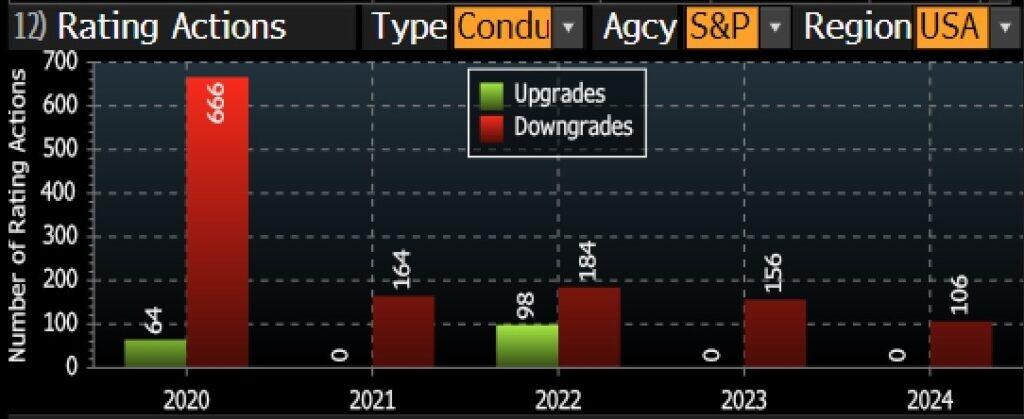
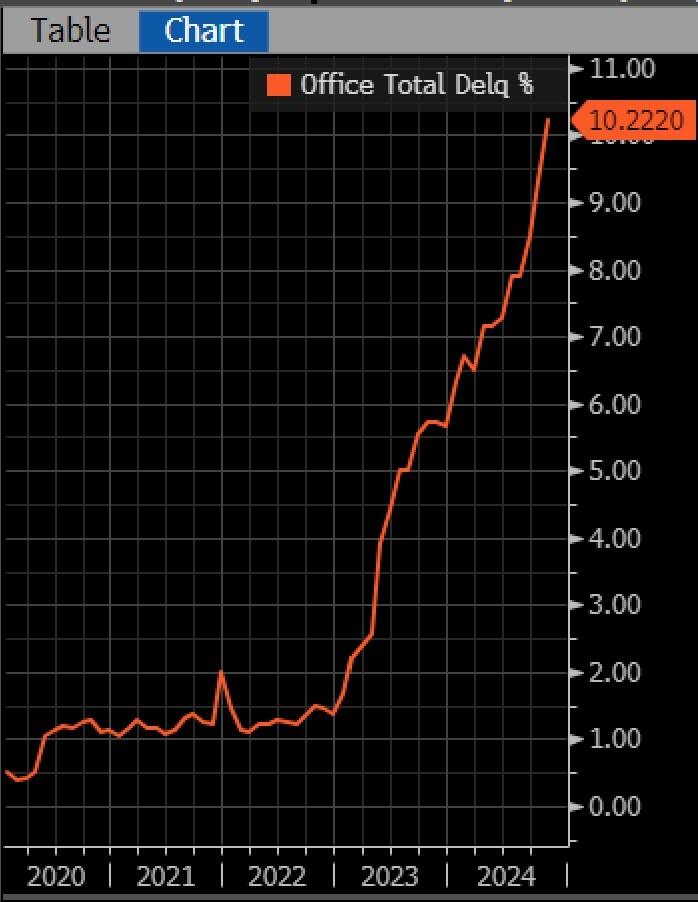
The delinquency rate for commercial mortgage-backed securities (CMBS) tied to office properties reached 10.4 percent in November 2024, approaching the 10.7 percent peak reached during the 2008 financial crisis. The ascent is the fastest two-year increase on record, with rates climbing 8.8 percentage points since late 2022, significantly outrunning the 6.3-point rise seen during the financial crisis nearly 15 years ago.

The office real estate sector has been grappling with a severe downturn for several years now, but are accelerating recently as they are driven by persistently high vacancy rates and declining rents. Property values, particularly for older office buildings, have plummeted, with many losing 50 to 70 percent of their market value and in some cases becoming effectively worthless. Those conditions have left real estate portfolio managers and building owners unable to borrow, refinance or sell properties, contributing to rising delinquencies and foreclosures. (Mortgages become effectively delinquent when payments are missed beyond a standard 30-day grace period.)

Three key factors contributed to the widespread impairment of office properties and, in turn, securitized mortgage products

  1. malinvestment due to artificially low interest rates and excessive credit expansion,

  2. zoning restrictions hampering property repurposing,

  3. and the widespread adoption of remote work following COVID-19 lockdowns.

During the 2020–2022 period of near-zero benchmark rates (and in real terms, negative interest rates), lenders underwrote commercial real estate loans with minimal debt service coverage ratios, frequently projecting property income to just cover interest payments. Those assumptions faltered as rates rose, exposing the speculative nature of many of the core suppositions undergirding those loans. Adding to that, rigid zoning and building regulations (in addition to obstinance among owners, in some cases) have slowed the transition of obsolete office spaces to other uses, such as residential conversions. Lastly, the COVID-19 pandemic accelerated a long-term shift toward remote work, reducing demand for traditional office spaces.

Loans can be removed from delinquency lists through resumed payments, foreclosure sales (typically at steep losses to investors), or loan restructuring under the so-calledextend-and-pretend“ strategy, which defers foreclosures into future years. This approach has been widely employed, pushing questions about the financial health of some real estate investment entities to 2025 and beyond.

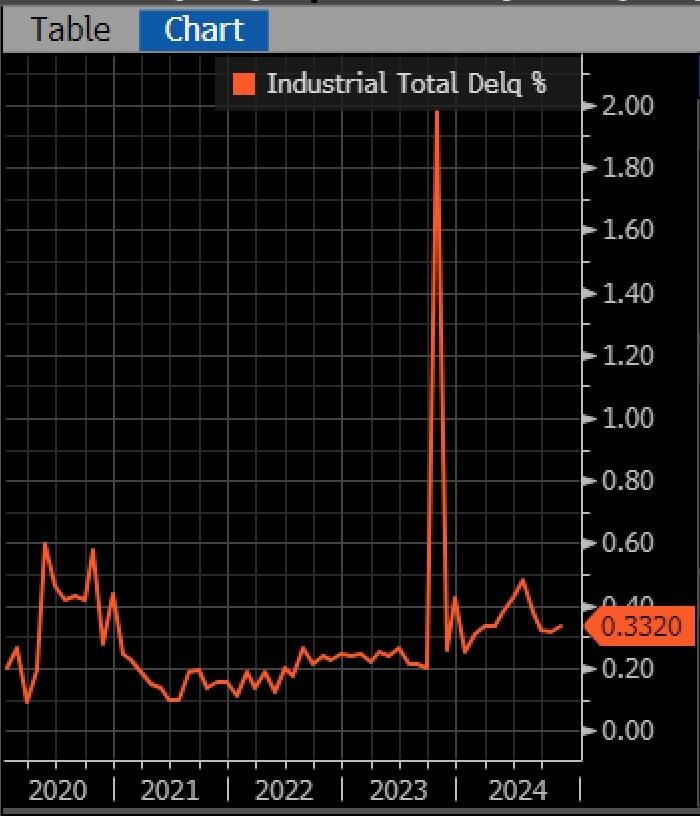
Among commercial real estate (CRE) segments, office properties are the most troubled, with delinquency rates significantly outpacing lodging (6.9 percent), retail (6.6 percent), and multifamily housing (4.2 percent). Of particular note, the industrial sector remains robust with a delinquency rate of just 0.3 percent. However, the distress is not confined to office properties. CRE-CLO (commercial real estate collateralized loan obligation) bonds, which include short-term floating-rate loans across various property types, are seeing distress rates hit record highs. Office loans account for nearly one in five distressed CRE-CLO loans, but multifamily loans are also at risk, with distress rates reaching 16.4 percent in Q3 2024. The weakness stems from the collision of soaring financing costs and underperforming properties. Indeed, as Austrian Business Cycle Theory (ABCT) predicts, artificially low interest rates stimulated aggressive underwriting during the pandemic, a large portion of which has proven wholly unsustainable.

Efforts to convert office buildings into residential spaces are increasing but remain limited by structural and economic constraints. Many office towers are unsuitable for conversion due to their large floor plates or prohibitively high retrofitting costs which often exceed the cost of demolition and rebuilding. In 2024, 73 office-to-residential conversions were completed, with an additional 30 underway. Despite plans to increase the pace in 2025, the cumulative impact remains minimal, addressing just 7.9 percent of the 902 million square feet of vacant office space nationwide.

The “survive till 2025” mindset dominates market sentiment, with landlords hoping for substantial Federal Reserve rate cuts to alleviate financial pressures. However, while the Fed has reduced rates, they remain between 4.5 percent and 4.75 percent, with the Secured Overnight Financing Rate (SOFR) at 4.57 percent. Moreover, concerns regarding $36 trillion in U.S. government debt, tariff threats, and signs of slowing disinflation have pushed long-term Treasury yields back to pre-cut levels, undermining hopes for refinancing relief. Those conditions have left many properties — especially those tied to bridge loans — on the brink of financial distress.

The financial risks associated with office mortgage losses are widely dispersed among global investors, thus diminishing the potential threat to the U.S. banking system. Office mortgages are held by a vast array of investors, including CMBS and CRE-CLO investors, insurance firms, Real Estate Investment Trusts (REITs), private equity firms, and international financial institutions. While U.S. banks have some exposure and have already recognized significant losses, no major collapses have occurred. Smaller banks with geographically and/or commercially concentrated mortgage portfolios remain at heightened risk, and escalating stress could precipitate systemic consequences.

The commercial real estate market’s troubles are not a temporary phenomenon but a structural crisis rooted in monetary policy-induced overbuilding, regulatory barriers, and a permanent shift in work patterns vastly accelerated by pandemic lockdowns. Vulture investors have emerged, but sparingly. The sector faces profound challenges which will unfold both against and in response to the forward trajectory of monetary policy, the consequent shape of the U.S. Treasury yield curve, and broad macroeconomic developments. Hopefully the stage is not being set for the next in an increasingly annualized procession of crises.

Tyler Durden
Fri, 12/06/2024 – 15:40

via ZeroHedge News https://ift.tt/UYoxWhQ Tyler Durden

The Kalecki Profit Equation And The Coming Reversion

The Kalecki Profit Equation And The Coming Reversion

Authored by Lance Roberts via RealInvestmentAdvice.com,

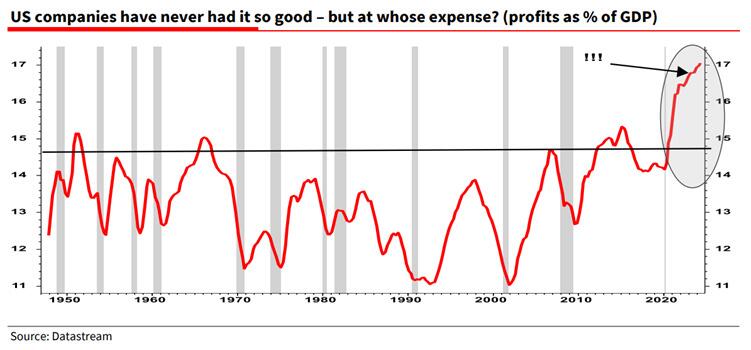
Corporations are currently producing the highest level of profitability, as a percentage of GDP, in history. However, understanding corporate profitability involves more than glancing at quarterly earnings reports. At its core, the Kalecki Profit Equation provides a valuable framework, especially when exploring the reasons behind today’s elevated profit margins and what could disrupt them.

James Montier discussed the Kalecki profit equation in 2012 in a post entitled “What Goes Up, Must Come Down.” However, that has not been the case, as noted recently by Albert Edwards at Societe Generale:

“Companies have been able to push through profit‑margin‑expanding price increases under the cover of two key events, namely 1) supply constraints in the aftermath of the Covid pandemic and 2) commodity cost-push pressures after Russia’s invasion of Ukraine. But we still emphasise that one of the main sources of the recent surge in profit margins is massive fiscal expansion. In short, the government has been spending more to the benefit of corporates.

It is that last statement that is most crucial for investors and the incoming Trump administration.

However, we need to understand the Kalecki Profit Equation.

The Kalecki Profit Equation Made Simple

Some economic equations or relations are inspired by guesswork and may not describe the real world precisely. Other equations always hold since they are simple accounting identities. The Kalecki Profit Equation is of the latter type. It describes precisely the factors that determine corporate profits. Knowing this relation can give investors a leg up in predicting earnings.

Named after the economist Michal Kalecki, this equation deciphers the macroeconomic elements that shape business earnings. Corporate profits derive from combining investment, government and household savings behaviors, dividends, and trade flows.

Profits = Investment – Household Saving – Foreign Saving – Government Saving + Dividends

Kalecki’s formula states that net investment, household and government savings, foreign trade balances, and corporate dividend payouts determine total corporate profits. The equation underscores how interconnected economic activities translate into business revenue. For example, when governments run deficits, they inject money into the economy, boosting overall demand and, by extension, corporate earnings. Conversely, business profitability can take a hit when households save more or governments cut spending.

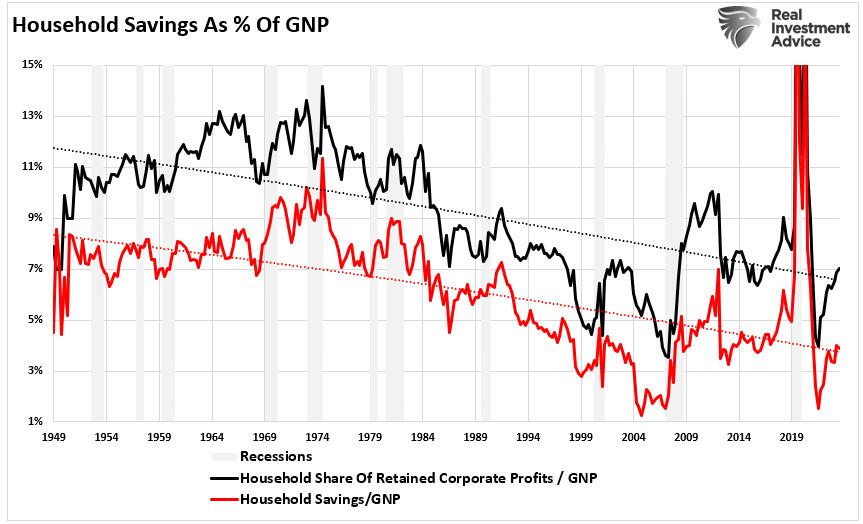
As shown, after a massive spike in household savings during the pandemic, the surge in corporate profitability was unsurprising as households went on a shopping spree.

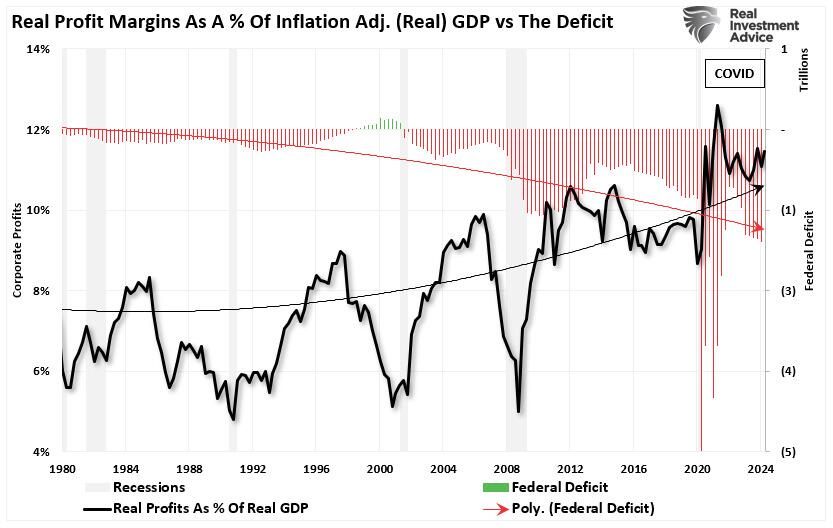
It is crucially important to understand the bolded statement above. Many economists and analysts are raising alarm bells about increasing government spending and deficits. However, over the past decade, record profit margins have become a hallmark of corporate America as politicians continue to “UN-save” by running more significant deficits. Therefore, corporate profit margins have averaged far higher than the historical norm, with both households and the government “dis-saving” at an increasing pace. From the aftermath of the 2008 financial crisis through the pandemic stimulus programs, fiscal policy has kept money flowing and profits robust.

As discussed previously, massive government interventions have kept economic growth humming for the last two decades. While the incoming Trump administration suggests cutting spending and the deficits, the consequences, which are long-term beneficial, will be painful in the short term.

Decoding Today’s Elevated Profit Margins

Government spending isn’t the sole contributor to recent profitability highs. Investment dynamics and changing consumer behavior have played critical roles. The post-pandemic stimulus created a consumption boom, reinforcing corporate earnings. Additionally, low interest rates over the last decade fueled significant business investment and stock buybacks, another source of profit strength. As Montier warns, record corporate profit margins can not last indefinitely.

“If the era of big government is here to stay then profits as a percent of GNP can remain higher than in the past. However, it should be noted that economic theory offers no reason as to why profit margins should mean revert. It is the return on capital, not the return on sales, that ‘should’ mean revert. Of course, because capital is not observable, we are forced to proxy it.

From a simple profit margins perspective, we can examine the Shiller P/E. This measure attempts to smooth out the cyclical elements of profitability by following Ben Graham’s advice to use 10 years of earnings in the denominator of the P/E. This makes it interesting to us in the current context as it automatically builds in the fact that profitability has been higher over the last 10 years.

So even if one believes that fiscal deficits are here to stay and that profitability is structurally higher as a result, the U.S. market is still trading at around 35x. This dooms investors to low long-run returns. Even if we don’t get any valuation or margin mean reversion, investors are facing a return of around 3% real – hardly likely to be sufficient recompense for the risk of owning equities.”

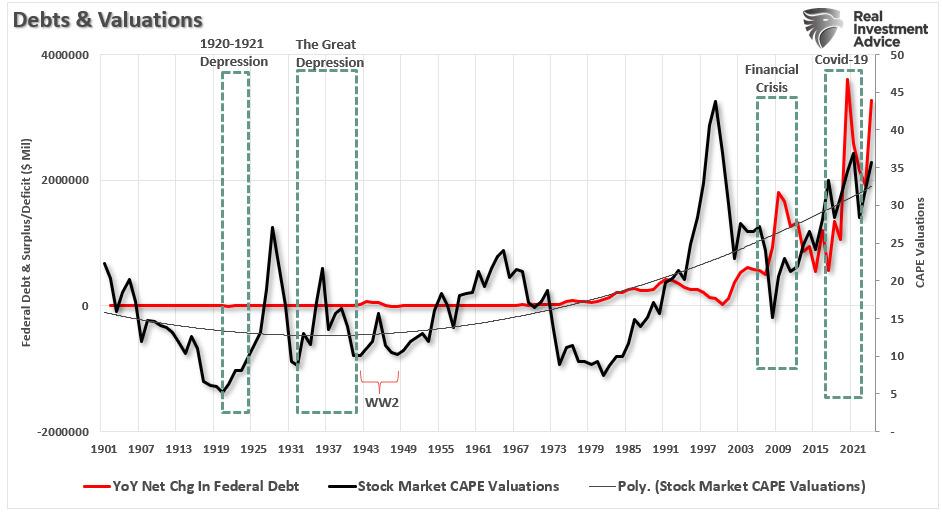
Since the “Financial Crisis,” massive Government spending has corresponded to a persistently elevated market valuation multiple.

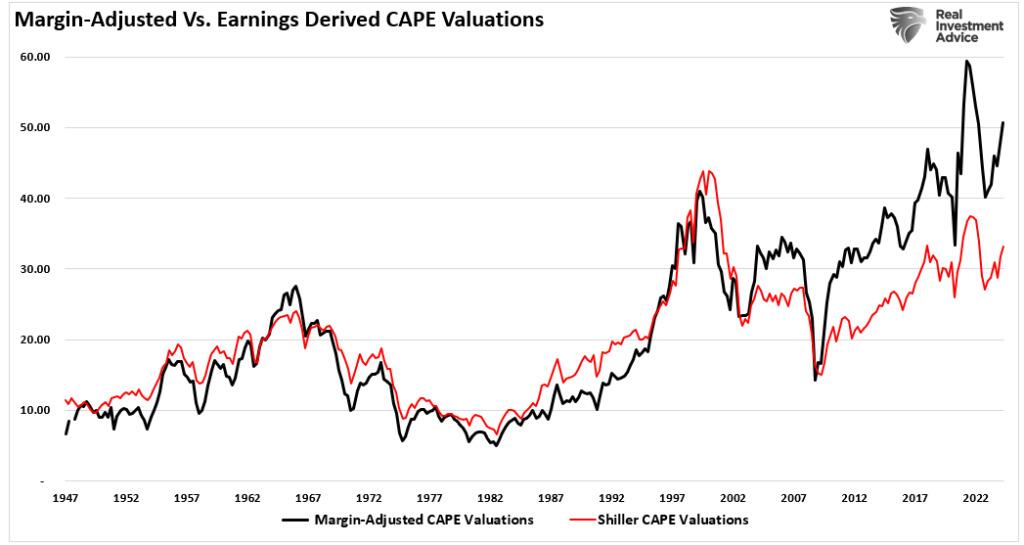
Another anomaly caused by the massive surge in Government and Household spending (dis-saving) has been the detachment of margin-adjusted valuations from earnings-driven valuation measures. As Montier noted in his research:

“In the past both John Hussman and I have shown that various measures of margin-adjusted CAPE have performed better than standard CAPE as predictors of returns – naturally due to the mean reversion of margins over time. They show how if margins were to revert to their ‘normal/historical levels,’ then the CAPE
would be much higher than the standard CAPE shows – margin-adjusted measures of CAPE are around 50x today! If you believe in full reversion of both valuations and margins,then your return outlook would be exceptionally downbeat.”

Of course, if we get valuation mean reversion, investors will face long-run returns significantly worse than 3% on an inflation-adjusted basis.

What would cause such a reversion? Any action that increases Government savings. As governments worldwide grapple with inflation and rising debt burdens, austerity measures may come into play. Consider the U.S. budget discussions around reducing expenditures on social programs and infrastructure. Any significant cuts could reduce aggregate demand, impacting corporate revenues.

Household savings trends are another factor to watch. As inflation erodes purchasing power and consumers face higher borrowing costs, the impulse to save rather than spend intensifies. This behavior can create a feedback loop in economic downturns, as lower consumption hits businesses, leading to reduced hiring and investment, further dampening growth.

Remember, in the Kalecki framework, rising household savings represent a direct drag on profits.

Why Stock Market Investors Should Be Concerned

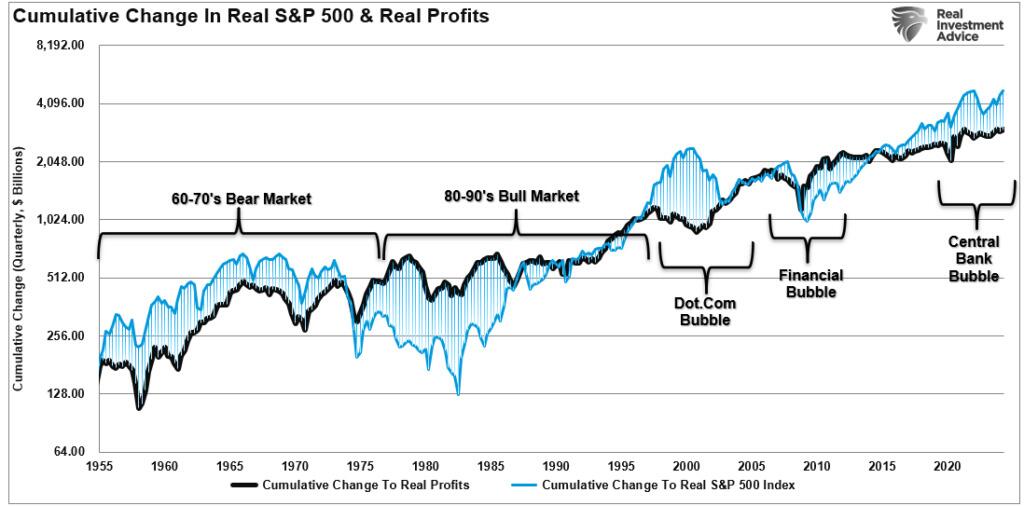
The Kalecki Profit Equation clearly explains that while debts and deficits erode economic growth and are deflationary through the diversion of capital from productive investment, a reversal of deficit spending suggests risk for investors. Valuations are high, partly because investors assume elevated profit margins will persist. However, the cumulative change of the inflation-adjusted price of the market significantly exceeds the profits being generated. Previous such deviations have not ended well for investors, which is what the Kalecki equation suggests.

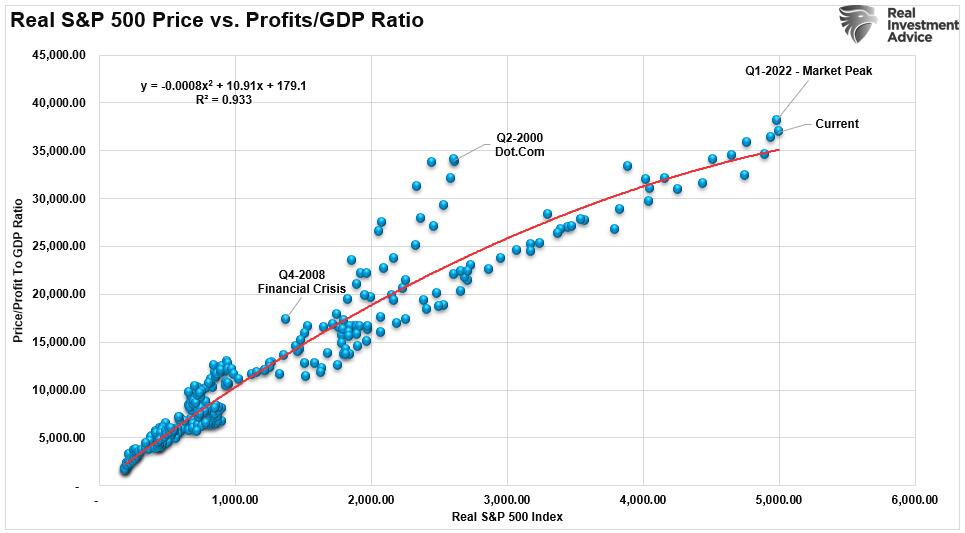
We see the same evidence in the correlation between corporate profits to GDP ratio vs the inflation-adjusted market price.

If economic conditions worsen or fiscal policies tighten, we could see a significant reset. Earnings projections would likely be revised downward, dragging down equity prices. As Montier suggests, long-term returns for U.S. equities look grim even under optimistic assumptions. He points out that price-to-earnings ratios reflect these outsized profit margins, leaving little room for error.

Importantly, as opposed to Yardeni’s more ebullient forecasts, as we addressed last week, history suggests that periods of high profitability are not indefinite. From a macroeconomic perspective, unsustainably high margins eventually face downward pressure from mean reversion. The Shiller P/E ratio, which adjusts earnings to a 10-year average, remains elevated, implying rich valuations without much margin of safety. In other words, any move toward fiscal restraint or consumer belt-tightening could usher in a profit decline.

As always, the future of corporate profits and market performance remains unpredictable, but understanding the forces at play provides an edge. Acknowledging the interdependency of government policy, household behavior, and corporate actions is crucial for investors. The coming years may test the resilience of today’s profit levels, and prudent investors should prepare for a range of outcomes.

*  *  *

For more insights on market trends and strategic advice, visit RealInvestmentAdvice.com.

Tyler Durden
Fri, 12/06/2024 – 15:00

via ZeroHedge News https://ift.tt/2JZavjc Tyler Durden

Strategic Syrian City Of Homs Poised To Fall To Anti-Assad Advance

Strategic Syrian City Of Homs Poised To Fall To Anti-Assad Advance

Making their way rapidly south down the center of Syria, hordes of jihadist insurgents led by Hayat Tahrir al-Sham (HTS) are already with a few miles of Homs and are set to besiege the city, after taking Aleppo and nearby Hama in just less than a week.

Thousands of Homs residents have been witnessed fleeing, as HTS has declared it ultimately wants to take Damascus, seat of the Assad government. Rastan and Talbiseh – in the governorate of Homs – are said to have fallen to the invaders backed by Turkey and based out of Idlib.

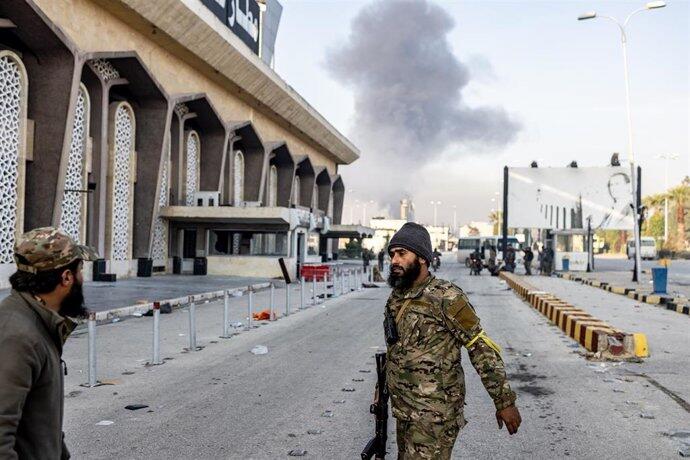
HTS and Al-Qaeda linked terrorists outside Aleppo International Airport, which they captured days ago.

Homs is about 30 miles south of Hama, which only fell Thursday, but is much more strategically important given it links to Damascus and the coast along a key highway.

Samer AbdelJaber, head of emergency coordination at the UN’s World Food Programme, has been quoted in Al Jazeera saying that with some 280,000 people already displaced in a week, these numbers could soon swell to 1.5 million.

People from Aleppo, Hama, and Homs, have been fleeing toward coastal enclaves. It is especially religious minorities, many of them Christians, who are worried about an ethno-religious genocide, given the Al-Qaeda pedigree of the so-called ‘rebels’. Alawites too fear extermination by the radical Islamists. 

Al Jazeera details, “A Syrian army officer told the Reuters news agency that Russian bombing overnight had destroyed the Rastan bridge along the key M5 highway linking Hama to Homs.” Towns in Homs governate which have been captured are located on the Homs side of the bridge, putting HTS within close striking distance of Homs.

By all accounts it’s not looking good amid unverified Friday reports that Syrian Army units have begun exiting Homs before even much heavy fighting ensues.

And in another worrying development, suggesting all manpower is being ordered to focus defense on Damascus and its environs, and the coast (such as Latakia) is that Syrian Army troops have “suddenly” exited Deir ez-Zor city and the whole area.

Israel has meanwhile bombed another Lebanon-Syria border crossing, specifically the Arida and Jousiyeh crossings, claiming that it is disrupting Hezbollah supply lines.

An HTS operations room has told the citizens of Homs, “Your time has come” – and has urged them to rise up against Assad forces.

Russian and Syrian warplanes have continued to pound their various positions, but without much resistance on the ground, HTS has been able to more forward at rapid pace.

Syrian forces possibly withdrawing to ultimately defend ‘fortress Damascus’…

Again, the area has many Syrian Christians – many of which have been the first to flee. Once source writes, “With the fall of Hama, new battleground will be in Homs. Valley of the Christians with its 200,000+ Christians may soon be the target of these battles, hosting many refugees also from Suqaylabiyah and Mhardeh. It’s not an overstatement to say the danger may exceed that of 2012-2014.”

Tyler Durden
Fri, 12/06/2024 – 14:40

via ZeroHedge News https://ift.tt/rnyqeOx Tyler Durden

Jurors In Daniel Penny Trial Say They Can’t Reach Unanimous Verdict On Manslaughter Charge

Jurors In Daniel Penny Trial Say They Can’t Reach Unanimous Verdict On Manslaughter Charge

Authored by Michael Washburn via The Epoch Times (emphasis ours),

A judge on Dec. 6 directed the jury in the Daniel Penny trial to continue deliberating after jurors said they were unable to reach a unanimous verdict on the top charge of manslaughter.

Daniel Penny arrives at Manhattan Criminal Court in New York on Jan. 17, 2024. Frank Franklin II/AP Photo

Penny was charged with manslaughter in the second degree and criminally negligent homicide in last year’s subway choking death of Jordan Neely.

At this time, we are unable to come to a unanimous vote on Count One, manslaughter in the second degree,” the jurors said in a note to the judge. The jurors had been deliberating since Tuesday.

In response, Judge Maxwell Wiley directed the jurors to keep deliberating in an attempt to reach a unanimous decision in what is known as an Allen charge.

The defense had objected to the issuing of an Allen charge and asked the judge to order a mistrial, saying, “We are concerned that the giving of an Allen charge under these circumstances would be coercive.”

The judge said that after further deliberation, the jury still might not arrive at a unanimous verdict, in which case there will be another trial with a different jury.

The courtroom at 100 Centre Street in lower Manhattan has been alternately crowded and near-deserted in these final days of the trial, as the jury has briefly returned to review evidence again and the judge has held brief conversations, some of them contentious, with the lawyers.

Penny’s trial on that charge and the second count has been going on since the first week of November. The jury finally began its deliberations on Tuesday afternoon, following summations from the defense and prosecution at the start of the week.

Since beginning its deliberations, the jury has made a number of requests, including for the replay of footage from the scene of the May 1, 2023, incident in which Jordan Neely died, for a chance to review portions of the trial transcript, and for clarification of the judge’s instructions regarding self-defense and the use of deadly force.

One of the requests, for a readback of part of the cross-examination of medical examiner Dr. Cynthia Harris, prompted the judge on Dec. 5 to seat the jury and have two people read from the transcript aloud in the courtroom. The cross-examination addressed the medical and factual basis on which Harris made her determination that Neely died an asphyxial death, and whether she had given due consideration to other possible factors.

While anticipation of a verdict in the controversial case has run high, Neely’s father has retained legal counsel to pursue civil action against Penny. On Thursday, the father’s lawyer filed a lawsuit against Penny before the Supreme Court of New York.

The complaint in that lawsuit states that the plaintiff is pursuing action through the highest court in the state because lower courts would not be able to grant the full damages that the lawsuit seeks.

Tyler Durden
Fri, 12/06/2024 – 13:00

via ZeroHedge News https://ift.tt/NJbql2w Tyler Durden

Coalition Forces Evacuate Crew After Ship Paralyzed In Critical Maritime Chokepoint

Coalition Forces Evacuate Crew After Ship Paralyzed In Critical Maritime Chokepoint

A potentially dangerous situation is unfolding in the southern Red Sea, a critical maritime chokepoint in the global shipping supply chain.

The British military’s United Kingdom Maritime Trade Operations Center (UKMTO) announced Friday morning that a commercial vessel is “listing astern” in the Bab el-Mandeb Strait about 105 nautical miles northwest of Al Hudaydah, Yemen. 

“A military source indicates that a merchant vessel is listing astern and poses a hazard to shipping in the Bab el-Mandeb Strait,” UKMTO wrote on X, adding, “The crew has been evacuated by coalition forces to Djibouti.” 

UKMTO said all commercial vessels transiting the maritime chokepoint have been cautioned and asked to report any “suspicious activity.” 

UKMTO has not provided any information on what caused the ship to “list astern.” This could result from a cargo shift, adverse weather conditions, or a potential attack by Iran-backed Houthis.

Earlier this week, US Central Command confirmed two US Navy destroyers intercepted missiles and drones targeting three US merchant vessels in the Gulf of Aden near the Bab al-Mandab Strait. 

The Washington Institute’s Noam Raydan reported in October that Houthi rebels launched 80 attacks on commercial ships in the critical maritime chokepoint in the southern Red Sea, sinking two ships and killing four sailors. This has since sparked a global supply chain crisis, pressuring container rates higher. 

*This is a developing story.

Tyler Durden
Fri, 12/06/2024 – 12:40

via ZeroHedge News https://ift.tt/UnviLNC Tyler Durden

Jeff Bezos Expresses Optimism About Trump’s Deregulation Agenda, Offers To Help

Jeff Bezos Expresses Optimism About Trump’s Deregulation Agenda, Offers To Help

Authored by Tom Ozimek via The Epoch Times (emphasis ours),

Amazon founder Jeff Bezos expressed optimism about President-elect Donald Trump’s second term on Wednesday, voicing enthusiasm for potential regulatory rollbacks in the years ahead, even offering to personally help with the deregulatory effort like his business arch-rival Elon Musk.

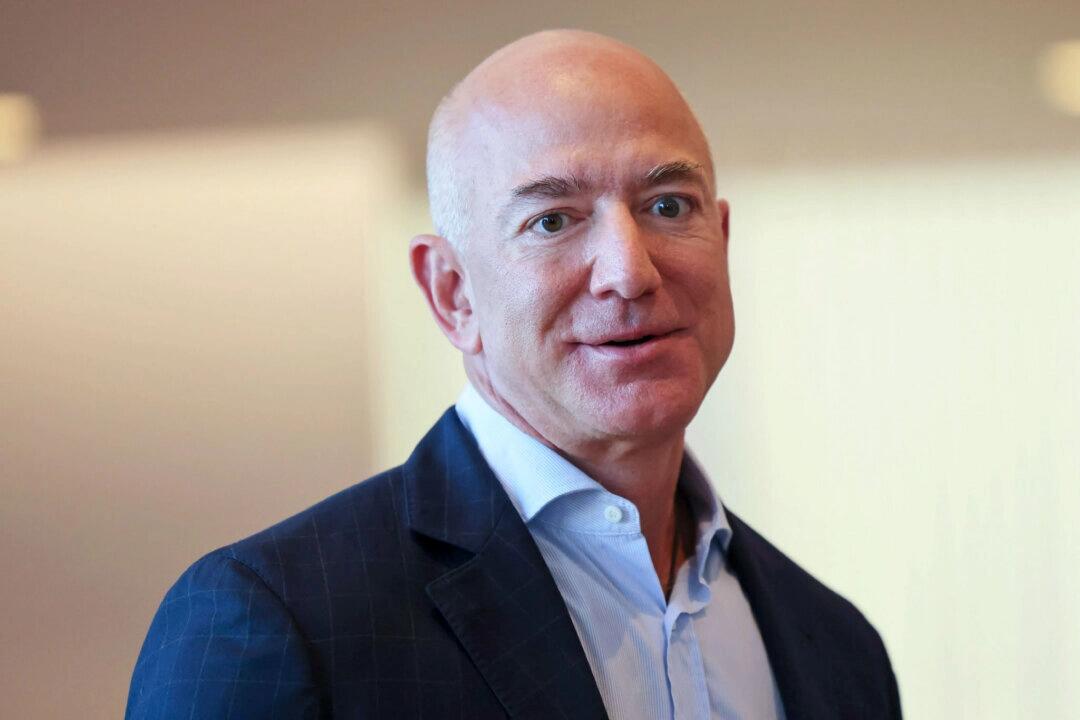
Amazon founder Jeff Bezos in New York City, on Sept. 20, 2021. Michael M. Santiago/Getty Images

Speaking at The New York Times’ DealBook Summit in New York on Dec. 4, Bezos said that there are “too many regulations in this country” and praised Trump’s commitment to slashing red tape.

I’m actually very optimistic this time around,” Bezos said. “He seems to have a lot of energy around reducing regulation. If I can help do that, I’m going to help him.”

Bezos said that, in his view, the United States is “so set up to grow” thanks to factors like abundant energy resources and the world’s best risk-capital system, and that eliminating barriers to growth is key to solving the nation’s most vexing economic problems, such as ballooning public debt.

You’re going to solve the problem of the national debt by making it a smaller percentage of GDP,” he said. “That means you have to grow the GDP at three, four, five percent a year, and let the national debt grow slower than that. If you can do that, then this is a very manageable problem.”

The billionaire entrepreneur added that America’s many advantages are being undermined by burdensome regulations.

“I’m very optimistic that President Trump is serious about this regulatory agenda, and I think he has a very good chance at succeeding,” he said.

Bezos’ comments come weeks after his decision in October to bar The Washington Post, which he owns, from endorsing a presidential candidate. The move sparked backlash, with tens of thousands of readers canceling subscriptions and protests from veteran journalists at the paper. In an op-ed, Bezos defended the decision, arguing that endorsements contribute to perceptions of bias in an era of widespread mistrust in the media and have little impact on election outcomes.

During his interview at The New York Times’ DealBook Summit, Bezos also addressed Trump’s contentious relationship with the press, saying he would work to dissuade the president-elect from seeing the media as an adversary.

“I don’t think the press is the enemy,” Bezos said, adding that he believes Trump’s relationship with the media has become less adversarial in recent years as he has grown as a person, and is “calmer … more confident, more settled.”

During his first term, Trump frequently criticized Bezos, Amazon, and The Washington Post. In 2019, Amazon alleged in court that Trump’s animosity cost the company a $10 billion Pentagon contract, which the Biden administration later split between Amazon and Microsoft.

Later in the interview, Bezos also commented on Musk’s regulatory role in the upcoming administration, expressing confidence that Musk would not use his influence to harm competitors. Bezos’s space venture, Blue Origin, is a rival to Musk’s SpaceX.

Musk co-leads the to-be-established Department of Government Efficiency (DOGE), which Trump has tasked with leading the effort to cut government expenditures and roll back bureaucracy. In an op-ed, Musk and his DOGE co-lead Vivek Ramaswamy called for a “lean team of small-government crusaders” to join them, seeking volunteers who would work long hours without pay on cutting regulations, downsizing the federal workforce, and reducing the federal budget.

Bezos hinted Wednesday that he might like to lend them a hand.

Tyler Durden
Fri, 12/06/2024 – 12:20

via ZeroHedge News https://ift.tt/H2isJaI Tyler Durden