Smith & Wesson Plunges After “Firearm-Buying Frenzy” Ends As “Digestion Period” Begins

Smith & Wesson Plunges After “Firearm-Buying Frenzy” Ends As “Digestion Period” Begins

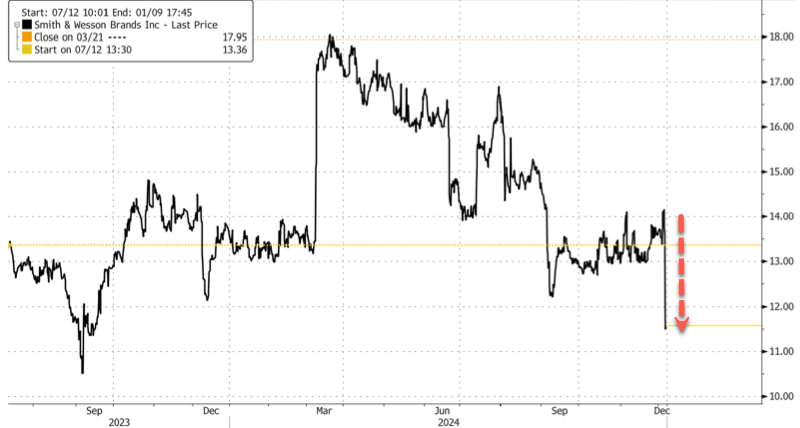
Shares of gunmaker Smith & Wesson Brands plunged in premarket trading after reporting adjusted earnings per share for the second quarter of fiscal 2025, which ended on October 31, that missed consensus estimates tracked by Bloomberg. This comes as firearm demand has cooled after the Covid frenzy. Furthermore, with President-elect Trump entering the White House next month, Americans are at ease that far-left Democrats and their radical non-profits funded by progressive billionaires will have a tougher environment to undermine the Second Amendment over the next four years.

Smith & Wesson’s dismal second-quarter earnings resulted from sliding gun demand in the US. 

Here’s a snapshot (courtesy of Bloomberg) of the earnings that missed the average analyst estimates: 

  • Adjusted EPS 11c, estimate 17c (Bloomberg Consensus) (2 estimates)

  • Net sales $129.7 million, estimate $133.7 million

  • Adjusted operating income $7.91 million, estimate $9.59 million

  • Gross margin 26.6%, estimate 29.8%

CEO Mark Smith commented on the earnings, blaming cash-strapped consumers and inflation for the industrywide downturn:

“Second quarter results came in below our expectations as overall demand for firearms normalized late in the quarter. We believe that the primary driver of the demand pressure continued to be inflation. The consumer cautiousness with discretionary spend that we observed in recent quarters was more pronounced during the second quarter than we anticipated.” 

Smith noted that despite the headwinds, Smith & Wesson outperformed the market and gained market share in the quarter. 

He warned about a “challenging demand environment” and flexed how the gun company has been able to navigate rough environments “many times before.”

CFO Deana McPherson said: “Net sales for our second quarter were nearly 4% above the prior year comparable quarter on the strength of our new Bodyguard 380 pistol and lever action rifles. Based on the softer demand trends we have seen across the industry in recent months, we have reduced our expectations for the second half of fiscal 2025, and for our third quarter, we expect our top line to be approximately 10-15% lower than fiscal 2024.” 

Craig-Hallum analyst Steve Dyer told clients that the weaker consumer demand and lackluster “firearm-buying frenzy” in the election were the main drivers behind the dismal earnings report.

Dyer pointed out that the firearms market has “entered a digestion period” after years of multiple buying panics, noting demand surges after strict regulation in the 2010s and riots and social unrest several years ago. 

Based on this, he slashed the price target of the stock to $13 from $18. 

Shares plunged 15% in premarket trading. As of Thursday’s close, shares have been flat on the year.
None of this comes as a surprise to readers, considering we have already covered the great gun bust, with the recent note that includes: 

However, suppressor demand appears to be rocketing higher.

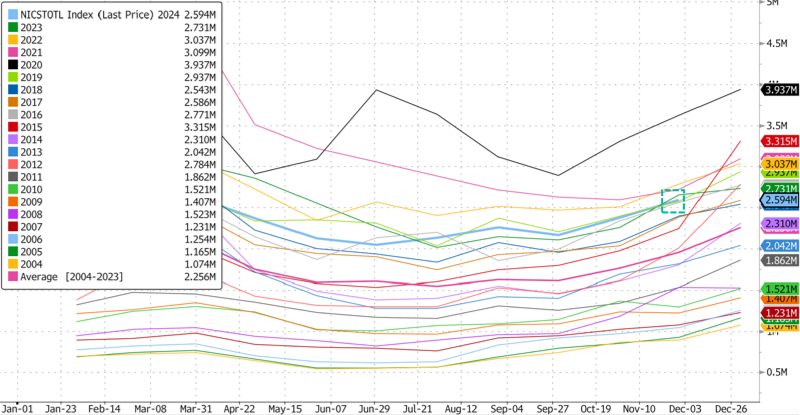
The latest National Instant Criminal Background System (NICS) data shows the boom and bust cycle of gun buying. Keep in mind that NICS checks are a proxy for the number of guns sold and are not exact because the background checks are performed on the buyer rather than the gun.
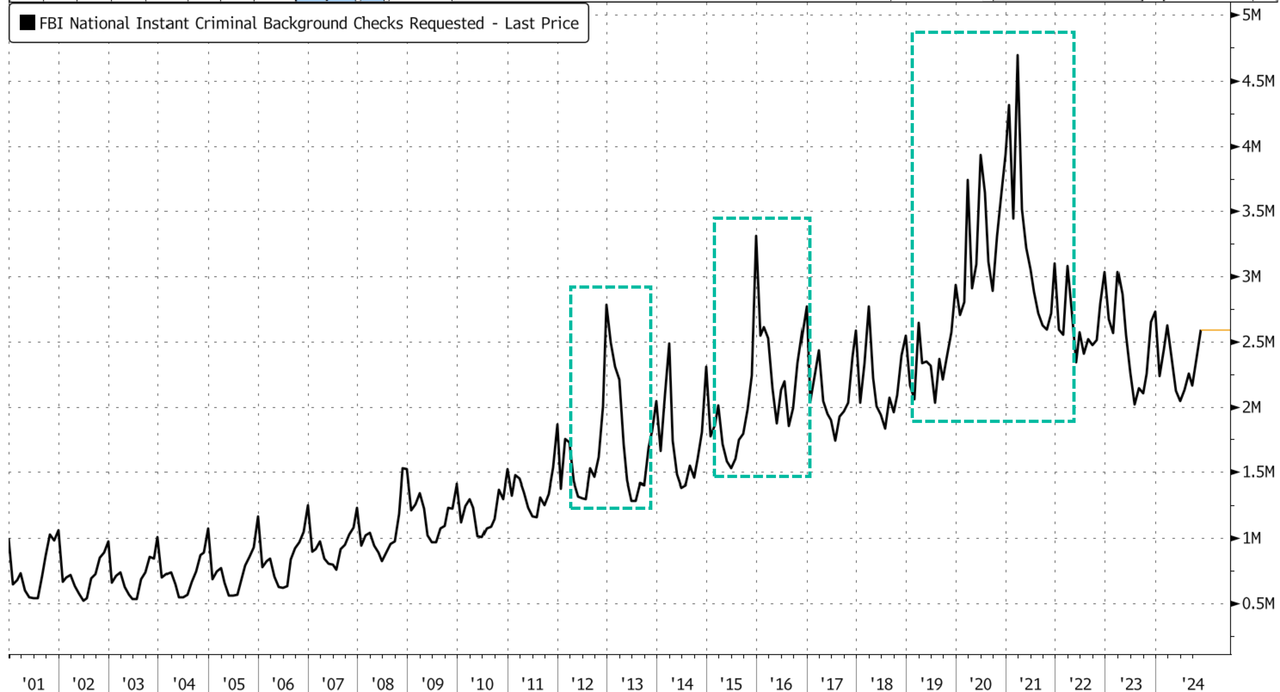
NICS checks are still well above a 20-year trend and seasonally rising into the end of the year.
Our view is that under Trump’s second term, the gun-buying panic days under anti-gunner Democrats will be over for now, and this will create deals, as gun companies like Smith & Wesson will have to push promotions to clear inventory. 

Tyler Durden
Fri, 12/06/2024 – 12:00

via ZeroHedge News https://ift.tt/KbezZG8 Tyler Durden

NASA Delays Artemis Moon Missions Until 2026 And 2027

NASA Delays Artemis Moon Missions Until 2026 And 2027

Authored by T.J.Muscaro via The Epoch Times,

The National Aeronautics and Space Administration (NASA) confirmed that its first manned flight of the Artemis Moon program won’t launch until April 2026, and the following mission—the first landing on the Moon since 1972—won’t happen until mid-2027.

This is the second time NASA has delayed the launch of Artemis II.

It was previously scheduled to launch in November 2024, and it was then pushed back to September 2025. NASA was targeting a 2026 launch for Artemis III.

NASA Administrator Bill Nelson announced the new schedule during a press conference on Dec. 5, emphasizing that it was received with unanimous support from the administration’s executive council and keeps the U.S. space program on track to beat communist China’s goal of landing by 2030.

However, he also stressed that the decision was made out of safety.

“The safety of our astronauts is always first in our decisions,” he said. ”It is our North Star. We do not fly until we are ready. We do not fly until we are confident that we have made the flight as safe as possible for the humans on board.

“We need to do this next test flight, and we need to do it right, and that’s how the Artemis campaign proceeds.”

The new launch schedule comes after a lengthy investigation was conducted into unexpected char and erosion discovered on the heat shield of Artemis I’s unmanned Orion capsule upon its return.

The capsule selected for Artemis II has an identical heat shield. But NASA’s leadership told reporters that its investigation showed that it was still reusable so long as the re-entry trajectory is adjusted.

That re-entry into Earth’s atmosphere slows the spacecraft down from near-25,000 mph to about 325 mph before parachutes are deployed, generating an exterior heat of nearly 5,000 degrees Fahrenheit, according to NASA.

An updated heat shield will be installed on Orion capsules, starting with Artemis IV.

NASA officials chose to alter the re-entry for Artemis II and III because ripping off the current heat shield and installing a new one would set the Moon landing back nearly another full year.

There are other issues with the capsule still being sorted as well, specifically with the life support system.

However, officials confirmed the heat shield decision allows the Moon rocket to start getting stacked together at NASA’s vehicle assembly building at Kennedy Space Center in Florida in anticipation of the spring 2026 launch.

On top of the investigation, Nelson reminded reporters that the timeline of the Artemis program is dependent upon a vast supply chain of international and commercial partners.

The European Space Agency (ESA) is building Orion’s service module, which is being built by Lockheed Martin.

Boeing is tasked with building the behemoth launch vehicle known as the Space Launch System.

SpaceX and Blue Origin are building the lunar landers.

New spacesuits are coming from Axiom Space, and Japan’s space agency JAXA is providing the next lunar rover.

“We must have a shared sense of urgency among all these partners, and I think we have that,” Nelson said, with that urgency focused on landing human beings on the Moon’s south pole—a region known to have water—before the CCP.

While the CCP plans to establish its own presence on the Moon does not specifically target the same landing area, NASA’s administrator does not want to take a chance on them claiming the location for themselves.

He referenced the CCP’s recent aggressive actions against the Philippines over territorial claims in the South China Sea.

“I wish that China could be someone that we could cooperate with, and maybe there will be an opportunity in the future,” he said.

“I hope so. But given the fact of the history of how the Chinese government has operated up until, including recently, I don’t want that to occur on a very important part of the moon.”

Artemis II will be a fly-by mission to the moon crewed by NASA astronauts Reid Wiseman, Victor Glover, and Christina Koch, as well as Canadian astronaut Jeremy Hansen.

It will complete the necessary objectives ahead of Artemis III.

Meanwhile, landing capabilities are dependent upon the success of Elon Musk’s SpaceX Starship.

NASA officials said the Starship needs to fly several times before it’s deemed ready for Artemis, including completion of an unmanned Moon landing and a refueling demonstration in Earth orbit.

Wiseman expressed his optimism about the SpaceX starship and the Artemis program during the press conference, recounting how he felt watching the starship successfully launch and return to the launch tower.

“I had just seen our booster,” he said.

”I had just seen the Orion spacecraft. I’m now watching Starship Six test flight. All the elements are there for humans on the Moon, and all the elements are there to push us onto Mars in the very future, near future. And I just felt it in my soul.”

Nelson also expressed confidence in SpaceX’s progress and the program as it is passed to a new administration and new NASA administrator, Jared Isaacman.

Nelson said he spoke to Isaacman on Dec. 4 congratulating him on his nomination, and that he looked forward to meeting with him.

Isaacman did not respond to The Epoch Times by publication.

Tyler Durden
Fri, 12/06/2024 – 11:40

via ZeroHedge News https://ift.tt/SXCz4rT Tyler Durden
Romanian Court Annuls Vote, Declares Presidential Election Do-Over, After ‘Far Right, Pro Russian’ Candidate On Top

Romanian Court Annuls Vote, Declares Presidential Election Do-Over, After ‘Far Right, Pro Russian’ Candidate On Top

Something unprecedented just happened in the NATO and EU member country of Romania – a top court on Friday annulled the first round of the country’s presidential election. Essentially there will now be a ‘do over’ election.

The Constitutional Court made the decision even as voting is still underway in the diaspora. “The electoral process for the election of the President of Romania will be resumed in its entirety, with the Government required to set a new date for the election of the President of Romania as well as a new calendar program for carrying out the necessary actions,” the court said in a statement.

The court decided “to annul the entire electoral process for the election of the President of Romania… to ensure the correctness and legality of the electoral process” – in a controversial ruling which has simply never happened.

Romanian independent presidential candidate Calin Georgescu, dubbed by the media as “far-right”. via Reuters

Calin Georgescu, the widely dubbed ‘far-right’ contender, came out on top in a first round of voting in a ‘shock’ outcome which left political opponents claiming Russian election interference.

Apparently the ‘smoking gun’ is related to mere social media posts on platforms like TikTok. “The Constitutional Court’s unprecedented decision — which is final — came after President Klaus Iohannis declassified intelligence on Wednesday that alleged Russia ran a sprawling campaign comprising thousands of social media accounts to promote Calin Georgescu across platforms like TikTok and Telegram,” The Associated Press details.

Georgescu emerged top of the ballot after the Nov.24 first round vote, despite declaring no campaign spending, and was set to enter a run-off originally scheduled for Sunday against reformist Elena Lasconi of the Save Romania Union party.

Contributing to the dossier examined by the court on the alleged Russian election interference included the Romanian Intelligence Service, the Foreign Intelligence Service, the Special Telecommunication Service and the Ministry of Internal Affairs, AP has noted further.

Georgescu’s nationalist rhetoric has proven ultra popular as social media videos featuring him have racked up millions of views. But at least much of this would likely be genuine and organic, given that the vast majority of the population leans ultra-conservative.

Also Romania has one of the highest church attendance rates in Europe, with the dominant religion being the very traditional Romanian Orthodox Church, which is also in communion with the Russian Orthodox Church.

Russia on Friday vehemently denied that it is interfering in Romania’s election. This as Western media is already labelling Georgescu as “pro-Russian”. Similar controversy has lately engulfed politics in Georgia as well, where pro-EU street protests have continued.

“The campaign for the Romanian presidential election… is accompanied by an unprecedented outburst of anti-Russian hysteria,” Russian foreign ministry spokeswoman Maria Zakharova told the press in response to the reports. “More and more absurd accusations are being made by local politicians, officials and media representatives…,” she said. “We firmly reject all hostile attacks, which we consider absolutely groundless.”

The European Commission at the same time says it’s closely monitoring the TikTok platform related to Romania’s election. NATO and Washington are also watching closely, given a Georgescu victory could have huge implications for the future of Western military bases and units inside Romania, on NATO’s so-called Eastern flank:

Romania is a serious military power, which is why the risk that NATO-skeptic, pro-Russia candidate Călin Georgescu will become its president next Sunday is confounding the alliance.

The country of 19 million has been a NATO member for two decades, and is the site of an airbase that is expanding to be the bloc’s biggest in Europe. It borders Ukraine; stares across the Black Sea at Russia-occupied Crimea; has sent arms and ammunition to Kyiv; and hosts a U.S. Aegis Ashore missile defense system in Deveselu, in southern Romania, where both Romanian and U.S. forces are based.

But those international ties are deplored by Georgescu, who has condemned the Deveselu missiles as a national “shame,” campaigned for ending Romanian aid to Ukraine, and called for “Russian wisdom” in shaping foreign policy.

His rhetoric is similar to Hungary’s Viktor Orban or Italy’s Meloni…

But depending on how convincing the alleged evidence in possession of Romanian intelligence is, this is more likely just another example of European officials screaming ‘Russian interference’ when a politician emerges who they don’t like. It is perhaps the next round of election which will be the most telling. It remains unclear whether the ‘evidence’ will be made public, or if it will be convincing to the general Romanian public.

Tyler Durden
Fri, 12/06/2024 – 11:20

via ZeroHedge News https://ift.tt/7uoHf8N Tyler Durden
Chevron Cuts Permian Capex for 2025

Chevron Cuts Permian Capex for 2025

By Irina Slav of OilPrice.com

Chevron has reduced the amount of capital expenditure it will allocate for its operations in the Permian Basin next year, the company said in an update.

The company said it planned to spend between $4.5 billion and $5 billion on production in the Permian, “as production growth is reduced in favor of free cash flow.” Total upstream spending for 2025 is planned at $13 billion, with the company’s total capex budget set in a range of between $14.5 billion to $15.5 billion.

This would be a decline from this year’s capex budget of $15.5 billion to $16.5 billion. When the affiliate capex budget is included, the 2025 budget represents a $2-billion reduction on the 2024 number, Chevron reported.

The company remains focused on its home operations, with the remainder of its U.S. budget to be split between operations in the DJ Basin and the Gulf of Mexico. In the latter area, Chevron said it expected daily production of some 300,000 barrels from its deepwater wells by 2026.

Chevron also said in its update that it will book charges of between $1 billion and $1.5 billion in the fourth quarter, most of it attributable to restructuring costs related to plans for achieving structural cost cuts of $2 billion to $3 billion by 2026.

“We continue to invest in high-return, lower-carbon projects that position the company to deliver free cash flow growth,” chief executive Mike Wirth said, highlighting the priorities of the company.

He also pointed out that “The 2025 capital budget along with our announced structural cost reductions demonstrate our commitment to cost and capital discipline,” hitting the second key point for shareholders in the energy industry.

The update could be seen as the latest piece of evidence that despite President-elect Trump’s plans for a return to a “Drill, baby, drill” mentality in the oil and gas industry, companies are wary of it and remain focused on cash and shareholder returns above production growth.

Tyler Durden
Fri, 12/06/2024 – 11:00

via ZeroHedge News https://ift.tt/yPa8TzK Tyler Durden

As TikTok Faces Chopping Block, Chili’s Scores Social Media Win With GenZ

As TikTok Faces Chopping Block, Chili’s Scores Social Media Win With GenZ

TikTok is back on the chopping block after a three-judge panel on the US Court of Appeals in Washington DC upheld a new law requiring its Chinese parent company, ByteDance, to sell the video-sharing app by January 19th.

The decision leaves the Supreme Court as the company’s last hope for stopping the law from taking effect.

President-elect Donald Trump, whose inauguration will take place one day after the ban, has spoken out against the ban – saying that it would mainly benefit Mark Zuckerberg-owned Meta.

The US Government has alleged that TikTok allows Beijing to collect data and spy on users, and that it’s a conduit to spread propaganda. China and the company have denied these claims, while free-speech advocates say the USG is trying to punish a platform they can’t control.

Chili’s Scores Win With TikTok

Goldman analysts have uncovered a fascinating new trend in the casual dining industry: Cash-strapped consumers (GenZers) are flocking to the American chain Chili’s Grill & Bar

Chili’s, Brinker International’s core brand (close to 90% of revenue)—trading on the NYSE under the ticker “EAT”—has outperformed the broader full-service restaurant industry. 

On Thursday, Goldman’s analysts Christine Cho and Teddy Farley told clients that the brand is experiencing a “clear turnaround.” 

The analyst said Chili’s revamped its core menus and offered new pricing strategies, which are now paying off. 

They continued:

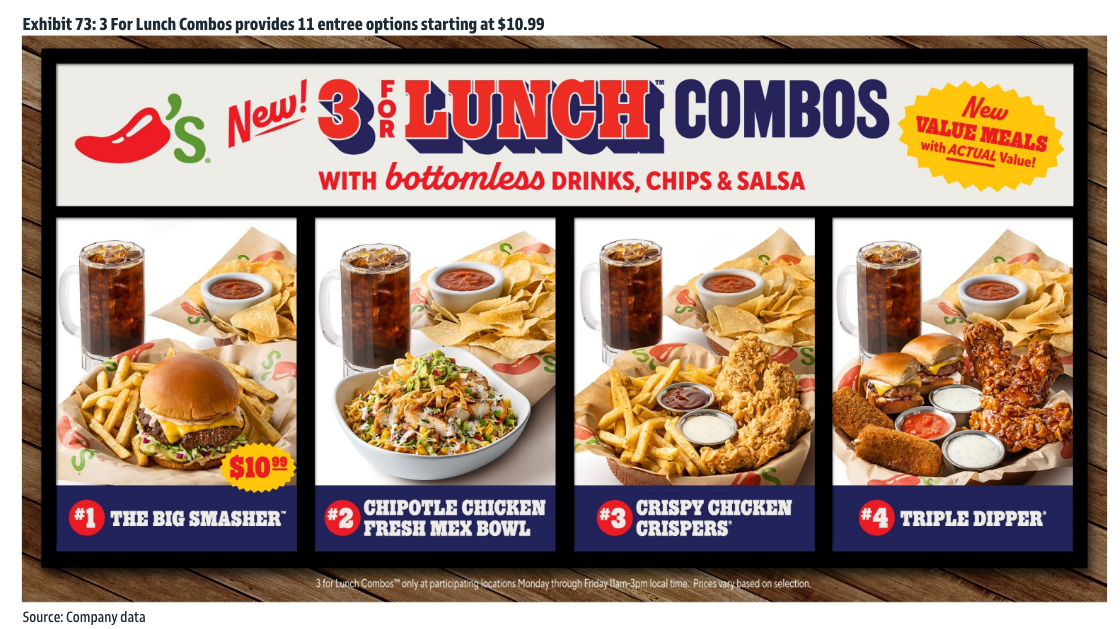
Focus on Core Menus and differentiated pricing strategy paying off. Company has reduced roughly quarter of Chili’s menu in the last 2.5 years and shifted focus to the Core 5 SKU categories (Burgers, Crispers, Fajitas, Margaritas, and newly added Triple Dippers) which now comprises 58% of Chili’s revenue.

An unexpected twist in all the new traffic: Chili’s social media team appears to have captured the hearts and minds of GenZers… 

The analysts provided more color on this: 

This has enabled the company to simplify kitchen operations, improve throughput and improve the guest experience. Moreover, successful menu/ marketing strategy has drawn a new generation of younger guests into the stores, who tends to spend more per visit and to visit more frequently

Chili’s is winning the eatery TikTok promo wars:

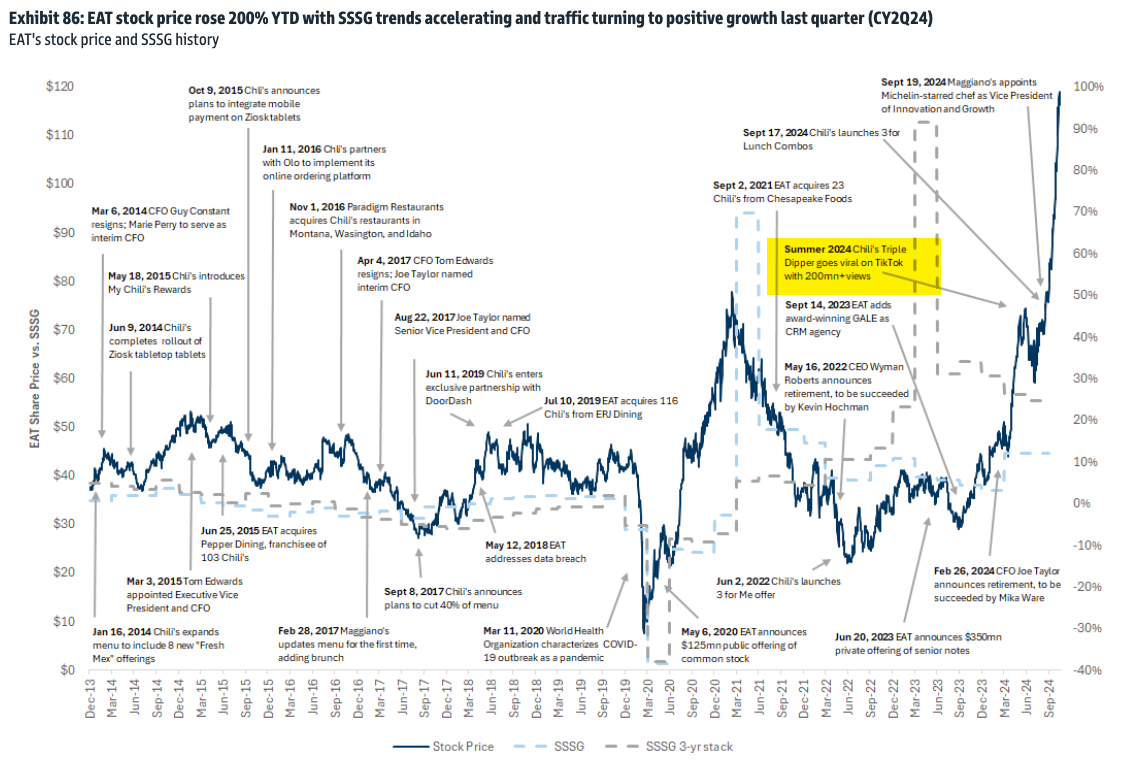
For instance, Triple Dipper (mix-and-match of 3 appetizers served with dipping sauces) received 200mn views on a viral Tik Tok campaign this year, driving sales up 70% YoY and contributing to c.11% of sales.

Traffic Surge

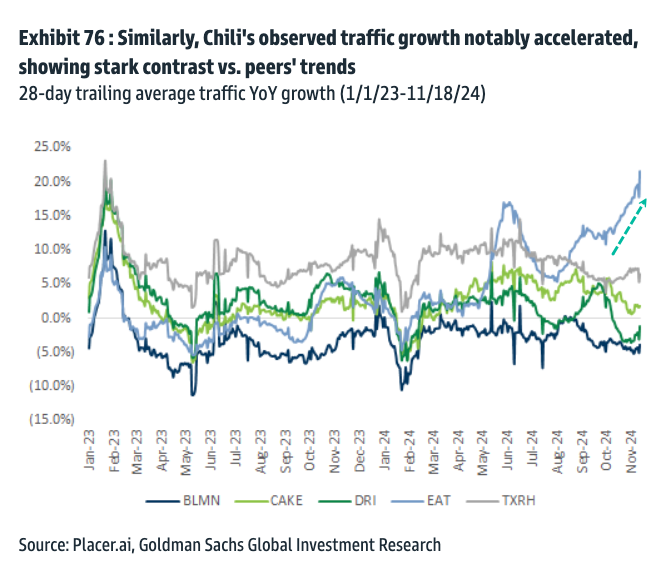
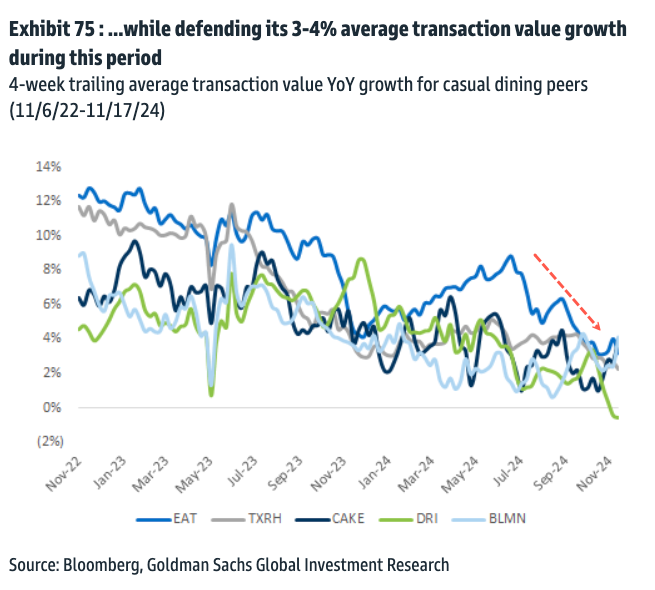
With Gen Z enamored by Chili’s, foot traffic at its restaurants nationwide has surged in the second half of the year. There is a notable negative divergence in traffic and spending compared to other major FSRs.

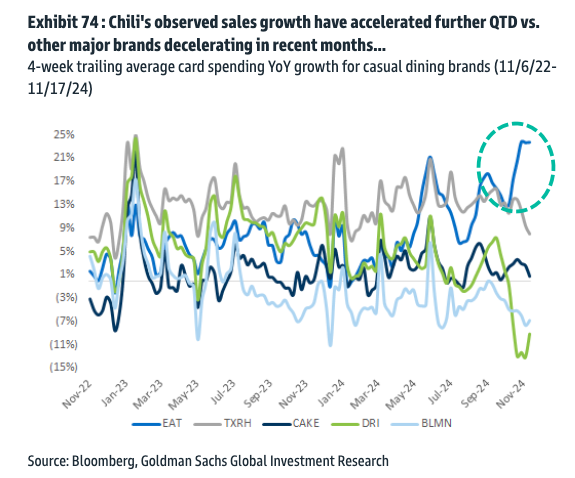
Sales growth at Chili’s has also picked up compared with other FSR brands. 

However, GenZers are likely just coming in for the deals. 

Increased sales and foot traffic (thank the TikTok promo) at Chili’s have sent EAT shares parabolic. 

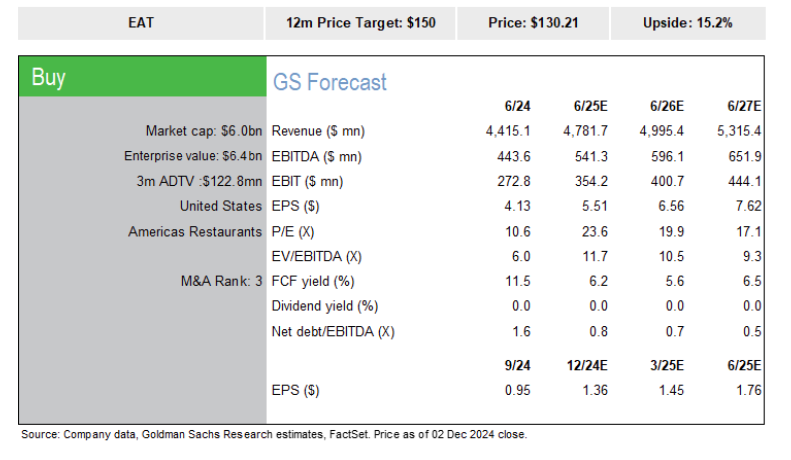
The analysts maintain a “Buy” rating on EAT with a $150 price target. 

Take note other FSRs!

Tyler Durden
Fri, 12/06/2024 – 10:40

via ZeroHedge News https://ift.tt/QyM4ZXH Tyler Durden

“The Market Is Pricing A December Cut”: Wall Street Reacts To Today’s Solid Jobs Report

“The Market Is Pricing A December Cut”: Wall Street Reacts To Today’s Solid Jobs Report

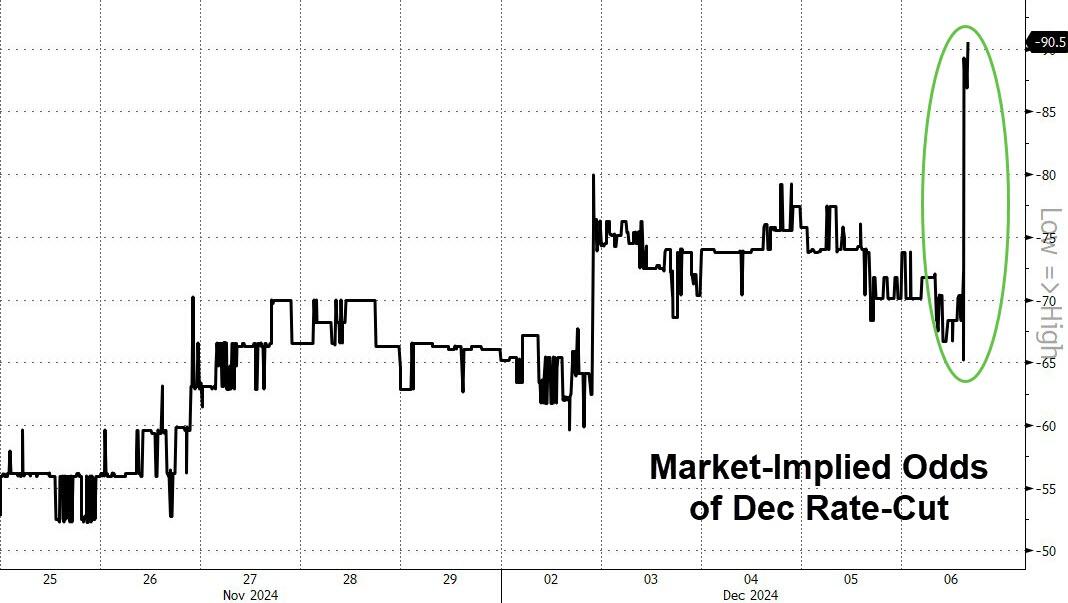
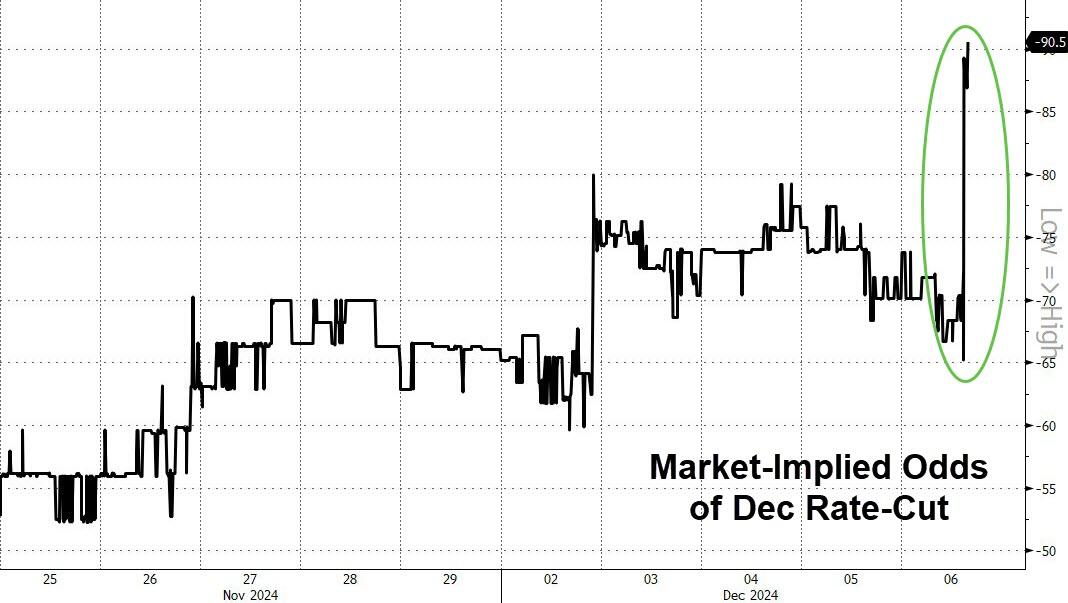
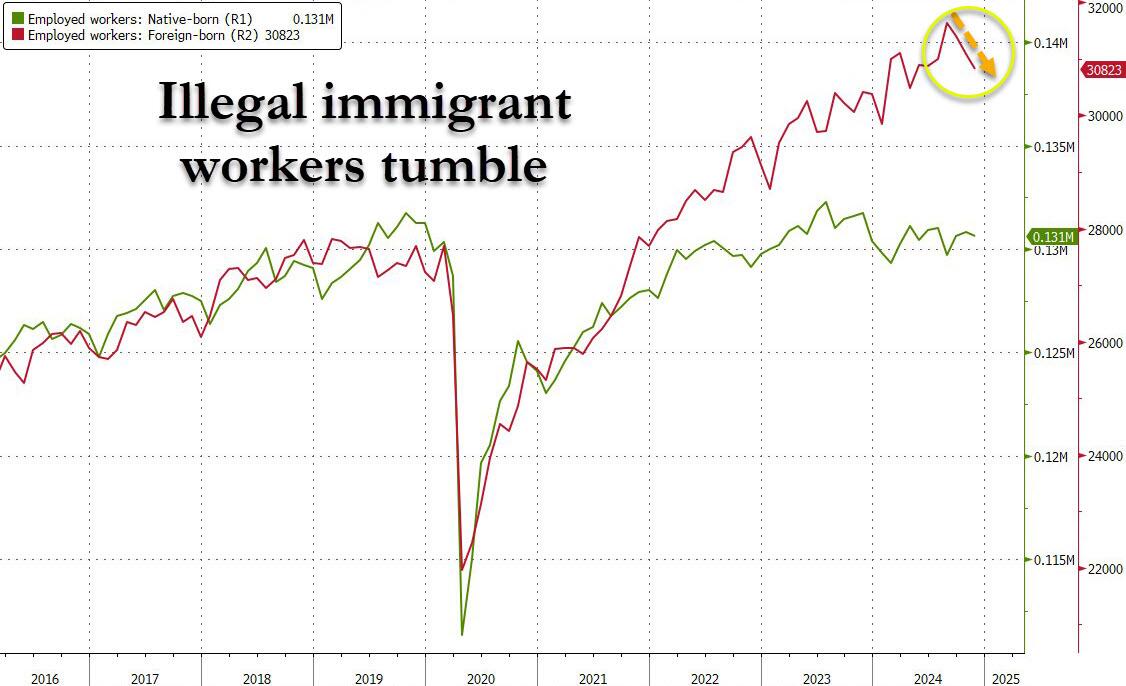
After today’s solid jobs report, which showed hotter than expected payrolls and wage growth, and which hints at much more wage growth now that “foreign born” (i.e., illegal workers) are tumbling forcing employers to hire much higher paid domestic laborers, the market is still convinced that the Fed still remains on track to cut rates in two weeks, even though core CPI is once again on the rise, at 3.3% and soon much higher, while the Atlanta Fed’s GDPNow tracker has the US economy growing also 3.3% this quarter.

Do Wall Street pundits agree? Below we have compiled a snapshot of some f the kneejerk reactions by traders, analysts and strategists.

Seema Shah, chief global strategist, Principal Asset Management:

“There are cracks in the labor market that require Fed attention. At the same time, with average earnings growth still stubborn, the Fed has to proceed down its rates path with significant caution and care. A December cut is in the offing but, come early 2025, the Fed is likely to slow its cutting pace to every other meeting. What started out as a Fed pivot has evolved into a central bank swerve.”

Anna Wong, head of Bloomberg Economics:

“Job growth was brisk in November, as hiring activity rebounded from an October print weakened by hurricanes and strikes — but the rebound is short of what it should have been if October’s weakness were all due to such temporary factors. For example, manufacturing job growth would still be in negative territory if not for a one-off boost from the resolution of the Boeing strike in early November. Indeed, the uptick in the unemployment rate – just 0.004 percentage point shy of rounding up to 4.3% — supports our contention that cyclical sectors are showing underlying weakness. Once all revisions to the data are in, we think they’ll show the true underlying pace of monthly job creation currently is barely positive — and well below what’s needed to stabilize the unemployment rate. That means the jobless rate will likely continue to climb. The November jobs report doesn’t seal the deal for a rate cut in December, but it also doesn’t take it off the table. We think the November CPI report (due out Dec. 11) will be critical for the Fed’s decision this month.”

Mike Zigmont, head of trading and research at Harvest Volatility Management:

“Small caps have underperformed for a long time until recently. My guess is that investors view today’s NFP as bullish and they are buying the small caps more than large because they think the outperformance will continue. If economy stays healthy and rates come down a little….it’s probably better for small caps.”

Carl Weinberg, High Frequency Economics:

“With earnings rising 4% at a year-on-year pace, there’s plenty of income to keep powering consumer spending. So retail sales should be good. Brisk consumer spending is what is making the economy grow so fast right now.”

Brian Coulton, chief economist at Fitch Ratings:

“The underlying growth in labor demand remains solid despite the small uptick in the unemployment rate – payrolls have grown by 172,000 per month over the last three months, probably closer to 200,000 if we allow for the October distortions. At the same time wage growth looks to have bottomed out at 4% in year-on-year terms and has crept up to 4.4% on a three-month annualized basis. That won’t stop the Fed from cutting rates again later this month but it will give them pause for thought – 4.4% wage growth doesn’t really work with 2% price inflation.”

Ira Jersey, Bloomberg Intelligence:

Overall, the data isn’t quite strong enough to shift the odds of a December rate move by the Fed, and the Treasury yield knee-jerk rally reflects the market fearing even a better payrolls report,” BI’s Jersey says. The slightly higher unemployment rate will give the Fed comfort. Yet on this trend, we suspect a December cut may be followed by a January pause…. The market is basically pricing for a December cut, but then the Fed to skip January, cut in March and skip May, with a final cut in either June or July. Given the incoming economic data, we don’t think this is unrealistic at this point — but we must remember this is a major shift from the cut at every 2025 meeting that was priced just three months ago.”

Tom Porcelli, PGIM:

“There are some cracks in the labor backdrop but the floor’s not falling out from beneath us here.”

Mohamed El-Erian:

“The fact that the unemployment rate went back up means that the Fed will be comfortable cutting by 25 basis points and that the market will increase the probability of this happening. On the policy front, this did not complicate what would have been a messy situation.”

Source: Bloomberg

Tyler Durden
Fri, 12/06/2024 – 10:20

via ZeroHedge News https://ift.tt/4w8HKFD Tyler Durden

Trump Victory Sparks Biggest Jump In Consumer Sentiment Since Clinton In 1992

Trump Victory Sparks Biggest Jump In Consumer Sentiment Since Clinton In 1992

After jumping in November (post-election, led by Republicans’ confidence), UMich consumer sentiment was expected to extend its gains in preliminary December data released today and it did, but the picture was mixed.

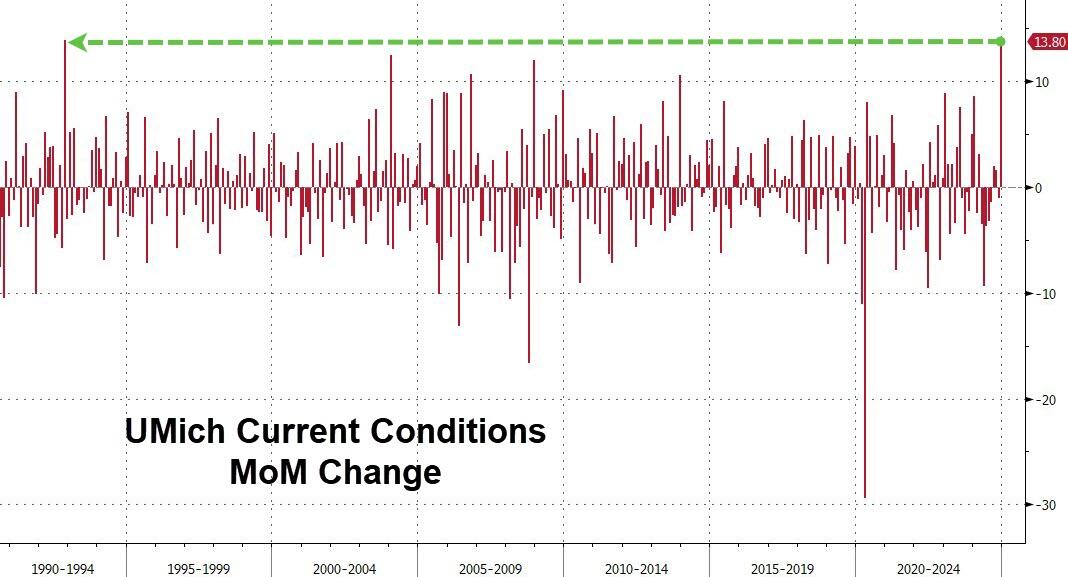
Current Conditions exploded higher (from 63.9 to 77.7, well above consensus) while Expectations dropped from 76.9 to 71.6 (missing consensus) with the headline sentiment rising to 74.0 from 71.8 (its highest since April)…

Source: Bloomberg

This was the biggest jump in Current Conditions since Nov 1992 – when Bill Clinton was elected…

Source: Bloomberg

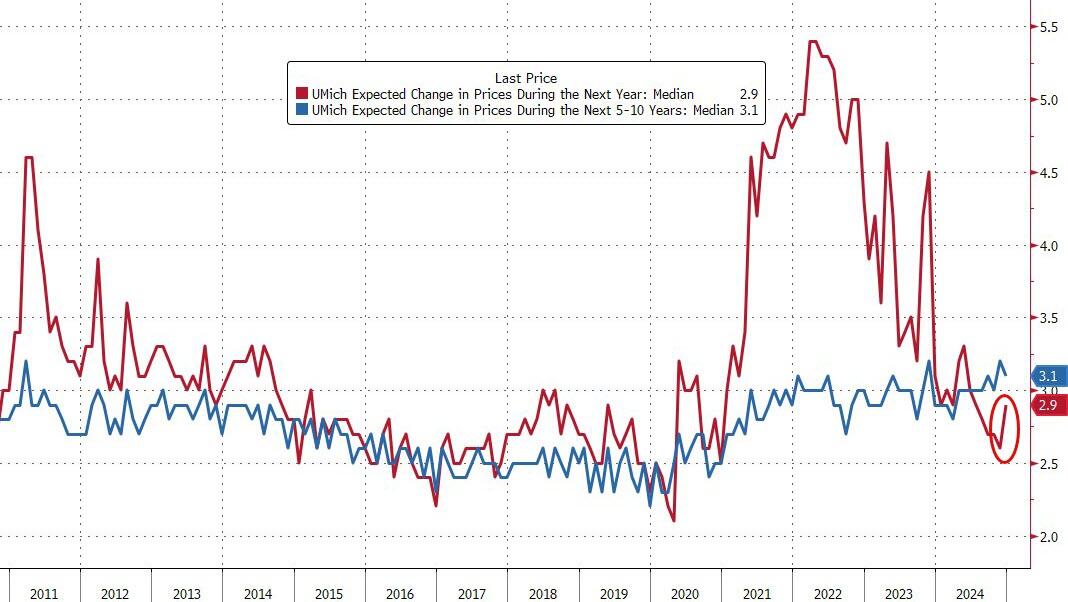
Along with that surge in confidence came a jump in inflation expectations…

Source: Bloomberg

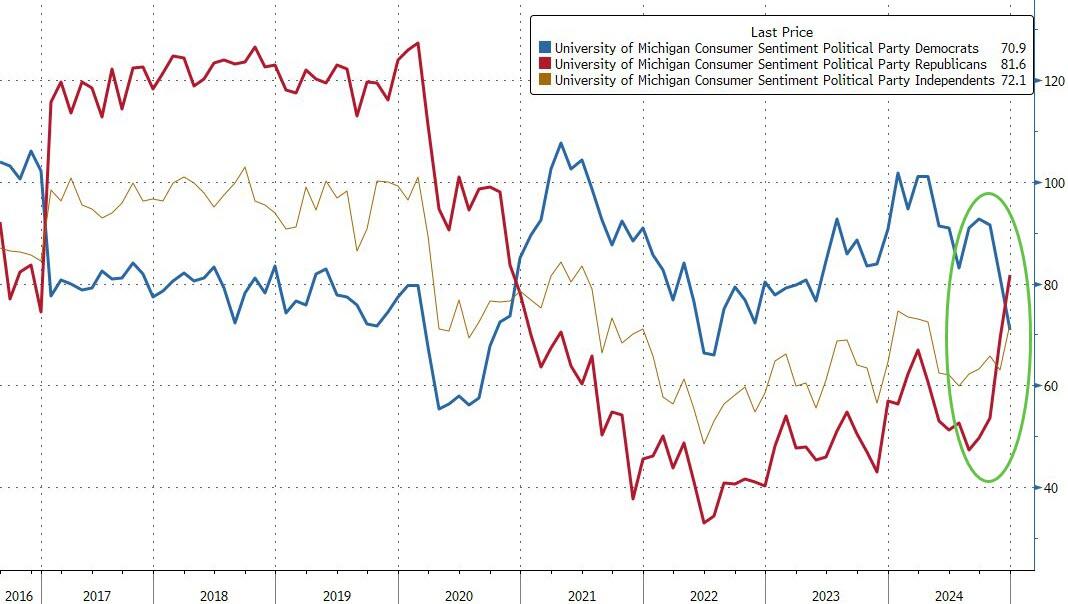
As UMich’s Joanne Hsu comments:The expectations index continued the post-election re-calibration that began last month, climbing for Republicans and declining for Democrats in December. Independents were, as usual, in the middle between the two major parties, with readings close to the national average. This adjustment process is consistent with a response to actual underlying changes in expectations for the national economy, and not merely an expression of partisanship.”

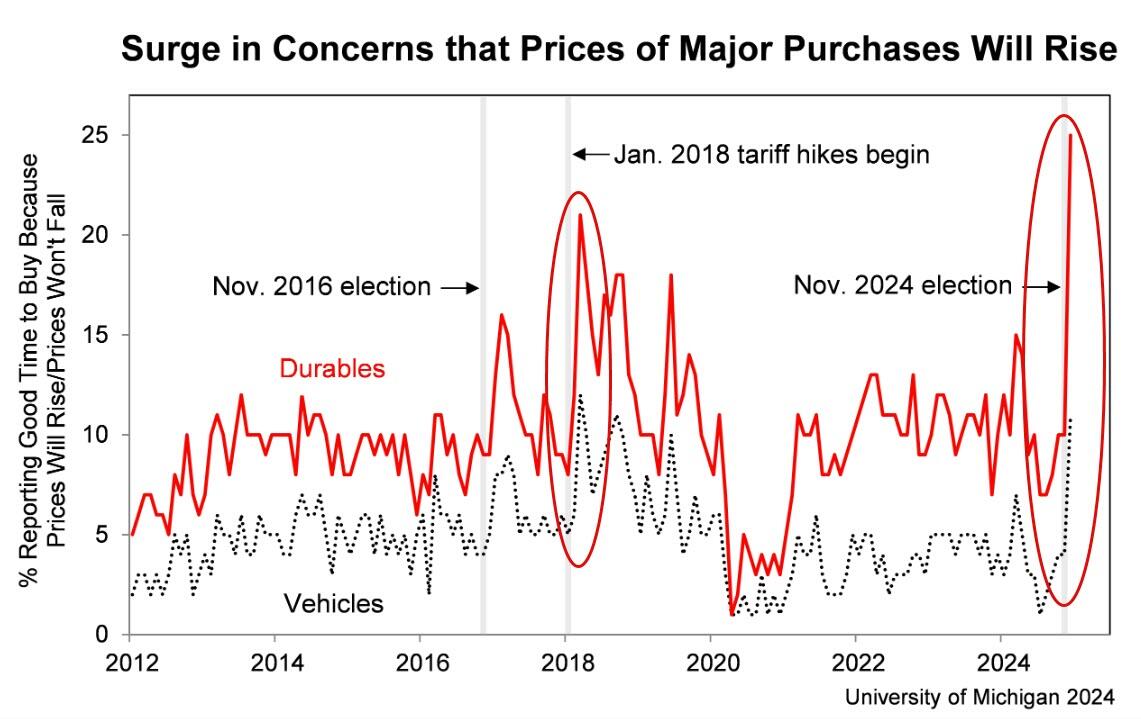
For example, throughout this month’s interviews, Democrats voiced concerns that anticipated policy changes, particularly tariff hikes, would lead to a resurgence in inflation.

Republicans disagreed; they expect the next president will usher in an immense slowdown in inflation.

As such, national measures of sentiment and expectations continue to reflect the collective economic experiences and observations of the American population as a whole.

Tyler Durden
Fri, 12/06/2024 – 10:10

via ZeroHedge News https://ift.tt/XkRiZ52 Tyler Durden

Russia, China Tell Their Citizens To Evacuate Syria Immediately

Russia, China Tell Their Citizens To Evacuate Syria Immediately

In a sign of likely more bad things to come for Assad forces, Syria’s closest powerful ally Russia has ordered all of its civilian nationals to leave the country as the al-Qaeda linked group Hayat Tahrir al-Sham continues its shock offensive, making its way south from captured Aleppo area to Hama and Homs into the heart of the country.

“Russia on Friday urged its citizens to leave Syria, as rebel forces in the country press a lightning offensive against Moscow-ally Bashar al-Assad’s government,” AFP confirms.

The Russian embassy in Damascus issued an alert telling citizens “to leave the country on commercial flights through airports in operation” while underscoring “difficult military and political situation” in Syria.

Russian soldier stationed in Syria, via AFP.

China already on Thursday had issued an alert for all of its citizens to depart the country. The Chinese Embassy in Damascus told its nationals to depart “as soon as possible” at a moment the Syrian Army has been seen withdrawing from both Hama and Homs.

“At present, the war in northwestern Syria is growing tense, and the security situation in Syria is further deteriorating,” Beijing’s embassy said.

“The embassy in Syria suggests that Chinese citizens in Syria take advantage of the fact that commercial flights are still in operation to return home or leave the country as soon as possible,” it warned.

While China does not have a huge amount of citizens in Syria, Russia has long maintained deep ties to the country. There’s even a large apartment building in Damascus known to house Russian engineers and their families, which goes back decades.

Russia’s military presence in Syria is not expected to change, however. Its forces have deployed since 2015 in defense of the Assad government. Russian warplanes have been flying alongside Syrian jets, pounding insurgent positions.

HTS is a US-designated terrorist organization, and is poised to capture Homs:

But the advance has not been slowed much given that there’s currently not a lot of resistance by the Syrian Army on the ground so far. The consensus seems to be that Damascus is pulling many of its military assets back to the area around the capital, and the coast, in order to defend these high-population enclaves.

But Russia and China began viewing the situation with much greater alarm given that one of the country’s two main international travel hubs, Aleppo International Airport, is now in the hands of the jihadists.

Border crossings into Lebanon have at the same time been bombed by Israel. “Israel bombed a border crossing between Lebanon and Syria on Friday morning not long after its reopening, in another violation of a fragile ceasefire deal signed last week,” a regional source writes.

“Airstrikes targeted the Arida border crossing, Lebanon’s northernmost coastal point in the Akkar district, cutting it off from neighbouring Syria, the state-run National News Agency confirmed,” the report adds. Iran-linked Iraqi militias have been coming across the border to Syria’s aid, and some reports have pointed to more Iranian officers sent, but it remains unclear whether Russia will surge additional troops into the conflict.

Tyler Durden
Fri, 12/06/2024 – 10:00

via ZeroHedge News https://ift.tt/ScxUzaX Tyler Durden

Payrolls – A Tale Of Two Reports

Payrolls – A Tale Of Two Reports

Authored by Peter Tchir via Academy Securities,

A Tale Of Two Reports

The Establishment Survey said we added 227k jobs and even had upward revisions of 56k to the prior two months. Pretty darn good.

Much better than ADP which came in at only 146k with significant downward revisions to last month, but that’s not the really weird part.

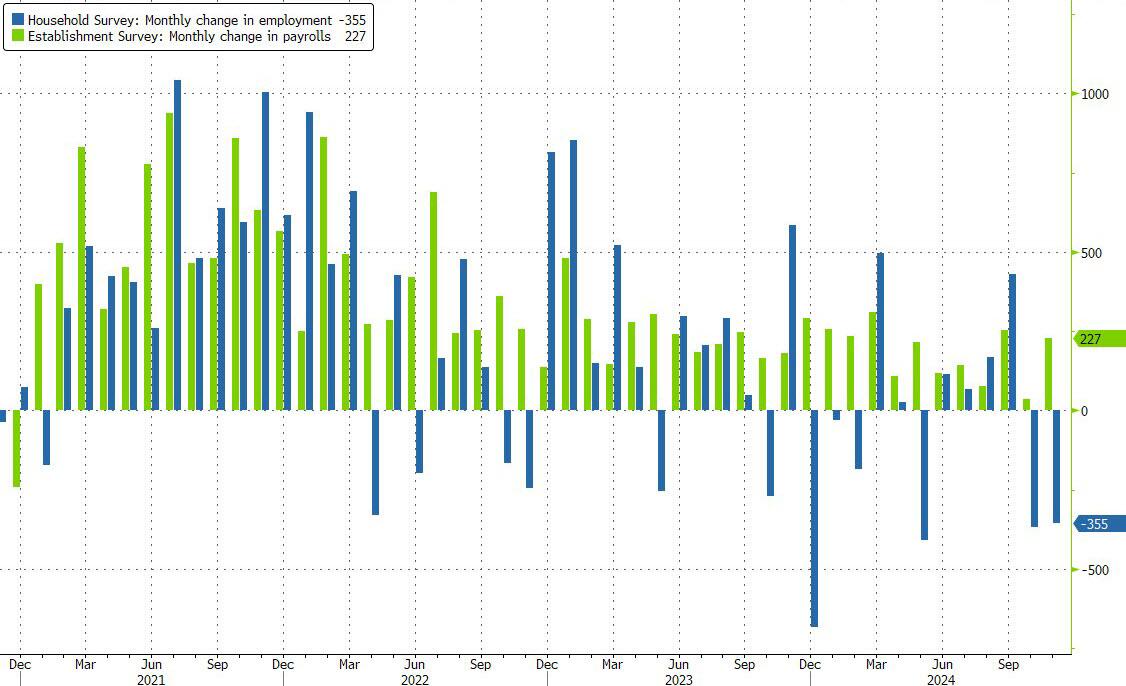
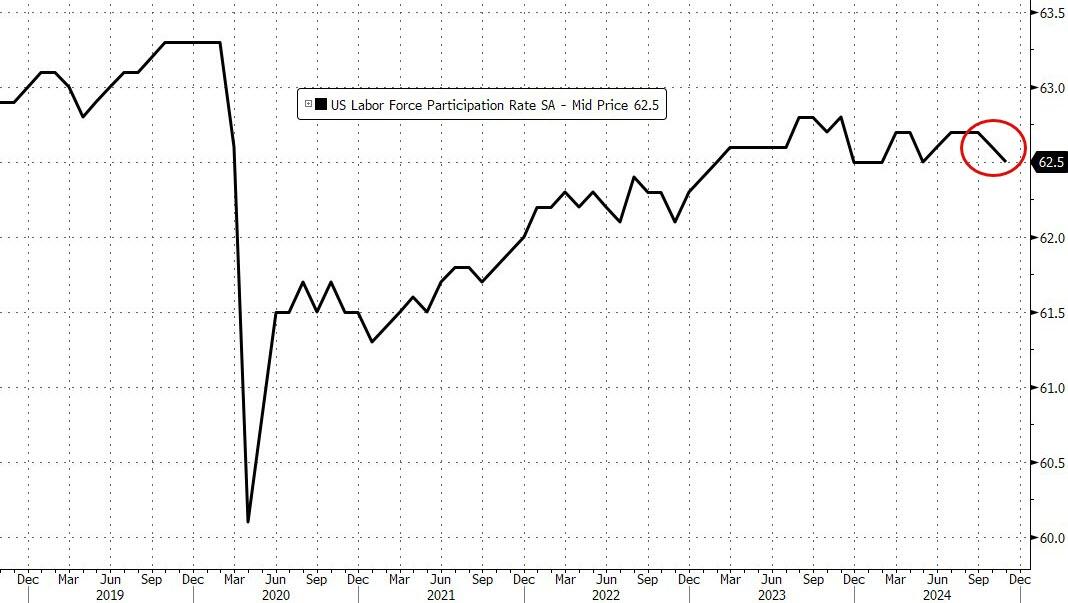
The unemployment rate ticked up to 4.2% from 4.1%. That is with the labor force participation rate dropping from 62.6% from 62.5%. So it is more like a rise of 0.2% and is because the Household Survey (which is the basis for the unemployment rate) had job losses of 355k (on top of last month’s job losses of 368k). It looks like we lost both full-time and part-time jobs in that report.

The initial reaction of lower treasury yields on the back of higher unemployment might not be the right move. The margin for error of the Household Survey is much bigger than that of the Establishment Survey (which is so high itself, that I’m not sure why we fixate so much on this data – the 90% confidence interval is +/- 130k for the Establishment Survey – which is kind of huge relative to the number itself).

See BLS Technical Note.

But since we have to deal with the data that we have, there are other things that point to a strong report:

  • Earnings came in slightly higher than expected.

  • Hours worked remained the same (slightly higher in fact as last month was revised down).

  • Last month, the birth/death model added 368k jobs (more than the total number of jobs), but this month it came in at a much smaller 5k, which to me, indicates more likelihood that the jobs are real and not coming from “plugged” data that may be wildly off (though that is a rough take at best).

Bottom Line

Fed cuts 25 at next meeting.

Will remain very data dependent. Will point to unemployment rate as a reason to remain vigilant, but will also have to address the strength of ADP and Establishment versus the Household. I think that holds them in check and they won’t commit to cutting more at next meeting.

The small rise in wages, couple with other hints of inflation, which is likely to tick higher as some companies are buying up merchandise ahead of “expected” Trump tariffs.

That will definitely be something Powell is forced to highlight.

Should be a “neutral” to mildly hawkish 25 bps, as the underlying data, away from the unemployment rate, based on back to back bad months in the Household survey, is likely to be deemed the outlier.

This could be the “final” squeeze of this recent short squeeze and I expect yields to tick higher, possibly later today, but definitely early next week.

I think relatively indifferent for stocks, but given how excited people have gotten about the market, they will need more data or news to drive prices higher, and I think we are in a “lull” out of D.C. where the next set of comments from President Elect Trump will likely to be ramp up the chaos level to reset negotiation starting positions even further apart from those whom he plans on negotiating with!

Our London road trip lead to some really interesting conversations and perspectives, and we did get the opportunity to go on Bloomberg TV from London yesterday (starts at the 1:12 mark).

Tyler Durden
Fri, 12/06/2024 – 09:41

via ZeroHedge News https://ift.tt/yKjaTN1 Tyler Durden

November Jobs Surge Above Estimates As Wage Growth Comes In Hot, Umemployment Rises

November Jobs Surge Above Estimates As Wage Growth Comes In Hot, Umemployment Rises

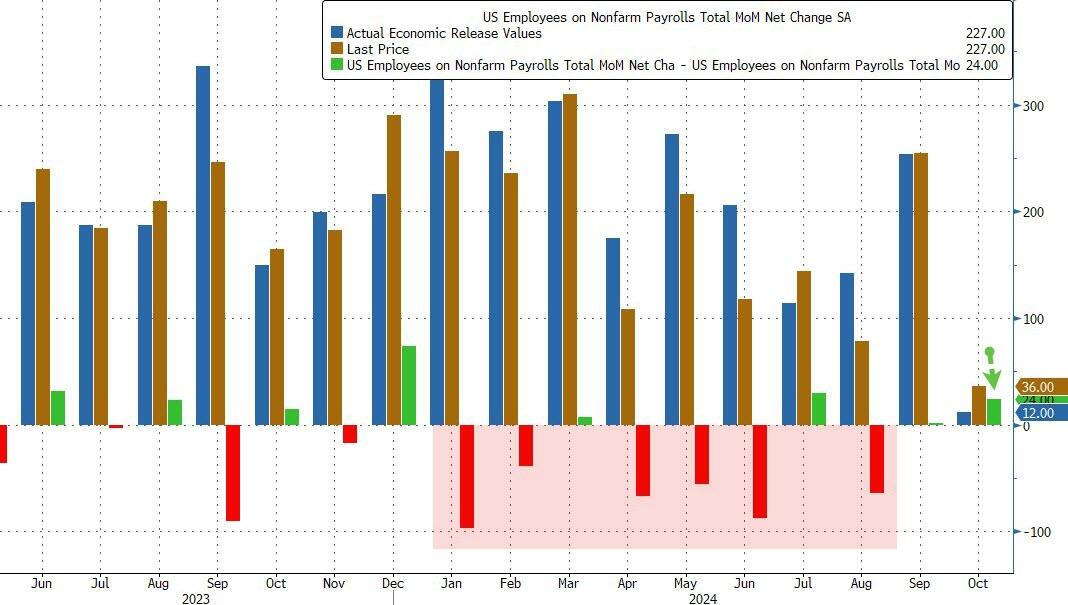
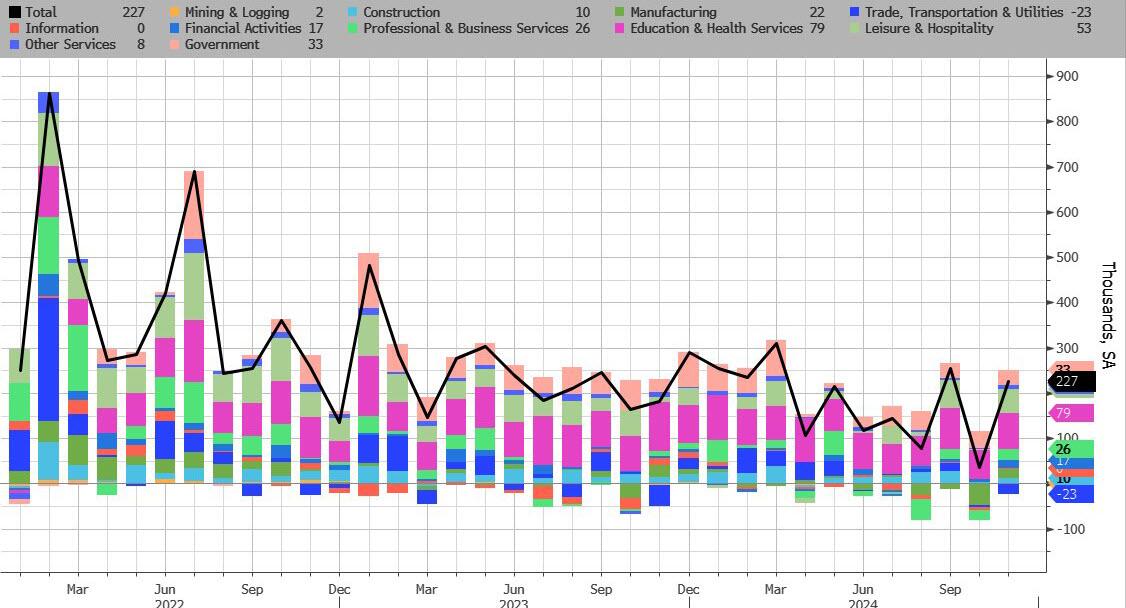
After the October hurricane-driven debacle which sent last month’s payrolls print to the lowest in years, at just 12K, traders were expecting a solid bounce today, with many whispering a print that would come above the consensus estimate of 220K… and they were right: moments ago the BLS reported that in November, payrolls growth surged to 227K, the second highest print since March (after the upward September revision).

Unlike previous month, most of which had all seen downward revision, the previous two months were revised higher, September was revised up by 32,000, from +223,000 to +255,000, and the change for October was revised up by 24,000, from +12,000 to +36,000. With these revisions, employment in September and October combined is 56,000 higher than previously reported.

The rebound reflects swings related to the end of the Boeing strike and the hurricanes that skewed the October data; hiring was led by health care and social assistance, as well as leisure and hospitality and government (see below)

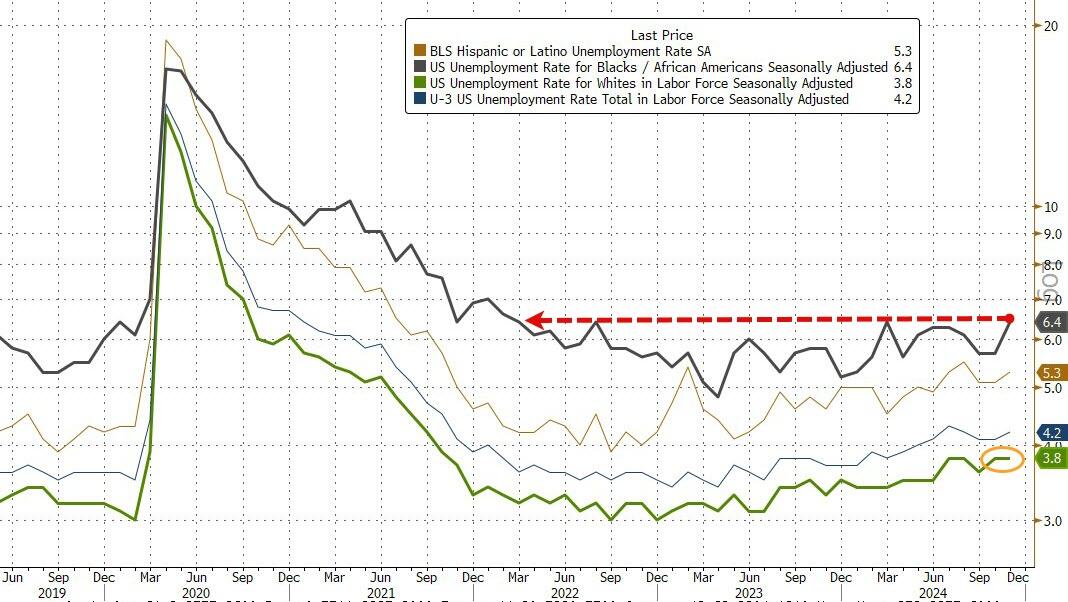
Those looking for a clear indication whether the Fed will keep cutting or halt its easing cycle in two weeks, will have to wait because the rest of the jobs report was mixed: on one hand, unemployment rose from 4.1% to 4.2%, and above the 4.1% estimate (with Black unemployment at 6.4% rising in November, while the jobless rates for adult men (3.9 percent), adult women (3.9 percent), teenagers (13.2 percent), Whites (3.8 percent), Asians (3.8 percent), and Hispanics (5.3 percent) showed little or no change over the month)…

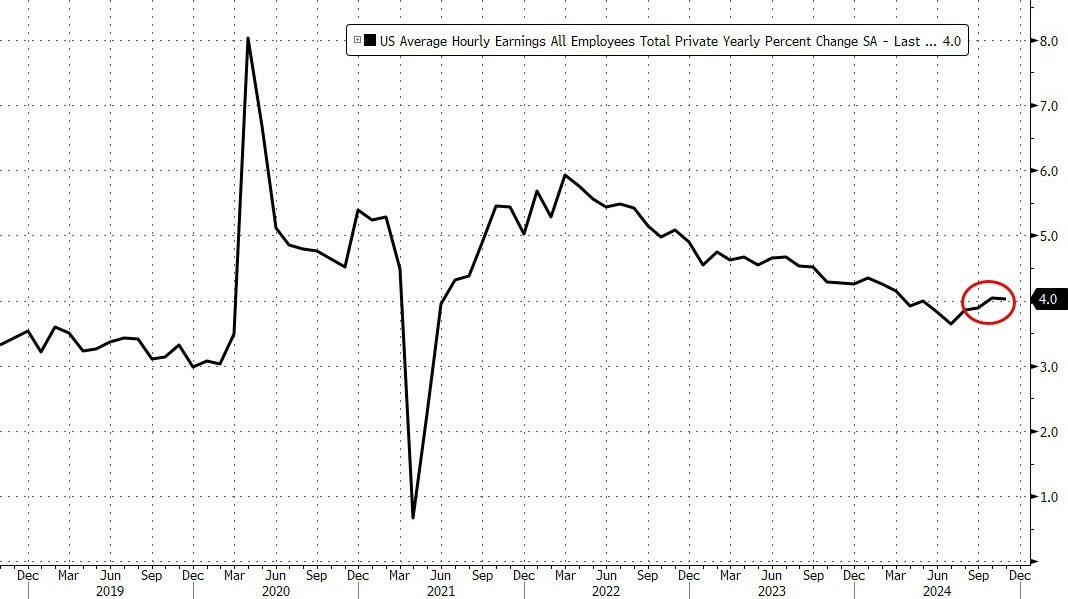
…but hourly earnings also rose, rising 0.4% MoM in November, above the 0.3% estimate, with annual wage growth flat at 4.0%, also above the 3.9% estimate, both indicating that wage growth pressures remain.

We should note that while the Establishment report gain of 227K payrolls was solid, the Household survey indicated a much bigger weakness, with the number of people employed tumbling by 355K to 161.141 million.

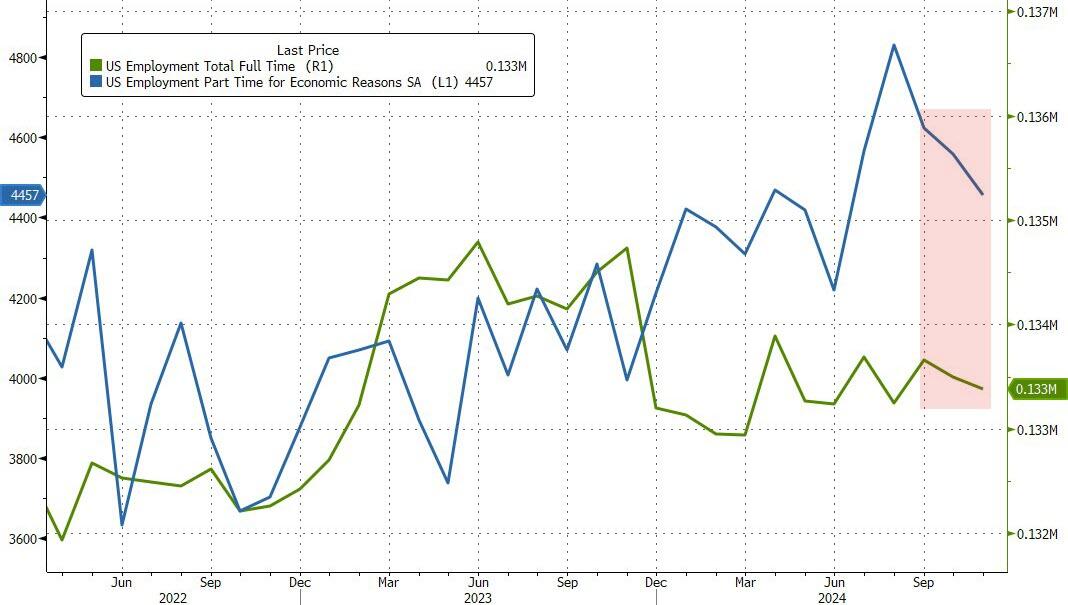
Tied to that, both the full-time and part-time series showed a notable drop (since these track the Household Survey), with full-time jobs dropping by 111K and part-time jobs down by 268K.

Taking a closer look at the report we find the following:

  • The number of long-term unemployed (those jobless for 27 weeks or more) was little changed at 1.7 million in November. This measure is up from 1.2 million a year earlier. In November, the long-term unemployed accounted for 23.2 percent of all unemployed people.
  • The labor force participation rate, at 62.5 percent, changed little in November and has remained in a narrow range of 62.5 percent to 62.7 percent since December 2023. The employment-population ratio, at 59.8 percent, also changed little over the month but is down by 0.6 percentage point over the year.

  • The number of people employed part time for economic reasons changed little at 4.5 million in November. This measure is up from 4.0 million a year earlier.
  • The number of people not in the labor force who currently want a job, at 5.5 million, changed little in November. These individuals were not counted as unemployed because they were not actively looking for work during the 4 weeks preceding the survey or were unavailable to take a job.
  • Among those not in the labor force who wanted a job, the number of people marginally attached to the labor force, at 1.6 million, was unchanged in November. These individuals wanted and were available for work and had looked for a job sometime in the prior 12 months but had not looked for work in the 4 weeks preceding the survey.
  • The number of discouraged workers, a subset of the marginally attached who believed that no jobs were available for them, changed little at 396,000 in November.

Taking a look at jobs by sector, we find that employment trended up in health care, leisure and hospitality, government, and social assistance. Employment increased in transportation equipment manufacturing, reflecting the return of workers who were on strike. Despite the onset of the Holiday season, retail trade cut 28,000 jobs the most jobs in a year, while durable goods manufacturing jobs jumped by 26,000 upon the conclusion of the Boeing strike. Yet while overall manufacturing employment rose due to an extra 32,000 transportation equipment roles, the sector was otherwise mixed; the semiconductor and electronic component sector lost 3,500 jobs. Here are some more details:

  • Health care added 54,000 jobs in November, in line with the average monthly gain of 59,000 over the prior 12 months. In November, ambulatory health care services added 22,000 jobs, led by a gain of 16,000 in home health care services. Employment also increased in hospitals (+19,000) and nursing and residential care facilities (+12,000).
  • Employment in leisure and hospitality trended up in November (+53,000), following little change in the prior month (+2,000). Over the month, employment trended up in food services and drinking places (+29,000). Leisure and hospitality had added an average of 21,000 jobs per month over the prior 12 months.
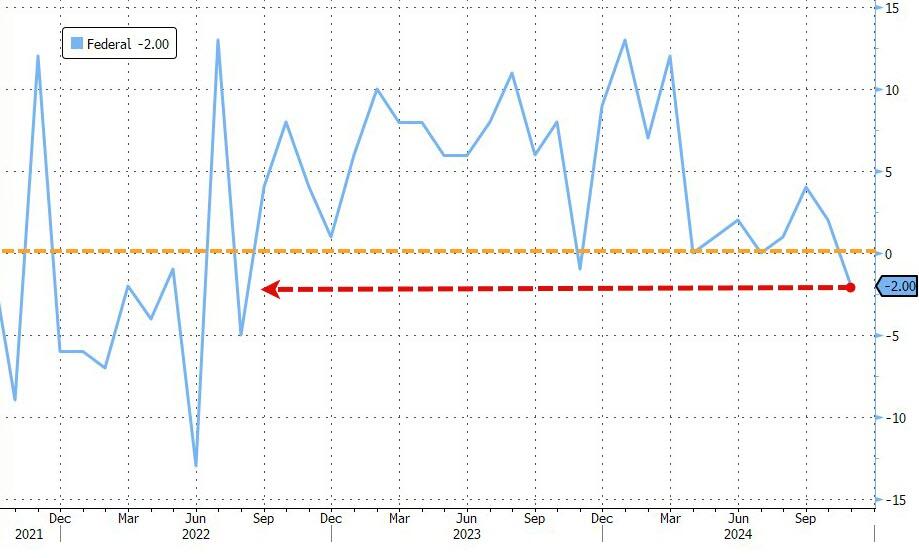
  • In November, government employment continued to trend up (+33,000), in line with the average monthly gain over the prior 12 months (+41,000). Over the month, employment continued to trend up in state government (+20,000).  However, it is notable that there was a 2,000 drop in Federal employees in the month, the biggest drop in two years.

  • Employment increased by 32,000 in transportation equipment manufacturing in November, reflecting the return of workers who were on strike.
  • Employment in social assistance edged up by 19,000 in November, similar to the average monthly gain of 18,000 over the prior 12 months. Over the month, individual and family services added 17,000 jobs.
  • Retail trade lost 28,000 jobs in November, after showing little net employment change over the prior 12 months. In November, employment declined in general merchandise retailers (-15,000), while electronics and appliance retailers added jobs (+4,000).

And visually:

Finally, for those trying to figure out what all this means, here is perhaps the most important chart: after hitting a record high in August, the number of illegal alien workers has tumbled (even as native-born workers remain flat). This suggests that wage growth is about to surge as employers will now be “forced” to hire domestic employees, who unlike their Guatemalan peers, have the ability to negotiate higher wages.

Tyler Durden
Fri, 12/06/2024 – 08:43

via ZeroHedge News https://ift.tt/dLHh73Y Tyler Durden