NFTs Hit 6-Month High Of $562M In Monthly Sales Volumes

NFTs Hit 6-Month High Of $562M In Monthly Sales Volumes

Authored by Ezra Reguerra via CoinTelegraph.com,

Non-fungible tokens (NFTs) have maintained their monthly sales momentum, surging by 57.8% in November as digital collectibles continue to recover. 

On Dec. 1, data company CryptoSlam showed that NFTs recorded $562 million in sales in November, a substantial increase in volume from October. CryptoSlam data also indicates that November’s monthly sales volume for NFTs is the highest since May, when digital collectibles had a $599 million sales volume. 

NFT sales volume from May to December 2024. Source: CryptoSlam

Despite the surge, NFT monthly volumes are still far from their peak in 2024. In March, digital collectible sales volumes recorded a yearly high of $1.6 billion. However, this was followed by a seven-month slump, with each month’s sales volume decreasing until it reached its lowest point since 2021. 

CryptoPunks floor price surges by 52% 

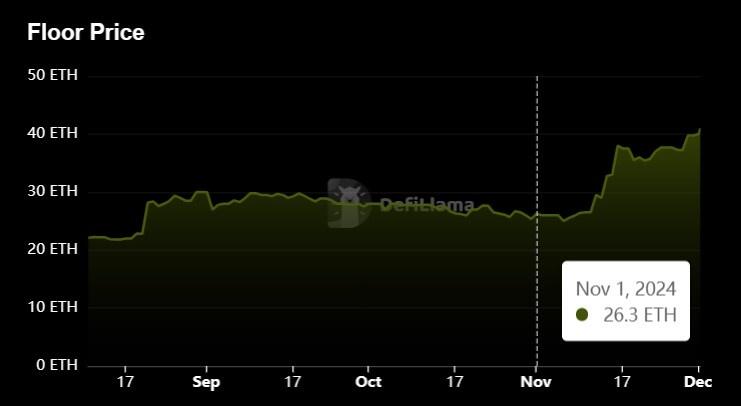
As the broader crypto markets surged, popular NFT collection CryptoPunks also had an impressive record in November. According to crypto data website DefiLlama, the NFT collection had a floor price of 26.3 Ether ETH$3,841.83 on Nov. 1. By Nov. 30, CryptoPunks’ floor price had risen to 39.7 ETH, worth about $147,000 at current market prices. 

CryptoPunks floor price data from September to November. Source: DefiLlama

CryptoSlam data also showed that CryptoPunks had a 30-day sales volume of more than $49 million, a 392% increase compared to the previous month. The collection also recorded 388 sales transactions, 213% more than in October. 

Apart from CryptoPunks, the Pudgy Penguins collection also had an impressive November. The collection’s monthly sales volume surged 262% month-on-month, with $16 million in volume. 

DefiLlama data also shows that Pudgy Penguins’ floor price rose from 8.7 ETH on Nov. 1 to 13 ETH, or roughly $48,000, on Nov. 30, a 49% increase.

Ethereum, Bitcoin leads NFT comeback

The Ethereum network led the month with over $216 million in sales volume, a 12% increase from October. 

In terms of percentages, Bitcoin recorded the highest increase among the top blockchains for NFTs. The network had $186 million in sales volume, a 99.44% surge from October. 

Meanwhile, Solana, Mythos Chain, Immutable, Polygon and BNB Chain collectively recorded $162.9 in NFT sales volume for November. 

Tyler Durden
Fri, 12/06/2024 – 06:30

via ZeroHedge News https://ift.tt/lw8Gm6O Tyler Durden

Dozens Of Middlemen Drop Out Of Trading Russian Oil To India

Dozens Of Middlemen Drop Out Of Trading Russian Oil To India

By Tsvetana Paraskova of OilPrice.com

Dozens of small trading players and middlemen have recently dropped out of trading Russian crude oil to India, as Russia’s interest rates and costs to fund trades have soared, Reuters reported exclusively on Thursday, quoting trade sources and customs and shipping data.

India, one of Russia’s top two markets to sell its oil banned in the West, now relies on Russian crude for a large part of its consumption. Since 2022, after the Russian invasion of Ukraine and the Western sanctions on Moscow, Russia has become India’s single biggest supplier of crude.

Back in 2022 and in 2023, many traders raced to deliver Russian crude to India, lured by the lucrative profits of the trades as risks were higher.

Little-known and newly-incorporated trading companies have handled large volumes of Russian crude oil and products since the Russian invasion of Ukraine and the withdrawal of Western firms from trades with Russia’s oil.

These new oil trading companies that have mushroomed are incorporated in jurisdictions outside of Europe and are often notoriously opaque in their management and dealings.

However, Russia has recently raised its benchmark interest rate to 21%. That’s the highest in two decades and is, of course, affecting funding costs for traders who depend on Russian banks to finance trades with Russian oil, as Western banks are not funding any.

Since the funding costs spiked earlier this year, many middlemen have dropped out of the trades with India, leaving the business to several trading houses.

Currently, the majority of Russian crude volumes are being handled by Litasco Middle East, the Dubai-based trading arm of Russia’s Lukoil, as well as Dubai-based firms Hinera Trading and Black Pearl Energy Trading, per customs and shipping data that Reuters has seen.

India’s demand for Russian crude, which is cheaper than alternatives due to the sanctions, has been so high recently that the discounts at which Russia’s oil is selling to India have narrowed. As a result, private Indian refiners, including Reliance Industries and Rosneft-controlled Nayara Energy, cut their imports of Russian crude by 18% in November compared to October, the New Indian Express reported this week, citing data from energy commodity tracking firm Vortexa.

Tyler Durden
Fri, 12/06/2024 – 05:00

via ZeroHedge News https://ift.tt/IcY3trZ Tyler Durden

Underwater Geopolitics

Underwater Geopolitics

Authored by Carlo J.V.Caro via RealClearWire.com,

How China’s Control of Undersea Cables and Data Flows Reshapes Global Power

Cable Routing Protocols

The rapid construction of undersea cables has brought a hidden but crucial issue into focus: the manipulation of the protocols that control how data travels beneath the sea. These protocols determine the pathways internet data takes, influencing speed, costs, and even exposure to surveillance. Even small changes in these pathways can tilt the global balance of digital power. China’s increasing role in this area demonstrates how technology can be used strategically to reshape geopolitics.

At the heart of this issue is a technology called Software-Defined Networking (SDN). SDN allows data traffic to be managed and optimized in real time, improving efficiency. But this same flexibility makes SDN vulnerable to misuse. Chinese tech companies like HMN Tech (formerly Huawei Marine Networks), ZTE, and China Unicom are leading the way in SDN development. China also holds sway in international organizations that set the rules for these technologies, such as the International Telecommunication Union (ITU) and the Institute of Electrical and Electronics Engineers (IEEE). This influence gives China a hand in shaping global standards and governance.

Africa illustrates how this influence plays out. Chinese investments in digital infrastructure across the continent are massive. For example, the PEACE (Pakistan and East Africa Connecting Europe) cable, which links East Africa to Europe, was designed to avoid Chinese territory. Yet, thanks to SDN technology, its traffic can still be redirected through Chinese-controlled points. This redirection could introduce delays of 20 to 30 milliseconds per hop—not much for casual browsing, but a serious issue for latency-sensitive activities like financial trading or encrypted communication.

In Southeast Asia, similar risks are evident. The Southeast Asia-Japan Cable (SJC), which connects Singapore to Japan, relies on several landing stations influenced by China. During a period of heightened tensions in the South China Sea, some data intended for Japan was mysteriously routed through Hainan Island, under Chinese jurisdiction. Such cases suggest technical routing decisions may sometimes have political motivations.

These examples are part of a broader strategy. By exploiting SDN, China can turn submarine cables into tools for surveillance and control. Data traffic from Africa or Southeast Asia destined for Europe could be secretly rerouted through Shanghai or Guangzhou, exposing it to China’s advanced surveillance techniques like deep packet inspection. This threat extends to cloud computing, as major providers such as Amazon Web Services (AWS), Microsoft Azure, and Alibaba Cloud rely on undersea cables. With SDN, Chinese cloud providers—aligned with state interests—could redirect sensitive inter-cloud traffic, putting critical communications at risk.

Manipulating global data routes gives any actor significant geopolitical power. For instance, in a crisis, China could degrade or even sever internet connectivity for rival nations. In the Taiwan Strait, this could isolate Taiwan from global markets, disrupting financial transactions and trade. In Africa, where Huawei has built a significant portion of the continent’s telecommunications infrastructure—reportedly constructing around 70 percent of 4G networks—there is concern that this reliance could create vulnerabilities. If political tensions were to arise, China could cause slowdowns or disruptions to reinforce dependence, making countries more vulnerable in political standoffs.

The numbers highlight the stakes. Submarine cables carry 99 percent of international data traffic—over 1.1 zettabytes annually. Significant portions of intra-Asia-Pacific data flows pass through key submarine cable landing stations, including Hong Kong, which is under Chinese jurisdiction. With Chinese firms increasingly involved in substantial global submarine cable projects—such as those undertaken by HMN Technologies—Beijing’s influence over the internet’s physical backbone is growing.

The economic impact of internet disruptions on highly connected economies is substantial. For instance, the NetBlocks Cost of Shutdown Tool (COST) estimates the economic impact of internet disruptions using indicators from the World Bank, ITU, Eurostat, and the U.S. Census. According to data presented by Atlas VPN, based on NetBlocks’ COST tool, a global internet shutdown for one day could result in losses of about $43 billion, with the United States and China accounting for nearly half of this sum. Additionally, Deloitte has estimated that for a highly internet-connected country, the per-day impact of a temporary internet shutdown would be on average $23.6 million per 10 million population.

A deliberate attack on routing protocols could cause widespread financial and operational chaos. In today’s interconnected world, where digital infrastructure underpins economic stability, the ability to manipulate undersea cable traffic represents a subtle but powerful geopolitical weapon.

Addressing this threat goes beyond simply building more cables. It requires rethinking how routing protocols are governed. Transparent global standards must ensure no single country or company can dominate these systems. Routine independent audits should be conducted to detect anomalies that may signal interference. Efforts like the European Union’s Global Gateway initiative and Japan’s Digital Partnership Fund must focus on creating alternative routes to reduce reliance on Chinese-controlled nodes.

This issue highlights a new reality in global politics: control over data flows is becoming a key form of power. While most attention has been on building physical infrastructure, the quiet manipulation of routing protocols marks an equally profound shift in global influence. To protect the integrity of the internet, the world must act decisively at both technical and governance levels.

Fiber-Optic Cable Repair Networks

China’s disproportionate control over fiber-optic cable repair networks reveals potential vectors for intelligence dominance, coercive leverage, and disruption of digital sovereignty. Globally, an estimated 60 dedicated cable repair ships service the planet’s 1.5 million kilometers of submarine cables. China controls a substantial percentage of the fleet, including ships operated by state-affiliated enterprises like Shanghai Salvage Company and China Communications Construction Group. In contrast, the United States and its allies maintain a small patchwork fleet, mostly concentrated in the North Atlantic and lacking coverage in the Indo-Pacific, where over 50 percent of global internet traffic routes through key subsea cables.

China’s fleet is heavily concentrated in the South and East China Seas, regions critical to global connectivity due to chokepoints like the Singapore Strait and the Luzon Strait. With maritime exclusivity bolstered by China’s claims in disputed waters, its repair ships have nearly unrestricted access to monitor, repair, or potentially tamper with cables under the guise of routine maintenance.

Repair missions involve exposing critical cable infrastructure, including repeaters, amplifiers, and branch units—hardware that boosts signal strength over long distances but also represents points of vulnerability. Chinese vessels are equipped with advanced robotic submersibles and precision cutting-and-splicing technologies, designed for repairs but capable of installing signal interception devices. Such tools could include optical fiber taps capable of harvesting unencrypted metadata or capturing latency patterns to infer sensitive traffic flow.

China’s advancements in photonics and quantum communication technologies underscore its capacity to exploit these vulnerabilities. The Chinese Academy of Sciences has reported significant breakthroughs in quantum key distribution (QKD) systems, raising the possibility of developing quantum-based methods to crack encrypted data intercepted during repairs. Integration of AI-driven data sorting tools could automate the extraction and classification of intercepted information, rendering bulk data acquisition during repairs a strategic advantage.

The high seas, where many repair operations occur, are governed by fragmented international frameworks like the United Nations Convention on the Law of the Sea (UNCLOS), which inadequately regulate activities involving critical infrastructure. The International Cable Protection Committee (ICPC) provides voluntary guidelines for repair operations, but enforcement mechanisms are weak, leaving the system vulnerable to exploitation by state actors.

Repair missions are often classified as “emergency operations,” requiring expedited approvals that bypass detailed oversight. In one case, a cable break in the South China Sea in 2021 prompted Chinese repair ships to operate without transparency for over three weeks, raising concerns about potential covert activities. These incidents are rarely reported, as they fall outside the jurisdiction of most maritime monitoring bodies.

The lack of countermeasures by the United States and its allies amplifies the risks posed by China’s dominance. The U.S. Navy operates no specialized repair ships, relying on private operators like Global Marine Group, whose fleet is aging and ill-equipped for operations in contested waters. This contrasts with China’s state-backed model, integrating its repair fleet into broader maritime networks, providing dual-use functionality for civilian and military objectives.

The financial model of undersea cable operations further constrains Western responses. Submarine cables are predominantly privately owned, with firms like Google, Meta, and Amazon investing heavily in infrastructure but lacking incentives to prioritize geopolitical considerations. This privatization leaves strategic gaps in surveillance and monitoring, as governments must negotiate access to privately controlled repair missions.

To mitigate China’s strategic advantage, a multipronged response is essential. The United States and its allies must develop state-owned or state-subsidized repair fleets to operate in contested regions like the South China Sea and Indian Ocean. Enhanced maritime surveillance systems, such as underwater drones and sonar-based monitoring arrays, should be deployed to track repair ship movements in real time.

Revising international frameworks by expanding ICPC mandates to include mandatory reporting of repair operations could curb opacity. Collaboration with regional partners, particularly nations in the Quad (Australia, India, Japan, and the United States), could bolster collective maritime domain awareness and create redundancies in cable repair capabilities.

Maritime Data Through Automated Vessel Tracking

China’s exploitation of automated vessel tracking systems exemplifies a sophisticated component of its global digital strategy. At the heart of this initiative lies the Automatic Identification System (AIS), a maritime safety technology mandated by the International Maritime Organization (IMO) for vessels exceeding 300 gross tons engaged in international trade. While originally intended to improve navigational safety by broadcasting vessel identities, locations, courses, and cargo details, AIS has been effectively repurposed by Beijing into a dual-use asset that supports both economic intelligence gathering and military surveillance.

Chinese firms, including the BeiDou Navigation Satellite System and Alibaba Cloud, have developed advanced platforms that aggregate AIS transmissions from shipping lanes worldwide. These platforms integrate AIS data with artificial intelligence-driven predictive analytics, enabling Beijing to monitor and analyze global maritime chokepoints such as the Strait of Malacca, the Panama Canal, and the Suez Canal—key arteries of international commerce. By doing so, China gains critical insights into global shipping patterns, strategic trade routes, and supply chain dynamics. As of 2023, the global merchant fleet comprised around 60,000 ships.

During the 2021 Suez Canal blockage, Chinese logistics firms, leveraging real-time AIS data, rapidly identified alternative routes through the Arctic and along the Indian Ocean, allowing Chinese exporters to reroute goods while Western competitors faced delays. Similarly, in the Strait of Malacca, a waterway facilitating the transit of over 16 million barrels of oil daily and 40 percent of global trade, Chinese analysts have used AIS data to optimize resource flow, preempt congestion, and study vulnerabilities in energy supply routes.

AIS data plays a pivotal role in China’s military strategy, especially in the Indo-Pacific. By combining AIS information with satellite imagery and data from undersea acoustic arrays, China has established a surveillance network capable of tracking naval deployments with precision. AIS data has been used to monitor patrol patterns of the U.S. Navy’s Seventh Fleet, revealing that over a third of its South China Sea operations in 2022 followed predictable routes. This surveillance allows the People’s Liberation Army Navy (PLAN) to anticipate U.S. Freedom of Navigation Operations (FONOPs) and position its assets accordingly.

China’s manipulation of AIS extends to conflict simulations and asymmetric warfare. During military exercises near Taiwan in 2023, Chinese forces reportedly deployed unmanned surface vessels programmed to mimic civilian AIS signals, complicating the identification of hostile assets.

Through its Digital Silk Road initiative, Beijing has exported various forms of maritime technologies that incorporate Automatic Identification System (AIS) capabilities. China often provides financial incentives to promote the adoption of its technologies abroad, which may enhance its access to regional maritime data. This asymmetry grants China an informational advantage and risks reshaping maritime transparency norms in its favor.

Rare Subsea Mapping Data

China’s increasing investment in subsea mapping has positioned it as a significant player in oceanographic intelligence, impacting scientific, commercial, and military domains. China has been actively mapping its claimed maritime territories using state-funded research vessels and autonomous systems. These efforts contribute to international initiatives like the Nippon Foundation-GEBCO Seabed 2030 project, which aims to map the entire global seabed by 2030 and had mapped approximately 23.4 percent as of June 2022 with international contributions. China’s activities extend to strategic regions in the Indo-Pacific, the Arctic, and the Indian Ocean, raising concerns over the dual-use potential of its data collection.

Subsea mapping data is critical for submarine cable routing, undersea infrastructure development, and naval operations. China’s repository of high-resolution bathymetric maps—including surveys of key chokepoints like the Strait of Malacca and the Bashi Channel—provides a tactical edge. These chokepoints are vital for global trade and serve as strategic naval passages for power projection and anti-access/area-denial operations. The People’s Liberation Army Navy uses seabed data to optimize the placement of undersea sensor arrays, critical for its “Great Underwater Wall” initiative, integrating hydroacoustic monitoring to detect foreign submarines.

China’s advancements in autonomous underwater vehicles (AUVs) enhance its capabilities. In 2021, the Hailong III and Qianlong II AUVs were deployed for deep-sea mapping missions in the South China Sea, gathering data at depths over 6,000 meters. These AUVs have multi-beam sonar systems achieving sub-meter resolution, surpassing commercial standards. Their ability to operate autonomously over long durations allows China to map intricate undersea topographies critical for resource exploration and undersea warfare.

China has used seabed mapping as a diplomatic tool to extend influence over smaller nations. Through its Maritime Silk Road Initiative, Beijing has signed agreements with over 20 countries, granting Chinese research vessels access to Exclusive Economic Zones (EEZs). Between 2015 and 2022, Chinese expeditions in Pacific Island nations’ EEZs often involved dual-use mapping activities.

In 2019, the Chinese survey vessel Haiyang Dizhi 8 conducted seismic surveys near the Vanguard Bank within Vietnam’s Exclusive Economic Zone (EEZ), collecting bathymetric data that aligns with key undersea routes potentially useful for submarine operations. This incursion led to a tense standoff with Vietnam, drawing international criticism over China’s assertive actions and raising concerns about the dual-use potential of the data collected. Similarly, in 2018, China’s proposed involvement in undersea cable projects connecting Papua New Guinea and the Solomon Islands through Huawei Marine raised significant security concerns. Fearing risks to the security of undersea communication cables and potential espionage, Australia intervened by funding and undertaking the projects themselves, highlighting apprehensions about granting Chinese entities access to critical seafloor data in the region.

China’s seabed mapping strategy has significant military implications, particularly in the South China Sea. In this region, where China has constructed artificial islands such as Fiery Cross Reef, Subi Reef, and Mischief Reef, high-resolution seabed data enables precise deployment of missile systems, naval patrols, and underwater drones. Detailed seabed mapping supports the construction and fortification of these islands, allowing for the installation of surface-to-air missiles, anti-ship cruise missiles, and the operation of military airstrips. Additionally, China’s deployment of unmanned underwater vehicles like the Sea Wing (Haiyi) gliders enhances their ability to collect oceanographic data crucial for submarine navigation and anti-submarine warfare. These activities have raised concerns among neighboring countries and the international community about the dual-use potential of China’s maritime endeavors and their impact on regional security.

By controlling seabed mapping data, China influences submarine cable networks, which carry 95 percent of global internet traffic and $10 trillion in daily financial transactions. China’s involvement in projects like the South Pacific Cable Project through state-owned China Mobile led to concerns over data interception capabilities. Its presence in Arctic seabed mapping, facilitated by icebreaker vessels like Xuelong 2, underscores ambitions to secure alternative maritime routes and resources under the guise of scientific research.

China’s approach to subsea mapping data has raised concerns about transparency and shared access in the global community. While international initiatives like the Seabed 2030 Project encourage open sharing of ocean floor data to advance scientific research and environmental understanding, China has been criticized for not fully sharing the extensive seabed data it collects. For example, much of the data gathered by Chinese vessels in international waters is not readily available in global databases like those managed by the International Hydrographic Organization (IHO) or the General Bathymetric Chart of the Oceans (GEBCO). This selective sharing limits other nations’ ability to leverage valuable information and contrasts with global norms promoting cooperation and transparency in oceanographic research.


Tyler Durden
Thu, 12/05/2024 – 23:25

via ZeroHedge News https://ift.tt/8oxJrPL Tyler Durden

Will Trump Keep Or Break His Vow To Release The Secret JFK Records?

Will Trump Keep Or Break His Vow To Release The Secret JFK Records?

Authored by Jacob Hornberger via The Future of Freedom Foundation,

In October 2022, the Mary Ferrell Foundation filed a lawsuit in federal court seeking the release of the JFK-assassination-related records that the CIA and other federal agencies have succeeded in keeping for more than 60 years. The foundation’s suit was based on the notion that the JFK Records Act of 1992 mandated the release of those records.

Not surprisingly, the CIA, operating through the Justice Department, fiercely opposed the lawsuit. It argued that “national security” required the continued secrecy of those 60-year-old records, even into perpetuity.

Recently, the Ninth Circuit federal Court of Appeals made it clear that it was siding with the government and keeping these records secret. See “Court Ruling Begs the Question, Is the JFK Records Act Dead?” by Chad Nagle, which is posted on the website of JFK Facts.

That certainly doesn’t surprise me.

While I greatly admire the people and attorneys who brought the lawsuit, I never had much hope that any federal judge, including those on the U.S. Supreme Court, would dare to buck the national-security establishment, especially on something like this.

Meanwhile, a member of Congress is proposing to bring into existence a new version of the Assassination Records Review Board, the independent agency that was charged with enforcing the JFK Records Act back in the 1990s. The ARRB did a fantastic job in securing the release, oftentimes over the fierce objections of the Deep State, of thousands of assassination-related records that the CIA, Pentagon, Secret Service, and other Deep State agencies had succeeded in keeping secret for more than 30 years.

Unfortunately, however, the JFK Records Act gave those federal agencies an additional 25 years of secrecy on thousands of records, on grounds of “national security,” while letting the ARRB go out of existence. That meant that when those 25 years were up, there was no federal agency in existence to enforce the law.

Will Congress bring into existence another ARRB? In my opinion, there isn’t any reasonable possibility of that happening. That’s because Congress is even more deferential to the national-security branch of the federal government than the federal judiciary is. The members of Congress know what will happen if they buck the Pentagon or the CIA: they will be threatened with closure of military bases and installations within their district, thereby making them “ineffective” members of Congress. Moreover, there is now a large number of proud military veterans and “former” CIA officials now serving in Congress who remain fiercely loyal to the national-security establishment. In my opinion, there is no reasonable possibility that this military-intelligence-congressional complex is going to help secure the release of those long-secret assassination-related records, given that the Deep State continues to fiercely oppose disclosure.

Given that President Biden has authorized the CIA and other federal agencies to keep their assassination-related records secret into perpetuity, there is, of course, no reasonable possibility that he will change his mind before leaving office (as he has done with his pardon of his son Hunter).

That leaves President-elect Donald Trump. In his campaign for reelection, he vowed to release the long-secret JFK-assassination records this time around. As you’ll recall, the last time he was president, he announced that he intended to release them when that 25-year period came due during his administration. But once he received a visit from the CIA, Trump quickly changed his mind and ordered that the records continue to be kept secret.

This time around, Trump’s supporters say that he has changed. This time, they say, he really is going to stand up to the Deep State and fulfill his vow to release those long-secret JFK-assassination-related records — no matter what the CIA, the Pentagon, and other federal agencies say. They say that his friendship with Robert F. Kennedy, Jr., will motivate him to keep his vow.

Okay, so let’s make it easy for Trump to fulfill his vow to get those long-secret JFK-assassination-related records released. All he has to do is prepare an order right now — before he is sworn into office — that will be good-to-go on his first day in office.

In fact, to make things easier and faster for him, I have prepared the following proposed order.

ORDER

I, President Donald Trump, hereby order the National Archives, the CIA, the Pentagon, the Secret Service, and all other federal agencies to immediately release and disclose all their records relating to the 1963 assassination of President John F. Kennedy, including the removal of all redacted portions of all such records. After more than 60 years of secrecy, enough is enough. No more secrecy.

Signed this 20th day of January 2025.
___________________________________
Donald Trump, President

Will Trump fulfill or break his vow to release such records by issuing that type of order? My prediction: Trump will join the federal judiciary and the Congress and, once again, defer to the Deep State. He will break his vow, either by ignoring it indefinitely or by, once again, ordering only a partial release of some of the records, including letting the CIA and other federal agencies keep portions of their long-secret records redacted.

All he has to do is print it, sign it, and publish it on his first day in office.

Tyler Durden
Thu, 12/05/2024 – 22:35

via ZeroHedge News https://ift.tt/K91ZnOx Tyler Durden

Trump Needs To Make An Example Of General Milley

Trump Needs To Make An Example Of General Milley

Authored by Christopher Roach via American Greatness,

In dealing with his enemies in the Deep State, President Trump could follow one of two paths. One would be the path of peace, reconciliation, and forgiveness. This would certainly be easier in the short term and also garner approval from insiders and the media. Alternatively, he could seek to clean house and punish the worst and most insubordinate offenders from his first term.

Which path Trump should take all depends on whether one believes the last eight years were normal partisan squabbles or if one believes that something monumental happened: the obstruction of democratic self-government by a technocratic Deep State.

I believe it is the latter for reasons I have explained before at length. In short, Trump was not allowed to govern, nor treated as other presidents were during his first term. The problem began before Trump, as entrenched bureaucratic interests have worked quietly to control more cooperative and less independent presidents, like Barack Obama and Joe Biden. But the resistance to Trump reflected a mature, ideological, and increasingly self-conscious managerial class that believed they were entitled to rule without regard to electoral results.

Trump was a threat to business as usual.

Thus, a cabal of intelligence agencies cooperated to stop him from making changes to foreign policy or scrutinizing the outsized military-industrial complex. Contrary to the media’s dire pronouncements, these insiders were the real threat to democracy and self-government.

Chairman of the Joint Chiefs of Staff, Mark Milley, was one of the worst offenders.

As documented in Bob Woodward’s book Peril, Milley spent a lot of time after the 2020 election caballing with Speaker of the House Nancy Pelosi and reassuring her that the military would resist certain orders from President Trump.

He met with the small group of officers who control our strategic nuclear forces and demanded they pledge to get his approval before executing any launch orders, even though, as head of the Joint Chiefs, he is merely an advisor and is statutorily excluded from the chain of command.

Finally, and most controversially, he was telling his counterpart in China that he would let them know if an attack or other action was coming from the United States. He defended this as normal “deconfliction” communications, but these secret talks took place without authorization from either the Secretary of Defense or the president.

All of Milley’s actions took place after he earlier joined with a group of retired officers to impede Trump’s use of the military to stop nationwide riots around June of 2020. Milley sent out an implied message to the troops suggesting that they could ignore any order to deploy, even though active-duty troops have been used in such a capacity repeatedly, including during the 1992 L.A. Riots.

As he reminded the whole nation by using the term “white rage,” Milley is typical of the new class of liberal senior officers who take part in the culture wars, cleave to one-half of the partisan divide, and act like they are beyond the control of the president whom they serve when they disagree with his politics.

Milley’s bad behavior was particularly egregious because of his role.

The Joint Chiefs are supposed to serve as military advisors. They are statutorily excluded from the ordinary chain of command to maintain institutional separation between advisory and command roles. This arrangement is designed to contribute to increased trust and candor between the Joint Chiefs and the president.

Secret talks with partisan opponents of the president, unauthorized back-channel communications to enemies, casual comparisons of the president to Adolf Hitler, and pseudo-idealistic suggestions that troops should disobey the orders they find disagreeable undermine that trust for obvious reasons.

Some have argued this might all be permissible in extremis and as part of the right of service members to resist illegal orders. But too much is made of this right. This defense is only supposed to apply to a very narrow set of self-evidently illegal orders, typically involving war crimes. Whether the government properly approved the use of troops to stop a riot is not such a case. Normally, the military must follow orders without delay. This distinguishes it from slower and less energetic civilian institutions.

There are a great many controversial—but legal—orders. Likely the most controversial would be an order to use nuclear weapons. The protocols on nuclear launch authority give exclusive power to the president to order a launch—a necessary, though admittedly dangerous, power to account for the fast timelines associated with a possible enemy first strike.

Perhaps this authority should be pulled back—I believe it should, particularly for cases of non-retaliatory uses of these weapons—but this was the established policy stretching back to the Cold War. More important, it was firmly established when Milley took it upon himself to undermine Trump’s authority by secretly demanding a loyalty oath from the officers in charge of our nuclear arsenal.

Milley did what he did because he was afraid of his own shadow and convinced himself that Trump was losing it and about to become a dictator.

In his supercilious and adolescent phrasing, we were facing a “Reichstag moment.”

The military is not part of the Constitution’s system of checks and balances. The military and the entire executive branch are subordinate to the president. He is their source of authority and is the boss, having attained his authority from an election involving the entire American people.

Once upon a time, liberals worried that a conservative, authoritarian military might thwart a liberal president and his policies. But these fears proved to be completely overblown. The military was, until a decade or so ago, a self-consciously nonpartisan institution. Even as it trended more conservative during the Clinton years, there was no insubordination akin to Milley’s performance.

It turns out that while the country was on the lookout for right-wing military extremists, the military had few defenses from leftist partisanship. Whether classified as treason or mere insubordination, a similarly corrosive performance risks repeating itself during Trump’s second term.

In the immediate aftermath of the election, the left seems to realize it is unwise to resist openly and violently, as they did for much of the Trump administration. But I believe, at the moment, they are merely regrouping and working on a strategy they believe will work.

The military, which retains prestige because it is still perceived as a nonpartisan repository of patriotic rectitude, will likely loom prominently in these plans, just as it did during Trump’s first term. As we know, the military and Milley lost all qualms about using the military domestically when they flooded the zone with armed National Guardsmen to create a Green Zone for Biden’s 2021 Inauguration.

This unhealthy politicization and leftist partisanship among the military’s senior leadership must be stopped.

The military should return to its role as a neutral instrument of national power. But this means it must chiefly be controlled by the elected president in the manner he directs. In order to restore healthier civil-military relations, there must be a dramatic and symbolic reset reminding the military and the rest of the country that Trump has full executive powers as president.

In order to accomplish this, Mark Milley should be recalled to service, court-martialed, punished, and publicly dishonored in order to prevent a resurgence of the corrosive principle of leftist military partisanship during Trump’s second term.

Tyler Durden
Thu, 12/05/2024 – 21:45

via ZeroHedge News https://ift.tt/ojSbCxc Tyler Durden

Israel Preparing For Possibility Of Syrian State Collapse

Israel Preparing For Possibility Of Syrian State Collapse

Israeli leaders and military officials are reportedly engaged in high level briefings over fast-moving events in Syria, which have seen Turkish-backed Islamists based in Idlib rapidly capture the major cities of Aleppo and Hama in less than a week.

Defense Minister Israel Katz and IDF Chief of Staff Lt. Gen. Herzi Halevi are carefully monitoring the situation across the border as the jihadists move south. “The IDF is following events and is preparing for any scenario in attack and defense,” the military said.

Anadolu/Getty Images

“The IDF will not allow a threat near the Syrian-Israeli border and will act to thwart any threat to the citizens of the State of Israel,” it added. Of course, Israel has long directly contributed to destabilizing Syria through frequent airstrikes and at various times in past years supporting an anti-Assad insurgency.

There have been some unconfirmed reports that one option Israel would consider is creating a buffer zone inside southern Syria in the scenario of some kind of state collapse, and should Hayat Tahrir al-Sham (HTS) make it to Homs and eventually Damascus. Some analysts have accused Israel of covertly supporting HTS’ ongoing rampage across the northern half of the country.

According to one Israeli report:

Channel 12 reports that Israel is preparing for the possibility that the Syrian army may collapse in the face of rapidly advancing rebel forces.

The report says Israel has been surprised by the weakness of the Syrian army, as it continues to swiftly lose ground to the jihadist-led fighters. The report adds that Israel has sent a strong warning to Iran not to send weaponry to Syria that could reach the hands of the Hezbollah terror group in Lebanon.

And an unnamed US official has told Axios on Thurdsay at a moment the HTS insurgents are in control of the central city of Hama, “The Syrian military forces are not really fighting.”

The official added, “We don’t think the regime is in immediate danger, but this is the biggest challenge for the Assad regime in the last decade.”

The last 12 hours have seen reports emerge of a Syrian Army counteroffensive around Hama, with some military bases on the outskirts having been taken back by national forces.

How did the security situation in the Aleppo area unravel so quickly? How or why did the Syrian Army retreat so rapidly?

* * *

Below, a prominent and longtime Syrian commentator who goes by Bassem gives a quick bird’s eye view explanation…

External:

1) Russia got distracted with the war in Ukraine and resources diverted there.

2) Hamas idiotically went on suicide mission in October 2023 and dragged Hizbollah into the conflict indirectly and exhausted them.

3) Israel weakened Iran in Syria past few years.

Source: @ThomasVLinge

Internal:

4) Assad did nothing to improve the lives of locals. Electricity for few hours a day, not enough fuel for daily matters, corruption, made the lives of Syrian business community hell (customs, etc), to name few.

5) all the while opposition was rebuilding, changing their message, training, even Ukrainian intelligence came in to support them with intelligence and drone technology.

* * *

We should add that US and European sanctions have devastated the Syrian economy and infrastructure, which have without doubt negatively impacted the Syrian Army’s general readiness and morale. And the US military has been occupying Syria’s oil and gas fields in the east for years at this point. Part of Washington’s purpose has remained to squeeze Damascus of energy resources, further weakening the Syrian state.

Tyler Durden
Thu, 12/05/2024 – 21:20

via ZeroHedge News https://ift.tt/ADUrebR Tyler Durden

DEI Is Deflating

DEI Is Deflating

Authored by Larry Sand via American Greatness,

Diversity, Equity, and Inclusion (DEI) has, over the past several years, become part of the fabric of American institutions, notably businesses and schools. In a nutshell, DEI pays no mind to quality but, instead, is a system whereby racial bean counting is the sine qua non of our culture. While this has already been a disastrous policy for all concerned, a recent study delves into the serious damage it has done.

On November 25, the Network Contagion Research Institute (NCRI) and Rutgers University Social Perception Lab released Instructing Animosity: How DEI Pedagogy Produces the Hostile Attribution Bias.The study examines whether the themes and materials common in DEI training foster inclusion or exacerbate conflicts and whether such materials promote empathy or increase hostility towards groups labeled as oppressors. The study consists of three experiments—one that focused on race, one on religion, and the other on caste.

As noted by National Review’s Abigail Anthony, although proponents of DEI training claim that they are designed to educate individuals about bias and reduce discrimination, “the study found that participants primed with DEI materials were more likely to perceive prejudice where none existed and were more willing to punish the perceived perpetrators.”

In the experiment that focused on race, the researchers randomly assigned 423 Rutgers University undergraduates into two groups: one control group exposed to a neutral essay about U.S. corn production and the other exposed to an essay that combined material from Ibram X. Kendi’s book How to Be an Antiracist and Robin DiAngelo’s book White Fragility. After exposure to the essays, participants were presented with the following race-neutral scenario: “A student applied to an elite East Coast university in Fall 2024. During the application process, he was interviewed by an admissions officer. Ultimately, the student’s application was rejected.”

The results showed that participants who were primed with Kendi’s and DiAngelo’s books perceived more discrimination from the admissions officer, despite the absence of any racial identification and evidence of discrimination. Those participants also believed that the admissions officer was more unfair to the applicant, had caused more harm to the applicant, and had committed more “microaggressions.”

This is not the only objective examination that shows the deleterious effects of DEI. A study by researchers Jay Greene and James Paul in 2021 details many aspects of the harmful scheme. In a nutshell, the authors find DEI to be “counterproductive and politically radical.

The part of the study that examines DEI’s effects on elementary schools is particularly damning. It looks at school districts with at least 15,000 students, of which there are 554, and finds that schools with Chief Diversity Officers (CDOs) “actually have larger gaps in achievement between black and white students, Hispanic and white students, and non-poor and poor students than districts without CDOs. Those gaps have grown wider over time. This pattern holds true even after controlling for a host of other observable characteristics of those districts.

The researchers explain that the gaps occur because CDOs “are more focused on promoting a political agenda than they are on finding effective educational interventions.”

And that political agenda includes advancing policies that typically exacerbate achievement gaps, such as eliminating gifted programs and advanced math classes “while selecting English and Social Studies content for its political orthodoxy rather than educational quality.”

But the times are changing; businesses nationwide are eliminating their DEI programs.

On Nov 25, Walmart announced that it would stop participating in the Human Rights Coalition’s Corporate Equality Index and remove the gender-neutral term “Latinx” from its documents, according to conservative filmmaker Robby Starbuck, who had been talking to Walmart for a story he was doing featuring the company’s DEI initiatives.

The announcement comes in the wake of similar moves by a string of other major corporations—Ford, John Deere, Lowe’s, Harley-Davidson, Jack Daniel’s, MicrosoftUnited Airlines, and Boeing—reflecting a backlash against DEI in American life.

Colleges, too, are backing away from the DEI regimen, although these decisions come from state governments, not typically from the colleges themselves.

Texas now has a law that bars public institutions of higher education from having DEI offices, as well as programs, activities, and training conducted by those offices. The law also restricts training or hiring policies based on race, gender identity, or sexual orientation.

Public universities in Florida and Utah have banned DEI. At MIT, a private university, President Sally Kornbluth confirmed that the school would “no longer require diversity statements in faculty hiring.” As reported by City Journal, the University of Michigan may soon end its investment in DEI.

Additionally, according to an analysis from OpenTheBooks.com, the University of North Carolina spends an estimated $90 million each year on 686 employees who promote diversity, equity, and inclusion in their departments or across the system. But change there, too, is on the horizon. In a repudiation of DEI ideology, the UNC Board of Governors has voted to repeal its diversity policy.

Not surprisingly, all the usual suspects are in a snit about the pushback against DEI. PEN America’s latest report, released in October, explains that new laws enacted this year are censoring teaching and research directly, imposing ideological restrictions on every aspect of university governance, banning DEI offices, restricting the topics of majors and minors, etc.

What else needs to be done to quash the DEI bilge?

On a national level, incoming President Trump will hopefully rescind all of Joe Biden’s executive orders implementing DEI and gender theory, including Executive Order 13985, which advanced a “whole-of-government equity agenda.”

Additionally, Congress should pass the Dismantle DEI Act, which is currently working its way through the House. If successful, it would eliminate DEI practices throughout the federal bureaucracy.

The feds could also have a hand in ending harmful woke practices in our colleges. As reported in the Wall Street Journal, Trump’s plan, which he announced last summer, “would change the accreditation system, protect free speech, eliminate wasteful administrative positions, and use the Justice Department to file lawsuits against schools that continue to engage in racial discrimination.”

Many Americans have had it and are pushing back against progressive nostrums regarding racial identity, diversity, equity, social justice, gender, and inclusion, reports Rick Hess, director of education policy studies at the American Enterprise Institute. He adds that average Americans of all races and ethnicities don’t agree with the views and values promoted by DEI trainers.

Instead of DEI, a more constructive plan would be to implement merit, excellence, and intelligence, or MEI, on the employment level, hiring the best candidates for open roles without considering demographics.

Per Alexandr Wang, MEI is a hiring process based on merit and will naturally yield a variety of backgrounds, perspectives, and ideas. “We will not pick winners and losers based on someone being the ‘right’ or ‘wrong’ race, gender, and so on.”

Woke may very well be going broke. Good riddance!

Tyler Durden
Thu, 12/05/2024 – 20:55

via ZeroHedge News https://ift.tt/sbRacg4 Tyler Durden

Visualizing What Americans Eat

Visualizing What Americans Eat

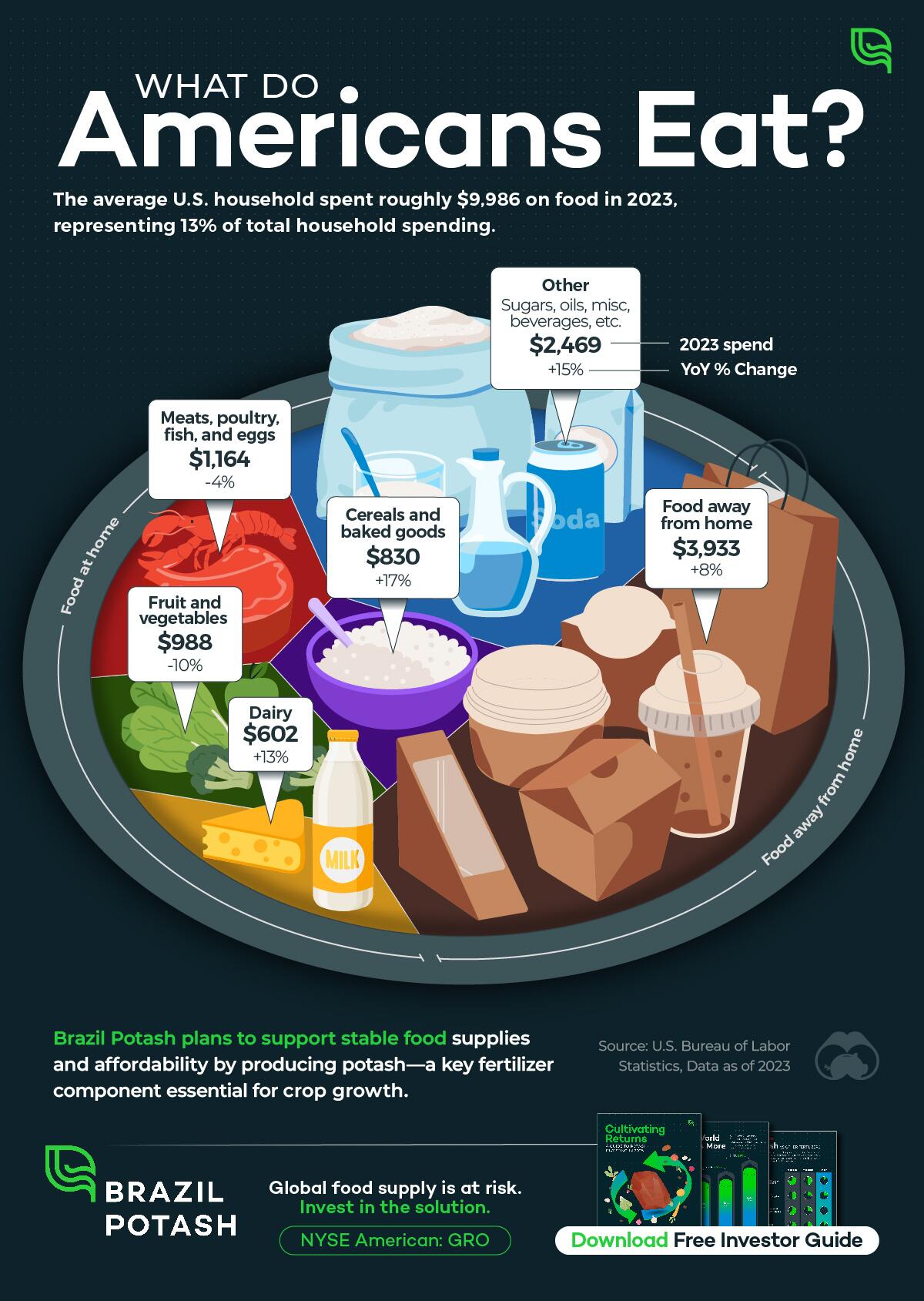
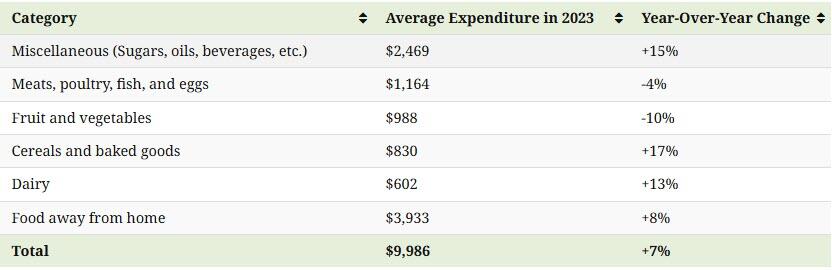
The average American household allocated $9,986 – or 13% of their total expenditures – toward food in 2023. But what does that spending reveal about the nation’s eating habits?

Visual Capitalist partnered with Brazil Potash to create this chart, which uses data from the U.S. Bureau of Labor Statistics, to show a breakdown of what Americans eat.

A Breakdown of Food Groups Consumed

In 2023, food eaten away from home made up an average of $3,933 per household, representing a substantial 39% of total food spending.

On the home front, the largest share of spending went to miscellaneous food items such as sugars, oils, and non-alcoholic beverages, amounting to $2,469. This is a significant 15% uptick from the previous year.

Meanwhile, spending on meat, poultry, fish, and eggs fell by 4% to $1,164. However, not all livestock farming saw a decline in spending, as dairy, the smallest share of spending, increased by 13% year-over-year.

Lastly, cereals and baked goods experienced the largest yearly increase, a 17% surge totaling $830.

Where Potash Comes In

U.S. food prices increased by 5.8% in 2023, influencing the spending habits of American consumers in various ways.

This is where potash comes in as a solution to food inflation.

Potash is a potassium-rich mineral used as a fertilizer to boost crop yields and support food production. Its use supports stable food supplies and affordability on a global scale.

You too can get involved in solving global food inflation and cultivate returns in your investment portfolio.

Tyler Durden
Thu, 12/05/2024 – 20:30

via ZeroHedge News https://ift.tt/bPANSx0 Tyler Durden

Trump Names David Sacks As White House AI, Crypto Czar

Trump Names David Sacks As White House AI, Crypto Czar

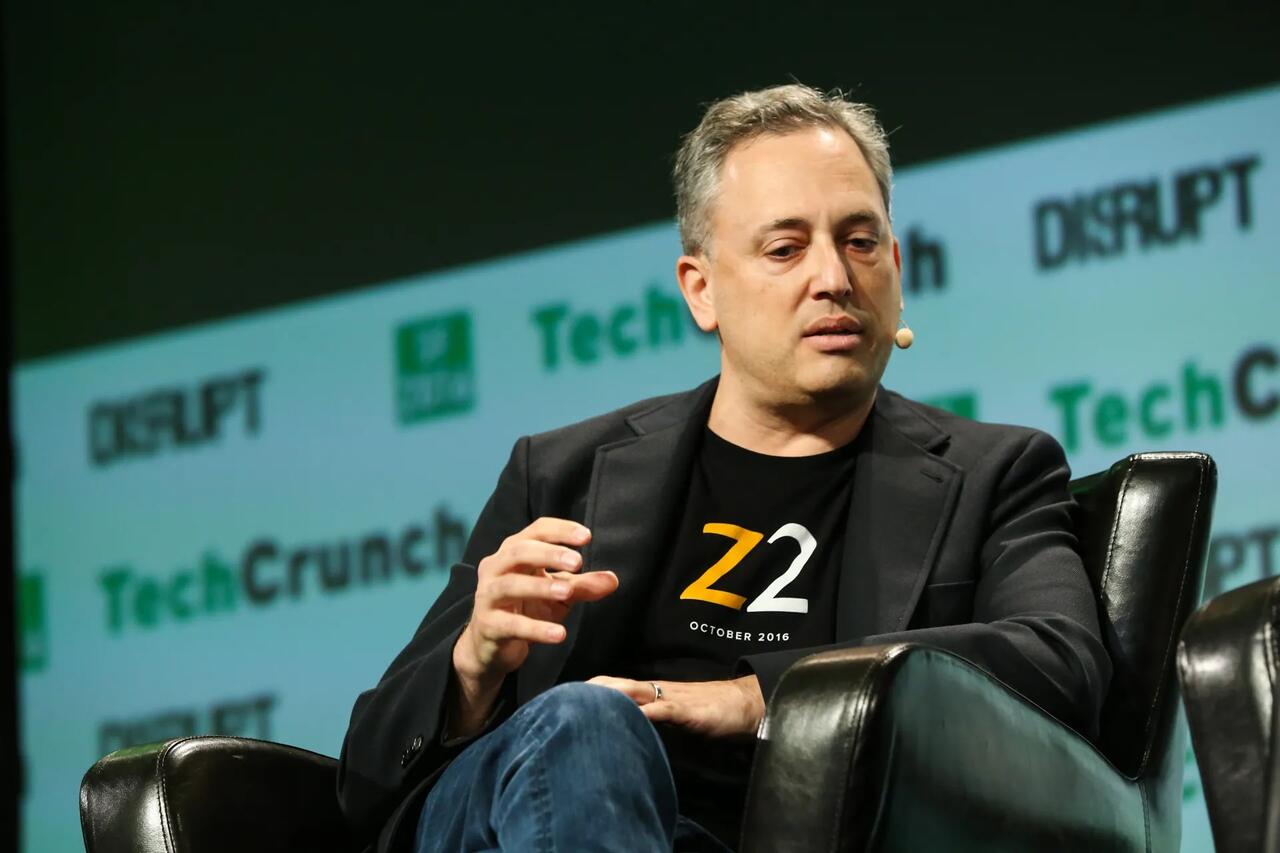
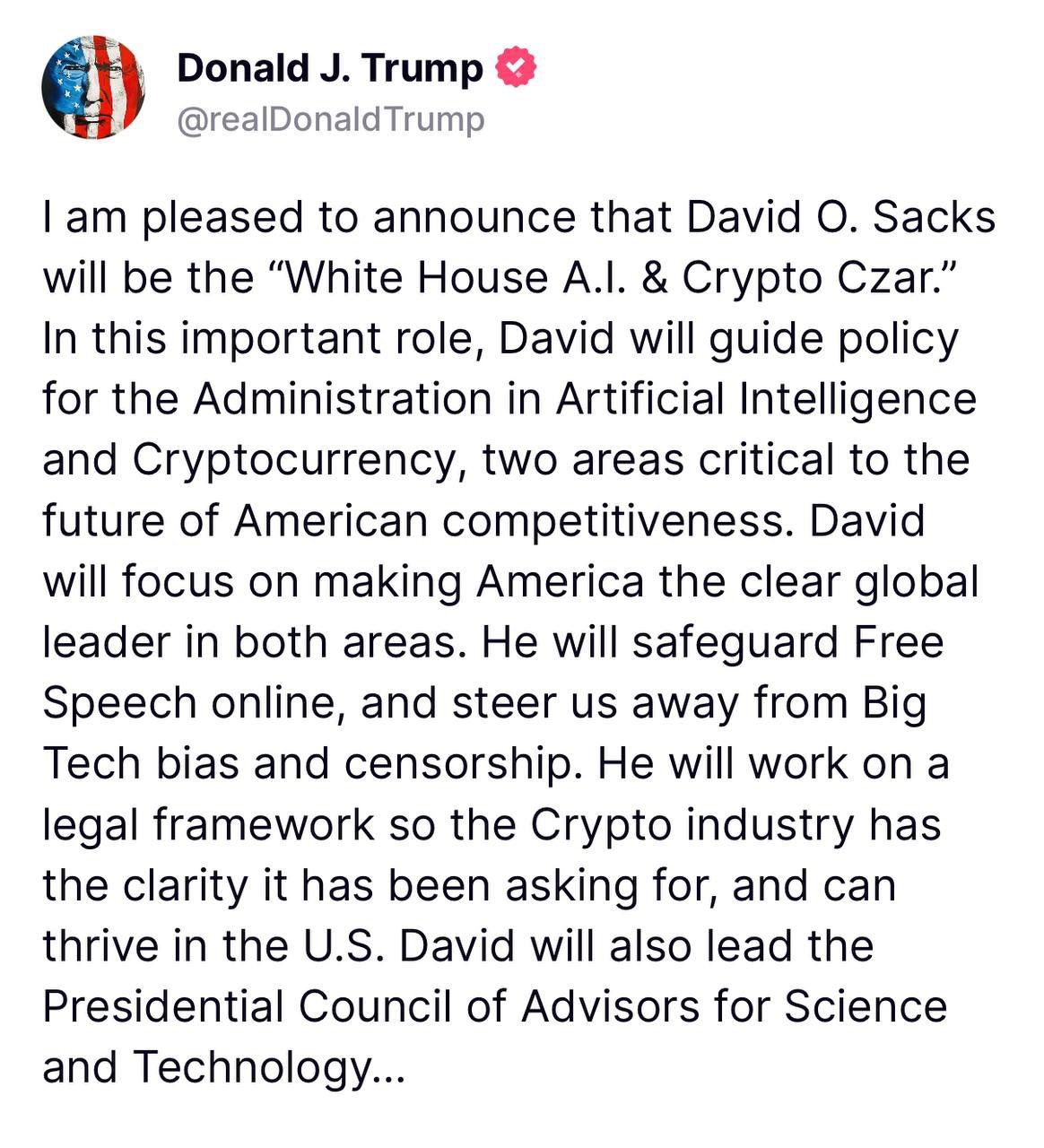
Donald Trump has named David Sacks as the “White House A.I. & Crypto Czar,” according to a Thursday night post on Truth Social.

He will work on a legal framework so the Crypto industry has the clarity it has been asking for, and can thrive in the US,” Trump said in the post, adding that Sacks will “guild policy for the Administration in Artificial Intelligence and Cryptocurrency, two areas critical to the future of American competitiveness.

David will focus on making America the clear global leader in both areas.”

The feeling is mutual David…


Tyler Durden
Thu, 12/05/2024 – 20:05

via ZeroHedge News https://ift.tt/3TPDXmp Tyler Durden

Technocracy Rising, Part 1: Why It’s Crucial To Understand The End Game

Technocracy Rising, Part 1: Why It’s Crucial To Understand The End Game

Authored by Jesse Smith via TruthUnmuted.org,

Major shake-ups are occurring across the global stage. History is replete with examples of breaks with the past from major political, economic, technological, and social upheaval. Throughout the ages, many self-serving individuals and groups have positioned themselves as rulers, financiers, benefactors, and thought leaders to steer change toward preferred outcomes. From the Pharaohs of Ancient Egypt to the Jacobin and Napoleon-led French Revolution in the late 18th century, societal transformation has been constant as one form of government replaces another.

We have now arrived at yet another historical inflection point. The desire for political and economic reconstruction is being demanded globally as the gap between the ultra-wealthy and everyone else continues to accelerate. In recent years, populism has taken flight by inspiring the masses to reject the rule of “the elite” and chart a new course. However, without scrutiny, this movement and its key figures could be just as dangerous as the establishment they are attempting to usurp. In fact, what we are witnessing is not populism in its truest sense but techno-populism or technocracy, as it has been called since its inception in 1920.

Technocracy originated in the winter of 1918-19 when Howard Scott formed a group of scientists, engineers, and economists that became known in 1920 as the Technical Alliance — a research organization. In 1933 it was incorporated under the laws of the State of New York as a nonprofit, non-political, non-sectarian membership organization.” 

– The Technocrat, Dec. 1964

What is Technocracy?

Historically, technocracy has not been well received. In fact, many who accurately comprehended its goals viewed it as a threat to democracy and the debt-based economic order run by the central banking establishment that has dominated the last century. Technocrats railed against this “Price System,” arguing it alone was to blame for the inequalities and inefficiencies of society. There is definitely some truth to their claims.

Under the Price System at its best there is not a single field of endeavor where the best technical standards are allowed to prevail. In other words, poverty, waste, crime, poor public health, bad living conditions, enforced scarcity, and low load-factors, are every one the direct and necessary consequences of the Price System… What we have tried to make clear is that it is the Price System itself, and not the individual human being, which is at fault.”

– Technocracy Study Course, Technocracy Inc. 1933, p.176

Technocracy can be defined simply as an impersonal and scientific method of managing all aspects of a society. Its primary concerns deal with how energy is produced and used. But it goes much deeper than this. One of the best explanations can be found in an issue of The Technocrat magazine from September 1937, where it states:

Technocracy is the science of social engineering, the scientific operation of the entire social mechanism to produce and distribute goods and services to the entire population of this continent. For the first time in human history it will be done as a scientific, technical, engineering problem. There will be no place for Politics or Politicians, Finance or Financeers, Rackets or Racketeers.”

The technocratic dream is revolutionary in scope, envisioning a total reorganization of industry, government, and law and order. They readily admit their intent is to socially engineer all of society, seize control of the production and distribution of all goods and services, and rid the world of rule by politicians and (traditional) financial controllers. The U.S. Constitution is also viewed as a relic, completely unfit to serve as a basis of governance and human rights.

Another job which has been neglected far too long is the rebuilding of our governmental machinery, from the village level right up to Congress. It cannot be avoided much longer, simply because the country has outgrown the constitutional clothes which the Founding Fathers tailored for it nearly two centuries ago. They have become as anachronistic, and as impractical, as a Pilgrim’s costume on an astronaut.” – Edith Chamberlain, The Technocrat, Dec. 1964

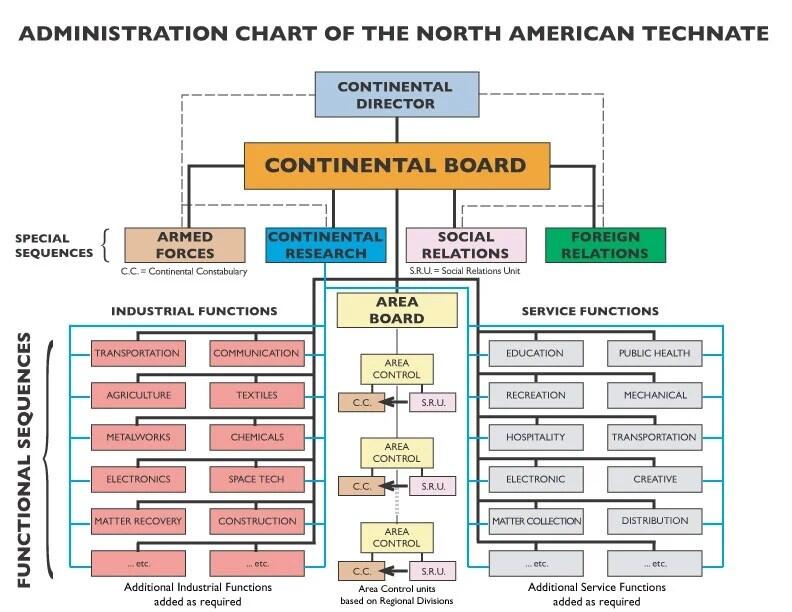
Technocrats make no pretense about maintaining a representative form of government be it a republic (as the USA was founded as) or democracy (what the USA has become). Its goal is to establish a scientific dictatorship to initiate and control all societal functions. Technocrats distanced themselves and were highly critical of fascists, communists, socialists, and other political movements but don’t have a problem with their own totalitarian style of rule termed a Technate.

Technocracy finds that the production and distribution of an abundance of physical wealth on a Continental scale for the use of all Continental citizens can only be accomplished by a Continental technological control, a governance of function, a Technate.”

– Technocracy Study Course, Technocracy Inc. 1933

Figure 22.1 from the Technocracy Study Course illustrates the point above revealing that technocracy is simply another form of top-down rule with a Continental Director having total authority of all societal functions.

Figure 22.1 – Technocracy Study Course

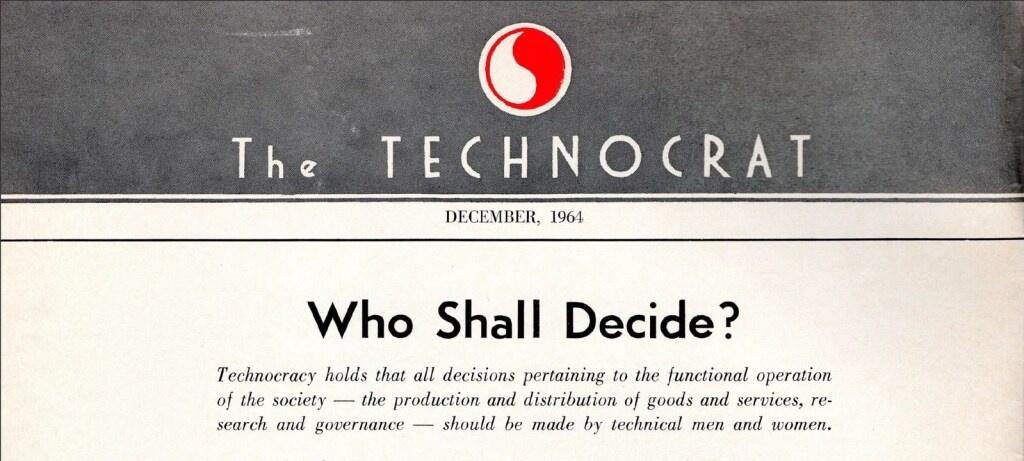
A December 1964, issue of The Technocrat magazine further explained that:

Technocracy holds that all decisions pertaining to the functional operation of the society — the production and distribution of goods and services, research, and governance — should be made by technical men and women. This does not mean that the technical people should leave their technical positions and go into politics, law, business promotion, public relations, and moral philosophy. Rather, it means that the scientists, technologists, engineers, and technicians shall continue to operate as such and that the decision-making of the society be moved into their functional realms.”

Silicon Valley and Washington, D.C. Form the Seat of Modern Technocracy

Image: Adobe Stock

Regardless of one’s comprehension of technocratic plans, a monumental reshaping of governments, economies, and societies is occurring, but not by elected representatives, constitutions, creeds, or the will of the people. Power is now concentrated in the hands of an exclusive class of scientists, technologists, engineers, and technicians—many of whom also happen to head multi-billion-dollar corporations.

We are also finding that technology has made people more isolated and infringes upon privacy with consequences yet to be realized. When we see the relationship between tech companies and government flourish, we are ultimately watching the implementation of a full-fledged technocracy.”

– Pendleton, Joseph. Californication: The Rise of the American Technocracy (p. 20). The Conservatarian Press.

Silicon Valley is the seat of modern technocracy. Big Tech is the euphemism for which it’s currently known. The World Economic Forum defines this dynamic as public-private partnerships (PPP).

Elon Musk, Peter Thiel, and Marc Andreeson are some of today’s most prominent techno-populists. Many believe they are modern day Justice League type heroes leading the world to newfound freedom (or at least in the United States). All were major contributors to Donald Trump’s reelection campaign in 2024. Vice President-Elect J.D. Vance has deep connections to Peter Thiel, indicating how close technocrats truly are to running the country.

Jeff Bezos, Tim Cook, and Sam Altman are also among the many tech gurus aligning themselves with the newly elected Trump administration. These endorsements indicate that for now, technocrats are content with using politicians and the political system to quietly transform the government into a full-fledged Technate from the inside out and vice versa.

It is the man who has command of the technical information who makes the real decisions in the functional phases of modern life. He is the only one who understands what needs to be done and how to do it. The politicians and financial manipulators who pretend that the right of decision is theirs are helpless without the technical men.”

– The Technocrat, Dec. 1964

Something else technocrats correctly understood was the sham of voting and elections. Perhaps this is another reason why they stayed hidden in times past, realizing the populace was not ready to accept this truth.

In the United States, it is generally assumed that the people vote for the kind of government they want, but that is not exactly true. Technically, they do not even vote directly for their president; they vote for electors who, in turn, are tacitly committed to vote for indicated candidates, the exact rules varying with the different states. Moreover, the public has little voice in choosing the candidates; it usually ends up with their having a choice between two men chosen by the respective political party ‘machines.’ And they have less choice concerning the policies of the president. Once elected, the president is under no real obligation to heed the desires of the people and often acts contrary to his campaign promises.” 

– The Technocrat, Dec. 1964

Would Donald Trump have been “reelected” without the help of the aforementioned technocrats? Now that he will resume the Presidency, will he be more beholden to the people or his big moneyed investors from Silicon Valley?

Why is Technocracy Rising Now?

Technocracy has long been resisted by traditional powers and was originally conceived only for the North American Continent. Today, technocracy is rising from the ashes like the Phoenix legend to become a global force to be reckoned with. I believe this is largely because of the pending economic meltdown. The debt-based, fiat currency system is at the end of its life cycle and the central bank establishment is looking for new ways to maintain control of the monetary system. They have joined ranks with the technocrats who were correct in predicting that the system would crash (though it has yet to take place due to manipulation tactics keeping it at bay).

If the human race on this Continent is to survive the crash of the Price System, Technocracy will have to be put into practice.”

– Technocracy in Plain Terms, Technocracy Inc. 1939

By adopting technocracy, the banking elite not only can retain control over the monetary system, they will also cement their rule over all industries, natural resources, governments, institutions, and people.

Technocracy Wouldn’t Exist Without Advances in Technology

Big Tech products are ubiquitous and thought to be indispensable in our ultramodern, future-oriented world. AI, robotics, and the Internet of Things (IoT) are touted as catalysts that can lead to a future of ease and prosperity for all. These technologies and more are considered part of the Fourth Industrial Revolution aka Industry 4.0, where the shift to digital technologies will supersede past ways of conducting business, communicating, and governing with one major caveat: the potential to overtake humanity itself and render humans as “hackable animals” and “useless people.” Consider the following statements from some of the world’s most prominent thought leaders.

“Technologies that are emerging today will soon be shaping the world tomorrow and well into the future – with impacts to economies and to society at large. Now that we are well into the Fourth Industrial Revolution, it’s critical that we discuss and ensure that humanity is served by these new innovations so that we can continue to prosper.”

– Mariette DiChristina, (former) Editor-in-Chief of Scientific American, and chair of the Emerging Technologies Steering Committee

“We must develop a comprehensive and globally shared view of how technology is affecting our lives and reshaping our economic, social, cultural, and human environments. There has never been a time of greater promise, or greater peril.”

– Klaus Schwab, Founder and Executive Chairman, World Economic Forum

“Now, fast forward to the early 21st century when we just don’t need the vast majority of the population… Most people don’t contribute anything to that, except perhaps for their data, and whatever people are still doing which is useful, these technologies increasingly will make redundant and will make it possible to replace the people.”

– Yuval Noah HarrariAuthor, Historian, and Philosopher

“Probably none of us will have a job.”

– Elon Musk (referring to the rise of Artificial Intelligence)

Paradoxically, technocracy claims to enable widespread prosperity while also rendering the lot of humanity replaceable, useless, and without meaning. How can this be? To technocrats of yesteryear, there was not much difference between human beings, dogs, pigs, and cars. The belief that humans are the capstone of all creation and made in the image of God was routinely mocked and discredited. In a chapter entitled, The Human Animal, the Technocracy Study Course further elaborates on its base view of humanity, stating:

The developments in the fields of physiology, biochemistry and biophysics, chiefly since 1900, are at last bringing us down to earth. Attention has already been called to the fact that the human body is composed chemically of the ordinary substances of which rocks are made. So are dogs, horses and pigs. In an earlier lesson, while discussing the ‘human engine,’ we pointed out that the human body obeys identically the same laws of energy transformation as a steam engine. This also is true of dogs, horses and pigs. These facts might lead one to suspect that human beings are very far removed from the semi-supernatural creatures they have heretofore supposed themselves to be…

When we observe a human being we merely perceive an object which makes a certain variety of motions and noises. The same is true, however, when we observe a dog or a Ford car.”

Modern technocrats also view the human as mere biological material that can be manipulated as needed, as evidenced by World Economic Forum Founder and Chairman Klaus Schwab:

This Fourth Industrial Revolution is, however, fundamentally different. It is characterized by a range of new technologies that are fusing the physical, digital, and biological worlds, impacting all disciplines, economies and industries, and even challenging ideas about what it means to be human.”

Contemporary technocracy has now merged with transhumanism forming a dangerous combination, as noted by author Patrick Wood, who wrote:

Technocrats see science and technology as the answer to improve and control society; transhumanists see the same science and technology as the answer to improve and control the human condition.”

– The Evil Twins of Technocracy and Transhumanism (p. 19). Coherent Publishing, LLC.

Why You Should Care About the Rise of Technocracy

Hopefully all the dots are starting to connect, enabling you to see where all of this is heading. Technocracy’s ascendance is a threat to all of humanity. Technocrats promise a utopian existence where abundance is the norm and work is optional, if not completely unnecessary. The self-appointed leaders believe they know best how to manage the world’s resources and its people. To accomplish these lofty goals, the social structure will have to undergo drastic changes which include redefining work and wages. The following excerpt from the Technocracy Study Course provides a detailed overview of what this entails.

“If the production is to be non-oscillatory and maintained at a high level so as to provide a high standard of living, it follows that consumption must be kept equal to production, and that a system of distribution must be designed which will allow this. This system of distribution must do the following things:

  1. Register on a continuous 24-hour time period basis the total net conversion of energy, which would determine (a) the availability of energy for Continental plant construction and maintenance, (b) the amount of physical wealth available in the form of consumable goods and services for consumption by the total population during the balanced load period.

  2. By means of the registration of energy converted and consumed, make possible a balanced load.

  3. Provide a continuous 24-hour inventory of all production and consumption.

  4. Provide a specific registration of the type, kind, etc., of all goods and services, where produced, and where used.

  5. Provide specific registration of the consumption of each individual, plus a record and description of the individual.

  6. Allow the citizen the widest latitude of choice in consuming his individual share of Continental physical wealth.

  7. Distribute goods and services to every member of the population.

In short, the goal of technocracy is to micromanage everything you do, produce, and consume through nonstop surveillance. This was not technically possible with the crude paper methods proposed by early technocrats. However, it is becoming achievable with the advent of digital technologies such as biometrics, Big Data, geospatial intelligence, digital currency, AI, and 5G. In a Technate, there will be no free-market economy where the average person could obtain wealth by starting a business or embarking upon a lucrative career path. Instead, technocrats promise each person a share of the overall wealth produced through the issue of Energy Certificates.

Under a technological administration of abundance, there is only one efficient method—that employing a system of Energy Certificates…These certificates are merely pieces of paper containing certain printed matter. They are issued individually to every adult of the entire population. The certificates issued to an individual may be thought of as possessing some of the properties both of bank cheque and of a traveler’s cheque. They would resemble a bank cheque in that they carry no face denomination. They receive their denomination only when being spent. They resemble a traveler’s cheque in that they possess some means of ready identification, such as counter-signature, photograph, or some similar device, so as to establish easy identification by the person to whom issued, and at the same time remain absolutely useless in the hands of anyone else.”

– Technocracy Study Course, p.230

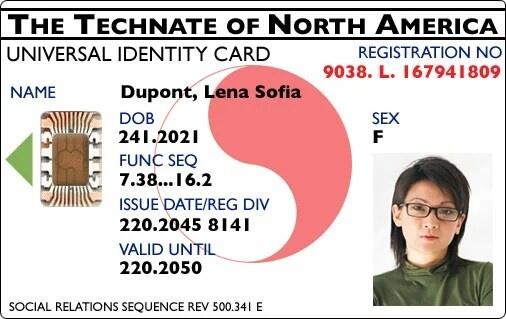
Today, Energy Certificates could take the form of Universal Basic/High Income payments issued in the form of Central Bank Digital Currency (CBDC) or some other form of digital currency. Corporate transactions could be conducted via carbon credits. Regardless of the mechanism of financial transfer, the individual will be totally dependent on the Technate with everything one does requiring a digital ID.

Technate of North America ID Card – Source: Technocracy Technate Picture Archive

The American dream of upward mobility, already heading toward extinction, will receive the knockout blow in a technocratic regime. Instead, compliance and energy usage will determine your level of prosperity. Property rights will also go out the window as the plan is to revolutionize housing into energy-efficient units with little variety and few manufacturers. This could occur today through the combination of an economic crisis wiping out individual wealth and mass printing of 3D houses fit for the technocratic era.

As envisioned, technocracy is no better than communism, fascism, or socialism. It’s just another power grab by individuals who believe they are smarter than the rest of us, with a promised utopia that will never materialize.

These prognostications may seem far-fetched now, but the rest of this series will spell out in detail how close the technocratic fantasy is becoming a reality. It is important for people everywhere to understand the implications of what is taking place and not be fooled by wolves in sheep’s clothing proclaiming a new golden age of humanity is imminent. The question is, a golden age for who? Cui bono?

Tyler Durden
Thu, 12/05/2024 – 19:15

via ZeroHedge News https://ift.tt/eh3dgqR Tyler Durden