China-Linked Hackers Breached 8 US Telecom Companies, White House Says

China-Linked Hackers Breached 8 US Telecom Companies, White House Says

Authored by Frank Fang via The Epoch Times,

Chinese state-sponsored hackers compromised at least eight U.S. telecommunication companies, a top White House official said on Dec. 4.

Anne Neuberger, deputy national security adviser for cyber and emerging technologies, provided an update on the Chinese threat actor group called “Salt Typhoon” during a press briefing on Wednesday. The threat group is believed to have hacked into the communications of senior U.S. government officials and prominent political figures, she said.

“We don’t believe any classified communications has been compromised,” Neuberger said.

The Chinese hacking appeared to target a relatively small group of Americans, she added, with only their phone calls and texts compromised.

The telecommunications companies that were breached have responded, but none of them “have fully removed the Chinese actors from these networks,” according to Neuberger.

“So there is a risk of ongoing compromises to communications until U.S. companies address the cybersecurity gaps the Chinese are likely to maintain their access,” Neuberger said.

In October, the FBI and the Cybersecurity and Infrastructure Security Agency (CISA) identified the Chinese hacks, saying at the time that an investigation was underway.

In late November, Neuberger and White House national security adviser Jake Sullivan hosted telecommunications executives for a meeting to share intelligence and discuss how the U.S. government and the private sector could work together.

Neuberger said President Joe Biden has been briefed multiple times on the issue. The White House “has made it a priority for the federal government to do everything it can,” she added.

Additionally, Neuberger pointed to efforts to improve cybersecurity in multiple sectors including rail and energy, after the 2021 ransomware attack on Colonial Pipeline.

“So, to prevent ongoing Salt Typhoon type intrusions by China, we believe we need to apply a similar minimum cybersecurity practice,” Neuberger said.

Also at Wednesday’s press briefing, a senior administration official said Salt Typhoon’s activities started at least a year or two ago. Additionally, the official said a “couple dozen” countries have been impacted by the Chinese hacking.

The FBI and the CSIA issued a joint statement on Nov. 13, revealing that Chinese hackers had compromised the networks of multiple telecom companies and stole customer call records and private communications from “a limited number of individuals who are primarily involved in government or political activity.”

On Tuesday, the FBI, the CISA, the National Security Agency (NSA), and international partners published a guide on best practices for protecting communication infrastructures.

CISA Executive Assistant Director for Cybersecurity Jeff Greene conceded on Tuesday that he didn’t have a timeline on when Chinese hackers could be purged from U.S. telecom networks.

“It would be impossible for us to predict when we’ll have full eviction,” Greene said at the time.

In September, the Justice Department announced that the FBI had taken down a botnet associated with “Flax Typhoon,” a threat group operating through the Beijing-based Integrity Technology Group. The botnet consisted of more than 200,000 consumer devices—such as network cameras, video recorders, and home and office routers—in the United States and elsewhere.

Another Chinese threat group, “Volt Typhoon,” began targeting a wide range of networks across U.S. critical infrastructure in 2021. The group, which was dismantled by a multi-agency operation in January, had maintained “access and footholds within some victim IT environments for at least five years,” according to CISA.

On Dec. 3, Rep. Laurel Lee (R-Fla.), a member of the House Committee on Homeland Security, said her legislation, officially known as the Strengthening Cyber Resilience Against State-Sponsored Threats Act, will combat the Chinese Communist Party’s growing threats against U.S. critical infrastructure.

“The Chinese Communist Party (CCP) will continue to exploit and undermine our national security every chance they get. We must stand up against foreign adversaries,” Lee wrote on the social media platform X.

If enacted, the legislation (H.R.9769) would create an interagency task force led by CISA and the FBI to deal with cybersecurity threats posed by China’s state-sponsored cyber threat groups. It would also require the new task force to inform Congress of its findings every year for five years.

Tyler Durden
Thu, 12/05/2024 – 18:25

via ZeroHedge News https://ift.tt/i4enT18 Tyler Durden

These Are The Best (And Worst) American Cities For Economic Mobility

These Are The Best (And Worst) American Cities For Economic Mobility

Behold – the American dream.

Where a fair and equal society allows anyone the ability to fashion the life they want, providing they’re willing to work for it.

A cornerstone of that dream is that each generation does better than the last, building and benefiting from growing economic opportunities.

But this does not necessarily hold true for all Americans.

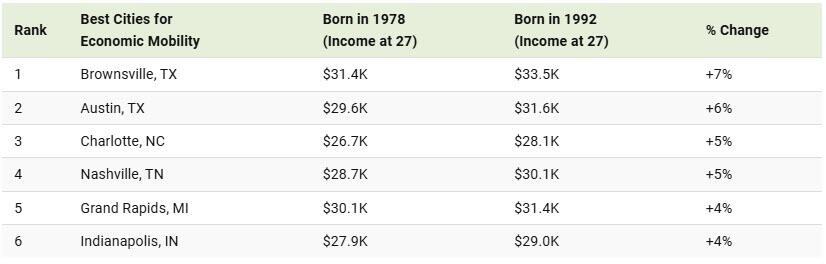
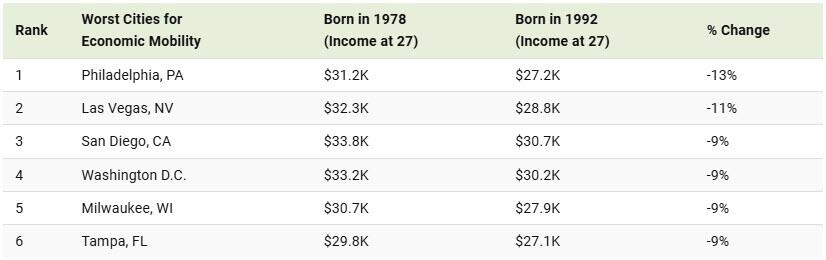
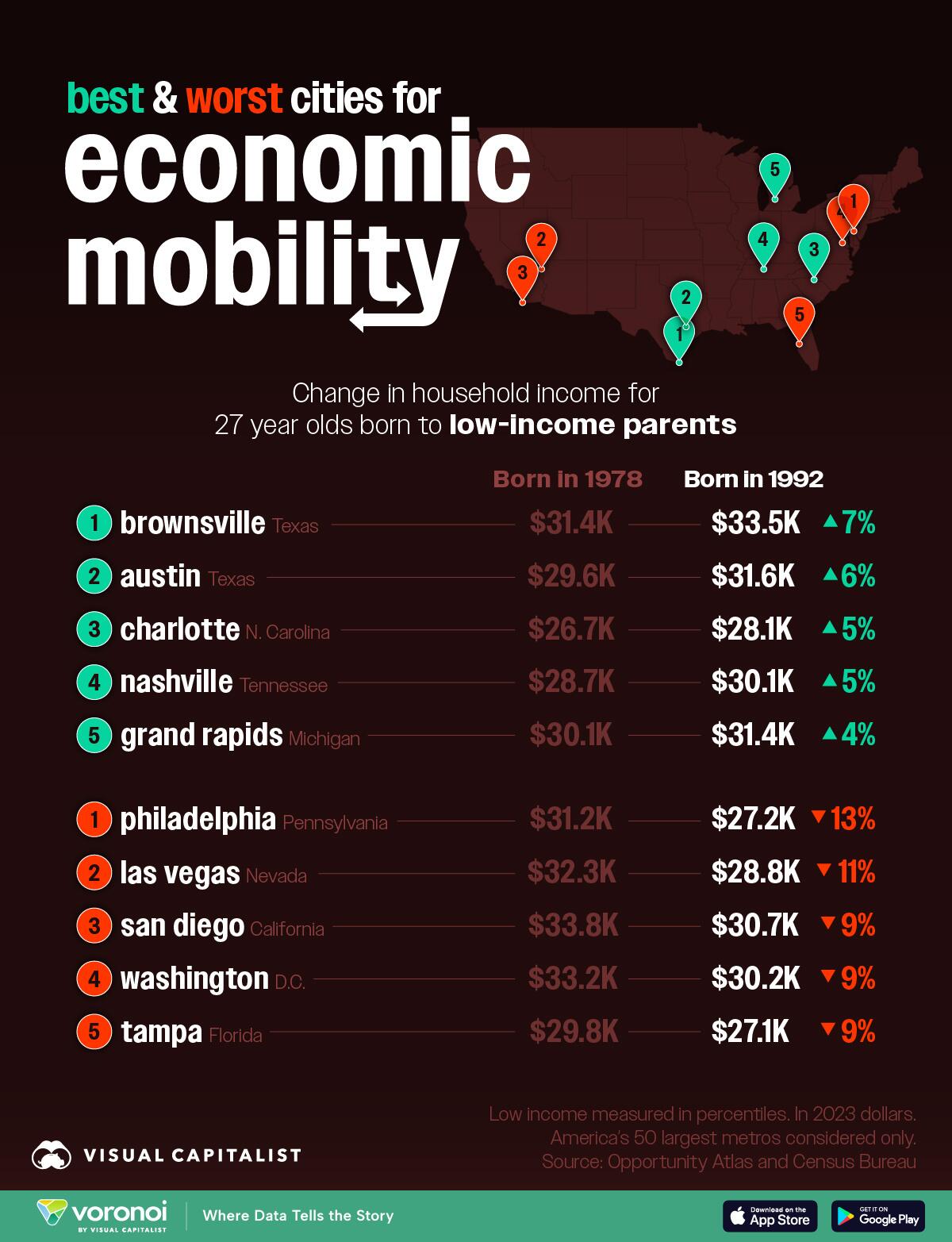
This chart, via Visual Capitalist’s Pallavi Rao, compares the real household income of 27-year-olds from two generations: those born in 1978 and those born in 1992, both raised by low-income parents. All figures are in 2023 dollars.

ℹ️ 27 is the earliest age at which estimates of adult incomes can be measured. Only the 50 largest metros were considered in this analysis. Low-income is categorized by percentile groups.

A positive percentage change implies economic mobility, allowing us to see the cities where adults had a chance to better their circumstances, and to what extent.

Data is sourced from a study conducted by Opportunity Atlas in partnership with the Census Bureau.

Where is the American Dream Still Alive?

Southern cities in Texas, Tennessee, and North Carolina did see upward mobility between generations in the lowest income group, with real wages improving 5-7%.

For example, in Brownsville, Texas, those born to low-income parents in 1992 earned an average of $33,000 at age 27. This is around $2,000 more than their 1978-born peers at the same age, the highest increase across all 50 metro areas.

In contrast, Philadelphia, Pennsylvania, saw real incomes decline across generations. The 1978 cohort earned a similar salary to their peers in Brownsville ($31,200), but a generation later, incomes dropped to $27,200.

In fact, only 12 of the 50 saw real income growth across generations for this economic class. And five of them were in Texas. This means that in 38 cities real wages fell between generations.

Zooming out, the average household income at 27 across the nation (for those born to low-income parents) dropped by 4%.

This class difference is important. Because when looking at the highest income percentile, the average income between generations increased 5%.

Wondering where wages adjusted for the cost of living are the highest in the country? Check out Mapped: Median Income by State for a quick overview.

Tyler Durden
Thu, 12/05/2024 – 18:00

via ZeroHedge News https://ift.tt/ezYaAOW Tyler Durden

How Big Is America’s Middle Class in 2024?

How Big Is America’s Middle Class in 2024?

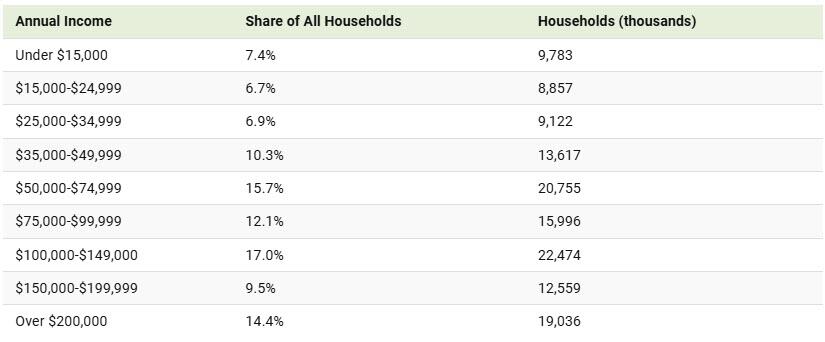
This graphic, via Visual Capitalist’s Pallavi Rao, visualizes the income distribution of all U.S. households in 2023, along with the range for which they would be considered middle class.

Pew Research estimates a household making between two-thirds to double the median annual income is considered middle class. While median income varies by state, we’ll use the U.S. average declared by the source to set the benchmark.

Data is sourced from the Census Bureau, and all figures are inflation-adjusted.

U.S. Household Income Distribution in 2023

In 2023, the median income was $80,060, placing families earning $53,000–$161,000 in the middle class bracked. This is about 40% of all U.S. households.

Here’s a more granular breakdown of household income distribution.

Looking at just the Census Bureau defined bands: the largest share of American households (17%) are in the $100,000-$150,000 annual salary range. It’s followed by the $50,000–$75,000 category (15.7%). These are also the upper and lower bands of the middle class.

Perhaps most interesting is that the $200,000 and over bracket had the third-largest cohort of households (14.4%).

The History of the Middle Class and Why it Matters

Like most parts of the modern economy, the middle class traces its roots back to the Industrial Revolution.

A new social strata emerged between the aristocracy and the working poor—where professionals, merchants, and skilled workers benefited the most from the economic changes of the time.

But why does it matter today? Because of their collective disposable income, a strong middle class provides a stable consumer base that drives productive investment and economic growth.

Additionally, the expansion of the middle class has been linked to reduced poverty rates and improved social policies in many countries.

Looking for more graphics that visualize wealth or income distribution. Check out How the Global Distribution of Wealth Has Changed Since 2000 for a bird’s eye view.

Tyler Durden
Thu, 12/05/2024 – 16:40

via ZeroHedge News https://ift.tt/TM0YRCc Tyler Durden

A Reset For America

A Reset For America

Authored by James Rickards via DailyReckoning.com,

In late November, $140 billion of American savings disappeared into thin air. This was the result of a revision to the U.S. personal savings rate by the BEA.

Of course, the money only ever existed in a government-published report. But the original “bullish” data was widely cited as a sign that all was well with the economy.

In truth, Americans are burning through their savings at a rapid pace. During the pandemic citizens reached record savings levels due to stimulus checks and programs, but since then all those excess savings have been burned through. Biden’s inflationary and anti-growth policies have taken their toll.

U.S. credit card debt recently surpassed $1.14 trillion, a new record, while growing at unprecedented speed. Compounding the problem, APRs on credit card debt are also at record highs, well over 20% on average, with certain cards reaching APRs of over 33%. That’s not far away from payday loan APRs.

And it’s not just American savings data that has been manipulated to appear healthier than it truly is.

New home sales data for the U.S. over the summer was also recently revised sharply downwards.

Payroll data and job openings have also been revised downward this fall. All sorts of bullish economic beats have been quietly revised to misses.  It appears that the Biden administration broadly exaggerated economic statistics in an attempt to make the economy appear healthier than it truly was.

Strangely, these data corrections don’t get nearly as much attention as the original (incorrect) reporting did. Once the “good” headline number comes out, traders and algorithms react immediately to the news. But they largely ignore subsequent bearish revisions, which don’t get nearly as much coverage in the news.

It’s just the way the world works. When investors want to see positive economic data, they’ll find it. But eventually, the country will have to address these underlying issues head-on. Fortunately, we will soon have a competent leader in the White House to do so.

A Renewed Sense of Purpose

If this economy was a game of poker, Donald Trump would have been dealt a 2-7 off suit. It’s a bad hand, statistically speaking.

But I believe that the Trump administration will, in time, overcome the subpar cards they were dealt. President Trump is set to cut red tape, eliminate waste, and make smart infrastructure investments. These aspects alone will have a highly significant impact on our financial outlook.

Moreover, since the election, there’s a renewed sense of purpose in the country.

Investors and business people understand how important this outcome was for the country. Before Trump’s win, there was widespread malaise throughout the country. There simply wasn’t much cause for optimism.

Now the nation feels reinvigorated. The country is excited about the idea of Elon and Vivek’s DOGE slashing government waste. The people want to see widespread agency corruption ended. And when was the last time you saw this much attention paid to cabinet picks? Never. Americans have finally re-engaged with their government.

This morale boost will be immensely helpful as we work through these headwinds. In economics, attitude matters almost as much as fundamentals.

I still expect a recession to hit soon, if we’re not already in it, due to the Biden administration’s economic fumbles. It remains to be seen just how bad things might get in the short run.

In terms of Trump’s policy plan, the new tariffs will encourage foreign companies to manufacture in the U.S. It’s simple: if you want to sell to America, set up shop here and create jobs. Trump made some progress on this during his first term, but now that the GOP has control of Congress and a mandate from the American people, it should be a smoother process this time around. Tariffs can also be a powerful bargaining tool, as Trump has already shown with Canada and Mexico.

Importantly, Trump’s team understands that it is impossible to tax our way out of this situation. The only path forward is to grow the economy faster than the debt. Once we turn that corner, the problem begins to address itself.

I’m not saying it’s going to be all smooth sailing. True reform is always a challenging process. There will almost certainly be more inflation on the horizon (but not nearly as bad as if Kamala had won). This is an unavoidable consequence of decades of reckless government spending.

Still, the outlook for the nation has improved dramatically since November 5th. We have a rare chance to make meaningful, lasting change in America.

It’s exciting to see it finally taking shape.

Tyler Durden
Thu, 12/05/2024 – 16:20

via ZeroHedge News https://ift.tt/SekWPHG Tyler Durden

Make France Governable Again

Make France Governable Again

By Elwin de Groot, Benjamin Picton and Maartje Wijffelaars, strategists at Rabobank

  • What we are looking for: A Prime Minister of the Fifth French Republic.

  • Who we are: The second largest economy in the Eurozone and the only nuclear power in the Eurozone; we are Europe-minded, but fundamentally weak, with a budget deficit that is more than twice the threshold set by Brussels. Our political landscape and parliament are divided into three blocs: far-left, centre and far-right. There is little room for compromise between them.

  • Our mission: to stay economically relevant and keep our economy afloat, whilst ensuring sustainable finances over the medium-term. Although our spread has widened, markets have largely been treating us as ‘too big to fail’; we would like to keep it that way.

  • You are: someone with relentless energy and who is able to bridge those said divisions; alternatively, you are able to drive a wedge into either the bloc on the right or left in order to fracture the opposition and force compromises. You like numbers, budgets and have a Machiavellian way about you.

  • We offer: an opportunity without much of an upside.

Bitcoin surged through the $100,000 level following an announcement from Donald Trump that he had nominated Paul Atkins to replace Gary Gensler as Chair of the Securities and Exchange Commission. Atkins is well regarded in Republican circles, having been previously appointed by George W. Bush as SEC Commissioner from 2002 to 2008. Trump’s announcement post on Truth Social promoted Atkins’ crypto chops, saying that he “recognizes that digital assets & other innovations are crucial to Making America Greater than Ever Before.”

While Trump continues to assemble his team to Make America Great Again, Emmanuel Macron is now faced with the difficult task of finding a new PM to make France governable again. Michel Barnier sensationally lost a no confidence vote in his 3-month premiership yesterday after Marine Le Pen’s National Rally sided with left-wing parties to bring down the government.

The fall of the French government was clearly already in the price, because EURUSD was largely unchanged on the day. OATs outperformed Bunds as the French sovereign curve bull steepened. The CAC40 gained 0.66%, but underperformed the Euro Stoxx 50 (+0.83%) and the German DAX (+1.08%), while the FTSE100 closed in the red and US indices again hit fresh all-time-highs. This morning, France’s spread opened several basis points tighter again, confirming that Macron still has the benefit of the doubt. But time is unlikely to be Macron’s friend. Moody’s said this morning that the French no-confidence vote is “credit negative”.

Looking ahead, there are multiple scenario’s to think of. Remember that the President can only dissolve the Assembly once a year, which means the French will have to work with the existing distribution of parliamentary seats until June 2025.

The scenario preferred by the opposition is for Macron to give up his post and call for early presidential elections – they are officially due in 2027. We don’t see this as a likely scenario, at least not until after March, when Le Pen looks set to be convicted over the misuse of EU funds, which would ban her from politics for five years. The reason why we don’t see Macron opting to resign before is because it would almost certainly pave the way for a Le Pen victory and subsequently a far-right prime minister. It would not change the parliamentary distribution in the near future, and hence would require support from centrist of left-wingers to push through a budget, which seems difficult to imagine at this point. But, crucially, Le Pen would then call for early parliamentary elections in July, where her party RN would have a real shot at winning, given that they won the popular vote this year. In any case, it would deliver a more conservative and Eurosceptic France, with limited to no intention to reform the unsustainable pension system and, ostensibly at least, less sense of urgency to substantially cut back the deficit and stabilise its massive and growing debt burden. Moreover, to protect pensioners, an important voter base, it could even lead to higher pension spending. If RN would actually care about fiscal consolidation this could then lead to spending cuts and higher taxation elsewhere, more detrimental to France’s longer-term growth outlook. In short, it might then be less detrimental to France’s short-term growth outlook, but more so to its longer-term one.

A second scenario would see the installation of a broker prime minister than would be able to find consensus over a budget. Such a consensus could only be reached, in our view, however, if the budget contained less spending cuts and/or fewer tax increases, to protect pensions. Indeed, Barnier’s proposal to save money on pension spending by delaying inflation indexation, by half a year, appeared to be a red line for Le Pen’s RN. Calculations differ as to the amount it would save, but it’s generally estimated at up to EUR 4bn. This seems hard to be found elsewhere, without harming the economy. A budget without these cuts might be slightly beneficial to the short-term growth outlook, but negative for the fiscal trajectory. Remember, France already spends much more on pensions than most other OECD countries (13.6% of GDP versus 7.7% on average in the OECD) and the national pension council has projected that the pension fund will be in deficit as from this year. It would also likely lead to a problem with Brussels further down the line, as it would imply that the budget won’t adhere to the reformed budget rules. A potential clash would likely be delayed until autumn next year, though, or perhaps the spring of 2026, when realised figures actually show France is off track.

A third, and perhaps most probable option is the installation of a caretaker government which has to rule based on emergency spending and taxation laws, until new elections will be called. This is a scenario that has never been tested. A government of this nature could be led by an independent, non-partisan figure to avoid any evident political biases. Whilst this is a short-term solution to keep the lights on in France and might save some economic pain due to less austerity, it is not very likely to lead to any structural improvements to either the public finances or Frances’ structural economic growth potential. Moreover, it would simply kick the can down the road. New elections in the year after would introduce a similar uncertainty as that of the past months. The fact that RN managed to secure the popular vote in July’s election, but didn’t manage to win that many seats, shows that they were very close to winning big.

Turning to the US, the ISM services report yesterday surprised on the softer side to print at 52.1 vs 56 previously. The ‘employment’ and ‘new orders’ sub indices both fell, but remain in expansion territory. ‘Prices paid’ rose from 58.1 to 58.2, which perhaps raises the stakes a little on tomorrow’s non-farm payrolls report for determining the outcome of the December FOMC meeting.

Speaking of the FOMC, Fed Chair Jerome Powell gave an interview with Andrew Ross Sorkin that yielded little in the way of fresh guidance for the upcoming meeting. When asked about why the Fed was cutting despite stickier inflation and a strong economy, Powell said “we can afford to be more cautious to find the neutral rate”. Mary Daly struck a similar tone on PBS News Hour, saying that there is “no sense of urgency” about cutting rates. A 25bp cut in December is currently 74% priced into the OIS strip. Our Fed watcher Philip Marey, for now, sticks with his view of a 25bp cut.

Tyler Durden
Thu, 12/05/2024 – 14:10

via ZeroHedge News https://ift.tt/Wfa0Zi9 Tyler Durden

EVs Simply Aren’t Selling

EVs Simply Aren’t Selling

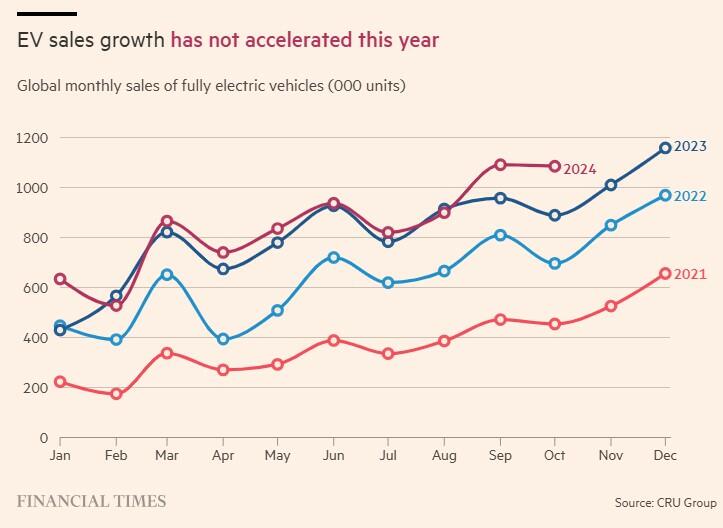
Now that the shine and allure of being the ‘new fad’ and government subsidies are starting to wear off – along with a marketplace full of super-saturated competition and robust supply – EVs simply aren’t selling.

That was the topic of a new FT report that claims the auto industry’s shift toward EVs, once seen as essential, is now facing serious challenges.

It cites for example that Northvolt, Europe’s top battery producer, filed for bankruptcy last week, casting doubt on the region’s industrial strategy. Additionally, Stellantis announced the closure of its UK van plant, risking 1,100 jobs, while Volkswagen and Ford also warned of significant job cuts and plant closures due to weaker-than-expected EV demand.

And as we noted earlier this week, GM is taking a $5 billion charge to reorganize its Chinese business. 

Now the U.S. risks falling further behind in its green transition as EV adoption lags and President-elect Trump’s plans to cut subsidies threaten progress. While President Biden aims for EVs to make up half of new car sales by 2030, they accounted for just 10% last year, according to FT.

And carmakers have scaled back production plans, with U.S. EV output expected to drop by 50% and European plans by 29% next year, according to Bernstein. By 2025, EV market share is projected to reach 23% in Europe and 13% in the U.S.

FT reported that the slow growth of EV adoption globally stems from high upfront costs, concerns about range and charging infrastructure, and fading energy price advantages due to geopolitical tensions.

Rising interest rates have further increased leasing costs. In Europe, EV prices have climbed from €40,000 in 2020 to €45,000 today, far above the €20,000 many consumers are willing to pay.

Meanwhile, inconsistent government subsidies have led to uneven adoption, with Germany and France cutting incentives, prompting concerns about declining EV sales and job losses in the auto industry.

China, by contrast, has successfully integrated its EV strategy, leveraging state-backed initiatives, subsidies, and a robust supply chain to dominate the market. More than half of new cars sold in China are now EVs or plug-in hybrids, aided by competitive pricing and innovative in-car technology.

Europe, constrained by free-market principles, cannot match China’s state-driven model and has resorted to imposing tariffs on Chinese EV imports. Despite setbacks, automakers in Europe remain optimistic, planning affordable EV models under €25,000 to meet stricter emissions targets, aiming to balance cost reduction with growing consumer interest in electric technology.

Bernstein analyst Daniel Roeska concluded: “The EV production forecast for 2025 has seemingly only gone one way — down.”

Tyler Durden
Thu, 12/05/2024 – 12:40

via ZeroHedge News https://ift.tt/LEkwqXh Tyler Durden

Sleepy Joe Strikes Again: Biden Falls Asleep At World Summit

Sleepy Joe Strikes Again: Biden Falls Asleep At World Summit

Authored by Luis Cornelio via Headline USA,

It’s clear that outgoing and embattled President Joe Biden no longer cares about public perception—using his pardon power to put his son above the law and now openly dozing off in front of world leaders. 

Biden was caught in a now-viral video seemingly asleep while resting his head on his hand during a summit in Angola.

Seated next to the sleepy president were the leaders of the Democratic Republic of the Congo, Tanzania and Zambia, as well as the Africa Finance Corporation. 

The summit sought to raise funds for a project to connect the African continent and boost its declining growth. Biden pledged a staggering $600 million in taxpayer dollars for the so-called rail plan. 

“Africa has been left behind for much too long… but not anymore,” Biden claimed, his voice raspy. “Africa is the future. I’m not being solicitous.” 

Despite the ambitious U.S.-funded project, Biden’s nap drew the most attention.

“Who’s running the country?” asked Republican official Jake Schneider, one of the first to share the video online. 

“President Biden isn’t even trying to fake it anymore. No need to count sheep here. Dude went straight snoozing,” one user wrote, sharing a screenshot of Biden seemingly asleep. 

Irish personality Chay Bowes similarly rebuked Biden on X, calling him “the singularly most useless and destructive” U.S. president in generations. 

“Literally sleeps his way through a meeting with African leaders,” Bowes added. “A corrupt and devious liar, a shame to the decent people of America.”

Podcast host Chad Prather quipped that Biden would sleep “through the inauguration” of President-elect Donald Trump. 

Biden’s nap comes less than four months after he was forced to renounce the Democratic nomination amid leftist concerns that, at 81, he would inadvertently pave the way for a Trump second term. 

The White House tried to shield the president from viral videos exposing him as confused, startled, limping and walking stiffly.  

The cover-up unraveled after Americans directly witnessed Biden repeatedly stumble over his words during the first debate with the more energetic Donald Trump. 

While Biden exited the race in disgrace and endorsed his equally unpopular vice president, Kamala Harris, Trump emerged victorious in the 2024 election, sweeping all battleground states and gaining ground across nearly all the country’s counties. 

Tyler Durden
Thu, 12/05/2024 – 08:45

via ZeroHedge News https://ift.tt/z3MlV15 Tyler Durden

Rate-Cuts? Jobless Claims Remain Low As Hurricane Effects Fade

Rate-Cuts? Jobless Claims Remain Low As Hurricane Effects Fade

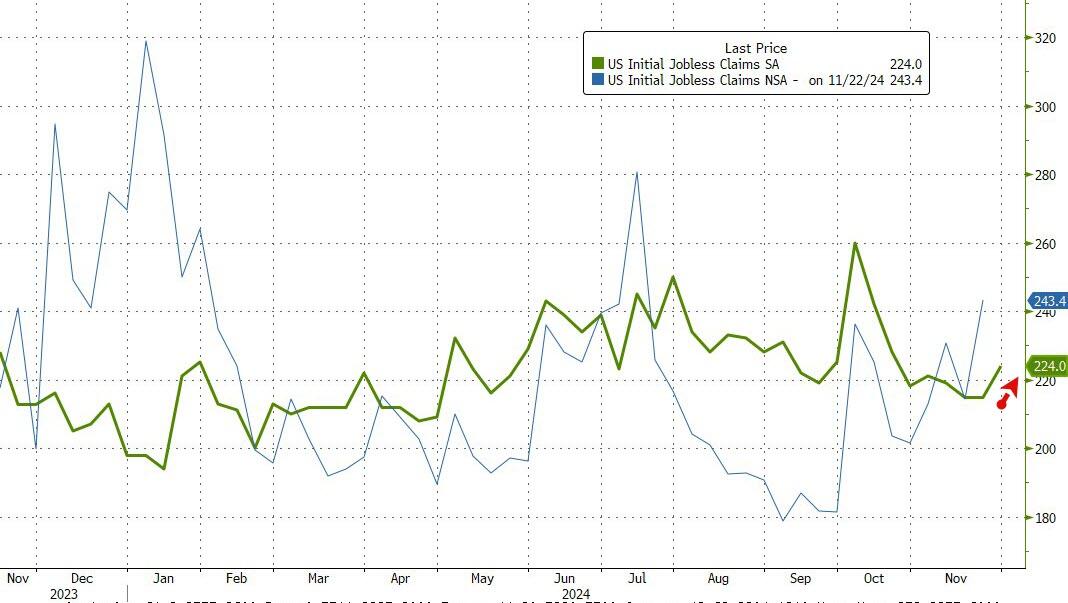
The number of Americans filing for jobless benefits for the first time rose modestly last week from 215k to 224k – still obviously very low numbers…

Source: Bloomberg

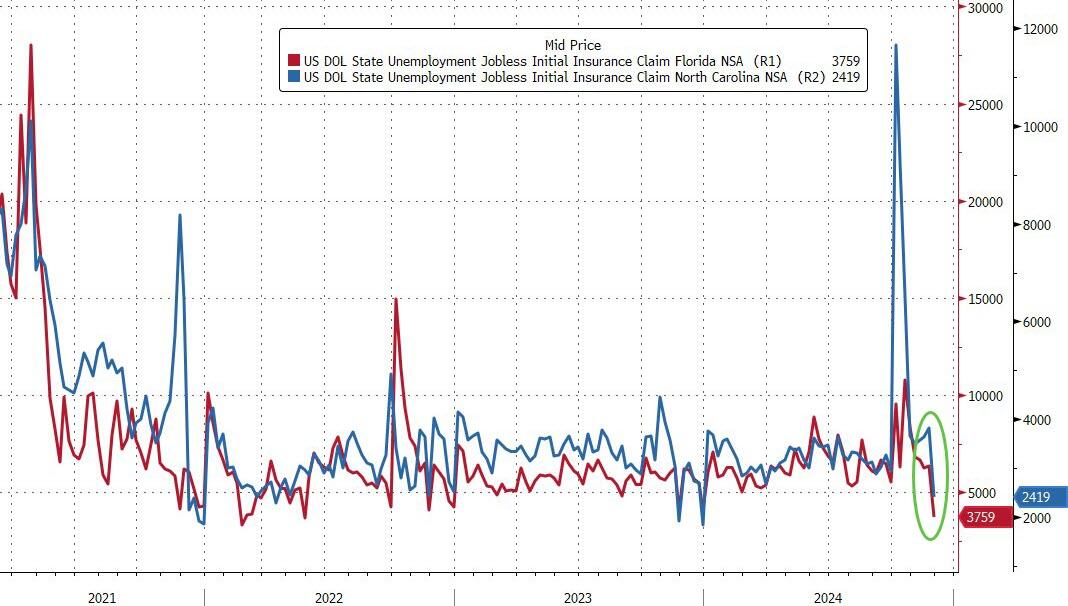
Hurricane-related states (Florida and North Carolina) have seen initial claims crash to near record lows

Source: Bloomberg

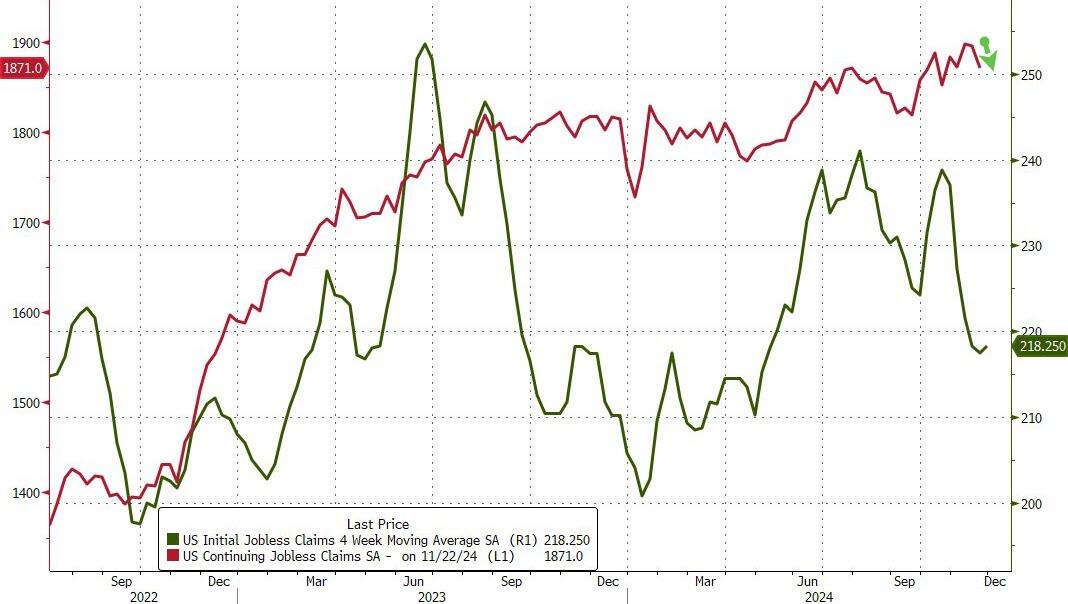
Continuing Claims dropped back below 1.9mm Americans (1.871mm)

Source: Bloomberg

Not exactly rate-cutting-type numbers, eh?

Tyler Durden
Thu, 12/05/2024 – 08:37

via ZeroHedge News https://ift.tt/IyYbBPJ Tyler Durden

Futures Flat After 56th Record High, Bitcoin Tops $100,000

Futures Flat After 56th Record High, Bitcoin Tops $100,000

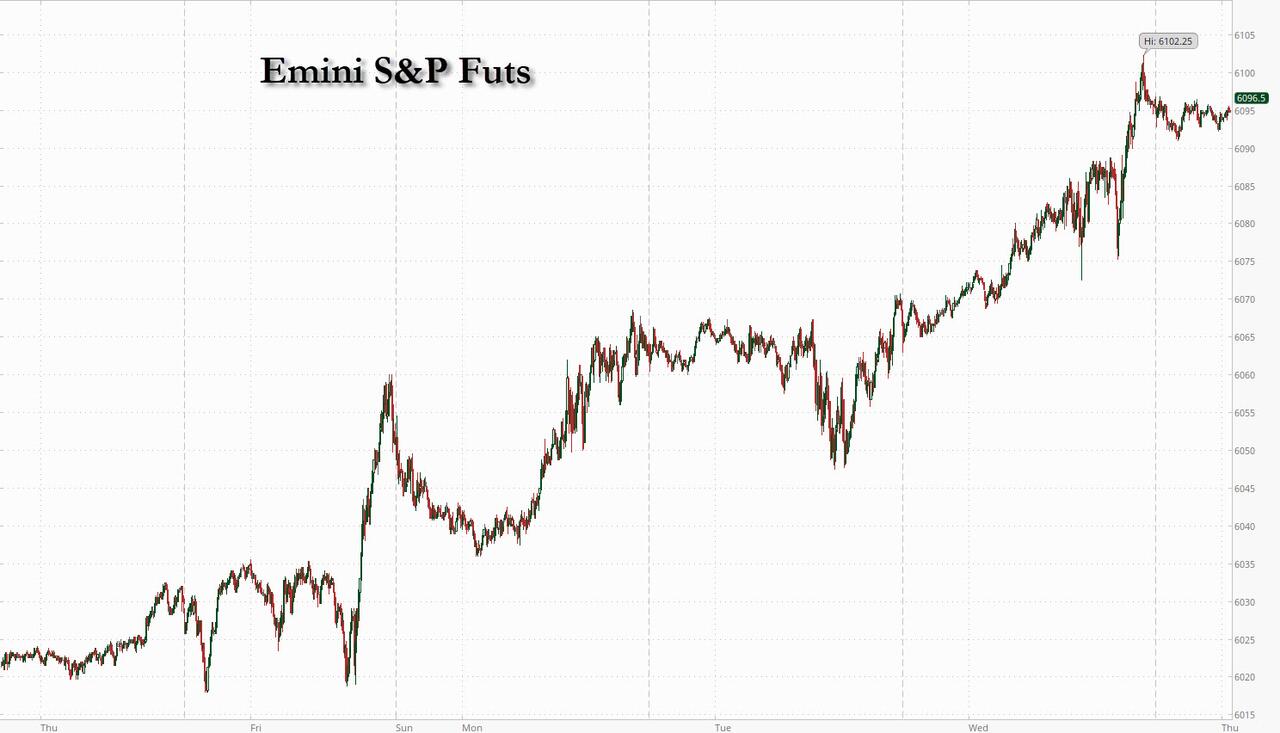
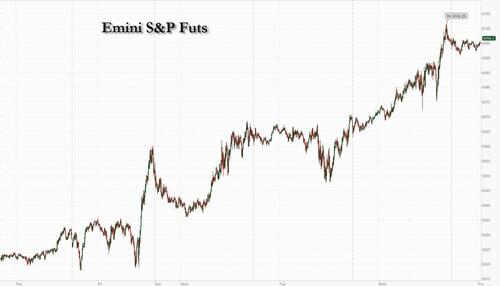
S&P 500 futures are flat, holding near Wednesday’s record high, with WTI futures bouncing around after OPEC+ agreed to delay output hikes for 3 months. As of 8:00am, futures were flat in a quiet trading session ahead of NFP after closing at a new all-time high for the 56th time in 2024; Nasdaq futures are down 0.1% as Mag7 names are mostly lower premarket with Semis underperforming. Bond yields are 1-2bps higher. Financials indicated higher. Bitcoin topped $100,000 for the first time after President-elect Trump named crypto proponent Paul Atkins to head the SEC. Microstrategy, which has become a proxy for crypto in the world of stocks, was up 8% crushing the latest onslaught of shorts. French assets rose slightly as investors debated the implications of the collapse of Michel Barnier’s government. The CAC 40 stock index climbed 0.1% in Paris, tracking Europe’s regional Stoxx 600 gauge. Commodities are mixed while the USD extends losses for a third consecutive day. It is a relatively light macro data day with jobless claims, which is not thought to be catalytic given tomorrow’s NFP print.
In premarket trading, cryptocurrency stocks jumped on Thursday after Bitcoin rallied past $100,000 for the first time, boosted by President-elect Donald Trump’s embrace of digital assets. Microstrategy, Coinbase, Riot Platforms and MARA Holdings were among those sharply higher in premarket trading. Here are some other notable premarket movers

  • AeroVironment (AVAV) falls 8% after the drone maker reported 2Q adjusted EPS that disappointed amid higher R&D spending.
  • American Eagle Outfitters (AEO) tumbles 13% after the apparel retailer lowered its full-year comparable sales forecast.
  • ChargePoint (CHPT) jumps 11% after the electric-vehicle charging company reported third-quarter revenue that beat average expectations.
  • Fiserv (FI) drops 9% after President-elect Donald Trump tapped the fintech’s CEO Frank Bisignano to serve as the Commissioner of the Social Security Administration.
  • Five Below (FIVE) jumps 14% after the discount retailer boosted its full-year net sales guidance and named former Forever 21 head Winnie Park as CEO.
  • Nano-X Imaging (NNOX) rises 11% after the medical imaging technology company said it received FDA clearance for its Nanox.ARC x-ray system.
  • NCino (NCNO) declines 19% after the banking software maker’s fourth-quarter revenue forecast fell short of estimates.
  • SentinelOne (S) falls 15% after the cybersecurity software company posted 3Q profit that fell short of estimates.
  • Synopsys (SNPS) declines 8% after the maker of electronic design automation software provider a weaker-than-expected forecast.

S&P 500 contracts were steady after the 56th record close of 2024 put the index on course for its best year since 2019. Fed Chair Jerome Powell buoyed sentiment on Wall Street by saying the US economy is in “remarkably good shape.” The dollar and Treasuries were lower. Attention turns next to today’s US jobless claims numbers before key non-farm payrolls data Friday.

In comments at the New York Times DealBook Summit in New York, Fed Chair Powell said downside risks from the labor market had receded. He also said Fed officials could afford to be cautious as they lower rates toward a neutral level — one that neither stimulates nor holds back the economy. Powell’s comments on the US economy did little to alter expectations implied by market pricing that the Fed will cut rates again when it meets later this month. Meanwhile, two surveys showed that US executives turned significantly more optimistic about the economy and prospects for their own businesses after Trump won the election.

France’s far-right leader Marine Le Pen teamed up with a left-wing coalition to topple Barnier’s administration on Wednesday, pitching the country into further political turbulence. President Emmanuel Macron now needs to find another premier who can pass a budget for 2025 through the deeply divided parliament.

“The markets have partially anticipated this development, but repercussions can be expected,” said Alexandre Hezez, chief investment officer at Group Richelieu. “Any political or budgetary misstep could punish France much more severely on the markets.”

French assets rebounded slightly as investors debated the implications of the collapse of Michel Barnier’s government. The CAC 40 stock index climbed 0.1% in Paris, tracking Europe’s regional Stoxx 600 index which rose for a sixth straight session and French equities outperform in early Thursday trading amid optimism that tax hikes proposed by the toppled government will not materialize. French aerospace firm Safran was lagging behind as analysts didn’t approve of its new targets. Aurubis rose on a higher-than-expected dividend. Here are the biggest movers Thursday:

  • Aurubis shares rise 14%, the most in 15 years, after the German copper producer announced a higher dividend than expected, which analysts called a positive surprise
  • French equities rise after a no-confidence vote toppled Prime Minister Michel Barnier, amid optimism that his proposed tax hikes will not pass in parliament, with the CAC40 up as much as 0.7%
  • HelloFresh shares gain as much as 12% on Thursday after Jefferies analysts raised their rating to buy from hold, saying the meal-kit firm’s stock is still trading “in value territory”
  • Watches of Switzerland shares jump as much as 10%, hitting their highest level since January, after the watch retailer reported a much better set of revenue figures in its second quarter
  • Avanza gains as much as 5.7% following an upgrade to buy at SEB, which expects the retail-trading platform’s outlook to be boosted by improving disposable incomes in Swedish households
  • TotalEnergies gain as much as 1.9% after the French energy company was upgraded to outperform at RBC, which notes a stronger outlook for shareholder compensation, relative to peers
  • Card Factory shares rise as much as 10%, the most since April 30, after the UK retailer’s acquisition of Minnesota-based Garven Holdings for $25 million
  • Continental shares rise as much as 1.9% after Bernstein analysts upgraded the auto parts maker to market perform, saying they expect the company’s tire business to remain strong next year
  • Safran shares drop as much as 5.5% after some analysts said the new targets outlined by the aerospace firm for the coming years are well below consensus expectations
  • Serica Energy drops as much as 5.7% after the oil and gas producer warned it has had to shut production at the Triton FPSO because of more issues, resulting in another cut to FY production guidance
  • Frasers Group shares fall as much as 15%, the biggest intraday drop since March 2020, after after the UK owner of retail outlets such as Sports Direct and House of Fraser cut its FY profit forecast
  • Tullow Oil shares plunge as much as 11% after announcing it has started to search for a new head as Chief Executive Rahul Dhir will step down in 2025
  • Synsam falls as much as 9.7% after its shareholder Theia Holdings offered as many as 16 million shares at a 9.9% discount compared to Wednesday’s close

In Asia, the MSCI Asia Pacific index was little changed as technology shares advanced while Korean stock losses extended amid a political turmoil with the country’s ruling party looking to prevent President Yoon Suk Yeol’s impeachment by voting against a motion to initiate proceedings that may take place Saturday.  The MSCI Asia Pacific Index traded in a narrow range, with TSMC and other chip shares in the region tracking the sector’s gains on Wall Street overnight. Shares in Hong Kong declined, while Chinese equities listed in the city also snapped a four-day winning streak with traders awaiting a key policy meeting later this month. South Korean stocks slid for a second day, with the ruling and opposition parties set to clash over an impeachment motion to unseat

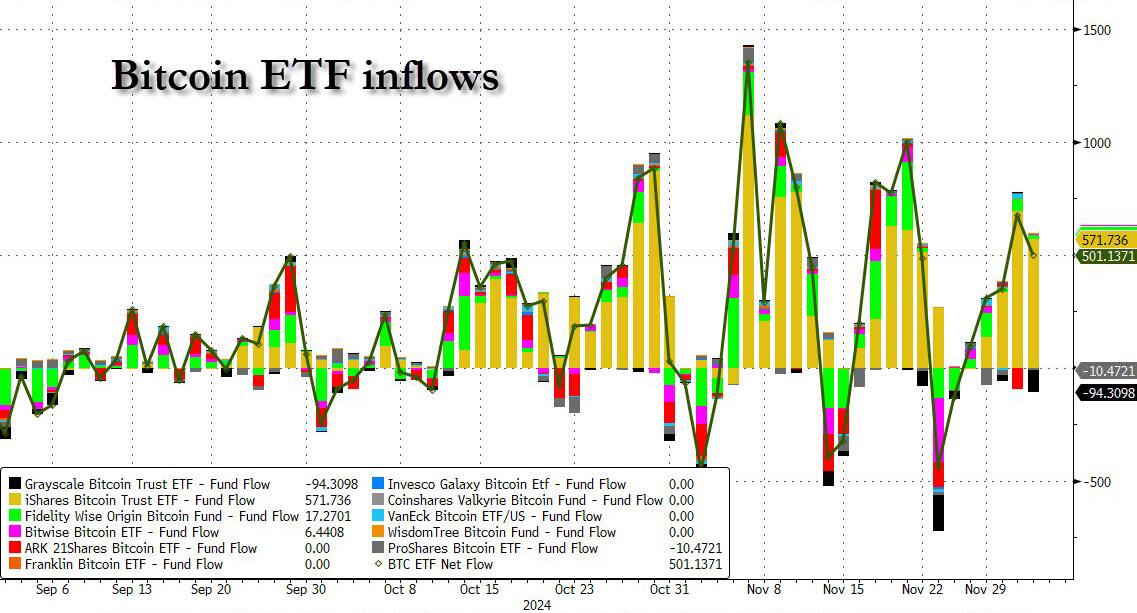
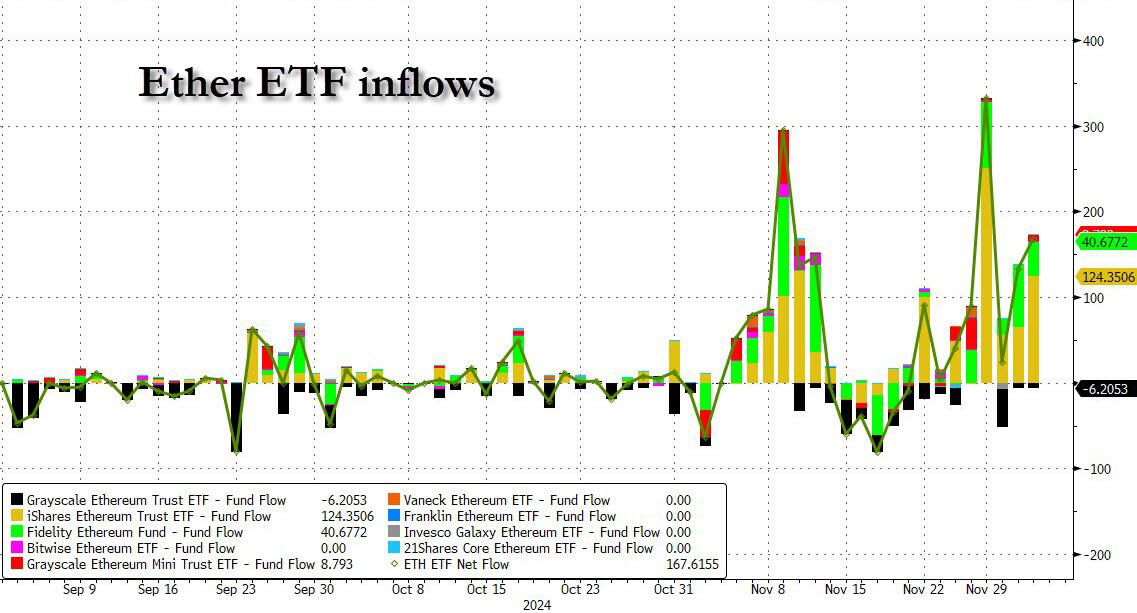
Bitcoin jumped as much as 6.1% to breach the $100,000 mark for the first time, boosted by Trump’s embrace of digital assets. Crypto tracking ETFs have seen huge inflows in recent days.
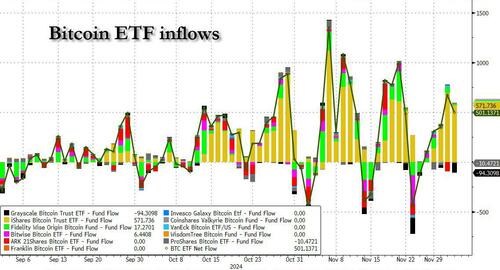
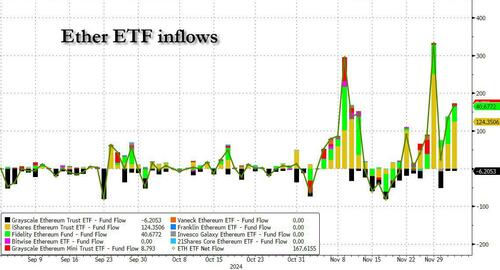
In FX, the Bloomberg Dollar Spot Index slipped 0.1%, falling for the second straight day; the yen extended gains after Bank of Japan Board Member Toyoaki Nakamura said he didn’t object to an interest rate hike later this month. EUR/USD edged up 0.2% to $1.0530 after France’s Prime Minister Michel Barnier was toppled in a no confidence vote, as widely expected

In rates, treasuries are slightly cheaper across maturities, underperforming core European rates ahead of weekly jobless claims and Friday’s broader US employment report. The US 10-year yield is higher by 3 bps to 4.21% with comparable bunds and gilts little changed, while French 10-year bond rise, trades around 5bp richer vs US, and outperforming their German peers and narrowing the 10-year yield spread to the lowest level this week despite the collapse of Michel Barnier’s government. President Macron is scheduled to make a statement at 8 p.m.

In commodities, oil prices edged higher as OPEC+ meets to discuss a further delay to its plans to revive oil production. WTI rises 0.5% to $68.90.

The US economic data calendar includes November Challenger job cuts (7:30am New York time) and October trade balance and weekly jobless claims (8:30am). Fed speaker slate includes Barkin at 12:15pm

Market Snapshot

  • S&P 500 futures little changed at 6,094.75
  • Brent Futures up 0.2% to $72.45/bbl
  • Gold spot down 0.3% to $2,642.18
  • US Dollar Index down 0.13% to 106.19
  • STOXX Europe 600 up 0.2% to 518.70
  • MXAP little changed at 186.91
  • MXAPJ little changed at 585.56
  • Nikkei up 0.3% to 39,395.60
  • Topix little changed at 2,742.24
  • Hang Seng Index down 0.9% to 19,560.44
  • Shanghai Composite up 0.1% to 3,368.86
  • Sensex up 0.9% to 81,698.29
  • Australia S&P/ASX 200 up 0.1% to 8,474.92
  • Kospi down 0.9% to 2,441.85
  • German 10Y yield little changed at 2.07%
  • Euro up 0.2% to $1.0530

Top Overnight News

  • BOJ’s Toyoaki Nakamura delivers somewhat dovish remarks, calling for policy tightening to proceed at a cautious pace and expressing doubt about the sustainability of wage growth. Bets on a BOJ rate hike this month fell to 37% WSJ
  • South Korea’s main opposition leader said ousting President Yoon Suk Yeol may be difficult due to lack of support from the ruling party. BBG
  • French stocks and bonds gained ahead of an address by Emmanuel Macron at 2 p.m. ET. As the president looks for a new PM, SocGen strategists see political uncertainty driving risk premium higher until new parliamentary elections. BBG
  • The ECB may resort to yield-curve control if a surge in government borrowing costs damps the impact of rate cuts, ING said, though that would be a “bold call” and not its base-case scenario. BBG
  • Ukrainian officials are holding high-level talks with the incoming Trump administration, seeking to narrow wide differences on achieving a settlement of Kyiv’s war with Russia even before President-elect Donald Trump takes office. WSJ
  • US President-elect Trump picked Paul Atkins for SEC Chair, while he picked Faulkender for Deputy US Treasury Secretary and Gail Slater as assistant AG for the antitrust division at the Department of Justice. Trump also named former Senator Kelly Loeffler to serve as Administrator of the Small Business Administration and Frank Bisignano to serve as the Commissioner of the Social Security Administration, while he named former Congressman Billy Long of Missouri to serve as the Commissioner of the Internal Revenue Service.
  • Donald Trump’s Middle East envoy has traveled to Qatar and Israel to kickstart the U.S. president-elect’s diplomatic push to help reach a Gaza ceasefire and hostage release deal before he takes office on January 20th. RTRS
  • Bitcoin blew past $100,000 as traders took in the prospect of relaxed regulations under Donald Trump’s pick of crypto proponent Paul Atkins to lead the SEC. BBG
  • China is accelerating its efforts to wean itself off of American semiconductors. FT
  • US execs turned sharply optimistic after Donald Trump’s presidential win, with 67% confident about the economy, up from 26% in August, a survey showed. Business leaders plan to ramp up investments and hiring, despite inflation jitters. BBG
  • Fed’s Daly (2024 voter) said they do not need to be urgent and need to carefully calibrate policy, while she will wait until the December meeting to make her decision. Daly also stated that inflation is still the number one challenge people are facing and there’s a lot more work to deliver on 2% inflation and durable expansion.

A more detailed look at global markets courtesy of Newsquawk

APAC stocks traded mixed and partially sustained the momentum from the fresh record levels on Wall St where tech led the advances with the help of earnings releases and softer yields following weak ISM Services data. ASX 200 eked slight gains with tech stocks taking inspiration from the outperformance stateside, while there was also an improvement in the latest trade and household spending data. Nikkei 225 gapped higher at the open but then gave back some of the initial spoils amid a choppy currency, while there was some intraday support seen after cautious rhetoric from BoJ’s Nakamura although the momentum waned shortly after. Hang Seng and Shanghai Comp were mixed with sentiment clouded after the PBoC’s operations resulted in another net liquidity drain and with a recent article in Chinese state media downplaying the pursuit of fast growth ahead of next week’s Central Economic Work Conference.

Top Asian News

  • China Foreign Ministry has decided to impose sanctions on 13 US military firms and executives from December 5th, it announced. Some of the firms under sanctions include Teledyne Brown Engineering, Brinc Drones, Shield AI.
  • South Korean army chief offered to resign, according to Yonhap
  • Chinese state media warned against blindly pursuing faster growth and signalled more focus on supporting consumption in a flurry of articles ahead of the Central Economic Work Conference, according to Bloomberg.
  • BoJ board member Nakamura said he is not confident about the sustainability of wage growth, while he added they are at a critical phase and must check many data and cautiously adjust the degree of monetary support in accordance with an improvement in the economy. Nakamura said that he sees a chance inflation may miss 2% from fiscal 2025 onward and noted that Japan’s economy has yet to move on course for a stable growth path. Furthermore, he said structural changes in Japan’s economy are required for inflation to stably hit 2% which will take a significant amount of time but also stated the adjustment of easy monetary policy will proceed gradually as the economy is expected to head toward a growth path. BoJ Board Member Nakamura later commented during a press conference that they will decide policy by examining data and he is not against a rate hike but believes it should be data-dependent.
  • Japanese PM Ishiba said the government should mull what’s an appropriate FX level and there are no plans to change the government-BoJ joint stance.
  • South Korean ruling party leader Han said the party will try to stop the impeachment motion from passing parliament but demanded that President Yoon leave the party, according to Yonhap. Furthermore, the opposition party said it plans to vote to impeach President Yoon at 7pm local time on Saturday.

European bourses opened flat but started grinding higher shortly after the open despite relatively quiet newsflow but potentially as some of the optimism potentially emanating from the gains on Wall Street. European sectors kicked off the session with a mild positive bias which later expanded as sentiment continued to improve shortly after the cash open. CAC 40 shrugged off the vote of no confidence which played out as expected, while President Macron is reported to be looking to announce a replacement before Saturday as opposed to taking the country to the polls. In terms of US equity futures, mild downward bias seen in the ES and NQ after yesterday’s session on Wall Street in which US stocks gained and the major indices printed fresh record highs with the Nasdaq leading advances amid outperformance in Tech and Consumer Discretionary and Communication names.

Top European News

  • BoE Monthly Decision Maker Panel data November 2024: Year-ahead own-price inflation was expected to be 3.7% in the three months to November vs. 3.5% in October. Expectations for CPI inflation a year ahead rose from 2.6% to 2.7% in the three months to November.Three-year ahead CPI inflation expectations was unchanged at 2.6%. Firms reported that annual wage growth was 5.5% in the three months to November vs. 5.6% in October. Expected year-ahead wage growth dropped by 0.1ppt to 4.0% on a three-month moving-average basis in November
  • French President Macron will address the nation on Thursday evening in a televised speech at 18:00 GMT, according to Sky News.
  • French Far-right leader Marine Le Pen said they have some requirements for backing the next PM and will contribute to crafting a budget, while she is not calling for President Marcon’s resignation but noted that the pressure is piling up.
  • Istat cut Italy’s 2024 GDP growth forecast to 0.5% (prev. 1.0% seen in June); cut 2025 GDP growth to 0.8% (prev. 1.1%).
  • Moody’s said French no-confidence vote is “Credit Negative”.
  • S&P said the fall of the French Govt. leaves France without a clear path towards reducing its budget.

FX

  • USD remains on the backfoot vs. peers following yesterday’s ISM-induced move in yields. Commentary from Fed Chair Powell who noted that the Fed can afford to be cautious in finding neutral failed to cause a stir in markets. Today’s US Calendar is a lighter one with US challenger layoffs and Fed’s Barkin on deck. Tomorrow’s NFP release looms large. DXY briefly slipped below yesterday’s 106.09 low. The next target comes via the 106 mark; Monday’s low sits @ 105.78.
  • EUR on a firmer footing vs. the USD with not much in the way of follow-through selling from the collapse of the French government (which was widely expected). Focus remains on the next steps and who (if anyone) Macron can appoint as PM. The main kicker is that the 2024 budget will likely be rolled into 2025. From a broader Eurozone perspective, pricing of a 50bps move at next week’s ECB meeting continues to be unwound with odds of a 25bps move now @ 86%. EUR/USD has made some progress on a 1.05 handle with the next upside target coming via the 21DMA @ 1.0561.
  • JPY is one of the better performers vs. the USD on account of remarks from BoJ dove Nakamura who stated that he is not against a rate hike. Pricing around the December announcement remains particularly choppy. However, odds of an unchanged rate sit @ 62% vs. 42% seen at the start of the week. USD/JPY is currently tucked within Friday’s 149.51-151.22 range.
  • GBP firmer vs. the USD for a third session in a row after shrugging off a dovish headline from the FT yesterday about BoE Governor Bailey’s view on the rate path (which appeared to in the end be more related to market pricing than his own view). MPC member Greene is due to speak later today. The BoE’s DMP (on which it places great weight) saw no follow-through into GBP. Cable has gained a firmer footing on a 1.27 handle and is now eyeing last Friday’s high @ 1.2749.
  • Antipodeans are both firmer vs. the USD with slight outperformance in NZD/USD despite a lack of fresh NZ-specific drivers. NZD/USD is currently caged within yesterday’s 0.5829-0.5884 range and yet to approach the 0.59 mark. AUD/USD failed to garner much additional support from an improvement in Australian trade and household spending data. AUD/USD currently sits towards the middle of yesterday’s 0.6399-0.6488 range.

Fixed Income

  • Mar’25 USTs are seeing a modest pullback from yesterday’s ISM-induced rally in US paper. The release further cemented expectations for the Fed to cut rates later this month with odds of such a move @ 73% before likely pausing in January. Comments from Fed Chair Powell yesterday did little to stand in the way of this pricing. A dovish outturn for NFP tomorrow could seal the deal on the FOMC.
  • French paper remarkably calm after yesterday’s collapse of the French government. The outcome was as expected and attention now turns towards who, if anyone Macron can appoint as PM (there is currently no obvious replacement candidate). The main kicker is that the 2024 budget will likely be rolled into 2025 and policy will likely end up being less restrictive than initially thought. In response to recent events, Moody’s has cautioned that the no confidence vote is “credit negative”. The GE/FR spread has narrowed to just below 81bps having peaked just shy of 89bps on Monday with last week’s 12yr high at 90bps just above.
  • Dec’24 Bunds are currently within yesterday’s 134.66-135.28 trading band with the corresponding 10yr yield around the 2.08% mark vs. yesterday’s 2.10% peak.
  • Mar’25 Gilts are marginally softer and in-fitting with price action in global peers. From a UK-specific standpoint, yesterday’s FT headline on Governor Bailey caused a stir, however, desks are broadly of the view that his comments over four rate hikes next year were taken out of context as he was referring more to market pricing than his own view. Today’s DMP release saw expectations for CPI inflation a year ahead rose from 2.6% to 2.7% in the three months to November, expected year-ahead wage growth dropped by 0.1ppt to 4.0%; BoE pricing was little changed.
  • France sold EUR 5bln vs exp. EUR 3-5bln 4.0% 2038, 0.5% 2040, 1.5% 2050, 0.5% 2072 OAT
  • Spain sold EUR 2.447bln vs exp. EUR 2-3bln 2.70% 2030 & 3.45% 2034 Bono

Commodities

  • Crude futures holding a modest upward bias after selling off in the US afternoon on Wednesday, which was later attributed to a bank offloading a large volume of US oil futures contracts ahead of today’s OPEC+ meeting. Sources today, so far, have failed to move prices.
  • Precious metals trade with a softer bias despite the weaker Dollar with traders cautious as they look ahead to the US jobs report tomorrow ahead of the US CPI data due next week.
  • Copper trades higher this morning with prices supported by the softer Dollar intraday coupled with the positive risk bias in Europe. Traders look ahead to next week’s Central Economic Work Conference which was hoped to provide fiscal stimulus, although Chinese press played this down in overnight reports.
  • Russian oil producer Rosneft invested USD 20bln into India, according to an Indian Government statement citing Russian President Putin. Russia are reportedly ready to set up manufacturing operations in India.
  • China’s Ministry of Commerce expresses strong concern over the EU’s plans to impose duties on Chinese titanium dioxide in 2025. China hopes the EU will conduct its investigation in line with WTO rules and avoid abusing trade remedies. Says it will firmly safeguard the legitimate rights and interests of Chinese enterprises.
  • OPEC+ has a deal in principle to delay output hike, according to delegates cited by Bloomberg; OPEC+ still discussing duration of delay, with three months in focus.
  • Several OPEC+ sources suggested a delay of output cuts for three months is the most likely outcome, while others have said a longer period is possible, according to Reuters sources.
  • OPEC+ voluntary cuts are expected to be pushed back by 3 months and then the group collective cut is expected to be extended until the end of 2026, according to Energy Intel’s Bakr.

Geopolitics

  • Israel’s cabinet will meet today to discuss the proposal for an exchange deal with Hamas, according to Israeli Media.
  • Russia reportedly fired missiles from its bases in Tartus, targeting Syrian rebels near Hama, according to a journalist via X.

US Event Calendar

  • 07:30: Nov. Challenger Job Cuts26.8% YoY, prior 50.9%
  • 08:30: Nov. Initial Jobless Claims, est. 215,000, prior 213,000
  • 08:30: Nov. Continuing Claims, est. 1.9m, prior 1.91m
  • 08:30: Oct. Trade Balance, est. -$75b, prior -$84.4b

DB’s Jim Reid concludes the overnight wrap

It’s been a very eventful 24 hours for markets, with the French government losing a no-confidence vote for the first time since 1962, alongside ongoing political uncertainty in South Korea and some hawkish-leaning comments from Fed Chair Powell. But despite everything that’s happening, risk assets have been broadly unphased by the various developments, with the S&P 500 (+0.61%) closing at another record high yesterday, whilst Bitcoin has crossed the $100,000 mark overnight for the first time. Indeed, it now means the S&P 500 is up +27.6% so far in 2024, which is only a couple of points behind its 2013 gain (+29.6%) that still stands as the strongest annual advance of the 21st century so far.

In terms of the French situation, the National Assembly voted yesterday to oust the government of Michel Barnier, with 331 votes in favour out of 577. However, the result was broadly expected, so it’s little surprise that markets haven’t seen much of a reaction. Indeed, since Marine Le Pen’s announcement on Monday that her party would vote against the government, it was clear that the numbers were there to remove the government, so that was when the biggest market reaction took place.

For the time being, the existing government will remain in place, and if needed, they can use emergency legislation to collect taxes and spend money. So this doesn’t mean a US-style shutdown beckons. But it’s still not obvious what ends the impasse, as the National Assembly remains fractured between different groups, with no obvious majority capable of being assembled. After all, it took almost a couple of months before Macron chose Michel Barnier as PM in the first place. And under the French constitution, a new election can’t be held until a year after the last one, which isn’t until the summer. President Macron is set to make a statement this evening, so that’ll be in focus for the path forward. Macron has said he will serve out his presidential term until 2027, but Le Pen continued to pressure him to resign yesterday in order to break the gridlock.

Overnight, the Euro has seen little change in response to these developments, and is currently trading at $1.052. Otherwise, French assets closed ahead of the vote yesterday, but they put in a reasonably strong performance beforehand, with the Franco-German 10yr spread tightening another -1.3bps on the day to 83.8bps. Moreover, France’s CAC 40 (+0.66%) outpaced the Europe-wide STOXX 600 (+0.37%). That came as European risk assets did well across the board yesterday, with the Italian-German 10yr spread (-3.5bps) reaching its tightest in 3 years at 115.5bps. And over in credit, Euro IG spreads (-1bp) and HY spreads (-5bps) both tightened as well.

That strength among French assets was echoed in the US, with the S&P 500 (+0.61%) hitting another record high and posting its 11th gain in the last 12 sessions. That came as Fed Chair Powell said the US economy is “in remarkably good shape”, and the growth has been better than previously forecasted. He added that he feels “very good about where the economy is and where monetary policy is”, and said the FOMC “can afford to be a little more cautious as we try to find neutral.” In the meantime, several other Fed speakers made similar comments about moving slowly, with San Francisco President Daly saying that “We do not need to be urgent”, and St Louis Fed President Musalem saying that “the time may be approaching to consider slowing the pace of interest rate reductions or pausing”. Richmond Fed President Barkin, also said he was in favour of a slower rate cut path to get policy to a “somewhat restrictive level.”

But even as Fed speakers leant in a somewhat hawkish direction, US Treasury yields fell across the curve thanks to some weaker than expected data. In particular, the ISM services index was only at 52.1 in November (vs. 55.7 expected), ending a run of 4 consecutive monthly increases. And the employment component was down to 51.5, which dampened expectations ahead of tomorrow’s jobs report. There also wasn’t much optimism either from the ADP’s report of private payrolls, which came in at 146k (vs. 150k expected), but also contained a negative revision to the previous month of -49k.

In light of that, investors dialled up the likelihood of a December rate cut from the Fed, with futures taking the probability up to a three-week high of 77.5% by the close. So that helped to push down US Treasury yields, with the 2yr yield (-5.4bps) closing at a 1-month low of 4.13%, whilst the 10yr yield (-4.5bps) fell to 4.18%. In turn, that helped to lift US equities, particularly in some of the more cyclical sectors, and the S&P 500 ended the day up +0.61% at a new record. That was supported by a further gain for the Magnificent 7 (+1.58%) which also hit a fresh record.

Overnight in Asia, South Korean markets have lost further ground overnight, with the KOSPI down another -0.85%. The South Korean won did stabilise yesterday, strengthening +1.11% against the US Dollar, but it’s since fallen back a bit, weakening another -0.16% this morning. Otherwise though, there’s been a fairly steady performance across the region, with Japan’s Nikkei (+0.31%), China’s CSI 300 (-0.23%) and Australia’s S&P/ASX 200 (+0.15%) not seeing any big moves in either direction. The only exception to that is the Hang Seng, which is down -1.15% this morning. And looking forward, US equity futures are only very slightly lower, with those on the S&P 500 down -0.05%.

To the day ahead now, and data releases from the US include the October trade balance and the weekly initial jobless claims. Meanwhile in Europe, we’ll get Euro Area retail sales, German factory orders and French industrial production for October, along with the November construction PMIs from Germany and the UK. Central bank speakers include the Fed’s Barkin, the ECB’s Vujcic and the BoE’s Greene.

Tyler Durden
Thu, 12/05/2024 – 08:27

via ZeroHedge News https://ift.tt/Dl1GstT Tyler Durden

“Current Situation Serious”: VW CEO Tells Workers Labor Cost Reduction Urgent To “Secure Future” 

“Current Situation Serious”: VW CEO Tells Workers Labor Cost Reduction Urgent To “Secure Future” 

Volkswagen CEO Oliver Blume addressed thousands of workers at the company’s Wolfsburg headquarters, emphasizing the urgent need to “secure the company’s future” amid a vicious downturn in the auto industry and intensifying competition.

According to The Wall Street Journal, Blume stated that the German auto giant has been streamlining operations and incorporated new synergies but still faces a bumpy road ahead. He added that reducing labor costs is needed.

The current situation is serious. New competitors are entering the market with unprecedented force. The price pressure is immense,” the CEO told workers on Wednesday. 

He added, “In addition, our labor costs in Germany have now become too high. That is why urgent measures are needed to secure Volkswagen’s future.”

In late October, Volkswagen’s top labor leader, works council chief Daniela Cavallo, who also sits on VW’s supervisory board, was quoted by Bloomberg as saying three factories were preparing for closure, and VW was mulling over eliminating thousands of jobs and scaling back pay by 10% and hours. 

Earlier this week, WSJ noted that 100,000 workers, or about 33% of the company’s total German workforce, staged a labor action across nine factories amid plant closure and mass layoff threats.

We’ve been extensively covering the dire situation unfolding at VW this fall: 

Also on Wednseday, works council Cavallo told workers, following Blume’s message, that severe headwinds plague VW and the entire auto industry. She hoped for a solution by VW that does not involve factory closures and job cuts

“We want to bring this to a good end before Christmas,” she told workers.

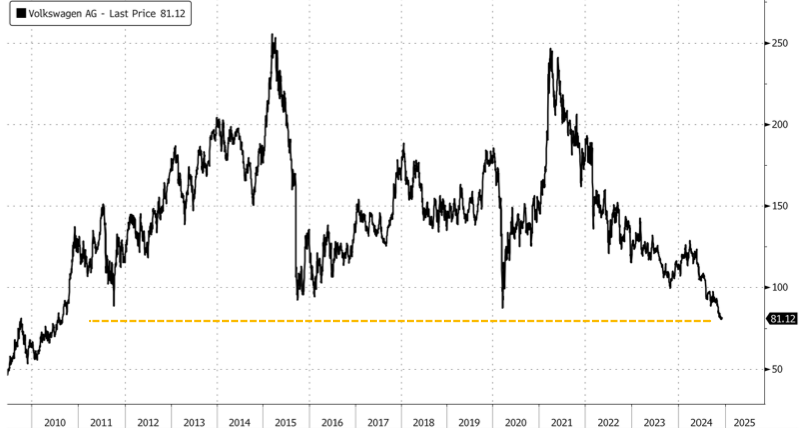
In markets, VW shares in Germany were down 27.5% on the year, trading around 2010 lows.

Implementing restructuring in the weeks before Christmas would be an absolute PR nightmare. Perhaps these cuts are planned for the start of the new year.

Tyler Durden
Thu, 12/05/2024 – 07:45

via ZeroHedge News https://ift.tt/0h65mfU Tyler Durden