Stoli Vodka Files For Bankruptcy Amid Legal Feud With Russia

Stoli Vodka Files For Bankruptcy Amid Legal Feud With Russia

The maker of iconic Stolichnaya vodka filed for bankruptcy following a crippling cyber attack in September and an ongoing legal feud with Russia over who owns the brand.

As reported by the Post, the Stoli Group USA filed for Chapter 11 in US Bankruptcy Court in Dallas last week after a “malicious cyber-attack” forced the company to operate its global business manually “while the systems are rebuilt,” chief executive Chris Caldwell said in a statement.

Stolichnaya Vodka’s name was changed to “Stoli” in 2022 to distance itself from Russia

Stoli Group said its “experiencing financial difficulties” according to the filing, which lists between $50 and $100 million in liabilities.

Caldwell also cited ongoing legal battles with Russia, which named the company and its owner – Russian-born and exiled billionaire Yuri Shefler – “extremists groups working against Russia’s interests,” earlier this year.

Shefler has been exiled since 2002 because of his opposition to President Vladimir Putin.

After the Ukraine invasion in March 2022 Shefler changed the name of the company to Stoli from Stolichnaya. That did not help, however, because at the time propaganda-addled westerners began dumping Russian vodka and spirits in protest, even when the vodka in question was owned by an opponent of Putin.

“Today, we have made the decision to rebrand entirely as the name no longer represents our organization,” Shefler said in a statement at the time. “More than anything, I wish for ‘Stoli’ to represent peace in Europe and solidarity with Ukraine.”

The brand has long been promoted as a Russian vodka even though it’s made in Latvia. Stoli Group is a subsidiary of Luxembourg-based SPI Group, which owns other spirts and wines, including Kentucky Owl bourbon. Only Stoli Group USA and Kentucky Owl are in bankruptcy, the company said.

Shefler has been at odds with Putin for decades, publicly denouncing a number of draconian anti-gay laws in 2013. Russia and Stoli Group have also clashed in courts.

The Russian government makes a state-owned version of the brand that is sold in the country with a label that clearly says it’s Russian made, according to reports. Ownership of the brand is disputed between Shefler’s Stoli Group, and Sojuzplodoimport, a firm owned by the Russian state.

The bankruptcy comes at a time when overall alcohol sales are slowing this year as Ozempic-injecting consumers pull back on consumption to save money and for health reasons. 

Consumption of spirits in the U.S. was down 3% and beer down 3.5% for the first seven months of 2024, according to IWSR, a global drinks data and analytics firm.

Tyler Durden
Tue, 12/03/2024 – 13:45

via ZeroHedge News https://ift.tt/jwnR5km Tyler Durden

County In Washington State Cannot Block ICE Deportation Flights, Appeals Court Rules

County In Washington State Cannot Block ICE Deportation Flights, Appeals Court Rules

Authored by Tom Ozimek via The Epoch Times (emphasis ours),

A federal appeals court has ruled that an order in King County, Washington, barring U.S. Immigration and Customs Enforcement (ICE) from using a Seattle-area airport to deport illegal immigrants from the country is unlawful, affirming a lower court’s summary judgment and clearing the way for the removals to continue.

Airplanes parked at King County International Airport-Boeing Field in Seattle on June 1, 2022. Lindsey Wasson/File Photo/Reuters

Judge Daniel A. Bress of the U.S. Court of Appeals for the Ninth Circuit wrote in the Nov. 29 opinion that a 2019 executive order issued by King County Executive Dow Constantine that prohibited the ICE deportation flights was unlawful. The ruling identified two primary legal violations: discrimination against federal operations under the supremacy clause of the U.S. Constitution and breach of a World War II-era instrument of transfer agreement governing the airport’s use.

Bress wrote that the executive order’s flight ban “discriminatorily burdens the United States” in the enforcement of federal immigration law and that this “discrimination, plain on the face of the Order, contravenes the intergovernmental immunity doctrine.” Rooted in the supremacy clause, the intergovernmental immunity doctrine protects federal government operations from discriminatory or obstructive actions by state and local governments.

The court also found that through Constantine’s directive, King County violated its contractual obligations under the instrument of transfer agreement, which granted the federal government the right to use the King County International Airport, commonly known as Boeing Field.

The dispute dates back to April 2019, when Constantine issued an executive order that explicitly opposed ICE’s deportation operations. The directive instructed airport officials to ensure that future leases and operating agreements with fixed-base operators—the companies that provide essential services such as fueling and aircraft maintenance—contained provisions prohibiting them from servicing ICE flights.

Constantine justified the order by citing the county’s disagreement with federal immigration policies, stating that the flights raised “deeply troubling human rights concerns which are inconsistent with the values of King County,” including family separations and deportation of people into unsafe conditions in other countries. The order effectively halted deportation flights at the airport.

In response to the order, the Department of Justice filed suit in February 2020, arguing that the directive unlawfully obstructed federal immigration enforcement and violated the terms of the airport’s transfer to King County based on an instrument of transfer agreement under the Surplus Property Act of 1944. The government sought to nullify the executive order and secure a permanent injunction against its enforcement.

The U.S. District Court for the Western District of Washington sided with the federal government, granting summary judgment in its favor. The court held that the order discriminated against federal operations by singling out ICE flights while allowing other users unrestricted access to Boeing Field. It also found that the order violated the instrument of transfer agreement, which required King County to allow federal use of the airport for nonexclusive purposes.

King County appealed the decision to the Ninth Circuit, arguing that the executive order was a lawful exercise of local authority as a market participant and did not violate federal law. The county claimed that it was acting to address legitimate safety, liability, and operational concerns stemming from ICE’s activities.

However, the Ninth Circuit rejected King County’s arguments, affirming the lower court’s ruling. Writing on behalf of the panel, Bress noted that the executive order unlawfully targeted federal operations and discriminated against ICE’s use of the airport based on opposition to federal immigration policy. The appeals court also determined that King County violated its contractual obligations under the instrument of transfer agreement.

The Epoch Times reached out to King County officials with a request for comment on the ruling but did not get a response by publication time.

The ruling was made weeks before the incoming Trump administration is set to take office and begin a deportation operation.

Tyler Durden
Tue, 12/03/2024 – 13:25

via ZeroHedge News https://ift.tt/0yrMd9q Tyler Durden

Mysterious ‘Car-Sized Drones’ Over New Jersey Prompt FBI Investigation

Mysterious ‘Car-Sized Drones’ Over New Jersey Prompt FBI Investigation

Several weeks of mysterious drone swarms over the skies of one New Jersey county near the military research and manufacturing facility Picatinny Arsenal have sparked concerns among residents and prompted an FBI investigation.  

“It’s kind of unsettling,” Mike Walsh, a Morris County resident who has spotted the drones on numerous occasions, told local media outlet PIX11 News.

He said some drones “are very big, probably the size of a car.” 

Since Nov. 18, Walsh and many other residents have spotted these drones in the night sky. 

“They’re kind of go slow,” he said, adding, “They come towards you. Then they change direction a little. They’re all going different ways.”

We first detailed the story on Nov. 19 in a note titled “Spy Drones? “Unusual Activity” Reported Over Morris County, New Jersey, Near Military Research Facility.” 

The potential national security threat piqued our interest, considering multiple reports that the mysterious drones were observed near Picatinny Arsenal.

PIX11 News said the FBI’s Newark field office has joined the investigation with other law enforcement agencies to determine who is flying these drones. 

PIX11 News contacted the FAA, which said it’s received reports of activity near Morris County. The FAA has two Temporary Flight Restrictions prohibiting drone flights over Picatinny Arsenal and Trump National Golf Club Bedminster

People think they were UFOs or being spied on,” Erica Campbell told media outlet NBC 4 New York.

Given the close proximity to the highly controlled airspace around NYC, we suspect that if these drones actually posed national security threats, stealth fighter jets armed with Sidewinders would have neutralized these threats almost immediately. 

Tyler Durden
Tue, 12/03/2024 – 13:05

via ZeroHedge News https://ift.tt/RLMHJqK Tyler Durden

Warning Shot: China Bans Exports Of Gallium, Germanium To US As Tit-For-Tat Chip War Escalates

Warning Shot: China Bans Exports Of Gallium, Germanium To US As Tit-For-Tat Chip War Escalates

The Biden administration’s new restrictions on China’s semiconductor industry have triggered a tit-for-tat response from Beijing, which announced an export ban on gallium, germanium, antimony, and other critical minerals with potential military applications to the US. 

Bloomberg reports that the Chinese Commerce Ministry announced the new export controls on Tuesday morning, adding that tighter controls on graphite sales will also be seen. 

“The US has generalized the concept of national security, and politicized and weaponized economic, trade and tech issues,” a ministry spokesperson said, adding, “It has abused export control measures and unreasonably restricted certain products’ export to China.”

On Monday, the Biden admin revealed broader restrictions on AI chips that can be delivered to China, including prohibiting the sale of advanced chips to more than 100 Chinese companies.  

Commerce Secretary Gina Raimondo told reporters Sunday that the move represented “the strongest controls ever enacted by the US to degrade the PRC’s ability to make the most advanced chips that they’re using in their military modernization,” adding US officials had worked closely with experts, industry and allied countries to ensure that “our actions protect national security while minimizing unintended commercial consequences.”

China’s dominance in the global mining and processing of rare earth materials is very alarming, as it produces 94% of the world’s gallium and 83% of germanium—critical metals used in the production of semiconductors, LEDs, and transistors. Beijing’s Ministry of Commerce has justified the export restrictions to protect national security amid the ongoing tech war.

Source: Bloomberg

Joe Mazur, a senior analyst with the consulting firm Trivium China, told Bloomberg that these “export bans on critical minerals have been in the hopper for some time and are intended as a warning.” 

“It’s a clear signal that China is preparing to strike back more forcefully against US economic pressure than it has in the past few years,” Mazur emphasized. 

Data from the US Geological Survey shows that the US imports about half its supply of gallium and germanium metals from China. 

The new restrictions serve as a calculated warning to America’s military-industrial complex and chipmakers, signaling that Beijing could escalate its response if Washington’s tit-for-tat tech war intensifies. And just wait for more fireworks with Trump entering the White House next month.

Meanwhile, there could be new high-grade gallium supplies hiding in southwest Montana. 

The US must build out its domestic supply chain of mining and refining rare earth minerals to break the addiction from China—something that won’t be happening for a while. 

Tyler Durden
Tue, 12/03/2024 – 12:25

via ZeroHedge News https://ift.tt/6jvI7fr Tyler Durden

‘Then They Fight You…’ – Bitcoin & The US’ Fiscal Crossroads

‘Then They Fight You…’ – Bitcoin & The US’ Fiscal Crossroads

Authored Avik Roy via BitcoinMagazine.com,

In this chapter from The Satoshi Papers, Avik Roy explores the U.S. government’s looming fiscal crisis and presents three potential responses from the United States: restriction, paralysis, or assimilation. Could Bitcoin emerge as a solution—or spark further conflict?

Introduction

Scholars dispute whether it was Mahatma Gandhi who first said, “First they ignore you, then they laugh at you, then they fight you, then you win.” What cannot be disputed is that advocates of bitcoin have adopted the aphorism as their own.

Bitcoiners commonly prophesize that at some point, bitcoin will replace the US dollar as the world’s predominant store of value.[1] Less frequently discussed is the essential question of exactly how such a transition might take place and what risks may lie along the path, especially if the issuers of fiat currency choose to fight back against challenges to their monetary monopolies.

Will the US government and other Western governments willingly adapt to an emerging bitcoin standard, or will they take restrictive measures to prevent the replacement of fiat currencies? If bitcoin does indeed surpass the dollar as the world’s most widely used medium of exchange, will a transition from the dollar to bitcoin be peaceful and benign, like the evolution from Blockbuster Video to Netflix? Or will it be violent and destructive, as with Weimar Germany and the Great Depression? Or somewhere in between?

These questions are not merely of theoretical interest. If bitcoin is to emerge from the potentially turbulent times ahead, the bitcoin community will need to contemplate exactly how to make it resilient to these future scenarios and how best to bring about the most peaceful and least disruptive transition toward an economy based once again upon sound money.

In particular, we must take into account the vulnerabilities of those whose incomes and wealth are below the rich-nation median—those who, at current and future bitcoin prices, may fail to save enough to protect themselves from the economic challenges to come. “Have fun staying poor,” some Bitcoiners retort to their skeptics on social media. But in a real economic crisis, the poor will not be having fun. The failure of fiat-based fiscal policy will inflict the most harm on those who most depend on government spending for their economic security. In democratic societies, populists across the political spectrum will have powerful incentives to harvest the resentment of the non-bitcoin-owning majority against bitcoin-owning elites.

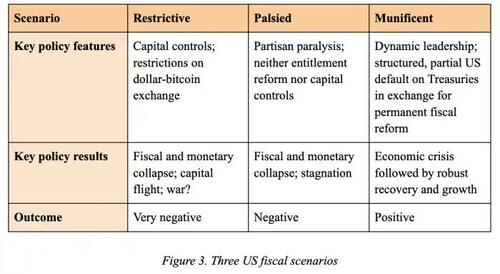
It is, of course, difficult to predict exactly how the US government will respond to a hypothetical fiscal and monetary collapse decades into the future. But it is possible to broadly group the potential scenarios in ways that are relatively negative, neutral, or positive for society as a whole. In this essay, I describe three such scenarios: A restrictive scenario, in which the US attempts to aggressively curtail economic liberties in an effort to suppress competition between the dollar and bitcoin; a palsied scenario, in which partisan, ideological, and special-interest conflicts paralyze the government and limit its ability to either improve America’s fiscal situation or prevent bitcoin’s rise; and a munificent scenario, in which the US assimilates bitcoin into its monetary system and returns to sound fiscal policy. I base these scenarios on the highly probable emergence of a fiscal and monetary crisis in the United States by 2044.

While these scenarios may also play out in other Western nations, I focus on the US here because the US dollar is today the world’s reserve currency, and the US government’s response to bitcoin is therefore of particular importance.

The Coming Fiscal and Monetary Crisis

We know enough about the fiscal trajectory of the United States to conclude that a major crisis is not merely possible but probable by 2044 if the federal government fails to change course. In 2024, for the first time in modern history, interest on the federal debt exceeded spending on national defense. The Congressional Budget Office (CBO)—the national legislature’s official, nonpartisan fiscal scorekeeper—predicts that by 2044, federal debt held by the public will be approximately $84 trillion, or 139 percent of gross domestic product. This represents an increase from $28 trillion, or 99 percent of GDP, in 2024.[2]

The CBO estimate makes several optimistic assumptions about the country’s fiscal situation in 2044. In its most recent projections, at the time of this publication, CBO assumes that the US economy will grow at a robust 3.6 percent per year in perpetuity, that the US government will still be able to borrow at a favorable 3.6 percent in 2044, and that Congress will not pass any laws to worsen the fiscal picture (as it did, for example, during the COVID-19 pandemic).[3]

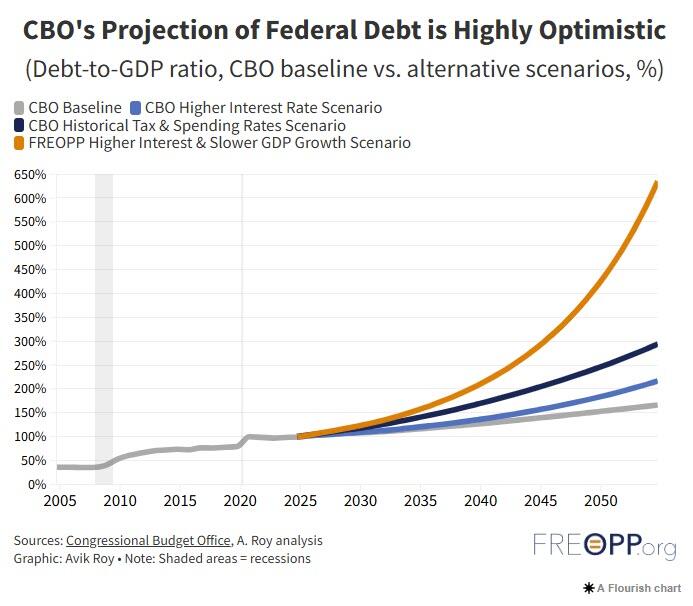
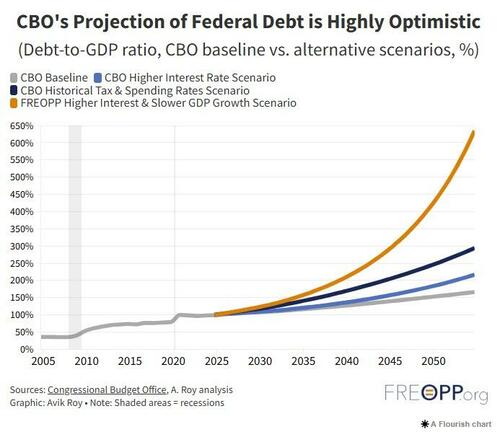
The CBO understands that its projections are optimistic. In May 2024, it published an analysis of how several alternative economic scenarios would affect the debt-to-GDP ratio. One, in which interest rates increase annually by a rate of 5 basis points (0.05 percent) higher than the CBO’s baseline, would result in 2044 debt of $93 trillion, or 156 percent of GDP. Another scenario, in which federal tax revenue and spending rates as a share of GDP continue at historical levels (for example, as a result of the continuation of purportedly temporary tax breaks and spending programs), yields a 2044 debt of $118 trillion, or 203 percent of GDP.[4]

But combining multiple factors makes clear how truly dire the future has become. If we take the CBO’s higher interest rate scenario, in which interest rate growth is 5 basis points higher each year, and then layer onto that a gradual reduction in the GDP growth rate, such that nominal GDP growth in 2044 is 2.8 percent instead of 3.6 percent, the 2044 debt reaches $156 trillion, or 288 percent of GDP. By 2054, the debt would reach $441 trillion, or 635 percent of GDP (see figure 1).

Figure 1. US debt-to-GDP ratio: Alternative scenarios
Credit: Avik Roy, https://public.flourish.studio/visualisation/18398503/.

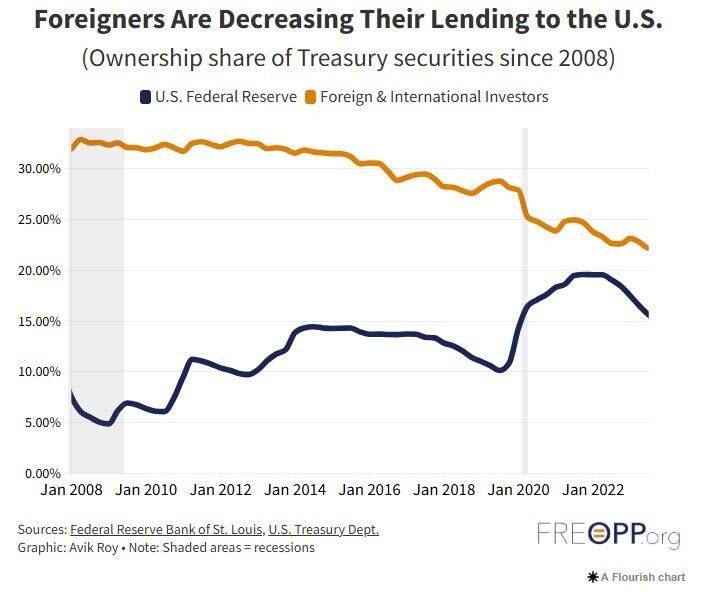
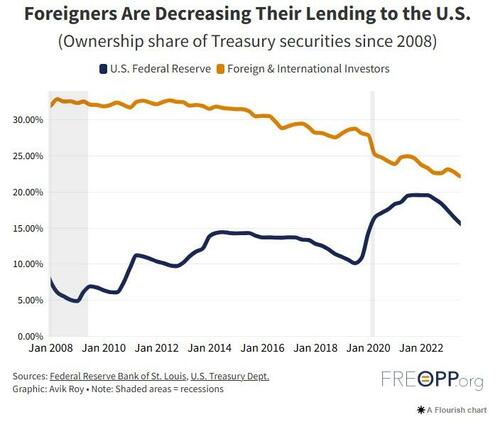
In this scenario of higher interest rate payments and lower economic growth, in 2044 the US government would pay $6.9 trillion in interest payments, representing nearly half of all federal tax revenue. But just as we cannot assume that economic growth will remain high over the next two decades, we cannot assume that the demand for US government debt will remain steady. At a certain point, the US will run out of other people’s money. Credit Suisse estimates that in 2022 there was $454 trillion of household wealth in the world, defined as the value of financial assets and real estate assets, net of debt.[5] Not all of that wealth is available to lend to the United States. Indeed, the share of US Treasury securities held by foreign and international investors has steadily declined since the 2008 financial crisis.[6] At the same time that demand for Treasuries is proportionally declining, the supply of Treasuries is steadily increasing (see figure 2).[7]

Figure 2. Ownership of US Treasuries
Credit: Avik Roy, https://public.flourish.studio/visualisation/7641395/.

In an unregulated bond market, this decline in demand paired with an increase in supply should lead to lower bond prices, signifying higher interest rates. The Federal Reserve, however, has intervened in the Treasury market to ensure that interest rates remain lower than they otherwise would. The Fed does this by printing new US dollars out of thin air and using them to buy the Treasury bonds that the broader market declines to purchase.[8] In effect, the Fed has decided that monetary inflation (that is, rapidly increasing the quantity of US dollars in circulation) is a more acceptable outcome than allowing interest rates to rise as the nation’s creditworthiness decreases.

This situation is not sustainable. Economist Paul Winfree, using a methodology developed by researchers at the International Monetary Fund,[9] estimates that “the federal government will begin running out of fiscal space, or its capacity to take on additional debt to deal with adverse events, within the next 15 years”—that is, by 2039. He further notes that “interest rates and potential [GDP] growth are the most important factors” that would affect his projections.[10]

For the purposes of our exercise, let us assume that the US will experience a fiscal and monetary failure by 2044—that is, a major economic crisis featuring a combination of rising interest rates (brought about by the lack of market interest in buying Treasuries) and high consumer price inflation (brought about by rapid monetary inflation). Over this twenty-year period, let us also imagine that bitcoin gradually increases in value, such that the liquidity of bitcoin, measured by its total market capitalization, is competitive with that of US Treasuries. Competitive liquidity is important because it means that large institutions, such as governments and multinational banks, can buy bitcoin at scale without excessively disrupting its price. Based on the behavior of conventional financial markets, I estimate that bitcoin will reach a state of competitive liquidity with Treasuries when its market capitalization equals roughly one-fifth of federal debt held by the public. Based on my $156 trillion estimate of federal debt in 2044, this amounts to approximately $31 trillion of bitcoin market cap, representing a price of $1.5 million per bitcoin—roughly twenty times the peak price of bitcoin reached in the first half of 2024.

This is far from an unrealistic scenario. Bitcoin appreciated by a comparable multiple from August 2017 to April 2021, a period of less than four years.[11] Bitcoin has appreciated by similar multiples on many other occasions previously.[12] And if anything, my projections of the growth of US federal debt are conservative. Let us, then, further imagine that by 2044, bitcoin is a well-understood, mainstream asset. A young man who turned eighteen in 2008 will celebrate his fifty-fourth birthday in 2044. By 2044, more than half of the US population will have coexisted with bitcoin for their entire adult lives. A robust ecosystem of financial products, including lending and borrowing, will by then likely have been well established atop the bitcoin base layer. Finally, let us speculate that in this scenario, inflation has reached 50 percent per annum. (This is somewhere between the over-100 percent inflation rates of Argentina and Turkey in 2023 and the nearly 15 percent inflation experienced by the US in 1980.)

In 2044, under these conditions, the US government will be in crisis. The rapid depreciation in the value of the dollar will have led to a sudden drop in demand for Treasury bonds, and there will not be an obvious way out. If Congress engages in extreme fiscal austerity—for example, by cutting spending on welfare and entitlement programs—its members will likely be thrown out of office. If the Federal Reserve raises interest rates enough to retain investor demand—say, above 30 percent—financial markets will crash, along with the credit-fueled economy, much as they did in 1929. But if the Fed allows inflation to rise even further, it will only accelerate the exit from Treasuries and the US dollar.

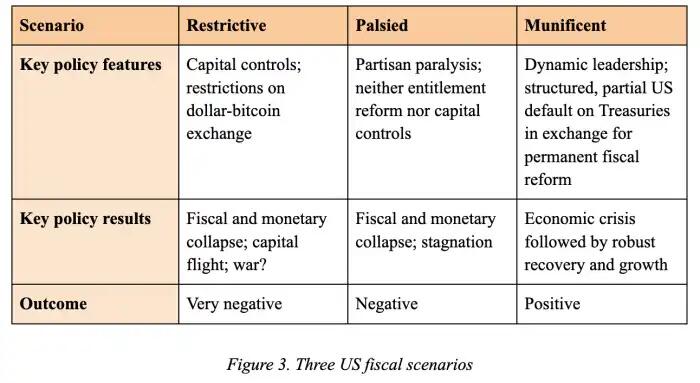
Under these circumstances, how might the US government respond? And how might it treat bitcoin? In what follows, I consider three scenarios. First, I contemplate a restrictive scenario, in which the US attempts to use coercive measures to prevent the use of bitcoin as a competitor to the dollar. Second, I discuss a palsied scenario, in which political divisions and economic weakness paralyze the US government, preventing it from taking meaningful steps for or against bitcoin. Finally, I consider a munificent scenario, in which the US eventually ties the value of the dollar to bitcoin, restoring the nation’s fiscal and monetary soundness. (See figure 3.)

Figure 3. Three US fiscal scenarios
1. The Restrictive Scenario

Throughout history, the most common response of government to a weakening currency has been to force its citizens to use and hold that currency instead of sounder alternatives, a phenomenon called financial repression. Governments also commonly deploy other economic restrictions, such as price controls, capital controls, and confiscatory taxation to maintain unsound fiscal and monetary policies.[13] It is possible—even probable—that the United States will respond similarly to the crisis to come.

Price Controls

In AD 301, the Roman Emperor Diocletian issued his Edictum de Pretiis Rerum Venalium—the Edict Concerning the Sale Price of Goods—which sought to address inflation caused by the long-running debasement of the Roman currency, the denarius, over a five-hundred-year period. Diocletian’s edict imposed price caps on over 1,200 goods and services.[14] These included wages, food, clothing, and shipping rates. Diocletian blamed rising prices not on the Roman Empire’s extravagant spending but on “unprincipled and licentious persons [who] think greed has a certain sort of obligation . . . in ripping up the fortunes of all.”[15]

Actions of this sort echo throughout history until the modern day. In 1971, US President Richard Nixon responded to the imminent collapse of US gold reserves by unilaterally destroying the dollar’s peg to one-thirty-fifth of an ounce of gold and by ordering a ninety-day freeze on “all prices and wages throughout the United States.”[16] Nixon, like Diocletian and so many other rulers in between, did not blame his government’s fiscal or monetary policies for his country’s predicament but rather the “international money speculators” who “have been waging an all-out war on the American dollar.”[17]

Even mainstream economists have convincingly shown that price controls on goods and services do not work.[18] This is because producers cease production if they are forced to sell their goods and services at a loss, which leads to shortages. But price controls remain a constant temptation for politicians since many consumers believe that price controls will protect them from inflation (at least in the short term). Since 2008, the Federal Reserve has imposed an increasingly aggressive set of controls on what economic historian James Grant calls “the most important price in capital markets”—that is, the price of money as reflected by interest rates.[19] As explained above, the Federal Reserve can effectively control interest rates on Treasury securities by acting as the dominant buyer and seller of those securities on the open market. (When bond prices rise because of more buying than selling, the interest rates implied by their prices decline, and vice versa.) The interest rates used by financial institutions and consumers, in turn, are heavily influenced by the interest rates on Treasury bonds, bills, and notes. Prior to the 2008 financial crisis, the Fed used this power narrowly, on a subset of short-term Treasury securities. But afterward, under Chairman Ben Bernanke, the Fed became far more aggressive in using its power to control interest rates throughout the economy.[20]

Capital Controls

Price controls are only one tool used by governments to control monetary crises. Another is capital controls, which hamper the exchange of a local currency for another currency or reserve asset.

In 1933, during the Great Depression, President Franklin Delano Roosevelt (popularly known as FDR) deployed a First World War–era statute to prohibit Americans from fleeing the dollar for gold. His Executive Order 6102 prohibited Americans from holding gold coin, gold bullion, and gold certificates and required people to surrender their gold to the US government in exchange for $20.67 per troy ounce.[21] Nine months later, Congress devalued the dollar by changing the price of a troy ounce to $35.00, effectively forcing Americans to accept an immediate 41 percent devaluation of their savings while preventing them from escaping that devaluation by using a superior store of value.[22]

Capital controls are far from a historical relic. Argentina has historically prohibited its citizens from exchanging more than $200 worth of Argentine pesos for dollars per month, ostensibly to slow the decline of the value of the peso.[23] China imposes strict capital controls on its citizens—essentially requiring government approval for any exchange of foreign currency—to prevent capital from leaving China for other jurisdictions.[24]

Increasingly, mainstream economists see these modern examples of capital controls as a success. The International Monetary Fund, born out of the 1944 Bretton Woods Agreement, had long expressed opposition to capital controls, largely at the behest of the United States, which benefits from global use of the US dollar. But in 2022, the International Monetary Fund revised its “institutional view” of capital controls, declaring them an appropriate tool for “managing . . . risks in a way that preserves macroeconomic and financial stability.”[25]

In my restrictive 2044 scenario, the US uses capital controls to prevent Americans from fleeing the dollar for bitcoin. The federal government could achieve this in several ways:

  • Announcing a purportedly temporary, but ultimately permanent, suspension of the exchange of dollars for bitcoin and forcing the conversion of all bitcoin assets held in cryptocurrency exchanges into dollars at a fixed exchange rate. (Based on my predicted market price at which bitcoin’s liquidity is competitive with Treasuries, that would be approximately $1.5 million per bitcoin, but there is no guarantee that a forced conversion would occur at market rates.)

  • Barring businesses under US jurisdiction from holding bitcoin on their balance sheets and from accepting bitcoin as payment.

  • Liquidating bitcoin exchange-traded funds (ETFs) by forcing them to convert their holdings to US dollars at a fixed exchange rate.

  • Requiring bitcoin custodians to sell their bitcoin to the US government at a fixed exchange rate.

  • Requiring those who self-custody their bitcoin to sell it to the government at a fixed exchange rate.

  • Introducing a central bank digital currency to fully surveil all US dollar transactions and ensure that none are used to purchase bitcoin.

The US government would be unlikely to execute all of these strategies successfully. In particular, the US will be unable to force all those who self-custody bitcoin to surrender their private keys. But many law-abiding citizens would likely comply with such a directive. This would be a pyrrhic victory for the government, however: The imposition of capital controls would lead to a further decline in confidence in the US dollar, and the cost to the US government of purchasing all the bitcoin custodied by American citizens and residents could exceed $10 trillion, further weakening the US fiscal situation. Nonetheless, the government in the restrictive scenario will have concluded that these are the least bad options.

Confiscatory Taxation

The US government could also use tax policy to restrict the utility of bitcoin and thereby curtail its adoption.

In a world where one bitcoin equals $1.5 million, many of the wealthiest people in the United States will be early bitcoin adopters. Technology entrepreneur Balaji Srinivasan has estimated that at a price of $1 million per bitcoin, the number of bitcoin billionaires will begin to exceed the number of fiat billionaires.[26] This does not imply, however, that the distribution of wealth among bitcoin owners would be more equal than the distribution of wealth among owners of fiat currency today.

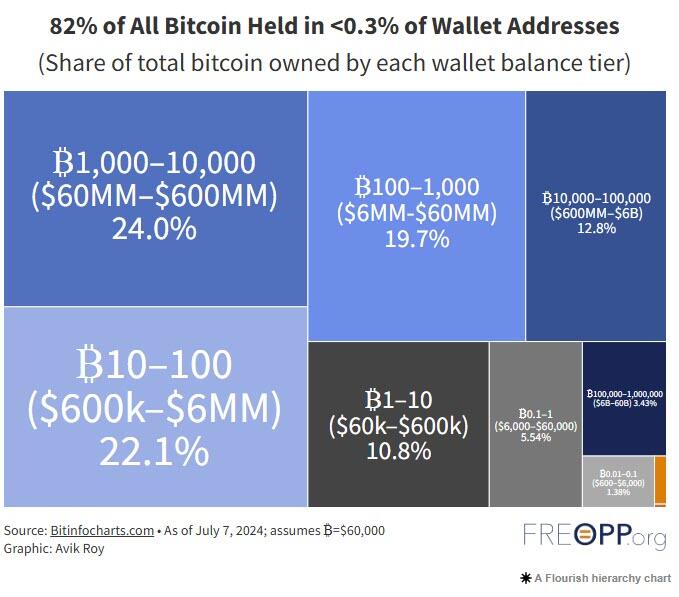
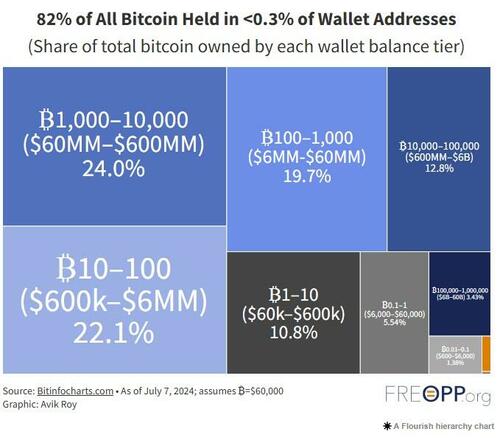
Fewer than 2 percent of all bitcoin addresses contain more than one bitcoin, and fewer than 0.3 percent contain more than ten bitcoin. Addresses within that top 0.3 percent own more than 82 percent of all the bitcoin in existence.[27] (See figure 4.) Given that many individuals control multiple wallets, and even allowing for the fact that some of the largest bitcoin addresses belong to cryptocurrency exchanges, these figures likely underestimate the amount of bitcoin wealth concentration. They compare unfavorably to US fiat wealth distribution; in 2019, the top 1 percent held merely 34 percent of all fiat-denominated wealth in the United States.[28]

If bitcoin ownership remains similarly distributed in 2044, those left behind by this monetary revolution—including disenfranchised elites from the previous era—will not go down quietly. Many will decry bitcoin wealth inequality as driven by anti-American speculators and seek to enact policies that restrict the economic power of bitcoin owners.

Figure 4. Distribution of bitcoin ownership
Credit: Avik Roy, https://public.flourish.studio/visualisation/18651414/.

In 2021, rumors circulated that Treasury Secretary Janet Yellen had proposed to President Joe Biden the institution of an 80 percent tax on cryptocurrency capital gains, a steep increase from the current top long-term capital gains tax rate of 23.8 percent.[29] In 2022, President Biden, building on a proposal by Massachusetts Senator Elizabeth Warren, suggested taxing unrealized capital gains—that is, on-paper increases in the value of assets that the holder has not yet sold.[30] This would be an unprecedented move since it would require people to pay taxes on earnings they have not yet realized.

It has long been argued that taxing unrealized capital gains would violate the US Constitution because unrealized gains do not meet the legal definition of income, and Article I of the Constitution requires that non-income taxes must be levied in proportion to states’ respective populations.[31] A recent case before the Supreme Court, Moore v. United States, gave the court the opportunity to make clear its position on the question; it declined to do so.[32] As a result, it remains eminently possible that a future Congress, supported by a future Supreme Court, will assent to the taxing of unrealized capital gains, and cryptocurrency gains specifically.

Moreover, a presidential administration that does not like the constitutional interpretations of an existing Supreme Court could simply pack the court to ensure more favorable rulings. The FDR administration threatened to do precisely that during the 1930s. The conservative Supreme Court of that era had routinely ruled that FDR’s economically interventionist policies violated the Constitution. In 1937, Roosevelt responded by threatening to appoint six new justices to the Supreme Court in addition to the existing nine. While he was ultimately forced to withdraw his court-packing proposal, the Supreme Court was sufficiently intimidated and began approving New Deal legislation at a rapid pace thereafter.[33]

A unique feature of US tax policy is that US citizens who live abroad are still required to pay US income and capital gains taxes, along with the taxes they pay in the country of their residence. (In all other advanced economies, expatriates only pay taxes once, based on where they live. For example, a French national living and working in Belgium pays Belgian tax rates, not French tax rates, whereas an American in Belgium pays both Belgian and US taxes.) This creates a perverse incentive for Americans living abroad to renounce their US citizenship. Every year, a few thousand Americans do so. However, they must first seek approval from a US embassy on foreign soil and pay taxes on all unrealized capital gains. In a restrictive scenario, in which the US Treasury is starved for revenue, it is easy to imagine the government suspending the ability of Americans to renounce their citizenship, ensuring that expatriates’ income remains taxable regardless of where they live.

Right-Wing Financial Restrictions

While many of the restrictive policies described above have been proposed by politicians affiliated with the Democratic Party, Republican Party officials and representatives in 2044 may be just as willing to amplify populist resentment of the bitcoin elite. The United States is already home to a vocal movement of both American and European intellectuals building a new ideology broadly known as national conservatism, in which the suppression of individual rights is acceptable in the name of the national interest.[34] For example, some national conservatives advocate monetary and tax policies that protect the US dollar against bitcoin, even at the expense of individual property rights.[35]

The USA PATRIOT Act was passed by overwhelming bipartisan congressional majorities weeks after the terrorist attacks of September 11, 2001. It was signed into law by Republican President George W. Bush and included numerous provisions designed to combat the financing of international terrorism and criminal activity, especially by strengthening anti-money-laundering and know-your-customer rules, as well as reporting requirements for foreign bank account holders.[36]

The PATRIOT Act may have helped reduce the risk of terrorism against the US, but it has achieved this at a significant cost to economic freedom, especially for American expatriates and others who use non-US bank accounts for personal or business reasons. Just as FDR used a law from the First World War to confiscate Americans’ gold holdings, in 2044 a restrictive government of either party will find many of the PATRIOT Act’s tools useful to clamp down on bitcoin ownership and usage.

The End of America’s Exorbitant Privilege

Bitcoin is remarkably resilient in its design; its decentralized network will likely continue to function well despite restrictive measures adopted by governments against its use. Today, for instance, a considerable amount of bitcoin trading volume and mining activity occurs in China, despite that country’s prohibition of it, because of the use of virtual private networks (VPNs) and other tools that disguise a user’s geographic location.[37]

If we assume that half of the world’s bitcoin is owned by Americans and further assume that 80 percent of American bitcoin is held by early adopters and other large holders, it is likely that most of that 80 percent is already protected against confiscation through self-custody and offshore contingency planning. Capital controls and restrictions could collapse institutional bitcoin trading volume in the US, but most of this volume would likely move to decentralized exchanges or to jurisdictions outside of the US with less restrictive policies.

A fiscal failure of the US in 2044 will be necessarily accompanied by a reduction in US military power because such power is predicated on enormous levels of deficit-financed defense spending. Hence, the US government will not be as capable in 2044 as it is today of imposing its economic will on other countries. Smaller nations, such as Singapore and El Salvador, could choose to welcome the bitcoin-based capital that the US turns away.[38] The mass departure of bitcoin-based wealth from the US would, of course, make America poorer and further reduce the ability of the US government to fund its spending obligations.

Furthermore, US restriction of bitcoin’s utility will not be enough to convince foreign investors that US Treasuries are worth holding. The main way the US government could make investing in US bonds more attractive would be for the Federal Reserve to dramatically raise interest rates because higher interest rates equate to higher yields on Treasury securities. But this would in turn raise the cost of financing the federal debt, accelerating the US fiscal crisis.

Eventually, foreign investors may require the US to denominate its bonds in bitcoin, or in a foreign currency backed by bitcoin, as a precondition for further investment. This momentous change would end what former French Finance Minister and President Valéry Giscard d’Estaing famously called America’s privilège exorbitant: Its long-standing ability to borrow in its own currency, which has enabled the US to decrease the value of its debts by decreasing the value of the dollar.[39]

If and when US bonds are denominated in bitcoin, the United States will be forced to borrow money the way other countries do: In a currency not of its own making. Under a bitcoin standard, future devaluations of the US dollar would increase, rather than decrease, the value of America’s obligations to its creditors. America’s creditors—holders of US government bonds—would then be in a position to demand various austerity measures, such as requiring that the US close its budget deficits through a combination of large tax increases and spending cuts to Medicare, Social Security, national defense, and other federal programs.

A substantial decline in America’s ability to fund its military would have profound geopolitical implications. A century ago, when the United States eclipsed the United Kingdom as the world’s leading power, the transition was relatively benign. We have no assurances that a future transition will work the same way. Historically, multipolar environments with competing great powers are frequently recipes for world wars.[40]

2. The Palsied Scenario

In medicine, a palsy is a form of paralysis accompanied by involuntary tremors. This term accurately describes my second scenario, in which the macroeconomic tremors accompanying bitcoin’s rise are paired in the US with partisan polarization, bureaucratic conflict, and diminishing American power. In the palsied scenario, the US is unable to act aggressively against bitcoin, but neither is it able to get its fiscal house in order.

Today, partisan polarization in the US is at a modern high.[41] Republicans and Democrats are increasingly sorted by cultural factors: Republicans are disproportionately rural, high school–educated, and white; Democrats are more urban, college-educated, and nonwhite. Independents, who now make up a plurality of the electorate, are forced to choose among the candidates selected for general elections by Republican and Democratic base voters in partisan primaries.[42]

While we can hope that these trends reverse over time, there are reasons to believe they will not. Among other factors, the accelerating development of software capabilities that manipulate behavior at scale, including artificial intelligence—for all of their promise—brings substantial risks in the political sphere. The potential for deepfakes and other forms of mass deception could reduce trust in political parties, elections, and government institutions while further fragmenting the US political environment into smaller subcultural communities. The cumulative effect of this fragmentation may be the inability to achieve consensus on most issues, let alone controversial ones such as reducing federal entitlement spending.

In the palsied scenario, the US government is unable in 2044 to enact most of the restrictive measures described in the previous section. For example, paralysis could prevent Congress and the Federal Reserve from developing a central bank digital currency because of adamant opposition from activists but especially from depository banking institutions, who correctly view such a currency as a mortal threat to their business models. (A retail central bank digital currency obviates the need for individuals and businesses to deposit their money at banks because they could instead hold accounts directly at the Federal Reserve.)[43]

Similarly, in the palsied scenario, Congress would be unable in 2044 to enact confiscatory taxes against bitcoin holders and the wealthy more broadly. Congress would fail to enact these policies for the same reasons it has failed to date: Concerns about such taxes’ constitutionality; opposition from powerful economic interests; and recognition that direct attacks on bitcoin-based capital will drive that capital offshore to the detriment of the United States.

The palsied scenario is no libertarian utopia, however. In such a scenario, the federal government would retain the ability to regulate centralized exchanges, ETFs, and other financial services that facilitate the conversion of US dollars to bitcoin. If a majority of US-held bitcoin becomes owned through ETFs, the federal regulatory agencies would maintain the ability to limit the conversion of bitcoin ETF securities into actual bitcoin, heavily restricting the movement of capital out of US-controlled products.

Most importantly, however, partisan paralysis means that Congress will be unable to solve America’s fiscal crisis. Congress will lack the votes for entitlement reform or other spending cuts. And by 2044, federal spending will continue to increase at such a rapid clip that no amount of tax revenue will be able to keep pace.

Under the palsied scenario, Americans who hold bitcoin will be better able to protect their savings from government intrusion than under the restrictive scenario. They will not have to flee the country to own bitcoin, for example. This suggests that a significant proportion of the bitcoin community—both individuals and entrepreneurs—will remain in the United States and likely emerge as an economically powerful constituency. But the institutional environment in which they live and work will be frozen in dysfunction. Anti-bitcoin policy makers and pro-bitcoin political donors may end up in a stalemate.

As in the restrictive scenario, in the palsied scenario the failure of the dollar-denominated Treasury bond market could force the United States to eventually get its fiscal house in order. In both cases, creditors may very well demand that the Treasury Department issue debt securities that are collateralized by hard assets. By 2044, bitcoin will have over three decades of validation as a preeminent store of value, and the American bitcoin community will be well positioned to help the US adapt to its new circumstances.

3. The Munificent Scenario

The munificent scenario is both the least intuitive and the most optimistic scenario for America in 2044. In the munificent scenario, US policy makers respond to the fiscal and monetary crisis of 2044 by actively moving to remain ahead of events, instead of being compelled to react to forces ostensibly outside of their control.

The munificent scenario involves the US doing in 2044 something similar to what El Salvador did in 2019 or Argentina did in 2023 when those countries elected Nayib Bukele and Javier Milei to their presidencies, respectively. Though Bukele and Milei are different leaders with somewhat differing philosophies, they have both explicitly expressed support for bitcoin, with Bukele establishing bitcoin as legal tender in El Salvador[44] and Milei pledging to replace the Argentine peso with the dollar[45] while legalizing bitcoin.[46] Milei has also used his presidential authority to significantly reduce Argentine public expenditures in inflation-adjusted terms, thereby achieving a primary budget surplus.[47]

Imagine that in November 2044, the US elects a dynamic, pro-bitcoin president who pledges to adopt bitcoin as legal tender alongside the dollar (à la Bukele) and works with Treasury bondholders to reduce the US debt burden (à la Milei). One could imagine a grand fiscal bargain in which Treasury bondholders accept a one-time, partial default in exchange for Medicare and Social Security reform and an agreement to back the US dollar with bitcoin going forward, at a peg of sixty-seven satoshis to the dollar (that is, $1.5 million per bitcoin). Bondholders will likely be glad to accept a partial default in exchange for significant reforms that put the US on a sustainable fiscal and monetary footing for the future.

Such reforms need not punish the elderly and other vulnerable populations. A growing body of research suggests that fiscal solvency need not be at odds with social welfare. For example, the Foundation for Research on Equal Opportunity published a health care reform plan that was introduced by Arkansas Rep. Bruce Westerman and Indiana Sen. Mike Braun in 2020 as the Fair Care Act. The plan would reduce the deficit by over $10 trillion in a thirty-year period and make the health care system fiscally solvent while achieving universal coverage.[48] The bill achieves this in two primary ways: First, it means-tests health care subsidies so that taxpayers are only funding the cost of care for the poor and the middle class, not the wealthy. Second, it reduces the cost of subsidizing health care by incentivizing competition and innovation. In these ways, the proposal increases the economic security of lower-income Americans while also increasing the fiscal sustainability of the federal government.

Similarly, the US could reform Social Security by transitioning the Social Security trust fund from Treasury bonds to bitcoin (or bitcoin-denominated Treasury bonds).[49] Such an idea is less practical in the era of high volatility that has characterized bitcoin’s early history, but by 2044 the bitcoin-dollar exchange rate is likely to be more stable. The post-ETF maturation of bitcoin trading, as large financial institutions introduce traditional hedging practices to the asset, has significantly reduced bitcoin’s dollar-denominated price volatility. Soon, bitcoin’s price volatility may resemble that of a stable asset such as gold. By collateralizing Social Security with bitcoin, the US could ensure that Social Security lives up to its name, providing actual economic security to American retirees in their golden years.

The munificent scenario has additional benefits. The US government, by directly aligning itself with bitcoin’s monetary principles, could help make the twenty-first century another American one. It is highly unlikely that America’s primary geopolitical rival, China, will legalize a currency such as bitcoin that it cannot control. America’s culture of entrepreneurship, married with sound money, could lead to an unprecedented era of economic growth and prosperity for the United States. But this would require US leaders to place the nation’s long-term interests ahead of short-term political temptations.

*  *  *

The Satoshi Papers is now available for pre-order in the Bitcoin Magazine Store.

Tyler Durden
Tue, 12/03/2024 – 12:05

via ZeroHedge News https://ift.tt/Gc6o58g Tyler Durden

Tesla’s China Sales Fall 4.3% In November As BYD Sales Surge

Tesla’s China Sales Fall 4.3% In November As BYD Sales Surge

Just hours after Delaware Chancery Court Judge Kathaleen McCormick ruled against Elon Musk’s record (but “deeply flawed” according to her) $56 billion performance-based compensation package, Tesla reported sales numbers out of China that didn’t offer any respite for its stock.

According to the China Passenger Car Association (CPCA), Tesla’s sales of China-made electric vehicles fell 4.3% year-on-year to 78,856 in November, Yahoo/Reuters reported

Sequentially, Model 3 and Model Y vehicles saw a 15.5% increase from the month prior, but it wasn’t enough to show YOY growth for the automaker.

Tesla introduced a limited-time 10,000 yuan ($1,375.89) loan discount on its Model Y in China, aiming to stay competitive as BYD’s aggressive price cuts gain traction.

The report added that Chinese automaker BYD set a new monthly sales record in November, with a 67.2% year-over-year increase, delivering 504,003 passenger vehicles from its Dynasty and Ocean series. Overseas sales accounted for 6.1% of the total.

Tesla extended its zero-interest financing for Model 3 and Model Y vehicles in China through December, marking the fifth extension since July. The company’s market share in China’s EV sector dropped to 6% in October, its lowest in a year and nearly half of September’s level, per CPCA data. 

We wrote last month that Chinese EV makers were slated to end the year with a “continued sales surge”. .

China’s major EV makers ended Q3 stronger than last year, with solid deliveries reducing the need for discounts, according to Bloomberg

Now, analysts predict a sales surge in Q4. EV and hybrid sales are booming, driven by expanded subsidies. In September, EVs and hybrids made up about 53% of new car sales.

Bloomberg Intelligence analyst Joanna Chen commented: “Industry demand has been better than expected since the third quarter following China’s beefed-up subsidies but many automakers still need a major push in the fourth quarter to hit their annual sales targets.”

She continued: “The first nine months usually contribute 70% of annual car sales and automakers below that threshold are under greater pressure to step up discounts in the quarter.”

Tyler Durden
Tue, 12/03/2024 – 11:45

via ZeroHedge News https://ift.tt/zUpLtKy Tyler Durden

Leverage And Speculation Are At Extremes

Leverage And Speculation Are At Extremes

Authored by Lance Roberts via RealInvestmentAdvice.com,

Financial markets often move in cycles where enthusiasm drives prices higher, sometimes far beyond what fundamentals justify. As discussed in last week’s #BullBearReport, leverage and speculation are at the heart of many such cycles. These two powerful forces support the amplification of gains during upswings but can accelerate losses in downturns. Today’s market environment shows growing signs of these behaviors, particularly in options trading and leveraged single-stock ETFs.

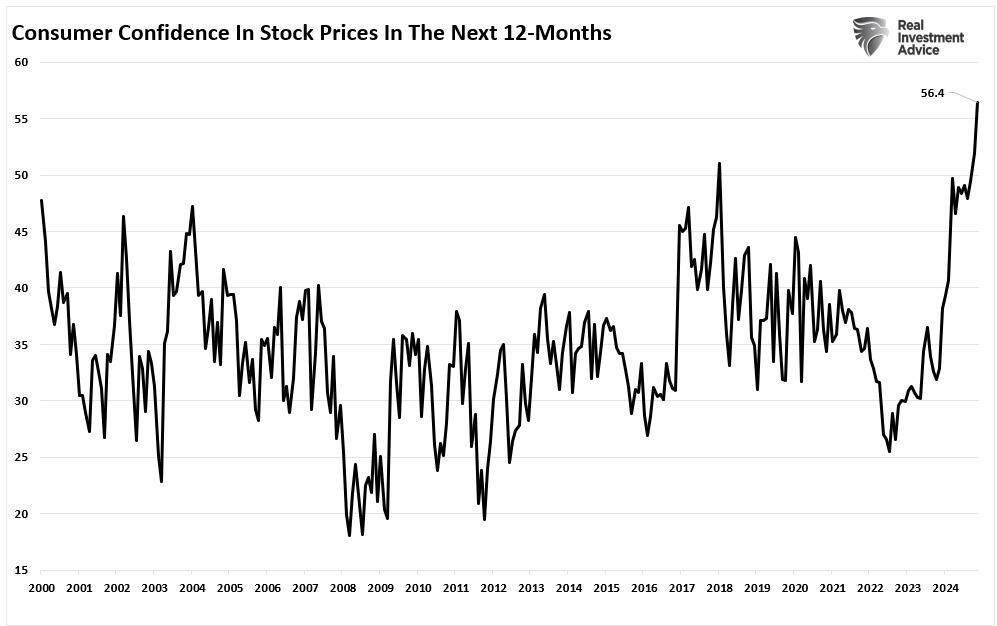
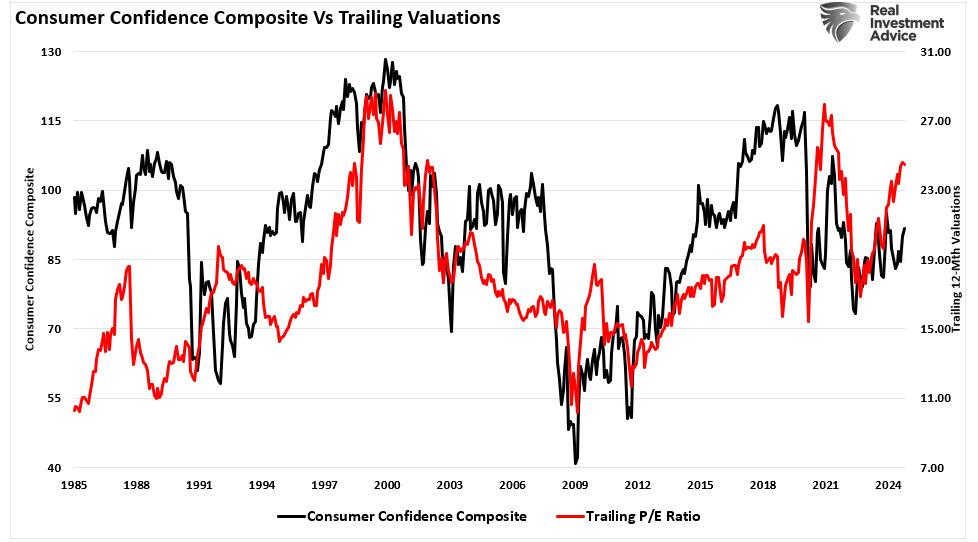
While leverage and speculation are not new to the financial markets, they manifest investor exuberance. We made this point in a recent post on “Exuberance,” as consumer confidence in higher stock prices has reached the highest level since President Trump enacted sweeping tax cuts in 2018. However, that was before his re-election in November; since then, investor confidence has soared to record levels.

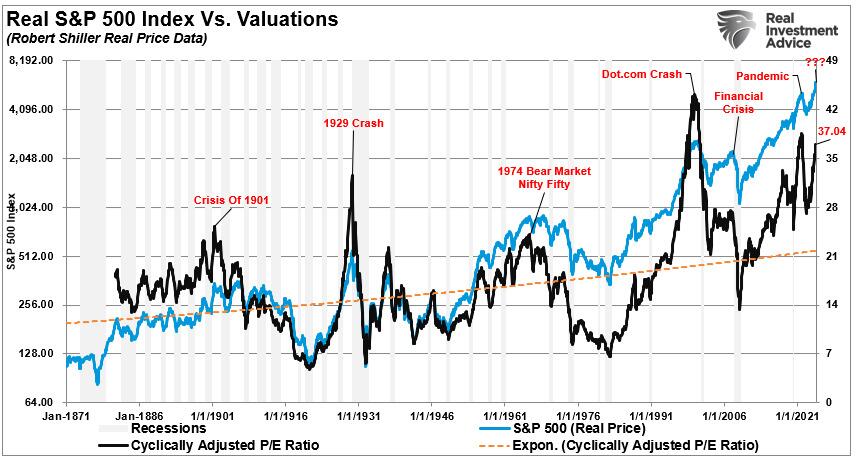
Notably, confidence and the desire to increase leverage and speculation in the markets are represented in current valuations.

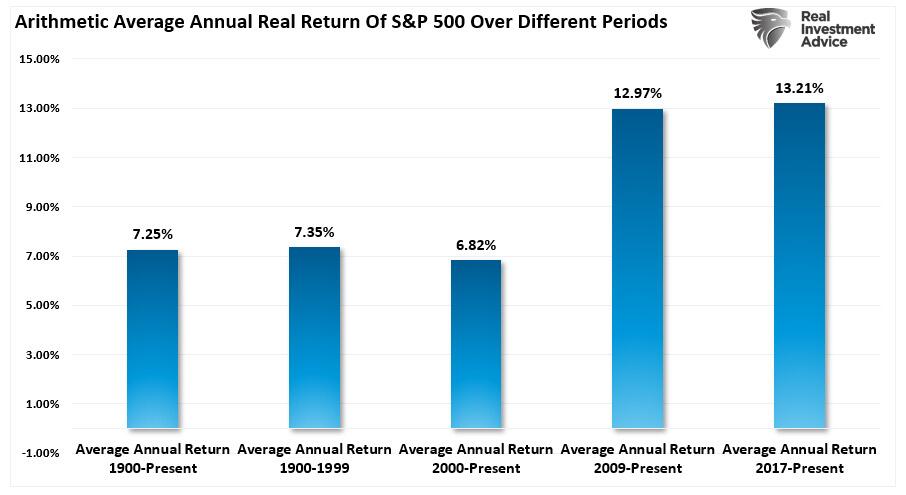
Of course, the rise in investor confidence should be unsurprising, given nearly 15 years of abnormally high market returns. The chart below shows the average annual inflation-adjusted return of the S&P 500 over different periods. Note that since 1900, the average real market return has been 7.25%. However, since 2009, that annual real return has increased by more than 50%, even more so since President Trump enacted the TCJA in 2017, reducing corporate tax rates.

Given the level of high consistent returns, combined with an extended period of low volatility, and continued monetary and fiscal interventions, it is unsurprising there has been an explosion in speculation and leverage. That activity is seen in options trading, especially short-dated call options, and the surge in single-stock levered ETFs.

The question for investors is what this means for future market returns, and the risk of when, not if, something goes wrong.

Speculation in Today’s Markets: A Closer Look

In March 2021, I wrote an article titled “Long On Confidence And Short On Experience” about how retail investors flooded the market.

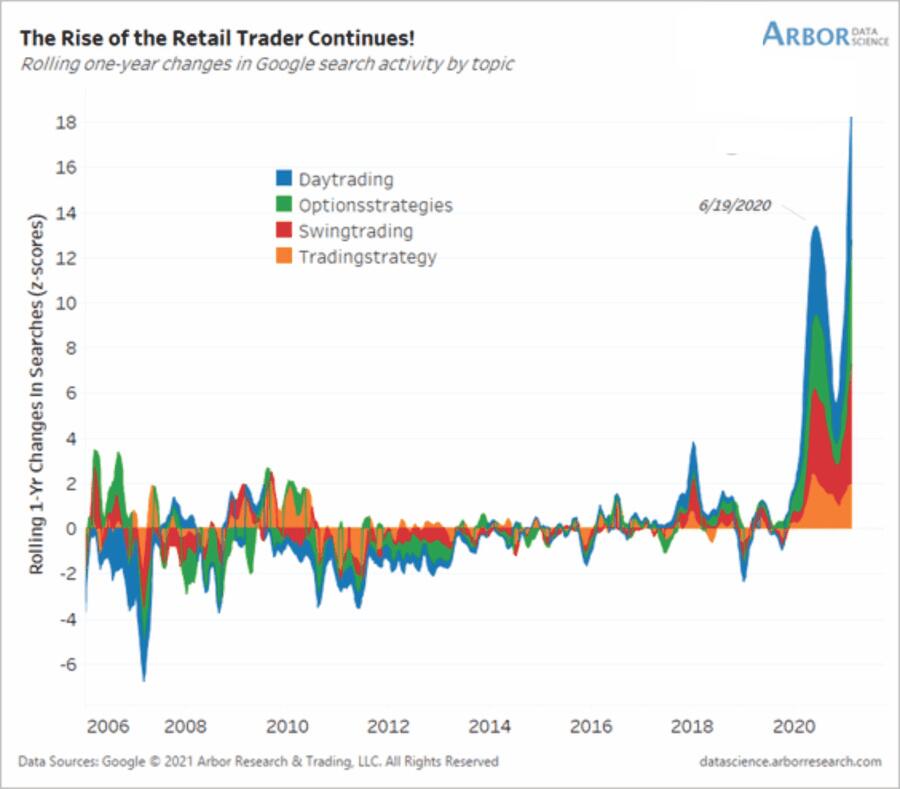
“In a “market mania,” retail investors are generally “long confidence” and “short experience” as the bubble inflates. While we often believe each ‘time’ is different, it rarely is. It is only the outcomes that are inevitably the same. A recent UBS survey revealed some fascinating insights about retail traders and the current speculation level in the market. The number of individuals searching “google” for how to “trade stocks has spiked since the pandemic lows.”

For anyone who has lived through two “real” bear markets, the imagery of people trying to learn how to “daytrade” their way to riches is familiar. From E*Trade commercials to “day trading companies,” people left their jobs to trade stocks. Of course, about 9-months later, it ended rather badly as we wrote in detail in “Retail Traders Go Bust.”

What is interesting is that after that painful lesson, just 24-months later, retail investors are again “long on confidence.” The painful lesson of losing large amounts of money has morphed into the “fear of missing out” on further gains. It is quite remarkable, but the signs are undeniable.

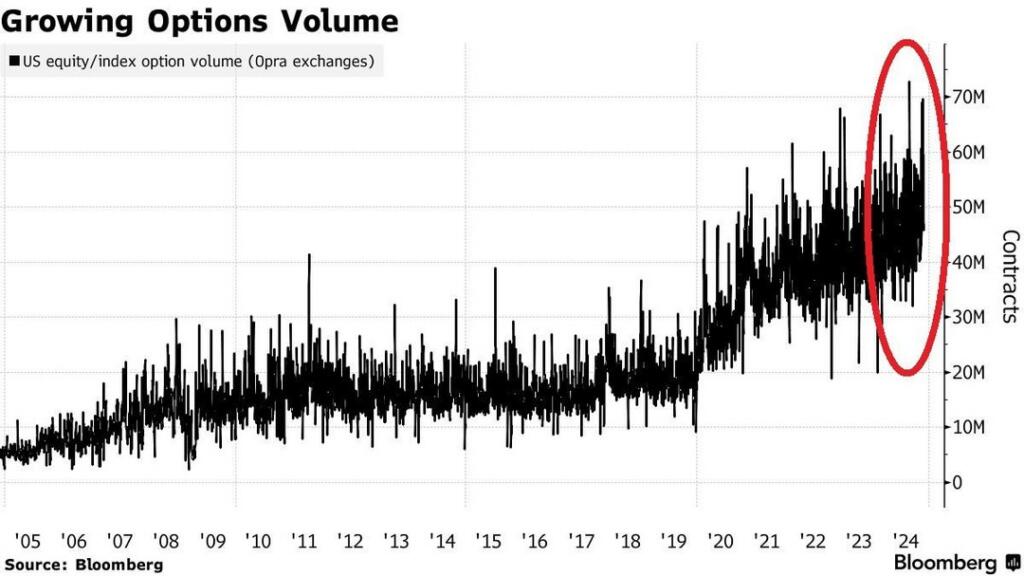
One sign of leverage and speculation we are watching are options. Options provide a leveraged way to bet on stock movements, requiring relatively little capital for potentially outsized returns. In November, US stock options volume hit nearly 70 million contracts on average per day; that is the second-highest on record, and trading activity has DOUBLED over the last two years.

As long as the market rises, those bets will pay off handsomely. The problem is that leverage works excellently on the way up but quickly turns into massive losses when markets decline.

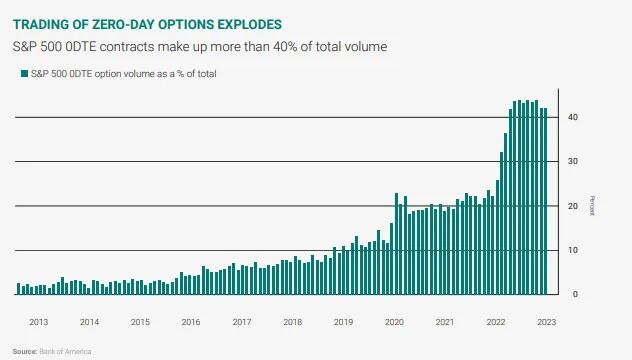
Options trading has become a focal point for modern speculation. The accessibility of trading platforms and low costs have made it easier than ever for retail investors to engage in speculative bets. Short-dated call options, also known as “zero-day” options, which expire in less than 24 hours, are attractive for speculators hoping to capitalize on short-term stock price movements. These contracts allow investors to control large positions for a fraction of the cost of owning the underlying shares outright, effectively providing leverage.

For example, the surge in options volume on tech giants like Nvidia and Tesla has coincided with sharp moves in their stock prices. This speculative activity feeds into a cycle where dealer hedging magnifies stock volatility, detaching prices from fundamental values.

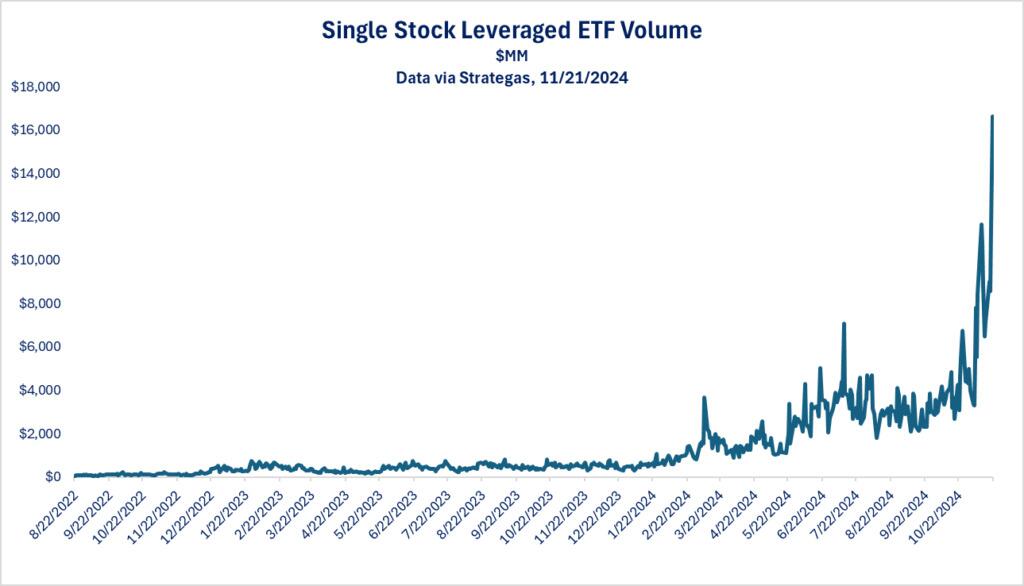
Don’t understand how to trade options? No problem, as Wall Street has got your back, or rather, your wallet. The newest speculation and leverage tool of choice is leveraged single-stock ETFs. These funds, designed to amplify the daily performance of a single stock, were developed to meet investor demand for an easy-to-understand product. For example, GraniteShares’ NVDL offers 2x exposure to Nvidia and has seen soaring trading activity. While the ETF can double the returns of Nvidia on any given day, it also doubles the losses. Such instruments are inherently risky, especially in volatile market conditions. Their popularity reflects an increasing appetite for speculative investments, often at the expense of prudent, long-term decision-making.

These trends are not unprecedented. Historically, periods of excessive leverage and speculation have driven markets to dizzying heights before sharp corrections followed. Investors today must understand these dynamics, learn from history, and adopt strategies to safeguard their portfolios.

Lessons from History: What Excessive Leverage Teaches Us

Periods of extreme leverage and speculation are not new, and the outcomes have consistently been painful for unprepared investors. The late 1990s dot-com bubble serves as a prime example. Speculative bets on internet stocks drove valuations to extraordinary levels, with investors leveraging margin accounts and options to chase gains. When the bubble burst, the Nasdaq lost nearly 80% of its value, leaving leveraged traders especially vulnerable to devastating losses.

Similarly, the 2008 financial crisis highlighted the dangers of leverage on a systemic scale. Banks, hedge funds, and individuals had layered debt onto overvalued housing assets, creating a fragile structure that crumbled when housing prices fell. What began as a localized issue in the U.S. housing market cascaded into a global financial meltdown.

More recently, the GameStop frenzy of 2021 showcased how speculative trading, often fueled by leverage, could drive wild price swings.

Young investors are taking on personal debt to invest in stocks. I have not personally witnessed such a thing since late 1999. At that time, ‘day traders’ tapped credit cards and home equity loans to leverage their investment portfolios. For anyone who has lived through two ‘real’ bear markets, the imagery of people trying to  ‘daytrade’ their way to riches is familiar. The recent surge in ‘Meme’ stocks like AMC and Gamestop as the ‘retail trader sticks it to Wall Street’ is not new.

Retail traders on platforms like Reddit’s WallStreetBets used call options to amplify their bets, forcing institutional investors to cover short positions. While some traders enjoyed massive gains, the stock’s eventual collapse left many with significant losses.

While this time certainly “feels’ different, particularly with Wall Street analysts ramping up market predictions for 2025, several warning signs warrant caution. First, valuation metrics, particularly in the technology sector, have reached more extreme levels. Stocks like Nvidia and Tesla are priced for perfection, with their valuations reflecting speculative enthusiasm rather than underlying fundamentals.

Second, the widespread use of leveraged products amplifies market volatility. Options trading and leveraged ETFs can cause rapid price swings, especially when market sentiment shifts. For example, a sharp decline in Nvidia’s stock could force a cascade of selling in instruments like NVDL, exacerbating broader market declines.

Finally, the systemic risks of leverage should not be overlooked. While today’s risks may not resemble the subprime mortgage crisis, the interconnectedness of financial markets means that unwinding leveraged positions in one area can ripple through the system, creating broader instability.

What Investors Should Do Now

Prudent risk management is essential in a market increasingly driven by speculation. Investors should begin by reassessing their portfolios to ensure they align with long-term goals and risk tolerance. High-risk assets, particularly those with stretched valuations or heavy reliance on speculative flows, may warrant trimming.

Diversification remains a cornerstone of effective risk management. Allocating across a mix of asset classes, sectors, and geographies can reduce the impact of a sharp downturn in any single area. Investors should also focus on quality, prioritizing companies with solid fundamentals, strong cash flows, and sustainable growth prospects.

Hedging can be a valuable tool in speculative markets. Simply increasing bonds or cash allocations can protect against downside risk. While these strategies may dampen potential near-term upside, they can mitigate risk during an unexpected reversion.

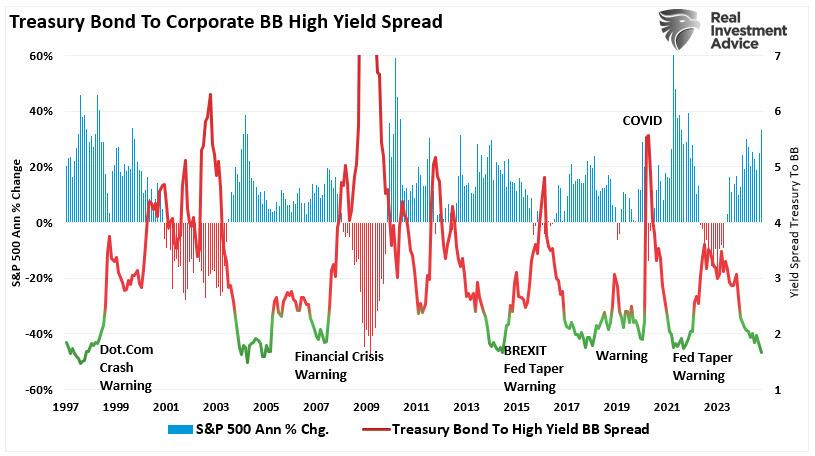
Finally, staying informed about market dynamics is critical. Monitoring speculative indicators, such as options volume and leveraged ETF flows, can provide early warning signs of frothy conditions. As discussed recently, pay attention to “Junk Bond To Treasury Spreads,” which have consistently been a leading indicator of financial risk.

“As investors, we suggest monitoring the high-yield spread closely because it tends to be one of the earliest signals that credit markets are beginning to price in higher risks. Unlike stock markets, which can often remain buoyant due to short-term optimism or speculative trading, the credit market is more sensitive to fundamental shifts in economic conditions.”

Conclusion

The market remains extremely bullish, and leverage and speculation continue to play a crucial role in driving extraordinary gains. However, as with everything, good times do not last forever. The current speculative environment is leaving investors exposed to significant risks when this current trend eventually reverses. The surge in options trading and leveraged single-stock ETFs reflects a speculative environment that requires vigilance. While markets may continue climbing in the near term, history shows that excesses often end with sharp corrections.

Investors can navigate these challenging conditions. A focus on fundamentals, managing risk, and maintaining a disciplined approach without succumbing to speculative temptations are required.

Those steps sound easy, but are difficult in a rising and speculative bull market where gains are easy to make. However, the benefit avoiding a bulk of the losses helps win the long game.

For more actionable insights on protecting and growing your portfolio, visit RealInvestmentAdvice.com.

Tyler Durden
Tue, 12/03/2024 – 11:25

via ZeroHedge News https://ift.tt/vo62FWK Tyler Durden

Lebanon Ceasefire On Brink Of Collapse As Tit-For-Tat Fire Intensifies

Lebanon Ceasefire On Brink Of Collapse As Tit-For-Tat Fire Intensifies

The Lebanon ceasefire which went into effect on November 27 is now hanging by a thread, amid an increasing intensity of of tit-for-tat exchanges of gunfire between the Israel Defense Forces (IDF) and Hezbollah.

In response to reports of Israeli fire, Hezbollah on Monday fired back as a “warning” shot into northern Israel, causing no casualties, according to regional reporting. Since then there have been several rockets fired.

Via Reuters

Israeli Prime Minister Benjamin Netanyahu immediately blasted what he called a serious violation of the fragile ceasefire. “Hezbollah’s firing at Mount Dov constitutes a serious violation of the ceasefire, and Israel will respond forcefully,” he said.

‘”We are determined to continue enforcing the ceasefire, and to respond to any violation by Hezbollah — a minor one will be treated like a major one.”

The IDF then proceeded to mount a series of large airstrikes on south Lebanon, which left at least five people dead. Nearly a dozen fatalities have been recorded due to Israeli attacks since last week’s ceasefire went into effect, per Al Jazeera:

Israel has killed eleven people, including a State Security officer, in separate attacks in Lebanon as it continues its assaults on the country since the ceasefire with Hezbollah came into effect last week.

Surprisingly, CNN has laid the blame for the crumbling ceasefire on Israel’s continued strikes, which have been much greater in number and intensity…

The attacks have reportedly involved artillery and small arms fire along with the airstrikes. Hezbollah has since escalated with rocket fire which the group has called “defensive” in nature.

This is supposed to be the period a 60-day transition where UN peacekeeping forces and the Lebanese national army takes control of Hezbollah positions in south Lebanon.

“The Israelis have been playing a dangerous game in recent days,” a US official told Axios. The Axios report further stresses that the ceasefire could collapse at any moment, also after Israel flew several drones over Beirut on Sunday.

The Biden administration is not officially laying blame on Israel, however. John Kirby has said some degree of limited exchange of fire was expended. “There has been dramatic reduction in the violence. The monitoring mechanism is in full force and is working … largely speaking the ceasefire is holding,” he told reporters at the start of the week.

On Monday a Pentagon spokesman also described that despite some incidents, the ceasefire between Israel and Hezbollah is holding. 

Netanyahu is meanwhile warning that if the ceasefire isn’t adhered to, and if it unravels, Lebanon can expect nothing less than a full-scale ground assault on the south to continue, and an all-out war. Israeli officials say that all of Lebanon will be fair-game for attacks.

Tyler Durden
Tue, 12/03/2024 – 11:05

via ZeroHedge News https://ift.tt/Yg2MXue Tyler Durden

Trump Team Refutes Reports Claiming He Will Immediately Discharge Transgender Military Troops

Trump Team Refutes Reports Claiming He Will Immediately Discharge Transgender Military Troops

Authored by Jack Phillips via The Epoch Times (emphasis ours),

President-elect Donald Trump’s team refuted anonymously sourced reports claiming that he would immediately discharge all transgender-identifying people from the military upon taking office.

President-elect Donald Trump in the Oval Office on Nov. 13, 2024. Saul Loeb/AFP via Getty Images

Trump spokeswoman Karoline Leavitt, who was tapped by the president-elect to be his press secretary, said in a statement to The Epoch Times on Nov. 30 that such claims by several media outlets are based on speculation.

These unnamed sources are speculating and have no idea what they are actually talking about,” Leavitt said. “No policy should ever be deemed official unless it comes directly from President Trump or his authorized spokespeople.”

The alleged proposed plan was first reported by The Times of London, citing “defense sources” and a “source familiar with Trump’s plans,” last week and would entail Trump’s signing an order to medically discharge transgender-identifying troops from the military. The move, it claimed, would force some 15,000 individuals from the armed forces.

The report did not list any named sources and did not indicate whether any of the individuals worked on the Trump transition team.

In response to The Times of London report, the head of the pro-LGBT Human Rights Campaign alleged that such a ban would “make our country less safe” and is “nothing more than transphobia.”

Our military must be able to recruit the best candidates, retain the highly trained service members who have already sacrificed so much for their country, and every qualified patriot should be able to serve openly, free of discrimination,” Kelley Robinson, Human Rights Campaign president, said in a statement last week amid the reports.

In 2017, during his first term in office, Trump announced that the military would no longer allow transgender-identifying people to serve in “any capacity,” coming after the Obama administration allowed such people to serve in the military and receive taxpayer-funded medical treatments related to identifying as transgender.

Our military must be focused on decisive and overwhelming victory and cannot be burdened with the tremendous medical costs and disruption that transgender in the military would entail,” Trump wrote on social media in July 2017.

The policy was revised in 2018 and only blocked people from serving in the military who had a history of gender dysphoria who were unable or unwilling to serve as their biological sex or had undergone medical transition treatment. In 2019, the Supreme Court ruled 5–4 that the 2018 version of the ban could remain intact, but the ban was later reversed by President Joe Biden.

Just days after taking office in early 2021, Biden signed an executive order that overturned the first Trump administration order.

At the time, Biden said that the U.S. military is “stronger” around the world and at home “when it is inclusive,” according to a statement. Defense Secretary Lloyd Austin had also indicated that he backed Biden’s decision.

In mid-2016, President Barack Obama ended a longstanding ban on transgender-identifying people in the military, with Defense Secretary Ash Carter at the time saying in a news conference that the military has to “have access to 100 percent of America’s population.”

Aside from military-related policies, Trump has backed a ban on transgender medical treatments for minors.

On his campaign website, the president-elect said he would remove hospitals and health care providers that participate in the “chemical or physical mutilation of minor youth” from Medicaid and Medicare programs.

Meanwhile, Trump has proposed barring transgender-identifying athletes from competing in women’s sports. In a town hall event in September, Trump said that if elected, his administration would stop the policy because “it’s a man playing” in a women’s game.

Look at what’s happened in swimming. Look at the records that are being broken,” he said.

In an Associated Press survey of more than 120,000 people who cast ballots during the last election, more than half of voters stated that support for transgender rights in government and society has gone too far. Among Trump voters, 85 percent said such support had gone too far.

The Associated Press contributed to this report.

Tyler Durden
Tue, 12/03/2024 – 10:45

via ZeroHedge News https://ift.tt/XJ5K2Up Tyler Durden

Job Opening Unexpectedly Surge With Biggest Increase in 14 Months; Quits Also Soar

Job Opening Unexpectedly Surge With Biggest Increase in 14 Months; Quits Also Soar

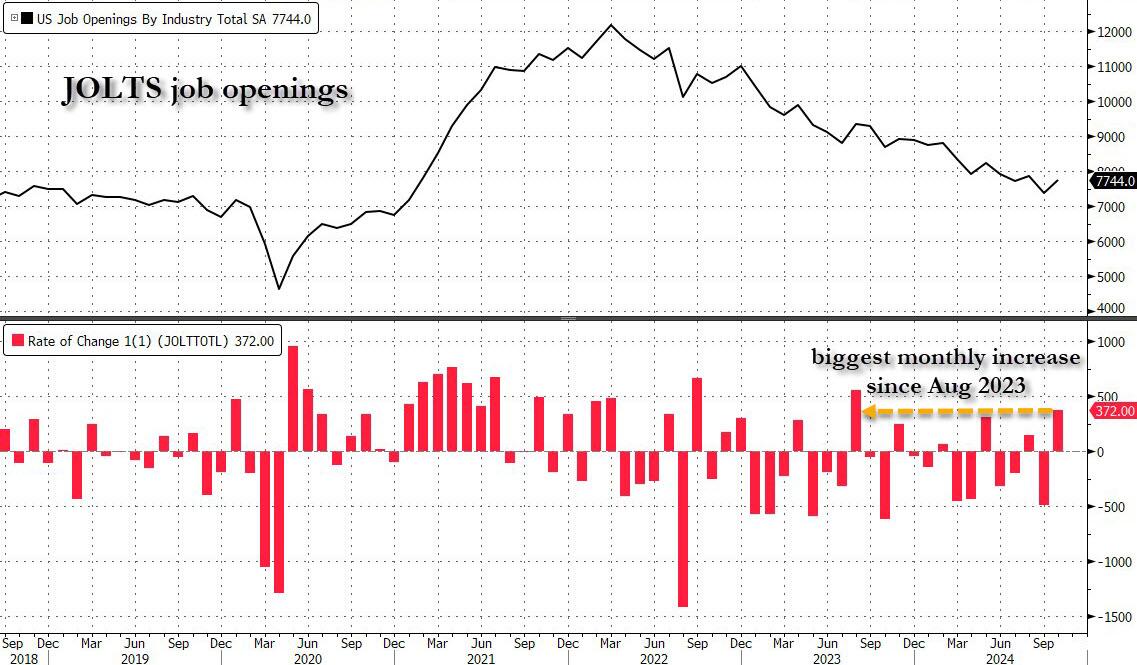
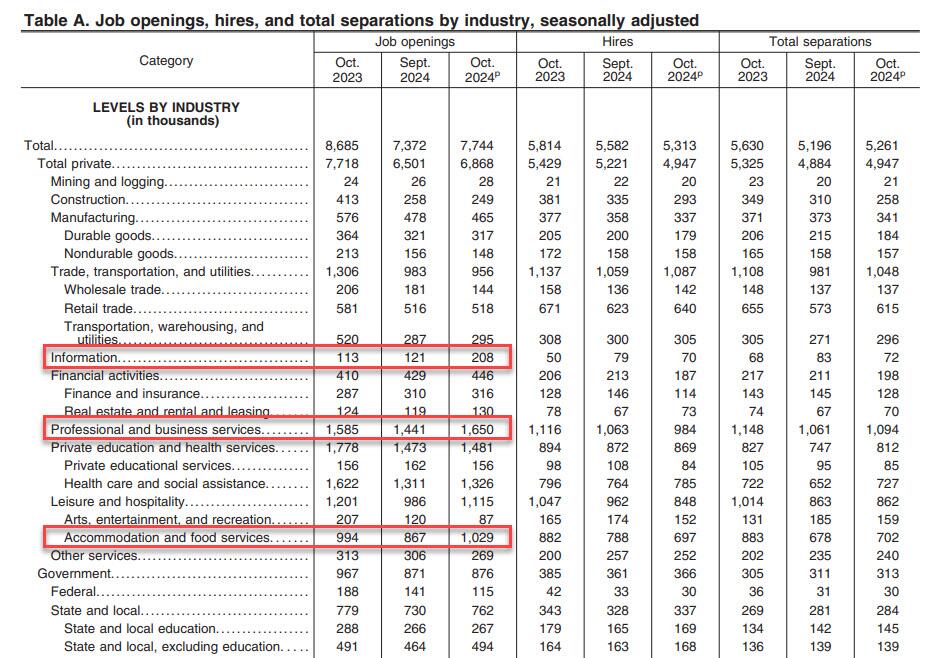
After last month’s catastrophic JOLTS report, which was a disaster across the board, and which was meant to give the Fed a green light to cut rates more after Biden won the election (which he didn’t, but the Fed still had to cut even if Trump is now in control), some speculated that Biden’s Department of Labor will do everything in its power to sabotage further rate cuts by the Fed, most notably the upcoming December decision in two weeks time, by pushing out much stronger than expected economic data. That’s precisely what happened moments ago when the DOL reported that in October, the number of job openings in the US soared by a whopping 372K, the biggest monthly increase since August 2023, to 7.744 million from 7.372 million.

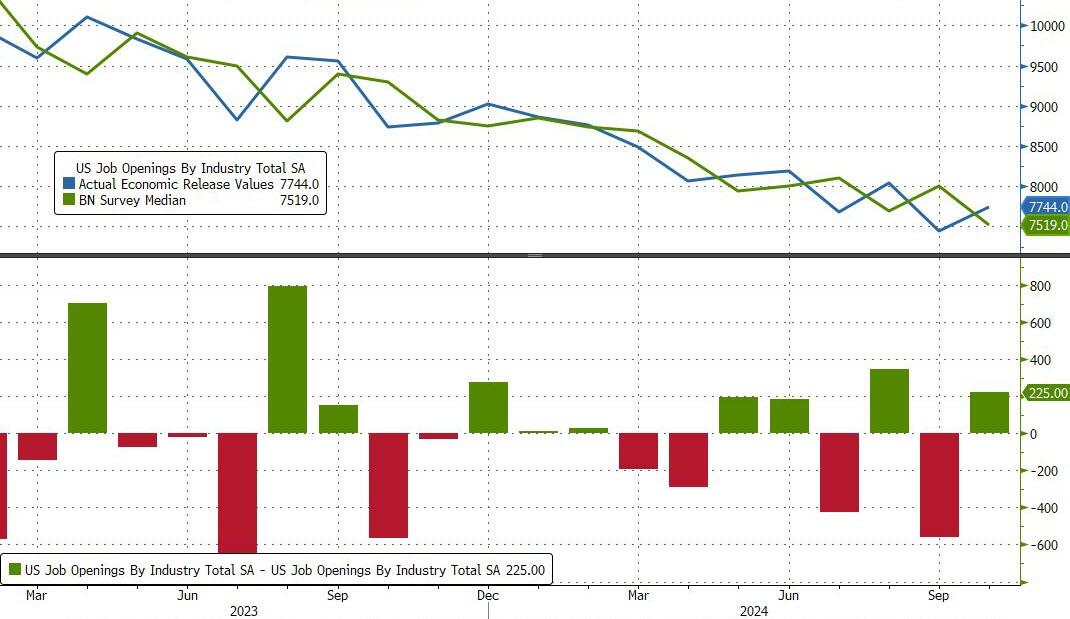
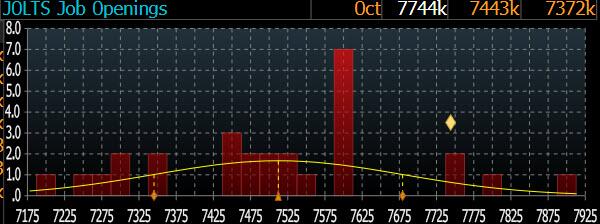
The JOLTS print smashed the median estimate of 7.519 million by 225K…

… with just 4 analysts (out of 28) predicting a higher job openings number.

According to the DOL, the job openings rate, at 4.6 percent, changed little over the month. The number of job openings increased in professional and business services (+209,000), accommodation and food services (+162,000), and information (+87,000) but decreased in federal government (-26,000).

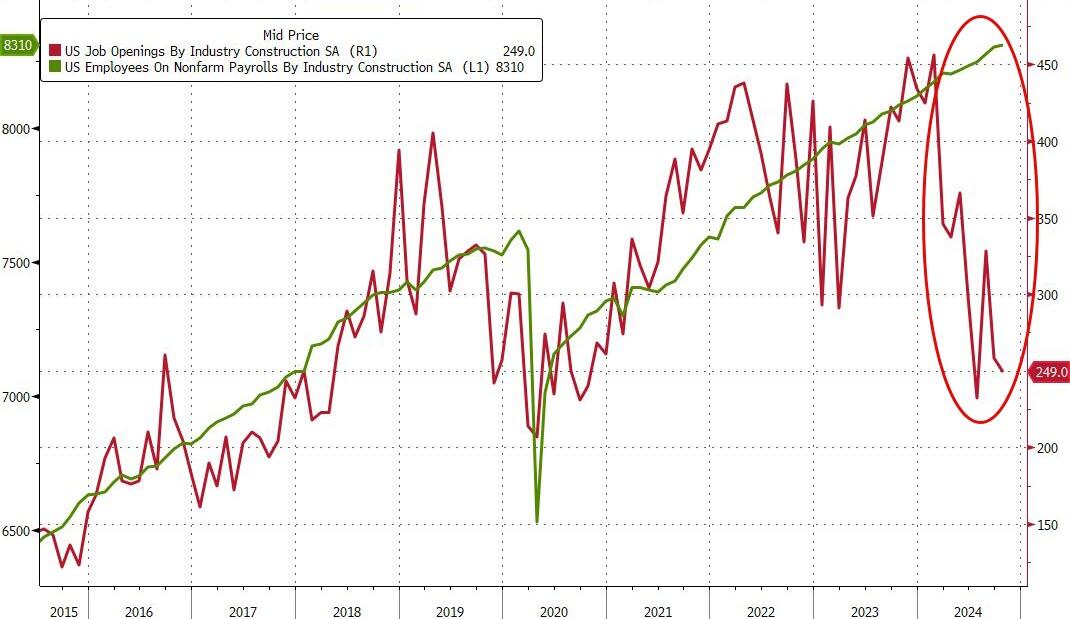
Amusingly, after we mocked two months ago the stunning surge in construction job openings just as a record chasm had opened between the manipulated number of construction jobs and openings…

… which meant the biggest monthly surge in construction job openings on record at a time when the housing market has effectively frozen thanks to sky high interest rates, a simply glorious paradox of manipulated bullshit data…

… the BLS realized that it had to make an adjustment after getting called out, and Construction Job openings dropped by another 9K to 249K and back to post-covid lows. Oh, and yes, the number of “construction jobs” is about to fall off a cliff just as soon as Orange Man Bad enters the White House.

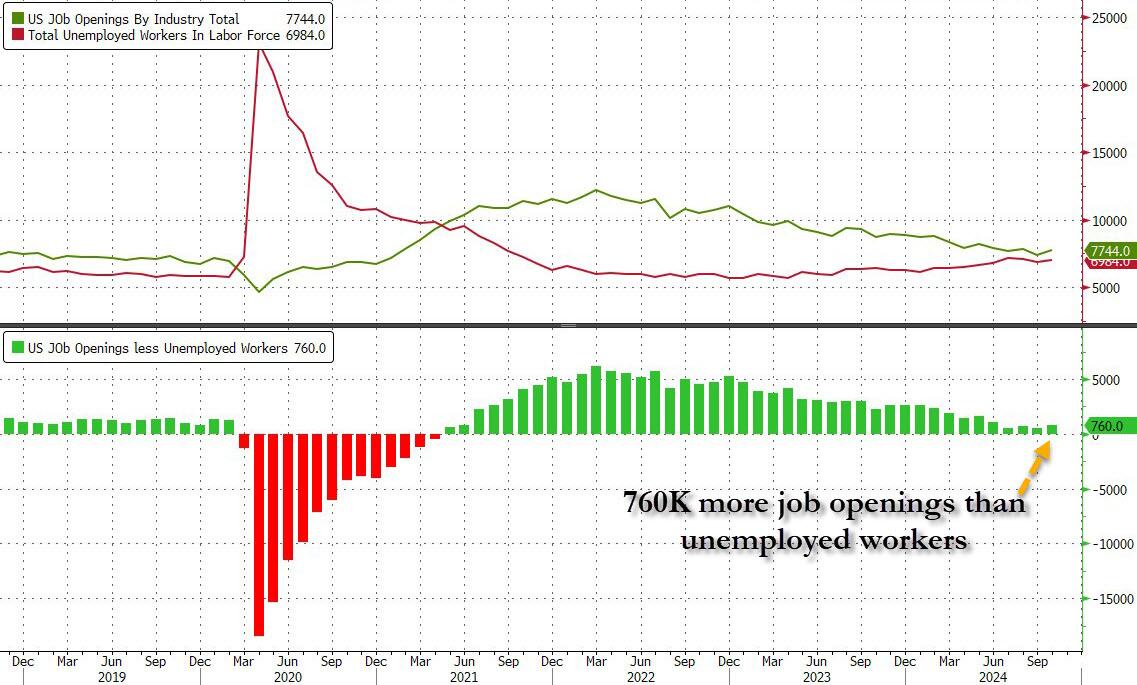
Setting the glaring data manipulation aside, in the context of the broader jobs report, in October the number of job openings was 770K more than the number of unemployed workers, an increase from the previous month and not too far from inverting once again, similar to what happened during the covid crash.

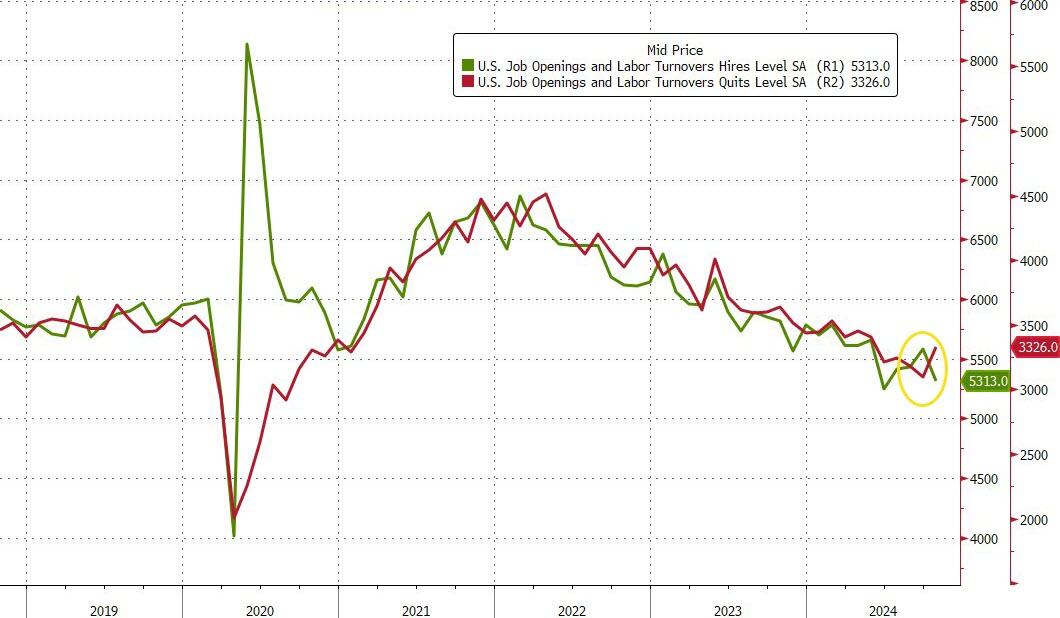
But while the job openings surge was a surprising reversal of the deteriorating trend observed for much of 2024, where even the DOL was stumped was the number of hires, which tumbled from 5.582 million to 5.313 million, a new post-covid low.

Commenting on the plunge, SouthBay Research notes that hiring was weak in October and the last time hiring was this low was June and NFP slowed to 118K. But remember that this data aligns with the October Payroll data – not November’s.  Both October NFP and the latest October JOLTS Hiring data cover the same period (through mid-October).” Furthermore, there were an additional 4 weeks since this JOLTS survey and hurricane recovery (aka hiring) rebounded. In addition, as the Job Openings indicate, employer intent to hire was already underway when this survey was completed.

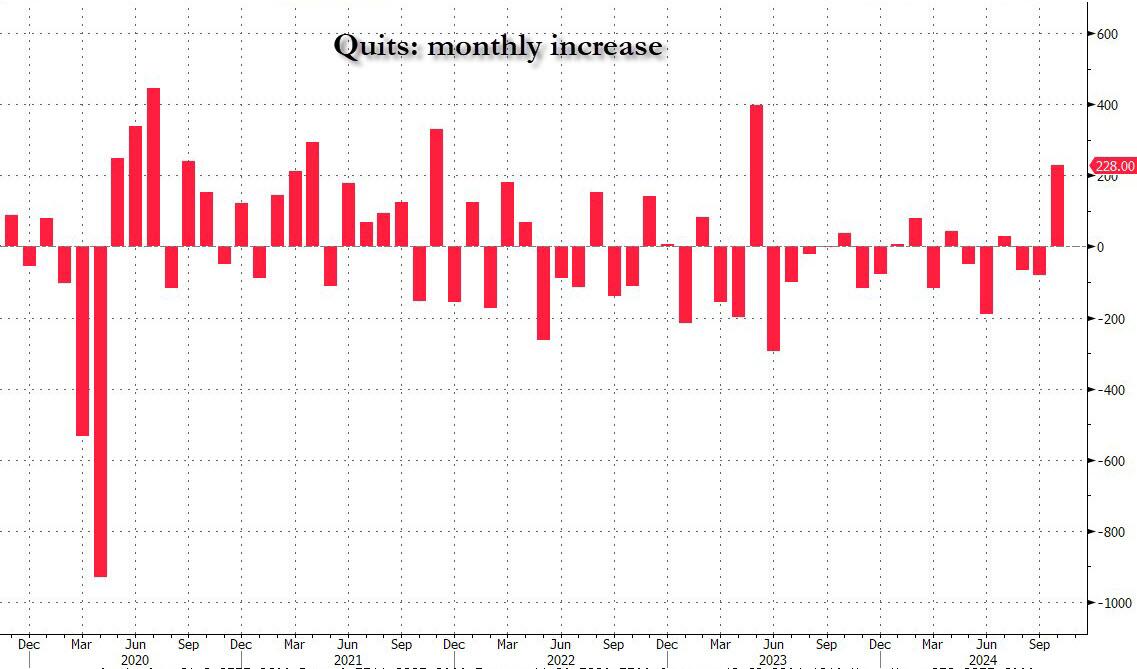
Meanwhile, the drop in hiring was offset by a surprise spike in the number of Quits, which rose by 228K from 3.098MM to 3.326MM, the biggest increase since May 2023, with quits increasing in accommodation and food services (+90,000).

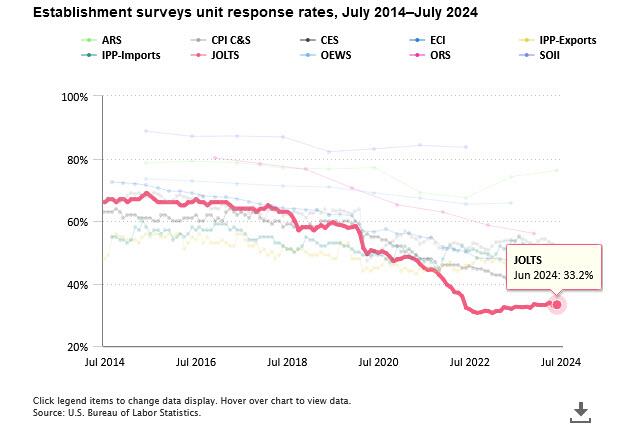
Finally, no matter what the “data” shows, let’s not forget that it is all just estimated, and it is safe to say that the real number of job openings remains still far lower since half of it – or some 70% to be specific – is guesswork. As the BLS itself admits, while the response rate to most of its various labor (and other) surveys has collapsed in recent years, nothing is as bad as the JOLTS report where the actual response rate remains near a record low 33%

In other words, more than two thirds, or 67% of the final number of job openings, is made up!

Looking ahead to Friday’s November Nonfarm Payrolls, the report will be driven by hurricane recovery, with the JOLTS data pointing to a lot of weakness in exactly the areas October Payrolls slipped. As for organic hiring, there have been no anecdotal signs of hiring pullback heading into November. On the contrary: businesses seem to be inclined to ramp up a bit, now that Trump is president and promises a dramatic easing of regulations.

Tyler Durden
Tue, 12/03/2024 – 10:36

via ZeroHedge News https://ift.tt/wdyKRnL Tyler Durden