WallerISMs

WallerISMs

By Benjamin Picton, Senior Macro Strategist at Rabobank

WallerISMs

Political instability in France again takes center stage today as markets continue to price in the seemingly inevitable collapse of Michel Barnier’s government. Marine Le Pen’s RN party vowed to side with left-wing parties to pass a vote of no confidence in Barnier’s administration this week after the Prime Minister used constitutional powers to push through unpopular social security savings measures without a vote. The Euro fell 0.75% against the Dollar and French 10-year yields rose 2.1bps in defiance of a broad downward shift for European sovereign curves.

The CAC40 closed mostly unchanged while the German DAX gained more than 1.5%. US stocks were mixed with the Dow losing 0.29% while the S&P500 rose by 0.29% and the more duration-sensitive NASDAQ put on almost 1%. US stocks may have been encouraged by a ‘Goldilocks’ manufacturing ISM report, which showed the ‘prices paid’ index falling from 54.8 to 50.3 while ‘new orders’ rose to 50.4 and ‘employment’ rose from 44.4 to 48.1.

The release of the ISM manufacturing report coincides with an article published in the FT today suggesting that Joe Biden’s embrace of industrial policy via the Inflation Reduction Act and the Chips Act is beginning to pay dividends for the American manufacturing sector as foreign investment and construction activity on new manufacturing projects surges (even if actual manufacturing employment is yet to show much upside). Figures on construction spending in October release yesterday confirmed showed stronger growth than expected.

The overall encouraging tone for the US economy paired with a fresh threat from President Trump over the weekend to impose 100% tariffs on BRICS economies seeking to de-dollarize to put a bid under the USD. Trump might contend that the rising construction activity for new manufacturing projects in the United States is due at least in part to his carrot and stick approach of offering generous tax cuts to domestic producers while imposing stiff tariffs on firms that instead produce outside of the US and seek to import finished goods. It is likely that at least some manufacturers saw which way the political winds were blowing and decided to de-risk by locating new projects inside US borders rather than gambling on a more free-trading status quo.

The Bloomberg Dollar spot index reached as high as 106.73 before retracing slightly in late trade, but the stronger Dollar wasn’t enough to send crude oil or gold prices much lower. The support in those commodity prices, along with the long wick on the DXY graph might suggest that the retracement in the USD that has been in place since the Friday before last might have a little further to run before the Dollar resumes its overall upward trend.

US OIS futures are this morning implying a 75% chance of a 25bp rate cut at the Fed’s December meeting following comments from Federal Reserve Governor Christopher Waller that at present he “lean[s] toward” supporting a further cut to the Fed Funds rate this month, but that his vote will depend on the flow of data between now and the December 18th FOMC meeting. Despite flagging support for a cut this month, Waller also sounded a note of caution by saying that recent data had raised some concerns that progress on disinflation may be stalling above the Fed’s 2% target.

The good result in the ‘prices paid’ component of the ISM manufacturing report might have helped to reassure traders listening to Waller, because the implied path of the Fed Funds rate according to the futures market is little changed since markets reopened after the Thanksgiving holiday late last week. Pricing on the December meeting implies ~1 extra basis point worth of cuts, while pricing for end of Q2 and Q4 next year suggests a Fed Funds rate ~2bps higher than was the case on Friday.

It may be the case that traders are simply waiting for this week’s dump of US labour market data and Jerome Powell’s comments tomorrow before adjusting their views on policy rates. Today brings the October JOLTS job openings figures, tomorrow we get the results of the ADP employment survey and Friday we will see the November non-farm payrolls report where further signs that the jobs market is no longer softening might be the sort of indicator that Waller is looking for to vote for a pause in December.

RaboResearch forecasts a cut from the FOMC in December and another in January to bring the top of the Fed Funds range down to 4.25%. After that, we think the Fed will be on hold as the new administration sets about implementing the Trump program of substantial tax cuts, deportations and universal tariffs.

Tyler Durden
Tue, 12/03/2024 – 10:25

via ZeroHedge News https://ift.tt/y8Xlgpf Tyler Durden

NVDA Doubles AAPL, Trump Blows Up The Dollar, & The End Of OPEC: Saxo’s Outrageous Predictions For 2025

NVDA Doubles AAPL, Trump Blows Up The Dollar, & The End Of OPEC: Saxo’s Outrageous Predictions For 2025

It’s that time of year again…

Saxo’s Outrageous Predictions are not exactly news and not exactly real – at least not yet.

And while they don’t know which stories will drive the global economy in the coming year, their 2025 predictions, from Nvidia trouncing its Mag 7 peers to the fall of OPEC, from a bold bet on reflation in China to a great leap forward in biotech, are just as promised…

Outrageous.

Trump 2.0 blows up the US dollar

Summary:  As the new Trump administration turns the global financial system on its head with huge tariffs, the world scrambles to find alternatives to the dollar

The globalist system that formed in the ashes of World War II was built on the combination of a US security guarantee to protect trade routes for the “Free World” and the use of the US dollar as the chief currency for transactions and as a store of value. Even after the greenback’s link to gold was broken by US President Nixon in 1971, the US dollar continued its domination in the globalised economy.

Cue the 2016 US election and the advent of President Trump, the first president in living memory to bash at the foundations of the global system, demanding tariffs for imported goods to right the huge US trade deficit wrongs and decrying the cost of maintaining the vast US security umbrella. US security alliance partners were shocked, and China was put on notice. But then came the pandemic and a new election brought Biden and encouraged the notion that Trump was an aberration, not the new norm. Then there was the 2024 US election and return of Trump. If Trump 1.0 was the warm-up act for deglobalisation, Trump 2.0 will prove the main event, with all of its consequences for the US dollar.

In 2025, the new Trump administration overhauls the entire nature of the US relationship with the world, slapping massive tariffs on all imports, while slashing deficits with the help of an Elon Musk-run Department of Government Efficiency (DOGE). The implications for the US dollar are dire for trade around the world, as it cuts off the needed supply of dollars to keep the wheels of the global USD system turning, ironically risking a powerful spike higher in the US dollar. Instead, safety valves are found, as global financial actors scramble for alternatives. China and the BRICS+ transact with gold-backed digital money and, to a degree, directly in a new gold-backed offshore yuan. Europe rebases its trading relationships increasingly in the euro. Gold-linked crypto stablecoins add to the mix, as this dramatic new chapter in global financial markets begins.

Potential market impact: The crypto market quadruples to more than USD 10 trillion, the US dollar falls 20% against major currencies and 30% versus gold. The US economy continues to reflate, but wages keep up with goods inflation, as production resources reshore to the US. US exporters advantaged.

Nvidia balloons to twice the value of Apple

Summary:  Armed with its revolutionary AI chips, could tech giant Nvidia grow to twice Apple’s size and become the most profitable company of all time?

The saying goes that in a gold rush, the only operators sure to make a fortune are the sellers of shovels, since most miners will fail to find any gold. What we are seeing in the AI space feels much like a gold rush, as the monopoly info-tech giants and a crush of start-ups have rushed to harness the golden promises of generative AI. These stretch from Meta’s Metaverse to the incredible number-crunching loads to drive new applications like autonomous driving. The primary shovel-seller in the AI gold rush is Nvidia, designer of the juiced-up chips, and just as importantly, the software ecosystem at the heart of the lion’s share of AI data centres.

In 2025, Nvidia’s success is supercharged further with the availability in volume of its revolutionary 208-billion transistor Blackwell chip, a chip that drives up to a 25-fold increase in performance of AI calculations per unit of energy consumed relative to the prior H100 generation. With the intensifying AI arms race as no giant or even government wants to be left behind, and as AI data centre electricity costs have soared, the insatiable demand for the more powerful and yet less power-hungry Blackwell chips sees Nvidia taking the crown as the most profitable company of all time. It handily surpasses Apple’s record USD 105 billion of profits next year, and with far faster growth baked into expectations, its market cap nearly doubles again, making it twice the size of Apple. This sees it tower above all other companies in the world at a value of USD 7 trillion, or 10% of the global equity market. Apple and other tech giants’ valuations suffer in relative terms, as their profitability is weighed down by the need to build titanic data centres to keep up in the AI gold rush.  

Potential market impact: Nvidia shares trade well north of USD 250, before the market begins to question its potential to grab an ever-greater share of corporate profits, and as unwelcome regulatory scrutiny on its monopoly status tempers the outlook. 

China unleashes CNY 50 trillion stimulus to reflate its economy

Summary:  Having created history’s most epic debt bubble, China boldly bets that fiscal stimulus to the tune of trillions of CNY is the only answer.

China is mired in a classic balance sheet recession akin to the Japanese experience of the 1990’s. In an epic binge, the country inflated a corporate debt and real-estate debt bubble without parallel in global economic history. China’s corporate debt alone stands at north of 150% of GDP. Local government debt is on the order of another 80-90% of GDP. Household debt is not as high as elsewhere, but much is linked to a suffering real estate market.  

When countries enter a balance sheet recession, every actor in the economy, both public and private, is strongly incentivised to pay down debt to repair balance sheets. But this effort to improve finances only worsens the collective outlook as economic activity and prices crater. The government can choose many paths in a balance sheet recession, but all come with significant risks. If you write off the debt, the economy deflates and the wealthy class of creditors is crushed. If you do nothing, the country can stay in a decades-long malaise. If you run massive trade surpluses to have other countries finance your balance sheet repair as China is already trying to do, you risk the ire of other nations and trade wars. If you force a reflation with massive fiscal stimulus, inflation can create social unrest. 

In 2025, China makes a bold bet that reflation is the only answer and thinks it can manage the inflationary risks as it unleashes a gargantuan set of fiscal initiatives that add up to promises of more than CNY 50 trillion (about USD 7 trillion) in 2025 and the following years. Much of the spending goes directly into consumers’ pockets via e-CNY digital currency, so that it will be injected straight into the economy rather than to pay off debt. China also adds heavy doses of social engineering in its stimulus, incentivising companies to reduce working hours to improve quality of life. This boosts leisure time, consumption, company formation, family formation and childbearing. 

Potential market impact:  A strong reflationary impact in China and the world, outperformance of EM relative to DM and China in particular, higher commodity prices globally, a stronger Chinese renminbi.

First bio-printed human heart ushers in new era of longevity

Summary:  It’s alive! Fusing bioengineering and medical science, scientists successfully bio-print a human heart, promising to extend the lives of millions.

In an unprecedented scientific breakthrough, 2025 sees researchers successfully bio-print a fully functional human heart, using advanced 3D bioprinting technology. Starting with high-resolution CT scans, scientists create an intricate digital model capturing every minute detail of the heart’s complex structure. This model serves as the blueprint for a state-of-the-art 3D bioprinter, which meticulously layers human stem cells and biodegradable scaffold materials to construct the organ with remarkable precision. 

Once printed, the nascent heart is placed in a specialised bioreactor that mimics the physiological conditions of the human body. Here, the heart matures over several weeks, allowing the cells to organise and differentiate properly, establishing vital networks of blood vessels and electrical pathways necessary for normal heart function. In a groundbreaking surgical procedure, the matured human heart is then transplanted into a pig for testing. 

The implications of this achievement are monumental. It promises to alleviate the global shortage of donor organs by providing bio-printed hearts tailored to the DNA of individual patients, thus reducing the risk of rejection. This breakthrough paves the way for extending human longevity by replacing failing organs with custom-made, fully compatible ones. Additionally, it opens avenues for innovation in bio-printing other complex organs, revolutionising regenerative medicine and personalised healthcare. 

This massive advance in biotechnology history captures global attention. The fusion of bioengineering and medical science promises to improve and lengthen the lives of millions in years to come. 

Potential market impact: The success in bio-printed organs sees growth expectations jump for the biotechnology and 3D printing sectors. Most companies in this space are in the start-up phase, but watch for a rash of IPOs in the space. More generally, this surge in innovation and investment could reshape the healthcare industry, leading to improved patient outcomes and significant economic growth.

Electrification boom ends OPEC

Summary:  As electric vehicles become more affordable, could oil-rich OPEC become irrelevant in 2025 and find itself on the ash heap of history?

In the space of just a few years, China has made a mockery of all prior assumptions about the potential scale of both EV production and adoption. Schroders, a nearly trillion-dollar asset manager, touted growth potential for Chinese EV production back in early 2021, projecting that EV sales might reach close to 5 million vehicles by the end of 2024 and a market share of 15%. The ensuing reality blew the roof off these projections, as Chinese EV registrations rose above 8 million already in 2023. And by September of 2024, EV market share of new car sales was reaching north of 45% in China, as overall EV sales growth rose above 40% year-on-year. This is some six years quicker than expected.  

China is showing the way in the transportation electrification boom. As other countries join China in rapidly building out exponential growth in production capacity, battery prices will deflate further, making EVs cheaper than their petrol-burning counterparts, with a crossover point in costs within 12 months, even on an unsubsidised basis. With an exponential adoption rate curve dead ahead, it brings forward projections of peak oil to as early as 2025 and the anticipation of an accelerating decline in demand in the years ahead. 

In 2025, with the writing on the wall on the forward demand picture since two-thirds of oil ends up as gasoline or diesel in cars and trucks, OPEC finds its relevance shrinking further and its multi-million barrel per day production limits irrelevant. With some members already cheating production quotas to grab what income they can and export demand falling, a majority of members quickly realise the jig is up. Amidst the bickering and in-fighting, key members leave. This consigns OPEC to the ash heap of history. Former members max out production to ensure market share, driving a large drop in oil prices. 

Potential market impact:  Crude oil slumps in price, a boon for airlines, chemical, paint and tire manufacturers and freight and logistics companies. But the market balances quickly and oil prices stabilise, as higher cost suppliers, especially in North America, shut down expensive shale oil production. Japanese carmakers find themselves in a desperate race to catch up with other EV players.

US imposes AI data centre tax as power prices run wild

Summary:  With tech giants sucking up power supplies for their new AI data centres, utility bills skyrocket and an outraged public demands action.

The AI revolution is a power-hungry one. The tech giants see that current electricity supply falls far short of what is required to power the massive new AI data centres they hope to build. They are already taking dramatic steps to secure stable, long-term power sources. Microsoft has contracted with Constellation Energy to reopen one of the old nuclear reactors at Three Mile Island. Google and Amazon are striking deals with US utilities and other providers to create small modular nuclear reactors (SMRs) for their planned AI data centres. But these are all long-term projects – for 2030 and beyond in the case of the latter two. What about the energy needs right here and now, as the AI arms race reaches new white-hot intensity already in 2025? 

In 2025, US power prices spike higher in several populated US areas, as the largest tech companies scramble to lock in baseload electricity supplies for their precious AI data centres.  This inspires popular outrage, as households see their utility bills skyrocket, aggravated by the huge spikes in power prices for electricity consumed at home during peak load periods in the evening. In response, many local authorities move in to protect political constituents, slapping huge taxes and even fines on the largest data centres in a move to subsidise lower power prices for households.  The taxes incentivise investment in massive new solar farms with load balancing battery packs, but also dozens of new natural gas-driven power stations, even as the demand for ever more power continues to rise faster than supply. Rising power prices drive a new inflationary impulse. 

Potential market impact:  A massive boom in US investment in power infrastructure. Companies like Fluor rise on signing massive new construction deals. Tesla’s accelerating Megapack gets increasing attention. Long-term US natural gas prices more than double, a significant contributor to a more inflationary outlook.

A natural disaster bankrupts a large insurance company for the first time

Summary:  After a year of wild weather in 2024, a catastrophic storm hits the US in 2025, sinking a large insurer that has underestimated climate change risks.

Climate change is driving an intensification of the earth’s water cycle. As the atmosphere warms, it can hold more moisture, and rainfall intensity has been rising sharply in recent years. This past year has seen wild weather events around the world, from a deluge that created temporary lakes in some of the driest areas of the Sahara, to deadly flooding in Slovakia and Poland as rivers burst their banks and in Connecticut and New York after a “once in a thousand year” rainfall event. Climate scientists have charted that rainfall amounts that fall in heavier rains around the world are marching ever higher. This means the risk that what was formerly considered a 100-year or even 1000-year rain and flooding event could happen on the order of once a decade, or even more frequently.  

In 2025, a catastrophic storm and rainfall event in the US catches the insurance industry unprepared, inflicting damage stretching into many multiples of the USD 40 billion in claims linked to Hurricane Katrina in 2005. One of the largest US insurers significantly underestimated the insurance risks from climate change, leading to underpriced policies in the affected region. With insufficient reserves to cover claims and inadequate reinsurance to mitigate the costs of this extreme event, panic spreads across the entire industry. A crisis unfolds, prompting government-level discussions on whether to bail out the failing company and the other walking wounded in the industry to prevent widespread risk contagion. The disaster forces a reset in natural disaster pricing, profoundly marking down real estate values in many housing markets. Consumer confidence takes a hit on the insecurity of the value of many homeowners’ largest asset, their house. 

Potential market impact:  Berkshire Hathaway shares rise as Buffett’s company has enough capital to weather the panic and the company gains market share.

Sterling erases post-Brexit discount versus the euro

Summary:  As Europe’s economy struggles, fresh fiscal policy winds are blowing in the UK, driving sterling back to levels versus the euro not seen since before Brexit.

The UK outlook is as constructive as ever in the post-Brexit era. That is, it is the most positive relative to the sick man of Europe, which is, well…Europe, or at least the core Eurozone countries, France and Germany. Fresh fiscal policy winds are blowing in the UK, where the new UK Labour government announced budget priorities ahead of 2025 that avoided the most growth-damaging types of tax hikes on income, while trimming the least productive public sector spending in moving to shrinking its deficits. By cutting unproductive subsidies like winter fuel aid for pensioners, encouraging investment in the property and manufacturing sectors and raising incomes for public sector workers, the UK is primed for solid nominal growth in the years ahead, keeping the Bank of England policy rate at a high level compared to major global peers.  

On the European continent, the situation couldn’t be more different. France has a dysfunctional government that is mired in a five-year exercise of getting its out-of-control budgets in order. It has already announced growth-killing taxes on personal and corporate income and austerity. Shield your eyes! Meanwhile, Germany remains the sickest of the sick in Europe, unwilling to debt finance desperately needed domestic investment in housing and infrastructure that it could easily afford. Its former economic model of cheap Russian energy inputs to drive its huge industrial base and manufactured exports lies in ruins. And its non-luxury car producers have been rendered uncompetitive by both high energy input costs and China running away with new EV battery technology and gobbling up a dominant global export share in the critical auto sector. Germany must find a new way – but that is perhaps an outrageous prediction for 2026…  

In 2025, sterling rises through 1.27 versus the euro, the level it traded ahead of the Brexit referendum, thus erasing its entire post-Brexit vote discount. 

Potential market impact:  Encouraging domestic investment and a more robust growth outlook support sterling versus the flailing euro, seeing the Euro/Sterling rate fall as low as 0.7500, below the rate the day before the Brexit vote at 0.76. The UK FTSE 100 posts a strong performance.

*  *  *

Read the full Outrageous Predictions report here…

Tyler Durden
Tue, 12/03/2024 – 10:05

via ZeroHedge News https://ift.tt/74Pp9wd Tyler Durden

California Bill Would Prioritize Descendants Of Slaves In University Admissions

California Bill Would Prioritize Descendants Of Slaves In University Admissions

Authored by Kimberly Hayek via The Epoch Times (emphasis ours),

A California lawmaker introduced a bill on Monday that would give the descendants of slaves priority admissions into the University of California and California State University schools, the state’s two public university systems.

A student walks toward Royce Hall on the campus of University of California at Los Angeles (UCLA) on March 11, 2020. Robyn Beck/AFP via Getty Images

The bill would change a precedent set nearly 30 years ago. Since 1996, California’s Proposition 209 has prohibited public schools, including the University of California and California State University, to use race as a factor in the admissions process.

California has long employed race-blind admissions efforts, which consider socio-economic status and location to identify disadvantaged students from immigrant or ethnic backgrounds.

Assemblymember Isaac Bryan, a Democrat representing parts of Los Angeles, told The Associated Press he would introduce the bill on Monday as lawmakers met on Capitol Hill with new members bing sworn in for the incipient legislative session.

“For decades universities gave preferential admission treatment to donors, and their family members, while others tied to legacies of harm were ignored and at times outright excluded,” Bryan said. “We have a moral responsibility to do all we can to right those wrongs.

Bryan noted that the measure aligns with recommendations put forth by members of California’s Reparations Task Force, a non-regulatory state agency established by the California assembly to study and develop reparations proposals. The California Reparation Task Force issued a thousand-page report in June 2023 detailing a far-reaching plan encompassing reforms at every level of government and even cash payments.

There is a growing understanding of California’s role in perpetuating the inequalities that arose from slavery, and there’s a willingness to try to rectify that harm, to heal that harm,” Bryan said. He said that the new admissions-focused measure is aimed at correcting past and present-day discrimination at universities.

“When folks think about reparations, they think about just cash payments. But repairing the harm and the inequality that came from slavery and the policies thereafter is a much bigger process,” he said.

Bryan’s proposal is, in part, being seen as a response to President-elect Donald Trump’s plans to end diversity, equity, and inclusion programs at educational institutions, which he outlined in 2023 as part of his Agenda47.

Trump has also pledged to get rid of the Department of Education. In addition, Republican Mike Rounds, a senator from South Dakota, introduced last week the Returning Education to Our States Act, a bill to abolish the Department of Education.

California Superintendent of Schools Tony Thurmond said in early November that California would pick up slack were Trump to move forward with federal education cuts.

Black students comprised approximately 4 percent of the California State University’s student population and 5 percent at the University of California in 2023, the university systems report.

Black students have the lowest graduation rate of any demographic in California higher education. The Cal State system, in particular, has historically struggled to graduate black students, who had an approximately 50 percent chance of graduating from a CSU school as late as 2022.

Reparation Bids

Bryan’s proposal to give descendants of slaves priority admission into public universities is the latest in a series of reparations attempts at California’s state level.

Gov. Gavin Newsom signed in September several reparations-minded bills and addressed a series of issues around which some black Californians have organized. The governor also signed a formal apology for California’s past role in the perpetuation of slavery and its enduring effects.

Among the bills he signed, Newsom addressed a range of issues pertaining to black communities. For instance, SB 1348, introduced by state Senator Steven Bradford, established the designation of “California Black-Serving Institutions,” with the goal of formally recognizing higher education campuses that excel at allocating resources to black students. Bradford’s district includes parts of Los Angeles County.

Newsom did veto, however, a proposal that would have allowed black families to reclaim property seized unjustly by the government via eminent domain. The governor cited the fact that the bill tasked a non-existent state agency with carrying out its provisions and requirements as the reason for the rejection. Like the promised admissions bill, that bill was put forth by Bryan.

Bryan did not immediately respond to a request for comment.

Tyler Durden
Tue, 12/03/2024 – 09:45

via ZeroHedge News https://ift.tt/Ss7pFwj Tyler Durden

Cyber Weekend Sales Rise 9% As Cyber Monday Fades Into Oblivion

Cyber Weekend Sales Rise 9% As Cyber Monday Fades Into Oblivion

Cyber Weekend e-commerce sales grew 9% in the US this year, up from 6% in 2023, according to data from Salesforce. The growth took place even as the average discount in the US shrank by 2% from last year, to 28%.

Cyber Weekend, the Saturday and Sunday sandwiched between Black Friday, which is the unofficial start of the holiday shopping season, and Cyber Monday, have become big online shopping days. US retailers garner about 20% of their annual sales during the holiday season.

“Despite the anticipation and careful planning that consumers put into Cyber Week, the discounts haven’t quite met expectations this year,” said Caila Schwartz, Director of Consumer Insights at Salesforce. “Nevertheless, shoppers still made a significant number of purchases thus far, demonstrating their resilience and eagerness to capitalize on the season’s deals.”

One explanation for the relatively strong showing of Cyber Weekend is that it continues to pull forward demand from Cyber Monday, a day which was created to much fanfare by the National Retail Federation in 2005 when online shopping was first emerging, and has already become anachronistic.

As Axis notes, Cyber Monday was an attempt by e-commerce companies to piggyback on the Black Friday shopping frenzy, which at the time was overwhelmingly an in-person affair. The original idea was that after taking Thursday and Friday off work, plus the weekend, office drones would log into their work computers on Monday, where they could order goods over the newfangled Internet.

Of course, today everybody has the internet in their pocket and e-commerce is mostly conducted over phones rather than desktop computers and nobody waits until Monday to find good deals since the deep online discount start in many cases well before Thanksgiving, and continue for many days after the holiday is long gone.

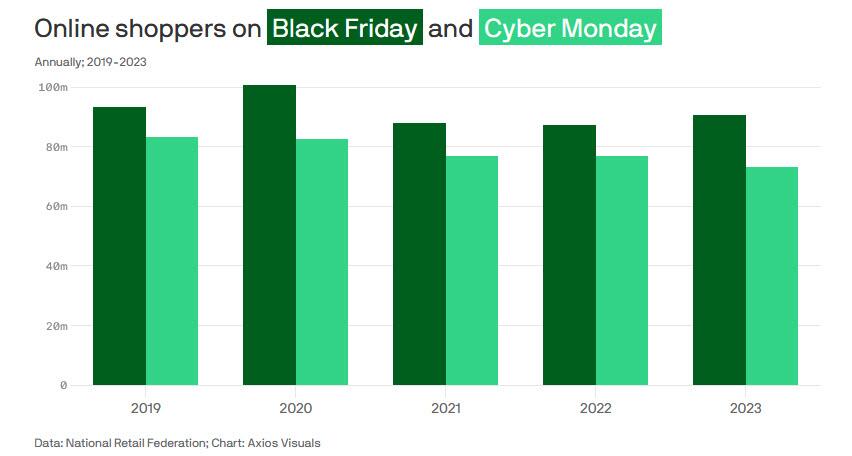
As a result, since 2019 there has been more online shopping on Black Friday than on Cyber Monday.

So while Cyber Monday was originally a way for retailers to squeeze an extra day of sales out of the Thanksgiving Day long weekend, in this day and age of constant attention for eyeballs among the “always online” population,, with each year Cyber Monday’s popularity continues to decline.

Tyler Durden
Tue, 12/03/2024 – 09:25

via ZeroHedge News https://ift.tt/Y3TguSV Tyler Durden

BBC Includes Male ‘Trans Woman’ On Top 100 Women List

BBC Includes Male ‘Trans Woman’ On Top 100 Women List

Via dailysceptic.org,

The BBC has included a male ‘trans woman’ Colombian scientist in its annual list of 100 inspiring women, just days after sparking controversy over its choice for women’s footballer of the year.

The Telegraph has the story:

Every year, the broadcaster compiles a list of women who have achieved great things in public life.

Its nominees include transgender biologist Brigitte Baptiste, described in the citation as a “trans woman” who “explores the common patterns between biodiversity and gender identity”.

The BBC says the scientist uses a “queer lens to analyse landscapes and species in a bid to expand the notion of ‘nature’ to better protect ecosystems”.

In a 2018 TED talk, Baptiste claimed scientists had discovered “transsexual” palm trees and stated that the “change of sex and gender has been reported regularly in science”.

On this basis, she argued that it was wise to do away with ideas of “naturalness” in nature, stating: “There is nothing more queer than nature.”

The broadcaster said: “BBC 100 Women acknowledges the toll this year has taken on women by celebrating those who – through their resilience – are pushing for change, as the world changes around them.” …

Zambian footballer Barbra Banda was honoured by the corporation despite being withdrawn from Women’s Africa Cup of Nations for high testosterone levels.

The BBC named Banda as its women’s footballer of the year for 2024.

Worth reading in full.

Fiona Crack, founder of BBC 100 Women and co-controller of BBC World Service languages and deputy global director, said:

“At the BBC, we are proud to shine a spotlight on these extraordinary women, from high-profile figures to those whose remarkable contributions often go unrecognised.”

‘Women’ – You keep using that word; we do not think it means what you think it means…

Tyler Durden
Tue, 12/03/2024 – 09:05

via ZeroHedge News https://ift.tt/BSnFrMa Tyler Durden

South Korea Declares Emergency Martial Law

South Korea Declares Emergency Martial Law

Moments ago, South Korean President Yoon Suk Yeol declared emergency martial law, accusing the opposition party of engaging in anti-state activities. This is not a headline you see every day.

Here are the headlines via AFP News:

  • SOUTH KOREA’S YOON SAYS GOVERNMENT ADMINISTRATION HAS BEEN PARALYZED BECAUSE OF OPPOSITION PARTY CONDUCTS

  • SOUTH KOREA’S YOON SAYS THROUGH MARTIAL LAW HE WILL REBUILD FREE AND DEMOCRATIC COUNTRY

AP News sheds more color on the situation: 

President Yoon Suk Yeol made the announcement during a televised briefing, vowing to “eradicate pro-North Korean forces and protect the constitutional democratic order.” It wasn’t immediately clear how the steps would affect the country’s governance and democracy.

Yoon — whose approval rating has dipped in recent months — has struggled to push his agenda against an opposition-controlled parliament since taking office in 2022.

Yoon’s conservative People Power Party had been locked in an impasse with the liberal opposition Democratic Party over next year’s budget bill. He has also been dismissing calls for independent investigations into scandals involving his wife and top officials, drawing quick, strong rebukes from his political rivals.

More saber rattling from President Yoon Suk Yeol, as per the Philippines news outlet Rappler:

“Yoon said he had no choice but to resort to such a measure in order to safeguard free and constitutional order, saying opposition parties have taken hostage of the parliamentary process to throw the country into a crisis.

“I declare martial law to protect the free Republic of Korea from the threat of North Korean communist forces, to eradicate the despicable pro-North Korean anti-state forces that are plundering the freedom and happiness of our people, and to protect the free constitutional order,” Yoon said.

Our take…

In a recent Korea Times op-ed, Chun In-bum, a retired ROK Lieutenant General, stated

Recent comments and accusations suggesting that the Yoon Suk Yeol administration may be creating a situation to declare martial law have reignited interest in the topic within South Korea.

Martial law is divided into two types:

  • emergency martial law, and

  • security martial law.

Emergency martial law grants the government sweeping powers, such as suspending the warrant system, restricting freedom of the press, curbing publication rights and limiting assembly and association, as well as overriding the authority of civilian courts and government agencies. When martial law is declared, the president must notify the National Assembly immediately. If the National Assembly demands its termination by a majority vote, the president is legally obligated to comply. While the National Assembly retains legislative authority, there are exceptional circumstances under which a military regime can temporarily assume control, particularly in the event of a coup that disrupts the normal constitutional order.

Martial law has a troubled history in South Korea. It was first declared on Oct. 21, 1948, in response to the Yeosu-Suncheon Incident, a rebellion by South Korean soldiers who refused to suppress a left-wing uprising. Since then, it has been used by various regimes as a mechanism to maintain power, often at the expense of civil liberties. One of the most infamous instances occurred in 1979, following the assassination of President Park Chung-hee. Martial law was declared nationwide, leading to the suppression of pro-democracy movements and widespread human rights abuses.

These historical abuses of martial law have left a deep imprint on South Korean society, creating a strong public aversion to any suggestion of its reimplementation. The memories of authoritarian rule, censorship and political persecution are still fresh for many citizens, particularly for those who lived through the turbulent decades of the 1960s to 1980s. The last declaration of martial law, in 1979, marked a period of intense social and political repression and the eventual rise of a democratic movement that culminated in the democratic reforms of the late 1980s.

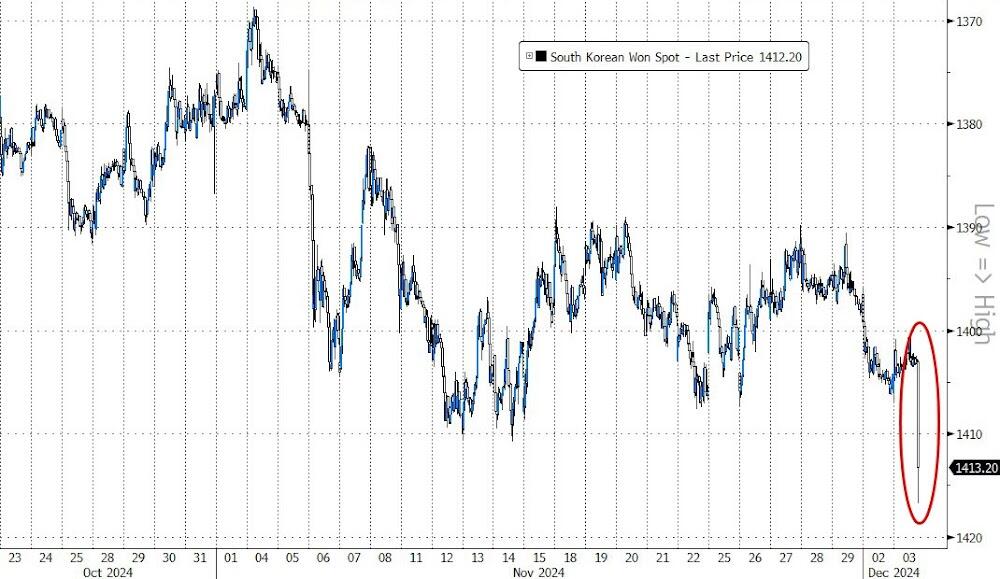
In markets, South Korea’s won dropped 1% to a two-year low of 1419.28 versus the dollar. 

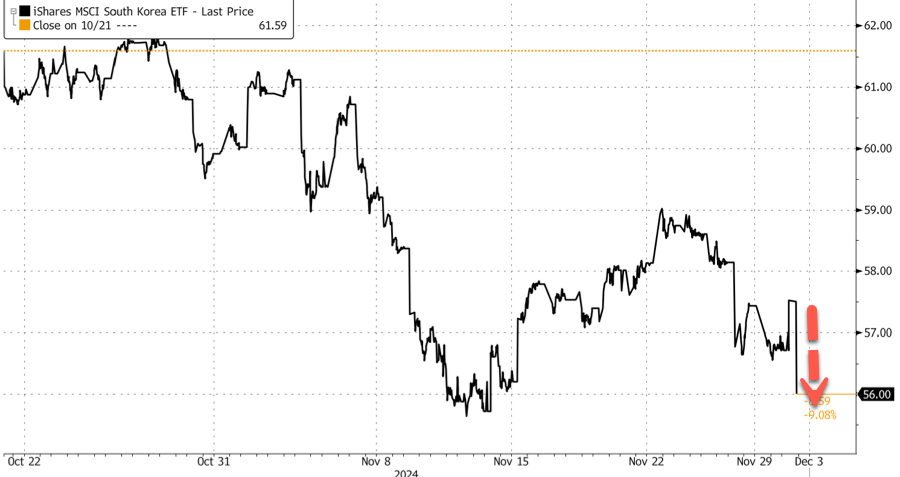
Ishares Msci South Korea ETF (EWY) falls 2.5% in premarket trading. 

*Developing…

Tyler Durden
Tue, 12/03/2024 – 08:47

via ZeroHedge News https://ift.tt/RQmAz5h Tyler Durden

The End Of Fake News? MSNBC Hits New Low In Ratings

The End Of Fake News? MSNBC Hits New Low In Ratings

Authored by Luis Cornelio via Headline USA,

The leftist “news” channel MSNBC is facing a ratings crisis, with some of its advertiser-coveted viewership dropping to a two-decade low, according to Nielsen data reviewed by Fox News

During the week of Nov. 6, MSNBC averaged just 38,000 viewers among adults 25-54, its lowest-rated non-holiday weekday since July 19, 2004.

As reported by Fox News, this demographic is widely prized by advertisers and is crucial for network revenue.

Low viewership impacted shows like The 11th Hour with Stephanie Ruhle and Jose Diaz Balart Reports, both of which saw their smallest audiences ever.  

Other shows—including Chris Jansing ReportsDeadline: White House and Katy Tur Reports—saw their worst days ever among the demos. 

Several shows lost over 50% of their 25-54 audience. Among those shows are The 11th Hour with Stephanie RuhleAll In with Chris HayesChris Jansing ReportsInside with Jen PsakiThe Rachel Maddow Show and Joy Reid’s ReidOut.

This slump couldn’t have come at a worse time, as MSNBC’s parent company, Comcast, announced cuts to cable channels, excluding NBC News and Bravo TV. CNN reports that MSNBC will be moved into “SpinCo,” a publicly traded cable programming company. 

Tech mogul Elon Musk has hinted at purchasing MSNBC, while journalist Jack Posobiec says he’s recruiting investors to take control of the left-wing network. 

Podcast host Joe Rogan joked about replacing Rachel Maddow if Musk buys MSNBC: “I will wear the same outfit and glasses, and I will tell the same lies.” 

Along with viewership and Comcast scandals, MSNBC is under the scrutiny of its viewers after Joe Scarborough and Mika Brzezinski met with Donald Trump, despite having previously compared him to dictators. 

Al Sharpton faces ethical scrutiny after his nonprofit quietly took a $500,000 donation from the Harris campaign ahead of his interview with Vice President Kamala Harris.

MSNBC conceded that Sharpton blindsided them with the donation. “MSNBC was unaware of the donations made to the National Action Network,” an MSNBC spokesperson told the Washington Free Beacon.

Tyler Durden
Tue, 12/03/2024 – 08:35

via ZeroHedge News https://ift.tt/lCRGYfb Tyler Durden

Futures Gain, S&P On Pace For 55th Record Closing High Of 2024

Futures Gain, S&P On Pace For 55th Record Closing High Of 2024

US equity futures are flat as the yield curve sees slight steepening; for once, the US is not benefiting from the risk-on rally seen in EU/APAC. As of 8:00am ET, S&P futures are fractionally in the green reversing earlier losses as traders await a busy line-up of Fed speakers and data releases after the index notched its 54th closing high of the year on Monday; Nasdaq 100 futures are down 0.1% even though Mag7 names are mostly higher in the premarket and Semis are bid. The USD is lower as the commodity complex catches a bid; WTI, silver, and sugar the outperformers; earlier Bloomberg reported China moved to restrict exports of rare earth metals to the US used in high-tech/military applications (gallium, germanium, antimony, and other superhard materials). Today’s macro focus will be on JOLTS and Vehicle Sales.

In premarket trading, Zscaler shares fall as much as 8.0% after the security software company gave a forecast for adjusted second-quarter earnings that missed expectations. Here are some other notable premarket movers

Anglogold Ashanti shares rise 3.7% after RBC Capital Markets upgraded the mining company to outperform from sector perform.

  • Credo Technology shares jump as much as 35% after the communications equipment company reported second-quarter results that beat expectations.
  • CVS Health gains 1.5% after Deutsche Bank upgrades the pharmacy chain to buy from hold, saying both earnings and the stock’s multiple appear to be near trough levels.
  • Janux Therapeutics shares soar 68% after the biotechnology firm announced positive updated interim clinical data for its oncology lead asset, JANX007.
  • Joby Aviation shares fall as much as 2.3%% after the all-electric vertical take-off and landing aircraft startup said its CFO Matthew Field notified the company he’d be resigning effective Dec. 13 for personal reasons.
  • Kroger shares advance 1% after Jefferies upgraded the retailer to buy from hold, and noted that the company has upside potential whether the acquisition of Albertsons goes through or not.
  • Microchip Technology shares decline 1.3% after the chipmaker said it planned to shut down a plant in Arizona, known as Fab 2. Additionally, the company sees third-quarter revenue being close to the low end of its original guidance.
  • TransMedics Group shares drop 8.0% after the medical-technology company narrowed its full-year revenue forecast. It also named a new chief financial officer.

The notable macro events this week include Friday’s payrolls report, which is expected to show hiring bounced back in November, preceded by Fed Chair Jerome Powell’s scheduled participation in a moderated discussion on Wednesday. Swaps are pricing a more than 70% chance of a quarter-point rate cut at the Fed’s Dec. 17-18 meeting.

“The market still expects the Fed will cut rates,” Mark Haefele, chief investment officer at UBS Global Wealth Management, said on Bloomberg Television. “We will see when the employment data comes through on Friday how brave you have to be. But I think the bias is still there and the market thinks there is still room to do that, given the overall picture.”

Elsewhere, Citi strategists said short sellers are capitulating as the S&P 500 keeps hitting record highs and is set for its best year since 2021, while positioning on European stocks remains bearish, further widening the gap between the two markets. According to Citi’s Chris Montagu, investor positioning in S&P 500 futures is “completely one-sided,” and is “setting new highs for a fourth consecutive week and increasingly the hold-out shorts are capitulating.”

Indeed, appetite for US equities has shown no sign of abating this year. The S&P 500 has surged 27%, powered by technology shares and a broad preference for US assets. The rally extended after the election of Donald Trump raised hopes of tax cuts and deregulation. By contrast, positioning on Euro Stoxx 50 futures remains net bearish while ETF outflows are accelerating. Investors are shunning the region’s stocks amid sluggish economic and earnings growth and political instability in France and Germany.

Much attention right now remains focused on Paris, where the government faces a vote of no confidence on Wednesday. French far-right leader Marine Le Pen is expected to join forces with a left-wing coalition to topple Michel Barnier’s administration.

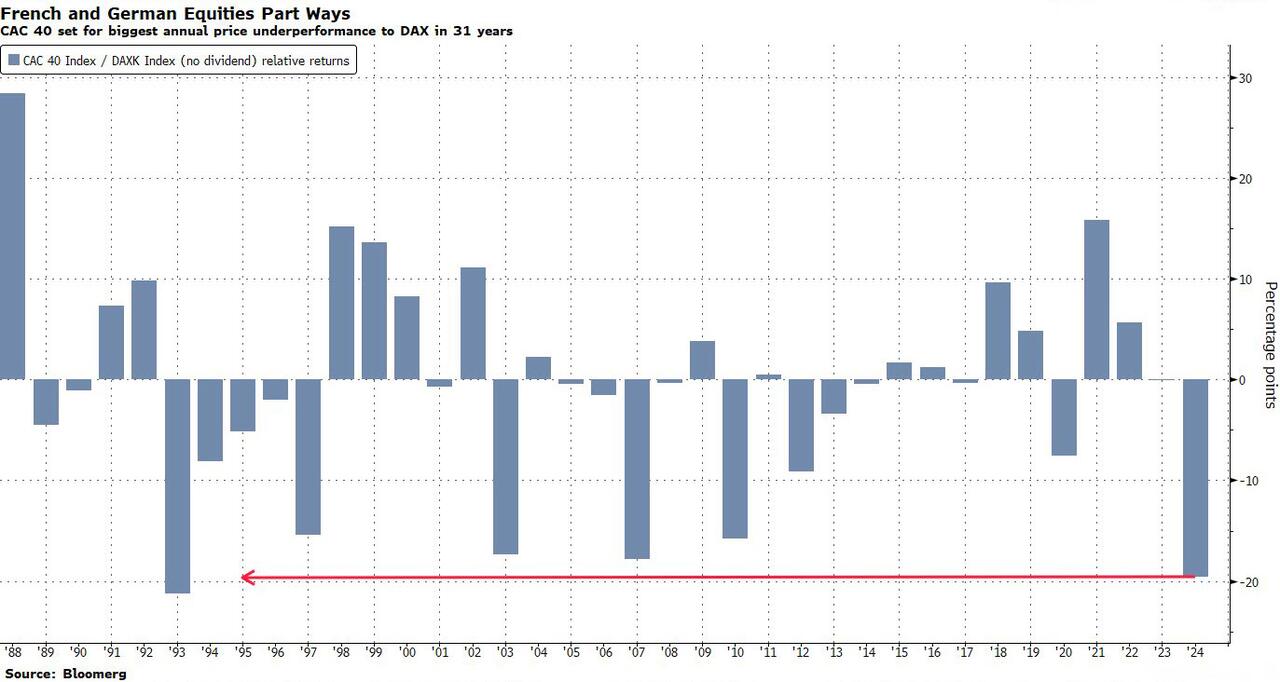
And speaking of Europe, stocks there rose, with the Stoxx 600 up 0.4%, as a rally for technology stocks drove a fourth straight day of gains for the benchmark, helping investors look past political risks in France. French stocks traded in line with their European peers on Tuesday, but the crisis has weighed on the CAC 40, causing it to trail neighboring markets like Germany, where the DAX Index rose above 20,000 points for the first time in its history. Here are the biggest movers Tuesday:

  • Hochtief shares rise as much as 5.9% after BofA upgraded its recommendation on the German infrastructure company to buy. The broker is positive about firms with US exposure going into 2025
  • BMW shares gain as much as 2.5% after UBS upgraded the German carmaker to buy from neutral, citing prospects for improved cash returns. Analysts say the firm is now their top OEM pick
  • SSP Group shares soar as much as 14% after the company, which runs food outlets in travel hubs, reported in-line annual results and said strong revenue growth has continued
  • Ceres Power shares rise as much as 3.2% after RBC upgraded the firm to sector perform, saying the British fuel-cell technology company is more insulated from headwinds versus peers
  • Greencore Group shares jump as much as 14% after the food company delivered a beat and raise, sweetened by the return of its dividend and a new share buyback
  • DiscoverIE shares gain as much as 16%, the most in a year, after the electrical component maker reported 1H results, prompting Shore Capital to upgrade its rating to hold from sell
  • Victrex shares jump as much as 17%, the most on record, after the specialty chemicals company reported results, with analysts noting decent trends in fiscal 4Q and reassuring comments about next year
  • Covivio shares drop as much as 11%, the most since April 2020, after Morgan Stanley downgraded the French firm to underweight from equal-weight, saying it may “lag” the real estate sector in 2025
  • Swiss Life shares fall as much as 4.2% after the insurer’s new targets were viewed as “challenging” by some analysts. JPMorgan says the payout ratio and cash remittances disappoint
  • Forvia shares drop as much as 6.1% as UBS downgraded the French car parts firm to neutral and set a Street-low price target, citing record uncertainty around the outlook for Europe’s car industry
  • Nel shares slide as much as 3.7% after RBC cut its recommendation to sector perform from outperform, citing slowing commercial activity with only two contracts announced this year
  • Grenergy shares plunge as much as 6.3% after the Spanish renewable company reported 9-month results impacted by low energy prices and a higher debt level

Earlier in the session, Asian stocks rose, on course for a third-straight daily gain, as semiconductor-related shares rallied after the US announced fresh curbs on technology exports to China. The MSCI Asia Pacific Index rose as much as 1.2%, with chip stocks TSMC and Tokyo Electron among the biggest boosts. Key benchmarks gained more than 1% in South Korea, Japan and Taiwan after the US unveiled measures to limit China’s access to crucial tech but stopped short of earlier proposals. Chinese stocks also reversed earlier losses after news that the country’s top leaders plan to start a key annual economic work conference next Wednesday to map out growth targets and stimulus plans for 2025.

In FX, a drop in the dollar gives relief to G-10 currencies, barring the yen, with a 0.3% decline to around 149.80/USD; the euro rises 0.3%, partly due to dollar weakness, while the CAC 40 climbs 0.6%.

In rates, treasuries are mixed in early US session with the curve steeper as long-end losses lift 30-year yields by ~2bp, steepening 2s10s and 5s30s spreads to day’s wides. US front-end yields are slightly richer on the day, widening 2s10s, 5s30s spreads by 1bp-2bp; 10-year yields around 4.21%, rising 2bps from Monday’s close, and outperforming bunds in the sector by 1.5bp, trails OATs outperforming by 2.5bp. In European bond markets, Germany’s is under pressure while France outperforms; French 10-year bonds are steady after a no-confidence vote was set for Wednesday, with the yield spread to comparable German debt hovering around 85 basis points. OAT-bund spread that widened the most in six months Monday is slightly narrower. German bonds underperform gilts and Treasuries across the curve, with yields rising most at the front end. Peripheral spreads tighten to Germany.

In commodities, oil climbed ahead of an OPEC+ supply meeting on Thursday, with the market supported by hopes China’s leadership will approve more stimulus at a major meeting next week. WTI trades within Monday’s range, adding 0.9% to around $68.73. Spot gold rises roughly $6 to trade near $2,645/oz. Spot silver gains 1.6% near $31.

Looking at today’s US economic data calendar, we get the October JOLTS job openings at 10am. Fed speaker slate includes Daly (12:15pm), Kugler (12:35pm), Goolsbee (1:30pm, 3:45pm)

Market Snapshot

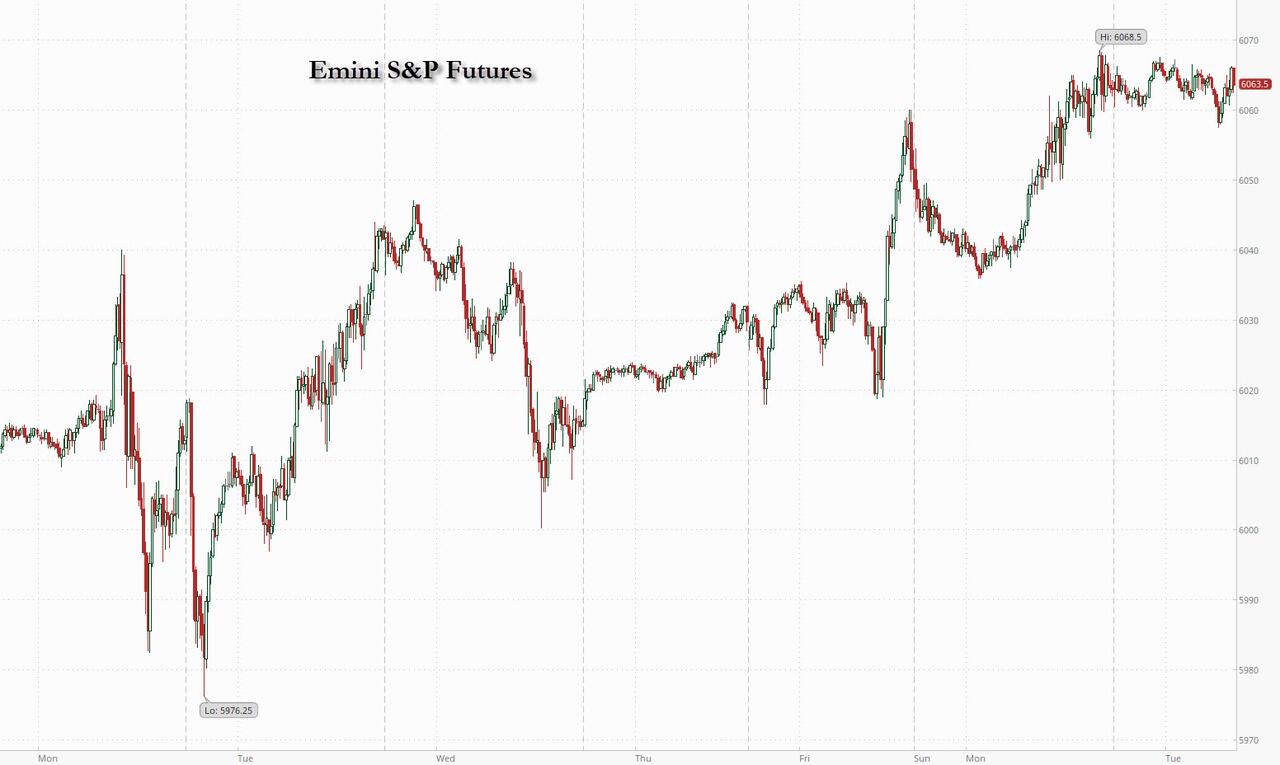
  • S&P 500 futures little changed at 6,062.75
  • STOXX Europe 600 up 0.5% to 516.11
  • MXAP up 1.3% to 187.38
  • MXAPJ up 1.2% to 586.44
  • Nikkei up 1.9% to 39,248.86
  • Topix up 1.4% to 2,753.58
  • Hang Seng Index up 1.0% to 19,746.32
  • Shanghai Composite up 0.4% to 3,378.81
  • Sensex up 0.8% to 80,917.24
  • Australia S&P/ASX 200 up 0.6% to 8,495.22
  • Kospi up 1.9% to 2,500.10
  • German 10Y yield little changed at 2.07%
  • Euro up 0.2% to $1.0520
  • Brent Futures up 1.0% to $72.58/bbl
  • Gold spot up 0.2% to $2,645.15
  • US Dollar Index down 0.18% to 106.26

Top Overnight News

  • China imposed an outright ban on the export of crucial chipmaking materials — including gallium and germanium — to the US, citing concerns over military usage and “abuse” of export controls. It comes after the US imposed fresh curbs on the sale of high-bandwidth memory chips to China. BBG
  • China’s Central Economic Work Conference, at which officials will discuss economic targets and stimulus plans for 2025, will commence on Wed 12/11. Mainland stocks rebounded, while the yuan slid to a one-year low despite fresh PBOC support. BBG
  • China’s crude oil imports are on track to peak as soon as next year as transport fuel demand begins to decline for the world’s top crude buyer, ending the country’s decades-long run as the dominant driver of expanding oil consumption. RTRS
  • Israel’s military said it “remains obligated” to a US-backed ceasefire after carrying out airstrikes in Lebanon yesterday in response to Hezbollah’s first attack under the truce. BBG
  • French lawmakers will hold a no-confidence vote Wednesday, with far-right leader Marine Le Pen expected to join forces with a left-wing coalition to topple the government. Prime Minister Michel Barnier used a constitutional mechanism on Monday to force through an unpopular budget, leading to a leftist coalition and Le Pen’s National Rally to call for votes of no confidence. BBG
  • The Fed’s John Williams expects more rate cuts will probably be needed “over time,” though stopped short of saying whether he would back a reduction this month. BBG
  • Donald Trump said he’ll block the Nippon Steel takeover of US Steel, instead pledging to revive it with tariffs and tax incentives. Separately, the president-elect picked investment banker Warren Stephens to be US ambassador to the UK. BBG
  • Intel CEO Pat Gelsinger’s exit may revive previously rejected deal options, including a split of the factory and product design businesses. BBG
  • BlackRock has agreed to buy private credit manager HPS Investment Partners for ~$12B in stock (HPS has ~$150B in AUM). WSJ
  • Fed’s Williams (voter) said he expects more rate cuts to happen over time and that monetary policy remains in a restrictive stance, while he added that what the Fed does with policy depends on incoming data and the outlook for the economy and policy remains ‘highly uncertain’. Furthermore, Williams expects US GDP at 2.5% this year but might be higher, as well as noted that they will need to bring interest rates down over time and it is unclear where the neutral rate is right now.

A more detailed look at global markets courtesy of Newsquawk

APAC stocks were mostly positive as the region took impetus from the fresh record highs seen in the S&P 500 and the Nasdaq. ASX 200 rose to a fresh record high with advances led higher by healthcare, tech and consumer discretionary. Nikkei 225 outperformed and reclaimed the 39,000 level with tech companies benefitting from further US export controls on China as restrictions related to advanced chips could spur a scramble for China to secure legacy-generation chip tools. Hang Seng and Shanghai Comp traded indecisively after the US unveiled a new package of chip export controls against China.

Top Asian News

  • China’s Semiconductor association say US chips are no longer “safe and reliable”. Relevant industries will have to be cautious about procuring these US chips.
  • China’s Internet Society call on domestic companies to carefully consider the procurement of US chips and seek to expand cooperation with chipmakers from other countries. US chip export controls have caused substantial harm to stable development of China’s internet industry
  • China’s MOFCOM bans to export of “dual-use items” relating to gallium, germanium, antimony and super-hard materials to the US. Tighter end-user and end-use vetting for graphite dual-use items which are exported to the US. Effective Dec. 3rd. Export of dual-use items to US military users or for military reasons is prohibited.
  • China is reportedly to hold the Central Economic Work Conference on December 11th-12th on 2025 economic growth targets and stimulus plans.

European bourses began the European session mostly in the positive territory, and sentiment continued to improve as the morning progressed, to display a sea of green in Europe. European sectors hold a strong positive bias, with only a handful of industries in negative territory. The top of the pile is populated by Banks, Travel & Leisure and Tech. The latter is buoyed by gains in heavy-weight ASML (+2.1%) after the Co. noted that the impact of export restrictions will fall within its existing outlook and will not have a direct material impact on business in 2024. Real Estate is the laggard. US equity futures are essentially flat and trading on either side of the unchanged mark, and unable to benefit from the positive momentum seen across the pond. RBC S&P 500 outlook: raises Communication Services to Overweight from Marketweight; cuts Healthcare to Marketweight from Overweight; cuts Materials to Marketweight from Overweight. China’s Auto Industry Body says Tesla (TSLA) sold 78,856 China made vehicles in Nov. (82,000 Y/Y).

Top European News

  • ECB’s Kazaks says a data-dependent and gradual approach are still appropriate, the pace and depth of easing will be determined by data and judgement.
  • France to hold no-confidence vote on Wednesday, 4th December. Press report that the vote will take place at 15:00GMT.
  • Barclaycard UK November Consumer Spending fell 0.5% Y/Y in November.

FX

  • USD is softer vs. peers as markets digest comments from the influential Waller at the Fed who stated that he is leaning in favour of a cut for the December meeting. Ahead, JOLTS ahead of speak from Fed’s Daly, Kugler and Goolsbee (twice). DXY is holding above the 106 mark and within yesterday’s 105.78-106.73 range.
  • EUR has been granted some reprieve vs. the USD. Albeit, it remains to be seen how long this will last given French political issues. The latest reports note that a no-confidence vote will take place at 15:00GMT on Wednesday. EUR/USD is back on a 1.05 handle and within yesterday’s 1.0460-1.0587 range.
  • GBP is firmer vs. the broadly softer USD with UK-specific drivers on the light side. As such, it is likely that events stateside will continue to dictate the state-of-play for Cable which is currently sat within yesterday’s 1.2617-1.2742 range.
  • Antipodeans are both near the top of the G10 leaderboard despite AUD facing some soft domestic data overnight and a softer CNY. The uptick in AUD/USD has led the pair back above the 0.65 mark. NZD/USD has been pivoting around the 0.59 mark.
  • CHF is modestly softer vs. the EUR following the latest Swiss inflation metrics which saw the Y/Y rate print at 0.7% vs. exp. 0.8% (prev. 0.6%) and fall short of the SNB’s Q4 average expectation of 1.0%.
  • PBoC set USD/CNY mid-point at 7.1996 vs exp. 7.2702 (prev. 7.1865).

Fixed Income

  • USTs are softer, weighed on by recent strong data which is lifting yields from the belly out. However, short-end debt is bid in the wake of Fed speak overnight with yields at the short-end pressured. Overnight, Waller said he is leaning towards a December cut, though noted one could argue the case for skipping and will be watching the data closely. USTs at the low-end of a 110-31+ to 111-06 band with the curve steeper.
  • OAT-Bund yield spread is narrowing down to 85bps having peaked just shy of 89bps on Monday. The main update in today’s session has been the timing of the no-confidence vote on Barnier, which is provisionally set for 15:00GMT on Wednesday.
  • Bunds are softer, with specifics somewhat light thus far and while ECB speak is in focus the likes of Cipollone haven’t added anything surprising. At the low-end of a 135.14-40 parameter, which is entirely within Monday’s 134.79-135.46 band. A fairly decent Schatz auction had little impact on Bund prices.
  • Gilts were trading in-fitting with peers going into the region’s own auction, in what has been a catalyst thin session thus far, aside from BRC Retail Sales data, which was weak. The auction saw a strong cover though both the price and yield tails were elevated when compared to recent taps, sparking some very modest pressure.
  • Germany sells EUR 3.607bln vs exp. EUR 4.5bln 2.0% 2026 Schatz Auction: b/c 2.3 (prev. 2.20x), average yield 1.94% (prev. 2.11%) & retention 19.84% (prev. 19.62%).
  • UK sells GBP 2.25bln 4.375% 2054 Gilt Auction: b/c 3.0x (prev. 3.08x), average yield 4.747% (prev. 4.735%), tail 0.4bps (prev. 0.3bps).

Commodities

  • A slightly choppy morning for crude benchmarks but underlying action is firmly bullish with WTI & Brent at the top-end of parameters and within proximity to yesterday’s USD 69.11/bbl and USD 72.89/bbl best. Complex benefitting from both reports that OPEC is likely to extend its latest output cuts and tensions around the Lebanon ceasefire.
  • Gold is trading at the top-end of a relatively narrow c. USD 15/oz range, peaked at USD 2650/oz overnight and while XAU remains firmer on the session it is yet to re-test the above high.
  • Base metals traded lacklustre overnight, but did catch a slight bid in tandem with the broader risk tone and the softer Dollar. 3M LME Copper probing USD 9.1k to the upside, a marked rebound from Monday’s USD 8.91k trough.
  • OPEC is likely to extend its latest oil output cuts until the end of Q1 2025 during its meeting on Thursday, according to OPEC+ sources cited by Reuters.
  • Premiums for Russia’s espo blend reach 2yr record of USD 1.30-1.50/bbl to brent, according to Reuters sources.
  • JPMorgan says Brent crude oil price is projected to average USD 80/bbl in 2024; says US Nat Gas 2025 price expected to average USD 3.50/MMBtu.
  • JPMorgan expects gold to rise towards USD 3,000/oz in 2025 with an average price of USD 2,950/oz in Q4 2025; says catch up trade later in 2025 could push silver prices towards USD 38/oz whilst platinum rallies to USD 1200/oz. Sees copper price towards USD 10,400/MT by Q4’25 and average USD 11,000/MT in 2026. Sees aluminium prices towards USD 2850/MT over H2’25.

Geopolitics

  • Israeli Defense Minister says if ceasefire collapses “we will no longer differentiate between Lebanon and Hezbollah”
  • Israeli forces blew up residential buildings in the Al-Geneina neighbourhood, east of Rafah in the southern Gaza Strip.
  • US Secretary of State Blinken met with Israel’s Strategic Affairs Minister Dermer and reiterated the importance of ending the Gaza war.
  • Syrian Armed Opposition Operations Department said they took control of Halfaya, Maardis and Taiba al-Imam in the northern countryside of Hama, according to Al Jazeera.

US Event Calendar

  • 10:00: Oct. JOLTs Job Openings, est. 7.52m, prior 7.44m

Fed speakers

  • 12:15: Fed’s Daly Is Interviewed Live on Fox Business
  • 12:35: Fed’s Kugler Gives Speech on Labor Market, Policy
  • 15:45: Fed’s Goolsbee Gives Closing Remarks

DB’s Jim Reid concludes the overnight wrap

Morning from Zurich where the DB Outlook roadshows roll on. There were lots of questions yesterday about the latest French situation as it became apparent that a French government collapse was increasingly likely. The situation went back and forth as the day went on, but ultimately, Marine Le Pen’s National Rally announced that they would support a motion of no confidence in the government of PM Michel Barnier. So along with the left-wing parties who are also backing the no-confidence motion, they have a majority in the National Assembly capable of bringing the government down, and this has led to a pretty serious market reaction. In fact, the Franco-German 10yr spread (+7.5bps) hit its widest level since 2012 yesterday, which was just before Mario Draghi pledged to do “whatever it takes” to save the euro. And the euro itself weakened by -0.75% against the US Dollar, marking its biggest daily decline since the week of Trump’s victory in the US election.

In terms of how the situation evolved yesterday, the prospects for the French government had looked pretty weak from the get-go. Indeed, the National Rally’s President Jordan Bardella said on RTL radio that “The National Rally will activate the censure vote unless of course there is a last minute miracle”. But around lunchtime, it was confirmed by the government that there’d be no change to the medication reimbursement system. So that pointed to a potential compromise with the National Rally’s demands, and the spread began to tighten again as it looked as though the government might survive. However, shortly after, Barnier announced that he’d push through the budget using special constitutional powers without a vote. So that saw the announcement of a no-confidence motion, which Marine Le Pen said she’d back after their demands weren’t met.

In terms of what happens next, we’re in territory that hasn’t been seen in a long time, as the last successful no-confidence motion was in 1962. That vote is likely to take place this week, possibly as soon as Wednesday, and assuming it’s successful, that would force the government’s resignation. In the short term, the government can remain in office as a caretaker government. But snap elections can’t happen again until the summer, as the French Constitution requires a one-year wait until another dissolution can take place, meaning that isn’t an option. So President Macron would have to propose a new PM, which could in theory be Barnier again, but there’s no reason to think a new government would be any more stable, given how fractured the National Assembly is. In terms of passing a budget, lawmakers could approve a special law authorising the government to collect existing taxes, and after that the government could allocate public spending by decree. However, this would only permit public spending that was part of the 2024 budget, rather than additional expenditures.

The likelihood of an imminent government collapse immediately led to fresh losses among French assets. For instance, the 10yr Franco-German spread ended the day at 88.1bps, the widest since 2012. Indeed, it also meant that the French 10yr yield (2.918%) closed only just below the Greek 10yr yield (2.927%), which just goes to show how investors’ assessment of sovereign risk has shifted over the last decade. For equities, the CAC 40 did manage to eke out a +0.02% gain, but that made it the worst performer of the big European indices, well behind the STOXX 600 that posted a +0.66% advance. Banks were hit in particular, with fresh losses for Société Générale (-2.61%), BNP Paribas (-1.24%) and Crédit Agricole (-0.87%), which built on their declines of the last two weeks.

Unlike the Euro crisis, there were no obvious signs of broader contagion to other countries yesterday. In fact, the 10yr Italian yield (-1.0bps) actually fell to a two-year low of 3.266%, and Spain’s 10yr yield (-2.4bps) fell to 2.768%, its lowest level in almost two years as well. Moreover, the push into safe assets meant yields on 10yr bunds (-5.4bps) saw the biggest declines, falling to its lowest since January at 2.034%. In the UK, the spread of 10yr gilt yields over bunds hit its widest since Liz Truss was PM, closing at 221.5bps yesterday. Matters weren’t helped there after the final UK manufacturing PMI for November was revised down six-tenths from the flash reading to 48.0, which is the weakest it’s been since February. So it continues the recent run where UK data has kept underwhelming expectations.

Outside of Europe, markets actually put in a decent performance yesterday, with the S&P 500 (+0.24%) moving up to yet another record high. One supportive factor was an upside surprise in the ISM manufacturing for November, which came in at 48.4 (vs. 47.5 expected). So even though it was still in contractionary territory, it was the strongest since June, and the new orders subcomponent (50.4) was in expansionary territory for the first time since March. That’s lifted up other growth estimates as well, with the Atlanta Fed’s GDPNow tracker for Q4 pointing to an annualised pace of +3.2%, which is its highest level to date.

That equity rally was led by further strength among big tech stocks, and the NASDAQ (+0.97%) and Magnificent 7 (+1.41%) moved up to record highs of their own. So it was a fairly narrow rally over the last 24 hours, and the equal-weighted S&P 500 actually saw a decent fall of -0.27%, moving off the all-time high it achieved last Friday.

In the meantime, US Treasury yields inched higher, with the 2yr yield up +2.9bps to 4.18%, whilst the 10yr yield rose +2.1bps to 4.19% (4.21% this morning). So that just about pushed the 2s10s curve back into inversion territory. The weakness on the 2yr might be pointing to a higher terminal rate, but investors yesterday priced in a greater chance of a rate cut this month. The chance of a cut closed at 76%, up 10pp from Friday, and the highest we have observed since US CPI data was released over 2 weeks ago. The uptick came after Fed Governor Waller spoke at the American Institute for Economic Research (AIER) Monetary Conference in Washington, D.C. last night. He said that “I am leaning toward continuing the work we have started in returning monetary policy to a more neutral setting,” signaling further cuts ahead, while adding that “an additional cut at our next meeting will not dramatically change the stance of monetary policy and allow ample scope to later slow the pace of rate cuts, if needed.” On the path of inflation he noted, “I believe the evidence is strong that policy continues to be significantly restrictive and that cutting again will only mean that we aren’t pressing on the brake pedal quite as hard.”

In Asia the Nikkei (+2.24%) is trading sharply higher and is leading gains in the region while the KOSPI (+1.75%) is also trading noticeably higher with the S&P/ASX 200 (+0.75%) also trading in positive territory. Elsewhere, Chinese stocks are mixed with the Hang Seng (+0.08%) slight up but with the Shanghai Composite (-0.86%) turning sharply lower as I type. US equity futures are flat. seeing slight gains while the CSI (-0.02%) is struggling to gain traction in early trade.

In FX, the Chinese yuan (-0.25%) is weakening for the third consecutive day, trading at a one-year low of 7.2913 against the dollar despite PBOC’s efforts to support sentiment as the central bank has been setting stronger-than-expected fixes since November.
To the day ahead now, and central bank speakers include the ECB’s Cipollone and Panetta, along with the Fed’s Kugler and Goolsbee. Otherwise, US data releases include the JOLTS report of job openings for October.

Tyler Durden
Tue, 12/03/2024 – 08:24

via ZeroHedge News https://ift.tt/aZi2c6N Tyler Durden

Telecoms Cable Between Sweden & Finland Damaged In Two Separate Places 

Telecoms Cable Between Sweden & Finland Damaged In Two Separate Places 

A land-based fiber-optics cable running across the border between Sweden and Finland was damaged in two separate locations on Monday. This incident comes weeks after EU investigators probed a Chinese-flagged vessel suspected of sabotaging undersea cables in the Baltic Sea. 

Internet provider Global Connect told AP News that the telecommunications cable was severed in two places in southern Finland. 

“The first damage has been repaired, and internet access has been mostly restored,” said Global Connect’s spokesman in Sweden, Niklas Ekström, adding that thousands of customers were briefly knocked offline. 

Ekström said, “We are still working on fixing the second damage.”

He noted that the first incident was related to construction work but provided no further details about what caused the second incident, stating: “We have no analysis on this so far.”

“The authorities are investigating the matter together with the company. We take the situation seriously,” Finland’s minister of transportation and communications, Lulu Ranne, wrote on X.

Euronews said, “Swedish media reported that Finnish police suspect a criminal offence in connection to the damaged cable.”

The incident comes weeks after two undersea fiber optic cables connecting Finland, Germany, Sweden, and Lithuania across the Baltic Sea were severed by what EU investigators believe was an act of sabotage by a 225-meter Chinese bulk carrier. NATO warships have since surrounded the vessel.

With wars ongoing in Eastern Europe and parts of the Middle East, spillover risks remain elevated, as terror groups, rogue nations, and or just plain bad actors may be intensifying sabotage efforts targeting infrastructure. 

Tyler Durden
Tue, 12/03/2024 – 07:45

via ZeroHedge News https://ift.tt/yqYFj8G Tyler Durden

“Already Pretty Far Down The Line”: The Container Store Could File For Bankruptcy As Soon As Next Year

“Already Pretty Far Down The Line”: The Container Store Could File For Bankruptcy As Soon As Next Year

As the retail apocalypse that started with Amazon and e-commerce continues, the latest victim is The Container Store.

The retail giant could file for bankruptcy as soon as next year, according to the New York Post, who said the retailer is blaming its recent descent on “a weak housing market and inflated prices” hurting sales.

The chain, based in Coppell, Texas, saw a pandemic-driven surge in 2020 and 2021 as homebound consumers, inspired by Marie Kondo’s Netflix show, embraced decluttering.

However, a sluggish housing market and persistent inflation have curbed moves, home renovations, and discretionary spending, shrinking demand for storage products. Or, in other words, people simply have less money for crap nowadays. 

The Post reported that the Container Store faces a “high probability” of bankruptcy next year, according to Tim Hynes, global head of credit research at Debtwire, following the path of retailers like Big Lots and LL Flooring.

Amid a record wave of store closures predicted this year by Coresight Research, The Container Store has shown signs of distress. In May, it suspended its earnings outlook and began a strategic review to address declining performance. In its latest quarter ending September 28, sales dropped 10.5%, with losses totaling $30.8 million.

A potential $40 million lifeline from Beyond, owner of Bed Bath & Beyond and Overstock.com, to stock Bed Bath & Beyond products appears in jeopardy. Last week, Bed Bath & Beyond hinted the deal might collapse, citing The Container Store’s inability to meet financing conditions.

Hynes said: “I don’t see any dramatic increase in holiday sales that will change the situation. They are already pretty far down the line.”

Incidentally, this also means a lot of bored housewives could be looking for new ‘projects’ heading into the New Year, so stay out of their way…

Tyler Durden
Tue, 12/03/2024 – 06:55

via ZeroHedge News https://ift.tt/ZwWKlo4 Tyler Durden