As Many As 200,000 Ukrainian Soldiers Have Deserted: Lawmaker

As Many As 200,000 Ukrainian Soldiers Have Deserted: Lawmaker

Authored by Kyle Anzalone via The Libertarian Institute,

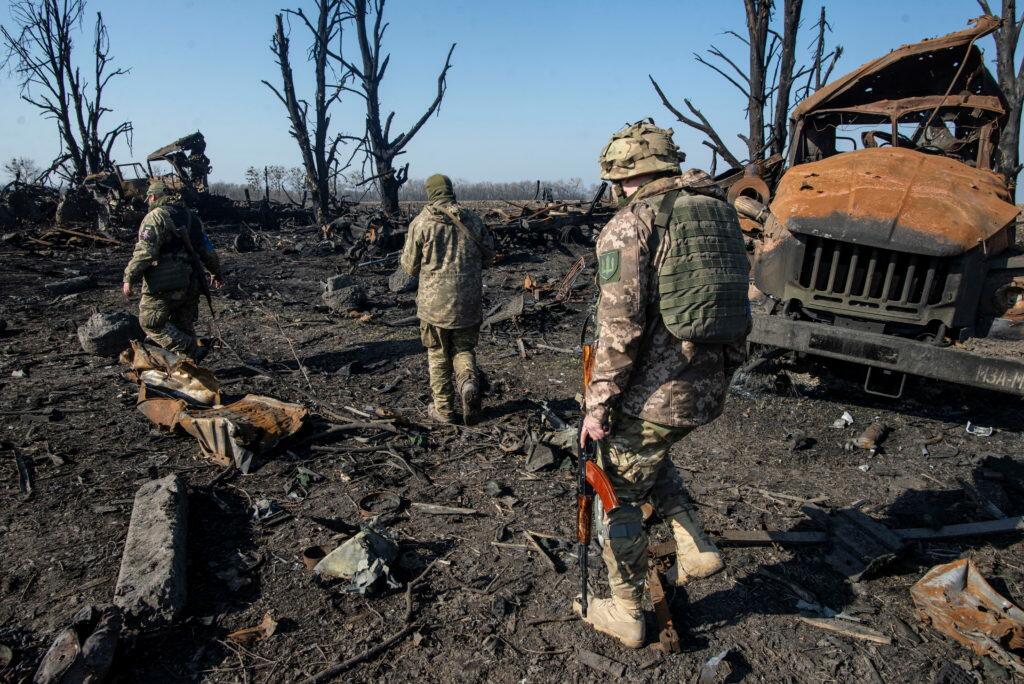
Ukrainian soldiers refusing to report for duty or walking away from their front-line positions are becoming an increasing problem for Kiev. One Ukrainian lawmaker said that there have been as many as 200,000 desertions

Ukrainian officials and soldiers told the AP that “Facing every imaginable shortage, tens of thousands of Ukrainian troops, tired and bereft, have walked away from combat and front-line positions to slide into anonymity.”

Ukrainian ground forces, via Reuters

The report adds, “Entire units have abandoned their posts, leaving defensive lines vulnerable and accelerating territorial losses, according to military commanders and soldiers.”

“Some take medical leave and never return, haunted by the traumas of war and demoralized by bleak prospects for victory,” writes The Associated Press. 

“Others clash with commanders and refuse to carry out orders, sometimes in the middle of firefights.”

Soldiers failing to report to their posts are a rapidly worsening problem for Kiev. In 2022, only 9,000 Ukrainians were prosecuted for desertion.

That number increased to 24,000 in 2023. Ukrainian government data showed prosecutions skyrocketed to 50,000 during the first nine months of 2024. 

The prosecutions do not capture the whole picture as one Ukrainian lawmaker told AP the number “could be as high as 200,000.”

The growing problem is likely a result of war fatigue.

“It is clear that now, frankly speaking, we have already squeezed the maximum out of our people,” said one military officer. 

Between casualties and desertions, Kiev is facing a massive manpower shortage. The AP noted Kiev lost a net 4,000 soldiers along the front lines in September. The White House is pushing Ukraine to lower its consumption age to 18 to help fill shortages.

Tyler Durden
Tue, 12/03/2024 – 06:30

via ZeroHedge News https://ift.tt/labRAOH Tyler Durden

These Are The Fastest-Growing European Economies In 2024

These Are The Fastest-Growing European Economies In 2024

European countries have faced significant challenges recently, including shrinking business activity and the euro hitting its lowest level against the dollar since 2022. Additionally, the threat of potential tariffs from a Donald Trump presidency in the U.S. has further weighed on the region.

Despite these headwinds, some nations have demonstrated robust economic growth in 2024.

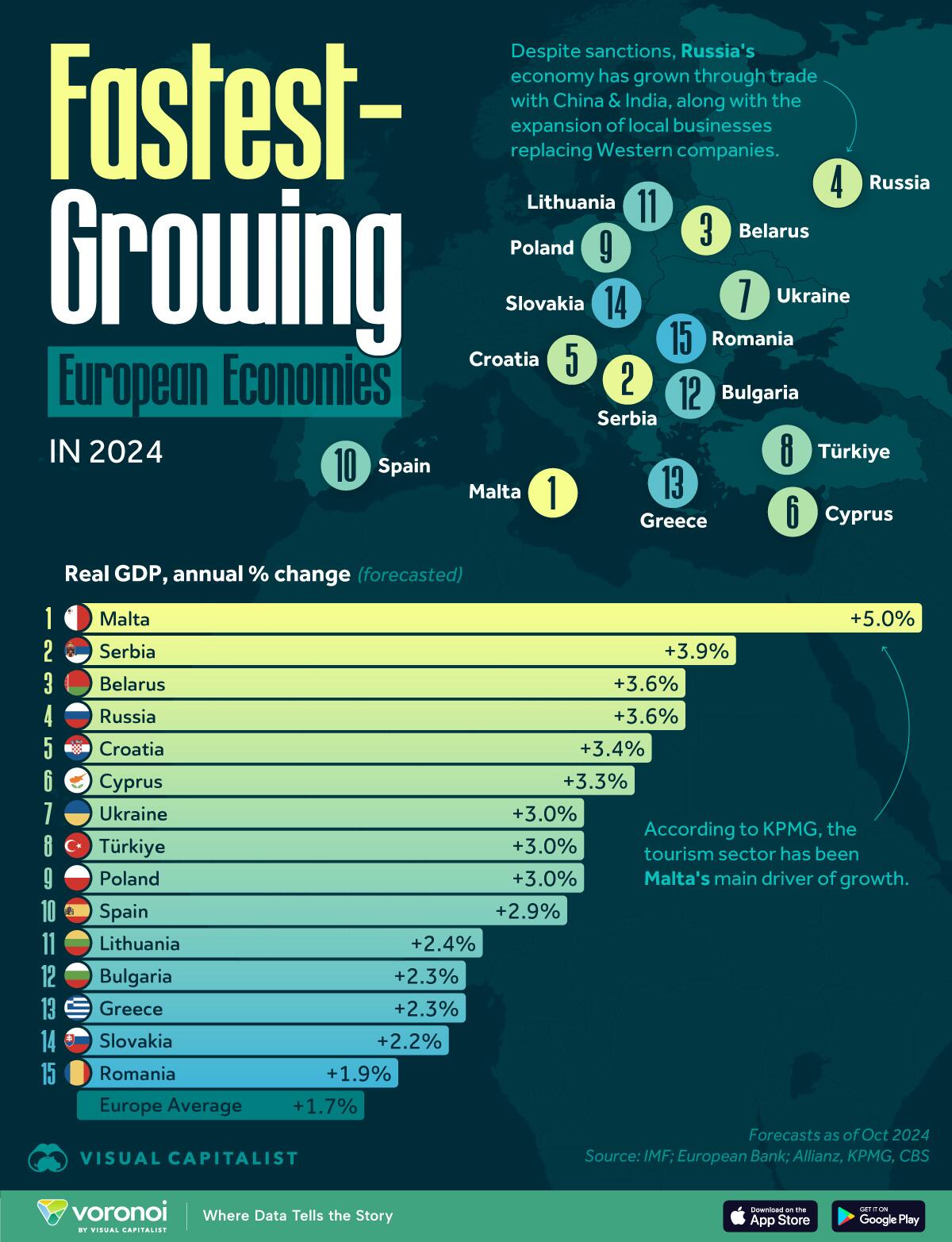
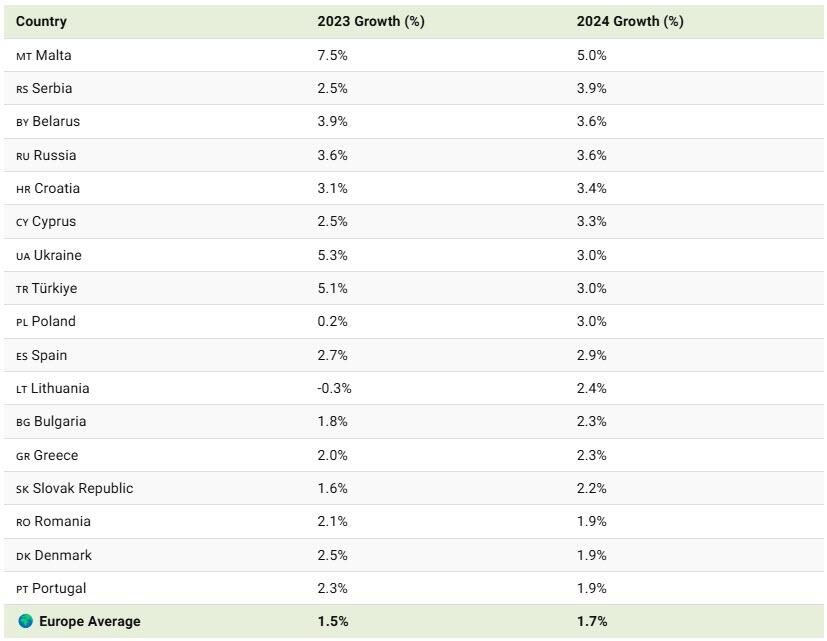
This graphic, via Visual Capitalist’s Bruno Venditti, ranks the top 15 European countries by their projected GDP growth for 2024, based on data from the IMF’s World Economic Outlook as of October 2024.

Malta and Serbia at the Top

At the top of the list, Malta stands out with an economy heavily focused on services, including tourism and financial services. The country also excels in manufacturing exports, particularly electronics and pharmaceuticals. Notably, Germany is Malta’s largest economic partner, accounting for 13% of its exports.

Serbia’s economy has also gained momentum in 2024, driven by services such as trade, tourism, catering, and construction.

The Impact of the Ukraine War

Russia’s economy, despite facing sanctions, has expanded through increased trade with China and India, along with growth in local businesses replacing Western companies.

Meanwhile, Ukraine’s economy is expected to grow by 3% this year, despite months of heavy Russian attacks on its energy infrastructure. This growth has been supported by the opening of a Black Sea export corridor along the coast last year and substantial aid from international partners, including EU institutions and the United States.

If you like this visualization, make sure to check EU’s Major Trade Partners in One Chart.

Tyler Durden
Tue, 12/03/2024 – 05:45

via ZeroHedge News https://ift.tt/hKYi1HB Tyler Durden

Panama Delists 6 Flagged Ships Over UK Russia Sanctions

Panama Delists 6 Flagged Ships Over UK Russia Sanctions

By Alex Kimani of OilPrice.com

Panama said it will cancel the registration of six ships sailing under its flag after they were sanctioned by the UK last week.

The delisting comes after Panama’s maritime authority in October pledged to penalize vessels sanctioned by the U.S., European Union, UK and United Nations.

Safeguarding the prestige of our flag is a top priority for this administration. The state has a fundamental responsibility to protect the integrity of the Panamanian ship registry, ensuring it remains free from international sanctions and unlinked to vessels associated with such listings,” Ramon Franco, director general of merchant marine at the Panama Maritime Authority, said in a statement.

Moscow continues to export large volumes of crude despite sanctions by the West.

Earlier in the year, Panama Canal authorities engaged in talks with U.S. LNG producers on how to meet increased demand for crossings as water levels recovered. The canal authorities worked with shippers to secure more passage for LNG customers, with plans to build water reservoirs as a solution to mitigate climate change-related shortages.

Last year, Europe accounted for 66 percent of total U.S. LNG exports, followed by Asia at 26 percent and Latin America and the Middle East with a combined eight percent.

However, Cheniere Energy is highly optimistic about Asian LNG demand, despite some countries with large gas-reliant economies currently hampered by poor credit ratings.

They tend to rely more on state-to-state agreements. Obviously that is not something we can participate in. We see Thailand, Philippines as very attractive markets,” Chief Commercial Officer Anatol Feygin told Reuters. Feygin expects China to import 100 million metric tons per year in the future, up from about 64 million metric tons in 2022.

However, Europe’s likely to continue being the leading consumer of U.S. LNG for years to come, with the continent poised to cut off more Russian gas.

Earlier, Politico reported that the European Commission proposed sanctions on Russia’s LNG sector as part of Brussels’ 14th sanctions package against Russia.

Tyler Durden
Tue, 12/03/2024 – 05:00

via ZeroHedge News https://ift.tt/P6QKfkD Tyler Durden

Germany Is Run By “A Government Of Idiots”: RyanAir CEO Slams Greens’ “Stupid Solutions”

Germany Is Run By “A Government Of Idiots”: RyanAir CEO Slams Greens’ “Stupid Solutions”

Authored by Liz Heflin via Remix News,

In an interview for the industry magazine “Airliners,” Ryanair CEO Michael O’Leary attacked German politicians, calling them “a government of idiots,” criticizing in particular the Greens, whom he accused of “stupid solutions,” reports DoRceczy.

He was also skeptical about the future government of the Federal Republic of Germany.

“I don’t think the next government of Germany will be any better,” he said.

Ryanair’s boss described the German aviation market as one of the worst in Europe, calling Berlin’s BER airport “dysfunctional,” adding that the airport could only function as “a regional airport at best.”

According to him, high fees of over €50 per passenger are a key reason why the German aviation industry is only slowly recovering from the coronavirus pandemic.

This is why Ryanair has already reduced its German capacity from 16 million to 13.5 million seats.

The fleet of 300 aircraft will be moved to more attractive markets, with the location “determined strictly on the basis of expected profits,” he said.

Ryanair will be withdrawing completely from Dortmund, Dresden, and Halle/Leipzig airports by March 2025, while Hamburg will see its flights cut by 60 percent, BER by 20 percent and Cologne/Bonn by 10 percent.

“Further cuts could come next year with the summer flight schedule, as Ryanair increasingly favors lower-cost destinations outside Germany,” DW reports.

Read more here…

Tyler Durden
Tue, 12/03/2024 – 03:30

via ZeroHedge News https://ift.tt/AQ4oBUE Tyler Durden

Scholz In Surprise Ukraine Visit Inspects Kamikaze Drones, Unveils $680M New Arms Package

Scholz In Surprise Ukraine Visit Inspects Kamikaze Drones, Unveils $680M New Arms Package

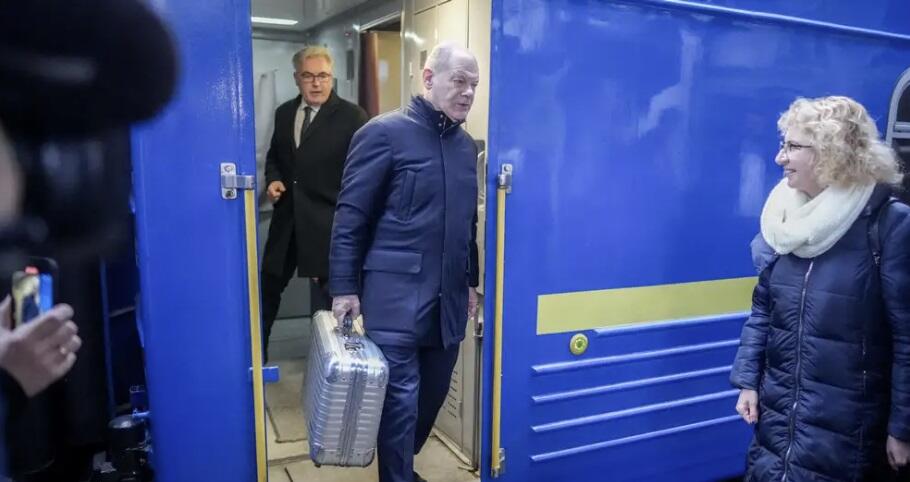
German Chancellor Olaf Scholz made a surprise visit to Kiev on Monday, which marked his first trip to Ukraine in two-and-a-half years, having arrived by train after which was greeted by President Zelensky.

“Winter is just around the corner, so there will also be winter equipment, as well as hand-held weapons and warming devices,” a German defense ministry spokesperson said while commenting on the German leader’s visit.

dpa/picture alliance

Scholz used the unannounced visit to unveil another massive military aid package at 650 million euros, or $680 million, to be transferred by the end of the year.

The supposed urgency of the aid is meant to underscore the alarm European leaders feel as Trump is set to enter the White House on Jan.20. He has promised to immediately begin negotiating an end to the war with Moscow.

“I would like to make it clear here on the ground that Germany will remain Ukraine’s strongest supporter in Europe,” said Scholz. “Ukraine can rely on Germany — we say what we do. And we do what we say,” Scholz additionally stated a post on social media.

Zelensky has in turn stated that his forces must become stronger amid reports that negotiations with Moscow are all but inevitable. He stressed that diplomacy could be an option “only when we know that we are strong enough.”

Scholz while in the Ukrainian capital inspected Western and German supplied kamikaze drones, which have been described as a “low-cost barrage munition”…

Simultaneous to Scholz being in Ukraine, German German Foreign Minister Annalena Baerbock is on an official visit to Beijing, where she blasted that Chinese-made drones are showing up in the Ukraine conflict, deployed by the Russian side.

“Drones from Chinese factories and North Korean troops attacking peace in the center of Europe violate our core European security interests,” Baerbock said just after a meeting with China’s top diplomat Wang Yi.

She told Wang that “increasing Chinese support for Russia’s war against Ukraine has an impact on our relations” and that this means “core German and European security interests are affected.” The West has condemned the ‘internationalization’ of the Ukraine war, after North Korean troops joined the Russian side; however, the clear double-standard is seen in the fact that the US and Europe haven’t batted an eye in providing massive NATO support to Kiev from the start.

Tyler Durden
Tue, 12/03/2024 – 02:45

via ZeroHedge News https://ift.tt/gD8inLP Tyler Durden

Erdogan Backstabs His Way Into Center Of Middle East Conflict

Erdogan Backstabs His Way Into Center Of Middle East Conflict

Authored by Conor Gallagher via NakedCapitalism.com,

Turkish President Recep Tayyip Erdoğan just had a phone call with his Russian counterpart Vladimir Putin on Nov. 24 in which the former reportedly talked up plans to expand cooperation as the two countries have done in recent years. Part of that includes years of Moscow holding the hands of Erdogan and Syrian President Bashar al-Assad in an effort to mend ties due to Türkiye’s key role in the dirty war effort to topple the Assad government.

Beijing was also interested in seeing that reconciliation happen and were led by Erdogan to believe it was in the cards and that Türkiye’s days of launching jihadi operations were over.

The Turkish people are also overwhelmingly against the Israel-US rampage through the Middle East, and Erdogan has spent the past year-plus railing against their crimes and selling the people on stopping the flow of supplies to Tel Aviv vital for its genocidal operations (in reality he’s only been disguising it).

Erdogan stabbed them all in the back when it launched its paramilitary forces in northwestern Syria into action last week in the most intense fighting in northwestern Syria since 2020, when Russian-backed government forces seized areas previously controlled by opposition fighters.

US proxies — Ukrainian neo-Nazis, Islamic fundamentalists, and Zionist genocidaires — are all converging on Syria in a renewed attempt to topple Syrian President Bashar al-Assad or at least peel off more territory ahead of any potential settlement and weaken the influence of Tehran in the country.

Türkiye, as the biggest backer of the Islamist paramilitaries Hayat Tahrir-al-Sham (HTS), formerly known as Jabhat al-Nusra, is playing a central role. Turkish Foreign Minister Hakan Fidan is denying Ankara involvement, but while that’s implausible enough given that Türkiye has long provided all types of support, it’s even more so considering that the Turkish-backed Syrian National Army militia reportedly participated in the battle alongside HTS. Elsewhere, Turkish security sources are saying they attempted to prevent the offensive but were unsuccessful while adding that it’s only “a limited offensive.”

While many in various corners are celebrating the offensive thinking this will weaken Russia (reports are that Russia is having to send reinforcement to Syria) and finally topple the hated Assad, a few things to keep in mind:

What Is Türkiye Doing in Syria?

Here is the state of the situation in Syria as of Sunday morning, according to Elijah J Magnier:

The Syrian opposition forces, primarily led by Hayat Tahrir al-Sham (HTS) and Ahrar al-Sham, with support from Islamist jihadist groups, have launched a significant ground offensive over the past 48 hours in rural Idlib, rural Aleppo, and parts of Aleppo city supported by drones and armoured battalions. In a rapid and well-coordinated advance, they have captured dozens of villages, including strategic areas along the M4 and M5 international highways connecting Damascus to Aleppo and Aleppo to Latakia, as well as the critical cities of Saraqeb and most of Aleppo. With the Syrian army’s defensive lines nearly nonexistent, it appears only a matter of time before opposition forces gain complete control of Aleppo city. Reclaiming these losses would require tens of thousands of troops, a resource the Syrian army does not currently possess.

Some reports now say that the opposition groups are already in control of Aleppo and Syrian government forces fell back to prepare for a counterattack.

The Turkish-backed offensive is conveniently timed to coincide with the Lebanon “ceasefire,” and according to Yedioth Ahronoth, Israeli officials view the advance on Aleppo as an opportunity to weaken Syria. That is unsurprising as it’s widely believed that Israel, thwarted in its ground invasion of Lebanon, has circled back to its previous backup plan following its 2006 failure in Lebanon, which is to eliminate Iran’s ability to resupply Hezbollah via Syria.

Türkiye is helping. As Syrian Foreign Minister Bassam Sabbagh said on 29 November, the Turkish-HTS offensive comes “within the framework of serving the goals of the Israeli occupation entity and its sponsors.”

Not only are Erdogan’s denunciations of Tel Aviv empty words, but it appears he is actively conspiring with Netanyahu and the US in Syria.

According to AFP and Russia’s Izvestia, Turkish intelligence gave the green light to and is helping to direct the offensive. It was coordinated between Turkish, Ukrainian, and French intelligence, with Israeli backing and US approval. HTS also receives considerable support from Ukrainian special forces with a focus on drone warfare to target Russian and Syrian positions — a connection facilitated by the Turks.

The US, like Turkey, is denying any involvement in the HTS-led offensive, but claimed the reason for Syria’s problems are Assad’s “reliance on Russia and Iran.”

Elsewhere in Syria, Israel is working in tandem with ISIS. Here’s what Syrian researcher, former soldier and journalist Ibrahim Wahdi told Vanessa Beeley about one such IAF attack on Syrian forces in Palmyra:

Local sources said that the Zionist aggression on the SAA and auxiliary forces in Palmyra city came during their rest after returning from military missions in the central Syrian desert.

According to field sources these units had been engaged in fierce clashes with ISIS terrorist groups in the Al Shoula area of the Deir Ezzor desert after they had been spotted infiltrating from within the US-imposed 55km exclusion zone around the US unlawful military base of Al Tanf on the border with Jordan, taking advantage of heavy fog to try and advance towards Syrian allied positions.

The Syrian allied forces routed the ISIS terrorists and caused significant injures and deaths among their ranks. Israel attacked Palmyra from the Al Tanf “protected” airspace therefore we can conclude that Israel was supporting the ISIS terrorist operations with airstrikes against the forces that have been entirely responsible for the defeat of ISIS in Syria with the help of the Russian Airforce since September 2015.

Beeley’s conclusion:

Israel is trying to decimate the Syrian Air Defence capability, demoralise and deplete Syrian armed forces and to destroy the essential infrastructure that provides a road link to Lebanon and the Hezbollah resistance forces. At the same time the US and Israel are bombing the Al Bukamal border crossing with Iraq to try to close the land bridge between Iran, Iraq, Syria and Lebanon. Thus they are intending to isolate both Lebanon and Syria from their allies and to break the links in the Resistance chain of supply which includes humanitarian aid, energy resources to combat the US occupation of Syrian resources, and military equipment to support the Resistance.

…The plan is clear – to deplete Syrian military capability and to keep the Syrian Arab Army busy on multiple fronts – in the north-west (Idlib), in the north (Türkiye and former Free Syrian Army proxies), in the north-east (US and Kurdish Contras), in the east (US base at Al-Tanf incubator for terror gangs including ISIS) and in the south (possible land invasion by Israel and Druze separatists backed by Israel, remnants of illegal armed groups in Daraa and surrounding countryside).

HTS (at that time still known as Al Nusra) and other jihadist groups previously had control of the majority of Syrian territory in the mid-2010s, before a major intervention by Russia, Iran and Hezbollah swung the situation in the other direction. According to Military Watch, the only reason HTS can continue to operate northwestern Syria is because Turkey has the area under its protection with military bases. Past Syrian efforts to defeat HTS and retake Idlib were squashed by the Turks, including air and artillery support to target Syrian positions and protect jihadists.

Turkey by assisting HTS and others in the current offensive — if not directing it — is violating the 2019 agreement it sponsored along with Russia and Iran to freeze the line of the conflict.

Since that 2019 agreement the US has kept up sanctions in an effort to strangle Syria while Israel continued to bomb groups that it claimed were Iranian revolutionary guards or Hezbollah militants. It would appear Erdogan simply used the 2019 freeze not to work towards a permanent peace with Assad’s Syria, but to rearm and prepare.

Erdogan Calculations

Erdogan’s interests in this case overlap with the US-Ukraine-Israel group. The diehard neo-Ottoman ambitions of Erdogan and his clique, which wish to see Turkey strengthen its influence over much of the former empire, coincide with the US-Ukraine-Israel’s desire to curtail Russian and Iranian influence curtailed in the region.

At the bare minimum Türkiye is looking to get more territory under its and its proxies control in Syria ahead of any permanent settlement (potentially under Trump II) for refugee return and which would also allow Ankara better positioning to neutralize the Kurdish forces it sees as a threat. Türkiye hosts more than three million Syrians, which Erdogan is under pressure domestically to do something about, and has been accused of coercing thousands into signing declarations of “voluntary return.” As the security environment “strengthens” in Syria, Erdogan says more Syrians will be expelled from Türkiye.

That’s the generous view. The other is that all Erdogan’s talk about joining the BRICS, SCO, statements against Israel, thawing ties with Assad, (Syria wants Erdogan to withdraw troops and Islamist paramilitary groups before normalizing ties, which Erdogan refuses to do) have been a big head fake.

Burning Moscow — Again

Ankara faces a difficult balancing act with Moscow. Türkiye does not want to see Russia (or Iran) become too strong in the region and has always used the US as a counterweight. At the same time, Russia and Türkiye have a mutually beneficial economic relationship — one that has been critical to Erdogan’s political survival and helpful to Moscow in bypassing Western sanctions.

The US is increasingly putting that arrangement under strain by slapping more sanctions on Turkish and Russian entities, including recent restrictions on Gazprombank, which is linked to the Russian gas giant. Ankara is trying to get the US to agree to a waiver, a decision Washington would be unlikely to take without something in return.

Türkiye gets nearly half of its natural gas and a quarter of its oil from Russia on good deals. Russia even showed flexibility on payment to help Erdogan get re-elected this year.

Russian tourism to Turkiye has gone through the roof since the war in Ukraine and western sanctions started. Russia is also completing work on a nuclear power plant in Türkiye, a major milestone for the country on a deal beneficial to Türkiye, which includes the training of nuclear engineers by the Russians. Not only that, but Ugur Gurses, a former Turkish central banker, believes the Russians were using that plant to  transfer funds by purchasing Turkish bonds instead of direct bank transfers in a boost to Türkiye’s foreign reserves in a bid to help Erdogan get re-elected, which he did in the closest call in his two-decade rule.

Erdogan’s calculations in Syria likely conclude that Russia cannot retaliate too hard… yet. Erdogan similarly reneged on a deal with Russia last year when he returned Azov fighters in Turkish custody to Ukraine in violation of a prisoner exchange deal. While Moscow would no doubt be furious over Turkish support for the Syrian offensive, Russia  also wants to ensure going forward that Türkiye will continue to keep the Turkish Straits closed to NATO warships thereby keeping them out of the Black Sea. Russia wants to continue to send oil and gas to and through Türkiye to remaining European customers. Russia also needs to maintain good ties with Azerbaijan, which is close to Israel and Türkiye, for transport corridor purposes.

Meanwhile, Türkiye is getting a lot of good will from the West recently.

It looks like the US is rethinking the sale of F-35s to Türkiye, which was dropped from the program over its purchase of Russian S-400 missile defense system. It was rumored that Türkiye would have to hand over the S-400s for readmission to the F-35 program, but in light of the recent developments in Syria, maybe that’s not what the Americans were after. Der Spiegel recently reported that Germany’s Federal Security Council, which meets in secret, is approving the sale of $368 million worth of heavy weaponry to Türkiye, as well as reconsidering Türkiye’s request to purchase Eurofighter warplanes. That’s big news as it marks the end of a years-long unofficial embargo imposed by Western allies on Türkiye, which has hampered its defense sector development.

Burning China and the SCO

One of the biggest items on the Shanghai Cooperation Organization (SCO) agenda at this summer’s summit, which Türkiye attended, was the resolution of the Syria issue.

The SCO has always emphasized the importance of combating terrorism and radicalism, especially in Central Asia where the US has tried to stir up trouble in recent years to no avail as investment by China and Russia in these countries dwarfs what the West has on offer. The recent summit, however, was seen as an expansion of the SCO’s ambitions to become the security provider to the Eurasian continent.

What the SCO wants to guard against above all else is efforts by the West to use terrorism or any other division strategies to thwart the growing power and economic integration of its member states.

Erdoğan attended the SCO summit and played up Türkiye’s potential contributions to the organization. Here he is alongside President Xi Jinping:

“The organization has become one of our important dialogue channels with Asia owing to our dialogue partner status, which we’ve held since 2013,” he said. “Our many years of experience fighting terrorism show that international cooperation is essential to dealing with this threat. In this context, we are ready to further strengthen our dialogue with the Shanghai Cooperation Organization.”

In reality, Erdogan has done more supporting of terrorism than fighting. The Idlib governate straddling the Turkish border controlled by jihadist groups and supported by Ankara for is the primary hub of Islamist terror operations not only in Syria but also one of the biggest in the world.

Erdogan had an opportunity to wind that down, but instead looks to be doubling down, and Beijing is sure to be upset with his latest demonstration that he cannot be trusted.

Erdoğan, once an outspoken critic of Beijing due to its alleged treatment of Uyghurs, a Muslim minority of Turkic origin in western China, has almost completely dropped his criticism in recent years.

Both Erdoğan at the SCO summit and FM Fidan on his summer trip to China (where he said Türkiye “will not allow activities in Türkiye that undermine China’s territorial integrity” in reference to support for jihadists that could aid Xinjiang separatists) were asking for more investment from Beijing in Türkiye. (The EU-27 countries still contribute 59 percent of Türkiye’s foreign direct investment inflows.)

Beijing was slowly obliging. Chinese automotive company BYD recently announced that it will construct a $1 billion plant in western Türkiye. Ali Baba is planning to invest $2 billion in Turkiye. The Chinese lithium-ion power batteries company Farisis started production at a plant near Istanbul last year. Ankara is also in separate talks with Chinese EV makers SAIC Motor Corp., Chery Automobile, and Great Wall Motor Co for investments in factories in Türkiye.

One wonders if Beijing is rethinking.

Shortsighted Calculations?

Erdogan’s ongoing support for extremist groups not only puts the economic relationship with China and Russia at risk, but if he’s doing so in part due to promises from the West, that could end up coming back to bite him. Like Erdogan, the US-led West is not agreement-capable, and any sanctions relief, F-35 deals, or Zangezur corridor promises could be snatched away as quickly as they’ve been gifted.

There’s also a good chance that Türkiye is throwing in with the losing side. An Iranian response to Israel is supposedly still coming. This renewed push by US proxies in Syria makes it more likely it’s going to be a strong one this time.

And the Moscow and Damascus response is already underway in Syria. From Military Watch:

…it was reported that over 400 militants were killed in the first 24 hours of engagements. The casualties were reported by deputy chief of the Russian Center for Reconciliation of the Opposing Parties in Syria, Captain 1st rank Oleg Ignasyuk, who stated: “Illegal armed units linked to the Jabhat Al Nusra terrorist organization started to attack government-controlled areas in the provinces of Aleppo and Idlib at 7:50 a.m. on November 27. The Syrian army, backed by Russia’s Aerospace Forces, is engaged in heavy fighting. Terrorist units suffered major troop and equipment losses in the past 24 hours. At least 400 militants were eliminated.” The figures appear credible when considering Al Nusa’s demonstrated ability in the past to absorb massive casualties during its offensives, as well as the heavily fortified nature of the Syrian Arab Army’s positions between Aleppo and the Idlib governate where the jihadist group’s forces are based. Reports have indicated that foreign advisors supporting the offensives of have also been killed, with both Türkiye and Ukraine having provided such support to Al Nusra in the front.

According to Larry Johnson at Sonar21“Reports on Telegram indicate that Syria, with ample support from Russia, are responding effectively to defeat the HTS attack. “

As referenced above, Russia might want Türkiye’s cooperation on the Black Sea and economic fronts for now, but for how much longer is it deemed necessary? Put another way, at what point does the cost of catering to Erdogan outweigh the benefits?

Maybe Russia, armed with its actual wonder weapons (as opposed to the imaginary Western ones), decides it’ll deal with the consequences of the Turkish straits being opened to NATO warships. Maybe Moscow decides it has enough other oil and gas customers, and it’ll take the hit by forgoing the exports to Türkiye and southeastern Europe. And there are other nations willing to help Russia bypass sanctions — although not in the EU customs union like Turkey.

Russia likely doesn’t want an even worse Türkiye headache at this time, but once Ukraine is eventually wrapped up, it could be bad news for Erdogan and his inner circle. It could be bad news even sooner if the majority of Turks figure out he’s playing them with all his fiery rhetoric against Israel.

We recently wrote about the potential spread of the Middle East conflict to the Caucasus region. All the major players from the Middle East conflicts are heavily involved in geopolitical maneuvering in the Caucasus. With Türkiye’s dramatic step into the ring and the Georgia color revolution attempt in full swing, as well as ongoing Armenia-Azerbaijan tensions with a heavy American presence in the former, it unfortunately looks like we’re inching closer to the Caucasus becoming another theater of the increasingly global New Cold War conflict.

Tyler Durden
Tue, 12/03/2024 – 02:00

via ZeroHedge News https://ift.tt/1cSf7ep Tyler Durden

Escobar: Trump May Be ‘Oreshniked’ On Ukraine Even Before He Gets To China

Escobar: Trump May Be ‘Oreshniked’ On Ukraine Even Before He Gets To China

Authored by Pepe Escobar,

With Oreshnik now entering the picture, everywhere the Hegemon will try to harass China they will also have to face Russia…

When it comes to state of the art Russian weaponry, what the inestimable Ray McGovern defines as the MICIMATT – the whole Hegemonic complex – seems to dwell in perpetual stupor.

They had no clue about Kalibr, Sarmat, Khinzal, Zircon or Avangard before they were introduced. They had no clue about Oreshnik (‘Hazel”) before the 30-minute protocolar warning by the Russians, stating a missile test was coming, and it was not nuclear. The Americans assumed that would be just another ballistic missile test, as they happen routinely close to the Arctic.

Even President Putin didn’t know Oreshnik was ready for its close-up until the last minute. And Kremlin spokesman Peskov confirmed that only an ultra-rarefied circle knew Oreshnik even existed.

In a nutshell: the MICIMATT only sees what Russia shows off – and when it happens. Call it a leak-proof vow of secrecy permeating the Russian military complex – which, by the way, is a massive state, nationalized company, with a few private components.

And that offers the Russian government, in practice, better engineering, better physics, better mathematics and better practical, final results than anything across the self-important collective West.

Oreshnik – a kinetic weapons system – is a certified game-changer when it comes to military technology and warfare in more ways than one: actually several. Simple physics tells us that by combining enough kinetic force and mass, utter devastation is guaranteed, comparable to a low-to-medium yield nuclear weapon. With the added benefit of no radiation.

Oreshnik is an intermediate-range ballistic missile (IRBM), under development by Russia (along with other systems) even before Trump 1.0 pulled the U.S. out of the INF treaty in 2019.

A few concise analyses have pointed out how Oreshnik can be fitted into intercontinental (italics mine) non-nuclear missiles. The Russians are being very diplomatic, not stressing that if Oreshnik is launched from the Russian Far East, it can easily reach most latitudes across the USA.

Moreover, applying Oreshnik tech to tactical missiles – Putin late last week said this is already happening – also changes the whole tactical domain.

The new game in town is Russia being capable of unleashing ultra-high-velocity kinetic weapons literally anywhere around the world – after warning civilians to abandon the area around the targets. And there’s absolutely no defense against it, anywhere.

Nowhere to run, baby, nowhere to hide

It’s quite predictable that the woke, arrogant/ignorant MICIMATT, as well as NATO and the whole, brainwashed collective West simply have no idea what just hit them, seemingly out of the blue.

To be concise: a system with the destructive power of a tactical nuclear weapon but carrying the precision of a top sniper’s bullet.

Ergo, sitting duck billion-dollar aircraft carriers; the whole, 800-plus Empire of Bases; assorted underground bunkers; ICBM launch platforms; naval shipyards; not to mention NATO’s HQ in Brussels, the Aegis Ashore base in Redzikowo (Poland), the NATO joint force center in the Netherlands, southern NATO command in Naples – all these immensely expensive assets are fair game for non-nuclear Oreshniks capable of reducing them to dust in a flash after flying for mere minutes at over Mach 10.

By now multitudes around the world are aware that Oreshnik may reach Berlin in 11 minutes and London in 19 minutes. Also that launched from southern Russia, Oreshnik may reach the U.S. air base in Qatar in 13 minutes; launched from Kamchatka in the Far East, it may reach Guam in 22 minutes; and launched from Chukotka, it may reach Minuteman III silos in Montana in 23 minutes.

To quote the epic 1960s Motown hit: “Nowhere to run, baby, nowhere to hide.”

Graphic proof that the MICIMATT and NATO have absolutely no clue what hit them – and will hit them again – is the escalation dementia in effect even after Oreshnik’s warheads reduced a missile factory in Dnipropetrovsk to smithereens. And even after Moscow made it quite clear that they don’t need nuclear weapons to hit anything they want anywhere on Earth.

The MICIMATT plus NATO, in tandem, fired ATACMS twice against Kursk; released a P.R. trial balloon related to the suicidal possibility of sending nuclear weapons to Kiev; NATO warned businesses to enter a “wartime scenario”; NATO’s armchair admiral Rob Bauer, a Dutch non-entity, advocated pre-emptive bombings of Russia; Le Petit Roi in France and the ghastly British PM re-started the gambit of “troop deployments” to Ukraine (Starmer later backed off); and last but not least, the Liver Sausage government in Germany started to draw plans to use metro stations as air raid shelters.

All this escalation paranoia sounds like a bunch of screaming kids playing in their dirty sandbox. Because for all practical purposes it is Russia which is now ruling the escalation game.

Breaking up Russia-China is hard to do

And that brings us to Trump 2.0.

The Deep State has already targeted Trump with a vicious war – a de facto pre-emptive counter-insurgency, even before he attempts to do anything practical regarding NATO’s collapsing Project Ukraine.

His ideal off-ramp might be an Afghanistan-style exit, leaving all the burdens ahead to a basket of NATO chihuahuas. Still, that’s not gonna happen.

Andrey Sushentsov is a program director of the Valdai Club and dean of MGIMO’s school of International Relations. He’s one of Russia’s top analysts. Sushentsov released this pearl to TASS, among other things:

“Trump is considering ending the Ukrainian crisis, not out of any sympathy for Russia, but because he acknowledges that Ukraine has no realistic chance of winning. His goal is to preserve Ukraine as a tool for U.S. interests, focusing on freezing the conflict rather than resolving it. Consequently, under Trump, the long-term strategy of countering Russia will persist. The U.S. continues to benefit from the Ukrainian crisis, regardless of which administration is in power.”

Sushentsov fully recognizes how “the U.S. state system is an inertial structure that resists decisions it deems contrary to American interests, so not all of Trump’s ideas will come to fruition.”

That’s just one graphic illustration, among many, that Moscow harbors no illusions whatsoever about Trump 2.0. Putin’s conditions for an attempt to solve the Ukraine riddle have been known at least since June: total Kiev withdrawal from Donbass and Novorossiya; no Ukraine in NATO; end of all 15,000+ Western sanctions; and a non-aligned, nuclear-free Ukraine.

That’s it. Everything non-negotiable; otherwise the war will continue on the battlefields, the way Russia sees fit, until Ukraine’s total surrender.

Evidently the Five Eyes – actually only 2 (U.S.-UK) – plus minion France, side by side with the most powerful silos inside the Deep State will continue to force Trump to double down on Project Ukraine, which is an essential part of the Forever Wars ethos.

The best he might be able to do is to divert attention from Project Ukraine by accommodating the Old Testament psychopathological genocidals in Tel Aviv, plus the Zio-con armada in D.C., in their obsession of forcing Washington to fight their war on Iran. Talk about a slight change of focus of the Forever Wars.

Tehran not only exports most of its energy to China but is an absolutely essential node of the International North South Transportation Corridor (INSTC) as well as the Belt and Road Initiative (BRI); that is, north-south and east-west crisscrossing Eurasia.

That would be the real war of choice – simultaneously against three BRICS (Russia, China, Iran). After all the American ruling class is already invested on a do-or-die Hybrid War against BRICS.

Still, the Trump 2.0/China face-off will be the fulcrum of the Hegemon’s foreign policy starting January 20. Virtually all of Trump’s appointments – as misguided as they may be – believe it is possible to break apart the Russia-China comprehensive strategic partnership and prevent China from buying energy from Iran.

There will be attempts to disrupt shipping lanes and supply lines – from the Maritime Silk Roads in the Indian Ocean rimland to the Northern Sea Route by the Arctic, including possible false flags along the INSTC.

But with Oreshnik now entering the picture, everywhere the Hegemon will try to harass China they will also have to face Russia. So the temptation to end Project Ukraine and NATO’s encroachment on Russia’s western borders will always be there in the back of Trump’s mind, part of a “seduce Russia to undermine China” syndrome.

The problem for the Hegemon is that the interlocking BRICS/SCO-wide Russia-China-Iran strategic partnerships do have other – kinetic – ideas.

Tyler Durden
Mon, 12/02/2024 – 23:25

via ZeroHedge News https://ift.tt/M2ISuk5 Tyler Durden

Mexico Stops 2 Migrant Caravans After Trump Tariff Threat

Mexico Stops 2 Migrant Caravans After Trump Tariff Threat

Days after Donald Trump announced that Mexican President Claudia Sheinbaum had “agreed to stop Migration through Mexico, and into the United States,” or face 25% import duties on Mexican goods, it appears she’s done just that.

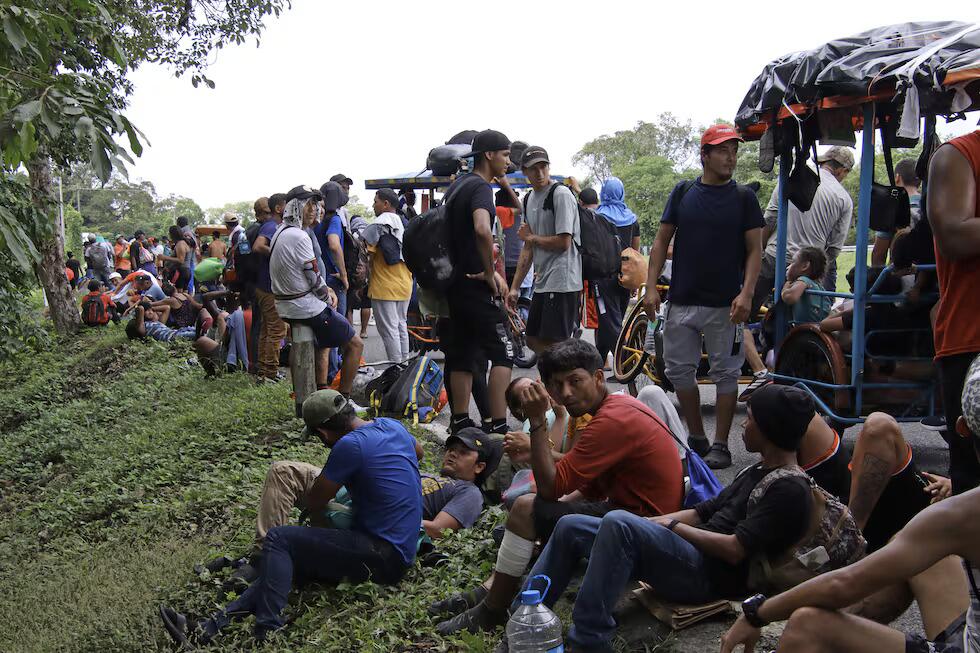
Migrants walking in a caravan heading to the United States take a break in the municipality of Tapachula in Chiapas.Juan Manuel Blanco (EFE)

According to the Associated Press, Mexico has already broken up two migrant caravans consisting of approximately 4,000 people at their peak. Some of the migrants were bused to cities in southern Mexico, while others were offered transit papers, which allow them to travel across Mexico for 20 days.

According to migrant rights activist Luis García Villagrán, Mexico’s actions against the two caravans appear to be part of “an agreement between the president of Mexico and the president of the United States.”

According to the report, the first of the caravans started near the Mexico-Guatemala burder on Nov. 5, the day Trump was elected. It had traveled roughly 270 miles in the ensuing four weeks of walking, ending up in Tehuantepec in the state of Oaxaca when it was broken up.

“They took some of us to Acapulco, others to Morelia, and others from our group to Oaxaca city,” said said Bárbara Rodríguez, a native Venezuelan who ended up catching a bus into Mexico City.

In a statement Saturday, the National Immigration Institute said the migrants voluntary accepted bus rides “to various areas where there is medical assistance and where their migratory status will be reviewed,” and said “upon accepting (the rides), they said they no longer wanted to face the risks along their way.” -AP

The second caravan made it around 140 miles to the town of Tonala in Chiapas state, where authorities offered the migrants the transit visas.

Meanwhile, Mexico’s Supreme Court of Justice of the Nation (SCJN) has approved an injunction filed by the Jesuit Refugee Service and the Alaíde Foppa Legal Clinic to create a public registry of detained migrants.

Tyler Durden
Mon, 12/02/2024 – 23:00

via ZeroHedge News https://ift.tt/g8IpV3K Tyler Durden

US Market Valuation: One For The History Books

US Market Valuation: One For The History Books

By Damien Cleusix of the Quantastic World substack

Executive Summary

This analysis presents a sobering outlook for the S&P 500, arguing that it is currently the most overvalued it has ever been, surpassing even the 2000 Tech Bubble and 2021 market frenzy. Key points include:

  1. The Margin-Adjusted Cyclically-Adjusted Price Earning Ratio (MAPE) indicates extreme overvaluation.
  2. Projections suggest negative nominal total returns for the S&P 500 over the next 10 years, with potential annual losses of 1.4% to 8.9%.
  3. A market correction to historical valuation norms could result in substantial losses, potentially up to 21.4% annually if occurring within the next three years.
  4. Ultra-loose monetary and fiscal policies have contributed to market distortion and speculation.
  5. Current market behavior reflects complacency and diminished critical thinking among investors.
  6. The analysis warns of potential inflationary pressures and the need for investors to reassess risk tolerance and prepare for lower returns or significant drawdowns.

The article concludes that achieving positive real returns in the coming decade would require exceptional circumstances, urging investors to remain grounded in fundamental valuation principles.
“Value investing is at its core the marriage of a contrarian streak and a calculator.”   – S. Klarman

“The first principle is that you must not fool yourself, and you are the easier person to fool.” – R. Feynman

In this analysis, we aim to objectively examine the current discrepancy between the intrinsic value and the market price of the S&P 500.

Our conclusion is that the S&P 500 is unlikely to have a positive nominal total return in the next 10 years and a ‘miracle’ would be needed to achieve positive real total returns.

Central Banks have brought forward future equity returns (and some more) with their accommodative policies and hyper-sensibility to downside volatility. Ultra-loose fiscal policies since Covid (justified in the first 6 months not thereafter) have put gasoline on the fire.

Being blunt, there is a real possibility for the S&P 500 to revisit at least the 2020 lows in the coming years.

Before we dive in, it’s important to recognize that valuation metrics have little to no ability to predict short-term market fluctuations. Think of it like a rubber band: the farther the market price is from its intrinsic value, the stronger the pull back toward that value. This means that even seemingly insignificant events can trigger the start of a mean reversion when valuations are extreme.
Market Behavior and Investor Psychology

When equity markets appear unstoppable—rising relentlessly on good, bad, or no news—investors may neglect the fundamental principle that value anchors price.

Over a decade of quasi-invincibility, where every market decline is swiftly recovered, can lead to complacency and diminished critical thinking. Reflection becomes a liability. The educated fools are in control.

This environment fosters narratives like “Buy the Dip,” and the creation of viral acronyms such as BTFD (Buy The F***ing Dip), FOMO (Fear Of Missing Out), and HODL (Hold On for Dear Life).

This time it is really different! Is it?

Central Banks around the world, by lowering interest rates aggressively and providing unlimited support, verbally and/or materially, to the markets at the slightest emergence of stress and by taking too much time or even refusing to remove the accommodations they provided, have set the stage for historical markets and social dislocations.

If one add that a chunk of the post-Covid fiscal spending largess going directly to the equity markets through gamified trading applications or passive mom and pop vehicles or the emergence of the YOLO meme/life mantra you have all the ingredients for a massive speculation frenzy.

When finance dominates everything, when companies’ management are obsessed by financial engineering and short-term personal rewards, when governments/central banks/regulators are controlled and not controlling, dogmatic and not pragmatic, the end result cannot be good.

While we will expand on this in another article, Ben Hunt of Epsilon theory has written extensively and brilliantly on the subject. One could start here.

Bubbles need leverage to expand

Although central banks have rapidly increased their target rates—often belatedly—they are now swiftly reversing course, once again demonstrating their asymmetric reaction functions.

Interest rates below a certain level probably have a detrimental effect for the real economy as investments in new productive capital become less and less elastic to rates as they decline toward 0%.

Zombie companies survive, preventing any Schumpetarian creative destruction, leaving excess supply in place, pushing inflation rate down (what? low rates could be deflationary?).

Furthermore, savers are forced to spend less unless they take more risk as their fixed income portfolio doesn’t generate much of an income.

The only thing striving is finance where actors put on more and more leverage to buy existing capital (buybacks, M&A, dividend payment to private equity firm, etc).

The sad consequence is a larger stock of debt unbacked by new productive capital.

A system where overall debt cannot be repaid, ever. A system where the can is kicked down the road until it can’t anymore.

The end game is either an inflationary burst to save the debtors, a multi-decade’s slow growth environment or a deflationary burst.

Given that the debtors are governments, interest groups lobbying them and Generation X and the younger ones (who will soon dominate the electorate), we have little doubt that the inflationary scenario is the most probable.

But let’s come back to the main subject of this article, the US equity market valuation.

Stocks are a claim on a expected future stream of cash flows. To assess this stream’s value today, we have to calculate its present value using an appropriate discount rate. This present value is called the intrinsic value of a stock or of a group of stocks.

At a given discount rate, the short-term fluctuations of cash flows have very little influence on intrinsic value. Remove entirely 1 or 2 years of cash flow and the difference will be small.

Longer-term expectations, on the other hand, have a large impact. Those expectations are highly pro-cyclical.

Earnings are already, as we will shortly demonstrate, well above trend and, therefore are highly likely to grow less than the overall economy. Still analysts are expecting them to grow much more quickly.

Changing the discount rate can have a huge impact.

Discount rate assumptions backed by market participants are strongly correlated with their mood. Bullish participants will accept a lower discount rate, ceteris paribus.

Prevailing interest rates usually serve as a loose anchor to discount rate assumptions. We can nevertheless see, experimentally, an increased exposure to risky assets the lower the risk-free rate is, even when the mean excess return is the same.

On the graph below, one can see the average allocations to a risky asset across different interest rate conditions. Each condition has 200 participants, from the MTurk platform. The x-axis shows the risk-free rate in each condition. The mean excess return on the risky asset is 5% in all conditions.


We will now demonstrate using a methodology proposed by J. Hussman, the Margin-Adjusted Cyclically-Adjusted Price Earning Ratio (MAPE), that the US stock markets is the most overvalued it has ever been.

R. Shiller and J. Campell proposed the concept Cyclically-Adjusted Price Earning (CAPE) to forecast 7-12 years markets future return using a long moving average of earnings back in 1988 (originally 10 years). The goal was to smooth out the business cycle influence on earnings in order to get a smoother series they called trend earnings.

The CAPE model was good at forecasting forward return in the past (M. Faber applied it to foreign markets too) but some argue that accounting changes, payout policies, a move toward less competitive markets could have made the CAPE model lose some or even most of its forecasting ability.

One can find some great discussion on the subject here and here.

R. Shiller introduced the Cyclically-Adjusted Total Return Price Earning Ratio to account for the change in company payout policies with the increased use of buybacks to return capital to shareholders.

Two flaws remained nevertheless.

First, as identified by J. Hussman, one can get an even smoother trend earning series by adjusting the CAPE to get constant historical margins. He uses 5.4% margin as its average. So if the most recent 10 years average margin is 7%, one ought to multiply the CAPE by 7%/5.4% (1.3). A CAPE of 30 becomes a MAPE of 40.

The second problem is that margin could have increased permanently due to structural change in the economy and the dominance of capital-light businesses.

While this might explain some of the increase in margin, we are convinced that a large part of the increase in margin is transitory and that once capitalism is allowed to work as it should, it will disappear. It will be the subject for another article.

Anyhow, we have assumed a permanent increase of margin to 7% starting in 1998 with the emergence of internet.

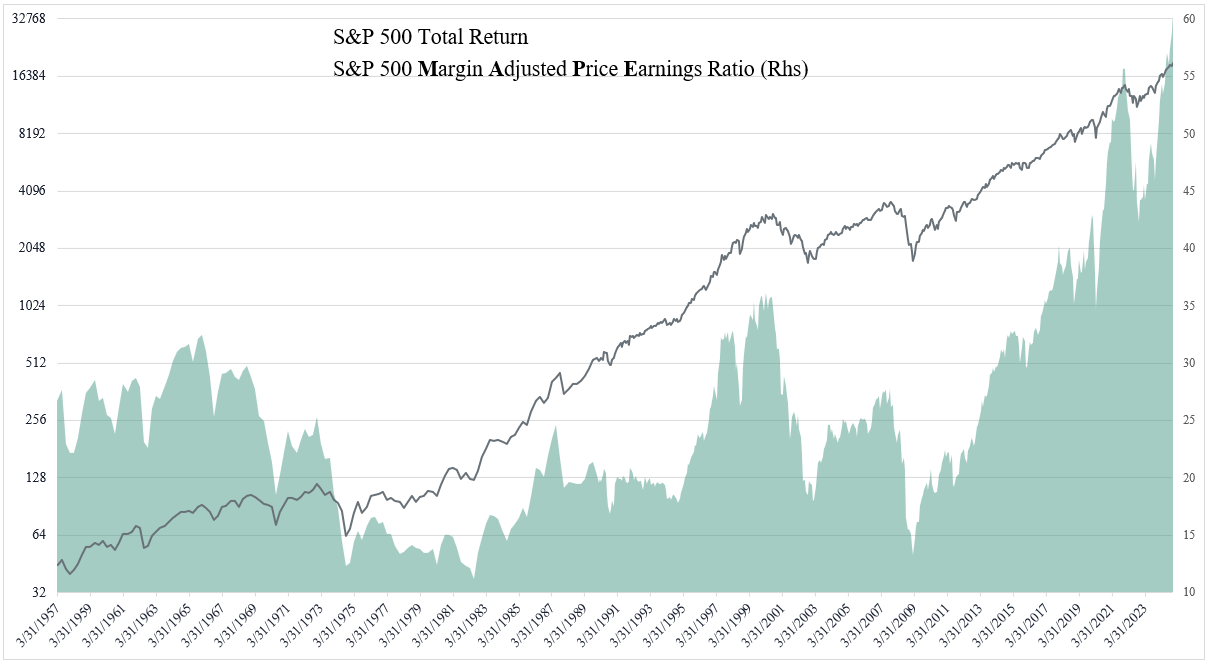
Let’s now look at the data.
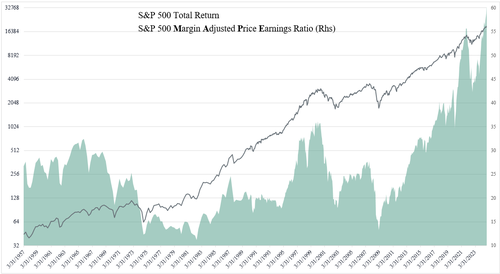
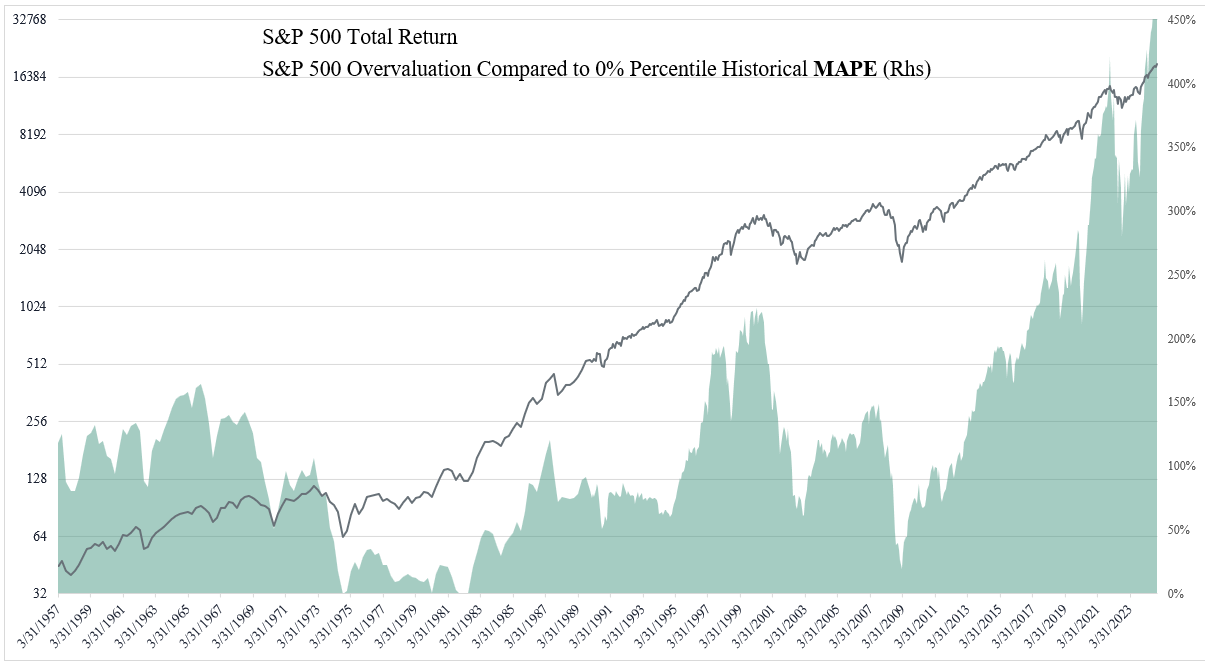
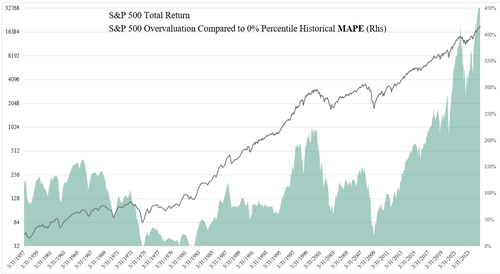
As one can see, today’s MAPE is the highest it has ever been, dwarfing the 2000 Tech Bubble and the end of 2021 frenzy.

We won’t talk about the divergence on factor valuations here, it will be the subject of another article.

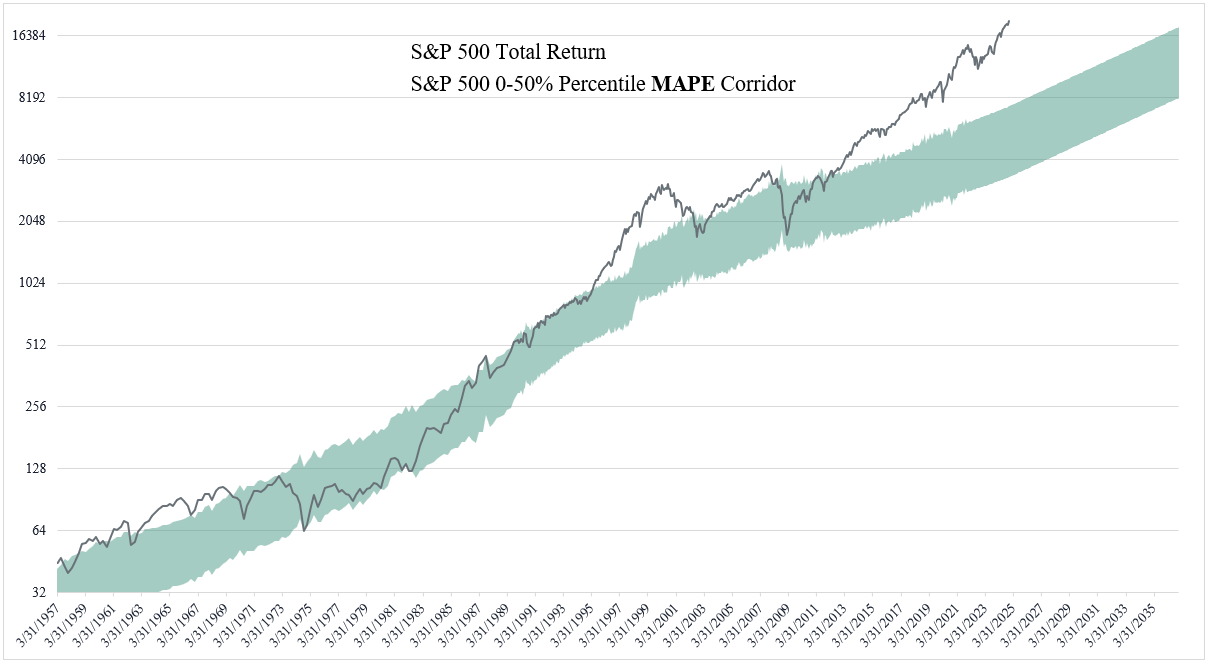
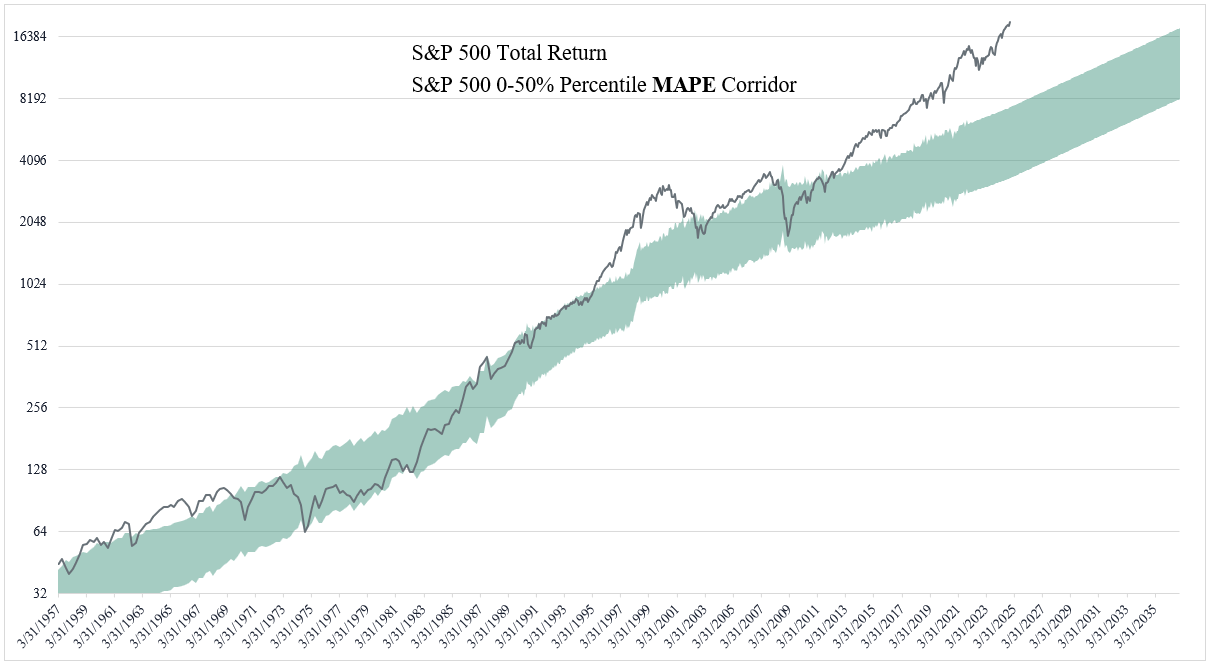
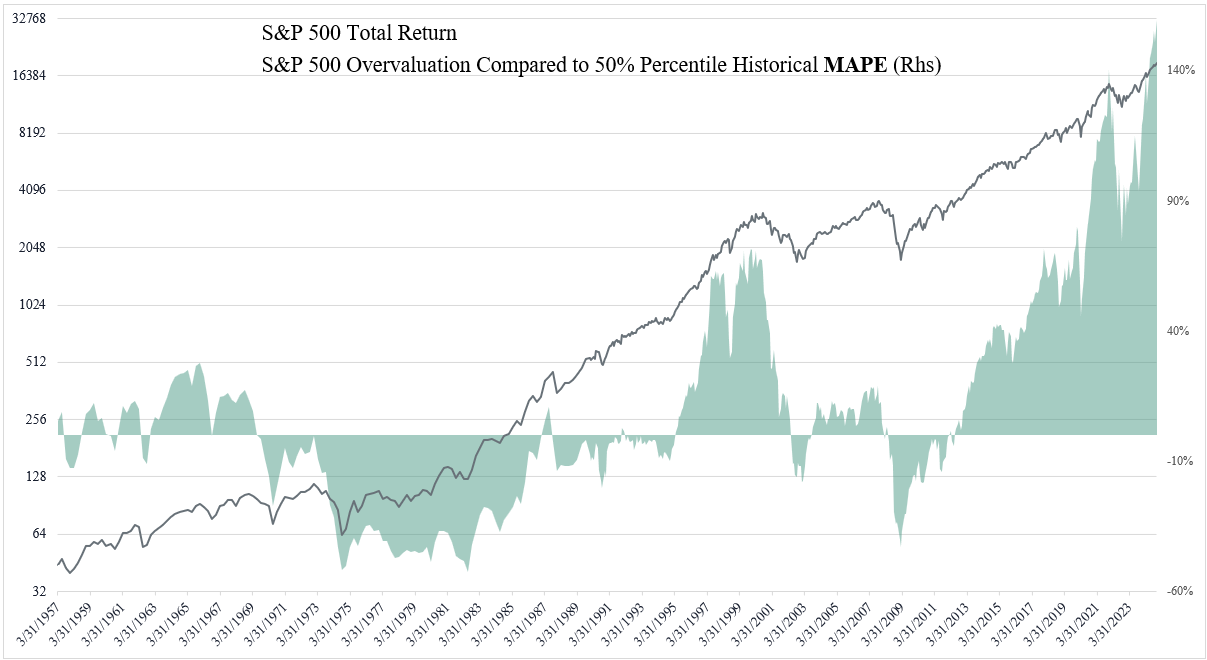
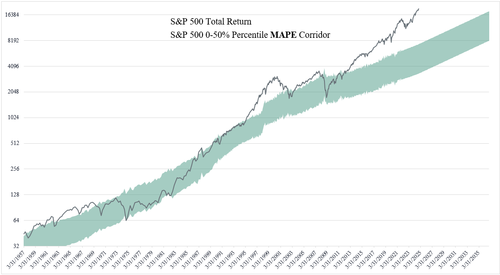
If we construct an historical corridor with boundaries between the 0% and 50% percentiles of MAPE history, the prospect looks grim for Buy and Holders.
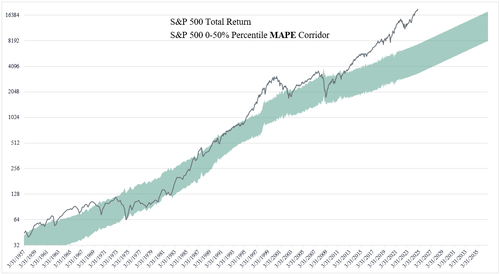
If we construct an historical corridor with boundaries between the 0% and 50% percentiles of MAPE history, the prospect looks grim for Buy and Holders.

The S&P 500 is currently almost 400% above the level corresponding to a bottom MAPE and 130% above the 50% percentile MAPE history.
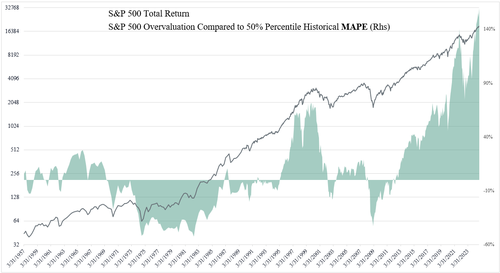
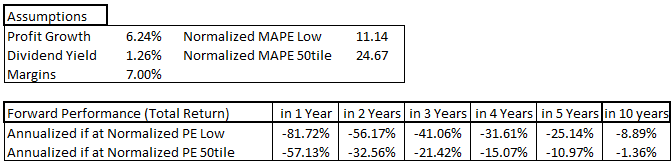
If we assumed a return to the MAPE 50% percentile, with nominal trend earnings growing at their historical pace and the current 1.26% dividend yield, one can see that the S&P 500 nominal total return for the next 10 years would be at -1.4% annually.

If the markets reached similar valuation to the summer 1982, the nominal total return for the next 10 years would be at -8.9% annually.

We doubt (and it is a strong understatement) the markets will wait 10 years to test the MAPE 50% percentile. A retest in the next 3 years is possible. Reaching the MAPE 50% percentile in 3 years’ time would imply an annualized 21.4% loss.
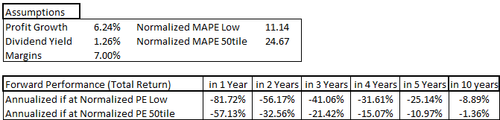
Even if we assume normalized margins to be 10%, a return to the MAPE 50% percentile in 3 years’ time would imply an annualized loss of more than 15%!

One should also not forget the historical tendency of deeply overvalued markets to fall significantly below the MAPE 50% percentile.

It is also important to remember that today’s margins are above our 7% assumption and that the CBO is projecting around 4% nominal US GDP growth to 2034. The odds are thus stacked against the >6% nominal earning growth we have assumed.

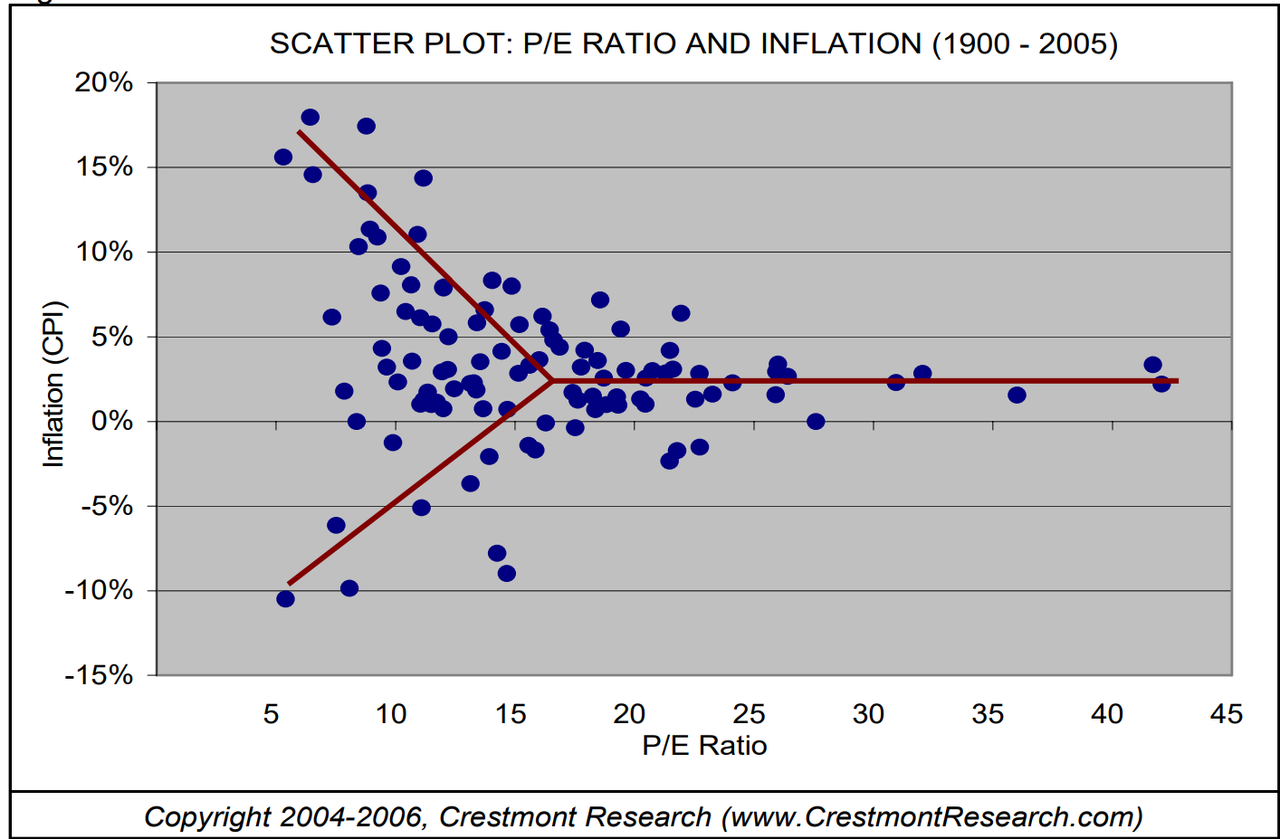
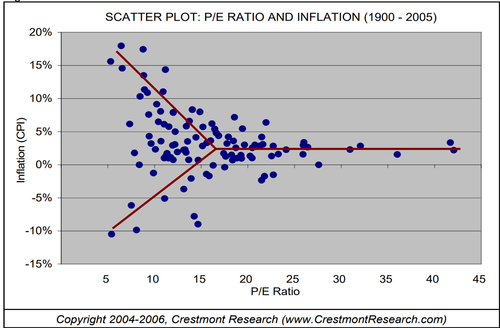
Among all the factors which will impact the markets nominal total return, the most important is inflation. As we have said earlier, on a 10-20 years’ basis the politicians’ rulers and their electors will favor much higher level of inflation.

In this scenario, while nominal earning growth will be higher, ceteris paribus, with increasing inflation, the price investors will be willing to pay for each unit of earning will decline. Investors do not like inflation or deflation.
Conclusion

In light of our analysis, the current state of the S&P 500 presents a sobering outlook for investors. The unprecedented levels of the Margin-Adjusted Cyclically-Adjusted Price Earning Ratio (MAPE) signal a market that is significantly overvalued, even surpassing the extremes of the 2000 Tech Bubble and the 2021 market frenzy.

Our projections suggest that achieving positive real returns in the coming decade would require nothing short of a miracle. The combination of ultra-loose monetary policies, misaligned fiscal measures, and a pervasive “this time is different” mentality has created a perfect storm of market distortion.Investors should be acutely aware that:

  1. The S&P 500 is currently trading at levels that are unsustainable in the long term.
  2. Even with optimistic assumptions, the potential for negative returns over the next 10 years is significant.
  3. A market correction to historical fair value could result in substantial losses, potentially as high as 21.4% annually if occurring within the next three years.

As we navigate these treacherous waters, it’s crucial to remember the wisdom of Seth Klarman: “Value investing is at its core the marriage of a contrarian streak and a calculator.” Now, more than ever, investors must resist the siren song of market euphoria and anchor their decisions in sound valuation principles.

The road ahead may be challenging, but it also presents opportunities for those who maintain discipline and a clear-eyed view of market fundamentals.

As we face the possibility of increased inflation and potential market turbulence, prudent investors should reassess their risk tolerance, diversify wisely, and prepare for a period of lower returns or even significant drawdowns.

In closing, let us heed Richard Feynman’s caution against self-deception. The markets have a way of teaching harsh lessons to those who ignore the fundamentals.

By staying grounded in reality and maintaining a long-term perspective, investors can navigate the coming years with greater resilience and potentially position themselves to capitalize on the opportunities that inevitably arise when markets return to more rational valuations.

“It is better to be out of the markets wishing to be in than in the markets wishing to be out” – Unknown

“I never invest at the bottom, and I always sell too soon.” – Nathan Rothschild
Tyler Durden
Mon, 12/02/2024 – 22:35

via ZeroHedge News https://ift.tt/3D17nQv Tyler Durden

Japanese ‘Human Washing Machine’ Uses AI For When You’re Too Lazy To Wash Your Own Ass

Japanese ‘Human Washing Machine’ Uses AI For When You’re Too Lazy To Wash Your Own Ass

As if obese redundant piles of American protoplasm, to borrow George Carlin’s phrase, weren’t already stagnant enough with the invention of Ozempic and the likes, there is now an AI powered human ‘washing machine’ that’ll wash their ass for when they’re too lazy to perform the most basic of hygiene tasks. 

Japanese firm Science Co. has unveiled an AI-powered “bath of the future,” a shower pod called the “Mirai Ningen Sentakuki.”

Resembling a high-tech capsule, it can wash and dry users in just 15 minutes. Chairman Yasuaki Aoyama revealed at an Osaka lecture that the device is 70% complete, aiming for a revolutionary bathing experience, according to the New York Post.

The user sits in a transparent capsule that partially fills with water, as shown in a viral video we’ve posted below. Sensors in the seat monitor vital signs to ensure an optimal bath, while high-speed jets with micro-sized air bubbles cleanse the body.

Chairman Yasuaki Aoyama commented: “We’re about 70% there.”

The Post wrote on Monday that the pod uses AI to monitor user biomarkers, projecting calming videos inside the capsule to enhance relaxation.

High-speed jets create microbubbles that burst with pressure waves, scrubbing away grime—a technique inspired by cleaning delicate electronics. The experience offers both physical and psychological cleansing, according to the company.

The design draws from the Ultrasonic Bath exhibited at the 1970 Japan Expo, which also used water and ultrasound for cleaning. Inspired by that, company chairman Yasuaki Aoyama plans to showcase the new “human washing machine” at Expo 2025 in Osaka, where 1,000 visitors can try it.

Reservations are already open, with plans for a home edition in the works.

And as for “enhanced relaxation”, this can only mean we are just one step from…well, The Dude said it best…

Tyler Durden
Mon, 12/02/2024 – 22:10

via ZeroHedge News https://ift.tt/MnLFHaT Tyler Durden