LVMH Reports “Mixed” Results As Goldman Says “Buy On Any Weakness”

LVMH Reports “Mixed” Results As Goldman Says “Buy On Any Weakness”

LVMH Moët Hennessy Louis Vuitton SE posted better-than-expected full-year sales but delivered mixed fourth-quarter results, highlighting a sluggish luxury recovery. Shares fell in European trading after the earnings report.

LVMH controls around 60 subsidiaries that manage 75 luxury brands. LVMH’s portfolio includes Christian Dior Couture, Givenchy, Fendi, Celine, Kenzo, Tiffany, and many more brands. It posted revenues of 84.68 billion euros ($88.27 billion) for 2024 versus 84.38 billion euros forecast by Bloomberg Consensus. This equates to organic growth of 1% versus the previous year. 

Here’s a snapshot of LVMH’s full-year results (courtesy of Bloomberg):

Recurring operating income EU19.57 billion, -14% y/y, estimate EU20.45 billion

  • Fashion & Leather Goods recurring operating income EU15.23 billion, -9.5% y/y, estimate EU15.44 billion

  • Wines & Spirits recurring operating income EU1.36 billion, -36% y/y, estimate EU1.62 billion

  • Perfume & Cosmetics recurring operating income EU671 million, -5.9% y/y, estimate EU730.3 million

  • Watches & Jewelry recurring operating income EU1.55 billion, -28% y/y, estimate EU1.76 billion

  • Selective Retailing recurring operating income EU1.39 billion, -0.4% y/y, estimate EU1.48 billion

Revenue EU84.68 billion, -1.7% y/y, estimate EU84.38 billion

  • Fashion & Leather Goods revenue EU41.06 billion, -2.6% y/y, estimate EU40.91 billion

  • Wines & Spirits revenue EU5.86 billion, -11% y/y, estimate EU5.98 billion

  • Perfume & Cosmetics revenue EU8.42 billion, +1.8% y/y, estimate EU8.47 billion

  • Watches & Jewelry revenue EU10.58 billion, -3% y/y, estimate EU10.4 billion

  • Selective Retailing revenue EU18.26 billion, +2.1% y/y, estimate EU18.18 billion

Dividend per share EU13, estimate EU12.89

Net income EU12.55 billion, -17% y/y, estimate EU13.38 billion

Fourth-quarter sales through December beat the Bloomberg Consensus. However, the report was mixed, with fashion, leather goods, and wine continuing to lag. Most growth came from Europe, the US, and Japan, while Asia slumped

Here’s a snapshot of LVMH’s fourth quarter: 

Organic revenue +1%, estimate -1.04% (Bloomberg Consensus)

  • Fashion & Leather Goods organic sales -1%, estimate -2.82%

  • Wines & Spirits organic sales -8%, estimate -6.94%

  • Perfumes & Cosmetics organic sales +2%, estimate +3.51%

  • Watches & Jewelry organic sales +3%, estimate -2.82%

  • Selective Retailing organic sales +7%, estimate +3.13%

  • US organic revenue +3%, estimate +3.73%

  • Asia excluding Japan organic revenue -10%, estimate -12.1%

  • Japan organic revenue +8%, estimate +14.7%

  • Europe organic revenue +4%, estimate +3.37%

Revenue EU23.93 billion vs. EU23.95 billion y/y, estimate

Commenting on the earnings report, Goldman’s Louise Singlehurst, Ben Rada Martin, and Adrien Duverger told clients:

LVMH reported a mixed result with +1% Q424 group sales 2% ahead of consensus, whilst EBIT was below (-8%); however, given positive commentary for January we would buy on any weakness.

LVMH delivered organic sales growth of +1% cFX yoy in 4Q, ahead of Visible Alpha Consensus Data (-1%), with the largest division, Fashion and Leather, decreasing -1% cFX (ahead of cons. -3%, and sequentially improving vs. -5% in 3Q24).

Margins were lighter than expectations with 2H24 Adj. EBIT -8% below consensus, with broadly in line F&L (-1%) largely offset by misses in Wines and Spirits (-28%), Watches & Jewellery (-18%) and perfumes and Cosmetics (-16%). We note the outlook commentary was broadly upbeat, with Louis Vuitton and Tiffany (which account for c. 55% group EBIT on our estimates, FY24) growing double digits in 2025 to date (noting some benefit from earlier Lunar New Year timing).

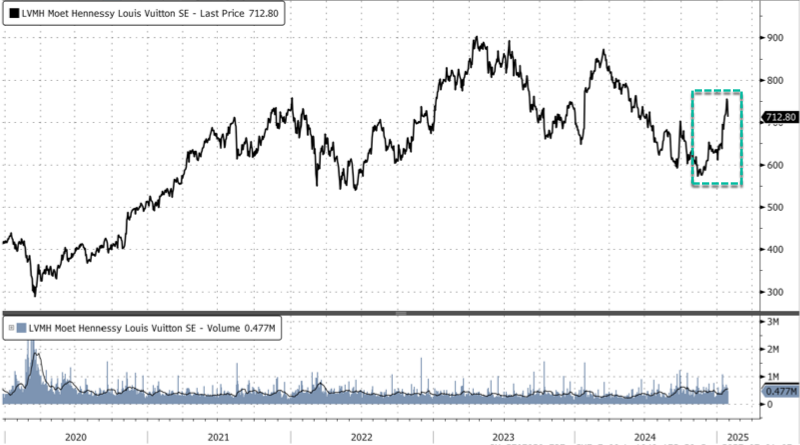
Singlehurst and the other analysts said the “recent appreciation in LVMH’s share price (+20% last month)” with “mixed FY24 topline result” may not be enough to continue the momentum in shares seen over the few months. 
However, they maintained a “Buy” rating on LVMH for these three reasons: 

  1. An improving shape of the Chinese Cluster and indications that demand has troughed in Q324 for the broader peer group;

  2. an acceleration in US trends in Q4 and positive outlook commentary for 2025 and

  3. scope for margin recovery with the return to positive sales growth. 

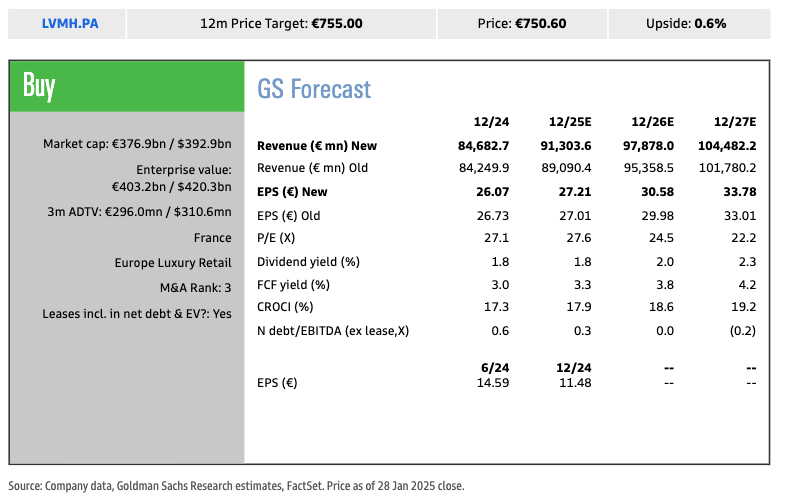
GS Valuation – Remain Buy; PT €755 (from €720)
Here are the key takeaways of LVMH’s earnings from other institutional desks (courtesy of Bloomberg):

JPMorgan (neutral)

  • “An improvement, but not the magnitude hoped,” says analyst Chiara Battistini
  • While numbers did improve sequentially, with in particular fashion & leather-goods at -1% in 4Q (vs -5% in 3Q), the pace of acceleration did not match that seen at peers so far, nor higher buyside expectations
  • This confirms that brand- and category-specific dynamics continue to play an essential role to drive traction with still very discerning consumers
  • Report also shows that even the best-in-class player can’t fully contain operating deleverage, with 2H margins missing at most divisions * Would not chase the recent LVMH (and sector) rally

Deutsche Bank (hold)

  • LVMH’s sales were weaker than expected, says analyst Adam Cochrane, though trading looks to have improved over the quarter and accelerated into January
  • Notes that the -1% fashion & leather-goods sales print was below the 2-3% investor bar following Richemont and Burberry’s results

Stifel (buy)

  • While LVMH saw an improving sales trend, the expectations bar got higher, writes analyst Rogerio Fujimori
  • Among positives, notes that all nationalities improved q/q, key brands like Dior and Tiffany accelerated in the fourth quarter, and both Louis Vuitton and Tiffany saw double-digit growth in January

TD Cowen (buy, PT raised to €840 from €800)

  • Results are better than feared, says analyst Oliver Chen, driven by an acceleration across the watches & jewelry and fashion & leather-goods segments.
  • While growth for Tiffany and Louis Vuitton is encouraging, other core brands in the portfolio such as Dior may need more product innovation to reignite cultural relevance

Telsey Advisory Group (outperform, PT raised to €820 from €750)

  • Strength in most geographies in the fourth quarter helped offset continued declines in Asia ex-Japan, says analyst Dana Telsey
  • Although consumer confidence in China remains challenging, LVMH’s broadly diversified portfolio of strong brands across product lines and geographies is beneficial

Bernstein (outperform)

  • While LVMH’s fashion & leather-goods organic growth beat expectations, it failed to stand up to upgraded expectations on the back of Richemont’s recent major beat, writes analyst Luca Solca
  • LVMH has work to do at Dior, as well as in other divisions

Jefferies (hold)

  • LVMH’s results confirm the “exceptional” nature of the fourth- quarter acceleration reported by some, and a diverging demand in favor of hard versus soft luxury, says analyst James Grzinic
  • Talk of a strong showing by Dior in 2024 and a positive double-digit in January-to-date sales at Louis Vuitton and Tiffany will be debated and contrasted with China’s long-haul recovery

Morgan Stanley (overweight)

  • Investor sentiment on LVMH had moved up and as such analyst Edouard Aubin expects that “at first glance” the report will disappoint investors
  • LVMH’s 4Q sales beat consensus by about 2%, a “smaller beat than what we have typically been seeing in luxury reporting year to date,” the analyst writes
  • For the “key sentiment driver of the stock,” the fashion & leather-goods segment saw organic sales drop 1% in 4Q, which is better than the consensus view, but below investor expectations of around flat to up 3%
  • Furthermore, the q/q acceleration in sales for that segment, from down 5% in 3Q to the 1% drop in 4Q, is below peers Richemont and Burberry Group

RBC (outperform)

  • “These results are mixed but arguably also as expected,” with the top line slightly better, as anticipated after Richemont, Brunello Cucinelli and Burberry reports, while margins and profitability were lower than expected, analyst Piral Dadhania writes
  • Figures Street consensus estimates for fiscal 2025 may come down by mid-single digits

Bloomberg Intelligence

  • LVMH confirmed the view that the demand slowdown passed its nadir for luxury goods in the the third quarter, says analyst Deborah Aitken, with a gradual pickup in all regions into the fourth
  • However, volume recovery and limited pricing could take two years to repair a weaker operating margin

LVMH Chief Executive Officer Bernard Arnault provided investors with an understanding of the luxury market’s forecasted recovery shape: “What I expect is to see a gradual recovery,” adding, “The environment was severely impacted by Covid, then there was a strong recovery, followed by another crisis — the real estate crisis — so it’s going to take some time.”

Tyler Durden
Wed, 01/29/2025 – 07:20

via ZeroHedge News https://ift.tt/fSOhVQr Tyler Durden
Ruh Roh, Pepsi… Republican Congressman Introduces FIZZ-NO Act To Nuke Soda From SNAP

Ruh Roh, Pepsi… Republican Congressman Introduces FIZZ-NO Act To Nuke Soda From SNAP

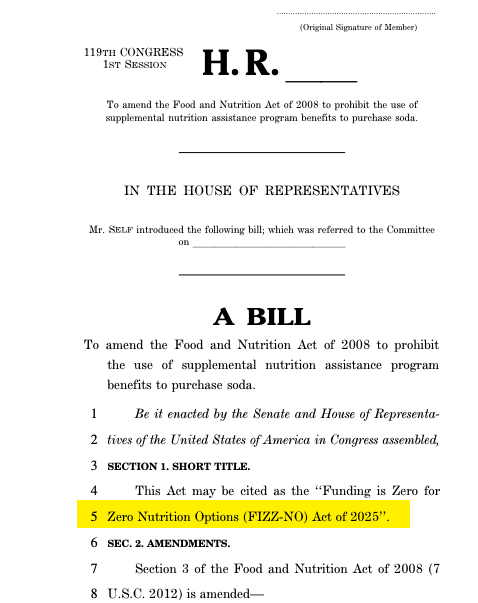
Ahead of Robert F. Kennedy Jr.’s confirmation hearing for the role of Secretary of Health and Human Services, set to begin on Wednesday, the “Make America Healthy Again” movement gained momentum with a new bill called the “Zero for Zero Nutrition Options” (FIZZ-NO) Act, that was introduced by Rep. Keith Self (R-TX). 

On Tuesday, Congressman Self’s office published a press release detailing how the FIZZ-NO Act is a major effort to improve public health and reduce taxpayer costs by eliminating soda from the Supplemental Nutrition Assistance Program (SNAP).

SNAP was originally created to help the poorest Americans access nutritious food,” Self stated, adding, “Allowing taxpayer dollars to subsidize sugary sodas, which offer zero nutritional value and contribute to costly health conditions, is counterproductive. The FIZZ-NO Act is a common-sense solution to strengthen public health and reduce the financial burden on taxpayers.”

Self on X wrote, “MAHA on the move!” 

Soda and toxic processed foods rammed down the throats of Americans, especially those using SNAP benefits, have become a massive healthcare burden, costing taxpayers upwards of $190 billion annually

According to the latest figures from the Centers for Disease Control and Prevention, about 40% of adults and 19% of children are obese, and there is a growing number of citizens who are morbidly obese because the food supply chain is controlled by globalist mega corps that push seed oils, sugar, and highly processed foods

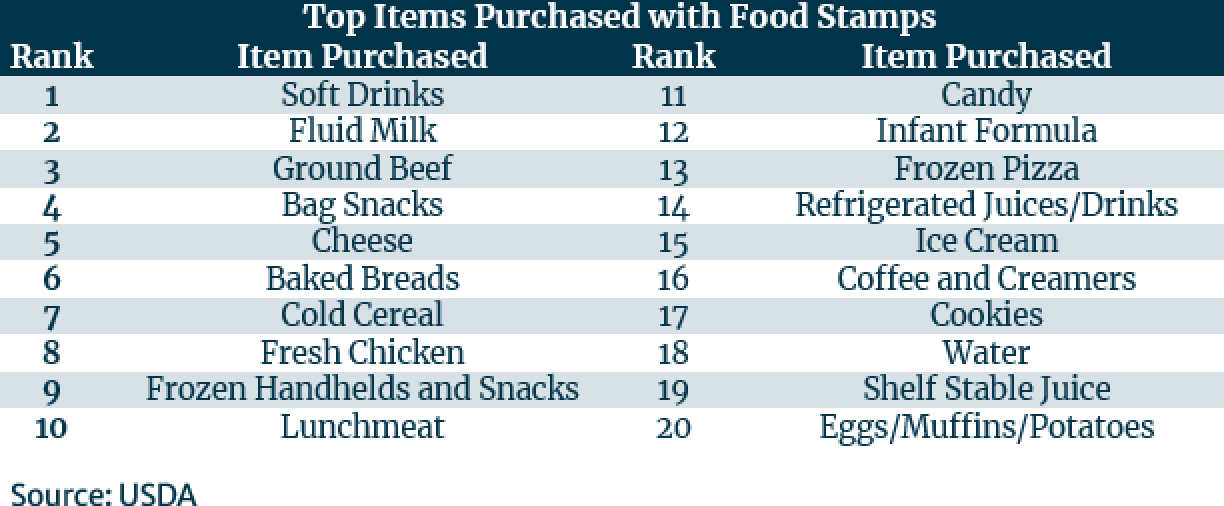
The director of Budget Policy at EPIC, Matthew Dickerson, recently pointed out soda was the top SNAP purchase. 

Reforming SNAP-eligible purchases away from soda and highly processed foods to clean food is the first step to “Make America Healthy Again.”  

While PepsiCo does not publicly disclose specific revenue figures from soda and junk food purchased through SNAP, there is reason to believe the FIZZ-NO Act, if passed, could impact the company’s future earnings. One might wonder how much PepsiCo will spend in lobbying efforts in an attempt to derail MAHA. 

Tyler Durden
Wed, 01/29/2025 – 06:55

via ZeroHedge News https://ift.tt/9wVeLfP Tyler Durden

Trump’s Fight Against Online Censorship Quickly Goes Global

Trump’s Fight Against Online Censorship Quickly Goes Global

Authored by Ben Weingarten via RealClearInvestigations,

Flanked by some of the Big Tech executives whose companies had suppressed the views of his supporters throughout his predecessor’s term, President Trump on Jan. 20 declared the days of such speech policing over.

Hours later, the president put action behind his words, signing an executive order prohibiting the federal government from engaging in, facilitating, or funding “any conduct that would unconstitutionally abridge the free speech of any American citizen.” 

The move was celebrated by those who see it as a blow against what they decry as the Censorship Industrial Complex. Others cast the executive order as giving dangerous license to “misinformation” and “disinformation.” 

What is clear is that this is just the latest salvo in an ongoing war over the digital public square, pitting the Trump administration and like-minded Republican congressional allies against not only domestic opponents but the global counter-disinformation eco-system.

The global speech-policing effort is looking like an early target. Trump himself seemed to convey that when he touted his order in a remote address last week to the World Economic Forum in Davos. The elite global conclave had recently declared “misinformation and disinformation” the leading short-term risk to the globe for the second-straight year, “underlining their persistent threat to societal cohesion and governance by eroding trust and exacerbating divisions within and between nations.”

Two days after the inauguration, Trump’s Secretary of State, Marco Rubio, released the “Priorities and Mission of the Second Trump Administration’s Department of State.” The short document included the charge that Foggy Bottom “must stop censorship and suppression of information.” Rubio continued:

The State Department’s efforts to combat malign propaganda have expanded and fundamentally changed since the Cold War era and we must reprioritize truth. The State Department I lead will support and defend Americans’ rights to free speech, terminating any programs that in any way lead to censoring the American people.” 

It is not yet known whether and to what extent Rubio’s approach will affect the reorganized successor to the State Department’s recently shuttered Global Engagement Center, whose efforts defenders had called essential to combating foreign propaganda. Critics have dismissed the reorganization – of an office that funded entities targeting disfavored domestic speech – as an effort to simply rebrand and persist.

The State Department did not respond to RealClearInvestigation’s inquiries in connection with this story.

The global “counter-disinformation” ecosystem encompasses research centers at top academic institutions and think tanks, fact-checkers, news raters, and like-minded for-profits – often funded and/or promoted by government agencies and powerful foundations, and operating and seeking to influence governments both stateside and across the Atlantic.

RealClearInvestigations, which recently previewed the censorship fight, e-mailed questions to other United States agencies and departments believed to be involved, directly or indirectly, in speech suppression on social media or otherwise likely to have a role in implementing the order.

These included the Department of Justice and the FBI; the Department of Homeland Security and its Cybersecurity and Infrastructure Security sub-agency; Departments of Defense and Health and Human Services; National Science Foundation; and Office of Management and Budget.

“The Department of Defense will fully execute and implement all directives outlined in the Executive Orders issued by the President, ensuring that they are carried out with utmost professionalism, efficiency, and in alignment with national security objectives,” a Pentagon official told RCI. The Department has previously come under fire for providing funding to news rating entities like NewsGuard seen by critics as biased against conservative and independent outlets.

A National Science Foundation spokesman told RCI that the agency was “reviewing all the executive orders carefully and implementing them accordingly.” In a December 2024 report, the House Judiciary Committee asserted that the foundation had “poured millions of taxpayer-funded grant dollars into the development of AI-powered tools to mass monitor and censor online content.”

Several departments did not respond to RCI’s inquiries. Others referred questions to the White House. It did not respond. 

Even as the administraton seeks to end government and government-supported censorship efforts, the more controversial part of Trump’s executive order may be its directive to identify those who quelled speech in the past. The directive calls on the attorney general and other executive department and agency heads to probe federal government activities violative of the order that took place during the Biden years, whereby the administration “trampled free speech rights by censoring Americans’ speech on online platforms,” and to prepare a report for President Trump “with recommendations for appropriate remedial actions.” It is not clear if such remedial actions will include prosecutions. 

Columbia University law professor Philip Hamburger, founder and CEO of the New Civil Liberties Alliance, which represented several plaintiffs in the Supreme Court case Murthy v. Missouri – a case that exposed federal collusion with social media companies to suppress disfavored speech – told RCI that Trump’s action did not go far enough. “The executive order, although very welcome, would have been even more valuable if it had waived qualified immunity for officials at CISA, the FBI, and other relevant agencies for purposes of free speech violations.”

Alex Abdo, litigation director of the Knight First Amendment Institute, also at Columbia University, offered an opposing view. Abdo wrote in Just Security that any probe of the Biden administration’s actions would be in bad faith, since the order prejudges the prior administration to have engaged in illicit conduct.

“Worse, the report may very well serve as an outlet for the Trump administration’s own censorial desires,” Abdo wrote. “If, for example, the report further targets researchers engaged in First Amendment protected research, then the administration will be doing exactly what it has accused the Biden administration of doing.” 

The House Judiciary Committee is poised to undertake a complementary effort this session. A spokesman told RCI the panel “will continue its oversight work of the Department of Justice and the FBI, in addition to investigating the threat foreign censorship laws pose to American speech.”

Trump has previously called for enacting “new laws laying out clear criminal penalties for federal bureaucrats who partner with private entities to do an end-run around the Constitution and deprive Americans of their First, Fourth, and Fifth Amendment rights.” 

To that end, the Judiciary Committee spokesperson told RCI that the panel would “move quickly to reintroduce legislation that will protect Americans’ First Amendment rights, such as the Censorship Accountability Act and the No Censors on our Shores Act.” The former would provide a right of action against federal employees for First Amendment violations. The latter would render any foreign official who engages in censorship of American speech inadmissible and deportable.

In the Senate, two days after the release of President Trump’s order, Kentucky Republican Rand Paul re-introduced the “Free Speech Protection Act.”

Consistent with the executive order, the legislation aims to bar federal employees from directing platforms to censor protected speech and prohibit grants “relating to programming on misinformation or disinformation.” It also imposes penalties on those who violate the law, including disciplinary action, a civil penalty of not less than $10,000, ineligibility for retirement benefits, and permanent revocation of any applicable security clearance. Too, it allows those who believe their rights have been violated to bring a civil action against the allegedly offending agency and employee who committed the violation.

“Americans are free people, and we do not take infringements upon our liberties lightly. The time has come for resistance and to reclaim our God-given right to free expression,” Sen. Paul wrote in re-introducing the bill.

Tyler Durden
Wed, 01/29/2025 – 06:30

via ZeroHedge News https://ift.tt/caQbyEu Tyler Durden

Ray Dalio Warns Of Brutal AI War Between U.S. And China: ‘No Country Can Lose’

Ray Dalio Warns Of Brutal AI War Between U.S. And China: ‘No Country Can Lose’

Billionaire investor and Bridgewater hedge fund founder Ray Dalio warned in an interview with All-In podcast co-host David Friedberg that neither the United States nor China can afford to lose the race for AI supremacy, stressing that this technological “war” is far more critical than “profits.” 

DAVID FRIEDBERG: I’m a productive asset guy. I like owning businesses that make stuff. In this environment, where do I own a productive asset—a business that can still see its revenue and its income grow as this inflationary effect and this devaluation occurs as we get through a debt crisis like this? What would be the best kind of productive asset? Is it a mining business? Is it a commodity trading business?

RAY DALIO: I’m with you. So, you know, that chart that we showed in the beginning has this line where productivity is going up. And it tends to compound on itself. And I think that’s where AI, and that is fantastic, but it depends where you’re referring to AI. I think the super scalers in this world have risk issues. You know, you think about the super scalers like Nvidia or others. I think that the tech war, certainly productivity, I’m with you man, but you want to invest in productivity. But there’s great disruption that’s going to take place, and there are going to be the disruptors and the disrupted. It’s not necessarily those who are producing the vehicles, but those who are implementing and changing as a result of having their big impact.

I think that the tech war, the AI war is more important. It is actually more important. It’s a war that no country can lose because it’s more important than profits. If you lose, if China or the U.S. really lose this war, it’s more important than profits. You have to play that war that way. It could be something like electric vehicles, or more in terms of Chinese electric vehicles, where they can produce them. But I think there are such high expectations. I think we are going to see applications. I think the Chinese are a bit behind in the chips, but they’re ahead in the applications.

DAVID FRIEDBERG: Did you see the DeepSeek announcement this weekend?

RAY DALIO: Yes, and that was known for a little while now. The Chinese play is going to be chips—very inexpensive chips embedded into manufactured goods. You’ll see robotics. The Chinese are unbelievably [good] at making things inexpensively. They own 33% of all world-manufactured goods, which is more than the combined US, German, and Japanese manufactured goods. The Chinese produce more.

You’re going to see that type of competition, and it may be like solar panels or something. Profit doesn’t matter. I think that where there’s productivity and innovation and disruptors to be. Essentially, being long those who are benefiting themselves through usage or creating the applications that are having the big effect is certainly one thing.

Tyler Durden
Wed, 01/29/2025 – 05:45

via ZeroHedge News https://ift.tt/KpbaPtX Tyler Durden

Pfizer To Pay $60 Million In False Claims Settlement Over Drug Kickbacks, DOJ Announces

Pfizer To Pay $60 Million In False Claims Settlement Over Drug Kickbacks, DOJ Announces

Authored by Jack Phillips via The Epoch Times (emphasis ours),

Pharmaceutical giant Pfizer Inc. has agreed to pay $60 million as part of a settlement to resolve false claims allegations relating to improper physician payments by one of its subsidiaries, according to a Department of Justice (DOJ) statement.

An illustration picture shows a drop from a syringe with the logo of US pharmaceutical company Pfizer on Nov. 17, 2020. Justin Tallis/AFP via Getty Images

The DOJ said that between March 2020 and September 2022, Pfizer subsidiary Biohaven Pharmaceuticals violated the federal False Claims Act by providing speaker honoraria and meals at high-end restaurants to doctors, to induce them to prescribe Nurtec ODT, a migraine drug, more often.

Some speaker programs were attended multiple times by the same doctors, resulting in no educational benefit, or attended by doctors’ spouses, family members, and colleagues who had no educational need to be there, the department added.

The False Claims Act anti‑kickback statute referenced by the DOJ bars entities from paying or offering anything of value to trigger the referral of services to items that are covered under federal health care programs such as Medicare, Medicaid, or others. It’s designed to make sure that the judgments made by health care providers will not be “compromised by improper financial incentives,” the statement said.

The False Claims Act allows whistleblowers to sue on behalf of the government and share in recoveries.

Patients deserve to know that their doctor is prescribing medications based on their doctor’s medical judgment, and not as a result of financial incentives from pharmaceutical companies,” said U.S. Attorney Trini E. Ross with the Western District of New York in a statement. “This settlement reflects our commitment to hold those who violate the laws accountable, regardless of their status or prestige.”

Pfizer, which bought out Biohaven in October 2022, ended the speaker programs for Nurtec at that time. Pfizer acquired the company for about $11.6 billion, making Biohaven a wholly owned subsidiary of the pharmaceutical giant.

Pfizer did not admit to any wrongdoing in agreeing to settle in the case.

We are pleased to put this legacy matter behind us, so that we can continue to focus on the needs of patients,” a spokesperson for Pfizer, which also made the commonly used mRNA COVID-19 vaccines, said in a statement last week as the DOJ announced the settlement.

The spokesperson also told news outlets that “the settlement relates to alleged conduct at Biohaven before Pfizer’s acquisition of the company in October 2022 and does not include any admission of liability or wrongdoing.”

The settlement resolves an August 2021 lawsuit filed in the Rochester, New York, federal court by Patricia Frattasio, a former Biohaven neuroscience sales specialist. Frattasio will receive about $8.4 million from the settlement. About $41.8 million will go to the federal government and $9.5 million will go to state Medicaid programs.

The Epoch Times has contacted Pfizer for additional comment.

Like a number of other major U.S. drug manufacturers, Pfizer has paid out a number of settlements over the years, including one for $24 million in which prosecutors alleged that it also violated the False Claims Act.

Pfizer in 2009 also reached a $2.3 billion settlement in what the DOJ billed at the time as the “largest health care fraud settlement” in the history of the United States. In that case, the company illegally promoted certain pharmaceutical products that ran afoul of the False Claims Act following whistleblower complaints, officials said at the time.

Reuters contributed to this report.

Tyler Durden
Wed, 01/29/2025 – 05:00

via ZeroHedge News https://ift.tt/hcN9iDK Tyler Durden

US, British Commercial Ships Cautiously Return To Red Sea As Gaza Truce Holds

US, British Commercial Ships Cautiously Return To Red Sea As Gaza Truce Holds

American and British vessels are cautiously returning to the Red Sea as the Gaza truce and prisoner exchange deal continues to hold. Starting last week Yemen’s Houthi movement made clear that it would honor the ceasefire, and refrain from attacking international vessels in the Red Sea so long as Israel bides by the ceasefire.

However, a key exception is that Houthis will only continue attacking Israeli vessels. This intent to scale back pro-Palestine maritime operations, which has seen drones and missiles lobbed against foreign ships for many months, is translating to less incidents over this past week.

The Yemeni Houthi army’s Joint Maritime Information Center (JMIC) announced Tuesday, “JMIC assesses that as the peace agreement progresses and vessels and infrastructure remain untargeted, improved stability is expected; however, the risk in the Red Sea and Gulf of Aden remain elevated.”

Via ABC News

Ansarallah representatives first revealed on January 19 that attacks would be scaled back given Hamas has agreed to the ceasefire deal with Israel. 

According to Lebanon-based The Cradle, “Since 19 January, six US and UK vessels have transited the Red Sea safely. Despite this, major international shipping firms such as Danish company Maersk, Swiss company MSC, and Japanese company Mitsui OSK Lines Ltd have said that they will not immediately resume journeys despite the Yemeni assurances.”

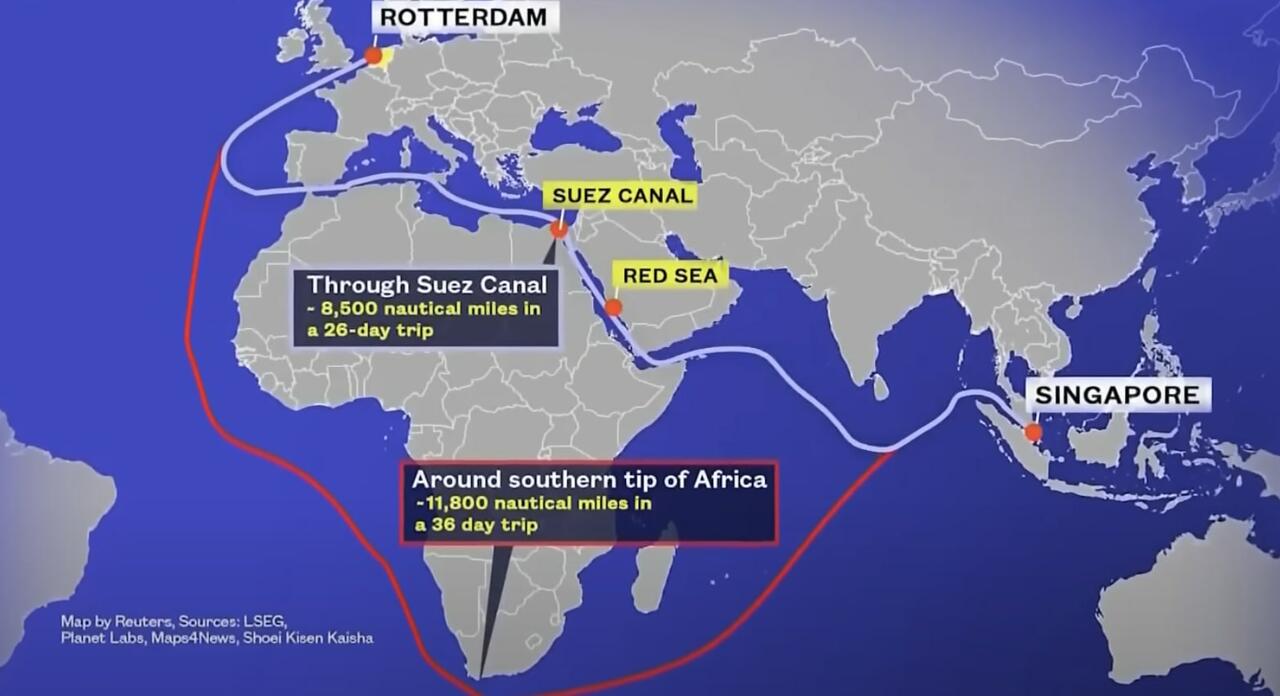
For the past year, international shipping companies been forced to take the much longer and costlier route around the Africa continent to avoid the Red Sea.

The Houthis have attacked more than 100 international commercial vessels, and have even targeted US and British military warships, including aircraft carriers. The Houthis have also shot down multiple American MQ-9 Reaper drones.

As we reported last week, ocean lines have said they are watching developments in the Red Sea but have offered no timeline to resume regular schedules there. Among major lines, only CMA CGM has maintained a schedule on the Suez Canal route.

Map via Reuters

“The situation in the Suez Canal remains fluid and the security situation is unclear,” said MSC in a statement to FreightWaves. “In order to guarantee the safety of our seafarers and to ensure consistency and predictability of service for our customers, MSC will continue to transit via the Cape of Good Hope [around Africa] until further notice.”

The cost of transit through the Suez Canal has greatly ratcheted, and the avoidance of the strategic waterway to and from the Mediterranean has also cost Egypt tens of billions of dollars.

Tyler Durden
Wed, 01/29/2025 – 04:15

via ZeroHedge News https://ift.tt/BKCZY1T Tyler Durden

The Example That Trump Made Out Of Colombia Will Reverberate Across The World

The Example That Trump Made Out Of Colombia Will Reverberate Across The World

Authored by Andrew Korybko via substack,

Colombian President Gustavo Petro thought that he’d rebalance lopsided relations with his returning US counterpart by abruptly rejecting two previously agreed military flights for repatriating his country’s illegal immigrants but was ultimately taught an unforgettable lesson. Trump reacted with fury by threatening 25% tariffs that would double in a week’s time and sanctioning high-level officials on national security pretexts among other punitive measures, which quickly prompted Petro to capitulate.

White House Press Secretary Karoline Leavitt then confirmed her country’s victory in its brief dispute with Colombia, shortly after which Petro rage-tweeted a convoluted rant about imperialism and racism as a parting shot against Trump that was widely met with mockery online, especially from Americans. This short-lived scandal was significant since Trump proved how serious he is about leveraging tariffs and sanctions to coerce Ibero-American countries into accepting the return of their repatriated citizens.

He won the 2016 election in part because of his pledge to build a southern border wall for stopping illegal immigration, but after an estimated 8 million illegals flooded into the country during Biden’s term, he then promised to expel as many as possible if voters returned him to office like they ultimately did. It’ll be difficult to return all of them, however, which is why his administration wants to coerce them into voluntarily leaving on their own by creating extremely onerous conditions for those who remain.

To that end, repatriating some of them to their homelands on military flights – including in handcuffs like what just happened to some illegal immigrants from Brazil – is meant to intimidate them into returning back home on their own terms, ergo the importance of ensuring that these flights aren’t rejected. In parallel with this, the Trump Administration is exploring an agreement to deport asylum seekers to El Salvador, which is now globally known for its zero-tolerance of gang members.

On the topic, US-sanctioned Venezuela halted repatriation flights last February after briefly allowing their resumption in October 2023, so suspected Venezuelan gang members might be sent straight from the US to Salvadoran prisons if a deal is reached. Combined with an unprecedented ramping up of ICE raids across the country, those who remain in the US illegally will always have to look over their shoulder and fear either being deported back to their homelands or sent to El Salvador depending on who they are.

The Trump Administration rightly considers illegal immigration to be a national security threat, which explains Trump’s harsh reaction to Petro rejecting those two previously agreed military flights. If he didn’t make an example out of him, then most Ibero-American countries would predictably defy the US on this issue as well, thus ruining his ambitious repatriation plans. Trump therefore had to remind Colombia and every other country in the hemisphere that they’re the US’ junior partner.

Failure to submit to its reasonable demands that they receive their repatriated citizens who illegally immigrated to the US will entail crushing tariff and sanctions consequences that’ll risk harming their economies and greatly inconveniencing their political elite. Furthermore, disrespecting the US and Trump personally like Petro did is absolutely unacceptable in what Trump described as the nascent “Golden Age of America”, and those that do so will be made to pay the price, including reputationally.

The so-called “rules-based order” was never what the Biden Administration mispresented it as being with regard to the claim of every country supposedly being equal and having to follow the same rules.

It was always about maintaining the US’ declining unipolar hegemony in the emerging Multipolar World Order by reinforcing the post-Old Cold War international hierarchy atop which it sits. A carrot-and-stick approach pairs with explicit double standards to coax countries into falling in line with varying success.

Those that are dependent on the US market and/or military equipment like most Ibero-American countries are tend to bend to its will while those like Russia that are more autarkic and strategically autonomous tend to resist. The Obama and Biden Administrations tried to disguise this reality with lofty rhetoric and by sometimes turning a blind eye to transgressions from its partners like those Ibero-American countries that hitherto refused to accept their repatriated citizens, but Trump is more direct.

He has no compunction about openly reminding them of their junior status vis-à-vis the US since he’d rather that his country be feared than loved if he has to choose between them per Machiavelli. Additionally, Trump is preparing for negotiations with Putin over Ukraine as well as with Xi over trade and likely also Taiwan, so he’d appear weak in their eyes if he let middling leader like Petro publicly defy and even insult him without consequence.

These imperatives made him escalate with Colombia.

The example that Trump just made out of Petro will therefore reverberate across the world.

What he calls the “Golden Age of America” can more accurately be called the era of US hyper-realism in foreign affairs whereby it explicitly declares its interests and then aggressively pursues them without any care for global opinion.

Thus, it might be better for Russia and China to compromise with the US instead of challenge it if they won’t replicate this policy, or if they lack the same power or will to use it.

Tyler Durden
Wed, 01/29/2025 – 03:30

via ZeroHedge News https://ift.tt/hZ2VvHe Tyler Durden

Ukrainian Media Outlets Start Asking For Donations After US Funding Is Paused

Ukrainian Media Outlets Start Asking For Donations After US Funding Is Paused

Authored by Dave DeCamp via AntiWar.com,

Major Ukrainian media outlets are asking for donations following the Trump administration’s 90-day foreign aid pause since many of them are funded by the US government.

Ukrainian-Canadian professor and researcher Ivan Katchanovski noted on X that the Ukrainian online newspaper Strana.ua reported that two outlets — Hromadske and Bihus.Info — acknowledged in their fundraising pitches that they lost US funding.

Source: Laurent Van der Stockt for Le Monde/Getty Images

BIHUS.Info said in a Facebook post that a “large portion” of its work had been funded by the US Agency for International Development (USAID). “Therefore, now the role of donations from viewers is changing from an alternative source to one of the key ones. What will happen in 90 days, we do not know, but we know one thing: now is the time to find out whether our work is really needed by Ukrainian society,” the post said.

Hromadske said that some of the “projects that we implement thanks to grants are temporarily stopped. That is why we especially need the support of each and every one of you.”

Other major Ukrainian outlets, including Ukrainska Pravda and Detector Media, also began asking for donations following the pause in US foreign aid but did not explicitly name that as the reason they’re fundraising.

Katchanovski, author of the book “The Maidan Massacre in Ukraine,” said many of the US-funded media outlets whitewashed the Ukrainian far-right and smeared opponents as pro-Russia.

“Major Ukrainian media outlets financed by the US and other Western governments, such as Ukrainska Pravda & Detector Media, propagated the war to the last Ukrainian, glorified & whitewashed neo-Nazi-led Azov, the OUN, and the UPA, & smeared anyone who opposed this as Russian agents paid by Kremlin,” Katchanovski wrote on X.

The New York Times reported that several humanitarian organizations in Ukraine have had to shut down due to the Trump administration’s foreign aid pause. US officials at the US Embassy in Ukraine are asking for exemptions for humanitarian operations in the country, but so far, the only known exemptions are for military aid to Israel and Egypt under the State Department’s Foreign Military Financing program.

The vast majority of US military aid to Ukraine is provided by the Pentagon, and that does not appear to be affected by the State Department’s pause. “I am focused on military aid; it has not been stopped, thank God,” Ukrainian President Volodymyr Zelensky said on Saturday.

Before leaving office, President Biden approved a huge amount of military aid for Ukraine, and there’s no sign those shipments have been frozen.

Tyler Durden
Wed, 01/29/2025 – 02:00

via ZeroHedge News https://ift.tt/SovqH86 Tyler Durden

ICE Immigration Enforcement Operations: What To Know

ICE Immigration Enforcement Operations: What To Know

Authored by Savannah Hulsey Pointer via The Epoch Times (emphasis ours),

President Donald Trump is making good on his campaign promise to deport illegal immigrants. Immigration and Customs Enforcement (ICE) has launched a number of “targeted enforcement operations” in major cities, yielding hundreds of arrests per day since its campaign began.

A man is detained by U.S. Immigration and Customs Enforcement (ICE) agents in Los Angeles, Calif. on Oct. 14, 2015. John Moore/Getty Images

On day one in office, Trump issued sweeping actions to combat illegal immigration, including deployment of military personnel to the southern border and deportations targeting those with a criminal record nationwide. Additionally, Trump declared a national border emergency and issued an order to end birthright citizenship for children of non-citizens or those on temporary status visas.

Planned Operations

According to ICE’s account on social media platform X, targeted enforcement operations involve “planned arrests of known criminal aliens who threaten national security or public safety.”

Since Jan. 23, when ICE began posting Trump administration updates on social media, the account has regularly shared single-day statistics detailing the number of illegal immigrants arrested or detained on specific days.

The first update announced 538 arrests and 373 detainers lodged on Jan. 23. The next day brought slightly higher figures, with the department’s announcement of 593 arrests. On Jan. 25 and 26, the agency announced 286 and 956 arrests, respectively. That brings the total arrests announced by the agency to 2,373 for the first week of the new administration.

ICE issued a statement on Jan. 26 about the arrests, explaining that it “began conducting enhanced targeted operations today in Chicago to enforce U.S. immigration law and preserve public safety and national security by keeping potentially dangerous criminal aliens out of our communities.”

ICE said it was working with the FBI, the Drug Enforcement Administration (DEA), Customs and Border Protection, the U.S. Marshals Service, and the Bureau of Alcohol, Tobacco, Firearms, and Explosives.

Chicago

Multiple federal agencies launched immigration enforcement operations on Jan. 26 in Chicago. Federal officials were present in the city to observe the Department of Homeland Security (DHS) immigration enforcement, including Acting Deputy Attorney General Emil Bove.

ICE did not offer figures for how many illegal immigrants it has arrested in Chicago. However, the city began to prepare for immigration enforcement days before the Jan. 26 arrests began.

Mayor Brandon Johnson spoke out about the operations in a post on X: “We’ve received reports of ICE enforcement activity in Chicago today. Please know that Chicago police were not involved. My team and I are working closely with City officials.”

Denver

The DEA Rocky Mountain Field Division worked with ICE and other federal officials to arrest 41 illegal immigrants from a “makeshift nightclub” in a Denver suburb on Jan. 26.

During the arrests, agents seized drugs—including cocaine—and weapons. The agency reported that a number of those found at the event are connected to the Venezuelan gang Tren de Aragua.

Houston

Houston’s DEA division posted on social media on Jan. 26 several photos of arrests carried out with the Department of Justice (DOJ) and DHS officials to make an unspecified number of arrests.

Newark

In Newark, local officials allege that ICE carried out an enforcement operation and illegally arrested workers at a local fast food distribution center, with Mayor Ras Baraka asserting that in addition to the detention of three non-citizens, some of those detained were citizens, one of which was allegedly a military veteran.

ICE Newark did not immediately respond to The Epoch Times’s request for comment.

Los Angeles

Los Angeles DEA also confirmed via social media on Jan. 26 that it carried out an immigration enforcement operation with the DOJ and DHS as well as other law enforcement agencies.

Arrests of illegal immigrants have also been reported by federal agencies in San Antonio, Miami, Detroit, Omaha, Phoenix, and Atlanta.

Other Arrests

ICE has also released details on specific arrests of criminal illegal aliens, including the arrest of a man in Houston. Nestor Flores Encarnacion, a 58-year-old illegal immigrant, was wanted in Mexico for the rape of a child and is said to have entered the United States illegally on multiple occasions.

This foreign fugitive brazenly entered the U.S. in violation of our nation’s laws on four separate occasions to evade prosecution in Mexico for allegedly raping a child,” said ICE Enforcement and Removal Operations Houston Field Office Director Bret A. Bradford.

On the same day, ICE’s Enforcement and Removal Operations San Francisco arrested an illegal immigrant and Guatemalan national convicted of lewd and lascivious acts with a minor. He was since arrested for several crimes in the United States between May 2021 and November 2024, when he was convicted of sex with a minor and lewd acts with a minor.

Border Czar

Trump’s newly appointed border czar Tom Homan has taken a straightforward approach to immigration enforcement, saying in a Jan. 21 interview on CNN that ICE will prioritize the arrest and deportation of illegal immigrants with a criminal record. He said, however, that the enforcement would not be limited to those illegal immigrants with a criminal background.

“That is the difference between the last administration and this administration: ICE is going to enforce immigration law. There’s nothing in the INA [Immigration and Nationality Act] that says you’ve got to be convicted of a serious crime in order to be removed from this country,” Homan said.

“[ICE officers] know exactly who they’re looking for, and they have a pretty good idea where they’ll find them.”

The Associated Press and Lawrence Wilson contributed to this report.

Tyler Durden
Tue, 01/28/2025 – 22:35

via ZeroHedge News https://ift.tt/VvUfS5R Tyler Durden

Putin Declares He Won’t Negotiate With Zelensky As Ukrainian Leader Has Outlawed Peace Talks

Putin Declares He Won’t Negotiate With Zelensky As Ukrainian Leader Has Outlawed Peace Talks

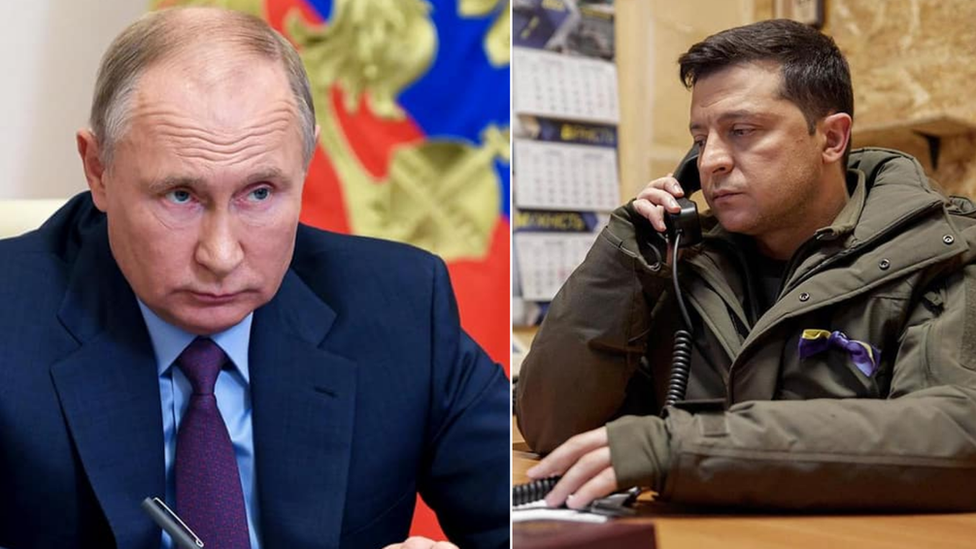
In a huge development which significantly raises the stakes for any future potential Trump-backed negotiations related to seeking ceasefire in the Ukraine war, President Vladimir Putin has said that he won’t negotiate with Ukraine so long as President Volodymyr Zelensky is in power, and on the other side of talks.

“If he wants to take part in negotiations, I will select such people, it’s not an issue. The question is about the final signing of the documents,” Putin said in a state broadcast TV interview on Tuesday. He argued that because of canceled elections Zelensky’s legitimacy has expired, and this means he “does not have the right to sign anything.”

Via BBC/Getty Images

Early in the war Zelensky had authorized a decree outlawing peace negotiations with Moscow. This happened in 2022 and there have not been direct engagements since, other than UAE-brokered POW swaps.

It was actually Zelensky who long ago declared that it is Putin who is illegitimate, and that Ukraine won’t enter peace negotiations so long as Putin is in power. It appears the Russian leader is now using the same tactic to turn the table, and create additional leverage at a moment Trump is pushing for talks and a final deal.

“On the question of the final signing of the documents…there cannot be a single mistake or wrinkle. Everything must be polished,” Putin emphasized.

But Putin in the fresh comments did leave an opening. “If there is a desire, any legal question can be resolved. So far, we simply don’t see such a desire” from the Ukrainian side, Putin stressed.

Essentially Putin is saying Zelensky would have to ‘move first’ to cancel that prior law banning talks with Putin’s government. This could by why the Kremlin is slow-playing Trump overtures which are meant to encourage everyone to get to the negotiating table.

Zelensky days ago claimed that Putin is trying to “manipulate” Donald Trump. According to a summary of the latest back-and-forth:

Russian President Vladimir Putin told reporters on Friday: “Regarding negotiations, we have always said—and I want to emphasize this again—that we are ready for talks on the Ukrainian issue.”

Ukrainian President Volodymyr Zelensky said in his evening address on Friday: “[Putin] wants to manipulate the desire of the President of the United States of America to achieve peace. I am confident that no Russian manipulations will succeed anymore.”

Institute for the Study of War said in a Russian offensive campaign assessment on Friday: “Putin is once again attempting to obfuscate his unwillingness to participate in good-faith negotiations to end the war by blaming Ukraine for defending itself against Russia’s invasion and illegal annexation of Ukrainian territory.”

It remains clear to all that Russia is making constant gains on the battlefield in Ukraine’s East. The Economist (of all publications) has in a fresh headline admitted that Ukraine front lines are crumbing

Putin further explained in the Tuesday interview, “Negotiations factually began immediately after the start of the Special Military Operation. Initially, we told the Ukrainian leadership at the time that the people of the Lugansk and Donetsk People’s Republics don’t want to be part of Ukraine. Leave these territories, and that’s it, that’s where it ends. No fighting, no war.”

Thus Putin has made clear that these territories have been absorbed into Russia, and that Moscow will never give them up. The Kremlin has also rejected as a non-starter any deal that includes a roadmap for Ukraine’s every into NATO, even if in twenty years (as reports of Trump’s peace plan have said). Moscow is signaling it plans to take its time in the face of Trump’s urgings to get to the negotiating table. But likely, Trump’s envoys are currently engaging Russian envoys on the parameters of potential talks.

Tyler Durden
Tue, 01/28/2025 – 22:10

via ZeroHedge News https://ift.tt/eHML7Oj Tyler Durden