Trump’s Tariff War Is Crushing American Alcohol Makers


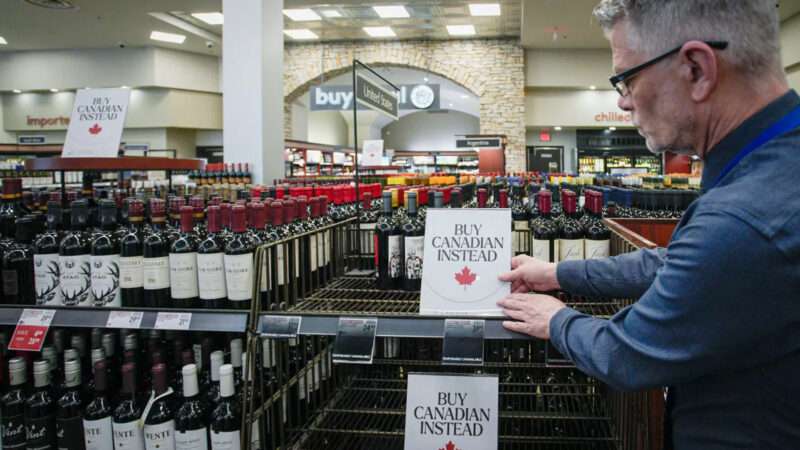
A man places a sign on a liquor store shelf that says 'buy Candian instead' | Liang Sen / Xinhua News Agency/Newscom

In recent weeks, new data has emerged from Canada showing the near-catastrophic consequences to American alcohol manufacturers from President Donald Trump’s tariff wars. Yet despite clear signs that his tariff policies are backfiring, the president keeps doubling down.

Last year, in response to the administration’s tariffs on goods from Canada, provincial liquor stores in Quebec and Ontario enacted a boycott on American wine and distilled spirits. Because the government operates the liquor stores in those provinces, it was relatively straightforward to simply pull all American-based alcohol from store shelves, essentially zeroing out Canadian alcohol sales for American producers.

Now, the data is starting to roll in concerning the impact of the boycott. Since 2024, there has been a jaw-dropping 91 percent decline in U.S. wine sales to Canada. In just October of last year, there was an 84 percent year-over-year drop in wine sales compared to the prior year and a 56 percent drop in distilled spirit sales. Prior to the boycott, Canada was one of the primary export markets for American wine.

As reported by The Independent, large distilling companies like Brown-Forman Corporation (producer of Jack Daniel’s) have seen their organic net sales to Canada plummet by 60 percent in the first half of the 2026 fiscal year. Jim Beam faced such a significant drop in sales from both the Canadian boycott and the general drying up of its international markets on account of the tariff wars that it suspended production entirely at its flagship plant.

According to The Independent, smaller distillers in states like Minnesota have suffered 70 percent declines in sales and have been forced to ship production to Canada by working with Canadian contract distillers. The result, in turn, is fewer U.S.-based manufacturing jobs and more Canadian-based jobs.

The pain extends throughout the broader drinks industry. A recent HuffPost report details a broad increase in prices at American cocktail bars nationwide due to current tariffs on products from the European Union and Mexico. Not only are drink prices rising, but many imported products are becoming harder to find as foreign makers of specialty liqueurs, spirits, and wine are increasingly limiting their exports to the U.S.

An under-appreciated aspect of alcohol products is that many are beholden to so-called Standards of Identity rules. These rules dictate that products like Champagne can only come from France, tequila from Mexico, and scotch from Scotland. Given that there are no domestic substitutes for these products, bar owners must either raise prices or remove them from their menus entirely.

Despite the crippling pain being borne by the industry, Trump has shown few signs of reconsidering. In response to news that French President Emmanuel Macron would not join Trump’s newly minted “Board of Peace” to resolve the ongoing Gaza conflict, Trump told reporters: “I’ll put a 200 percent tariff on his wines and Champagnes, and he’ll join, but he doesn’t have to join.”

In the meantime, the drinks industry—and consumers—will continue to suffer.

The post Trump's Tariff War Is Crushing American Alcohol Makers appeared first on Reason.com.

from Latest – Reason.com https://ift.tt/TUt7Zie
via IFTTT

Government’s Theory for Prosecuting Don Lemon as to Disruption of Minneapolis Church Service

The indictment in U.S. v. Levy-Armstrong has been unsealed; I excerpted the key allegations as to the disruption itself in this post. But what about Don Lemon, the former longtime CNN reporter who livestreamed the disruption?

If a person breaks a speech-neutral law in order to record and publish something, his motivation generally doesn’t give him any First Amendment right to break the law. That’s true as to trespass laws, wiretapping laws, and more. And that’s true whether the person is working for a professional news outlet or just acting on his own.

At the same time, the government still has to show all the elements of the crime as to each defendant, and sometimes it might be unable to do that as to the person who is just trying to report on the event. An example: The crime of burglary generally (to oversimplify) requires unlawfully entering onto property with the intent to commit a further crime there, often theft. If a gang of people break into a store in order to steal from it, they may well be guilty of commercial burglary.

But if someone else walks into the store and livestream them doing it, then the elements of commercial burglary wouldn’t be satisfied, because he didn’t enter with the intent to commit a further crime. He is therefore not guilty—not because his acting as a journalist gives him a First Amendment immunity, but because his lack of intent to steal means the elements of the crime are absent as to him.

Lemon, together with other defendants, was indicted for violating 18 U.S.C. § 241, which in relevant part makes it a crime to

conspire to injure, oppress, threaten, or intimidate any person … in the free exercise or enjoyment of any right or privilege secured to him by the Constitution or laws of the United States

and 18 U.S.C. § 248(a)(2), which in relevant part makes it a crime to

by force or threat of force or by physical obstruction, intentionally injures, intimidates or interferes with or attempts to injure, intimidate or interfere with any person lawfully exercising or seeking to exercise the First Amendment right of religious freedom at a place of religious worship.

To convict Lemon, the government has to show all the elements of the crime as to him. It has to show that he conspired with the others to oppress people in their free exercise of religion, which is to say that he entered into an express or implicit agreement with them to commit the underlying unlawful acts (§ 241). And it has to show (to oversimplify slightly) that he either personally used force or threat of force or physical obstruction to intentionally interfere with their religious worship (§ 248), or that he is guilty as a coconspirator or an accomplice.

Whether the government can do that, I assume, will be a matter for trial (or perhaps for pretrial motions practice, though I doubt that such motions will resolve the issue). Here are the government’s factual allegations as to Lemon:

All defendants met at a shopping center for a pre-op briefing, during which ARMSTRONG and ALLEN advised other co-conspirators, including defendants KELLY, LEMON, RICHARDSON, LUNDY, CREWS, FORT, and AUSTIN, about the target of their operation (i.e., Cities Church) and provided instruction on how the operation would be conducted once they arrived at the Church. Once at the Church, all of the defendants entered the Church to conduct a takeover-style attack and engaged in various acts in furtherance of the conspiracy….

Overt Act# 4: At the pre-operation briefing, defendants ARMSTRONG and ALLEN advised other co-conspirators, including defendants KELLY, LEMON, RICHARDSON, LUNDY, CREWS, FORT, and AUSTIN, about the target of their operation (i.e., Cities Church) and provided instruction on how the operation would be conducted once they arrived at the Church.

Overt Act# 5: On the morning of January 18, 2026, defendant LEMON began livestreaming on his internet-based show, “TheDonLemonShow,” where he explained to his audience that he was in Minnesota with an organization that was gearing up for a “resistance” operation against the Federal Government’s immigration policies, and he took steps to maintain operational secrecy by reminding certain co-conspirators to not disclose the target of the operation and stepped away momentarily so his mic would not accidentally divulge certain portions of the planning session.

Overt Act# 6: During a discussion with defendant ARMSTRONG at the pre-op briefing, (a) defendant LEMON thanked defendant ARMSTRONG for what she was doing and assured her that he was “not saying … what’s going on” (i..e., was not disclosing the target of the operation); (b) defendant ARMSTRONG explained that “Operation Pullup” was a “clandestine” operation in which she and other agitators would “show up somewhere that is a key location, [where the targets] don’t expect us … , and we disrupt business as usual. That’s what we’re about to go do right now.”; and (c) defendant LEMON said he would see her there.

Overt Act# 7: Before heading to the Church to join his co-conspirators, defendant LEMON advised his livestream audience that, “We’re going to head to the operation. Again, we’re not going to give any, any of the information away” (i.e., operational details that would disclose where he and his co-conspirators were heading)….

Overt Act# 11: While enroute to the Church, defendant RICHARDSON told defendant LEMON that they had to “catch up” to the others, and defendant LEMON replied, “Let’s go, catch up”; and, because he was still livestreaming, LEMON instructed RICHARDSON and an unidentified male, “Don’t give anything away” (i.e., don’t divulge information about the operation), and advised his audience, “We can’t say too much. We don’t want to give it up.”

Overt Act# 12: Continuing on the morning of January 18, 2026, all of the defendants, together with other co-conspirators, entered the Church sanctuary, with the first wave positioning themselves among the congregants and the second wave, led by defendants ARMSTRONG and ALLEN, commencing the disruptive takeover operation, in which the first wave of agitators then actively joined….

Overt Act# 15: While inside the Church, defendants ARMSTRONG, ALLEN, KELLY, LEMON, RICHARDSON, LUNDY, CREWS, FORT, and AUSTIN oppressed, threatened, and intimidated the Church’s congregants and pastors by physically occupying most of the main aisle and rows of chairs near the front of the Church, engaging in menacing and threatening behavior, (for some) chanting and yelling loudly at the pastor and congregants, and/or physically obstructing them as they attempted to exit and/or move about within the Church….

Overt Act# 20: Defendant LEMON told his livestream audience about congregants leaving the Church and about a “young man” who LEMON could see was “frightened,” “scared,” and “crying,” and LEMON observed that the congregants’ reactions were understandable because the experience was “traumatic and uncomfortable,” which he said was the purpose.

Overt Act # 21: As the operation continued, defendant LEMON acknowledged the nature of it by expressing surprise that the police hadn’t yet arrived at the Church, and admitted knowing that “the whole point of [the operation] is to disrupt.”

Overt Act# 22: While the takeover operation was underway, defendant LEMON asked defendant ARMSTRONG, “Who is the person that we should talk to? Is there a pastor or something?,” and she pointed toward the front of the Church but noted the pastor “might have run away.”

Overt Act# 23: With other co-conspirators standing nearby, defendants LEMON, RICHARDSON, and FORT approached the pastor and largely surrounded him (to his front and both sides), stood in close proximity to the pastor in an attempt to oppress and intimidate him, and physically obstructed his freedom of movement while LEMON peppered him with questions to promote the operation’s message.

Overt Act# 24: While talking with the pastor, defendant LEMON stood so close to the pastor that LEMON caused the pastor’s right hand to graze LEMON, who then admonished the pastor, “Please don’t push me.”

Overt Act# 25: Although the pastor told defendant LEMON and the others to leave the Church, defendant LEMON and the other defendants ignored the pastor’s request and did not immediately leave the Church….

Overt Act# 28: At one point, defendant LEMON posted himself at the main door of the Church, where he confronted some congregants and physically obstructed them as they tried to exit the Church building to challenge them with “facts” about U.S. immigration policy….

If Lemon is found to have conspired with the other defendants, then he could be liable as to their actions as well. But I take it that these allegations are the heart of the government’s evidence that Lemon had indeed conspired with the other defendants (and, in part, that Lemon had independently engaged in obstructive actions). Consider for yourselves whether you think they suffice.

The post Government's Theory for Prosecuting Don Lemon as to Disruption of Minneapolis Church Service appeared first on Reason.com.

from Latest – Reason.com https://ift.tt/FPaUj8n
via IFTTT
Indictment Over Disruption of Minneapolis Church Service Unsealed

The indictment (in U.S. v. Levy-Armstrong) is here. The allegations are that defendants violated 18 U.S.C. § 241 which in relevant part makes it a crime to

conspire to injure, oppress, threaten, or intimidate any person … in the free exercise or enjoyment of any right or privilege secured to him by the Constitution

and 18 U.S.C. § 248(a)(2), which in relevant part makes it a crime to

by force or threat of force or by physical obstruction, intentionally injures, intimidates or interferes with or attempts to injure, intimidate or interfere with any person lawfully exercising or seeking to exercise the First Amendment right of religious freedom at a place of religious worship.

(Section 248(a)(1), the most commonly used part of the same statute, prohibits the same as to “obtaining or providing reproductive health services”; the statute is called the Freedom of Access to Clinic Entrances Act, but it has always covered both abortion clinics and places of worship.)

Here is the heart of the allegations about what happened at the church. I will blog separately about how the indictment bears on Don Lemon (the former long-time CNN reporter) who livestreamed the event:

Overt Act# 12: Continuing on the morning of January 18, 2026, all of the defendants, together with other co-conspirators, entered the Church sanctuary, with the first wave positioning themselves among the congregants and the second wave, led by defendants ARMSTRONG and ALLEN, commencing the disruptive takeover operation, in which the first wave of agitators then actively joined.

Overt Act# 13: As the pastor was beginning his sermon, defendant ARMSTRONG interrupted the service with loud declarations about the Church harboring a “Director of ICE” and indicating that the time for Judgment had come, and other co-conspirators immediately joined in by yelling and blowing whistles in a takeover attack on the Church, all of which quickly caused the situation in the Church to become chaotic, menacing, and traumatizing to Church members.

Overt Act# 14: While inside the Church, defendants ARMSTRONG, ALLEN, KELLY, RICHARDSON, LUNDY, CREWS, and AUSTIN and others led and/or joined with their co-conspirators in various chants, including “ICE Out!,” “Hands Up, Don’t Shoot!,” and “Stand Up, Fight Back!,” while gesturing in an aggressive and hostile manner, which congregants and the pastor perceived as threats of violence and a potential prelude to a mass shooting.

Overt Act# 15: While inside the Church, defendants ARMSTRONG, ALLEN, KELLY, LEMON, RICHARDSON, LUNDY, CREWS, FORT, and AUSTIN oppressed, threatened, and intimidated the Church’s congregants and pastors by physically occupying most of the main aisle and rows of chairs near the front of the Church, engaging in menacing and threatening behavior, (for some) chanting and yelling loudly at the pastor and congregants, and/or physically obstructing them as they attempted to exit and/or move about within the Church.

Overt Act# 16: While inside the Church, defendant AUSTIN stood with other agitators in and around the main aisles in the Church to intimidate the Church members and obstruct and interfere with their freedom of movement, approached the pastor and congregants in a menacing manner, and, near the end of the operation, loudly berated the pastor with questions about Christian nationalism and Christians wanting to have their faith be the law of the land.

Overt Act# 17: While inside the Church, defendant LUNDY personally participated in the disruptive takeover operation with other defendants by standing in the main aisle with the others and contributing to the physical obstruction and intimidation of the congregants, participating loudly in some of the chants (e.g., one saying that the targeted ICE agent must be “Out! Out!”), and punching his fist in the air.

Overt Act# 18: While inside the Church, defendant CREWS personally participated in the disruptive takeover operation with other defendants by standing in and around the main aisle with the others and contributing to the physical obstruction and intimidation of the congregants and participating in some of the chants.

Overt Act# 19: While inside the Church, defendant KELLY (a) disrupted the service by chanting, “This ain’t God’s house. This is the house of the devil.”; (b) approached one female congregant, who was with two young children, and demanded to know in a hostile manner why she was not involved in and supportive of the takeover operation; and (c) screamed “Nazi” in congregants’ faces and asked child congregants, “Do you know your parents are Nazis? They’re going to burn in hell.”

Overt Act# 20: Defendant LEMON told his livestream audience about congregants leaving the Church and about a “young man” who LEMON could see was “frightened,” “scared,” and “crying,” and LEMON observed that the congregants’ reactions were understandable because the experience was “traumatic and uncomfortable,” which he said was the purpose….

Overt Act# 23: With other co-conspirators standing nearby, defendants LEMON, RICHARDSON, and FORT approached the pastor and largely surrounded him (to his front and both sides), stood in close proximity to the pastor in an attempt to oppress and intimidate him, and physically obstructed his freedom of movement while LEMON peppered him with questions to promote the operation’s message.

Overt Act# 24: While talking with the pastor, defendant LEMON stood so close to the pastor that LEMON caused the pastor’s right hand to graze LEMON, who then admonished the pastor, “Please don’t push me.”

Overt Act# 25: Although the pastor told defendant LEMON and the others to leave the Church, defendant LEMON and the other defendants ignored the pastor’s request and did not immediately leave the Church.

Overt Act# 26: After causing most of the congregants to flee, some of the defendants and other agitators engaged in a chant proclaiming, “Who shut this down? We shut this down!”

Overt Act# 27: As one congregant reported to responding police officers, some of the agitators blocked the stairs leading to the Church’s childcare area and made it difficult and hazardous for parents to retrieve their children, causing some to take alternative routes in or around the Church.

Naturally, the First Amendment offers no defense to charges that one has conspired to physically obstruct worship services by shouting them down on the church’s property—just as it offers no defense to charges that one has conspired to hold a demonstration inside an abortion clinic’s operating rooms. And of course this would equally apply to right-wing protesters who might want to interrupt a service at a mosque, to anti-Semitic protesters who might want to interrupt a service at a synagogue, or whoever else.

On the other hand, the charge do require (to oversimplify) a showing that each defendant conspired with the others to engage in the obstruction, or (as to § 248(a)(2)) that each defendant either personally participated in the obstruction or acted as an accomplice or a coconspirator. I take it that Don Lemon’s defense would be that he wasn’t a coconspirator who had expressly or implicitly agreed with the others to commit an unlawful act (the essence of criminal conspiracy), but rather just a journalist who was there to document what happened for his own and his viewers’ purposes. More on that in a separate post.

The post Indictment Over Disruption of Minneapolis Church Service Unsealed appeared first on Reason.com.

from Latest – Reason.com https://ift.tt/lJWA3yi
via IFTTT

Federal District Court Judge Rejects Minnesota’s Anti-Commandeering Arguments Against DHS “Operation Metro Surge” (and with Good Reason)

Speaking of commandeering, today in Minnesota v. Trump, federal district court Judge Kate Menendez rejected Minnesota’s request for an injunction against the Trump Administration’s “Operation Metro Surge” immigration enforcement initiative in Minneapolis. Unlike my co-blogger Ilya Somin, I believe Judge Menendez was entirely correct to do so, as existing law does not remotely support Minnesota’s claims.

As Judge Menendez recognized, the anti-commandeering doctrine is relatively narrow. It bars the federal government from issuing directives to state or local governments, Under the relevant cases, the federal government may not force state or local governments to administer or enforce a federal regulatory scheme or adopt federal law enforcement or regulatory priorities. For this reason, states are not obligated to assist the Department of Homeland Security in identifying, detaining, and deporting unlawfully present aliens any more than state or local law enforcement is required to assist the Drug Enforcement Agency in arresting and prosecuting those who use or possess (or even distribute) marijuana.

But the anti-commandeering doctrine does not prevent the federal government from pressuring states to cooperate, nor does it insulate states from the potentially burdensome or disruptive effects of federal law. Indeed, the relevant cases are quite clear on this. So, for example, New York v. United States held that it was permissible for the federal government to impose more stringent regulatory constraints and greater tax burdens on states that failed to address low-level radioactive waste in accord with the federal government’s preferences. Under the Clean Air Act, states that fail to adopt and maintain adequate State Implementation Plans are not subject to injunctions, but can face more stringent offset requirements and direct federal regulation that promises to be more onerous and less sensitive to local concerns than state or local regulation would be. (Threatening highway funds, on the other hand, might be a bridge to far.)

Other cases, such as Garcia v. SAMTA and Reno v. Condon also make it abundantly clear that states get no special exemption from the burdens or disruptions that may be caused by federal law. That’s the way federal supremacy works. If a given federal action is otherwise constitutional, it takes more than state or local displeasure to make the action unconstitutional. Indeed, were it otherwise state and local governments would have a de facto objectors veto (cf. heckler’s veto) over efforts to enforce federal laws to which state and local governments object.

In her opinion in Minnesota v. Trump, Judge Menendez seemed particularly concerned with the line-drawing problem: How to differentiate permissible federal enforcement decisions from those that are unconstitutionally coercive. Recognizing that the federal government is entitled to focus or concentrate federal enforcement efforts in line with federal priorities, including by focusing such efforts in non-cooperating jurisdictions, on what basis can such efforts constitute commandeering? As noted above, that such decisions may be unwelcome, burdensome, or even punitive is not enough under current law. Even in the conditional spending context it takes more than a naked threat to withdraw a large pot of money for inducement to become compulsion, such as the sort of reliance interests we saw in NFIB v. Sebelius.

None of this means that everything the Trump Administration is doing in Minnesota is lawful (let alone desirable). Congressional oversight of the Trump Administration’s immigration enforcement efforts, including (but not limited to) the tragic deaths of anti-ICE activists, is more than welcome. (Indeed, it is long overdue.) My point here is simply that whatever the legal or other problems with “Operation Metro Surge,” the idea that it constitutes unconstitutional commandeering or otherwise violates the Tenth Amendment is not among them–and even though she may not have wanted to, Judge Menendez agreed.

The post Federal District Court Judge Rejects Minnesota's Anti-Commandeering Arguments Against DHS "Operation Metro Surge" (and with Good Reason) appeared first on Reason.com.

from Latest – Reason.com https://ift.tt/fAEKWDZ
via IFTTT

Private Suit Commandeers New Hampshire Government to Maintain Vehicle Emission Inspections

This weekend car owners in New Hampshire were supposed to be done with regular automobile emission inspections. Although such inspections had been part of the New Hampshire’s State Implementation Plan (SIP) under the federal Clean Air Act, the state legislature passed a law abolishing the program last year, effective today, January 31. Now, however, the inspections may be required after all.

Gordon-Darby Holdings, which owns the company that administered the program under a contract with the state did not want the program (and its associated revenue) to go away, so it filed suit, seeking an injunction to force New Hampshire to continue requiring automobile emission inspections. According to Gordon-Darby, New Hampshire was required to maintain the program unless and until it received approval from the federal Environmental Protection Agency. On this basis, the company went to court and—quite shockingly—prevailed.

In an order issued this past Tuesday in Gordon-Darby Holdings v. NH Department of Safety, federal district court judge Landya McCafferty enjoined New Hampshire from taking any action  “to terminate, suspend, or otherwise cease implementation or enforcement” of the vehicle inspection program, on the grounds that ending the program would violate the Clean Air Act. Because the program was part of the state’s EPA-approved SIP, it was now required under federal law.

Judge McCafferty’s decision is shocking because it is well-established that the federal government cannot require that state governments adopt or enforce regulatory measures. Such “commandeering” is unconstitutional under clear and controlling Supreme Court precedent.

As the Supreme Court explained in New York v. United States¸ “the federal government may not compel the States to enact or administer a federal regulatory program.” Rather,  the federal government may offer inducements to states to encourage their cooperation. This is what is generally called “cooperative federalism.” (Whether this is “cooperative” or adversarial in practice is of course another question.)

Under the Clean Air Act, should a state fail to submit, maintain, or enforce a SIP, the federal government will regulate in its stead (through a Federal Implementation Plan or FIP), impose more stringent requirements, and perhaps withhold some sources of federal funding (although perhaps not highway funding). A federal command or court injunction, on the other hand, is not an option. Indeed, that these are the only ways to get a state to comply has been black letter law since the 1970s when the federal government briefly considered arguing that states could be required to adopt particular regulatory measures, including (as it happens) vehicle emission inspection programs.

Were this not enough, the Court has also made clear that federal law may not force a state to maintain state laws that the federal government likes. Accordingly, in Murphy v NCAA the Court rejected the federal government’s attempt to prevent New Jersey from repealing its laws no sports gambling (and on this point, no justice dissented). Congress can prohibit sports gambling if it wants to, but it cannot force states to enact or maintain such prohibitions. As the Court explained in Murphy, “A more direct affront to state sovereignty is not easy to imagine.”

Judge McCafferty’s declaration that “federal law continues to require New Hampshire to maintain an inspection program” is profoundly wrong. What is most astonishing, however, is that New Hampshire never argued otherwise. To the contrary, the state’s attorneys conceded that “the requirements of the SIP are enforceable, that the SIP requires the State to enforce and implement the I/M program[, and] that this Court is obligated to issue appropriate orders directing the State to implement and enforce the SIP.”

That a federal judge would get such a basic, and well-established, doctrine as anti-commandeering so profoundly wrong is concerning. After all, it is typically taught to first-year law students in the introductory Constitutional Law course. But the judge’s omission is far less shocking than the New Hampshire Attorney General’s office’s concession. A federal judge can be forgiven for not considering an argument that was not raised by the parties (particularly if the argument is one that may be waived). Harder to explain is why a state AG would fail to defend his state’s prerogatives in the face of an unconstitutional claim.

The court was correct that repeal of the emission inspection program renders New Hampshire’s SIP noncompliant. But so what? Under the Clean Air Act there are procedures for redressing SIP inadequacies and imposing constitutionally permissible sanctions. There are even opportunities for private interests to sue the EPA if they believe the EPA is not responding to a state’s failure with sufficient alacrity (Judge McCafferty’s claim to the contrary notwithstanding). But nothing in the Clean Air Act (let alone the Constitution) gives the federal government (including a federal district court judge) to simply command a state to maintain a given regulatory program.

Tuesday’s order only imposed a preliminary injunction against the state, so there may still be time for the state to vindicate its interest and undo this unconstitutional command. In the meantime, the state’s failure to defend its sovereign interests is leaving New Hampshire car owners holding the bag.

The post Private Suit Commandeers New Hampshire Government to Maintain Vehicle Emission Inspections appeared first on Reason.com.

from Latest – Reason.com https://ift.tt/xn2aXKT
via IFTTT

Hawaii Deceptive Election-Related Deepfake Disclaimer Requirement Struck Down,

Judge Shanlyn Park’s order yesterday in Babylon Bee, LLC v. Lopez (D. Haw.), held unconstitutional Hawaii’s Act 191. That law provided that “no person shall recklessly distribute… materially deceptive media in reckless disregard of the risk of harming the reputation or electoral prospects of a candidate in an election or changing the voting behavior of voters in an election.” “Materially deceptive media” is defined as “[a]ny information, including any video, image, or audio, that”

  1. Is an advertisement;
  2. Depicts an individual engaging in speech or conduct in which the depicted individual did not in fact engage;
  3. Would cause a reasonable viewer or listener to believe that the depicted individual engaged in the speech or conduct depicted; and
  4. Was created by [certain digital technologies].

“Advertisement” is in turn defined as “any communication, excluding sundry items such as bumper stickers, that”

  1. Identifies a candidate directly or by implication, or identifies an issue or question that will appear on the ballot at the next applicable election; and
  2. Advocates or supports the nomination, opposition, or election of the candidate, or advocates the passage or defeat of the issue or question on the ballot.

The law provides a safe harbor for people who distribute material that “includes a disclaimer informing the viewer that the media has been manipulated by technical means and depicts appearance, speech, or conduct that did not occur.” But for video and images, the disclaimer must, among other things (and to simplify slightly),

  1. Appear throughout the entirety of the video [for videos];
  2. Be in letters at least as large as the largest size of any text communication.

For pure audio, the disclaimer must be read “[a]t the beginning and end of the media in a clearly spoken manner.”

Also,

If the media was generated by editing or creating new media from an existing video, image, or audio, the media shall include a citation directing the viewer or listener to the original sources from which the unedited version of the existing videos, images, or audios were obtained or generated.

These restrictions, which carry criminal and civil penalties and also authorize private lawsuits, apply “between the first working day of February in every even-numbered year through the next general election.”

The court concluded that this was a content-based restriction on speech that didn’t fit within any First Amendment exception:

[T]he Supreme Court has “reject[ed] the notion that false speech should be in a general category that is presumptively unprotected.” U.S. v. Alvarez (2012). Instead, it has permitted restrictions on the content of speech in a “few historic and traditional categories [of expression] long familiar to the bar.” Among these categories of unprotected speech are defamation and fraud. However, unlike defamation and fraud—which typically require a showing of actual or tangible harm, Act 191 goes further to prohibit the distribution of materially deceptive media “in reckless disregard of the risk of harming the reputation or electoral prospects of a candidate in an election[.]” By its plain language, Act 191 extends beyond those traditional categories of expression, requiring only a speculative and unquantifiable “risk” of harm.

The law therefore had to pass strict scrutiny—i.e., had to be “narrowly tailored to serve a compelling state interest”—and the court concluded that the law wasn’t narrowly tailored:

To be narrowly tailored, a “curtailment of free speech must be actually necessary to the solution.” “If a less restrictive alternative would serve the Government’s purpose, the legislature must use that alternative.” …

Here, State Defendants do not contest that less restrictive, speech-neutral alternatives exist, only that such alternatives would be “less effective” than Act 191. The legislative history of Act 191 does not indicate whether the Legislature considered less restrictive alternatives in enacting Act 191. Instead, the parties rely, in large part, on evidence in the form of vying expert declarations to support their respective positions. Both parties’ experts identify counter speech and increased digital and political literacy as potential alternatives to mitigating the impacts of political deepfakes, with differing takes on their efficacy.

With respect to counter speech as a less restrictive alternative, Plaintiffs argue that Hawai’i “could counter deceptive speech with factual speech of its own,” or it could start a government database or committee dedicated to tracking and flagging materially deceptive content. The parties’ experts offer competing opinions with respect to the efficacy of counter speech as a solution. While State Defendants’ expert explains that political deepfakes are “sticky,” “highly realistic,” and can spread too quickly for counter speech to be effective post-dissemination, Plaintiffs’ expert counters that “the arguments made against political deepfakes (that they are convincing, are sticky, and spread quickly) also apply to written misinformation,” making political deepfakes nonunique from other forms of misinformation, and that studies indicate that counter speech in the form of “crowd-sourced fact checking[,] reduces engagement with and diffusion of misinformation and can help identify misinformation at scale.” Despite the competing evidence, this Court finds that targeted counter speech appears to be a viable, less restrictive alternative to Act 191 because it serves Hawaii’s purpose and would not be overinclusive.

Next, with respect to increased electoral literacy as a less restrictive alternative, Plaintiffs argue that Hawai’i could launch educational campaigns on how to spot deceptive political content. The parties’ experts appear to agree that such an alternative would be effective at mitigating the effects of political deepfakes. According to Plaintiffs’ expert, “[r]esearch suggests that promoting digital and media literacy, as well as increasing political knowledge, will likely be more effective than bans in mitigating the harms associated with false information spread through political deepfakes.”

Despite State Defendants’ contention that educational campaigns would be “less effective” than Act 191 due to the nature of political deepfakes, State Defendants’ expert agrees that “with strengthened media literacy skills and greater political sophistication, people can be more likely to identify political deepfakes and less likely to believe that they are accurate.” State Defendants’ expert’s only reservation with increased literacy as a viable alternative appears to be that developing such skills in the electorate “would require a larger investment of resources” compared to a ban. Such a reason has been rejected by the Supreme Court for it has made clear that “[t]he First Amendment does not permit the State to sacrifice speech for efficiency.” Thus, State Defendants have failed to demonstrate that increasing the digital and political literacy of the electorate through educational campaigns would be less effective than Act 191.

In addition to the less restrictive alternatives identified by the parties’ experts, Plaintiffs argue that Hawai’i also has existing laws that it could enforce to protect electoral integrity, or alternatively, that Act 191 could be amended to limit potential plaintiffs to candidates actually harmed by unprotected false speech, thereby more closely mirroring defamation law. With respect to the former alternative, Plaintiffs assert that Hawaii’s election fraud law, for example, already regulates the knowing publication and/or distribution of false information about the “withdrawal of a candidate at the election” or “about the time, date, place, or means of voting.” Plaintiffs also argue that Hawai’i has additional existing statutory causes of action—such as privacy torts, copyright infringement, or defamation—that already address some of the alleged harms that materially deceptive media pose.

State Defendants’ briefing is not directly responsive to these arguments. They, however, concede elsewhere that “much of what Act 191 restricts would also constitute unprotected defamation,” which would, in this Court’s view, conceivably be covered by the State’s existing defamation laws. Because State Defendants have introduced no evidence addressing this issue, the Court finds that they have failed to demonstrate that existing laws are insufficient to deal with the purported risk of political deepfakes and generative AI technologies on the integrity of Hawai’i elections. Altogether, this Court concludes that Act 191 fails narrow tailoring.

And the court concluded that Act 191 was also unconstitutionally vague:

At its core, Act 191 prohibits the distribution of “materially deceptive media in reckless disregard of the risk of harming the reputation or electoral prospects of a candidate in an election or changing the voting behavior of voters in an election.” The consequences of imposing a vague standard are two-fold. First, Act 191’s “reckless disregard of the risk of harming” or “changing” standard muddies the line between compliance and noncompliance by forcing speakers to base their conduct on their own risk assessment, rather than on clear, objective standards.

Second, Act 191 introduces an inherently subjective assessment for enforcement agencies. Rather than require actual harm, Act 191 imposes a risk assessment based solely on the value judgments and biases of the enforcement agency—which could conceivably lead to discretionary and targeted enforcement that discriminates based on viewpoint. In this case, the ultimate consequence of indeterminate compliance lines and the risk of discriminatory enforcement is a chilling effect on First Amendment speech.

Mathew W. Hoffmann and Philip A. Sechler (Alliance Defending Freedom) and Shawn A. Luiz represent the Babylon Bee.

The post Hawaii Deceptive Election-Related Deepfake Disclaimer Requirement Struck Down, appeared first on Reason.com.

from Latest – Reason.com https://ift.tt/TMDKCzb
via IFTTT

“I Published a Fake Paper on Pregnancy Cravings for Prime Numbers”

From Retraction Watch (Pascual Chiago); you can see the published paper here (perma.cc version in case the original gets taken down). An excerpt:

I had grown weary of the constant stream and abuse of spam invitations to submit manuscripts to journals and to attend fake conferences on the other side of the world, a trend extensively studied in academia. The last straw: a solicitation from the Clinical Journal of Obstetrics and Gynecology, well outside my work in mathematics education.

Accepting the challenge, I decided to submit a deliberately nonsensical, AI-generated manuscript in response to observe how the individuals behind these supposed journals operate.

In October 2025, I wrote to someone named Henry Jackson, who had sent the article invitation in August (despite the fact that no such person is listed on the journal’s website). I sent a manuscript generated entirely by ChatGPT to test how far a publication created with zero genuine effort could go and whether there was any filtering mechanism in place to prevent a meaningless article from being published.

I proposed the following title in my reply: “Obstetric Paradoxes and Didactic Equations: The Impact of Mathematical Teaching on Childbirth and Beyond.” The abstract read:

In an unprecedented quantum leap in interdisciplinary research, we introduce the concept of ‘Gyneco-Obstetric Algebraic Didactics’ (GOAD). This paper explores the impact of teaching mathematical models using obstetric metaphors on the cognitive flexibility of third-trimester patients and first-year mathematics students alike. Through the introduction of the Ovary-Function Theorem (OFT) and the application of the Cervix-Dilation Equation , the study reveals that explaining non-Euclidean spaces through pelvic retroversion significantly improves calculus test scores and reduces birth anxiety by 13.7%. A case study with pregnant mathematicians and aspiring gynecologists demonstrates that integrating the Fibonacci sequence into labor progression charts induces spontaneous appreciation for abstract algebra and mild cravings for prime numbers. These findings challenge the traditional boundaries between prenatal care and set theory, suggesting that mathematical didactics and obstetric gynecology, when merged, can birth new paradigms in both fields. Further research is encouraged, especially in the context of cesarean matrices and post-partum group theory.
There’s more.

Referring to our own family’s pregnancy experience, my wife has many virtues, but I regret to say that “spontaneous appreciation for abstract algebra and mild cravings for prime numbers” have not been among them. (Indeed, I’m more likely to experience mild cravings for prime numbers than she has ever been.) Maybe, though, that’s because we didn’t integrate the Fibonacci sequence into labor progression charts.

The post "I Published a Fake Paper on Pregnancy Cravings for Prime Numbers" appeared first on Reason.com.

from Latest – Reason.com https://ift.tt/CqbatL3
via IFTTT

Trump’s Tariff War Is Crushing American Alcohol Makers


A man places a sign on a liquor store shelf that says 'buy Candian instead' | Liang Sen / Xinhua News Agency/Newscom

In recent weeks, new data has emerged from Canada showing the near-catastrophic consequences to American alcohol manufacturers from President Donald Trump’s tariff wars. Yet despite clear signs that his tariff policies are backfiring, the president keeps doubling down.

Last year, in response to the administration’s tariffs on goods from Canada, provincial liquor stores in Quebec and Ontario enacted a boycott on American wine and distilled spirits. Because the government operates the liquor stores in those provinces, it was relatively straightforward to simply pull all American-based alcohol from store shelves, essentially zeroing out Canadian alcohol sales for American producers.

Now, the data is starting to roll in concerning the impact of the boycott. Since 2024, there has been a jaw-dropping 91 percent decline in U.S. wine sales to Canada. In just October of last year, there was an 84 percent year-over-year drop in wine sales compared to the prior year and a 56 percent drop in distilled spirit sales. Prior to the boycott, Canada was one of the primary export markets for American wine.

As reported by The Independent, large distilling companies like Brown-Forman Corporation (producer of Jack Daniel’s) have seen their organic net sales to Canada plummet by 60 percent in the first half of the 2026 fiscal year. Jim Beam faced such a significant drop in sales from both the Canadian boycott and the general drying up of its international markets on account of the tariff wars that it suspended production entirely at its flagship plant.

According to The Independent, smaller distillers in states like Minnesota have suffered 70 percent declines in sales and have been forced to ship production to Canada by working with Canadian contract distillers. The result, in turn, is fewer U.S.-based manufacturing jobs and more Canadian-based jobs.

The pain extends throughout the broader drinks industry. A recent HuffPost report details a broad increase in prices at American cocktail bars nationwide due to current tariffs on products from the European Union and Mexico. Not only are drink prices rising, but many imported products are becoming harder to find as foreign makers of specialty liqueurs, spirits, and wine are increasingly limiting their exports to the U.S.

An under-appreciated aspect of alcohol products is that many are beholden to so-called Standards of Identity rules. These rules dictate that products like Champagne can only come from France, tequila from Mexico, and scotch from Scotland. Given that there are no domestic substitutes for these products, bar owners must either raise prices or remove them from their menus entirely.

Despite the crippling pain being borne by the industry, Trump has shown few signs of reconsidering. In response to news that French President Emmanuel Macron would not join Trump’s newly minted “Board of Peace” to resolve the ongoing Gaza conflict, Trump told reporters: “I’ll put a 200 percent tariff on his wines and Champagnes, and he’ll join, but he doesn’t have to join.”

In the meantime, the drinks industry—and consumers—will continue to suffer.

The post Trump's Tariff War Is Crushing American Alcohol Makers appeared first on Reason.com.

from Latest – Reason.com https://ift.tt/TUt7Zie
via IFTTT

ICE’s Presence at the 2026 Winter Olympics Is Sparking International Backlash


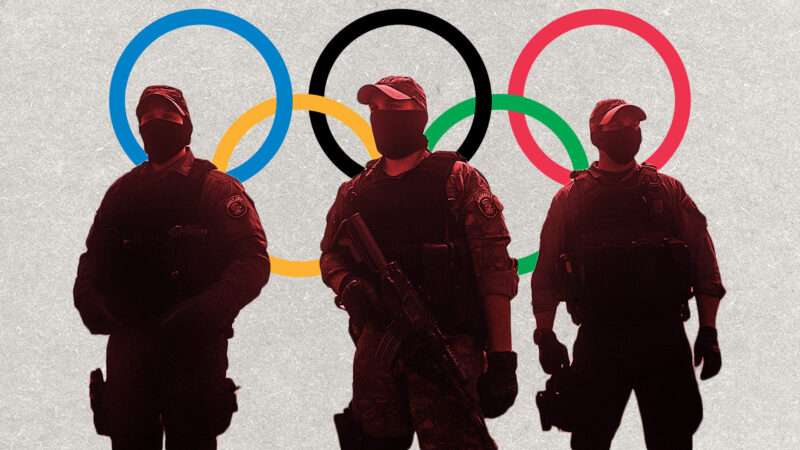
ICE agents in front of the Olympics logo | Illustration: Wikimedia Commons/Midjourney

In most years, the main controversy leading up to the Olympics has to do with team uniforms or which countries will take part in the games. For this year’s Winter Olympics in Milan and Cortina d’Ampezzo, the hottest issue is security.   

On Tuesday, the U.S. announced it would include agents from Immigration and Customs Enforcement (ICE) as part of its security detail. ESPN reported that any ICE personnel associated with the games would come from Homeland Security Investigations (HSI), an investigative unit that has supported Olympic security efforts before and typically focuses on transnational crimes such as smuggling operations, drug trafficking, and complex financial cases. This unit is distinct from ICE’s more widely known Enforcement Removal Operations division, which has dominated headlines amid President Donald Trump’s domestic immigration crackdown.

In a statement to NPR, Department of Homeland Security spokeswoman Tricia McLaughlin clarified that ICE would be “supporting the U.S. Department of State’s Diplomatic Security Service and host nation to vet and mitigate risks from transnational criminal organizations.” Officials from Italy’s interior ministry have likewise emphasized that ICE personnel would work out of U.S. diplomatic facilities, such as the Milan consulate, and would not be deployed in public spaces or run security operations on the ground. On Friday, the U.S. Olympic and Paralympic Committee clarified that ICE will not conduct security or enforcement activity at the games and that Olympic security remains under Italian authority, as reported by Straight Arrow News

Despite these reassurances, the announcement that ICE would serve as security at the games has elicited a hostile reception from local officials. Calling ICE “a militia that kills,” Milan Mayor Giuseppe Sala told Italy’s RTL radio, “It’s clear that they are not welcome in Milan, there’s no doubt about it. But I wonder, could we ever say ‘No’ to Trump?…We can take care of their security ourselves. We don’t need ICE.”

Opposition expanded beyond Milan’s city hall to include left-wing parties and activist groups, many of whom are already vocal critics of Italy’s center-right government, The Guardian reports. For these groups, ICE’s presence has become a symbol of Trump-era immigration enforcement and a focal point for broader criticism of Italy’s security arrangements. Organizers have circulated petitions and announced an “ICE OUT” rally timed to the February 6 opening ceremony.

Even if ICE’s role at the games is limited to support functions, significant questions remain unanswered. Officials have not specified how many agents will be involved, how information will be shared, or what limits exist to prevent a temporary Olympic assignment from evolving into a lengthier security campaign. In the absence of clear public detail—and given ICE’s reputation for opaque internal practices—it is unsurprising that the agency’s involvement has met resistance in Italy. That reaction, mirroring criticism in the United States, reflects a broader pattern: Enforcement agencies widely perceived as unaccountable tend to generate backlash wherever they appear, regardless of nuance or national boundaries.

The post ICE's Presence at the 2026 Winter Olympics Is Sparking International Backlash appeared first on Reason.com.

from Latest – Reason.com https://ift.tt/K3WVkX9
via IFTTT