ICE’s Presence at the 2026 Winter Olympics Is Sparking International Backlash


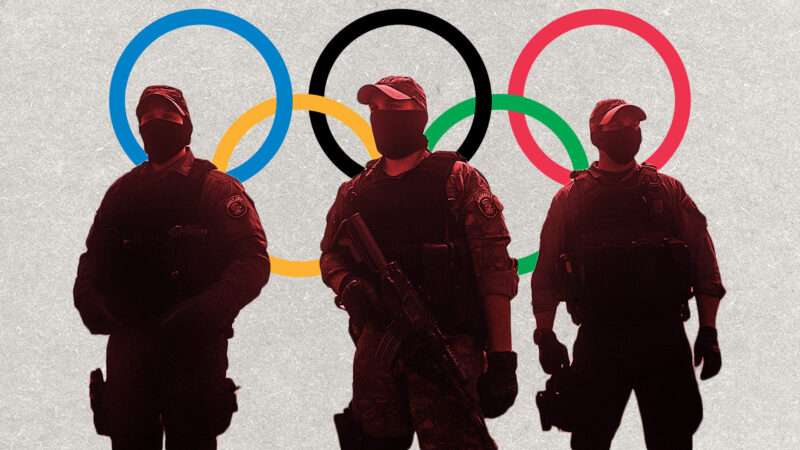
ICE agents in front of the Olympics logo | Illustration: Wikimedia Commons/Midjourney

In most years, the main controversy leading up to the Olympics has to do with team uniforms or which countries will take part in the games. For this year’s Winter Olympics in Milan and Cortina d’Ampezzo, the hottest issue is security.   

On Tuesday, the U.S. announced it would include agents from Immigration and Customs Enforcement (ICE) as part of its security detail. ESPN reported that any ICE personnel associated with the games would come from Homeland Security Investigations (HSI), an investigative unit that has supported Olympic security efforts before and typically focuses on transnational crimes such as smuggling operations, drug trafficking, and complex financial cases. This unit is distinct from ICE’s more widely known Enforcement Removal Operations division, which has dominated headlines amid President Donald Trump’s domestic immigration crackdown.

In a statement to NPR, Department of Homeland Security spokeswoman Tricia McLaughlin clarified that ICE would be “supporting the U.S. Department of State’s Diplomatic Security Service and host nation to vet and mitigate risks from transnational criminal organizations.” Officials from Italy’s interior ministry have likewise emphasized that ICE personnel would work out of U.S. diplomatic facilities, such as the Milan consulate, and would not be deployed in public spaces or run security operations on the ground. On Friday, the U.S. Olympic and Paralympic Committee clarified that ICE will not conduct security or enforcement activity at the games and that Olympic security remains under Italian authority, as reported by Straight Arrow News

Despite these reassurances, the announcement that ICE would serve as security at the games has elicited a hostile reception from local officials. Calling ICE “a militia that kills,” Milan Mayor Giuseppe Sala told Italy’s RTL radio, “It’s clear that they are not welcome in Milan, there’s no doubt about it. But I wonder, could we ever say ‘No’ to Trump?…We can take care of their security ourselves. We don’t need ICE.”

Opposition expanded beyond Milan’s city hall to include left-wing parties and activist groups, many of whom are already vocal critics of Italy’s center-right government, The Guardian reports. For these groups, ICE’s presence has become a symbol of Trump-era immigration enforcement and a focal point for broader criticism of Italy’s security arrangements. Organizers have circulated petitions and announced an “ICE OUT” rally timed to the February 6 opening ceremony.

Even if ICE’s role at the games is limited to support functions, significant questions remain unanswered. Officials have not specified how many agents will be involved, how information will be shared, or what limits exist to prevent a temporary Olympic assignment from evolving into a lengthier security campaign. In the absence of clear public detail—and given ICE’s reputation for opaque internal practices—it is unsurprising that the agency’s involvement has met resistance in Italy. That reaction, mirroring criticism in the United States, reflects a broader pattern: Enforcement agencies widely perceived as unaccountable tend to generate backlash wherever they appear, regardless of nuance or national boundaries.

The post ICE's Presence at the 2026 Winter Olympics Is Sparking International Backlash appeared first on Reason.com.

from Latest – Reason.com https://ift.tt/K3WVkX9
via IFTTT

Will AI Benefit Everyone?


Technology authors Perry Metzger and Brian Merchant | Graphic by Adani Samat

Technology authors Perry Metzger and Brian Merchant debate the resolution, “Artificial Intelligence will provide enormous net benefits to nearly every member of society.”

Metzger is taking the affirmative. He is the co-founder and chairman of the board of Alliance for the Future, and the author of science comic Computers: How Digital Hardware Works.

Merchant is taking the negative. He is a reporter in residence at the AI Now Institute. He’s also the author of two books, The One Device: The Secret History of the iPhone and Blood in the Machine: The Origins of the Rebellion Against Big Tech.

The debate is moderated by Soho Forum Director Gene Epstein.

The post Will AI Benefit Everyone? appeared first on Reason.com.

from Latest – Reason.com https://ift.tt/iLlUD0g
via IFTTT

State Appellate Judge on the Second Amendment and Felons

From Alaska Court of Appeals Judge Timothy Terrell’s concurrence Wednesday in Ivyories v. State:

I write separately to set out my view that the Second Amendment does not permit persons convicted of nonviolent felonies to be deprived of their gun rights after they have served their sentence and any post-release supervision period….

A majority of federal circuit courts have continued to rely on the language from the United States Supreme Court in Heller and succeeding cases and have concluded that statutes prohibiting felons from possessing firearms do not violate the Second Amendment. But the Third Circuit has rejected this view and concluded that persons convicted of nonviolent felonies should not necessarily permanently lose their gun rights. Other circuits have leaned toward that approach or left open the issue of whether some felons (particularly nonviolent felons) may have a viable as-applied challenge to felon-in-possession bans.

I agree with the Third Circuit and write separately to add my voice to the list of judges and courts who have concluded that felon-in-possession bans are unconstitutional as applied to those persons convicted of nonviolent felonies. I recognize that, in Alaska, this issue is currently governed by the Alaska Supreme Court’s decision in Farmer v. State. Accordingly, I will not analyze the underlying legal issues in detail. However, cognizant of the possibility that the Alaska Supreme Court may choose to revisit its holding in Farmer, I note below the cases pertinent to the key issues and lay out other jurists’ observations that are helpful in thinking about the scope of the Second Amendment.

Why the Alaska Supreme Court has a valid basis to revisit its holding in Farmer v. State

Looking at the issue in a vacuum (without the Farmer holding), I agree with those federal circuit courts that have concluded that the statements in Heller and later Supreme Court decisions about the validity of felon-in-possession bans do not resolve whether the Second Amendment permits the permanent disarmament of persons convicted of nonviolent felonies.

First, with respect to Heller‘s statement that felon-in-possession bans fall into the category of “presumptively lawful measures,” I agree with Ninth Circuit Judge Lawrence VanDyke’s recent partial dissent in United States v. Duarte, where he stated the following:

The majority extracts from Heller‘s footnoted statement that felon-in-possession laws are “presumptively lawful” the apparent per se rule that all felon-in-possession laws are constitutional, warranting “the categorical application of § 922(g)(1) to felons.” … But “[m]aking the leap from presumptively constitutional to always constitutional … is too much for that overused line to bear, no matter how you read it.”

Heller speaks only in terms of a presumption. A presumption must be defeasible. So the Court’s statement that felon-in-possession laws are only presumptively lawful implies that felon-in-possession laws must be unlawful in at least some instances. And it is especially unusual to put such weight on Heller‘s dicta that felon-in-possession laws are presumptively constitutional, because it is black-letter law that all legislation is entitled to a presumption of constitutionality. But no one thinks that that longstanding presumption gives statutes passed by Congress blanket immunity from searching constitutional scrutiny.

Second, as the Sixth Circuit pointed out in United States v. Williams, the validity of felon-in-possession statutes was not at issue in Heller, so the Court’s statements about such statutes were dicta, which should not be applied uncritically to determine whether the statutes violate the Second Amendment. The Sixth Circuit also noted that reexamination of the issue was appropriate because Bruen had changed the required method of analysis for Second Amendment claims.

Third, although Heller and Bruen referred to the Second Amendment rights of “law-abiding, responsible” persons, the Rahimi Court disagreed with the United States’s use of this language when it argued that gun rights belong only to the responsible. The Court noted that while such citizens are undoubtedly among the class of persons who enjoy Second Amendment rights, it had not meant to suggest that this was a limitation on the class of persons who possessed such rights.

Given the recent developments in Second Amendment case law, the Alaska Supreme Court would be entitled to reexamine the constitutionally permissible scope of Alaska’s felon-in-possession statute, AS 11.61.200, i.e., whether persons convicted of nonviolent felonies may be prevented from possessing concealable firearms for ten years after they have been discharged from their sentence.

Preliminary observations about when felon-in-possession bans may be applied to persons convicted of nonviolent felonies

I note that I am not advancing a categorical argument that firearms bans can never be applied to persons convicted of nonviolent felonies.

First, whether convicted of a violent or a nonviolent felony, all felons temporarily lose the right to possess firearms while they are serving their sentence in prison. As a Third Circuit judge recently observed, “It is as ancient as it is obvious that a person who is imprisoned or otherwise confined does not have the right to bear arms for the duration of confinement.”

Second, governments have passed statutes that continue this disability after the inmate is released from prison on parole, probation, or other forms of supervised release, and courts have analyzed whether such restrictions are permitted by the Second Amendment. My concurrence only concerns firearms bans that continue in effect after a felon has been unconditionally discharged from service of their sentence.

Felons are among “the people” protected by the Second Amendment

I turn now to the first step of the two-step analysis for Second Amendment claims set out in Bruen — determining whether “the Second Amendment’s plain text covers an individual’s conduct.” In deciding the first step of the Bruen analysis, courts have grappled with the question of whether felons are among “the people” protected by the Second Amendment, which provides in pertinent part that “the right of the people to keep and bear Arms, shall not be infringed.”

As then-Judge Barrett explained in her dissent in the Seventh Circuit’s decision in Kanter v. Barr, there are two approaches to evaluating what persons and groups fall within the Second Amendment’s coverage:

There are competing ways of approaching the constitutionality of gun dispossession laws. Some maintain that there are certain groups of people — for example, violent felons — who fall entirely outside the Second Amendment’s scope. Others maintain that all people have the right to keep and bear arms but that history and tradition support Congress’s power to strip certain groups of that right. These approaches will typically yield the same result; one uses history and tradition to identify the scope of the right, and the other uses that same body of evidence to identify the scope of the legislature’s power to take it away.

Initially, there seemed to be a consensus among scholars, relying on what has been termed the “virtuous citizenry” theory, that the right to bear arms could be taken away from those persons who had removed themselves from the community of virtuous, law-abiding citizens by engaging in felony conduct, and some circuit courts adopted that view. But the Supreme Court cast doubt on the viability of that theory in Rahimi when it rejected the government’s argument that the Second Amendment’s protections extend only to “law-abiding, responsible” persons and found the term “responsible” too vague. Moreover, many federal circuit courts — including those that have upheld the validity of felon-in-possession bans as applied to nonviolent felons under the Bruen analysis — have now concluded that felons do fall presumptively within the scope of the Second Amendment’s protections, i.e., felons are part of “the people” protected by the Second Amendment. I find the analysis of these courts persuasive and conclude that felons are part of “the people” protected by the Second Amendment and do not fall categorically outside its scope.

There is no past analogue for disarming nonviolent felons

The second step of the Bruen analysis requires courts to examine whether there is a historical analogue of government firearm regulation that is sufficiently similar to the challenged law so as to support the conclusion that the government may validly enforce the statutory firearms limitation. I agree with those courts and judges that have concluded there is no long-standing historical analogue for permanent disarmament of felons, much less those convicted of nonviolent felonies. As the Ninth Circuit stated in United States v. Chovan:

[I]t is not clear that such prohibitions are so longstanding. The first federal firearm restrictions regarding violent offenders were not passed until 1938, as part of the Federal Firearms Act. See C. Kevin Marshall, Why Can’t Martha Stewart Have a Gun?, 32 Harv. J.L. & Pub. Pol’y 695, 698, 708 (2009) (noting that “one can with a good degree of confidence say that bans on convicts possessing firearms were unknown before World War I”).

I recognize that these decisions are currently a minority among the circuit courts. But I agree with the Sixth Circuit in Williams that the real lesson of all the historical analogues put forth in defense of disarmament provisions is that it is only permissible to disarm persons or groups who pose a real risk of physical violence to others. It is dangerousness that is the touchstone of the ability to disarm. {Some courts have concluded that it is not necessary that a crime be one that always involves violence and that some crimes, such as drug trafficking, have such a substantial connection to violence that a person convicted of that offense may be prohibited from possessing firearms. I express no view other than to note that a strict dichotomy between crimes that are invariably committed by violence and crimes that may be committed without violence may not necessarily be the appropriate standard for assessing an as-applied challenge to a felon-in-possession statute.} I find it an unacceptable diminishment of the Second Amendment that a person who commits a nonviolent felony, such as tax fraud, loses their gun rights, even after they have completely served their sentence.

{The statute at issue in this case, AS 11.61.200, only generally imposes a ten-year ban on the possession of concealable firearms (running from the date of unconditional discharge on the prior felony), not a lifetime ban. But a ban of such length clearly impinges on constitutional rights. As applied to persons convicted of violent felonies, such a ban is constitutional for the reasons set out in State v. Eberhardt (La. 2014). As to the fact that this statute only bars the possession of concealable firearms, i.e., handguns, and does not prohibit the possession of long guns, that contention was addressed in Heller, where the Supreme Court stated that “[i]t is no answer to say, as petitioners do, that it is permissible to ban the possession of handguns so long as the possession of other firearms (i.e., long guns) is allowed.” The Court went on to state, “It is enough to note, as we have observed, that the American people have considered the handgun to be the quintessential self-defense weapon.”}

I believe that when the United States Supreme Court is squarely faced with the question of whether persons convicted of nonviolent felonies may successfully raise an as-applied challenge to felon-in-possession statutes, it will answer this question in the affirmative. I agree with Justice Barrett’s observation that “the Second Amendment is not absolute” and that it permits regulation that is consistent with our Nation’s tradition of firearm regulations, but it is also the case that Second Amendment rights are not second-class constitutional rights. The justifications for disarming nonviolent offenders are insufficient to strip away this fundamental right from persons who have fully served their sentences.

The post State Appellate Judge on the Second Amendment and Felons appeared first on Reason.com.

from Latest – Reason.com https://ift.tt/TRGZSfB
via IFTTT

Butt Me No Butts: Teacher’s Firing for Reading “I Need a New Butt!” Children’s Book to Class Overturned

A short excerpt from Tuesday’s long decision by Mississippi Court of Appeals Judge Anthony Lawrence in Price v. Hinds County School Dist.:

Toby Price, a licensed educator and assistant principal, read to the Gary Road Elementary School second-grade class on “Read Across America Day.” Since the educator who was scheduled to read to the class did not appear on a Zoom session, Price—at the last minute—stepped in to read and selected a book entitled “I Need a New Butt!” from his personal collection. The picture book was intended to be humorous and depicted a child searching for a “new butt.” As such, the book contained references to and illustrations of “butts,” “butt cracks,” and “farts.” {The child imagines a litany of possibilities for his “new butt,” such as “a butt that’s armor-plated[,]” “a bumper butt made of chrome[,]” “[a] rocket butt[,]” an “arty-farty butt[,]” and “[a] robo-butt[.]” The book concludes with the child finding his father bending over to repair a sink only to discover his father’s butt also had a crack in it.}

Following the reading, a student began repeating the word “butt” incessantly. Price was placed on administrative leave that day and fired two days later.

The court concluded that the firing decision “was arbitrary, capricious, and lacked substantial evidence,” and was thus invalid under state law:

The Board’s decision was detailed in its reasoning as follows: (1) the book at issue “contained pictures of child and adult nudity and inappropriate activities”; (2) Price previously “acknowledged the problematic nature” of such books; (3) the book caused a “negative, immediate impact”; (4) Price violated the Mississippi Code of Ethics; and (5) Price was not a credible witness….

This Court notes that “[t]he superintendent of a school district may dismiss a licensed school employee for good cause.” However, “in a hearing concerning a dismissal, the burden is on the superintendent to show that a principal or teacher has been dismissed for good cause.” …

“[T]he terms ‘arbitrary’ and ‘capricious’ imply a lack of understanding of or a disregard for the surrounding facts and settled controlling principles.” “An act is arbitrary when it is not done according to reason or judgment, but depending on the will alone.” On the other hand, an action is “capricious” if it is “done without reason, in a whimsical manner, implying either a lack of understanding of or a disregard for the surrounding facts and settled controlling principles.”

With those definitions in mind, this Court finds the School Board’s decision arbitrary and capricious. The school’s library contained a number of books depicting “nudity” and “inappropriate activities.” Several of those books were entered into evidence at the hearing and reviewed by this Court. The books included numerous mentions of the word “butt,” naked children running through the street, a child disobeying numerous school rules, a person dancing naked in the rain, a person standing in only a raincoat which exposes his butt, and what appeared to be “[s]omething’s head where their bottom should be.” There is simply no stark contrast between this book’s content and the content of the others. The evidence before this Court does not support a finding that the book “I Need a New Butt!” was more severe in nature than the other books contained in the library.

Further, the school had allowed similar books—even one with the same author and illustrator as the subject book—to be read to elementary students in the past. The record reflects that Price not only read a similar book to students in the past, but that reading was streamed live, recorded, and posted on Gary Road Elementary’s Facebook page. At the time of the hearing, the post was still on Gary Road Elementary’s social media pages. In sum, the school allowed the reading of a similar book to occur without issue and allowed the content to remain available on its social media page. The books in the school’s library discussed “butts” and contained pictures of butts, but the school district complained in particular about “I Need a New Butt!”

Price’s termination was based on a book similar in nature to other books contained in the library, which leads this Court to believe the decision was indeed reached “in a whimsical manner.” In sum, the decision of the School Board demonstrates “a lack of understanding of or a disregard for the surrounding facts and settled controlling principles.” Therefore, we conclude that the decision to uphold Price’s termination lacked substantial evidence and was reached in an arbitrary and capricious manner.

The court therefore didn’t reach Price’s arguments that the decision violated the Due Process Clause or the First Amendment.

Joel Frank Dillard represents Price.

The post Butt Me No Butts: Teacher's Firing for Reading "I Need a New Butt!" Children's Book to Class Overturned appeared first on Reason.com.

from Latest – Reason.com https://ift.tt/wF6WR3Y
via IFTTT

Key Inflation Metric Hits 3 Percent, Despite Trump’s Claim That Rising Prices Are ‘Solved’


US Dollars tinted red | Photo: PedaltotheStock/Envato

Inflation is stubbornly refusing to be vanquished by presidential edict.

Prices paid to domestic producers for their goods jumped by 0.5 percent during December, according to Department of Labor data released Friday morning. That surge in higher wholesale prices brought the annualized producer price index (PPI) to 3 percent for the year. December’s sharp increase in the PPI defied expectations and followed tamer increases of 0.1 percent in October and 0.2 percent in November.

More alarming is the so-called “core PPI,” which does not include more volatile categories like food and fuel prices. In December, core PPI increased by 0.7 percent, and climbed by 3.3 percent over the course of last year.

The PPI is often seen as an early warning signal about inflation at the consumer level—that’s what is measured by the more well-known consumer price index, which rang in at 0.3 percent in December and 2.7 percent for 2025. That’s because higher prices at the wholesale level will likely be passed along to the retail level in the coming months.

The new inflation report comes at an awkward time for President Donald Trump, who declared earlier this week that inflation had been “solved.”

“It’s over,” Trump told an Iowa crowd at a Fox News town hall event. “We have it good where prices are coming way down.”

The data also figures to complicate the ongoing fight between Trump and the Federal Reserve. Trump wants the central bank to cut interest rates more quickly to help juice the economy, but the Federal Reserve voted earlier this week to hold interest rates steady, in part because “inflation remains somewhat elevated.

High interest rates are generally seen as a check against inflation, since they encourage households and businesses to save rather than borrow or spend. Lower interest rates would ease budgetary pressure from the national debt and could make it easier for Americans to borrow, but they also might trigger another bout of higher inflation at a time when prices are already rising faster than the Fed’s stated goal of 2 percent annually.

Hours before the new inflation report was published on Friday, Trump named Kevin Warsh, a former member of the Federal Reserve’s board, to be the next chairman of the central bank. Warsh must be confirmed by the Senate. Federal Reserve Chairman Jerome Powell’s term ends in May, but Trump has been trying to force Powell to step down earlier.

Trump may not be able to reduce inflation by changing the leader of America’s central bank or by declaring prices to be falling, but he’s also not totally powerless. It is undeniable that Trump’s tariffs are putting upwards pressure on prices, while also not providing the economic boost the administration promised.

Until that policy changes, it’s hard to take Trump seriously when he talks about making life more affordable.

The post Key Inflation Metric Hits 3 Percent, Despite Trump's Claim That Rising Prices Are 'Solved' appeared first on Reason.com.

from Latest – Reason.com https://ift.tt/Onh1XzV
via IFTTT

My New Lawfare Article on “Minnesota’s Compelling Tenth Amendment Case Against Trump’s ICE Surge”

Earlier today, Lawfare published my article “Minnesota’s Compelling 10th Amendment Case Against Trump’s ICE Surge.” Here is an excerpt:

The federal government’s brutal and often illegal use of Immigration and Customs Enforcement (ICE) personnel and other federal agents in Minnesota has generated extensive litigation. On Jan. 12, one particularly crucial case was filed by the state of Minnesota and the cities of Minneapolis and St. Paul, arguing that the federal Metro Surge operation—deploying thousands of ICE and other federal agents to the Twin Cities—violates the 10th Amendment. That amendment states that “powers not delegated to the United States by the Constitution, nor prohibited by it to the States, are reserved to the States respectively, or to the people.” In a series of decisions supported primarily by conservative justices, such as Printz v. United States (1997) (written by conservative icon Justice Antonin Scalia), the Supreme Court has held that the federal government cannot “commandeer” state and local officials to do the federal government’s bidding, or to help enforce federal laws.

Control over state and local government personnel is one of the powers reserved to the states by the 10th Amendment. In addition, as legal scholar Michael Rappaport has shown, the original meaning of the Constitution indicates that such control is a basic element of the sovereignty inherent in being a state in the first place….

Part of the purpose of the federal “surge” is to coerce Minnesota jurisdictions into giving up their sanctuary policies and using their resources to assist federal deportation efforts. As federal District Judge Katherine Menendez noted in a hearing in the case on Jan. 26, Trump administration officials have repeatedly indicated that this is one of their objectives. Attorney General Pam Bondi suggested as much in a Jan. 24 letter to Minnesota Gov. Tim Walz. A Jan. 16 White House statement explicitly indicates that Minnesota’s “sanctuary defiance” is “responsibl[e] for the enhanced enforcement operations in Minnesota.” A recent statement by Trump “border czar” Tom Homan indicates that the administration will not withdraw immigration enforcement officers from Minnesota unless state and local governments curb sanctuary policies and extend “cooperation” to federal immigration enforcers….

The Minnesota case is not exactly analogous to previous anti-commandeering rulings by federal courts. But that is in part because it represents an even more blatant violation of the 10th Amendment. In Printz and other cases, such as New York v. United States (1992) and Murphy v. NCAA, the Supreme Court struck down congressional legislation requiring states to help enforce various types of federal laws, or to enact legislation of their own. In a series of decisions during the first Trump administration, and continuing in the second, numerous lower federal courts ruled that the president cannot order states to aid in immigration enforcement actions, and cannot withhold federal funds from sanctuary jurisdictions in cases where doing so would be “coercive” or Congress had not authorized immigration-related conditions on recipients.

The administration’s current actions are more egregious than those struck down in previous anti-commandeering rulings. Here, there is no congressional authorization for federal coercion of states; the president is acting on his own. And the direct use of force is even more blatantly coercive than illegally withholding federal grants. If the federal government cannot coerce states by enacting commandeering laws and imposing grant conditions, surely it cannot do so at the literal point of a gun….

If allowed to stand by the courts, the federal action in Minnesota would set an extremely dangerous precedent. It could easily be used against a variety of state policies, including those of conservative “gun sanctuaries”—such as Montana and Missouri—which restrict state and local assistance efforts to enforce federal gun control laws. A future Democratic administration could send thousands of armed agents to harass gun owners and disrupt state and local government operations until gun sanctuary jurisdictions drop their restrictions.

Indeed, the Minnesota operation has already threatened gun rights traditionally prized by conservatives. Administration officials have defended the killing of Alex Pretti on the grounds that he was carrying a gun at the time—even though he had a legal permit to do so, never drew the weapon, and federal agents took it from him before they shot him.

The post My New Lawfare Article on "Minnesota's Compelling Tenth Amendment Case Against Trump's ICE Surge" appeared first on Reason.com.

from Latest – Reason.com https://ift.tt/BvpWlZd
via IFTTT

There Are No Good Reasons To Subsidize Sports Stadiums. Governments Keep Doing It Anyway.


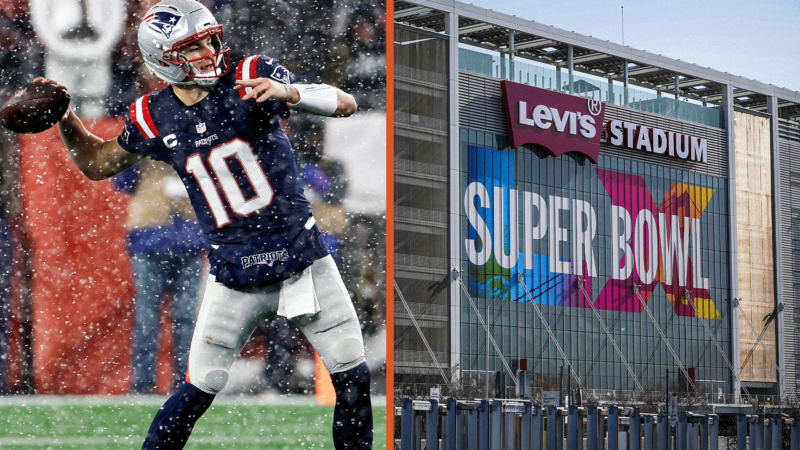
New England Patriot's player and Levi Stadium, sight of the Super Bowl | Credit: Dylan Stewart/Image of Sport/Eric Canha/Cal Sport Media/Newscom

This year’s Super Bowl between the Seattle Seahawks and the New England Patriots will feature several interesting story lines: Sam Darnold’s redemption arc, Mike Vrabel’s coaching job, and the Seahawks hoping to avenge themselves for the infamous Malcolm Butler interception. With the betting line in Seattle’s favor at press time, it seems the public is hoping to cash in on a Seahawks win. But there are reasons why freedom-loving football fans should be cheering for New England: the Patriots are one of a handful of NFL teams that play home games in a privately funded stadium.

Of the NFL’s 32 teams, only five—the New York Giants, New York Jets, Los Angeles Chargers, Los Angeles Rams, and the Patriots—did not receive government subsidies to build their home stadiums. While it may now be common for ultrarich team owners to receive lavish subsidies to build new stadiums or upgrade existing ones, this hasn’t always been the case. “Almost all stadiums that were built at the beginning of the 20th century were private stadiums,” economist J.C. Bradbury recently explained to Reason‘s Eric Boehm. Up until recently, “owners would have been laughed at if they went to the local city council or county commission and asked for money to help them build a stadium,” Bradbury adds.

This is clearly no longer the case. In recent years, state governments have greenlit millions of dollars for stadium projects for the Buffalo Bills ($850 million) and the Tennessee Titans (a record $1.26 billion). Last year, the Washington Commanders announced they would build a new $3.7 billion stadium in the nation’s capital, with a cool $1 billion coming from D.C. residents.

What might justify such flagrant levels of subsidies? Pride in the local sports team is certainly one reason. But oftentimes lawmakers push this funding as a way to boost local economies; not only will these stadiums bring in revenue through games, but also through events and concerts, the argument goes.

If stadiums are meant to revitalize the economy, they are dropping the ball. In a 2022 paper, J.C. Bradbury, along with economists Dennis Coates and Brad Humphreys, noted that “nearly all empirical studies find little to no tangible impacts of sports teams and facilities on local economic activity, and the level of venue subsidies typically provided far exceeds any observed economic benefits.” As the Center for Economic Accountability points out: “Sports compete with other local businesses for consumers’ entertainment dollars, rather than creating ‘economic development’ out of thin air.”

This public spending comes with tradeoffs. “We see these people spending money in and around stadiums, but what we don’t see is their foregone spending, that is, they’d be spending it elsewhere in the community,” says Bradbury.

It also comes with corruption. “This pervasive lack of transparency in the planning and negotiation process around stadium subsidies also creates an environment where corruption can flourish,” writes John C. Mozena, a senior fellow at Reason Foundation, the nonprofit that publishes Reason. In 2023, former Anaheim, California, Mayor Harish Sidhu “pled guilty to four federal felonies while the city was negotiating a stadium deal with the Los Angeles Angels baseball team” and admitted to “pass[ing] inside information to the team’s negotiators and attempt[ing] to influence the city’s decisions in favor of the Angels in return for an expected $1 million campaign contribution from the team,” according to Mozena. This scandal ultimately led to the cancellation of the Angels’ new stadium deal.

Despite all of the evidence of why stadium subsidies are a losing play, these wealth redistribution schemes aren’t going away anytime soon. Ohio lawmakers are hoping to spend $600 million on a new stadium for the Cleveland Browns, and last year, Oregon’s Legislature approved $800 million in state bonds for an MLB stadium in Portland, even though no professional team has announced plans to move to the state.

Ending public support for these projects would protect taxpayers and hardly impact professional teams. “If we stop funding all sports stadiums tomorrow, then the world wouldn’t change hardly at all,” says Bradbury. “Basically, just these wealthy owners would say, ‘OK, I guess I gotta fund it myself.”

The post There Are No Good Reasons To Subsidize Sports Stadiums. Governments Keep Doing It Anyway. appeared first on Reason.com.

from Latest – Reason.com https://ift.tt/i07yNTL
via IFTTT

South Carolina Gave $1.3 Billion to Scout Motors. It’s Already $150 Million Over Budget.


Scout Motors factory site under construction in Blythewood, South Carolina. | Scout Motors Inc.

In March 2023, Scout Motors announced it would spend $2 billion to build an electric vehicle (E.V.) factory in South Carolina. The company, a newly launched subsidiary of Volkswagen, would build electric trucks and SUVs.

CEO Scott Keogh said the company chose South Carolina because “the state was ready to go.” But it likely didn’t hurt that state lawmakers agreed to provide Scout $1.29 billion in incentives, including $400 million for site preparation.

Three years later, Scout has yet to build a single vehicle; it hopes to begin production by 2027. But South Carolina is already $150 million over budget on the project, and officials want state taxpayers to pick up the slack.

“South Carolina has racked up $150 million in cost overruns as it works to fulfill pledges it made to lure electric vehicle maker Scout Motors to the state,” Jessica Holdman of the South Carolina Daily Gazette wrote this week.

Holdman noted that in the original incentive plan, the state and county governments “agreed to contract and pay for all of the mass grading work at no cost to the company” as well as “the costs of all associated environmental requirements.”

The latter provision accounts for about half of the shortfall: In order to receive construction permits, the company had to “mitigate” the land used to build the factory by preserving or restoring certain wetlands.

This week, the South Carolina Department of Commerce announced that $72 million of the $150 million overage stemmed from wetland mitigation costs. “Commerce initially budgeted $50 million for mitigation efforts, and has already spent $55.5 million on those activities,” according to The Herald.

That’s in addition to the state’s actual construction costs, which apparently have also grown. In his fiscal year 2027 budget proposal, Gov. Henry McMaster requested an additional $50 million for “inflationary construction cost” at the Scout Motors site.

“I know that the inflation has gone up so much on all things that Department of Commerce has spent the money that they have, and they need more,” McMaster said earlier this month. “Costs went up. Contracting costs went up. We paid them. We agreed, we will get the site prepared.”

Just like the money for wetland mitigation, the extra funding will have to come from state taxpayers. “We would not have the money to pay [contractors] for several years under our regular funding,” South Carolina Secretary of Commerce Harry Lightsey told reporters this week.

Cost overruns are perfectly routine on large projects. But those costs are for the companies to bear. If circumstances change, that’s part of the gamble. Scout Motors, on the other hand, is benefiting from the largess of South Carolina taxpayers, whom state officials decided should assume a portion of the risk.

And it’s not like Scout doesn’t have the resources available: At the end of 2024, parent company Volkswagen reported over €40 billion ($47.6 billion) in cash on hand.

Scout estimates that at full capacity, its new factory “will be capable of building up to 200,000 vehicles annually, or roughly 40 vehicles every hour.” But it’s worth wondering how long it will take to ramp up to that level of demand, if ever.

The 2022 Inflation Reduction Act codified $7,500 tax credits for the purchase of electric vehicles, but President Donald Trump’s One Big Beautiful Bill Act terminated the program in October 2025. Sales of E.V.s surged in August and September, only to plummet once the credit expired.

“With government-backed sales incentives revoked at the start of October, total EV sales in Q4 plunged to 234,000 units, down 46% compared to Q3 and 36% lower year over year,” Cox Automotive reports.

When it first announced its South Carolina factory, Scout had more reason to be optimistic; given the dip in E.V. sales, it may have to scale back its ambitions. But if that happens, it’s not just Scout and Volkswagen who will be on the hook, but South Carolina taxpayers.

The post South Carolina Gave $1.3 Billion to Scout Motors. It's Already $150 Million Over Budget. appeared first on Reason.com.

from Latest – Reason.com https://ift.tt/RU4NPv3
via IFTTT

Judge Says ICE Violated Court Orders in 74 Cases—See Them All Here


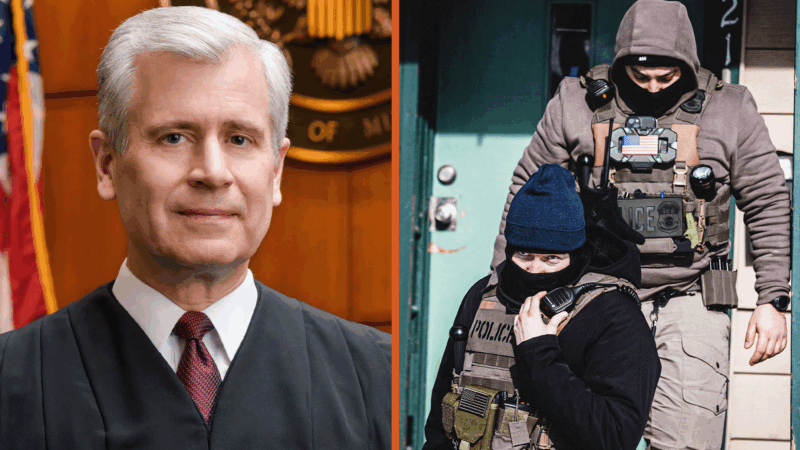
Chief U.S. District Judge Patrick J. Schiltz and ICE agents | Dave Decker/ZUMAPRESS/Newscom/U.S. District Court for the District of Minnesota

An infuriated federal judge in Minnesota on Wednesday published a list of nearly 100 court orders that Immigration and Customs Enforcement (ICE) had violated over the last month, and Reason has collected links to the cases. 

Patrick J. Schiltz, Chief Judge of the U.S. District Court for Minnesota, released the list as an appendix to a court order castigating ICE for repeatedly violating court orders regarding immigrant detention.

Although the appendix listed 74 cases with 96 separate violations, Schiltz wrote that the “extent of ICE’s noncompliance is almost certainly substantially understated. This list is confined to orders issued since January 1, 2026, and the list was hurriedly compiled by extraordinarily busy judges.”

Nevertheless, the extraordinary document offers a glimpse of a national campaign by the federal government to deprive detained immigrants of due process rights that an overwhelming majority of federal judges say they’re entitled to.

In one example from Schiltz’s list, ICE arrested a Venezuelan man living in Eagan, Minnesota, and transferred him to Texas, despite a judge’s order to keep him in-state. 

According to the judge’s order granting the man’s writ of habeas corpus:

He lives with his partner and his six-year-old daughter, and he is employed by a landscaping company. He is not subject to a final order of removal. After Petitioner attended an appointment regarding his pending asylum application on January 20, 2026, he was arrested and detained by ICE without a warrant and without apparent justification. Petitioner filed a petition for a writ of habeas corpus that same day. The next day, January 21, 2026, the Court entered an Order enjoining Respondents from moving Petitioner outside of Minnesota until the Court ruled on the pending habeas petition. Nevertheless, the Court has reason to believe that Petitioner is presently detained in El Paso, Texas.

In another case from the appendix, ICE arrested a Moldovan refugee who had already gone through extensive background checks and vetting. In response to her petition for emergency relief, the government claimed that her detention was based on her “fail[ure] to acquire permanent resident status within one year.” 

But as the judge noted in his order granting the woman’s petition (citation omitted), “Such a basis for detention is illogical given that refugees are not eligible to apply for adjustment of status until they have ‘been physically present in the United States for at least one year.'”

Schiltz’s list, however, is just a PDF with case names and numbers. Let’s bring it up to Web 1.0 standards.

Your friendly neighborhood Reason reporter found the dockets for 71 out of the 74 cases on CourtListener, a free online repository of federal court records. It appears most of the judges’ orders and other docket entries are still only available on PACER, the federal government’s clunky, pay-by-the-page database, but this is at least one more step toward making the information widely available.

25-CV-4722: Hakan K. v. Noem (Judges: JMB/DTS) (Order Violated: January 24, 2026)

25-CV-4741: Luis L.P. v. Brott (Judges: NEB/DJF) (Order Violated: January 9, 2026)

25-CV-4776: Ahmed A. v. Pamela Bondi (Judges: JWB/DJF) (Order Violated: January 6, 2026)

26-CV-080: Francisco E.O. v. Olson (Judges: JRT/DJF) (Order Violated: January 15, 2026)

26-CV-013: Suhaib M. v. Kristi Noem (Judges: JWB/DJF) (Order Violated: January 12, 2026)

26-CV-031: Alex V.Y.L. v. Pamela Bondi (Judges: JWB/DJF) (Order Violated: January 9, 2026)

26-CV-106: Marlon M.M. v. Easterwood (Judges: NEB/ECW) (Order Violated: January 15, 2026)

26-CV-0107: Juan T.R. v. Noem (Judges: PJS/DLM) (Order Violated: January 14, 2026)

26-CV-130: Botir B. v. Bondi (Judges: LMP/DJF) (Order Violated: January 15, 2026)

26-CV-138: Lide E.G.Q. v. Executive Office for Immigration Review (Judges: JWB/JFD) (Order Violated: January 9, 2026)

26-CV-00146: Jhony A. v. Bondi (Judges: JMB/LIB) (Order Violated: January 15, 2026)

26-CV-150: Christopher A.F.E. v. Pamela Bondi (Judges: JWB/ECW) (Order Violated: January 14, 2026)

26-CV-156: Evelin M.A. v. Bondi (Judges: NEB/DLM) (Order Violated: January 23, 2026)

26-CV-160: Jose A. v. Bondi (Judges: NEB/EMB) (Order Violated: January 15, 2026)

26-CV-00161: Pascual G. v. Bondi (Judges: JMB/LIB) (Order Violated: January 12, 2026)

26-CV-164: Santiago A.C.P. v. Todd Lyons (Judges: JWB/DTS) (Order Violated: January 15, 2026; January 19, 2026; January 20, 2026)

26-CV-166: Andrei C. v. Lyons (Judges: SRN/ECW) (Order Violated: January 12, 2026)

26-CV-167: Oscar O.T. v. Pamela Bondi (Judges: JWB/JFD) (Order Violated: January 15, 2026; January 19, 2026; January 20, 2026)

26-CV-00168: Martin R. v. Bondi (Judges: JMB/LIB) (Order Violated: January 12, 2026; January 20, 2026; January 21, 2026)

26-CV-00208: Abdi W. v. Trump (Judges: KMM/SGE) (Order Violated: January 21, 2026)

26-CV-213: Adriana M.Y.M. v. David Easterwood (Judges: JWB/JFD) (Order Violated: January 24, 2026)

26-CV-216: Estefany J.S. v. Pamela Bondi (Judges: JWB/SGE) (Order Violated: January 13, 2026)

26-CV-231: Martha S.S. v. Kristi Noem (Judges: JWB/DLM) (Order Violated: January 16, 2026; January 20, 2016)

26-CV-233: Joaquin Q. L. v. Bondi (Judges: LMP/DTS) (Order Violated: January 14, 2026; January 21, 2026)

26-CV-244: Jose L.C.C. v. Pamela Bondi (Judges: JWB/DTS) (Order Violated: January 15, 2026; January 19, 2026)

26-CV-252: Juan R. v. Bondi (Judges: SRN/DTS) (Order Violated: January 16, 2026)

26-CV-261: Jesus A.P. v. Bondi (Judges: PJS/EMB) (Order Violated: January 15, 2026)

26-CV-272: Abdiqadir A. v. Bondi (Judges: JMB/DTS) (Order Violated: January 16, 2026)

26-CV-276: Bashir Ali K. v. Noem (Judges: LMP/DTS) (Order Violated: January 22, 2026)

26-CV-282: Roman N. v. Donald Trump (Judges: JWB/DLM) (Order Violated: January 3, 2026; January 17, 2026)

26-CV-00283: Sandra C. v. Bondi (Judges: JMB/JFD) (Order Violated: January 16, 2026; January 21, 2026)

26-CV-296: Yeylin C.R. v. Bondi (Judges: NEB/LIB) (Order Violated: January 20, 2026)

26-CV-301: Liban G. v. Noem (Judges: SRN/ECW) (Order Violated: January 15, 2026; January 16, 2026; January 20, 2026; January 22, 2026)

26-CV-0309: Joseph T.M. v. Bondi (Judges: PJS/EMB) (Order Violated: January 22, 2026)

26-CV-312: Obildzhon E. v. Pamela Bondi (Judges: JWB/DTS) (Order Violated: January 17, 2026)

26-CV-313: Corina E. v. Pamela Bondi (Judges: JWB/DTS) (Order Violated: January 17, 2026)

26-CV-314: E.E. v. Pamela Bondi (Judges: JWB/DTS) (Order Violated: January 17, 2026)

26-CV-316: Manolo Z. L. v. Trump (Judges: LMP/DTS) (Order Violated: January 15, 2026)

26-CV-317: C. v. Bondi (Judges: NEB/JFD) (Order Violated: January 18, 2026)

26-CV-319: C. v. Bondi (Judges: NEB/JFD) (Order Violated: January 18, 2026)

26-CV-328: Felix J.C.A. v. Pamela Bondi (Judges: JWB/DLM) (Order Violated: January 24, 2026)

26-CV-00351: Ihor D. v. Noem (Judges: JMB/DTS) (Order Violated: January 20, 2026; January 22, 2026)

26-CV-369: Francisco M. v. Bondi (Judges: JMB/EMB) (Order Violated: January 16, 2026; January 23, 2026)

26-CV-0380: Alberto C.M. v. Noem (Judges: DWF/SGE) (Order Violated: January 23, 2026)

26-CV-396: Josue David P. A. v. Bondi (Judges: LMP/JFD) (Order Violated: January 17, 2026)

26-CV-00404: Nadejda P. v. Lyons (Judges: KMM/DLM) (Order Violated: January 22, 2026)

26-CV-410: Paula G. v. Bondi (Judges: JMB/DLM) (Order Violated: January 17, 2026; January 20, 2026)

26-CV-423: Ronnie C. v. Pamela Bondi (Judges: JWB/JFD) (Order Violated: January 18, 2026; January 21, 2026)

26-CV-0424: J.B.C.O. et al., v. Bondi (Judges: JRT/DJF) (Order Violated: January 19, 2026; January 25, 2026)

26-CV-437: Darvin M. v. Bondi (Judges: SRN/EMB) (Order Violated: January 19, 2026)

26-CV-439: Maria U.C.G. v. Pamela Bondi (Judges: JWB/LIB) (Order Violated: January 24, 2026)

26-CV-00440: Abdirahman S. v. Bondi (Judges: JMB/DJF) (Order Violated: January 22, 2026)

26-CV-00444: Enrique L. v. Bondi (Judges: JMB/SGE) (Order Violated: January 22, 2026)

26-CV-0445: Fernando T. v. Noem (Judges: ECT/EMB) (Order Violated: January 20, 2026)

26-CV-447: Alexis D.A.M. v. Bondi (Judges: JRT/ECW) (Order Violated: January 20, 2026)

26-CV-449: Hector T.G. v. Bondi (Judges: NEB/LIB) (Order Violated: January 23, 2026)

26-CV-454: Luis S. v. Bondi (Judges: ECT/LIB) (Order Violated: January 22, 2026)

26-CV-457: Sonia M.M.C. v. Pamela Bondi (Judges: JWB/LIB) (Order Violated: January 24, 2026)

26-CV-00480: Jose A. v. Noem (Judges: JMB/ECW) (Order Violated: January 26, 2026)

26-CV-485: Ivan R. v. Pamela Bondi (Judges: JWB/EMB) (Order Violated: January 21, 2026; January 24, 2026)

26-CV-489: Yosber I.M.C. v. Bondi (Judges: JRT/DLM) (Order Violated: January 21, 2026)

26-CV-493: Fabian L.C. v. Bondi (Judges: NEB/DLM) (Order Violated: January 24, 2026)

26-CV-00504: Maria P. v. Brott (Judges: JMB/JFD) (Order Violated: January 23, 2026)

26-CV-517: Brayan M.O. v. Bondi (Judges: NEB/JFD) (Order Violated: January 24, 2026)

26-CV-00537: Isidro L. v. Lyons (Judges: JMB/DLM) (Order Violated: January 22, 2026)

26-CV-546: Maria V.H., et al., v. Bondi (Judges: JMG/DLM) (Order Violated: January 24, 2026)

26-CV-00561: Elvis T. E., et al. v. Bondi (Judges: KMM/JFD) (Order Violated: January 22, 2026)

26-CV-0575: Guled O. v. Noem (Judges: ADM/DJF) (Order Violated: January 23, 2026)

26-CV-00580: Carlos A. G. v. Bondi (Judges: SRB-DJF) (Order Violated: January 23, 2026)

26-CV-597: Jose V. v. Easterwood (Judges: DSD/LIB) (Order Violated: January 25, 2026)

26-CV-00663: Marco Q. v. Noem (Judges: SRB-DLM) (Order Violated: January 26, 2026)

The post Judge Says ICE Violated Court Orders in 74 Cases—See Them All Here appeared first on Reason.com.

from Latest – Reason.com https://ift.tt/NgFoq4G
via IFTTT
House Republicans To Introduce Voting Reform Bill With Voter ID, Proof Of Citizenship Rules

House Republicans To Introduce Voting Reform Bill With Voter ID, Proof Of Citizenship Rules

Authored by Aldgra Fredly via The Epoch Times (emphasis ours),

House Republicans on Jan. 29 said they plan to roll out a comprehensive election reform bill that would set requirements for elections, including for photo IDs and proof of citizenship.

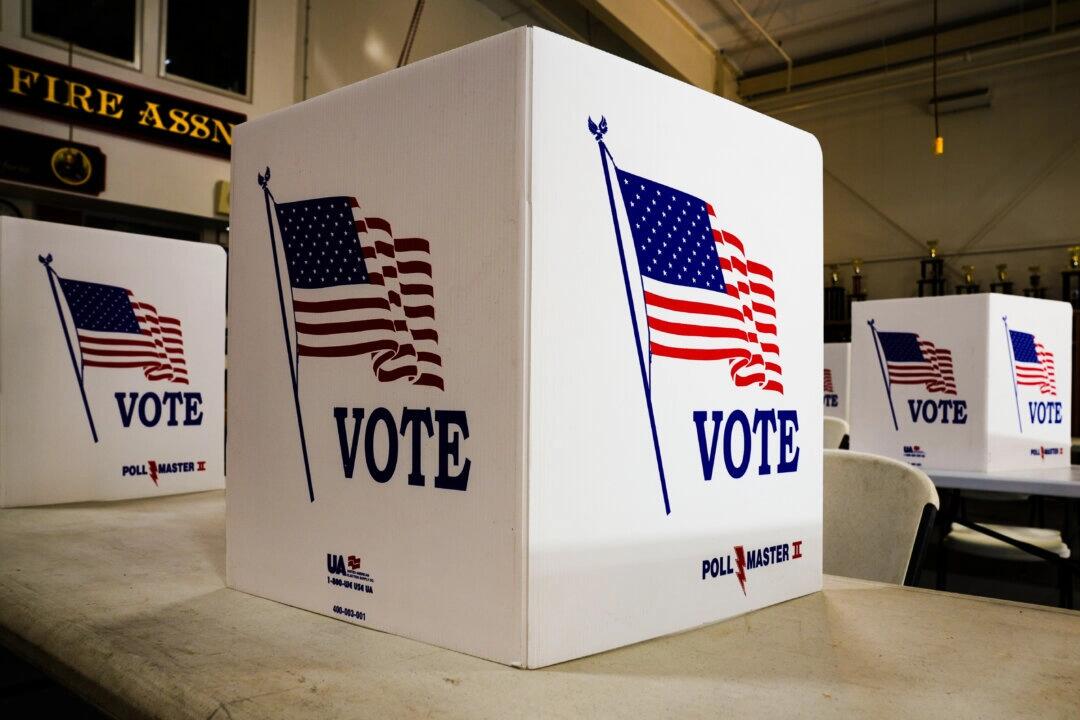
Voting booths are set up at a polling place in Newtown, Pa., on April 23, 2024. AP Photo/Matt Rourke, File

House Administration Committee Chair Rep. Bryan Steil (R-Wis.) said the Make Elections Great Again (MEGA) Act aims to prevent election fraud and will be introduced during the House’s pro-forma session on Jan. 30.

“Americans should be confident their elections are being run with integrity – including commonsense voter ID requirements, clean voter rolls, and citizenship verification,” Steil said in a statement.

These reforms will improve voter confidence, bolster election integrity, and make it easy to vote, but hard to cheat.”

The bill, if passed, would require voters to show photo identification when casting ballots and verify their citizenship during registration.

It would also mandate that mail-in ballots be received by the close of polls on election day and require states to use auditable paper ballots.

Under the legislation, it would be “unlawful for an individual to distribute, order, request, deliver, or possess” a ballot belonging to another person who is not an immediate family member or caregiver.

It would also prohibit people from delivering more than four mail-in ballots at a time, except for incidental possession by postal workers or election officials.

In addition, the bill would tighten routine voter list maintenance requirements, ban universal vote by mail, and prohibit states from using a voting system that allows voters to choose more than one candidate or rank multiple candidates for the same office.

Rep. Joe Morelle (D-N.Y.), the Democratic Party’s top lawmaker on the House Administration Committee, opposed the bill and accused House Republicans of trying to “rig the system so they can choose their voters.”

This bill is their latest attempt to block millions of Americans from exercising their right to vote,” Morelle said in a statement. “I will fight this bill at every turn.”

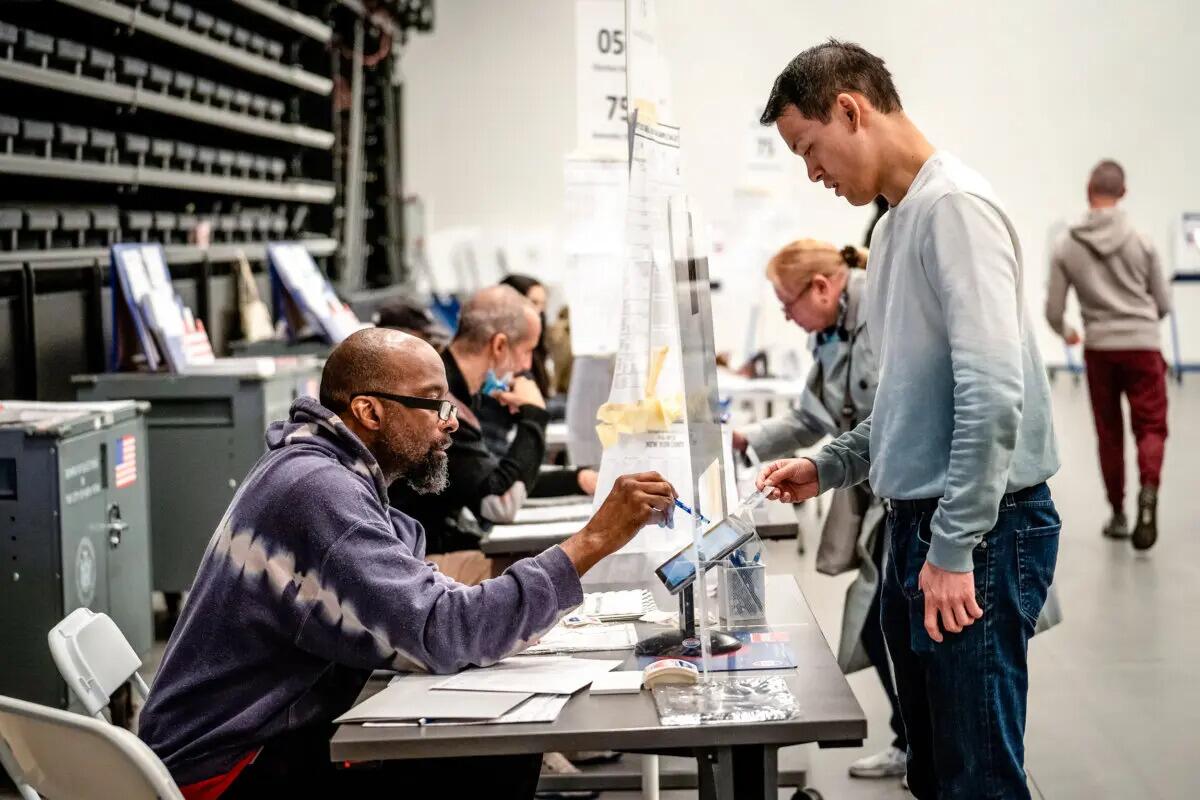
A voter shows his photo identification to poll workers as he arrives to cast his midterm election ballot in New York City on Nov. 8, 2022. Samira Bouaou/The Epoch Times

The MEGA Act is backed by several election advocacy groups, including America’s First Policy Institute (AFPI), which said the bill includes requirements that will prevent noncitizens from voting in U.S. elections.

“As an American citizen, casting a ballot is a civic duty, a unique privilege, and a fundamental right to help determine who represents you in government and who will stand for your ideas, values, and freedom,” AFPI’s chair of election integrity, Kenneth Blackwell, said in a statement.

And that right, which men and women have died on foreign battlefields to protect, is discarded when noncitizens are allowed to vote.

Election Transparency Initiative National Chairman Ken Cuccinelli said the omnibus would make voting “accessible for eligible citizens while closing loopholes that invite abuse, by banning ballot harvesting, stopping taxpayer-funded partisan registration schemes, and requiring auditable paper ballots.”

Tyler Durden
Fri, 01/30/2026 – 17:00

via ZeroHedge News https://ift.tt/iRWVPqv Tyler Durden