The post Open Thread appeared first on Reason.com.
from Latest – Reason.com https://ift.tt/TFwdZsC
via IFTTT
another site
The post Open Thread appeared first on Reason.com.
from Latest – Reason.com https://ift.tt/TFwdZsC
via IFTTT

A British government–funded video game aimed at students aged 11 to 18 is warning teenagers that questioning mass migration or even researching immigration statistics online could lead to a referral to the U.K.’s counterterrorism program, Prevent. The game, titled Pathways, guides white teenage characters through scenarios in which they must avoid being flagged for “extreme right-wing ideology,” portraying certain political activity or even searches for information as potential warning signs. Within the game, characters are told they risk referral if they interact with groups said to spread “harmful ideological messages” or attend protests opposing what is described as the “erosion of British values.”
The post Brickbat: Down the Wrong Pathway appeared first on Reason.com.
from Latest – Reason.com https://ift.tt/0SkVWvu
via IFTTT
The post Open Thread appeared first on Reason.com.
from Latest – Reason.com https://ift.tt/TFwdZsC
via IFTTT
“Energy Suicide”: Slovak PM Fico To Sue After Brussels Issues Total Ban On Russian Gas
Slovakia is obliged to stop taking over Russian gas by Nov. 1, 2027, at the latest, and according to Slovak Prime Minister Robert Fico, the EU decision to ban all gas from member states amounts to “energy suicide.” As a result, Bratislava will file a lawsuit at the Court of Justice of the European Union (ECJ) against the newly adopted regulations.

On Monday, the Council of the European Union and the European Parliament formally adopted the new legislation on the gradual phase-out of Russian gas and oil imports. The move is part of the REPowerEU plan, which aims to become independent from Russian energy carriers.
Fico immediately criticized the move, calling it “energy suicide,” and said that “when the military conflict ends, everyone will be breaking their legs, rushing to go to Russia to do business.”
Fico announced that Slovakia will file a lawsuit against the adopted regulation at the Court of Justice of the European Union based in Luxembourg, writes Hlavnespravy.sk.
According to Fico, the country will argue that the regulation violates the principles of subsidiarity and proportionality.
He added that the Slovak Ministry of Justice, together with the portfolio responsible for foreign and European affairs, had prepared a “very professional document” and that they would be asking for the regulation to be declared contrary to the basic principles of the EU.
Fico also announced that Hungary, which voted against the legislation together with Slovakia, is also filing a lawsuit. It is not possible to file a joint action, but the argument is coordinated with the Hungarian side.
Fico says the war in Ukraine will be over by Nov. 1, 2027, “and everyone comes to their sense.” He believed that detaching from Russian energy in this way was suicide, and that not only he, but also German economists, politicians, and other EU politicians see it that way. According to his claim, the decision was made on a meaningless, ideological basis, due to hatred towards the Russian Federation.
Fico has long called for a ceasefire in the war, leading some to criticize his position in the conflict. However, his point about Russian energy has been echoed across the political spectrum in Europe, especially during a time when European nations feel threatened by the U.S.’s increasingly dominant position in supplying Europe’s energy needs. If the U.S. were to decide to curtail liquified natural gas (LNG) deliveries, for instance, it could be disastrous for Europe.
Fico also criticized the fact that the decree was adopted by a qualified majority. According to him, the European Commission has circumvented the principle of unanimity, which should be applied in the event of sanctions. The Slovak prime minister assessed this as a violation of the basic principles of the EU treaties. Increasingly, decisions on immigration, foreign policy, and a range of other issues are being taken by “qualified majority,” but since the EU cannot reach this, it is now violating the founding treaties to pass through its agenda.
He also warned that Slovakia could find itself in a situation where the energy carrier concerned would not be sufficient due to the regulation. As he puts it, “one dependency will be replaced by another”, and Europe will have to obtain even higher quantities of liquefied gas from the United States.
According to Fico, Slovakia has already suffered significant damage when the transit of Russian gas on the territory of the country stopped. According to him, this was caused by the decision of the Ukrainian president and meant a loss of up to €500 million per year due to the lack of transit fees.
As reported in Hungarian outlet Hirado.hu, the situation of European gas supply continues to deteriorate after the Arctic cold in the United States significantly reduced LNG production. Due to the extreme frosts, American gas production decreased by about 11 percent, and prices more than doubled, while domestic consumption increased sharply. There is fear that exports, including shipments to Europe, may also decline.
The European market is particularly vulnerable, as the filling of gas reservoirs has already fallen below 45 percent and is in danger of falling below 25 percent.
In Germany, reservoirs are already under 41 percent filled and incoming LNG is used immediately, which means that strategic reserves are barely formed. All of this means price increases are coming at a time when the EU is urging complete separation from Russian natural gas.
The development of the situation depends crucially on how long the extreme cold lasts in the United States and when LNG plants can return to normal operation.
Tyler Durden
Mon, 02/02/2026 – 02:00
via ZeroHedge News https://ift.tt/HafiysI Tyler Durden
A Panicking Oracle Plans To Raise Up To $50 Billion, As Its Stock And Bonds Crater
Just over a month ago, on Dec 17, alongside the news that Abu Dhabi was set to invest billions in OpenAI thus preventing a year-end tech rout, we said that ORCL CDS – which on that day hit the widest level since the 2008 financial crisis at 156bps – “may have gone a bit too far”…
ORCL CDS limit down tomorrow (of course, there is no limit down in CDS). https://t.co/FQNgsek5Js
— zerohedge (@zerohedge) December 18, 2025
… and sure enough, for the next month or so, Oracle CDS tightened rather notably. However, we certainly did not expect the company to just sit there and do nothing, as the market started asking questions again about where the tens of billions in committed funding would come from. After all, we were the first to lay out back in November the case why Oracle CDS should be trading much wider than it was at the time (see “Oracle Is First AI Domino To Fall After Barclays Downgrades Its Debt To Sell.“)
And since nothing changed, the questions started coming in once more.
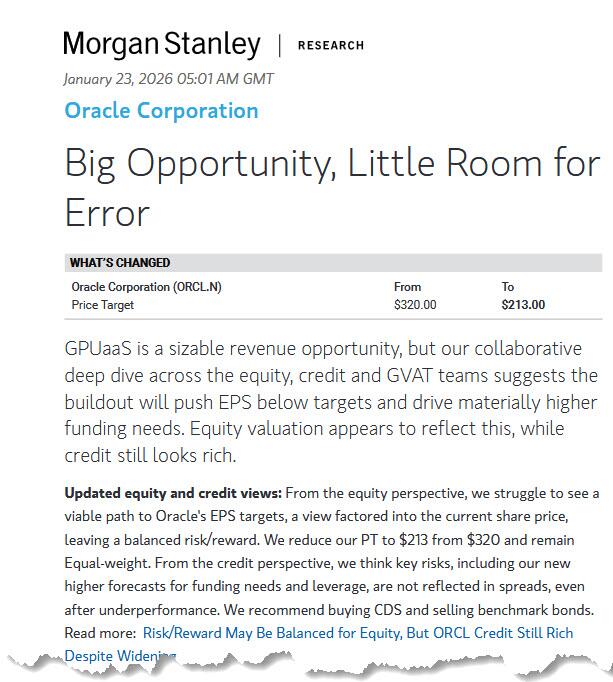
First, it was Morgan Stanley’s analysts (here for pro subs) with a major cut to their ORCL price target. The reason: “GPUaaS is a sizable revenue opportunity, but our collaborative deep dive across the equity, credit and GVAT teams suggests the buildout will push EPS below targets and drive materially higher funding needs. Equity valuation appears to reflect this, while credit still looks rich.”
If that wasn’t bad enough, in the same report the bank’s credit analysts said that they “reiterate our recommendation to buy 5Y CDS protection. Our new funding and leverage forecasts, paired with technicals, limited financing plan transparency, and our prior IG situation comp analysis, all support a move toward ~200bp, in our view. In regards to the bonds, a common question from investors this year has been whether current levels are a good entry point. We do not think this is case. We actually present even wider spread targets (~200bp for 10Y vs. ~170-175bp presented pre-Thanksgiving, ~250bp for 30Y vs. ~220bp, still using a media/ cable comp set) and formally introduce sell recommendations on the 35s and 55s.“
And then it went from bad to worse for Oracle just three days later, when on Jan 26 TD Cowen’s Michael Elias, published a report which crushed ORCL, not only sending its stock to a new 7 month lows, but pushing its CDS wll above the Dec 17 high.

That’s because according to Elias, who certainly does not mince his words when it comes to criticism of Oracle, the company is considering cutting 20,000 to 30,000 jobs and selling some of its activities as US banks pull back from financing the company’s AI data-center expansion. The job cuts would free up $8 billion to $10 billion in in much needed cash flow. Recall that according to Barclays, absent dramatic changes to its business, the company could run out of cash as soon as the end of 2026. Oracle is also weighing a sale of its health-care software unit, Cerner, which it acquired for $28.3 billion in 2022.
Below we excerpt from Elias’ note “Oracle: Ability To Procure Incremental U.S. Data Center Capacity Faces Challenges Amid Financing Struggles, Raising Questions On The Potential For Incremental U.S. RPO Growth”, also available to pro subs.
In June 2025, we were the first to highlight via our channel checks Oracle’s intention to procure ~5GW of data center capacity in support of OpenAI workloads, which proved accurate as Oracle in late 3Q25 leased ~5.2GW of U.S. data center capacity (which we highlighted in October) including: 1) 1.4GW in Shackleford, Texas, 2) 902MW (critical IT) in Port Washington, Wisconsin, 3) 1.0GW in Saline Township, Michigan, 4) 1.2GW in Doña Ana County, New Mexico, and 5) an incremental 672MW (critical IT) expansion in Abeline, Texas. Amidst the largest ramp in data center demand in history, there has been a material increase in the demand for frontend construction loans/project financing from private data center operators, particularly concentrated with Oracle given timing, leading to ~$58B of debt being raised for Oracle/OpenAI data center projects ($38B for Shackleford/Wisconsin and $20B for New Mexico) in a two-month period, with more behind it.
However, with Oracle to procure what our channel checks now indicate is ~3MM GPUs (and other IT gear) to support its existing OpenAI agreement, both equity and debt investors have raised questions regarding Oracle’s ability to finance this buildout, as demonstrated by widening of Oracle’s CDS spreads and pressure on Oracle’s stock/bonds. Assuming a conservative $30MM/MW in IT fit out costs, the implied ~$156B capex requirement, coupled with separate questions on OpenAI’s ability to fund its ~$1.4T in outstanding multi-year commitments, has led to multiple U.S. banks to pull back from lending to Oracle-linked data center projects. Furthermore, our channel checks indicate that multiple Oracle data center leases that were under negotiation with private operators struggled to secure financing, in turn preventing Oracle from securing the data center capacity via a lease. In cases where U.S. banks are still open to lending, our checks indicate that borrowing cost spreads for Oracle-linked data center projects have widened to Non-IG levels (i.e. now SOFR+300-450bps vs. SOFR+225-250bps in September).
As the borrowing costs for operators rise, the result has been a slowdown in +100MW U.S. Oracle data center leasing by private operators as the market digests the current Oracle financing requirements. Importantly, our channel checks indicate that banks in Asia are still willing to lend (at a slight premium relative to historical rates) to data center operators undertaking Oracle leases as these banks look to gain exposure to the AI sector, providing a path for international Oracle expansion in support of incremental RPO. However, the pullback in U.S. financing has raised questions regarding Oracle’s ability continue growing its revenue (RPO) in the U.S. if it continues facing challenges securing U.S. data center capacity to support OCI customer contracts.
The punchline: amidst these surging capital requirements, which can no longer be met by US-based banks, TD’s latest channel checks indicate that Oracle is now requiring 40% upfront customer deposits as it looks to mitigate the incremental capex requirement for incremental revenue (RPO) growth.
Furthermore, the channel checks indicate that Oracle is evaluating multiple paths forward to address financing questions including:
In the event of BYOC (which the TD channel checks confirm is a potential), TD questions if any existing Oracle/OpenAI contracts would need to be re-cut given the current $/GPU/hour pricing structure which includes the cost of the GPUs. In the interim, Elias writes that the near-term incremental demand needs of OpenAI have shifted to be fulfilled by Microsoft and to a lesser extent Amazon.
It’s not just Morgan Stanley and TD: Sanchit Vir Gogia, chief analyst at Greyhound Research, said the banking divergence as a critical warning sign. “The difference in sentiment between US and Asian banks isn’t just a minor detail; it’s the first serious sign of financial friction in Oracle’s hyperscale ambitions,” he said. The $300 billion OpenAI deal may look impressive, he added, but “when you look closer, it’s built on backlog with no guaranteed revenue and massive capex requirements.”
Gogia argued that enterprises need to fundamentally rethink how they view Oracle cloud contracts. “CIOs need to treat Oracle’s cloud buildout not as a service agreement, but as a shared infrastructure risk,” he said. “If they can’t fund it, they can’t build it. And if they can’t build it, you can’t run your workloads.”
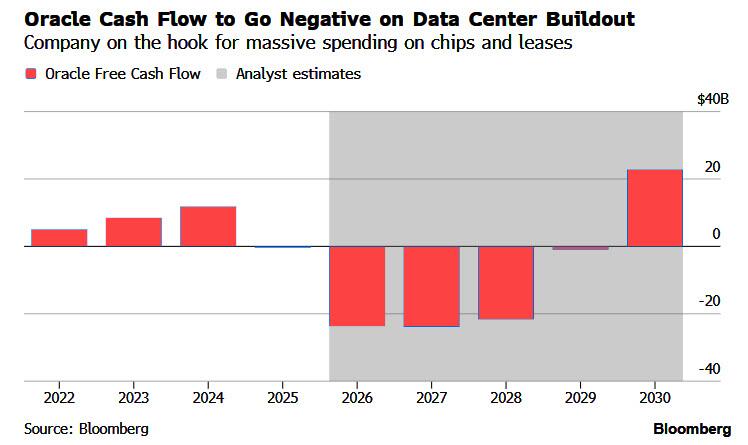
And all of this, of course, takes place against a background of historic cash incineration by Oracle and negative cash burn as far as the eye can see, making what until recently was unthinkably, all too possible.
So with the company facing a creeping squeeze of corporate distress and junk bond spreads as sentiments turns apocalyptic, amid growing speculation it will be forced to lay off tens of thousands and liquidate its best assets, Oracle has predictably panicked, and on Sunday it unexpectedly announced plans to raise $45 billion to $50 billion this year through a combination of debt and equity sales to build additional cloud infrastructure capacity.
The company plans to raise half of the funds via equity-linked and common equity issuances, including mandatory convertible preferred securities and through an at-the-market equity program of as much as $20 billion, something will will certainly depress its stock for the foreseeable future as it sells stock on even the smallest of breakouts. The rest of its funding target would be raised via a single issuance of bonds early in 2026. The company borrowed $18 billion in 2025 in what was one of the year’s largest corporate bond offerings.
Of course, as noted above, if Oracle does not raise the money, it may very well find itself in a liquidity crisis or much worse, so all David Ellison is doing, is whatever the market said he should have done long ago.
According to Bloomberg, Oracle is raising money to build additional capacity to meet the contracted demand from the company’s largest cloud customers, including Advanced Micro Devices, Meta Platforms, Nvidia, OpenAI, TikTok and xAI, the company said in a statement Sunday.
The announcement coincides with persistent fears about whether massive artificial intelligence-linked investments by tech companies such as Oracle will pay off. The company’s shares have fallen around 50% from its record price on Sept. 10, wiping out roughly $460 billion in market value. And the looming stock sales will lead to even bigger losses.
Developing AI data centers – without concurrently collecting cash from its clients – has pushed Oracle’s free cash flow negative, where it is expected to stay until 2030. As a result of its terribly structured deals, the company is on the hook for tens for billions of dollars in spending in the coming years, largely on semiconductors and leases.
Issuing equity would help send a message to the market that Oracle is serious about maintaining its investment-grade debt rating, wrote John DiFucci, an analyst at Guggenheim, in a January note.
“If Oracle can complete the raise successfully it will start digging itself out of the considerable hole it has found itself in,” said Gil Luria, an analyst at DA Davidson & Co.
Actually, even if Oracle can complete the raise, it still is facing massive funding shortfalls; and if it can’t it could very well be lights out.
Making matters worse, the debt market will not have an appetite for this much investment-grade debt from Oracle given its existing commitments and trading in its credit default swaps, Luria said. Issuing equity may also hurt the company’s stock price, which in turn will spill over into its bonds.
Making this significant of an announcement on a Sunday afternoon is unusual for a mature company like Oracle. The timing, “could be the management team trying to stop the endless slide in the share price by trying to give investors some hope ahead of Monday’s open,” Luria said. Judging by where futures are trading, the company could not have picked a worse day for its announcement which will likely see the stock tumble double digits when it opens for trading.
A key part of Oracle’s cloud investment is its contract with OpenAI, which has committed to spending about $300 billion to rent servers from Oracle. OpenAI is not profitable, adding to worries about the financial strains from huge capital expenditures without a clear timeline for meaningful returns. In fact, OpenAI has some $1.4 trillion in commitments to various other companies and if for some reason the company announces this money won’t be forthcoming in time… well, just don’t be stuck holding the world’s biggest circle jerk bag.
More in the full Morgan Stanley and TD Cowen notes available to pro subs.
Tyler Durden
Sun, 02/01/2026 – 23:13
via ZeroHedge News https://ift.tt/A5ob3kt Tyler Durden
San Francisco Ends $5M-A-Year Program That Supplied Alcohol To Homeless Addicts
Sigh. It’s not parody. It’s San Francisco. The city is shutting down a controversial program that used millions in taxpayer funds to provide alcohol to homeless residents struggling with addiction, according to the NY Post.
Mayor Daniel Lurie said the city will end the Managed Alcohol Program, which cost about $5 million each year and began during the COVID-19 pandemic.
“For years, San Francisco was spending $5 million a year to provide alcohol to people who were struggling with homelessness and addiction — it doesn’t make sense, and we’re ending it,” Lurie told The California Post.
The program was launched in April 2020, when the city placed unhoused residents in hotels during lockdowns. Medical staff supplied controlled amounts of beer and liquor to prevent dangerous withdrawal symptoms while stores and bars were closed. Although intended as a temporary measure, it continued for nearly six years.
During its operation, the program served only 55 people, translating to an average cost of roughly $454,000 per client.
Now, Lurie says the city has fully pulled its support.
“We have ended every city contract for that program,” he said.

Community Forward, the nonprofit that managed the initiative in recent years, confirmed that the city has terminated its funding. Financial records show the group received millions in public money, much of it spent on staff salaries.
San Francisco’s program was the first of its kind in the United States, modeled loosely on similar efforts in Canada. Unlike other harm-reduction policies, such as needle exchanges, MAP directly supplied alcohol to people already dependent on it.
Since taking office last year, Lurie has moved away from long-standing harm-reduction policies. He has also ended the distribution of drug-use equipment and pushed for stricter enforcement of street drug activity.
“Under my administration, we made San Francisco a recovery-first city and ended the practice of handing out fentanyl smoking supplies so people couldn’t kill themselves on our streets,” Lurie said.
“We have work to do, but we have transformed the city’s response, and we are breaking the cycles of addiction, homelessness and government failure that have let down San Franciscans for too long.”
Last year, he warned open-air drug markets that enforcement would increase.
“If you do drugs on our streets, you will be arrested,” Lurie said. “And instead of sending you back out in crisis, we will give you a chance to stabilize and enter recovery.”
The Post writes that recovery advocates welcomed the decision to end MAP. Tom Wolf, a former homeless addict who now works in outreach, said the program wasted public funds.

“They [were] wasting our money just paying people to keep using the drug that they’re hopelessly addicted to,” Wolf said.
He also criticized how harm reduction has evolved.
“Harm reduction itself is part of the overall social justice framework,” he said, adding that it has shifted from preventing disease to “supporting drug users.”
Steve Adami, head of the Salvation Army’s recovery-focused program in San Francisco, said the city is now rethinking decades of policy.
“Under Mayor Lurie, they have reassessed the outcomes of those models,” Adami said. “That we are a recovery-first city. He’s made a significant investment into abstinence-based and recovery-focused services.”
In May, Lurie signed the Recovery First Act, signaling a shift toward abstinence and treatment-based approaches.
Despite the changes, major challenges remain. San Francisco has limited detox capacity, with only about 68 beds for thousands of people who cycle through homelessness each year. Many residents seeking help still face long waits for treatment.
The end of the alcohol program reflects the mayor’s broader effort to reverse years of permissive policies as he tries to address addiction, homelessness, and the decline of the city’s downtown core.
Tyler Durden
Sun, 02/01/2026 – 22:45
via ZeroHedge News https://ift.tt/W28KBdg Tyler Durden
Democrat Wins Texas Special Election, Eroding GOP’s Slim House Majority
Republicans’ thin majority in the US House grew slimmer still on Saturday, as a special election in Texas has filled a long-vacant seat with a Democrat who’s vowed to “tear ICE up from the roots.”
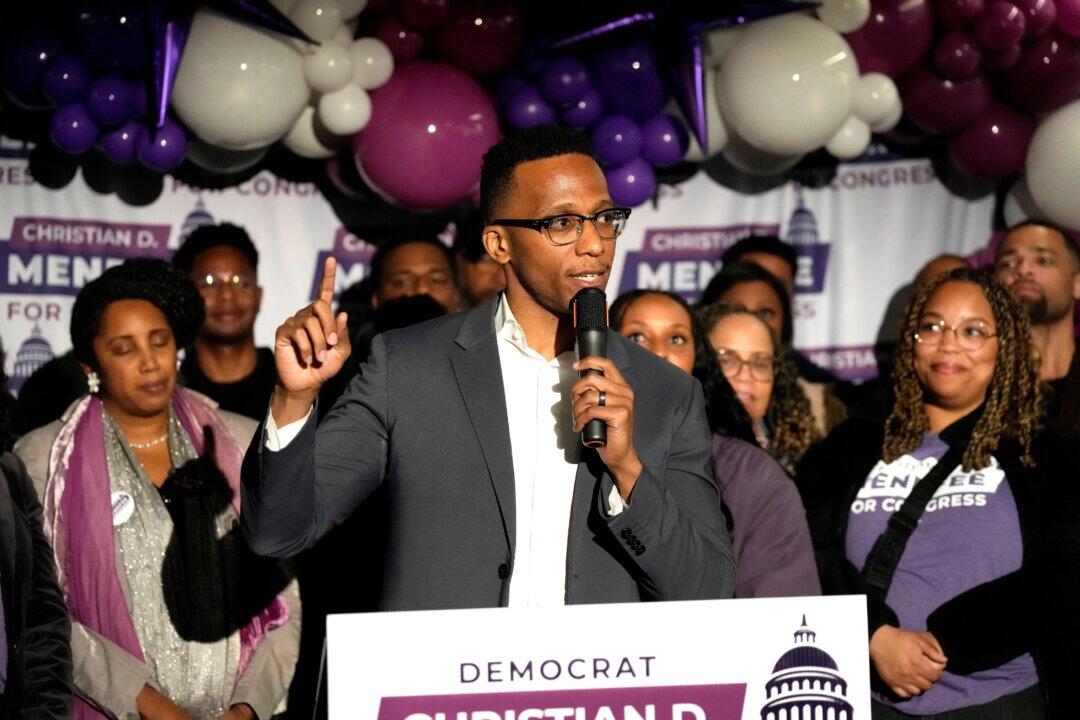
Progressive leftist Christian Menefee will represent Texas’s 18th Congressional District, after beating fellow Democrat Amanda Edwards in a runoff election for a seat that’s been vacant since Democrat Sylvester Turner died last March.
The development comes as new polls show Democrats with a national edge heading into November’s midterms.
While the black-and-Latino-dominated Houston-area district was predestined to send another Democrat to Washington, the finality of a free-for-all race that started with 16 candidates means Republicans will soon have a razor-thin four-seat lead.
Before Saturday, Republicans held a narrow 218–213 majority in the U.S. House. Democrats will likely push for Menefee’s immediate swearing in, which will erode the GOP lead to 218–214.
Three additional House vacancies in Georgia, New Jersey, and California have special elections scheduled in March, April, and August, respectively.
Democrats were furious last year when House Speaker Mike Johnson (R-La.) delayed the swearing-in of Rep. Adelita Grijalva (D-Ariz.) until mid-November, two months after she won a special election.
Despite Democrats’ excitement over Menefee’s win, it doesn’t offer much insight into which party has an edge in November’s midterm elections.
The 2024 Democratic presidential candidate and former Vice President Kamala Harris won Texas’s 18th district by a 40 percent-point margin over President Donald Trump, 69 percent to 29 percent.

Democrats accused Gov. Gregory Abbott of slow-rolling the special election, so as to ease the pressure on House Speaker Mike Johnson, who must repeatedly contend with rebellious GOP holdouts as he ushers bills through the legislative process in a closely-split House.
Though Turner died in March, Abbott didn’t schedule the election until November, saying he felt it important not to rush things, given Harris County’s checkered election history.
“No county in Texas does a worse job of conducting elections than Harris County. They repeatedly fail to conduct elections consistent with state law,” he said in April.
The delay was compounded when the race went to a runoff.
Speaking to cheering supporters Saturday night, Menefee addressed some of his remarks to President Trump:
“The results here tonight are a mandate for me to work as hard as I can to oppose your agenda, to fight back against where you’re taking this country and to investigate your crimes.”
The progressive Menefee, who was Harris County Attorney, assured the crowd that he would work to deliver universal health care, impeach Homeland Security Secretary Kristi Noem, and “tear ICE up from the roots.”
Amanda Edwards going *very* negative on Christian Menefee in the closing days of the TX-18 all-Democratic special election >>> pic.twitter.com/i9rLeOSJV1
— Jacob Rubashkin (@JacobRubashkin) January 30, 2026
If recent polls are an indication, the GOP has ground to make up if it’s to retain its hold on the House. A Fox News poll published this week found that, in a generic “which party do your prefer” question, 52% of voters said they’d back a Democrat to represent their district, compared to 46% who said they’d vote Republican.
Analysts caution that these polls have limited predictive value at this point.
“Political science analyses demonstrate that aggregate responses to this question begin to more accurately predict the actual House vote by around mid-summer,” GOP pollster Daron Shaw told Fox.
Trump could be a significant handicap for Republican office-seekers.
On the issue of affordability, voters currently prefer Democrats by a whopping 14-point margin, and Dems are sure to emphasize the role of Trump’s sprawling tariff regime in boosting prices.
He’s also given them a heap of tone-deaf quotes to use in advertising – for example, saying “the word ‘affordability’ is a con job.”
Meanwhile, Trump has dampened the enthusiasm of many conservatives, through his failure to deliver spending cuts, his administration’s attempts to avoid releasing the Epstein files, and his pursuit of the Deep State’s regime change agenda in Venezuela, Cuba and Iran.
Tyler Durden
Sun, 02/01/2026 – 21:35
via ZeroHedge News https://ift.tt/q1RhutV Tyler Durden
On January 27, in United States v. Hembree, the Fifth Circuit held that the federal felon firearm ban (18 USC 922(g)(1)) based on a conviction for simple possession of methamphetamine violates the Second Amendment. Coincidentally, on March 2 the Supreme Court will hear oral argument in another case that came from the Fifth Circuit, United States v. Hemani, which concerns whether the federal firearm ban by an unlawful user of drugs (18 USC 922(g)(3)) violates the Second Amendment.
The opinion by Judge Higginson, joined by Judge Willett and Judge Engelhardt, is rendered with the backdrop that the Fifth Circuit has upheld the felon-in-possession ban facially, but has recognized the viability of as-applied challenges. Given that the government sustained its burden to show the ban’s facial constitutionality, it argued that the burden shifted to Hembree to demonstrate its unconstitutionality as applied to him. The court relegated that argument to a footnote citing Rahimi: “It is the government’s burden to demonstrate that the challenged regulation is ‘relevantly similar to laws our tradition is understood to permit.'”
While “in some instances, we have remanded to allow party presentation of history and discussion of intervening caselaw before the district court,” here “the government provided robust historical discussion in its briefing and specifically ‘offer[ed] analogues to other felonies,’ for our review as well.” It’s a good sign that litigants have learned to proffer what they deem to be the historical analogues required by Bruen, given the initial criticisms of the text-history method that lawyers and judges are incapable to doing anything more than analysis of means-ends scrutiny.
But that’s where the government fell short. First, it cited historical laws imposing severe punishment for possession of contraband, including “laws punishing the knowing receipt of a stolen horse, the theft of mail, and the counterfeiting and forgery of public securities with death.” But in a prior decision, the Fifth Circuit refuted such purported analogues: “Those Founding-era offenses—knowing receipt of a stolen horse, mail theft, and counterfeiting—’concern theft, fraud, or deceit,’ not the ‘use and sale of addictive drugs.'” None of these alleged analogues are firearms regulations and thus could not possibly demonstrate a historic tradition of firearm regulation.
Second, the government pointed to historical laws “disarming dangerous people,” adding that “drug crimes are inherently dangerous,” even mere possession, which “entails the dealing with and enriching of drug traffickers.” However, the government offered nothing about “the dangerous nature of narcotics” other than the mere fact of Hembree’s conviction.
In contrast to the government, which failed to meet its burden of showing that a felony based on drug possession aligned with “the Nation’s history and tradition of disarming individuals whose past criminal conduct demonstrates a special danger of misusing firearms,” Hembree pointed out that possession of drugs, including opium, was not unlawful at the Founding and that non-medical drug use became unlawful only in the 20th century. Moreover, without evidence of intoxication at the time the person used a firearm, no historical analogue existed based on a person’s habitual or occasional drug use. That is, of course, the issue right now before the Supreme Court in Hemani.
The government relied on Rahimi to urge “dangerousness” as the criteria, but that was at too high a level of generality. As the court replied, “Indeed, not one piece of historical evidence suggests that, at the time they ratified the Second Amendment, the Founders authorized Congress to disarm anyone it deemed dangerous.”
Judge Willett wrote a concurring opinion, as he often does, to make some broader points questioning the overgrowth of federal power. When the Federalists advocated adoption of the Constitution without a bill of rights because powers not delegated are reserved, Patrick Henry replied: “Why not say so? Is it because it will consume too much paper?”
Even without the Second Amendment, does the felon-in-possession ban rest on an enumerated power of Congress? The Constitution delegates power to Congress “To regulate Commerce … among the several States.” Judge Willett writes: “Perplexingly, the Supreme Court once declared that this power ‘is not confined to the regulation of commerce among the states.'” That’s from United States v. Darby, 312 U.S. 100, 118 (1941). More recently, the Court has tried to better define and limit the commerce power.
Hembree’s argument that no enumerated power exists for the felon ban is foreclosed by Fifth Circuit precedent. However, as Judge Willett wryly remarks, “where the enumerated-powers belt slips—as the Anti-Federalists foresaw—the Second Amendment suspenders hold, at least for Hembree.” And Judge Willett “remain[s] open to reconsidering whether § 922(g)(1) truly falls within Congress’s enumerated powers.”
It is noteworthy that the Hembree court engaged in no discussion whatever about the dangers of methamphetamine, as would have been highlighted in the pre-Bruen days of intermediate scrutiny. The drug originally became popular in Germany in the 1930s. Because it could keep soldiers alert and aggressive, it became a staple of Germany’s Blitzkrieg attacks. As shown in a recent documentary, the Brits and Americans discovered its enhanced qualities and issued doses by the millions to their soldiers.
I first encountered “crystal meth” or “crank” in the ’80s when court-appointed to represent a defendant on federal gun charges. The guys on a construction crew were addicted to the drug. Their dealer sought to avoid prosecution for trafficking by introducing the crew members to an undercover ATF agent who pretended to be the top dealer. He said no more meth to you guys unless you get me firearms (that was his hook to bring gun charges). They couldn’t find any real guns so they built pipe bombs for the undercover agent. The ATF agent created the crime to get credit for having it prosecuted.
The government should not seek cert in Hembree. To date, both the Biden Administration in Rahimi (involving a violent wife beater) and the Trump Administration in Hemani (involving a pot head who also allegedly possessed cocaine and supposedly had connections to terrorism) have brought cases to the Court with unsympathetic defendants and fact patterns. It would be unfortunate if meth heads, gang bangers, and stoners became the test case rights claimants in foundational Second Amendment cases.
Methamphetamine is listed on Schedule II as it does have medical uses, but it can be addictive and dangerous. We’ll see what the Supreme Court does with Hemani, which concerns gun possession by a marijuana user.
The post Second Amendment Roundup: 5th Circuit Holds Disarming for Meth Conviction Violates 2nd Amendment appeared first on Reason.com.
from Latest – Reason.com https://ift.tt/a8Pybde
via IFTTT
On January 27, in United States v. Hembree, the Fifth Circuit held that the federal felon firearm ban (18 USC 922(g)(1)) based on a conviction for simple possession of methamphetamine violates the Second Amendment. Coincidentally, on March 2 the Supreme Court will hear oral argument in another case that came from the Fifth Circuit, United States v. Hemani, which concerns whether the federal firearm ban by an unlawful user of drugs (18 USC 922(g)(3)) violates the Second Amendment.
The opinion by Judge Higginson, joined by Judge Willett and Judge Engelhardt, is rendered with the backdrop that the Fifth Circuit has upheld the felon-in-possession ban facially, but has recognized the viability of as-applied challenges. Given that the government sustained its burden to show the ban’s facial constitutionality, it argued that the burden shifted to Hembree to demonstrate its unconstitutionality as applied to him. The court relegated that argument to a footnote citing Rahimi: “It is the government’s burden to demonstrate that the challenged regulation is ‘relevantly similar to laws our tradition is understood to permit.'”
While “in some instances, we have remanded to allow party presentation of history and discussion of intervening caselaw before the district court,” here “the government provided robust historical discussion in its briefing and specifically ‘offer[ed] analogues to other felonies,’ for our review as well.” It’s a good sign that litigants have learned to proffer what they deem to be the historical analogues required by Bruen, given the initial criticisms of the text-history method that lawyers and judges are incapable to doing anything more than analysis of means-ends scrutiny.
But that’s where the government fell short. First, it cited historical laws imposing severe punishment for possession of contraband, including “laws punishing the knowing receipt of a stolen horse, the theft of mail, and the counterfeiting and forgery of public securities with death.” But in a prior decision, the Fifth Circuit refuted such purported analogues: “Those Founding-era offenses—knowing receipt of a stolen horse, mail theft, and counterfeiting—’concern theft, fraud, or deceit,’ not the ‘use and sale of addictive drugs.'” None of these alleged analogues are firearms regulations and thus could not possibly demonstrate a historic tradition of firearm regulation.
Second, the government pointed to historical laws “disarming dangerous people,” adding that “drug crimes are inherently dangerous,” even mere possession, which “entails the dealing with and enriching of drug traffickers.” However, the government offered nothing about “the dangerous nature of narcotics” other than the mere fact of Hembree’s conviction.
In contrast to the government, which failed to meet its burden of showing that a felony based on drug possession aligned with “the Nation’s history and tradition of disarming individuals whose past criminal conduct demonstrates a special danger of misusing firearms,” Hembree pointed out that possession of drugs, including opium, was not unlawful at the Founding and that non-medical drug use became unlawful only in the 20th century. Moreover, without evidence of intoxication at the time the person used a firearm, no historical analogue existed based on a person’s habitual or occasional drug use. That is, of course, the issue right now before the Supreme Court in Hemani.
The government relied on Rahimi to urge “dangerousness” as the criteria, but that was at too high a level of generality. As the court replied, “Indeed, not one piece of historical evidence suggests that, at the time they ratified the Second Amendment, the Founders authorized Congress to disarm anyone it deemed dangerous.”
Judge Willett wrote a concurring opinion, as he often does, to make some broader points questioning the overgrowth of federal power. When the Federalists advocated adoption of the Constitution without a bill of rights because powers not delegated are reserved, Patrick Henry replied: “Why not say so? Is it because it will consume too much paper?”
Even without the Second Amendment, does the felon-in-possession ban rest on an enumerated power of Congress? The Constitution delegates power to Congress “To regulate Commerce … among the several States.” Judge Willett writes: “Perplexingly, the Supreme Court once declared that this power ‘is not confined to the regulation of commerce among the states.'” That’s from United States v. Darby, 312 U.S. 100, 118 (1941). More recently, the Court has tried to better define and limit the commerce power.
Hembree’s argument that no enumerated power exists for the felon ban is foreclosed by Fifth Circuit precedent. However, as Judge Willett wryly remarks, “where the enumerated-powers belt slips—as the Anti-Federalists foresaw—the Second Amendment suspenders hold, at least for Hembree.” And Judge Willett “remain[s] open to reconsidering whether § 922(g)(1) truly falls within Congress’s enumerated powers.”
It is noteworthy that the Hembree court engaged in no discussion whatever about the dangers of methamphetamine, as would have been highlighted in the pre-Bruen days of intermediate scrutiny. The drug originally became popular in Germany in the 1930s. Because it could keep soldiers alert and aggressive, it became a staple of Germany’s Blitzkrieg attacks. As shown in a recent documentary, the Brits and Americans discovered its enhanced qualities and issued doses by the millions to their soldiers.
I first encountered “crystal meth” or “crank” in the ’80s when court-appointed to represent a defendant on federal gun charges. The guys on a construction crew were addicted to the drug. Their dealer sought to avoid prosecution for trafficking by introducing the crew members to an undercover ATF agent who pretended to be the top dealer. He said no more meth to you guys unless you get me firearms (that was his hook to bring gun charges). They couldn’t find any real guns so they built pipe bombs for the undercover agent. The ATF agent created the crime to get credit for having it prosecuted.
The government should not seek cert in Hembree. To date, both the Biden Administration in Rahimi (involving a violent wife beater) and the Trump Administration in Hemani (involving a pot head who also allegedly possessed cocaine and supposedly had connections to terrorism) have brought cases to the Court with unsympathetic defendants and fact patterns. It would be unfortunate if meth heads, gang bangers, and stoners became the test case rights claimants in foundational Second Amendment cases.
Methamphetamine is listed on Schedule II as it does have medical uses, but it can be addictive and dangerous. We’ll see what the Supreme Court does with Hemani, which concerns gun possession by a marijuana user.
The post Second Amendment Roundup: 5th Circuit Holds Disarming for Meth Conviction Violates 2nd Amendment appeared first on Reason.com.
from Latest – Reason.com https://ift.tt/a8Pybde
via IFTTT
Is An Irrevocable Life Insurance Trust Right For You? Are You Super Rich?
Authored by Javier Simon via The Epoch Times (emphasis ours),
An irrevocable life insurance trust (ILIT) can allow affluent individuals to pass on wealth to heirs while keeping it outside of their taxable estate. This could help them reduce or avoid the estate tax upon death, which can be as high as 40 percent.
It also can help you pass over assets to individuals with special needs without affecting their eligibility for government programs like Medicaid or Social Security Disability Income (SSDI).
But it may not be the best for everyone. It’s virtually impossible to amend an ILIT without a court order or the consent of its beneficiaries. There are also some more pitfalls to watch out for.
So let’s take a closer look at an ILIT and see if it’s right for you as part of your comprehensive estate plan.
You can establish an ILIT with the help of a qualified estate-planning attorney. The ILIT is a legal arrangement that holds assets, mainly a life insurance policy, for the benefit of another or others.
As a trust grantor, you create the trust. You may appoint a trustee to manage the trust. The trustee can be anyone such as a lawyer, a family member, a friend or an organization. The trustee uses trust assets to purchase a life insurance policy in your name. The trustee is also responsible for paying annual insurance premiums and administering the trust.
When you pass away, the policy’s death benefit is paid directly to the trust and then proceeds are distributed to the beneficiary.
One of the main reasons people utilize ILITs is to minimize any estate tax burden. When you transfer assets to an ILIT, you relinquish control of those assets completely and they technically become property of the trust, which is its own legal entity.
So these assets won’t be part of your gross taxable estate and thereby could minimize estate taxes or eliminate them.
In 2026, the federal estate tax is levied on assets upon death worth more than $15 million ($30 million for married couples) before they can be transferred to heirs.
These amounts are known as the lifetime gift and estate tax exemption.
Here’s an example of how an ILIT may reduce your estate tax liability:
Let’s say you have assets totaling $15 million and purchase a life insurance policy that pays a $5 million death benefit to your child. After you pass away, you would have a taxable estate of $20 million. That’s above the lifetime gift and estate tax exemption.
But if the $5 million insurance policy were owned by an ILIT, your taxable estate would remain at $15 million. That’s under the exemption amount.
However, keep this in mind: Life insurance gifted to an ILIT within three years of your death would be included in your gross estate for estate tax purposes.
But ILITs have more to offer.
If set up right, an ILIT can protect the insurance policy cash value or death benefit from creditors of both you and your beneficiaries. The reason is that ILITs are not considered to be owned by the beneficiaries. And there’s another upside to this.
If your beneficiary has special needs, their eligibility for government programs like Medicaid and SSDI may be affected by the size of their assets. Since the ILIT is not technically owned by the beneficiary, this could avoid income-based drawbacks for qualification in government programs.
But there are some drawbacks to ILITs.
Once you transfer assets to an ILIT, you relinquish control over those assets. You generally can’t take them back or make any changes to the ILIT once it has been established without the consent of all beneficiaries or some kind of court order.If you don’t have a large estate and therefore expect to owe no estate taxes, you may be better off with a revocable living trust. With these trusts, you still remain in control of its assets during your lifetime and you can make amendments to the trust as you please.
An ILIT can be an essential tool, especially for affluent individuals with large estates who believe they’d face federal estate taxes. Because the states that levy their own estate tax have their own exemption levels, an ILIT could also minimize state-based estate taxes.
ILITs also offer a certain degree of asset protection from creditors. So it may be a good idea when you or your beneficiaries are in litigious careers, too. And it also can be crucial for those with special needs, because ILITs can help them remain eligible for much needed government programs. But you have to be ready to relinquish control of assets in an ILIT completely.
Moreover, ILITs can be extremely complex and can backfire if not properly established and funded. This is why it’s a good idea to work closely with a qualified tax professional and estate planning attorney when pursuing an ILIT.
The Epoch Times copyright © 2026. The views and opinions expressed are those of the authors. They are meant for general informational purposes only and should not be construed or interpreted as a recommendation or solicitation. The Epoch Times does not provide investment, tax, legal, financial planning, estate planning, or any other personal finance advice. The Epoch Times holds no liability for the accuracy or timeliness of the information provided.
Tyler Durden
Sun, 02/01/2026 – 21:00
via ZeroHedge News https://ift.tt/odDiNqp Tyler Durden