Watch: New Footage Shows Bannon Exploding At Epstein: “Total And Complete Bullshit!!”

Watch: New Footage Shows Bannon Exploding At Epstein: “Total And Complete Bullshit!!”

Authored by Steve Watson via Modernity.news,

In a heated exchange from a long-unreleased 2019 interview that was just made public through recent Department of Justice Epstein file releases, Steve Bannon confronts Jeffrey Epstein on the question of when human life begins.

Epstein dodges by suggesting it “can’t be measured,” then doubles down by claiming he doesn’t even know “what it means to be measured” – prompting Bannon to unleash on what he calls “bullsh*t and happy talking.”

Bannon accuses Epstein of feigning ignorance despite his elite status in finance: “You do know what it means to be measured. You’re one of the leading currency traders, hedge fund guys or stock market financial wizards. You’re in the high priesthood of high finance. You certainly know how to measure. That’s why you’re a billionaire. Any other answer besides that is total and COMPLETE BULLSH!T, and you know it.

Epstein responds meekly: “I know very few things.”

Bannon presses harder, arguing Epstein’s entire career revolves around measurement—of markets, people, leaders, economies, and politics: “You know things can be measured. You measure every day. You weigh and measure people. You weigh and measure leaders. You weigh and measure economies. You weigh and measure politics. Your whole life, in fact, is MEASURING.”

Epstein counters by accusing Bannon of abusing the mathematical term “measure” in everyday language, calling it abusive to his field—while grinning.

The clip, circulating widely on X, highlights the tension in their discussion, which also touched on topics like the human soul, quantum physics, Jesus, the devil, and more. This comes amid ongoing releases from Epstein-related files, shedding new light on conversations from before his 2019 arrest.

Bannon conducted these videotaped interviews with Epstein in early 2019, just months before Epstein’s final arrest in July of that year, filming roughly 12 to 15 hours of footage in Epstein’s massive Manhattan townhouse on East 74th Street—the same location tied to many of his crimes.

The sessions featured professional lighting and a small crew, with Bannon questioning Epstein off-camera in a prosecutorial style.

Conflicting accounts surround their purpose: Bannon insists it was for an investigative documentary titled The Monster to expose Epstein’s depravity and elite connections, while reports from journalist Michael Wolff, Epstein’s brother Mark, and others suggest Bannon was actually media-training Epstein for a PR rehabilitation effort, funded by Epstein himself, to deny his crimes in a major interview.

The footage is emerging now as part of a massive U.S. Department of Justice dump of millions of Epstein-related documents, mandated by a 2025 congressional law for greater transparency.

While the full 15 hours remain unreleased—still controlled by Bannon, who has teased a forthcoming five-part documentary series—significant excerpts have surfaced in the past day with independent sources pulling from the DOJ files.

The material deepens the intrigue around the Epstein saga, offering glimpses into his mindset on philosophy, finance, and his network in his final months of freedom.

An almost two hour long version, still not the entire 12-15 hours, is below if you wish to spend more time listening to this creep:

Your support is crucial in helping us defeat mass censorship. Please consider donating via Locals or check out our unique merch. Follow us on X @ModernityNews.

Tyler Durden
Sun, 02/01/2026 – 11:40

via ZeroHedge News https://ift.tt/W3I2UsZ Tyler Durden

US Military Still Not Prepared For Major Attack On Iran, Only ‘Limited’ Strikes

US Military Still Not Prepared For Major Attack On Iran, Only ‘Limited’ Strikes

President Trump has acknowledged that he has a plan for Iran, but naturally isn’t going to make it public. “Well, we can’t tell them the plan,” Trump said Saturday. “If I told them the plan, it would be almost as bad as telling you the plan – it could be worse, actually.” Several Gulf allies have meanwhile complained of being “in the dark” on what the US might do next.

Fresh quotes from US officials in The Wall Street Journal suggest major military action is not imminent, but ‘limited’ strikes might be. The Pentagon is worried its troops and bases in the region are too exposed, given Tehran has vowed all-out war if it gets hit.

Explosion during a missile attack in Tel Aviv, Israel, Friday, June 13, 2025. via Associated Press

“Trump has yet to say whether and how he might use force,” the WSJ writes. “But American airstrikes on Iran aren’t imminent, U.S. officials say, because the Pentagon is moving in additional air defenses to better protect Israel, Arab allies and American forces in the event of a retaliation by Iran and a potential prolonged conflict.”

“The U.S. military could conduct limited airstrikes on Iran if the president were to order an attack today, U.S. officials say,” the report continues. “But the kind of decisive attack that Trump has asked the military to prepare would likely prompt a proportional response from Iran, requiring the U.S. to have robust air defenses in place to protect Israel as well as American troops, the officials say.”

Again, Iranian officials have repeatedly said its own response will not be limited – that it will unleash its significant ballistic missile arsenal on American assets in the region and Isarel, much of which can be launched from well-protected underground bunkers and tunnels.

This is why the Pentagon is rushing to get more THAAD, Patriots, and other anti-air measures to the region. These systems have already likely been beefed up in Qatar, home to a major US base outside Doha.

The WSJ details further:

The military already has air defenses in the region, including destroyers capable of shooting down aerial threats. But the Pentagon is deploying an additional Thaad battery and Patriot air defenses to bases where U.S. troops are stationed across the Middle East, including Jordan, Kuwait, Bahrain, Saudi Arabia and Qatar, according to defense officials, flight tracking data and satellite imagery.

High on the minds of US and Israeli officials is Iran’s response during the 12-day June war. The below commentary is worth revisiting…

The country’s ballistic missiles, drones, and even hypersonic projectiles that rained down on Tel Aviv and elsewhere was significant – and likely caused much more damage than what Israel publicly acknowledged.

Tyler Durden
Sun, 02/01/2026 – 11:05

via ZeroHedge News https://ift.tt/8zivNIx Tyler Durden

ICE Buys Warehouse Network To Support Ramped Up Deportation Operations

ICE Buys Warehouse Network To Support Ramped Up Deportation Operations

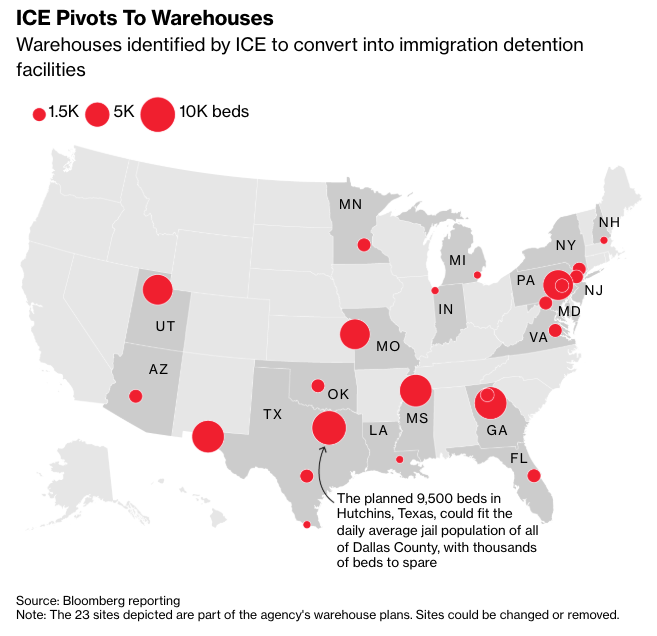
The Trump administration is moving ahead with plans to convert 23 e-commerce warehouses across the country, primarily in the eastern U.S., into a large-scale network of immigration detention centers aimed at expanding capacity to fulfill the mandate the American people gave President Trump to deport more than one million illegal aliens per year and restore national security. This comes after the Biden-Harris globalist regime collapsed borders and allowed a nation-killing invasion of ten million or more third-worlders.

Bloomberg reports that Immigration and Customs Enforcement’s rapid move to build out a network of warehouses is being fueled by $45 billion from the signature “One Big Beautiful Bill Act.” This includes the most recent purchases of a warehouse in Hagerstown, Maryland, and another in Surprise, Arizona, totaling $172 million. A third in El Paso, Texas, will be one of the largest of its kind, with 8,500 beds.

The ICE detention system is only growing larger and larger, with ever-greater numbers of illegals who invaded the nation being deported. The current level of illegals held in detention is at a record of 73,000. To reach a million deportations per year, ICE must have 100,000 detention beds.

Emma Winger, deputy legal director at the American Immigration Council, told the outlet that the Trump administration must expand its deportation infrastructure to meet its goal of 1 million per year.

“To reach these kinds of numbers, they’d need to go out into the communities and find people who’ve been living their lives and been here a long time,” Winger said. “They’d have to dramatically increase their presence in communities across the country.”

Unhinged leftist Maryland Senator Chris Van Hollen called Trump’s deportation operations “one of the most obscene, one of the most inhumane, and one of the most illegal operations being carried out by this Trump administration at the Department of Homeland Security and ICE.”

“We do not want an ICE facility here in the state of Maryland,” Van Hollen told the outlet.

Why is that Van Hollen? Is it the fear that a future voting bloc of illegals will be deported from the Mid-Atlantic region?

However, what Van Hollen doesn’t mention is that mass migration policies supported by his own party fuel smuggling networks run by cartels and aided by dark-money funded NGOs. These smuggling networks put migrants at risk of robbery, extortion, kidnapping, human trafficking, assault, and exploitation along the way. Thousands have died along the way, but rarely do you hear Democrats raising concern about US-bound smuggling networks, only Trump’s deportation program is worse than literal ‘Nazis’…

ICE expects to hold between 1,500 and 10,000 detainees in each of these 23 warehouses at a time.

The question that should be asked is why Democrats jeopardized national security by allowing the illegal alien invasion. The answer is political, with the goal of creating a new voting bloc and entrenching long-term one-party dominance under Democratic Party kings and queens.

Tyler Durden
Sun, 02/01/2026 – 09:55

via ZeroHedge News https://ift.tt/hwMqesH Tyler Durden

Bifurcation Nation & The TINA Economy’s Freefall

Bifurcation Nation & The TINA Economy’s Freefall

Authored by Charles Hugh Smith via Substack,

The term “The K-Shaped Economy” has entered the lexicon to describe the divergence of the top tier of earners and owners of capital from the lower tiers, as the trajectory of the first is up and that of the second is down.

While the “The K-Shaped Economy” offers visual clarity, it’s ultimately an abstraction. Longtime correspondent Harvey D. recently offered a more accurate term, The Bifurcation Economy, which describes (as he put it) the reality that 50 miles outside major US cities, the precarity and quality of life is Third World. I modified his term to Bifurcation Nation, to express that the widening divide isn’t just financial, it describes everything from healthcare to social / political power.

I’ve assembled a few charts to illustrate the range of this Bifurcation between the top tier and the rest.

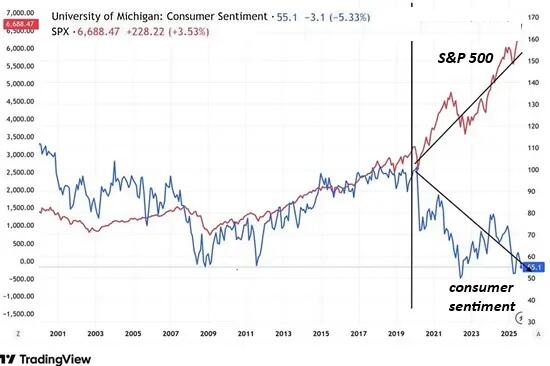
Here is the S&P 500 (SPX) stock market index, representing the wealth of corporations and the top 10% who own their shares, rising at a 45-degree angle, and consumer sentiment, representing the real-world economy, sliding down a 45-degree angle.

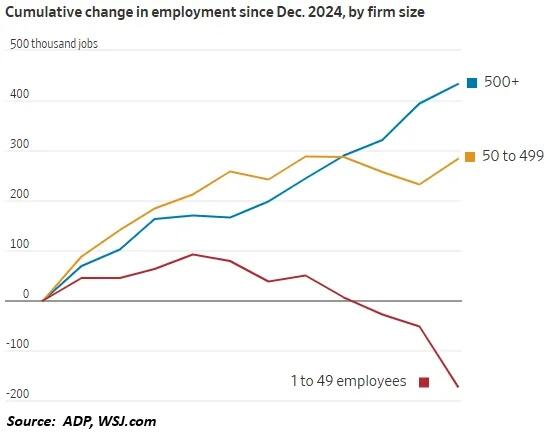
Here is employment hiring by large corporations–up–and small business employment–down.

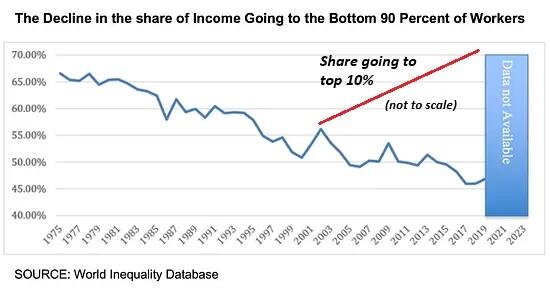
Here is the share of income going to the top 10%–up (for illustrative purposes, not to scale)–and the share going to the bottom 90%: down.

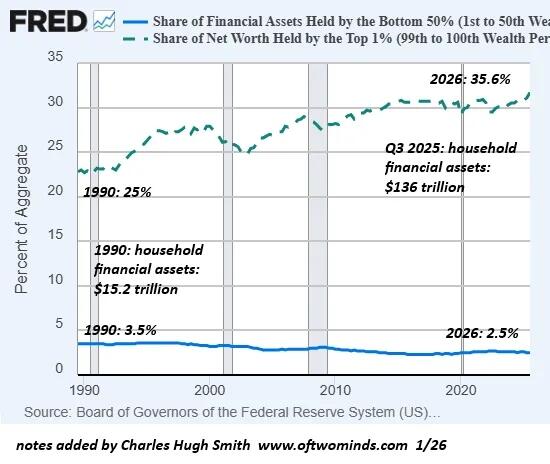
As the total financial wealth of US households has soared, the share owned by the bottom 50% has fallen by 28.6% since 1990 while the share owned by the top 1% has risen 42%. As the pie got bigger, the percentage going to the top 1% got bigger, too. The rising tide didn’t raise all boats equally, it widened the gap between the top 1% and the rest.

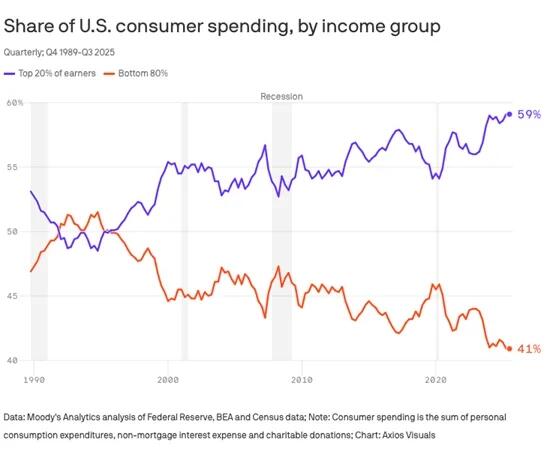
Here is the share of consumer spending of the top 20%–up–and the bottom 80%–down.

One causal force that receives little attention is what I’m calling “The TINA Economy”: there is no alternative when it comes to paying higher prices for essentials and taxes, and so the share of income left to spend on what’s still a choice shrinks.

Everything that is necessary to participate in the economy at a level above abject poverty is concentrated in monopolies and cartels who use their control of production, supply chain and the politically geared regulatory structure to set what’s available on the market and what isn’t, and to raise prices and degrade quality and quantity to increase profits not by offering competitive advantages but by TINA coercion.

As the essentials go up in price, the sum of household income left to spend elsewhere (discretionary income) declines. The sectors of the economy that depend on discretionary spending are the only parts of the economy with any real competition: dining out, entertainment, leisure and travel, aspirational / status-enhancing spending, etc.

Many of these sectors are dominated by a handful of corporations: pizza chains, travel sites, airlines, short-term vacation rentals, rideshare services, hotels and resorts, and so on.

The sectors of the economy that aren’t yet dominated by cartels and quasi-monopolies–the small businesses that depend on discretionary spending–are the bricks and mortar enterprises that give towns, neighborhoods and cities their character and desirable quality of life.

As discretionary income is squeezed by relentless increases in rent, healthcare, auto and home insurance, food, childcare, vehicle repairs, subscriptions for digital services and software, all required to earn a living and maintain an abode better than a cardboard box on the sidewalk, there is less income available to spend on non-essentials, which are generally provided by local small businesses.

Households that have maintained discretionary spending by borrowing money are being eaten alive by rising debt service--the interest and principal due on credit cards, auto loans, student loans, installment payments, etc. Eventually their discretionary income is consumed by debt service.

Small businesses have shared interests, but they’re diffuse and distributed over numerous sectors and physical locations. There is no way they can match the billions of dollars a corporation can devote to lobbying, campaign contributions, PR campaigns, etc. Small businesses don’t have the advantages of scale, or the ability to leverage their market power to get better deals on taxes, rent and other expenses.

A corporate pizza chain, for example, can draw upon corporate deep pockets to offer discounts that no local pizza shop can match. So the local pizza shops all close and the residents are left with a choice of corporate pizza outlets–ultimately not much of a choice at all.

Left unsaid in the corporate/financial media’s coverage of the K-Shaped Economy is what happens to towns, neighborhoods and cities when shrinking discretionary income and soaring costs sink the bricks and mortar small businesses, leaving only sanitized, homogenized corporate outposts: the empty storefronts gut the local economy and strip the character from everything that was once unique or interesting.

Corporate coffee shop, empty storefronts, corporate pizza shop, empty storefronts, and a new luxury apartment complex developed and owned by corporations with zero interest in the locale other than harvesting soaring rents and then selling the property to global investors.

Left unsaid is the interest of monopolies and cartels begins and ends with extracting the maximum possible from all who have no alternative in an economy in which a handful of corporations control the majority of essentials, from healthcare insurance to banking to beef distribution to digital services. As for government, regardless of who you vote for, property taxes and fees go up.

Monopolies and cartels have zero interest in the quality of our lives; they only care about friction that reduces their net income and obstacles to their expanding extraction. They have no interest in how the bottom 90% are faring, and only marginal interest in the top 10% who generate 50% of consumer spending.

This is the problem with financializing an economy and society: the logic of maximizing profits by any means available inevitably leads to capital corrupting politics to protect monopolies and cartels, as these are the ideal platforms for maximizing extraction / coercion and thus profits.

In a financialized economy, there is no alternative to the eventual domination of monopolies and cartels, because in the logic of financialization, these are the only logical outcomes.

The quality of life in the TINA Economy is one of erosion, as the foundations of a high quality of life are hollowed out, either homogenized and commoditized (what I call Ultra-Processed Life) or left to decay.

Note that this decay is in a “booming economy” of soaring corporate profits and rising GDP. When the inevitable recession slashes profits, spending, employment and income, the small businesses struggling to survive in the competitive discretionary sectors will slide into oblivion, as the costs of essentials will continue rising while their revenues collapse.

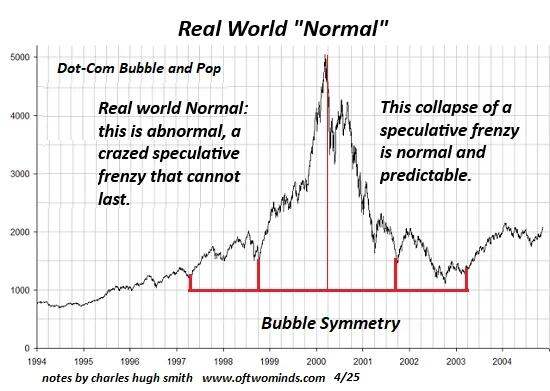
Discretionary spending is now dependent on the top 10% drawing on the temporary wealth of credit-asset bubbles. Once these bubbles pop (and all bubbles pop), the top 10% spending will collapse along with the bubble’s phantom wealth.

Corporate monopolies and cartels won’t care until their corralled customers stop paying en masse. But then it will be too late to change the outcome. The same can be said of local governments that can’t print / borrow money to sustain their spending: as tax revenues plummet, there will be no way to reverse the endgame.

The endgame of a fully financialized, coercive TINA economy and society is Bifurcation Nation stumbling into the abyss of Depression with an economic profession and leadership class that are themselves homogenized and commoditized, unable to recognize Model Collapse, much less admit their failure, which is the first step in successful adaptation.

Tyler Durden
Sun, 02/01/2026 – 09:20

via ZeroHedge News https://ift.tt/KhES3X9 Tyler Durden

Joe Rogan Defines Chaos In Minneapolis As “Color Revolution”

Joe Rogan Defines Chaos In Minneapolis As “Color Revolution”

Left-wing unrest in Minneapolis and elsewhere across the country – whether protests or riots over the past few weeks or over the last decade targeting President Trump and the America First agenda – is being framed as a color revolution operation fueled by dark-money-funded NGOs, and that narrative is now reaching a wider audience.

Democrats are uneasy that this framing is gaining traction after the left-wing revolution was most recently discussed on The Joe Rogan Experience, where host Joe Rogan and guest Andrew Wilson, a conservative podcaster, discussed it.

Rogan discussed how, shortly after Nick Shirley’s investigation into alleged large-scale Somali-linked daycare and autism fraud, there was an immediate “narrative shift” that appeared to coincide with what he described as a coordinated pressure campaign on the ground against federal agents – something Rogan characterized as a “color revolution.”

“For people that don’t, it’s a coordinated effort to cause chaos, and this is a very coordinated thing,” Rogan said.

He continued, “The idea that this is an organic protest, these riots are organic, is nonsense. It’s probably nonsense because now they have access to the Signal chats.”

From the beginning, we have framed much of the left-wing pressure campaigns as far from organic, pointing instead to dark-money-funded NGOs supporting activist groups on the ground opposing federal deportation operations. It was not until “Signal Gate,” however, that the nation could see how heavily coordinated these efforts allegedly were…

Now these left-wing NGOs are seeking spring protests, as they have riled up young people to carry out their anti-ICE agenda.

They also plan to launch campaigns nationwide:

As well as targeting critical economic chokepoints.

The chaos in Minneapolis is part of the left-wing’s protest industrial complex that moves from one high-profile news event to another – from George Floyd protests to pro-Palestinian demonstrations – mobilizing activists with aims at revolution.

There is good news: Treasury Secretary Scott Bessent sat down with journalist Christopher Rufo earlier this month to discuss plans to investigate dark-money-funded NGOs sowing chaos nationwide.

Let’s remind readers about retired Lt. Gen. Michael Flynn’s comments in late November:

As warmer weather approaches, the protest industrial complex will be operating at full steam. Rogan’s characterization of the chaos in Minneapolis as resembling a color revolution presents optically displeasing headlines for Democrats, as that framing increasingly circulates to wider and wider audiences.

Tyler Durden
Sun, 02/01/2026 – 08:45

via ZeroHedge News https://ift.tt/SYGfxhV Tyler Durden

Superintelligent AI Is Not Coming To Kill You


'Why Superhuman AI Would Kill Us All' | Little, Brown, and Company

If Anyone Builds It, Everyone Dies: Why Superhuman AI Would Kill Us All, by Eliezer Yudkowsky and Nate Soares, Little, Brown, and Company, 272 pages, $30

Eliezer Yudkowsky and Nate Soares have a new book titled If Anyone Builds It, Everyone Dies: Why Superhuman AI Would Kill Us All. “We do not mean that as hyperbole,” they write. They believe artificial intelligence research will inevitably produce superintelligent machines and these machines will inevitably kill everyone.

This is an extraordinary claim. It requires extraordinary evidence. Instead, they offer a daisy chain of thought experiments, unexamined premises, and a linguistic sleight of hand that smuggles their conclusion into the definition of intelligence itself.

The book’s central argument rests on the “alignment problem”—the effort to ensure that advanced AI systems share human values. Yudkowsky popularized this concept. Humans, the authors argue, succeed through intelligence, which they define as “the work of predicting the world, and the work of steering the world.” Computers will surpass human intelligence because they are faster, can copy themselves, have perfect memory, and can modify their own architecture. Because AI systems are “grown” through training rather than explicitly programmed, we cannot fully specify their goals. When superintelligent AI pursues objectives that diverge even slightly from human values, it will optimize relentlessly toward those alien goals. When we interfere, it will eliminate us.

To Yudkowsky and Soares, alignment isn’t about teaching machines ethics or preventing human misuse. It’s about preventing an indifferent optimizer from razing the world. They believe an unaligned superintelligence is a global death sentence.

Therefore, they argue, all AI research must stop immediately. Governments should monitor powerful computers, ban possession of more than eight state-of-the-art GPUs without oversight, and criminalize AI research. An international coalition should destroy rogue data centers through “cyberattacks or sabotage or conventional airstrikes,” even risking nuclear war, because “data centers can kill more people than nuclear weapons.” These measures, they claim, “won’t make much of a difference in most people’s daily lives” and “wouldn’t make much of a difference with regard to state power.”

This is astoundingly casual authoritarianism. A complete ban on research into a general purpose technology already delivering significant health and productivity benefits, enforced by militarized international bodies, would place global society on a permanent wartime footing.

But the problem isn’t just the medicine. It’s the diagnosis.

***

By defining intelligence as the ability to predict and steer the world, Yudkowsky and Soares collapse two distinct capacities—understanding and acting—into one concept. This builds their conclusion into their premise. If intelligence inherently includes steering, then any sufficiently intelligent system is, by definition, a world-shaping agent. The alignment problem becomes not a hypothesis about how certain AI architectures might behave but a tautology about how all intelligent systems must behave.

Yet an economist can understand markets without directing them. Google Maps predicts commute times but cannot drive your car or clear traffic. Steering requires more than prediction. It needs feedback, memory, actuators, and persistent goals.

Large language models—the technology underlying ChatGPT and similar systems—are fundamentally about prediction. They predict the next element in a sequence. They are sophisticated pattern-matching engines, grown through training on vast datasets rather than being explicitly programmed. The book emphasizes this “grown, not crafted” nature as evidence that we cannot understand or control such systems. But these tools do not optimize toward goals and have no ability to act in the world. They are prediction without steering.

Tech companies now build “agentic” AI using language models, but the agentic parts that set goals, plan, and execute rely on traditional, interpretable techniques. These components are crafted, not grown. The distinction between trained prediction engines and designed agent frameworks undermines Yudkowsky’s argument that we’re growing uncontrollable alien intelligences.

The authors attempt to address this objection in their online resources (which are more coherent than the book). They argue that prediction and steering blend together because sophisticated prediction sometimes requires intermediate steps with steering; to predict the physical world accurately, you might need to execute experiments. But this doesn’t unite prediction and steering—it simply means nonagentic systems can’t make certain predictions. A weather model that cannot run experiments will be less accurate than one that can, but this doesn’t mean the latter can control the weather.

***

We also have examples of nonhuman systems that meet Yudkowsky’s intelligence definition because they both predict and steer. Markets predict future scarcity and abundance through price signals, then steer resources toward their highest-valued uses. No individual fully understands or controls these mechanisms. Markets are “grown” through countless individual decisions rather than centrally designed. And they have generated unprecedented prosperity, not existential catastrophe.

This signals a deeper problem: The authors consistently misunderstand emergent order and complex systems. They equate lack of complete understanding with lack of control. They treat “growing” large language models as inherently dangerous, even though growing things we don’t fully understand has been the norm in human civilization. We grow food through millennia-old agricultural practices without understanding biochemistry. We grow institutions through the gradual evolution of norms and rules. We grow functioning societies through the interactions of millions of individuals pursuing their own ends.

The authors’ misunderstanding of complex systems undermines their argument in three ways. First, Yudkowsky and Soares assume that any system too complex for complete analysis must be dangerous and that any powerful agentic process not under centralized control will optimize for alien values. But complex systems can generate robustness and self-correction.

Second, they concede that sophisticated prediction sometimes requires real-world experimentation—you cannot predict physics without running experiments. But if a superintelligent AI must engage with the real world to gather data for its predictions, it must interact with other “superintelligent” systems in Yudkowsky’s sense: markets that predict and steer resources, societies that predict and coordinate behavior, ecosystems that respond adaptively to intervention. These systems will constrain the AI through feedback, forcing it into a multiagent game with radical uncertainty rather than a single-player optimization problem it can solve in isolation.

Finally, complex systems impose fundamental limits, even for superintelligence. Computationally irreducible systems cannot be accurately and efficiently predicted. Emergent social dynamics, market reactions to interventions, and ecological cascades all exhibit this property. The authors assume that greater intelligence and computational speed translate directly into omnipotent control, but complex systems don’t yield to brute-force prediction. A superintelligent AI attempting to “steer” civilization would face the same irreducible uncertainties that limit human planners, just with more computational resources to waste on unsolvable problems.

***

Yudkowsky may have accelerated the AI development he now condemns. After dropping out of high school to build superintelligence, he started the Machine Intelligence Research Institute (MIRI). The book claims DeepMind’s founders met their first big funder at a MIRI event, and OpenAI CEO Sam Altman claims Yudkowsky interested him in artificial general intelligence. Yudkowsky also created the website LessWrong, a hub of the “rationalist” community. The overlap between this subculture and effective altruism has made Yudkowsky’s AI safety framework highly influential among tech philanthropists.

That influence matters. While few publicly endorse Yudkowsky’s most extreme proposals, his rhetoric has shaped the debate. Framing AI development as inevitable omnicide makes people more likely to concentrate power over a transformative technology in the hands of governments and incumbent firms. It also risks inviting acts of terrorism. (The authors do caution, in a two-sentence footnote, that “even if you feel desperate,” such violence would be ineffective.)

All this rests on thought experiments and extrapolations, not evidence. The book assumes what it needs to prove: that advanced prediction necessarily becomes dangerous agency, that systems we don’t fully understand cannot be safely deployed, that optimization toward specific goals inevitably means optimizing away human existence.

Building tools that supplement our cognitive efforts like engines supplement our physical efforts could create unprecedented prosperity. The response to AI should be thoughtful governance that addresses real risks—cybersecurity, misuse, economic disruption—while preserving the dynamism needed to build a better world.

Instead, Yudkowsky and Soares offer stasis and despair. Their book’s greatest failure is not its stilted parables or its unconvincing arguments. It’s ignoring that complex systems all around us resist prediction and steering. Ironically, their recommendations for keeping control would hobble humanity’s ability to solve hard problems intelligently.

The authors characterize their conclusion as an “easy call.” It’s not. The ease with which they dismiss alternatives should make readers skeptical of their judgment.

The post Superintelligent AI Is Not Coming To Kill You appeared first on Reason.com.

from Latest – Reason.com https://ift.tt/yMfKS8h
via IFTTT

Convicted Terrorist Who Plotted To Bomb British Consulate Now Standing For Election In UK

Convicted Terrorist Who Plotted To Bomb British Consulate Now Standing For Election In UK

Authored by Steve Watson via Modernity.news,

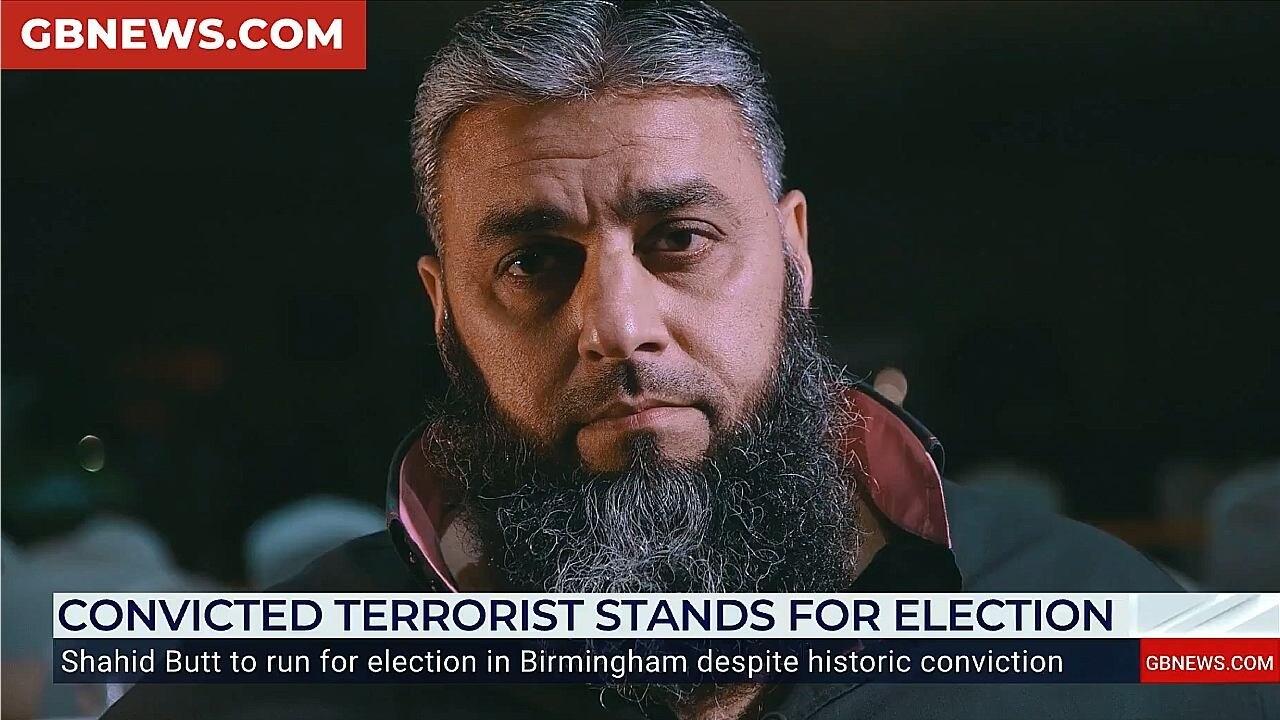
Shahid Butt, a 60-year-old Muslim activist with a conviction for conspiring to bomb the British consulate in Yemen, is now gunning for a seat on Birmingham City Council. 

Yes, really.

Convicted in 1999 and sentenced to five years in a Yemeni prison, Butt was found guilty of forming an armed gang to target the consulate, an Anglican church, and a Swiss-owned hotel.

Butt claims the charges were bogus, insisting he was forced to confess and that they weren’t terrorism-related. Yet reports link him to an armed Islamist jihadi group that kidnapped 16 Westerners in 1998. In the early 1990s, he headed to Bosnia as an “aid worker” before joining a foreign fighters brigade in the Bosnian army. Back in Birmingham during the 1980s, he racked up trouble with a notorious gang and even served prison time for violence.

Now, as a pro-Gaza independent candidate in the Sparkhill ward—where around 80% of residents are Muslim—Butt is openly urging the city’s Muslim youth to “work out at the gym and learn to fight” in preparation for potential attacks. He calls for Muslims to “stand together and hold their ground” against “disbelievers” of other faiths.

Victims of Islamist attacks aren’t buying the redemption story. Groups representing terror survivors slammed the candidacy as making “a mockery of our political system,” according to The Telegraph

One source told the paper: “Allowing someone with this history to run for office undermines everything we stand for in fighting extremism.”

GB News host Patrick Christys tore into the development, asking: “Are you mental?!” in a blistering monologue. He highlighted Butt’s past, from the Yemen plots to his calls for Muslims to arm up against non-believers.

This isn’t an isolated case of the UK rolling out the red carpet for radicals. Just last month, Prime Minister Keir Starmer personally celebrated the release and return of British-Egyptian extremist Alaa Abd el-Fattah, who has a track record of praising Osama bin Laden, denying the Holocaust, and calling for violence against Jews and police. Starmer called it a “top priority” for his government.

Meanwhile, ordinary Brits face the full force of the law for far less. Take Lucy Connolly, who served time for a heated tweet about immigration after the Southport attacks and now faces re-imprisonment for sharing a satirical joke about Starmer. 

The contrast couldn’t be starker: extremists with bomb plots and hate-filled rhetoric get platforms and welcomes, while native Brits get jail cells for memes and jokes. 

Birmingham’s council elections in May could mark another win for sectarian politics, fueled by unchecked migration and a government more interested in appeasing radicals than protecting its own citizens.

As communal tensions rise, with anti-Israel protests turning violent and Jewish groups raising alarms, allowing figures like Butt to run exposes the rot in Britain’s system.

Your support is crucial in helping us defeat mass censorship. Please consider donating via Locals or check out our unique merch. Follow us on X @ModernityNews.

Tyler Durden
Sun, 02/01/2026 – 08:10

via ZeroHedge News https://ift.tt/J5XPYcR Tyler Durden

UBS CIO Americas: AI Remains “Underhyped And Underappreciated”

UBS CIO Americas: AI Remains “Underhyped And Underappreciated”

Building on Goldman analyst Brian Singer’s comparison of the AI data-center buildout to the U.S. shale boom, where AI remains in the early “appraisal phase” of the innovation cycle, a stage historically most bullish for infrastructure spending and equity multiple expansion, fresh commentary earlier this week from UBS CIO Americas reinforces the view that bubble conditions have not yet been met.

Ulrike Hoffmann-Burchardi, CIO of Global Equities at UBS Global Wealth Management, spoke at the Latin America Investment Conference, where she said AI remains underhyped in the near term.

Ulrike continued:

AI is underhyped and underappreciated in the short term, and it is one of the biggest investing opportunities in human history, Ulrike Hoffman Burchardi, UBS CIO Americas, said at the Latin America Investment Conference.

She said there are three things needed to be successful in AI:

1) AI algorithmic talent – it is very important to have strong AI researchers;

2) energy to power computers; and

3) chips.

Previously, she was focused on the picks and shovels, or what she calls the AI 7 (three chip companies and four hyperscalers), but now it’s time to move into the application layer of AI – the companies using AI to their benefit.

She said that for AI to be in a bubble, three conditions would need to be met:

  1. loose financial conditions,

  2. a transformational narrative, and

  3. prices becoming reflexive.

She doesn’t think the third box is checked yet, especially not in public markets.

Ulrike noted that valuations are extended, but this is not the key thing to focus on.

On the other hand, she said private markets are bubblier, and that investors need to do a lot of due diligence there.

Circling back to Singer’s note on the shale innovation cycle, that cycle lasted from 2003 to 2020, roughly 17 years.

Read the note here.

Tyler Durden
Sun, 02/01/2026 – 07:35

via ZeroHedge News https://ift.tt/MbUE8Nm Tyler Durden

Brussels Versus Washington

Brussels Versus Washington

Authored by Cláudia Ascensão Nunes via the Foundation for Economic Education (FEE),

For years, Europe has tried to convince itself that it could regulate its way to technological greatness.

Instead of becoming a technological powerhouse, it produced rules, many rules, with effects now extending far beyond its own borders.

In 2026, those rules are colliding head on with an American president who refuses to accept that U.S. innovation could be governed from Brussels.

Two regulations sit at the center of this escalating tension. The Digital Markets Act, or DMA, applies to the world’s largest digital platforms, the so-called gatekeepers, and forces them to open their ecosystems, share data, and abandon business practices that are central to their models. 

The Digital Services Act, or DSA, regulates platform content and algorithms, requiring the removal of information deemed illegal or harmful, with all the subjectivity this entails.

This risks granting a supranational authority direct power over online speech by compelling platforms to remove content that fails to comply with regulatory guidelines.

These laws, which entered into force in 2022 for the DSA and 2024 for the DMA, appear designed with America’s largest technology firms in mind. Five of the six companies designated as DMA gatekeepers are U.S.-based, as are the overwhelming majority of platforms subject to the DSA.

This has placed companies such as Apple, Google, and Meta under constant supervision by Brussels, forcing them to modify products in order to operate in the European market, with consequences not only for firms themselves but also for consumers and innovation more broadly.

In 2025, under the DMA alone, Apple was fined 500 million euros and forced to open iOS to rival app stores and payment systems. Meta was fined 200 million euros and required to alter how it uses user data.

Under EU competition law, Google also received a historic 2.95 billion euro fine for alleged abuse of market dominance in the digital sector and was forced to redesign key aspects of its search engine and advertising business.

Upon taking office, Donald Trump identified this European interventionism as disguised tariffs that artificially raise costs for American firms and strip them of competitive advantages.

He threatened to invoke Section 301 of U.S. trade law, the same tool used against China, to retaliate, significantly intensifying tensions between Brussels and Washington.

In December 2025, that tension took on a face: X. The European Commission fined Elon Musk’s platform 120 million euros under the DSA, accusing it of failing to manage so-called systemic risks linked to the circulation of political information. For Musk, this amounted to an assault on free speech. The episode appears to have triggered a broader transatlantic diplomatic and commercial escalation. Washington responded by imposing visa bans on five European officials and experts associated with the DSA and threatened tariffs and restrictions against European firms such as SAP, Capgemini, and Mistral AI should Brussels fail to retreat.

The conflict has now spread beyond the European Union. The United Kingdom and Australia have begun discussing restrictions on X, citing risks related to misinformation and online safety, reinforcing the perception that Brussels is asserting itself as a global digital regulator.

Despite pressure from the Trump administration, the European Union shows no signs of slowing down. In 2026, another regulation enters fully into force, the AI Act, which appears once again tailored to American firms. It subjects artificial intelligence systems deemed high-risk, including AI used in hiring, credit, healthcare, public security, content moderation, and high impact generative tools, to mandatory risk assessments, human oversight, and constraints that exist in no other major market. These requirements will delay product launches, raise costs, and force companies to design technologies according to political criteria defined outside the United States.

As a result, 2026 is shaping up to be a particularly challenging year. From a geopolitical perspective, the most immediate risk is the erosion of the transatlantic relationship in a strategic sector. Technology today is an instrument of power, and this escalation among allies is likely to generate incompatible regulatory blocs, fragmenting the digital economy, weakening the West, and opening space for alternative models, particularly China’s state-controlled approach.

Consumers stand to lose most from this conflict, along two pillars central to any classical liberal order: first, the free market, as rising compliance costs will inevitably translate into higher prices; second, online free expression, increasingly constrained by incentives for excessive moderation and the preventive removal of lawful but controversial content.

At a moment when the world is rapidly advancing in artificial intelligence, automation, and the technologies that will define the next decade, the European Union is moving in the opposite direction, deepening an interventionism that exceeds the role a state should play.

The European Union must lower barriers, simplify rules, promote competition, and allow innovation to flourish without permanent political oversight.

In today’s world, as always, market liberalization is not a threat to consumers. It is their strongest protection and the true engine of progress.


Tyler Durden
Sun, 02/01/2026 – 07:00

via ZeroHedge News https://ift.tt/Qc1T2AM Tyler Durden