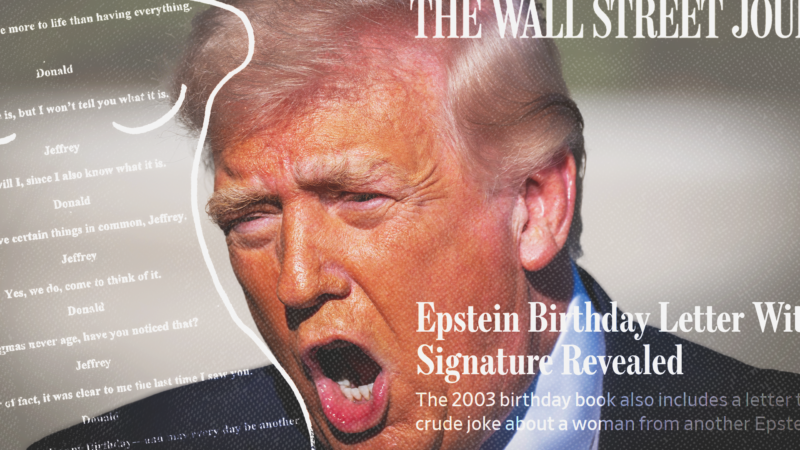
Last year, President Donald Trump sued The Wall Street Journal, claiming the newspaper had defamed him by reporting that he contributed to a 2003 album marking the 50th birthday of financier Jeffrey Epstein, who was later convicted of soliciting a minor for prostitution in Florida and committed suicide in 2019 while facing federal charges involving sex trafficking of minors. On Monday, a federal judge in Miami dismissed that lawsuit without prejudice, meaning Trump can try to correct the legal deficiencies in his initial complaint.
Given the facts of the case, it seems doubtful that Trump can meet that challenge. But even if he can, the sloppiness of his initial complaint is not surprising, since Trump has a long history of filing shaky lawsuits against people whose speech offends him. Although those lawsuits are framed as attempts to vindicate Trump’s legal rights, the main point is to punish his adversaries by forcing them to defend against his claims and thereby deter others from crossing him. As Trump sees it, the speech-chilling impact of such litigation is a feature, not a bug.
In the July 17 article at the center of this case, the Journal described a “bawdy” letter that the House Committee on Oversight and Government Reform subsequently obtained from Epstein’s estate via a subpoena. The letter features an imaginary dialogue between “Donald” and “Jeffrey” alluding to “certain things” they had in common. “A pal is a wonderful thing,” it concludes. “Happy Birthday—and may every day be another wonderful secret.” The letter, which is framed by a sketch of a nude woman’s torso, is signed by what the Journal described as “a squiggly ‘Donald’ below her waist, mimicking pubic hair.”
Given Trump’s well-established friendship with Epstein, it is plausible that he would have participated in the birthday album. But Trump insists the letter is “fake.”
In his ruling on Monday, U.S. District Judge Darrin Gayles said it was premature to address the dispute about the letter’s authenticity. But he said Trump failed to adequately allege that the Journal had acted with “actual malice,” the standard that the Supreme Court has said the First Amendment requires in defamation cases involving public figures. Under that standard, Trump must show that the Journal made an allegedly defamatory statement “with knowledge that it was false or with reckless disregard of whether it was false or not.”
Trump’s July 18 complaint asserts that the defendants—including Khadeeja Safdar and Joseph Palazzolo, the reporters who wrote the story; Dow Jones, which owns the Journal; News Corporation, which owns Dow Jones; News Corporation CEO Robert Thomson; and Rupert Murdoch, the company’s majority owner and emeritus chairman—”knew or should have known” that the statements in the article were false. The complaint adds that the Journal published the article “maliciously, with knowledge of the falsity of the statement, and/or with reckless disregard of their truth or falsity.” It avers that the defendants acted “with actual malice, oppression, and fraud in that they were aware of the falsity of the publication and, thus, made said publications in bad faith, out of disdain and ill-will directed towards Plaintiff without any regard for the truth.”
Since the complaint does not try to substantiate those bald assertions, it “falls short of pleading actual malice,” Gayles notes. “These ‘formulaic recitations of the “actual malice” element’ are insufficient to state a claim. President Trump also fails to allege how each Defendant acted with actual malice.”
Prior to publishing the article about the Epstein letter, Palazzolo emailed White House press secretary Karoline Leavitt for comment. “President Trump, through counsel, denied writing the Letter and warned Dow Jones not to publish the story,” Gayles notes. Trump claimed that denial was enough to show that the defendants had “serious doubts about the truth of their reporting” and therefore published the story with actual malice.
“The Court disagrees,” Gayles writes. “To establish actual malice, ‘a plaintiff must show the defendant deliberately avoided investigating the veracity of the statement in order to evade learning the truth.’ The Complaint comes nowhere close to this standard. Quite the opposite.”
Before running the story, the Journal “contacted President Trump, Justice Department officials, and the FBI for comment,” Gayles notes. “President Trump responded with his denial, the Justice Department did not respond at all, and the FBI declined to comment. In short, the Complaint and Article confirm that Defendants attempted to investigate. The Article also states that [the Journal] reviewed the Letter. Accordingly, President Trump’s conclusory allegation that Defendants had contradictory evidence and failed to investigate is rebutted by the Article and is insufficient to establish actual malice.”
The article itself noted Trump’s denial and quoted his response: “This is not me. This is a fake thing. It’s a fake Wall Street Journal story….I never wrote a picture in my life. I don’t draw pictures of women….It’s not my language. It’s not my words.” The fact that the Journal let readers decide for themselves whether the letter was authentic, Gayles notes, makes an allegation of actual malice “less plausible.”
Trump’s claim that the Journal published the article “out of disdain and ill-will” is doubly problematic, Gayle adds. “Aside from being conclusory and without factual support,” he says, “ill-will, improper motive or personal animosity plays no role in determining whether a defendant acted with actual malice.” Trump’s contrary assumption confuses the literal meaning of “actual malice” with the legal definition.
Gayles identifies another problem with Trump’s complaint. In addition to the statements that it describes as “defamatory per se,” which relate to the provenance of the birthday letter, the complaint describes statements regarding Trump’s chumminess with Epstein as “implicitly defamatory.” For the latter category of defamation, the plaintiff must “allege and prove special damages,” meaning “actual, out of pocket losses which must be proven by specific evidence as to the time, cause, and amount” of “a realized or liquidated loss.”
Trump’s complaint “is devoid of any allegations regarding special damages,” Gayles notes. Instead it generally alleges that the Journal article caused “overwhelming financial and reputational damages to President Trump, expected to be in the billions of dollars, due to the direct and implicit defamatory statements.” It later avers that the combination of compensatory and punitive damages should be “not less than $10 billion.” The complaint does not even try to explain how Trump arrived at that preposterous figure.
During the same interview in which Trump denied writing the birthday letter, he warned that the Journal would face a lawsuit if it published the story. “I’m gonna sue The Wall Street Journal just like I sued everyone else,” he said.
Trump was true to his word—not just in the sense that he followed through on his threat but also in the sense that the resulting complaint, like nearly all of his prior lawsuits against people who said things he did not like, fails to make even superficially plausible claims. Last September, for example, Trump filed what he described as “a $15 Billion Dollar Defamation and Libel Lawsuit” against The New York Times—“one of the worst and most degenerate newspapers in the History of our Country.”
Trump’s man beef was reporting that deflated his self-image as an astute businessman. But “rather than straightforwardly listing the facts of the case,” Reason‘s Joe Lancaster noted, the complaint included “dozens of pages histrionically detailing how great Trump is and how terrible The New York Times is. It reads less like a formal legal document than one of Trump’s social media posts, calling the Times a ‘full-throated mouthpiece of the Democrat Party’ engaging in ‘wrong and partisan criticism.'”
Like Trump’s lawsuit against the Journal, that complaint against the Times conflated the “actual malice” standard with the allegation that the defendants were driven by political or personal animus. “Defendants each desire for President Trump [to] fail politically and financially,” it averred. “Each feels actual malice towards President Trump in the colloquial sense….Put bluntly, Defendants baselessly hate President Trump in a deranged way.”
All of that was legally irrelevant for the same reason it does not matter whether the Journal published its article about the Epstein letter “out of disdain and ill-will.” And as in the Journal lawsuit, Trump asserted that “the reputational injury inflicted in this case reaches billions of dollars” without even attempting to back up that claim.
That 85-page complaint was so full of irrelevancies that a federal judge struck it four days after it was filed. “The complaint is decidedly improper and impermissible,” U.S. District Judge Steven Merryday ruled. “As every lawyer knows (or is presumed to know), a complaint is not a public forum for vituperation and invective—not a protected platform to rage against an adversary. A complaint is not a megaphone for public relations or a podium for a passionate oration at a political rally or the functional equivalent of the Hyde Park Speakers’ Corner.” Per Merryday’s instructions, Trump subsequently filed an amended complaint that was less than half as long, focusing on legal arguments rather than spleen venting.
While the initial complaint in that case may have broken new ground in blatantly using litigation to condemn political opponents, it was typical of the way that Trump deploys lawsuits: as a tool to punish his foes rather than a means of obtaining compensation for legally cognizable injuries. That has been Trump’s pattern for more than four decades, whether he was demanding $500 million from an architecture critic who said unkind things about one of his real estate projects, seeking $5 billion from a financial journalist who dared to question the extent of his wealth, suing a comedian for breach of contract based on a joke likening Trump to an orangutan, asserting that CNN defamed him by describing his reality-defying claims about the 2020 presidential election as “the Big Lie,” alleging that the Des Moines Register committed consumer fraud by publishing poll results he did not like, or averring that CBS caused him $20 billion in damages by editing a 60 Minutes interview with Kamala Harris to make her seem slightly more cogent.
Unsurprisingly, Trump has rarely prevailed in such lawsuits. And when defendants do agree to settlements, it is not necessarily because Trump had a winning legal argument. In 2024, for example, ABC paid $16 million to settle a defamation lawsuit based on its reporting about a civil verdict against Trump. While This Week host George Stephanopoulos indisputably conflated “sexual abuse” with “rape,” the significance of that inaccuracy, in terms of injury to Trump, was open to question. And last year, when Paramount paid the same amount to settle Trump’s lawsuit over the 60 Minutes interview with Harris, concerns about approval of the company’s pending merger with Skydance Media were a much more likely explanation than the merits of Trump’s laughable legal claims.
As Trump has made clear, the main goal of these lawsuits is not to prevail in court. After an appeals court rejected his absurd defamation lawsuit against journalist Tim O’Brien, Trump told The Washington Post “he knew he couldn’t win the suit but brought it anyway to make a point.” What was the point? “I spent a couple of bucks on legal fees, and they spent a whole lot more,” Trump said. “I did it to make his life miserable, which I’m happy about.”
In addition to all the complaints Trump has actually filed, his minions frequently send cease-and-desist letters to journalists and other objects of his ire. Given the punishment that a well-heeled plaintiff can inflict simply by forcing someone to defend against a meritless lawsuit, such threats cannot lightly be disregarded.
On its face, it is odd that Trump would brag about suing the Journal for defamation yet file a complaint that failed even to properly plead his claims. But that negligence presents less of a puzzle once you recognize that Trump is using the courts to pursue his personal vendettas rather than anything resembling justice.
The post A Federal Judge Dismisses Trump's Defamation Lawsuit Against <i>The Wall Street Journal</i> appeared first on Reason.com.
from Latest – Reason.com https://ift.tt/HxNcMpg
via IFTTT